Chemistry 9701/21 — May/June 2025
Cambridge AS Level · AS Level Structured Questions · worked solutions for every part, with the mark scheme
Topics Atoms, Molecules and Stoichiometry · Hydroxy Compounds · Electrochemistry · Equilibria · Carbonyl Compounds · Chemical Bonding · +8 more
Solid sodium conducts electricity. Sodium oxide conducts electricity when molten but not when solid.
Name the type of bonding present in sodium and in sodium oxide.
bonding in sodium .............................................................................................................
bonding in sodium oxide ...................................................................................................
Answer
- bonding in sodium: metallic
- bonding in sodium oxide: ionic
sodium: metallic; sodium oxide: ionic
Background Concept
Metals consist of positive ions in a lattice surrounded by a sea of delocalised electrons (metallic bonding). Metal oxides such as sodium oxide are ionic compounds, made of oppositely charged ions held in a giant lattice by electrostatic attraction (ionic bonding).
Understanding the Question
The stem tells you sodium conducts as a solid, while sodium oxide conducts only when molten — classic evidence for metallic vs ionic bonding. The command word 'name' needs just the bonding types.
Approach
Match each substance to its structure: metal → metallic; metal + non-metal oxide → ionic.
Step-by-Step Reasoning
Sodium is an element of Group 1, a metal, so its atoms lose their outer electrons to a shared delocalised sea — metallic bonding. Sodium oxide is formed between a metal (Na) and a non-metal (O), involving electron transfer and a giant ionic lattice — ionic bonding. The conductivity pattern given in the stem confirms this: metals conduct as solids (mobile electrons), ionic compounds conduct only when molten or dissolved (mobile ions).
Key Takeaways
Conductivity behaviour is a diagnostic: solid-state conduction suggests metallic bonding; conduction only when molten/dissolved suggests ionic bonding.
Common Mistakes
Writing 'covalent' for sodium oxide, or vague answers like 'electrostatic' without naming metallic/ionic.
Things to Be Careful About
Both names are required for the single mark — one blank loses the mark.
Answer
Solid sodium contains delocalised electrons which are free to move (carry charge) through the structure.
Delocalised electrons move through the structure, carrying charge.
Background Concept
In metallic bonding, outer electrons are delocalised over the whole lattice. These mobile charge carriers allow current to flow even though the ions themselves are fixed.
Understanding the Question
'Explain how' requires the mechanism: which particles move and why that constitutes conduction.
Approach
Identify the mobile charged species (delocalised electrons) and state they move through the solid.
Step-by-Step Reasoning
The sodium ions in the lattice are fixed, so they cannot carry current. The delocalised valence electrons, however, are not bound to any one atom and can drift through the lattice when a potential difference is applied — this movement of charge is the electric current.
Key Takeaways
Metallic conduction = mobile delocalised electrons; the ions stay fixed.
Common Mistakes
Saying 'electrons move' without stating they are delocalised, or saying ions move (that would be ionic conduction).
Things to Be Careful About
The mark is for the movement of delocalised electrons — include the word 'delocalised'.
Answer
When molten, the sodium ions () and oxide ions () are free to move through the liquid, carrying charge.
The ions (Na+ and O2−) are free to move through the liquid when molten.
Background Concept
In a solid ionic lattice, ions are held in fixed positions and cannot carry current. Melting overcomes the electrostatic attractions, freeing the ions to migrate.
Understanding the Question
'Explain why sodium oxide conducts when molten' — name the mobile charge carriers in the molten state.
Approach
State that melting frees the ions; the moving ions carry the charge.
Step-by-Step Reasoning
Solid Na2O has a fixed lattice of Na+ and O2− ions. On melting, the lattice collapses and the ions become mobile. Under a potential difference, Na+ ions move towards the cathode and O2− ions towards the anode; this movement of charged ions is the current.
Key Takeaways
Ionic conduction requires mobile ions — molten or aqueous, never solid.
Common Mistakes
Attributing conduction to electrons in sodium oxide, or saying 'particles move' without specifying ions.
Things to Be Careful About
Say 'ions move' — electrons are not the charge carriers in ionic compounds.
Separate samples of sodium and sodium oxide are each added to an excess of cold water.
Answer
2Na + 2H2O -> 2NaOH + H2
Background Concept
Group 1 metals react vigorously with cold water to form the hydroxide and hydrogen gas.
Understanding the Question
'Write an equation' — a balanced symbol equation with state symbols for Na in cold water.
Approach
Products are NaOH and H2; balance and add state symbols.
Step-by-Step Reasoning
Na + H2O → NaOH + H2. Balance H: two waters give two NaOH and one H2, requiring 2 Na. State symbols: Na(s), H2O(l), NaOH(aq) since it dissolves, H2(g).
Key Takeaways
Alkali metal + water → hydroxide + hydrogen.
Common Mistakes
Forgetting to balance (Na + H2O → NaOH + H2 is wrong), or writing Na2O as a product.
Things to Be Careful About
Answer
Na2O + H2O -> 2NaOH
Background Concept
Basic metal oxides react with water to form alkaline hydroxides. Sodium oxide is a basic oxide.
Understanding the Question
Write the equation for Na2O with cold water — product is sodium hydroxide, no gas.
Approach
Combine the oxide with water to give the hydroxide; balance.
Step-by-Step Reasoning
Na2O + H2O → NaOH; two Na on the left requires 2 NaOH, which also balances O and H. NaOH is aqueous as it dissolves; no gas is evolved.
Key Takeaways
Metal oxide + water → metal hydroxide (for soluble oxides of Group 1 and 2).
Common Mistakes
Omitting the 2 before NaOH, or adding H2 as a product by confusing with the sodium reaction.
Things to Be Careful About
No hydrogen gas is formed here — only the metal itself gives H2.
Complete Table 1.1.
Do not refer to temperature changes when considering observations for these reactions.
Table 1.1
| sodium | sodium oxide | |
|---|---|---|
| one similarity in observation on addition to cold water | ||
| one difference in observation on addition to cold water |
Answer
| sodium | sodium oxide | |
|---|---|---|
| similarity | both solids disappear, giving colourless solutions | |
| difference | effervescence (hydrogen gas bubbles) | no effervescence |
Similarity: both dissolve/disappear giving colourless solution; difference: sodium effervesces, sodium oxide does not.
Background Concept
Sodium reacts vigorously with water producing hydrogen gas (effervescence); sodium oxide simply dissolves/reacts to form sodium hydroxide solution with no gas. Both leave NaOH in solution.
Understanding the Question
Complete the comparison table with one observation common to both and one that differs. The instruction not to mention temperature change rules out 'heat released' as an answer.
Approach
Think about what you would see: disappearance of solid, colour of solution, bubbling.
Step-by-Step Reasoning
Similarity: both solids disappear (sodium reacts away, Na2O dissolves/reacts) and both give a colourless solution of NaOH. Difference: sodium produces hydrogen gas, seen as effervescence; sodium oxide produces no gas, so no effervescence.
Key Takeaways
Both give alkaline NaOH solution, but only the metal gives a gas.
Common Mistakes
Citing temperature rise (explicitly excluded by the question), or describing sodium hydroxide solution as not colourless.
Things to Be Careful About
Do not refer to temperature changes — the question forbids it.
State the oxidation number of the Period 3 elements bonded to in and .
Explain the difference in the oxidation number.
Answer
- Oxidation number of Na in NaCl: ; oxidation number of P in : .
- The difference arises because Na has only one valence (outer-shell) electron, so it can lose only one electron to chlorine, while P has five valence electrons and can share all five with chlorine atoms (expanding to five covalent bonds).
Na: +1; P: +5; Na has 1 valence electron, P has 5.
Background Concept
Oxidation number reflects the number of electrons an atom loses or shares. Chlorine is more electronegative than both Na and P, so in each chloride the bonding electrons are assigned to Cl, giving Cl an oxidation number of −1. The Period 3 element's oxidation number then equals the number of electrons it has lost or is sharing.
Understanding the Question
Two tasks: state the oxidation numbers, and explain why they differ — the explanation must be in terms of the number of valence electrons.
Approach
Apply the rule that Cl is −1 in these chlorides, so the element's oxidation number balances the chlorines. Then explain via valence electron count.
Step-by-Step Reasoning
In NaCl, one Cl is −1, so Na is +1: sodium, in Group 1, has a single 3s valence electron and loses it to form Na+. In PCl5, five Cl atoms at −1 each total −5, so P is +5: phosphorus has five valence electrons (3s2 3p3) and forms five covalent bonds, sharing all five with the more electronegative chlorine atoms. The maximum oxidation number an element shows in its chlorides equals its group number / number of valence electrons.
Key Takeaways
Oxidation number in a chloride = number of valence electrons involved in bonding; Cl is −1 in chlorides.
Common Mistakes
Giving P as +3 (confusing with PCl3), or explaining the difference in terms of reactivity rather than valence electron count.
Things to Be Careful About
Both oxidation numbers AND the valence-electron explanation are needed for the two marks — the explanation must reference the number of outer-shell electrons.
Table 1.2 shows melting points of some oxides.
Table 1.2
| oxide | melting point/ °C |
|---|---|
| –73 | |
| 0 | |
| 17 | |
| 1610 | |
| 2852 | |
| 2072 |
A student suggests the following hypothesis.
The higher the oxidation number of the element combined with oxygen, the higher the melting point of the oxide.
Use Table 1.2 to deduce if this hypothesis is true or false or if there is not enough information to make a conclusion. Explain your answer.
Answer
The hypothesis is false.
Comparing oxides of the same element: sulfur has oxidation number +4 in (m.p. −73 °C) and +6 in (m.p. +17 °C) — here the higher oxidation number does give the higher melting point. However, comparing across elements, Si has oxidation number +4 in (m.p. 1610 °C) while S has only +4 in (m.p. −73 °C) and S in has +6 (m.p. 17 °C) — the same or higher oxidation number gives a far lower melting point. Since (+6) has a much lower melting point than (+4), a higher oxidation number does not consistently give a higher melting point, so the hypothesis is false.
False — e.g. SO3 (oxidation number +6) has a much lower melting point (17 °C) than SiO2 (+4, 1610 °C).
Background Concept
Melting point depends on structure and bonding (giant ionic/covalent vs simple molecular), not directly on oxidation number. SiO2 is giant covalent (very high m.p.), MgO and Al2O3 are ionic lattices (high m.p.), while SO2, SO3 and H2O are simple molecular with weak intermolecular forces (low m.p.).
Understanding the Question
The hypothesis links oxidation number to melting point. You must use the table to decide: true, false, or insufficient data — and justify with comparisons.
Approach
Assign oxidation numbers to each element in its oxide, then look for pairs that contradict the hypothesis. A single counter-example makes it false.
Step-by-Step Reasoning
Oxidation numbers: S is +4 in SO2 and +6 in SO3; Si is +4 in SiO2; Mg is +2 in MgO; Al is +3 in Al2O3. Within sulfur, SO3 (+6, 17 °C) > SO2 (+4, −73 °C), which superficially supports the hypothesis. But SO3 (+6) melts at 17 °C while SiO2 (+4) melts at 1610 °C and MgO (+2) at 2852 °C — higher oxidation numbers with far lower melting points. These counter-examples disprove the hypothesis, so it is false. The real determinant is structure/bonding: giant structures melt high, simple molecular oxides melt low.
Key Takeaways
Melting point reflects structure and bonding type, not oxidation number. When testing a hypothesis against data, look specifically for counter-examples.
Common Mistakes
Concluding 'true' from the SO2/SO3 pair alone; concluding 'not enough information' without attempting comparisons; comparing oxides of different elements without assigning oxidation numbers.
Things to Be Careful About
All three elements are needed for the two marks: the verdict (false), a comparison/statement of oxidation numbers, and the correct link to melting points. The comparison must pair oxides whose oxidation numbers and melting points contradict the trend.
A sample of iron is analysed using a mass spectrometer. The mass spectrum shows three isotopes of iron are present in the sample.
Answer
Atoms of the same element with the same number of protons but different number of neutrons.
Atoms of the same element with the same number of protons but different number of neutrons.
Background Concept
Isotopes are variants of a particular chemical element which differ in neutron number, and consequently in nucleon number. All isotopes of a given element have the same number of protons but a different number of neutrons in each atom.
Understanding the Question
The question asks for a definition of isotopes. This is a foundational concept in atomic structure, requiring the candidate to state the defining characteristics of isotopes clearly and concisely.
Approach
Recall the standard IUPAC definition of isotopes. The key elements to include are: same element (implying same number of protons/atomic number) and different number of neutrons (implying different mass number).
Step-by-Step Reasoning
- State that isotopes are atoms of the same element.
- Specify that they have the same number of protons (which defines the element).
- Specify that they have a different number of neutrons (which gives them different mass numbers).
Key Takeaways
Isotopes share chemical properties (due to identical electron configurations) but may have different physical properties (like mass) due to differing neutron numbers.
Common Mistakes
- Stating isotopes have different numbers of electrons (this describes ions, not isotopes).
- Forgetting to specify 'same element' or 'same number of protons'.
- Saying 'different mass' without explaining why (different neutrons).
Things to Be Careful About
Ensure the definition explicitly mentions both the constant (protons/atomic number) and the variable (neutrons/mass number). Simply saying 'same element, different mass' is often not accepted as a complete definition without explaining the subatomic particle difference.
Fig. 2.1 shows the mass spectrum of the sample of iron.
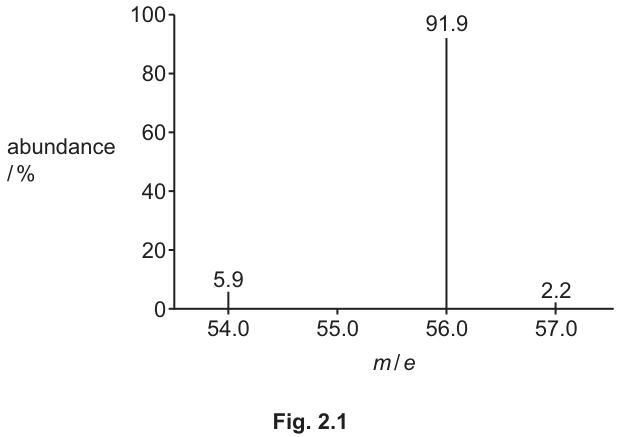
Use Fig. 2.1 to calculate the relative atomic mass, , of iron to one decimal place.
Show your working.
Working
Answer
55.9
55.9
Background Concept
The relative atomic mass () of an element is the weighted average mass of its atoms compared to 1/12th the mass of a carbon-12 atom. When a sample contains multiple isotopes, the is calculated by multiplying the mass of each isotope by its relative abundance (as a fraction or percentage), summing these products, and dividing by the total abundance (usually 100% if percentages are used).
Understanding the Question
The question provides a mass spectrum (Fig. 2.1) showing three isotopes of iron with their m/e values (which correspond to their mass numbers for singly charged ions) and their percentage abundances. The task is to calculate the relative atomic mass to one decimal place.
Approach
Use the formula for relative atomic mass:
Substitute the values from the spectrum and compute the result.
Step-by-Step Reasoning
- Identify the isotopes and their data from Fig. 2.1:
- : mass = 54, abundance = 5.9%
- : mass = 56, abundance = 91.9%
- : mass = 57, abundance = 2.2%
- Set up the calculation:
- Calculate the numerator:
- Sum =
- Divide by 100:
- Round to one decimal place as required: 55.9.
Key Takeaways
Always ensure abundances are converted to fractions (divide by 100) or the sum is divided by 100 at the end. The m/e value for a singly charged ion () in a mass spectrometer is numerically equal to the mass number of the isotope.
Common Mistakes
- Forgetting to divide the sum by 100 (using percentages directly as if they were fractions).
- Using the wrong mass values (e.g., using exact isotopic masses instead of mass numbers, though for this level, mass numbers from the m/e axis are expected).
- Rounding errors during intermediate steps.
Things to Be Careful About
Check the significant figures and decimal places required. Here, one decimal place is specified. The sum of percentages is , confirming the data is complete.
Complete Table 2.1 to show the number of protons and nucleons in one atom of .
Table 2.1
| particle | number of particles in one atom of |
|---|---|
| protons | |
| nucleons |
Answer
| particle | number of particles in one atom of |
|---|---|
| protons | 26 |
| nucleons | 56 |
protons: 26, nucleons: 56
Background Concept
The nuclide symbol provides key information about an atom:
- (atomic number or proton number) = number of protons.
- (mass number or nucleon number) = number of protons + number of neutrons.
- For a neutral atom, number of electrons = number of protons.
Iron (Fe) has an atomic number of 26, meaning it always has 26 protons.
Understanding the Question
The question asks for the number of protons and nucleons in one atom of . The superscript 56 is the mass number (nucleon number).
Approach
Identify the atomic number of iron (from periodic table or prior knowledge) for protons. The mass number is given directly in the symbol for nucleons.
Step-by-Step Reasoning
- Iron (Fe) is element 26, so it has 26 protons. This is constant for all iron isotopes.
- The symbol indicates a mass number () of 56. Nucleons are protons + neutrons, so the number of nucleons is 56.
- Fill in the table: protons = 26, nucleons = 56.
Key Takeaways
The number of protons defines the element and does not change between isotopes. The mass number (nucleons) changes due to different neutron numbers.
Common Mistakes
- Confusing nucleons with neutrons. Nucleons = protons + neutrons. If asked for neutrons in , it would be .
- Looking up the wrong atomic number for iron.
Things to Be Careful About
Ensure the correct terminology: 'protons' (subatomic particle) vs 'nucleons' (collective term for protons and neutrons in the nucleus).
Deduce the number of pairs of electrons in the shell with principal quantum number in an Fe atom.
Answer
7
Working
Electron configuration of Fe ():
Shell contains:
Total electrons in shell =
Number of pairs =
7
Background Concept
The principal quantum number designates the electron shell. For a given , the subshells are (), (), (), etc. The shell can hold up to 18 electrons (one , three , five orbitals).
Understanding the Question
The question asks for the number of pairs of electrons in the shell with principal quantum number in a neutral iron atom (Fe, ).
Approach
- Write the full electron configuration of Fe.
- Identify all subshells with (, , ).
- Sum the electrons in these subshells.
- Divide by 2 to get the number of pairs.
Step-by-Step Reasoning
- Iron has 26 electrons. Following the Aufbau principle:
(or ) - The shell with includes the , , and subshells.
- Electrons in : (2 electrons) + (6 electrons) + (6 electrons) = 14 electrons.
- Each pair consists of 2 electrons. Number of pairs = .
Key Takeaways
When counting electrons in a shell, include all subshells with that principal quantum number, even if they are filled after a higher shell (like filling before ).
Common Mistakes
- Forgetting to include the electrons when counting electrons in the shell. Many students stop at and miss the electrons.
- Counting individual electrons instead of pairs.
- Using the wrong electron configuration for transition metals (remember fills before , but when writing configuration by shell, belongs to ).
Things to Be Careful About
The question asks for pairs of electrons, not total electrons. Double-check the final division by 2.
Answer
Fe(g) -> Fe+(g) + e-
Background Concept
The first ionisation energy is the enthalpy change when one mole of gaseous atoms is converted to one mole of gaseous 1+ ions. The equation must show the removal of one electron from a neutral gaseous atom.
Understanding the Question
Write the equation representing the first ionisation energy of iron. This requires correct chemical species, charges, and state symbols.
Approach
Write the reactant as gaseous iron atoms and the products as gaseous iron(1+) ions and an electron. Include state symbols.
Step-by-Step Reasoning
- Reactant: — gaseous iron atoms.
- Products: — gaseous iron ions with +1 charge, and — an electron.
- Equation:
Key Takeaways
State symbols are crucial in ionisation energy equations. The reactant and product ions must be gaseous (g). The electron does not need a state symbol.
Common Mistakes
- Forgetting state symbols, especially (g) for Fe and Fe+.
- Writing or instead of .
- Including or other incorrect electron forms.
Things to Be Careful About
Ensure the equation is balanced in terms of mass and charge. Left side charge = 0, right side charge = (+1) + (-1) = 0. State symbols are mandatory for full marks.
Suggest how the value for the first ionisation energy of compares to the first ionisation energy of . Explain your answer in terms of the factors that affect ionisation energy.
Answer
The first ionisation energy of is the same as that of .
Explanation:
- Both isotopes have the same number of protons (same nuclear charge).
- Both have the same electronic configuration (same shielding).
- Therefore, the nuclear attraction to the outermost electron is the same.
- Consequently, the energy required to remove the outermost electron is unaffected.
Same
Background Concept
Ionisation energy depends on three main factors:
- Nuclear charge (number of protons): Greater nuclear charge increases attraction to electrons, increasing IE.
- Shielding (inner electrons): Inner electrons shield outer electrons from the full nuclear charge, decreasing IE.
- Distance from the nucleus: Outer electrons further from the nucleus experience less attraction, decreasing IE.
Isotopes of an element have the same number of protons and electrons but different numbers of neutrons. Neutrons do not affect electrostatic attraction significantly.
Understanding the Question
Compare the first ionisation energy of and and explain using factors affecting ionisation energy.
Approach
- State whether they are the same or different.
- Explain using the factors: nuclear charge, shielding/electronic configuration, and resulting attraction.
Step-by-Step Reasoning
- Comparison: The values are the same. Isotopes have identical chemical properties and ionisation energies.
- Nuclear charge: Both and have 26 protons. Therefore, the nuclear charge is identical.
- Electronic configuration / Shielding: Both have 26 electrons arranged identically (). The number of inner (shielding) electrons is the same.
- Attraction: Since nuclear charge and shielding are the same, the effective nuclear charge felt by the outermost electron is the same. The slight mass difference does not significantly affect electron-nucleus distance or attraction.
- Conclusion: The energy required to remove the outermost electron (first IE) is the same for both isotopes.
Key Takeaways
Isotopes have the same ionisation energy because ionisation energy depends on electrostatic forces, which are determined by protons and electrons, not neutrons.
Common Mistakes
- Saying the IE is different because of different mass or different number of neutrons.
- Failing to mention 'same nuclear charge' or 'same number of protons'.
- Not linking the factors back to 'nuclear attraction' or 'energy required'.
- Saying 'same mass' affects it (mass has negligible effect on electronic structure).
Things to Be Careful About
The mark scheme specifically looks for: same electronic configuration/same shielding, same number of protons/same nuclear charge, same nuclear attraction, and no change. Ensure all these logical steps are covered in the explanation.
Hexene reacts with hydrogen gas to produce hexane.
Fig. 3.1 shows the distribution of energies of molecules at temperature .
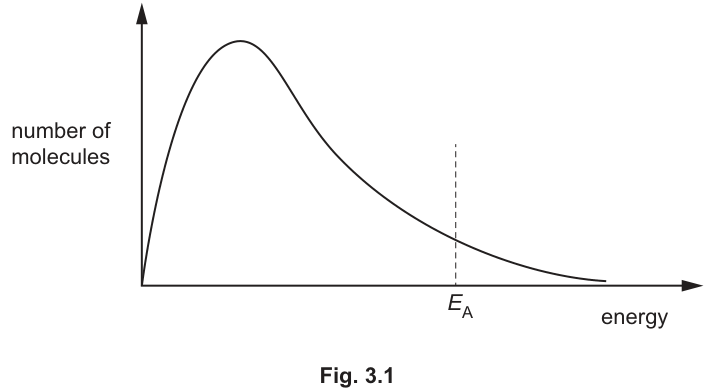
Sketch on Fig. 3.1 the shape of the curve for the same sample of molecules when the temperature is increased.
Answer
The new curve (dashed) should:
- Start at the origin.
- Have a lower peak than the original curve.
- Have the peak shifted to the right (higher energy).
- Cross the original curve once, to the right of the original peak.
See sketch description above
Background Concept
A Maxwell-Boltzmann distribution curve shows the distribution of molecular energies in a gas at a specific temperature. The area under the curve represents the total number of molecules (which is constant if the amount of gas doesn't change). The peak of the curve represents the most probable energy. The curve starts at the origin (no molecules have zero energy in a continuous distribution, though practically it starts very low) and has a long tail to the right.
Understanding the Question
The question asks to sketch the curve for the same sample of at a higher temperature. We are given the original curve at temperature with activation energy marked.
Approach
When temperature increases, the average kinetic energy of the molecules increases. This means:
- The total area under the curve must remain the same (same number of molecules).
- To keep the area constant while shifting to higher energies (right), the peak must lower.
- The curve must spread out, so it extends further to the right.
- The curve must start at the origin (energy = 0, number of molecules = 0).
- Because the new curve is lower at low energies but higher at high energies, it must cross the original curve at some point.
Step-by-Step Reasoning
- Start at origin: At 0 energy, there are effectively 0 molecules. Both curves start here.
- Peak lower: Since the average energy increases, the distribution spreads out. To maintain the same area (total number of molecules), the height of the peak must decrease.
- Peak to the right: The most probable energy (peak) increases with temperature. So the new peak is to the right of the old peak.
- Crossing: At low energies, the higher temperature curve is lower (fewer molecules have low energy). At high energies (the tail), the higher temperature curve is higher (more molecules have high energy). Therefore, they must cross once. The crossing point is to the right of the original peak.
Key Takeaways
For a Maxwell-Boltzmann curve at a higher temperature: lower peak, shifted right, starts at origin, crosses original curve once to the right of the original peak, longer tail.
Common Mistakes
- Drawing the peak higher (wrong, area must be constant).
- Shifting the peak left (wrong, average energy increases).
- Not starting at the origin.
- Drawing the new curve entirely above the old one (violates conservation of molecules/area).
Things to Be Careful About
- The curve must cross the original curve. If it doesn't, it implies more molecules total or a different distribution shape.
- The crossing point must be to the right of the original peak.
Answer
- Greater proportion of molecules have energy greater than or equal to the activation energy ().
- This leads to an increase in the frequency of successful collisions between and .
See answer above
Background Concept
The rate of reaction depends on the frequency of successful collisions. For a collision to be successful, the colliding particles must have energy equal to or greater than the activation energy (). The Maxwell-Boltzmann distribution shows how many molecules have a given energy.
Understanding the Question
Explain why increasing temperature increases the rate of reaction 1 (hydrogenation of hexene). This is a standard kinetics explanation linking temperature to rate.
Approach
- Look at the distribution curve at higher temperature (from part i). The area to the right of is larger.
- This means more molecules have enough energy to react.
- More energetic molecules collide more frequently and successfully.
Step-by-Step Reasoning
- Mark 1 (M1): At a higher temperature, the curve shifts right and flattens. The area under the curve to the right of (the shaded region representing molecules with ) is larger. So, a greater proportion (or percentage) of molecules have energy . Note: It's not just 'more molecules', it's a 'greater proportion' because the total number of molecules is constant.
- Mark 2 (M2): Because more molecules have the required activation energy, a higher fraction of collisions are successful. This increases the frequency of successful collisions (between and hexene), thus increasing the rate.
Key Takeaways
Rate increases with temperature because a greater proportion of molecules have energy , leading to more frequent successful collisions. It is NOT because molecules move faster (though they do, the primary reason for the exponential rate increase is the energy distribution change).
Common Mistakes
- Saying 'molecules move faster' (this is true but doesn't fully explain the rate increase in terms of activation energy; the mark scheme specifically looks for the proportion with energy ).
- Saying 'more molecules have energy ' without mentioning 'proportion' or 'fraction' (technically the number increases if volume changes, but usually we assume constant amount, so proportion is the key word. However, 'greater proportion' is the standard mark scheme wording).
- Forgetting to mention 'successful' collisions.
Things to Be Careful About
- Must mention activation energy or .
- Must mention 'proportion' or 'fraction' or 'percentage'.
Answer
Catalyst.
Catalyst
Background Concept
Nickel is a common catalyst for the hydrogenation of alkenes (adding across the double bond). It provides an alternative reaction pathway with a lower activation energy.
Understanding the Question
State the role of nickel in reaction 1 (hexene + hydrogen -> hexane).
Approach
Recall that transition metals like Ni, Pd, Pt are used as catalysts for hydrogenation.
Step-by-Step Reasoning
Nickel speeds up the reaction without being consumed. It is a catalyst.
Key Takeaways
Nickel acts as a catalyst in hydrogenation reactions.
Common Mistakes
- Calling it a 'reagent' or 'reactant'.
- Saying 'it increases the rate' (that's what a catalyst does, but the question asks for the 'role' or 'name', usually 'catalyst' is the expected answer. 'Catalyst' is the specific term).
Things to Be Careful About
- Just write 'catalyst'.
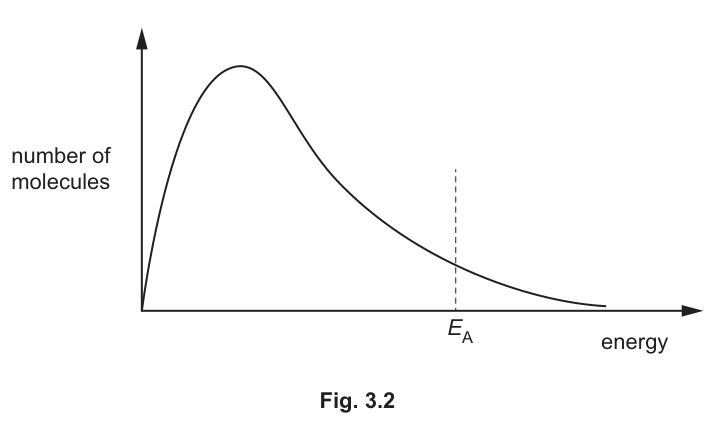
Answer
Draw a vertical dashed line to the left of the original line. Label it (e.g., or 'new ' or 'catalyst ').
See annotation description above
Background Concept
A catalyst provides an alternative reaction pathway with a lower activation energy. On a Maxwell-Boltzmann distribution graph (number of molecules vs energy), the activation energy is a vertical line on the x-axis. Lowering means moving this line to the left (lower energy value).
Understanding the Question
Annotate Fig 3.2 (which is the same as Fig 3.1) to show the effect of adding nickel (a catalyst) at temperature . The temperature doesn't change, so the distribution curve stays the same. Only changes.
Approach
- Catalyst lowers .
- Draw a new vertical line at a lower energy value (to the left).
- Label it.
Step-by-Step Reasoning
- The curve itself does not change because temperature is constant.
- The activation energy is reduced by the catalyst (nickel).
- Draw a new vertical dashed line to the left of the original .
- Label it clearly, e.g., or just indicate it's the new activation energy.
Key Takeaways
Catalyst -> lower -> vertical line moves left on energy axis. Curve stays same.
Common Mistakes
- Moving the curve (that's for temperature).
- Moving the line to the right (that would be higher ).
- Not labeling the new line.
Things to Be Careful About
- The annotation must show is further to the left (lower energy).
Answer
If a change is made to a system at dynamic equilibrium, the position of the equilibrium moves to minimise the change in conditions.
See answer above
Background Concept
Le Chatelier's principle predicts how a system at equilibrium responds to a disturbance (change in concentration, temperature, or pressure).
Understanding the Question
Define Le Chatelier's principle. (2 marks)
Approach
Recall the standard definition. Key components: 'dynamic equilibrium', 'change is made', 'equilibrium moves', 'minimise the change'.
Step-by-Step Reasoning
- M1: Mention that the system is at dynamic equilibrium and a change is made. The equilibrium moves (shifts).
- M2: The direction of the shift is to minimise (or counteract) the change in conditions.
Key Takeaways
Definition must include 'dynamic equilibrium' and 'minimise the change'.
Common Mistakes
- Forgetting 'dynamic'. Just saying 'equilibrium moves'.
- Saying 'oppose the change' (mark scheme usually accepts 'minimise', 'oppose' is often accepted but 'minimise' is safer. Actually, mark scheme says 'minimise'. 'Oppose' is technically slightly different but often accepted in CIE. Stick to 'minimise').
- Not mentioning that the equilibrium moves.
Things to Be Careful About
- Exact wording matters for definitions. 'Minimise the change in conditions' is the standard phrase.
Reaction 2 shows the equilibrium reaction between X(g) and Y(g) to produce Z(g) in a sealed container.
Fig. 3.3 shows the effect of changing pressure on the percentage yield of Z(g) at two different temperatures, 300 K and 350 K.
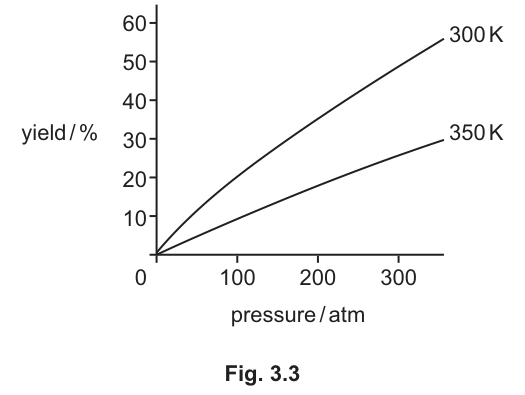
Deduce two conclusions about reaction 2 using Fig 3.3.
Answer
-
The forward reaction is exothermic.
(Reasoning: At a given pressure, the yield is lower at 350 K than at 300 K. Increasing temperature decreases yield, so equilibrium shifts left (reverse direction). Reverse is endothermic, so forward is exothermic.) -
.
(Reasoning: Increasing pressure increases the yield of Z. Equilibrium shifts to the side with fewer moles of gas to reduce pressure. Since yield of Z increases, the right side (products) has fewer moles. So moles of reactants > moles of products .)
Forward reaction is exothermic;
Background Concept
Le Chatelier's principle applies to equilibria:
- Temperature: Increasing temperature favors the endothermic direction. If forward is exothermic, increasing T shifts equilibrium left (reactants), decreasing yield of products.
- Pressure: Increasing pressure favors the side with fewer moles of gas. If reactants have more moles than products, increasing pressure shifts equilibrium right (products), increasing yield.
Understanding the Question
Reaction 2: . Graph shows yield of Z vs pressure at 300 K and 350 K. Deduce two conclusions.
Approach
Analyze the effect of temperature (compare the two curves) and the effect of pressure (slope of curves).
Step-by-Step Reasoning
- Conclusion 1 (Temperature effect): Look at the curves. At any fixed pressure (e.g., 200 atm), the yield at 300 K is higher than at 350 K. This means increasing temperature (from 300 to 350) decreases the yield of Z. According to Le Chatelier, increasing T shifts equilibrium in the endothermic direction. Since yield decreases, shift is to the left (reverse). So reverse is endothermic, meaning the forward reaction is exothermic.
- Conclusion 2 (Pressure effect): Look at the curves. As pressure increases (x-axis), yield of Z increases (y-axis). Increasing pressure shifts equilibrium to the side with fewer gas moles. Since yield of Z (product) increases, the equilibrium shifts to the right. Therefore, the product side has fewer moles than the reactant side. Reactants have moles, products have moles. So .
Key Takeaways
- Higher T -> lower yield => Exothermic forward reaction.
- Higher P -> higher yield => Fewer moles on product side.
Common Mistakes
- Getting the temperature effect backwards (saying endothermic).
- Getting the pressure effect backwards (saying ).
- Not stating the conclusion clearly (e.g., just writing 'exothermic' without context, though usually 'forward reaction is exothermic' is the mark).
Things to Be Careful About
- The graph has 'yield / %'. Higher up means more product.
- 300 K is the upper curve (higher yield). 350 K is the lower curve (lower yield).
The structure of vitamin C is shown in Fig. 4.1.
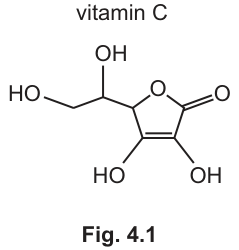
Answer
C3H4O3
Background Concept
An empirical formula represents the simplest whole-number ratio of atoms of each element in a compound. To find it from a structural formula, you first determine the molecular formula by counting all atoms, then divide by their greatest common divisor.
Understanding the Question
The question asks for the empirical formula of vitamin C based on its skeletal structure shown in Fig. 4.1. You must count the number of carbon, hydrogen, and oxygen atoms in the molecule.
Approach
- Count the total number of C, H, and O atoms in the molecular structure to get the molecular formula.
- Divide the subscripts by their highest common factor to obtain the simplest whole-number ratio.
Step-by-Step Reasoning
Looking at Fig. 4.1:
- Carbon atoms: There are 4 carbons in the five-membered ring (including the carbonyl carbon and the two alkene carbons, plus the ring junction carbon) and 2 carbons in the side chain (). Total C = 6.
- Oxygen atoms: There is 1 ring oxygen, 1 carbonyl oxygen (), and 4 hydroxyl oxygens (). Total O = 6.
- Hydrogen atoms: The side chain has 3 H, the has 2 H, the ring junction has 1 H, and the two ring groups have 2 H. Total H = 3 + 2 + 1 + 2 = 8.
Molecular formula: .
Dividing by 2 gives the empirical formula: .
Key Takeaways
Always count carefully from skeletal structures: vertices and ends of lines are carbons, and hydrogens attached to carbons are implied to satisfy four bonds.
Common Mistakes
- Forgetting to count hydrogens on carbons (they are not drawn in skeletal structures).
- Miscounting the ring atoms or the side chain.
Things to Be Careful About
Ensure you are giving the empirical formula (simplest ratio), not the molecular formula. The question specifically asks to "deduce the empirical formula".
The concentration of vitamin C is found by titration with .
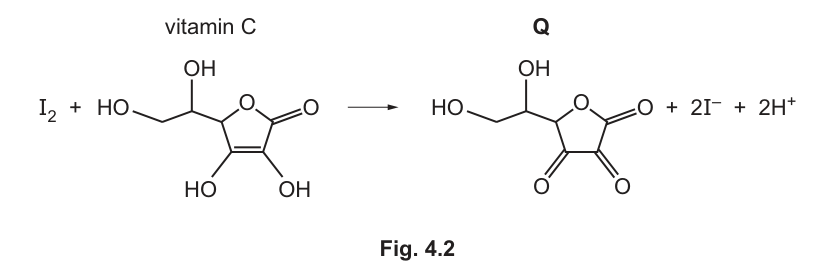
A vitamin C tablet is dissolved in water to produce of vitamin C solution.
of this vitamin C solution is added to a flask with approximately of water and an indicator.
Exactly of reacts with the sample of vitamin C solution in the flask.
[: vitamin C, 176]
Working
Answer
1.42e-5 mol
Background Concept
The amount of substance (in moles) can be calculated from the concentration (in mol dm) and the volume (in dm) using the equation: . Volumes given in cm must be divided by 1000 to convert to dm.
Understanding the Question
You are given the volume () and concentration () of the iodine solution used in a titration. You need to calculate the number of moles of that reacted.
Approach
- Convert the volume from cm to dm.
- Multiply the concentration by the volume in dm.
Step-by-Step Reasoning
Key Takeaways
Always check units. Concentration is per dm, so volume must be in dm.
Common Mistakes
- Forgetting to divide the volume by 1000.
- Incorrect use of scientific notation.
Use your answer to (b)(i) to calculate the mass, in g, of vitamin C in the tablet. Show your working.
(If you were unable to calculate a value for the amount of in (b)(i), use the value . This is not the correct value.)
Working
From Fig. 4.2, the reaction ratio is 1 mol vitamin C : 1 mol .
Amount of vitamin C in sample = amount of = .
Mass of vitamin C in sample:
The original solution volume is , which is times the sample volume.
Total mass of vitamin C in the tablet:
Answer
(or to 3 s.f.)
0.099968 g
Background Concept
In a titration, the moles of titrant used can be used to find the moles of analyte via the stoichiometric ratio from the balanced equation. If the analyte solution was diluted or if a sample was taken from a larger volume, a scaling factor must be applied to find the total amount in the original sample.
Understanding the Question
You have calculated the moles of in of the vitamin C solution. You need to find the total mass of vitamin C in the entire solution (which came from one tablet). The of vitamin C is 176.
Approach
- Use the 1:1 stoichiometry from Fig. 4.2 to find moles of vitamin C in the sample.
- Convert moles to mass using .
- Scale up the mass by the ratio of total volume to sample volume ().
Step-by-Step Reasoning
- Moles of vitamin C in = (from 1:1 ratio).
- Mass in = .
- Scaling factor = .
- Total mass = .
Alternatively, calculate total moles first: , then mass = .
Key Takeaways
Always track the volume scaling factor in titrations where a sample is taken from a larger prepared solution.
Common Mistakes
- Forgetting to multiply by the dilution factor ().
- Using the wrong or not using at all.
- Incorrect stoichiometric ratio (though here it is 1:1, students might assume 2:1 from the produced).
Things to Be Careful About
The mark scheme accepts . Ensure significant figures are reasonable (3 s.f. gives , which is also acceptable, but carrying extra digits is safer during calculation).
Answer
oxidising agent
oxidising agent
Background Concept
An oxidising agent is a substance that oxidises another substance by accepting electrons from it. In the process, the oxidising agent itself is reduced.
Understanding the Question
You are asked to deduce the role of in the reaction shown in Fig. 4.2.
Approach
Look at what happens to in the reaction. It goes from (oxidation state 0) to (oxidation state -1). Since it gains electrons (is reduced), it acts as an oxidising agent.
Step-by-Step Reasoning
In Fig. 4.2, is converted to . The oxidation state of iodine changes from 0 to -1. This is a reduction (gain of electrons). Therefore, is the oxidising agent.
Key Takeaways
If a reagent is reduced (gains electrons, oxidation number decreases), it is the oxidising agent.
Common Mistakes
- Confusing oxidising agent with reducing agent.
- Stating "it gains electrons" without naming the role correctly.
Suggest two reasons why hot concentrated acidified potassium manganate(VII) is not a suitable reagent for producing Q from vitamin C.
Answer
- It will also oxidise the alcohol (hydroxy) groups (primary and secondary) in vitamin C.
- It will break the carbon-carbon double bond (C=C) in the ring.
See answer
Background Concept
Potassium manganate(VII) () in hot concentrated acidified conditions is a very strong oxidising agent. It can oxidise:
- Primary alcohols to carboxylic acids.
- Secondary alcohols to ketones.
- Carbon-carbon double bonds (C=C), often cleaving them to form carbonyl compounds or carboxylic acids.
Iodine () is a milder oxidising agent that selectively oxidises the enediol group in vitamin C to a diketone without affecting other functional groups like isolated alcohols or breaking C=C bonds under these conditions.
Understanding the Question
You need to suggest two reasons why hot concentrated acidified is not suitable for producing compound Q from vitamin C. This means will cause unwanted side reactions.
Approach
Look at the functional groups in vitamin C (Fig. 4.1) that are not the target of the oxidation to Q. Identify which of these will react with a strong oxidising agent like .
Step-by-Step Reasoning
Vitamin C contains:
- Two secondary alcohol groups on the side chain ( and ).
- A carbon-carbon double bond (C=C) in the ring.
- The enediol group (which is the target).
is too strong and will:
- Oxidise the primary alcohol () to a carboxylic acid () and the secondary alcohol () to a ketone ().
- Oxidatively cleave the C=C double bond in the ring, breaking the ring structure.
Therefore, it does not give the desired product Q selectively.
Key Takeaways
Strong oxidising agents like are not selective and will react with multiple functional groups. Milder agents like are needed for selective oxidations.
Common Mistakes
- Only mentioning one reason (e.g., only alcohols or only C=C).
- Saying "it will oxidise vitamin C" (that's the point, the question asks why it's not suitable for producing Q specifically).
Things to Be Careful About
Ensure you mention both the alcohol groups and the C=C bond. The mark scheme specifically looks for these two points.
Predict two absorptions that will be seen in the infrared spectra of both vitamin C and Q. Describe the relevant bond and the specific functional group that is responsible for each absorption identified.
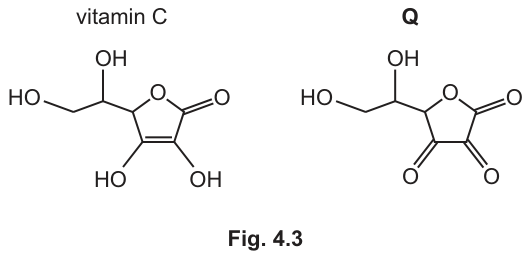
Table 4.1
| bond | functional groups containing the bond | characteristic infrared absorption range (in wavenumbers)/ |
|---|---|---|
| C−O | hydroxy, ester | 1040–1300 |
| C=C | aromatic compound, alkene | 1500–1680 |
| C=O | amide carbonyl, carboxyl ester | 1640–1690 1670–1740 1710–1750 |
| CN | nitrile | 2200–2250 |
| C−H | alkane | 2850–2950 |
| N−H | amine, amide | 3300–3500 |
| O−H | carboxyl hydroxy | 2500–3000 3200–3650 |
Answer
Any two of the following:
| wavenumber / | bond | functional group |
|---|---|---|
| 1040 – 1300 | C–O | ester / hydroxy |
| 3200 – 3650 | O–H | hydroxy / alcohols |
| 2850 – 2950 | C–H | alkane |
| 1710 – 1750 | C=O | ester |
See answer
Background Concept
Infrared (IR) spectroscopy measures the absorption of infrared radiation by molecules, causing bond vibrations. Different bonds absorb at characteristic wavenumbers (). The provided table lists absorption ranges for various bonds and their associated functional groups.
Understanding the Question
You need to predict two absorptions that will be seen in the IR spectra of both vitamin C and compound Q. This means you must identify bonds/functional groups that are present in both structures. Looking at Fig. 4.3:
- Vitamin C has: C=O (ester), C-O (ester, hydroxy), O-H (hydroxy), C-H (alkane), C=C (alkene).
- Compound Q has: C=O (ester, ketone/diketone), C-O (ester), C-H (alkane). It has lost the C=C and the two enediol O-H groups, but retains the side-chain O-H and the ester C=O and C-O.
Common bonds in both: C-O, O-H (from side chain), C-H, C=O (ester).
Approach
- Identify the functional groups present in both molecules.
- Match these to the bonds and wavenumber ranges in Table 4.1.
- Ensure the functional group name matches the bond type in the table.
Step-by-Step Reasoning
- C-O bond: Both have ester groups and vitamin C (and Q's side chain) has hydroxy groups. Range: 1040–1300 .
- O-H bond: Both have hydroxy (alcohol) groups on the side chain. Range: 3200–3650 .
- C-H bond: Both have alkane parts (side chain). Range: 2850–2950 .
- C=O bond: Both have ester groups. Range: 1710–1750 .
Note: C=C is only in vitamin C, not Q. The C=O from the new diketone in Q is in the carbonyl range (1670-1740), but the ester C=O is definitely in both (1710-1750).
Key Takeaways
When asked for absorptions common to two molecules, focus on functional groups that remain unchanged or are present in both. Always pair the bond, the functional group, and the wavenumber range correctly from the table.
Common Mistakes
- Including C=C (only in vitamin C).
- Giving the wavenumber range for C=O of a ketone/carboxyl (1640-1690 or 1670-1740) instead of the ester (1710-1750) if not careful, though the ester is definitely in both.
- Forgetting to specify the functional group or giving an incorrect match (e.g., C-O with carboxyl).
Things to Be Careful About
The question asks for "two complete rows". You must provide the wavenumber range, the bond, and the functional group. Any two valid rows from the table that apply to both molecules will score.
Compound A contains the elements carbon, hydrogen and oxygen only.
When A is heated with , compounds B and C are produced, as shown in Fig. 5.1.
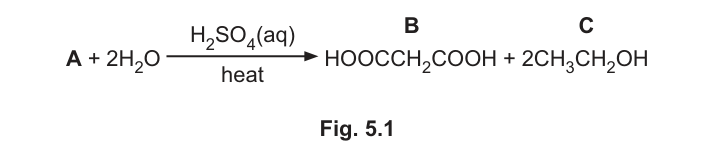
Answer
The structure is diethyl propanedioate (diethyl malonate).
Diethyl propanedioate structure (see diagram)
Background Concept
Esters are derivatives of carboxylic acids where the acidic hydrogen is replaced by an alkyl group. They have the general formula RCOOR'. Esters can be hydrolysed back to the parent carboxylic acid and alcohol. Acid-catalysed hydrolysis is the reverse of esterification:
If a compound produces a dicarboxylic acid and two molecules of an alcohol upon hydrolysis with water, it must be a diester (an ester formed from a dicarboxylic acid and a monoalcohol, or a dicarboxylic acid and a diol, but here the stoichiometry 1:2 suggests a diester of a monoalcohol).
Understanding the Question
The reaction scheme shows Compound A reacting with 2 molecules of water in the presence of aqueous sulfuric acid and heat to produce Compound B (HOOCCH₂COOH, propanedioic acid/malonic acid) and 2 molecules of Compound C (CH₃CH₂OH, ethanol). This is a hydrolysis reaction. We need to draw the structure of the starting ester, Compound A.
Approach
- Identify the reaction type: Acid-catalysed hydrolysis of an ester.
- Identify the products: Propanedioic acid (a dicarboxylic acid with 3 carbons) and ethanol (a 2-carbon alcohol).
- Reconstruct the ester: The ester links form between the carboxylic acid groups of B and the hydroxyl groups of C. Since there are 2 moles of ethanol and 1 mole of acid, A is the diethyl ester of propanedioic acid.
- Draw the skeletal structure.
Step-by-Step Reasoning
- Identify the reaction: The reagents H₂SO₄(aq) and heat with water indicate acid hydrolysis of an ester.
- Identify products: B is HOOCCH₂COOH (propanedioic acid). C is CH₃CH₂OH (ethanol).
- Reconstruct A: The reaction is . This means A is formed by condensing propanedioic acid with 2 ethanol molecules, losing 2 water molecules.
- Structure: The central part is the -CH₂- from the acid. The two -COOH groups become -COOCH₂CH₃ groups.
- Drawing: The skeletal structure shows a central CH₂ connected to two carbonyl carbons (C=O), each connected to an oxygen, which is connected to an ethyl group (CH₂CH₃).
Key Takeaways
- Hydrolysis of esters breaks the ester link (C-O single bond next to carbonyl) to give the acid and alcohol.
- A diester hydrolyses to give one dicarboxylic acid molecule and two monoalcohol molecules.
- Skeletal structures omit C and H atoms on the carbon chain, showing vertices and ends of lines as carbons.
Common Mistakes
- Drawing the full structural formula instead of the skeletal formula when not specified (though skeletal is standard for organic chem at this level, full structural is often accepted if correct, but skeletal is preferred for diesters to avoid clutter).
- Incorrectly placing the ester link (e.g., drawing an ether linkage).
- Forgetting the carbonyl group (C=O) in the ester.
Things to Be Careful About
- Ensure the ester links are correct: R-C(=O)-O-R'. Do not draw R-O-C(=O)-R' (which is the same, but ensure the carbonyl is on the acid side).
- The central carbon chain is 3 carbons long (C-C-C), with the ester groups on C1 and C3.
Answer
(acid) hydrolysis
hydrolysis
Background Concept
Esters react with water in the presence of an acid catalyst (like dilute H₂SO₄) or a base catalyst (like NaOH) to break the ester bond. This reaction is called hydrolysis (meaning 'splitting with water'). When an acid catalyst is used, it is specifically acid hydrolysis, and it is the reverse of Fischer esterification. It produces the carboxylic acid and the alcohol from which the ester was derived.
Understanding the Question
The question asks for the name of the reaction where Compound A (an ester) is heated with water and aqueous sulfuric acid to produce a carboxylic acid (B) and an alcohol (C).
Approach
The reaction is the cleavage of an ester bond by water. The standard term for this is hydrolysis. Since an acid catalyst is used, 'acid hydrolysis' is the precise term, though 'hydrolysis' alone is often accepted.
Step-by-Step Reasoning
- Reactants: Ester (A) + Water.
- Conditions: H₂SO₄(aq) (acid catalyst), heat.
- Products: Carboxylic acid (B) + Alcohol (C).
- This is the definition of ester hydrolysis.
Key Takeaways
- Ester + Water --(H⁺/heat)--> Carboxylic Acid + Alcohol is hydrolysis.
- Ester + NaOH(aq) --(heat)--> Carboxylate Salt + Alcohol is alkaline hydrolysis (saponification).
Common Mistakes
- Writing 'hydrolysis' without specifying 'acid' if the question implies specificity (though usually 'hydrolysis' is enough, 'acid hydrolysis' is better).
- Confusing with 'hydration' (addition of water to an alkene).
Things to Be Careful About
- The mark scheme accepts '(acid) hydrolysis'. Ensure you don't write 'condensation' (which is the reverse reaction).
When aqueous is added to separate samples of B and C, effervescence is observed with B only.
Complete the equation to describe the reaction between B and an excess of aqueous .
...... + ...... ......
Answer
HOOCCH2COOH + Na2CO3 -> NaOOCCH2COONa + CO2 + H2O
Background Concept
Carboxylic acids are weak acids, but they are stronger than carbonic acid (H₂CO₃). Therefore, carboxylic acids react with carbonates (like Na₂CO₃) and hydrogen carbonates (like NaHCO₃) to produce a salt, water, and carbon dioxide gas. This is a standard test for carboxylic acids (effervescence/bubbling due to CO₂).
For a dicarboxylic acid like propanedioic acid (HOOCCH₂COOH), there are two acidic protons. If excess carbonate is present, both protons are replaced by sodium ions to form the disodium salt.
General reaction:
Or for a dicarboxylic acid (H₂A):
Understanding the Question
Compound B is HOOCCH₂COOH (propanedioic acid). We need to complete the equation for its reaction with aqueous Na₂CO₃. The question states 'excess' Na₂CO₃, ensuring full neutralization to the disodium salt.
Approach
- Identify the acid: HOOCCH₂COOH (diprotic).
- Identify the base: Na₂CO₃.
- Products: Disodium salt (NaOOCCH₂COONa), CO₂, H₂O.
- Balance: 1 mole of acid reacts with 1 mole of carbonate to give 1 mole of salt, 1 mole CO₂, 1 mole H₂O.
Step-by-Step Reasoning
- Reactants: HOOCCH₂COOH + Na₂CO₃.
- The two -COOH groups react with the CO₃²⁻ ion.
- The products are the salt where H⁺ is replaced by Na⁺: NaOOCCH₂COONa.
- The carbonate ion (CO₃²⁻) reacts with 2H⁺ to form H₂O and CO₂.
- Equation: .
- Check balancing: C: 3+2=5 left, 4+1=5 right. Na: 2 left, 2 right. H: 4 left, 2+2=4 right. O: 4+3=7 left, 4+1+2=7 right. Balanced.
Key Takeaways
- Carboxylic acids react with carbonates to release CO₂.
- Dicarboxylic acids form disodium salts with carbonates.
- The stoichiometry is 1:1 for H₂A + Na₂CO₃.
Common Mistakes
- Writing the acid salt (NaHOOCCH₂COONa) instead of the normal salt. With excess carbonate, the normal salt forms.
- Forgetting to balance the equation (e.g., writing 2 acid molecules with 1 carbonate, which is wrong for a diprotic acid reacting with a divalent base; actually 2 RCOOH + Na2CO3 -> 2 RCOONa + H2O + CO2. For HOOCCH2COOH, it's 1:1).
- Writing H₂CO₃ as a product instead of CO₂ + H₂O.
Things to Be Careful About
- Ensure the salt formula is correct: NaOOCCH₂COONa. The carboxylate groups are -COO⁻Na⁺.
- State symbols are not explicitly required in the mark scheme for this part, but if included, (aq) for reactants and (aq) for salt, (g) for CO₂, (l) for H₂O.
Answer
C (ethanol) is not as strong an acid as B (propanedioic acid) / C is not acidic enough to react with carbonate / C is a weaker acid than carbonic acid.
C is a weaker acid than B
Background Concept
For an acid to react with a carbonate and produce CO₂, the acid must be stronger than carbonic acid (H₂CO₃). Carboxylic acids (pKa ~4-5) are stronger than carbonic acid (pKa1 ~6.4), so they react. Alcohols (pKa ~16) are much weaker acids than water (pKa ~15.7), and certainly much weaker than carbonic acid. Therefore, alcohols do not react with carbonates to release CO₂.
Understanding the Question
Compound C is ethanol (CH₃CH₂OH). We need to explain why it doesn't react with Na₂CO₃ to produce effervescence, unlike compound B (a carboxylic acid).
Approach
Compare the acid strengths. Ethanol is a very weak acid, weaker than carbonic acid. Therefore, it cannot protonate the carbonate ion to release CO₂.
Step-by-Step Reasoning
- Reaction with carbonate requires the organic compound to be a stronger acid than H₂CO₃.
- B is a carboxylic acid (stronger than H₂CO₃).
- C is an alcohol (weaker than H₂CO₃, pKa ~16 vs ~6.4).
- Therefore, C does not react.
- Mark scheme wording: 'C is not as strong an acid as B' or similar.
Key Takeaways
- Acidity order: Carboxylic acids > Carbonic acid > Water > Alcohols.
- Only acids stronger than carbonic acid react with carbonates to give CO₂.
Common Mistakes
- Saying 'ethanol is not an acid'. It is a very weak acid, just not strong enough.
- Saying 'ethanol is a base'. It is neutral/very weakly acidic.
Things to Be Careful About
- Use the term 'weaker acid' or 'not as strong an acid'.
A student suggests a two-step synthesis to produce B, as shown in Fig. 5.2.

Identify the reagents and conditions required in steps 1 and 2.
step 1 ................................................................................................................
step 2 ................................................................................................................
Answer
Step 1: NaOH(aq) (or KOH(aq)) and heat (or warm).
Step 2: Acidified potassium dichromate(VI) (or K₂Cr₂O₇ / H⁺) and heat under reflux.
Step 1: NaOH(aq), heat. Step 2: Acidified K2Cr2O7, heat under reflux.
Background Concept
Step 1: Haloalkane to Alcohol
Halogenoalkanes can be converted to alcohols by nucleophilic substitution. The reagent is aqueous alkali (NaOH or KOH). The hydroxide ion (OH⁻) acts as a nucleophile, attacking the carbon bonded to the halogen. Conditions require heating to ensure the reaction goes to completion. If alcoholic KOH is used, elimination (to form an alkene) would occur instead.
Step 2: Primary Alcohol to Carboxylic Acid
Primary alcohols can be oxidized first to aldehydes and then to carboxylic acids. To get the carboxylic acid directly, an oxidizing agent like acidified potassium dichromate(VI) (K₂Cr₂O₇ / H₂SO₄) is used. The reaction must be carried out under reflux to prevent the escape of the intermediate aldehyde or volatile alcohol, allowing full oxidation to the carboxylic acid. Distillation would stop at the aldehyde.
Understanding the Question
We need to convert 1,3-dichloropropane (ClCH₂CH₂CH₂Cl) to propane-1,3-diol (HOCH₂CH₂CH₂OH) in Step 1, and then to propanedioic acid (HOOCCH₂COOH, Compound B) in Step 2.
Approach
- Step 1: Replace -Cl with -OH. This is nucleophilic substitution. Reagent: NaOH(aq). Condition: Heat.
- Step 2: Oxidize primary alcohol groups (-CH₂OH) to carboxylic acid groups (-COOH). Reagent: Acidified K₂Cr₂O₇. Condition: Heat under reflux.
Step-by-Step Reasoning
- Step 1: ClCH₂CH₂CH₂Cl → HOCH₂CH₂CH₂OH. Two Cl atoms replaced by two OH groups. Reagent: NaOH(aq) (aqueous is crucial to avoid elimination). Condition: Heat (reflux is good but 'heat' is often accepted for substitution, though reflux is safer). Mark scheme says 'NaOH(aq) AND heat'.
- Step 2: HOCH₂CH₂CH₂OH → HOOCCH₂COOH. Primary alcohols oxidized to carboxylic acids. Reagent: Acidified potassium dichromate(VI) (K₂Cr₂O₇ with dilute H₂SO₄). Condition: Heat under reflux (to ensure full oxidation).
Key Takeaways
- Haloalkane + NaOH(aq) + heat → Alcohol (substitution).
- Haloalkane + NaOH(alc) + heat → Alkene (elimination).
- Primary alcohol + acidified K₂Cr₂O₇ + heat under reflux → Carboxylic acid.
- Primary alcohol + acidified K₂Cr₂O₇ + heat under distillation → Aldehyde.
Common Mistakes
- Using alcoholic NaOH for Step 1 (would give alkene).
- Using KMnO₄ for Step 2 (acceptable in some contexts, but dichromate is standard for A-Level organic synthesis unless specified).
- Forgetting 'acidified' for the dichromate.
- Forgetting 'heat under reflux' for Step 2 (would stop at aldehyde or not react fully).
Things to Be Careful About
- Specify 'aqueous' for NaOH in Step 1.
- Specify 'acidified' and 'heat under reflux' for Step 2.
Answer
oxidation
oxidation
Background Concept
The conversion of a primary alcohol to a carboxylic acid involves the loss of hydrogen and/or gain of oxygen. This is an oxidation reaction. The oxidizing agent (like dichromate) is reduced.
Understanding the Question
Step 2 converts HOCH₂CH₂CH₂OH to HOOCCH₂COOH. This is an oxidation.
Approach
The reaction uses an oxidizing agent (acidified dichromate). Therefore, it is oxidation.
Key Takeaways
- Alcohol to Aldehyde/Carboxylic Acid is oxidation.
- Aldehyde to Carboxylic Acid is oxidation.
Common Mistakes
- Writing 'dehydration' (loss of water, gives alkene).
- Writing 'substitution'.
Things to Be Careful About
- Just 'oxidation' is sufficient.
B reacts with an excess of reducing agent R to produce D.
An excess of is added to D.
- A vigorous reaction occurs.
- Misty fumes are seen.
- Organic compound E is produced.
Answer
LiAlH₄
LiAlH4
Background Concept
Carboxylic acids are difficult to reduce. Sodium borohydride (NaBH₄) is a mild reducing agent that reduces aldehydes and ketones to alcohols but is not strong enough to reduce carboxylic acids or esters. Lithium aluminium hydride (LiAlH₄) is a strong reducing agent that can reduce carboxylic acids, esters, aldehydes, and ketones to alcohols. It must be used in dry ether, followed by acidification.
Understanding the Question
Compound B (HOOCCH₂COOH, a carboxylic acid) is reduced by an excess of reducing agent R to produce D. We need to identify R. Since B is a carboxylic acid, we need a strong reducing agent like LiAlH₄.
Approach
Recall the reducing agents for carbonyl compounds. LiAlH₄ reduces COOH to CH₂OH.
Step-by-Step Reasoning
- Reaction: Carboxylic acid → Primary alcohol.
- Reagent required: LiAlH₄ (Lithium aluminium hydride).
- NaBH₄ would not work.
- Formula: LiAlH₄.
Key Takeaways
- LiAlH₄ reduces: Aldehydes, Ketones, Carboxylic Acids, Esters → Alcohols.
- NaBH₄ reduces: Aldehydes, Ketones → Alcohols (not carboxylic acids/esters).
Common Mistakes
- Writing NaBH₄ (too weak).
- Writing H₂/Ni (catalytic hydrogenation is difficult for carboxylic acids, usually requires high pressure/temp and specific catalysts, LiAlH4 is the standard answer).
- Writing 'hydrogenation' instead of the formula.
Things to Be Careful About
- The question asks for the 'formula', so write LiAlH₄.
Complete the equation to describe the reaction of B with an excess of R.
Use [H] to represent one atom of hydrogen from R.
...... + ......[H] ......
Working
Reduction of carboxylic acid to alcohol:
Compound B is HOOCCH₂COOH (2 carboxyl groups).
Total [H] needed = 2 × 4 = 8 [H].
Product D is HOCH₂CH₂CH₂OH.
Answer
HOOCCH2COOH + 8[H] -> HOCH2CH2CH2OH + 2H2O
Background Concept
The reduction of a carboxylic acid to a primary alcohol using [H] (representing a reducing agent like LiAlH₄ followed by H⁺/H₂O) can be represented as:
The carboxyl group (-COOH) gains 4 hydrogen atoms: 2 to reduce the C=O to CH-OH (actually C=O to CH₂-OH involves adding 2H to C and 2H to O, net 4H, and losing the original O as water).
Let's trace atoms: -COOH (C, 2O, 1H) -> -CH₂OH (C, 1O, 3H). Change: +2H to C, +2H to O (replacing =O with -OH and adding H to C). Wait.
-COOH + 4[H] -> -CH₂OH + H₂O.
Left: C, 2O, 1H + 4H = C, 2O, 5H.
Right: C, 1O, 3H + H₂O (2H, 1O) = C, 2O, 5H. Balanced.
Understanding the Question
Compound B is propanedioic acid: HOOC-CH₂-COOH. It has two carboxylic acid groups. We are using excess reducing agent, so both groups are reduced to primary alcohols.
Product D is propane-1,3-diol: HOCH₂-CH₂-CH₂OH.
We need to write the balanced equation using [H].
Approach
- Write the reduction half-equation for one -COOH group: -COOH + 4[H] -> -CH₂OH + H₂O.
- Since there are two -COOH groups, multiply by 2: 2(-COOH) + 8[H] -> 2(-CH₂OH) + 2H₂O.
- Add the central CH₂ group back.
- Full equation: HOOCCH₂COOH + 8[H] -> HOCH₂CH₂CH₂OH + 2H₂O.
Step-by-Step Reasoning
- Reactant: HOOCCH₂COOH.
- Reagent: 8[H] (4 per carboxyl group × 2 groups).
- Organic Product: HOCH₂CH₂CH₂OH (propane-1,3-diol).
- By-product: 2H₂O (one per carboxyl group reduced).
- Check balance:
- Left: C₃H₄O₄ + 8H = C₃H₁₂O₄.
- Right: C₃H₈O₂ + 2H₂O = C₃H₁₂O₄.
- Balanced.
Key Takeaways
- Reduction of -COOH to -CH₂OH requires 4[H].
- Dicarboxylic acids require 8[H] to become diols.
- Water is a by-product of this reduction.
Common Mistakes
- Using 4[H] total instead of 8[H] (forgetting there are two acid groups).
- Forgetting the water by-product.
- Writing the wrong organic product (e.g., aldehyde).
Things to Be Careful About
- The question asks to use [H]. Do not write LiAlH₄ in the equation.
- Ensure the organic product is correct: HOCH₂CH₂CH₂OH.
Answer
1,3-dichloropropane
1,3-dichloropropane
Background Concept
Phosphorus(V) chloride (PCl₅) reacts with alcohols to produce chloroalkanes (alkyl chlorides) and phosphorus oxychloride (POCl₃) and hydrogen chloride (HCl) misty fumes.
Reaction:
The -OH group is replaced by a -Cl atom. If an organic molecule has multiple -OH groups (a polyol), all reactive -OH groups will be replaced by -Cl atoms (assuming excess PCl₅).
Observations: Vigorous reaction, misty fumes of HCl.
Understanding the Question
Compound D is HOCH₂CH₂CH₂OH (propane-1,3-diol). Excess PCl₅ is added. Both -OH groups will be replaced by -Cl atoms.
Product E will be ClCH₂CH₂CH₂Cl.
We need to name E.
Approach
- Identify D: Propane-1,3-diol.
- Reaction with PCl₅: Substitution of -OH by -Cl.
- Product: 1,3-dichloropropane.
Step-by-Step Reasoning
- D is a diol with OH groups on carbons 1 and 3.
- PCl₅ replaces -OH with -Cl.
- Product is ClCH₂CH₂CH₂Cl.
- IUPAC name: 1,3-dichloropropane.
Key Takeaways
- PCl₅ converts alcohols to alkyl chlorides.
- Observation: Misty fumes of HCl.
- Polyols react at all hydroxyl groups.
Common Mistakes
- Naming it as 'dichloropropane' without position numbers (though 1,3 is the only option for this skeleton if it's the straight chain, but 1,2 or 1,1 are possible isomers, so numbers are needed).
- Confusing with PCl₃ (which also works but PCl₅ is specified).
- Writing the formula instead of the name.
Things to Be Careful About
- The question asks to 'Name organic compound E'. So write the name, not the formula.
Three bottles of colourless liquids labelled F, G and H contain separate pure samples of the compounds ethanal, propanal or propanone but not necessarily in that order.
Answer
Carbonyl group,
Carbonyl group (C=O)
Background Concept
Ethanal () and propanal () are aldehydes; propanone () is a ketone. Both families contain the carbonyl functional group, a double bond in which the carbon is bonded only to carbon and/or hydrogen atoms (no -OH, no halogen).
Understanding the Question
'State the functional group' demands the name of the group common to all three compounds — not the names of the individual compounds.
Approach
Recall that aldehydes and ketones are collectively the carbonyl compounds.
Step-by-Step Reasoning
The group defines both aldehydes and ketones, so the single functional group shared by all three is the carbonyl group.
Key Takeaways
Aldehydes and ketones share the carbonyl group but differ in what is attached to the carbonyl carbon: H in aldehydes, two carbon groups in ketones.
Common Mistakes
Writing 'aldehyde' or 'ketone' — these name the compound classes, not the shared group. Writing 'C=O' without the word 'carbonyl' may not be credited.
Things to Be Careful About
The question says 'the functional group' (singular) common to all three — answer with the group name, not a compound name.
State a reagent and the relevant observation that confirm that F, G and H have the same functional group.
reagent .....................................................................................................................................
observation ...............................................................................................................................
Answer
Reagent: 2,4-dinitrophenylhydrazine (2,4-DNPH)
Observation: orange (red/yellow) precipitate
Reagent: 2,4-DNPH; observation: orange precipitate
Background Concept
2,4-dinitrophenylhydrazine reacts with the carbonyl group of aldehydes and ketones in a condensation (addition–elimination) reaction to form an insoluble 2,4-dinitrophenylhydrazone, which appears as a bright orange precipitate. Because both aldehydes and ketones give a positive result, the test confirms the presence of the carbonyl group without distinguishing between the two classes.
Understanding the Question
The question asks for a reagent whose observation confirms all three liquids have the SAME functional group (carbonyl), so the test must be positive for both aldehydes and ketones. Tests like Tollens' would only detect aldehydes and so would not confirm all three.
Approach
Choose the group test for C=O that works for both aldehydes and ketones: 2,4-DNPH, and quote the precipitate colour.
Step-by-Step Reasoning
2,4-DNPH condenses with any aldehyde or ketone to give an orange/yellow/red precipitate of the corresponding 2,4-dinitrophenylhydrazone. Since ethanal, propanal and propanone all contain C=O, all three would give this precipitate, confirming the shared functional group.
Key Takeaways
2,4-DNPH = test FOR carbonyl (both classes); Tollens'/Fehling's = test that DISTINGUISHES aldehyde from ketone; alkaline iodine = test for the CH3CO- group or methyl carbinols.
Common Mistakes
Naming Tollens' reagent — it gives a positive result only for aldehydes, so it cannot confirm all three share the group. Writing 'goes orange' without 'precipitate' loses the observation mark.
Things to Be Careful About
The observation must include the word 'precipitate'; the accepted colours are orange, red or yellow.
Separate samples of F, G and H are each tested with Tollens’ reagent and with alkaline . The observations are shown in Table 6.1.
Table 6.1
| Tollens’ reagent | alkaline | |
|---|---|---|
| F | no observable change | pale yellow precipitate |
| G | silver mirror | pale yellow precipitate |
| H | silver mirror | no precipitate |
Use Table 6.1 to name the organic compounds in bottles F, G and H.
F = .............................................
G = .............................................
H = .............................................
Answer
- F = propanone
- G = ethanal
- H = propanal
F = propanone, G = ethanal, H = propanal
Background Concept
Tollens' reagent (ammoniacal silver nitrate) oxidises aldehydes but not ketones; the Ag+ is reduced to metallic silver, seen as a silver mirror. Alkaline iodine gives the tri-iodomethane (iodoform) test: a pale yellow precipitate of forms with compounds containing the group (methyl ketones and ethanal) or the group (oxidised in situ to ).
The three candidates:
- ethanal, : aldehyde AND has skeleton → Tollens' positive, iodoform positive
- propanal, : aldehyde but no group → Tollens' positive, iodoform negative
- propanone, : ketone with group → Tollens' negative, iodoform positive
Understanding the Question
Table 6.1 gives each bottle's response to the two tests. 'No observable change' with Tollens' means no aldehyde; 'silver mirror' means aldehyde; iodoform precipitate means a methyl carbonyl group.
Approach
Work through each bottle: use Tollens' first to split aldehydes (G, H) from the ketone (F), then use the iodoform result to separate ethanal (positive) from propanal (negative).
Step-by-Step Reasoning
- F: no change with Tollens' → not an aldehyde → propanone (the only ketone). Its pale yellow precipitate with iodine is consistent, since propanone has the group.
- G: silver mirror → aldehyde; yellow precipitate with iodine → contains → ethanal (the only aldehyde with a methyl carbonyl unit).
- H: silver mirror → aldehyde; no precipitate with iodine → no group → propanal.
Key Takeaways
Tollens' distinguishes aldehyde from ketone; the iodoform test distinguishes ethanal from other aldehydes and identifies methyl ketones. Using two tests in combination pins down each structure.
Common Mistakes
Swapping G and H by forgetting that ethanal, not propanal, gives the iodoform test (propanal's carbonyl carbon is bonded to an ethyl group, not a methyl group). Assuming all aldehydes give the iodoform test.
Things to Be Careful About
The iodoform test responds to the group specifically — the methyl must be directly attached to the carbonyl carbon. Propanal is , so it fails this test.
Identify the yellow precipitate produced when alkaline is added to separate samples of F and G.
Answer
Tri-iodomethane, (iodoform)
Tri-iodomethane (CHI3)
Background Concept
In the tri-iodomethane (iodoform) reaction, alkaline iodine first iodinates the methyl group of a compound all the way to , then hydroxide cleaves the bond to give the carboxylate and insoluble yellow tri-iodomethane, .
Understanding the Question
'Identify the yellow precipitate' asks for the chemical name/formula of the solid, not the type of reaction.
Approach
Recall the named product of the iodoform test.
Step-by-Step Reasoning
The pale yellow precipitate characteristic of the iodoform test is tri-iodomethane, , also called iodoform.
Key Takeaways
'Pale yellow precipitate' with alkaline iodine always means .
Common Mistakes
Writing 'iodine' or 'iodide' as the precipitate — the precipitate is the organic product .
Things to Be Careful About
Either the name 'tri-iodomethane' or the formula scores; 'iodoform' is the alternative name.
Compound J does not contain the same functional group as F, G and H. Compound J also reacts with alkaline to produce a pale yellow precipitate.
Suggest the structure of compound J.
Answer
Any secondary alcohol containing the group, e.g. propan-2-ol, (or ethanol, )
CH3CH(OH)R, e.g. propan-2-ol
Background Concept
The iodoform test is positive for two structural features: the group (methyl ketones and ethanal) and the group. Alcohols of the latter type are oxidised by the alkaline iodine (an oxidising mixture) in situ to the corresponding methyl carbonyl compound, which then gives the yellow precipitate. Ethanol () is the only primary alcohol that qualifies, as it oxidises first to ethanal.
Understanding the Question
J does NOT contain the carbonyl group, yet still gives a pale yellow precipitate with alkaline iodine. We must suggest a structure with a different functional group that still passes the iodoform test.
Approach
Ask: which non-carbonyl structures give a positive iodoform test? Answer: alcohols containing , i.e. secondary alcohols with a methyl on the carbinol carbon, plus ethanol.
Step-by-Step Reasoning
Alkaline iodine oxidises the unit to , which then undergoes the iodoform reaction to give the pale yellow precipitate. So J can be any where R is H or an alkyl group — for example propan-2-ol () or ethanol (, where R = H). These are alcohols, not carbonyl compounds, satisfying the condition on J's functional group.
Key Takeaways
The iodoform test detects OR ; the alcohol route works because iodine/alkali oxidises the alcohol first.
Common Mistakes
Suggesting a methyl ketone or ethanal — these contain the carbonyl group, which J must not. Suggesting butan-2-ol-type alcohols is fine, but suggesting a primary alcohol other than ethanol (e.g. propan-1-ol) is wrong — it lacks the unit.
Things to Be Careful About
The general structure is with R = H or alkyl; the OH must be on the carbon bearing the group.