Chemistry 9701/14 — May/June 2025
Cambridge AS Level · Multiple Choice (AS Level) · answer key with instant marking and worked solutions
Topics Chemical Bonding · Atoms, Molecules and Stoichiometry · Halogen Compounds · Hydroxy Compounds · Introduction to Organic Chemistry · Atomic Structure · +15 more
Tap an option under each question to check it — your score builds as you go.
The diagram shows the logarithm of the first 13 ionisation energies of an element.
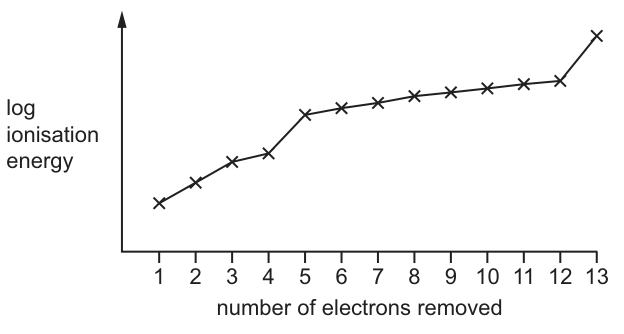
Which statement is correct?
Options
A A proton is lost for each successive ionisation energy.
B The element is aluminium.
C The element is silicon.
D The element has only one outer electron.
Working
A large jump in ionisation energy between the 4th and 5th values indicates that the first 4 electrons are removed from the outermost shell, so the element has 4 outer electrons. A second large jump between the 12th and 13th values indicates that the next 8 electrons (5th to 12th) are removed from the second shell, and the 13th electron is removed from the first shell.
The electronic configuration is therefore 2, 8, 4, which corresponds to an element with 14 electrons, i.e., silicon.
- Option A is incorrect because ionisation involves the removal of electrons, not protons.
- Option B is incorrect because aluminium has 3 outer electrons (configuration 2, 8, 3), which would show a jump after the 3rd ionisation energy.
- Option D is incorrect because the element has 4 outer electrons.
Answer
C
C
Background Concept
Ionisation energy is the energy required to remove an electron from a gaseous atom or ion. Successive ionisation energies increase because each subsequent electron is removed from an increasingly positive ion, experiencing a stronger electrostatic attraction to the nucleus. However, a very large increase (a "jump") in ionisation energy occurs when an electron is removed from a new, inner principal quantum shell (energy level). This inner electron is closer to the nucleus, experiences less shielding from inner electrons, and is therefore held much more strongly. By identifying where these large jumps occur in a graph of successive ionisation energies, we can deduce the number of electrons in each shell and thus the full electronic configuration of the element.
Understanding the Question
The question provides a graph of the logarithm of the first 13 ionisation energies of an unknown element plotted against the number of electrons removed (from 1 to 13). We must use the pattern of the graph to identify the element or a correct property of it from the four given options. The logarithmic scale is used to compress the large range of ionisation energy values onto a readable graph, but the relative positions of the jumps remain the same.
Approach
We will locate the large jumps in the ionisation energy values on the graph. The position of the first large jump tells us the number of outer-shell electrons. The position of subsequent large jumps tells us the number of electrons in the inner shells. This allows us to deduce the full electronic configuration and identify the element. Then we evaluate each option to find the correct statement.
Step-by-Step Reasoning
- First jump (outer shell): The graph shows a gradual increase from the 1st to the 4th ionisation energy, followed by a larger jump to the 5th. This indicates that the first 4 electrons are removed from the outermost shell, and the 5th electron is removed from a shell closer to the nucleus. Therefore, the element has 4 electrons in its outermost shell. This immediately eliminates option B (aluminium has 3 outer electrons, configuration 2, 8, 3, which would show a jump after the 3rd IE) and option D (the element does not have only one outer electron).
- Second jump (inner shell): The graph shows a gradual increase from the 5th to the 12th ionisation energy, followed by a larger jump to the 13th. This indicates that electrons 5 through 12 (a total of 8 electrons) are removed from the next inner shell, and the 13th electron is removed from an even deeper shell. Thus, the second shell contains 8 electrons.
- Innermost shell: Since the 13th electron is being removed from a new shell, and the first shell can hold a maximum of 2 electrons, the element must have 2 electrons in its first shell. (The graph only goes up to 13, so we only see the removal of 1 electron from the first shell, but the jump at 13 confirms it is the start of the n=1 shell).
- Full configuration and identification: Combining these findings, the electronic configuration is 2, 8, 4. The total number of electrons is 14, which corresponds to silicon (atomic number 14). This confirms option C is correct.
- Evaluating option A: Ionisation is the process of removing electrons from atoms to form positive ions. Protons are located in the nucleus and are not removed during chemical ionisation processes. Thus, option A is fundamentally incorrect.
Key Takeaways
- A large jump in successive ionisation energies indicates the removal of an electron from a new, inner principal quantum shell.
- The number of electrons in the outermost shell equals the ionisation number just before the first large jump.
- The capacity of each shell (2, 8, 8, ...) can be deduced from the number of electrons removed between successive jumps.
Common Mistakes
- Confusing protons and electrons: Option A is a distractor for students who do not recall that ionisation involves the loss of electrons, not protons.
- Misreading the graph: Students might count the points incorrectly or fail to identify the "jumps" versus the "gradual increases". Remember to look for the steepest segments of the graph.
- Assuming the total number of electrons: The graph only shows the first 13 ionisation energies. Students must deduce that the first shell holds 2 electrons even though only 1 is shown being removed (the jump at 13 implies the start of the n=1 shell, which holds 2).
Things to Be Careful About
- Logarithmic scale: The y-axis is logarithmic. This does not change the relative positions of the jumps, but students should not try to read the actual ionisation energy values from the axis unless specifically asked.
- State symbols and terminology: When writing about ionisation, always specify that electrons are removed, not protons or neutrons.
- Aluminium vs Silicon: Aluminium (Group 13) has 3 outer electrons and shows a jump after IE3. Silicon (Group 14) has 4 outer electrons and shows a jump after IE4. Phosphorus (Group 15) has 5 and shows a jump after IE5. Matching the jump position to the group number is a reliable check.
What is the empirical formula of butanoic acid?
Options
A C₂H₄O
B C₃H₆O
C C₄H₈O
D C₅H₁₀O
Working
Butanoic acid has the molecular formula C₄H₈O₂.
Divide every subscript by the highest common factor, 2:
C₄H₈O₂ → C₂H₄O
Answer
A
A
Background Concept
The empirical formula gives the simplest whole-number ratio of atoms of each element in a compound. The molecular formula gives the actual number of atoms of each element in one molecule. For many simple compounds the two are identical, but when the molecular formula has subscripts that share a common factor, the empirical formula is obtained by dividing them all by that factor.
Understanding the Question
The question asks directly for the empirical formula of butanoic acid. This requires two things: knowing the molecular formula of butanoic acid, and then simplifying it to the smallest whole-number ratio.
Approach
- Recall the molecular formula of butanoic acid.
- Find the highest common factor of the subscripts.
- Divide each subscript by that factor to obtain the empirical formula.
- Match the result to one of the options.
Step-by-Step Reasoning
- Butanoic acid is a saturated carboxylic acid with four carbon atoms: CH₃CH₂CH₂COOH.
- Counting atoms: 4 C, 8 H, 2 O, giving the molecular formula C₄H₈O₂.
- The subscripts 4, 8 and 2 all share a highest common factor of 2.
- Dividing each subscript by 2: C₂H₄O.
- This matches option A.
Key Takeaways
- The empirical formula is always the simplest whole-number ratio, not necessarily the molecular formula.
- Carboxylic acids with even carbon numbers often have empirical formulas different from their molecular formulas because of the two oxygen atoms.
- When the molecular formula is given (or recalled), always check whether the subscripts can be divided down.
Common Mistakes
- Choosing C₄H₈O (option C) by forgetting the second oxygen in the carboxylic acid group — butanoic acid has two oxygen atoms, not one.
- Assuming the molecular formula is already the empirical formula without checking for a common factor.
- Confusing butanoic acid (C₄H₈O₂) with butanal (C₄H₈O), which has only one oxygen.
Things to Be Careful About
- The —COOH group contributes two oxygen atoms and one hydrogen atom; do not forget them when counting.
- Always reduce the formula fully — an answer like C₄H₈O₂ would be the molecular formula, not the empirical formula.
- Read the options carefully: several are plausible one-carbon-off distractors, so the exact ratio of C:H:O (2:4:1) must match.
In which pair is the bond angle in the first species smaller than the smallest bond angle in the second species?
Options
A CH₄ and SF₆
B CO₂ and BF₃
C H₂O and H₃O⁺
D NH₄⁺ and NH₃
Working
Compare the bond angle in the first species with the smallest bond angle in the second species.
- A: CH₄ = 109.5°; SF₆ = 90° → 109.5° is not smaller than 90°.
- B: CO₂ = 180°; BF₃ = 120° → 180° is not smaller than 120°.
- C: H₂O = 104.5°; H₃O⁺ ≈ 107° → 104.5° is smaller than 107°. ✔
- D: NH₄⁺ = 109.5°; NH₃ ≈ 107° → 109.5° is not smaller than 107°.
Answer
C
C
Background Concept
VSEPR theory predicts molecular shapes from the number of electron pairs around the central atom. Both bonding pairs and lone pairs repel each other, but lone pairs occupy more space and compress the bond angles between bonding pairs.
Common shapes and approximate bond angles include:
- linear: 180°
- trigonal planar: 120°
- tetrahedral: 109.5°
- octahedral: 90°
- trigonal pyramidal: about 107°
- bent: about 104.5°
Understanding the Question
The question asks for the pair in which the bond angle in the first species is smaller than the smallest bond angle in the second species. This is important because some species, such as SF₆, have more than one bond angle, so we must use the smallest one when comparing.
Approach
Recall the shape and bond angle of each species, identify the smallest bond angle in the second species, and compare it with the bond angle of the first species.
Step-by-Step Reasoning
- A: CH₄ is tetrahedral, bond angle 109.5°. SF₆ is octahedral, with bond angles of 90° and 180°. The smallest is 90°. Since 109.5° > 90°, this pair does not work.
- B: CO₂ is linear, bond angle 180°. BF₃ is trigonal planar, bond angle 120°. Since 180° > 120°, this pair does not work.
- C: H₂O is bent, bond angle about 104.5°. H₃O⁺ is trigonal pyramidal, bond angle about 107°. Since 104.5° < 107°, this pair satisfies the condition.
- D: NH₄⁺ is tetrahedral, bond angle 109.5°. NH₃ is trigonal pyramidal, bond angle about 107°. Since 109.5° > 107°, this pair does not work.
Therefore, the correct answer is C.
Key Takeaways
- Lone pairs reduce bond angles: H₂O has two lone pairs and a smaller angle than H₃O⁺, which has only one lone pair.
- Octahedral molecules such as SF₆ have 90° bond angles, which are often the smallest.
- NH₄⁺ has a larger bond angle than NH₃ because NH₄⁺ has no lone pairs on the central atom.
Common Mistakes
- Using the largest or only bond angle in the second species instead of the smallest.
- Forgetting that SF₆ has 90° angles.
- Assuming NH₃ has a larger bond angle than NH₄⁺; the opposite is true because NH₃ has a lone pair.
Things to Be Careful About
- Read “smallest bond angle” carefully.
- Approximate values such as 104.5° and 107° are sufficient for comparison.
- Remember that a positive charge on the central atom, as in H₃O⁺, reduces the lone-pair effect compared with the neutral H₂O.
Two glass vessels, M and N, are connected by a closed valve.
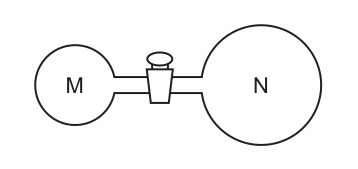
M contains helium at 20 °C at a pressure of . N has been evacuated, and has three times the volume of M.
The valve is opened and the temperature of the whole apparatus is raised to 100 °C.
What is the final pressure in the system?
Options
A
B
C
D
Working
Initial conditions for helium in vessel M:
Final conditions after the valve is opened and temperature is raised:
Using the combined gas law :
Answer
A
A
Background Concept
The behaviour of an ideal gas is described by the ideal gas equation . When the amount of gas () is constant, this can be rearranged into the combined gas law: . This equation is valid provided temperature is measured in Kelvin. When a gas expands into an evacuated vessel, the total volume available to the gas is the sum of the volumes of all connected vessels.
Understanding the Question
We have a fixed amount of helium gas initially confined to vessel M at 20 °C and . Vessel N is evacuated and has three times the volume of M. When the valve is opened, the gas expands to fill both vessels, so the new volume is the sum of the two. Then the temperature of the whole apparatus is raised to 100 °C. We need to find the final pressure in the system.
Approach
- Identify the initial state of the gas (pressure, volume, temperature in Kelvin).
- Identify the final state of the gas (final volume is , final temperature in Kelvin).
- Apply the combined gas law to find the final pressure.
Step-by-Step Reasoning
Let the volume of vessel M be . Since N has three times the volume of M, .
Initial state (gas in M only):
Final state (gas in both M and N):
Substitute into and rearrange for :
This matches option A.
Why the other options are wrong:
- B (): This is the result if you forget to add the volume of M and use instead of . ()
- C (): This is the result if you ignore the volume change and only account for the temperature change, perhaps using 25 °C (298 K) as the initial temperature. ()
- D (): This is the result if you multiply by the volume ratio instead of dividing (i.e., using instead of ). ()
Key Takeaways
- Always convert temperatures to Kelvin before using any gas law equation.
- When a gas expands into connected evacuated vessels, the final volume is the sum of all the volumes, not just the volume of the evacuated vessel.
- The combined gas law is the most direct tool when the amount of gas is constant and both pressure, volume, and temperature change.
Common Mistakes
- Forgetting to add the initial volume to the evacuated volume (using instead of ).
- Using Celsius instead of Kelvin in the gas law calculation.
- Inverting the volume ratio (multiplying by instead of ), which gives a pressure higher than the initial pressure when the volume actually increased.
Things to Be Careful About
- The temperature must always be in Kelvin for gas law calculations: .
- Pay close attention to the wording: "three times the volume of M" means , so the total volume is .
- Significant figures: the given pressure has at least one significant figure, but the options are given to 3 significant figures, so carry at least 3 sig figs through the calculation.
Solid sulfur consists of molecules made up of eight atoms covalently bonded together.
The bonding in sulfur dioxide is O=S=O.
Using these data, what is the value of the S=O bond enthalpy?
Options
A
B
C
D
Working
The combustion of sulfur is:
Using :
Bonds broken:
- :
- 8 O=O bonds:
Total energy to break bonds
Bonds formed:
- 8 molecules, each with 2 S=O bonds: 16 S=O bonds formed.
Answer
D —
D
Background Concept
Bond enthalpy (bond dissociation enthalpy) is the energy required to break one mole of a specific covalent bond in the gaseous state. The enthalpy change of a reaction can be estimated from bond enthalpies using:
Breaking bonds requires energy (endothermic, positive contribution), while forming bonds releases energy (exothermic, negative contribution). The net enthalpy change is the difference between the two.
Hess's law states that the enthalpy change of a reaction depends only on the initial and final states, not on the route taken. This allows us to construct energy cycles linking reactants, intermediates, and products.
Understanding the Question
We are given:
- (enthalpy of combustion of )
- Energy to break 1 mol into gaseous atoms = 2232 kJ mol⁻¹
- O=O bond enthalpy = 496 kJ mol⁻¹
We need to find the S=O bond enthalpy in (which is O=S=O, so two S=O bonds per molecule).
The combustion reaction is . The enthalpy change of this reaction is −2376 kJ mol⁻¹.
Approach
Write the balanced equation, identify all bonds broken and formed, apply , and solve for the unknown S=O bond enthalpy.
Step-by-Step Reasoning
-
Write the balanced combustion equation: .
-
Bonds broken:
- : 2232 kJ (given directly — this is the energy to atomise the whole molecule).
- 8 O=O bonds: kJ.
- Total: kJ.
-
Bonds formed: 8 molecules, each with 2 S=O bonds, so 16 S=O bonds formed.
-
Apply the bond enthalpy relation:
- Solve:
Distractor analysis:
- A (239): Obtained if the sign of is mishandled: . This treats the enthalpy change as if less energy is released on bond formation than is consumed on bond breaking, forgetting that the combustion is exothermic.
- B (257): A plausible but incorrect value with no clean derivation from the given data.
- C (319): Obtained by miscounting the number of S=O bonds formed: . This treats only 12 S=O bonds (e.g., forgetting that each has two S=O bonds).
Key Takeaways
- Bond enthalpy calculations require careful bookkeeping of every bond broken and formed, including stoichiometric coefficients.
- The sign of matters: exothermic reactions release more energy on bond formation than is consumed on bond breaking.
- Each molecule (O=S=O) contains two S=O double bonds — 8 molecules give 16 S=O bonds.
Common Mistakes
- Forgetting the sign of : Treating −2376 as +2376, or subtracting it instead of adding it when rearranging, gives the wrong answer (option A).
- Miscounting the number of S=O bonds: 8 molecules × 2 S=O bonds each = 16, not 8 or 12.
- Forgetting that the energy to break into atoms (2232 kJ) is for the whole molecule, not per S atom.
- Not including the 8 molecules in the bond-breaking total — each contributes one O=O bond worth 496 kJ.
Things to Be Careful About
- The energy to break into gaseous atoms is given per mole of , not per mole of S atoms — use it as-is.
- The O=O bond enthalpy is per mole of O=O bonds; with 8 molecules, that is kJ.
- State symbols matter: is solid, and are gases — the energy to atomise is already included in the bond-breaking term.
- Units: all energies are in kJ mol⁻¹, and the final answer must carry the same unit.
In this question, the average oxidation state of sulfur in S₂O₃²⁻ and sulfur in S₂O₄²⁻ should be used.
In which reaction does the underlined element have the largest increase in oxidation state?
Options
A 3CrO₄³⁻(aq) + 8H⁺(aq) → 2CrO₄²⁻(aq) + Cr³⁺(aq) + 4H₂O(l)
B 2NO₂(g) + H₂O(l) → HNO₃(aq) + HNO₂(aq)
C S₂O₃²⁻(aq) + 2H⁺(aq) → S(s) + SO₂(g) + H₂O(l)
D 2S₂O₄²⁻(aq) + H₂O(l) → S₂O₃²⁻(aq) + 2HSO₃⁻(aq)
Working
For each option, find the largest positive change in oxidation state of the underlined element.
A: In , Cr is ; it forms () and (), so the largest increase .
B: In , N is ; it forms () and (), so the largest increase .
C: In , the average oxidation state of S is ; it forms () and (), so the largest increase .
D: In , the average oxidation state of S is ; it forms (average ) and (), so the largest increase .
The largest increase is .
Answer
C
C
Background Concept
Oxidation state (oxidation number) is a bookkeeping number assigned to an atom by a set of rules:
- The oxidation state of an uncombined element is .
- For a monatomic ion, the oxidation state equals its charge.
- Oxygen is usually (except in peroxides, where it is ).
- Hydrogen is usually .
- The sum of oxidation states in a neutral compound is ; in a polyatomic ion it equals the ion charge.
A positive increase in oxidation state is oxidation; a decrease is reduction. In some reactions an element is simultaneously oxidised and reduced — this is disproportionation — and then different atoms of that element show different oxidation-state changes. The question only asks for the largest increase, so we look at the biggest positive difference, not the highest final state.
The question also specifically tells us to use the average oxidation state of sulfur in and . This is because the two sulfur atoms are not equivalent in these ions, but for this comparison we treat them as if they share the oxidation state equally.
Understanding the Question
Underlined elements are Cr in option A, N in option B, and S in options C and D. For each reaction we must find the largest increase in oxidation state of that element, not the overall oxidation state change of all atoms. For example, an element might be partly oxidised and partly reduced; the largest increase could come from the atoms that are oxidised. Since all four options are set up so that several atoms of the underlined element change oxidation state, we compare the maximum positive change in each option.
Approach
Assign oxidation states to the underlined element in every reactant and product species. Then, for each option, find the highest product oxidation state and subtract the reactant oxidation state. Compare these differences across the four options and select the largest.
Step-by-Step Reasoning
Option A — Cr
:
:
And has oxidation state . Some Cr goes from to ; that is an increase of . Another Cr atom goes from to , a decrease of . The largest increase is therefore .
Option B — N
In :
In , with H and three O :
In , with H and two O :
The largest increase is .
Option C — S
In , using the average oxidation state for S:n
The products are and . Elemental sulfur has oxidation state . In :
So one sulfur atom changes from average to (decrease), while another changes from average to (increase ). The largest increase is therefore .
Option D — S
In , using average oxidation state for S:
In , average S is . In , with H and three O :
So some sulfur increases from to : an increase of . Other sulfur decreases to . The largest increase is .
Comparing all options, A, B and D each have a largest increase of , while option C has a largest increase of . Therefore the correct answer is C.
Key Takeaways
- Oxidation state is a bookkeeping tool; changes in oxidation state identify oxidation and reduction.
- In a polyatomic ion, the oxidation states must sum to the charge of the ion, not to zero.
- When asked for the largest increase, subtract the reactant oxidation state from the highest product oxidation state.
- When the question says to use an average oxidation state, follow that instruction exactly; it removes ambiguity in ions such as thiosulfate and dithionite.
Common Mistakes
- Picking the product with the highest oxidation state, such as in or in , instead of calculating the increase. Here this might seem attractive, but the increase is only .
- Forgetting that the sum of oxidation states in an ion equals the ion charge, not zero. For , if the charge is ignored, Cr would incorrectly be given .
- Treating the two sulfur atoms in and as having different oxidation states without being told to. The question explicitly asks for the average, so use and .
- Ignoring the word "increase" and looking for the option with the most redox change or the largest decrease.
Things to Be Careful About
- Always include the charge of a polyatomic ion when finding oxidation states: e.g. has total charge , not .
- Watch the sign of the change: oxidation is a positive increase, reduction is a negative change.
- In disproportionation reactions, some atoms increase and some decrease; only the positive increase is relevant when the question asks for the largest increase.
- Compare all four options before selecting the answer; several options may have the same increase, and the largest one is the correct choice.
Methanol, CH₃OH, is made industrially from carbon monoxide and hydrogen in the equilibrium reaction shown.
Which statement about this equilibrium is correct?
Options
A for the process is
B An increase in pressure increases the equilibrium yield of methanol.
C An increase in temperature increases the equilibrium yield of methanol.
D The addition of an effective catalyst increases the equilibrium yield of methanol.
Working
For the equilibrium
so A is incorrect because the partial pressure of hydrogen must be squared.
The forward reaction has 3 mol of gas on the left and 1 mol of gas on the right. Increasing pressure shifts the equilibrium to the side with fewer gas molecules, increasing the yield of methanol. B is correct.
is negative, so the forward reaction is exothermic. Increasing temperature favours the endothermic reverse reaction and decreases the yield, so C is incorrect.
A catalyst speeds up both forward and reverse reactions equally and does not change the equilibrium position, so D is incorrect.
Answer
B
B
Background Concept
This is a homogeneous gas-phase equilibrium:
For a general equilibrium , the equilibrium constant in terms of partial pressures is
Each partial pressure is raised to the stoichiometric coefficient of that species. Le Chatelier's principle states that if a stress is applied to a system at equilibrium, the position of equilibrium shifts to counteract that stress. An increase in pressure favours the side with fewer moles of gas; a change in temperature depends on the sign of ; a catalyst does not change the position of equilibrium.
Understanding the Question
The question asks which single statement about this equilibrium is correct. Four possible statements are given: one about the form of the expression, one about the effect of pressure, one about the effect of temperature, and one about the effect of a catalyst. To answer, you need to use the stoichiometric coefficients, count the number of gas moles on each side, use the sign of , and recall what a catalyst does to an equilibrium.
Approach
Check each statement systematically.
- For A, write the correct expression and compare it with the one given.
- For B, count gas moles on each side and apply Le Chatelier's principle to an increase in pressure.
- For C, use the sign of : an exothermic forward reaction is favoured by a decrease in temperature.
- For D, recall that a catalyst lowers the activation energy for both directions equally, so it does not alter the equilibrium composition.
Only one statement will be chemically correct.
Step-by-Step Reasoning
Statement A
The correct expression is
because the coefficient of hydrogen in the balanced equation is 2. The option shows without the square, so it is incorrect.
Statement B
On the left-hand side there are moles of gas. On the right-hand side there is 1 mole of gas. Increasing the pressure favours the side with fewer gas molecules, which is the right-hand side. Therefore the equilibrium yield of methanol increases. This statement is correct.
Statement C
The forward reaction has , so it is exothermic. Increasing the temperature adds heat, and the equilibrium shifts in the endothermic direction, which is the reverse reaction. This decreases the yield of methanol, so the statement is incorrect.
Statement D
A catalyst provides an alternative pathway with lower activation energy for both the forward and reverse reactions. It speeds up the attainment of equilibrium but does not change the position of equilibrium or the equilibrium yield. Therefore this statement is incorrect.
Hence the correct answer is B.
Key Takeaways
- The expression must include each partial pressure raised to its stoichiometric coefficient.
- The effect of pressure on a gas-phase equilibrium depends on the change in the number of moles of gas: higher pressure favours fewer gas moles.
- The effect of temperature depends on the sign of : increasing temperature favours the endothermic direction.
- A catalyst affects the rate of approach to equilibrium, not the equilibrium position.
Common Mistakes
- Forgetting to square in the expression.
- Assuming that increasing pressure always increases yield without counting the number of gas moles on each side.
- Thinking that an exothermic reaction is favoured by heating; in fact, heating favours the endothermic reverse reaction.
- Stating that a catalyst increases the equilibrium yield; it only helps equilibrium be reached faster.
Things to Be Careful About
- Use partial pressures, not concentrations, when writing , and raise each to the correct power.
- Count only gaseous species when determining the change in moles of gas.
- Note that is negative, so the forward reaction is exothermic.
- A catalyst does not change or the equilibrium composition, only the rate at which equilibrium is reached.
The distribution of molecular energies in an ideal gas can be represented in a Boltzmann distribution.
Which change in conditions leads to a larger value for the number of molecules that have the most probable energy?
Options
A keeping the temperature constant but decreasing the pressure
B keeping the pressure constant but decreasing the temperature
C keeping the temperature constant but increasing the pressure
D keeping the pressure constant but increasing the temperature
Working
The most probable energy is the energy at the peak of the Boltzmann distribution. Lowering the temperature narrows the distribution and raises the peak, so a larger number of molecules have the most probable (lower) energy. Changing the pressure at constant temperature does not alter the shape of the molecular-energy distribution.
Answer
B
B
Background Concept
The Boltzmann distribution shows the spread of molecular energies in a gas at a given temperature. The curve is not symmetric: it starts at zero, rises sharply to a peak (the most probable energy), then falls gradually to a long tail at high energy. The total area under the curve is proportional to the total number of molecules. At a higher temperature, the distribution broadens: the peak moves to a higher energy and becomes lower, because the same number of molecules is spread over a wider range of energies. At a lower temperature, the distribution narrows: the peak moves to a lower energy and becomes higher, because more molecules cluster near the average energy.
Understanding the Question
The question asks which change in conditions increases the number of molecules that have the most probable energy — i.e., raises the peak of the distribution. It offers four options that vary temperature and pressure. We need to recall that the shape of the Boltzmann distribution depends only on temperature (for a fixed amount of ideal gas), not on pressure.
Approach
Think of the peak height of the Boltzmann curve. Temperature is the key variable: lowering temperature raises the peak; raising temperature lowers it. Pressure changes at constant temperature do not change the distribution of molecular energies, so options A and C cannot be correct. Among the temperature-changing options, we need the one that lowers temperature, which is B.
Step-by-Step Reasoning
- The "most probable energy" is the energy at the maximum of the distribution curve.
- At constant temperature, the distribution of molecular energies is fixed regardless of pressure (for an ideal gas). Therefore, changing pressure alone (A or C) does not increase the number of molecules at the most probable energy.
- Decreasing temperature at constant pressure (B) narrows the distribution and raises the peak, so more molecules have the most probable (lower) energy.
- Increasing temperature at constant pressure (D) broadens the distribution and lowers the peak, so fewer molecules have the most probable energy.
- Therefore, the correct answer is B.
Key Takeaways
- The Boltzmann distribution is a temperature-dependent curve; its peak height and position change with temperature.
- Lower temperature → higher, narrower peak; higher temperature → lower, broader peak.
- Pressure does not affect the shape of the molecular-energy distribution for an ideal gas at a given temperature.
Common Mistakes
- Confusing "most probable energy" with "average energy": the most probable energy is the peak, not the mean.
- Thinking that increasing pressure increases the number of molecules at a given energy: pressure changes the number of molecules per unit volume but not the distribution shape.
- Choosing D because higher temperature gives molecules more energy: but the peak height decreases, so the number at the most probable energy is smaller.
Things to Be Careful About
- The question asks for the number of molecules with the most probable energy, not the value of that energy.
- At higher temperature, the most probable energy increases, but the number of molecules at that energy decreases.
- The distribution is for a fixed amount of gas; if the amount changes, the total area changes, but the question implies a fixed sample.
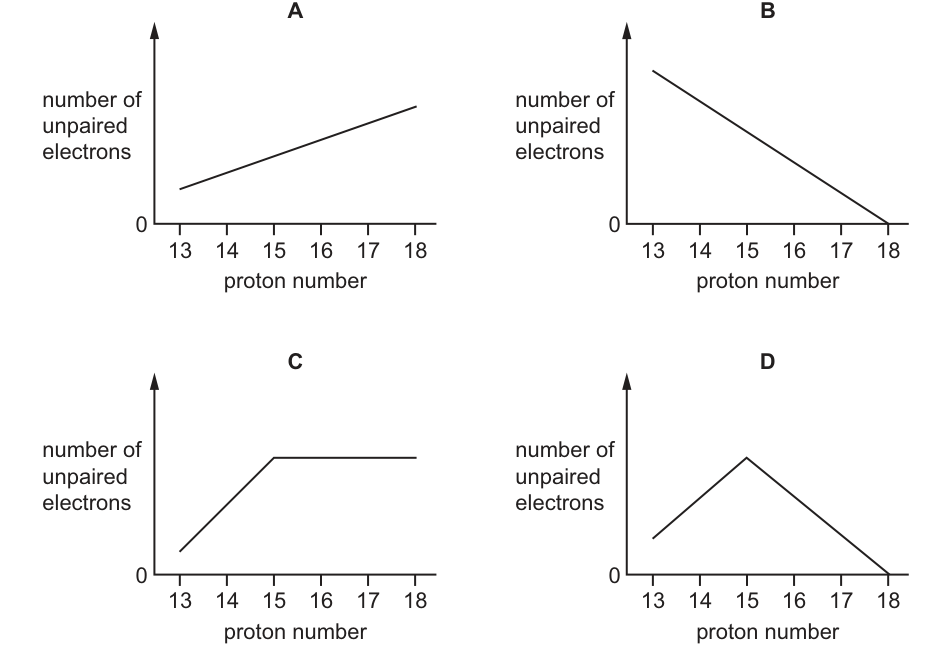
Which graph represents the number of unpaired electrons in the atoms of six elements in Period 3 of the Periodic Table?
Options
Working
The six elements in Period 3 with proton numbers 13 to 18 are aluminium (13), silicon (14), phosphorus (15), sulfur (16), chlorine (17), and argon (18).
Their valence electron configurations in the 3p subshell are:
- Al (13): unpaired electron
- Si (14): unpaired electrons
- P (15): unpaired electrons
- S (16): unpaired electrons
- Cl (17): unpaired electron
- Ar (18): unpaired electrons
The number of unpaired electrons increases from 1 to 3 across elements 13 to 15, then decreases to 0 across elements 16 to 18. This corresponds to graph D.
Answer
D
D
Background Concept
The electronic configuration of atoms follows the Aufbau principle, the Pauli exclusion principle, and Hund's rule. Hund's rule states that electrons fill degenerate orbitals (orbitals of the same energy, such as the three 3p orbitals) singly first, with parallel spins, before pairing up. This maximises the number of unpaired electrons in a subshell until it is half-filled.
Understanding the Question
The question asks to identify the correct graph showing the number of unpaired electrons for the six Period 3 elements with proton numbers 13 to 18 (Al, Si, P, S, Cl, Ar). The x-axis is the proton number, and the y-axis is the number of unpaired electrons.
Approach
Determine the valence electron configuration for each element from proton number 13 to 18. Apply Hund's rule to the 3p subshell to count the number of unpaired electrons for each element. Plot these values mentally and match the resulting trend to one of the given graphs.
Step-by-Step Reasoning
- Elements 13 to 18 are in Period 3. Their inner electron configuration is that of neon, . All inner electrons are paired, so we only need to consider the valence electrons in the 3s and 3p subshells.
- The 3s subshell is always fully occupied () for all these elements, contributing 0 unpaired electrons.
- The 3p subshell has three degenerate orbitals. As we add electrons from proton number 13 to 18:
- Al (13): . One electron in the first 3p orbital. Unpaired = 1.
- Si (14): . Two electrons in separate 3p orbitals (Hund's rule). Unpaired = 2.
- P (15): . Three electrons, one in each 3p orbital. Unpaired = 3. This is the half-filled subshell.
- S (16): . Four electrons. One orbital must now contain a pair. Unpaired = 2.
- Cl (17): . Five electrons. Two orbitals contain pairs, one contains a single electron. Unpaired = 1.
- Ar (18): . Six electrons. All three 3p orbitals are fully paired. Unpaired = 0.
- The sequence of unpaired electrons is 1, 2, 3, 2, 1, 0.
- Graph D shows exactly this trend: rising from 1 at proton number 13 to a peak of 3 at proton number 15, then falling to 0 at proton number 18.
Key Takeaways
Hund's rule governs the filling of degenerate orbitals. The number of unpaired electrons in a p-subshell increases from 1 to 3 as electrons are added, then decreases from 2 to 0 as pairing begins. This creates a symmetric peak at the half-filled subshell.
Common Mistakes
- Forgetting Hund's rule and assuming electrons pair up immediately (e.g., thinking has 0 unpaired electrons).
- Ignoring that the 3s electrons are paired and only counting 3p electrons (though for these elements, 3s is always , so it doesn't change the unpaired count, but it is good practice).
- Assuming the trend continues to increase linearly across the period.
Things to Be Careful About
- State that the inner shells are fully paired and contribute zero unpaired electrons.
- Remember that the 3p subshell has 3 orbitals, not 1.
- Graph C shows a plateau, which would be incorrect because after the half-filled subshell (P), electrons begin to pair up, reducing the number of unpaired electrons.
A 69.0 g sample of nitrogen dioxide is placed in a reaction vessel.
The initial pressure of the nitrogen dioxide is . An effective catalyst is then added and the nitrogen dioxide begins to decompose into its elements.
After ten minutes, the total pressure is .
What is the mass of oxygen molecules in the reaction vessel after ten minutes?
Options
A 4.80 g
B 9.60 g
C 38.4 g
D 48.0 g
Working
Molar mass of = 46.0 g mol, so initial moles = mol.
At constant V and T, total moles are proportional to pressure: total moles after = mol; increase = 0.15 mol.
For every 2 mol NO2 decomposed, total moles increase by 1 and 2 mol O2 are formed. Hence 0.15 mol increase corresponds to 0.30 mol O2.
Mass of O2 = g.
Answer
B
B
Background Concept
Nitrogen dioxide, , is a covalent oxide of nitrogen. When it 'decomposes into its elements', the products are nitrogen gas and oxygen gas, both diatomic molecules: and . The balanced equation for the decomposition is
For a gas or mixture of gases at constant volume and temperature, means that pressure is directly proportional to the total number of moles of gas: . This lets us turn a pressure ratio into a mole ratio.
Understanding the Question
We are given 69.0 g of and told that the initial pressure is . After partial decomposition, the total pressure is . The question asks for the mass of oxygen molecules present. The key point is that is the total pressure of all gases in the vessel, not the partial pressure of oxygen, and not simply '10% of the NO2 has decomposed'. The catalyst is only there to make the decomposition fast enough; it does not change the stoichiometry or the equilibrium position.
Approach
- Convert the initial mass of NO2 into moles using its molar mass.
- Use the pressure ratio to find the final total number of moles of gas.
- Write and balance the decomposition equation.
- Relate the increase in total moles to the amount of oxygen formed.
- Convert moles of oxygen to mass and select the option.
Step-by-Step Reasoning
Step 1: initial moles of NO2.
Step 2: final total moles.
At constant and , , so
The increase in total moles is .
Step 3: balanced equation and stoichiometry.
Let be the amount of NO2 decomposed. Then remaining NO2 = , N2 formed = , O2 formed = . Total moles = . Set this equal to 1.65:
, so .
Therefore O2 formed = .
Step 4: mass of oxygen.
So the correct option is B.
Key Takeaways
- In a gas mixture at constant V and T, pressure is a direct measure of total moles.
- 'Elements' for nitrogen and oxygen means N2 and O2, so balance the equation accordingly.
- The increase in total moles per reaction is the key stoichiometric link.
- A catalyst affects rate, not the equilibrium amounts or the stoichiometry.
Common Mistakes
- Treating as '10% of NO2 decomposed'. The pressure increase is only 0.1P, but because 2 mol of gas become 3 mol, this corresponds to 20% decomposition, giving 0.30 mol O2 (9.60 g), not 0.15 mol O2 (4.80 g, option A).
- Assuming complete decomposition: that would give 1.5 mol O2 and 48.0 g (option D).
- Writing the products as N and O atoms instead of N2 and O2, which gives an unbalanced equation and wrong mole ratios.
- Using the total pressure as the partial pressure of oxygen.
- Forgetting to multiply by the molar mass of O2 when converting moles to mass.
Things to Be Careful About
- Keep state symbols in the balanced equation; they are not essential for the calculation but show the physical states.
- The pressure–mole proportionality only holds if volume and temperature are constant; this is implied by a reaction vessel under the same conditions.
- The question asks for oxygen molecules, O2, so use .
- The catalyst is a distractor: it only speeds up the reaction.
- Watch significant figures: the data include 69.0 and 1.1; the intended option is 9.60 g.
Which statement about the molecule PF₅ is correct?
Options
A Every F–P–F bond angle is 90°.
B The central atom in the molecule does not have a lone pair of electrons.
C The molecule has an overall dipole moment.
D The shape of the molecule is octahedral.
Working
PF5 has 5 bonding pairs and 0 lone pairs around the central phosphorus atom. VSEPR predicts a trigonal bipyramidal shape. The equatorial F–P–F bond angles are 120°, while the axial–equatorial angles are 90°, so not every bond angle is 90°. The symmetric arrangement of identical P–F bonds cancels the bond dipoles, so the molecule has no overall dipole moment. A molecule with 6 electron pairs would be octahedral, not PF5.
Answer
B — the central atom does not have a lone pair of electrons.
B
Background Concept
PF5 is a covalent molecule of phosphorus pentafluoride. Phosphorus has 5 valence electrons, and each fluorine contributes one electron to a single P–F bond. This gives 5 bonding pairs and no lone pairs on the central atom. According to VSEPR theory, 5 electron pairs arrange themselves as far apart as possible in a trigonal bipyramidal shape.
Understanding the Question
The question asks which statement about PF5 is correct. We need to check the shape, bond angles, lone pairs, and polarity of the molecule.
Approach
Apply VSEPR theory: count the electron pairs around the central atom, predict the shape, then check each option against that shape and the symmetry of the molecule.
Step-by-Step Reasoning
- Count valence electrons of P: 5.
- Each F forms one single bond with P, using one electron from P and one from F. So there are 5 bonding pairs and 0 lone pairs around P.
- Five electron pairs give a trigonal bipyramidal shape: 3 equatorial positions at 120° to each other, and 2 axial positions at 90° to the equatorial plane.
- Option A is false because equatorial F–P–F angles are 120°, not all 90°.
- Option B is true because the central atom has no lone pair.
- Option C is false because the identical P–F bonds are arranged symmetrically, so the individual bond dipoles cancel and the molecule has no overall dipole moment.
- Option D is false because octahedral geometry requires 6 electron pairs; PF5 has 5.
Key Takeaways
- PF5 is trigonal bipyramidal, not octahedral.
- The central phosphorus atom has 5 bonding pairs and no lone pairs.
- A molecule can have polar bonds but still be non-polar if the bond dipoles cancel by symmetry.
Common Mistakes
- Assuming that because P–F bonds are polar, the whole molecule is polar.
- Confusing 5 electron pairs with octahedral geometry, which needs 6.
- Thinking all bond angles in a trigonal bipyramid are 90°; the equatorial angles are 120°.
Things to Be Careful About
- Count lone pairs as well as bonding pairs when applying VSEPR.
- Remember that PF5 is an example of an expanded octet: phosphorus has 10 electrons around it.
- Check each option individually rather than stopping at the first plausible statement.
Which solid compound has both ionic and covalent bonding but not coordinate bonding?
Options
A Al₂Cl₆
B CH₃COONa
C MgCl₂
D NH₄Cl
Working
- A Al₂Cl₆ — covalent dimer; bridging Cl atoms form coordinate (dative) bonds. Has covalent and coordinate bonding, no ionic bonding.
- B CH₃COONa — Na⁺ and CH₃COO⁻ form an ionic lattice; the ethanoate ion contains covalent bonds (C–C, C–H, C=O, C–O). No coordinate bond.
- C MgCl₂ — ionic lattice of Mg²⁺ and Cl⁻; no covalent bonding.
- D NH₄Cl — ionic between NH₄⁺ and Cl⁻, covalent within NH₄⁺, and the N–H bond formed by donation from NH₃ to H⁺ is a coordinate bond.
Answer
B — CH₃COONa
B
Background Concept
Ionic bonding arises from the transfer of electrons between a metal and a non-metal, producing oppositely charged ions held by electrostatic attraction. Covalent bonding involves the sharing of electron pairs between atoms. A coordinate (dative) bond is a special covalent bond in which both electrons of the shared pair come from a single atom (a lone-pair donor).
Understanding the Question
The question asks for a solid compound that has both ionic and covalent bonding, but not coordinate bonding. This means we need a compound that is ionic overall (metal + polyatomic ion, or ammonium salt) and also contains covalent bonds within a polyatomic ion, while having no dative bonds.
Approach
Evaluate each option systematically:
- Decide whether the compound is ionic (metal + non-metal, or ammonium salt).
- Check whether it contains covalent bonds within a polyatomic ion.
- Check whether any bond is a coordinate (dative) bond.
Step-by-Step Reasoning
- A — Al₂Cl₆: Aluminium chloride is a covalent compound. In the gas/solid phase it exists as a dimer with bridging chlorine atoms. Each bridging Cl donates a lone pair to an Al atom, forming coordinate bonds. So it has covalent and coordinate bonding, but no ionic bonding. Eliminated.
- B — CH₃COONa (sodium ethanoate): Na⁺ and CH₃COO⁻ form an ionic lattice. Within the ethanoate ion, the C–C, C–H, C=O and C–O bonds are all ordinary covalent bonds formed by sharing one electron from each atom. There is no lone-pair donation, so no coordinate bond. This compound has both ionic and covalent bonding but no coordinate bonding. Answer.
- C — MgCl₂: Magnesium chloride is an ionic compound of Mg²⁺ and Cl⁻. There are no covalent bonds. Eliminated.
- D — NH₄Cl (ammonium chloride): Ionic between NH₄⁺ and Cl⁻, and covalent within the ammonium ion. However, one of the four N–H bonds is a coordinate bond: the H⁺ ion has no electrons, so the lone pair on NH₃ is donated to form that bond. Thus it contains coordinate bonding. Eliminated.
Key Takeaways
- Ionic compounds can contain covalent bonds within polyatomic ions (e.g. ethanoate, nitrate, sulfate, ammonium).
- A coordinate bond is a covalent bond where both electrons come from one atom; it is common in NH₄⁺, H₃O⁺ and Al₂Cl₆.
- The ammonium ion always contains one coordinate bond, even though all four N–H bonds look identical.
Common Mistakes
- Assuming NH₄Cl has no coordinate bond because all N–H bonds appear the same. In fact, one is a dative bond.
- Thinking MgCl₂ has significant covalent character; it is essentially ionic.
- Forgetting that Al₂Cl₆ is covalent, not ionic.
Things to Be Careful About
- Distinguish between ionic + covalent (CH₃COONa) and ionic + covalent + coordinate (NH₄Cl).
- The phrase "solid compound" is a distractor here — all four options are solids, so it does not affect the answer.
Which equation represents the standard enthalpy change of formation, , for ethanol?
Options
A
B
C
D
Working
The standard enthalpy change of formation, , is the enthalpy change when one mole of a compound is formed from its elements in their standard states.
Ethanol, , is formed from 2 mol , 3 mol and mol . At standard conditions (298 K, 1 atm) ethanol is a liquid.
Answer
D
D
Background Concept
The standard enthalpy change of formation, , is defined as the enthalpy change when one mole of a compound is formed from its elements, all in their standard states, under standard conditions (usually 298 K and 1 atm). The standard state of a substance is its most stable physical form at these conditions. For carbon, the standard state is solid graphite, ; for hydrogen, it is the diatomic gas ; for oxygen, it is . For ethanol, the standard state at 298 K and 1 atm is a liquid, .
This question tests whether you can translate that definition into a correctly balanced chemical equation.
Understanding the Question
The question asks you to identify which of four equations correctly represents the standard enthalpy change of formation of ethanol. The command is essentially "identify", so you must check each option against the definition. Three conditions must all be satisfied:
- The reactants are the elements in their standard states.
- The equation is balanced so that exactly one mole of ethanol is formed.
- The ethanol product is in its standard physical state (liquid).
Any option that fails even one of these conditions is incorrect.
Approach
Work through the definition methodically:
- Write the formula of ethanol and count the atoms: contains 2 carbon atoms, 6 hydrogen atoms, and 1 oxygen atom.
- Convert this into the formation equation: 2 mol mol mol mol .
- Check the physical state of each substance at standard conditions.
- Eliminate options that fail any condition.
Step-by-Step Reasoning
-
Identify the elements and their standard states.
- Carbon: (graphite).
- Hydrogen: .
- Oxygen: .
All four options use these correct reactant forms.
-
Balance the equation for one mole of ethanol.
- Ethanol has 2 C atoms, so we need 2 mol .
- Ethanol has 6 H atoms, so we need 3 mol (since each provides 2 H atoms).
- Ethanol has 1 O atom, so we need mol .
- Options A and B use , which provides only 5 hydrogen atoms — the equation would not balance (5 H vs 6 H). These are eliminated.
-
Check the physical state of the product.
- At 298 K and 1 atm, ethanol is a liquid. Therefore the product must be written as .
- Option C has the correct stoichiometry but writes ethanol as a gas, , which is not its standard state. Eliminated.
-
Select the correct option.
- Option D has the correct stoichiometry (2 C, 3 H2, ½ O2) and the correct product state (liquid). It satisfies all three conditions of the definition.
Key Takeaways
- The standard enthalpy change of formation always involves one mole of product formed from its elements in their standard states.
- "Standard state" is a physical-state requirement: you must know whether the compound is solid, liquid, or gas at 298 K and 1 atm.
- When checking a formation equation, always verify: (a) reactants are elements in standard states, (b) the equation balances to exactly one mole of product, and (c) the product is in its standard state.
Common Mistakes
- Choosing the gas state for ethanol (options A and C): ethanol is a liquid at standard conditions, so cannot represent .
- Miscounting hydrogen atoms: provides only 5 H atoms, not the 6 required for ethanol. Some students see "2½" and think it is just a fraction without checking the atom count.
- Confusing formation with combustion: a combustion equation would have as a reactant and and as products. Formation is the opposite direction — building the compound from its elements.
Things to Be Careful About
- State symbols are part of the definition of — omitting or miswriting them changes the meaning of the equation.
- The equation must produce exactly one mole of the compound; coefficients must be scaled accordingly (e.g. is allowed, not ).
- The elements must be in their standard states — for carbon that is solid graphite, not or diamond.
- Always count atoms carefully when a coefficient is a fraction; a fraction like can hide an unbalanced equation.
When K₂MnO₄ reacts with concentrated hydrochloric acid, the products include chlorine molecules and MnCl₂. All of the manganese atoms are reduced to MnCl₂.
Both Mn and Cl change their oxidation numbers during the reaction. No other element is oxidised or reduced.
Using these changes in oxidation number, how many moles of chlorine will be produced when 1.0 mol of K₂MnO₄ reacts with an excess of hydrochloric acid?
Options
A 2.0 mol
B 2.5 mol
C 3.0 mol
D 4.0 mol
Working
In , the oxidation number of Mn is :
In , Mn has oxidation number . Each Mn therefore gains electrons:
Chlorine is oxidised from in HCl to in :
So 1 mol of accepts 4 mol of electrons, which produces mol of .
Answer
A (2.0 mol)
A
Background Concept
Redox reactions involve the transfer of electrons. Oxidation number is a bookkeeping number assigned to each atom. An increase in oxidation number means oxidation (electron loss); a decrease means reduction (electron gain). In any redox reaction, the total number of electrons lost by the reducing agent equals the total number gained by the oxidising agent. This electron balance lets us find mole ratios even when the full balanced equation is not given.
For , it is important to recognise that this is potassium manganate(VI), not potassium permanganate. The two ions and four ions fix Mn at . In contrast, has Mn at . This distinction is the key to the calculation.
Understanding the Question
The reaction is between and excess concentrated hydrochloric acid. The products include and . All Mn ends up as , so every Mn atom is reduced from to . Chlorine in HCl is oxidised from to in . The statement that no other element is oxidised or reduced tells us that K and O keep their oxidation numbers, so the only electron transfer is from to Mn. We need the moles of produced by 1 mol of . Because HCl is in excess, it is not the limiting reagent; the amount of is fixed by how many electrons 1 mol of can accept.
Approach
- Find the oxidation number of Mn in and in .
- Determine the electrons gained per mole of Mn.
- Determine the electrons released per mole of formed.
- Equate electrons gained and lost to calculate the moles of .
Step-by-Step Reasoning
Let be the oxidation number of Mn in . K is and O is :
In , Cl is :
So Mn changes from to , a decrease of 4. Each mole of Mn gains 4 mol of electrons:
In HCl, Cl is . In , each Cl atom is . Each loses 1 electron, but is diatomic, so forming 1 mol of releases 2 mol of electrons:
1 mol of contains 1 mol of Mn, so it can accept 4 mol of electrons. These 4 mol of electrons oxidise mol of . Therefore the answer is A.
The full balanced equation is a useful check:
It also shows 2 mol of per mol of .
Distractors: Option B (2.5 mol) comes from treating as with Mn at , giving 5 electrons per Mn and 2.5 mol of . Option D (4.0 mol) comes from forgetting that is diatomic and counting 4 mol of Cl atoms as 4 mol of . Option C (3.0 mol) has no simple redox basis; it might come from a miscount of the electron change.
Key Takeaways
- Oxidation number changes give electron transfer directly.
- Always compare the oxidation numbers of the element in the reactant and product.
- For diatomic molecules, account for two atoms per molecule when converting electron loss to moles of product.
- The statement that no other element is oxidised or reduced lets us ignore spectator elements.
Common Mistakes
- Assuming has Mn at . It has two and four , so Mn is . This leads to option B.
- Forgetting to divide by 2 for . Each mole of needs two and releases two electrons; 4 mol of electrons give 2 mol of , not 4 mol.
- Trying to balance the full equation first; this is not necessary and can waste time. Use electron transfer.
- Ignoring the phrase "excess hydrochloric acid" and treating HCl as limiting; the amount of is determined by .
Things to Be Careful About
- Use oxidation number rules consistently: K is , O is in normal compounds, and Cl is in chlorides.
- The oxidation number of an element in its elemental form is , but contains two Cl atoms, so the electron change per mole of is 2 mol of electrons.
- Keep units as mol of electrons; do not confuse mol of atoms with mol of molecules.
- If a full equation is used as a check, it must be balanced in atoms and charge; here the balanced equation confirms the 2:1 ratio.
A nitrogen–hydrogen mixture, initially in the mole ratio of 1 : 3, reaches equilibrium with ammonia when 50% of the nitrogen has reacted. The total final pressure is .
What is the partial pressure of ammonia in the equilibrium mixture?
Options
A
B
C
D
Working
Start with 1 mol of and 3 mol of . 50% of the reacts, so 0.5 mol of reacts.
Total moles at equilibrium mol.
Mole fraction of .
Partial pressure of .
Answer
C ()
C
Background Concept
For a gaseous mixture at equilibrium, the partial pressure of a gas is the pressure it would exert if it alone occupied the whole container. It is given by:
where is the mole fraction of gas A:
So, to find the partial pressure of ammonia, we need the equilibrium amounts of all gases, not just the amount of ammonia produced.
Understanding the Question
We are told that nitrogen and hydrogen are mixed in the mole ratio 1 : 3 and reach equilibrium according to:
50% of the nitrogen reacts. The total final pressure is . We are asked for the partial pressure of ammonia in the equilibrium mixture. Notice that the question does not ask for , so we only need mole fractions and the total pressure.
Approach
Because only ratios matter, choose convenient initial amounts: 1 mol of and 3 mol of . Use the stoichiometry of the reaction to calculate how much is consumed and how much is formed when 0.5 mol of reacts. Then add the equilibrium moles to find the total, calculate the mole fraction of ammonia, and multiply by the total pressure .
Step-by-Step Reasoning
-
Initial amounts
Let the initial amounts be:- : 1 mol
- : 3 mol
- : 0 mol
-
Amount of nitrogen reacted
50% of 1 mol = 0.5 mol of reacts. -
Use stoichiometry
The balanced equation shows that 1 mol of reacts with 3 mol of to form 2 mol of .So when 0.5 mol of reacts:
- consumed mol
- formed mol
-
Equilibrium amounts
- : mol
- : mol
- : mol
-
Total moles at equilibrium
-
Mole fraction of ammonia
-
Partial pressure of ammonia
Therefore, the correct option is C.
Key Takeaways
- Partial pressure is mole fraction multiplied by total pressure.
- Always use equilibrium amounts, not initial amounts, when finding mole fractions at equilibrium.
- Stoichiometry tells us the exact amounts of reactants consumed and products formed.
- Choosing convenient initial amounts, such as 1 mol and 3 mol, makes the calculation simple when only ratios are given.
Common Mistakes
- Using the initial total moles instead of the equilibrium total moles. The initial total is 4 mol, but the equilibrium total is 3 mol. Using 4 mol would give , which is option B and is incorrect.
- Forgetting that 3 mol of are consumed for every 1 mol of . Some might subtract only 0.5 mol from instead of 1.5 mol.
- Confusing mole fraction with partial pressure. Mole fraction is a dimensionless ratio; partial pressure has pressure units and requires multiplying by .
- Reading "50% of nitrogen reacted" as "50% of nitrogen remains". 50% reacted means half of the initial nitrogen is used up, so 0.5 mol remains from 1 mol.
Things to Be Careful About
- The initial ratio 1 : 3 matches the stoichiometric ratio, so both reactants are consumed in the same proportion, but the total number of moles changes because 4 moles of reactants form 2 moles of product.
- The answer is expressed as a fraction of , so no numerical pressure value is needed.
- Keep the amounts in moles consistent throughout; do not mix moles with masses or volumes.
Propyl methanoate is hydrolysed with NaOH(aq) at 20 °C to form two products, X and Y. Product X is an alcohol.
Data from the experiment is shown.
| time / s | [X] / mol dm |
|---|---|
| 0 | 0.000 |
| 40 | 0.004 |
| 80 | 0.007 |
| 120 | 0.010 |
| 180 | 0.015 |
| 240 | 0.019 |
| 300 | 0.022 |
Which row is correct?
Options
| average rate of reaction between 240 and 300 s | product Y | |
|---|---|---|
| A | HCOONa | |
| B | HCOOH | |
| C | HCOONa | |
| D | HCOOH |
Working
Average rate between 240 s and 300 s:
Propyl methanoate, , is hydrolysed by to the sodium salt of methanoic acid and an alcohol. Since X is the alcohol, Y is sodium methanoate, .
Answer
A
A
Background Concept
Esters are hydrolysed by aqueous alkali (saponification). An ester, , reacts with to give the sodium salt of the carboxylic acid, , and the alcohol, . The ester bond is broken and the acid part becomes the carboxylate salt while the alkyl group from the alcohol part becomes the alcohol.
The average rate of a reaction over a time interval is the change in concentration of a reactant or product divided by the time taken:
Here the concentration of product X is measured at intervals, so the average rate is found from the gradient of the chord joining the two relevant points on a concentration-time graph.
Understanding the Question
Propyl methanoate is : the methanoate (formate) group is and the propyl group is . It is hydrolysed with at 20 °C. The question tells us that product X is the alcohol, and asks us to identify both the average rate of reaction between 240 s and 300 s and the identity of product Y.
From the data table, rises from 0.019 mol dm at 240 s to 0.022 mol dm at 300 s. The two candidate rates offered are and mol dm s, and the two candidate identities for Y are and . We must compute the rate and recall the hydrolysis products to select the correct row.
Approach
First, identify the products of the alkaline hydrolysis. The ester is made from methanoic acid and propan-1-ol, so hydrolysis with gives sodium methanoate, , and propan-1-ol. Since X is the alcohol, Y must be , which immediately eliminates options B and D.
Second, calculate the average rate using the two concentration values at 240 s and 300 s. The rate is the change in divided by the change in time. Then match the computed value to the remaining options.
Step-by-Step Reasoning
Step 1 — Identify the hydrolysis products.
Propyl methanoate, , is the ester of methanoic acid, , and propan-1-ol, . Alkaline hydrolysis:
The sodium salt is sodium methanoate (sodium formate); the alcohol is propan-1-ol. Since the question states X is the alcohol, Y is . This rules out B and D, which give (the free acid, which would only form in acidic hydrolysis).
Step 2 — Calculate the average rate.
The concentration of X increases from 0.019 mol dm at 240 s to 0.022 mol dm at 300 s:
This matches the rate in options A and B. Combined with Step 1, the correct row is A.
Why not 7.33 × 10⁻⁵?
That value would arise from an incorrect time interval, for example using s (240 s to 280 s) or misreading the concentration change, or from dividing by the wrong denominator. The correct interval is 60 s.
Key Takeaways
- Alkaline hydrolysis of an ester always produces the sodium salt of the carboxylic acid and the alcohol; acidic hydrolysis produces the free carboxylic acid and the alcohol.
- The average rate over an interval is — the change in concentration divided by the time interval.
- When a question offers paired rows of answers, eliminate options one criterion at a time to narrow down the choice.
Common Mistakes
- Choosing instead of : is the product of acidic hydrolysis, not hydrolysis with . With alkali, the acid is neutralised to its sodium salt.
- Using the wrong time interval: the interval is 240 s to 300 s, a difference of 60 s, not 40 s or another value. Using 40 s gives mol dm s, close to the distractor .
- Forgetting that the rate is the change in concentration of X, not the total concentration or the change in concentration of the ester.
Things to Be Careful About
- Always read the interval endpoints from the question: 240 s and 300 s, so s.
- Use the correct units: mol dm s.
- Recognise the ester structure from its name: propyl methanoate = , so the acid part is methanoate () and the alcohol part is propyl ().
The table shows the numbers of bond pairs and lone pairs in four different species.
Which row is correct?
Options
| species | total number of bond pairs | total number of lone pairs | |
|---|---|---|---|
| A | nitrogen molecule | 3 | 1 |
| B | ammonia molecule | 4 | 1 |
| C | ammonium ion | 4 | 0 |
| D | hydroxide ion | 1 | 4 |
Working
- : a triple bond gives 3 bond pairs, and each N atom carries one lone pair, so total lone pairs = 2. Row A is wrong.
- : three N–H bonds give 3 bond pairs and one lone pair on N. Row B is wrong.
- : four N–H bonds give 4 bond pairs and no lone pair on N. Row C is correct.
- : one O–H bond gives 1 bond pair and three lone pairs on O. Row D is wrong.
Answer
C
C
Background Concept
In covalent species, the electrons around an atom can be divided into bond pairs (shared between two atoms in a covalent bond) and lone pairs (non-bonding pairs belonging to one atom). The total number of electron pairs around a central atom determines its shape by VSEPR theory, because all electron pairs repel one another. A multiple bond counts as one region of electron density for shape, but it contains more than one bond pair: a double bond has 2 bond pairs and a triple bond has 3 bond pairs.
For ions, the charge must be included when counting valence electrons. A positive charge removes one electron; a negative charge adds one electron. A dative (coordinate) covalent bond, such as the fourth N–H bond in , is still a normal bond pair once formed.
Understanding the Question
This is a one-mark multiple-choice item asking which row of the table correctly lists the total number of bond pairs and lone pairs in the given species. The phrase "total number" means we count all lone pairs present in the whole species, not just those on one chosen atom. We must check each row against the correct Lewis structure.
Approach
For each species, draw or visualise its Lewis (dot-and-cross) structure and count:
- bond pairs = number of covalent bonds (single, double or triple counted bond-by-bond);
- lone pairs = non-bonding pairs of electrons.
Alternatively, use the total number of valence electrons: total electron pairs . Then subtract the number of bond pairs from the total pairs to find lone pairs: lone pairs .
Step-by-Step Reasoning
Row A – nitrogen molecule,
Each N atom has 5 valence electrons, so has 10 valence electrons, i.e. 5 electron pairs. The two atoms share a triple bond, which uses 3 bond pairs. That leaves 2 electrons (one pair) on each nitrogen atom, so the total number of lone pairs is 2, not 1. Row A is wrong.
Row B – ammonia molecule,
Nitrogen has 5 valence electrons; each H contributes 1, giving 8 valence electrons, i.e. 4 electron pairs. Three pairs are used in the three N–H bonds, so there are 3 bond pairs and 1 lone pair. The table says 4 bond pairs, which is incorrect.
Row C – ammonium ion,
Valence electrons: , i.e. 4 electron pairs. All four pairs are used in the four N–H bonds, one of which is a dative bond from N to . There are therefore 4 bond pairs and 0 lone pairs. Row C is correct.
Row D – hydroxide ion,
Valence electrons: , i.e. 4 electron pairs. One pair forms the O–H bond, leaving 3 lone pairs on oxygen. The table says 4 lone pairs, which is incorrect.
Only row C matches the correct counts, so the answer is C.
Key Takeaways
- Count bond pairs as the number of covalent bonds; count lone pairs as non-bonding pairs on any atom.
- Include the ionic charge when counting valence electrons.
- A triple bond contributes 3 bond pairs, and a dative bond contributes 1 bond pair.
- For simple species, total electron pairs , and lone pairs .
Common Mistakes
- Forgetting that each nitrogen atom in has a lone pair, so the total is 2, not 1.
- Confusing total electron pairs with bond pairs in : there are 4 electron pairs but only 3 bond pairs.
- Thinking the positive charge on removes a bond; it removes an electron, leaving 4 bonds and no lone pairs.
- Under-counting lone pairs on by forgetting the extra electron from the negative charge.
Things to Be Careful About
- Read "total number of lone pairs" as the sum over the whole species, not just the central atom.
- Remember that a dative covalent bond is still a bond pair once formed.
- Use the charge of an ion when counting valence electrons; a common slip is to ignore it.
- If a table gives both bond pairs and lone pairs, check that the two values add to the correct total number of electron pairs.
Which row is correct?
Options
| property | explanation | |
|---|---|---|
| A | AgI dissolves in aqueous ammonia more readily than AgCl does | AgI reacts with aqueous ammonia |
| B | HCl decomposes more readily than HI does | Cl is more electronegative than I |
| C | I₂ has a higher melting point than Cl₂ | I₂ has stronger van der Waals' forces than Cl₂ |
| D | I₂ is a stronger oxidising agent than Cl₂ | an I atom loses electrons more readily than a Cl atom |
Working
Option C is correct. is a larger molecule than and contains more electrons, so the induced dipole–dipole (van der Waals') forces between molecules are stronger. More energy is needed to overcome them, so has the higher melting point.
A is incorrect: is more soluble in aqueous ammonia than , and does not react with aqueous ammonia.
B is incorrect: decomposes more readily than because the H–I bond is weaker than the H–Cl bond; electronegativity is not the reason.
D is incorrect: is the stronger oxidising agent; oxidising strength decreases down Group 17, and the given explanation refers to losing electrons, which is reducing behaviour.
Answer
C
C
Background Concept
The halogens (Group 17) exist as diatomic molecules. As the group is descended, atomic radius increases and each molecule has more electrons in a larger electron cloud. This increases the strength of temporary induced dipole–dipole attractions, called London or van der Waals' forces, so melting and boiling points rise from to .
Oxidising ability is the tendency to gain electrons. Down the group, the atoms become larger and less able to attract an incoming electron, so oxidising strength decreases: . The reverse is true for the reducing ability of the halide ions.
The thermal stability of hydrogen halides depends on the strength of the H–X bond. Down the group, the H–X bond enthalpy decreases, so is the least stable and decomposes most readily; is very stable.
Silver halides differ in solubility in aqueous ammonia. dissolves because forms the soluble complex ion . is sparingly soluble and is essentially insoluble, so does not dissolve in aqueous ammonia.
Understanding the Question
The table gives four rows, each pairing a property of a halogen or halide with an explanation. For a row to be correct, both the property and its explanation must be true. The question tests several Group 17 trends at once.
Approach
Evaluate each row separately. First check whether the stated property is true; then check whether the stated explanation is the correct chemical reason. If either is false, the row is wrong. The correct row must satisfy both.
Step-by-Step Reasoning
A: The property says dissolves more readily than in ammonia. In fact does dissolve, forming and , while is too insoluble. So the property is false; the explanation is also false because does not react with aqueous ammonia. Row A is incorrect.
B: The property says decomposes more readily than . This is backwards: the H–Cl bond is stronger than the H–I bond, so is more thermally stable and decomposes more readily. Even if the property were corrected, electronegativity is not the reason; bond enthalpy is. Row B is incorrect.
C: and are simple molecular substances. The intermolecular forces are van der Waals' (London) forces. has more electrons and a larger electron cloud, so its van der Waals' forces are stronger, requiring more energy to overcome; hence it has the higher melting point. Both the property and the explanation are correct. Row C is correct.
D: The property says is a stronger oxidising agent than . Oxidising strength decreases down the group, so is the stronger oxidising agent. The explanation says an I atom loses electrons more readily, which describes reducing behaviour, not oxidising ability. Row D is incorrect.
Therefore the correct row is C.
Key Takeaways
- Down Group 17, van der Waals' forces increase, so melting and boiling points increase.
- Oxidising strength of the halogens decreases down the group.
- Thermal stability of hydrogen halides decreases down the group because the H–X bond becomes weaker.
- dissolves in aqueous ammonia, but does not.
- In table questions, both the property and the explanation must be correct.
Common Mistakes
- Saying decomposes more readily than ; the trend is the opposite.
- Using electronegativity to explain thermal stability; the correct factor is H–X bond enthalpy.
- Thinking is a stronger oxidising agent than ; oxidising strength decreases down the group.
- Confusing losing electrons (reducing behaviour) with oxidising ability.
- Assuming dissolves in aqueous ammonia like .
Things to Be Careful About
- Read the direction of each comparison carefully ("more readily", "stronger").
- Remember that a stronger oxidising agent is itself reduced, i.e. it gains electrons.
- Melting and boiling points of simple molecules are governed by intermolecular forces, not by the covalent bond strength within the molecule.
- If an option has a false property, reject the row without needing to evaluate the explanation further.
Substance J reacts with water. A gas is given off and the pH of the solution increases. The solution is then reacted with sulfuric acid and a white precipitate forms.
What could be substance J?
Options
A barium
B barium oxide
C magnesium
D magnesium oxide
Working
- Gas given off — only a metal produces hydrogen with water:
Barium oxide and magnesium oxide give no gas, so B and D are eliminated.
- pH increases — both Ba and Mg form the alkaline hydroxide M(OH)₂.
- White precipitate with H₂SO₄ —
BaSO₄ is insoluble (white). MgSO₄ is soluble, so magnesium gives no precipitate — C is eliminated.
Answer
A (barium)
A
Background Concept
Group 2 (alkaline earth) metals react with cold water to give the metal hydroxide and hydrogen gas: M + 2H₂O → M(OH)₂ + H₂. This reaction becomes more vigorous down the group. The oxides of Group 2 metals also react with water to form the hydroxide, but no gas is evolved: MO + H₂O → M(OH)₂.
The solubility of Group 2 sulfates decreases down the group: MgSO₄ is soluble, CaSO₄ is sparingly soluble, and BaSO₄ is essentially insoluble. Insoluble barium sulfate forms a dense white precipitate — this is the basis of the sulfate test.
Understanding the Question
Three observations are given:
- A gas is given off when J reacts with water.
- The pH of the solution increases.
- Adding sulfuric acid to the solution produces a white precipitate.
We must identify which of the four substances satisfies all three conditions simultaneously.
Approach
Test each observation against each option, eliminating any option that fails one of the conditions. The gas evolution condition immediately separates the metals (Ba, Mg) from the oxides (BaO, MgO). The precipitate condition then separates Ba from Mg.
Step-by-Step Reasoning
- Gas given off — Only a metal reacting with water produces hydrogen gas. The oxides BaO and MgO simply dissolve to form hydroxides with no gas. So B and D are eliminated.
- pH increases — Both remaining options (Ba, Mg) form alkaline hydroxides, so this condition does not discriminate.
- White precipitate with H₂SO₄ — Ba(OH)₂ reacts: Ba(OH)₂ + H₂SO₄ → BaSO₄↓ + 2H₂O. BaSO₄ is insoluble → white precipitate. Mg(OH)₂ reacts: Mg(OH)₂ + H₂SO₄ → MgSO₄ + 2H₂O. MgSO₄ is soluble → no precipitate. So C is eliminated.
Answer: A (barium).
Key Takeaways
- Group 2 metals give H₂ with water; Group 2 oxides do not (they give only the hydroxide).
- BaSO₄ is insoluble and forms a white precipitate — this is the classic sulfate test.
- MgSO₄ is soluble, so magnesium fails the precipitate condition.
Common Mistakes
- Choosing magnesium (C) because it also gives off hydrogen and raises pH — forgetting that MgSO₄ is soluble and would give no precipitate.
- Choosing an oxide (B or D) because it raises pH — overlooking the "gas given off" condition.
Things to Be Careful About
- "Gas given off" is the key discriminator that eliminates the oxides.
- The white precipitate specifically identifies the insoluble sulfate (BaSO₄), not just any Group 2 sulfate.
Compound L has empirical formula NH. It decomposes on gentle heating to produce ammonia and compound M only. An aqueous solution of compound L is a good conductor of electricity.
Which row could be correct?
Options
| identity of M | species present in L(aq) | |
|---|---|---|
| A | N₂H₄ | N₃⁻ and H⁺ |
| B | N₂H₄ | NH₄⁺ and NH₂⁻ |
| C | HN₃ | NH₃ and HN₃ |
| D | HN₃ | NH₄⁺ and N₃⁻ |
Working
L has empirical formula NH, so its molecular formula is .
L decomposes on gentle heating to give and M only. If M were , then L would be , whose empirical formula is , not NH. So M cannot be .
If M is , then L = , which has empirical formula NH. So L is (ammonium azide) and M is (hydrazoic acid).
The aqueous solution conducts electricity well, so L is an ionic compound. As the ammonium salt of hydrazoic acid it dissociates in water:
Answer
D (M = ; species in L(aq) = and )
D
Background Concept
The empirical formula of a compound is the simplest whole-number ratio of atoms of each element present. Compound L has empirical formula NH, meaning its molecular formula must contain equal numbers of N and H atoms, i.e. .
When a compound decomposes into two products, the total numbers of atoms in the products must equal the numbers in the reactant (conservation of atoms). So if L + M, the combined formula of ammonia and M must match L's formula.
Ionic compounds (salts) conduct electricity when molten or dissolved in water because their ions are free to move and carry charge. A good electrical conductor in aqueous solution is strong evidence that L is an ionic compound that dissociates into ions.
Understanding the Question
We are given three facts about compound L:
- Its empirical formula is NH (N:H ratio 1:1).
- Gentle heating decomposes it into ammonia () and compound M only.
- Its aqueous solution conducts electricity well.
The task is to identify M and the species present in L(aq) from four options. Each option pairs a candidate for M ( or ) with a proposed set of species in solution.
Approach
Step 1: Use the decomposition to determine M. Since L + M, add the atoms of and each candidate M, and check whether the result has empirical formula NH. Only a correct M will give the required 1:1 ratio.
Step 2: Once L is identified, determine the species in aqueous solution. Because the solution conducts electricity well, L must be ionic and dissociate into its constituent ions.
Step-by-Step Reasoning
Step 1 — Test M = (options A and B):
If L = + , then L has formula . The ratio N:H = 3:7, which is not 1:1, so the empirical formula would not be NH. This contradicts the given information. Therefore M , and options A and B are eliminated.
Step 2 — Test M = (options C and D):
If L = + , then L has formula . The ratio N:H = 4:4 = 1:1, giving empirical formula NH. This matches. So L = , which is the formula of ammonium azide, , and M = (hydrazoic acid). The decomposition is:
Step 3 — Identify the species in L(aq):
is a salt (ammonium azide). In aqueous solution it dissociates into its ions:
The free-moving and ions carry charge, which explains the good electrical conductivity.
Why option C is wrong: Option C lists and as the species in L(aq). These are the decomposition products, not the species present in a solution of L. Moreover, a solution of molecular and would not be a good conductor of electricity.
Why option D is correct: Option D lists and — exactly the ions produced by dissociation of .
Therefore the answer is D.
Key Takeaways
- Use conservation of atoms to deduce a formula from decomposition products.
- The empirical formula of the combined decomposition products must match the given empirical formula of the reactant.
- A good electrical conductor in aqueous solution indicates an ionic compound that dissociates into free-moving ions.
- Distinguish between the decomposition products of a compound and the species present in its aqueous solution.
Common Mistakes
- Choosing C: confusing the decomposition products ( and ) with the ions present in the aqueous solution of L. The question asks for species in L(aq), which for an ionic salt are its ions, not the molecules it forms on heating.
- Not checking the empirical formula: accepting M = without verifying that + = has empirical formula , not NH.
- Forgetting the conductivity clue: ignoring that good conductivity in aqueous solution implies an ionic (salt) compound, which rules out molecular species in solution.
Things to Be Careful About
- The empirical formula NH means the molecular formula must be (equal numbers of N and H atoms).
- The azide ion is a polyatomic ion with a single negative charge; hydrazoic acid is .
- Balance the decomposition equation: (atoms conserved: 4 N and 4 H on each side).
- contains the ammonium ion and the azide ion , not and (which would describe hydrazoic acid, a weak acid, not a salt).
X, Y and Z are elements in Period 3 of the Periodic Table. The results of some experiments carried out with compounds of these elements are shown.
| element | result of adding the oxide of the element to H₂O(l) | result of adding the chloride of the element to H₂O(l) | result of adding the oxide of the element to HCl(aq) |
|---|---|---|---|
| X | no reaction | hydrolyses | forms chloride salt |
| Y | forms hydroxide | dissolves | forms chloride salt |
| Z | forms acid | hydrolyses | hydrolyses |
Which statement is correct?
Options
A Element X is Al and element Y is Mg.
B Element X is Si and element Y is Na.
C Element Y is Al and element Z is P.
D Element Y is Na and element Z is Al.
Working
Element X:
- Oxide + H₂O: no reaction → not Na or Mg (these form hydroxides); could be Al or Si
- Chloride + H₂O: hydrolyses → covalent chloride (AlCl₃, SiCl₄)
- Oxide + HCl: forms chloride salt → amphoteric oxide (Al₂O₃) ✓
- SiO₂ is acidic and does NOT react with HCl to form a salt → X = Al
Element Y:
- Oxide + H₂O: forms hydroxide → Na or Mg (basic oxides)
- Chloride + H₂O: dissolves → ionic chloride (NaCl, MgCl₂)
- Oxide + HCl: forms chloride salt → basic oxide
- Both Na and Mg fit; option A pairs Y = Mg ✓
Element Z:
- Oxide + H₂O: forms acid → P or S (acidic oxides)
- Chloride + H₂O: hydrolyses → covalent chloride (PCl₃, SCl₂)
- Oxide + HCl: hydrolyses → acidic oxide reacts with water
Checking options:
- A: X = Al, Y = Mg → all observations fit ✓
- B: X = Si → SiO₂ + HCl does NOT form a chloride salt ✗
- C: Y = Al → Al₂O₃ + H₂O does NOT form a hydroxide ✗
- D: Y = Na, Z = Al → Al₂O₃ + H₂O does NOT form an acid ✗
Answer
A — Element X is Al and element Y is Mg.
A
Background Concept
Period 3 elements (Na, Mg, Al, Si, P, S, Cl) form oxides and chlorides whose bonding and acid-base behaviour change systematically across the period.
Oxides:
- Na₂O, MgO — ionic, basic: react with water to form hydroxides; react with acids to form salts
- Al₂O₃ — amphoteric: insoluble in water (no reaction); reacts with both acids and bases
- SiO₂ — giant covalent, acidic: insoluble in water; reacts with bases but NOT with acids
- P₄O₁₀, SO₂/SO₃ — covalent, acidic: react with water to form acids
Chlorides:
- NaCl, MgCl₂ — ionic: dissolve in water (no hydrolysis)
- AlCl₃, SiCl₄, PCl₃, PCl₅ — covalent: hydrolyse in water, releasing HCl
Understanding the Question
The table gives three observations for each of X, Y, Z (Period 3 elements). We must identify which option correctly assigns the elements.
Approach
For each element, use the three observations to narrow down the possibilities, then check each option against all observations.
Step-by-Step Reasoning
Element X:
- Oxide + H₂O: no reaction → excludes Na, Mg (these form hydroxides); could be Al (insoluble amphoteric) or Si (insoluble acidic)
- Chloride + H₂O: hydrolyses → covalent chloride → AlCl₃ or SiCl₄
- Oxide + HCl: forms chloride salt → Al₂O₃ is amphoteric and reacts with HCl; SiO₂ is acidic and does NOT react with HCl → X = Al
Element Y:
- Oxide + H₂O: forms hydroxide → Na₂O or MgO (basic oxides)
- Chloride + H₂O: dissolves → NaCl or MgCl₂ (ionic chlorides)
- Oxide + HCl: forms chloride salt → basic oxide
→ Y = Na or Mg. Option A says Mg, which fits.
Element Z:
- Oxide + H₂O: forms acid → P or S (acidic oxides)
- Chloride + H₂O: hydrolyses → PCl₃, SCl₂ (covalent)
- Oxide + HCl: hydrolyses → acidic oxide reacts with water in the acid
→ Z = P or S
Checking options:
- A: X = Al, Y = Mg → all observations fit ✓
- B: X = Si → SiO₂ + HCl does NOT form a chloride salt ✗
- C: Y = Al → Al₂O₃ + H₂O does NOT form a hydroxide ✗
- D: Y = Na, Z = Al → Al₂O₃ + H₂O does NOT form an acid ✗
Key Takeaways
- Period 3 oxides trend from basic (left) to amphoteric (Al) to acidic (right)
- Covalent chlorides (AlCl₃, SiCl₄, PCl₃) hydrolyse in water; ionic chlorides (NaCl, MgCl₂) simply dissolve
- Amphoteric Al₂O₃ reacts with both acids and bases
Common Mistakes
- Assuming all oxides react with water — Al₂O₃ and SiO₂ are insoluble
- Confusing "dissolves" (ionic chloride) with "hydrolyses" (covalent chloride)
- Forgetting that SiO₂ is acidic and won't react with HCl
Things to Be Careful About
- The table's "hydrolyses" for Z's oxide in HCl refers to the oxide reacting with water (P₄O₁₀ is a powerful dehydrating agent)
- Check every observation for each element before selecting an option
The flow diagram shows two successive reactions starting from element Q. Element Q is either calcium or barium.
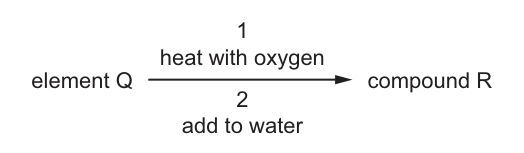
Element Q forms a nitrate that is less thermally stable than strontium nitrate.
What is the identity of compound R?
Options
A CaO
B Ca(OH)₂
C BaO
D Ba(OH)₂
Working
Thermal stability of Group 2 nitrates increases down the group: .
Since element Q forms a nitrate that is less thermally stable than strontium nitrate, Q must be positioned above strontium in Group 2. Given the options (Ca or Ba), Q must be calcium (Ca).
Following the flow diagram:
- Calcium heated with oxygen forms calcium oxide:
- Calcium oxide added to water forms calcium hydroxide:
Thus, compound R is .
Answer
B
B
Background Concept
Group 2 elements (the alkaline earth metals) react with oxygen to form ionic metal oxides (MO), which in turn react with water to form metal hydroxides (M(OH)₂). The thermal stability of Group 2 nitrates increases down the group (). This trend is explained by polarisation: smaller cations (like Mg²⁺) have a higher charge density and distort the large nitrate ion more, weakening the N–O bonds and making decomposition easier. Larger cations (like Ba²⁺) have lower charge density, polarise the nitrate ion less, and their nitrates are more thermally stable.
Understanding the Question
The question gives a flow diagram where element Q (either Ca or Ba) is heated with oxygen, and the product is then added to water to yield compound R. We are also told that Q's nitrate is less thermally stable than strontium nitrate. We need to identify R from the given options.
Approach
First, use the nitrate thermal stability trend to pinpoint which element Q is. Second, trace the chemical reactions in the flow diagram (metal → oxide → hydroxide) to determine the identity of compound R.
Step-by-Step Reasoning
- Identify element Q: The thermal stability of Group 2 nitrates increases down the group. Strontium is below calcium and above barium. Since Q's nitrate is less stable than Sr(NO₃)₂, Q must be above Sr. Between the choices (Ca and Ba), Q is calcium.
- Reaction 1 (heat with oxygen): Calcium burns in oxygen to form calcium oxide.
- Reaction 2 (add to water): Calcium oxide is a basic oxide that reacts with water to form calcium hydroxide.
- Conclusion: Compound R is calcium hydroxide, , which corresponds to option B.
Key Takeaways
- Group 2 nitrate thermal stability increases down the group; use this to identify elements in periodicity questions.
- Group 2 metals form oxides with oxygen, and these oxides form hydroxides with water.
Common Mistakes
- Confusing the trend direction: thinking stability decreases down the group, which would incorrectly identify Q as barium.
- Assuming the diagram means the metal reacts directly with water to give R in both paths: the diagram shows a two-step sequence (metal → oxide → hydroxide), not two parallel paths from the metal.
Things to Be Careful About
- Ensure you read "less thermally stable" correctly; it means higher up the group, not lower.
- State symbols are often required in full written answers, though not strictly necessary for selecting a multiple-choice option here.
Which anions are formed when chlorine is passed into cold aqueous potassium hydroxide?
Options
A Cl⁻ and ClO⁻
B Cl⁻ and ClO₃⁻
C Cl⁻ and ClO₄⁻
D ClO⁻ and ClO₃⁻
Working
In cold aqueous potassium hydroxide, chlorine disproportionates:
The oxidation number of chlorine changes from 0 to and , forming chloride ions and chlorate(I) (hypochlorite) ions. Chlorate(V) ions are only formed with hot, concentrated alkali.
Answer
A
A
Background Concept
Chlorine is a strong oxidising agent and also undergoes disproportionation in alkaline solution. Disproportionation is a redox reaction in which the same element is simultaneously oxidised and reduced. In chlorine, the oxidation number is 0. In cold aqueous alkali, one chlorine atom is reduced to (chloride, ) while another is oxidised to (chlorate(I), , commonly called hypochlorite). The reaction is:
The conditions matter: cold, dilute alkali favours chloride and chlorate(I), whereas hot, concentrated alkali favours further disproportionation to chlorate(V), .
Understanding the Question
The question asks which anions are formed when chlorine gas is passed into cold aqueous potassium hydroxide. The key word is cold. This tells us we need the cold-alkali disproportionation products, not the hot-concentrated-alkali products. The options list pairs of anions, so the task is to recall the correct pair formed under these conditions.
Approach
Start by identifying the oxidation number of chlorine in elemental chlorine, , which is 0. In alkali, chlorine disproportionates because it can both gain and lose electrons. For cold alkali, the stable products are chloride, , with oxidation number , and chlorate(I), , with oxidation number . For hot concentrated alkali, the products are chloride and chlorate(V), . Since the question specifies cold aqueous potassium hydroxide, select the cold-alkali pair.
Step-by-Step Reasoning
-
Write the oxidation numbers of chlorine in each possible product:
- In , oxidation number is .
- In , oxygen is , so chlorine is .
- In , total charge is and three oxygens contribute , so chlorine is .
- In , total charge is and four oxygens contribute , so chlorine is .
-
In cold alkali, chlorine disproportionates from 0 to and only. The product is the chlorate(I) ion, .
-
The balanced equation confirms the stoichiometry:
-
Therefore the anions formed are chloride and chlorate(I), which matches option A.
-
The other options are incorrect because they include chlorate(V) or chlorate(VII), which require hot, concentrated alkali or stronger oxidising conditions.
Key Takeaways
- Chlorine disproportionates in alkali because it can be both reduced and oxidised.
- Cold aqueous alkali gives and .
- Hot, concentrated alkali gives and .
- The oxidation number of chlorine in the oxyanions increases from in to in to in .
Common Mistakes
- Choosing option B, which includes , is the most common error. This happens when the cold/hot condition is ignored.
- Confusing chlorate(I), , with chlorate(V), , or chlorate(VII), .
- Forgetting that chlorine starts at oxidation number 0 and must be both oxidised and reduced in disproportionation.
Things to Be Careful About
- Always read whether the alkali is cold or hot/concentrated; the products are different.
- Use oxidation numbers to check which products are consistent with disproportionation.
- Make sure the equation is balanced in both atoms and charge.
- Use the correct terminology: is chlorate(I) or hypochlorite, not chlorate(V).
What increases for each successive element in Period 3 from sodium to sulfur?
Options
A the highest oxidation number of the element seen in an oxide
B the melting point of the elements
C the number of occupied orbitals in the atom
D the pH of the solutions of the chlorides in water
Working
For Period 3 elements Na → Mg → Al → Si → P → S, the highest oxidation number shown in their oxides is:
Na +1, Mg +2, Al +3, Si +4, P +5, S +6
This increases by 1 for each successive element.
The other options do not show a steady increase:
- Melting point: rises to Si, then falls sharply for P and S.
- Number of occupied orbitals: not every step adds a new occupied orbital.
- pH of chloride solutions: generally decreases (more acidic) across the period, not increases.
Answer
A
A
Background Concept
In Period 3, elements show trends in oxidation states, physical properties, and acid-base behaviour. From sodium to sulfur, the highest oxidation number seen in an oxide increases steadily because the elements use more of their outer-shell electrons in bonding to oxygen.
Understanding the Question
The question asks which property increases for every successive element from sodium to sulfur. The phrase “successive element” is important: a property that rises then falls is not correct.
Approach
Check each option against known Period 3 data. Only one property is consistently increasing across Na, Mg, Al, Si, P, and S.
Step-by-Step Reasoning
A. Highest oxidation number in oxides
Na₂O: Na is +1
MgO: Mg is +2
Al₂O₃: Al is +3
SiO₂: Si is +4
P₄O₁₀: P is +5
SO₃: S is +6
So this increases by 1 each step. Correct.
B. Melting point of the elements
Na, Mg, and Al have metallic structures; Si is a giant covalent solid with a very high melting point; P₄ and S₈ are simple molecular substances with low melting points. The trend rises then falls, so it is not increasing for every successive element.
C. Number of occupied orbitals in the atom
Na and Mg both have the same occupied core orbitals plus the 3s orbital. Adding electrons to the 3p sub-shell does not always increase the number of occupied orbitals because several electrons can occupy the same orbital. For example, P and S both have all three 3p orbitals occupied. So this does not increase for every successive element.
D. pH of the solutions of the chlorides in water
NaCl gives a neutral solution. Many later Period 3 chlorides hydrolyse in water to produce acidic solutions, so the pH generally decreases rather than increases.
Key Takeaways
The highest oxidation number of an element in its oxide often equals the number of outer-shell electrons it can use in bonding. From Na to S, this value increases steadily: +1, +2, +3, +4, +5, +6.
Common Mistakes
- Assuming melting point increases across the whole period because it rises from Na to Si.
- Forgetting that Si has a giant covalent structure, which makes its melting point unusually high.
- Confusing pH increase with pH decrease: acidic solutions have lower pH.
- Miscounting occupied orbitals: adding electrons to an already occupied orbital does not create a new occupied orbital.
Things to Be Careful About
- The question asks about “each successive element”, so a property that increases then decreases is not acceptable.
- “Highest oxidation number seen in an oxide” refers to the most positive oxidation state in a stable oxide, not every oxidation state the element can show.
- For chlorides, the pH trend is generally downward, not upward, because later chlorides hydrolyse to form acidic solutions.
Which statement about an ammonium ion is correct?
Options
A All of the H–N–H bond angles in the ion are 90°.
B All of the H–N–H bond angles in the ion are 107°.
C The ion contains a N–H dative covalent bond which is weaker than the other three N–H covalent bonds.
D The ion will react with a base as it is a weak acid.
Working
- The ammonium ion, , has four bonding pairs and no lone pair around nitrogen, so it is tetrahedral with H–N–H bond angles of about 109.5°, not 90° or 107°.
- One N–H bond is a dative (coordinate) covalent bond, but once formed it is identical in strength to the other three N–H bonds.
- can donate a proton to a base: . It therefore behaves as a weak acid.
Answer
D — The ion will react with a base as it is a weak acid.
D
Background Concept
The ammonium ion, , is formed when ammonia accepts a proton. Nitrogen in ammonia has a lone pair of electrons, which it donates to a hydrogen ion, . This forms a dative covalent (coordinate) bond. The ion has four N–H bonds and no lone pair on nitrogen, so VSEPR theory predicts a tetrahedral shape with bond angles of about 109.5°.
An acid is a proton donor. can donate a proton to a base, so it is a weak acid in aqueous solution.
Understanding the Question
The question asks which statement about the ammonium ion is correct. Each option tests a different idea:
- A and B test the bond angle.
- C tests whether the dative bond is weaker than the other N–H bonds.
- D tests whether the ion is a weak acid that reacts with a base.
Approach
Check each statement against known facts about .
Step-by-Step Reasoning
-
Bond angle
- has four bonding pairs and no lone pairs around nitrogen.
- VSEPR predicts a tetrahedral arrangement: bond angle = 109.5°.
- So A (90°) and B (107°) are both incorrect. 107° is the bond angle in ammonia, , which has one lone pair.
-
Dative covalent bond
- The fourth N–H bond is formed by donation of the nitrogen lone pair to a ion.
- Once formed, all four N–H bonds are identical; the dative bond is not weaker than the other three.
- So C is incorrect.
-
Acid behaviour
- can donate a proton to a base, e.g. .
- This is the behaviour of a weak acid.
- So D is correct.
Key Takeaways
- is tetrahedral with bond angles of 109.5°.
- A dative covalent bond is not weaker than an ordinary covalent bond once formed; all four N–H bonds in are equivalent.
- is the conjugate acid of ammonia and behaves as a weak acid.
Common Mistakes
- Confusing the bond angle in (107°) with that in (109.5°).
- Thinking that a dative bond is always weaker or different in strength from a normal covalent bond.
- Forgetting that can donate a proton and is therefore acidic.
Things to Be Careful About
- Count the electron pairs around nitrogen carefully: four bonds and no lone pair gives tetrahedral, not pyramidal.
- Remember that coordinate bonds are covalent bonds; their strength depends on the atoms involved, not on how the bond was formed.
- In acid-base questions, always identify which species can donate a proton.
An alcohol, U, is reacted with hot acidified K₂Cr₂O₇ solution. The organic product of the reaction contains 58.8% C, 9.8% H and 31.4% O by mass.
What is the identity of alcohol U?
Options
A 2-methylbutan-2-ol
B 3-methylbutan-2-ol
C pentan-1-ol
D propan-1-ol
Working
Assume 100 g of product:
- C: mol
- H: mol
- O: mol
Divide by the smallest number of moles:
Multiply by 2 to obtain whole numbers: empirical formula .
Hot acidified oxidises a primary alcohol to a carboxylic acid. The product is a saturated monocarboxylic acid with 5 carbon atoms. Of the options, only pentan-1-ol is a 5-carbon primary alcohol; it oxidises to pentanoic acid, .
Answer
C — pentan-1-ol
C
Background Concept
Acidified potassium dichromate(VI), , is a strong oxidising agent for alcohols. Its action depends on the class of alcohol:
- a primary alcohol is oxidised first to an aldehyde, and with hot, excess oxidant it is further oxidised to a carboxylic acid;
- a secondary alcohol is oxidised to a ketone, which resists further oxidation;
- a tertiary alcohol has no hydrogen atom on the carbon bearing the group, so it is not oxidised under these conditions.
The percentage composition of an organic compound can be converted into an empirical formula by assuming 100 g of the compound and dividing each mass by the appropriate relative atomic mass.
Understanding the Question
The question gives the percentage by mass of C, H and O in the organic product formed when alcohol U is treated with hot acidified . It asks you to identify U from four named alcohols. This requires two linked deductions: first, work out the formula of the product from its percentage composition; second, use the oxidation behaviour of alcohols to decide which starting alcohol could give that product.
The word "hot" is important: with hot acidified dichromate, a primary alcohol is fully oxidised to a carboxylic acid, not stopped at the aldehyde.
Approach
- Assume 100 g of product and convert each percentage to moles of atoms.
- Divide all mole values by the smallest to obtain a simplest ratio, then multiply to whole numbers to get the empirical formula.
- Recognise the empirical formula as that of a saturated monocarboxylic acid, .
- Since a carboxylic acid is formed, U must be a primary alcohol with the same number of carbon atoms as the product.
- Select the option that is a primary alcohol with the matching carbon skeleton.
Step-by-Step Reasoning
Using 100 g of product:
- C: mol
- H: mol
- O: mol
Divide each by the smallest value, 1.96:
The ratio is , so multiply by 2 to obtain whole numbers: .
The empirical formula mass is . A saturated monocarboxylic acid has the general formula ; with this is . So the product is a five-carbon carboxylic acid such as pentanoic acid.
Hot acidified dichromate oxidises a primary alcohol to a carboxylic acid. Therefore U must be a primary alcohol with five carbon atoms. Among the options:
- 2-methylbutan-2-ol is tertiary, so it is not oxidised;
- 3-methylbutan-2-ol is secondary, so it would give a ketone, , not ;
- propan-1-ol is primary but has only three carbons, giving propanoic acid, , whose percentage composition does not match;
- pentan-1-ol is a five-carbon primary alcohol and oxidises to pentanoic acid, .
Hence U is pentan-1-ol.
Key Takeaways
- Hot acidified : primary alcohol carboxylic acid, secondary alcohol ketone, tertiary alcohol no reaction.
- Percentage composition by mass can be converted into an empirical formula by assuming 100 g and dividing by relative atomic masses.
- The formula is characteristic of a saturated monocarboxylic acid, while is characteristic of an aldehyde or ketone.
- Working backwards from an oxidation product to the alcohol requires both the formula and the oxidation class.
Common Mistakes
- Treating a secondary alcohol as if it could be oxidised to a carboxylic acid. Secondary alcohols stop at ketones.
- Forgetting that tertiary alcohols are not oxidised because there is no hydrogen on the carbon attached to the group.
- Stopping at the ratio and not multiplying by 2 to obtain whole-number subscripts.
- Choosing propan-1-ol because it is primary, without checking that the carbon count of the product must match the percentage data.
- Overlooking the significance of "hot": under cold conditions or with distillation, a primary alcohol might be isolated as the aldehyde instead of the carboxylic acid.
Things to Be Careful About
- Use the correct relative atomic masses: C = 12, H = 1, O = 16.
- Divide by the smallest number of moles, not by the smallest percentage.
- Ensure the empirical formula contains whole-number subscripts before comparing it with a known functional group.
- The product formula must be consistent with the oxidation state: a carboxylic acid contains two oxygen atoms, whereas a ketone contains only one.
- In an exam answer, show the mole calculation clearly and state the oxidation rule that links the product back to the alcohol.
Which row shows a primary, a secondary and a tertiary alcohol?
Options
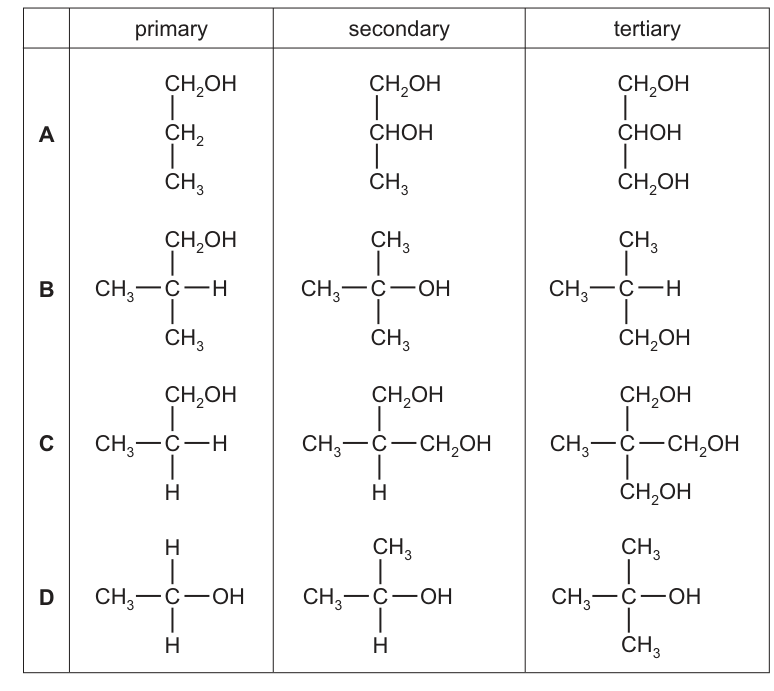
Working
To classify an alcohol, look at the carbon atom bonded to the group (the carbinol carbon):
- Primary (): The carbon is attached to 1 other carbon (or 0 for methanol).
- Secondary (): The carbon is attached to 2 other carbons.
- Tertiary (): The carbon is attached to 3 other carbons.
Analyzing Row D:
- Primary column: The structure is (ethanol). The bonded to is attached to 1 (). This is a primary alcohol.
- Secondary column: The structure is (propan-2-ol). The central bonded to is attached to 2 atoms (two groups). This is a secondary alcohol.
- Tertiary column: The structure is (2-methylpropan-2-ol). The central bonded to is attached to 3 atoms (three groups). This is a tertiary alcohol.
Row D correctly shows a primary, secondary, and tertiary alcohol in that order.
Answer
D
D
Background Concept
Alcohols are classified based on the number of carbon atoms attached to the carbon atom bearing the hydroxyl () group. This carbon is often called the carbinol carbon or the alpha-carbon (-carbon).
- Primary () alcohol: The group is attached to a carbon that is bonded to one other alkyl group (or no other carbons, in the case of methanol, ). General formula: .
- Secondary () alcohol: The group is attached to a carbon that is bonded to two other alkyl groups. General formula: .
- Tertiary () alcohol: The group is attached to a carbon that is bonded to three other alkyl groups. General formula: .
This classification is important because it affects the chemical reactivity of the alcohol, particularly in oxidation reactions (primary alcohols oxidise to aldehydes then carboxylic acids; secondary to ketones; tertiary do not oxidise easily) and substitution/elimination mechanisms.
Understanding the Question
The question asks to identify the row (A, B, C, or D) in the provided table that correctly lists a primary alcohol, followed by a secondary alcohol, and then a tertiary alcohol. We must examine the structural formula in each cell of the table and determine the classification of the alcohol shown.
Approach
For each structure in the table, locate the carbon atom directly bonded to the oxygen of the group. Count how many other carbon atoms are directly bonded to that specific carbon. Use the definitions above to classify the alcohol. Compare the classifications with the column headers ('primary', 'secondary', 'tertiary'). The correct row must have all three classifications match the headers.
Step-by-Step Reasoning
Row A:
- Primary column: Shows (propan-1-ol). The with is attached to 1 C. Correct ().
- Secondary column: Shows (propane-1,2-diol). This is a diol. While it contains a secondary alcohol group (), it also contains a primary one. More importantly, let's look at the tertiary column.
- Tertiary column: Shows (propane-1,2,3-triol / glycerol). There is no tertiary alcohol group here. The central carbon is secondary, the end carbons are primary. Incorrect.
Row B:
- Primary column: Shows 2-methylpropan-1-ol. The with () is attached to 1 C. Correct ().
- Secondary column: Shows (2-methylpropan-2-ol). The central C is attached to three methyl groups. This is a tertiary alcohol, but the column header is 'secondary'. Incorrect.
- Tertiary column: Shows 2-methylpropan-1-ol again (primary). Incorrect.
Row C:
- Primary column: 2-methylpropan-1-ol. Correct ().
- Secondary column: Shows a molecule with two groups. Both are primary alcohol groups. No secondary alcohol group present. Incorrect.
- Tertiary column: Shows a molecule with three groups attached to a central carbon (plus a methyl). All alcohol groups are primary. Incorrect.
Row D:
- Primary column: Shows (ethanol). The carbon bonded to is bonded to one methyl group (). This is a primary alcohol.
- Secondary column: Shows (propan-2-ol). The central carbon bonded to is bonded to two methyl groups (). This is a secondary alcohol.
- Tertiary column: Shows (2-methylpropan-2-ol or tert-butanol). The central carbon bonded to is bonded to three methyl groups (). This is a tertiary alcohol.
Row D matches the sequence: primary, secondary, tertiary.
Key Takeaways
- Classification of alcohols depends solely on the number of carbon atoms attached to the carbon holding the group.
- Primary: 1 R-group (or 0 for methanol).
- Secondary: 2 R-groups.
- Tertiary: 3 R-groups.
- Always look at the specific carbon atom bonded to the functional group, not the whole molecule.
Common Mistakes
- Counting all carbons in the molecule: Students might count the total number of carbons (e.g., in 2-methylpropan-2-ol, there are 4 carbons) and get confused. They must only count carbons attached to the carbinol carbon (the C with the OH).
- Confusing the structure: In row B, the 'secondary' column actually shows a tertiary alcohol (tert-butyl alcohol). Students might misread the bonds.
- Ignoring multiple functional groups: In rows A and C, the molecules are diols or triols. A molecule can contain both primary and secondary alcohol groups (like in row A, secondary column), but the question asks for a row showing a primary, a secondary, and a tertiary alcohol as distinct examples. Row D provides clear, single-functional-group examples for each class.
Things to Be Careful About
- State symbols are not needed for classification questions, but ensure you read the structural formula correctly (e.g., distinguishing from ).
- Bent structures: In the diagrams, bonds are drawn vertically and horizontally. Ensure you trace the connections correctly. For example, in the tertiary column of D, the central C is connected to a top , a left , a bottom , and a right . That's 3 carbons attached to the central carbon.
- Methanol: Methanol () is technically a primary alcohol because the carbon is attached to 0 other carbons (which fits the pattern where R=H, though strictly R is an alkyl group, IUPAC classifies methanol as primary). However, usually questions provide clear , , examples like ethanol, propan-2-ol, and 2-methylpropan-2-ol.
1-chloro-2-methylbutane reacts with sodium cyanide in a nucleophilic substitution reaction.
What is the most likely intermediate or transition state in this reaction?
Options
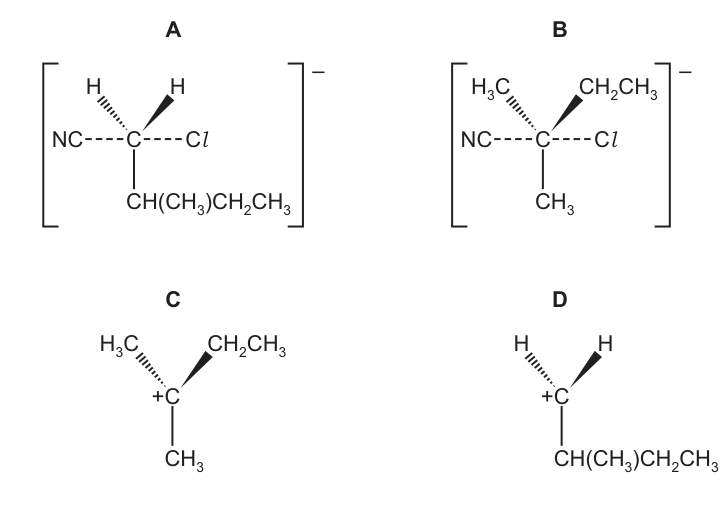
Answer
A
1-chloro-2-methylbutane is a primary halogenoalkane (the chlorine is attached to a primary carbon, C1, which is bonded to two hydrogen atoms and one alkyl group). Primary halogenoalkanes react with good nucleophiles like the cyanide ion (CN⁻) via an SN2 mechanism.
The SN2 mechanism is a concerted, one-step reaction. It does not form a carbocation intermediate. Instead, it proceeds through a pentacoordinate transition state where the nucleophile forms a partial bond with the carbon while the leaving group (chloride) forms a partial bond. The carbon atom involved must be the one originally bonded to the chlorine (C1).
- Options C and D show carbocation intermediates, which are characteristic of the SN1 mechanism. Primary carbocations are too unstable to form, so SN1 is not the likely pathway.
- Option B shows a transition state at the wrong carbon atom (C2, the tertiary carbon). The reaction occurs at C1 where the chlorine is attached.
- Option A correctly shows the pentacoordinate transition state at the primary carbon (C1, bonded to two H atoms and the rest of the chain), with partial bonds to the incoming nucleophile (NC) and the leaving group (Cl), and a net charge of -1.
Answer
A
A
Background Concept
Nucleophilic substitution in halogenoalkanes generally proceeds via one of two mechanisms: SN1 (substitution nucleophilic unimolecular) or SN2 (substitution nucleophilic bimolecular). The pathway depends heavily on the class of the halogenoalkane:
- SN2 Mechanism: Favored by primary halogenoalkanes. It is a concerted, one-step process. The nucleophile attacks the electrophilic carbon from the side opposite to the leaving group (backside attack). This leads to a pentacoordinate transition state with partial bonds to both the nucleophile and the leaving group. There is no intermediate formed. The rate depends on the concentration of both the halogenoalkane and the nucleophile.
- SN1 Mechanism: Favored by tertiary halogenoalkanes. It is a two-step process. First, the leaving group departs to form a carbocation intermediate (rate-determining step). Then, the nucleophile attacks the carbocation. Primary carbocations are highly unstable and generally do not form under normal conditions, so primary halogenoalkanes do not react via SN1.
Understanding the Question
The question asks for the most likely intermediate or transition state for the reaction between 1-chloro-2-methylbutane and sodium cyanide (NaCN).
- Identify the substrate: 1-chloro-2-methylbutane has the structure Cl–CH₂–CH(CH₃)–CH₂–CH₃. The chlorine atom is attached to C1. C1 is bonded to two hydrogen atoms and one carbon atom (C2). Therefore, this is a primary halogenoalkane.
- Identify the reagent: Sodium cyanide provides the cyanide ion, CN⁻, which is a strong nucleophile.
- Determine the mechanism: Primary halogenoalkanes reacting with strong nucleophiles undergo SN2 substitution. This means we are looking for a transition state, not a carbocation intermediate. The reaction happens at C1.
Approach
- Classify the halogenoalkane: 1-chloro-2-methylbutane is primary.
- Select the mechanism: Primary substrates with good nucleophiles undergo SN2.
- Eliminate options based on mechanism type: SN2 involves a transition state, not a carbocation intermediate. Eliminate C and D (carbocations).
- Eliminate options based on the reaction site: The reaction must occur at the carbon holding the leaving group (Cl), which is C1 (the primary carbon with two H atoms). Eliminate B (which is at C2).
- Verify the remaining option: A shows the correct carbon (primary) and the correct SN2 transition state geometry (pentacoordinate, partial bonds, negative charge).
Step-by-Step Reasoning
- Structure Analysis: 1-chloro-2-methylbutane is Cl–CH₂–CH(CH₃)CH₂CH₃. The carbon bonded to Cl is a primary carbon (bonded to 2 H's and 1 C). Let's call this C1.
- Mechanism Selection: Because C1 is primary, steric hindrance is low, favoring the SN2 backside attack. The cyanide ion (CN⁻) is a good nucleophile. Thus, the reaction is SN2.
- Transition State vs Intermediate: SN2 reactions proceed through a single transition state with no intermediate. SN1 reactions proceed through a carbocation intermediate. Since this is SN2, we look for a transition state (pentacoordinate carbon with partial bonds). This eliminates C and D, which show carbocations (positive charge on carbon, only 3 bonds shown explicitly plus the charge).
- Note on D: Even if we considered SN1, a primary carbocation (D) is too unstable to form.
- Note on C: C shows a tertiary carbocation at C2. This would be the intermediate for 2-chloro-2-methylbutane, not 1-chloro-2-methylbutane.
- Evaluating Transition States (A and B):
- The transition state must involve the carbon atom that is losing the leaving group (Cl). In 1-chloro-2-methylbutane, this is C1.
- C1 has two hydrogen atoms attached. Looking at A, the central carbon is bonded to two H atoms and a –CH(CH₃)CH₂CH₃ group. This matches C1. The structure shows partial bonds (dashed lines) to NC and Cl, and a negative charge (from the incoming CN⁻). This is the correct SN2 transition state.
- Looking at B, the central carbon is bonded to –CH₃, –CH₂CH₃, and –CH₃. This corresponds to C2 of the molecule (which has a methyl branch and an ethyl group). The chlorine is not on C2, so substitution does not happen here. This is incorrect.
- Conclusion: Option A is the correct transition state.
Key Takeaways
- Primary halogenoalkanes undergo nucleophilic substitution via the SN2 mechanism.
- SN2 reactions have a pentacoordinate transition state (partial bonds to nucleophile and leaving group) and do not form carbocation intermediates.
- Always identify the correct carbon atom: the reaction occurs at the carbon bonded to the halogen (the electrophilic center).
- Tertiary halogenoalkanes would form carbocation intermediates (SN1), but primary ones do not.
Common Mistakes
- Confusing substrate classes: Thinking 1-chloro-2-methylbutane is tertiary because it has a methyl branch. The classification depends on the carbon holding the halogen. Here, Cl is on C1 (primary), not C2 (tertiary).
- Assuming carbocation intermediate: Assuming all nucleophilic substitutions go through carbocations. This is only true for SN1 (tertiary substrates). Primary substrates go via SN2 (transition state only).
- Wrong reaction site: Selecting a structure involving C2 (the branched carbon) instead of C1 (the carbon with the Cl). The nucleophile attacks the carbon bonded to the leaving group.
Things to Be Careful About
- Structure naming: Ensure you correctly identify which carbon is which. "1-chloro" means Cl is on C1. "2-methyl" means the methyl branch is on C2. The primary carbon is C1.
- Transition state charge: The transition state for CN⁻ + RCl is [NC···R···Cl]⁻. The net charge is -1. Options A and B correctly show this.
- Partial bonds: In transition states, bonds are breaking and forming simultaneously. Look for dashed lines representing partial bonds. In intermediates (carbocations), look for a full positive charge and only 3 bonds to carbon (6 electrons in valence shell).
When 0.010 mol of a hydrocarbon X reacts with 720 cm³ of hydrogen at room conditions, an alkane is formed.
What is hydrocarbon X?
Options
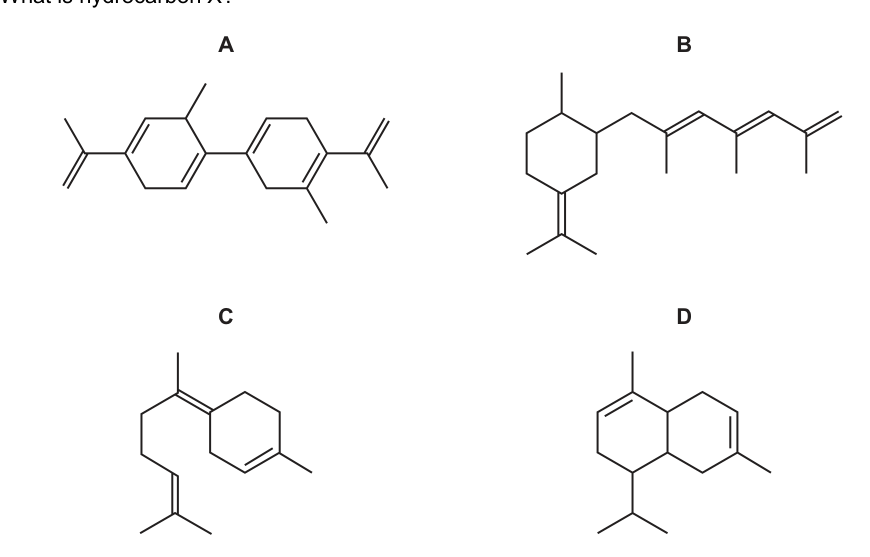
Working
At room conditions, the molar volume of a gas is (or ).
The ratio of moles of hydrogen to moles of hydrocarbon X is:
This means 1 mole of hydrocarbon X reacts with 3 moles of . Since the product is an alkane, all carbon-carbon double bonds (C=C) in X must be hydrogenated. Each C=C bond reacts with one molecule. Therefore, hydrocarbon X must contain exactly 3 C=C double bonds.
Note: Benzene rings (aromatic rings) do not react with hydrogen at room conditions; they require high temperature and pressure. Structures containing benzene rings (like A) would not fully hydrogenate to an alkane under these conditions, or would require many more moles of hydrogen if they did. We look for a structure with exactly 3 non-aromatic C=C double bonds.
- Structure A: Contains aromatic rings and 2 C=C bonds in side chains. (Incorrect)
- Structure B: Contains 4 or 5 C=C double bonds. (Incorrect)
- Structure C: Contains exactly 3 C=C double bonds. (Correct)
- Structure D: Contains 2 C=C double bonds. (Incorrect)
Answer
C
C
Background Concept
Hydrogenation of Alkenes:
Alkenes undergo addition reactions with hydrogen () in the presence of a catalyst (usually nickel, palladium, or platinum) to form alkanes. This is an addition reaction where the pi bond in the C=C double bond breaks, and two hydrogen atoms add across the carbons.
Each mole of C=C double bonds reacts with exactly 1 mole of gas. Therefore, if a hydrocarbon has C=C double bonds, 1 mole of that hydrocarbon will react with moles of to form the corresponding alkane (assuming no other unsaturated groups like C≡C or aromatic rings that react under these conditions).
Molar Volume of Gases:
At room conditions (typically defined as 25°C and 101 kPa in Cambridge syllabus, or sometimes 20°C), the molar volume of an ideal gas is approximately (or ). This allows conversion between volume of a gas and number of moles.
Reading Skeletal Structures:
In skeletal structures, vertices and ends of lines represent carbon atoms. Hydrogen atoms attached to carbons are implied. Double bonds are shown as double lines (=). Aromatic rings (benzene rings) are often drawn as hexagons with alternating double bonds or a circle inside. Benzene rings are very stable due to delocalization and do not readily undergo addition reactions with hydrogen at room temperature and pressure; they require much harsher conditions (high temp, high pressure, catalyst). Therefore, in a question specifying "room conditions" and forming an "alkane", we typically only count non-aromatic C=C double bonds, or assume the question implies complete saturation of reactive unsaturation. However, looking at the options, we are looking for a simple stoichiometric match.
Understanding the Question
We are given:
- Amount of hydrocarbon X:
- Volume of hydrogen gas: at room conditions
- Reaction: X + → Alkane
We need to identify which of the four structures (A, B, C, D) is hydrocarbon X.
The key is to find the stoichiometric ratio of to X. This ratio tells us how many moles of hydrogen react with one mole of X, which corresponds to the number of C=C double bonds that are hydrogenated.
Approach
- Calculate moles of hydrogen: Use the molar volume at room conditions () to find the moles of in .
- Determine the ratio: Divide moles of by moles of X to find how many moles of react per mole of X.
- Analyze structures: Count the number of reactive C=C double bonds in each option (A, B, C, D).
- Ignore aromatic rings if the conditions are mild (room temp), as they don't hydrogenate easily. However, if the problem implies complete hydrogenation to an alkane, we must be careful. Let's look at the numbers first.
- The calculated ratio is likely a small integer (1, 2, 3, etc.).
- Match: Select the structure that has the matching number of C=C double bonds.
Step-by-Step Reasoning
Step 1: Calculate moles of
Step 2: Determine the stoichiometric ratio
This means 1 molecule of X reacts with 3 molecules of . Since each C=C bond reacts with one , hydrocarbon X must have 3 C=C double bonds (that are reactive under these conditions).
Step 3: Analyze the options
-
Structure A: This molecule contains two benzene-like rings (aromatic) and two isopropenyl groups (). Benzene rings do not hydrogenate at room conditions. Even if we only count the side chain alkenes, there are 2 double bonds. If we counted the benzene rings (which would require moles of plus 2 for the side chains = 8 moles), the ratio would be 8:1. This does not match 3:1.
-
Structure B: Let's count the double bonds. There is one in the ring (bottom left), one in the isopropenyl group attached to the ring, and a conjugated chain with multiple double bonds. Counting carefully: ring double bond (1), isopropenyl (1), chain has at least 3 double bonds. Total is around 5 or 6. This is too many.
-
Structure C: Let's count the C=C double bonds.
- Bottom left: Isopropenyl group () — 1 double bond.
- Middle: A double bond connecting the chain/ring system (looks like an exocyclic double bond or part of the ring) — 1 double bond.
- Right ring: One double bond inside the six-membered ring — 1 double bond.
Total = 3 C=C double bonds. All are non-aromatic alkenes. They will all react with at room conditions with a catalyst.
per mole of X. This matches our calculated ratio.
-
Structure D: This is a fused ring system (decalin derivative). There is one double bond in the left ring and one in the right ring. Total = 2 C=C double bonds. This would react with 2 moles of (ratio 2:1). This does not match.
Conclusion: Structure C has exactly 3 reactive C=C double bonds, matching the 3:1 stoichiometry derived from the gas volume data.
Key Takeaways
- Always convert gas volumes to moles using the appropriate molar volume ( or at room conditions for CIE).
- The ratio of moles of to moles of unsaturated compound gives the number of double bonds (or equivalent unsaturation) that are hydrogenated.
- Be careful with aromatic rings: they are stable and do not undergo addition with under mild conditions (room temp). Questions specifying "room conditions" usually imply only alkene/alkyne hydrogenation.
- Practice counting double bonds in complex skeletal structures (terpenes like limonene, myrcene, etc., often appear in these questions).
Common Mistakes
- Wrong molar volume: Using (which is for RTP at 0°C/STP in some older definitions, or specifically STP 0°C, 101kPa). Cambridge uses for room temperature (25°C). Using 22.4 would give mol, ratio 3.2, which is confusing. Using 24.0 gives exactly 3.
- Counting aromatic rings: Assuming benzene rings react with 3 at room temperature. They don't. If a student counted the benzene rings in A as reacting, they would get a huge number.
- Miscounting double bonds in skeletal structures: Forgetting that vertices are carbons or missing a double bond in a chain. Structure C is a bit complex (looks like a terpene, possibly lycopene fragment or similar), so careful tracing is needed.
- Forgetting the mole ratio: Calculating moles of but forgetting to divide by moles of X to get the per-molecule ratio.
Things to Be Careful About
- State symbols and conditions: The question says "room conditions". Ensure you use .
- Structure interpretation: In skeletal formulae, a line end is a methyl group, a vertex is a CH2 (unless double bonded), and double lines are double bonds. In Structure C, the double bond at the bottom left is clearly . The double bond in the right ring is clear. The central double bond connecting the systems is clear. Total 3.
- Aromaticity: Recognizing that Structure A contains aromatic rings is crucial. Even if the question said "complete hydrogenation", Structure A would require moles of . The ratio is 3, so A is definitely wrong.
An alkene reacts with hot concentrated acidified KMnO₄ to produce a single organic product as shown.
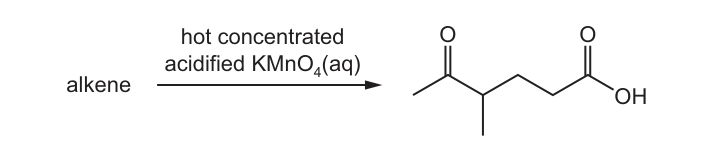
What is the structure of the alkene?
Options
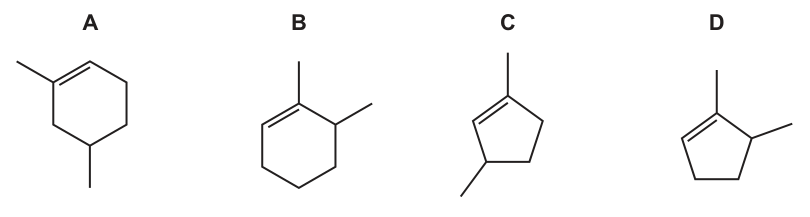
Working
Hot concentrated acidified KMnO₄ oxidatively cleaves the C=C double bond:
- A carbon with two alkyl groups (R₂C=) becomes a ketone (R₂C=O).
- A carbon with one alkyl and one hydrogen (RHC=) becomes a carboxylic acid (RCOOH).
- A terminal =CH₂ group would produce CO₂ (an inorganic product).
The product is a single organic molecule containing both a ketone and a carboxylic acid group: 5-oxo-4-methylhexanoic acid (CH₃COCH(CH₃)CH₂CH₂COOH). Since both carbonyl groups are in the same molecule, the original alkene must be cyclic (cleaving a ring opens it into a single chain). If the alkene were acyclic, cleavage would produce two separate organic fragments.
Working backwards from the product:
- The ketone group (CH₃CO–) comes from a ring carbon that had a methyl group and no hydrogen (R₂C=).
- The carboxylic acid group (–COOH) comes from the other ring carbon that had one hydrogen (RHC=).
- The carbon chain between them is –CH(CH₃)–CH₂–CH₂–, meaning there are three saturated carbons between the double-bond carbons in the ring, making it a 5-membered ring (cyclopentene derivative).
Checking the options:
- A and B are 6-membered rings (cyclohexene derivatives) — incorrect ring size.
- C is 1,3-dimethylcyclopent-1-ene. Cleavage would give 4-methyl-5-oxohexanoic acid (CH₃COCH₂CH₂CH(CH₃)COOH), which does not match the product.
- D is 1,3-dimethylcyclopent-1-ene (methyls on C1 and C3, but with the double bond between C1 and C5 in the numbering that gives the correct connectivity). Cleavage of D gives exactly CH₃COCH(CH₃)CH₂CH₂COOH, matching the product.
Answer
D
D
Background Concept
Oxidative cleavage of alkenes using hot concentrated acidified potassium manganate(VII) (KMnO₄) breaks the C=C double bond completely and oxidises each carbon of the double bond depending on its substitution:
- R₂C= (two alkyl groups, no hydrogens) → R₂C=O (ketone)
- RHC= (one alkyl group, one hydrogen) → RCOOH (carboxylic acid)
- H₂C= (two hydrogens, terminal alkene) → CO₂ (carbon dioxide, an inorganic gas)
If the alkene is acyclic, cleavage produces two separate fragments (or one organic fragment and CO₂ if there is a terminal =CH₂). If the alkene is cyclic, cleavage opens the ring but leaves the molecule as a single chain with two functional groups at the ends.
Understanding the Question
The question shows an alkene reacting with hot concentrated acidified KMnO₄ to give a single organic product: 5-oxo-4-methylhexanoic acid, with the structure CH₃–CO–CH(CH₃)–CH₂–CH₂–COOH. We are given four cyclic alkene options (A, B, C, D) and must identify which one produces this exact product.
The product has:
- A ketone at one end (CH₃CO–)
- A carboxylic acid at the other end (–COOH)
- A methyl branch on the carbon adjacent to the ketone
- Two CH₂ groups between the branched carbon and the carboxylic acid
Approach
- Determine if the alkene is cyclic or acyclic: Since the product is a single organic molecule containing both a ketone and a carboxylic acid, the alkene must be cyclic. Acyclic cleavage would give two fragments.
- Determine the ring size: Count the atoms in the product chain between the two carbonyl carbons. The ketone carbon and the carboxylic acid carbon were the two double-bond carbons. Between them in the product are: CH(CH₃), CH₂, CH₂ — that is 3 carbons. Including the two carbonyl carbons, the ring has 5 carbons (cyclopentene derivative).
- Eliminate wrong ring sizes: Options A and B are 6-membered rings (cyclohexene), so they are eliminated.
- Determine methyl positions: The ketone comes from a carbon that had a methyl group attached (and no H). The carboxylic acid comes from a carbon that had one H. The methyl branch on C4 of the product comes from a ring carbon that is one position away from the ketone carbon. Trace the connectivity in C and D to see which gives the correct product.
Step-by-Step Reasoning
Step 1: Cyclic vs acyclic
The product 5-oxo-4-methylhexanoic acid (CH₃COCH(CH₃)CH₂CH₂COOH) is a single molecule with two oxidised ends. This is only possible if the original alkene was a ring — cleaving the double bond opens the ring into a linear chain. If it were an open-chain alkene, we would get two separate products (or CO₂ + one product if terminal). Since only one organic product is formed, the alkene is cyclic.
Step 2: Ring size
In the product, the two carbonyl carbons (C1 of COOH and C5 of the ketone) were the original double-bond carbons. The chain between them is: C4(CH₃)–C3–C2, which is 3 carbons. Total ring size = 2 (double bond carbons) + 3 (saturated carbons) = 5. So the alkene is a cyclopentene derivative.
- Options A and B are cyclohexenes (6-membered rings). Eliminate them.
Step 3: Analyse option C
Option C is 1,3-dimethylcyclopent-1-ene (methyl on C1 and C3, double bond between C1 and C2).
- C1 has a methyl and no H → becomes ketone (CH₃CO–)
- C2 has one H → becomes carboxylic acid (–COOH)
- Going from C1 around the ring to C2: C1–C5–C4–C3(CH₃)–C2
- Product: CH₃CO–CH₂–CH₂–CH(CH₃)–COOH → 4-methyl-5-oxohexanoic acid
- This does not match the given product (the methyl is on the wrong carbon).
Step 4: Analyse option D
Option D has the methyl on the double-bond carbon (C1) and the other methyl on C3 (adjacent to C1 on the saturated side). Double bond is between C1 and C5 (or C1 and C2 depending on numbering).
- C1 has a methyl and no H → becomes ketone (CH₃CO–)
- The other double-bond carbon has one H → becomes carboxylic acid (–COOH)
- Going from C1 around the ring to the acid carbon: C1–C(saturated with CH₃)–CH₂–CH₂–C(acid)
- Product: CH₃CO–CH(CH₃)–CH₂–CH₂–COOH → 5-oxo-4-methylhexanoic acid
- This matches the given product exactly.
Conclusion: Option D is the correct alkene.
Key Takeaways
- Hot concentrated acidified KMnO₄ cleaves C=C bonds and oxidises each carbon based on substitution: R₂C= → ketone, RHC= → carboxylic acid, H₂C= → CO₂.
- A single organic product from oxidative cleavage indicates a cyclic alkene.
- Working backwards from the product: identify which carbons were the double-bond carbons (the two carbonyl carbons), count the ring size, and match the substituent positions.
Common Mistakes
- Assuming the alkene is acyclic: Students may forget that a single organic product implies a cyclic structure and try to match an open-chain alkene, which would give two fragments.
- Miscounting the ring size: Forgetting to include the two double-bond carbons when counting the ring size from the product chain.
- Confusing the methyl positions in C and D: Both are dimethylcyclopentenes, but the position of the methyl relative to the double bond determines which end becomes the ketone vs the carboxylic acid and where the branch ends up in the product.
- Forgetting that =CH₂ gives CO₂: If a terminal alkene were used, CO₂ would be produced (inorganic), and students might incorrectly count it as an organic product.
Things to Be Careful About
- State symbols and reagent conditions: The reagent must be hot concentrated acidified KMnO₄ for oxidative cleavage. Cold dilute KMnO₄ would give a diol (syn-addition), not cleavage.
- Distinguishing ketone from carboxylic acid ends: The ketone comes from the more substituted double-bond carbon (no H), and the carboxylic acid from the less substituted one (one H). This determines which end of the ring opens to which functional group.
- Numbering the product correctly: When naming or matching the product, number from the carboxylic acid (highest priority functional group) to correctly locate the ketone and methyl branch.
- Option C vs D similarity: Both are 5-membered rings with two methyl groups. Carefully trace the connectivity from the double bond through the ring to ensure the methyl branch ends up on the correct carbon (C4, adjacent to the ketone, not adjacent to the carboxylic acid).
Testosterone is an optically active organic molecule.
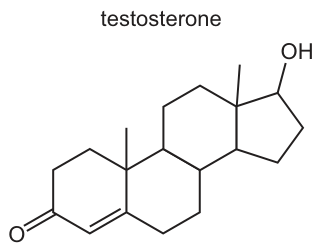
How many chiral centres are there in one molecule of testosterone?
Options
A 5
B 6
C 7
D 8
Working
A chiral centre is a carbon atom bonded to four different groups. In a ring system, we must trace the path around the ring in both directions; if the paths are different, the ring carbons count as different groups.
Analyzing the testosterone structure:
- C3, C4, C5: These are part of the ketone (C=O) and alkene (C=C) groups in the first ring. They are sp² hybridised and cannot be chiral centres.
- C1, C2, C6, C7, C11, C12, C15, C16: These are CH₂ groups (bonded to two identical hydrogen atoms), so they are not chiral.
- C10: Bonded to a methyl group, C1 (CH₂), C9 (CH), and C5 (sp² carbon of the double bond). Four different groups. Chiral.
- C8: Bonded to H, C7 (CH₂), C9 (CH), and C14 (CH). Four different groups. Chiral.
- C9: Bonded to H, C8 (CH), C10 (quaternary C with methyl), and C11 (CH₂). Four different groups. Chiral.
- C13: Bonded to a methyl group, C12 (CH₂), C14 (CH), and C15 (CH₂). Four different groups. Chiral.
- C14: Bonded to H, C8 (CH), C13 (quaternary C), and C15 (CH₂). Four different groups. Chiral.
- C17: Bonded to H, OH, C16 (CH₂), and C13 (quaternary C). Four different groups. Chiral.
Total chiral centres: C8, C9, C10, C13, C14, C17.
Count = 6.
Answer
B
B
Background Concept
A chiral centre (or stereocentre) is typically a carbon atom that is sp³ hybridised and bonded to four different atoms or groups. Because of this tetrahedral arrangement, the molecule lacks a plane of symmetry at that carbon, leading to optical isomerism (enantiomers).
In acyclic molecules, this is straightforward to spot. In cyclic molecules like steroids, the "groups" attached to a ring carbon often include the rest of the ring itself. To determine if two ring paths count as different groups, you must trace the path around the ring in both directions (clockwise and anticlockwise). If the sequence of atoms or substituents encountered is different in the two directions, the two paths are considered different groups, and the carbon can be chiral.
Carbon atoms that are not chiral centres include:
- sp² hybridised carbons (part of C=C or C=O double bonds).
- sp hybridised carbons (part of C≡C triple bonds).
- CH₂ or CH₃ groups (bonded to two or three identical hydrogen atoms).
Understanding the Question
The question asks for the number of chiral centres in testosterone, a steroid hormone. The provided image shows the skeletal structure of testosterone. We must identify every carbon atom that is bonded to four distinct groups. The options are 5, 6, 7, or 8.
Approach
- Eliminate non-sp³ carbons: Identify carbons involved in double bonds (C=O and C=C). These cannot be chiral.
- Eliminate CH₂/CH₃ groups: Identify carbons with two or three hydrogens. These cannot be chiral.
- Analyze remaining carbons: For the remaining CH or quaternary C atoms, check the four attached groups. For ring carbons, mentally trace the ring paths to ensure the groups are distinct.
Step-by-Step Reasoning
Let's number the carbons according to standard steroid nomenclature and analyse them:
-
Ring A (leftmost ring):
- C3: Has a =O group. sp² hybridised. Not chiral.
- C4 and C5: Part of the C=C double bond. sp² hybridised. Not chiral.
- C1 and C2: CH₂ groups. Not chiral.
- C10: Quaternary carbon at the ring junction. Attached to: (1) Methyl group (CH₃), (2) C1 (CH₂), (3) C9 (CH), (4) C5 (sp² carbon of the alkene). All four are different. Chiral (1).
-
Ring B (second ring):
- C6 and C7: CH₂ groups. Not chiral.
- C8: CH at ring junction. Attached to: (1) H, (2) C7 (CH₂), (3) C9 (CH), (4) C14 (CH). The paths around the rings lead to different environments. Chiral (2).
- C9: CH at ring junction. Attached to: (1) H, (2) C8 (CH), (3) C10 (quaternary C with methyl), (4) C11 (CH₂). All different. Chiral (3).
-
Ring C (third ring):
- C11 and C12: CH₂ groups. Not chiral.
- C13: Quaternary carbon at ring junction. Attached to: (1) Methyl group (CH₃), (2) C12 (CH₂), (3) C14 (CH), (4) C15 (CH₂). All different. Chiral (4).
- C14: CH at ring junction. Attached to: (1) H, (2) C8 (CH), (3) C13 (quaternary C), (4) C15 (CH₂). All different. Chiral (5).
-
Ring D (rightmost 5-membered ring):
- C15 and C16: CH₂ groups. Not chiral.
- C17: CH bonded to an -OH group. Attached to: (1) H, (2) -OH, (3) C16 (CH₂), (4) C13 (quaternary C). All different. Chiral (6).
Total count: 6 chiral centres (C8, C9, C10, C13, C14, C17).
Key Takeaways
- A chiral centre requires an sp³ carbon with 4 different substituents.
- In fused ring systems, ring junction carbons and carbons bearing substituents (like -OH or -CH₃) are common chiral centres.
- Always check for sp² carbons (double bonds) and CH₂ groups to quickly eliminate non-chiral centres.
Common Mistakes
- Counting sp² carbons: Students might count C3, C4, or C5 as chiral centres. Remember, double-bonded carbons are planar (sp²) and cannot be chiral centres.
- Missing ring junctions: Forgetting that carbons at the junction of two rings (like C8, C9, C10, C13, C14) are often chiral because the two ring paths are different.
- Ignoring the methyl groups: The angular methyl groups at C10 and C13 create quaternary chiral centres. If you miss them, you might undercount.
Things to Be Careful About
- Tracing ring paths: When checking a ring carbon like C8, ensure you verify that the path C8→C7→C6... is different from C8→C14→C15.... In complex steroids, they almost always are, but it's a necessary check.
- State symbols/functional groups: The -OH at C17 and the =O at C3 are crucial for defining the groups attached to adjacent carbons.
Quinone is an unsaturated molecule.
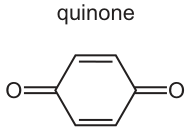
Which statement about quinone is correct?
Options
A Quinone is non-planar and has an overall dipole moment.
B Quinone is non-planar and does not have an overall dipole moment.
C Quinone is planar and has an overall dipole moment.
D Quinone is planar and does not have an overall dipole moment.
Working
Quinone (p-benzoquinone) contains a six-membered ring where every carbon atom is involved in a double bond (either C=C or C=O). This means all ring carbon atoms are sp² hybridised. Atoms with sp² hybridisation have trigonal planar geometry, and the unhybridised p-orbitals overlap to form a conjugated π system. For this p-orbital overlap to occur effectively, the entire molecule must be planar. This eliminates options A and B.
The molecule contains two polar C=O bonds. Because oxygen is more electronegative than carbon, each C=O bond has a dipole moment pointing from the carbon towards the oxygen. In quinone, these two C=O groups are located at positions 1 and 4, which are directly opposite each other on the ring (para positions). The dipole vectors point in exactly opposite directions along the same axis. Because the molecule is highly symmetric (it has a centre of inversion), these two equal and opposite dipole moments cancel each other out completely. There is no net overall dipole moment. This eliminates option C.
Answer
D
D
Background Concept
Planarity in organic molecules often arises from sp² hybridisation. Atoms with sp² hybridisation (like the carbons in C=C and C=O bonds) have trigonal planar geometry, with bond angles of approximately 120°. When a ring consists entirely of sp² hybridised atoms, the ring is planar to allow the unhybridised p-orbitals to overlap side-by-side, forming a conjugated π system.
A dipole moment is a vector quantity. For a molecule to have no overall dipole moment, the individual bond dipoles must cancel out. This happens when the molecule has a high degree of symmetry, such as a centre of inversion, a horizontal mirror plane, or opposing equal dipoles that sum to zero vectorially.
Understanding the Question
The question provides the structure of quinone (cyclohexa-2,5-diene-1,4-dione), which is a six-membered ring with two C=O groups at opposite ends (positions 1 and 4) and two C=C double bonds. We need to determine two properties:
- Is the molecule planar or non-planar?
- Does it have an overall dipole moment or not?
Approach
First, assess the hybridisation of the atoms in the ring. Since all ring carbons are part of double bonds (C=C or C=O), they are all sp² hybridised. This dictates the geometry and planarity of the molecule.
Second, evaluate the symmetry and vector addition of bond dipoles. Identify the polar bonds (C=O) and their orientations. If they are symmetrically opposed, their dipoles will cancel.
Step-by-Step Reasoning
-
Planarity: Look at the carbon atoms in the six-membered ring. There are four carbons involved in C=C double bonds and two carbons involved in C=O double bonds. Every carbon atom in the ring is sp² hybridised. sp² hybridised atoms have trigonal planar geometry. Furthermore, the unhybridised p-orbitals on each carbon atom are perpendicular to the plane of the σ bonds and overlap to form a conjugated π system across the ring. For this p-orbital overlap to occur effectively, the entire ring must be planar. The oxygen atoms in the C=O groups also lie in this plane. Therefore, quinone is a planar molecule. This eliminates options A and B.
-
Dipole moment: The molecule contains two polar C=O bonds. Oxygen is more electronegative than carbon, so each C=O bond has a dipole moment pointing from the carbon towards the oxygen. In quinone, these two C=O groups are located at positions 1 and 4, which are directly opposite each other on the ring (para positions). The dipoles point in exactly opposite directions along the same axis. Because the molecule is symmetric (it has a centre of inversion and D₂h symmetry), the two equal and opposite dipole moments cancel each other out completely. There is no net dipole moment. This eliminates option C and confirms option D.
Key Takeaways
- Molecules with all sp² hybridised atoms in a ring (like benzene, or conjugated cyclic systems) are planar to allow p-orbital overlap.
- Overall dipole moment depends on molecular symmetry. Even if a molecule contains polar bonds, a high degree of symmetry (like a centre of inversion or opposing equal dipoles) can result in no overall dipole moment.
Common Mistakes
- Assuming that the presence of polar bonds (C=O) automatically means the molecule has a dipole moment. Students must remember that dipole moments are vectors and must cancel out due to symmetry.
- Thinking the ring is non-planar because it is not aromatic (benzene). Quinone is not aromatic (it doesn't have a fully delocalised ring of 6 π electrons in the same way, and the C=O bonds localise the electrons), but it is still planar because all atoms are sp² hybridised and the p-orbitals can still overlap.
- Confusing quinone with cyclohexane or cyclohexene derivatives that have sp³ carbons, which would be non-planar (e.g., chair or half-chair conformations).
Things to Be Careful About
- Always check the hybridisation of ALL atoms in the ring, not just whether it is "aromatic". sp² carbons force planarity.
- When assessing dipole moments, draw the individual bond dipole vectors and add them as vectors. If they are equal and opposite, the resultant is zero. Do not just count polar bonds.
- Ensure you correctly identify the positions of the functional groups. In p-benzoquinone, the carbonyls are para (1,4), which is crucial for the cancellation of dipoles. If they were ortho (1,2) or meta (1,3), the molecule would have a net dipole moment.
Which reagent would react with 1-bromopropane to give the highest yield of propene?
Options
A ammonia
B aqueous potassium hydroxide
C potassium cyanide
D ethanolic sodium hydroxide
Working
Propene is formed by elimination of HBr from 1-bromopropane.
- Ammonia and potassium cyanide act as nucleophiles, giving substitution products.
- Aqueous potassium hydroxide favours nucleophilic substitution, giving propan-1-ol.
- Ethanolic sodium hydroxide provides basic conditions that favour elimination, forming propene.
Answer
D — ethanolic sodium hydroxide
D
Background Concept
Halogenoalkanes contain a polar C–Br bond. The carbon attached to bromine is electrophilic, so nucleophiles can attack it in nucleophilic substitution. However, if a strong base removes a hydrogen from the carbon adjacent to the C–Br carbon, the electron pair shifts to form a C=C bond and the bromide ion leaves. This is elimination.
The solvent is crucial. In aqueous solution, the hydroxide ion is strongly solvated by water, which reduces its basicity and encourages nucleophilic substitution. In ethanol, hydroxide is less strongly solvated and acts more readily as a base, so elimination is favoured. For 1-bromopropane, elimination of HBr gives propene.
Understanding the Question
The question asks which reagent would give the highest yield of propene from 1-bromopropane. It is testing whether you know that propene formation requires elimination, not substitution. The options are all common reagents used with halogenoalkanes, so the key is to identify which set of conditions promotes elimination rather than substitution.
Approach
Classify each reagent by its role:
- Ammonia is a nucleophile.
- Aqueous potassium hydroxide provides hydroxide ions in water.
- Potassium cyanide provides cyanide ions, which are nucleophiles.
- Ethanolic sodium hydroxide provides hydroxide ions in ethanol.
Only the last of these is the standard condition for elimination of a halogenoalkane to form an alkene. Therefore, the correct option is D.
Step-by-Step Reasoning
-
Ammonia (A): The lone pair on nitrogen attacks the electrophilic carbon of 1-bromopropane, causing nucleophilic substitution. The product is propylamine, not propene.
-
Aqueous potassium hydroxide (B): In water, hydroxide acts mainly as a nucleophile. It substitutes the bromine atom, forming propan-1-ol. Aqueous conditions solvate the hydroxide ion strongly, reducing its effectiveness as a base and favouring substitution.
-
Potassium cyanide (C): The cyanide ion is a good nucleophile. It attacks the carbon and substitutes bromine, forming butanenitrile. Again, this is substitution, not elimination.
-
Ethanolic sodium hydroxide (D): In ethanol, hydroxide is less strongly solvated and acts as a base. It removes a hydrogen atom from the carbon adjacent to the C–Br carbon. The electron pair moves to form a C=C bond, and bromide ion leaves. The product is propene.
The elimination can be summarised as:
Only D provides the conditions for elimination, so it gives the highest yield of propene.
Key Takeaways
- The solvent determines whether a halogenoalkane undergoes substitution or elimination.
- Aqueous hydroxide favours nucleophilic substitution to form an alcohol.
- Ethanolic hydroxide favours elimination to form an alkene.
- Ammonia and cyanide are nucleophiles and give substitution products, not alkenes.
Common Mistakes
- Choosing aqueous potassium hydroxide because it contains hydroxide ions. In water, hydroxide acts mainly as a nucleophile, so the product is propan-1-ol, not propene.
- Thinking that any hydroxide reagent gives elimination. The solvent is essential: ethanol favours elimination, water favours substitution.
- Forgetting that ammonia and potassium cyanide are nucleophiles, so they substitute rather than eliminate.
Things to Be Careful About
- The word “ethanolic” means ethanol is the solvent; “aqueous” means water is the solvent.
- Elimination from a primary halogenoalkane may require heating, but the reagent is still ethanolic sodium hydroxide.
- If writing the equation, balance it and include state symbols where required. Here, only the reagent needs to be identified.
Acidified potassium dichromate(VI), K₂Cr₂O₇, is added to propan-1-ol and the mixture is immediately distilled. The distillate is treated with HCN in the presence of KCN.
What is the organic product?
Options
A CH₃C(CN)(OH)CH₃
B CH₃CH₂CH₂CO₂H
C CH₃CH₂CH(OH)CN
D CH₃CH₂CH₂CN
Working
Acidified oxidises propan-1-ol, a primary alcohol. Because the mixture is distilled immediately, the aldehyde formed, propanal, is removed before it can be further oxidised to the carboxylic acid.
Propanal then undergoes nucleophilic addition of HCN (with KCN supplying ) across the carbonyl group, forming a cyanohydrin (hydroxynitrile):
Answer
C
C
Background Concept
This question links two classic reactions: the controlled oxidation of a primary alcohol and the nucleophilic addition of hydrogen cyanide to a carbonyl compound.
A primary alcohol () is oxidised by acidified (or acidified ) first to an aldehyde and then, if the oxidising agent remains in contact, to a carboxylic acid. The aldehyde is less oxidised than the acid and can be isolated by distilling it off as it forms, because aldehydes have lower boiling points than the alcohol and the acid. Under reflux (no distillation), the oxidation proceeds all the way to the carboxylic acid.
Carbonyl compounds () undergo nucleophilic addition. Hydrogen cyanide adds across the double bond in the presence of a trace of base (here KCN) to give a cyanohydrin (a hydroxynitrile), . The cyanide ion is the nucleophile; it attacks the electrophilic carbonyl carbon, and a proton then attaches to the oxygen.
Understanding the Question
The question describes a two-step synthesis starting from propan-1-ol. The first step is oxidation with acidified dichromate, with immediate distillation — the key condition. The second step treats the distillate with HCN/KCN. You must identify the final organic product. The command is implicit: deduce the product of each step in sequence.
The crucial detail is "immediately distilled": this tells you the oxidation is stopped at the aldehyde stage, not allowed to reach the carboxylic acid. The distillate is therefore propanal, and the second step is HCN addition to that aldehyde.
Approach
- Recognise propan-1-ol as a primary alcohol and recall its oxidation products: aldehyde (if distilled off) or carboxylic acid (if refluxed).
- Identify the distillate as propanal, .
- Apply the nucleophilic addition of HCN to the aldehyde carbonyl, giving the cyanohydrin .
- Match this structure to the options.
Step-by-Step Reasoning
Step 1 — Oxidation of propan-1-ol. Propan-1-ol is , a primary alcohol because the is on a carbon bonded to only one other carbon. Acidified dichromate oxidises it. The aldehyde intermediate is propanal, . Since the mixture is distilled immediately, the volatile propanal (boiling point about 49 °C) is removed from the reaction vessel before it can be oxidised further to propanoic acid. So the distillate is propanal.
Step 2 — HCN addition to propanal. Propanal is an aldehyde, with . In the presence of KCN, the cyanide ion attacks the carbonyl carbon, and a proton adds to the oxygen. The product is the cyanohydrin:
This matches option C.
Why the other options are wrong:
- A — is the cyanohydrin of propanone (acetone), a ketone. Propan-1-ol oxidises to an aldehyde, not a ketone, so this product cannot form.
- B — is propanoic acid, the product of complete oxidation of propan-1-ol. It would form only if the aldehyde were not removed by distillation.
- D — is a nitrile with no hydroxyl group. HCN addition to a carbonyl always gives a cyanohydrin carrying both and on the same carbon, so this option is inconsistent with the reaction.
Key Takeaways
- Primary alcohols can be oxidised to aldehydes (by distilling the aldehyde off) or to carboxylic acids (under reflux). The isolation method determines the product.
- HCN adds to the carbonyl group of aldehydes and ketones to give cyanohydrins (hydroxynitriles); the product always has both and on the carbonyl carbon.
- In multi-step synthesis questions, identify the intermediate from the reaction conditions before considering the final step.
Common Mistakes
- Choosing B: forgetting that distillation stops the oxidation at the aldehyde stage. If the question said "heated under reflux", B would be correct.
- Choosing A: confusing an aldehyde with a ketone. Propan-1-ol gives an aldehyde on oxidation; only secondary alcohols give ketones.
- Choosing D: forgetting that the cyanide carbon becomes bonded to the carbonyl carbon, so the product must contain both a hydroxyl and a nitrile group on the same carbon.
Things to Be Careful About
- The phrase "immediately distilled" is the decisive condition — it signals controlled oxidation to the aldehyde.
- HCN is toxic and is generated in situ; the KCN provides the nucleophilic ion.
- In the cyanohydrin product, the and groups are both attached to the same (former carbonyl) carbon — check that the option you choose shows this.
Compound Q gives positive results when tested separately with alkaline I₂(aq) and with Tollens’ reagent.
What is compound Q?
Options
A CHOCH₂CH₂CHO
B CH₃CH₂COCHO
C CH₃COCH₂CHO
D CH₃COCOCH₃
Working
Alkaline (iodoform test) is positive for the group. Tollens’ reagent is positive for an aldehyde group, .
- A: dialdehyde — Tollens positive, but no group.
- B: aldehyde present — Tollens positive, but no group.
- C: contains both and .
- D: diketone with two groups, but no aldehyde.
Only C satisfies both tests.
Answer
C
C
Background Concept
The question tests two classic qualitative tests in carbonyl chemistry.
-
Alkaline iodine (iodoform test): dissolved in reacts with a methyl ketone, , to give a yellow precipitate of iodoform, . Secondary alcohols with the group also give a positive test because they are first oxidised to methyl ketones. So the structural requirement is a group.
-
Tollens’ reagent: This is ammoniacal silver nitrate, containing . An aldehyde, , is oxidised to a carboxylate, while is reduced to metallic silver, seen as a silver mirror or grey precipitate. Simple ketones do not react.
Thus a compound positive to both tests must contain both an aldehyde group and a methyl ketone group.
Understanding the Question
We are told that compound Q gives positive results with both alkaline and Tollens’ reagent. The options are four condensed carbonyl structures. We need to find the one that contains both a group and a group. There is no calculation; this is a functional-group recognition question.
Approach
For each option, write out the carbonyl environment. Check for a terminal group for Tollens’ reagent, and check for a group for the iodoform test. The correct option must satisfy both tests. Use elimination.
Step-by-Step Reasoning
-
A: is a dialdehyde. It has two aldehyde groups, so it would give a positive Tollens’ test, but it has no group, so it would not give the iodoform test. Eliminate.
-
B: has an aldehyde group at one end and a ketone carbonyl in the middle. However, the group attached to that carbonyl on the left is , not . Therefore it is not a methyl ketone and would not give the iodoform test. Eliminate.
-
C: has on the left (a methyl ketone) and on the right (an aldehyde). It gives positive results with both tests. This is the correct answer.
-
D: is a diketone with two groups, so it would give the iodoform test, but it has no aldehyde group, so it would not give a positive Tollens’ test. Eliminate.
Only C satisfies both requirements.
Key Takeaways
- Tollens’ reagent detects aldehydes.
- Alkaline iodine detects methyl ketones, and secondary alcohols that can be oxidised to methyl ketones.
- Read condensed formulae carefully: at the end of a chain is an aldehyde; is a methyl ketone; a carbonyl flanked by two carbon chains is not necessarily a methyl ketone.
- In multiple-choice questions, apply each test as a filter to eliminate options.
Common Mistakes
- Assuming that any carbonyl compound gives a positive Tollens’ test; ketones do not.
- Thinking the iodoform test is positive for any ketone; only methyl ketones () or secondary alcohols give it.
- Misreading as containing a methyl ketone; the carbonyl is flanked by an ethyl group and a formyl group, not by a methyl group.
- Forgetting that has no aldehyde even though it has two methyl ketone groups.
Things to Be Careful About
- In condensed formulae, an aldehyde group is often written at the end as ; the carbon of the aldehyde is part of the carbonyl group.
- The iodoform test requires the unit specifically; a group does not give iodoform.
- Tollens’ reagent is ammoniacal silver nitrate; the positive result is a silver mirror, not just a colour change.
- In the exam, state the structural feature that each test detects, then match it to the formula.
Structural isomerism and stereoisomerism should be considered when answering this question.
How many isomeric esters of methanoic acid can be made with the molecular formula C₅H₁₀O₂?
Options
A 2
B 3
C 4
D 5
Working
An ester of methanoic acid has the structure . For , the alkyl group R must be .
The four isomeric butyl groups give four esters:
- butyl methanoate,
- isobutyl methanoate,
- sec-butyl methanoate,
- tert-butyl methanoate,
sec-butyl methanoate has a chiral centre (the carbon attached to O is bonded to four different groups: H, , , O), so it exists as two enantiomers.
Total = 3 achiral esters + 2 enantiomers = 5.
Answer
D
D
Background Concept
Esters have the general structure where the carbonyl carbon is bonded to an alkyl/aryl group (R) and an alkoxy group (OR'). Esters of methanoic acid are formate esters, , where the acid-derived part is fixed as . The only variation among isomeric esters of methanoic acid comes from the alkyl group attached to the oxygen.
Isomerism comes in two flavours relevant here:
- Structural isomerism — different connectivity of atoms (different carbon skeletons or different positions of the functional group).
- Stereoisomerism — same connectivity, different spatial arrangement. Optical isomerism arises when a molecule contains a chiral centre: a carbon atom bonded to four different groups. Such a molecule exists as a pair of non-superimposable mirror images (enantiomers).
The question explicitly instructs you to consider both, which is the crucial hint.
Understanding the Question
The question asks for the number of isomeric esters of methanoic acid with the molecular formula . Since the acid part is methanoic acid, the ester is always . The task is to count every distinct ester — both structural isomers and stereoisomers — that fits the formula. The parenthetical hint "Structural isomerism and stereoisomerism should be considered" tells you that merely counting the butyl groups is not enough; you must also check for chirality.
Approach
- Determine what the alkyl group R must be, given the fixed part and the total formula .
- Enumerate all structurally isomeric butyl groups ().
- For each resulting ester, check whether the carbon attached to oxygen is chiral (four different substituents).
- Add the extra enantiomer(s) to the structural count to get the total number of isomers.
Step-by-Step Reasoning
The ester is . The part contributes 1 carbon, 1 hydrogen, and 2 oxygens. The alkyl group R is a saturated alkyl group .
For the total formula :
- Carbons:
- Hydrogens:
So R must be a butyl group, . There are four structurally isomeric butyl groups:
- n-butyl: → butyl methanoate
- isobutyl: → isobutyl (2-methylpropyl) methanoate
- sec-butyl: → sec-butyl methanoate
- tert-butyl: → tert-butyl methanoate
Now check each for a chiral centre. The carbon directly bonded to the ester oxygen is the one that could be chiral:
- n-butyl: the carbon is (two identical H atoms) → not chiral.
- isobutyl: the carbon is → not chiral.
- sec-butyl: the carbon is , bonded to H, , , and O — four different groups → chiral. This ester exists as two enantiomers.
- tert-butyl: the carbon is a quaternary C bonded to three identical groups → not chiral.
So the structural count is 4, and sec-butyl methanoate contributes an additional enantiomer. Total isomers = 4 structural + 1 extra stereoisomer = 5.
Therefore the correct option is D.
Key Takeaways
- Esters of methanoic acid are formate esters, , so only the alkyl group varies.
- Counting isomers of a given formula requires first fixing the functional group, then enumerating all alkyl groups of the required size.
- Always check for chirality when the question mentions stereoisomerism: a carbon with four different substituents is a chiral centre and doubles the count (one pair of enantiomers).
- The four butyl groups (n-, sec-, iso-, tert-) are a classic set worth memorising.
Common Mistakes
- Forgetting stereoisomerism: counting only the 4 butyl esters and answering C (4). The question's hint exists precisely to prevent this.
- Confusing isobutyl and sec-butyl: isobutyl is (a attached to O); sec-butyl is (a attached to O). Only sec-butyl gives a chiral centre.
- Thinking tert-butyl is chiral: the central carbon is bonded to three identical methyl groups, so it cannot be chiral.
- Miscounting the enantiomer pair: a chiral centre adds one extra isomer (the second enantiomer), not two extra, because the first enantiomer is already counted as the structural isomer.
Things to Be Careful About
- Read the instruction line carefully — "Structural isomerism and stereoisomerism should be considered" is a direct invitation to include optical isomers.
- When determining R, remember the ester oxygen is part of the skeleton; the alkyl group is , not .
- In an exam, draw out each butyl ester and mark the chiral centre explicitly to avoid missing it.
- The answer is a pure count, so no units or equations are needed — just the number 5 and the option letter D.
The juice of one lemon reacts completely with 120 cm³ of 0.50 mol dm⁻³ sodium carbonate solution.
The formula of citric acid is HOOCCH₂C(OH)(COOH)CH₂COOH.
No sodium carbonate is left unreacted.
What is the amount of citric acid in one lemon assuming that it is the only acid in the sample?
Options
A 0.02 mol
B 0.04 mol
C 0.06 mol
D 0.09 mol
Working
Moles of Na₂CO₃ = 0.50 mol dm⁻³ × 120/1000 dm³ = 0.06 mol
Citric acid is triprotic (3 COOH groups → 3 H⁺ per molecule).
Each CO₃²⁻ consumes 2 H⁺: CO₃²⁻ + 2H⁺ → H₂O + CO₂
So 1 mol citric acid (3 H⁺) reacts with 1.5 mol Na₂CO₃.
Moles of citric acid = 0.06 / 1.5 = 0.04 mol
Answer
B (0.04 mol)
B
Background Concept
Citric acid is a triprotic acid — it contains three carboxylic acid (–COOH) groups, each of which can donate one H⁺ ion. Sodium carbonate (Na₂CO₃) provides carbonate ions (CO₃²⁻), each of which can accept two protons:
CO₃²⁻ + 2H⁺ → H₂O + CO₂
Understanding the Question
We know the volume and concentration of sodium carbonate solution that reacts completely with the lemon juice. We need to find the amount (moles) of citric acid in the lemon, assuming citric acid is the only acid present.
Approach
- Calculate moles of Na₂CO₃ from concentration and volume.
- Determine how many moles of H⁺ the carbonate consumes (2 per CO₃²⁻).
- Determine how many moles of H⁺ one mole of citric acid provides (3 per molecule).
- Use the ratio to find moles of citric acid.
Step-by-Step Reasoning
Step 1: Moles of Na₂CO₃
n = c × V = 0.50 mol dm⁻³ × 0.120 dm³ = 0.06 mol
Step 2: H⁺ consumed
Each CO₃²⁻ needs 2 H⁺. So 0.06 mol Na₂CO₃ consumes 0.12 mol H⁺.
Step 3: Citric acid contribution
Each citric acid molecule has 3 COOH → 3 H⁺. So 1 mol citric acid gives 3 mol H⁺.
Step 4: Moles of citric acid
Moles citric acid = 0.12 / 3 = 0.04 mol
Key Takeaways
- Always identify how many acidic protons a polyprotic acid can donate.
- Carbonate is a dibasic base (accepts 2 H⁺ per CO₃²⁻).
- The stoichiometric ratio between acid and carbonate depends on both the number of COOH groups and the 2:1 H⁺:CO₃²⁻ ratio.
Common Mistakes
- Forgetting that citric acid has THREE COOH groups, not one.
- Using a 1:1 ratio between citric acid and sodium carbonate.
- Confusing the 2:1 ratio of H⁺ to CO₃²⁻.
Things to Be Careful About
- Convert cm³ to dm³ when using mol dm⁻³.
- The reaction produces CO₂, so the carbonate is fully consumed.
- "No sodium carbonate is left unreacted" tells us all 0.06 mol reacted.
Separate samples of 1-bromopropane are used in two different reactions.
reaction 1: 1-bromopropane is converted into compound X by heating it under pressure with ammonia in ethanol.
reaction 2: 1-bromopropane is converted into compound Y. Compound Y undergoes hydrolysis to form butanoic acid.
Which row identifies compound X and describes the reagents used in reaction 2 to make compound Y?
Options
| identity of compound X | reagents for reaction 2 | |
|---|---|---|
| A | CH₃CH₂CH₂NH₂ | HCN(aq) |
| B | CH₃CH₂CH₂NH₂ | KCN dissolved in ethanol |
| C | CH₃CH₂CH₂OH | HCN(aq) |
| D | CH₃CH₂CH₂OH | KCN dissolved in ethanol |
Working
Reaction 1: ammonia acts as a nucleophile and substitutes the bromine in 1-bromopropane, giving propylamine (propan-1-amine), .
Reaction 2: for compound Y to hydrolyse to butanoic acid, Y must be butanenitrile, . A halogenoalkane is converted into a nitrile by heating with dissolved in ethanol, not with .
Answer
B
B
Background Concept
Halogenoalkanes contain a polar bond. The bromine is electron-withdrawing, so the carbon it is attached to is electron-deficient and can be attacked by nucleophiles. In nucleophilic substitution, a nucleophile donates a pair of electrons to this carbon, the bond breaks, and the bromine leaves as . Two important nucleophiles are ammonia and cyanide ion.
With ammonia, the product is an amine. With cyanide ion, , the product is a nitrile, and the carbon chain is extended by one carbon atom. Nitriles can be hydrolysed to carboxylic acids, so a nitrile is a useful intermediate for making a carboxylic acid with one more carbon than the starting halogenoalkane.
Understanding the Question
The question gives two separate reactions of 1-bromopropane. Reaction 1 asks for compound X formed with ammonia under pressure. Reaction 2 asks for the reagents needed to form compound Y, knowing that Y hydrolyses to butanoic acid. The answer must combine the identity of X with the correct reagent for reaction 2.
Approach
First identify X: ammonia substitutes bromine, so X is the corresponding primary amine. Then work backwards from butanoic acid: the only sensible compound Y that hydrolyses to a carboxylic acid is a nitrile. Finally, recall the standard reagent for converting a halogenoalkane into a nitrile: potassium cyanide in ethanol, not aqueous hydrogen cyanide.
Step-by-Step Reasoning
- In reaction 1, attacks the electron-deficient carbon of 1-bromopropane. The bromine leaves and, after loss of a proton, the product is propan-1-amine, . This eliminates options C and D, which show an alcohol.
- In reaction 2, Y must be a compound that hydrolyses to butanoic acid, . Hydrolysis of a nitrile, , produces . Therefore Y is butanenitrile, .
- To make butanenitrile from 1-bromopropane, the cyanide ion must replace bromine. This is done with dissolved in ethanol. The nitrile product has one extra carbon, which is why butanoic acid, not propanoic acid, is obtained after hydrolysis.
- is not the reagent for this substitution. Aqueous hydrogen cyanide is used for addition to carbonyl compounds, forming hydroxynitriles, not for converting halogenoalkanes into nitriles.
- The correct row is therefore B: X is and the reagents for reaction 2 are dissolved in ethanol.
Key Takeaways
- Ammonia converts a halogenoalkane into an amine by nucleophilic substitution.
- Potassium cyanide in ethanol converts a halogenoalkane into a nitrile and extends the carbon chain by one carbon.
- Nitriles hydrolyse to carboxylic acids, so a nitrile is a key intermediate in carboxylic acid synthesis.
- Do not confuse , used with carbonyl compounds, with in ethanol, used with halogenoalkanes.
Common Mistakes
- Choosing HCN(aq): this is the reagent for addition to aldehydes and ketones, not for substitution in halogenoalkanes.
- Identifying X as an alcohol: reaction with ammonia gives an amine, not an alcohol.
- Forgetting that hydrolysis of a nitrile gives a carboxylic acid, so failing to see that Y must be a nitrile.
- Overlooking the carbon-chain extension: 1-bromopropane has three carbons, but the nitrile has four, leading to butanoic acid after hydrolysis.
Things to Be Careful About
- The solvent matters: is used in ethanol, not in water, for this nucleophilic substitution.
- The product of reaction 1 is a primary amine because 1-bromopropane is a primary halogenoalkane.
- In the exam, read the table rows carefully: options A and B both give the correct amine, so the deciding point is the reagent for reaction 2.
The diagram shows part of a polymer chain.
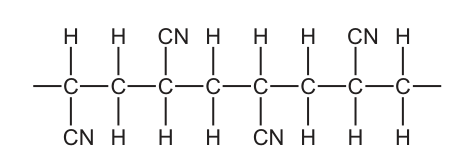
Which monomer would form this polymer?
Options
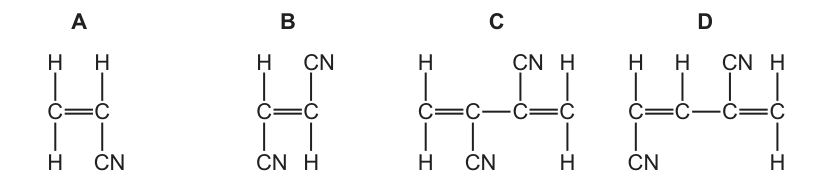
Answer
The polymer chain in Fig. 39 shows a repeating pattern of carbon atoms in the backbone with substituents. Reading from left to right, the substituents on consecutive carbons are:
- C1: H and CN
- C2: H and H
- C3: CN and H
- C4: H and H
The repeating unit is .
In addition polymerisation, the monomer contains a C=C double bond. To find the monomer from the repeating unit, place a double bond between the two backbone carbon atoms and retain the substituents.
Repeating unit:
Monomer: (prop-2-enenitrile or acrylonitrile).
Looking at the options:
- A: (matches the deduced monomer)
- B: (would form )
- C and D: Contain C=C-C=C systems (dienes), which would produce different repeating units with 4 carbons.
The correct monomer is A.
Answer
A
A
Background Concept
Addition polymerisation is a reaction where monomers containing a carbon-carbon double bond (C=C) join together to form a long-chain polymer (addition polymer) with no other products. The double bond in each monomer breaks to form single bonds that link the monomers together.
The repeating unit is the smallest structural unit that repeats along the polymer chain. For addition polymers derived from alkenes, the repeating unit contains two carbon atoms in the main backbone (derived from the C=C bond of the monomer) and all the original substituents.
To deduce the monomer from a polymer structure:
- Identify the repeating unit by finding the shortest sequence of atoms that repeats along the chain.
- Draw the repeating unit with single bonds between the backbone carbons.
- Convert the single bond between the backbone carbons back into a double bond to reveal the monomer structure.
Understanding the Question
The question provides a diagram (Fig. 39) showing a segment of a polymer chain and asks to identify the monomer that would form it. Four options (A, B, C, D) are given as possible monomer structures.
The polymer backbone consists of carbon atoms. We need to analyze the substituents attached to these carbons to determine the repeating unit and then work backwards to find the monomer.
Approach
- Analyze the polymer chain: Look at the substituents on each carbon atom in the backbone of Fig. 39. Identify the repeating pattern.
- Determine the repeating unit: The repeating unit is the smallest block of atoms that repeats. For addition polymers from alkenes, this is typically a two-carbon unit.
- Deduce the monomer: Convert the repeating unit back to a monomer by placing a double bond between the two backbone carbons.
- Match with options: Compare the deduced monomer structure with the given options A, B, C, and D.
Step-by-Step Reasoning
Step 1: Analyze the substituents in Fig. 39
Reading the backbone carbons from left to right and noting the groups attached (top and bottom):
- Carbon 1: H (top), CN (bottom)
- Carbon 2: H (top), H (bottom)
- Carbon 3: CN (top), H (bottom)
- Carbon 4: H (top), H (bottom)
- Carbon 5: H (top), CN (bottom)
- Carbon 6: H (top), H (bottom)
- Carbon 7: CN (top), H (bottom)
- Carbon 8: H (top), H (bottom)
Step 2: Identify the repeating unit
The pattern of substituents is clearly repeating every two carbon atoms: .
This is the repeating unit of the polymer. The polymer is poly(ethenenitrile) or polyacrylonitrile (PAN).
Step 3: Deduce the monomer
For an addition polymer with the repeating unit , the monomer must have the same atoms arranged with a double bond between the two backbone carbons.
Monomer structure: (or written as ).
This is prop-2-enenitrile (acrylonitrile).
Step 4: Evaluate the options
- Option A: Shows (left C has H, H; right C has H, CN). This matches our deduced monomer. Polymerisation of this gives , which is identical to the repeating unit found (direction does not matter in polymer repeating units).
- Option B: Shows . Polymerisation would give , which does not match the diagram (every other carbon would have a CN group, not just alternating ones with CH2).
- Option C: Shows a diene structure (). This would form a polymer with a 4-carbon repeating unit or involve double bonds remaining in the backbone (conjugated polymer), which does not match the saturated backbone in Fig. 39.
- Option D: Shows another diene structure. Similar reasoning to C applies; it does not match the simple repeating unit .
Therefore, A is the correct monomer.
Key Takeaways
- Repeating units: In addition polymers, the repeating unit is typically a two-carbon fragment (for simple alkenes) that repeats along the chain. Identify it by looking for the repeating pattern of substituents.
- Monomer deduction: To find the monomer from a repeating unit, simply place a double bond between the backbone carbons of the repeating unit.
- Polymer direction: The repeating unit can be written in either direction (e.g., or ); both come from the same monomer .
Common Mistakes
- Choosing a diene (C or D): Students might see multiple double bonds in the options and guess a diene without carefully checking the repeating unit of the polymer. The polymer in Fig. 39 has a saturated backbone (all single bonds between backbone carbons), which is characteristic of addition polymerisation of a simple alkene, not a diene (which would leave a double bond in the backbone or have a larger repeating unit).
- Misidentifying the repeating unit: Counting every carbon or missing the alternation. The pattern is strictly alternating: one carbon has CN, the next has only H. This is a 2-carbon repeating unit.
- Confusing orientation: Noting that CN is up on some carbons and down on others. In a 2D diagram of a polymer chain, this indicates stereochemistry (atactic, isotactic, or syndiotactic arrangement), but for identifying the monomer in addition polymerisation, the connectivity (which groups are on which carbons) is what matters, not the up/down orientation in the drawing.
Things to Be Careful About
- State symbols and balancing: Not applicable here, but always ensure equations are balanced if writing them.
- Repeating unit boundaries: The repeating unit is enclosed in brackets with 'n' outside. The bonds extending from the brackets indicate the chain continues. Ensure you identify the correct repeating block (usually 2 carbons for simple alkenes).
- Monomer structure: The monomer must have a C=C double bond. If the option shows a ring or a different functional group, it is incorrect for addition polymerisation to form this chain.
- Option B trap: Option B is 1,2-dicyanoethene. Students might see CN groups and think 'more CN is better', but the polymer clearly has CH2 groups (carbons with only H substituents), so the monomer must have a CH2 group. Option A is the only one with a CH2= group.
The mass spectrum of element Z is shown.
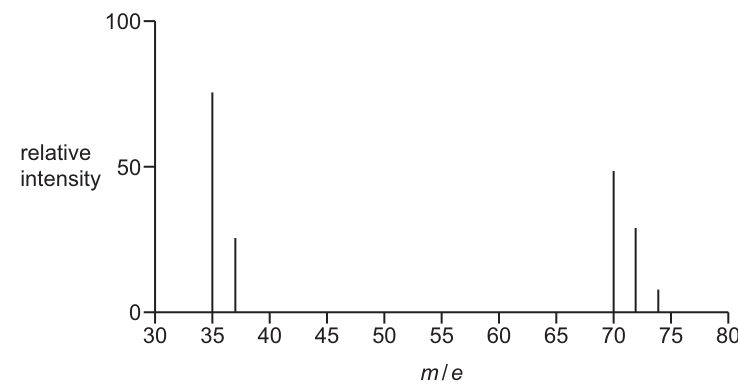
What is element Z?
Options
A arsenic
B chlorine
C gallium
D tungsten
Working
The mass spectrum shows peaks at m/e = 35 and 37 with a relative intensity ratio of approximately 3 : 1, corresponding to the two isotopes and in the monatomic ion .
It also shows peaks at m/e = 70, 72, and 74 with a relative intensity ratio of approximately 9 : 6 : 1. These correspond to the diatomic molecular ion formed from the combinations of these isotopes (, , and ).
This isotopic and molecular ion pattern is characteristic of chlorine gas ().
Answer
B
B
Background Concept
Mass spectrometry is used to determine the relative masses and abundances of isotopes in a sample. When an element exists as a diatomic molecule (such as , , or ), the mass spectrum will show peaks for both the monatomic ions () and the molecular ions (). If the element has multiple isotopes, the molecular ion peaks will also split into a pattern determined by the binomial expansion of the isotopic abundances. For chlorine, the isotopes and occur in a roughly 3 : 1 ratio.
Understanding the Question
The question provides a mass spectrum with peaks at m/e = 35, 37, 70, 72, and 74. We need to identify element Z from the given options: arsenic, chlorine, gallium, or tungsten. The peaks at 35 and 37 suggest an element with isotopes of mass 35 and 37. The peaks at 70, 72, and 74 are exactly double the masses, suggesting a diatomic molecule.
Approach
- Analyze the lower mass peaks (35, 37) to identify the element and its isotopic ratio.
- Analyze the higher mass peaks (70, 72, 74) to confirm if they represent a diatomic molecule of the identified element.
- Match the observed pattern with the known isotopic properties of the options.
Step-by-Step Reasoning
- The peaks at m/e = 35 and 37 have relative intensities of roughly 75 and 25, giving a 3 : 1 ratio. This matches the natural abundance of chlorine isotopes: (75%) and (25%). These peaks represent the monatomic ion .
- The peaks at m/e = 70, 72, and 74 represent the molecular ion . The possible combinations of two chlorine atoms from the two isotopes are:
- : m/e = 70, probability =
- or : m/e = 72, probability =
- : m/e = 74, probability =
The expected intensity ratio is 9 : 6 : 1. The graph shows peaks at 70 (~50), 72 (~33), and 74 (~11), which is approximately 9 : 6 : 1.
- Checking the other options:
- Arsenic (As) has a relative atomic mass of ~75 and does not have a 3 : 1 isotopic pair at 35/37.
- Gallium (Ga) has isotopes at 69 and 71 in a ~3 : 1 ratio, which would give peaks at 69, 71, 138, 140, 142.
- Tungsten (W) has a relative atomic mass of ~184 and would show peaks in the 180-186 range.
Only chlorine fits the observed mass spectrum.
Key Takeaways
- Diatomic elements like chlorine produce both monatomic () and molecular () ion peaks in mass spectrometry.
- The isotopic pattern of the molecular ion follows the binomial expansion of the isotopic abundances (e.g., 9 : 6 : 1 for ).
Common Mistakes
- Forgetting that the higher mass peaks (70, 72, 74) represent the molecular ion rather than a different element or isotope.
- Misinterpreting the 3 : 1 ratio at 35/37 as belonging to an element with atomic mass 35 or 37, rather than recognizing it as an isotopic pair.
Things to Be Careful About
- Ensure you distinguish between monatomic ion peaks and molecular ion peaks when interpreting mass spectra of diatomic elements.
- The relative intensities of the molecular ion peaks are determined by the combinatorial probabilities of the isotopes, not just simple addition.
Your score so far
Answer a question to start scoring
Your marks add up here as you work through the paper.