Chemistry 9701/13 — May/June 2025
Cambridge AS Level · Multiple Choice (AS Level) · answer key with instant marking and worked solutions
Topics Introduction to Organic Chemistry · Atoms, Molecules and Stoichiometry · Atomic Structure · Chemical Bonding · Nitrogen Compounds · Carbonyl Compounds · +15 more
Tap an option under each question to check it — your score builds as you go.
Which isolated gaseous atom has a total of five electrons occupying spherically shaped orbitals?
Options
A sodium
B fluorine
C boron
D potassium
Working
Spherically shaped orbitals are s orbitals.
Electron configurations and numbers of s electrons:
- Sodium, Na: — s electrons
- Fluorine, F: — s electrons
- Boron, B: — s electrons
- Potassium, K: — s electrons
Only sodium has a total of five electrons occupying spherically shaped orbitals.
Answer
A — sodium
A
Background Concept
Orbitals are regions of space in which there is a high probability of finding an electron. Different types of orbital have different shapes: s orbitals are spherically shaped, p orbitals are dumbbell-shaped (two lobes), and d orbitals have more complex shapes. Each s orbital can hold a maximum of two electrons, and an atom can have more than one occupied s orbital (e.g. 1s, 2s, 3s, 4s).
In a ground-state atom, electrons fill subshells in a specific order: 1s, 2s, 2p, 3s, 3p, 4s, 3d, etc. The question asks for the atom that has a total of five electrons in spherically shaped orbitals — that is, five electrons distributed among all its occupied s orbitals.
Understanding the Question
The question gives four neutral atoms — sodium, fluorine, boron, and potassium — and asks which one has exactly five electrons in s orbitals. The phrase “isolated gaseous atom” tells us to consider a single neutral atom in its ground state, not an ion and not an atom in a compound. The key idea is recognising that “spherically shaped orbitals” means s orbitals, then counting all s electrons, not just the outer-shell ones.
Approach
- Identify that spherically shaped orbitals are s orbitals.
- Write the full ground-state electron configuration for each option.
- Count the electrons in the s subshells (1s, 2s, 3s, 4s, …).
- Compare the totals and select the atom with five s electrons.
Step-by-Step Reasoning
- Sodium, Na (Z = 11): configuration . The s electrons are in 1s, 2s, and 3s: . This matches the requirement.
- Fluorine, F (Z = 9): configuration . The s electrons are . Fluorine has five electrons in total in its outer shell, but only four are in s orbitals.
- Boron, B (Z = 5): configuration . The s electrons are . Boron has five electrons in total, but one is in a p orbital.
- Potassium, K (Z = 19): configuration . The s electrons are in 1s, 2s, 3s, and 4s: .
Only sodium gives the required total of five s electrons, so the correct option is A.
Key Takeaways
- s orbitals are the spherically shaped orbitals; p and d orbitals have different shapes.
- “Total number of electrons in s orbitals” means adding electrons from every occupied s subshell, not just the valence shell.
- Writing full electron configurations and counting carefully is the reliable method for this type of question.
Common Mistakes
- Counting only the outer-shell electron: sodium has one outer s electron, but the question asks for the total across all occupied s orbitals.
- Confusing total electrons with s electrons: boron and fluorine each have five total electrons, but neither has five s electrons.
- Thinking p orbitals are spherical: p orbitals are dumbbell-shaped, so their electrons must not be counted.
- Forgetting that potassium has both 3s and 4s electrons; its s-electron total is 7, not 1.
Things to Be Careful About
- Use the correct filling order: 4s fills before 3d for potassium, so potassium’s configuration ends in , not .
- The question specifies an isolated gaseous atom, so use the neutral ground-state configuration, not an ion or an excited-state configuration.
- Read “five electrons occupying spherically shaped orbitals” as five electrons in s orbitals, not five s orbitals (each s orbital holds two electrons).
Diagram 1 shows the reaction pathway for a reaction.
Diagram 2 shows a graph of concentration of reactant against time for the same reaction.
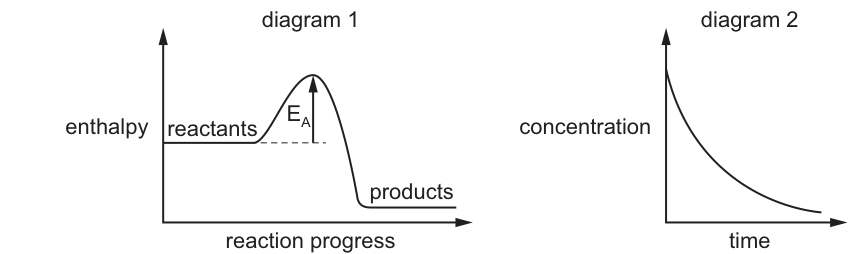
Which diagrams, drawn to the same scale, show the effect of increased temperature on this reaction?
Options
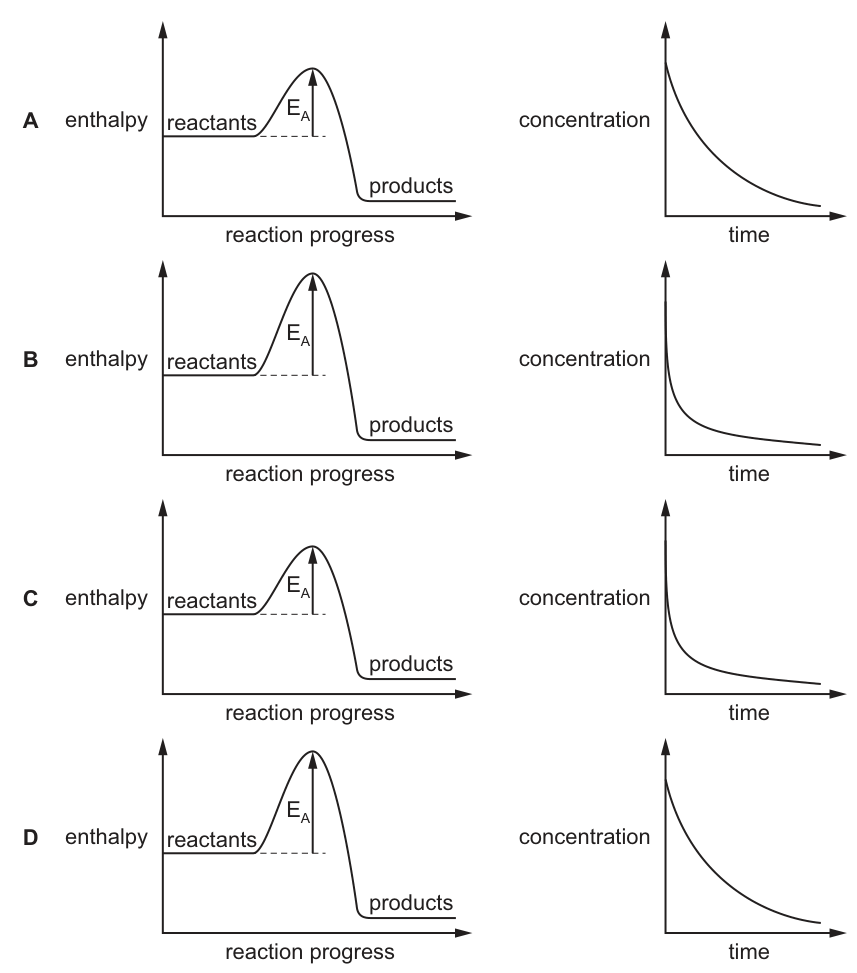
Working
Increasing temperature:
- Does not change the activation energy (the energy barrier is a property of the reaction pathway, not the temperature).
- Does increase the rate of reaction, so the reactant concentration decreases faster (steeper initial gradient on the concentration–time graph).
Option C shows the same as the original and a steeper concentration–time curve, correctly representing the effect of increased temperature.
Answer
C
C
Background Concept
The activation energy is the minimum energy that colliding particles must possess for a reaction to occur. It is determined by the reaction pathway (the specific bonds being broken and formed) and is an intrinsic property of the reaction mechanism. Temperature does not alter this energy barrier.
What temperature does affect is the distribution of kinetic energies among the particles. At a higher temperature, the Boltzmann distribution shifts to the right and flattens, meaning a greater proportion of particles have energy . This results in more successful collisions per unit time and therefore a faster reaction rate.
On an enthalpy profile diagram, is the vertical distance from the reactants level to the peak (transition state). On a concentration–time graph, a faster reaction is shown by a steeper initial gradient (concentration drops more rapidly).
Understanding the Question
The question presents two diagrams for a reaction: an enthalpy profile (Diagram 1) showing an exothermic reaction with a marked , and a concentration–time graph (Diagram 2) showing exponential decay of reactant concentration. Four options (A–D) each show a pair of diagrams drawn to the same scale. The task is to identify which pair correctly represents the effect of increasing temperature on this reaction.
The command word is implicit: "which diagrams... show the effect" — we must select the option where both diagrams are consistent with a temperature increase.
Approach
Apply two rules:
- must remain unchanged (same peak height relative to reactants) — this eliminates any option showing a different barrier.
- The concentration–time curve must be steeper (faster rate) while maintaining the same general shape (same reaction order) — this eliminates options showing no change or a wrong shape.
Check each option against both criteria.
Step-by-Step Reasoning
Option A: The enthalpy diagram shows the same as the original. The concentration–time graph also appears unchanged (same gradient as the original). This shows no effect of temperature on rate — incorrect.
Option B: The enthalpy diagram shows the same . The concentration–time graph is steeper, suggesting a faster rate. However, examining the curve shape more carefully, it drops extremely steeply and then levels off almost immediately in a way inconsistent with the same reaction order (it looks like a different kinetic profile rather than simply a faster version of the same exponential decay). This is not a correct representation of the same reaction at higher temperature.
Option C: The enthalpy diagram shows the same (peak at the same height above reactants, same ). The concentration–time graph shows a steeper initial gradient than the original, indicating a faster reaction, while maintaining the same exponential decay shape (same order). This correctly represents increased temperature: same energy barrier, faster rate. ✓
Option D: The enthalpy diagram shows a larger (higher peak). This would represent a different reaction pathway or the effect of removing a catalyst — not the effect of temperature. Temperature does not change . The concentration–time graph also appears unchanged. Incorrect on both counts.
Therefore, C is the correct answer.
Key Takeaways
- Activation energy is a fixed property of the reaction pathway; it does not change with temperature.
- Increasing temperature increases the rate (steeper concentration–time gradient) without altering the energy barrier.
- On a Boltzmann distribution, temperature shifts the curve rightward, increasing the fraction of particles exceeding , but itself is unchanged.
- When interpreting paired diagrams, both must be consistent with the single change being tested.
Common Mistakes
- Confusing temperature with catalyst effects: A catalyst lowers (shown by a lower peak); temperature does not. Students who select D are confusing these two factors.
- Thinking changes with temperature: The barrier height is determined by the mechanism, not by how hot the system is.
- Selecting A: Students may think that because the concentration–time graph doesn't change shape (still exponential), nothing has changed. But the gradient must be steeper for a faster reaction.
- Misreading the scale: The question states diagrams are drawn to the same scale, so visual comparison of peak heights and gradients is valid.
Things to Be Careful About
- Ensure you compare the same features across options: peak height relative to reactants line (for ) and initial gradient of the curve (for rate).
- The products level and reactants level should remain unchanged in the enthalpy diagram (same ), as temperature does not alter the thermodynamics of the reaction in this context.
- The concentration–time graph should start at the same initial concentration (same -intercept) since we are comparing the same reaction, just at a different temperature.
The equation shows the overall reaction between an amine and an acid chloride.
The four steps in the mechanism are as follows.
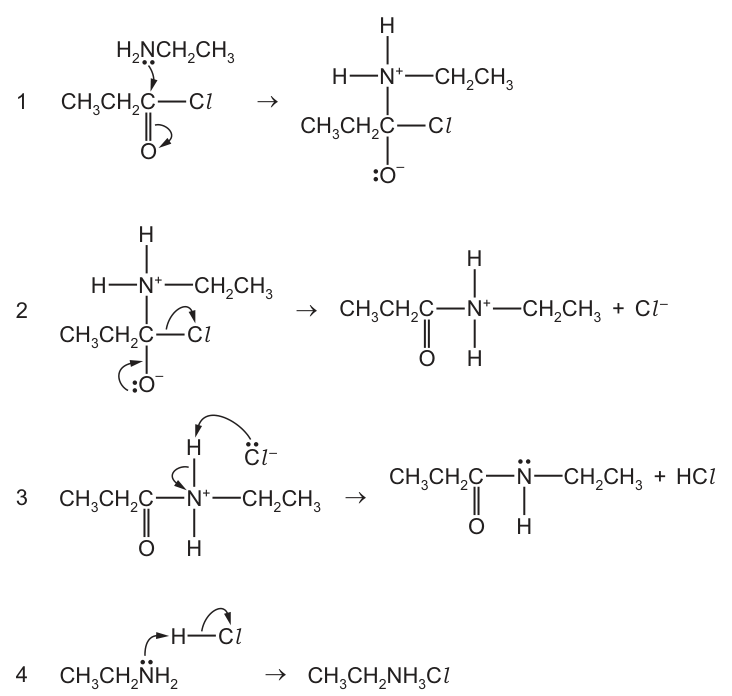
Which steps are Brønsted–Lowry acid–base reactions?
Options
A 1 and 3
B 3 and 4
C 3 only
D 4 only
Answer
B (3 and 4)
A Brønsted–Lowry acid–base reaction involves the transfer of a proton (H) from an acid (proton donor) to a base (proton acceptor). Examining the mechanism steps:
- Step 1: Nucleophilic addition. The lone pair on nitrogen attacks the carbonyl carbon; the C=O -bond breaks. No proton is transferred.
- Step 2: Elimination. The lone pair on oxygen reforms the C=O -bond, and the C–Cl bond breaks to release Cl. No proton is transferred.
- Step 3: Deprotonation. The chloride ion (base) accepts a proton from the positively charged nitrogen (acid). This is a proton transfer.
- Step 4: Protonation. The lone pair on nitrogen in ethylamine (base) accepts a proton from HCl (acid). This is a proton transfer.
Steps 3 and 4 are Brønsted–Lowry acid–base reactions.
B
Background Concept
In organic reaction mechanisms, different types of elementary steps can occur. A Brønsted–Lowry acid–base reaction is specifically defined as a proton (H) transfer: the acid is the proton donor, and the base is the proton acceptor. In mechanism diagrams, this is represented by a curly arrow originating from a lone pair on the base and pointing to the hydrogen atom, with a second curly arrow showing the heterolytic cleavage of the H–X bond (electrons moving to X).
Other common steps in nucleophilic acyl substitution (the reaction of an acid chloride with an amine) include nucleophilic addition (a nucleophile attacks an electrophilic carbon, often breaking a -bond) and elimination (a lone pair reforms a -bond, expelling a leaving group). These steps involve the transfer of electron pairs to form or break bonds to atoms other than hydrogen, so they are not Brønsted–Lowry acid–base reactions.
Understanding the Question
The question provides the overall equation for the reaction between ethylamine (a primary amine) and propanoyl chloride (an acid chloride) to form an amide and an ammonium salt. It then shows the four-step mechanism with curly arrows and asks which steps are Brønsted–Lowry acid–base reactions. The task is to analyze each step and identify where a proton (H) is transferred from one species to another.
Approach
To solve this, examine each step in the mechanism and look for a proton transfer. Specifically, check if a curly arrow starts at a lone pair on an atom (the base) and ends at a hydrogen atom, and if another curly arrow shows the bond between that hydrogen and another atom breaking (the acid donating the proton). If no hydrogen is involved in the bond-making/bond-breaking process, it is not a Brønsted–Lowry acid–base step.
Step-by-Step Reasoning
- Step 1: The lone pair on the nitrogen atom of ethylamine attacks the electrophilic carbonyl carbon of propanoyl chloride. Simultaneously, the -electrons of the C=O double bond move onto the oxygen atom. This is a nucleophilic addition step. No proton is transferred; electrons move to carbon and oxygen. Not a Brønsted–Lowry acid–base reaction.
- Step 2: The lone pair on the negatively charged oxygen moves down to reform the C=O -bond, and the C–Cl bond breaks heterolytically, releasing a chloride ion (Cl). This is an elimination step. No proton is transferred. Not a Brønsted–Lowry acid–base reaction.
- Step 3: The intermediate has a positively charged nitrogen with an N–H bond. A chloride ion (Cl), acting as a base, uses its lone pair to attack and accept the proton (H) from the nitrogen. The N–H bond breaks, and the electrons remain on nitrogen to neutralize its positive charge, forming the neutral amide and HCl. This is a clear proton transfer (Cl accepts H, the protonated amide donates H). This is a Brønsted–Lowry acid–base reaction.
- Step 4: A second molecule of ethylamine has a lone pair on its nitrogen. This lone pair attacks the hydrogen atom of the HCl molecule produced in Step 3. The H–Cl bond breaks, with the electrons going to chlorine to form Cl. The ethylamine accepts the proton to form the ethylammonium ion (CHCHNH), which pairs with Cl to form ethylammonium chloride. This is another proton transfer (ethylamine accepts H, HCl donates H). This is a Brønsted–Lowry acid–base reaction.
Therefore, steps 3 and 4 are the Brønsted–Lowry acid–base reactions. The correct option is B.
Key Takeaways
- A Brønsted–Lowry acid–base reaction in a mechanism is always a proton transfer (H moves from one species to another).
- Nucleophilic addition and elimination steps involve electron pair movement to form/break bonds to atoms like carbon, oxygen, or chlorine, but do not involve proton transfer.
- Always look for the curly arrow pointing to a hydrogen atom and the adjacent bond breaking to identify acid–base steps.
Common Mistakes
- Confusing nucleophilic attack with acid–base reactions: Students may see a lone pair attacking something and assume it is a base reacting with an acid. However, if the lone pair attacks a carbon atom (nucleophilic attack) rather than a hydrogen atom (protonation), it is not a Brønsted–Lowry acid–base reaction.
- Missing the second acid–base step: Step 4 is often overlooked. The overall equation shows two moles of amine reacting, but only one is incorporated into the amide product. The second mole acts as a base to neutralize the HCl produced, which is exactly what Step 4 depicts. Forgetting to check Step 4 leads to choosing option C (3 only).
Things to Be Careful About
- Ensure you distinguish between the Lewis definition of an acid/base (electron pair acceptor/donor) and the Brønsted–Lowry definition (proton donor/acceptor). Steps 1 and 2 involve Lewis acid-base interactions (formation of dative bonds), but only steps 3 and 4 are Brønsted–Lowry.
- Read the curly arrows carefully: an arrow pointing to H means proton transfer; an arrow pointing to C or another atom means a different type of step.
Chromium is present in compound X.
- Two moles of compound X react with exactly 3 moles of silicon.
- The only products of this reaction are 4 moles of chromium and 3 moles of a silicon compound in which the oxidation state of the silicon is +4.
- Chromium and silicon are the only elements that change their oxidation states in this reaction.
What could be the identity of compound X?
Options
A
B
C
D
Working
Let the silicon compound be , since silicon is in oxidation state +4 and oxygen is -2.
Check option A:
Atoms balance: ; ; .
Oxidation states:
- Cr: (reduction; electrons gained)
- Si: (oxidation; electrons lost)
The electron transfer balances, and only Cr and Si change oxidation state. Therefore X is .
Answer
A
A
Background Concept
Redox reactions are identified by changes in oxidation number. Oxidation number is a bookkeeping charge assigned by rules: uncombined element 0; oxygen usually ; hydrogen usually (but in metal hydrides); the sum of oxidation numbers in a neutral species is 0. In any redox reaction, the total number of electrons lost by the reducing agent equals the total number gained by the oxidising agent. Therefore, a balanced redox equation must balance both atoms and electron transfer. The question also uses stoichiometric coefficients: formula units of X produce Cr atoms, so each X contains Cr atoms.
Understanding the Question
We are told exactly how much of each species reacts: . The silicon compound has Si in oxidation state . Since only Cr and Si change oxidation state, the other element in X (O or H) must be unchanged in the silicon product. We need choose among four chromium compounds. The options differ only in the non-chromium element and its amount: , , , . The correct formula must give a balanced atom count and a balanced electron transfer.
Approach
Use the redox bookkeeping first. Three Si atoms are oxidised from 0 to , so they release electrons. Those electrons must reduce the Cr atoms produced. If each Cr in X has oxidation state , then , so . Thus X contains Cr in the state. A neutral compound with two ions needs the other atoms to supply charge. With oxygen (), that is three O atoms, giving . Then confirm the full equation balances. Check the other options against the same electron and atom balance.
Step-by-Step Reasoning
- From the coefficient , each formula unit of X contains Cr atoms.
- The Si atoms go from oxidation state 0 to : total electrons lost = .
- These electrons reduce Cr atoms from to 0: , so . So Cr in X is .
- X is neutral. Cr at contribute . The remaining atoms must contribute .
- Oxygen has oxidation state , so O atoms give : .
- Hydrogen would need to be (as in a metal hydride) to give , giving . But in the silicon product , H is and Si would be , not . Also H would change oxidation state, contradicting the statement.
- would require Cr if H is ; then Cr atoms would gain only electrons, not the supplied by Si.
- Check option A by balancing:
Atoms: ; ; . Oxidation states: Cr (gain e each, e total); Si (lose e each, e total). Oxygen remains throughout.
6. Option D, , would have Cr (), so Cr atoms would need electrons, but Si supplies only ; it also cannot form identical silicon compounds with Si in the state from O atoms. So D is impossible.
Therefore , option A.
Key Takeaways
- Stoichiometric coefficients give atom ratios that can identify an unknown formula.
- Redox reactions must balance electron transfer as well as atoms.
- Oxidation numbers are bookkeeping charges; the "only elements that change oxidation state" constraint is a powerful filter.
- A neutral compound's oxidation numbers must sum to zero.
Common Mistakes
- Assuming hydrogen is always . In metal hydrides it is , but in silanes it is ; either way, H would change oxidation state, which is forbidden here.
- Forgetting to check electron balance: a formula can balance atoms but not redox (as with ).
- Thinking the silicon compound must be without checking; here the state and oxygen as the unchanged element make the only sensible product.
- Ignoring the phrase "only Cr and Si change oxidation state"; it eliminates any compound containing H, because H would have to change between X and the silicon product.
Things to Be Careful About
- Use oxidation-number rules consistently: O is in both and ; Si is 0 as an element and in ; Cr is in and 0 as an element.
- The electron transfer must be equal: .
- The question gives mole ratios, so the coefficients in the balanced equation must match exactly: .
- For an MCQ, after finding a candidate that satisfies all conditions, confirm the other options fail at least one condition.
The reversible reaction shown is in equilibrium at a temperature of 450°C.
The table shows the equilibrium concentrations in the reaction mixture.
The temperature of the reaction mixture is increased at constant volume.
The concentration of one of the components falls to at equilibrium under these conditions.
What is the concentration of in the new equilibrium mixture?
Options
A
B
C
D
Working
The forward reaction is exothermic (). Increasing the temperature favours the endothermic backward reaction, so decomposes and its concentration falls.
From the equation, , so this decomposition produces half as much :
Answer
C
C
Background Concept
This question uses Le Chatelier's principle: when a system at equilibrium is disturbed, the position of equilibrium shifts to minimise the disturbance. For a temperature change, the equilibrium shifts in the direction that absorbs or releases heat to oppose the change. Here the forward reaction is exothermic (), so the backward reaction is endothermic. Raising the temperature adds heat to the system, so the equilibrium shifts in the endothermic direction, i.e. backwards: . This consumes and produces and .
The stoichiometry of the reaction is also essential: the equation shows that two moles of decompose to give one mole of and one mole of . Therefore any change in is twice the corresponding change in or .
Understanding the Question
We are given the equilibrium concentrations at 450°C: , , (all in mol dm). The temperature is then increased at constant volume and a new equilibrium is reached. We are told that one component has a concentration of . The task is to find the new .
The command is essentially a calculation disguised as a multiple-choice question. The key first step is to decide which component falls to 0.80. Since increasing the temperature shifts the equilibrium backwards, must decrease and both and must increase. Only can therefore be the component that falls to 0.80.
Approach
- Use the sign of to decide the direction of the shift when temperature increases.
- Identify which species falls to 0.80.
- Calculate the decrease in .
- Use the 2:1 stoichiometric ratio to find the increase in .
- Add this increase to the original .
Step-by-Step Reasoning
- The forward reaction is exothermic because is negative. Increasing the temperature favours the endothermic backward reaction.
- In the backward reaction, is consumed and and are formed. Hence falls; and rise.
- The component that falls to 0.80 must be : .
- Decrease in .
- From , the amount of formed is half the amount of decomposed: .
- New .
This corresponds to option C.
Why the other options are wrong:
- A (0.80) is simply the new concentration of HI, not H2.
- B (0.93) would result from subtracting 0.09 from 1.02, which is the wrong direction.
- D (1.20) would result from adding 0.18 to 1.02, ignoring the 2:1 stoichiometric ratio.
Key Takeaways
- For an exothermic forward reaction, increasing temperature shifts equilibrium to the left.
- Identify which species can actually decrease before doing any arithmetic.
- Use the stoichiometric coefficients, not a 1:1 assumption, when converting a change in one concentration into a change in another.
Common Mistakes
- Assuming that H2 falls because the question mentions a fall; in fact H2 is produced by the backward shift.
- Using a 1:1 ratio between HI and H2 instead of 2:1.
- Confusing the sign of : a negative means the forward reaction is exothermic, so increasing temperature shifts equilibrium to the endothermic (backward) direction.
- Forgetting that the temperature change is at constant volume; here that simply means no concentration change from volume change, but the equilibrium shift still occurs.
Things to Be Careful About
- Keep units as mol dm throughout.
- The stoichiometric ratio is , so divide the HI change by 2.
- The new concentration is found by adding the increase to the original concentration, not by using the new HI concentration directly.
- In an MCQ, always check that your answer matches one of the options; if not, revisit the direction of shift or the stoichiometry.
The first stage in the industrial production of nitric acid from ammonia can be represented by the following equation.
Using the following standard enthalpy change of formation data, what is the value of the standard enthalpy change, , for this reaction?
| compound | |
|---|---|
Options
A
B
C
D
Working
Use Hess's law:
Products ():
Reactants ():
Answer
C ()
C
Background Concept
The standard enthalpy change of formation, , is the enthalpy change when one mole of a compound is formed from its elements in their standard states under standard conditions (298 K and 1 atm). By definition, an element in its standard state — here — has .
Hess's law states that the enthalpy change of a reaction depends only on the initial and final states, not on the route taken. When formation enthalpies are known, the reaction enthalpy is found by:
Each formation enthalpy is multiplied by the stoichiometric coefficient of that substance in the balanced equation.
Understanding the Question
The question gives the balanced equation for the oxidation of ammonia and a table of standard enthalpies of formation for , and . Oxygen gas is an element in its standard state, so its is zero and it does not appear in the table. We must calculate the standard enthalpy change for the whole reaction.
Approach
Apply the Hess's law formula directly:
- Sum the formation enthalpies of the products, each multiplied by its coefficient.
- Sum the formation enthalpies of the reactants, each multiplied by its coefficient.
- Subtract the reactant sum from the product sum.
Step-by-Step Reasoning
-
Products — :
-
Reactants — :
-
Reaction enthalpy:
The negative sign shows the reaction is exothermic — ammonia oxidation releases heat.
Key Takeaways
- Always multiply each by its stoichiometric coefficient.
- Elements in their standard states contribute zero.
- The formula is the standard route from formation data.
Common Mistakes
- Forgetting coefficients: using instead of .
- Sign error in subtraction: forgetting that subtracting means adding .
- Ignoring O2: some mistakenly assign a value to instead of zero.
- Reversing the subtraction: using reactants minus products gives the wrong sign.
Things to Be Careful About
- Watch the sign of each formation enthalpy carefully — and are negative, is positive.
- Units are kJ mol⁻¹ for the reaction as written.
- Option A (+905.2) is the trap for getting the sign wrong; option D (−1274.0) is the trap for miscounting coefficients.
The gaseous compound Z decomposes on heating.
In the diagram, Boltzmann distributions for Z at two different temperatures, P and Q, are shown. The lines X and Y indicate activation energies for the decomposition of Z with and without a catalyst.
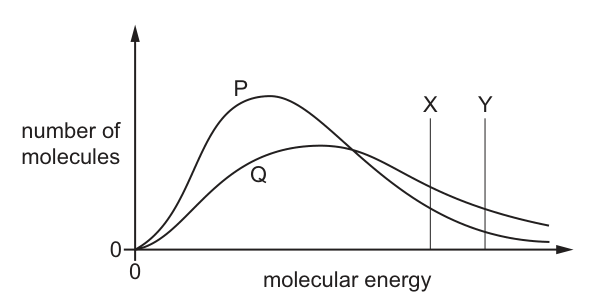
Which curve and which line describe the decomposition of Z at a higher temperature and with a catalyst present?
Options
| higher temperature | catalyst present | |
|---|---|---|
| A | P | X |
| B | P | Y |
| C | Q | X |
| D | Q | Y |
Working
At a higher temperature, the average kinetic energy of the molecules increases. The Boltzmann distribution curve becomes broader, flatter, and shifts to the right towards higher energies. Curve Q represents the higher temperature.
A catalyst provides an alternative reaction pathway with a lower activation energy. Line X is at a lower energy than line Y, so line X represents the activation energy with a catalyst present.
Therefore, the higher temperature is Q and the catalyst present is X.
Answer
C
C
Background Concept
Boltzmann distribution curves show the distribution of molecular energies in a sample of gas at a given temperature. The area under the curve represents the total number of molecules (which remains constant). The peak of the curve corresponds to the most probable energy. The curve starts at the origin (no molecules have zero energy) and tails off to the right.
The activation energy () is the minimum energy required for a successful collision (a reaction to occur). It is represented by a vertical line on the distribution graph. The area under the curve to the right of the line represents the fraction of molecules with energy greater than or equal to .
Understanding the Question
The question asks to identify the curve and line corresponding to two separate conditions:
- Decomposition at a higher temperature.
- Decomposition with a catalyst present.
We are given two curves (P and Q) representing different temperatures, and two vertical lines (X and Y) representing different activation energies.
Approach
- Recall how temperature affects the Boltzmann distribution curve: higher temperature means higher average kinetic energy, shifting the curve to the right and lowering the peak.
- Recall how a catalyst affects the activation energy: a catalyst lowers the activation energy by providing an alternative pathway.
- Match these effects to the given curves (P, Q) and lines (X, Y) to find the correct option.
Step-by-Step Reasoning
- Temperature effect: When the temperature of a gas increases, the molecules have more kinetic energy on average. The Boltzmann distribution curve changes: the peak becomes lower (fewer molecules have the most probable energy), the curve becomes broader, and it shifts to the right towards higher energies. The area under the curve remains the same (total number of molecules is constant). Looking at the diagram, curve Q is broader, flatter, and shifted to the right compared to curve P. Therefore, curve Q represents the higher temperature, and curve P represents the lower temperature.
- Catalyst effect: A catalyst increases the rate of reaction by providing an alternative reaction pathway with a lower activation energy (). On the Boltzmann distribution graph, a lower activation energy is represented by a vertical line further to the left (lower energy value). Looking at the diagram, line X is at a lower energy than line Y. Therefore, line X represents the lower activation energy (with a catalyst), and line Y represents the higher activation energy (without a catalyst).
- Conclusion: The higher temperature is represented by curve Q, and the catalyst present is represented by line X. This matches option C.
Key Takeaways
- Higher temperature shifts the Boltzmann distribution curve to the right, lowers the peak, and broadens the curve. The area under the curve remains constant.
- A catalyst lowers the activation energy, which is shown as a vertical line at a lower energy value on the Boltzmann distribution graph.
- The area under the curve to the right of the activation energy line represents the proportion of molecules with sufficient energy to react. Both a higher temperature and a lower activation energy increase this area, thus increasing the rate of reaction.
Common Mistakes
- Confusing the effect of temperature on the curve: thinking a higher temperature makes the peak higher (it actually makes it lower and broader because the area must remain constant).
- Confusing the effect of a catalyst on activation energy: thinking a catalyst increases activation energy (it decreases it).
- Misreading the graph: confusing which line is at a lower energy (X is to the left of Y on the energy axis, so X is lower energy).
Things to Be Careful About
- Remember that the total area under the Boltzmann distribution curve is constant regardless of temperature or catalyst. Only the shape and position change.
- A catalyst does NOT change the position of the Boltzmann distribution curve itself; it only changes the position of the activation energy line. The question asks for the curve at a higher temperature AND the line with a catalyst. These are two independent changes being asked about.
- Ensure you read the axes correctly: the x-axis is molecular energy (increasing to the right), and the y-axis is the number of molecules.
The structure of a molecule found in food is shown.
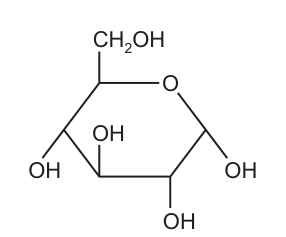
Four statements about the molecule are listed.
- This molecule contains only bonds.
- This molecule contains both and bonds.
- The six-membered ring is planar.
- The six-membered ring is non-planar.
Which two statements are correct?
Options
A 1 and 3
B 1 and 4
C 2 and 3
D 2 and 4
Answer
The molecule shown is a saturated cyclic sugar (a pyranose). All bonds depicted in the structure are single bonds (C–C, C–O, C–H, O–H). Single bonds are exclusively bonds; there are no double or triple bonds, so there are no bonds. Statement 1 is correct and Statement 2 is incorrect.
The carbon atoms in the six-membered ring are each bonded to four groups (tetrahedral geometry, sp hybridised). The ring oxygen is also sp hybridised. According to VSEPR theory, sp hybridised atoms have bond angles of approximately 109.5°. A planar six-membered ring would require bond angles of 120° and would suffer from severe torsional strain due to eclipsing substituents. To achieve ideal bond angles and minimise strain, the ring adopts a puckered, non-planar conformation (such as a chair or boat form). Statement 4 is correct and Statement 3 is incorrect.
The correct statements are 1 and 4, which corresponds to option B.
Answer
B
B
Background Concept
In covalent bonding, a single bond is always a (sigma) bond, formed by the head-on overlap of atomic orbitals. A double bond consists of one bond and one (pi) bond, formed by the side-on overlap of p-orbitals. A triple bond consists of one bond and two bonds. Therefore, the presence of any double or triple bond in a molecule indicates the presence of bonds; if only single bonds are present, the molecule contains only bonds.
Regarding molecular shape, VSEPR (Valence Shell Electron Pair Repulsion) theory predicts that electron pairs around a central atom arrange themselves to minimise repulsion. Atoms with four single bonds (or a combination of bonds and lone pairs summing to four regions of electron density) are sp hybridised and adopt a tetrahedral geometry with bond angles of approximately 109.5°. When atoms with tetrahedral geometry are joined in a ring, a planar regular hexagon (with 120° internal angles) is geometrically incompatible with the ideal 109.5° bond angles. Additionally, a planar ring would force all adjacent substituents into eclipsed conformations, creating high torsional strain. To relieve both angle strain and torsional strain, six-membered rings containing sp atoms pucker into non-planar conformations, most commonly the chair or boat forms.
Understanding the Question
The question provides a skeletal structure of a six-membered cyclic sugar molecule (a pyranose ring, such as glucose in its cyclic form). The structure contains five carbon atoms and one oxygen atom in the ring, with hydroxyl (-OH) and hydroxymethyl (-CHOH) substituents. Four statements are given about the bonding and 3D geometry of this molecule, and the task is to identify which two are correct. Statements 1 and 2 concern the types of covalent bonds present ( vs ), while Statements 3 and 4 concern the planarity of the ring.
Approach
- Examine the skeletal structure for any double or triple bonds to determine whether bonds are present.
- Identify the hybridisation of the atoms in the ring by counting the number of bonded atoms and lone pairs.
- Apply VSEPR theory and knowledge of ring strain to deduce whether a ring of sp hybridised atoms can be planar.
Step-by-Step Reasoning
- Bonding (Statements 1 and 2): Look closely at Fig. 8.1. The skeletal structure shows only single lines connecting atoms. There are no double lines (=) or triple lines (). Every bond shown (C–C, C–O, C–H, O–H) is a single covalent bond. Since all bonds are single, they are all bonds. There are no bonds in this molecule. Therefore, Statement 1 ('This molecule contains only bonds') is correct, and Statement 2 is incorrect.
- Ring Planarity (Statements 3 and 4): The carbon atoms in the ring are each bonded to four groups (e.g., two ring atoms, one hydrogen, and one -OH or -CHOH group). This means every ring carbon is sp hybridised with tetrahedral geometry. The oxygen atom in the ring is bonded to two carbons and has two lone pairs, which also makes it sp hybridised. Because all ring atoms are sp hybridised, the ideal bond angles are ~109.5°. If the ring were planar, it would be a regular hexagon with 120° angles, causing significant angle strain. Furthermore, a planar conformation would cause severe torsional strain as the substituents on adjacent carbons would be forced into eclipsed positions. To minimise these strains, the ring puckers into a non-planar shape (such as a chair conformation). Therefore, Statement 4 ('The six-membered ring is non-planar') is correct, and Statement 3 is incorrect.
- Conclusion: Statements 1 and 4 are correct. This matches option B.
Key Takeaways
- Single bonds are always bonds; bonds only exist in double or triple bonds.
- Atoms with four regions of electron density (sp hybridised) have tetrahedral geometry (~109.5° bond angles).
- Six-membered rings containing only sp atoms cannot be planar; they must pucker to achieve ideal bond angles and avoid torsional strain.
Common Mistakes
- Assuming that a hexagonal ring drawn on paper is planar: skeletal structures are 2D representations and do not accurately depict 3D geometry. A hexagon drawn flat does not mean the molecule is flat.
- Misidentifying the oxygen in the ring: the ring oxygen has two bonds and two lone pairs, making it sp hybridised, not sp.
- Confusing and bonds: remembering that every single bond is a bond, and bonds are only added on top of a bond in multiple bonds.
Things to Be Careful About
- Always check the skeletal structure carefully for double bonds (like C=O or C=C) which would introduce bonds. In this sugar molecule, it is in the cyclic hemiacetal form, so there are no carbonyl groups or alkenes.
- Do not assume planarity from the 2D drawing. Apply hybridisation and VSEPR theory to determine the true 3D shape.
In which substance are covalent bonds broken as it melts?
Options
A silicon(IV) oxide
B ice
C iodine
D ethanol
Working
Silicon(IV) oxide is a giant covalent (network) solid, so melting it breaks covalent Si–O bonds. Ice, iodine and ethanol are molecular substances; melting only breaks intermolecular forces (hydrogen bonding and/or van der Waals' forces), leaving their covalent bonds intact.
Answer
A — silicon(IV) oxide
A
Background Concept
Substances can be classified by the type of structure they form. In a giant covalent structure (also called a network covalent structure), all the atoms are joined to each other by strong covalent bonds in a continuous 3D lattice. Examples include diamond, graphite and silicon(IV) oxide. In a simple molecular structure, atoms are joined within each molecule by strong covalent bonds, but the molecules themselves are held together only by weak intermolecular forces such as van der Waals' forces, permanent dipole–dipole forces, or hydrogen bonds.
When a substance melts, the forces between its particles are overcome. For a molecular substance, this means breaking intermolecular forces, not the covalent bonds inside each molecule. For a giant covalent substance, there are no separate molecules, so melting requires breaking covalent bonds throughout the network. This is why giant covalent substances have very high melting points.
Understanding the Question
The question asks which substance has covalent bonds broken as it melts. The key distinction is between:
- bonds within a molecule (intramolecular covalent bonds), and
- forces between molecules (intermolecular forces).
You are being tested on whether you can identify which of the four options is a giant covalent solid rather than a molecular solid. The options are silicon(IV) oxide, ice, iodine and ethanol.
Approach
For each option, ask: "What kind of structure does this substance have?"
- If it is molecular, melting breaks intermolecular forces, not covalent bonds.
- If it is giant covalent, melting breaks covalent bonds.
Only one of the four substances is giant covalent, so that substance is the answer.
Step-by-Step Reasoning
-
Silicon(IV) oxide, SiO₂ — Each silicon atom is bonded to four oxygen atoms and each oxygen atom is bonded to two silicon atoms, forming a giant 3D covalent network. There are no discrete molecules. When SiO₂ melts, the Si–O covalent bonds must be broken. This matches the question.
-
Ice, H₂O — Ice is a molecular solid. Each water molecule contains O–H covalent bonds, but the molecules are held together by hydrogen bonds between the oxygen of one molecule and a hydrogen of another. When ice melts, only these hydrogen bonds are broken; the O–H covalent bonds stay intact.
-
Iodine, I₂ — Iodine is a simple molecular substance. Each I₂ molecule has a strong I–I covalent bond, but the molecules are held together in the solid by weak van der Waals' forces. Melting iodine breaks only those weak intermolecular forces, not the I–I covalent bond.
-
Ethanol, C₂H₅OH — Ethanol is a molecular liquid/solid with covalent bonds within each molecule (C–C, C–H, C–O and O–H). The molecules are held together by hydrogen bonding and van der Waals' forces. Melting ethanol breaks these intermolecular forces, not its covalent bonds.
Therefore, the only substance in which covalent bonds are broken on melting is silicon(IV) oxide.
Key Takeaways
- Giant covalent structures have high melting points because melting requires breaking covalent bonds.
- Molecular substances have lower melting points because only weak intermolecular forces are broken on melting.
- "Hydrogen bonds" are intermolecular forces, not covalent bonds, even though the word "bond" is used.
- To answer this type of question, first classify the substance as giant covalent, ionic, metallic, or molecular.
Common Mistakes
- Saying ice breaks covalent bonds: Ice is molecular; melting breaks hydrogen bonds between water molecules, not O–H covalent bonds.
- Confusing iodine's I–I covalent bond with the forces between I₂ molecules: The I–I bond is intramolecular and is not broken on melting.
- Thinking ethanol's O–H bond breaks on melting: Ethanol molecules stay intact; only intermolecular forces are overcome.
- Not recognising SiO₂ as giant covalent: SiO₂ is often written as a formula that looks molecular, but it is a network solid.
Things to Be Careful About
- Read the phrase "covalent bonds broken as it melts" carefully: it specifically refers to intramolecular covalent bonds, not intermolecular forces.
- Remember that substances like diamond, graphite and SiO₂ are giant covalent, whereas most small covalent compounds (water, iodine, ethanol, carbon dioxide) are molecular.
- Do not confuse melting with chemical reaction: melting is a physical change, so the molecules of a molecular substance remain unchanged.
Why is the second ionisation energy of sodium larger than the second ionisation energy of magnesium?
Options
A The attraction between the nucleus and the outer electron is greater in than in .
B The nuclear charge of is greater than that of .
C The outer electron of is more shielded than the outer electron of .
D The outer electron of Na is in the same orbital as the outer electron of Mg.
Working
After the first ionisation:
- has the configuration ; the second electron removed comes from the shell, close to the nucleus and relatively little shielded.
- has the configuration ; the second electron removed comes from the outer shell, further from the nucleus and more shielded by the inner electrons.
So the attraction between the nucleus and the electron being removed is greater in than in .
Answer
A
A
Background Concept
Ionisation energy is the energy required to remove one mole of electrons from one mole of gaseous atoms or ions. For a given species, successive ionisation energies rise because each electron removed leaves a more positive ion, so the remaining electrons are held more strongly by the nucleus.
The energy needed to remove an electron depends on three factors: the nuclear charge (the number of protons), the distance of the electron from the nucleus, and the shielding caused by inner electrons. Shielding reduces the effective nuclear charge felt by an outer electron. An electron in a lower principal shell () is closer to the nucleus and is shielded only by the electrons, whereas an electron in a higher principal shell () is further away and is shielded by all the electrons in the inner shells.
When comparing the second ionisation energies of two elements, it is essential to identify exactly which electron is removed after the first electron has already been lost.
Understanding the Question
This question compares the second ionisation energy of sodium with that of magnesium. It tests whether you can work out the electron configuration of each +1 ion and identify the shell from which the second electron is removed. The correct explanation must refer to the attraction between the nucleus and the electron being removed.
Approach
Start by writing the full electron configurations of Na and Mg. Remove one electron to form and . Then remove a second electron and note which shell it comes from. Compare distance from the nucleus and shielding. Use this comparison to judge each option.
Step-by-Step Reasoning
-
Sodium has atomic number 11: . Its first ionisation removes the electron, leaving with configuration .
-
Magnesium has atomic number 12: . Its first ionisation removes one electron, leaving with configuration .
-
The second ionisation of sodium removes an electron from the subshell. This electron is in the second principal shell, close to the nucleus, and is shielded only by the two electrons.
-
The second ionisation of magnesium removes the remaining electron. This electron is in the third principal shell, further from the nucleus, and is shielded by the full core.
-
Therefore the electron removed from experiences a much stronger attraction to the nucleus than the electron removed from . This is why the second ionisation energy of sodium is larger. The actual values reflect this: the second ionisation energy of Na is about , while that of Mg is about .
Now check the options:
- A is correct because it states this greater attraction.
- B is incorrect because has the greater nuclear charge (12 protons compared with 11 in ).
- C is incorrect because the outer electron of is less shielded, not more shielded, than the outer electron of .
- D is not a valid explanation: the outer electrons of the neutral atoms are both in the orbital, so this provides no distinction; after first ionisation the electrons removed are from different shells ( for and for ).
Key Takeaways
To compare successive ionisation energies, always write the configurations of the ions and identify the shell from which the electron is removed. A large jump occurs when removing an electron from a completed inner shell. Shielding and distance from the nucleus can outweigh a greater nuclear charge.
Common Mistakes
Choosing B: the nuclear charge of is not greater; has 12 protons. Choosing C: the outer electron of is less shielded, not more shielded. Choosing D: the orbitals involved are different ( for and for ). Also, forgetting to consider the ion after the first ionisation.
Things to Be Careful About
Use the correct electron configurations for the ions, not the atoms. Remember that the second electron removed from Na comes from the second shell, not the third. In ionisation energy questions, compare the electron being removed, not the overall atom.
reacts with to form a single compound with a simple molecular structure.
Which row describes how the bond angles change during the reaction?
Options
| F–B–F bond angle | H–N–H bond angle | |
|---|---|---|
| A | decreases | decreases |
| B | decreases | increases |
| C | increases | decreases |
| D | increases | increases |
Working
- BF: trigonal planar, F–B–F = 120°.
- NH: trigonal pyramidal, H–N–H ≈ 107°.
- In FB–NH, B forms a fourth (coordinate) bond to N: B becomes tetrahedral, so F–B–F decreases to ≈109.5°.
- N also becomes tetrahedral (no lone pair), so H–N–H increases from ≈107° to ≈109.5°.
Answer
B (decreases; increases)
B
Background Concept
BF is electron deficient: boron has only six valence electrons in three B–F bonds, so it can accept a lone pair. NH has a lone pair on nitrogen. The reaction forms a coordinate (dative) bond from N to B, giving FB–NH.
VSEPR theory predicts shapes from electron-pair repulsion:
- BF: 3 bonding pairs, no lone pairs → trigonal planar, 120°.
- NH: 3 bonding pairs + 1 lone pair → trigonal pyramidal, ~107°.
- FB–NH: B has 4 bonding pairs; N has 4 bonding pairs. Both are tetrahedral, ~109.5°.
Understanding the Question
The question asks how the F–B–F angle and H–N–H angle change when BF and NH form the adduct. Need compare each angle before and after.
Approach
- Determine shape and bond angle of BF.
- Determine shape and bond angle of NH.
- Determine shape around B and N in FB–NH.
- Compare each angle.
Step-by-Step Reasoning
- In BF, B has three bond pairs and no lone pair. VSEPR: trigonal planar, F–B–F = 120°.
- In NH, N has three bond pairs and one lone pair. Lone pair repulsion compresses H–N–H to about 107°.
- In FB–NH, the N lone pair becomes a B–N coordinate bond. B now has four bond pairs, so it is tetrahedral: F–B–F ≈ 109.5° (decrease from 120°).
- N now has four bond pairs and no lone pair, so it is tetrahedral: H–N–H ≈ 109.5° (increase from ~107°).
- Therefore F–B–F decreases, H–N–H increases → B.
Key Takeaways
- A molecule with 3 bond pairs and no lone pair is trigonal planar.
- A molecule with 3 bond pairs and 1 lone pair is trigonal pyramidal.
- A molecule/ion with 4 bond pairs and no lone pair is tetrahedral.
- Formation of a coordinate bond can change the electron-pair geometry of both atoms.
Common Mistakes
- Assuming both angles decrease because both atoms become tetrahedral. N was already approximately tetrahedral in electron-pair arrangement; the lone pair compressed the bond angle below 109.5°. Removing the lone pair (by making it a bond pair) lets the H–N–H angle open up slightly.
- Forgetting that BF is trigonal planar, not tetrahedral.
Things to Be Careful About
- The H–N–H angle in NH is not exactly 109.5°; it is about 107° due to lone-pair repulsion.
- In FB–NH, both B and N have four bonding pairs, so both are tetrahedral with angles near 109.5°.
- A coordinate bond counts as a normal bond pair for VSEPR purposes.
The equation for the reaction of nitrogen with hydrogen is shown.
Which statement is correct?
Options
A is measured at .
B is measured at .
C represents the standard enthalpy change for the formation of ammonia gas.
D represents the enthalpy change when of reacts with of .
Working
The equation shows 1 mol N2(g) reacting with 3 mol H2(g) to form 2 mol NH3(g).
- Standard enthalpy changes are quoted at 298 K (25 °C) and 100 kPa, often stated as 101 kPa.
- ΔHr° is for the reaction as written, not for formation of 1 mol NH3.
- The stoichiometry is 1 mol N2 : 3 mol H2, not 1 mol N2 : 1 mol H2.
Answer
B
B
Background Concept
The standard enthalpy change of reaction, ΔHr°, is the enthalpy change when the molar quantities shown in the balanced equation react under standard conditions. Standard conditions are usually taken as 298 K (25 °C) and 100 kPa (1 bar; older sources often use 1 atm = 101.325 kPa).
The standard enthalpy change of formation, ΔHf°, is a special case: it is the enthalpy change when 1 mol of a compound is formed from its elements in their standard states.
Understanding the Question
The question gives the Haber process equation:
N2(g) + 3H2(g) ⇌ 2NH3(g) ΔHr° = −92.2 kJ mol⁻¹
It asks which statement about ΔHr° is correct. This is a definition-and-interpretation question, not a calculation.
Approach
Check each option against the definition of standard enthalpy change and the stoichiometry of the balanced equation.
Step-by-Step Reasoning
- Option A: Standard enthalpy changes are measured at 298 K, not 298 °C. 298 °C is about 571 K, so this statement is incorrect.
- Option B: Standard pressure is 100 kPa, and 101 kPa is commonly used as 1 atm. This statement is correct.
- Option C: The standard enthalpy change of formation of ammonia refers to forming 1 mol of NH3 from its elements. The given equation forms 2 mol of NH3, so ΔHr° is the enthalpy change of reaction, not the standard enthalpy change of formation of ammonia. Incorrect.
- Option D: The balanced equation shows 1 mol N2 reacting with 3 mol H2, not 1 mol H2. Incorrect.
Therefore, the correct answer is B.
Key Takeaways
- Standard conditions: 298 K and 100 kPa (or 101 kPa as 1 atm).
- ΔHr° always refers to the reaction exactly as written, including its stoichiometric coefficients.
- ΔHf° is always per mole of product formed.
Common Mistakes
- Confusing 298 K with 298 °C.
- Assuming that any enthalpy change involving a product is automatically a formation enthalpy change.
- Misreading the stoichiometry as 1 mol N2 : 1 mol H2 instead of 1 mol N2 : 3 mol H2.
Things to Be Careful About
- Pay attention to the units: kJ mol⁻¹ refers to the reaction as written, not per mole of a particular reactant unless stated.
- Remember that standard pressure may be given as 100 kPa or 101 kPa; both are acceptable in this context.
Hydrogen peroxide, , decomposes into water and oxygen when a suitable catalyst is added.
of aqueous hydrogen peroxide decomposes to produce of oxygen at room conditions.
What is the concentration of the aqueous hydrogen peroxide?
Options
A
B
C
D
Working
The decomposition is
At room conditions, the molar volume is .
From the equation, gives , so
The hydrogen peroxide solution has volume .
Answer
B ()
B
Background Concept
Hydrogen peroxide decomposes according to the balanced equation
This tells us the mole ratio: every 2 mol of hydrogen peroxide produces 1 mol of oxygen gas. Under room conditions, one mole of any gas occupies (). The concentration of a solution is the amount of solute in moles divided by the volume of solution in dm.
Understanding the Question
The question gives the volume of hydrogen peroxide solution () and the volume of oxygen gas produced at room conditions (). It asks for the concentration of the original hydrogen peroxide solution. To find concentration, two conversions are needed: gas volume moles of O, and moles of O moles of HO using the reaction ratio.
Approach
Use the molar volume to convert of oxygen into moles. Then use the balanced equation to find the moles of hydrogen peroxide decomposed. Finally, divide those moles by the volume of hydrogen peroxide solution converted into dm.
Step-by-Sep Reasoning
- Convert oxygen volume to dm: .
- Use molar volume:
- Apply the mole ratio. Since , the moles of hydrogen peroxide decomposed are twice the moles of oxygen:
- Convert solution volume: .
- Calculate concentration:
This corresponds to option B.
Among the distractors, option C () is the value obtained if the stoichiometric ratio is ignored and the moles of hydrogen peroxide are taken as equal to the moles of oxygen. Options A and D arise from using a wrong solution volume or a wrong conversion factor.
Key Takeways
The essential chain for gas stoichiometry in solution is: volume of gas moles of gas (using molar volume), moles of gas moles of solute (using the balanced equation), then moles of solute concentration. Always associate room conditions with .
Common Mistakes
- Forgetting the mole ratio and using mol of HO instead of mol; this gives option C.
- Using as the molar volume; that value refers to standard temperature and pressure (STP), not room conditions.
- Failing to convert into before calculating concentration.
- Mixing cm and dm; remember .
Things to Be Careful About
The balanced equation must show that oxygen is produced from two molecules of hydrogen peroxide, so the ratio is . Write the volume of oxygen as a fraction of the molar volume in the same units. Keep consistent units throughout, and report the concentration with its unit, .
When of an organic compound is vaporised, it occupies a volume of at and .
Using the expression , which expression should be used to calculate the relative molecular mass, , of the compound?
Options
A
B
C
D
Working
From , the amount of gas is .
Since , rearranging gives:
Substituting , , , and :
Answer
D
D
Background Concept
The ideal gas equation relates the pressure (in Pa), volume (in m³), amount of substance (in mol), and temperature (in K) of an ideal gas, where is the gas constant. Because the compound is vaporised, it behaves as a gas and obeys this equation. The amount of substance is linked to the mass and the relative molecular mass by . Combining the two relationships lets us determine from a single measurement of pressure, volume and temperature of a known mass of vapour.
Understanding the Question
The question gives the mass of a vaporised organic compound (), the volume it occupies (), the temperature () and the pressure (), and asks which of four expressions correctly calculates the relative molecular mass . The two traps are the algebraic rearrangement of and the conversion of the volume from cm³ to m³ — the pressure is in Pa and is in J K⁻¹ mol⁻¹, so the volume must be in m³ for the units to work.
Approach
- Rearrange to make the subject: .
- Substitute and solve for : .
- Convert the volume to SI units: .
- Substitute all values and match the result to the options.
Step-by-Step Reasoning
Start from the ideal gas equation:
Make the subject:
Now use the relationship between mass, moles and molar mass, :
Rearrange to find :
Substitute the given values. The volume must be converted: (since ).
This is exactly option D.
Why the other options are wrong:
- A and C have the form . This is , not — the rearrangement is inverted, putting in the numerator instead of the denominator.
- B has the correct arrangement but uses instead of for the volume. would be the conversion for dm³, not cm³; .
Key Takeaways
- To find from gas data, combine with to get .
- Always convert to SI units before using : volume in m³, pressure in Pa, temperature in K.
- Remember the conversion factors: and .
Common Mistakes
- Wrong volume conversion: using instead of — this treats cm³ as if it were dm³. .
- Inverted rearrangement: placing in the numerator, giving rather than . The mass must be multiplied by and divided by .
- Forgetting is in SI units: only works when pressure is in Pa, volume in m³ and temperature in K.
Things to Be Careful About
- The volume unit is the main trap: must become .
- The final answer has units of g mol⁻¹, consistent with mass in g and amount in mol.
- Check the arrangement by dimensional analysis: has units of g × J K⁻¹ mol⁻¹ × K / (Pa × m³) = g × J mol⁻¹ / (J) = g mol⁻¹, which is the correct unit for .
A washing powder contains sodium hydrogencarbonate, , as one of the ingredients.
In a titration, a solution containing of this washing powder requires of sulfuric acid for complete reaction. The sodium hydrogencarbonate is the only ingredient that reacts with the acid.
What is the percentage by mass of sodium hydrogencarbonate in the washing powder?
Options
A
B
C
D
Working
Balanced equation:
Moles of :
From the equation, 2 mol react with 1 mol :
Mass of ():
Percentage by mass:
Answer
C
C
Background Concept
Sodium hydrogencarbonate, , is an amphiprotic salt — its hydrogencarbonate ion, , can act as a Brønsted–Lowry base and accept a proton from an acid. When it reacts with sulfuric acid, each ion accepts one , producing carbon dioxide and water:
Sulfuric acid is diprotic — each molecule of provides two ions. So the overall balanced equation is:
This 2:1 stoichiometric ratio is the key to the calculation: two moles of sodium hydrogencarbonate react with one mole of sulfuric acid.
Understanding the Question
The question gives us a 1.00 g sample of washing powder, and tells us that it requires 7.15 cm³ of 0.100 mol dm⁻³ for complete reaction. We are told sodium hydrogencarbonate is the only ingredient that reacts with the acid, so all the acid consumed is used up by . The task is to find the percentage by mass of in the powder — i.e., the mass of present divided by the total mass of powder, multiplied by 100%.
The command is essentially a calculation: convert the volume and concentration of acid into moles, use the stoichiometric ratio to find moles of , convert to mass using the molar mass, and finally express this as a percentage of the 1.00 g sample.
Approach
The strategy is a standard titration stoichiometry calculation, in four steps:
- Calculate moles of using , remembering to convert cm³ to dm³.
- Use the balanced equation to find moles of — here the ratio is 2:1.
- Convert moles of to mass using , where .
- Divide the mass of by the 1.00 g sample mass and multiply by 100% to get the percentage.
Step-by-Step Reasoning
Step 1 — Moles of sulfuric acid.
, with and .
Step 2 — Moles of .
From , the ratio is 2:1.
Step 3 — Mass of .
.
Step 4 — Percentage by mass.
This matches option C.
Key Takeaways
- Titration stoichiometry: moles of acid from , then scale by the balanced equation ratio.
- The 2:1 ratio between a monoprotic base () and a diprotic acid () is the most common trap in this style of question.
- Percentage by mass = (mass of component / total mass) × 100%.
Common Mistakes
- Assuming a 1:1 ratio between and . This would give 6.0% (option B). The correct ratio is 2:1 because is diprotic.
- Forgetting to convert cm³ to dm³. Using 7.15 directly as dm³ would give a wildly wrong answer.
- Using the wrong molar mass for (e.g., forgetting the hydrogen, or miscounting oxygens). .
- Forgetting to multiply by 100% when converting a fraction to a percentage.
Things to Be Careful About
- State the balanced equation with correct coefficients — it is the source of the stoichiometric ratio.
- Units: volume must be in dm³ for ; mass in g for percentage by mass.
- Significant figures: the data are given to 3 significant figures (7.15, 0.100), so the answer 12.0% is appropriately given to 3 significant figures.
- The percentage is by mass, so it is the mass of (0.120 g) divided by the total mass of the powder (1.00 g), not by the volume or moles.
The flow chart shows some reactions of nitrogen compounds.

Which row identifies gas 1 and salt 2?
Options
| gas 1 | salt 2 | |
|---|---|---|
| A | ammonia | ammonium nitrate |
| B | ammonia | sodium nitrate |
| C | nitrogen dioxide | ammonium nitrate |
| D | nitrogen dioxide | sodium nitrate |
Working
Gas 1 reacts with an acid to form salt 1. Ammonia () is a basic gas that reacts with acids to form ammonium salts (e.g., ). Nitrogen dioxide () is an acidic gas and does not react with acids to form simple salts in this manner. Thus, gas 1 is ammonia.
Salt 1 (an ammonium salt) reacts with an alkali (e.g., ) to produce salt 2, ammonia, and water. The cation in salt 2 comes from the alkali (e.g., ), not from the ammonium salt. Therefore, salt 2 is a sodium salt (e.g., sodium nitrate, ), not an ammonium salt.
This matches gas 1 = ammonia and salt 2 = sodium nitrate.
Answer
B
B
Background Concept
Ammonia () is a basic gas due to the lone pair of electrons on the nitrogen atom, which can accept a proton () from an acid to form the ammonium ion (). This is a classic Brønsted-Lowry acid-base reaction. Ammonium salts ( salts) react with strong alkalis (e.g., ) in a displacement reaction that releases ammonia gas, water, and the salt corresponding to the alkali's cation and the original acid's anion.
Understanding the Question
The question provides a flow chart: gas 1 reacts with acid to give salt 1, and salt 1 reacts with alkali to give salt 2 + other products. We must identify gas 1 and salt 2 from the given options. The options suggest gas 1 is either ammonia or nitrogen dioxide, and salt 2 is either an ammonium or sodium salt.
Approach
- Determine which gas is basic enough to react with an acid to form a salt.
- Determine the nature of salt 1 based on the reaction of gas 1 with acid.
- Predict the products of salt 1 reacting with an alkali to identify salt 2.
Step-by-Step Reasoning
- Step 1: Gas 1 reacts with an acid to form salt 1. Ammonia () is a well-known basic gas that neutralises acids to form ammonium salts (e.g., ). Nitrogen dioxide () is an acidic oxide/gas and does not react with acids to form simple salts in this manner. Therefore, gas 1 must be ammonia. This eliminates options C and D.
- Step 2: Salt 1 is an ammonium salt, such as ammonium nitrate () if nitric acid was used.
- Step 3: Salt 1 (ammonium salt) reacts with an alkali (e.g., sodium hydroxide, ). The reaction is:
The products are salt 2 (sodium nitrate, ), ammonia gas, and water. The cation in salt 2 comes from the alkali (), not from the ammonium ion. Therefore, salt 2 is a sodium salt (sodium nitrate), not an ammonium salt. This eliminates option A.
- Conclusion: Gas 1 is ammonia and salt 2 is sodium nitrate, which corresponds to option B.
Key Takeaways
- Ammonia is a basic gas that reacts with acids to form ammonium salts.
- Ammonium salts react with alkalis to release ammonia gas and form a new salt whose cation comes from the alkali.
- Recognising the acid-base nature of nitrogen compounds is key to predicting their reactions.
Common Mistakes
- Assuming salt 2 retains the ammonium cation: students might think salt 2 is still an ammonium salt (e.g., ammonium nitrate), forgetting that the alkali provides the new cation () and the ammonium ion is converted to ammonia gas.
- Misidentifying nitrogen dioxide as a basic gas: is an acidic gas and does not react with acids to form salts in this simple neutralisation way.
Things to Be Careful About
- Always track the source of cations and anions in salt formation and displacement reactions. The cation in the final salt comes from the reagent that provides it (the alkali), not the reactant that is being displaced (the ammonium ion).
- Remember the state symbols and products: the "other products" in the second step are ammonia gas and water.
Mixing aqueous silver nitrate and aqueous sodium chloride produces a precipitate.
Addition of which reagent to the mixture gives a colourless solution?
Options
A aqueous ammonia
B aqueous potassium iodide
C dilute hydrochloric acid
D dilute nitric acid
Answer
A — aqueous ammonia.
The precipitate is AgCl. Aqueous ammonia dissolves it by forming the colourless complex ion:
The resulting solution is colourless.
A
Background Concept
Silver nitrate reacts with soluble chlorides to give a white precipitate of silver chloride:
Silver halides differ in their solubility in aqueous ammonia, and this is used as a qualitative test to distinguish chloride, bromide and iodide ions. AgCl dissolves in dilute aqueous ammonia, AgBr dissolves only in concentrated aqueous ammonia, and AgI is insoluble even in concentrated ammonia.
The dissolution happens because ammonia forms a stable complex ion with silver(I):
The silver(I) ion is removed from the AgCl equilibrium as the colourless diamminesilver(I) complex, so the precipitate dissolves.
Understanding the Question
The question starts with a known precipitation reaction: aqueous silver nitrate mixed with aqueous sodium chloride produces a precipitate of silver chloride. You are then asked which of four reagents would turn the mixture into a colourless solution. The key is to recognise that the precipitate is AgCl and to recall which reagent can dissolve it.
Approach
First identify the precipitate as AgCl. Then apply the qualitative test for halide ions: silver chloride dissolves in aqueous ammonia, but silver bromide and silver iodide do not under the same conditions. Check each option against this fact. Aqueous ammonia is the only reagent that can convert the solid AgCl into a soluble colourless complex ion. The other options either leave the precipitate unchanged or form another precipitate.
Step-by-Step Reasoning
- The precipitate formed is AgCl, a white solid.
- AgCl is sparingly soluble in water, but it dissolves when aqueous ammonia is added because NH3 coordinates to Ag+:
- The complex ion [Ag(NH3)2]+ is colourless, and the chloride ion is also colourless, so a colourless solution results.
- The other options do not give a colourless solution:
- Aqueous potassium iodide would provide iodide ions, forming a yellow precipitate of AgI.
- Dilute hydrochloric acid adds more chloride ions but does not dissolve AgCl.
- Dilute nitric acid does not react with AgCl to form a soluble species.
Key Takeaways
- Silver chloride is the white precipitate formed when chloride ions are tested with silver nitrate.
- The solubility of silver halides in ammonia follows the order AgCl > AgBr > AgI.
- AgCl dissolves in aqueous ammonia because of formation of the colourless [Ag(NH3)2]+ complex ion.
- This behaviour is a standard qualitative test used to distinguish halide ions.
Common Mistakes
- Assuming that AgCl is insoluble in all reagents; in fact it dissolves in aqueous ammonia.
- Confusing dilute and concentrated ammonia: AgCl dissolves in dilute ammonia, whereas AgBr needs concentrated ammonia and AgI does not dissolve.
- Choosing potassium iodide because it reacts with silver ions; it actually forms another precipitate, AgI, rather than a colourless solution.
- Forgetting to include the charge on the complex ion when writing the equation.
Things to Be Careful About
- Write state symbols in equations: AgCl is (s), NH3 is (aq), and the complex ion is (aq).
- The equation must be balanced in both atoms and charge: left side is neutral, right side has +1 and -1, so overall charge is zero.
- In the exam, “aqueous ammonia” usually means dilute aqueous ammonia for this test; AgCl dissolves in it, while AgBr would require concentrated ammonia.
- The colourless nature of the solution comes from the colourless complex ion, not from simple dissolution of AgCl in water.
Which statement is correct?
Options
A Barium oxide reacts with water at room temperature to form barium hydroxide and hydrogen.
B Calcium oxide does not react with water at room temperature.
C Magnesium hydroxide reacts with steam to form magnesium oxide and hydrogen.
D Strontium oxide reacts with water at room temperature to form strontium hydroxide only.
Working
Group 2 oxides are basic oxides. They react with water at room temperature to form the corresponding metal hydroxide, not hydrogen:
- A is incorrect: barium oxide gives barium hydroxide only; no hydrogen is formed.
- B is incorrect: calcium oxide does react with water to form calcium hydroxide.
- C is incorrect: it is magnesium metal, not magnesium hydroxide, that reacts with steam to give and .
- D is correct: strontium oxide reacts with water to form strontium hydroxide only.
Answer
D
D
Background Concept
Group 2 elements form oxides with the general formula , where M is the metal. These oxides are basic oxides (except beryllium oxide, which is amphoteric). A basic oxide reacts with water to form the metal hydroxide:
No hydrogen gas is produced in this reaction because the metal is already in its +2 oxidation state in the oxide; there is no redox change. Hydrogen is produced only when the metal itself reacts with water or steam, for example:
This distinction is the key to the question.
Understanding the Question
The question asks which statement about Group 2 oxides and water is correct. Each option must be tested against the known chemistry of these oxides. The correct statement must describe a reaction that actually happens and give the correct products.
- A claims barium oxide gives barium hydroxide and hydrogen.
- B claims calcium oxide does not react with water.
- C claims magnesium hydroxide reacts with steam to give magnesium oxide and hydrogen.
- D claims strontium oxide reacts with water to give strontium hydroxide only.
Approach
Start from the general reaction of a Group 2 oxide with water: . Apply this to each oxide named and check whether the products match the statement. Also separate the chemistry of the oxide from the chemistry of the metal: only the metal produces hydrogen with water or steam.
Step-by-Step Reasoning
- Strontium oxide (D): . This matches the statement exactly: strontium hydroxide is the only product. So D is correct.
- Barium oxide (A): . Barium is already +2 in BaO, so no hydrogen can be formed. The statement is false because it includes hydrogen as a product.
- Calcium oxide (B): . Calcium oxide reacts readily with water, often vigorously, forming slaked lime. The statement that it does not react is false.
- Magnesium hydroxide (C): Magnesium hydroxide is not the species that produces hydrogen with steam. The metal magnesium reacts with steam: . Magnesium hydroxide, if heated strongly, decomposes to and , not to hydrogen. So C is false.
Therefore the only correct statement is D.
Key Takeaways
- Group 2 oxides are basic oxides and react with water to form the corresponding hydroxide only.
- Oxide + water reactions do not produce hydrogen; metal + water/steam reactions do.
- The formula of a Group 2 hydroxide is .
- Calcium oxide reacting with water is an important industrial reaction (slaked lime).
Common Mistakes
- Adding hydrogen as a product of an oxide–water reaction. The oxide already contains oxygen and the metal is already oxidised, so no redox occurs.
- Confusing magnesium metal with magnesium hydroxide. It is the metal that reacts with steam to give and .
- Assuming calcium oxide is unreactive. It does react with water, often vigorously.
- Writing the hydroxide formula incorrectly, e.g. instead of .
Things to Be Careful About
- Use correct state symbols: oxides are solids, water is liquid or steam is gas.
- Balance the oxide–water equation: one mole of reacts with one mole of to give one mole of .
- Read the word “only” carefully in D: it correctly excludes any other product.
- In MCQs, a statement containing “does not react” is often false for reactive Group 2 oxides; check the actual chemistry before selecting it.
Which statement about the properties of halogens and hydrogen halides is correct?
Options
A A chloride ion is a stronger reducing agent than an iodide ion.
B Chlorine is more volatile than bromine because chlorine has stronger intermolecular forces.
C Hydrogen bromide is more thermally stable than hydrogen iodide because it has a stronger covalent bond.
D Iodine is less reactive than bromine because iodine has weaker covalent bonds.
Working
- A is incorrect: reducing strength of halide ions increases down Group 17, so I⁻ is a stronger reducing agent than Cl⁻.
- B is incorrect: Cl₂ is more volatile than Br₂ because Cl₂ has weaker intermolecular forces, not stronger ones.
- C is correct: H–Br has a stronger covalent bond than H–I, so HBr is more thermally stable than HI.
- D is incorrect: iodine is less reactive than bromine because its oxidising ability is weaker, not because of weaker covalent bonds in I₂.
Answer
C
C
Background Concept
In Group 17, several trends change regularly down the group:
- Bond enthalpy of H–X decreases from HF to HI. The H–F bond is the strongest and H–I is the weakest.
- Thermal stability of hydrogen halides therefore decreases down the group: HF is most stable, HI is least stable.
- Reducing strength of halide ions increases down the group: I⁻ is the strongest reducing agent, Cl⁻ is weaker.
- Volatility increases down the group as intermolecular forces become stronger: Cl₂ is a gas, Br₂ is a liquid, I₂ is a solid.
- Oxidising ability of halogens decreases down the group: Cl₂ is a stronger oxidising agent than Br₂, which is stronger than I₂.
Understanding the Question
This is a multiple-choice question asking which single statement about halogens and hydrogen halides is correct. Each option must be checked against the correct Group 17 trend.
Approach
Evaluate each option one by one using the relevant trend. The correct statement is the one that matches the observed chemistry of the halogens.
Step-by-Step Reasoning
- Option A: Chloride ion vs iodide ion as reducing agents. Reducing strength increases down the group because larger ions lose electrons more easily. I⁻ is a stronger reducing agent than Cl⁻. Therefore A is false.
- Option B: Chlorine vs bromine volatility. Volatility is related to boiling point. Cl₂ has fewer electrons and weaker London forces than Br₂, so it is more volatile. The statement says chlorine has stronger intermolecular forces, which is wrong. Therefore B is false.
- Option C: Thermal stability of HBr vs HI. Thermal stability depends on the strength of the H–X bond. The H–Br bond is stronger than the H–I bond, so HBr is more thermally stable. This is correct.
- Option D: Reactivity of iodine vs bromine. Halogen reactivity as oxidising agents decreases down the group. Iodine is less reactive because it is a weaker oxidising agent, not because I₂ has weaker covalent bonds. Therefore D is false.
The only correct statement is C.
Key Takeaways
- Thermal stability of hydrogen halides follows bond enthalpy: HF > HCl > HBr > HI.
- Reducing strength of halide ions increases down Group 17.
- Halogen oxidising ability decreases down Group 17.
- Volatility is controlled by intermolecular forces, not bond strength.
Common Mistakes
- Confusing the trend in reducing strength of halide ions with the trend in oxidising ability of halogens.
- Thinking that iodine is less reactive because its I–I bond is weak. The reactivity trend is about electron gain, not bond breaking in the halogen molecule.
- Mixing up volatility with bond strength. Volatility depends on intermolecular forces, not intramolecular covalent bonds.
Things to Be Careful About
- Read each statement carefully and identify which trend it refers to.
- Remember that thermal stability of hydrogen halides is directly linked to H–X bond enthalpy.
- Do not assume that all trends down a group have the same direction; reducing power and oxidising power are opposite trends for halogens and halide ions.
Three statements about the chemical periodicity of Period 3 oxides are listed.
- The maximum oxidation state of the Period 3 elements in their oxides increases from sodium to phosphorus, then decreases from phosphorus to sulfur.
- The oxides from sodium to aluminium dissolve in water without hydrolysis; from silicon to sulfur they are hydrolysed by water.
- The structure and bonding changes from giant ionic to giant covalent to simple molecular.
Which statements are correct?
Options
A 1, 2 and 3
B 1 only
C 2 and 3 only
D 3 only
Working
Statement 1 — Maximum oxidation states across Period 3: Na +1, Mg +2, Al +3, Si +4, P +5, S +6, Cl +7. The value increases steadily across the period; it does not decrease from phosphorus to sulfur (P +5, S +6). False.
Statement 2 — The basic oxides NaO and MgO react with water to form bases, e.g. , and AlO is insoluble; they do not simply dissolve without hydrolysis. False.
Statement 3 — NaO, MgO and AlO are giant ionic; SiO is giant covalent; PO, SO and SO are simple molecular. True.
Only statement 3 is correct.
Answer
D
D
Background Concept
Period 3 oxides show a systematic change in structure, bonding and acid–base behaviour as the element moves from left to right across the period. The maximum oxidation state of the element in its oxide increases across the period because more valence electrons become available for bonding: Na +1, Mg +2, Al +3, Si +4, P +5, S +6, Cl +7. The bonding and structure also change: the metal oxides (NaO, MgO, AlO) are giant ionic lattices; SiO is a giant covalent (macromolecular) network; and the non-metal oxides (PO, SO, SO) are simple molecular covalent substances. With water, basic oxides react to form alkalis (), amphoteric AlO is insoluble, and acidic oxides are hydrolysed to form acids ().
Understanding the Question
This is a one-mark multiple-choice question that asks you to judge three statements about Period 3 oxides and then select the option that lists the correct ones. Statement 1 concerns the trend in maximum oxidation state across the period. Statement 2 concerns how the oxides behave with water — whether they dissolve without reaction or are hydrolysed. Statement 3 concerns the change in structure and bonding across the series. The trap is that each statement must be judged independently, and the options combine them in different ways.
Approach
Evaluate each statement on its own merits before looking at the options. For statement 1, write out the maximum oxidation states of the elements in their oxides across the period and check whether the trend really decreases from phosphorus to sulfur. For statement 2, recall what actually happens when each oxide is added to water — does it react or merely dissolve? For statement 3, recall the structure and bonding of each oxide. Then match the true statements to the options.
Step-by-Step Reasoning
Statement 1 — The maximum oxidation states of the elements in their oxides are: Na +1, Mg +2, Al +3, Si +4, P +5, S +6, Cl +7. The trend increases steadily across the period. Phosphorus reaches +5, but sulfur reaches +6 — so the oxidation state continues to increase from phosphorus to sulfur rather than decrease. The statement claims it "decreases from phosphorus to sulfur", which is false. Statement 1 is incorrect.
Statement 2 — The statement claims the oxides from sodium to aluminium dissolve in water without hydrolysis. In reality, NaO and MgO react vigorously with water to form the corresponding hydroxides: . This is a chemical reaction, not a simple dissolution without hydrolysis. AlO is amphoteric and essentially insoluble in water. So the first half of the statement is wrong. (The second half — that the acidic oxides from silicon to sulfur are hydrolysed by water — is broadly true, since PO, SO and SO react with water to form acids, but the statement as a whole is false.) Statement 2 is incorrect.
Statement 3 — Across the period the oxides change from giant ionic (NaO, MgO, AlO, held by strong electrostatic forces between ions) to giant covalent (SiO, a 3D network of Si–O covalent bonds) to simple molecular (PO, SO, SO, covalent molecules held together by weak van der Waals forces). This is exactly what the statement says. Statement 3 is correct.
Only statement 3 is correct, which corresponds to option D.
Why the distractors are wrong: option A (1, 2 and 3) fails because statements 1 and 2 are false. Option B (1 only) fails because statement 1 is false. Option C (2 and 3 only) fails because statement 2 is false.
Key Takeaways
- The maximum oxidation state of Period 3 elements in their oxides increases steadily across the period from +1 (Na) to +7 (Cl); it does not peak at phosphorus.
- Basic metal oxides react with water to form alkalis; acidic non-metal oxides are hydrolysed to form acids. "Dissolves without hydrolysis" is not the behaviour of NaO or MgO.
- The structure and bonding of the oxides changes from giant ionic → giant covalent → simple molecular across the period.
- In statement-combination MCQs, judge each statement independently before matching to the options.
Common Mistakes
- Assuming the maximum oxidation state peaks at phosphorus because the trend is often quoted as "increasing to the middle". In fact it increases all the way to chlorine (+7); sulfur reaches +6.
- Confusing "reacts with water" with "dissolves in water". NaO and MgO undergo a chemical reaction with water to form hydroxides, so they do not dissolve without hydrolysis.
- Forgetting that AlO is amphoteric and insoluble in water, not a simple basic oxide that dissolves.
- Selecting option C because statement 3 is clearly true and statement 2 "sounds" plausible — the first half of statement 2 is the giveaway that it is false.
Things to Be Careful About
- The maximum oxidation state is the highest oxidation number the element shows in its oxides, not the most common one.
- Write out the oxidation states explicitly (Na +1, Mg +2, Al +3, Si +4, P +5, S +6, Cl +7) to avoid miscounting the P → S step.
- Remember that SiO is the only giant covalent oxide in the series; the non-metal oxides are simple molecular.
- For statement 2, note that the acidic oxides are hydrolysed by water, but the basic oxides react with water to form bases — the word "hydrolysis" applies to the acidic oxides, not to the basic ones.
Which dot-and-cross diagrams represent molecules that can react with unburned hydrocarbons to form peroxyacetyl nitrate, PAN, a component of photochemical smog?
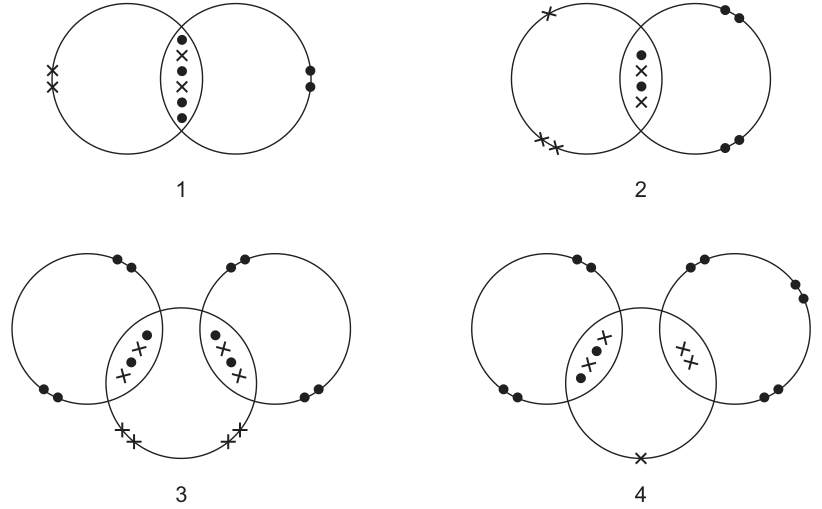
Options
A 1 and 3
B 1 and 4
C 2 and 3
D 2 and 4
Working
Peroxyacetyl nitrate (PAN) is a component of photochemical smog formed from the reaction of unburned hydrocarbons (volatile organic compounds) with nitrogen oxides in the presence of sunlight and oxygen.
The key molecules involved in the formation of PAN are:
- Nitrogen dioxide (NO₂): reacts with peroxyacetyl radicals to form PAN.
- Oxygen (O₂): reacts with hydrocarbon radicals to form peroxy radicals.
Analyzing the dot-and-cross diagrams:
- Diagram 1: Shows a triple bond with one lone pair on each atom. This represents nitrogen gas (). Nitrogen is unreactive and does not directly form PAN.
- Diagram 2: Shows a double bond with two lone pairs on each atom. This represents oxygen gas (). Oxygen is required for the oxidation of hydrocarbons to peroxy radicals.
- Diagram 3: Shows a bent triatomic molecule with single bonds and lone pairs. This likely represents ozone () or a similar molecule, but is not the primary nitrogen-containing precursor.
- Diagram 4: Shows a bent triatomic molecule with an odd number of electrons (radical). This represents nitrogen dioxide (), which has 17 valence electrons (5 from N, 6×2 from O). is the key nitrogen oxide that reacts with peroxyacetyl radicals to form PAN.
The molecules that react to form PAN are (Diagram 2) and (Diagram 4).
Answer
D
D
Background Concept
Photochemical smog is a type of air pollution that occurs when vehicle emissions (hydrocarbons and nitrogen oxides) react in the presence of sunlight. A key component of photochemical smog is peroxyacetyl nitrate (PAN), which is an eye irritant and phytotoxin.
The formation of PAN involves a complex series of free-radical reactions. The essential steps are:
- Photolysis of NO₂: Sunlight breaks down nitrogen dioxide into nitrogen monoxide and a reactive oxygen atom.
- Ozone formation: The oxygen atom reacts with oxygen gas to form ozone.
- Hydrocarbon oxidation: Unburned hydrocarbons (RH) react with hydroxyl radicals (•OH) or ozone to form organic radicals, which then react with oxygen () to form peroxy radicals (•). For example, acetaldehyde (from hydrocarbons) forms a peroxyacetyl radical (•).
- PAN formation: The peroxyacetyl radical reacts with nitrogen dioxide () to form PAN.
Thus, the critical molecules from the atmosphere that participate directly in the formation pathway to PAN (along with hydrocarbons) are nitrogen dioxide () and oxygen ().
Understanding the Question
The question asks to identify which dot-and-cross diagrams represent molecules that can react with unburned hydrocarbons to form peroxyacetyl nitrate (PAN). We are given four diagrams and must identify the chemical species they represent, then select the two that are involved in PAN formation.
- Diagram 1: Two atoms, triple bond, 1 lone pair each. Total valence electrons = 10. This is .
- Diagram 2: Two atoms, double bond, 2 lone pairs each. Total valence electrons = 12. This is .
- Diagram 3: Three atoms, central atom bonded to two others. Looks like (ozone) or similar, but let's check electron count. Central O has 1 lone pair, bonded to two O's (one double, one single/dative). Total 18 electrons. This is .
- Diagram 4: Three atoms, central atom bonded to two others, with an unpaired electron. Total valence electrons = 17 (5 from N + 12 from two O's). This is (nitrogen dioxide), a free radical.
The correct molecules are and .
Approach
- Identify the molecules in each dot-and-cross diagram by counting valence electrons and analyzing bonding/lone pairs.
- Recall the chemistry of photochemical smog: Specifically, the formation of PAN requires nitrogen dioxide () and oxygen () reacting with hydrocarbon-derived radicals.
- Match the molecules to the diagrams: is Diagram 2, is Diagram 4.
- Select the option containing 2 and 4.
Step-by-Step Reasoning
- Diagram 1: The diagram shows two atoms sharing three pairs of electrons (triple bond) and each having one lone pair. Total valence electrons = . This is nitrogen gas, . is very unreactive due to the strong triple bond and does not participate in smog formation. Reject.
- Diagram 2: The diagram shows two atoms sharing two pairs of electrons (double bond) and each having two lone pairs. Total valence electrons = . This represents oxygen gas, . In the atmosphere, reacts with hydrocarbon radicals (formed from unburned hydrocarbons) to produce peroxy radicals (•), which are precursors to PAN. Accept.
- Diagram 3: This is a triatomic molecule. Counting electrons: central atom has 1 lone pair (2e), each outer atom has 2 lone pairs (4e each), and there are two bonding regions. Total valence electrons = 18. This represents ozone, . While ozone is present in smog, the direct precursors to PAN from the list are and (with hydrocarbons). The question asks for molecules that react with unburned hydrocarbons to form PAN. The key reaction is peroxyacetyl radical + -> PAN. The peroxyacetyl radical comes from hydrocarbon + . So and are the correct answers.
- Diagram 4: This is a triatomic molecule with an odd number of electrons. Central atom (N, 5 valence e⁻) bonded to two O atoms (6 valence e⁻ each). Total = 17 valence electrons. The diagram shows an unpaired electron (the single 'x' at the bottom). This is nitrogen dioxide, . reacts with the peroxyacetyl radical to form PAN. Accept.
Therefore, diagrams 2 () and 4 () are correct. This corresponds to option D.
Key Takeaways
- Photochemical smog formation involves reactions between hydrocarbons, , and in the presence of sunlight.
- PAN (peroxyacetyl nitrate) is formed specifically from the reaction of nitrogen dioxide () with peroxyacetyl radicals (derived from hydrocarbons and oxygen).
- Dot-and-cross diagrams can be used to identify radicals (odd number of electrons) like .
Common Mistakes
- Confusing with : Diagram 1 is (triple bond), which is inert. Students might think nitrogen is involved and choose diagram 1, forgetting it's gas, not the reactive oxide .
- Miscounting electrons in : has 17 valence electrons, making it a free radical. Diagram 4 correctly shows this with an unpaired electron. Diagram 3 has 18 electrons (like or ), which is not .
- Forgetting the role of : Students might focus only on and hydrocarbons, missing that oxygen (, Diagram 2) is essential for forming the peroxy radical intermediate.
Things to Be Careful About
- Dot-and-cross diagrams for radicals: is a radical with 17 electrons. Ensure you can identify the unpaired electron in the diagram (Diagram 4 has a single 'x' outside the bonding regions).
- Chemistry of PAN: Remember the specific precursors: hydrocarbons + + sunlight/ -> PAN. The direct reactants combining to form the final PAN molecule are the peroxyacetyl radical and , but the overall process requires to generate the peroxy radical from hydrocarbons.
- Diagram 3 vs Diagram 4: Diagram 3 is likely ozone (, 18e⁻) or sulfur dioxide (, 18e⁻). Diagram 4 is nitrogen dioxide (, 17e⁻). The odd electron count is the key identifier for .
Which set of three elements contains a single element that has both the highest melting point and the lowest electrical conductivity of the three elements in the set?
Options
A magnesium, aluminium and silicon
B aluminium, silicon and phosphorus
C sodium, magnesium and aluminium
D silicon, phosphorus and chlorine
Working
Silicon has a giant covalent structure, giving it the highest melting point of Mg, Al and Si. It is a semiconductor, so its electrical conductivity is lower than the metallic conductors Mg and Al. Thus silicon is the single element satisfying both conditions.
Answer
A
A
Background Concept
In Period 3 (Na to Ar), the type of structure changes from metallic (Na, Mg, Al) to giant covalent (Si) to simple molecular (P4, S8, Cl2, Ar). Melting point and electrical conductivity depend on this structure.
Understanding the Question
The question asks for a set of three elements where the same element is both the highest melting point and the lowest electrical conductivity within that set. It is not asking for a trend across the whole period; it is a comparison within each option.
Approach
For each option, identify which element has the highest melting point. Then check whether that same element also has the lowest electrical conductivity among the three.
Step-by-Step Reasoning
- A: Mg, Al, Si. Si (giant covalent) has the highest melting point. Mg and Al are metals with metallic bonding and conduct electricity well; Si is a semiconductor and conducts poorly. So Si satisfies both conditions.
- B: Al, Si, P. Si has the highest melting point, but P (simple molecular) is the poorest conductor. The two conditions are not met by the same element.
- C: Na, Mg, Al. Al has the highest melting point, but Na is the poorest conductor among the metals. Not the same element.
- D: Si, P, Cl. Si has the highest melting point, but Cl (simple molecular) is the poorest conductor. Not the same element.
Therefore A is correct.
Key Takeaways
- Silicon is a giant covalent semiconductor: high melting point, low electrical conductivity.
- Metals conduct electricity well; simple molecular substances are poor conductors.
- Always check that the same element satisfies both stated properties.
Common Mistakes
- Assuming all non-metals are insulators: silicon is a semiconductor, not a good conductor, but not an insulator either.
- Comparing properties across the whole period instead of within the given set.
- Choosing an option where the highest melting point and lowest conductivity belong to different elements.
Things to Be Careful About
- The phrase 'contains a single element' means one element must satisfy both conditions.
- Melting point order in Period 3: rises from Na to Al, peaks at Si, then drops sharply for P, S, Cl, Ar.
- Electrical conductivity: metals good, silicon semiconducting, non-metals poor.
In which row do the particles increase in size?
Options
| smallest largest | |||
|---|---|---|---|
| A | N | O | F |
| B | |||
| C | |||
| D | Ne |
Working
For isoelectronic species (same number of electrons), radius decreases as proton number increases, because the greater nuclear charge pulls the same electron cloud closer.
- A: N, O, F — same period; atomic radius decreases across a period, so order is N > O > F. Not increasing.
- B: , , — isoelectronic (10 e); proton numbers 7, 8, 9; radius decreases with proton number, so > > . Not increasing.
- C: , , — isoelectronic (10 e); proton numbers 11, 12, 13; radius decreases, so > > . Not increasing.
- D: , Ne, — isoelectronic (10 e); proton numbers 11, 10, 9; radius increases as proton number decreases, so < Ne < . Increasing.
Answer
D
D
Background Concept
Atomic and ionic radius trends. Across a period, atomic radius decreases: the nuclear charge (proton number) increases while electrons enter the same principal shell, so the outer electrons are pulled closer to the nucleus. For ions, the key idea is isoelectronic species — atoms and ions that have the same number of electrons. When species are isoelectronic, their size is governed entirely by the nuclear charge: the greater the proton number, the more strongly the same electron cloud is attracted, and the smaller the radius. Anions (extra electrons) are larger than their parent atoms; cations (fewer electrons) are smaller.
Understanding the Question
This multiple-choice question asks which row lists particles in order of increasing size (smallest largest). Four rows are given, each containing three particles. The task is to determine the correct size ordering for each row and identify the one that genuinely increases. The rows mix neutral atoms from one period (A) and isoelectronic sets of ions and atoms (B, C, D).
Approach
Check each row one at a time. For row A, apply the across-period trend for neutral atoms. For rows B, C, and D, recognise that each contains isoelectronic species (all with 10 electrons), so compare proton numbers: more protons means a smaller radius, fewer protons means a larger radius. The row that goes from highest proton number to lowest proton number is the one that increases in size.
Step-by-Step Reasoning
- Row A: N, O, F. These are neutral atoms in Period 2. Across a period, atomic radius decreases because the increasing nuclear charge pulls the same outer shell closer. So the order is N > O > F — this row decreases in size, so it is not the answer.
- Row B: , , . Each ion has 10 electrons (isoelectronic with Ne): has 7 + 3 = 10, has 8 + 2 = 10, has 9 + 1 = 10. Proton numbers are 7, 8, 9 respectively. For isoelectronic species, the one with the fewest protons is the largest, so > > . This row decreases in size.
- Row C: , , . Each ion has 10 electrons (isoelectronic with Ne). Proton numbers are 11, 12, 13 respectively. More protons means a smaller radius, so > > . This row decreases in size.
- Row D: , Ne, . Each species has 10 electrons. Proton numbers are 11, 10, 9 respectively. Fewer protons means a larger radius, so < Ne < . This row increases in size — this is the correct answer.
Key Takeaways
- For isoelectronic species, size is determined by proton number: more protons smaller radius.
- Across a period, neutral atomic radius decreases as proton number increases.
- Anions are larger than their parent atoms; cations are smaller.
- Always count electrons carefully for ions before applying the isoelectronic rule.
Common Mistakes
- Confusing the direction of the across-period trend — atomic radius decreases across a period, not increases.
- Forgetting that isoelectronic ions differ in size: the species with the fewest protons is the largest, not the one with the most electrons (they all have the same number of electrons).
- Treating all ions of the same charge as the same size without considering the proton number.
Things to Be Careful About
- Count electrons correctly for ions: has 10 electrons (7 protons + 3 extra), not 7.
- For isoelectronic comparisons, compare proton numbers, not electron numbers — the electron count is identical by definition.
- Remember the question asks for increasing size; check the direction of each row before selecting.
W, X, Y and Z are Group 2 elements barium, calcium, magnesium and strontium but not in that order.
- W reacts faster with dilute hydrochloric acid than Y.
- The hydroxide of X is less soluble in water than the hydroxide of W.
- The sulfate of Y is the most soluble of the sulfates of W, X, Y and Z.
- The carbonate of Z decomposes more slowly than the carbonate of W at the same temperature.
What is the of the nitrate of W?
Options
A 148.3
B 164.1
C 211.6
D 261.3
Working
Group 2 trends: reactivity with acids increases down the group; hydroxide solubility increases down the group; sulfate solubility decreases down the group; carbonate thermal stability increases down the group.
Y has the most soluble sulfate, so .
W reacts faster with acid than Y, so W lies below Mg.
Taking :
- Clue 2: X's hydroxide is less soluble than W's, so X is above Sr. The only free element above Sr is Ca, so .
- Clue 4: Z's carbonate decomposes more slowly than W's, so Z lies below W. The remaining element is Ba, so .
Hence , and:
Answer
C (211.6)
C
Background Concept
This question merges two ideas: the systematic trends shown by the Group 2 elements (Mg, Ca, Sr, Ba) down the group, and the relative molecular mass of a compound.
Going down Group 2:
- Reactivity (ease of losing the two outer-shell electrons to form ions) increases. So the rate of reaction with dilute acid increases down the group: Mg < Ca < Sr < Ba.
- Solubility of the hydroxides increases down the group. The lattice enthalpy of the hydroxide falls as the cation radius grows, and this dominates over the fall in hydration enthalpy, so dissolution becomes more favourable.
- Solubility of the sulfates decreases down the group. Here the fall in hydration enthalpy is larger than the fall in lattice enthalpy, so the larger cations dissolve les easily: MgSO4 > CaSO4 > SrSO4 > BaSO4.
- Thermal stability of the carbonates increases down the group (the decomposition temperature rises). A large cation with low charge density polarises (distorts) the carbonate ion less, so the carbonate is more stable. Thus MgCO3 decomposes readily, BaCO3 much less readily.
Understanding the Question
The stem gives four qualitative clues that compare W, X, Y and Z (which are barium, calcium, magnesium and strontium in some order). From these observations you must decide exactly which element each letter stands for, then calculate the relative molecular mass of W's nitrate. The command is implicit — a deduction plus a calculation. The four options (148.3, 164.1, 211.6, 261.3) are precisely the values of the nitrates of, respectively, Mg, Ca, Sr and Ba, so choosing the right option depends entirely on identifying W correctly.
Approach
Start with the clue that pins down one element outright: the sulfate of Y is the most soluble of all four sulfates. Since sulfate solubility decreases down the group, the most soluble sulfate belongs to the smallest element, Mg. Having fixed Y = Mg, use the remaining clues as inequalities to place W, X and Z. Use the reactivity clue to set W below Mg, then test the candidate W = Sr against the hydroxide-solubility and carbonate-stability clues; the assignments must be mutually consistent.
Step-by-Step Reasoning
-
Fix Y from sulfate solubility. Sulfate solubility decreases down Group 2, so the most soluble sulfate is MgSO4. Therefore Y = Mg.
-
Use reactivity with acid. W reacts faster than Y, so W is more reactive than Mg, i.e. W lies further down the group: W ∈ {Ca, Sr, Ba}.
-
Place X from hydroxide solubility. The hydroxide of X is less soluble than that of W, so X lies above W in the group.
-
Place Z from carbonate stability. The carbonate of Z decomposes more slowly than that of W, so Z is more thermally stable and lies below W.
-
Test the candidate W = Sr.
- X must be above Sr. The elements above Sr are Mg and Ca; Mg is already assigned to Y, so X = Ca. This satisfies clue 2 (Ca(OH)2 is less soluble than Sr(OH)2).
- Z must be below Sr. The remaining element is Ba, so Z = Ba. This satisfies clue 4 (BaCO3 is more stable than SrCO3).
- All clues are now satisfied: W = Sr, X = Ca, Y = Mg, Z = Ba.
-
Confirm no other assignment works. If W = Ca, then X would have to be above Ca (i.e. Mg), which is already taken by Y — contradiction. If W = Ba, X would have to be above Ba, which is impossible. So W = Sr is the only consistent choice.
-
Calculate of the nitrate of W.
This matches option C.
Key Takeaways
- Group 2 hydroxides become more soluble down the group, while Group 2 sulfates become less soluble down the group — a classic pair of opposing trends that candidates must memorise correctly.
- Reactivity with water/acid and carbonate thermal stability both increase down the group.
- When a question provides several qualitatative clues, the strategy is to find the one clue that identifies an element uniquely, then narrow the others by elimination.
- of a nitrate like Sr(NO3)2 requires doubling the nitrate group: one Sr + two N + six O.
Common Mistakes
- Getting a trend backwards. A very common error is to think hydroxide solubility decreases, or sulfate solubility increases, down the group. Here, mixing up clue 2 or clue 3 will assign W to the wrong element and lead to a wrong option.
- Forgetting that sulfate solubility decreases. If a candidate believes the most soluble sulfate is at the bottom of the group, they would set Y = Ba and the whole deduction falls apart.
- Arithmetic slip in . Using Sr = 88 instead of 87.6, or forgeting to double the nitrate group, gives values such as 212 or 203. The options are engineered so that a wrong element (A=Mg, B=Ca, D=Ba) gives a "neat" wrong answer — the calculation itself does not flag the error.
- Ageuing W = Ca. Trying W = Ca fails because X would need to be Mg, which is already Y — a neat illustration of why the identity must be self-consistent across all four clues.
Things to Be Careful About
- Memorise the exact direction of the solubility trends: hydroxides increase, sulfates decrease, down the group.
- Use accurate relative atomic masses for Group 2: Mg = 24.3, Ca = 40.1, Sr = 87.6, Ba = 137.3. The question quietly expects these values.
- In the calculation double the entire nitrate group (2N and 6O), not just the N.
- Ecosystem the logic: after assigning W = Sr, X = Ca, Y = Mg, Z = Ba, check that every one of the four clues is obeyed so no contradiction remains.
Polymer J has repeat unit .
Polymer K has repeat unit .
Which row is correct?
Options
| monomer from which polymer J is produced | monomer from which polymer K is produced | |
|---|---|---|
| A | pent-1-ene | but-1-ene |
| B | pent-1-ene | but-2-ene |
| C | pent-2-ene | but-1-ene |
| D | pent-2-ene | but-2-ene |
Working
For polymer J, the repeat unit has two backbone carbon atoms, one carrying an ethyl group and the other a methyl group. Restoring the double bond between these two backbone carbons gives the monmer:
This is pent-2-ene.
For polymer K, each repeat unit has two backbone carbon atoms, each carrying a methyl group. Restoring the double bond gives:
This is but-2-ene.
Answer
D — pent-2-ene and but-2-ene
D
Background Concept
Addition polymerisation joins alkene molecules end-to-end. The C=C double bond opens, and the electrons form single bonds to adjacent monomer units. The repeat unit and the monomer therefore have the same carbon skeleton. To work backwards from a repeat unit to the monomer, replace the single bond between two adjacent backbone carbon atoms with a double bond, keeping all the groups attached to those carbon atoms exactly the same. The name of the alkene is then found from the longest chain containing that double bond and from the position of the double bond.
Understanding the Question
We are given two repeat units and four possible combinations of monomer names. We need to decide, for each polymer, which alkene could open and polymerise to give that repeat unit. The options involve pent- and but- monmers with the double bond either at the end (1-ene) or in the middle (2-ene). The difference between a 1-ene and a 2-ene is visible in the repeat unit: a 1-ene gives a backbone carbon with two H atoms (CH2), while a 2-ene gives two backbone carbons that each have one H and one alkyl group.
Approach
For each repeat unit, take any two adjacent backbone carbons and re-form the C=C double bond between them. Count the total number of carbon atoms in the repeat unit to identify pent- or but-. Then decide where the double bond lies in the longest chain. If one of the double-bond carbons has two H atoms, the alkene is a 1-ene; if both double-bond carbons carry alkyl side groups, it is a 2-ene.
Step-by-Step Reasoning
For polymer J, the repeat unit is -[CH(C2H5)CH(CH3)]-. The backbone has two carbons: one is bonded to an ethyl group (C2H5) and one H; the other is bonded to a methyl group (CH3) and one H. Re-forming the double bond between these two backbone carbons gives the monomer CH3CH2CH=CHCH3. This has five carbons and the double bond is between C2 and C3, so the name is pent-2-ene.
For polymer K, the repeat unit is -[CH(CH3)CH(CH3)]-. Both backbone carbons carry a methyl group and one H. Re-forming the double bond gives CH3CH=CHCH3. This has four carbons and the double bond is between C2 and C3, so the name is but-2-ene.
Option D matches both. The other options all involve a 1-ene, which would give a repeat unit containing a CH2 group in the backbone. For example, pent-1-ene, CH2=CHCH2CH2CH3, would give a repeat unit -[CH2-CH(CH2CH2CH3)]-, not the repeat unit given. Similarly, but-1-ene, CH2=CHCH2CH3, would give -[CH2-CH(CH2CH3)]-, not the repeat unit given for polymer K.
Key Takeaways
- To find the monomer from a repeat unit, put the double bond back between two backbone carbon atoms.
- Count all carbon atoms, including side-chain carbons, to decide the parent alkene chain length.
- A 1-ene has a terminal CH2 group and gives a repeat unit with an unsubstituted CH2 in the backbone.
- A 2-ene has the double bond between two internal carbons and gives a repeat unit in which two backbone carbons carry alkyl side groups.
Common Mistakes
- Choosing a 1-ene: a 1-ene monomer would produce a repeat unit with a CH2 group in the backbone. Neither polymer J nor polymer K has a CH2 group in the repeat unit.
- Miscounting carbon atoms: side-chain groups must be counted when naming the parent alkene. Ethyl (2 C) + methyl (1 C) + 2 backbone C = 5 C, so J is pent-; two methyl groups + 2 backbone C = 4 C, so K is but-.
- Confusing pent-1-ene with pent-2-ene: the 1-ene has the double bond at the end of the chain, so its repeat unit would contain a CH2 backbone carbon, which is not present here.
Things to Be Careful About
- Write the side groups exactly as they appear in the repeat unit: ethyl is two carbon atoms, methyl is one carbon atom.
- When re-forming the double bond, do not move or change any side group; only the bond between the two backbone carbons changes.
- The repeat unit can be written left-to-right or right-to-left; pent-2-ene is still the same monomer for polymer J even if the repeat unit is drawn in the opposite direction.
- The answer is a 2-ene in both cases, not a 1-ene.
ethanenitrile reacts with an excess of dilute sodium hydroxide. The reaction produces organic compound S and ammonia gas only.
The reaction has an yield.
Which mass of S is produced?
Options
A
B
C
D
Working
Ethanenitrile hydrolyses with dilute NaOH:
CH3CN + NaOH + H2O -> CH3COONa + NH3
So S is sodium ethanoate, CH3COONa.
Mr(CH3COONa) = (2 × 12.0) + (3 × 1.0) + (2 × 16.0) + 23.0 = 82.0
Theoretical moles of S = 0.200 mol.
At 80.0% yield:
actual moles of S = 0.200 × 0.800 = 0.160 mol
Mass of S = 0.160 × 82.0 = 13.1 g
Answer
B (13.1 g)
B
Background Concept
Nitriles contain the -C≡N functional group. Under aqueous conditions they can be hydrolysed. With dilute sodium hydroxide, ethanenitrile reacts to give the sodium salt of the corresponding carboxylic acid and ammonia:
CH3CN + NaOH + H2O -> CH3COONa + NH3
So the organic product S is sodium ethanoate, not ethanoic acid. The reaction is 1:1 in terms of nitrile to S.
Understanding the Question
We start with 0.200 mol of ethanenitrile and an excess of NaOH, so the nitrile is the limiting reactant. The yield is only 80.0%, meaning we do not get the full 0.200 mol of S. We need the mass of S actually produced.
Approach
- Write the balanced equation and identify S.
- Calculate the molar mass of S.
- Find the theoretical moles of S from the nitrile.
- Multiply by the percentage yield to get actual moles.
- Convert actual moles to mass using mass = moles × molar mass.
Step-by-Step Reasoning
- Balanced hydrolysis: CH3CN + NaOH + H2O -> CH3COONa + NH3.
- S = CH3COONa.
- Mr(CH3COONa) = (2 × 12.0) + (3 × 1.0) + (2 × 16.0) + 23.0 = 82.0.
- Theoretical moles of S = 0.200 mol, because the mole ratio is 1:1.
- Actual moles of S = 0.200 × 0.800 = 0.160 mol.
- Mass of S = 0.160 × 82.0 = 13.12 g ≈ 13.1 g.
This matches option B.
Key Takeaways
- Hydrolysis of a nitrile with NaOH gives a carboxylate salt and ammonia, not the free carboxylic acid.
- Percentage yield is applied to the amount of product: actual moles = theoretical moles × (percentage/100).
- Always use the molar mass of the actual product formed, including any metal ion.
Common Mistakes
- Forgetting the 80.0% yield and using 0.200 mol directly gives 16.4 g, option D.
- Using the molar mass of ethanoic acid (60.0) instead of sodium ethanoate (82.0) gives 9.60 g, option A.
- Confusing the product with ethanoic acid because acid hydrolysis of nitriles gives carboxylic acids; here the reagent is NaOH, so the salt forms.
Things to Be Careful About
- Read the reagent: dilute NaOH means sodium ethanoate, while dilute H2SO4/H+ would give ethanoic acid and ammonium salt.
- Check that the equation is balanced and the mole ratio is 1:1.
- Keep the yield as a decimal (0.800), not 80, when multiplying.
- Use units: g mol^-1 for molar mass and g for mass.
The structure of butenedioic acid is shown.
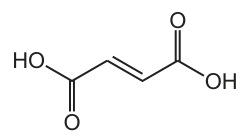
When an excess of is added to butenedioic acid, which organic product is formed?
Options
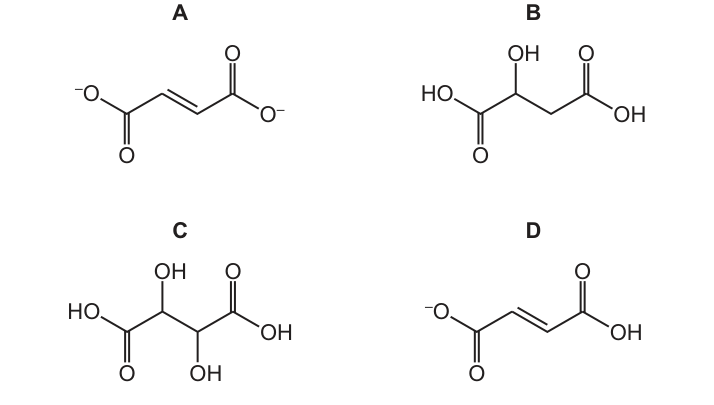
Working
Butenedioic acid is a dicarboxylic acid containing two –COOH groups and a C=C double bond.
NaOH(aq) is a strong base that reacts with carboxylic acids in an acid–base neutralisation reaction to form a carboxylate salt and water.
Because an excess of NaOH is added, both –COOH groups will be deprotonated to form –COO⁻ ions.
The C=C double bond is unreactive towards NaOH(aq).
The resulting organic product is the dicarboxylate salt (⁻OOC–CH=CH–COO⁻).
Answer
A
A
Background Concept
Carboxylic acids (–COOH) are weak acids that undergo acid–base neutralisation reactions with strong bases such as aqueous sodium hydroxide (NaOH). In this reaction, the acidic hydrogen of the carboxyl group is removed, forming a carboxylate anion (–COO⁻) and water. If a molecule contains more than one carboxyl group (a polycarboxylic acid), each group will react with the base according to the equation:
Carbon–carbon double bonds (C=C) are generally unreactive towards aqueous alkalis like NaOH; they do not undergo addition or substitution with hydroxide ions under these conditions.
Understanding the Question
The question provides the structure of butenedioic acid, which is a dicarboxylic acid with a trans C=C double bond in the middle (HOOC–CH=CH–COOH). It asks for the organic product when an excess of NaOH(aq) is added. The options show various possible structures: some with modified carbon chains, some with only one carboxyl group deprotonated, and one with both carboxyl groups deprotonated while retaining the double bond.
Approach
Identify the functional groups in butenedioic acid and determine which ones react with NaOH(aq).
- The –COOH groups are acidic and will react with the base NaOH.
- The C=C double bond is non-polar and unreactive towards aqueous NaOH.
- Because NaOH is in excess, all acidic protons (from both –COOH groups) will be removed.
- Match the resulting structure to the given options.
Step-by-Step Reasoning
- Butenedioic acid has the structure HOOC–CH=CH–COOH. It contains two carboxylic acid functional groups and one carbon–carbon double bond.
- When NaOH(aq) is added, an acid–base neutralisation occurs. The hydroxide ion (OH⁻) removes the acidic proton from the –COOH group, forming a carboxylate ion (–COO⁻) and water.
- Since there are two –COOH groups, two moles of NaOH are required per mole of butenedioic acid to fully neutralise it. The question specifies that an excess of NaOH is added, ensuring both carboxyl groups are fully deprotonated.
- The C=C double bond does not react with NaOH(aq). Alkenes typically undergo electrophilic addition with halogens or hydrogen halides, not nucleophilic addition or substitution with hydroxide ions in this context.
- The resulting organic product is the dicarboxylate salt: ⁻OOC–CH=CH–COO⁻.
- Looking at the options:
- Option A shows the dicarboxylate salt with the C=C double bond intact. This matches our predicted product.
- Option B shows a saturated chain with two hydroxyl groups added across the double bond and one carboxyl group unchanged. This is incorrect.
- Option C shows a saturated chain with three hydroxyl groups. This is incorrect.
- Option D shows a mono-carboxylate salt (only one –COOH deprotonated). This would be the product if NaOH were in limited amount for just one group, but with excess NaOH, both groups react. This is incorrect.
- Therefore, Option A is the correct product.
Key Takeaways
- Carboxylic acids react with aqueous alkalis (like NaOH) to form carboxylate salts and water.
- Polycarboxylic acids will have all their acidic –COOH groups deprotonated if the base is in excess.
- C=C double bonds are unreactive towards aqueous NaOH; do not assume they will undergo addition or reduction unless a specific reagent (like H₂/Ni or Br₂) is present.
Common Mistakes
- Assuming the C=C double bond reacts with NaOH. Alkenes do not react with aqueous bases.
- Forgetting that "excess" NaOH means all acidic protons are removed, leading to the choice of a mono-salt (Option D) instead of the di-salt (Option A).
- Confusing the reaction with NaOH with reactions like hydration (adding H₂O across the double bond) or reduction.
Things to Be Careful About
- Read the quantity of reagent carefully: "excess" vs "limited" or "1 equivalent". Excess NaOH with a dicarboxylic acid gives the di-salt.
- Ensure you only modify the functional groups that actually react with the given reagent. NaOH only reacts with acidic protons (–COOH, phenols), not with C=C bonds.
- Distinguish between organic products and inorganic by-products. Water is formed but is inorganic; the question asks for the organic product.
Four organic compounds are shown.
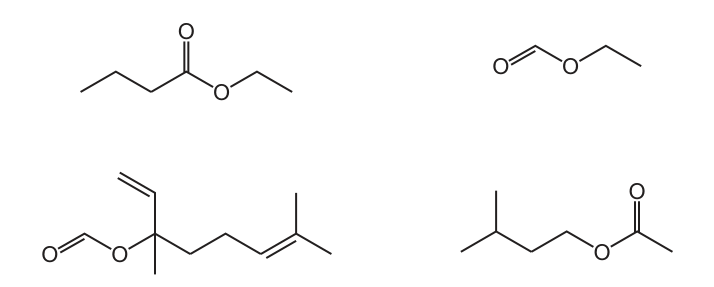
A mixture of these four compounds reacts with hot aqueous sodium hydroxide.
The products of this reaction are acidified.
Which organic acids are present in the products?
Options
A butanoic, ethanoic and propanoic acids
B butanoic, ethanoic and methanoic acids
C ethanoic, 3-methylbutanoic and propanoic acids
D methanoic, 3-methylbutanoic and propanoic acids
Working
Alkaline hydrolysis (saponification) of an ester with hot aqueous NaOH cleaves the ester bond, producing a carboxylate salt and an alcohol. Subsequent acidification converts the carboxylate salt into the free carboxylic acid.
To find the organic acids produced, identify the acyl (acid-derived) portion of each ester by breaking the C–O bond adjacent to the carbonyl group:
- Top left (ethyl butanoate): Acyl group is → yields butanoic acid.
- Top right (ethyl methanoate): Acyl group is → yields methanoic acid.
- Bottom left (complex methanoate ester): Acyl group is → yields methanoic acid.
- Bottom right (3-methylbutyl ethanoate): Acyl group is → yields ethanoic acid.
The unique organic acids present in the final acidified products are butanoic acid, methanoic acid, and ethanoic acid.
Answer
B
B
Background Concept
Esters undergo alkaline hydrolysis (saponification) when heated with aqueous sodium hydroxide. The hydroxide ion acts as a nucleophile, attacking the electrophilic carbonyl carbon of the ester. The reaction cleaves the acyl–oxygen bond (the bond between the carbonyl carbon and the alkoxy oxygen), producing a carboxylate anion and an alcohol. Because the reaction is carried out in basic conditions, the carboxylic acid is deprotonated to form a carboxylate salt. When the mixture is subsequently acidified (e.g., with dilute or ), the carboxylate salt is protonated to yield the free carboxylic acid. The alcohol portion of the ester remains unchanged throughout the process.
Understanding the Question
The question provides skeletal structures of four different esters and asks which organic acids will be present after the mixture is heated with hot aqueous NaOH and then acidified. This requires the ability to read skeletal formulas of esters and correctly identify the carboxylic acid portion (the acyl group) derived from each molecule.
Approach
For each ester structure, locate the carbonyl group () and mentally break the single bond between the carbonyl carbon and the ester oxygen (). The fragment containing the carbonyl carbon (and its attached groups) corresponds to the carboxylic acid (after acidification). The fragment attached to the ester oxygen corresponds to the alcohol. List the unique carboxylic acids produced from the mixture.
Step-by-Step Reasoning
- Top left structure: This is ethyl butanoate. The acyl group is (butanoyl). Hydrolysis yields butanoic acid () and ethanol.
- Top right structure: This is ethyl methanoate. The acyl group is (formyl). Hydrolysis yields methanoic acid () and ethanol.
- Bottom left structure: This is a methanoate ester with a complex, branched alcohol moiety containing carbon-carbon double bonds. Despite the complexity of the alcohol part, the acyl group is simply . Hydrolysis yields methanoic acid and the complex alcohol.
- Bottom right structure: This is 3-methylbutyl ethanoate (isoamyl acetate). The acyl group is (acetyl). Hydrolysis yields ethanoic acid () and 3-methylbutan-1-ol.
Collecting the unique acids from all four reactions gives: butanoic acid, methanoic acid, and ethanoic acid. This matches option B.
Key Takeaways
- Alkaline hydrolysis of esters always produces a carboxylate salt and an alcohol; acidification yields the free carboxylic acid.
- To predict the acid product from an ester, focus only on the acyl side of the ester linkage (); the alcohol side () does not affect the identity of the carboxylic acid.
- Skeletal structures can hide simple acid groups (like for methanoates or for ethanoates); always trace the carbonyl carbon and its direct attachments.
Common Mistakes
- Confusing the acid and alcohol parts: Breaking the wrong bond in the ester linkage (e.g., the oxygen–alkyl bond instead of the acyl–oxygen bond) leads to assigning the alcohol fragment as the acid.
- Overlooking methanoate esters: Students may miss that the bottom-left structure is a methanoate because the complex alcohol group distracts from the simple acyl group, leading them to incorrectly assume a more complex acid is formed.
- Ignoring the acidification step: Forgetting that the initial hydrolysis produces a carboxylate salt, not the free acid, and that acidification is required to get the final organic acid product.
Things to Be Careful About
- Always verify the identity of the acyl group by counting carbons and checking for hydrogen atoms attached directly to the carbonyl carbon (which indicates a methanoate/methanoic acid derivative).
- Remember that double bonds or branches in the alcohol portion of an ester do not alter the carboxylic acid produced during hydrolysis.
- State symbols and exact naming are not required for this MCQ, but precise structural identification is critical to avoid selecting distractors that rely on misreading the ester fragments.
Ethanal reacts with KCN dissolved in liquid HCN. This reaction involves the formation of an intermediate.
Which statement is correct?
Options
A HCN does not have any lone pairs of electrons and so is the catalyst.
B The of C=O attacks in a nucleophilic attack.
C A proton from HCN is transferred to the intermediate.
D The reaction is a nucleophilic substitution.
Working
Ethanal (CHCHO) reacts with HCN in a nucleophilic addition reaction. The cyanide ion CN (from KCN) acts as the nucleophile and attacks the electron-defficient carbonyl carbon, forming an alkoxide intermediate.
This is not a substitution, and CN is NOT a catalyst—it is consumed in the first step. K is a spectator ion and is not attacked. HCN does have lone pairs (on the N and the C).
the final step is a proton transfer: a proton from HCN adds to the negatively charged oxygen of the intermediate to form the hydroxynitrile.
Answer
C — A proton from HCN is transferred to the intermediate.
C
Background Concept
HCN adds to aldehydes and unsymmetrical ketones to form hydroxynitriles (cyanohydrins). The reaction is a nucleophilic addition. Because HCN is a weak acid, it dissociates to give CN and H. The CN ion is a good nucleophile—its carbon atom carries a lone pair and a partial negative charge—so it can attack the electron-deficient, partially positive carbonyl carbon. The product is a 2-hydroxynitrile, e.g. ethanal gives 2-hydroxypropanenitrile, CHCH(OH)CN.
Understanding the Question
Ethanal is treated with potassium cyanide dissolved in liquid HCN. The question asks which statement about the mechanism is correct. In a typical exam, this tests your command of the nucleophilic addition mechanism rather than mere recall of the product. Notice that the options are about: lone pairs on HCN, the role of K, the proton-transfer step, and whether the reaction is substitution or addition. You are to pick the one true statement.
Approach
Recognise the reaction type first: aldehyde + HCN = nucleophilic addition. Write the mechanism in your head: CN attacks the C=O carbon, an intermediate alkoxide forms, then H (from HCN) adds to the O . Then test each option against this mechanism: whether the nucleophile is CN, whether the electrophilic centre is the carbonyl carbon (not K), whether the proton transfer step occurs, and whether it is addition not substitution. Only C matches.
Step-by-Step Reasoning
the correct mechanism is:n1. KCN dissociates: KCN K + CN . CN is the nucleophile.n2. The C=O bond is polar: oxygen is more electronegative, so the carbon carries a partial positive charge (electrophile) and oxygen a partial negative.n3. The lone pair on the carbon of CN attacks the carbonyl carbon, forming a new C–C bond. The C=O bond breaks andboth electrons move onto the oxygen, giving an alkoxide intermediate with a negative charge on O.n4. A proton (H) from a molecule of HCN transfers to the O , forming the –OH group.
Now test each option:n- A — false. HCN has lone pairs: the nitrogen has a lone pair, and the carbon of the cyanide group also carries a lone pair (it is a carbenion-like centre). Also CN is not a catalyst—it is consumed in the first step (though HCN is regenerated only in the sense that the proton is returned; the CN unit ends up in the product).
the statement is wrong on both counts.
- B — false. The of C=O is electron-rich; it does not attack K . Everything is reversed: the electrophile is the carbonyl carbon, and the nucleophile is CN , not the oxygen. K is a spectator.
- C — true. After the nucleophilic attack, the intermediate carries a negative charge on oxygen; a proton from HCN is transferred to that oxygen to give the neutral hydroxynitrile.
- D — false. The reaction is a nucleophilic addition (the C=O becomes C–O and a C–C bond forms), not a substitution. In substitution a leaving group would depart; here no leaving group leaves.
Key Takeaways
- HCN adds to aldehydes and ketones by nucleophilic addition, not substitution.
- CN (the anion) is the nucleophile; the carbonyl carbon is the electrophile.
- The mechanism has two steps: nucleophilic attack, then protonation of the alkoxide.
- K is a spectator; HCN is the source of both the CN and the proton dissociating to CN and H.
Common Mistakes
- Calling the reaction nucleophilic substitution—it is addition, because the C=O becomes C–O and a new bond forms to carbon; no group leaves.
- Thinking CN is a catalyst—it is the nucleophile and is incorporated into the product.
- Thinking the carbonyl oxygen is the attacking species—oxygen is electron-rich, but the attack is by the nucleophile CN on the carbon.
- Forgetting that HCN has lone pairs (on N and C), so option A is wrong even before considering catalysis.
Things to Be Careful About
- With unsymmetrical carbonyls, the CN group adds to the more substituted/py partially positive carbon (the carbonyl carbon itself); the stereochemistry at that new centre may produce racemic mixtures, but that is not tested here.
- HCN is toxic and volatile; in practice the reaction uses KCN with mineral acid to generate HCN in situ—irrelevant to the mechanism but a useful safety note.
- The question asks for the one correct statement; options A, B, D each contain a clear error, leaving C as the only defensible choice.
What is formed when propanone is heated under reflux with a solution of ?
Options
A propan-2-ol
B propan-1-ol
C propanal
D propane
Working
is a reducing agent that reduces the carbonyl group. It reduces aldehydes to primary alcohols and ketones to secondary alcohols.
Propanone is a ketone, . Reduction adds hydrogen across the bond:
The product is the secondary alcohol propan-2-ol.
Answer
A
A
Background Concept
Sodium borohydride, , is a mild reducing agent widely used in organic chemistry to reduce the carbonyl group of aldehydes and ketones. It supplies hydride ions (), which attack the electrophilic carbonyl carbon. The outcome depends on the structure of the carbonyl compound: an aldehyde () is reduced to a primary alcohol (), whereas a ketone () is reduced to a secondary alcohol (). In both cases the group becomes a group, with a new bond formed on the carbonyl carbon.
Understanding the Question
This MCQ asks for the product formed when propanone is heated under reflux with a solution of . Propanone is the simplest ketone, with the structure . The question tests whether you recognise that propanone is a ketone (not an aldehyde), know that reduces the carbonyl group, and can name the resulting alcohol correctly.
Approach
- Identify the functional group of propanone — it is a ketone, with the group in the middle of the carbon chain.
- Recall what does to a ketone — it reduces the to a , adding an atom to the carbonyl carbon.
- Draw the product: the carbonyl carbon becomes , with the two methyl groups unchanged, giving .
- Name the product: propan-2-ol, because the group is on carbon 2.
Step-by-Step Reasoning
Propanone has the structure . The carbonyl carbon is bonded to two methyl groups, so it is a ketone.
acts as a source of hydride, . The hydride attacks the electrophilic carbonyl carbon, breaking the bond. Protonation (from water or the alcohol solvent) then adds to the oxygen, giving an alcohol.
For propanone:
The carbonyl carbon now carries an group and an atom, and is still bonded to the two groups. The product is propan-2-ol, a secondary alcohol, because the carbon bearing the group is attached to two other carbon atoms.
Now consider the distractors:
- B, propan-1-ol — this is the primary alcohol that would result from reducing propanal (), an aldehyde. Propanone is a ketone, so reduction gives a secondary alcohol, not a primary one.
- C, propanal — an aldehyde is an oxidation product of propan-1-ol, not a reduction product of propanone. Reduction of a ketone cannot produce an aldehyde.
- D, propane — this would require removing the oxygen entirely and adding extra hydrogen. does not deoxygenate the molecule; it only reduces the carbonyl group.
The correct answer is therefore A.
Key Takeaways
- reduces aldehydes to primary alcohols and ketones to secondary alcohols.
- The carbonyl group becomes : the carbon gains an and the oxygen gains an .
- Recognising whether a carbonyl compound is an aldehyde or a ketone determines the class of alcohol produced.
- The name of the alcohol follows from the position of the group on the longest carbon chain.
Common Mistakes
- Choosing propan-1-ol (B): confusing a ketone with an aldehyde. Propanone is a ketone, so reduction gives a secondary alcohol (propan-2-ol), not a primary alcohol.
- Choosing propanal (C): thinking reduction of a ketone could give an aldehyde. Reduction removes the group; it does not rearrange it into a group.
- Choosing propane (D): assuming removes oxygen completely. only reduces the carbonyl group; it does not deoxygenate the molecule.
Things to Be Careful About
- The suffix "-one" in propanone tells you it is a ketone; the prefix "propan-" tells you it has three carbons.
- is selective for the carbonyl group; it does not reduce bonds or other functional groups under these conditions.
- "Heated under reflux" is standard for such reductions; it ensures the reaction proceeds at a reasonable rate but does not change the identity of the product.
- Be careful with naming: the group in propan-2-ol is on carbon 2, making it a secondary alcohol.
The compounds shown are all produced by plants.
Each compound is warmed with acidified .
Which compound will give a different observation to the other three?
Options
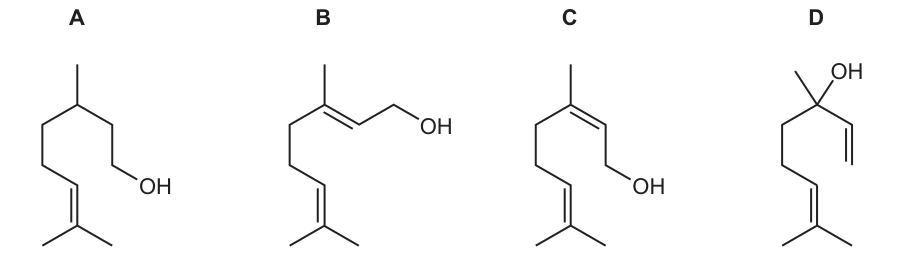
Working
Acidified potassium dichromate(VI), , is an oxidizing agent. It oxidizes primary and secondary alcohols, reducing the orange dichromate(VI) ion () to the green chromium(III) ion (), causing a colour change from orange to green.
- Compounds A, B, and C all contain a primary alcohol group (). The carbon atom bonded to the group is attached to only one other carbon atom. These will be oxidized, resulting in an orange to green colour change.
- Compound D contains a tertiary alcohol group. The carbon atom bonded to the group is attached to three other carbon atoms (a methyl group, a methylene chain, and a vinyl group). Tertiary alcohols cannot be oxidized by acidified dichromate(VI) because there is no hydrogen atom on the carbon bearing the hydroxyl group to be removed. Therefore, no reaction occurs, and the solution remains orange.
Compound D gives a different observation (remains orange) compared to A, B, and C (turn green).
Answer
D
D
Background Concept
The reaction of alcohols with acidified potassium dichromate(VI) () is a standard test for alcohol classification in A-Level Chemistry.
- Primary alcohols () are oxidized first to aldehydes () and then, under reflux or with excess oxidant, to carboxylic acids (). In both steps, the dichromate(VI) ion (, orange) is reduced to chromium(III) ion (, green).
- Secondary alcohols () are oxidized to ketones (). The same orange-to-green colour change occurs.
- Tertiary alcohols () are not oxidized under these conditions. Oxidation of an alcohol involves the removal of a hydrogen atom from the oxygen and a hydrogen atom from the carbon atom bearing the hydroxyl group (the -carbon). In a tertiary alcohol, the -carbon is bonded to three other carbon atoms and has no hydrogen atom attached to it. Therefore, no oxidation can occur, and the orange colour of the dichromate solution persists.
Understanding the Question
We are given four skeletal structures of organic compounds (terpenes produced by plants) and asked to identify which one gives a different observation when warmed with acidified . The key is to determine the type of alcohol (primary, secondary, or tertiary) in each molecule and predict the result of the oxidation reaction.
Approach
- Examine each skeletal structure (A, B, C, D) and locate the hydroxyl () group.
- Determine the class of alcohol by counting how many carbon atoms are directly attached to the carbon bearing the group.
- 1 carbon attached -> Primary alcohol.
- 2 carbons attached -> Secondary alcohol.
- 3 carbons attached -> Tertiary alcohol.
- Apply the oxidation rules: Primary and secondary alcohols cause an orange-to-green colour change. Tertiary alcohols cause no colour change (remains orange).
- Identify the odd one out.
Step-by-Step Reasoning
- Compound A: The group is at the end of a chain, attached to a group. This carbon is bonded to only one other carbon. It is a primary alcohol. It will be oxidized. Observation: Orange to green.
- Compound B: The group is attached to a group at the end of the chain. It is a primary alcohol. It will be oxidized. Observation: Orange to green.
- Compound C: The group is attached to a group. It is a primary alcohol. It will be oxidized. Observation: Orange to green.
- Compound D: The group is attached to a carbon atom that is bonded to three other carbon groups: a methyl group (top left line), a chain (left), and a vinyl group (, right). This is a tertiary alcohol (specifically, this is linalool). Because the -carbon has no hydrogen, it cannot be oxidized. Observation: Remains orange.
Therefore, D is the compound that gives a different observation.
Key Takeaways
- Acidified potassium dichromate(VI) tests for oxidizable alcohols (primary and secondary).
- The colour change is orange () to green ().
- Tertiary alcohols do not react; the solution stays orange.
- Classifying alcohols from skeletal formulae is essential: look at the carbon attached to the group.
Common Mistakes
- Confusing tertiary alcohols with secondary: Students might miscount the bonds on the carbon bearing the group in structure D. Remember that lines ending in nothing are methyl groups (). In D, the C-OH carbon has a bond to OH, a bond to a methyl, a bond to the main chain, and a bond to the vinyl group. That's 3 carbons attached -> tertiary.
- Thinking alkenes react: The molecules contain C=C double bonds. While alkenes can be oxidized by strong oxidizing agents (like hot concentrated KMnO4), acidified dichromate(VI) at standard test conditions is primarily used to test alcohols in this context. The primary differentiator here is the alcohol class. Even if the double bonds were affected, the alcohol oxidation is the standard curriculum point.
- Forgetting the colour: Remembering that dichromate is orange and chromium(III) is green. Some students confuse this with iodine/thiosulfate or other redox indicators.
Things to Be Careful About
- Skeletal structures: In skeletal formulae, the is written out, but the carbon it's attached to is a vertex. Count the lines meeting at that vertex (excluding the O-H bond). If 3 lines meet at the C-OH carbon (plus the bond to O), it's tertiary. If 2 lines meet (plus bond to O), it's secondary. If 1 line meets (plus bond to O), it's primary.
- State of oxidation: Warming with acidified dichromate is sufficient to oxidize primary and secondary alcohols. Tertiary alcohols require much harsher conditions (and even then, they undergo dehydration first, not direct oxidation of the alcohol group).
- Observation wording: The question asks for the observation. For A, B, C: "solution turns from orange to green". For D: "solution remains orange" or "no colour change". D is the correct answer because it lacks the colour change.
Structural and stereoisomerism should be considered when answering this question.
How many alcohols with the molecular formula give a yellow precipitate with alkaline ?
Options
A 2
B 3
C 4
D 5
Working
The iodoform (tri-iodomethane) test gives a yellow precipitate with alcohols containing the group (secondary alcohols with a methyl group on the carbinol carbon).
For , the alcohols with this group are:
- Pentan-2-ol:
- 3-methylbutan-2-ol:
Each has a chiral centre at the carbon (four different groups attached), so each exists as two enantiomers.
Number of stereoisomers = 2 alcohols × 2 enantiomers = 4
Answer
C
C
Background Concept
The iodoform (tri-iodomethane) reaction is a qualitative test for two structural features: a methyl carbonyl group (found in methyl ketones and ethanol) or a secondary alcohol with a methyl group on the hydroxyl-bearing carbon, i.e. the group . When such a compound is warmed with alkaline iodine (iodine dissolved in aqueous sodium hydroxide), a pale yellow solid precipitates — this is tri-iodomethane, , which has a distinctive antiseptic smell.
The chemistry has two stages. First, the secondary alcohol is oxidised by the iodine in alkaline conditions to the corresponding methyl ketone . Second, the methyl group of that ketone is exhaustively iodinated (each H replaced by I), and the resulting tri-iodo compound undergoes cleavage of the C–C bond to give the yellow precipitate and a carboxylate ion.
Optical (stereo)isomerism arises when a carbon atom is bonded to four different groups. Such a carbon is a chiral (asymmetric) centre, and the molecule exists as a pair of non-superimposable mirror images called enantiomers. Enantiomers have identical chemical properties but rotate plane-polarised light in opposite directions. When a question instructs you to consider stereoisomerism, each enantiomer must be counted as a separate compound.
Understanding the Question
The question asks how many alcohols with molecular formula give a yellow precipitate with alkaline . The yellow precipitate is tri-iodomethane, so we are being asked which of these alcohols give a positive iodoform test. The opening instruction — "Structural and stereoisomerism should be considered" — is a deliberate hint that we must count every structural isomer AND every optical isomer (enantiomer) separately. This is a one-mark multiple-choice question, so the reasoning must be quick but exact.
Approach
- State the structural requirement for a positive iodoform test on an alcohol: the presence of the group.
- List all the structural isomers of that are alcohols (ethers are irrelevant here) and identify which ones contain this group.
- For each qualifying alcohol, check whether the carbon bearing the OH group is chiral (bonded to four different groups).
- Count 2 for each chiral alcohol (one R and one S enantiomer); count 1 for any qualifying alcohol that is not chiral.
- Sum the total and match it to an option.
Step-by-Step Reasoning
Step 1 — List all eight alcohol isomers of :
- Pentan-1-ol:
- Pentan-2-ol:
- Pentan-3-ol:
- 2-methylbutan-1-ol:
- 3-methylbutan-1-ol:
- 2-methylbutan-2-ol: (tertiary)
- 3-methylbutan-2-ol:
- 2,2-dimethylpropan-1-ol:
Step 2 — Apply the iodoform condition. Only secondary alcohols with the group qualify:
- Pentan-2-ol: the carbinol carbon carries a group → positive test.
- 3-methylbutan-2-ol: the carbinol carbon carries a group → positive test.
- Pentan-3-ol: the carbinol carbon is bonded to two ethyl groups ( on both sides), so there is no directly on it → negative test.
- All primary alcohols (pentan-1-ol, 2-methylbutan-1-ol, 3-methylbutan-1-ol, 2,2-dimethylpropan-1-ol) → negative.
- 2-methylbutan-2-ol is tertiary (no H on the carbinol carbon) → cannot be oxidised → negative.
Step 3 — Check chirality of the two qualifying alcohols:
- Pentan-2-ol: C2 is bonded to , OH, H and — four different groups → chiral → two enantiomers.
- 3-methylbutan-2-ol: C2 is bonded to , OH, H and — four different groups → chiral → two enantiomers.
Step 4 — Total = 2 + 2 = 4 stereoisomers. This matches option C.
Distractor analysis:
- Option A (2): counts only the two structural isomers, forgetting that the instruction says to consider stereoisomerism and that each exists as a pair of enantiomers.
- Option B (3): a miscount, e.g. incorrectly including pentan-3-ol or miscounting enantiomers.
- Option D (5): overcounts, probably by including alcohols that do not give the iodoform test.
Key Takeaways
- The iodoform test is specific to the and groups; not every secondary alcohol gives a positive result.
- When a question says to consider stereoisomerism, you must count enantiomers separately — a single chiral centre doubles the count.
- A carbon bonded to four different groups is a chiral centre.
Common Mistakes
- Forgetting to count enantiomers when the question explicitly says to consider stereoisomerism — this gives 2 (option A) instead of 4.
- Assuming pentan-3-ol gives a positive iodoform test — it does not, because its carbinol carbon has no group attached.
- Confusing the iodoform test (specific to methyl ketones / alcohols) with a general test for all ketones or all secondary alcohols.
- Including tertiary alcohols such as 2-methylbutan-2-ol, which cannot be oxidised and give a negative test.
Things to Be Careful About
- The structural condition is , i.e. a methyl group directly bonded to the carbon that also bears the OH group and one H.
- The phrase "alkaline " signals the iodoform test — iodine in sodium hydroxide solution — and the yellow precipitate is .
- The question's opening sentence "Structural and stereoisomerism should be considered" is the key hint: it tells you to double the count for chiral alcohols.
- Check chirality carefully: the OH-bearing carbon must have four different substituents, not just three different ones (two identical groups means no chirality).
An amine is produced in the following reaction.
What is the mechanism?
Options
A electrophilic addition
B free-radical substitution
C nucleophilic addition
D nucleophilic substitution
Working
is a halogenoalkane. The C–I bond is polar, so the carbon is ; has a lone pair and acts as a nucleophile. It attacks the saturated carbon and displaces , so the reaction is a substitution, not an addition or a radical process.
Answer
D — nucleophilic substitution
D
Background Concept
Halogenoalkanes contain a polar carbon–halogen bond because the halogen is more electronegative than carbon. This makes the carbon atom electron-deficient () and therefore open to attack by a nucleophile — a species that carries a lone pair of electrons and can donate them to form a new covalent bond.
Ammonia, , has a lone pair on nitrogen, so it is a classic neutral nucleophile. In this reaction it attacks the carbon of iodoethane, the C–I bond breaks heterolytically, and iodide leaves as . This is a substitution because the iodine atom is replaced by an amino group. A second molecule of ammonia then removes a proton from the initially formed ethylammonium ion, giving the neutral amine and .
Understanding the Question
This is a one-mark multiple-choice question asking you to name the mechanism of the reaction:
You are not asked to draw the mechanism, only to identify its type. The key is to recognise that is a halogenoalkane and that is acting as a nucleophile.
Approach
- Identify the substrate: iodoethane is a saturated halogenoalkane.
- Identify the reagent: ammonia has a lone pair, so it behaves as a nucleophile.
- Since the carbon is saturated, there is no multiple bond for addition to occur across.
- The halogen is displaced, so the reaction must be a substitution.
- Eliminate the options that involve addition or radicals, leaving nucleophilic substitution.
Step-by-Step Reasoning
- is ethyl iodide, a primary halogenoalkane. The C–I bond is polarised so that carbon is and iodine is .
- has a lone pair on nitrogen. It is therefore a nucleophile, attracted to the electron-deficient carbon.
- The lone pair of forms a new bond to carbon while the C–I bond breaks heterolytically, with both electrons going to iodine as .
- The initial organic product is the ethylammonium ion, . A second molecule removes a proton from it:
- This is why two moles of ammonia are needed overall.
Now consider the options:
- A electrophilic addition — requires an electrophile adding across a C=C or C=O double bond. There is no multiple bond here.
- B free-radical substitution — requires homolytic bond fission and radical intermediates, usually initiated by UV light with alkanes and halogens. This is an ionic, polar reaction, not a radical one.
- C nucleophilic addition — requires a polar multiple bond, such as a carbonyl group, that can undergo addition. Iodoethane has no such bond.
- D nucleophilic substitution — correct: the nucleophile replaces the halogen atom at a saturated carbon.
Key Takeaways
- Halogenoalkanes undergo nucleophilic substitution with ammonia to form primary amines.
- Ammonia acts as a nucleophile because of the lone pair on nitrogen.
- Two moles of ammonia are required: one as the nucleophile and one to remove the proton from the ethylammonium ion.
- Mechanism classification depends on the presence or absence of a multiple bond and on whether bond breaking is heterolytic or homolytic.
Common Mistakes
- Choosing B, free-radical substitution, by confusing the reaction of a halogenoalkane with the halogenation of an alkane. There is no UV light or radical initiator here, and no homolytic fission.
- Choosing C, nucleophilic addition, because ammonia is a nucleophile. Addition requires a multiple bond; iodoethane has none.
- Thinking that ammonia is an electrophile. It is electron-rich and attacks the electron-deficient carbon, so it is a nucleophile.
- In a drawn mechanism, pointing the curly arrow from the C–I bond towards nitrogen. The arrow must go from the nitrogen lone pair to carbon, and the C–I bond arrow must go from the bond to iodine.
Things to Be Careful About
- The C–I bond is polar; carbon is and iodine is .
- The reaction is a substitution, not an addition, because the halogen is replaced.
- Use the exact term “nucleophilic substitution” in the answer.
- If drawing the mechanism, show heterolytic fission of the C–I bond and a curly arrow from the lone pair of to the carbon atom.
The reaction shown can be used to lengthen a carbon chain.
Which row shows the correct reagent and conditions for this reaction?
Options
| reagent | conditions | |
|---|---|---|
| A | KCN | heat under reflux in dilute sulfuric acid |
| B | KCN | heat under reflux in ethanol |
| C | HCN | heat under reflux in dilute sulfuric acid |
| D | HCN | heat under reflux in ethanol |
Working
This is a nucleophilic substitution: the in is replaced by . The cyanide must come from a soluble ionic source, so use KCN, not HCN. KCN is dissolved in ethanol and the mixture is heated under reflux; aqueous conditions would give the alcohol as the major product.
Answer
B
B
Background Concept
Halogenoalkanes undergo nucleophilic substitution because the carbon-halogen bond is polar: the halogen is more electronegative than carbon, so the carbon carries a partial positive charge and is open to attack by a nucleophile. The cyanide ion, , is a good nucleophile and can replace the halide ion. When a halogenoalkane is heated with potassium cyanide in ethanol, the product is a nitrile, , and the carbon chain is lengthened by one carbon atom. The choice of solvent is important: in aqueous conditions water competes as a nucleophile and the major product becomes the alcohol, so ethanol is used to keep the reaction on the substitution-to-nitrile pathway. HCN is a covalent, weakly acidic molecule and is a poor source of free cyanide ions compared with an ionic cyanide salt.
Understanding the Question
The equation shows 1-bromopropane, , reacting with to give butanenitrile, , and bromide ion. The question asks which reagent and conditions make this reaction work. The options compare KCN with HCN as the reagent, and ethanol with dilute sulfuric acid as the reaction medium. You need to recognise the reaction as nucleophilic substitution and recall the standard laboratory conditions for converting a halogenoalkane into a nitrile.
Approach
First identify the reaction type: a nucleophile, , replaces the halogen, so this is nucleophilic substitution. Next decide what supplies the nucleophile: an ionic salt such as KCN dissociates to give free ions, whereas HCN is covalent and does not. Then choose the solvent: ethanol, not water, so that water does not compete as a nucleophile. Finally, choose heating under reflux to increase the rate while keeping volatile ethanol in the flask. Applying these three decisions eliminates the wrong options and leaves B.
Step-by-Step Reasoning
- The product is a nitrile, formed by replacing with . This is a nucleophilic substitution at the carbon attached to bromine.
- KCN is an ionic compound and provides a high concentration of ions in solution. HCN is only weakly ionised and is a poor source of cyanide ions, so the reagent must be KCN. This rules out C and D.
- In aqueous solution, water molecules can also attack the electron-deficient carbon, giving the alcohol as a side product. Using ethanol as the solvent suppresses this competing reaction and favours nitrile formation. This rules out A, which uses dilute sulfuric acid.
- Heating under reflux increases the rate of reaction and prevents loss of volatile ethanol, so the correct conditions are heat under reflux in ethanol.
- Therefore the correct row is B: KCN, heat under reflux in ethanol.
- The other options fail for specific reasons: A would protonate cyanide ions in acid, reducing their nucleophilicity; C and D use HCN, which does not supply free effectively.
Key Takeaways
To lengthen a carbon chain by one carbon, convert a halogenoalkane to a nitrile using KCN (or NaCN) in ethanol under reflux. The reaction is nucleophilic substitution. The solvent must be ethanol, not water, and the reagent must be an ionic cyanide, not HCN.
Common Mistakes
- Choosing HCN: it is covalent and does not provide a good supply of ions.
- Choosing aqueous conditions: water competes as a nucleophile and the alcohol is formed instead of the nitrile.
- Choosing dilute sulfuric acid: acid protonates cyanide to HCN and would also hydrolyse the nitrile product, not help form it.
- Forgetting reflux: reflux is needed to heat the mixture safely and keep volatile ethanol in the reaction vessel.
Things to Be Careful About
- The standard answer is KCN in ethanol, heat under reflux; sometimes alcoholic KCN is used as shorthand.
- Do not write aqueous KCN: aqueous conditions favour alcohol formation.
- In any equation you write, show the cyanide ion with its negative charge, .
- The nitrile group is written , not , in the product of this reaction.
Which row shows the products formed when cyclohexene reacts with acidified under different conditions?
Options
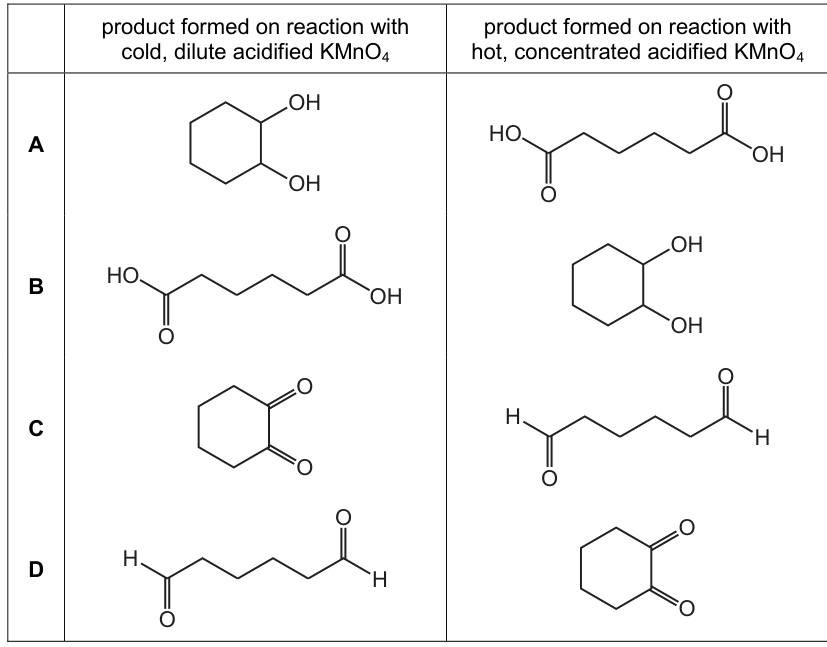
Answer
A
-
Cold, dilute acidified KMnO₄ oxidises cyclohexene by adding two –OH groups across the C=C bond (syn addition), giving cyclohexane-1,2-diol. The carbon–carbon skeleton is not broken.
-
Hot, concentrated acidified KMnO₄ cleaves the C=C bond completely. Each carbon of the original double bond (both bearing one hydrogen) is oxidised to a carboxylic acid group, giving hexanedioic acid (HOOC–(CH₂)₄–COOH).
Row A correctly shows cyclohexane-1,2-diol for cold, dilute conditions and hexanedioic acid for hot, concentrated conditions.
A
Background Concept
Acidified potassium manganate(VII), KMnO₄, is a strong oxidising agent whose behaviour with alkenes depends critically on the reaction conditions.
Cold, dilute, neutral or slightly acidic KMnO₄ (often called Baeyer's reagent when alkaline) performs syn addition of two hydroxyl groups across the C=C double bond, producing a vicinal diol (1,2-diol). The carbon–carbon framework remains intact; only the pi bond is broken and replaced by two C–O single bonds. This is a mild oxidation.
Hot, concentrated, acidified KMnO₄ is a vigorous oxidising agent that cleaves the C=C bond entirely. Each carbon atom that was part of the double bond is oxidised further:
- If the carbon bears one hydrogen (R–CH=), it is oxidised to a carboxylic acid (R–COOH).
- If the carbon bears no hydrogens (R₂C=), it is oxidised to a ketone (R₂C=O).
- If the carbon bears two hydrogens (=CH₂), it is oxidised to CO₂.
For a cyclic alkene like cyclohexene, cleavage opens the ring and produces a single straight-chain dicarboxylic acid (since both alkene carbons are –CH= groups).
Understanding the Question
The question asks which row correctly pairs the product from cyclohexene with cold, dilute acidified KMnO₄ (left column) against the product from hot, concentrated acidified KMnO₄ (right column). The four options show various combinations of diols, diones, dialdehydes, and dicarboxylic acids. We must identify the correct product for each condition.
Approach
- Apply the cold, dilute rule to cyclohexene: syn dihydroxylation → cyclohexane-1,2-diol.
- Apply the hot, concentrated rule to cyclohexene: oxidative cleavage of the ring → hexanedioic acid (adipic acid), since both alkene carbons are monosubstituted (each has one H).
- Match these two products to the rows in the table.
Step-by-Step Reasoning
Cold, dilute acidified KMnO₄:
Cyclohexene has a C=C bond within a six-membered ring. Under mild conditions, KMnO₄ adds two –OH groups across the double bond in a syn fashion:
The product is a cyclic 1,2-diol (cis-1,2-cyclohexanediol). The ring is preserved. This eliminates options B, C, and D for the left column, since they show hexanedioic acid, cyclohexanedione, or hexanedial respectively.
Hot, concentrated acidified KMnO₄:
Under vigorous conditions, the C=C bond is cleaved. In cyclohexene, each carbon of the double bond is bonded to one hydrogen and one alkyl group (–CH₂–). Oxidative cleavage converts each =CH– group to a –COOH group, opening the ring:
The product is hexanedioic acid (also called adipic acid), a straight-chain dicarboxylic acid with six carbons. This eliminates options C and D for the right column (which show hexanedial and cyclohexanedione respectively).
Matching to the table:
- Row A: cold → cyclohexane-1,2-diol ✓; hot → hexanedioic acid ✓
- Row B: reversed products ✗
- Row C: cold → cyclohexane-1,2-dione ✗; hot → hexanedial ✗
- Row D: cold → hexanedial ✗; hot → cyclohexane-1,2-dione ✗
The correct answer is A.
Key Takeaways
- Cold, dilute KMnO₄ → syn dihydroxylation (diol), no C–C bond cleavage.
- Hot, concentrated acidified KMnO₄ → oxidative cleavage of C=C; =CH– becomes –COOH, =CR₂ becomes ketone, =CH₂ becomes CO₂.
- For cyclic alkenes, hot concentrated KMnO₄ opens the ring to give a dicarboxylic acid (if both alkene carbons are monosubstituted).
Common Mistakes
- Confusing the two conditions: writing the cleavage product (hexanedioic acid) for cold dilute conditions, or the diol for hot concentrated conditions. The condition (temperature and concentration) determines which reaction occurs.
- Writing aldehydes instead of carboxylic acids: under hot concentrated acidified KMnO₄, aldehydes are further oxidised to carboxylic acids. Hexanedial (option D) would not be the product — it would be oxidised to hexanedioic acid.
- Writing diones instead of diols: cyclohexane-1,2-dione (options C and D) is not a product of KMnO₄ oxidation of cyclohexene under any standard condition.
- Forgetting that both alkene carbons in cyclohexene are =CH– groups: if one were =CR₂, a ketone would form at that end. Here both ends give carboxylic acids.
Things to Be Careful About
- Always check whether the conditions are cold/dilute (diol) or hot/concentrated (cleavage). This is the single most important distinction.
- Under acidic hot concentrated conditions, aldehydes are not stable — they are oxidised to carboxylic acids. Do not write RCHO as a final product with hot acidified KMnO₄.
- For unsymmetrical alkenes, remember that each alkene carbon is oxidised independently based on its substitution pattern (0, 1, or 2 hydrogens attached).
- State symbols are not required here since the question is structural, but be aware that KMnO₄ is typically used in aqueous solution.
Two steps in the free-radical substitution reaction between methane and chlorine are shown.
Which statement is correct?
Options
A Step 1 is initiation and step 2 is propagation.
B Step 1 is propagation and step 2 is termination.
C Step 1 is initiation and step 2 is termination.
D Both steps are propagation.
Working
Initiation: (homolytic fission under UV light) — creates radicals from a molecule.
Termination: two radicals combine to form a molecule, e.g. — removes radicals.
Step 1: — one radical in, one radical out, so it is propagation.
Step 2: — one radical in, one radical out, so it is also propagation.
Answer
D
D
Background Concept
Free-radical substitution of an alkane (here methane with chlorine) is a chain reaction made of three types of steps.
- Initiation: homolytic fission of the bond under UV light produces two chlorine radicals: . This is the only step that creates radicals from non-radical molecules.
- Propagation: a radical reacts with a molecule to form a product and a new radical. The number of radicals is conserved (one in, one out), so the chain can continue. In the methane–chlorine reaction there are two propagation steps: one that forms the chlorinated product and one that regenerates the radical that keeps the chain going.
- Termination: two radicals combine to form a molecule, removing radicals from the system and stopping the chain, e.g. , , or .
The decisive test for classifying a step is to count radicals on each side of the arrow: initiation has no radicals on the left but produces them; propagation has exactly one radical on each side; termination has radicals on the left but none on the right.
Understanding the Question
The question shows two steps of the free-radical substitution of methane with chlorine and asks which statement correctly classifies them. The options pair the two steps with initiation, propagation and termination. We must check each step to see whether it creates radicals (initiation), converts one radical into another (propagation), or removes radicals (termination).
Step 1: — a methyl radical reacts with a chlorine molecule; a new chlorine radical is produced.
Step 2: — a chlorine radical reacts with a chloromethane molecule; a new chloromethyl radical is produced.
Approach
Recall the definitions of initiation, propagation and termination, then classify each step by counting radicals on each side. A propagation step has exactly one radical on the left and one on the right. Initiation has no radicals on the left but produces radicals. Termination has radicals on the left but no radicals on the right. Both steps here have one radical in and one radical out, so both are propagation.
Step-by-Step Reasoning
Step 1: . The methyl radical attacks a chlorine molecule, abstracting one chlorine atom to form and leaving a chlorine radical. Radical count: one in (), one out (). This is a propagation step — the chain continues because a new radical is generated.
Step 2: . The chlorine radical abstracts a hydrogen atom from chloromethane, forming and a new chloromethyl radical. Radical count: one in (), one out (). Again this is propagation.
Neither step is initiation (no homolytic fission of into two radicals), and neither is termination (no two radicals combining into a molecule). Therefore both steps are propagation, and only option D is correct.
Why the distractors are wrong:
- A claims step 1 is initiation. Initiation is the UV-driven homolytic fission ; step 1 already involves a radical () reacting, so it is a chain step, not the radical-generating step.
- B claims step 2 is termination. Termination removes radicals; step 2 still has a radical on the product side (), so it cannot be termination.
- C claims step 1 is initiation and step 2 is termination — both halves are wrong for the same reasons.
Key Takeaways
- Initiation: molecules → radicals (homolytic fission, e.g. ).
- Propagation: radical + molecule → product + new radical (radical count conserved, one in one out).
- Termination: radical + radical → molecule (radicals removed).
- To classify any step, count the number of radical species on each side of the arrow.
Common Mistakes
- Confusing initiation with the first propagation step. A step is initiation only if it actually creates radicals from non-radicals. In step 1 a radical () is already present, so it cannot be initiation.
- Thinking termination means "the reaction stops" and applying it to any late step. Termination specifically requires two radicals combining to form a molecule, with no radical on the product side.
- Forgetting that propagation is a two-step cycle: one step forms the product and a new radical, and the second regenerates the radical that continues the chain. Both steps shown here are propagation.
Things to Be Careful About
- Count the number of radical species (species with an unpaired electron, shown with a dot ) on each side of the arrow.
- Initiation requires an energy source (UV light) for the homolytic fission of ; the steps in the question do not involve breaking into two radicals.
- The radical dot is essential: a species without the dot is not a radical, so its presence or absence determines the classification.
Compound P displays cis/trans isomerism and gives a red-brown precipitate with Fehling’s solution.
What is P?
Options

Working
1. Check for cis/trans isomerism:
Cis/trans (E/Z) isomerism across a double bond requires each carbon of the double bond to be attached to two different groups.
- Option A: The left carbon is bonded to two identical hydrogen atoms. No cis/trans isomerism.
- Option C: The left carbon is bonded to two identical hydrogen atoms. No cis/trans isomerism.
- Options B and D: Each carbon of the bond has two different substituents. Both show cis/trans isomerism.
2. Check the Fehling's test result:
Fehling's solution contains ions (blue). It is reduced to a red-brown precipitate of copper(I) oxide, , only by aldehydes. Ketones do not react.
- Option B: Contains a ketone group (). Will not give a positive Fehling's test.
- Option D: Contains an aldehyde group (). Will reduce Fehling's solution to give a red-brown precipitate.
Only Option D satisfies both conditions.
Answer
D
D
Background Concept
Cis/Trans Isomerism in Alkenes:
For an alkene to exhibit cis/trans (or E/Z) stereoisomerism, rotation around the double bond must be restricted (which it is), and each carbon atom of the double bond must be bonded to two different groups. If either carbon of the double bond is attached to two identical groups (e.g., two hydrogen atoms, or two methyl groups), the molecule cannot have cis and trans isomers because swapping the groups does not produce a different spatial arrangement.
Fehling's Test for Carbonyl Compounds:
Fehling's solution is a deep blue solution containing complexed copper(II) ions (). It is a mild oxidising agent that specifically oxidises aldehydes to carboxylic acids, while the is reduced to , which precipitates as copper(I) oxide (), a red-brown solid. Ketones lack a hydrogen atom on the carbonyl carbon and cannot be easily oxidised by mild oxidising agents like Fehling's or Tollens' reagent; therefore, they give a negative result (the solution remains blue).
Understanding the Question
The question asks to identify Compound P from four options (A, B, C, D) based on two chemical properties:
- It displays cis/trans isomerism.
- It gives a red-brown precipitate with Fehling's solution (meaning it is an aldehyde).
We must evaluate each structure against these two criteria.
Approach
The strategy is to filter the options sequentially:
- First filter (Structure): Eliminate any molecule that does not meet the strict geometric requirement for cis/trans isomerism at the bond.
- Second filter (Functional Group): From the remaining candidates, eliminate any molecule that is not an aldehyde, as only aldehydes reduce Fehling's solution.
Step-by-Step Reasoning
Step 1: Evaluate cis/trans isomerism for each option.
- Option A: The structure is 3-methylbut-2-enal. Look at the left carbon of the bond: it is bonded to two atoms. Because these two groups are identical, swapping them does not create a new isomer. No cis/trans isomerism.
- Option B: The structure is a methyl ketone (4-methylpent-3-en-2-one). The left has and ; the right has and . Both carbons have two different groups. Shows cis/trans isomerism.
- Option C: The structure is 2-methylpropenal. The left carbon of the bond is bonded to two atoms. No cis/trans isomerism.
- Option D: The structure is trans-but-2-enal. The left has and ; the right has and . Both carbons have two different groups. Shows cis/trans isomerism.
After Step 1, only B and D remain as candidates.
Step 2: Evaluate the Fehling's test for the remaining candidates.
- Option B: Contains a group, which is a ketone. Ketones do not react with Fehling's solution. The solution would remain blue. Fails the second condition.
- Option D: Contains a group, which is an aldehyde. Aldehydes are oxidised by Fehling's solution: . The is a red-brown precipitate. Satisfies the second condition.
Option D is the only compound that meets both criteria.
Key Takeaways
- Always check both carbons of a double bond for two different substituents when determining if cis/trans isomerism is possible. A terminal group or a carbon with two identical alkyl groups immediately rules out stereoisomerism at that bond.
- Reagent specificity is crucial in organic identification: Fehling's and Tollens' reagents distinguish aldehydes from ketones, while 2,4-DNPH tests for the presence of a carbonyl group (both aldehydes and ketones).
Common Mistakes
- Misreading the double bond substituents: Students often glance at the overall molecule and assume an alkene shows cis/trans isomerism without checking if either carbon has two identical groups (like the two 's on the left carbon in options A and C).
- Confusing Fehling's with 2,4-DNPH: 2,4-DNPH gives a yellow/orange precipitate with both aldehydes and ketones. If a student confuses the tests, they might incorrectly accept Option B.
- Ignoring the functional group: Option B is clearly an aldehyde-like structure to some, but the carbonyl is bonded to two carbons ( and the alkene chain), making it a ketone. Recognising as a ketone is essential.
Things to Be Careful About
- State symbols and precipitate colours: Fehling's test produces a red-brown precipitate (). Tollens' test produces a silver mirror. Ensure you match the correct reagent to the correct observation.
- Terminal alkenes: Any molecule with a group at the end of a chain cannot exhibit cis/trans isomerism at that double bond.
- Ketone vs Aldehyde identification: An aldehyde has the carbonyl carbon bonded to at least one hydrogen (). A ketone has the carbonyl carbon bonded to two carbon groups (). Option B has , which is a ketone.
Fructose is a sugar with more than one chiral centre. The fructose molecule is shown with X, Y and Z indicating three carbon atoms.
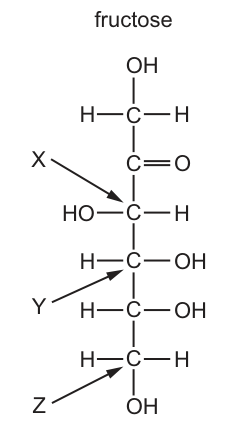
Which carbon atoms are chiral centres?
Options
A X, Y and Z
B X and Y only
C X only
D Y only
Working
A chiral centre is a carbon atom bonded to four different groups.
- Carbon X (C3): Bonded to , , (above), and (below). All four groups are different. Chiral.
- Carbon Y (C4): Bonded to , , (above), and (below). All four groups are different. Chiral.
- Carbon Z (C6): Bonded to , (above), and two atoms. Because two groups are identical (hydrogen atoms), it is not chiral.
Note: Carbon 2 (C=O) is hybridised and bonded to only three groups, so it cannot be a chiral centre. Carbon 1 (top ) also has two identical hydrogen atoms.
Therefore, only X and Y are chiral centres.
Answer
B
B
Background Concept
A chiral centre (or stereocentre) in organic chemistry is typically a carbon atom that is hybridised (tetrahedral geometry) and bonded to four different atoms or groups of atoms. If any two of the four groups attached to a carbon are identical, the molecule has a plane of symmetry passing through that carbon, and it is superimposable on its mirror image (achiral).
Key requirements for a carbon to be a chiral centre:
- It must be hybridised (single bonds only to four substituents). Atoms involved in double or triple bonds (like or carbons) cannot be chiral centres because they do not have four distinct substituents in a tetrahedral arrangement.
- All four groups attached must be chemically distinct. This includes checking not just the immediate atom but the entire group extending from it.
Fructose is a ketohexose sugar with the molecular formula . In its open-chain form, it contains a ketone group at C2 and hydroxyl groups on the other carbons.
Understanding the Question
The question provides the open-chain structure of fructose and labels three specific carbon atoms as X, Y, and Z. We are asked to identify which of these labelled carbons are chiral centres.
From the image and standard fructose structure:
- Top carbon (C1): group.
- Carbon 2 (C=O): Ketone group. (Note: The text description in the prompt had a slight misalignment with the image labels, but the image clearly shows X pointing to C3, Y to C4, and Z to C6. We follow the image and chemical logic).
- Carbon X (C3): group.
- Carbon Y (C4): group.
- Carbon 5 (C5): group (unlabelled).
- Carbon Z (C6, bottom): group.
Approach
To solve this, we examine each labelled carbon atom (X, Y, Z) and list the four groups attached to it. If all four are different, it is a chiral centre. If any two are the same (e.g., two hydrogens), or if the carbon is not hybridised (e.g., ), it is not a chiral centre.
Step-by-Step Reasoning
-
Analyze Carbon X (C3):
- Attached groups: , , the group above (), and the group below ().
- Are they different? Yes. , and the two carbon chains are different (one ends in a ketone, the other in a long chain with more OH groups).
- Conclusion: Carbon X is a chiral centre.
-
Analyze Carbon Y (C4):
- Attached groups: , , the group above (), and the group below ().
- Are they different? Yes. All four are distinct.
- Conclusion: Carbon Y is a chiral centre.
-
Analyze Carbon Z (C6, the bottom carbon):
- Attached groups: , the group above (), and two hydrogen atoms ( and ).
- Are they different? No. There are two identical hydrogen atoms attached to this carbon.
- Conclusion: Carbon Z is not a chiral centre.
-
Check other carbons (for completeness):
- C1 (top ): Has two H atoms. Not chiral.
- C2 (): hybridised, only 3 groups attached. Not chiral.
- C5 (unlabelled ): Attached to , , (below), and the rest of the chain (above). All four different. C5 is also a chiral centre, but it is not labelled X, Y, or Z.
Therefore, among the labelled atoms, only X and Y are chiral centres.
Key Takeaways
- A chiral carbon must have four different groups attached.
- Always check for identical atoms (like two hydrogens in a group) — this immediately rules out chirality.
- carbons (double bonds) cannot be chiral centres.
- In sugars like fructose, the carbons with linkages (except those at the ends if they are ) are typically chiral centres.
Common Mistakes
- Misidentifying groups: Students often look at groups and forget that the two hydrogens make them achiral. Carbon Z is a group (specifically the carbon is bonded to 2 H's), so it cannot be chiral.
- Ignoring the ketone carbon: Carbon 2 () is planar () and has only three bonds to other atoms (plus the double bond counts as one connection direction effectively for geometry). It cannot be a chiral centre. If a student thought X pointed to C2, they might incorrectly rule it out or get confused.
- Forgetting to look beyond the immediate atom: When comparing groups, students might stop at the first atom (e.g., seeing two groups above and below and thinking they are the same). They must trace the full chain to see the difference (e.g., one side leads to a ketone, the other to a primary alcohol).
Things to Be Careful About
- Label alignment: Ensure you are looking at the correct carbon. In the diagram, X points to C3, Y to C4, and Z to C6. Do not confuse the labels.
- Definition of chirality: It is not enough to have a carbon with 4 bonds; the groups must be different. and groups are never chiral centres.
- State symbols/structure: This is an open-chain representation. In solution, fructose exists primarily as a cyclic hemiketal (furanose or pyranose form), which creates an additional chiral centre at C2 (the anomeric carbon). However, the question specifically shows the open-chain structure, so we analyse that only.
An organic compound, T, contains only one functional group.
Compound T has the empirical formula .
Some functional groups are listed.
- alcohol
- aldehyde
- ester
- ketone
Which functional groups are possible for compound T?
Options
A 1 and 3
B 1 and 4
C 2 and 3
D 2 and 4
Working
The empirical formula allows molecular formulae that are whole-number multiples: , , , etc.
- Aldehyde: acetaldehyde, , has formula . Possible.
- Ester: ethyl ethanoate, , has formula . Possible.
- Alcohol: a saturated monohydric alcohol with formula would need an additional C=C or a ring, giving a second functional group; no simple alcohol fits.
- Ketone: a ketone requires at least three carbons, e.g. propanone , which is not a multiple of .
Only aldehyde and ester are possible.
Answer
C
C
Background Concept
The empirical formula gives the simplest whole-number ratio of atoms in a compound, while the molecular formula gives the actual numbers of atoms in one molecule. The molecular formula is always a whole-number multiple of the empirical formula. For , possible molecular formulae include , , , and so on.
Functional groups are specific atom groupings that determine the characteristic reactions of an organic compound. The list in the question contains four common oxygen-containing groups: alcohol (), aldehyde (), ester (), and ketone (). Each functional group has a minimum carbon and oxygen requirement, and some require more than one oxygen atom.
Understanding the Question
Compound T has empirical formula and contains only one functional group. We must decide which of the four listed functional groups could appear in such a compound. The key is to remember that the molecular formula could be a multiple of the empirical formula, and that a molecule may contain more than one oxygen atom if the functional group requires it.
Approach
- Write the possible molecular formulae as multiples of .
- For each functional group, determine the smallest molecular formula that contains that group and no other functional group.
- Check whether that formula matches one of the allowed multiples.
- Eliminate any group that would require an extra functional group or a formula inconsistent with the empirical formula.
Step-by-Step Reasoning
Aldehyde
The simplest aldehyde is methanal, (), but that does not match . The next aldehyde, ethanal, is , which has molecular formula . This is exactly the empirical formula, so an aldehyde is possible. The aldehyde functional group contains one oxygen atom, and the carbon skeleton can provide the required two carbons.
Ester
An ester contains two oxygen atoms, so its molecular formula must have at least two oxygens. The smallest ester, methyl methanoate, is , formula , which is not a multiple of . However, ethyl ethanoate, , has formula , which is exactly twice the empirical formula. It contains only one ester functional group and no other functional group, so an ester is possible.
Alcohol
A monohydric alcohol contains one group and therefore one oxygen atom. The molecular formula would need to be if it had two carbons and one oxygen. But a saturated alcohol with two carbons is ethanol, . To get as an alcohol, the molecule would have to contain a C=C double bond (e.g. vinyl alcohol, ) or a ring, introducing a second functional group (an alkene) or an unusual cyclic structure. Since the question specifies only one functional group, a simple alcohol is not possible.
Ketone
A ketone has the general formula and requires at least three carbon atoms (the smallest ketone is propanone, , formula ). This formula is not a multiple of . A ketone with more carbons would have formula , , etc., none of which can be reduced to because the ratio of H to C is 2:1 but the O count would force a non-integer multiple. Therefore a ketone is not possible.
Thus only aldehyde (2) and ester (3) fit, giving option C.
Key Takeaways
- The molecular formula can be a multiple of the empirical formula; always consider this before ruling out a functional group.
- Functional groups have characteristic minimum formulae: aldehydes and ketones contain one oxygen, while esters contain two oxygens.
- A molecule with only one functional group cannot contain an additional C=C or ring if that would create a second functional group.
- The empirical formula alone does not uniquely determine the functional group; it only limits the possibilities.
Common Mistakes
- Assuming the molecular formula must equal the empirical formula, thereby missing the ester possibility.
- Thinking an alcohol with formula is possible without realising it would require an alkene or ring, adding a second functional group.
- Forgetting that a ketone needs at least three carbons and therefore cannot have the empirical formula .
- Confusing an ester with a carboxylic acid; a carboxylic acid also has two oxygens but is not in the list.
Things to Be Careful About
- Always check that the molecular formula is a whole-number multiple of the empirical formula.
- Count oxygen atoms carefully: an ester has two oxygens, so its molecular formula must contain an even number of oxygens if the empirical formula has one oxygen.
- The phrase "only one functional group" excludes molecules with an additional C=C or ring that would itself be considered a functional group.
- In an MCQ, after identifying the possible groups, read the options carefully to match the correct combination.
The mass spectrum of an organic compound has the following features.
- The molecular ion peak is at . This peak has a relative intensity = 100.
- There is a peak at , which has a relative intensity = 2.2.
- There is no fragment peak at .
- There is a fragment peak at .
What could be the identity of the organic compound?
Options
A methyl methanoate,
B methoxyethane,
C ethanoic acid,
D propan-2-ol,
Working
The molecular ion peak at gives for all four options.
The peak has relative intensity 2.2% of the molecular ion. Each carbon atom contributes about 1.1% to the peak because of , so the compound contains:
This eliminates methoxyethane and propan-2-ol, which are .
The fragment at is , formed by cleavage of the bond in methyl methanoate. Ethanoic acid would not give this fragment, and the absence of an peak () also rules it out.
Answer
A — methyl methanoate
A
Background Concept
Mass spectrometry is used to measure the relative molecular mass of a compound and to identify structural features from fragmentation. When a molecule is ionised, the molecular ion is formed with the same mass as the molecule, so its peak gives . Some molecules contain a heavier isotope, especially (natural abundance about 1.1%). A molecule with carbon atoms therefore shows an peak whose intensity is approximately of the peak. Fragment ions appear at lower values and correspond to stable cations produced by cleavage of particular bonds.
Understanding the Question
This question gives a mass spectrum with a molecular ion at , an peak at with relative intensity 2.2, no peak at , and a fragment peak at . Four compounds are suggested, and all have . The task is to use the isotope peak and the fragmentation pattern to decide which compound fits.
Approach
First use the intensity to count the number of carbon atoms. Then use the fragment at to distinguish between the remaining two-carbon candidates. Finally check that the absence of is consistent with the chosen structure.
Step-by-Step Reasoning
- All four options have : methyl methanoate and ethanoic acid are , while methoxyethane and propan-2-ol are . The molecular ion peak alone does not distinguish them.
- The peak is 2.2% as intense as the molecular ion. Since each carbon contributes about 1.1% due to , the number of carbon atoms is . This eliminates methoxyethane and propan-2-ol, which have three carbons.
- The remaining candidates are methyl methanoate and ethanoic acid. The fragment at is . In methyl methanoate, , cleavage of the bond gives this ion. Ethanoic acid, , does not have a bond and would not give a strong peak; its characteristic fragments include at and at .
- The absence of a peak at also supports methyl methanoate: an fragment at would be expected from a compound containing an group such as ethanoic acid, whereas methyl methanoate has no such group.
- Therefore the compound is methyl methanoate, option A.
For the other options: methoxyethane has three carbons, so its peak would be about 3.3%, not 2.2%. Propan-2-ol also has three carbons and would give a different intensity. Ethanoic acid is eliminated by the fragmentation evidence above.
Key Takeaways
The intensity of the peak is a quick way to count carbon atoms in a molecule. Fragment peaks identify particular bonds or groups, so combining the molecular ion, isotope peak, and fragmentation pattern allows isomers with the same to be distinguished.
Common Mistakes
- Forgetting that all four options have the same and trying to use the molecular ion peak alone.
- Ignoring the peak, which is the key to counting carbon atoms.
- Assuming is unique to methyl methanoate; in some alcohols can also appear at , but the carbon count already eliminates those options.
- Confusing the fragment ion () with , which also has but arises from different structures.
Things to Be Careful About
The intensity is measured relative to the molecular ion peak. The 1.1% figure applies per carbon atom because of the natural abundance of . When interpreting fragment peaks, always check the structure of the bond that would need to break to form the ion. Also note that values are rounded to integer masses for common fragments.
Your score so far
Answer a question to start scoring
Your marks add up here as you work through the paper.