Chemistry 9701/12 — May/June 2025
Cambridge AS Level · answer key with instant marking and worked solutions
Topics Halogen Compounds · Atoms, Molecules and Stoichiometry · States of Matter · Chemical Bonding · Equilibria · Chemical Energetics · +14 more
Tap an option under each question to check it — your score builds as you go.
Consider the following statements.
1 Silicon dioxide has a higher melting point than sulfur dioxide.
2 Ammonia has a higher boiling point than phosphine, PH₃.
Which statements are correct?
Options
A both statement 1 and statement 2
B statement 1 only
C statement 2 only
D neither statement 1 nor statement 2
Working
Statement 1:
Silicon dioxide, SiO2, is a giant covalent network solid with strong covalent bonds throughout. Sulfur dioxide, SO2, is a simple molecular substance with weak intermolecular forces. Therefore SiO2 has a higher melting point than SO2. Statement 1 is correct.
Statement 2:
Ammonia, NH3, can form hydrogen bonds between molecules because N is highly electronegative and is bonded to H. Phosphine, PH3, cannot form hydrogen bonds effectively because P is much less electronegative. Therefore NH3 has a higher boiling point than PH3. Statement 2 is correct.
Both statements are correct.
Answer
A
A
Background Concept
Melting and boiling points depend on the amount of energy needed to overcome the forces holding particles together.
- Silicon dioxide (SiO2) is a giant covalent network solid. Each silicon atom is bonded to four oxygen atoms and each oxygen atom is bonded to two silicon atoms. Breaking this structure requires breaking many strong covalent bonds, so its melting point is very high.
- Sulfur dioxide (SO2) is a simple molecular substance. Individual SO2 molecules are held together only by weak van der Waals forces, so little energy is needed to separate them. Its melting point is low.
Ammonia and phosphine are both molecular substances, but the intermolecular forces differ:
- Ammonia (NH3) has hydrogen bonding because hydrogen is bonded to nitrogen, a highly electronegative atom with a lone pair. Hydrogen bonding is a relatively strong intermolecular force.
- Phosphine (PH3) has only weak van der Waals forces because phosphorus is not electronegative enough to create a sufficiently polar P–H bond for hydrogen bonding.
Understanding the Question
The question gives two independent statements and asks which are correct. We need to evaluate each statement separately using structure and bonding principles.
Approach
- Compare the structure of SiO2 with SO2 to judge statement 1.
- Compare the intermolecular forces in NH3 with PH3 to judge statement 2.
- Choose the option that matches the correct combination.
Step-by-Step Reasoning
Statement 1:
- SiO2 is a giant covalent network, not a simple molecule.
- Strong covalent bonds must be broken to melt it.
- SO2 is a simple molecular substance with weak intermolecular forces.
- Therefore SiO2 has a higher melting point than SO2.
- Statement 1 is correct.
Statement 2:
- NH3 has hydrogen bonding because N–H bonds are polar and N has a lone pair.
- PH3 has only van der Waals forces because P–H bonds are much less polar.
- Hydrogen bonding is stronger than van der Waals forces.
- Therefore NH3 has a higher boiling point than PH3.
- Statement 2 is correct.
Since both statements are correct, the answer is A.
Key Takeaways
- A giant covalent structure gives a very high melting point because many strong covalent bonds must be broken.
- Simple molecular substances have low melting and boiling points because only weak intermolecular forces are involved.
- Hydrogen bonding occurs when hydrogen is bonded to nitrogen, oxygen, or fluorine.
- A molecule with hydrogen bonding has a higher boiling point than a similar molecule without it.
Common Mistakes
- Assuming all oxides are simple molecular. SiO2 is a giant covalent network solid.
- Thinking PH3 can hydrogen bond just because phosphorus has a lone pair. Hydrogen bonding requires H bonded to N, O, or F, and a sufficiently electronegative atom.
Things to Be Careful About
- Distinguish between giant covalent structures and simple molecular structures.
- Remember that hydrogen bonding is an intermolecular force, not an intramolecular bond.
- Check both statements independently before choosing an option.
How many neutrons are contained in an atom of iron with a mass number of 60?
Options
A 26
B 30
C 34
D 60
Working
The proton number (atomic number) of iron is 26.
Number of neutrons = mass number proton number
Answer
C (34)
C
Background Concept
An atom is described by two key numbers:
- Proton number (atomic number, ) — the number of protons in the nucleus. This identifies the element.
- Mass number (nucleon number, ) — the total number of protons and neutrons in the nucleus.
Since an atom is neutral, the number of electrons equals the number of protons, but the neutrons are neutral particles that contribute almost all the extra mass beyond the protons.
The relationship is:
For iron, the proton number is 26. This is a fact worth memorising: iron is element 26, with symbol .
Understanding the Question
The question gives the mass number of an atom of iron as 60 and asks how many neutrons it contains. It does not give the proton number explicitly, so we must recall that iron has atomic number 26. The answer must be a whole number of neutrons, since neutrons are discrete particles.
Four options are given, and only one matches the correct calculation.
Approach
- Identify the element from its name: iron = , atomic number 26.
- Use the formula: neutrons = mass number proton number.
- Subtract 26 from 60.
- Select the matching option.
Step-by-Step Reasoning
- Iron is element 26, so every atom of iron has 26 protons.
- The mass number is given as 60. The mass number counts all nucleons: protons + neutrons.
- Therefore:
- This matches option C.
Option A (26) is the proton number, not the neutron number.
Option B (30) would be obtained by incorrectly halving the mass number.
Option D (60) confuses the mass number with the number of neutrons.
Key Takeaways
- Neutrons are found using .
- The mass number is the total of protons and neutrons.
- The atomic number identifies the element and is constant for all atoms of that element.
- Knowing the atomic numbers of common elements such as iron is essential for quick calculation.
Common Mistakes
- Choosing 26: this is the proton number, not the neutron number.
- Choosing 60: this is the mass number, the total of both protons and neutrons.
- Forgetting that neutrons are neutral and do not affect the charge of the atom.
Things to Be Careful About
- Always use the mass number, not the relative atomic mass, when asked for neutrons in a specific isotope.
- The mass number is always a whole number in such questions.
- If the atom is an ion, the number of electrons changes but the number of protons and neutrons does not; here the atom is neutral, so no correction is needed.
The diagram shows a Boltzmann distribution of molecular energies for a gaseous reaction at two different temperatures and two different activation energies.
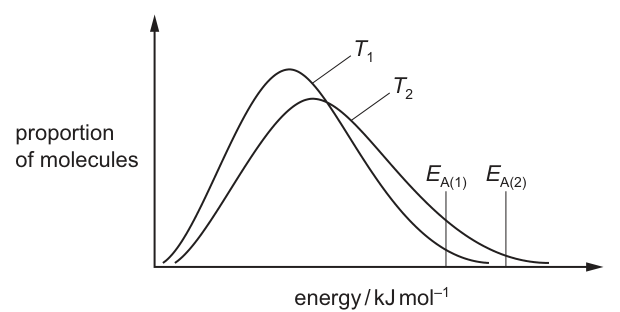
Which combination of temperature and activation energy will give the highest reaction rate?
Options
A and
B and
C and
D and
Working
The reaction rate is proportional to the proportion of molecules with energy greater than or equal to the activation energy ().
- A higher temperature () shifts the Boltzmann distribution curve to the right and lowers the peak, increasing the proportion of molecules with energy .
- A lower activation energy () means a larger area under the curve lies to the right of the line, again increasing the proportion of successful collisions.
The combination of the highest temperature () and the lowest activation energy () gives the greatest proportion of molecules with sufficient energy to react, resulting in the highest reaction rate.
Answer
D
D
Background Concept
Collision theory states that for a reaction to occur, reactant particles must collide with sufficient energy (greater than or equal to the activation energy, ) and with the correct orientation. The Maxwell-Boltzmann distribution curve shows the distribution of molecular kinetic energies in a gas at a given temperature. The area under the curve to the right of a vertical line representing is proportional to the number (or proportion) of molecules with energy , which determines the reaction rate.
Understanding the Question
The question asks to identify which combination of temperature ( or ) and activation energy ( or ) will yield the highest reaction rate, based on the provided Boltzmann distribution graph. We need to maximize the area under the curve to the right of the chosen line.
Approach
We evaluate the two variables independently:
- Temperature: Compare and . The curve for the higher temperature is shifted to the right and has a lower peak (to maintain the same total area, representing the total number of molecules). Thus, . Higher temperature increases the proportion of molecules with energy .
- Activation energy: Compare and . Energy increases from left to right on the x-axis. Thus, . A lower activation energy means a larger proportion of molecules have energy .
The combination that maximizes the successful collision proportion is the highest temperature and the lowest activation energy.
Step-by-Step Reasoning
- Looking at the graph, the curve labeled is flatter and its peak is shifted to the right compared to . This indicates that is the higher temperature. At , a greater proportion of molecules have higher kinetic energies.
- The vertical line for is to the left of , meaning represents a lower activation energy. A lower threshold is easier to overcome, so a larger fraction of molecules will have energy than .
- To get the highest reaction rate, we need the maximum proportion of molecules with energy . This occurs at the highest temperature () and the lowest activation energy ().
- Therefore, the correct combination is and , which corresponds to option D.
Key Takeaways
- Higher temperature shifts the Maxwell-Boltzmann curve to the right and lowers the peak, increasing the number of molecules with energy .
- Lowering the activation energy (e.g., by using a catalyst) increases the area under the curve to the right of the line, increasing the reaction rate.
- Both higher temperature and lower activation energy independently increase the reaction rate.
Common Mistakes
- Assuming the curve with the higher peak is at a higher temperature: The peak is actually lower at higher temperatures because the curve spreads out to the right, and the total area (total number of molecules) must remain constant.
- Confusing the activation energy values: Remember that energy increases from left to right on the x-axis, so is lower than .
Things to Be Careful About
- Always check the x-axis direction: energy increases to the right.
- Remember that the area under the curve is constant for a given amount of gas, so a rightward shift must result in a lower peak.
- The question asks for the highest reaction rate, so choose the combination that maximizes the area to the right of the activation energy line (highest , lowest ).
The reaction between sulfur dioxide and oxygen has the equation shown.
of and of are placed in a closed container and heated to a constant temperature.
At this temperature, of are present in the equilibrium mixture.
Which statement is correct?
Options
A The equilibrium partial pressure of is greater than the equilibrium partial pressure of .
B has units of .
C At a lower temperature, the equilibrium amount of is lower than .
D The mole fraction of is less than 0.8.
Working
For the reaction :
| Initial (mol) | 1.0 | 1.0 | 0 |
| Change (mol) | |||
| Equilibrium (mol) | 0.2 | 0.6 | 0.8 |
Total moles at equilibrium mol.
Mole fraction of .
Since , statement D is correct.
Answer
D
D
Background Concept
This question tests three connected ideas from chemical equilibria:
- Mole fraction and partial pressure: for an ideal gas mixture, the partial pressure of a component is its mole fraction times the total pressure. Comparing partial pressures is therefore equivalent to comparing mole fractions.
- Units of : is written in terms of partial pressures, and its units depend on the change in the number of moles of gas, .
- Le Chatelier's principle: a change in temperature shifts the equilibrium position in the direction that opposes the change; for an exothermic forward reaction, lowering the temperature favours the forward direction.
Understanding the Question
We start with mol of and mol of in a closed container. At equilibrium, mol of is present. We must decide which of four statements is correct. The reaction is exothermic (), which matters for statement C.
Approach
- Build an ICE table to find the equilibrium amounts of all three gases.
- Compare mole fractions (hence partial pressures) of and for statement A.
- Determine the units of from the stoichiometry for statement B.
- Apply Le Chatelier's principle to the temperature change for statement C.
- Calculate the mole fraction of for statement D.
Step-by-Step Reasoning
Step 1 — ICE table
Stoichiometry: .
Since mol of forms, the change in is mol (2:2 ratio) and the change in is mol (2:1 ratio).
| Initial (mol) | 1.0 | 1.0 | 0 |
| Change (mol) | |||
| Equilibrium (mol) | 0.2 | 0.6 | 0.8 |
Total moles at equilibrium mol.
Step 2 — Statement A
Partial pressure is proportional to mole fraction at constant temperature and volume.
Mole fraction of
Mole fraction of
So . Statement A is false.
Step 3 — Statement B
Units: (e.g. or ).
This is not . Statement B is false.
Step 4 — Statement C
The forward reaction is exothermic (). Lowering the temperature shifts the equilibrium in the exothermic direction — the forward direction — producing more . So the equilibrium amount of would be greater than mol, not lower. Statement C is false.
Step 5 — Statement D
Mole fraction of .
Since , statement D is true.
Key Takeaways
- Use an ICE table to track equilibrium amounts; the stoichiometric ratios determine the changes.
- For ideal gases, partial pressure is proportional to mole fraction.
- The units of depend on (moles of gaseous products minus moles of gaseous reactants). Here , so has units of .
- Le Chatelier's principle: an exothermic forward reaction is favoured by a decrease in temperature.
Common Mistakes
- Wrong O2 change: forgetting that changes by half the amount of formed ( mol, not mol).
- Confusing mole fraction with moles: the mole fraction of is , not .
- Direction of temperature shift: for an exothermic reaction, lowering temperature favours products, not reactants.
Things to Be Careful About
- Mole fractions are always between 0 and 1, so a mole fraction of is definitely less than — but the calculation is needed to confirm it.
- When determining units, count only gaseous species in .
- The total pressure is not given, but it is not needed — mole fractions alone suffice for statements A and D.
‘Red lead’ is a red pigment with the formula . Every formula unit of ‘red lead’ is the same.
Each formula unit contains three lead ions and four oxide ions. Lead has two different oxidation states in ‘red lead’.
What are the oxidation states of lead in ‘red lead’?
Options
A +1 and +2
B +1 and +3
C +2 and +4
D +2 and +6
Working
Each oxide ion has oxidation state , so four oxide ions contribute a total of .
The compound is neutral, so the three lead ions must contribute a total of .
Let the number of ions be and the number of ions be .
Substituting :
So each formula unit contains two ions and one ion.
Answer
The two oxidation states of lead in 'red lead' are and .
C
C
Background Concept
Oxidation state (oxidation number) is the charge an atom would have if all bonding electrons were assigned to the more electronegative atom. In ionic compounds, the oxidation state equals the actual ionic charge. For a neutral compound, the sum of all oxidation states multiplied by their atom counts must equal zero.
Understanding the Question
The question tells us that 'red lead' has the formula and that each formula unit contains three lead ions and four oxide ions. It also states that lead exists in two different oxidation states within the compound. We need to determine which two oxidation states those are.
Approach
- Recognise that oxygen in oxides normally has oxidation state .
- Calculate the total negative charge from the four oxide ions.
- Since the compound is neutral, the three lead ions must balance that charge exactly.
- Test which pair of oxidation states from the options can sum to the required total with three lead ions.
Step-by-Step Reasoning
-
Charge from oxide ions:
Each contributes . With four oxide ions:
-
Required positive charge:
For neutrality, the three lead ions must sum to . -
Test the options:
- A (+1 and +2): Maximum possible total with three ions is , which is less than . Impossible.
- B (+1 and +3): Maximum total is . Could we reach ? Try , . No combination of and sums to (possible sums: 3, 5, 7, 9). Impossible.
- C (+2 and +4): Try . This works! Two ions and one ion.
- D (+2 and +6): Try , , . No combination sums to (possible sums: 6, 10, 14). Impossible.
-
Confirm with algebra:
Let = number of and = number of .
Substituting :
So . This confirms two and one .
Key Takeaways
- In a neutral compound, the sum of oxidation states (each multiplied by its atom count) equals zero.
- Oxygen almost always has oxidation state in oxides.
- When a compound contains the same element in two oxidation states, set up charge-balance equations to find the ratio of ions.
Common Mistakes
- Forgetting that the total charge must be divided among three lead ions, not one.
- Assuming the oxidation states must be consecutive integers; they do not have to be, but here the charge balance forces and .
- Miscounting: some students incorrectly think means one lead is and the other two are without checking the charge balance.
Things to Be Careful About
- Always multiply each oxidation state by the number of atoms of that element.
- Check that the chosen pair actually sums to the required total with exactly three ions.
- Remember that this is a neutral compound, so positive and negative charges must cancel exactly.
Some standard enthalpy of combustion data are given.
| substance | standard enthalpy change of combustion / |
|---|---|
| C(s) | –394 |
| –286 | |
| –726 |
Using these data, what is the enthalpy change of formation of methanol?
Options
A
B
C
D
Working
Formation of methanol:
By Hess's law:
Answer
A ()
A
Background Concept
Hess's law states that the enthalpy change of a reaction is independent of the route taken, provided the initial and final states are the same. This works because enthalpy is a state function — its value depends only on the starting and ending conditions, not on the path between them. In practice, this means we can add, subtract, and scale enthalpy changes of known reactions to obtain the enthalpy change of a reaction that is difficult or impossible to measure directly.
The standard enthalpy change of combustion, , is the enthalpy change when one mole of a substance is completely burned in oxygen under standard conditions. The standard enthalpy change of formation, , is the enthalpy change when one mole of a compound is formed from its elements in their standard states. Here we are given three combustion enthalpies and asked to find a formation enthalpy — a classic Hess's law application.
Understanding the Question
The table gives:
We must find of methanol, i.e. the enthalpy change for:
The four options are , , , and kJ mol. The sign and magnitude of the answer depend entirely on correctly applying Hess's law with the right stoichiometric coefficients.
Approach
The key insight is that both routes below start from the same reactants and end at the same products:
Route 1: Elements (C, H, O) → combustion products (CO + HO)
Route 2: Elements → methanol (formation) → combustion products (CO + HO)
Since both routes connect the same initial and final states, their total enthalpy changes are equal:
Rearranging gives:
The factor of 2 on arises because two moles of H are needed to form one mole of CHOH.
Step-by-Step Reasoning
-
Write the three combustion equations explicitly:
-
Combine the combustions of the elements to match the combustion products of methanol:
Combustion of C gives one CO; combustion of 2 H gives two HO. Together:
with .
-
Reverse the combustion of methanol (flipping the sign):
-
Add steps 2 and 3 and cancel common species:
CO and 2HO cancel on both sides; O cancels as :
with .
-
Select the option: The value matches option A.
Key Takeaways
-
Hess's law lets us calculate formation enthalpies from combustion data without performing the formation reaction directly.
-
The general relationship is:
with each term scaled by its stoichiometric coefficient.
-
Reversing a reaction flips the sign of ; multiplying a reaction by a factor multiplies by the same factor.
Common Mistakes
- Forgetting the stoichiometric factor of 2 on — this would give , which is option C (wrong sign and wrong magnitude).
- Getting the sign of wrong — subtracting as if it were gives , which is not among the options but shows the danger of sign errors.
- Confusing formation with combustion — the formation reaction produces one mole of compound from elements, while combustion consumes one mole of compound with oxygen. These are opposite processes in the cycle.
- Dropping the negative signs when substituting values — every value in the table is negative, and each must be substituted with its sign.
Things to Be Careful About
- Always include the stoichiometric coefficient when combining enthalpy changes — the 2 in is essential.
- Check the sign of the final answer: formation of methanol is exothermic (negative), consistent with most stable compounds having negative formation enthalpies.
- The units are kJ mol, referring to the enthalpy change per mole of the reaction as written (one mole of CHOH formed).
- In an exam, draw the energy cycle or write the equations explicitly to avoid sign errors — it is easy to misplace a minus sign when working purely algebraically.
Which row is correct?
Options
| smallest bond angle | largest bond angle | ||
|---|---|---|---|
| A | |||
| B | |||
| C | |||
| D |
Working
For each molecule, count the electron pairs around the central atom and apply VSEPR:
- : 3 bonding pairs, 0 lone pairs trigonal planar, bond angle .
- : 3 bonding pairs, 1 lone pair trigonal pyramidal, bond angle .
- : 2 bonding pairs, 2 lone pairs bent, bond angle .
Lone pairs repel more strongly than bonding pairs, so each lone pair compresses the bond angle. Therefore, smallest to largest:
Answer
A
A
Background Concept
VSEPR (Valence Shell Electron Pair Repulsion) theory states that electron pairs around a central atom arrange themselves as far apart as possible to minimise repulsion. Both bonding pairs and lone pairs count as electron domains. However, a lone pair is concentrated closer to the central atom and occupies more space, so it repels other electron pairs more strongly than a bonding pair does. This extra repulsion pushes bonding pairs closer together, reducing the bond angle.
The electron-pair geometry describes the arrangement of all electron pairs around the central atom, while the molecular shape describes only the positions of the atoms. For example, both and have four electron domains arranged tetrahedrally, but their molecular shapes are trigonal pyramidal and bent respectively.
Understanding the Question
This multiple-choice question asks for the correct order of bond angles from smallest to largest for three molecules: , and . Each row in the table gives a different ordering, and only one is correct. The key is to compare the number of lone pairs on the central atom and how they affect the bond angle.
Approach
For each molecule, determine the number of bonding pairs and lone pairs on the central atom. Then use VSEPR to identify the electron-pair geometry and the resulting molecular shape. Finally, compare the bond angles, remembering that more lone pairs on the central atom means greater lone-pair repulsion and therefore a smaller bond angle.
Step-by-Step Reasoning
-
- Boron is in Group 3 and forms three single bonds to fluorine.
- Central B has 3 bonding pairs and no lone pairs.
- Electron-pair geometry: trigonal planar.
- Bond angle: .
-
- Nitrogen is in Group 5 and forms three single bonds to hydrogen.
- Central N has 3 bonding pairs and 1 lone pair.
- The four electron domains point toward the corners of a tetrahedron, but the molecular shape is trigonal pyramidal.
- The lone pair repels the N–H bonding pairs more strongly than they repel each other, compressing the H–N–H angle from the ideal to about .
-
- Oxygen is in Group 6 and forms two single bonds to hydrogen.
- Central O has 2 bonding pairs and 2 lone pairs.
- Again, four electron domains give a tetrahedral electron-pair arrangement, but the molecular shape is bent.
- Two lone pairs repel the O–H bonding pairs even more, reducing the H–O–H angle to about .
-
Ordering
- :
- :
- :
So the correct order from smallest to largest bond angle is:
This matches option A.
Key Takeaways
- Bond angle is determined by the total number of electron pairs around the central atom, not just the number of atoms bonded to it.
- Lone pairs compress bond angles because they repel more strongly than bonding pairs.
- The more lone pairs on the central atom, the smaller the bond angle.
- Distinguish between electron-pair geometry and molecular shape: is trigonal pyramidal, not tetrahedral; is bent, not tetrahedral.
Common Mistakes
- Choosing option C, which puts before . This is wrong because has two lone pairs, so its bond angle is smaller than that of .
- Confusing molecular shape with electron-pair geometry. For example, saying is tetrahedral ignores the lone pair and leads to an incorrect bond angle.
- Forgetting that has no lone pairs, so its bond angle is the largest at .
Things to Be Careful About
- Use the accepted approximate bond angles: = , = , = .
- Count lone pairs only on the central atom; lone pairs on terminal atoms do not affect the central bond angle in the same way.
- In VSEPR, a double or triple bond is treated as one electron domain, although this is not needed for these three molecules.
- When comparing bond angles, always reason from lone-pair repulsion rather than from the number of bonded atoms alone.
In the Haber process, the reaction between the two gaseous reactants requires the use of a catalyst that contains a transition element.
What is the metal and in which mole ratio do the gases react?
Options
| metal | mole ratio | |
|---|---|---|
| A | Fe | 1 : 2 |
| B | Fe | 1 : 3 |
| C | V | 1 : 2 |
| D | V | 1 : 3 |
Working
The Haber process combines nitrogen and hydrogen:
The catalyst is iron (Fe). The mole ratio of the two gaseous reactants, , is therefore 1 : 3.
Answer
B
B
Background Concept
The Haber process is the industrial synthesis of ammonia from nitrogen and hydrogen. It is an equilibrium reaction carried out at high temperature and pressure, and it uses a heterogeneous catalyst. The catalyst is finely divided iron, often promoted with oxides of potassium and aluminium. The balanced equation is:
The mole ratio of the two gaseous reactants is therefore 1 : 3 (one mole of nitrogen to three moles of hydrogen).
Understanding the Question
The question asks for two pieces of information:
- Which transition metal is used as the catalyst in the Haber process?
- In what mole ratio do the two gaseous reactants (nitrogen and hydrogen) react?
The options pair a metal (Fe or V) with a mole ratio (1 : 2 or 1 : 3).
Approach
Recall the Haber process equation and the identity of its catalyst. The catalyst is iron, and the stoichiometric ratio of N₂ to H₂ is 1 : 3.
Step-by-Step Reasoning
- The Haber process reaction is:
- The catalyst is iron (Fe). Vanadium(V) oxide is used in the Contact process for sulfuric acid, not in the Haber process.
- From the balanced equation, one mole of nitrogen reacts with three moles of hydrogen, so the mole ratio is 1 : 3.
- This matches option B.
Key Takeaways
The Haber process catalyst is iron. The reactant mole ratio is always N₂ : H₂ = 1 : 3. This is a fundamental fact tested in AS chemistry.
Common Mistakes
- Confusing the Haber process catalyst (Fe) with the Contact process catalyst (V₂O₅).
- Misreading the mole ratio as 1 : 2, which is the ratio of nitrogen to ammonia (1 : 2) rather than nitrogen to hydrogen.
Things to Be Careful About
The question asks for the ratio between the two reactants, not between a reactant and the product. Always read the wording carefully.
Things to Be Careful About
- The catalyst is written as Fe, not Fe₂O₃ or any other compound.
- The mole ratio must be expressed in the order given in the options: metal first, then ratio. Here the ratio is N₂ : H₂ = 1 : 3.
Aqueous hydrogen peroxide, , decomposes into water and oxygen in the presence of a suitable catalyst.
of a solution of hydrogen peroxide produced of oxygen in 2.0 minutes.
The volume of gas was measured at room conditions.
What is the average rate of decomposition of hydrogen peroxide during this 2.0 minute period?
Options
A
B
C
D
Working
Moles of O₂ produced:
From the balanced equation , the mole ratio of H₂O₂ : O₂ is 2 : 1.
Moles of H₂O₂ decomposed:
Decrease in concentration of H₂O₂:
Time = 2.0 minutes = 120 s
Average rate:
Answer
C
C
Background Concept
The rate of a reaction is the change in concentration of a reactant or product per unit time. For a reactant being consumed, the rate is:
Here we want the average rate of decomposition of hydrogen peroxide over the 2.0-minute period, so we need the total change in concentration of H₂O₂ divided by the total time.
Understanding the Question
- We have 50 cm³ of 0.50 mol dm⁻³ H₂O₂ solution.
- 120 cm³ of O₂ gas is produced in 2.0 minutes.
- The gas volume is measured at room conditions, so the molar gas volume is 24 dm³ mol⁻¹ (24000 cm³ mol⁻¹).
- We need the average rate of decomposition of H₂O₂ in mol dm⁻³ s⁻¹.
Approach
- Convert the volume of O₂ to moles using the molar gas volume at room conditions.
- Use the balanced equation 2H₂O₂ → 2H₂O + O₂ to find the moles of H₂O₂ decomposed (2 mol H₂O₂ per 1 mol O₂).
- Convert moles of H₂O₂ to a concentration change by dividing by the solution volume in dm³.
- Divide by the time in seconds to obtain the rate.
Step-by-Step Reasoning
- Moles of O₂ = 120 cm³ ÷ 24000 cm³ mol⁻¹ = 0.005 mol.
- From the stoichiometry, moles of H₂O₂ decomposed = 2 × 0.005 = 0.010 mol.
- Δ[H₂O₂] = 0.010 mol ÷ 0.050 dm³ = 0.20 mol dm⁻³.
- Time = 2.0 min = 120 s.
- Average rate = 0.20 mol dm⁻³ ÷ 120 s = 0.00167 mol dm⁻³ s⁻¹ ≈ 0.0017 mol dm⁻³ s⁻¹.
This matches option C.
Key Takeaways
- Always convert gas volumes to moles using the appropriate molar gas volume (24 dm³ mol⁻¹ at room conditions).
- Always apply the stoichiometric ratio from the balanced equation — forgetting it is a classic error.
- Convert all units consistently: cm³ → dm³, minutes → seconds.
- The rate of decomposition of H₂O₂ is twice the rate of formation of O₂ because of the 2:1 mole ratio.
Common Mistakes
- Forgetting the 2:1 stoichiometric ratio and using moles of O₂ directly as moles of H₂O₂ → gives 0.00083 mol dm⁻³ s⁻¹ (option B).
- Using the molar gas volume at STP (22.4 dm³ mol⁻¹) instead of room conditions (24 dm³ mol⁻¹).
- Confusing cm³ and dm³ when converting volume.
- Not converting minutes to seconds.
Things to Be Careful About
- "Room conditions" is a specific term — it means 25 °C and 1 atm, where 1 mol of gas occupies 24 dm³.
- The volume of the solution (50 cm³) is used to convert moles to concentration, not the gas volume.
- The rate is asked in mol dm⁻³ s⁻¹, so time must be in seconds.
The average intermolecular forces in water are much stronger than the average intermolecular forces in steam.
The average intermolecular forces in ice are slightly stronger than the average intermolecular forces in water.
Enthalpy changes are associated with the equilibrium processes shown.
Which statements are correct?
1 and are both negative.
2 is greater than .
3 The intermolecular forces in ice and water are of the same type.
Options
A 1, 2 and 3
B 1 and 2 only
C 1 and 3 only
D 2 and 3 only
Working
Statement 1: Both (vaporisation) and (fusion) are endothermic processes, so both are positive. Statement 1 is false.
Statement 2: Vaporisation breaks all intermolecular forces, whereas fusion only partially weakens them. Therefore . Statement 2 is true.
Statement 3: Both ice and water are held together by hydrogen bonding (and van der Waals forces) — the same type of intermolecular force. Statement 3 is true.
Answer
D (2 and 3 only)
D
Background Concept
Enthalpy changes accompany phase changes. Converting a solid to a liquid (fusion) and a liquid to a gas (vaporisation) both require energy input to overcome intermolecular forces, so both and are positive (endothermic).
The magnitude of the enthalpy change reflects how much intermolecular force must be overcome. Vaporisation requires breaking essentially all intermolecular attractions, while fusion only needs to loosen the ordered structure enough to allow flow. Hence is much larger than .
Water and ice are both composed of HO molecules held together by hydrogen bonds (plus weaker van der Waals forces). The type of intermolecular force is the same in both phases.
Understanding the Question
The question gives two equilibria:
- with
- with
We must judge which of three statements about these enthalpy changes and the intermolecular forces are correct.
Approach
Evaluate each statement independently using the sign and magnitude of the enthalpy changes, and the nature of the intermolecular forces.
Step-by-Step Reasoning
-
Statement 1: Both and are negative.
- Melting and boiling both require energy input. Therefore both enthalpy changes are positive, not negative. Statement 1 is false.
-
Statement 2: is greater than .
- Boiling breaks all intermolecular forces; melting only weakens them. So is considerably larger than . Statement 2 is true.
-
Statement 3: The intermolecular forces in ice and water are of the same type.
- Both phases consist of HO molecules with hydrogen bonding and van der Waals forces. The type is the same. Statement 3 is true.
Thus only statements 2 and 3 are correct, matching option D.
Key Takeaways
- Phase changes that require energy input are endothermic ().
- Vaporisation enthalpy > fusion enthalpy because more intermolecular force is overcome.
- Intermolecular force type does not change with phase; only the extent of interaction changes.
Common Mistakes
- Assuming that because ice is cold, melting must be exothermic — melting always requires energy.
- Confusing the sign convention: endothermic processes have positive .
- Thinking that ice has a different type of bonding than water; it is the same hydrogen bonding, just more ordered.
Things to Be Careful About
- Read the arrow direction: the equilibria are written solid → liquid and liquid → gas, which are the endothermic directions.
- Distinguish between the magnitude and the sign of enthalpy changes.
- Remember that hydrogen bonding exists in both ice and liquid water; the difference is the degree of organisation, not the type of force.
An experiment is carried out to determine the value of in hydrated lithium hydroxide, . A sample of the solid is heated in a crucible over a Bunsen flame.
Complete dehydration takes place; decomposition does not occur.
mass of empty crucible / g =
mass of crucible with / g =
mass of crucible and residue after heating / g =
Which equation gives the correct value of ?
Options
A
B
C
D
Working
Mass of hydrated sample .
Mass of anhydrous .
Mass of water lost .
Moles of .
Moles of .
Answer
C
C
Background Concept
A hydrated salt contains water molecules as water of crystallisation. When heated, these water molecules are driven off, leaving the anhydrous salt. In , each formula unit contains one and water molecules. Because the heating causes complete dehydration and no decomposition, the amount of is unchanged: all the present before heating is still present after heating. The value of is the mole ratio of water to :
The molar mass of is approximately and that of water is .
Understanding the Question
You are given three crucible masses: (empty crucible), (crucible + hydrated salt), and (crucible + anhydrous salt after heating). The question asks which algebraic expression gives . The key is to identify which mass differences represent the hydrate, the anhydrous salt, and the water lost, then convert those masses to moles.
Approach
- Find the mass of the hydrated sample from .
- Find the mass of anhydrous from .
- Find the mass of water lost as the difference between the hydrate and the residue: .
- Convert the masses of and to moles using their molar masses.
- Divide moles of water by moles of to obtain .
Step-by-Step Reasoning
Mass of hydrated :
Mass of anhydrous after heating:
Mass of water lost:
Moles of anhydrous :
Moles of water lost:
Therefore:
This matches option C.
Option A, , is negative because the residue is lighter than the hydrate; water lost is , not . Option B gives only the moles of water and ignores the anhydrous , so it cannot give . Option D uses the wrong mass difference and also has an incorrect numerator sign.
Key Takeaways
- Water of crystallisation is found from the mass loss on heating.
- Always use mole ratios, not mass ratios, to find .
- Subtract the empty crucible mass to obtain the mass of each solid sample.
- The molar masses of the anhydrous compound and water must both be used.
Common Mistakes
- Using instead of for the mass of water lost.
- Using (the hydrated sample mass) in the denominator instead of (the anhydrous mass).
- Forgetting to include the molar mass of .
- Treating as a mass ratio rather than a mole ratio.
Things to Be Careful About
- Molar mass of : ; molar mass of water is .
- Complete dehydration means no decomposition; if decomposition occurred, the residue would not be pure and the calculation would be invalid.
- Units cancel in the ratio, so has no unit.
- Check the denominator carefully: it is , not .
A sample of an ideal gas occupies at and .
How many moles of gas are present in the sample?
Options
A
B
C
D
Working
Convert to SI units:
, , .
Use :
Answer
B
B
Background Concept
The ideal gas equation is , where is pressure, is volume, is amount in moles, is the gas constant and is absolute temperature. For an ideal gas, this equation is exact. In SI units, , so pressure must be in , volume in and temperature in . The equation is usually rearranged as when the amount is required.
Understanding the Question
The question gives a volume of , a temperature of and a pressure of , and asks for the number of moles of ideal gas. The chemistry is simple; the trap is that the data are not in SI units. You must convert before substituting.
Approach
Convert each quantity to SI units: ; ; . Then substitute into and compare with the options.
Step-by-Step Reasoning
- Pressure: .
- Volume: , so .
- Temperature: .
- Rearrange : .
- Substitute:
This matches option B.
Key Takeaways
The ideal gas equation is only used correctly when all quantities are in SI units. Always convert to , to , and to before using . The same equation can be rearranged to find , or .
Common Mistakes
- Using the Celsius temperature directly: gives , which is option D. The Kelvin scale must always be used.
- Leaving the volume in : if the conversion is missed, the numerical answer is too large by a factor of ; if the conversion is applied incorrectly as , the answer becomes , option A.
- Forgetting to convert to while using in SI units: this introduces a factor of .
- Mixing unit systems, such as using with and , without adjusting the units of .
Things to Be Careful About
- Use (or ) when converting Celsius to Kelvin; either gives the same answer to three significant figures here.
- Keep the answer in standard form with the correct unit: .
- The gas is described as ideal, so no correction for intermolecular forces or molecular volume is needed; the simple equation applies.
- If a question gives volume in , remember ; here the volume is in .
Under certain conditions, and react as shown. The activation energy for the reaction is .
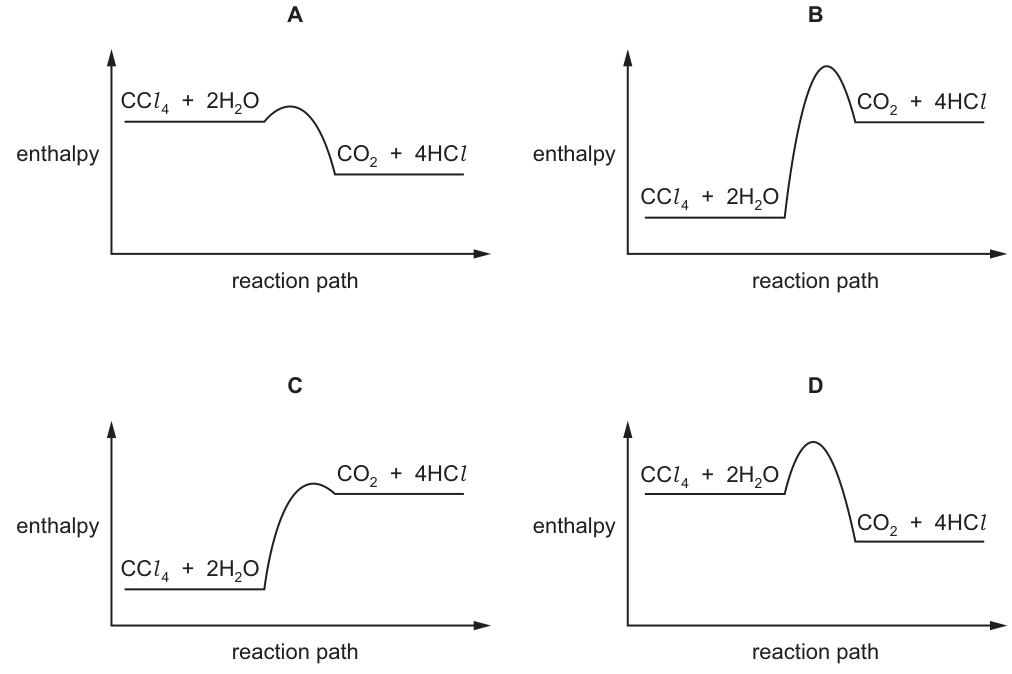
Which enthalpy profile diagram best fits this reaction?
Options
Working
The enthalpy change is . Since is negative, the reaction is exothermic, meaning the products () are at a lower enthalpy level than the reactants (). This eliminates options B and C.
The activation energy is . This is the energy difference between the reactants and the transition state (the peak of the curve). The magnitude of the enthalpy change is , which is the energy difference between the reactants and the products.
Since , the height of the activation barrier above the reactants should be roughly equal to the depth of the energy drop below the reactants.
- Diagram A shows a small activation barrier and a large energy drop.
- Diagram D shows a large activation barrier roughly equal in magnitude to the energy drop.
Diagram D matches the given values.
Answer
D
D
Background Concept
An enthalpy profile diagram (or reaction coordinate diagram) plots the enthalpy of the system against the reaction path (progress of reaction). Key features include:
- Reactants and Products: Horizontal lines representing the initial and final states. If the products are lower than the reactants, energy is released (, exothermic). If products are higher, energy is absorbed (, endothermic).
- Transition State (Activated Complex): The peak of the curve. It represents the highest energy point along the reaction path.
- Activation Energy (): The vertical energy difference between the reactants and the transition state peak. It is always a positive value representing the minimum energy required for the reaction to occur.
- Enthalpy Change (): The vertical energy difference between the reactants and the products. .
Understanding the Question
We are given the reaction with and . We must select the diagram (A, B, C, or D) that correctly represents these thermodynamic parameters.
Approach
- Use the sign of to determine the relative vertical positions of reactants and products.
- Compare the numerical values of and to determine the relative heights of the activation barrier and the energy drop.
Step-by-Step Reasoning
Step 1: Determine exothermic vs endothermic.
. The negative sign indicates an exothermic reaction. Energy is released to the surroundings, so the products must be at a lower enthalpy level than the reactants.
- Diagrams A and D show products lower than reactants (exothermic). These are candidates.
- Diagrams B and C show products higher than reactants (endothermic). These are incorrect.
Step 2: Compare magnitudes of and .
- The activation energy is the height of the peak above the reactant line.
- The enthalpy change is the depth of the product line below the reactant line.
- Notice that . Therefore, the activation barrier should be roughly as tall as the energy drop is deep. The peak should be slightly higher above the reactants than the products are below them.
Step 3: Evaluate remaining options (A and D).
- Diagram A: The peak is only slightly above the reactants (small ), and the products are much lower than the reactants (large ). This would correspond to a small and large , which does not match our data ( vs ).
- Diagram D: The peak is significantly above the reactants (large ), and the products are significantly below the reactants (large ). The barrier height and the drop depth are visually comparable, matching the numerical values given.
Thus, Diagram D is the correct profile.
Key Takeaways
- The sign of determines whether the profile goes down (exothermic) or up (endothermic).
- The activation energy is always measured from the reactants to the peak, not from the products.
- The relative magnitudes of and dictate the shape of the curve; if they are similar, the peak and product levels will be roughly symmetric around the reactant level.
Common Mistakes
- Confusing the direction of : A negative means products are lower, not higher.
- Measuring from the products to the peak: is always from reactants to the peak. (The distance from products to peak is the reverse activation energy, , which is much larger than the forward barrier, as seen in diagram D).
- Ignoring the magnitudes: Assuming any exothermic diagram is correct without checking if the barrier height matches the given .
Things to Be Careful About
- State symbols and balancing in the equation are not needed for selecting the diagram, but ensure you read the and values correctly (signs and units).
- In diagram D, the reverse activation energy is the total height from the product line to the peak (), which is why the right side of the curve is much taller than the left side barrier.
A helium ion contains two protons, two neutrons and one electron.
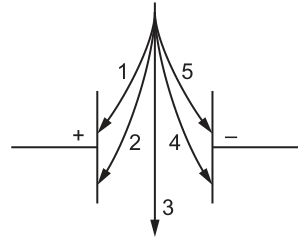
This helium ion and a proton are passed separately through a uniform electric field.
The particles are travelling at the same velocity.
Which arrow describes the path of each particle?
Options
| helium ion | proton | |
|---|---|---|
| A | 1 | 2 |
| B | 2 | 1 |
| C | 4 | 5 |
| D | 5 | 4 |
Working
Both the helium ion () and the proton () are positively charged. In the electric field with a positive plate on the left and a negative plate on the right, both particles will be deflected towards the negative plate (to the right). This means their paths must be either 4 or 5.
The deflection of a particle in a uniform electric field is given by:
Since both particles travel at the same velocity through the same field over the same length , the deflection is proportional to the charge-to-mass ratio ().
For the helium ion ():
Charge , mass (2 protons + 2 neutrons).
For the proton ():
Charge , mass (1 proton).
The proton has a greater ratio, so it experiences a greater acceleration and a larger deflection. Arrow 5 shows a larger deflection than arrow 4.
Therefore, the helium ion follows path 4 and the proton follows path 5.
Answer
C
C
Background Concept
When a charged particle passes through a uniform electric field, it experiences a force . If the particle's velocity is perpendicular to the field, it will undergo parabolic deflection, similar to projectile motion under gravity. The direction of deflection depends on the sign of the charge (positive charges deflect towards the negative plate, negative charges towards the positive plate). The magnitude of the deflection depends on the charge-to-mass ratio () of the particle. A higher ratio results in greater acceleration and thus a larger deflection for a given velocity and field length.
Understanding the Question
The question asks to identify the paths of a helium ion (, with 2 protons, 2 neutrons, 1 electron) and a proton () as they pass through a uniform electric field. The field is created by a positive plate on the left and a negative plate on the right. Both particles enter with the same velocity. We need to determine which of the given arrows (4 or 5, since both are positive) corresponds to each particle.
Approach
- Determine the direction of deflection for each particle based on their charge. Both are positive, so both deflect towards the negative plate (right side, paths 4 or 5).
- Calculate the charge-to-mass ratio () for each particle.
- Relate to the deflection: higher means greater deflection.
- Match the particles to the correct paths based on their relative deflections.
Step-by-Step Reasoning
- Direction of deflection: The helium ion has 2 protons and 1 electron, giving a net charge of . The proton has 1 proton and 0 electrons, giving a net charge of . Both are positively charged. The electric field points from the positive plate (left) to the negative plate (right). Positive charges are repelled by the positive plate and attracted to the negative plate, so both particles deflect to the right. This narrows the possible paths to 4 and 5.
- Magnitude of deflection: The equation for deflection in a uniform electric field, assuming the particle enters perpendicular to the field and travels a horizontal distance at velocity , is . Since both particles travel at the same velocity through the same field over the same length , the deflection is proportional to the charge-to-mass ratio ().
- Calculating :
- Helium ion (): , (2 protons + 2 neutrons). .
- Proton (): , (1 proton). .
- Matching paths: The proton has a greater ratio (), so it experiences a greater acceleration and a larger deflection. Looking at the right side of the diagram, arrow 5 curves more sharply (larger deflection) than arrow 4. Therefore, the proton follows path 5 and the helium ion follows path 4. This matches option C.
Key Takeaways
- Positive particles deflect towards the negative plate in an electric field.
- The deflection magnitude is proportional to the charge-to-mass ratio () when velocity and field strength are constant.
- Always consider both the sign of the charge (for direction) and the ratio (for magnitude) when analyzing particle deflection.
Common Mistakes
- Assuming the helium ion deflects more because it has a higher charge ( vs ). Forgetting to divide by the mass (4 u vs 1 u) leads to the incorrect conclusion that the helium ion has the larger deflection.
- Confusing the direction of deflection: positive particles are attracted to the negative plate, not the positive plate.
- Forgetting that the helium ion has 2 neutrons, which contribute to its mass but not its charge.
Things to Be Careful About
- Ensure you calculate the net charge correctly: helium ion has 2 protons and 1 electron, so charge is , not or .
- Remember that neutrons have mass but no charge, so they increase the mass and decrease the ratio without affecting the direction of deflection.
- The deflection is proportional to , not just or individually.
The skeletal formulae of arginine and lysine are shown.
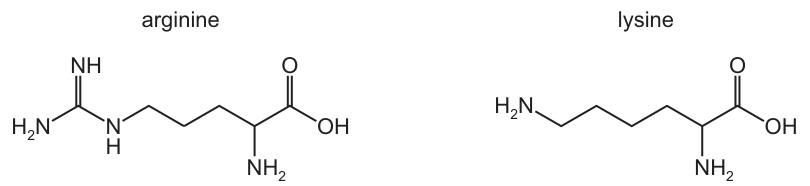
Which row is correct?
Options
| substance | empirical formula | ||
|---|---|---|---|
| A | arginine | 174 | |
| B | arginine | 176 | |
| C | lysine | 144 | |
| D | lysine | 146 |
Working
Arginine:
From the structure, count the atoms:
- Carbon (C): 1 (guanidine) + 3 (chain) + 1 (alpha-carbon) + 1 (carboxyl) = 6
- Hydrogen (H): 4 (guanidine group: , , ) + 6 (three groups) + 1 (-carbon) + 2 (amine) + 1 (carboxyl) = 14
- Nitrogen (N): 3 (guanidine) + 1 (amine) = 4
- Oxygen (O): 2 (carboxyl)
Molecular formula:
Empirical formula (divide by 2):
This matches row A.
Lysine (for verification):
Molecular formula:
Empirical formula:
Rows C and D are incorrect.
Answer
A
A
Background Concept
Molecular vs. Empirical Formula:
- The molecular formula gives the actual number of atoms of each element in a molecule (e.g., ).
- The empirical formula gives the simplest whole-number ratio of atoms (e.g., ). It is found by dividing the molecular formula by the greatest common divisor.
Relative Molecular Mass ():
- Calculated by summing the relative atomic masses () of all atoms in the molecular formula. For organic molecules containing C, H, N, O: .
Reading Structural Formulae:
- In skeletal/structural drawings, carbon atoms are at vertices and ends of lines. Hydrogen atoms attached to carbon are implied (enough to make 4 bonds). Hydrogen atoms attached to heteroatoms (N, O) must be counted explicitly as they are usually drawn.
Understanding the Question
The question provides structural formulae for two amino acids, arginine and lysine. We must identify the correct row in a table that lists the substance, its empirical formula, and its relative molecular mass (). The mark scheme indicates the correct answer is A.
Approach
- Count atoms in the full molecular structure of arginine to determine its molecular formula.
- Simplify the molecular formula to find the empirical formula.
- Calculate using the molecular formula.
- Compare the results with the given options (A and B for arginine; C and D for lysine).
Step-by-Step Reasoning
Analyzing Arginine:
- Structure:
- Counting Carbons: 1 in the guanidine group () + 3 in the propyl chain () + 1 alpha-carbon () + 1 carboxyl carbon () = 6 C.
- Counting Hydrogens:
- Guanidine group: (2) + (1) + (1) = 4
- Chain: 3 = 6
- Alpha-carbon: 1 ()
- Alpha-amine: 2 ()
- Carboxyl: 1 ()
- Total H = 4 + 6 + 1 + 2 + 1 = 14 H.
- Counting Nitrogens: 3 in guanidine + 1 in amine = 4 N.
- Counting Oxygens: 2 in carboxyl group = 2 O.
- Molecular Formula:
- Empirical Formula: Divide subscripts by 2 (GCD is 2) -> .
- Calculation:
- Match: Row A has arginine, empirical formula , and . This is correct.
Analyzing Lysine (to eliminate C and D):
- Structure:
- Molecular Formula: (6 C, 14 H, 2 N, 2 O)
- Empirical Formula: Divide by 2 ->
- Calculation:
- Check Options:
- Row C: Empirical (correct), but (incorrect, should be 146).
- Row D: Empirical (incorrect, H count is wrong), (correct but wrong formula).
Key Takeaways
- Always distinguish between molecular formula (actual atoms) and empirical formula (simplest ratio). The question asks for the empirical formula, but is calculated from the molecular formula.
- When counting atoms in organic structures, remember that hydrogens on carbons are implied (to make 4 bonds), but hydrogens on heteroatoms (N, O) must be counted from the drawing.
- Simplify the molecular formula by finding the greatest common divisor of all subscripts.
Common Mistakes
- Confusing molecular and empirical formulas: Students might calculate the molecular formula () and look for it in the table, or fail to simplify to the empirical formula ().
- Miscounting hydrogens: Forgetting the H on the or groups in the guanidine side chain of arginine, or the H on the group. This leads to wrong H counts and wrong .
- Using empirical formula to calculate : must be calculated using the molecular formula. If you used the empirical formula for arginine, you would get , which is half the correct value.
Things to Be Careful About
- State symbols: Not required here, but ensure you don't add them to formulae if not asked.
- Significant figures: values are typically given to the nearest whole number (integer) for these calculations unless decimal places are specified by values (e.g., Cl=35.5). Here, all values are integers (12, 1, 14, 16), so the result is an integer.
- Distractor analysis: Row D has the correct for lysine (146) but the wrong empirical formula ( instead of ). This is a trap for students who calculate correctly but mess up the H count or empirical formula simplification.
The oxide and chloride of an element X are separately mixed with water. The two resulting solutions have the same effect on litmus.
What could element X be?
Options
A Al
B Ca
C Na
D P
Working
For the oxide and chloride to have the same effect on litmus, both must give solutions of the same acid-base type.
| Element | Oxide in water | Chloride in water | Same? |
|---|---|---|---|
| Na | Na2O gives NaOH (alkaline) | NaCl neutral | No |
| Ca | CaO gives Ca(OH)2 (alkaline) | CaCl2 neutral | No |
| Al | Al2O3 amphoteric/insoluble | AlCl3 hydrolyses to acidic solution | No |
| P | P4O10 gives H3PO4 (acidic) | PCl3/PCl5 hydrolyse to acidic solutions | Yes |
Only phosphorus gives acidic solutions from both its oxide and its chloride.
Answer
D (P)
D
Background Concept
Oxides and chlorides behave differently with water depending on the element. Metal oxides of Group 1 and Group 2 are basic: they form metal hydroxides. Non-metal oxides are acidic: they form acids. Amphoteric oxides, such as Al2O3, can react with both acids and bases but are essentially insoluble in water. Chlorides also vary: chlorides of Group 1 and Group 2 metals are neutral salts, while chlorides of non-metals or of small highly charged cations hydrolyse in water to give acidic solutions. Litmus is red in acid and blue in alkali.
Understanding the Question
The question asks which element's oxide and chloride, separately mixed with water, produce solutions with the same effect on litmus. We are not asked for exact pH values; we only need the same acid-base category. For each option, decide whether the oxide solution and the chloride solution are both acidic, both alkaline, or both neutral.
Approach
For each element, determine:
- Oxide with water: acidic, alkaline, or neutral?
- Chloride with water: acidic, alkaline, or neutral?
- Do the two match?
Eliminate mismatches. Only phosphorus gives acidic solutions from both its oxide and its chloride.
Step-by-Step Reasoning
-
Sodium:
The oxide gives an alkaline solution. Sodium chloride, NaCl, dissolves to give a neutral solution. Different. -
Calcium:
The oxide gives an alkaline solution. Calcium chloride, CaCl2, dissolves to give a neutral solution. Different. -
Aluminium:
Al2O3 is amphoteric and essentially insoluble in water, so it does not give a strongly acidic or alkaline solution. Aluminium chloride hydrolyses in water:
[Al(H2O)6]3+ + H2O ⇌ [Al(OH)(H2O)5]2+ + H3O+
This makes the solution acidic. Different. -
Phosphorus:
The oxide gives an acidic solution. Phosphorus chlorides also hydrolyse:
Both give acidic solutions. Same.
Therefore, element X is phosphorus.
Key Takeaways
- Non-metal oxides are acidic; Group 1 and Group 2 oxides are basic; amphoteric oxides such as Al2O3 are intermediate.
- Chlorides of non-metals hydrolyse to acidic solutions; chlorides of Group 1 and Group 2 metals are neutral.
- Same litmus effect means the oxide and chloride solutions must belong to the same acid-base category.
Common Mistakes
- Assuming all chlorides are neutral. AlCl3 and PCl3/PCl5 are acidic because they hydrolyse.
- Assuming Al2O3 is basic because aluminium is a metal. It is amphoteric and essentially insoluble in water.
- Forgetting that CaCl2 is neutral, not acidic, because it comes from a strong base and a strong acid.
Things to Be Careful About
- Phosphorus can form more than one chloride; both PCl3 and PCl5 give acidic solutions.
- Aluminium chloride is covalent and hydrolyses; it does not simply dissolve as Al3+ and Cl-.
- The phrase same effect on litmus could mean both acidic or both alkaline; here both are acidic.
Why do the halogens become less volatile as Group 17 is descended?
Options
A The halogen–halogen bond energy decreases.
B The halogen–halogen bond energy increases.
C The number of electrons in each molecule increases.
D The van der Waals’ forces between molecules become weaker.
Working
Halogens exist as simple non-polar diatomic molecules. Volatility depends on the strength of the intermolecular forces between molecules, not on the halogen–halogen bond. Down Group 17 the molecules get larger and contain more electrons, so the induced dipole–dipole (van der Waals') attractions become stronger. More energy is needed to separate the molecules, so boiling points rise and the halogens become less volatile.
Answer
C — The number of electrons in each molecule increases.
C
Background Concept
Volatility is a measure of how readily a liquid or solid turns into vapour; it is controlled by the strength of the intermolecular forces that must be overcome. The halogens are simple molecular substances: each molecule is non-polar and diatomic, e.g. , , and . The only significant forces between such molecules are instantaneous induced dipole–induced dipole interactions, often called London dispersion forces or van der Waals' forces. These arise from temporary fluctuations in electron distribution and their strength increases with the number of electrons and the size of the molecule. More electrons give a larger, more polarisable electron cloud, stronger temporary dipoles, and therefore stronger intermolecular attractions.
Understanding the Question
The question asks for the reason for a trend: as Group 17 is descended, halogens become less volatile, meaning their boiling points increase. It is a multiple-choice question, so you need to pick the factor that actually causes this trend. You must distinguish between the intramolecular halogen–halogen bond and the intermolecular forces between separate molecules. The stem gives no extra data; the answer comes from recalling the trend and its cause.
Approach
Recall the trend: and are gases, is a liquid and is a solid at room temperature. Down the group, boiling points increase. Since volatility is the inverse of boiling point, less volatile means a higher boiling point, which means stronger intermolecular forces. Then examine the options: which one correctly describes a change that strengthens intermolecular forces? Option C gives an increase in the number of electrons per molecule. Options A and B concern the halogen–halogen bond energy, which is irrelevant to a phase change because no covalent bonds are broken when a halogen vaporises. Option D says van der Waals' forces become weaker, which is the opposite of what is needed.
Step-by-Step Reasoning
- Identify the type of substance: halogens are simple molecular, non-polar diatomic molecules.
- When a halogen vaporises, only intermolecular forces are broken; the covalent X–X bonds remain intact. Therefore bond energy does not determine volatility. This eliminates A and B, even though the statement in A about bond energy may be true.
- Volatility depends on intermolecular forces. Down the group, molecules become larger and have more electrons: F has 9 electrons, Cl has 17, Br has 35 and I has 53 per atom, so each molecule has 18, 34, 70 and 106 electrons respectively.
- More electrons make the electron cloud more polarisable, so the instantaneous induced dipole–induced dipole (van der Waals') forces between molecules become stronger.
- Stronger intermolecular forces require more energy to overcome, so the boiling point increases and the halogen is less volatile. Therefore C is correct.
- Option D says van der Waals' forces become weaker; this is the opposite of the actual trend, so it is false.
Key Takeaways
- Volatility and boiling point of simple molecular substances depend on intermolecular forces, not on intramolecular bond strength.
- Non-polar molecules interact through van der Waals' (London dispersion) forces; these increase with electron count and molecular size.
- Down Group 17, increasing electron number leads to stronger van der Waals' forces, higher boiling points and lower volatility.
Common Mistakes
- Choosing A because the halogen–halogen bond energy does decrease down the group; this is true but irrelevant to volatility because vaporisation does not break covalent bonds.
- Choosing D by misremembering the trend as weaker forces; the forces actually strengthen down the group.
- Confusing volatility with reactivity; reactivity of halogens decreases down the group, but that is a different trend.
Things to Be Careful About
- 'Less volatile' means a higher boiling point, so it corresponds to stronger, not weaker, intermolecular forces.
- Halogens are non-polar diatomic molecules; there is no permanent dipole or hydrogen bonding between them.
- In multiple choice, read the options carefully: A and B are distractors about bond energy, while D reverses the correct intermolecular force trend.
Compound M is a white solid. It is the chloride of a Period 3 element.
Information about some reactions starting with compound M is given in the table.
| reaction | observation |
|---|---|
| compound M + non-polar solvent | colourless solution |
| compound M added a little at a time to water | steamy fumes, Q colourless solution, R |
| fumes Q tested with moist blue litmus paper | paper turns red |
| solution R + a few drops of NaOH(aq) + excess NaOH(aq) | white precipitate dissolves to give a colourless solution |
What is compound M?
Options
A aluminium chloride
B magnesium chloride
C phosphorus pentachloride
D sodium chloride
Working
- M dissolves in a non-polar solvent, so it is a covalent molecular chloride, not an ionic chloride.
- M + water gives steamy fumes Q that turn moist blue litmus red, so Q is HCl formed by hydrolysis.
- Solution R gives a white precipitate with a little NaOH(aq) that dissolves in excess NaOH(aq), so the hydroxide is amphoteric, typical of Al³⁺(aq).
- These observations together identify M as aluminium chloride, AlCl₃.
Answer
A (aluminium chloride)
A
Background Concept
Period 3 chlorides show a clear trend in bonding. Sodium chloride and magnesium chloride are ionic solids, so they do not dissolve in non-polar solvents. Aluminium chloride is covalent and molecular (Al₂Cl₆ in the vapour), so it dissolves in non-polar solvents. It also hydrolyses vigorously in water, releasing HCl.
Aluminium hydroxide is amphoteric: it dissolves in acids and also in excess strong alkali.
Understanding the Question
We are given a compound M, a chloride of a Period 3 element. The table gives three observations:
- M dissolves in a non-polar solvent → colourless solution.
- Adding M to water gives steamy fumes Q and a colourless solution R.
- Q turns moist blue litmus red.
- R gives a white precipitate with a little NaOH, which dissolves with excess NaOH.
We need to identify M from the four options.
Approach
Use the observations one by one to eliminate options:
- Solubility in a non-polar solvent tells us the type of bonding.
- The acidic steamy fumes tell us the gas produced on hydrolysis.
- The behaviour of the solution with NaOH tells us which metal ion is present.
Step-by-Step Reasoning
-
Non-polar solvent solubility: Ionic chlorides such as NaCl and MgCl₂ do not dissolve in non-polar solvents. Only covalent chlorides dissolve. This points to aluminium chloride or phosphorus pentachloride, not sodium or magnesium chloride.
-
Reaction with water: AlCl₃ hydrolyses to give steamy fumes of HCl. PCl₅ also reacts with water to give steamy fumes of HCl, but the solution behaviour in step 3 distinguishes them.
-
Acidic gas Q: HCl turns moist blue litmus red. This confirms Q is HCl, so M is a chloride that hydrolyses to release HCl.
-
Solution R with NaOH: A white precipitate that dissolves in excess NaOH is the classic test for Al³⁺. Al(OH)₃ is amphoteric and dissolves in excess alkali to form a colourless solution containing [Al(OH)₄]⁻. Phosphorus does not form such an amphoteric hydroxide, so PCl₅ is eliminated.
Therefore M is aluminium chloride.
Key Takeaways
- Ionic chlorides are insoluble in non-polar solvents; covalent chlorides dissolve.
- AlCl₃ is a covalent chloride that hydrolyses in water to give HCl.
- Al³⁺(aq) gives a white precipitate with NaOH that dissolves in excess NaOH, because Al(OH)₃ is amphoteric.
Common Mistakes
- Choosing magnesium chloride because it is a Period 3 chloride and gives a white precipitate with NaOH. But Mg(OH)₂ does not dissolve in excess NaOH, and MgCl₂ is ionic, so it would not dissolve in a non-polar solvent.
- Choosing phosphorus pentachloride because it also gives steamy HCl fumes. But PCl₅ does not produce an amphoteric hydroxide with NaOH.
Things to Be Careful About
- Read the observation "dissolves in a non-polar solvent" carefully: it is a strong clue to covalent bonding.
- The phrase "steamy fumes" is characteristic of HCl in moist air.
- "White precipitate dissolves in excess NaOH" is specific to amphoteric hydroxides such as Al(OH)₃.
Which statement about strontium and its compounds is correct?
Options
A Strontium hydroxide is more soluble than barium hydroxide.
B Strontium sulfate is more soluble than magnesium sulfate.
C Strontium nitrate has a lower thermal stability than calcium nitrate.
D Strontium is a stronger reducing agent than magnesium.
Working
Going down Group 2:
- A — Solubility of hydroxides increases down the group, so Ba(OH)2 is more soluble than Sr(OH)2. False.
- B — Solubility of sulfates decreases down the group, so MgSO4 is more soluble than SrSO4. False.
- C — Thermal stability of nitrates increases down the group, so Sr(NO3)2 is more stable than Ca(NO3)2. False.
- D — Ionisation energy decreases down the group, so Sr loses electrons more easily and is a stronger reducing agent than Mg. True.
Answer
D — Strontium is a stronger reducing agent than magnesium.
D
Background Concept
Group 2 (alkaline earth) metals — Be, Mg, Ca, Sr, Ba — show clear periodic trends as you go down the group:
- Atomic radius increases (more electron shells)
- First ionisation energy decreases (outer electron further from nucleus, more shielding)
- Metals become stronger reducing agents (easier to lose the two outer electrons)
- Solubility of hydroxides increases down the group
- Solubility of sulfates decreases down the group
- Thermal stability of nitrates and carbonates increases down the group (the larger the cation, the less it polarises the nitrate/carbonate ion)
Understanding the Question
The question presents four statements about strontium (Sr) and its compounds, each comparing Sr with another Group 2 element or its compounds. Only one statement is correct, so we must test each against the known trends and eliminate the three false ones.
Approach
Recall the four key Group 2 trends and apply each to the specific comparison in each option. Eliminate the three false statements; the one that survives is the answer.
Step-by-Step Reasoning
Option A — Hydroxide solubility increases down the group. Ba(OH)2 is very soluble while Sr(OH)2 is less soluble, so Sr hydroxide is NOT more soluble than Ba hydroxide. False.
Option B — Sulfate solubility decreases down the group. MgSO4 is soluble while SrSO4 is sparingly soluble, so Sr sulfate is NOT more soluble than Mg sulfate. False.
Option C — Thermal stability of nitrates increases down the group. The larger Sr2+ cation polarises the nitrate ion less than the smaller Ca2+ cation, so Sr(NO3)2 is more stable than Ca(NO3)2, not less. False.
Option D — Ionisation energy decreases down the group, so Sr loses its outer electrons more readily than Mg. A stronger reducing agent is one that is more easily oxidised (loses electrons), so Sr is indeed a stronger reducing agent than Mg. True.
Key Takeaways
- Group 2 hydroxide solubility increases down the group; sulfate solubility decreases down the group.
- Thermal stability of nitrates and carbonates increases down the group.
- Reducing power (ease of losing electrons) increases down the group as ionisation energy falls.
Common Mistakes
- Thinking hydroxide solubility decreases down the group (it actually increases).
- Confusing the direction of sulfate solubility (it decreases, the opposite of hydroxides).
- Mixing up thermal stability direction — larger cations give MORE stable nitrates, not less.
Things to Be Careful About
- Read each statement's direction carefully ("more soluble", "lower thermal stability").
- Remember that "stronger reducing agent" for a metal means "more easily oxidised", i.e. the more reactive metal.
- Note that trends for hydroxides and sulfates run in opposite directions — a frequent trap.
Sodium bromide is warmed with concentrated sulfuric acid.
Which row describes the change in the oxidation number of the sulfur and the role of the bromide ions in the reaction?
Options
| change in oxidation number of sulfur | role of bromide ions | |
|---|---|---|
| A | +6 to +4 | oxidising agent |
| B | +6 to +4 | reducing agent |
| C | +4 to 0 | oxidising agent |
| D | +4 to 0 | reducing agent |
Working
In concentrated sulfuric acid, bromide ions are oxidised to bromine while the sulfuric acid is reduced to sulfur dioxide:
The oxidation number of sulfur changes from in to in . The bromide ions change from to , so they are oxidised and act as the reducing agent.
Answer
B
B
Background Concept
Redox reactions are tracked by oxidation numbers. An increase in oxidation number is oxidation; a decrease is reduction. The species that is itself reduced is the oxidising agent, because it causes another species to be oxidised. The species that is itself oxidised is the reducing agent, because it causes another species to be reduced.
Concentrated sulfuric acid can behave as an oxidising agent. Sulfur in is in its highest common oxidation state, , so it can be reduced to lower states such as in . This happens particularly with bromide and iodide ions, which are strong enough reducing agents to reduce it.
Understanding the Question
The question gives a reaction: sodium bromide is warmed with concentrated sulfuric acid. It asks for two things: the change in oxidation number of sulfur, and the role of the bromide ions. The options combine these two pieces of information, so you need to determine both correctly and then match them.
Approach
Write the redox equation that occurs, assign oxidation numbers to sulfur and bromine, decide which element is oxidised and which is reduced, and then identify the oxidising and reducing agents. Finally, match the correct change and role to the options.
Step-by-Step Reasoning
- Sodium bromide reacts with concentrated sulfuric acid to form hydrogen bromide. With warming, hydrogen bromide reduces the sulfuric acid:
-
Assign oxidation numbers in this equation:
- In : H is , O is . Total from H and O is , so S must be .
- In : O is each, total , so S is .
- In : H is , so Br is .
- In : Br is .
-
Sulfur goes from to : its oxidation number decreases, so sulfur is reduced. The species containing sulfur, , is therefore the oxidising agent.
-
Bromine goes from to : its oxidation number increases, so bromide ions are oxidised. The species that is oxidised is the reducing agent. Therefore bromide ions act as the reducing agent.
-
Matching these results to the options, the correct row is: change in oxidation number of sulfur to , role of bromide ions reducing agent. This is option B.
Key Takeaways
- Oxidation number increases = oxidation; oxidation number decreases = reduction.
- The oxidising agent is the species reduced; the reducing agent is the species oxidised.
- Concentrated sulfuric acid can oxidise bromide ions to bromine, being reduced itself to sulfur dioxide.
Common Mistakes
- Confusing the oxidising and reducing agents: bromide ions are oxidised, so they are the reducing agent, not the oxidising agent.
- Assigning the oxidation number of sulfur in as instead of .
- Forgetting that bromide is oxidised to bromine, which is why the change in oxidation number of sulfur is to , not to .
Things to Be Careful About
- Always calculate oxidation numbers from the known rules: H is , O is , and the sum in a neutral molecule is zero.
- Read the question carefully: it asks for the role of the bromide ions, not the role of sulfuric acid.
- Use the balanced equation to confirm the electron transfer rather than relying on memory alone.
A reaction occurs when ammonium chloride is added to calcium hydroxide.
What is the role of the ammonium ions in this reaction?
Options
A acid
B base
C oxidising agent
D reducing agent
Working
The ammonium ion, , can donate a proton to the hydroxide ion from calcium hydroxide:
This is proton transfer, not electron transfer, so the ammonium ion is acting as a Bronsted-Lowry acid.
Answer
A — acid
A
Background Concept
A Bronsted-Lowry acid is a species that donates a proton, , and a Bronsted-Lowry base is a species that accepts a proton. The ammonium ion, , is the conjugate acid of ammonia, : it can lose one proton to become ammonia. Calcium hydroxide supplies hydroxide ions, , which are strong proton acceptors. When the two are mixed, a proton is transferred from the ammonium ion to the hydroxide ion, forming ammonia and water. This is an acid-base reaction, not a redox reaction, because no oxidation numbers change.
Understanding the Question
The question asks you to classify the role of the ammonium ion, , when ammonium chloride is added to calcium hydroxide. The four options are acid, base, oxidising agent, and reducing agent. To answer, you need to decide whether the ammonium ion is donating a proton, accepting a proton, accepting electrons, or donating electrons. The key clue is the presence of hydroxide ions from calcium hydroxide, a strong base, which will readily accept a proton.
Approach
Start by identifying which species can donate or accept a proton. Hydroxide, , is a classic base, so it will accept a proton. The ammonium ion has a proton it can lose, so it is the most likely proton donor. Then check whether any electron transfer is involved: if oxidation numbers remain unchanged, the species cannot be an oxidising or reducing agent. Write the ionic equation to make the proton transfer clear.
Step-by-Step Reasoning
- Calcium hydroxide provides hydroxide ions, , which are proton acceptors.
- The ammonium ion, , can donate one of its hydrogen ions as a proton.
- The proton transfer is shown by the ionic equation:
- This equation shows donating to , so it is acting as a Bronsted-Lowry acid.
- To rule out redox, compare oxidation numbers: nitrogen is in both and , and hydrogen and oxygen keep their usual oxidation numbers. No electrons are transferred, so the ammonium ion is not an oxidising or reducing agent.
- Therefore the correct option is A, acid.
Key Takeaways
- A Bronsted-Lowry acid is a proton donor; a Bronsted-Lowry base is a proton acceptor.
- and are a conjugate acid-base pair.
- Acid-base reactions involve proton transfer; redox reactions involve electron transfer. Always check oxidation numbers before classifying a species as oxidising or reducing.
Common Mistakes
- Saying is a base because ammonia, , is a base. The ammonium ion is the conjugate acid, not the base.
- Choosing oxidising or reducing agent without checking for a change in oxidation number. No oxidation numbers change here.
- Confusing the Bronsted-Lowry definition with the idea that an acid must have a pH below 7 in water. The role in this reaction is determined by proton transfer.
Things to Be Careful About
- Use the Bronsted-Lowry definition, not just the Arrhenius definition, when classifying species in a proton-transfer reaction.
- The overall reaction is , but the ionic equation for the proton transfer is enough to identify the role of the ammonium ion.
- State symbols are not required for this classification, but if you include them, make sure they are correct: , , , .
Elements Y and Z are both in Period 3. Element Y has the smallest atomic radius in Period 3.
There are only two elements in Period 3 that have a lower melting point than element Z.
Elements Y and Z react together to form compound R.
Which compound could be R?
Options
A
B MgS
C
D
Working
- Atomic radius decreases across Period 3, so Y = Cl.
- Melting points (°C): Na 98, Mg 650, Al 660, Si 1414, P 44, S 115, Cl2 -101, Ar -189.
Only Cl2 and Ar have lower melting points than P, so Z = P. - P and Cl react to form PCl3 (or PCl5); option D.
Answer
D — PCl3
D
Background Concept
In Period 3, atomic radius generally decreases from Na to Cl because the nuclear charge increases while the shielding by inner electrons stays roughly the same. The element with the smallest atomic radius in Period 3 is therefore chlorine.
Melting point across Period 3 is not a simple trend. Sodium, magnesium and aluminium are metals with metallic bonding; silicon has a giant covalent structure and a very high melting point; phosphorus, sulfur, chlorine and argon are simple molecular substances with low melting points. Approximate melting points are: Na 98°C, Mg 650°C, Al 660°C, Si 1414°C, P 44°C, S 115°C, Cl2 -101°C, Ar -189°C.
Understanding the Question
We are given two clues:
- Element Y has the smallest atomic radius in Period 3.
- Only two elements in Period 3 have a lower melting point than element Z.
We must identify Y and Z, then decide which compound they form together. The options are MgCl2, MgS, Na2S and PCl3.
Approach
- Use the atomic radius trend to identify Y.
- Use the melting point data to identify Z.
- Match the two elements to the compound in the options.
Step-by-Step Reasoning
- Atomic radius decreases from Na to Cl across Period 3, so Y = Cl.
- Look at the melting points. Phosphorus melts at 44°C. The only two Period 3 elements with lower melting points are chlorine (-101°C) and argon (-189°C). So Z = P.
- Phosphorus and chlorine react together to form phosphorus trichloride, PCl3, or phosphorus pentachloride, PCl5. Since PCl3 is one of the options, R is PCl3.
- The correct option is D.
Key Takeaways
- Atomic radius decreases across a period due to increasing nuclear charge.
- Melting point in Period 3 reflects the type of structure: giant covalent silicon is very high, simple molecular substances are low.
- Chlorine is a non-metal that forms covalent chlorides with non-metals such as phosphorus.
Common Mistakes
- Forgetting argon when counting elements with lower melting points.
- Assuming the smallest atomic radius is sodium, which is actually the largest in Period 3.
- Choosing MgCl2 because chlorine is involved, without correctly identifying Z as phosphorus.
Things to Be Careful About
- Period 3 includes argon, but atomic radius is usually discussed for Na to Cl; the noble gas is often ignored.
- Sulfur has a higher melting point than phosphorus, so it is not one of the two elements lower than Z.
- Phosphorus can form both PCl3 and PCl5; the option given is PCl3.
of each of four different compounds of Group 2 elements are thermally decomposed. The residue in each decomposition is the oxide of the Group 2 element.
The volume of gas produced from each reaction is measured at room conditions.
Which substance produces the greatest volume of gas?
Options
A calcium carbonate
B calcium nitrate
C strontium carbonate
D strontium nitrate
Working
For carbonates:
1 mol compound gives 1 mol gas.
For nitrates:
1 mol compound gives 2.5 mol gas.
Moles of gas from 1.0 g:
- CaCO3: mol
- Ca(NO3)2: mol
- SrCO3: mol
- Sr(NO3)2: mol
Greatest moles of gas, hence greatest volume, is from calcium nitrate.
Answer
B
B
Background Concept
Group 2 carbonates and nitrates both undergo thermal decomposition to leave the metal oxide, but they release different amounts of gas.
For a carbonate:
So 1 mol of carbonate produces 1 mol of gas.
For a nitrate:
So 1 mol of nitrate produces 2.5 mol of gas: 2 mol of and 0.5 mol of .
At the same temperature and pressure, equal numbers of moles of any gas occupy the same volume. Therefore, comparing volumes of gas is the same as comparing moles of gas produced. Because the same mass (1.0 g) of each compound is used, we must compare moles of gas per gram, not per mole of compound.
Understanding the Question
The question gives four Group 2 compounds and states that 1.0 g of each is decomposed completely to the oxide. The gas produced is collected and its volume measured at room conditions. We must decide which compound gives the greatest volume of gas.
The key is that the compounds differ in two ways:
- the anion: carbonate vs nitrate;
- the cation: calcium vs strontium.
Both affect the answer. The anion determines how many moles of gas are released per mole of compound; the cation affects the molar mass, and therefore how many moles of compound are present in 1.0 g.
Approach
- Write the balanced decomposition equations for carbonates and nitrates.
- Find the number of moles of gas produced per mole of compound.
- Calculate the number of moles of compound in 1.0 g using .
- Multiply the two values to get moles of gas produced from 1.0 g.
- Compare the values; the largest corresponds to the greatest volume.
Step-by-Step Reasoning
Step 1: Gas produced per mole of compound
For carbonates:
1 mol carbonate gives 1 mol gas.
For nitrates:
2 mol nitrate gives 5 mol gas, so 1 mol nitrate gives 2.5 mol gas.
Step 2: Molar masses
Using approximate relative atomic masses: Ca = 40, Sr = 88, C = 12, N = 14, O = 16.
Step 3: Moles of gas from 1.0 g
For carbonates, moles of gas = .
- CaCO3: mol
- SrCO3: mol
For nitrates, moles of gas = .
- Ca(NO3)2: mol
- Sr(NO3)2: mol
Step 4: Compare
The largest number of moles of gas is produced by calcium nitrate, 0.0152 mol. Since all gases are measured at the same room conditions, this also gives the greatest volume.
Therefore the correct option is B.
Key Takeaways
- Thermal decomposition of Group 2 carbonates gives 1 mol of per mole of carbonate.
- Thermal decomposition of Group 2 nitrates gives a mixture of and , totalling 2.5 mol of gas per mole of nitrate.
- When comparing amounts of different compounds, always convert to moles using the molar mass.
- At the same temperature and pressure, gas volume is directly proportional to moles of gas, so comparing moles is sufficient.
Common Mistakes
- Comparing per mole of compound instead of per gram. Per mole, nitrates always beat carbonates, but among nitrates the lighter calcium compound gives more moles per gram than the heavier strontium compound.
- Forgetting that nitrate decomposition produces two gases, and , and using only 1 mol of gas per mole of nitrate.
- Using the molar mass of the cation or anion instead of the whole compound.
- Assuming that because strontium is below calcium in Group 2, its compounds behave differently; the decomposition pattern is the same, but the molar mass is larger.
Things to Be Careful About
- The nitrate equation must be balanced correctly: . The is easy to miss.
- Use the molar mass of the complete formula unit, including water-free anhydrous salts.
- State symbols are not essential for the calculation but help clarify which species are gases.
- If the question asked for an actual volume, you would multiply moles of gas by the molar volume at room conditions (about 24 dm mol), but here only a comparison is needed.
Sulfur dioxide in the atmosphere can form acid rain. This occurs in two steps.
1 oxidation of to
2 formation of dilute
Which row identifies the atmospheric catalyst for step 1 and the reagent for step 2?
Options
| catalyst | reagent | |
|---|---|---|
| A | ||
| B | ||
| C | ||
| D |
Working
Step 1: is oxidised to by , but this oxidation is catalysed in the atmosphere by .
Step 2: reacts with water to form sulfuric acid:
So the catalyst is and the reagent for step 2 is .
Answer
C
C
Background Concept
Sulfur dioxide released into the atmosphere, mainly from burning sulfur-containing fossil fuels, is a major cause of acid rain. It does not form acid rain directly in one step. Instead, it first needs to be oxidised from sulfur in the +4 oxidation state to sulfur in the +6 oxidation state, forming sulfur trioxide, . This oxidation is slow in clean air, but in polluted air nitrogen dioxide, , acts as a catalyst. The sulfur trioxide then combines with atmospheric water vapour to produce sulfuric acid, which falls as acid rain.
A catalyst is a substance that speeds up a reaction without being used up overall. It is different from a reactant: the reactant is the substance that is actually consumed in the chemical change. Here, oxygen is the oxidising agent needed for step 1, but it is not the catalyst. The catalyst is .
Understanding the Question
The question gives the two-step atmospheric process:
- oxidation of to
- formation of dilute
You are asked to identify, from the table, which substance is the atmospheric catalyst for step 1 and which substance is the reagent for step 2. The options mix up , , and , so the key is to know the exact role of each substance.
The command word is "identify" — you only need to select the correct row, but you should be able to justify your choice using the chemistry of acid rain formation.
Approach
Think about the two steps separately.
- Step 1 is an oxidation. The oxidising agent is oxygen, , because gains oxygen to become . However, the question asks for the catalyst, not the oxidising agent. In atmospheric chemistry, catalyses this oxidation.
- Step 2 is the formation of sulfuric acid from sulfur trioxide. This is a hydration reaction: reacts with water, , to give .
Once you identify the catalyst as and the reagent for step 2 as , the correct row is C.
Step-by-Step Reasoning
Step 1: oxidation of to
The overall oxidation is:
In this equation, is a reactant and the oxidising agent. It is not a catalyst, because it is consumed. The atmospheric catalyst is . It catalyses the oxidation by providing an alternative pathway, for example:
The nitrogen monoxide formed can then be re-oxidised by oxygen:
This regenerates , so overall is not used up and acts as a catalyst.
Step 2: formation of dilute
The sulfur trioxide formed in step 1 reacts with water vapour in the atmosphere:
The reagent for this step is therefore water, . Oxygen is not involved in this step.
Checking the options
- A: as catalyst — incorrect, because is a reactant/oxidising agent, not a catalyst.
- B: as catalyst and as reagent for step 2 — both incorrect.
- C: as catalyst and as reagent — correct.
- D: as catalyst but as reagent for step 2 — incorrect, because step 2 uses water, not oxygen.
Key Takeaways
- Acid rain from sulfur dioxide forms via two steps: oxidation of to , then reaction of with water.
- is the atmospheric catalyst for the oxidation of .
- is the oxidising agent in step 1, not the catalyst.
- The reagent for forming from is .
- A catalyst is regenerated and not consumed overall; a reactant is consumed.
Common Mistakes
- Choosing as the catalyst because oxygen is needed for oxidation. Oxygen is the oxidising agent, not the catalyst.
- Choosing as the reagent for step 2. Step 2 is a hydration, not an oxidation, so water is required.
- Forgetting that is regenerated in the catalytic cycle and therefore qualifies as a catalyst.
Things to Be Careful About
- Read the column headings carefully: the question asks for the catalyst in step 1, not the oxidising agent.
- Remember the exact equation for step 2: . This makes it clear that water, not oxygen, is the reagent.
- In multiple-choice questions, a substance may appear in the table with a correct role in one column but an incorrect role in the other; check both columns before selecting the row.
Which statement about the mechanism of an reaction of a halogenoalkane is correct?
Options
A A nucleophile is substituted by an electrophile.
B One intermediate is formed from two reacting molecules.
C The intermediate is stabilised by adjacent alkyl groups.
D The intermediate is uncharged.
Working
In an reaction the halogenoalkane first ionises to form a carbocation intermediate (rate-determining step), which is then attacked by the nucleophile. The carbocation is positively charged and is stabilised by electron-donating alkyl groups (inductive effect and hyperconjugation), so tertiary carbocations are the most stable.
- A is incorrect: it is the leaving group (halide) that is substituted by a nucleophile, not a nucleophile substituted by an electrophile.
- B is incorrect: the intermediate (carbocation) is formed from one molecule only, not two.
- C is correct: the carbocation intermediate is stabilised by adjacent alkyl groups.
- D is incorrect: the intermediate is positively charged, not uncharged.
Answer
C
C
Background Concept
(unimolecular nucleophilic substitution) is a two-step mechanism for halogenoalkanes. In the first, rate-determining step, the carbon–halogen bond breaks heterolytically, producing a carbocation and a halide ion. In the second, fast step, a nucleophile attacks the carbocation. Because the rate-determining step involves only ONE molecule (the halogenoalkane), the reaction is first-order and is called .
The carbocation is an intermediate — a high-energy, short-lived species that forms in one step and is consumed in the next. Carbocations are electron-deficient: the positively charged carbon has only six valence electrons and is hybridised and planar. They are stabilised by electron-donating groups. Alkyl groups donate electron density through the inductive effect and through hyperconjugation (the delocalisation of (C–H) bonding electrons into the empty p orbital). The more alkyl groups attached to the cationic carbon, the more stable the carbocation: tertiary secondary primary methyl. This is why reactions are favoured by tertiary halogenoalkanes.
Understanding the Question
This multiple-choice question asks which statement about the mechanism of an reaction of a halogenoalkane is correct. It tests two linked ideas: the actual steps of the mechanism (what forms, from how many molecules) and the nature of the intermediate (its charge and how it is stabilised). Each option must be judged against the mechanism.
Approach
Recall the two steps of :
Identify the intermediate as the carbocation , then test each statement against the mechanism and the properties of carbocations.
Step-by-Step Reasoning
- Statement A — "A nucleophile is substituted by an electrophile." This is wrong. In nucleophilic substitution, the nucleophile attacks the electron-deficient carbon and the halide (the leaving group) departs. It is the halogen that is substituted by the nucleophile, not the reverse.
- Statement B — "One intermediate is formed from two reacting molecules." This is wrong. In , the carbocation intermediate forms from a single molecule of the halogenoalkane. The involvement of two molecules in the rate-determining step is the hallmark of , not .
- Statement C — "The intermediate is stabilised by adjacent alkyl groups." This is correct. The carbocation is stabilised by alkyl groups through the inductive effect and hyperconjugation, which is why the stability order is methyl.
- Statement D — "The intermediate is uncharged." This is wrong. The intermediate is a carbocation and carries a positive charge.
Therefore the correct option is C.
Key Takeaways
- proceeds through a carbocation intermediate formed in a slow, unimolecular, rate-determining step, followed by a fast nucleophilic attack.
- The intermediate is a positively charged carbocation, stabilised by electron-donating alkyl groups.
- Carbocation stability order: tertiary secondary primary methyl.
- differs in that the nucleophile attacks in the same step as the leaving group departs (one transition state, two molecules involved).
Common Mistakes
- Confusing and : the intermediate forms from ONE molecule; the transition state involves TWO molecules. Statement B is a classic trap.
- Thinking the intermediate is uncharged: the carbocation is positively charged, so statement D is false.
- Misreading statement A as "the halogen is substituted by a nucleophile" — the wording in the option reverses the roles and is therefore wrong.
Things to Be Careful About
- The intermediate in is a charged carbocation, not a neutral species and not the transition state.
- Alkyl groups stabilise carbocations; they do not destabilise them. This stabilisation is the reason tertiary halogenoalkanes react fastest by .
The repeat unit of a polymer is shown.
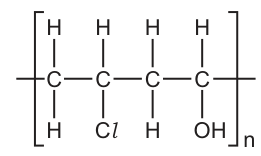
Three statements about this polymer are listed.
1 Its disposal is hazardous because it produces toxic gases when burned.
2 Two different monomers are used to make this polymer.
3 The monomer for this polymer is 3-chlorobut-2-ene-1-ol.
Which statements are correct?
Options
A 1 and 2
B 1 and 3
C 1 only
D 2 only
Working
Statement 1: The polymer repeat unit contains a chlorine atom () and a hydroxyl group (). Polymers containing chlorine (such as PVC or this copolymer) produce toxic gases, including hydrogen chloride () and potentially dioxins, when burned. Statement 1 is correct.
Statement 2: The repeat unit has a 4-carbon main chain: . Addition polymers from single alkenes have a 2-carbon repeat unit. A 4-carbon linear repeat unit indicates a copolymer made from two different 2-carbon monomers. Breaking the repeat unit in half gives:
- Monomer 1: (chloroethene)
- Monomer 2: (ethenol)
Two different monomers are used. Statement 2 is correct.
Statement 3: The monomer 3-chlorobut-2-ene-1-ol has the structure . If this underwent addition polymerisation via the bond, the repeat unit would be branched: . This does not match the given linear 4-carbon repeat unit. Statement 3 is incorrect.
Statements 1 and 2 are correct.
Answer
A
A
Background Concept
Addition Polymerisation and Repeat Units
In addition polymerisation, alkene monomers () open their double bonds to form long chains. A single alkene monomer (e.g., ethene, ) produces a repeat unit with a 2-carbon backbone: . When a polymer has a repeat unit with more than 2 carbons in the main chain (e.g., 4 carbons), it is almost always a copolymer formed from two different 2-carbon monomers. The repeat unit can be split in half to reveal the original monomers.
Polymer Disposal
Polymers containing heteroatoms like chlorine (e.g., PVC, poly(vinyl chloride)) or nitrogen (e.g., polyacrylonitrile) produce hazardous gases when incinerated. Chlorine-containing polymers release hydrogen chloride () gas and can form highly toxic dioxins and furans under incomplete combustion. Polymers with oxygen-containing groups (like alcohols) may produce carbon monoxide () and other toxic vapours.
Understanding the Question
The question provides the displayed structure of a polymer repeat unit: and asks to evaluate three statements about it. We must determine which statements are true based on polymer chemistry principles: disposal hazards, monomer identification, and structural deduction.
Approach
- Evaluate Statement 1: Look at the atoms in the repeat unit. The presence of chlorine () is the key indicator for toxic gas production on burning.
- Evaluate Statement 2: Count the carbon atoms in the main chain of the repeat unit. A 4-carbon chain in an addition polymer implies two 2-carbon monomers (a copolymer). Split the repeat unit to verify.
- Evaluate Statement 3: Draw the structure of 3-chlorobut-2-ene-1-ol and predict its polymer repeat unit. Compare it with the given structure. If they differ, the statement is false.
Step-by-Step Reasoning
Statement 1: Disposal hazards
The repeat unit is . It contains a chlorine atom bonded to the carbon chain. When chlorine-containing polymers are burned, the bonds break, producing hydrogen chloride () gas, which is toxic and corrosive. Under certain conditions, chlorinated organic polymers can also form dioxins, which are highly toxic and persistent environmental pollutants. Therefore, statement 1 is correct.
Statement 2: Number of monomers
The repeat unit has 4 carbon atoms in the continuous backbone: . In addition polymerisation, each monomer contributes 2 carbons to the backbone. A 4-carbon repeat unit means the polymer is made from two different monomers (a copolymer). We can deduce them by splitting the repeat unit in the middle:
- Left half: monomer is (chloroethene or vinyl chloride).
- Right half: monomer is (ethenol or vinyl alcohol).
Since two distinct monomers are required, statement 2 is correct.
Statement 3: Monomer identity
The proposed monomer is 3-chlorobut-2-ene-1-ol. Let's draw its structure:
Numbering from the alcohol end: .
If this undergoes addition polymerisation via the double bond, the repeat unit would have a 2-carbon backbone with branches:
This is a branched polymer with a methyl group () on one carbon and a hydroxymethyl group () on the other. This does not match the given linear 4-carbon backbone repeat unit . Therefore, statement 3 is incorrect.
Conclusion: Statements 1 and 2 are correct, which corresponds to option A.
Key Takeaways
- Copolymers: A repeat unit with a 4-carbon (or longer) main chain in an addition polymer indicates a copolymer made from two different 2-carbon monomers. Split the repeat unit in half to identify them.
- Polymer disposal: Polymers containing halogens (especially chlorine) produce toxic gases (e.g., , dioxins) when burned, making incineration hazardous without specialized scrubbing equipment.
- Monomer deduction: Always check the backbone length and branching. A single monomer with a bond will produce a repeat unit where only the two carbons of the double bond are in the main chain; all other carbons from that monomer become branches.
Common Mistakes
- Misidentifying the monomer: Assuming a 4-carbon repeat unit comes from a single 4-carbon monomer. Students often draw the monomer as a straight chain (e.g., ) and forget that polymerisation only opens the double bond, leaving the rest of the chain as branches. The given repeat unit is linear, so it must be a copolymer.
- Ignoring the chlorine hazard: Forgetting that chlorine-containing polymers (like PVC) are hazardous to burn due to and dioxin formation. Students may focus only on the organic structure and miss the environmental chemistry aspect.
- Confusing structural isomers: Drawing 3-chlorobut-2-ene-1-ol incorrectly (e.g., putting the chlorine on the wrong carbon) and then incorrectly predicting a linear repeat unit. The correct structure clearly shows a methyl branch that would appear in the polymer.
Things to Be Careful About
- Repeat unit splitting: When splitting a repeat unit to find monomers, ensure the split is between two carbon atoms that were originally double-bonded. For , the split is between C2 and C3: and . Replacing the single bond at the split with a double bond gives the monomers.
- State symbols and formulae: When writing monomer structures, ensure the double bond is correctly placed. is ethenol (though it tautomerises to acetaldehyde, in polymer contexts it's treated as the monomer unit for polyvinyl alcohol derivatives).
- Option matching: The question asks "Which statements are correct?" and the options combine them. Always verify each statement independently before selecting the option. Here, 1 and 2 are true, 3 is false, so "1 and 2" (Option A) is the correct choice.
Methanoic acid, , has acidic properties similar to those of other carboxylic acids. In addition, it can be oxidised by the same oxidising agents that are capable of oxidising aldehydes.
Which pair consists of two compounds that will give the same observations with Fehling’s reagent?
Options
A and
B and
C and
D and
Working
Fehling's reagent is a test for aldehydes: it gives a brick-red precipitate of with aldehydes, which are oxidised to carboxylic acids.
Methanoic acid, , contains a group, so it is oxidised by Fehling's reagent and gives the brick-red precipitate.
For the pair to give the same observations, the second compound must also be an aldehyde.
- A: is a carboxylic acid — no reaction with Fehling's.
- B: is an ester — no reaction.
- C: is a ketone — no reaction.
- D: is an aldehyde — gives the same brick-red precipitate.
Answer
D
D
Background Concept
Fehling's reagent is a mild oxidising agent used to distinguish aldehydes from ketones. It is a deep-blue alkaline solution containing complexed with tartrate ions. Aldehydes are easily oxidised to carboxylic acids, reducing to , which precipitates as brick-red . Ketones are not oxidised under these mild conditions, so no change is observed.
Methanoic acid, , is unusual among carboxylic acids: its carbon is bonded to a hydrogen atom as well as the group, so it contains a (formyl) unit — the same functional group as an aldehyde. Consequently it can be oxidised further to carbon dioxide and water by the same oxidising agents that oxidise aldehydes, including Fehling's reagent.
Understanding the Question
The question asks which pair of compounds will give the same observations with Fehling's reagent. Methanoic acid gives a positive Fehling's test (brick-red precipitate) because of its aldehyde-like group. We must therefore find the compound that also gives a positive test — i.e., an aldehyde.
Approach
- Recall that Fehling's reagent tests for aldehydes (brick-red precipitate).
- Recognise that methanoic acid behaves like an aldehyde because it contains a group.
- Identify the functional group of each second compound in the options.
- Select the pair where both compounds give the same (positive) observation.
Step-by-Step Reasoning
- Methanoic acid, , has the structure . The carbon bears one hydrogen and one group, so the molecule contains a unit. Fehling's reagent oxidises this group, giving a brick-red precipitate of .
- Option A: (ethanoic acid) is a carboxylic acid with no group — it is not oxidised by Fehling's reagent. Different observation.
- Option B: (methyl ethanoate) is an ester — no reaction with Fehling's. Different observation.
- Option C: (butanone) is a ketone — no reaction with Fehling's. Different observation.
- Option D: (propanal) is an aldehyde — oxidised by Fehling's to propanoic acid, giving the same brick-red precipitate as methanoic acid. Same observation.
Therefore the correct answer is D.
Key Takeaways
- Fehling's reagent is a specific test for aldehydes: a brick-red precipitate of confirms an aldehyde.
- Methanoic acid is the exception among carboxylic acids: it contains a group and is oxidised by Fehling's (and Tollens') reagent.
- Ketones and ordinary carboxylic acids do not react with Fehling's reagent.
Common Mistakes
- Assuming all carboxylic acids behave identically — methanoic acid is special because of its formyl hydrogen.
- Confusing Fehling's reagent with 2,4-dinitrophenylhydrazine (2,4-DNPH), which tests for any carbonyl group, not just aldehydes.
- Forgetting that ketones are not oxidised by Fehling's reagent.
Things to Be Careful About
- The structure of methanoic acid: it is , not .
- Fehling's reagent distinguishes aldehydes from ketones; it does not react with all carbonyl compounds.
- The observation is a brick-red precipitate of — a colour change alone is not the full answer.
- Note the question asks for the pair that gives the same observations — both must be positive (or both negative).
Which row gives pentanenitrile as one product?
Options
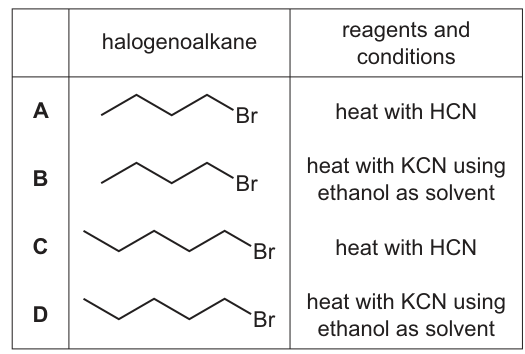
Working
Pentanenitrile has 5 carbon atoms (). The nucleophilic substitution reaction with cyanide ions adds one carbon atom to the halogenoalkane chain. Therefore, the starting halogenoalkane must have 4 carbon atoms (1-bromobutane).
The correct reagent for this nucleophilic substitution is potassium cyanide () dissolved in ethanol, which provides the nucleophilic ions. Hydrogen cyanide () is a weak acid and does not provide a sufficient concentration of ions for this reaction.
Row B uses 1-bromobutane (4 carbons) and in ethanol, producing pentanenitrile (5 carbons).
Answer
B
B
Background Concept
Nucleophilic substitution in halogenoalkanes: Halogenoalkanes can undergo nucleophilic substitution reactions where a nucleophile replaces the halogen atom. Cyanide ions () act as nucleophiles, attacking the electron-deficient carbon atom bonded to the halogen. This reaction is typically carried out by heating the halogenoalkane with potassium cyanide () in an ethanol/water mixture (ethanol is used as a solvent to dissolve both the organic halogenoalkane and the ionic ). The reaction increases the carbon chain length by one atom, forming a nitrile.
Understanding the Question
The question asks to identify the correct combination of halogenoalkane and reagents/conditions that will produce pentanenitrile as one of the products. We are given four options (A, B, C, D) with different halogenoalkanes (1-bromobutane or 1-bromopentane) and different reagents/conditions (heat with or heat with in ethanol). We need to deduce which combination yields a 5-carbon nitrile using the correct reagent.
Approach
- Determine the number of carbon atoms in the target product, pentanenitrile.
- Recognize that cyanide substitution adds one carbon atom to the original halogenoalkane chain, so deduce the required number of carbons in the starting halogenoalkane.
- Identify the correct reagent and solvent for nucleophilic substitution with cyanide ( in ethanol, not ).
- Match these requirements to the given options.
Step-by-Step Reasoning
- Target molecule analysis: Pentanenitrile has the formula . The prefix "pent-" indicates 5 carbon atoms in total, including the carbon in the nitrile group ().
- Chain length change: When a halogenoalkane reacts with a cyanide nucleophile, the group replaces the halogen. This adds exactly one carbon atom to the carbon skeleton. To obtain a 5-carbon nitrile (pentanenitrile), the starting halogenoalkane must have carbon atoms. This corresponds to 1-bromobutane (). This eliminates options C and D, which use 1-bromopentane (5 carbons, which would yield hexanenitrile, a 6-carbon nitrile).
- Reagent selection: The nucleophile required is the cyanide ion, . Potassium cyanide () is an ionic compound that dissociates in solution to provide and ions, making it a good source of the nucleophile. Hydrogen cyanide () is a weak covalent acid that only partially ionises, providing a very low concentration of ions. It is not suitable as a reagent for this nucleophilic substitution. Furthermore, is extremely toxic and not used in standard laboratory preparations of nitriles. Thus, the reagent must be . This eliminates options A and C.
- Solvent: Ethanol is used as a solvent because it can dissolve both the organic halogenoalkane (which is non-polar) and the ionic (which is polar), allowing the reaction to proceed. Heating is required to provide the activation energy for the reaction.
- Conclusion: Option B correctly uses 1-bromobutane (4 carbons) and in ethanol as the solvent. The reaction is: The organic product is pentanenitrile.
Key Takeaways
- Nucleophilic substitution with cyanide ions () extends the carbon chain of a halogenoalkane by one carbon atom.
- To synthesize a nitrile with carbon atoms, start with a halogenoalkane with carbon atoms.
- in ethanol is the correct reagent and solvent system; is not used because it is a weak acid and does not provide sufficient nucleophile concentration.
Common Mistakes
- Choosing instead of : Students often write in equations, but is a weak acid and does not provide the nucleophiles needed for the reaction. (or ) must be used.
- Miscounting carbon atoms: Forgetting that the nitrile carbon is part of the main chain. 1-bromobutane (4 carbons) + (1 carbon) = pentanenitrile (5 carbons). Using 1-bromopentane would give hexanenitrile (6 carbons).
- Ignoring the solvent: Ethanol is required to dissolve both the organic halogenoalkane and the ionic cyanide salt. Aqueous conditions might lead to competing hydrolysis to form an alcohol.
Things to Be Careful About
- Always count the carbon in the group when naming the nitrile product. Pentanenitrile has 5 carbons total, not 4.
- Reagents for nitrile synthesis must be ionic cyanide salts (, ) dissolved in ethanol, not hydrogen cyanide gas or aqueous .
- Conditions typically include heating under reflux to prevent the loss of volatile organic reactants and products.
An ester, , is hydrolysed in alkaline conditions. and are different alkyl groups.
Which row identifies the two products formed?
Options
| product 1 | product 2 | |
|---|---|---|
| A | ||
| B | ||
| C | ||
| D |
Working
An ester is hydrolysed by water, but in alkaline conditions the hydroxide ion acts as the nucleophile and cleaves the ester link:
The product on the acyl side is a carboxylate ion, not the free carboxylic acid, because the acid is neutralised by the alkali. The product on the alkoxy side is the alcohol.
Answer
B
B
Background Concept
An ester has the general structure , which can be written as . The ester link is the single bond between the acyl carbon and the alkoxy oxygen. Hydrolysis breaks this link using water.
The conditions of hydrolysis determine the form of the products:
- Acid-catalysed hydrolysis gives a carboxylic acid and an alcohol:
- Alkaline hydrolysis uses hydroxide ions. The hydroxide attacks the carbonyl carbon, and the ester link is broken to give a carboxylate ion and an alcohol:
The carboxylate ion is formed because the reaction mixture is basic: any carboxylic acid that might form is immediately neutralised by the excess alkali.
Understanding the Question
The question gives a generic ester , where and are different alkyl groups, and asks which row correctly identifies the two products of alkaline hydrolysis. The key is to notice the word “alkaline” and to know how that changes the product compared with acid hydrolysis.
This is a one-mark recall question, but it tests a common source of confusion: whether the product is the free carboxylic acid or its salt.
Approach
- Identify the two parts of the ester: the acyl part, , and the alkoxy part, .
- Recall that alkaline hydrolysis produces a carboxylate salt, not a free carboxylic acid.
- Recall that the alcohol is produced as the neutral alcohol, not as an alkoxide ion.
- Compare these products with the options and select the correct row.
Step-by-Step Reasoning
- The ester is , so the acyl group is and the alkoxy group is .
- In alkaline hydrolysis, hydroxide ion attacks the carbonyl carbon. A tetrahedral intermediate forms, then the bond to the alkoxy group breaks.
- The immediate organic products are a carboxylate ion, , and an alkoxide ion, .
- The alkoxide ion is strongly basic and immediately accepts a proton from water:
So the final product on the alkoxy side is the alcohol . - The carboxylate ion is stabilised by resonance and remains as in the basic solution. If any free acid were formed, it would react with :
- Therefore product 1 is and product 2 is .
Checking the options:
- A gives , which would be the acid-hydrolysis product, not the alkaline-hydrolysis product.
- B gives and , which matches the correct products.
- C gives and , both incorrect.
- D gives and , but the alkoxide is not the final product.
So the correct answer is B.
Key Takeaways
- Alkaline hydrolysis of an ester gives a carboxylate salt and an alcohol.
- Acid-catalysed hydrolysis of an ester gives a carboxylic acid and an alcohol.
- The identity of the alkyl groups ( and ) does not affect the type of products, only their specific structures.
- The basic conditions matter: any free acid is neutralised, and any alkoxide is protonated by water.
Common Mistakes
- Choosing A: This is the product set for acid hydrolysis, not alkaline hydrolysis. In alkaline conditions the carboxylic acid would be deprotonated.
- Choosing C or D: These include an alkoxide ion, , as a final product. Alkoxides are not stable in water and are protonated to the alcohol.
- Forgetting the charge: The carboxylate product carries a negative charge. Writing when the medium is alkaline loses the mark.
Things to Be Careful About
- Always read whether the conditions are acidic or alkaline before deciding on the product form.
- If a specific alkali such as is named, the carboxylate product is often written as the sodium salt, e.g. .
- Make sure any equation you write is balanced in both atoms and charge.
- The statement that and are different alkyl groups simply avoids any ambiguity about identical groups; it does not change the chemistry.
Which compound cannot be oxidised by acidified potassium dichromate(VI) solution but does react with sodium metal?
Options
A
B
C
D
Working
Acidified oxidises primary and secondary alcohols, but not tertiary alcohols or ketones.
Sodium metal reacts with any alcohol containing an group, releasing ; it does not react with a ketone.
- A : tertiary alcohol — not oxidised; has , so reacts with Na. ✔
- B : ketone — not oxidised; no , so does not react with Na. ✘
- C : primary alcohol — oxidised. ✘
- D : secondary alcohol — oxidised. ✘
Answer
A
A
Background Concept
Acidified potassium dichromate(VI), , is a common oxidising agent for alcohols. Primary alcohols can be oxidised to aldehydes and then carboxylic acids; secondary alcohols are oxidised to ketones. Tertiary alcohols, in which the carbon bearing the group has no hydrogen atom attached, are not oxidised under these conditions. Ketones are also resistant to oxidation by dichromate.
Sodium metal reacts with compounds containing an group. For alcohols: . Ketones do not have an group, so they do not react with sodium metal in this way.
Understanding the Question
We need a compound that satisfies two conditions simultaneously: (1) it cannot be oxidised by acidified ; (2) it does react with sodium metal. The correct option must pass both tests.
Approach
First, classify each compound by functional group. Then apply the oxidation rule and the sodium test. Eliminate any option that fails either condition.
Step-by-Step Reasoning
- Option A: — This is a tertiary alcohol. The carbon attached to is bonded to three methyl groups and has no hydrogen. Therefore it cannot be oxidised by acidified dichromate. It still has an group, so it reacts with sodium to release hydrogen. This satisfies both conditions.
- Option B: — This is a ketone (butanone). Ketones are not oxidised by acidified dichromate under normal conditions, so it passes the first condition. However, it has no group, so it does not react with sodium metal. It fails the second condition.
- Option C: — This is a primary alcohol (butan-1-ol). It can be oxidised by acidified dichromate to butanal and then butanoic acid. It fails the first condition.
- Option D: — This is a secondary alcohol (butan-2-ol). It can be oxidised to butanone. It fails the first condition.
Only A meets both requirements.
Key Takeaways
- Acidified dichromate oxidises primary and secondary alcohols but not tertiary alcohols.
- The sodium test detects the presence of an group; alcohols produce hydrogen gas.
- A ketone is not oxidised by dichromate, but it also does not react with sodium because it lacks an group.
Common Mistakes
- Choosing B because it is not oxidised, while forgetting that it does not react with sodium.
- Thinking that all compounds containing oxygen react with sodium; only those with an group, such as alcohols, do.
Things to Be Careful About
- The oxidation of a primary alcohol can go further to a carboxylic acid, but the key point is that it is oxidised.
- Tertiary alcohols are resistant to oxidation because the carbon bearing has no hydrogen to remove.
- Always check both conditions in a two-part question.
Butan-2-one reacts with alkaline . An excess of dilute sulfuric acid is then added to the reaction mixture.
The organic products of this reaction sequence are triiodomethane and product M.
What is product M?
Options
A ethanoate ion
B ethanoic acid
C propanoate ion
D propanoic acid
Working
Butan-2-one is CHCOCHCH, a methyl ketone. In the iodoform (triiodomethane) reaction, the CHCO– group is cleaved to give CHI. The remaining R group (CHCH–) becomes the carboxylate. Under alkaline conditions the product is the propanoate ion, CHCHCOO. Adding excess dilute HSO protonates this to propanoic acid, CHCHCOOH.
Answer
D (propanoic acid)
D
Background Concept
The iodoform (haloform) reaction is a characteristic reaction of methyl ketones, R–CO–CH. When heated with alkaline iodine (I in NaOH), the CHCO– group is oxidised and cleaved to give triiodomethane (CHI), a yellow solid with a distinctive smell, and a carboxylate ion RCOO. The reaction also works for secondary alcohols of the type CHCH(OH)–R, which are first oxidised to the corresponding methyl ketone.
Understanding the Question
Butan-2-one, CHCOCHCH, is a methyl ketone because it contains the CHCO– group. The sequence described is: (1) reaction with alkaline I(aq), which triggers the iodoform reaction; (2) addition of excess dilute HSO, which protonates any carboxylate ion formed. The question asks for the identity of product M after the whole sequence, so we must account for both steps.
Approach
- Identify the CHCO– group in butan-2-one.
- Recall the general equation for the iodoform reaction: R–CO–CH + 3I + 4OH → RCOO + CHI + 3I + 3HO.
- Determine R: in butan-2-one, R = CHCH– (ethyl).
- Recognise that the carboxylate is propanoate, CHCHCOO.
- Apply the acidification step: carboxylate + H → carboxylic acid, so propanoic acid, CHCHCOOH.
Step-by-Step Reasoning
- Structure of butan-2-one: CH–CO–CH–CH.
- The CHCO– fragment is converted to CHI (triiodomethane).
- The rest of the molecule (CHCH–) attaches to the carbon that becomes the carboxylate: CHCHCOO (propanoate ion).
- Under alkaline conditions, the counter-ion is Na (from NaOH), so sodium propanoate is present.
- Adding excess dilute HSO protonates the propanoate ion to propanoic acid, CHCHCOOH.
- Therefore, product M is propanoic acid.
Key Takeaways
- The iodoform reaction is a reliable test for the CHCO– group (methyl ketones) and for secondary alcohols with the CHCH(OH)– group.
- The R group in the methyl ketone determines the length of the carboxylic acid chain formed.
- Acidification is a standard workup to convert carboxylate salts into the corresponding carboxylic acids.
Common Mistakes
- Choosing propanoate ion (option C) instead of propanoic acid (option D): forgetting that the acid is added to protonate the carboxylate.
- Confusing the carbon count: butan-2-one has 4 carbons; CHI removes 1, leaving 3 carbons for the acid (propanoic).
- Thinking ethanoic acid (option B) is formed by miscounting or confusing with the iodoform test on ethanol/acetaldehyde.
Things to Be Careful About
- Always read whether the question asks for the product before or after acidification.
- Count the carbon atoms in the R group carefully.
- Remember the iodoform test gives a yellow precipitate of CHI, which is the observable sign of a positive test.
Four reagents are listed.
1 aqueous
2 dilute
3 liquid
4 solid
Which reagents, when added to ethanol, will rapidly produce a gas that turns blue litmus red?
Options
A 1 and 2
B 1 and 3
C 2 and 4
D 3 and 4
Working
Ethanol reacts with liquid and solid to form chloroethane and acidic gases:
and are acidic gases and turn blue litmus red. Aqueous does not react with ethanol, and dilute does not rapidly produce an acidic gas.
Answer
D (reagents 3 and 4)
D
Background Concept
Alcohols can be converted into halogenoalkanes by replacing the OH group with a halogen. Common reagents for converting an alcohol into a chloroalkane include , and . These reactions are useful because they also produce acidic gases, often , which can be detected by their effect on damp blue litmus paper: an acidic gas turns blue litmus red.
For ethanol, the reactions are:
Both and are acidic gases, so either reaction produces a gas that turns blue litmus red.
Understanding the Question
The question lists four reagents and asks which two, when added to ethanol, will rapidly produce a gas that turns blue litmus red. The key clue is the gas test: blue litmus turning red indicates an acidic gas. We must therefore decide which reagents react with ethanol to give an acidic gas such as or .
Approach
Evaluate each reagent in turn:
- Does it react with ethanol?
- If it does, is an acidic gas produced?
- Is the reaction rapid under the stated conditions?
Aqueous and dilute can be eliminated quickly because neither rapidly produces an acidic gas from ethanol. and are both standard reagents for converting alcohols to chloroalkanes and both produce gas.
Step-by-Step Reasoning
-
Reagent 1: aqueous
Potassium chloride is an ionic salt dissolved in water. It provides and ions, but these do not react with ethanol under normal conditions. No gas is produced, so reagent 1 is not selected. -
Reagent 2: dilute
Dilute hydrochloric acid is an aqueous solution of . Although ethanol can be protonated by strong acid, dilute does not rapidly convert ethanol into chloroethane with evolution of gas. The conversion of an alcohol to a chloroalkane using normally requires concentrated and a catalyst such as . Reagent 2 is therefore not selected. -
Reagent 3: liquid
Thionyl chloride reacts readily with ethanol:Both and are acidic gases, so blue litmus turns red. Reagent 3 is selected.
-
Reagent 4: solid
Phosphorus(V) chloride also reacts readily with ethanol:The gas produced is acidic and turns blue litmus red. Reagent 4 is selected.
Therefore the correct pair is reagents 3 and 4, which corresponds to option D.
Key Takeaways
- , and convert alcohols into chloroalkanes.
- These reactions often produce acidic gases such as and .
- An acidic gas can be identified by turning damp blue litmus paper red.
- Aqueous chloride salts and dilute do not rapidly produce gas from ethanol.
Common Mistakes
- Choosing dilute because it contains chloride ions: dilute does not rapidly convert ethanol to chloroethane with gas evolution.
- Thinking aqueous can act as a chlorinating agent: the chloride ion in aqueous solution is not reactive enough.
- Forgetting that is also an acidic gas; even if were missed, the reaction with still produces an acidic gas.
- Confusing the gas test: it is the gas produced, not the reagent itself, that must turn blue litmus red.
Things to Be Careful About
- Write balanced equations with correct formulae: , , , , , and .
- Use state symbols where required: liquid , solid , and gases such as and .
- The question says "rapidly"; this excludes slow or equilibrium processes such as ethanol with dilute .
- In an exam, the gas test wording "turns blue litmus red" is the standard test for an acidic gas.
Four drops of 1-chlorobutane, 1-bromobutane and 1-iodobutane are put separately into three test-tubes containing of aqueous silver nitrate at . In each case, a hydrolysis reaction occurs.
represents and represents the halogen atom.
The rate of formation of cloudiness in the test-tubes is in the order .
Why is this?
Options
A The bond energy of R–X decreases from to .
B The first ionisation energy of the halogen decreases from to .
C The solubility of decreases from to .
D The R–X bond polarity decreases from to .
Working
The hydrolysis is a nucleophilic substitution in which the C–X bond must break. The rate of cloudiness reflects how quickly X⁻ is released and precipitated as AgX.
Down Group 17, the C–X bond energy decreases:
A weaker C–I bond breaks more readily, so RI hydrolyses fastest, then RBr, then RCl.
Answer
A (The bond energy of R–X decreases from RCl to RI.)
A
Background Concept
Halogenoalkanes undergo nucleophilic substitution with water (hydrolysis). In the silver nitrate test, Ag⁺(aq) acts as a trap: as soon as a halide ion X⁻ is released from the halogenoalkane, it precipitates as insoluble silver halide, AgX. The cloudiness therefore appears at a rate that mirrors the rate of the hydrolysis reaction.
The rate-determining step of this hydrolysis involves breaking the C–X bond. So the factor that controls the rate is how easy it is to break that bond — i.e. the C–X bond dissociation energy.
Understanding the Question
The question states the observed rate order:
and asks you to pick the reason. You need to identify which physical property actually governs the rate of this reaction.
Approach
Ask: what must happen for the reaction to proceed, and which property changes in the same direction as the observed rate? The C–X bond must break, so compare C–X bond energies down the group. Then check each option to see whether it is chemically relevant to the rate.
Step-by-Step Reasoning
- The hydrolysis is a nucleophilic substitution. The slow (rate-determining) step is the breaking of the C–X bond.
- Down Group 17, the C–X bond energy decreases: C–Cl ≈ 346 kJ mol⁻¹, C–Br ≈ 290 kJ mol⁻¹, C–I ≈ 228 kJ mol⁻¹.
- A weaker bond breaks more easily, so the reaction is faster. This matches RCl < RBr < RI exactly.
- Therefore option A is correct.
- Option B (first ionisation energy) is irrelevant — ionisation energy describes removing an electron from a gaseous atom, not breaking a covalent bond in a molecule.
- Option C (solubility of AgX) is about the extent of precipitation at equilibrium, not the rate at which the precipitate forms. Also, AgCl is actually the most soluble of the three silver halides, yet RCl reacts slowest — the trend contradicts the observation.
- Option D (bond polarity) is tempting but wrong: decreasing polarity would make the carbon less δ⁺ and less attractive to the nucleophile, which would slow RI down — the opposite of what is observed. The rate is governed by bond strength, not polarity.
Key Takeaways
The rate of hydrolysis of halogenoalkanes down Group 17 is controlled by the C–X bond energy. Weaker bonds (C–I) break faster. This is a classic example of how bond strength, not electronegativity or ionisation energy, determines reactivity in this context.
Common Mistakes
- Choosing D (bond polarity) because it feels chemically intuitive. Remember: the rate-determining step is bond breaking, so bond strength wins.
- Choosing C (AgX solubility) — confusing the rate of precipitation with the equilibrium solubility of the product.
- Choosing B (ionisation energy) — applying a concept about isolated atoms to a covalent bond in a molecule.
Things to Be Careful About
- Distinguish kinetics (how fast, governed by bond breaking) from thermodynamics/equilibrium (how much, governed by solubility).
- Remember the correct trend: C–X bond energy decreases down the group, so reactivity of halogenoalkanes in nucleophilic substitution increases from Cl to I.
Propanoic acid reacts with to give organic product P.
Methanoic acid reacts with organic product P, in the presence of a few drops of concentrated sulfuric acid, to give organic product Q.
What are the skeletal formulae of the two organic products?
Options
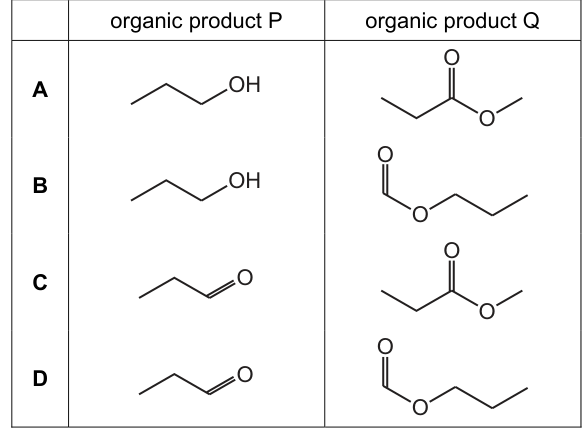
Working
Step 1: Identify organic product P
Propanoic acid () reacts with lithium tetrahydridoaluminate (). is a strong reducing agent that reduces carboxylic acids fully to primary alcohols.
Product P is propan-1-ol. This eliminates options C and D, which show propanal (an aldehyde). does not stop at the aldehyde stage under standard conditions.
Step 2: Identify organic product Q
Methanoic acid () reacts with propan-1-ol (product P) in the presence of concentrated sulfuric acid. This is a Fischer esterification reaction, producing an ester and water.
The ester formed is propyl methanoate. The alkyl group (propyl) comes from the alcohol, and the alkanoate group (methanoate) comes from the carboxylic acid.
Step 3: Match with options
- Product P: propan-1-ol (skeletal formula with 3-carbon chain and terminal -OH)
- Product Q: propyl methanoate (skeletal formula with group attached to a 3-carbon chain)
This corresponds to row B.
Answer
B
B
Background Concept
Reduction of Carboxylic Acids
Carboxylic acids can be reduced to primary alcohols using strong reducing agents. Lithium tetrahydridoaluminate () is a powerful reducing agent capable of reducing carboxylic acids, aldehydes, and ketones. Unlike milder reducing agents or specific controlled reductions (e.g., DIBAL-H at low temperatures which can stop at the aldehyde), in dry ether followed by aqueous acid workup reduces carboxylic acids all the way to primary alcohols. The reaction involves the addition of hydride ions () to the carbonyl carbon.
Esterification (Fischer Esterification)
When a carboxylic acid reacts with an alcohol in the presence of an acid catalyst (typically concentrated ), an ester and water are formed. This is a condensation reaction. The naming of the resulting ester follows the pattern: [alkyl group from alcohol] [alkanoate group from acid]. For example, methanoic acid + ethanol gives ethyl methanoate.
Understanding the Question
The question presents a two-step organic synthesis sequence:
- Propanoic acid is treated with to yield product P.
- Methanoic acid is then reacted with product P (using concentrated ) to yield product Q.
We are asked to identify the skeletal formulae of P and Q from four options (A, B, C, D). The key is to correctly predict the product of each reaction step.
Approach
- Analyze the first reaction: Determine what does to a carboxylic acid. Recall that it is a strong reducing agent that produces primary alcohols, not aldehydes. This will identify P and eliminate incorrect options.
- Analyze the second reaction: Recognize the reagents (carboxylic acid + alcohol + acid catalyst) as conditions for esterification. Determine the structure of the ester formed from methanoic acid and the alcohol identified in step 1.
- Compare: Match the predicted structures of P and Q with the given skeletal formulae options.
Step-by-Step Reasoning
Step 1: Reaction of propanoic acid with
- Reactant: Propanoic acid ()
- Reagent: (lithium tetrahydridoaluminate)
- Reaction type: Reduction
- reduces the carboxyl group () to a primary alcohol group ().
- Product P: Propan-1-ol ()
- Note: If the product were an aldehyde (propanal), it would be incorrect because is too strong and reduces carboxylic acids directly to alcohols. This eliminates options C and D, which show P as propanal (a carbonyl group at the end of the chain).
Step 2: Reaction of methanoic acid with product P (propan-1-ol)
- Reactants: Methanoic acid () and propan-1-ol ()
- Catalyst: Concentrated
- Reaction type: Esterification (condensation)
- The from the carboxylic acid and the from the alcohol's hydroxyl group are removed to form water. The remaining fragments join to form an ester linkage ().
- Methanoic acid provides the methanoate part:
- Propan-1-ol provides the propyl part:
- Product Q: Propyl methanoate ()
- Note: Option A shows propyl ethanoate (), which would require ethanoic acid, not methanoic acid. This eliminates option A.
Step 3: Matching skeletal formulae
- Option B shows P as propan-1-ol (a 3-carbon chain with an -OH group at the end) and Q as propyl methanoate (a group attached to a 3-carbon propyl chain). This matches our deductions perfectly.
Key Takeaways
- is a strong reducing agent that reduces carboxylic acids to primary alcohols. It does not stop at the aldehyde stage under standard conditions.
- Esterification combines a carboxylic acid and an alcohol. The name of the ester is [alkyl from alcohol] [alkanoate from acid].
- Skeletal formulae must be read carefully: the number of carbons in the chain and the position of functional groups (especially the H on a methanoate group) are critical for distinguishing between similar esters.
Common Mistakes
- Stopping at the aldehyde: Assuming reduces carboxylic acids only to aldehydes. This is a common confusion with reagents like DIBAL-H (diisobutylaluminium hydride) at low temperatures, or confusing it with the reduction of acyl chlorides. goes all the way to the alcohol.
- Reversing ester naming: Writing "methyl propanoate" instead of "propyl methanoate". Remember: the alkyl group (first word) comes from the alcohol, and the alkanoate group (second word, ending in -oate) comes from the carboxylic acid.
- Misreading skeletal formulae: Failing to notice that propyl methanoate has a hydrogen atom attached directly to the carbonyl carbon (), whereas ethanoate has a methyl group (). In skeletal structures, the H on a methanoate group is sometimes drawn explicitly or implied by the lack of a carbon chain at that end.
Things to Be Careful About
- Reagent strength: Always check the reducing agent. is mild and does not reduce carboxylic acids. is strong and does. Both reduce aldehydes/ketones to alcohols.
- Ester structure: The ester linkage is . In methanoate esters, the carbonyl carbon is bonded to a hydrogen, not a carbon chain. Ensure the skeletal formula reflects this (e.g., rather than ).
- State symbols and conditions: While not explicitly asked for here, noting that esterification requires an acid catalyst and is reversible (equilibrium) is good practice for understanding the full context.
Samples of the gases and are mixed together and irradiated with ultraviolet light.
Which compound is produced by a termination step in the reaction?
Options
A
B
C
D
Working
Initiation:
Propagation:
Termination (two radicals combine):
Answer
C —
C
Background Concept
Free-radical substitution occurs when alkanes, or halogenoalkanes such as chloromethane, react with halogens under ultraviolet light. The mechanism has three stages:
- Initiation: homolytic fission of the halogen molecule produces halogen radicals.
- Propagation: two steps that each consume a radical and regenerate a radical, so the chain continues.
- Termination: two radicals combine to form a stable molecule with no unpaired electrons.
Understanding the Question
The question mixes and and irradiates them with UV light. It asks which compound is produced specifically by a termination step. We need to distinguish termination products from products formed in initiation or propagation.
Approach
Write out the radical mechanism for the reaction. Identify the radicals present: and . In a termination step, two radicals combine. Then check which of the four options could be formed by such a combination.
Step-by-Step Reasoning
-
Initiation:
-
Propagation:
-
Termination: any two radicals combine:
-
Among the options, only (1,2-dichloroethane) is a termination product. is formed in a propagation step, is not formed in this mechanism, and would require an elimination reaction, not radical combination.
Key Takeaways
- A termination step always involves two radicals combining.
- The product of termination is a stable molecule with all electrons paired.
- In this reaction, possible termination products include , , and .
Common Mistakes
- Choosing because it appears in the mechanism. is produced in a propagation step, not a termination step.
- Choosing because two hydrogen atoms might combine. Hydrogen radicals are not significant intermediates here; the radicals are and .
- Thinking that could form. That would require elimination, which is not part of this free-radical substitution mechanism.
Things to Be Careful About
- Remember that termination requires two radicals to combine. A product formed from one radical and a molecule is usually a propagation product.
- The product is the same as , i.e. 1,2-dichloroethane.
- Always check that the final product has no unpaired electrons, because radicals are highly reactive and termination removes them.
Propan-1-ol, , is dehydrated by passing its vapour over hot aluminium oxide to give a hydrocarbon.
Which structural formula represents the product obtained when the hydrocarbon reacts with bromine?
Options
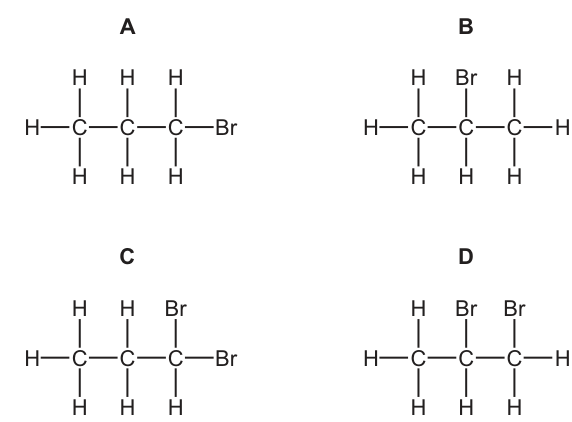
Working
Step 1: Dehydration of propan-1-ol
Propan-1-ol () is dehydrated by passing its vapour over hot aluminium oxide (). This is an elimination reaction that removes a molecule of water to form an alkene:
The hydrocarbon product is propene ().
Step 2: Reaction of propene with bromine
Propene undergoes electrophilic addition with bromine (). The bond in the double bond breaks, and one bromine atom adds to each of the two carbon atoms that were double-bonded:
The product is 1,2-dibromopropane.
In displayed structural formula form, this is:
This matches option D.
Answer
D
D
Background Concept
Dehydration of alcohols: When an alcohol is passed over a hot catalyst such as aluminium oxide () or concentrated sulfuric acid (), it undergoes an elimination reaction. A molecule of water () is removed — specifically, an group from one carbon and an atom from an adjacent carbon — forming a carbon-carbon double bond (). The product is an alkene.
For propan-1-ol (), the only adjacent carbon to the -bearing carbon (C1) is C2. Removing from C2 and from C1 gives propene (). There is no other possible alkene product from propan-1-ol under these conditions.
Electrophilic addition to alkenes: The double bond consists of one bond and one bond. The electrons are exposed above and below the plane of the molecule, making them accessible to electrophiles. When bromine () approaches, the electrons polarise the bond, inducing a dipole (). The electrophilic is attacked by the electrons, forming a bromonium ion intermediate. The ion then attacks from the opposite side, opening the ring. The net result is that one atom adds to each carbon of the original double bond, giving a vicinal dibromoalkane (1,2-dibromide).
Understanding the Question
The question describes a two-stage process:
- Propan-1-ol vapour is passed over hot aluminium oxide → dehydration → hydrocarbon (alkene).
- That hydrocarbon reacts with bromine → electrophilic addition → product.
We are given four displayed structural formulae (A, B, C, D) and asked which one represents the final product. We must deduce the alkene first, then predict the addition product.
Approach
- Step 1: Apply the dehydration reaction to propan-1-ol to identify the alkene formed (propene).
- Step 2: Apply electrophilic addition of to propene. The two bromine atoms add across the double bond, one to each carbon of the .
- Step 3: Match the resulting structure (1,2-dibromopropane) to the given options.
Step-by-Step Reasoning
Step 1: Dehydration
Propan-1-ol has the structure . The group is on carbon 1. Elimination removes from C1 and from C2, forming a double bond between C1 and C2:
The hydrocarbon is propene ().
Step 2: Electrophilic addition of bromine
Propene has a double bond between C1 and C2. Bromine () adds across this double bond. Each carbon of the double bond receives one bromine atom:
The product is 1,2-dibromopropane.
Step 3: Matching to options
- Option A shows 1-bromopropane () — only one Br atom. This would result from free-radical substitution or addition of HBr, not addition of . ❌
- Option B shows 2-bromopropane () — only one Br atom, on the middle carbon. This is the product of Markovnikov addition of HBr to propene, not . ❌
- Option C shows 1,1-dibromopropane () — two Br atoms on the same carbon. This is not the product of simple electrophilic addition of to propene. ❌
- Option D shows 1,2-dibromopropane () — one Br on each carbon of the original double bond. ✅
The correct answer is D.
Key Takeaways
- Dehydration of a primary alcohol over hot produces an alkene by elimination of water.
- Electrophilic addition of to an alkene gives a 1,2-dibromoalkane (vicinal dibromide), with one Br on each carbon of the former double bond.
- The bromine test for unsaturation (decolourisation of bromine water or bromine in ) relies on this addition reaction.
Common Mistakes
- Confusing addition with HBr addition: Adding HBr to propene gives 2-bromopropane (Markovnikov product, option B). Adding gives 1,2-dibromopropane (option D). The question specifies bromine (), not hydrogen bromide.
- Forgetting that both carbons of the double bond get a bromine atom: Options A and B show only one Br atom, which would require a substitution reaction or addition of HBr, not .
- Placing both Br atoms on the same carbon: Option C (1,1-dibromopropane) is not formed by simple electrophilic addition of to propene.
- Misidentifying the dehydration product: Propan-1-ol gives propene, not propanone (which would require oxidation, not dehydration).
Things to Be Careful About
- Always read the reagent carefully: (bromine) adds two Br atoms across a double bond; HBr (hydrogen bromide) adds one H and one Br.
- In displayed structural formulae, ensure all atoms and bonds are shown correctly. Count the hydrogens and bromines to verify the molecular formula matches the expected product ( for 1,2-dibromopropane).
- Dehydration over is an elimination (not a substitution or oxidation), so the product is an alkene, not a carbonyl compound.
Alkane S has molecular formula .
S reacts with in the presence of sunlight to produce only two different monochloroalkanes, . Both of these monochloroalkanes are treated with hot ethanolic . They both produce the same alkene T, and no other organic products.
What is produced when T is treated with hot concentrated acidified ?
Options
A and
B and
C and
D only
Working
Alkane S must be 2-methylpropane, since its two monochloroalkanes are and . Both eliminate HCl with hot ethanolic KOH to give the same alkene T, (2-methylprop-1-ene).
Hot concentrated acidified cleaves the bond oxidatively. The terminal carbon gives ; the carbon gives propanone, .
Answer
B
B
Background Concept
An alkane such as can undergo free-radical substitution with chlorine in sunlight. Each different type of hydrogen atom in the molecule gives a different monochloroalkane, so counting the number of possible monochloro products tells you how many distinct hydrogen environments the alkane has.
There are two structural isomers of : butane, , and 2-methylpropane, . Both have two types of hydrogen atom, so both give two monochloroalkanes. The extra clue in the question is that the two monochloroalkanes must eliminate to the same alkene.
Hot ethanolic KOH causes elimination (dehydrohalogenation) of a halogenoalkane: a molecule of HX is removed and a C=C bond is formed. Hot concentrated acidified is a powerful oxidising agent that cleaves the C=C bond completely. The products depend on the substitution of the alkene: a terminal group is oxidised to , an group to a carboxylic acid, and an group to a ketone.
Understanding the Question
We are told S is an alkane of formula , that its chlorination gives exactly two different monochloroalkanes, and that both of those, on elimination, give the same alkene T with no other organic products. The question then asks for the products when T is oxidised by hot concentrated acidified . The task is therefore to identify T, then apply the oxidative cleavage rules.
Approach
- List the possible isomers of and their hydrogen environments.
- Decide which isomer's two monochloro derivatives both eliminate to a single alkene.
- Draw T and classify the two alkene carbons.
- Apply the oxidative cleavage rule to determine the products and select the option.
Step-by-Step Reasoning
Butane has two types of hydrogen: the six hydrogens on the two end groups and the four hydrogens on the two groups. Its monochloro derivatives are 1-chlorobutane and 2-chlorobutane. 1-Chlorobutane eliminates to but-1-ene. 2-Chlorobutane can eliminate to but-2-ene, but it can also eliminate to but-1-ene by removing a different -hydrogen. Since the question says both monochloroalkanes give the same alkene and no other organic products, butane cannot be S.
2-Methylpropane, , has nine equivalent hydrogens on the three methyl groups and one unique hydrogen on the central carbon. Its two monochloroalkanes are:
- (1-chloro-2-methylpropane)
- (2-chloro-2-methylpropane)
Elimination of HCl from either gives the same alkene, 2-methylprop-1-ene:
From the first, HCl is removed from the carbon and the adjacent carbon; from the second, HCl is removed from the central carbon and any one of the methyl groups. Thus T is 2-methylprop-1-ene.
Now oxidise T. The double bond has one carbon that is (terminal) and one carbon that is (no hydrogen). Hot concentrated acidified cleaves the C=C bond:
- , propanone
So the products are and , which is option B.
Why the other options are wrong: A would be the cleavage products of but-1-ene, not of T. D would be the product from an internal symmetrical alkene such as but-2-ene, which gives two molecules of ethanoic acid. C does not correspond to the cleavage of 2-methylprop-1-ene.
Key Takeaways
- The number of different monohalogenated products from an alkane equals the number of different types of hydrogen atom.
- Hot ethanolic KOH converts halogenoalkanes to alkenes by elimination.
- Hot concentrated acidified cleaves alkenes: gives a carboxylic acid and ; gives a ketone and ; gives two carboxylic acids.
- A ketone is not further oxidised by hot acidified under these conditions.
Common Mistakes
- Assuming S is butane because it also has two types of hydrogen. But 2-chlorobutane can eliminate to both but-1-ene and but-2-ene, so the two monochloroalkanes would not give only one alkene.
- Confusing hot concentrated acidified (oxidative cleavage) with cold dilute alkaline (which forms a diol and does not break the C=C bond).
- Writing for the terminal carbon; a terminal is oxidised all the way to , not to methanoic acid.
- Forgetting that a ketone is resistant to further oxidation, so propanone remains as a product.
Things to Be Careful About
- Read the reagent carefully: hot concentrated acidified means cleavage, not hydroxylation.
- Check the substitution pattern of each alkene carbon before assigning the oxidation product.
- In an MCQ, once you identify T, the option follows directly; do not let the extra steps about chlorination and elimination distract you.
- Use the phrase 'no other organic products' as a key clue: it rules out butane because 2-chlorobutane would give a mixture of alkenes.
Including structural isomers and stereoisomers, how many isomers are there of ?
Options
A 2
B 3
C 4
D 5
Working
The formula has one degree of unsaturation, so the isomers contain a C=C double bond.
Structural isomers:
- 1,1-dibromoethene:
- 1,2-dibromoethene:
The 1,2-isomer has two different groups on each carbon of the double bond, so it exists as E and Z stereoisomers.
Total = 1 + 2 = 3.
Answer
B
B
Background Concept
Isomers are different compounds with the same molecular formula. Structural isomers differ in the order in which atoms are connected; stereoisomers have the same connectivity but differ in the spatial arrangement of atoms.
For alkenes, the C=C double bond prevents free rotation, so if each carbon of the double bond carries two different substituents, the molecule can exist as E/Z (or cis/trans) stereoisomers. The general rule is: a carbon in a C=C can show E/Z isomerism only when its two substituents are different from each other.
The degree of unsaturation helps decide the family of isomers. For a compound containing halogens, each halogen atom is counted like a hydrogen:
where is the number of halogen atoms.
Understanding the Question
The question asks for the total number of isomers of , explicitly including both structural isomers and stereoisomers. This is a reminder that simply drawing the different connectivities is not enough: any stereoisomerism arising from the C=C bond must also be counted.
Approach
- Use the degree of unsaturation to decide what type of structure is possible.
- Draw every distinct way of arranging the two bromine atoms and two hydrogen atoms around a two-carbon skeleton.
- For each structural isomer, check whether the C=C carbons each have two different substituents. If they do, count the E and Z stereoisomers separately.
- Add the numbers together.
Step-by-Step Reasoning
For :
So there is one double bond or one ring. A two-carbon ring is impossible, so the isomers must be alkenes with a C=C double bond.
The two possible connectivities are:
- 1,1-dibromoethene:
- 1,2-dibromoethene:
These are the only structural isomers. There is no other way to connect two carbons, two hydrogens and two bromines while keeping one C=C bond.
Now check stereoisomerism.
In 1,1-dibromoethene, one carbon is bonded to two H atoms and the other carbon is bonded to two Br atoms. Because each carbon has identical substituents, no E/Z isomers are possible.
In 1,2-dibromoethene, each carbon is bonded to one Br and one H. The two groups on each carbon are different, so rotation about the C=C is restricted and two stereoisomers exist:
- (E)-1,2-dibromoethene: the two Br atoms are on opposite sides of the double bond.
- (Z)-1,2-dibromoethene: the two Br atoms are on the same side of the double bond.
Therefore the total number of isomers is:
The correct option is B.
Option A (2) counts only the structural isomers and forgets the stereoisomers. Option C (4) and option D (5) overcount, usually by incorrectly treating the 1,1-isomer as having stereoisomers or by counting the same structure more than once.
Key Takeaways
- The degree of unsaturation quickly identifies whether a molecule is an alkene, a ring, or something else.
- E/Z isomerism is possible only when each carbon of the C=C double bond has two different substituents.
- When a question says "including stereoisomers", count E/Z forms separately from the structural isomers.
Common Mistakes
- Forgetting that stereoisomers must be counted, giving the answer 2 instead of 3.
- Assuming 1,1-dibromoethene has E/Z isomers. It does not, because one carbon has two identical H atoms and the other has two identical Br atoms.
- Confusing cis/trans with E/Z. For this molecule cis/trans works, but E/Z is the more general and safer description.
- Counting the E and Z forms as if they were additional structural isomers, leading to overcounting.
Things to Be Careful About
- In the degree-of-unsaturation formula, count each halogen as one hydrogen: is added to the hydrogen count.
- Always check both carbons of the double bond independently for two different substituents.
- Use E/Z notation rather than cis/trans when the substituents are not simply two identical pairs, although here cis/trans is acceptable.
- Do not count 1,2-dibromoethene as one isomer and then also count E/Z as separate extra structures without removing the original single structure.
Which compound exhibits stereoisomerism?
Options
A 1,1-dichloropropene
B 2,3-dichloropropene
C 1,2-dichloropropane
D 1,3-dichloropropane
Working
Stereoisomerism includes cis/trans (geometric) isomerism about a C=C bond and optical isomerism from a chiral centre.
- A (1,1-dichloropropene): the C1 carbon of the C=C bears two identical Cl atoms, so no cis/trans isomerism is possible.
- B (2,3-dichloropropene): the C1 carbon of the C=C bears two identical H atoms, so no cis/trans isomerism is possible.
- C (1,2-dichloropropane): C2 is bonded to four different groups (CH3, Cl, H, CH2Cl), making it chiral → optical (stereo)isomerism.
- D (1,3-dichloropropane): no C=C and no chiral centre → no stereoisomerism.
Only C exhibits stereoisomerism.
Answer
C
C
Background Concept
Stereoisomerism is the phenomenon where two or more compounds have the same molecular formula and the same sequence of bonded atoms (the same structural formula) but differ in the spatial arrangement of those atoms. At AS Level, two forms of stereoisomerism are examined: geometric (cis/trans) isomerism and optical isomerism.
Geometric isomerism occurs in alkenes. Around a C=C double bond, rotation is restricted because the pi bond locks the two carbons in place. If each carbon of the double bond carries two different substituents, the substituents can be arranged on the same side (cis) or on opposite sides (trans) of the double bond, giving two different compounds. If either carbon carries two identical substituents, only one arrangement exists and no geometric isomerism is possible.
Optical isomerism occurs when a molecule contains a chiral (asymmetric) carbon atom — a carbon bonded to four different groups. Such a molecule is not superimposable on its mirror image, so it exists as a pair of enantiomers (optical isomers). A carbon with even two identical groups is not chiral.
Understanding the Question
This multiple-choice question lists four chlorinated three-carbon compounds — two propenes (alkenes) and two propanes (alkanes) — and asks which one exhibits stereoisomerism. The trap is that many students think only of cis/trans isomerism and forget that optical isomerism is also a form of stereoisomerism. The correct answer is C, 1,2-dichloropropane, because its central carbon is chiral.
Approach
For each option, write out the full structural formula. Then apply two independent tests:
- If the molecule contains a C=C double bond, check whether each carbon of the double bond carries two different groups. If both do, cis/trans isomerism is possible; if either carbon has two identical groups, it is not.
- Check every carbon for the presence of four different groups. Any carbon with four different groups is a chiral centre, giving optical isomerism.
A compound shows stereoisomerism if either test is positive.
Step-by-Step Reasoning
A — 1,1-dichloropropene. The double bond is between C1 and C2; C1 carries two chlorine atoms and C2 carries one H and one CH3. Because C1 has two identical Cl atoms, the molecule cannot show cis/trans isomerism. There is also no tetrahedral carbon with four different groups, so no optical isomerism. No stereoisomerism.
B — 2,3-dichloropropene. Structure: CH2=C(Cl)–CH2Cl. The double bond is between C1 and C2; C1 carries two H atoms (identical), so no cis/trans isomerism. No chiral centre is present. No stereoisomerism.
C — 1,2-dichloropropane. Structure: CH3–CH(Cl)–CH2Cl. The central carbon C2 is bonded to four different groups: a hydrogen atom, a chlorine atom, a methyl group (CH3) and a chloromethyl group (CH2Cl). Because all four groups are different, C2 is a chiral centre. The molecule therefore exists as two non-superimposable mirror images (enantiomers) — this is optical isomerism, a form of stereoisomerism. This is the correct answer.
D — 1,3-dichloropropane. Structure: ClCH2–CH2–CH2Cl. There is no double bond, so no cis/trans isomerism. Each carbon is bonded to at least two identical H atoms, so no carbon is chiral. No stereoisomerism.
Key Takeaways
- Stereoisomerism encompasses both geometric (cis/trans) and optical isomerism.
- For cis/trans isomerism, each carbon of the C=C must carry two different groups.
- For optical isomerism, a molecule needs a carbon bonded to four different groups (a chiral centre).
- Haloalkanes can show optical isomerism if they contain a chiral centre.
Common Mistakes
- Forgetting that optical isomerism is a type of stereoisomerism and only checking for cis/trans.
- Assuming that any alkene with chlorine atoms shows cis/trans isomerism — in 1,1-dichloropropene both Cl atoms are on the same carbon, so they are identical and no geometric isomerism is possible.
- Not drawing the structure and missing the chiral centre in 1,2-dichloropropane.
Things to Be Careful About
- Always write the full structural formula before deciding.
- A carbon with two identical groups (e.g. two H atoms or two Cl atoms) can never be chiral.
- A C=C bond does not automatically produce cis/trans isomers; each carbon of the double bond must have two different substituents.
- The phrase "exhibits stereoisomerism" is broad — consider both geometric and optical isomerism.
The mass spectrum of shows a molecular ion peak, , at the value of 50 with a relative abundance of .
Other peaks are present in the mass spectrum.
What is seen in the mass spectrum at the value of 52?
Options
A a peak with relative abundance of
B a peak with relative abundance of
C a peak with relative abundance of
D a peak with relative abundance of
Working
- The molecular ion at is .
- Chlorine has two common isotopes: and , in an abundance ratio of about .
- The peak at is , the M+2 peak.
- Its relative abundance is .
Answer
B (a peak with relative abundance of )
B
Background Concept
Mass spectrometry separates ions by their mass-to-charge ratio. When a molecule contains an element with more than one naturally occurring isotope, the molecular ion does not appear as a single peak. Instead, a cluster of peaks appears: the lightest isotope combination gives the M+ peak, and heavier isotope combinations give M+1, M+2, etc. The relative heights of these peaks reflect the natural abundances of the isotopes.
Understanding the Question
The molecule is . The molecular ion peak at is given as . We are asked what appears at . This is not a random fragment; it is the molecular ion that contains the heavier chlorine isotope, .
Approach
Identify the isotopic composition of each peak. The peak at 50 is . The peak at 52 is . Use the natural abundance ratio of chlorine isotopes, , to find the relative abundance of the heavier isotope peak.
Step-by-Step Reasoning
- Calculate the mass of : .
- Calculate the mass of : .
- Chlorine has about and , so the abundance ratio is .
- The peak at has relative abundance .
- The peak at is one-third as abundant: .
- Therefore the correct option is B.
Key Takeaways
- Isotopic peaks in mass spectra are diagnostic of the elements present.
- For a molecule containing one chlorine atom, the M+ and M+2 peaks appear in a ratio.
- The heavier isotope shifts the peak to higher by the mass difference.
Common Mistakes
- Assuming both isotope peaks have the same abundance (). This would only be true if the isotopes were equally abundant.
- Multiplying by 3 instead of dividing, giving . This would imply is more abundant than , which is not true.
- Confusing the M+2 peak with a carbon-13 contribution. Carbon-13 would give an M+1 peak at , not the M+2 peak at 52.
Things to Be Careful About
- Use the correct isotope masses: and differ by 2.
- Relative abundances are normalised to the base peak. Here the M+ peak is , so the M+2 peak is .
- The question asks specifically about the peak at ; answer with the relative abundance, not just the identity of the ion.
Your score so far
Answer a question to start scoring
Your marks add up here as you work through the paper.