Chemistry 9701/11 — May/June 2025
Cambridge AS Level · Multiple Choice (AS Level) · answer key with instant marking and worked solutions
Topics Atoms, Molecules and Stoichiometry · Introduction to Organic Chemistry · Carboxylic Acids and Derivatives · States of Matter · Reaction Kinetics · Atomic Structure · +15 more
Tap an option under each question to check it — your score builds as you go.
reacts with water in a redox reaction.
What are the numbers , and in the correctly balanced equation?
Options
| A | 2 | 8 | 1 |
| B | 2 | 5 | 1 |
| C | 3 | 8 | 1 |
| D | 3 | 5 | 1 |
Working
Balance each element across the equation:
- Iodine:
- Chlorine:
- Hydrogen:
- Oxygen:
From the hydrogen and oxygen balances: .
Substituting and :
Taking : and .
Answer
C (, , )
C
Background Concept
A balanced chemical equation must have equal numbers of atoms of each element on both sides. When an equation has several unknown coefficients, we write one atom-balance equation per element and solve them as a system of simultaneous equations.
This is a redox reaction: in , iodine has oxidation state +3 (chlorine is more electronegative and takes -1 each). In the products, iodine appears as HI (oxidation state -1) and HIO (oxidation state +5). Iodine is therefore simultaneously reduced (+3 -1) and oxidised (+3 +5) — a disproportionation. Chlorine stays at -1 throughout (in ICl, HCl and HClO), and oxygen is -2 in HO, HIO and HClO.
Understanding the Question
We must find the smallest whole-number coefficients , and that balance:
Note that the coefficient multiplies BOTH HIO and HClO — this is a fixed constraint of the equation as written. The options give candidate values for , and ; we determine the correct set by balancing.
Approach
Write an atom-balance equation for each of the four elements (I, Cl, H, O). The oxygen balance immediately links and (). The hydrogen balance then gives a relation between , and . The iodine and chlorine balances express and in terms of and . Substituting into the hydrogen relation gives directly in terms of , and the smallest integer solution follows.
Step-by-Step Reasoning
- Iodine: left has atoms (one per ICl). Right: from HI + from HIO. So .
- Chlorine: left has . Right: from HCl + from HClO. So .
- Hydrogen: left has . Right: (HCl) + (HI) + (HIO) + (HClO) = . So .
- Oxygen: left has . Right: (HIO) + (HClO) = . So .
From (3) and (4): , so .
From (1): . From (2): .
Substitute: .
The smallest whole-number solution is , giving . Then , and , .
Balanced equation: .
Verification:
- I: ✓
- Cl: ✓
- H: ✓
- O: ✓
This matches option C (, , ).
Distractors:
- A (, , ): would require from , which is not a whole number.
- B (, , ): same problem — is inconsistent with .
- D (, , ): is correct, but must be , not 5.
Key Takeaways
- Balancing a multi-species equation is done systematically by writing one atom-balance equation per element and solving the resulting system.
- Recognise when a coefficient applies to more than one species ( here multiplies both HIO and HClO).
- In redox reactions, identify the element that is both oxidised and reduced (disproportionation) — here iodine in ICl.
Common Mistakes
- Forgetting that HClO contains no iodine — miscounting iodine as instead of .
- Forgetting that the coefficient multiplies both HIO and HClO in the hydrogen and oxygen balances.
- Arithmetic slips when solving the simultaneous equations.
Things to Be Careful About
- Count atoms element by element on both sides before writing each equation.
- The oxygen balance () is the key that unlocks the hydrogen relation.
- Always verify the final equation by re-counting every atom.
- Choose the smallest whole-number set of coefficients (here ).
The rate of the reaction between a reactive metal and an excess of a dilute acid is investigated.
The total volume of hydrogen gas produced is recorded every 30 seconds for 3 minutes.
| time / s | total volume of hydrogen gas / |
|---|---|
| 0 | 0 |
| 30 | 64 |
| 60 | 105 |
| 90 | 132 |
| 120 | 151 |
| 150 | 161 |
| 180 | 167 |
The average rate of reaction during the first 30 seconds is P.
The average rate of reaction during the last 30 seconds is Q.
What is the value of P – Q?
Options
A
B
C
D
Working
Answer
B
B
Background Concept
The rate of a reaction measures how quickly reactants are converted into products. For a reaction that produces a gas, the rate can be tracked by measuring the volume of gas collected over time. The average rate over a time interval is the change in the measured quantity divided by the length of the interval:
where is the change in gas volume and is the time interval. Because the metal is being consumed and the acid concentration falls as the reaction proceeds, the rate generally decreases with time — the volume-time graph becomes progressively less steep.
Understanding the Question
The table records the total (cumulative) volume of hydrogen produced at 30-second intervals over 3 minutes. The question defines P as the average rate during the first 30 seconds and Q as the average rate during the last 30 seconds, and asks for P − Q.
The word "total" is critical: each volume entry is the sum of all gas produced up to that time, so the volume produced within any interval is the difference between the two readings at its ends.
Approach
This is a data-processing question. For each interval, compute the average rate as (final volume − initial volume) ÷ 30 s, then subtract Q from P. No chemical reasoning beyond the definition of average rate is needed.
Step-by-Step Reasoning
-
First 30 s (0 to 30 s): The volume rises from 0 to , so . Therefore .
-
Last 30 s (150 to 180 s): The volume rises from 161 to , so . Therefore .
-
Subtract: , which matches option B.
Why the distractors are wrong:
- C (2.13): This is just P on its own — the candidate forgot to subtract Q.
- A (1.21): Close to P minus the overall average rate for the whole run (), i.e. . This mistakes the "last 30 s" rate for the whole-run average.
- D (3.43): Equals — taking the volume change from 30 s to 180 s but dividing by 30 s instead of 150 s. This is an interval/denominator mismatch.
Key Takeaways
- Average rate over an interval = change in measured quantity ÷ time interval.
- Cumulative data must be differenced to find the change within an interval.
- Rates fall as reactants are consumed — a shallower slope means a slower rate.
- Always identify the exact interval boundaries (here 150–180 s for the "last 30 seconds").
Common Mistakes
- Using the total volume at 180 s divided by 180 s as the "last" rate — this gives the overall average, not Q.
- Forgetting to subtract Q from P (choosing option C).
- Using the wrong interval for Q, e.g. (option D), which divides a 150-second volume change by 30 seconds.
- Mixing up units — the rates must be in , not .
Things to Be Careful About
- The table lists cumulative totals, not the volume produced in each 30 s window.
- The last 30 s runs from 150 s to 180 s, giving .
- Keep time in seconds throughout so the rates come out in .
- Round the final answer to two significant figures to match the options.
In the diagram, curve X was obtained by measuring the volume of oxygen produced during the decomposition of of hydrogen peroxide. A catalyst of manganese(IV) oxide was used.
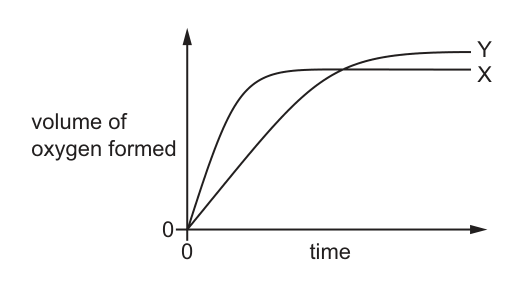
Which alteration to the original experimental conditions would produce curve Y?
Options
A adding more manganese(IV) oxide
B adding some hydrogen peroxide
C adding water
D raising the temperature
Working
Curve Y has a lower initial gradient than curve X, meaning the initial rate of reaction is slower. This indicates a lower initial concentration of hydrogen peroxide.
Curve Y reaches a higher final volume of oxygen than curve X, meaning more moles of hydrogen peroxide decomposed. This indicates a greater total amount (moles) of hydrogen peroxide.
- A Adding more catalyst: increases the rate but does not change the final volume of oxygen.
- B Adding 0.1 mol dm⁻³ hydrogen peroxide: increases the total volume of solution, diluting the original solution (lower concentration, slower initial rate). It also adds more moles of hydrogen peroxide (higher final volume of oxygen).
- C Adding water: dilutes the solution (lower concentration, slower initial rate) but does not add more moles of hydrogen peroxide (same final volume).
- D Raising the temperature: increases the rate of reaction (steeper initial gradient) and does not change the final volume.
Answer
B
B
Background Concept
The rate of a chemical reaction in solution depends on the concentration of the reactants. A higher concentration means more frequent collisions between reactant particles, leading to a faster initial rate. The total volume of product formed in a reaction that goes to completion depends on the total number of moles of the limiting reactant, not its concentration. A catalyst speeds up the reaction by providing an alternative pathway with a lower activation energy, but it does not affect the total amount of product formed. Temperature increases the kinetic energy of particles, increasing both the frequency and the energy of collisions, thus increasing the rate of reaction.
Understanding the Question
The question provides a graph of the volume of oxygen gas produced over time during the decomposition of hydrogen peroxide. Curve X represents the original experiment using 100 cm³ of 1.0 mol dm⁻³ H₂O₂. Curve Y represents a modified experiment. We need to identify which modification produces curve Y. By observing the graph, curve Y has a lower initial slope (slower initial rate) and a higher final plateau (greater total volume of oxygen produced) compared to curve X.
Approach
We need to match the changes in the graph (lower initial rate, higher final volume) to the chemical effects of each proposed alteration.
- Lower initial rate -> lower initial concentration of H₂O₂.
- Higher final volume -> greater total moles of H₂O₂.
Evaluate each option against these two criteria.
Step-by-Step Reasoning
- Curve analysis: The gradient of the volume-time graph at t=0 represents the initial rate of reaction. Curve Y is less steep initially than curve X, so the initial rate is lower. This happens if the initial concentration of the reactant is lower. The final horizontal asymptote represents the total volume of oxygen produced, which is proportional to the total moles of H₂O₂ decomposed. Curve Y levels off at a higher volume, so there must be more total moles of H₂O₂.
- Option A (adding more catalyst): A catalyst increases the rate of reaction (steeper initial gradient) but does not change the total moles of reactant, so the final volume remains the same. This would produce a curve steeper than X but with the same final level. Incorrect.
- Option B (adding some 0.1 mol dm⁻³ H₂O₂): Adding a solution of lower concentration (0.1 mol dm⁻³ < 1.0 mol dm⁻³) to the original solution increases the total volume, thereby decreasing the overall initial concentration of H₂O₂. This results in a slower initial rate (less steep gradient). However, it also adds extra moles of H₂O₂ to the mixture. Since there are more moles of reactant, more oxygen will be produced overall, leading to a higher final volume. This matches curve Y perfectly. Correct.
- Option C (adding water): Adding water dilutes the solution, lowering the concentration of H₂O₂ and thus decreasing the initial rate (less steep gradient). However, water does not add any H₂O₂, so the total moles of H₂O₂ remains unchanged. The final volume of oxygen would be the same as curve X. Incorrect.
- Option D (raising the temperature): Increasing the temperature increases the kinetic energy of the particles, leading to more frequent and more energetic collisions. This increases the rate of reaction (steeper initial gradient). It does not change the total moles of reactant, so the final volume remains the same. Incorrect.
Key Takeaways
- The initial gradient of a product vs. time graph indicates the initial rate, which is affected by concentration, temperature, and catalysts.
- The final volume (or mass) of product indicates the total amount (moles) of limiting reactant.
- Diluting a solution with a lower concentration reagent decreases the overall concentration (slowing the rate) but can increase the total moles if the reagent itself contains the reactant.
Common Mistakes
- Confusing concentration with total amount of substance: thinking that adding water or a dilute solution changes the total moles of reactant. Water adds volume but no moles of H₂O₂.
- Assuming a catalyst affects the final yield: catalysts only affect the rate, not the equilibrium position or total product formed from a given amount of reactant.
Things to Be Careful About
- Always read both axes of a rate graph: the gradient gives the rate (affected by concentration, temperature, catalyst), while the final plateau gives the total yield (affected only by the total moles of limiting reactant).
- When adding a solution of a different concentration, remember that the new total volume dilutes the original solution, lowering its concentration even if more moles are added.
The first seven ionisation energies of an element between lithium and neon in the Periodic Table are shown.
What is the outer electronic configuration of the element?
Options
A
B
C
D
Working
The large jump in ionisation energy occurs between the 6th (13,300) and 7th (71,000) ionisation energies. This shows that after removing 6 electrons, the next electron comes from a much more stable inner shell (the core).
Therefore the element has 6 electrons in its outer shell.
The element is between lithium and neon (Period 2). With 6 outer electrons, the configuration is (oxygen).
Answer
C ()
C
Background Concept
Successive ionisation energies are the energies required to remove each successive electron from an atom. When a large jump occurs between two successive ionisation energies, it signals that the next electron is being removed from a much lower, more stable shell — the noble-gas core. The number of electrons removed before the big jump equals the number of valence (outer-shell) electrons.
Understanding the Question
The question lists the first seven ionisation energies of an element between lithium and neon (a Period 2 element). Our task is to deduce the outer electronic configuration. The key clue is the dramatic jump between the 6th and 7th ionisation energies.
Approach
- Scan the successive ionisation energies for the largest jump.
- Count how many electrons were removed before that jump — this gives the number of valence electrons.
- Match that count to the Period 2 configuration (2s/2p orbitals).
Step-by-Step Reasoning
- The successive ionisation energies are 1310, 3390, 5320, 7450, 11,000, 13,300, 71,000 kJ mol⁻¹.
- The jump from 13,300 to 71,000 is enormous (more than a fivefold increase).
- This jump occurs after the 6th electron is removed, so the 7th electron must come from the stable 1s² core.
- Therefore the element has 6 electrons in its outer shell.
- A Period 2 element with 6 outer electrons has the configuration 2s² 2p⁴ — this is oxygen.
- The correct option is C.
Key Takeaways
A large jump in successive ionisation energies marks the transition from the valence shell to a noble-gas core. Count the electrons removed before the jump to find the number of valence electrons.
Common Mistakes
- Miscounting which ionisation energy shows the jump (the jump is after the 6th, not the 7th).
- Confusing the number of valence electrons with the wrong group.
Things to Be Careful About
- The jump is between the 6th and 7th ionisation energies, meaning 6 electrons were removed before it.
- The element is between lithium and neon, so it is in Period 2 — configurations only involve 2s and 2p orbitals.
- Option D (2s² 2p⁶) would correspond to neon, which would show a jump after the 8th electron, not the 6th.
The reaction of hydrogen with oxygen is shown.
Which expression corresponds to the standard enthalpy change of this reaction?
Options
A
B
C
D
Working
The reaction forms water from its elements in their standard states. The standard enthalpy change of formation, , is defined for the formation of one mole of a compound from its elements. Here two moles of water are formed, so the enthalpy change of the reaction is:
Answer
A
A
Background Concept
The standard enthalpy change of formation, , is the enthalpy change when one mole of a compound is formed from its elements in their standard states under standard conditions (298 K, 1 atm). The standard enthalpy change of combustion, , is the enthalpy change when one mole of a substance is completely burned in oxygen under standard conditions. A key skill in energetics is recognising when a given reaction is itself a formation reaction, so that its enthalpy change can be written directly in terms of values without needing a Hess cycle.
Understanding the Question
This is a multiple-choice question asking which expression gives the standard enthalpy change of the reaction . The four options are built from and . The task is to decide which combination correctly represents the enthalpy change of this specific reaction.
Approach
Ask: what kind of reaction is this? Hydrogen gas and oxygen gas (both elements in their standard states) combine to form water. That is exactly the definition of a formation reaction for water. The only complication is that the equation forms two moles of water, not one. Since is defined per mole of compound formed, the enthalpy change for forming two moles is simply twice the standard enthalpy of formation of water. No combustion enthalpies are involved because nothing is being burned — the reactants are already elements.
Step-by-Step Reasoning
- Recognise that and are elements in their standard states. By definition, the standard enthalpy of formation of any element in its standard state is zero.
- The product, , is a compound formed directly from its elements. Therefore the reaction is the formation reaction of water.
- The definition of refers to the formation of one mole of compound. The given equation produces , i.e. two moles.
- Therefore the enthalpy change of the reaction as written is .
- This matches option A.
Why the distractors are wrong:
- B uses combustion enthalpies, but combustion is the burning of a substance in oxygen. Here hydrogen is being reacted with oxygen to form water, not burned as a fuel in a combustion sense — and the expression shown does not correspond to any valid enthalpy relationship for this reaction.
- C gives only , which is the enthalpy change for burning one mole of hydrogen to form one mole of water. This ignores the stoichiometric coefficient of 2 and, more fundamentally, uses the wrong type of enthalpy change.
- D incorrectly adds a combustion enthalpy term to the formation term. Once water has been formed, there is no further combustion step; adding double-counts or misassigns the energy change.
Key Takeaways
- Recognise a formation reaction on sight: a compound formed from its elements in their standard states.
- Always respect the stoichiometric coefficient — is per mole, so multiply by the number of moles formed.
- Combustion enthalpies apply when a substance is burned in oxygen; they are not interchangeable with formation enthalpies.
Common Mistakes
- Forgetting the factor of 2 and choosing option C (which would be correct only for ).
- Confusing formation and combustion enthalpies, leading to options B or D.
- Thinking that of an element must be included; it is zero by definition for elements in their standard states.
Things to Be Careful About
- The definition of is strictly for one mole of compound — the coefficient in the balanced equation determines the multiplier.
- Note the physical state: water here is liquid, . The standard enthalpy of formation of liquid water differs slightly from that of water vapour, so the state symbol matters if values are quoted.
- In an MCQ, once you identify the reaction type and the correct multiplier, you can select the answer directly without computing any numbers.
P is a compound that burns in an excess of oxygen to give carbon dioxide and water only.
of P contains of carbon and of hydrogen.
When P is added to a solution of sodium carbonate, bubbles of gas are seen.
What is P?
Options
A
B
C
D
Working
Mass of oxygen in P:
Moles of atoms:
Divide by the smallest ratio, 0.050:
So the empirical formula is .
P reacts with sodium carbonate giving bubbles of gas, so P is a carboxylic acid (contains ).
The only option that has empirical formula and is a carboxylic acid is D, .
Answer
D
D
Background Concept
An organic compound containing only carbon, hydrogen and oxygen burns in excess oxygen to give carbon dioxide and water. All of its carbon appears as and all of its hydrogen appears as , so the masses of C and H in the original compound are known from the combustion data. If the compound itself contains oxygen, that oxygen mass is simply the remaining mass after subtracting the masses of C and H from the total sample mass.
The empirical formula is the smallest whole-number ratio of moles of atoms in the compound. To find it, convert each element's mass to moles and divide by the smallest number.
The other key clue is that carboxylic acids react with carbonates, releasing carbon dioxide:
The bubbles seen are . Aldehydes, ketones and alcohols do not normally react with sodium carbonate in this way.
Understanding the Question
The question gives the total mass of P, , and tells you that this sample contains of carbon and of hydrogen. Because P burns to and only, it can contain C, H and possibly O. You must first calculate the mass of oxygen by difference.
It also tells you that P produces gas with sodium carbonate solution. This is a chemical test for a carboxylic acid: a compound with a group. A candidate compound must therefore satisfy both the empirical-formula clue and the acid functional-group clue.
Approach
Work in three stages:
- Find the mass of oxygen in 2.20 g of P by difference.
- Convert the masses of C, H and O to moles, then reduce to the simplest whole-number ratio to get the empirical formula.
- Use the sodium carbonate test to identify which candidate is a carboxylic acid, and check that its molecular formula is consistent with the empirical formula.
Step-by-Step Reasoning
Mass of oxygen:
Convert each mass to moles using the appropriate atomic masses:
Divide each mole value by the smallest, :
So the empirical formula is .
Now look at the options against two criteria:
- Option A, , has molecular formula . This does match the empirical formula, but ethanal is an aldehyde, not a carboxylic acid. It does not give bubbles with sodium carbonate.
- Option B, , is ethanoic acid and does contain a carboxyl group, but its molecular formula is , so its empirical formula is , not .
- Option C, , has molecular formula , so it has empirical formula . But it contains a ketone carbonyl and an alcohol group, not a carboxylic acid group, so it does not react with sodium carbonate to give .
- Option D, (butanoic acid), has molecular formula . This is , so its empirical formula is correct. It also contains a carboxylic acid group, so it reacts with sodium carbonate and releases carbon dioxide.
Therefore P is option D.
Key Takeaways
- Combustion data gives the masses of C and H; any O in the compound is found by difference.
- The empirical formula comes from the simplest mole ratio, not directly from the masses.
- The sodium carbonate test is specific for carboxylic acids: effervescence indicates .
- A correct answer must satisfy both quantitative composition and the chemical test.
Common Mistakes
- Forgetting to include oxygen. If you only use the C and H masses, you get a ratio that does not match any option and you miss the key step.
- Choosing A because its molecular formula is exactly C2H4O. The empirical formula is necessary but not sufficient; A is an aldehyde, not a carboxylic acid, so it fails the chemical test.
- Thinking any carbonyl compound reacts with carbonate. Aldehydes and ketones are not acidic enough to displace carbonic acid from sodium carbonate.
- Incorrectly matching option B. B is an acid, but its empirical formula is CH2O, not C2H4O.
Things to Be Careful About
- Use atomic masses C = 12, H = 1, O = 16.
- The phrase "burns in an excess of oxygen to give carbon dioxide and water only" tells you the compound contains C, H and possibly O, but no other elements such as N or S.
- Check the full molecular formula of each option, not just the displayed shorthand. For example, and both reduce to the same empirical formula, but only the one with the carboxyl group reacts with carbonate.
- State the final answer as the option letter; the working is what supports it.
Substance W has the physical properties shown.
| m.p. / °C | b.p. / °C | electrical conductivity of solid | electrical conductivity of liquid | electrical conductivity in water |
|---|---|---|---|---|
| 2072 | 2980 | poor | good | insoluble |
What is substance W?
Options
A aluminium oxide
B iron
C silicon dioxide
D sodium fluoride
Working
W has a very high melting point and boiling point, so it is likely to have a giant ionic or giant covalent structure.
Its solid is a poor conductor but its liquid is a good conductor. This is the classic behaviour of an ionic compound: ions are fixed in the solid lattice, but free to move when molten.
W is insoluble in water. Among the ionic options, aluminium oxide is insoluble in water, whereas sodium fluoride is soluble. Iron is a metallic conductor in the solid state, and silicon dioxide is a poor conductor even when molten.
Answer
A — aluminium oxide
A
Background Concept
Physical properties such as melting point, boiling point, electrical conductivity, and solubility can be used to deduce the type of structure and bonding in a substance.
- Ionic compounds: high melting/boiling points, poor conductivity as solids, good conductivity when molten or in aqueous solution, often soluble in water.
- Giant covalent substances: very high melting/boiling points, poor conductivity as solids and usually poor conductivity when molten, insoluble in water.
- Metals: high melting/boiling points, good conductivity as solids and when molten, insoluble in water.
Understanding the Question
The table gives four physical properties of substance W:
- m.p. = 2072 °C
- b.p. = 2980 °C
- solid conductivity = poor
- liquid conductivity = good
- conductivity in water = insoluble
The question asks which of the four substances matches all of these properties.
Approach
- Use the high melting/boiling point to narrow the possibilities to giant structures.
- Use electrical conductivity to distinguish between ionic, metallic, and covalent network structures.
- Use solubility in water to choose between the remaining candidates.
Step-by-Step Reasoning
-
High m.p. and b.p.
- Aluminium oxide, silicon dioxide, and iron all have very high melting/boiling points.
- Sodium fluoride is ionic and also has a high melting point, but it is soluble in water.
-
Solid conductivity = poor
- Iron is a metal, so it conducts electricity in the solid state. This eliminates iron.
- Silicon dioxide is a giant covalent network; it does not conduct electricity as a solid or when molten. This would not match the “liquid conductivity = good” property.
-
Liquid conductivity = good
- Aluminium oxide is ionic. In the solid state its ions are fixed in a lattice, so it does not conduct. When molten, the ions are free to move, so it conducts electricity.
- Sodium fluoride is also ionic and would conduct when molten, but it is soluble in water.
-
Insoluble in water
- Aluminium oxide is insoluble in water.
- Sodium fluoride is soluble in water.
Therefore, substance W is aluminium oxide.
Key Takeaways
- Ionic compounds conduct electricity only when molten or in aqueous solution, not as solids.
- Giant covalent substances have very high melting points but generally do not conduct electricity even when molten.
- Solubility in water helps distinguish between ionic compounds that dissolve and those that do not.
Common Mistakes
- Choosing silicon dioxide because it has a high melting point, without checking that it would not conduct when molten.
- Choosing sodium fluoride because it is ionic, without checking that it is soluble in water.
- Forgetting that metals conduct electricity in the solid state.
Things to Be Careful About
- Read the conductivity columns carefully: solid, liquid, and in water are three separate tests.
- “Insoluble in water” is a key clue; many ionic compounds dissolve, but not all do.
- Aluminium oxide is an example of an ionic compound with a very high melting point and low solubility in water.
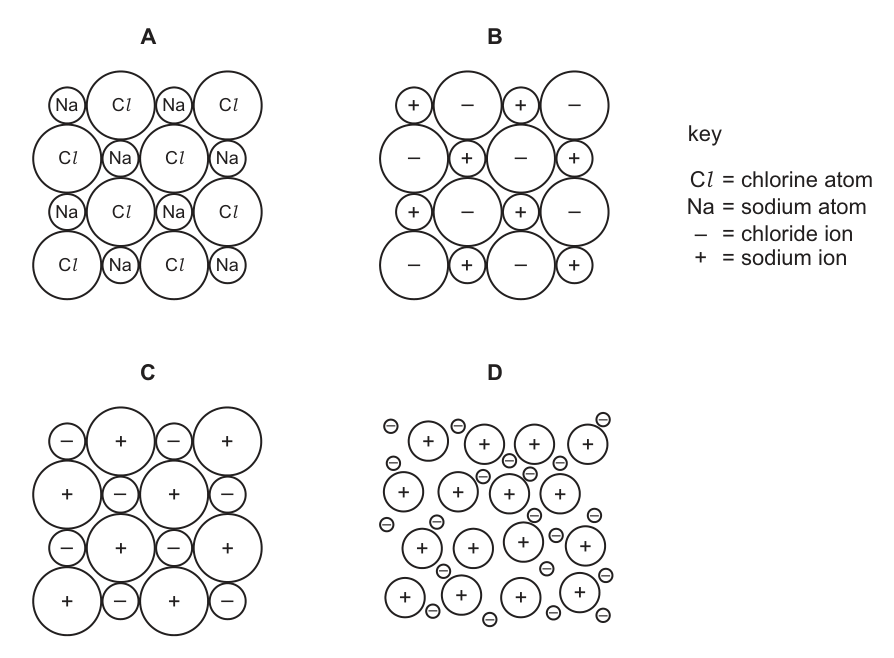
Which diagram represents the lattice structure of sodium chloride?
Options
A Diagram A
B Diagram B
C Diagram C
D Diagram D
Answer
B
B
Background Concept
Sodium chloride is a giant ionic lattice (specifically, a rock salt structure). It is formed by the electrostatic attraction between positively charged sodium ions () and negatively charged chloride ions (). In such a lattice, ions are arranged in a regular, repeating 3D pattern where each ion is surrounded by ions of the opposite charge. This maximises attractive forces and minimises repulsive forces.
A key feature of ionic lattices is the relative size of the ions. The sodium ion () has the electron configuration (isoelectronic with neon, 2 electron shells). The chloride ion () has the electron configuration (isoelectronic with argon, 3 electron shells). Therefore, the chloride ion is significantly larger than the sodium ion (, ).
Understanding the Question
The question asks to identify the correct 2D diagram representing the lattice structure of sodium chloride. We are given four diagrams (A, B, C, D) and a key defining the symbols:
- = chlorine atom
- = sodium atom
- = chloride ion
- = sodium ion
We must evaluate each diagram based on: (1) whether it shows ions or atoms, (2) the arrangement (ordered vs. random), and (3) the relative sizes of the positive and negative species.
Approach
- Check species: Sodium chloride is ionic, so the diagram must show ions ( and ), not neutral atoms ( and ). This eliminates diagrams using atomic labels.
- Check arrangement: Ionic lattices are highly ordered and regular. Random arrangements are incorrect.
- Check relative sizes: The anion () must be larger than the cation (). Compare the sizes of the and circles in the remaining diagrams.
Step-by-Step Reasoning
- Diagram A: The key defines the labels as (sodium atom) and (chlorine atom). Sodium chloride is an ionic compound consisting of and ions, not neutral atoms. This diagram is incorrect.
- Diagram D: The ions are arranged randomly and irregularly. Ionic lattices have a regular, alternating arrangement of ions. This diagram likely represents a liquid or a gas, or simply a disordered mixture, not a crystal lattice. This is incorrect.
- Diagram C: This diagram shows an alternating arrangement of and ions, which is good. However, the positive ions (, sodium) are drawn as large circles and the negative ions (, chloride) as small circles. This implies the cation is larger than the anion. In reality, (3 shells) is much larger than (2 shells). This diagram has the relative sizes wrong.
- Diagram B: This diagram shows an alternating arrangement of positive () and negative () ions, consistent with an ionic lattice. The key identifies as sodium ion and as chloride ion. The positive ions () are drawn as small circles and the negative ions () as large circles. This correctly represents the fact that the chloride ion () is larger than the sodium ion (). This is the correct representation.
Key Takeaways
- Ionic lattices are composed of ions, not neutral atoms. Always check the key and labels.
- Ionic lattices have a regular, alternating arrangement of cations and anions.
- For sodium chloride, the anion () is larger than the cation () due to the extra electron shell.
Common Mistakes
- Choosing A: Students might see and and think it's correct, forgetting that in the lattice they exist as ions ( and ). The key explicitly defines them as atoms here.
- Choosing C: Students might correctly identify the alternating pattern but fail to recall or apply the relative ionic radii (), leading them to pick the diagram with the wrong size ratio.
- Choosing D: Students might confuse the 2D lattice representation with a particle diagram of a liquid or gas where particles are close but not ordered.
Things to Be Careful About
- Read the key carefully: The key distinguishes between atoms (, ) and ions (, ). Diagram A uses atomic labels, which is a common distractor.
- Relative sizes: Always verify the relative sizes of cations and anions. For Group 1 halides (like NaCl, KBr), the halide ion is always larger than the metal ion.
- Order vs. Random: Lattice structures are defined by their long-range order. Any diagram showing a random arrangement is incorrect for a solid lattice.
An aqueous solution X contains substance HQ which behaves as a weak acid.
The soluble salt NaQ is added to X.
What happens to the and the pH in X?
Options
| pH | ||
|---|---|---|
| A | decreases | decreases |
| B | decreases | increases |
| C | increases | decreases |
| D | increases | increases |
Working
Adding NaQ supplies ions. This increases the concentration of on the right-hand side of the equilibrium
so the position of equilibrium shifts to the left, removing ions. Hence decreases, and since , pH increases.
Answer
B
B
Background Concept
A weak acid such as only partially ionises in water:
At equilibrium the forward and reverse rates are equal. Adding a soluble salt that contains the conjugate base introduces a large concentration of ions common to the equilibrium. This is the common ion effect: the added disturbs the equilibrium, and by Le Chatelier's principle the position shifts to the side that reduces the disturbance — here to the left, consuming and to form more .
The pH is defined by
so a decrease in corresponds to an increase in pH.
Understanding the Question
The question gives a weak acid equilibrium and asks what happens to two linked quantities when the sodium salt of the acid, , is added to the solution. The key point is that is a soluble ionic salt, so it dissociates completely into and ions. The ion is the conjugate base of and is already present in the equilibrium mixture. Adding more of it is a classic common-ion situation. The command is essentially "predict and explain": decide the direction of the equilibrium shift, then translate the resulting change into a pH change.
Approach
- Recognise that supplies , a species on the right-hand side of the equilibrium.
- Apply Le Chatelier's principle: increasing the concentration of a product shifts the equilibrium to the left.
- Deduce that falls.
- Use to determine that pH rises.
No calculation is needed; the question only tests qualitative prediction.
Step-by-Step Reasoning
- is a soluble salt, so in aqueous solution it fully dissociates:
The ion is a spectator and does not affect the acid equilibrium.
- The added increases the concentration of a species on the right of the equilibrium:
By Le Chatelier's principle, the system responds by shifting in the direction that consumes some of the added — that is, to the left.
-
Shifting left converts and into , so decreases.
-
Since , a smaller gives a larger pH. Therefore pH increases.
This matches option B: decreases and pH increases.
Key Takeaways
- Adding a salt of the conjugate base of a weak acid suppresses the acid's ionisation: this is the common ion effect.
- Le Chatelier's principle applies to acid–base equilibria exactly as to other equilibria: adding a product shifts the equilibrium toward reactants.
- and pH move in opposite directions: lower means higher pH.
- A soluble salt is assumed to be fully dissociated, so only the relevant ion (here ) matters.
Common Mistakes
- Choosing A: thinking pH decreases when decreases. This confuses the direction of pH with the direction of .
- Thinking that adding adds and therefore changes pH directly. is a spectator ion.
- Assuming the salt reacts with water to produce more . Here the conjugate base is the common ion and suppresses ionisation, not increases it.
- Forgetting that is weak, so the equilibrium is established and can be shifted; a strong acid would fully dissociate and the common ion effect would be irrelevant.
Things to Be Careful About
- pH is defined as , so a ten-fold decrease in raises pH by 1 unit.
- The equilibrium arrow is , not ; the system is dynamic and can shift.
- The salt is stated to be soluble, so it dissociates completely; do not treat it as a weak electrolyte.
- In a buffer context, adding to creates a buffer, but here the question only asks for the immediate direction of change, not the buffer capacity.
Dinitrogen tetroxide, , decomposes reversibly.
An equilibrium mixture of and gases is placed in a closed container under standard conditions.
The conditions are changed.
Under the new conditions, .
Which change in conditions occurs?
Options
A The pressure increases.
B The pressure decreases.
C The temperature increases.
D The temperature decreases.
Working
For the endothermic reaction , .
increases from to .
Increasing temperature favours the endothermic (forward) direction, producing more and increasing .
Pressure changes do not alter at constant temperature.
Answer
C (The temperature increases)
C
Background Concept
For a reversible reaction at equilibrium, the equilibrium constant depends only on temperature. Changing pressure or concentration does not change the value of (it only shifts the position of equilibrium).
For an endothermic reaction (), increasing the temperature favours the forward direction, so increases. For an exothermic reaction (), increasing the temperature favours the reverse direction, so decreases.
Understanding the Question
The reaction is endothermic (). We are told that increases dramatically from to . We need to identify which change in conditions caused this increase.
Approach
Recall that is only affected by temperature. Then determine whether an increase or decrease in temperature would increase for an endothermic reaction.
Step-by-Step Reasoning
- Identify the reaction as endothermic: .
- Note that has increased (from to ).
- For an endothermic reaction, increasing temperature shifts equilibrium to the right (towards products), increasing .
- Decreasing temperature would shift equilibrium to the left, decreasing .
- Pressure changes do not affect — they only shift the position of equilibrium to minimise the change, but the value of remains constant at a given temperature.
- Therefore the correct change is an increase in temperature.
Key Takeaways
- is temperature-dependent only; pressure and concentration changes do not change its value.
- For an endothermic reaction, increases with increasing temperature.
- For an exothermic reaction, decreases with increasing temperature.
Common Mistakes
- Confusing the effect of pressure: pressure shifts the position of equilibrium but does not change .
- Mixing up endothermic and exothermic: remember "endothermic absorbs heat, so adding heat (increasing temperature) favours the forward reaction."
Things to Be Careful About
- Always check the sign of before deciding how temperature affects .
- The units of (mol dm) confirm the stoichiometry (), but this is not needed to answer the question.
- In a closed container, changing pressure (e.g. by changing volume) does not change at constant temperature.
of is added to of in an insulated vessel.
Both solutions are at a temperature of before mixing. After mixing, the temperature rises and the highest temperature reached is .
Assume that:
- all the energy released in the reaction goes into raising the temperature of the aqueous reaction mixture
- the specific heat capacity of the mixture is .
What is the value of the enthalpy of neutralisation determined from this experiment?
Options
A
B
C
D
Working
Total volume = 50 + 100 = 150 cm³
Temperature rise = 29 - 20 = 9 K
Heat released:
q = VcΔT = 150 × 4.2 × 9 = 5670 J = 5.67 kJ
Moles:
n(H₂SO₄) = 0.050 × 1.0 = 0.050 mol
n(NaOH) = 0.100 × 1.0 = 0.100 mol
Neutralisation:
H₂SO₄ + 2NaOH → Na₂SO₄ + 2H₂O
0.050 mol H₂SO₄ reacts with 0.100 mol NaOH, forming 0.100 mol H₂O.
Enthalpy of neutralisation per mole of water:
ΔH = -5.67 kJ / 0.100 mol = -56.7 kJ mol⁻¹
Answer
B (−56.7 kJ mol⁻¹)
B
Background Concept
The enthalpy of neutralisation is the heat evolved when one mole of water is formed from the reaction between an acid and a base. For a strong acid and a strong base it is typically about -57 kJ mol⁻¹. In this experiment the heat released warms the whole aqueous mixture, so we use calorimetry: q = VcΔT, where c is given per unit volume.
Understanding the Question
50 cm³ of 1.0 mol dm⁻³ H₂SO₄ and 100 cm³ of 1.0 mol dm⁻³ NaOH are mixed. Both start at 20 °C and the highest temperature reached is 29 °C. The task is to find the enthalpy of neutralisation from this temperature rise. The key is to calculate the heat released and then divide by the number of moles of water actually formed.
Approach
- Find the total volume of the mixture and the temperature rise.
- Calculate the heat released using q = VcΔT.
- Calculate the moles of H₂SO₄ and NaOH.
- Use the balanced neutralisation equation to find the moles of water formed.
- Divide the heat by the moles of water and give a negative sign because the reaction is exothermic.
Step-by-Step Reasoning
- Total volume = 50 + 100 = 150 cm³.
- Temperature rise = 29 - 20 = 9 K.
- Heat released = 150 × 4.2 × 9 = 5670 J = 5.67 kJ.
- n(H₂SO₄) = 0.050 × 1.0 = 0.050 mol.
- n(NaOH) = 0.100 × 1.0 = 0.100 mol.
- Equation: H₂SO₄ + 2NaOH → Na₂SO₄ + 2H₂O.
- 0.050 mol H₂SO₄ requires 0.100 mol NaOH, so the acid and base are exactly in the stoichiometric ratio and 0.100 mol water is formed.
- ΔH = -5.67 kJ / 0.100 mol = -56.7 kJ mol⁻¹.
Key Takeaways
- Enthalpy of neutralisation is expressed per mole of water formed, not per mole of acid or base.
- Sulfuric acid is diprotic, so one mole of H₂SO₄ reacts with two moles of NaOH and produces two moles of water.
- When the heat capacity is given per cm³, use volume in q = VcΔT.
Common Mistakes
- Using only the volume of one solution instead of the total volume.
- Dividing by moles of H₂SO₄ instead of moles of water formed.
- Forgetting that the reaction is exothermic and omitting the negative sign.
- Using ΔT = 29 K instead of 29 - 20 = 9 K.
Things to Be Careful About
- The temperature rise is 9 K, not 29 K.
- The unit J cm⁻³ K⁻¹ means q = VcΔT, not mcΔT with mass.
- Check the stoichiometry: H₂SO₄ provides two H⁺ ions, so it needs two moles of NaOH.
- The final answer must be negative because heat is released.
Barium dithionate, , is soluble in water.
ions slowly decompose in acidic solution.
of is dissolved in water in a volumetric flask and the solution made up to the mark with .
At time , a white precipitate of mass is present in the flask.
What is the concentration of in the volumetric flask at time ?
Options
A
B
C
D
Working
Molar mass of
Initial moles of
The white precipitate is (formed when from the decomposition reacts with ).
Molar mass of
Moles of precipitated
Each mole of decomposed gives one mole of , hence one mole of .
Moles of remaining
Concentration
Answer
C ()
C
Background Concept
This question tests core stoichiometry: converting between mass and moles using molar mass, applying a stoichiometric ratio from a balanced equation, and expressing moles as a concentration in mol dm⁻³. The key chemical insight is that the decomposition of the dithionate ion produces sulfate ion, which immediately precipitates with barium ion as insoluble barium sulfate. Barium sulfate is famously insoluble — it is the basis of the gravimetric sulfate analysis and the classic sulfate test — while barium dithionate is, as stated, soluble.
Understanding the Question
We start with 3.513 g of the hydrated salt BaS₂O₆·2H₂O dissolved in 100 cm³ of acidified solution. The dithionate ion slowly decomposes:
The SO₄²⁻ produced reacts with Ba²⁺ to form a white precipitate of BaSO₄. At time x, 0.661 g of precipitate has formed. We need the concentration of undecomposed BaS₂O₆ remaining at that moment. The command is a calculation — "What is the concentration" — so full numerical working is required.
The traps are: (1) the initial mass refers to the hydrated salt, so the water of crystallisation must be included in the molar mass; (2) the precipitate is a different compound (BaSO₄), not BaS₂O₆; (3) the volume must be in dm³ for a concentration in mol dm⁻³.
Approach
- Find the molar mass of the hydrated salt and convert the initial mass to initial moles.
- Recognise the precipitate is BaSO₄, find its molar mass, and convert the precipitate mass to moles.
- Use the 1:1 stoichiometry of the decomposition to find moles of dithionate decomposed.
- Subtract to find moles remaining.
- Divide by the volume in dm³ to get concentration.
Step-by-Step Reasoning
Step 1 — Initial moles.
M_r(BaS₂O₆·2H₂O) = 137.3 + 2(32.1) + 6(16.0) + 2(18.0) = 333.5 g mol⁻¹.
Step 2 — The precipitate.
The decomposition produces SO₄²⁻, which reacts with Ba²⁺:
M_r(BaSO₄) = 137.3 + 32.1 + 4(16.0) = 233.4 g mol⁻¹.
Step 3 — Stoichiometry.
Each mole of S₂O₆²⁻ that decomposes produces one mole of SO₄²⁻, which precipitates as one mole of BaSO₄. So moles of dithionate decomposed = moles of BaSO₄ = 0.00283 mol.
Step 4 — Remaining moles.
Step 5 — Concentration.
Volume = 100 cm³ = 0.100 dm³.
This matches option C.
Why the distractors are wrong:
- A (0.0077): This is the moles remaining, not divided by the volume — forgetting the 0.100 dm³ factor.
- B (0.0090): Likely from using an incorrect molar mass (e.g. omitting the water of crystallisation) or an arithmetic slip in the subtraction.
- D (0.090): A factor-of-ten error on C, or using the wrong initial moles.
Key Takeaways
- Always include water of crystallisation in the molar mass of a hydrated salt.
- Recognise that a precipitate in such problems is often the insoluble salt of the cation with the product anion (here BaSO₄).
- The 1:1 stoichiometry of the decomposition links moles of reactant decomposed to moles of product formed.
- Concentration requires dividing by volume in dm³ (100 cm³ = 0.100 dm³).
Common Mistakes
- Forgetting the 2H₂O in the molar mass of the hydrated salt, giving a wrong initial mole count.
- Not recognising that the precipitate is BaSO₄ and trying to relate the precipitate mass directly to BaS₂O₆.
- Forgetting to convert 100 cm³ to 0.100 dm³ before computing concentration.
- Confusing moles remaining with concentration — option A is exactly the moles without dividing by volume.
Things to Be Careful About
- Molar masses: use accurate values (Ba 137.3, S 32.1, O 16.0, H 1.0).
- The volume is 100 cm³ = 0.100 dm³.
- The precipitate mass is for BaSO₄, not for BaS₂O₆.
- The decomposition is slow — the question is about the state at a particular time, not completion.
- State symbols: SO₂ is a gas and escapes, so it does not affect the precipitate mass.
The diagram shows two containers of methane connected by a closed tap.
Each container has a volume of .

The tap is opened. The temperature of the system is changed to .
The system reaches constant pressure.
What is the pressure of methane within the system?
Options
A
B
C
D
Working
Total moles of methane (): .
Total volume after tap is opened:
Using the ideal gas equation :
Convert to kPa:
Answer
A
A
Background Concept
The ideal gas equation, , relates the pressure (), volume (), amount of substance in moles (), and absolute temperature () of an ideal gas. The gas constant has a value of , which requires pressure to be in pascals (Pa), volume in cubic metres (m), and temperature in kelvin (K). When gases from multiple containers are mixed, the total amount of gas is the sum of the moles in each container, and the total volume available is the sum of the individual container volumes (assuming the connecting tube volume is negligible).
Understanding the Question
We are given two containers, each with a volume of , containing methane ().
- Container 1: methane at .
- Container 2: methane at .
The tap connecting them is opened, allowing the gas to occupy the combined volume. The system is then heated to and reaches a new constant pressure. We need to calculate this final pressure.
Approach
- Determine the total number of moles of methane in the system by converting the given masses to moles using the molar mass of methane.
- Determine the total volume available to the gas after the tap is opened.
- Use the ideal gas equation () with the total moles, total volume, and final temperature to find the final pressure.
Step-by-Step Reasoning
Step 1: Calculate total moles of methane.
The molar mass () of methane () is .
Moles in container 1: .
Moles in container 2: .
Total moles: .
Step 2: Determine total volume.
When the tap is opened, the gas expands to fill both containers.
.
Step 3: Calculate final pressure.
Given: , , , .
Convert pascals to kilopascals ():
This matches option A.
Key Takeaways
- When mixing gases in connected containers, add the moles and add the volumes.
- Always check units in the ideal gas equation: use Pa, m, K, and mol when .
- Converting between Pa and kPa is a common step that requires attention to decimal places.
Common Mistakes
- Forgetting to add volumes: Using instead of would give a pressure of (Option B), which is incorrect because the gas expands into both containers.
- Using wrong units for R: If is used with volume in dm or pressure in kPa directly without conversion, the result will be wrong.
- Ignoring the mass of one container: Calculating moles using only one of the masses (e.g., just 16 g or just 96 g) leads to incorrect total moles and thus wrong pressure.
Things to Be Careful About
- Unit consistency: The gas constant requires pressure in Pa (not kPa) and volume in m (not dm or L). The final answer must be converted from Pa to kPa to match the options.
- State symbols and formulas: Ensure the molar mass is calculated correctly for the specific gas (methane, , not just carbon or hydrogen).
Which statement about a 3p orbital is correct?
Options
A It can hold a maximum of six electrons.
B It has the highest energy of the orbitals with principal quantum number 3.
C It is at a higher energy level than a 3s orbital but has the same shape.
D It is occupied by one electron in an isolated phosphorus atom.
Working
A single 3p orbital can hold a maximum of 2 electrons — the 3p subshell of three orbitals holds 6 — so A is incorrect. Within the shell the energy order is , so the 3p orbital is not the highest energy (B is incorrect). A 3p orbital is dumbbell-shaped, whereas a 3s orbital is spherical, so they do not share the same shape (C is incorrect). Phosphorus () has the configuration ; by Hund's rule the three 3p electrons occupy the three 3p orbitals singly, so each 3p orbital holds one electron.
Answer
D
D
Background Concept
An atomic orbital is a region of space around the nucleus where there is a high probability of finding an electron. Each orbital has a characteristic shape: s orbitals are spherical, while p orbitals are dumbbell-shaped (two lobes lying along an axis). Each orbital can hold a maximum of two electrons, which must have opposite spins (Pauli exclusion principle).
A subshell is a set of orbitals of the same type within a shell: the s subshell contains 1 orbital (2 electrons), the p subshell contains 3 orbitals (6 electrons), and the d subshell contains 5 orbitals (10 electrons). For multi-electron atoms, orbitals within the same principal shell are not all equal in energy: the energy increases in the order . For , this gives .
Hund's rule states that when filling a set of degenerate (equal-energy) orbitals, such as the three 3p orbitals, electrons occupy each orbital singly with parallel spins before any pairing occurs.
Understanding the Question
The question presents four statements about a 3p orbital and asks which one is correct. Each statement tests a different idea: (A) the maximum number of electrons an orbital can hold, (B) the relative energies of orbitals within the shell, (C) the shape of a p orbital compared with an s orbital, and (D) the electron configuration of an isolated phosphorus atom. To answer, evaluate each statement against the correct facts and reject those that are false.
Approach
Work through each statement in turn:
- Recall that one orbital holds at most 2 electrons, not 6 — 6 is the capacity of the whole p subshell.
- Recall the energy order within the shell: , so the 3p orbital is not the highest.
- Compare the shapes: s orbitals are spherical, p orbitals are dumbbell-shaped — they differ.
- Write the electron configuration of phosphorus and apply Hund's rule to the three 3p electrons.
Step-by-Step Reasoning
Statement A: "It can hold a maximum of six electrons." A single orbital obeys the Pauli exclusion principle and holds at most two electrons, with opposite spins. Six electrons is the capacity of the entire 3p subshell (three orbitals × 2 electrons each). The statement confuses an orbital with a subshell, so it is false.
Statement B: "It has the highest energy of the orbitals with principal quantum number 3." In a multi-electron atom, orbital energy within a shell increases with the azimuthal quantum number: . The 3d orbitals lie higher in energy than the 3p orbitals, so the 3p orbital is not the highest-energy orbital of the shell. False. (In a hydrogen atom all orbitals of the same are degenerate, but the standard ordering for multi-electron atoms is what applies here.)
Statement C: "It is at a higher energy level than a 3s orbital but has the same shape." The first half is true — a 3p orbital is higher in energy than a 3s orbital. However, the shapes are different: an s orbital is spherical, whereas a p orbital consists of two lobes (dumbbell shape). Because the statement claims the same shape, it is false.
Statement D: "It is occupied by one electron in an isolated phosphorus atom." Phosphorus has atomic number 15, so it has 15 electrons. Its electron configuration is . The 3p subshell contains three electrons distributed among the three degenerate 3p orbitals. By Hund's rule, each orbital receives one electron (with parallel spins) before any pairing occurs. Hence each 3p orbital is occupied by exactly one electron. This statement is correct.
Therefore the correct answer is D.
Key Takeaways
- One orbital holds at most two electrons; a p subshell (three orbitals) holds six.
- Within a shell, orbital energy increases in the order for multi-electron atoms.
- s orbitals are spherical; p orbitals are dumbbell-shaped.
- Hund's rule: fill degenerate orbitals singly with parallel spins before pairing.
Common Mistakes
- Saying a 3p orbital holds six electrons — that is the subshell capacity, not the orbital capacity.
- Choosing B because 3p seems "high" — forgetting that the 3d orbitals are higher still.
- Assuming all orbitals in the same shell have the same shape.
- Writing for phosphorus or pairing the 3p electrons prematurely, ignoring Hund's rule.
Things to Be Careful About
- Read "3p orbital" (singular) vs "3p subshell" carefully — the electron capacities differ (2 vs 6).
- The energy ordering applies to multi-electron atoms; for hydrogen, all orbitals of the same are degenerate.
- Hund's rule requires parallel spins when filling degenerate orbitals singly.
In which pair do both species:
- have the same shape
- have the same number of covalent bonds?
Options
A methane and the ammonium ion
B carbon dioxide and nitrogen
C boron trifluoride and ammonia
D water and oxygen
Working
Melthane, : four bond pairs around carbon, no lone pairs, so tetrahedral, with 4 covalent bonds.
Ammonium ion, : four bond pairs around nitrogen, no lone pairs, so tetrahedral, with 4 covalent bonds. The dative N-H bond counts as a covalent bond.
Both species are tetrahedral and have 4 covalent bonds, so the correct pair is A.
Answer
A
A
Background Concept
Molecular shape is determined by the number of electron pairs (bonding pairs and lone pairs) in the valence shell of the central atom. VSEPR theory says these electron pairs repel each other and arrange themselves as far apart as possible. With four bonding pairs and no lone pairs around a central atom, the electron-pair geometry is tetrahedral, with bond angles of about .
A covalent bond is formed when two atoms share a pair of electrons. A coordinate (dative) bond is just a covalent bond in which both shared electrons come from one atom; once formed, it is chemically identical to any other covalent bond and must be counted as one covalent bond.
When comparing two species, the shape depends on the number of bonding and lone pairs around the central atom, while the number of covalent bonds depends on how many shared pairs of electrons hold the atoms together.
Understanding the Question
The question asks for the pair in which both species have the same shape and the same number of covalent bonds. Both conditions must be true at once.
The four options compare simple molecules and ions: and ; and ; and ; and and . To answer, deduce the molecular geometry and count the covalent bonds for each species, then check both criteria.
Approach
For each species:
- Draw the Lewis structure.
- Count the number of bonding pairs and lone pairs around the central atom.
- Use VSEPR to predict the electron-pair geometry and hence the molecular shape.
- Count the number of covalent bonds, remembering that double and triple bonds are still covalent bonds, as is a coordinate bond.
Then compare the two species in each option against both criteria.
Step-by-Step Reasoning
Option A — and
- Carbon in methane forms four single C-H bonds. Carbon has no lone pairs in this molecule, so it has four bonding pairs and no lone pairs: tetrahedral, 4 covalent bonds.
- The ammonium ion is formed when ammonia, , accepts a proton, . Ammonia has a lone pair on nitrogen; this lone pair forms a coordinate bond to the proton. The nitrogen in therefore has four N-H bonding pairs and no lone pairs: tetrahedral, 4 covalent bonds.
- Since both species are tetrahedral and both have 4 covalent bonds, option A is correct.
Option B — and
- Carbon dioxide, O=C=O, is linear because the carbon has two double bonds and no lone pairs. It has two covalent bonds (two double bonds) or, counting shared pairs, four bonding pairs.
- Nitrogen, , is also linear with the structure N≡N. It has one triple covalent bond, or three shared pairs.
- Both are linear, but they do not have the same number of covalent bonds. So B is wrong.
Option C — and
- Boron trifluoride: boron forms three B-F bonds and has no lone pairs. Three bonding pairs give a trigonal planar shape, 3 covalent bonds.
- Ammonia: nitrogen forms three N-H bonds and has one lone pair. Three bonding pairs plus one lone pair give a trigonal pyramidal shape, also 3 covalent bonds.
- They have the same number of covalent bonds, but different shapes. So C is wrong.
Option D — and
- Water is bent: oxygen has two O-H bonds and two lone pairs, so the molecular shape is bent. It has 2 covalent bonds.
- Oxygen gas has the linear structure O=O: one double bond. It has 1 covalent bond and is linear.
- They differ in both shape and number of covalent bonds. So D is wrong.
Only option A satisfies both conditions.
Key Takeaways
- VSEPR shape depends on the total number of electron pairs around the central atom, not just the number of atoms attached.
- Lone pairs affect shape: four bonding pairs give tetrahedral; three bonding pairs plus one lone pair give trigonal pyramidal.
- A coordinate bond is a covalent bond and must be counted.
- When comparing species, satisfy both conditions: shape and bond count.
Common Mistakes
- Saying has only 3 covalent bonds because one bond is dative. The dative bond is still a covalent bond, so has 4.
- Igoring the lone pair on ammonia and giving a trigonal planar shape. Ammonia is pyramidal because of the lone pair.
- Confusing electron-pair geometry with molecular shape. has tetrahedral electron-pair geometry but trigonal pyramidal molecular shape.
- Counting bond pairs rather than electron domains for double bonds: a double bond is one electron domain in VSEPR, even though it involves two shared pairs.
Things to Be Careful About
- Include lone pairs when predicting shape; they occupy space and repel more strongly than bonding pairs.
- Count every shared pair as a covalent bond, including dative, double, and triple bonds.
- For , the positive charge does not change the four shared pairs or the tetrahedral shape.
- The question needs both criteria to be true; it is not enough that two species merely have the same shape or merely the same number of bonds.
A reaction involving ammonium ions is shown.
Four statements about this reaction are listed.
- The ammonium ions are reduced.
- In the reverse reaction, ammonia acts as a Brønsted–Lowry base.
- The ammonium ion and the ammonia molecule have the same bond angle.
- This reaction is not a redox reaction.
Which statements are correct?
Options
A 1 and 2
B 1 and 3
C 2 and 4
D 3 and 4
Working
- Statement 1: Oxidation numbers: N in NH₄⁺ = −3; N in NH₃ = −3; H = +1; O = −2. No element changes oxidation state, so no redox occurs. False.
- Statement 2: Reverse reaction: NH₃ + H₂O → NH₄⁺ + OH⁻. NH₃ accepts a proton, so it acts as a Brønsted–Lowry base. True.
- Statement 3: NH₄⁺ is tetrahedral with bond angle 109.5°; NH₃ is trigonal pyramidal with bond angle about 107°. They are not the same. False.
- Statement 4: No oxidation numbers change, so the reaction is not a redox reaction. True.
Answer
C
C
Background Concept
This reaction is a Brønsted–Lowry acid–base equilibrium. A Brønsted–Lowry acid is a proton donor, and a Brønsted–Lowry base is a proton acceptor. In the forward reaction, NH₄⁺ donates a proton to OH⁻, so NH₄⁺ is the acid and OH⁻ is the base. In the reverse reaction, NH₃ accepts a proton from H₂O, so NH₃ acts as a base.
Understanding the Question
We need to judge four statements about the equilibrium NH₄⁺ + OH⁻ ⇌ NH₃ + H₂O. Statement 1 asks whether ammonium ions are reduced. Statement 2 asks about the reverse reaction and Brønsted–Lowry behaviour. Statement 3 compares the bond angles of NH₄⁺ and NH₃. Statement 4 asks whether the reaction is a redox reaction.
Approach
Check each statement independently.
- For redox, assign oxidation numbers to every element on both sides of the equation and see whether any change.
- For acid–base, look at proton transfer in the direction stated.
- For shape, use VSEPR theory: count bonding pairs and lone pairs around the central nitrogen.
Step-by-Step Reasoning
- Statement 1: In NH₄⁺, N has oxidation number −3. In NH₃, N also has oxidation number −3. H is +1 in both, and O is −2 in both OH⁻ and H₂O. No element changes oxidation state, so no reduction occurs. Statement 1 is false.
- Statement 2: The reverse reaction is NH₃ + H₂O → NH₄⁺ + OH⁻. NH₃ gains a proton to become NH₄⁺, so NH₃ is acting as a Brønsted–Lowry base. Statement 2 is true.
- Statement 3: NH₄⁺ has four bonding pairs and no lone pairs, so it is tetrahedral with bond angles 109.5°. NH₃ has three bonding pairs and one lone pair, so it is trigonal pyramidal with bond angles about 107°. The lone pair compresses the bond angles, so they are not the same. Statement 3 is false.
- Statement 4: Since no oxidation numbers change, this is a proton-transfer reaction, not a redox reaction. Statement 4 is true.
The correct statements are 2 and 4, which corresponds to option C.
Key Takeaways
- Proton transfer reactions are not redox reactions.
- A substance can act as a base in one direction even if the forward reaction shows it as an acid.
- Lone pairs reduce bond angles below the ideal tetrahedral value.
Common Mistakes
- Thinking that NH₄⁺ is reduced to NH₃ because a hydrogen is lost. This is a proton transfer, not an electron transfer; oxidation numbers do not change.
- Assuming NH₃ and NH₄⁺ have the same shape because they contain the same atoms. The lone pair on NH₃ changes the shape and bond angle.
Things to Be Careful About
- Always assign oxidation numbers before deciding whether a reaction is redox.
- Remember that Brønsted–Lowry definitions are about proton transfer, not electron transfer.
- When comparing shapes, count both bonding pairs and lone pairs around the central atom.
Which reduction process occurs on the surface of a catalytic converter?
Options
A reduction of carbon dioxide and nitrogen oxides
B reduction of carbon dioxide only
C reduction of nitrogen oxides only
D reduction of carbon monoxide
Working
A catalytic converter removes harmful exhaust gases. Nitrogen oxides () are reduced to nitrogen gas (), while carbon monoxide () is oxidised to carbon dioxide (). Carbon dioxide is not reduced — it is a product of the oxidation of . Therefore the reduction process occurring is the reduction of nitrogen oxides only.
Answer
C
C
Background Concept
A catalytic converter in a petrol vehicle is designed to reduce harmful exhaust emissions. The three main pollutants targeted are carbon monoxide (), unburnt hydrocarbons, and nitrogen oxides (, mainly and ). On the surface of the catalyst (typically platinum, palladium, or rhodium), two types of redox reactions occur simultaneously: oxidation of to and oxidation of hydrocarbons to and , and reduction of nitrogen oxides to nitrogen gas (). Redox reactions always involve simultaneous oxidation and reduction — one species loses electrons while another gains them. Reduction is the gain of electrons (a decrease in oxidation number), and oxidation is the loss of electrons (an increase in oxidation number). In the catalytic converter, the reduction process is the conversion of nitrogen oxides to nitrogen gas.
Understanding the Question
The question asks which reduction process occurs on the surface of a catalytic converter. It is a single-answer multiple-choice question with four options. The command is essentially "identify" — recall the chemistry of catalytic converters. The key is to understand what gets reduced (gains electrons) versus what gets oxidised (loses electrons) in the converter. The options present combinations of carbon dioxide, nitrogen oxides, and carbon monoxide, so you must know the fate of each species.
Approach
Recall the two main redox processes in a catalytic converter: (1) reduction of to , and (2) oxidation of to . Then match each option to these processes. Since the question specifically asks for the reduction process, look for the species that is reduced — the nitrogen oxides. Carbon monoxide is oxidised, and carbon dioxide is neither reduced nor a reactant being reduced.
Step-by-Step Reasoning
- In a catalytic converter, nitrogen oxides are reduced to nitrogen gas. For example, . The nitrogen in has an oxidation number of +2 (and +4 in ), and it is reduced to 0 in — it gains electrons.
- Carbon monoxide is oxidised to carbon dioxide: . The carbon goes from +2 in to +4 in — it loses electrons (oxidation).
- Carbon dioxide is a product, not a reactant that gets reduced. It is already in its most oxidised form (carbon at +4), so it cannot be reduced further in this context.
- Therefore, the reduction process occurring is the reduction of nitrogen oxides only, which is option C.
- Option A is wrong because carbon dioxide is not reduced. Option B is wrong because carbon dioxide is not reduced at all. Option D is wrong because carbon monoxide is oxidised, not reduced.
Key Takeaways
- Catalytic converters reduce to (reduction) and oxidise to (oxidation).
- Redox terminology: reduction = gain of electrons / decrease in oxidation number; oxidation = loss of electrons / increase in oxidation number.
- Be able to identify which species is reduced and which is oxidised in a given process by tracking oxidation numbers.
Common Mistakes
- Confusing oxidation and reduction: thinking is reduced because it is a pollutant being removed. In fact, is oxidised to .
- Thinking is reduced because it appears as a product — but it is the product of oxidation, not a reactant being reduced.
- Forgetting that the reduction of produces , which is the key reduction process in the converter.
Things to Be Careful About
- Read the question carefully: it asks for the reduction process, not all processes. Even though is oxidised, that is not the answer.
- Know the oxidation numbers: nitrogen in is +2, in is +4, and in is 0 (reduction); carbon in is +2 and in is +4 (oxidation). Tracking these numbers prevents confusion.
Three statements about the halogens, chlorine, bromine and iodine and their compounds are listed.
- The halogen with the highest boiling point has atoms which form the strongest bond to hydrogen.
- The halogen with the strongest instantaneous dipole (id–id) attractions forms the most thermally stable hydrogen halide.
- The most volatile element most rapidly oxidises hydrogen.
Which statements are correct?
Options
A 1 and 2
B 1 only
C 2 and 3
D 3 only
Working
Statement 1 — Boiling point increases down the group, so has the highest boiling point. However, H–X bond strength decreases down the group ( is the strongest among , , ). Iodine therefore has the highest boiling point yet forms the weakest H–X bond. Incorrect.
Statement 2 — The strongest instantaneous dipole–induced dipole attractions are in (largest molecule, most polarisable). But thermal stability of the hydrogen halides decreases down the group ( is the most stable). Iodine gives the least stable hydrogen halide. Incorrect.
Statement 3 — The most volatile halogen is chlorine (lowest boiling point; a gas at room temperature). Chlorine is also the strongest oxidising agent among , , , so it oxidises hydrogen most readily. Correct.
Answer
D
D
Background Concept
The halogens (Group 17) show several regular trends as you go down the group from chlorine to iodine:
- Atomic radius and electron cloud size increase down the group.
- Boiling point increases down the group because the molecules are larger and more polarisable, so the instantaneous dipole–induced dipole (id–id / van der Waals) attractions between molecules are stronger.
- Electronegativity decreases down the group.
- Bond strength of H–X decreases down the group: . The larger the halogen atom, the poorer the orbital overlap with the small hydrogen 1s orbital.
- Thermal stability of the hydrogen halides decreases down the group for the same reason — the weaker the H–X bond, the more easily it breaks on heating.
- Oxidising power decreases down the group: . A good oxidising agent is one that readily gains electrons, and the smaller, more electronegative halogen is better at this.
This question tests whether you can match the direction of each trend to the property named in each statement.
Understanding the Question
Three statements link a physical or chemical property of the halogens to a related property of their hydrogen halides. For each statement you must check whether the two trends point in the same direction — if the property that is "highest" or "strongest" belongs to the same halogen as the second property, the statement is correct; if the trends run opposite, it is false.
The three statements are independent, so you judge each one separately, then select the option that lists the correct combination.
Approach
For each statement, identify which halogen has the property named in the first half, then check whether that same halogen has the property named in the second half. If the same halogen satisfies both, the statement is correct; if different halogens satisfy each half, the statement is false.
Step-by-Step Reasoning
Statement 1: "The halogen with the highest boiling point has atoms which form the strongest bond to hydrogen."
- The halogen with the highest boiling point is iodine, — the largest molecule with the strongest id–id attractions.
- The strongest bond to hydrogen among , , is , because bond strength decreases down the group.
- Iodine has the highest boiling point but forms the weakest H–X bond. The two properties belong to different halogens, so the statement is false.
Statement 2: "The halogen with the strongest instantaneous dipole (id–id) attractions forms the most thermally stable hydrogen halide."
- The strongest id–id attractions are in iodine, the largest and most polarisable molecule.
- The most thermally stable hydrogen halide is (thermal stability decreases down the group: ).
- Iodine has the strongest id–id attractions but forms the least stable hydrogen halide. The statement is false.
Statement 3: "The most volatile element most rapidly oxidises hydrogen."
- The most volatile halogen is chlorine — it has the lowest boiling point and is a gas at room temperature, whereas bromine is a liquid and iodine a solid.
- Chlorine is also the strongest oxidising agent among , , , so it oxidises hydrogen most readily (hydrogen burns in chlorine, forming ).
- Both halves point to chlorine, so the statement is true.
Only statement 3 is correct, which corresponds to option D.
Key Takeaways
- Boiling point / volatility and id–id attractions increase down Group 17.
- H–X bond strength and thermal stability of hydrogen halides decrease down Group 17.
- Oxidising power decreases down Group 17.
- When a question links two trends, always check the direction of each trend and whether the same halogen satisfies both.
Common Mistakes
- Assuming iodine is the strongest oxidising agent because it is the largest halogen. In fact oxidising power decreases down the group, so chlorine is the strongest of the three.
- Confusing boiling point with bond strength. High boiling point reflects strong intermolecular forces, not strong intramolecular (covalent) bonds. Iodine has the highest boiling point but the weakest H–I bond.
- Mixing up thermal stability with bond strength direction. Both decrease down the group, but students sometimes think the larger halogen makes a more stable halide — the opposite is true.
Things to Be Careful About
- The question restricts itself to chlorine, bromine and iodine — fluorine is excluded. The trends are the same, but the strongest H–X bond overall is , and the strongest oxidising agent overall is . Do not let fluorine confuse the comparison among the three named halogens.
- "Most volatile" means lowest boiling point, i.e. chlorine, not iodine.
- Read each statement as a two-part claim: the halogen named in the first half must also be the one in the second half for the statement to be correct.
Which reagent or reagents and conditions will oxidise chlorine, , into a compound containing chlorine in the +5 oxidation state?
Options
A followed by at room temperature
B concentrated at room temperature
C cold dilute
D hot concentrated
Working
Chlorine disproportionates in hot concentrated alkali to form chloride and chlorate(V):
In , chlorine has oxidation number +5.
Answer
D (hot concentrated )
D
Background Concept
Chlorine undergoes disproportionation — a reaction in which the same element is simultaneously oxidised and reduced — when it reacts with aqueous alkali. The oxidation state of chlorine in is 0. In cold dilute alkali it is converted to (oxidation state −1) and (oxidation state +1). In hot concentrated alkali, the disproportionation goes further: chlorine is converted to and (oxidation state +5).
Understanding the Question
The question asks which reagent/conditions will oxidise chlorine into a compound containing chlorine in the +5 oxidation state. This is a direct test of the two disproportionation reactions of chlorine with sodium hydroxide.
Approach
Recall the two key reactions:
- Cold dilute : (chlorine in is +1)
- Hot concentrated : (chlorine in is +5)
Since the question specifies the +5 state, the hot concentrated alkali is required.
Step-by-Step Reasoning
- Option A — followed by is the test for halide ions, not an oxidation of chlorine. Reject.
- Option B — Concentrated at room temperature does not oxidise chlorine to a +5 state; chlorine is already the oxidised form of chloride and concentrated sulfuric acid does not convert to a chlorate. Reject.
- Option C — Cold dilute gives , where chlorine is +1, not +5. Reject.
- Option D — Hot concentrated gives , where chlorine is +5. Accept.
Key Takeaways
- Chlorine disproportionates in alkali.
- Cold dilute alkali → (Cl in +1).
- Hot concentrated alkali → (Cl in +5).
- The oxidation state of chlorine in the product is determined by the conditions.
Common Mistakes
- Confusing the cold dilute reaction (which gives +1) with the hot concentrated reaction (which gives +5).
- Thinking that / is relevant to oxidation; it is only a halide test.
Things to Be Careful About
- Always check the oxidation state of chlorine in the product ion: has Cl = +1, has Cl = +5.
- The word "oxidise" means the oxidation number of chlorine increases from 0 to a positive value; in disproportionation, some chlorine is reduced while some is oxidised.
Which diagram shows the electronegativity of the elements Na, Mg, Al and Si plotted against their first ionisation energies?
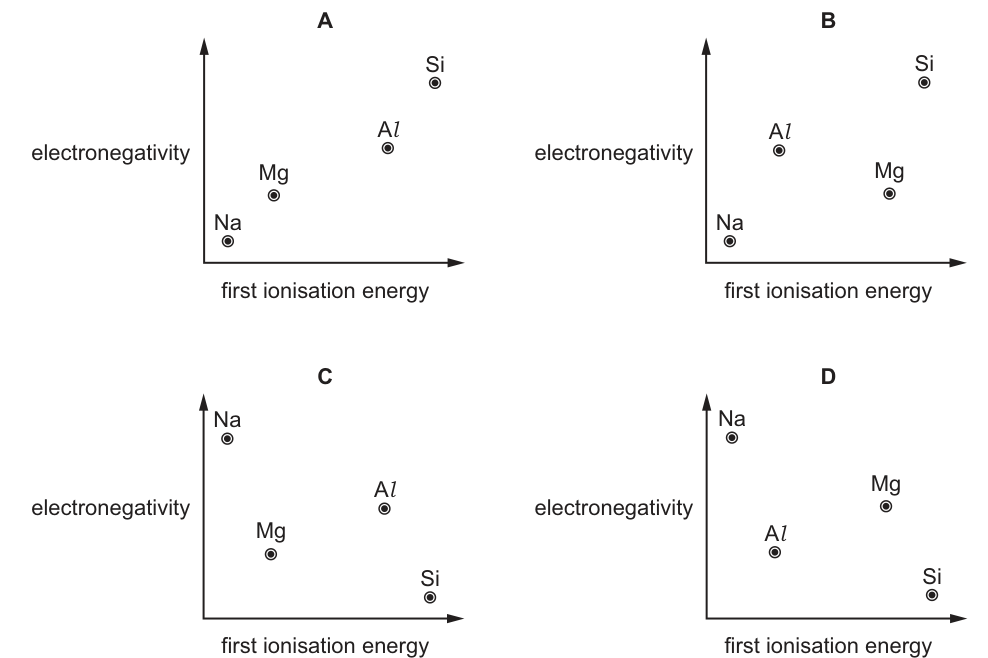
Options
A Diagram A
B Diagram B
C Diagram C
D Diagram D
Answer
B
Electronegativity increases across Period 3 from Na to Si: Na < Mg < Al < Si.
First ionisation energy generally increases across Period 3, but there is a drop from Mg to Al because the electron is removed from a higher-energy 3p orbital in Al compared to the stable, fully-filled 3s orbital in Mg. Thus, the order is Na < Al < Mg < Si.
Diagram B correctly shows electronegativity increasing Na < Mg < Al < Si (y-axis) and first ionisation energy increasing Na < Al < Mg < Si (x-axis).
B
Background Concept
Electronegativity is the measure of the tendency of an atom to attract a pair of electrons in a chemical bond. Across a period (left to right), electronegativity increases because the nuclear charge increases while the shielding effect remains roughly constant (electrons are added to the same shell). This stronger effective nuclear charge pulls bonding electrons closer.
First ionisation energy is the energy required to remove one mole of electrons from one mole of gaseous atoms to form one mole of gaseous 1+ ions. Generally, this increases across a period due to increasing nuclear charge and similar shielding. However, there are notable drops between Group 2 and Group 3 (e.g., Mg to Al) and between Group 15 and Group 16 (e.g., P to S) due to subshell effects (full or half-full subshell stability and electron repulsion in paired orbitals).
Understanding the Question
The question asks to identify the correct scatter plot showing the relationship between electronegativity (y-axis) and first ionisation energy (x-axis) for the Period 3 elements Na, Mg, Al, and Si. We need to determine the relative ordering of these four elements along both axes.
Approach
- Determine the order of Na, Mg, Al, Si for electronegativity (y-axis).
- Determine the order of Na, Mg, Al, Si for first ionisation energy (x-axis), paying attention to the Mg/Al anomaly.
- Match these orders to the positions of the points in the given diagrams.
Step-by-Step Reasoning
Electronegativity (y-axis):
Electronegativity increases steadily across Period 3 from left to right.
- Na (Group 1): lowest (~0.9)
- Mg (Group 2): higher (~1.2)
- Al (Group 13): higher (~1.5)
- Si (Group 14): highest (~1.8)
Order on y-axis (bottom to top): Na < Mg < Al < Si.
First Ionisation Energy (x-axis):
Generally increases across the period, but we must consider electron configurations:
- Na: (lowest IE, easiest to remove 3s electron)
- Mg: (full 3s subshell is stable, so IE is higher than expected)
- Al: (the 3p electron is higher in energy and slightly shielded by the 3s electrons, making it easier to remove than an electron from the stable 3s subshell of Mg)
- Si: (higher nuclear charge than Al, so IE is higher)
Values (approximate kJ/mol): Na (496) < Al (577) < Mg (738) < Si (786).
Order on x-axis (left to right): Na < Al < Mg < Si.
Matching to Diagrams:
- y-axis order: Na (lowest) < Mg < Al < Si (highest). This eliminates C and D, where Na is at the top.
- x-axis order: Na (leftmost) < Al < Mg < Si (rightmost). Note that Al must be to the left of Mg (lower IE), even though Al is above Mg (higher electronegativity).
- Diagram A: Shows Mg to the left of Al on the x-axis (incorrect IE order).
- Diagram B: Shows Na < Al < Mg < Si on the x-axis (correct IE order) and Na < Mg < Al < Si on the y-axis (correct EN order). Mg is to the right of Al (higher IE) but below Al (lower EN). This matches our analysis perfectly.
Key Takeaways
- Electronegativity increases monotonically across a period.
- First ionisation energy generally increases across a period but has drops at Group 3 (p-block start) and Group 6 (paired p-electrons) due to subshell structure and electron repulsion.
- When plotting two periodic properties, the non-monotonic nature of ionisation energy creates a 'zig-zag' or crossing pattern relative to a monotonic property like electronegativity.
Common Mistakes
- Assuming both trends are identical: Students often assume both IE and electronegativity increase in the exact same order (Na < Mg < Al < Si), leading them to choose Diagram A. This ignores the Mg/Al ionisation energy anomaly.
- Confusing the axes: Mixing up which axis is which or misreading the relative positions of the points.
- Forgetting electron configurations: Not knowing why Mg has a higher first ionisation energy than Al (full 3s subshell vs. single 3p electron).
Things to Be Careful About
- Always write out the electron configurations for Period 3 elements (up to Ar) to check for subshell anomalies in ionisation energy.
- Remember that electronegativity does not have the same anomalies as ionisation energy; it increases smoothly across the period.
- In scatter plots, check both axes independently before concluding.
Radium is an element below barium in Group 2 of the Periodic Table.
Which equation shows what happens when solid radium nitrate, , is heated strongly?
Options
A
B
C
D
Working
Group 2 nitrates decompose on strong heating to the metal oxide, nitrogen dioxide and oxygen:
For radium, M = Ra, so:
This matches option A.
Answer
A
A
Background Concept
Group 2 metal nitrates decompose on heating. The nitrate ion acts as an oxidising agent, and the thermal decomposition gives the metal oxide, nitrogen dioxide and oxygen. The general equation is:
This is different from the decomposition of most Group 1 nitrates, which give the metal nitrite and oxygen.
Understanding the Question
Radium is below barium in Group 2, so it has the same typical Group 2 chemistry. The question asks which balanced equation correctly represents the thermal decomposition of solid radium nitrate. We need to recall the correct product pattern and then check that the equation is balanced.
Approach
- Recall the general thermal decomposition of a Group 2 nitrate.
- Substitute radium, Ra, for the metal M.
- Write the balanced equation.
- Compare with the options and eliminate those with incorrect products or unbalanced atoms.
Step-by-Step Reasoning
-
For a Group 2 nitrate, the metal is in the +2 oxidation state, so the nitrate formula is M(NO₃)₂.
-
On strong heating, the nitrate decomposes to the metal oxide, MO, nitrogen dioxide, NO₂, and oxygen, O₂.
-
The unbalanced equation is:
-
Multiplying by 2 to remove the fraction gives:
-
For radium, M = Ra, so the correct equation is:
-
Check atoms:
- Left: 2 Ra, 4 N, 12 O
- Right: 2 Ra, 4 N, 12 O (2 in RaO + 8 in 4NO₂ + 2 in O₂)
This is option A.
Key Takeaways
- Group 2 nitrates decompose to the metal oxide, nitrogen dioxide and oxygen.
- The metal oxide of a Group 2 element is always MO, e.g. RaO, not Ra₂O.
- Always check that the equation is balanced before selecting an option.
Common Mistakes
- Confusing Group 2 nitrate decomposition with Group 1 nitrate decomposition.
- Writing Ra₂O instead of RaO.
- Choosing an equation that is not balanced, such as option C.
- Thinking nitrogen gas, N₂, or dinitrogen oxide, N₂O, is produced; these are not the normal products for Group 2 nitrate decomposition.
Things to Be Careful About
- Use the correct oxidation state of the Group 2 metal when writing the oxide formula.
- Remember to include the correct state symbols: solid, gas, etc.
- Always verify atom balance for both metal and non-metal atoms.
The table shows some data for the elements in Period 3 of the Periodic Table.
| melting point / K | electrical conductivity | |
|---|---|---|
| sodium | 371 | good |
| magnesium | 922 | good |
| aluminium | 933 | good |
| silicon | 1693 | poor |
| phosphorus | 317 | does not conduct |
| sulfur | 386 | does not conduct |
| chlorine | 172 | does not conduct |
| argon | 84 | does not conduct |
Which statements are correct?
- All the elements in the table with a giant structure have a higher melting point than each of the elements in the table with a simple molecular structure.
- Magnesium has a higher melting point than sodium because it has more delocalised electrons and stronger electrostatic attraction between the delocalised electrons and the metal ions.
- Phosphorus and sulfur do not conduct electricity because they are simple molecular solids at room conditions.
Options
A 1, 2 and 3
B 1 and 2 only
C 1 and 3 only
D 2 and 3 only
Working
Classify the Period 3 elements by structure:
- Giant structures: Na, Mg, Al (metallic); Si (giant covalent).
- Simple molecular: P (), S (), Cl (), Ar.
Statement 1 — False. The lowest melting point among the giant structures is sodium (371 K), but sulfur (simple molecular) melts at 386 K. So not every giant structure has a higher melting point than every simple molecular element.
Statement 2 — True. Mg has two delocalised electrons per atom and ions; Na has one delocalised electron per atom and ions. The stronger electrostatic attraction between the delocalised electrons and the metal ions gives Mg the higher melting point.
Statement 3 — True. P and S are simple molecular solids with no mobile charged particles, so they cannot conduct electricity.
Answer
D (2 and 3 only)
D
Background Concept
Physical properties such as melting point and electrical conductivity are determined by the structure and bonding of a substance. In Period 3, three distinct structure types appear:
- Metallic (Na, Mg, Al): positive ions arranged in a lattice surrounded by a sea of delocalised (mobile) electrons. The melting point depends on the charge on the ions and the number of delocalised electrons per atom — more charge and more delocalised electrons mean stronger electrostatic attraction and a higher melting point. Conductivity is good because the delocalised electrons are free to move.
- Giant covalent (Si): all atoms joined by a 3D network of strong covalent bonds. This gives a very high melting point; conductivity is poor because the electrons are localised in the covalent bonds and are not free to move.
- Simple molecular (P, S, Cl, Ar): discrete molecules (or single atoms for Ar) held together only by weak intermolecular (van der Waals) forces. Melting points are low, and the solids do not conduct because there are no free electrons or mobile ions.
Understanding the Question
The question provides melting points and electrical conductivity for all eight Period 3 elements and asks which of three statements about structure–property relationships are correct. You must judge each statement independently — true or false — then select the option that matches your three verdicts. The command is effectively "identify the correct statements," so the skill is careful classification and precise reasoning, not calculation.
Approach
Start by classifying every element by its structure type, because both statements 1 and 3 depend on it. Then evaluate each statement in turn:
- Statement 1 is a factual comparison of melting points across structure types — check the actual data rather than assuming the trend.
- Statement 2 is an explanation of why Mg melts higher than Na, using the metallic bonding model.
- Statement 3 is an explanation of why molecular solids do not conduct.
Finally, match your verdicts to the options (each option combines statement numbers).
Step-by-Step Reasoning
Statement 1 — The giant structures are Na, Mg, Al (metallic) and Si (giant covalent). The simple molecular elements are P, S, Cl and Ar. The claim is that every giant structure melts higher than every molecular one. The lowest melting point among the giant structures is sodium at 371 K; the highest among the molecular elements is sulfur at 386 K. Since 371 K < 386 K, the claim fails. Sodium is the exception that makes statement 1 false.
Statement 2 — In the metallic bonding model, melting point is governed by the strength of electrostatic attraction between the lattice of positive ions and the sea of delocalised electrons. Magnesium forms ions (charge +2) and contributes two delocalised electrons per atom, whereas sodium forms ions (charge +1) with one delocalised electron per atom. The greater ion charge and the larger number of delocalised electrons in Mg produce a much stronger attraction, so Mg melts higher (922 K vs 371 K). This statement is true.
Statement 3 — Electrical conduction requires mobile charged particles (free electrons or free ions). Phosphorus () and sulfur () are simple molecular solids: their electrons are held within covalent bonds in discrete molecules, and there are no ions. With no mobile charge carriers, they cannot conduct electricity. This statement is true.
Verdicts: 1 = false, 2 = true, 3 = true. The only option listing statements 2 and 3 is D.
Key Takeaways
- Always classify a substance's structure (metallic, giant covalent, ionic, simple molecular) before predicting its physical properties.
- Metallic melting point trends are explained by ion charge and the number of delocalised electrons per atom — both increase the strength of the electrostatic attraction.
- Conductivity requires mobile charge carriers: delocalised electrons in metals, mobile ions in molten/aqueous ionic compounds; simple molecular solids have neither.
- When a statement makes an "all ... every ..." claim, test it against the actual data — one counterexample (Na vs S) is enough to falsify it.
Common Mistakes
- Assuming that all giant structures automatically melt higher than all molecular structures without checking the data. The counterexample here is sodium (371 K) vs sulfur (386 K).
- Saying Mg has "more electrons" without specifying that the key points are the higher ion charge ( vs ) and the greater number of delocalised electrons.
- Stating that molecular solids don't conduct "because electrons are not free" without the precise idea of mobile charge carriers — the mark-scheme-worthy phrase is "no free/mobile charged particles."
- Forgetting that argon is monatomic but still behaves as a simple molecular (atomic) solid held by van der Waals forces.
Things to Be Careful About
- Read the table values precisely: statement 1 hinges entirely on the comparison between sodium (371 K) and sulfur (386 K).
- In metallic bonding explanations, mention both the ion charge and the number of delocalised electrons — each is a distinct creditable point.
- Distinguish "poor conductor" (silicon, a semiconductor) from "does not conduct" (molecular solids) — the question uses these deliberately.
- Match your verdicts to the option letters carefully: options combine statements in different ways (e.g. "1, 2 and 3", "1 and 2 only", etc.), so one wrong verdict changes the answer.
Each mineral listed behaves as a mixture of two carbonate compounds. They can be used as fire retardants because they decompose in the heat, producing . This gas smothers the fire.
- barytocite,
- dolomite,
- huntite,
What is the order of effectiveness as fire retardants, from best to worst?
Options
| best | worst | ||
|---|---|---|---|
| A | dolomite | barytocite | huntite |
| B | dolomite | huntite | barytocite |
| C | huntite | barytocite | dolomite |
| D | huntite | dolomite | barytocite |
Working
Each formula unit releases one per carbonate group. Compare the mass of released per formula mass.
- Barytocite, : ; mass ;
- Dolomite, : ; mass ;
- Huntite, : ; mass ;
Best = highest : huntite > dolomite > barytocite.
Answer
D
D
Background Concept
Fire retardants that work by smothering rely on producing a large volume of per unit mass of solid. Metal carbonates decompose on heating:
Each carbonate group releases one molecule. For a mixed carbonate such as , the number of molecules per formula unit equals the number of carbonate groups in the formula. To compare effectiveness, calculate the mass fraction of :
A higher mass fraction means more per gram, hence better smothering.
Understanding the Question
The three minerals are listed with their formulas. The question asks to rank them from best to worst fire retardant. Since the retardant action is due to released, "best" means greatest production per unit mass. The formulas contain different numbers of carbonate groups and different metal masses, so both factors affect the ranking.
Approach
- Count the number of molecules per formula unit from the carbonate groups.
- Calculate the molar mass of each mineral using values: Ba = 137, Ca = 40, Mg = 24, C = 12, O = 16.
- Calculate the mass of per formula unit.
- Divide the mass by the molar mass and compare the percentages.
Step-by-Step Reasoning
Barytocite,
- It has two carbonate groups, so it releases 2 per formula unit.
- Mass of
The heavy barium atom makes up a large fraction of the mass, lowering the percentage.
Dolomite,
- It also has two carbonate groups, so 2 per formula unit.
- Mass of
Calcium and magnesium are much lighter than barium, so dolomite has a higher fraction than barytocite.
Huntite,
- It has four carbonate groups, so 4 per formula unit.
- Mass of
Huntite releases the most per gram, so it is the best fire retardant.
Ranking from best to worst: huntite > dolomite > barytocite, which is option D.
Why the other options are wrong:
- Options A and B put dolomite as best, ignoring that huntite has a higher mass fraction.
- Option C puts barytocite above dolomite, but barytocite's heavy barium atom makes its percentage the lowest.
Key Takeaways
- Fire retardant effectiveness can be quantified by the mass fraction of released.
- The number of molecules per formula unit equals the number of carbonate groups.
- When comparing effectiveness, compare per gram of material, not per mole of material.
Common Mistakes
- Comparing moles of per mole of mineral without considering the molar mass of the mineral.
- Forgetting to multiply by the number of carbonate groups in the formula.
- Ranking "best" as the lowest percentage.
- Using the mass of the carbonate group () instead of the mass of (44).
Things to Be Careful About
- Use consistent relative atomic masses throughout.
- Include all metal atoms when calculating .
- State the comparison clearly as mass of per unit mass of mineral.
- Remember that "best" means highest per gram, not lowest.
Compound X contains two Period 3 elements, Y and Z.
Compound X reacts with water to form only two products: a slightly soluble hydroxide and compound Q.
Q is a compound of element Z and hydrogen.
Compound Q burns in moist air to produce an oxide and water. The oxidation number of element Z in the oxide is +5.
Which row identifies element Y and element Z?
Options
| element Y | element Z | |
|---|---|---|
| A | Mg | P |
| B | Na | S |
| C | Na | P |
| D | Mg | S |
Working
- The slightly soluble hydroxide must be ; is very soluble, so Y = Mg. This eliminates B and C.
- Q is the hydride of Z. If Z = P, Q = ; if Z = S, Q = .
- burns in moist air to , in which P has oxidation number +5. burns to , in which S has oxidation number +4, not +5.
- Hence Z = P and Y = Mg.
Answer
A
A
Background Concept
Some binary compounds of Period 3 elements hydrolyse in water. For example, magnesium phosphide, , reacts with water to give magnesium hydroxide and phosphine:
Two key facts are being tested here. First, the solubility of the hydroxide: is only slightly soluble in water, whereas is very soluble. Second, the oxidation number of an element in a binary oxide can be deduced from the oxide formula using the usual rules (oxygen is ).
Understanding the Question
Compound X is a binary compound of two Period 3 elements, Y and Z. When X reacts with water it gives exactly two products: a slightly soluble hydroxide (which tells us about Y) and a compound Q that contains Z and hydrogen only (so Q is a hydride of Z). Q then burns in moist air to give an oxide of Z and water, and the oxidation number of Z in that oxide is stated to be +5. We must choose which pair (Y, Z) fits all of these clues.
Approach
Break the problem into two independent deductions:
- Identify Y from the hydroxide: only one of the candidate elements forms a slightly soluble hydroxide when its compound is hydrolysed.
- Identify Z from the hydride Q and the oxide formed on burning: the hydride must burn to an oxide in which Z has oxidation number +5.
Test each candidate pair against these clues and eliminate those that fail.
Step-by-Step Reasoning
Step 1 — Identify Y from the hydroxide.
The hydrolysis product is a slightly soluble hydroxide. Among the candidates, Mg forms , which is only slightly soluble, whereas Na forms , which is very soluble. Therefore Y must be Mg. This immediately rules out options B and C (which list Na).
Step 2 — Identify Z from the hydride Q.
The remaining candidates for Z are P (option A) and S (option D).
- If Z = P, the hydride Q is phosphine, .
- If Z = S, the hydride Q is hydrogen sulfide, .
Step 3 — Use the oxidation number of Z in the oxide.
Q burns in moist air to give an oxide of Z and water, and Z has oxidation number +5 in that oxide.
- burns to phosphorus(V) oxide, . In , oxygen is (total ), so the two P atoms must sum to , giving each P an oxidation number of . This matches the clue.
- burns to sulfur dioxide, . In , oxygen is (total ), so S must be , not . This does not match.
Therefore Z = P and Y = Mg, which is option A.
Key Takeaways
- A slightly soluble hydroxide among Period 3 elements points to Mg, not Na.
- The identity of a hydride can be inferred from the element it contains, and the oxide formed on combustion reveals the element's oxidation state.
- Oxidation numbers are calculated from the oxide formula by setting the sum of oxidation numbers equal to zero.
Common Mistakes
- Assuming Na because sodium compounds are common; but is very soluble, so it cannot give a "slightly soluble hydroxide".
- Confusing the oxide of sulfur: has S at +4, not +5. Sulfur can reach +6 in , but the hydride burns to in moist air.
- Forgetting that the oxidation number must be calculated from the formula rather than guessed from the element's group number.
Things to Be Careful About
- In , the oxidation number of P is +5 because the formula has two P atoms sharing the +10 total. Do not confuse this with the +5 of a single P atom.
- The clue says the oxide forms "in moist air" — this is a standard condition for phosphine combustion and does not change the oxidation-number calculation.
- Check both clues together: Y must be Mg AND Z must be P. Option D (Mg, S) fails because S would give an oxide with oxidation number +4, not +5.
Three reagents are listed.
- aqueous sodium carbonate
- water
Which reagents react with pure ethanoic acid to give a solution containing ethanoate ions?
Options
A 1 and 2
B 1 and 3
C 1 only
D 2 and 3
Working
Ethanoic acid, , is a weak carboxylic acid.
Reagent 1 — aqueous sodium carbonate: reacts as a base with the acid, producing sodium ethanoate, which dissociates to give ethanoate ions:
✓
Reagent 2 — : a strong reducing agent that reduces the carboxylic acid to a primary alcohol (ethanol); no ethanoate ions are formed.
✗
Reagent 3 — water: ethanoic acid partially ionises in water:
✓
Reagents 1 and 3 both give solutions containing ethanoate ions.
Answer
B
B
Background Concept
Ethanoic acid () is a weak carboxylic acid. Its acidic behaviour comes from the carboxyl group (), where the O–H bond can break, releasing a proton () and leaving the ethanoate ion (). Being a weak acid, it only partially dissociates in water. This question tests whether you know which reagents interact with the acid in a way that produces ethanoate ions in solution.
Three distinct types of chemistry are involved:
- Acid–base neutralisation with a base such as carbonate — produces the salt, which dissociates into ions in solution.
- Reduction with a hydride reagent such as — removes the oxygen functionality, converting the acid to an alcohol and destroying the carboxyl group.
- Ionisation in water — the weak acid partially dissociates to give the ethanoate ion and a hydronium ion.
Understanding the Question
The question lists three reagents and asks which react with pure ethanoic acid to give a solution containing ethanoate ions (). The key phrase is "a solution containing ethanoate ions" — we need the reagent to cause the acid to lose its proton and form its conjugate base. We must evaluate each reagent in turn and decide whether it produces ethanoate ions in the resulting solution.
Approach
For each reagent, ask: does it react with the group in a way that produces ions?
- Sodium carbonate: a base — will neutralise the acid, forming the sodium salt, which ionises in solution.
- : a reducing agent — will reduce the acid to an alcohol, removing the carboxyl group entirely.
- Water: a solvent and weak base — will accept a proton from the acid, producing the ethanoate ion via acid dissociation.
Step-by-Step Reasoning
Reagent 1 — aqueous sodium carbonate:
Sodium carbonate is a basic salt. The carbonate ion () is a strong enough base to accept a proton from ethanoic acid. The reaction is:
The sodium ethanoate formed is a soluble ionic compound that fully dissociates in water:
So the solution contains ethanoate ions. ✓
Reagent 2 — :
Lithium aluminium hydride is a powerful reducing agent. It reduces carboxylic acids to primary alcohols:
The carboxyl group is reduced to a group, so the acid functionality is destroyed. The product is ethanol, not an ethanoate salt. No ethanoate ions are formed. ✗
Reagent 3 — water:
Ethanoic acid is a weak acid. When water is added to pure (glacial) ethanoic acid, the acid partially ionises:
The equilibrium lies well to the left (ethanoic acid is a weak acid, ), but there ARE ethanoate ions present in the solution. The question asks for a solution containing ethanoate ions — this condition is satisfied. ✓
Therefore, reagents 1 and 3 both give solutions containing ethanoate ions. The answer is B.
Why the distractors are wrong:
- Option A (1 and 2): includes , which reduces the acid to ethanol, not producing ethanoate ions.
- Option C (1 only): omits water, which does produce ethanoate ions by weak acid dissociation.
- Option D (2 and 3): includes but omits sodium carbonate, which is the most obvious producer of ethanoate ions.
Key Takeaways
- Carboxylic acids react with bases (carbonates, alkalis) to form carboxylate salts, which dissociate to give carboxylate ions in solution.
- reduces carboxylic acids to primary alcohols — it does not form carboxylate ions.
- Weak acids partially ionise in water, producing their conjugate base (the carboxylate ion) even without an added base.
- The question tests the distinction between acid–base chemistry and reduction chemistry of the carboxyl group.
Common Mistakes
- Thinking produces ethanoate ions: it reduces the acid to an alcohol, destroying the carboxyl group.
- Forgetting that water alone causes some ionisation of a weak acid — you do not need a strong base to get ethanoate ions present.
- Confusing "reacts to give a solution containing ethanoate ions" with "fully neutralises the acid" — partial ionisation in water still qualifies.
Things to Be Careful About
- The phrase "pure ethanoic acid" means glacial (anhydrous) acetic acid — adding water to it initiates ionisation.
- The reaction with carbonate produces gas — effervescence is a characteristic test for carboxylic acids.
- is moisture-sensitive and reacts violently with water; in practice it is used in dry ethereal solvents, but this is not needed for the exam question.
Complete combustion of compound T produces carbon dioxide and water only. Compound T produces steamy fumes with . Compound T does not give any visible product with 2,4-dinitrophenylhydrazine reagent.
What can be deduced with certainty from this information?
Options
A Compound T is a carboxylic acid.
B Compound T is a hydrocarbon.
C Compound T is an alcohol.
D Compound T is not an aldehyde.
Working
Complete combustion giving only and shows T contains C and H; it may also contain O, so T is not necessarily a hydrocarbon.
Steamy fumes with show an group is present, which fits an alcohol or a carboxylic acid; neither A nor C is certain.
No visible product with 2,4-DNPH means T has no aldehyde or ketone carbonyl group, so T cannot be an aldehyde.
Answer
D
D
Background Concept
Several qualitative tests are used to identify functional groups in organic compounds.
- Complete combustion: any compound containing C and H (and possibly O) burns to give and only. It does not prove the absence of oxygen.
- test: compounds containing an group (alcohols and carboxylic acids) react with phosphorus(V) chloride to give steamy fumes of . The white mist is hydrogen chloride.
- 2,4-dinitrophenylhydrazine (2,4-DNPH) test: this reagent reacts with aldehydes and ketones to form an orange/yellow precipitate. It does not give a visible product with alcohols, and carboxylic acids do not give the test either, because their carbonyl group is not reactive in this way.
Understanding the Question
The question gives three observations about compound T and asks what can be deduced with certainty. The options are: carboxylic acid, hydrocarbon, alcohol, or not an aldehyde. We must decide which conclusion is forced by the evidence, not merely possible.
Approach
Work through each observation and see which functional groups it allows and which it rules out. Then check each option: if more than one functional group fits the evidence, that option is not certain. The only option that must be true is the one that is guaranteed by the evidence.
Step-by-Step Reasoning
-
Combustion products: and only tell us that T contains carbon and hydrogen. Oxygen may also be present, because an oxygen-containing compound still gives only and on complete combustion. Therefore T is not necessarily a hydrocarbon, so B is not certain.
-
test: steamy fumes are , formed when reacts with an group. Both alcohols and carboxylic acids contain an group, so T could be an alcohol or a carboxylic acid. This means A is not certain (it could be an alcohol) and C is not certain (it could be a carboxylic acid).
-
2,4-DNPH test: no visible product means T does not contain an aldehyde or ketone carbonyl group. Since an aldehyde would give an orange/yellow precipitate with 2,4-DNPH, T cannot be an aldehyde. Therefore D is certain.
Thus the only conclusion that must be true is D.
Key Takeaways
- Combustion products alone do not identify a compound as a hydrocarbon; oxygen may be present.
- gives steamy fumes with any compound containing an group, not just alcohols.
- 2,4-DNPH is a test for aldehydes and ketones only; a negative result excludes both.
- In "what can be deduced with certainty" questions, eliminate any option that is merely possible rather than forced.
Common Mistakes
- Assuming that combustion producing only and proves the compound is a hydrocarbon. Oxygen-containing compounds also give these products.
- Assuming that identifies an alcohol specifically. Carboxylic acids also give steamy fumes.
- Assuming that a carboxylic acid would give a positive 2,4-DNPH test. The 2,4-DNPH test is for aldehydes and ketones; carboxylic acids do not give a visible product.
- Concluding that T is not a ketone or not an aldehyde is not the same as identifying T; here, only the negative conclusion about aldehyde is certain.
Things to Be Careful About
- The steamy fumes with are ; they indicate an group, not a specific class of compound.
- 2,4-DNPH gives a positive result for aldehydes and ketones; a negative result excludes both, so it certainly excludes an aldehyde.
- Do not overstate the deduction: T could be an alcohol or a carboxylic acid, but we cannot tell which from the given information.
Information about carbonyl compound X is given.
- Compound X reacts with to produce a secondary alcohol.
- Compound X reacts with alkaline to give a yellow precipitate.
What is compound X?
Options
A butanal
B butanone
C ethanal
D pentan-3-one
Working
reduces aldehydes to primary alcohols and ketones to secondary alcohols. Since X gives a secondary alcohol, X must be a ketone; butanal and ethanal can be ruled out.
A positive iodoform test — a yellow precipitate of — shows the presence of a group. Butanone, , has this group; pentan-3-one, , does not.
Answer
B (butanone)
B
Background Concept
Carbonyl compounds contain the group. is a strong reducing agent that donates hydride ions to the carbonyl carbon. It reduces aldehydes to primary alcohols and ketones to secondary alcohols. The organic class of the product therefore immediately tells you whether the starting carbonyl was an aldehyde or a ketone.
A separate diagnostic is the iodoform test. When a compound containing a group is treated with alkaline iodine, the methyl group is successively iodinated and then cleaved to give tri-iodomethane, , a yellow solid with a characteristic antiseptic smell. Ethanal, , also gives a positive test because it can be oxidised to a compound with the required unit. The test is therefore positive for methyl ketones and for ethanal, but not for ketones that lack a directly attached group.
Understanding the Question
The question gives two observations about an unknown carbonyl compound, X:
- reduction gives a secondary alcohol.
- Alkaline gives a yellow precipitate.
The task is to identify X from four options: butanal, butanone, ethanal, and pentan-3-one. The two clues work together: the first narrows the class of compound, while the second distinguishes between the possible ketones.
Approach
Use the reduction clue first because it gives a clean functional-group classification. A secondary alcohol can only come from a ketone, so the aldehyde options can be discarded. Then examine the remaining ketone options with the iodoform test. The yellow precipitate tells you the molecule contains a group, so choose the ketone that matches that structural feature.
Step-by-Step Reasoning
-
Apply the reduction clue.
- An aldehyde is reduced to a primary alcohol, .
- A ketone is reduced to a secondary alcohol, .
- Because X gives a secondary alcohol, X must be a ketone. This eliminates butanal and ethanal immediately.
-
Identify the remaining ketone options.
- Butanone:
- Pentan-3-one:
-
Apply the iodoform test.
- The yellow precipitate is , formed only when the molecule has a group.
- Butanone has directly attached to the carbonyl carbon, so it gives a positive iodoform test.
- Pentan-3-one is a symmetrical ketone with no group directly attached to the carbonyl carbon; the carbonyl carbon is bonded to two ethyl groups, so it does not give the iodoform test.
-
Conclude.
- Butanone is the only option that is a ketone and gives a positive iodoform test.
Key Takeaways
- reduction of a carbonyl compound reveals whether the starting material was an aldehyde or a ketone.
- The iodoform test is specific for the group, not for all ketones.
- When several options are given, use each diagnostic test to eliminate possibilities step by step.
- Recognise that ethanal also gives a positive iodoform test, but it would give a primary alcohol on reduction, so it cannot be correct here.
Common Mistakes
- Assuming that every ketone gives a positive iodoform test. Only methyl ketones, with the group, give the yellow precipitate.
- Forgetting that ethanal gives a positive iodoform test; it is eliminated by the reduction clue instead.
- Confusing the structures of butanone and pentan-3-one; draw them if necessary to see which carbon is bonded to the carbonyl group.
- Stating that gives a primary alcohol from a ketone; that would wrongly exclude butanone.
Things to Be Careful About
- Use precise organic terminology: aldehydes give primary alcohols and ketones give secondary alcohols on reduction.
- In the iodooform test, the yellow precipitate is ; simply saying "yellow precipitate" is usually enough, but naming the compound shows full understanding.
- Check the connectivity of the carbonyl carbon: the group must be , not just any alkyl group next to the carbonyl group.
- In a multiple-choice question, select the option that satisfies both clues; butanone fits both, while pentan-3-one fails the iodooform test.
An organic compound J reacts with an excess of sodium to produce an organic ion with a charge of –3. J reacts with an excess of to produce an organic ion with a charge of –1.
What is the structural formula of J?
Options
A
B
C
D
Working
Sodium (Na) reacts with both alcohol (-OH) and carboxylic acid (-CO2H) groups, replacing each acidic hydrogen with Na to give a charge of -1 per group.
Sodium hydroxide (NaOH) reacts only with carboxylic acid groups (-CO2H → -CO2⁻); it does not react with alcohol groups.
- Charge of -3 with excess Na → 3 ionisable groups (-OH and/or -CO2H).
- Charge of -1 with excess NaOH → 1 -CO2H group.
- So J has 1 -CO2H and 2 -OH groups.
Check options:
- A : 1 -CO2H + 2 -OH ✓
- B : 1 -CO2H + 1 -OH (aldehyde unreactive) → -2 with Na ✗
- C : 2 -CO2H + 1 -OH → -2 with NaOH ✗
- D : no -CO2H → 0 with NaOH ✗
Answer
A
A
Background Concept
Sodium metal reacts with any compound containing acidic hydrogens — hydrogens attached to oxygen in both alcohols (-OH) and carboxylic acids (-CO2H). Each such hydrogen is released as H2 gas, and the oxygen becomes negatively charged, forming a sodium salt. So each -OH or -CO2H group contributes exactly one unit of negative charge to the resulting organic ion.
Sodium hydroxide (NaOH) is a base that only reacts with the more acidic carboxylic acid group (-CO2H), converting it to a carboxylate ion (-CO2⁻). Alcohols are far too weakly acidic to react with NaOH(aq).
Understanding the Question
The question gives two experimental facts about compound J:
- With an excess of sodium → an organic ion of charge -3.
- With an excess of NaOH(aq) → an organic ion of charge -1.
We must deduce how many -OH and -CO2H groups J contains, then identify which structural formula matches.
Approach
- Determine which groups react with Na: both -OH and -CO2H count.
- Determine which groups react with NaOH: only -CO2H counts.
- Use the two observed charges to set up two conditions, then test each option against them.
Step-by-Step Reasoning
- With excess Na: charge -3 means there are 3 ionisable hydrogens in total, so the number of (-OH + -CO2H) groups is 3.
- With excess NaOH: charge -1 means there is exactly 1 -CO2H group.
- Combine: J must have 1 -CO2H group and 2 -OH groups.
- Test the options:
- A HOCH2CH(OH)CH2CO2H: 1 -CO2H + 2 -OH → matches both conditions ✓
- B HO2CCH(OH)CH2CHO: 1 -CO2H + 1 -OH; the aldehyde (CHO) does not react → only -2 with Na ✗
- C HO2CCH(OH)CH2CO2H: 2 -CO2H + 1 -OH → would give -2 with NaOH ✗
- D HOCH2COCH2CHO: no -CO2H, only an alcohol, a ketone and an aldehyde → 0 with NaOH ✗
- Only A satisfies both conditions.
Key Takeaways
- Na reacts with both -OH and -CO2H groups; NaOH(aq) reacts only with -CO2H groups.
- The charge on the organic ion directly tells you how many of each reactive group are present.
- Aldehyde and ketone carbonyl groups do not react with Na or NaOH in this way and contribute no charge.
Common Mistakes
- Assuming NaOH reacts with alcohol groups (it does not — alcohols are too weakly acidic).
- Forgetting that the aldehyde group in options B and D contributes no charge.
- Counting the carbonyl oxygen in option D as a reactive group.
- Misreading "excess" and thinking only some groups react — with excess reagent, all reactive groups react.
Things to Be Careful About
- Each -OH and -CO2H group always contributes exactly -1 to the ion charge with Na.
- Distinguish carefully between what Na does and what NaOH does — they are different reagents with different reactivity.
- Check every functional group in the formula, not just the ones you expect to find.
Which formula represents the organic compound formed by the reaction of propanoic acid with methanol in the presence of concentrated sulfuric acid as a catalyst?
Options
A
B
C
D
Working
Propanoic acid is and methanol is . Esterification (acid + alcohol ester + water) joins them with the alkyl group of the alcohol attached to the oxygen of the carboxylate group:
This gives methyl propanoate, , which matches option B.
Answer
B
B
Background Concept
Esterification is a condensation reaction between a carboxylic acid and an alcohol, catalysed by concentrated sulfuric acid. The acid provides the ester (carboxylate) linkage: the of the carboxylic acid and the of the alcohol's group are eliminated as water, and the alkyl group of the alcohol becomes attached to the oxygen of the carboxylate group. The general equation is:
The ester is named as the alkyl group from the alcohol followed by the acid name with an -oate ending: methanol + propanoic acid gives methyl propanoate.
Understanding the Question
We are asked to identify the organic compound formed when propanoic acid reacts with methanol in the presence of concentrated sulfuric acid as a catalyst. This is a classic esterification. The question gives four structural formulae and asks which one is the ester product. We must build the ester from the two reactants and match it to the correct option.
Approach
- Write the structure of propanoic acid: a 3-carbon chain with a group at the end.
- Write the structure of methanol: a 1-carbon alcohol, .
- Combine them: the alkyl group of the alcohol (methyl, ) attaches to the carboxylate oxygen; the of the acid and the of the alcohol are lost as water.
- Write the ester formula and match it to the options.
Step-by-Step Reasoning
Propanoic acid is . Methanol is .
Esterification:
The ester is methyl propanoate, .
Option B is , which is the same as — the correct answer.
Why the other options are wrong:
- A: is butan-2-one, a ketone. There is no oxygen between the carbonyl carbon and the terminal methyl group, so it is not an ester. It would be the product of oxidation of butan-2-ol, not esterification.
- C: is ethyl ethanoate (ethyl acetate), which would come from ethanoic acid + ethanol. The acid and alcohol are swapped relative to the question.
- D: is methyl butanoate, which would come from butanoic acid (a 4-carbon acid) + methanol. The acid chain is one carbon too long.
Key Takeaways
- Esterification: , catalysed by concentrated .
- The alkyl group from the alcohol is attached to the carboxylate oxygen (the linkage).
- Ester naming: alkyl group from the alcohol + acid name with -oate ending (e.g., methyl propanoate).
- The ester linkage is ; a ketone has the carbonyl carbon bonded directly to two carbon groups with no intervening oxygen.
Common Mistakes
- Confusing ester with ketone: an ester has an oxygen between the carbonyl carbon and the alkyl group (), while a ketone has directly. Option A is a ketone, not an ester.
- Swapping the acid and alcohol: ethyl ethanoate (option C) comes from ethanoic acid + ethanol, not propanoic acid + methanol. The alkyl group on the oxygen side must come from the alcohol (methyl), and the carbonyl chain from the acid (propyl).
- Miscounting the carbon chain: using a 4-carbon acid (option D) instead of the 3-carbon propanoic acid.
- Forgetting water is also a product: the question asks only for the organic compound, but the full equation includes .
Things to Be Careful About
- The ester linkage is ; make sure the alkyl group from the alcohol is on the oxygen side.
- Count carbons carefully: propanoic acid contributes a 3-carbon chain () and methanol contributes one carbon (), so the ester has four carbons total, with the carbonyl carbon being the second carbon of the chain.
- The catalyst (concentrated ) does not appear in the product; it only speeds up the reaction (and helps remove water to drive the equilibrium forward).
Structural isomerism and stereoisomerism should be considered when answering this question.
2,5-dibromohexane is heated under reflux with ethanolic KOH.
How many isomeric compounds are formed with molecular formula ?
Options
A 3
B 5
C 6
D 7
Working
2,5-dibromohexane is CH3CHBrCH2CH2CHBrCH3. Ethanolic KOH causes elimination of HBr from each brominated carbon. Each C–Br can eliminate a beta-H from either side:
- C2 can give C1=C2 or C2=C3
- C5 can give C5=C6 or C4=C5
Combining the two eliminations gives the structural dienes:
- hexa-1,5-diene
- hexa-1,4-diene
- hexa-2,4-diene
Now count stereoisomers:
- hexa-1,5-diene: no E/Z, so 1
- hexa-1,4-diene: one internal C=C, so E and Z, giving 2
- hexa-2,4-diene: two internal C=C; E,E; E,Z; Z,Z, giving 3
Total = 1 + 2 + 3 = 6
Answer
C
C
Background Concept
Ethanolic KOH is a strong base and favours elimination over substitution. A bromoalkane loses HBr from the carbon bearing the Br and an adjacent carbon, forming a C=C bond. With a dibromide, two eliminations occur, producing a diene.
Structural isomers differ in the positions of the double bonds. Stereoisomers arise where each carbon of a C=C has two different groups attached, giving E/Z isomerism.
Understanding the Question
We start with 2,5-dibromohexane, formula C6H12Br2. Reflux with ethanolic KOH removes both HBr molecules, giving C6H10. The question asks for the number of isomeric C6H10 products, and explicitly tells us to consider both structural isomerism and stereoisomerism.
Approach
- Draw the skeleton of 2,5-dibromohexane.
- Identify the possible double-bond positions from each C–Br elimination.
- Combine the two eliminations to find distinct structural dienes.
- Count E/Z stereoisomers for each structural diene.
Step-by-Step Reasoning
The structure is CH3CHBrCH2CH2CHBrCH3.
At C2, elimination can give either C1=C2 or C2=C3.
At C5, elimination can give either C5=C6 or C4=C5.
Combining these possibilities:
- C1=C2 with C5=C6 gives hexa-1,5-diene.
- C1=C2 with C4=C5 gives hexa-1,4-diene.
- C2=C3 with C5=C6 is the same as hexa-1,4-diene when numbered from the other end.
- C2=C3 with C4=C5 gives hexa-2,4-diene.
So there are three structural dienes.
Now count stereoisomers:
- Hexa-1,5-diene has both double bonds terminal, so no E/Z isomerism: 1 compound.
- Hexa-1,4-diene has one internal double bond, so E and Z forms exist: 2 compounds.
- Hexa-2,4-diene has two internal double bonds. The possible combinations are E,E; E,Z; and Z,Z. Because the molecule is symmetric, E,Z and Z,E are identical, so there are 3 compounds.
Total = 1 + 2 + 3 = 6.
Key Takeaways
- Ethanolic KOH favours elimination; aqueous KOH favours substitution.
- A dibromide can undergo two eliminations to form a diene.
- Count structural isomers first, then add stereoisomers.
- Use symmetry to avoid counting the same compound twice.
Common Mistakes
- Forgetting to count E/Z stereoisomers.
- Counting hexa-2,5-diene as a separate compound from hexa-1,4-diene.
- Counting E,Z and Z,E as two different compounds in symmetric hexa-2,4-diene.
- Assuming an alkyne could form; here the two Br atoms are not on adjacent carbons, so an alkyne is not possible.
Things to Be Careful About
- Number the chain from the end that gives the lowest locants for the double bonds.
- Check symmetry before counting stereoisomers.
- The phrase "under reflux with ethanolic KOH" signals complete elimination of both HBr molecules.
Considering only structural isomers, what is the number of alcohols of each type with the formula ?
Options
| primary | secondary | tertiary | |
|---|---|---|---|
| A | 3 | 3 | 2 |
| B | 4 | 2 | 2 |
| C | 4 | 3 | 1 |
| D | 5 | 2 | 1 |
Working
The molecular formula for an alcohol is a saturated monohydric alcohol. Enumerate the three carbon skeletons of and place the group at each non-equivalent position.
Pentane chain:
- pentan-1-ol (primary)
- pentan-2-ol (secondary)
- pentan-3-ol (secondary)
2-methylbutane:
- 2-methylbutan-1-ol (primary)
- 2-methylbutan-2-ol (tertiary)
- 3-methylbutan-1-ol (primary)
- 3-methylbutan-2-ol (secondary)
2,2-dimethylpropane:
- 2,2-dimethylpropan-1-ol (primary)
Counts:
- Primary: 4 (pentan-1-ol, 2-methylbutan-1-ol, 3-methylbutan-1-ol, 2,2-dimethylpropan-1-ol)
- Secondary: 3 (pentan-2-ol, pentan-3-ol, 3-methylbutan-2-ol)
- Tertiary: 1 (2-methylbutan-2-ol)
Answer
C (primary 4, secondary 3, tertiary 1)
C
Background Concept
Structural isomers share the same molecular formula but differ in how the atoms are connected. For saturated monohydric alcohols , the type is decided by how many carbon atoms are directly attached to the carbon bearing the group:
- Primary (): the OH-bearing carbon is attached to one other carbon.
- Secondary (): attached to two other carbons.
- Tertiary (): attached to three other carbons.
Understanding the Question
The formula also covers ethers, but the question explicitly asks for alcohols only. We must count every structural isomer that is an alcohol and classify each one. The phrase "structural isomers only" means stereoisomers (optical or cis/trans) are not counted.
Approach
Draw the three possible carbon skeletons for five carbons: pentane (straight chain), 2-methylbutane (one branch), and 2,2-dimethylpropane (two branches on the central carbon). For each skeleton, place the group on each non-equivalent carbon, name the alcohol, and classify it as primary, secondary, or tertiary. Then sum the counts.
Step-by-Step Reasoning
- Carbon skeletons of : pentane, 2-methylbutane, 2,2-dimethylpropane.
- Pentane: placing OH at C1 gives pentan-1-ol (); at C2 gives pentan-2-ol (); at C3 gives pentan-3-ol (). Positions C4 and C5 are equivalent to C2 and C1, so no new isomers.
- 2-methylbutane (): the two methyl groups on the branch carbon are equivalent — OH on either gives 2-methylbutan-1-ol (). OH on the branch carbon itself gives 2-methylbutan-2-ol (). OH on the gives 3-methylbutan-2-ol (). OH on the terminal gives 3-methylbutan-1-ol ().
- 2,2-dimethylpropane (): all four methyl groups are equivalent — OH on any gives 2,2-dimethylpropan-1-ol ().
- Counts: primary = 4, secondary = 3, tertiary = 1. Total 8 alcohols. This matches option C.
Key Takeaways
Systematically enumerating carbon skeletons prevents missing isomers, and recognising equivalent positions prevents double counting. The classification of an alcohol depends only on the number of carbons attached to the OH-bearing carbon.
Common Mistakes
- Counting ethers, which also have the formula , even though the question restricts to alcohols.
- Treating the two methyl groups on the branch carbon of 2-methylbutane as distinct positions — they are equivalent, so only one primary isomer arises from them.
- Misclassifying 2-methylbutan-2-ol as secondary: its OH-bearing carbon is attached to three carbons, so it is tertiary.
Things to Be Careful About
- Name alcohols by numbering from the end nearest the group.
- "Structural isomers only" excludes stereoisomers, so no optical isomers are counted here.
- Check every skeleton once and mark equivalent positions before placing the OH group.
Which structure represents part of the polymer chain of PVC?
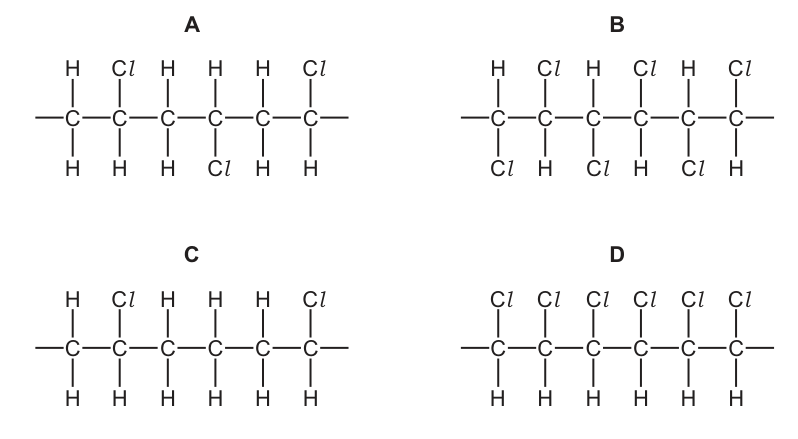
Options
A Structure A
B Structure B
C Structure C
D Structure D
Working
PVC stands for poly(chloroethene) or polyvinyl chloride. The monomer is chloroethene (vinyl chloride), which has the structure .
In addition polymerisation, the carbon-carbon double bond () breaks to form single bonds linking the monomer units together. The repeat unit is formed by taking the monomer, removing the double bond, and adding bonds to adjacent units:
This means the polymer chain consists of a carbon backbone where every second carbon atom is bonded to a chlorine atom (and a hydrogen atom), and the other carbon atoms in the chain are bonded to two hydrogen atoms ( groups).
Looking at the structures:
- Structure A: Shows a carbon chain where chlorine atoms are attached to alternating carbon atoms (C2, C4, C6), while the intervening carbons (C1, C3, C5) have only hydrogen atoms. This matches the repeat unit . (Note: The position of Cl up or down represents stereochemistry, but the connectivity is correct).
- Structure B: Shows every carbon atom bonded to a chlorine atom. This would correspond to a polymer from 1,2-dichloroethene (), not chloroethene.
- Structure C: Shows chlorine atoms only at the ends of the drawn section, not in a regular repeating pattern.
- Structure D: Shows every carbon atom bonded to a chlorine atom (same as B essentially), which is incorrect for PVC.
Therefore, Structure A is the correct representation.
Answer
A
A
Background Concept
Addition Polymerisation
Addition polymerisation is the process where unsaturated monomers (typically alkenes containing a double bond) join together to form a long chain polymer without the loss of any small molecules. The -bond of the alkene breaks, and the electrons form new -bonds with adjacent monomer units.
For a monomer of the form , the repeat unit is . The double bond becomes a single bond in the polymer backbone, and the substituents ( groups) hang off the carbon chain.
PVC (Polyvinyl Chloride)
PVC is a common plastic used for pipes, cable insulation, and flooring. It is made from the monomer chloroethene (also called vinyl chloride), which has the formula .
Understanding the Question
The question asks to identify the correct structural representation of a segment of the PVC polymer chain from four options (A, B, C, D). We need to deduce the structure of the polymer from the name "polyvinyl chloride" and match it to the diagrams.
Approach
- Identify the monomer: "vinyl chloride" or "chloroethene" is .
- Determine the repeat unit: Open the double bond to get .
- Analyze the connectivity: In the polymer chain, there must be a regular alternation of groups (carbons with 2 H's) and groups (carbons with 1 H and 1 Cl). Specifically, every other carbon in the chain must bear a chlorine atom.
- Evaluate the options: Check each structure to see if it matches this alternating pattern.
Step-by-Step Reasoning
- Monomer Analysis: The monomer is chloroethene, . One carbon has two hydrogens, the other has one hydrogen and one chlorine.
- Polymerisation: When these molecules polymerise, the double bond opens. The carbon that had two hydrogens () remains bonded to two hydrogens in the chain. The carbon that had the chlorine () remains bonded to one hydrogen and one chlorine.
- Repeat Unit: The repeating unit is . This means in a chain of carbons, if we number them 1, 2, 3, 4..., carbons 1, 3, 5... should be (bonded to 2 H's) and carbons 2, 4, 6... should be (bonded to 1 H and 1 Cl).
- Checking Structure A:
- C1: bonded to H, H ()
- C2: bonded to Cl, H ()
- C3: bonded to H, H ()
- C4: bonded to H, Cl () — note Cl is below, but connectivity is correct.
- C5: bonded to H, H ()
- C6: bonded to Cl, H ()
- This shows the correct alternating pattern: . This is correct.
- Checking Structure B: Every carbon has a Cl attached. This would come from a monomer like (1,2-dichloroethene). Incorrect.
- Checking Structure C: The chlorine atoms are not in a regular repeating pattern. C2 and C6 have Cl, but C4 does not. A polymer must have a regular repeating unit. Incorrect.
- Checking Structure D: Every carbon has a Cl attached (and an H). Similar to B, this implies every carbon is a unit, which is incorrect for PVC. Incorrect.
Key Takeaways
- PVC is poly(chloroethene). The name tells you the monomer.
- In addition polymers from substituted alkenes , the repeat unit is .
- The polymer chain backbone consists of carbon atoms, with the substituent (Cl in this case) attached to every other carbon atom.
- Stereochemistry (whether the Cl is drawn up or down) can vary (atactic, isotactic, syndiotactic), but the connectivity (which atoms are bonded to which) is the primary identifier in these questions.
Common Mistakes
- Confusing the monomer: Thinking PVC is made from ethene () or dichloroethene (). "Vinyl chloride" specifically means chloroethene.
- Miscounting substituents: In Structure B and D, students might not notice that every carbon has a chlorine, whereas in PVC only half the carbons (in the repeat unit) have a chlorine.
- Ignoring the double bond opening: Forgetting that the double bond becomes a single bond in the chain, so the carbons in the chain are hybridised and bonded to 4 things total (2 in chain + 2 substituents). All structures show this, but connectivity is key.
Things to Be Careful About
- Connectivity vs. Stereochemistry: In Structure A, the Cl on C4 is drawn pointing down, while Cl on C2 and C6 point up. This represents a specific stereochemical arrangement (likely syndiotactic or atactic depending on interpretation), but for the purpose of identifying the polymer structure (connectivity), what matters is that Cl is on alternating carbons. Do not reject A just because the Cl atoms aren't all on the same side.
- Repeat Unit: Ensure you understand that the repeat unit is . The empirical formula of the polymer is the same as the monomer. Structure A has the ratio C:Cl = 2:1 (roughly, looking at the segment 6 carbons, 3 Cls). Structure B and D have ratio 1:1.
A possible mechanism for the exothermic hydrolysis of 2-chloro-2-methylpropane is shown.
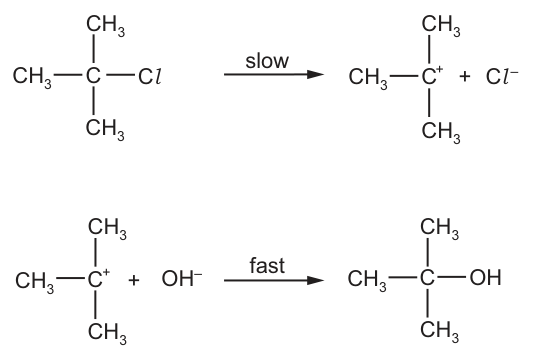
Which diagram represents the reaction pathway diagram for this mechanism?
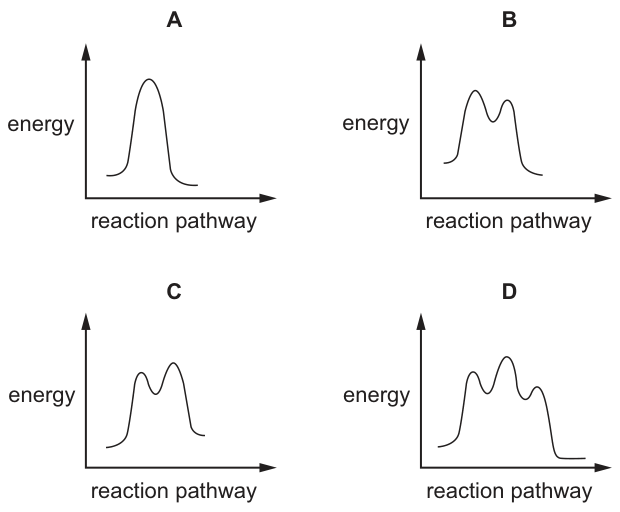
Options
A Diagram A
B Diagram B
C Diagram C
D Diagram D
Working
The mechanism has two steps, so the pathway diagram must have two peaks (transition states) and one intermediate (the valley between them). This eliminates A (one peak) and D (three peaks).
The first step is slow, meaning it has a higher activation energy than the second step. Therefore, the first peak must be higher than the second peak. This eliminates C.
The overall reaction is exothermic, so the products must be at a lower energy than the reactants. Diagram B satisfies all these conditions.
Answer
B
B
Background Concept
A reaction pathway diagram (or energy profile) plots the energy of the system against the reaction pathway (progress of the reaction). Each step in a mechanism corresponds to a peak (transition state) and the species formed between steps are intermediates, represented by the valleys between peaks. The height of each peak from the preceding valley (or reactants) is the activation energy for that step. The difference in energy between reactants and products indicates whether the overall reaction is exothermic (products lower than reactants) or endothermic (products higher than reactants). The slowest step in a mechanism has the highest activation energy and thus the highest peak on the pathway diagram.
Understanding the Question
We are given a two-step mechanism for the hydrolysis of 2-chloro-2-methylpropane. Step 1 is slow (formation of carbocation and chloride ion), and Step 2 is fast (reaction of carbocation with hydroxide ion to form the alcohol). We are also told the overall reaction is exothermic. We must select the correct energy profile diagram from four options.
Approach
- Determine the number of steps in the mechanism to find the number of peaks.
- Identify the slow step to determine which peak is higher.
- Use the overall exothermic nature of the reaction to check the relative energy of reactants and products.
Step-by-Step Reasoning
- The mechanism shows two distinct steps: the dissociation of the halogenoalkane into a carbocation and chloride ion (slow), followed by the reaction of the carbocation with hydroxide ions (fast). Two steps mean there are two transition states, so the diagram must have two peaks. Diagram A has one peak (single-step mechanism) and Diagram D has three peaks. Both are eliminated. Diagrams B and C both have two peaks.
- The rate-determining step (slow step) is the first step. The activation energy for the first step is the energy difference between the reactants and the first peak. The activation energy for the second step is the energy difference between the intermediate (valley) and the second peak. Since the first step is slower, it has a higher activation energy, meaning the first peak must be higher than the second peak. In Diagram C, the second peak is higher, which would imply the second step is slower. In Diagram B, the first peak is higher, matching the mechanism.
- The overall reaction is exothermic, meaning the products have less energy than the reactants. The final energy level on the right side of the diagram must be lower than the initial energy level on the left. Both B and C show this, but B is already confirmed by the peak heights.
- Therefore, Diagram B is the correct representation.
Key Takeaways
- Number of peaks = number of steps in the mechanism.
- Valleys between peaks represent reaction intermediates.
- The slowest step (rate-determining step) has the highest activation energy and corresponds to the highest peak.
- Exothermic overall reaction means products are at a lower energy level than reactants.
Common Mistakes
- Counting the number of species instead of the number of steps (e.g., thinking 3 species = 3 peaks).
- Confusing which peak is higher: the slow step has the higher activation energy, so its peak is higher, not lower.
- Forgetting that the overall reaction being exothermic means the final energy level must be lower than the initial level.
Things to Be Careful About
- Ensure the number of peaks exactly matches the number of mechanistic steps.
- Remember that the intermediate sits in a valley between the two peaks, not at the same energy as reactants or products.
- The activation energy for the second step is measured from the intermediate's energy level, not from the reactants' level.
Compound W contains atoms of carbon, nitrogen and hydrogen.
Compound W reacts with to produce propanoic acid.
Which row is correct?
Options
| functional group in compound W | name of compound W | |
|---|---|---|
| A | amine | ethylamine |
| B | nitrile | ethanenitrile |
| C | amine | propylamine |
| D | nitrile | propanenitrile |
Working
Nitriles () undergo acid hydrolysis with to give carboxylic acids. Since propanoic acid () is formed, compound W must be the nitrile with the same three-carbon skeleton: , which is propanenitrile. Amines would instead form an ammonium salt with , not a carboxylic acid.
Answer
D
D
Background Concept
Nitriles are organic compounds containing the cyano group, , attached to a carbon chain (general formula ). When a nitrile is heated with dilute acid such as , it undergoes acid hydrolysis: the triple bond is broken and water adds across it, converting the nitrile into a carboxylic acid and an ammonium salt.
The carbon atom of the cyano group is retained and becomes the carboxyl carbon of the acid, so the carboxylic acid produced has the same number of carbon atoms as the original nitrile. This is the key relationship that lets you work backwards from the product to the reactant.
Amines, by contrast, contain an amino group () and react with by simple acid-base neutralisation to form alkylammonium salts, e.g. . They never produce a carboxylic acid.
Understanding the Question
We are told that compound W contains carbon, nitrogen and hydrogen, and that it reacts with to produce propanoic acid. The options offer two possible functional groups (amine or nitrile) and two possible names (ethylamine/ethanenitrile with 2 carbons, or propylamine/propanenitrile with 3 carbons). The task is to pick the row that correctly identifies both the functional group and the name.
The command is essentially a deduction: use the reaction with to identify the functional group, then use the carbon count of the product to determine the name.
Approach
- Identify the reaction type. The conversion of a nitrogen-containing organic compound into a carboxylic acid using acid is the classic hydrolysis of a nitrile. This immediately rules out the amine options.
- Count the carbons. Propanoic acid is — three carbons in total. The nitrile that produces it must also have three carbons: .
- Name the nitrile. A three-carbon chain with a group is propanenitrile.
- Match to the options. Only row D gives nitrile + propanenitrile.
Step-by-Step Reasoning
- Functional group: The reaction with producing a carboxylic acid is the signature of nitrile hydrolysis. Amines would simply be protonated to give an ammonium salt and no carboxylic acid would form. Therefore W contains a nitrile group, eliminating options A and C.
- Carbon count: Propanoic acid has the structure . It contains three carbon atoms: the methyl carbon, the methylene carbon, and the carboxyl carbon. Since the nitrile carbon becomes the carboxyl carbon, the nitrile must have the same three-carbon skeleton: .
- Name: The IUPAC name for is propanenitrile (the parent chain is propane, with the group named as the nitrile suffix). This eliminates option B (ethanenitrile has only two carbons) and confirms D.
- Verification: Option D states the functional group is nitrile and the name is propanenitrile — both correct.
Key Takeaways
- Nitriles hydrolyse in acid to carboxylic acids with the same number of carbon atoms — the cyano carbon becomes the carboxyl carbon.
- Amines + give ammonium salts, not carboxylic acids; this distinction identifies the functional group.
- When naming a nitrile, count the total carbon chain including the nitrile carbon: propanenitrile has three carbons, ethanenitrile has two.
Common Mistakes
- Choosing an amine option because amines contain nitrogen and react with . The key point is the product: an amine would give an alkylammonium chloride, never a carboxylic acid. The formation of propanoic acid is the giveaway that W is a nitrile.
- Miscounting carbon atoms. Some students count only the alkyl chain and forget that the nitrile carbon is part of the chain. Propanoic acid has three carbons, so the nitrile must be propanenitrile (three carbons), not ethanenitrile (two).
- Confusing the reaction with reduction. Nitriles can be reduced to amines (e.g. with ), but the reaction here is with , which is hydrolysis, not reduction.
Things to Be Careful About
- Always count the carbon in the group when naming a nitrile: it is carbon number 1 of the chain.
- The hydrolysis of a nitrile requires heating with the acid; the question implies this condition by stating the reaction occurs, so no need to mention it in the answer.
- Remember the hydrolysis equation includes water: . The nitrogen leaves as ammonium ion, not as ammonia gas, under acidic conditions.
Two reactions are described.
- 2-bromo-2-methylbutane heated with
- 2-chloro-2-methylbutane heated with
In both reactions, the conditions are the same and is in excess.
of 2-bromo-2-methylbutane forms of product X.
[: 2-bromo-2-methylbutane, 150.9; 2-chloro-2-methylbutane, 106.5]
Which row is correct?
Options
| percentage yield of product X / % | relative rate of reaction | |
|---|---|---|
| A | 41 | 1 is faster than 2 |
| B | 41 | 2 is faster than 1 |
| C | 70 | 1 is faster than 2 |
| D | 70 | 2 is faster than 1 |
Working
Moles of 2-bromo-2-methylbutane = 30.18 / 150.9 = 0.200 mol
Product X is 2-methylbutan-2-ol, C5H12O, $M_r$ = 88.0
Theoretical mass of X = 0.200 × 88.0 = 17.6 g
Percentage yield = (12.32 / 17.6) × 100 = 70%
Relative rate: C—Br bond weaker than C—Cl, so reaction 1 is faster than reaction 2.
Answer
C
C
Background Concept
Tertiary halogenoalkanes react with aqueous sodium hydroxide by nucleophilic substitution (SN1 mechanism). The halogen atom is replaced by a hydroxide ion, producing a tertiary alcohol. For 2-bromo-2-methylbutane and 2-chloro-2-methylbutane, the product is the same: 2-methylbutan-2-ol, C5H12O.
The rate of this reaction depends on the ease of breaking the carbon–halogen bond in the rate-determining step. The C–Br bond is weaker than the C–Cl bond (bond enthalpy roughly 290 kJ mol⁻¹ vs 340 kJ mol⁻¹), so bromo compounds undergo substitution faster than chloro compounds.
Understanding the Question
The question gives the mass of 2-bromo-2-methylbutane used (30.18 g) and the actual mass of product X formed (12.32 g). We must:
- Identify product X.
- Calculate the percentage yield.
- Compare the relative rates of the two reactions.
The chloro compound is only used for the rate comparison; the yield is calculated from the bromo compound data.
Approach
- Recognise that both reactions give the same tertiary alcohol.
- Convert the mass of the bromo compound to moles.
- Use the 1:1 mole ratio to find the theoretical moles of product.
- Calculate the theoretical mass of product using its Mr.
- Divide actual mass by theoretical mass and multiply by 100.
- Compare C–X bond strengths to determine which reaction is faster.
Step-by-Step Reasoning
- Product X: both halogenoalkanes are tertiary, and aqueous NaOH favours substitution. The product is 2-methylbutan-2-ol, CH3C(OH)(CH3)CH2CH3, formula C5H12O, Mr = 88.0.
- Moles of 2-bromo-2-methylbutane = 30.18 g / 150.9 g mol⁻¹ = 0.200 mol.
- 1 mol halogenoalkane gives 1 mol alcohol, so theoretical moles of X = 0.200 mol.
- Theoretical mass of X = 0.200 × 88.0 = 17.6 g.
- Percentage yield = (12.32 / 17.6) × 100 = 70%.
- Rate: C–Br bond is weaker than C–Cl, so the bromo compound (reaction 1) reacts faster than the chloro compound (reaction 2).
This matches row C.
Key Takeaways
- Aqueous NaOH with tertiary halogenoalkanes gives tertiary alcohols via SN1.
- Percentage yield = (actual mass / theoretical mass) × 100%.
- Halogenoalkane reactivity order: RI > RBr > RCl > RF, determined by C–X bond strength.
Common Mistakes
- Using the Mr of the reactant instead of the product when calculating theoretical yield.
- Assuming alcoholic conditions (elimination to alkene) instead of aqueous (substitution to alcohol).
- Choosing "chloro faster" because chlorine is more electronegative; reactivity is governed by bond strength, not electronegativity.
Things to Be Careful About
- The yield calculation uses only the bromo compound data; the chloro compound is present only for the rate comparison.
- Ensure the product formula is correct before calculating Mr.
- Bond strength decreases down the group, so bromo compounds are more reactive than chloro compounds.
An alkene P reacts with an excess of hot concentrated acidified .
Methylpropanoic acid is the only organic product.
What is alkene P?
Options
A 2,5-dimethylhex-3-ene
B 2-methylbut-2-ene
C methylpropene
D oct-4-ene,
Working
Hot concentrated acidified cleaves the C=C bond completely. A carbon of the double bond that bears an H becomes a carboxylic acid; one bearing no H becomes a ketone; a terminal becomes .
Methylpropanoic acid is . For it to be the only organic product, cleavage must give two identical molecules of it, so each alkene carbon must be a carbon attached to an isopropyl group:
This is 2,5-dimethylhex-3-ene.
Answer
A
A
Background Concept
Hot concentrated acidified potassium manganate(VII), , is a strong oxidising agent. With an alkene it does not merely add across the double bond (as cold dilute does, forming a diol); it cleaves the C=C bond completely, breaking both the bond and the bond. The fragments become carbonyl compounds. The product at each carbon is fixed by how many hydrogen atoms that carbon carries:
- A carbon of the C=C that carries one H and is bonded to another carbon () is oxidised to a carboxylic acid, .
- A carbon that carries no H () is oxidised to a ketone, .
- A terminal carbon is oxidised to , which is not an organic product.
So an alkene gives a mixture of acids, ketones and depending on substitution.
Methylpropanoic acid means 2-methylpropanoic acid, structure : a branched C4 carboxylic acid.
Understanding the Question
The question states that hot concentrated acidified reacts with an unknown alkene P, and methylpropanoic acid is the only organic product. We must identify P from four options. The key phrase is "only organic product": the cleavage must produce just one organic compound, and that compound is methylpropanoic acid. Any alkene that also gives a ketone, a different acid, or is wrong.
Approach
Work backwards from the product. Since only one organic product forms, both halves of the alkene must give the same acid. The acid must come from a double-bond carbon of type attached to an isopropyl group . Therefore the alkene is the symmetric molecule . Then verify this matches one of the options by naming it, and check the other options by working out their cleavage products.
Step-by-Step Reasoning
- Write methylpropanoic acid: .
- The double-bond carbon that becomes this acid must be a carbon bonded to , because the acid's -carbon (next to COOH) is a CH carrying the isopropyl group.
- "Only organic product" requires both alkene carbons to give the same acid, so the alkene is symmetric: .
- Name it: the longest chain containing the double bond has 6 carbons (hex-3-ene), with methyl groups at C2 and C5, so 2,5-dimethylhex-3-ene — option A.
- Check the other options:
- B 2-methylbut-2-ene, : the left carbon has no H, so it gives propanone ; the right carbon has one H, giving ethanoic acid . Two different products, neither methylpropanoic acid.
- C methylpropene, : the left carbon has no H, giving propanone; the terminal gives . Products are propanone and , no organic acid at all.
- D oct-4-ene, : each double-bond carbon has one H, so cleavage gives two molecules of butanoic acid , not methylpropanoic acid.
Key Takeaways
- Hot concentrated acidified cleaves the C=C bond; the product at each carbon is set by its H-substitution ( → carboxylic acid, → ketone, → ).
- "Only one organic product" from cleavage implies a symmetric alkene.
- Be able to name an alkene from its structure: longest chain containing the double bond, lowest locant for the double bond, substituents in alphabetical order.
Common Mistakes
- Using cold dilute chemistry (diol formation) instead of hot concentrated (oxidative cleavage).
- Thinking a terminal gives a carboxylic acid — it gives .
- Naming the alkene incorrectly, e.g. calling a 4-carbon chain instead of hex-3-ene.
- Choosing D because it is symmetric — but its cleavage product is butanoic acid, not methylpropanoic acid.
Things to Be Careful About
- "Methylpropanoic acid" is 2-methylpropanoic acid, — the methyl is on C2.
- Symmetry alone is not enough; the cleavage product must be the correct acid (butanoic vs methylpropanoic).
- Count carbons carefully: the alkene has 8 carbons in total, 4 on each side of the double bond.
Three substances are listed.
- butane
- hydrogen
- hydrogen bromide
Which substances are possible products of the free-radical substitution reaction between ethane and bromine?
Options
A 1, 2 and 3
B 1 and 2 only
C 1 and 3 only
D 2 and 3 only
Working
Free-radical substitution of ethane with bromine:
- Propagation: — hydrogen bromide is formed.
- Termination: — butane is formed.
- Hydrogen is not a product of any step.
Answer
C (1 and 3 only)
C
Background Concept
Free-radical substitution is the mechanism by which alkanes react with halogens (notably chlorine and bromine) in the presence of ultraviolet light. The reaction proceeds through three stages: initiation, propagation, and termination. In initiation, the halogen molecule undergoes homolytic fission to form two halogen radicals, each carrying an unpaired electron. In propagation, these radicals attack the alkane, abstracting a hydrogen atom and forming a new carbon-centred radical, which then reacts with more halogen molecules to regenerate the halogen radical and sustain the chain. In termination, two radicals combine to form a stable molecule, removing radicals from the system and ending the chain reaction.
Understanding the Question
The question presents three substances — butane (), hydrogen (), and hydrogen bromide () — and asks which could be produced when ethane () reacts with bromine () via free-radical substitution. The key word is "possible": any product formed in any step of the mechanism counts, not just the major monosubstituted product (bromoethane). This is a common exam trap: students often recall only the main product and forget the by-products of propagation and termination.
Approach
Write out the complete mechanism — initiation, both propagation steps, and all termination steps — then check each substance against the products. The key insight is that HBr is produced in the propagation step when a bromine radical abstracts a hydrogen from ethane, and butane is produced in a termination step when two ethyl radicals combine. Hydrogen gas is never produced because the hydrogen atoms abstracted from ethane always bond to bromine (forming HBr), not to each other.
Step-by-Step Reasoning
- Initiation: (homolytic fission under UV light). The Br–Br bond breaks evenly, producing two bromine radicals.
- Propagation step 1: . The bromine radical abstracts a hydrogen atom from ethane, forming an ethyl radical and hydrogen bromide. This is where HBr (product 3) is formed.
- Propagation step 2: . The ethyl radical reacts with a bromine molecule to form bromoethane and regenerate a bromine radical, sustaining the chain.
- Termination steps (radical + radical):
- (butane). Two ethyl radicals combine to form butane. This is where butane (product 1) is formed.
- .
- .
Checking each substance:
- Butane — YES, formed in the termination step when two ethyl radicals combine.
- Hydrogen — NO, no step produces . The hydrogen abstracted from ethane always forms HBr with the bromine radical, never .
- Hydrogen bromide — YES, formed in the first propagation step.
Therefore, products 1 and 3 are possible, but 2 is not. The correct answer is C.
Distractor analysis:
- Option A (1, 2 and 3): wrongly includes hydrogen. A student might think that because C–H bonds break, hydrogen gas is released — but the hydrogen atom is transferred to the bromine radical, forming HBr.
- Option B (1 and 2 only): includes hydrogen and omits HBr, showing a misunderstanding of the propagation step.
- Option D (2 and 3 only): includes hydrogen and omits butane, missing the termination product.
Key Takeaways
- Free-radical substitution produces multiple products: the monosubstituted haloalkane, HBr from propagation, and alkanes from termination (radical combination).
- The termination step where two identical alkyl radicals combine produces a longer-chain alkane (here, butane from two ethyl radicals).
- Hydrogen gas is never a product of halogenation of alkanes; the hydrogen abstracted forms the hydrogen halide.
Common Mistakes
- Forgetting the termination steps and their products — butane is a valid product here.
- Assuming hydrogen gas is produced because C–H bonds are broken — the hydrogen is transferred to the halogen radical to form HBr, not released as .
- Confusing free-radical substitution with combustion, which does produce water and carbon oxides.
Things to Be Careful About
- The question says "possible products," so every step of the mechanism counts — including termination.
- The propagation step produces HBr, not — this is the key discriminator.
- Butane is formed only in termination, which requires two ethyl radicals to collide — a minor but real pathway that the mark scheme credits.
The structure of the testosterone molecule is shown.
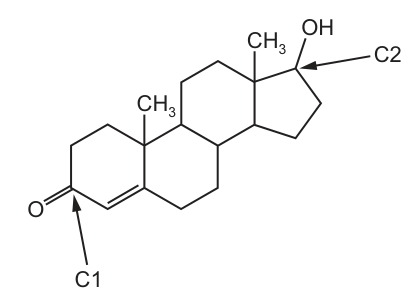
Which statements are correct?
- Carbon atoms C1 and C2 can be oxidised with acidified .
- There are fewer than 27 hydrogen atoms in one testosterone molecule.
- There are six chiral carbon atoms in one testosterone molecule.
Options
A 1 only
B 2 and 3
C 2 only
D 3 only
Working
Statement 1: Carbon C1 is the carbonyl carbon of a ketone group. Ketones cannot be oxidised by acidified . Carbon C2 is bonded to a hydroxyl group, a methyl group, and two ring carbons, making it a tertiary alcohol carbon. Tertiary alcohols cannot be oxidised by acidified because there is no hydrogen atom on the carbon bearing the group. Thus, statement 1 is incorrect.
Statement 2: The molecular formula of testosterone is . There are 28 hydrogen atoms in one molecule. Since is not fewer than , statement 2 is incorrect.
Statement 3: A chiral carbon atom is an -hybridised carbon bonded to four different groups. In the testosterone structure, the chiral carbons are:
- The five ring-junction carbons (four at the fusion of rings A/B/C and one at the fusion of rings C/D bearing a methyl group).
- The carbon in the five-membered ring bonded to the group (C17 in standard numbering, labeled near C2 in the diagram).
There are exactly 6 chiral carbon atoms. Thus, statement 3 is correct.
Only statement 3 is correct.
Answer
D
D
Background Concept
Oxidation of Organic Compounds: Acidified potassium dichromate(VI) () is a common oxidising agent. Primary alcohols can be oxidised to aldehydes and then to carboxylic acids. Secondary alcohols can be oxidised to ketones. Tertiary alcohols and ketones resist oxidation under these conditions because there is no hydrogen atom on the carbon bearing the functional group (for alcohols) or because breaking a C-C bond is required (for ketones), which demands much harsher conditions.
Chirality: A chiral carbon (stereocenter) is an atom bonded to four different groups. In organic chemistry, this is most commonly an -hybridised carbon atom. Identifying chiral centers in complex molecules like steroids requires carefully tracing the four substituents attached to each carbon to ensure they are not identical.
Molecular Formulae: For complex molecules, counting atoms directly from a skeletal structure can be error-prone. Knowing or deducing the molecular formula (e.g., for testosterone) allows quick verification of atom counts.
Understanding the Question
The question presents the skeletal structure of testosterone and asks to evaluate three statements:
- Whether specific carbons (C1 and C2 as labeled in the diagram) can be oxidised by acidified dichromate.
- Whether the total number of hydrogen atoms is less than 27.
- Whether there are exactly six chiral carbon atoms.
We must determine which statements are true to select the correct option (A, B, C, or D). The marking scheme confirms the answer is D (statement 3 only).
Approach
- For Statement 1: Identify the functional groups at the labeled carbons. C1 points to the ketone carbonyl carbon. C2 points to the carbon bearing the hydroxyl group in the five-membered ring. Apply oxidation rules for ketones and tertiary alcohols.
- For Statement 2: Determine the molecular formula of testosterone. Testosterone is a well-known steroid with the formula . Compare the number of hydrogens (28) with 27.
- For Statement 3: Systematically scan the molecule for carbons with four different substituents. Focus on ring junctions and carbons with heteroatom substituents. Count them and verify if there are six.
Step-by-Step Reasoning
Evaluating Statement 1:
- The arrow labeled C1 points to the carbon of the group in the first ring. This is a ketone. Ketones cannot be oxidised by acidified because doing so would require breaking a strong C-C bond. Therefore, C1 cannot be oxidised.
- The arrow labeled C2 points to the carbon in the five-membered ring that is bonded to an group, a group, and two ring carbons. This makes it a tertiary alcohol. Tertiary alcohols cannot be oxidised by acidified dichromate because the carbon bearing the group has no hydrogen atoms to remove. Therefore, C2 cannot be oxidised.
- Since neither carbon can be oxidised, Statement 1 is incorrect.
Evaluating Statement 2:
- The molecular formula of testosterone is .
- This means there are 28 hydrogen atoms in one molecule.
- is not fewer than . (If counting from the structure: 4 methyl groups = 12 H; the double bond has 1 H; the remaining carbons in the rings account for the rest, totaling 28 H).
- Therefore, Statement 2 is incorrect.
Evaluating Statement 3:
- A chiral carbon must be hybridised and bonded to four different groups. Let's identify them in the steroid skeleton:
- Ring junction between A and B (bottom): This carbon is bonded to H, a in ring A, a in ring B, and the quaternary ring junction carbon. (4 different groups) -> Chiral.
- Ring junction between A and B (top, with methyl): Bonded to , the ketone carbon, the chiral ring junction below, and the next ring junction carbon. (4 different groups) -> Chiral.
- Ring junction between B and C (top): Bonded to H, in ring B, in ring C, and the next ring junction. (4 different groups) -> Chiral.
- Ring junction between B and C (bottom): Bonded to H, the quaternary carbon from A/B junction, in ring B, and in ring C. (4 different groups) -> Chiral.
- Ring junction between C and D (top, with methyl): Bonded to , in ring C, in ring C/D junction, and the carbon with the OH group. (4 different groups) -> Chiral.
- Carbon with the OH group (in ring D): Bonded to , , the ring junction carbon above, and a in ring D. (4 different groups) -> Chiral.
- Counting these gives exactly 6 chiral carbon atoms.
- Therefore, Statement 3 is correct.
Since only statement 3 is correct, the correct option is D.
Key Takeaways
- Oxidation limits: Always check if a carbon is primary, secondary, or tertiary (for alcohols) or if it's a ketone. Only primary/secondary alcohols and aldehydes are readily oxidised by acidified dichromate.
- Chirality in rings: Ring junctions and carbons with substituents on rings are common chiral centers. Always check all four paths around the ring to ensure the groups are different.
- Molecular formulas: For complex natural products, memorizing or deriving the molecular formula is faster and more reliable than counting every hydrogen on a skeletal structure.
Common Mistakes
- Misidentifying oxidation sites: Students might think the carbon can be oxidised, or that any alcohol can be oxidised. Remember: ketones and tertiary alcohols do not react with mild oxidising agents like acidified .
- Miscounting hydrogens: Skeletal structures omit hydrogen atoms on carbons. Students often forget to add the implicit hydrogens to satisfy carbon's valency of 4, leading to an incorrect count (e.g., counting fewer than 28).
- Overlooking chiral centers: Students may only look for carbons with heteroatoms (like the C-OH carbon) and miss the ring junction carbons, which are often chiral due to the asymmetry of the fused ring system.
Things to Be Careful About
- Label interpretation: The labels C1 and C2 in the diagram are not standard IUPAC steroid numbering (where the ketone is at C3 and the alcohol at C17). Always follow the arrows in the diagram to identify the specific atoms being discussed.
- State symbols and reagents: While not tested here, remember that acidified dichromate is . The oxidation of alcohols requires the presence of a hydrogen on the alpha-carbon.
- Chirality definition: A carbon in a ring can be chiral even if two paths around the ring seem similar; trace the full path to the next point of difference. In fused ring systems like steroids, the asymmetry of the fusion (e.g., cis vs trans) makes the junction carbons chiral.
The structural formula of hept-1,4,5-triene is shown.
How many of the carbon atoms in one molecule of hept-1,4,5-triene are hybridised?
Options
A 4
B 5
C 6
D 7
Working
Write the structure showing all double bonds:
Label the carbon atoms 1 to 7. A carbon is if it has 3 sigma bonds and no lone pairs; it is if it has 2 sigma bonds, as in the central carbon of a cumulated diene.
- and :
- :
- :
- : (two double bonds)
- :
- :
So the number of carbon atoms is 4.
Answer
A
A
Background Concept
Carbon hybridisation is determined by the number of regions of electron density around the carbon atom, which is the number of sigma bonds plus any lone pairs. A carbon with four sigma bonds is (tetrahedral), one with three sigma bonds and one p orbital is (trigonal planar), and one with two sigma bonds and two p orbitals is (linear).
In an alkene, each carbon of the double bond forms three sigma bonds, so it is hybridised. However, in a cumulated diene such as , the central carbon forms only two sigma bonds, so it is hybridised, not .
Understanding the Question
The question asks how many carbon atoms in one molecule of hept-1,4,5-triene are hybridised. The name tells us there are seven carbon atoms and three double bonds at positions 1, 4 and 5. The condensed formula given is:
Writing out the double bonds gives:
Notice that the double bonds at positions 4 and 5 share a carbon atom, forming a cumulated system.
Approach
Draw the complete carbon skeleton with all hydrogens. For each carbon, count the number of sigma bonds it forms. Then assign hybridisation:
- 4 sigma bonds →
- 3 sigma bonds →
- 2 sigma bonds →
Finally, count only the carbons.
Step-by-Step Reasoning
Number the carbon atoms from the end nearest the first double bond:
- : double bond to and two H atoms → 3 sigma bonds →
- : double bond to , single bond to , one H → 3 sigma bonds →
- : single bonds to and , two H atoms → 4 sigma bonds →
- : double bond to , single bond to , one H → 3 sigma bonds →
- : double bonds to both and , no H atoms → 2 sigma bonds →
- : double bond to , single bond to , one H → 3 sigma bonds →
- : single bond to , three H atoms → 4 sigma bonds →
The carbons are , , and : a total of 4. Therefore the correct option is A.
Key Takeaways
- Hybridisation is decided by the number of sigma bonds, not by the number of double bonds.
- A carbon in a normal double bond is .
- The central carbon of a cumulated system is , because it has only two sigma bonds.
- Always draw the full structural formula before counting hybridisation.
Common Mistakes
- Assuming every carbon in a molecule containing double bonds is ; this ignores carbons such as and .
- Forgetting that the central carbon of a cumulated diene is , not .
- Counting the number of double bonds instead of the number of carbons.
- Misreading the condensed formula and missing the cumulated unit.
Things to Be Careful About
- Use the locants in the name (1,4,5-triene) to place the double bonds correctly.
- Include all hydrogen atoms when drawing the structure; this makes sigma-bond counting straightforward.
- The central carbon of a cumulated diene has no hydrogen atoms, which is a clue that it is .
- Count carefully: three double bonds do not automatically mean six carbons when one carbon is shared between two double bonds.
Hydrocarbon X is saturated. Each molecule contains one ring of carbon atoms.
The mass spectrum of hydrocarbon X is measured.
The peak representing the ion is high.
The peak representing the ion is high.
What is the value for the ion of X?
Options
A 56
B 58
C 70
D 72
Working
The [M+1]+ peak arises from molecules containing one \textsuperscript{13}C atom. The natural abundance of \textsuperscript{13}C is about 1.1% of \textsuperscript{12}C.
Ratio of peak heights:
Each carbon atom contributes approximately 1.1% to the [M+1]+ peak, so:
Hydrocarbon X is saturated with one ring, so it is a cycloalkane with formula .
For : , molar mass .
Answer
C (70)
C
Background Concept
In mass spectrometry, the molecular ion (M+) corresponds to the intact molecule where every carbon is the most abundant isotope, \textsuperscript{12}C. A small fraction of molecules contain one \textsuperscript{13}C atom (natural abundance ~1.1%) instead of \textsuperscript{12}C, producing a peak at one mass unit higher, the [M+1]+ peak. The relative height of the [M+1]+ peak to the M+ peak is therefore proportional to the number of carbon atoms in the molecule.
Understanding the Question
We are told hydrocarbon X is saturated and contains one ring of carbon atoms. This means X is a cycloalkane with general formula . The mass spectrum gives the heights of the M+ and [M+1]+ peaks. We must use these to find the number of carbon atoms, then the molar mass, which equals the m/e of the M+ ion.
Approach
- Compute the ratio of the [M+1]+ to M+ peak heights.
- Divide this ratio by the fractional abundance of \textsuperscript{13}C (0.011) to obtain the number of carbon atoms.
- Use the cycloalkane formula to calculate the molar mass and hence the m/e of M+.
Step-by-Step Reasoning
- Peak height ratio: .
- Since each carbon contributes about 1.1% (0.011) to the [M+1]+ peak, the number of carbons is .
- A saturated hydrocarbon with one ring has formula . For , this is .
- Molar mass: .
- The m/e of the M+ ion equals the relative molecular mass, so m/e = 70.
Key Takeaways
- The [M+1]+ peak height relative to M+ gives the number of carbon atoms.
- A saturated hydrocarbon with one ring is a cycloalkane, formula .
- The m/e of the molecular ion equals the relative molecular mass.
Common Mistakes
- Using the alkane formula instead of the cycloalkane formula.
- Forgetting to divide the peak ratio by the \textsuperscript{13}C abundance (1.1%).
- Misreading the peak heights or the ratio.
Things to Be Careful About
- The natural abundance of \textsuperscript{13}C is approximately 1.1%, i.e. 0.011 as a fraction.
- The [M+1]+ peak may also have small contributions from other isotopes (e.g. \textsuperscript{2}H), but for hydrocarbons these are negligible.
- Ensure the molecular formula matches the degree of unsaturation: one ring means one degree of unsaturation, so .
Your score so far
Answer a question to start scoring
Your marks add up here as you work through the paper.