Chemistry 9701/22 — February/March 2025
Cambridge AS Level · AS Level Structured Questions · worked solutions for every part, with the mark scheme
Topics Chemical Bonding · Introduction to Organic Chemistry · Carboxylic Acids and Derivatives · Hydroxy Compounds · Electrochemistry · Equilibria · +11 more
Phosphorus and chlorine are elements in Period 3 of the Periodic Table.
Chlorine forms three different compounds with phosphorus.
The most common compounds are and .
Answer
| compound | oxidation number of P | oxidation number of |
|---|---|---|
| +3 | -1 | |
| +5 | -1 |
PCl3: P = +3, Cl = -1; PCl5: P = +5, Cl = -1
Background Concept
Oxidation number is a bookkeeping tool that assigns electrons to the more electronegative atom in a bond. For a neutral molecule, the sum of all oxidation numbers must equal zero. Chlorine is more electronegative than phosphorus (Cl: 3.16, P: 2.19 on the Pauling scale), so in any P–Cl bond, chlorine takes the electrons and is assigned an oxidation number of -1.
Understanding the Question
The question asks for the oxidation numbers of both phosphorus and chlorine in PCl₃ and PCl₅. This is a direct application of the rule that the sum of oxidation numbers in a neutral compound equals zero.
Approach
Since chlorine is more electronegative, assign Cl = -1 in both compounds. Then solve for P using the zero-sum rule.
Step-by-Step Reasoning
For PCl₃:
- Cl is more electronegative, so each Cl = -1
- Sum of oxidation numbers = 0: P + 3(-1) = 0
- P = +3
For PCl₅:
- Cl is more electronegative, so each Cl = -1
- Sum of oxidation numbers = 0: P + 5(-1) = 0
- P = +5
Note that phosphorus shows variable oxidation states because it has five valence electrons (3s²3p³) and can expand its octet using 3d orbitals, allowing it to form five covalent bonds.
Key Takeaways
- The more electronegative element gets the negative oxidation number in a binary compound.
- Phosphorus can show oxidation states of +3 and +5 due to its five valence electrons.
- Always check: sum of oxidation numbers = 0 for neutral molecules.
Common Mistakes
- Assigning Cl as +1 because it comes second in the formula (order in formula does not determine oxidation number sign).
- Forgetting that the sum must be zero for a neutral compound.
Things to Be Careful About
- Write the sign before the number (e.g., +3 not 3+), though both are generally accepted.
- Ensure you give both oxidation numbers for each compound as the table requires.
In a closed system, and exist in an equilibrium mixture as shown in reaction 1.
Deduce two conditions that favour the production of in reaction 1.
1
2
Answer
- Low temperature — the forward reaction is exothermic (), so decreasing temperature shifts the equilibrium to the right, favouring .
- High pressure — there is 1 mole of gas on the left and 0 moles of gas on the right, so increasing pressure shifts the equilibrium to the side with fewer gas molecules (the right).
Low temperature and high pressure
Background Concept
Le Chatelier's principle states that when a system at equilibrium is subjected to a change in conditions, the equilibrium shifts to oppose that change. For temperature, the system shifts in the endothermic direction when heated and in the exothermic direction when cooled. For pressure (in gas-phase equilibria), the system shifts toward the side with fewer moles of gas when pressure is increased.
Understanding the Question
The reaction is with kJ mol⁻¹. We need to deduce two conditions that favour the forward reaction (production of PCl₅).
Approach
Examine two features of the equation: (1) the sign of ΔH tells us about temperature; (2) the number of moles of gas on each side tells us about pressure. Note that only gaseous species count for the pressure argument — PCl₃ is liquid and PCl₅ is solid.
Step-by-Step Reasoning
Temperature:
- kJ mol⁻¹ means the forward reaction is exothermic (releases heat).
- Lowering the temperature causes the equilibrium to shift in the exothermic direction to produce more heat, i.e., to the right.
- Therefore, low temperature favours PCl₅ production.
Pressure:
- Left side: 1 mole of gas (Cl₂). PCl₃ is liquid, so it does not contribute.
- Right side: 0 moles of gas (PCl₅ is solid).
- Increasing pressure shifts equilibrium toward the side with fewer moles of gas — the right side.
- Therefore, high pressure favours PCl₅ production.
Key Takeaways
- Always check state symbols before counting moles of gas for the pressure argument.
- Exothermic forward reactions are favoured by low temperature.
- Reactions that reduce the number of gas moles are favoured by high pressure.
Common Mistakes
- Counting PCl₃(l) or PCl₅(s) as contributing to the gas mole count.
- Saying 'high temperature' because it speeds up the reaction (confusing rate with equilibrium position).
- Saying 'low pressure' by incorrectly counting solid/liquid species as gases.
Things to Be Careful About
- The question asks for conditions that favour production of PCl₅ (the forward direction), not the reverse.
- Be precise: say 'low temperature' not 'cool' and 'high pressure' not 'compress'.
The third compound of phosphorus and chlorine, W, has a relative molecular mass, , between that of and . The compound contains 69.6% by mass of chlorine.
Determine the molecular formula of W.
Working
Percentage of P = 100 - 69.6 = 30.4%
Mole ratio:
Empirical formula = (empirical formula mass = 31.0 + 2(35.5) = 102)
of = 137.5; of = 208.5
, which lies between 137.5 and 208.5.
Answer
Molecular formula of W =
P2Cl4
Background Concept
To determine a molecular formula from percentage composition, one first finds the empirical formula by converting percentages to moles and simplifying to the smallest whole-number ratio. The molecular formula is then found by determining how many empirical formula units fit within the actual relative molecular mass.
Understanding the Question
Compound W contains only P and Cl, is 69.6% Cl by mass, and has an Mr between PCl₃ (137.5) and PCl₅ (208.5). We must find its molecular formula.
Approach
- Find the mass percentage of P by subtraction.
- Convert both percentages to moles using Ar values.
- Divide by the smaller to get the simplest ratio → empirical formula.
- Calculate the empirical formula mass and compare with the Mr constraint to find the molecular formula.
Step-by-Step Reasoning
Step 1: Percentage of P
- %P = 100 - 69.6 = 30.4%
Step 2: Moles
- Moles of P = 30.4 / 31.0 = 0.981
- Moles of Cl = 69.6 / 35.5 = 1.961
Step 3: Ratio
- Divide by smaller: P : Cl = 0.981/0.981 : 1.961/0.981 = 1 : 2
- Empirical formula = PCl₂
Step 4: Molecular formula
- Empirical formula mass of PCl₂ = 31 + 2(35.5) = 102
- We need Mr between 137.5 and 208.5
- 102 × 1 = 102 (too low, below 137.5)
- 102 × 2 = 204 (between 137.5 and 208.5 ✓)
- Molecular formula = P₂Cl₄
Key Takeaways
- Percentage composition gives the empirical formula; the Mr constraint gives the molecular formula.
- Always check that your final Mr falls within any stated range.
- The empirical formula mass is the key multiplier between empirical and molecular formula.
Common Mistakes
- Forgetting to subtract from 100 to find the percentage of P.
- Reporting the empirical formula (PCl₂) instead of the molecular formula (P₂Cl₄).
- Using the wrong Ar values (e.g., Cl = 35 instead of 35.5).
Things to Be Careful About
- The question specifies Mr is between PCl₃ and PCl₅, which eliminates PCl₂ (Mr = 102) and confirms P₂Cl₄ (Mr = 204).
- Round the mole ratio carefully; 0.98 : 1.96 is clearly 1 : 2.
W is a liquid at room temperature and pressure. It reacts vigorously with water to form an acidic solution.
Suggest the structure and bonding in W. Explain your answer.
Answer
- Structure: simple molecular — because it is a liquid at room temperature (low melting/boiling point), indicating weak intermolecular forces between molecules.
- Bonding: covalent — because it reacts vigorously with water (hydrolysis), which is characteristic of covalent chlorides of non-metals.
Simple molecular structure with covalent bonding
Background Concept
The physical state and chemical behaviour of a substance reveal its structure and bonding. Simple molecular substances have low melting and boiling points because only weak intermolecular forces (van der Waals or dipole-dipole) hold the molecules together in the solid/liquid state. Covalent chlorides of non-metals (such as PCl₃, PCl₅, SiCl₄) are hydrolysed by water because the central atom has available d-orbitals or is electron-deficient, allowing nucleophilic attack by water. In contrast, ionic chlorides (like NaCl) simply dissolve without reacting.
Understanding the Question
W is P₂Cl₄. It is a liquid at RTP and reacts vigorously with water to give an acidic solution. We must deduce its structure and bonding and justify each conclusion.
Approach
Link each observation to a structural/bonding conclusion:
- Liquid at RTP → low melting point → weak forces between molecules → simple molecular structure.
- Reacts with water (hydrolysis) → covalent bonding (ionic compounds dissolve, not hydrolyse).
Step-by-Step Reasoning
Structure — simple molecular:
- Being a liquid at room temperature means the melting point is low.
- Low melting points are characteristic of simple molecular structures where only weak intermolecular forces (van der Waals forces) need to be overcome to melt.
- Giant covalent or ionic structures would be solids with high melting points.
Bonding — covalent:
- The vigorous reaction with water to form an acidic solution is hydrolysis.
- Hydrolysis is characteristic of covalent chlorides of non-metals (e.g., PCl₃ + 3H₂O → H₃PO₃ + 3HCl).
- Ionic chlorides (e.g., NaCl, MgCl₂) dissolve in water without vigorous reaction.
- The acidic solution results from HCl being produced during hydrolysis.
Key Takeaways
- Physical state at RTP is a diagnostic for structure type (simple molecular vs giant).
- Hydrolysis by water is a diagnostic for covalent bonding in Period 3 chlorides.
- The combination of low mp + hydrolysis uniquely identifies a simple covalent molecular substance.
Common Mistakes
- Saying 'it has a low boiling point' without linking to the type of force (intermolecular vs intramolecular).
- Saying 'it is molecular' without specifying 'simple molecular' (as opposed to giant molecular).
- Confusing the reason for acidity: it is the HCl produced by hydrolysis, not the compound itself being an acid.
Things to Be Careful About
- The mark scheme requires both the conclusion AND the reason for each point.
- 'Weak intermolecular forces' or 'low melting point' are both acceptable justifications for simple molecular.
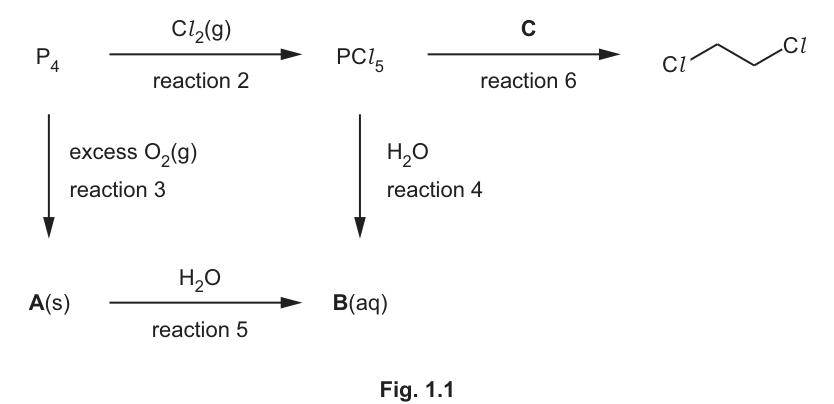
Fig. 1.1 shows a reaction scheme involving and .
Answer
The green colour of chlorine gas disappears (as it reacts with phosphorus).
Green colour of gas disappears
Background Concept
Chlorine is a pale green gas with a pungent odour. When it reacts with phosphorus, the chlorine is consumed, so its characteristic green colour fades or disappears. Phosphorus burns in chlorine to form white solid phosphorus chlorides (PCl₃ or PCl₅ depending on conditions).
Understanding the Question
Reaction 2 is P₄ + Cl₂(g) → PCl₅. The question asks what is observed — a visible change that a student in the lab would report.
Approach
Identify the most obvious visual change: chlorine is green and gaseous; as it is consumed, the green colour disappears.
Step-by-Step Reasoning
- Chlorine gas is green in colour.
- In reaction 2, chlorine reacts with phosphorus to form solid PCl₅.
- As the reaction proceeds, chlorine is used up, so the green colour of the gas disappears.
- (White fumes/solid of PCl₅ may also be noted, but the mark scheme specifically credits the disappearance of the green colour.)
Key Takeaways
- Observations should describe what you see, not name the products.
- The colour of chlorine (green) is a standard recall fact for Period 3 reactions.
Common Mistakes
- Saying 'a white solid forms' — while true, the mark scheme specifically credits the disappearance of the green colour.
- Saying 'the reaction is exothermic' — this is a conclusion, not an observation.
Things to Be Careful About
- Use 'green colour disappears' or 'green gas is decolourised' — both are acceptable.
- Do not confuse this with the observation for reaction with oxygen (white smoke).
Answer
Trigonal bipyramidal
Trigonal bipyramidal
Background Concept
VSEPR (Valence Shell Electron Pair Repulsion) theory predicts molecular shapes based on the number of electron pairs around the central atom. Phosphorus in PCl₅ has five bonding pairs and zero lone pairs (5 valence electrons each forming one bond with a Cl). Five electron pairs adopt a trigonal bipyramidal arrangement to minimise repulsion: three equatorial pairs at 120° and two axial pairs at 90° to the equatorial plane.
Understanding the Question
The question asks for the shape of a PCl₅ molecule. This is a standard VSEPR application.
Approach
Count electron pairs around P: 5 bonding pairs, 0 lone pairs → 5 electron domains → trigonal bipyramidal.
Step-by-Step Reasoning
- P has 5 valence electrons.
- Each electron forms a bond with a Cl atom → 5 bonding pairs.
- No lone pairs remain on P.
- 5 electron domains with 0 lone pairs → trigonal bipyramidal geometry.
- Bond angles: 120° (equatorial-equatorial) and 90° (axial-equatorial).
Key Takeaways
- PCl₅ is the classic example of expanded octet and trigonal bipyramidal geometry.
- Five electron domains with no lone pairs always give trigonal bipyramidal.
Common Mistakes
- Writing 'tetrahedral' (that is for 4 domains) or 'octahedral' (that is for 6 domains).
- Confusing PCl₅ (trigonal bipyramidal) with SF₆ (octahedral).
Things to Be Careful About
- Write 'trigonal bipyramidal' (or 'trigonal bipyramid') — both spellings are accepted.
Answer
P4 + 5O2 -> P4O10
Background Concept
Phosphorus burns in excess oxygen to form phosphorus(V) oxide, P₄O₁₀ (also written as P₂O₅ in its empirical form, but the molecular formula is P₄O₁₀). This is a white solid that is the anhydride of phosphoric(V) acid.
Understanding the Question
Reaction 3 shows P₄ reacting with excess O₂(g) to form solid A. We need to write the balanced equation for this reaction.
Approach
P₄ + O₂ → P₄O₁₀. Balance oxygen: 10 O atoms needed on the right, so 5 O₂ molecules on the left.
Step-by-Step Reasoning
- Reactants: P₄ and O₂ (excess oxygen means complete oxidation to P(V)).
- Product: P₄O₁₀ (phosphorus(V) oxide), a white solid.
- Balance: P₄ + 5O₂ → P₄O₁₀
- Check: 4 P on each side, 10 O on each side ✓
Key Takeaways
- Excess oxygen gives P₄O₁₀ (P in +5 state); limited oxygen would give P₄O (P in +3 state).
- The molecular formula is P₄O₁₀, not P₂O₅ (which is the empirical formula).
Common Mistakes
- Writing P₂O₅ instead of P₄O₁₀ (the molecular formula is required since P₄ is the reactant).
- Not balancing the equation correctly.
- Writing P₄O₆ (that would be with limited oxygen).
Things to Be Careful About
- State symbols are not required here but the equation must be balanced.
- Use P₄ not 4P as the reactant (the question uses P₄).
Answer
Phosphoric(V) acid
Phosphoric(V) acid
Background Concept
P₄O₁₀ is the anhydride of phosphoric(V) acid: P₄O₁₀ + 6H₂O → 4H₃PO₄. PCl₅ also hydrolyses in water: PCl₅ + 4H₂O → H₃PO₄ + 5HCl. Both reactions produce phosphoric(V) acid (H₃PO₄) in aqueous solution.
Understanding the Question
B is formed in both reaction 4 (PCl₅ + H₂O) and reaction 5 (P₄O₁₀ + H₂O). We need to name the common product B(aq).
Approach
Identify the aqueous product common to both hydrolysis reactions. Both give H₃PO₄ in solution.
Step-by-Step Reasoning
- Reaction 4: PCl₅ + 4H₂O → H₃PO₄ + 5HCl → B is H₃PO₄ (phosphoric(V) acid)
- Reaction 5: P₄O₁₀ + 6H₂O → 4H₃PO₄ → B is H₃PO₄ (phosphoric(V) acid)
- The common product is phosphoric(V) acid.
Key Takeaways
- P₄O₁₀ is the acidic anhydride of H₃PO₄.
- PCl₅ hydrolysis also gives H₃PO₄ (plus HCl).
- The (V) in the name indicates phosphorus is in the +5 oxidation state.
Common Mistakes
- Writing 'phosphoric acid' without the (V) — while sometimes accepted, the IUPAC name includes the oxidation state.
- Confusing with phosphoric(III) acid (H₃PO₃), which comes from PCl₃ or PO₆.
- Writing the formula instead of the name (the question says 'Name B').
Things to Be Careful About
- The question asks for the name, not the formula.
- 'Phosphoric(V) acid' is the expected answer; 'phosphoric acid' may be accepted but is less precise.
Answer
C is ethane-1,2-diol:
HO-CH2-CH2-OH (ethane-1,2-diol)
Background Concept
PCl₅ is a powerful chlorinating agent that converts hydroxyl (-OH) groups into chloro (-Cl) groups. With alcohols: ROH + PCl₅ → RCl + POCl₃ + HCl. With diols (compounds with two -OH groups), both -OH groups are replaced by -Cl. Therefore, if PCl₅ reacts with a compound to give 1,2-dichloroethane (ClCH₂CH₂Cl), the starting compound must be ethane-1,2-diol (HOCH₂CH₂OH).
Understanding the Question
Reaction 6 shows PCl₅ + C → 1,2-dichloroethane (Cl-CH₂-CH₂-Cl). We must identify C and draw its structure.
Approach
Work backwards: 1,2-dichloroethane has Cl on both carbons. PCl₅ replaces -OH with -Cl. So C must have -OH on both carbons → ethane-1,2-diol.
Step-by-Step Reasoning
- Product: ClCH₂CH₂Cl (1,2-dichloroethane)
- PCl₅ converts -OH → -Cl (this is its characteristic reaction with alcohols)
- Working backwards: replace each -Cl with -OH
- C = HOCH₂CH₂OH (ethane-1,2-diol)
- The reaction is: HOCH₂CH₂OH + 2PCl₅ → ClCH₂CH₂Cl + 2POCl₃ + 2HCl
Key Takeaways
- PCl₅ is a selective chlorinating agent for -OH groups.
- To deduce the starting material, reverse the substitution: -Cl in product → -OH in reactant.
- Ethane-1,2-diol (ethylene glycol) is a common diol.
Common Mistakes
- Drawing ethene (CH₂=CH₂) — PCl₅ does not add Cl₂ across a double bond in this context.
- Drawing ethanol (CH₃CH₂OH) — this would give chloroethane, not 1,2-dichloroethane.
- Not drawing the full displayed formula showing all atoms and bonds.
Things to Be Careful About
- The question says 'draw the structure', so a displayed formula showing all atoms and bonds is expected.
- Both -OH groups must be shown on adjacent carbons.
1,2-dichloroethane, , reacts with to produce an unsaturated compound, , as shown in reaction 7.
Answer
Contains one or more carbon-carbon double bonds (C=C).
Contains a C=C double bond
Background Concept
In organic chemistry, 'unsaturated' refers to a compound that contains at least one carbon-carbon double bond (C=C) or triple bond (C≡C), meaning it has fewer hydrogen atoms than the corresponding saturated alkane. The term comes from the ability of such compounds to 'add' hydrogen (or other atoms) across the multiple bond.
Understanding the Question
The question asks for the definition of 'unsaturated' as applied to the organic product C₂H₃Cl (chloroethene, vinyl chloride).
Approach
State the standard definition: presence of C=C (or C≡C) double/multiple bonds.
Step-by-Step Reasoning
- C₂H₃Cl has the formula CH₂=CHCl (chloroethene).
- It contains a C=C double bond.
- 'Unsaturated' means the molecule contains one or more C=C (or C≡C) bonds.
- This is in contrast to 'saturated' compounds which contain only C-C single bonds.
Key Takeaways
- Unsaturated = contains C=C or C≡C bonds.
- The term relates to the ability to undergo addition reactions.
- C₂H₃Cl is chloroethene (vinyl chloride), the monomer for PVC.
Common Mistakes
- Saying 'contains double bonds' without specifying carbon-carbon double bonds (C=O is a double bond but does not make a compound 'unsaturated' in the alkene sense).
- Saying 'can undergo addition reactions' — this is a consequence, not the definition.
Things to Be Careful About
- The mark scheme accepts 'C=C', 'double bond', or 'multiple bond' as the key term.
- Be specific: it is the carbon-carbon multiple bond that defines unsaturation.
Answer
Ethanol (as solvent) and heat (reflux).
Ethanol solvent and heat
Background Concept
Halogenoalkanes undergo elimination when treated with NaOH (or KOH) dissolved in ethanol and heated. The hydroxide ion acts as a base, removing a proton (H⁺) from a β-carbon while the halide leaves, forming a C=C double bond. This contrasts with nucleophilic substitution, which occurs with aqueous NaOH (where OH⁻ acts as a nucleophile rather than a base).
Understanding the Question
Reaction 7 converts 1,2-dichloroethane to chloroethene (C₂H₃Cl) by elimination of HCl. We need the conditions.
Approach
Recall the standard conditions for elimination of halogenoalkanes: alcoholic NaOH (NaOH in ethanol) and heat.
Step-by-Step Reasoning
- The reaction eliminates HCl from 1,2-dichloroethane to form a C=C bond (chloroethene).
- This is an elimination reaction.
- Conditions for elimination: NaOH dissolved in ethanol (not water) and heated under reflux.
- The ethanol solvent favours elimination over substitution because it reduces the nucleophilicity of OH⁻ while maintaining its basicity.
Key Takeaways
- Aqueous NaOH → substitution; ethanolic NaOH + heat → elimination.
- The solvent choice (water vs ethanol) determines the mechanism.
- Both conditions (ethanol AND heat) must be stated for full marks.
Common Mistakes
- Saying 'aqueous NaOH' — this gives substitution, not elimination.
- Saying only 'heat' without mentioning ethanol as the solvent.
- Saying 'concentrated NaOH' without specifying the solvent.
Things to Be Careful About
- The mark scheme requires BOTH 'ethanol' AND 'heat' for the one mark. Stating only one is insufficient.
Compound D contains carbon, hydrogen and chlorine only.
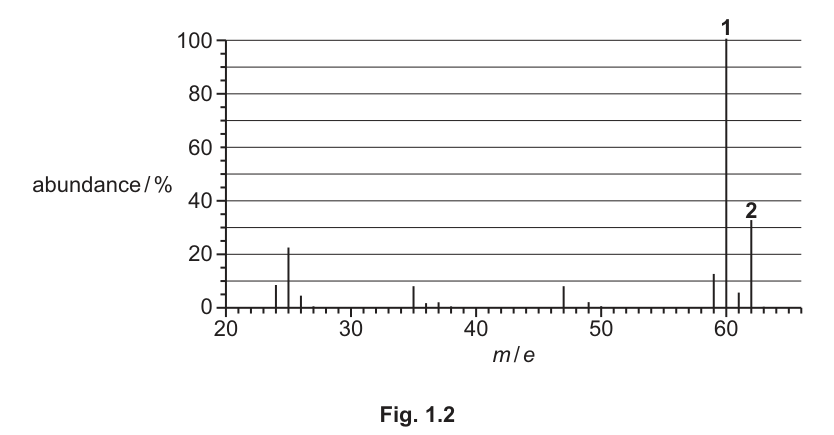
Fig. 1.2 shows the mass spectrum of D.
Answer
The ratio of peaks 1 to 2 is approximately 3:1 (100:33), which is characteristic of a molecule containing one chlorine atom, due to the natural abundances of the isotopes (75%) and (25%).
3:1 ratio due to two isotopes of chlorine (35Cl and 37Cl)
Background Concept
Chlorine has two stable isotopes: ³⁵Cl (approximately 75% abundance) and ³⁷Cl (approximately 25% abundance). In a mass spectrum, a molecule containing one chlorine atom will show a molecular ion peak (M) and an M+2 peak in a ratio of approximately 3:1. This is because the molecule can contain either ³⁵Cl (giving mass M) or ³⁷Cl (giving mass M+2), and the relative probabilities reflect the natural isotope abundances.
Understanding the Question
Peak 1 is at m/e = 60 (M peak, containing ³⁵Cl) and peak 2 is at m/e = 62 (M+2 peak, containing ³⁷Cl). Their relative abundances are 100% and approximately 33%. We must explain this ratio.
Approach
Identify that the 3:1 ratio is the signature of one chlorine atom in the molecule, arising from the two isotopes of chlorine.
Step-by-Step Reasoning
- Peak 1 at m/e = 60: this is the molecular ion containing ³⁵Cl.
- Peak 2 at m/e = 62: this is the molecular ion containing ³⁷Cl (M+2 peak).
- The ratio 100:33 ≈ 3:1 matches the natural abundance ratio of ³⁵Cl:³⁷Cl = 75:25 = 3:1.
- This confirms the molecule contains exactly one chlorine atom.
- (If it contained two Cl atoms, we would see M:M+2:M+4 in a ratio of approximately 9:6:1.)
Key Takeaways
- A 3:1 M:M+2 ratio = one chlorine atom.
- A 1:1 M:M+2 ratio = one bromine atom (⁷⁹Br and ⁸¹Br are roughly equal abundance).
- The M+2 peak is always 2 mass units higher than M when caused by a heavier isotope.
Common Mistakes
- Saying 'chlorine has two isotopes' without linking to the 3:1 ratio and the abundance values.
- Attributing the peaks to different molecules rather than isotopic variants of the same molecule.
- Confusing with the 1:1 ratio of bromine.
Things to Be Careful About
- Must mention BOTH the 3:1 ratio AND the two isotopes of chlorine (³⁵Cl and ³⁷Cl) with their relative abundances.
- The mark scheme requires the link between the ratio and the isotopes.
Answer
(chloroethyne / chloroacetylene)
Cl-C≡C-H
Background Concept
From the mass spectrum, the molecular ion peak at m/e = 60 gives Mr = 60. The compound contains only C, H, and Cl. With one chlorine atom (mass 35), the remaining mass is 60 - 35 = 25, which must be accounted for by carbon and hydrogen atoms. The only combination of C and H that gives mass 25 is C₂H (2×12 + 1 = 25). So the molecular formula is C₂HCl. With only two carbons and one hydrogen, the structure must contain a triple bond: Cl-C≡C-H (chloroethyne).
Understanding the Question
D contains C, H, and Cl only. From the mass spectrum, Mr = 60. We must suggest a structure.
Approach
- Subtract the mass of one Cl (35) from Mr (60) to get 25 for C and H.
- Determine the combination: 2C + 1H = 25 ✓
- Molecular formula = C₂HCl.
- Propose a structure: with only 2 C and 1 H, a triple bond is required to satisfy valency → Cl-C≡C-H.
Step-by-Step Reasoning
- Mr = 60 (from peak 1)
- Contains 1 Cl (from the 3:1 isotope pattern): mass contribution = 35
- Remaining mass = 60 - 35 = 25
- C₂H = 2(12) + 1 = 25 ✓
- Molecular formula = C₂HCl
- Valency check: C needs 4 bonds, H needs 1, Cl needs 1.
- Structure: Cl-C≡C-H (chlorine bonded to one carbon via single bond, triple bond between the two carbons, hydrogen on the other carbon).
- This is chloroethyne (chloroacetylene).
Key Takeaways
- Use the isotope pattern to confirm the number of Cl atoms, then subtract to find the rest of the formula.
- Check valency when proposing structures: each C must have 4 bonds total.
- C₂HCl can only exist as a linear molecule with a C≡C triple bond.
Common Mistakes
- Proposing CH₂=CCl (this has Mr = 62, not 60, and doesn't match the formula C₂HCl).
- Forgetting to check valency: Cl-C=C-H would leave carbons with incomplete octets.
- Writing the formula as C₂HCl without drawing the structure (the question asks for the structure).
Things to Be Careful About
- Draw the triple bond clearly: Cl-C≡C-H.
- The structure must be linear (sp hybridised carbons).
- Ensure the molecular formula matches: C₂HCl, Mr = 24 + 1 + 35 = 60 ✓.
Answer
Metallic bonding is the electrostatic attraction between positive metal ions (cations) and delocalised electrons.
Electrostatic attraction between positive metal ions and delocalised electrons.
Background Concept
Metallic bonding is the force that holds the atoms together in a metal. It is modelled as a 'sea of electrons' or 'electron gas' surrounding a regular lattice of positive metal ions (cations). The valence electrons of the metal atoms are not bound to any specific atom; instead, they are delocalised and free to move throughout the entire metallic structure.
Understanding the Question
The question asks for a definition of metallic bonding and allocates 2 marks. This requires stating the nature of the force (electrostatic attraction) and identifying the two species that are attracting each other (positive metal ions and delocalised electrons).
Approach
Recall the standard definition of metallic bonding. Ensure both key components are mentioned: the attractive force and the particles involved.
Step-by-Step Reasoning
- Identify the force: It is an electrostatic attraction (opposite charges attract).
- Identify the positive species: Metal atoms lose their valence electrons to become positive metal ions (cations).
- Identify the negative species: The lost valence electrons become delocalised, forming a 'sea' of electrons that can move freely.
- Combine these into a concise definition: 'Electrostatic attraction between positive metal ions and delocalised electrons.'
Key Takeaways
A precise definition must name the force (electrostatic attraction) and both types of particles (positive metal ions/cations and delocalised electrons). Vague answers like 'attraction between atoms and electrons' will not score.
Common Mistakes
- Stating 'attraction between metal atoms and electrons' (reject 'atoms' for 'ions').
- Forgetting to specify that the electrons are 'delocalised'.
- Writing 'ionic bonding' or confusing it with covalent bonding.
Things to Be Careful About
Use precise terminology: 'electrostatic attraction', 'positive metal ions' (or 'cations'), and 'delocalised electrons'.
The Group 2 elements form stable cations.
State and explain the variation in ionic radius of the Group 2 elements down the group.
Answer
Ionic radius increases down the group. This is because each successive ion has an extra shell of electrons, increasing the distance from the nucleus to the outermost electrons.
Ionic radius increases down the group due to the addition of extra electron shells.
Background Concept
The ionic radius is the radius of an ion in an ionic crystal lattice. For Group 2 elements, the atoms lose two electrons to form cations. The size of these cations depends on the distance from the nucleus to the outermost occupied electron shell.
Understanding the Question
The question asks to state and explain the variation in ionic radius of Group 2 elements down the group. 'State' means give the trend (increase or decrease). 'Explain' means give the structural reason for this trend.
Approach
- State the trend: As you go down Group 2 (Be, Mg, Ca, Sr, Ba), the ionic radius increases.
- Explain the trend: Moving down the group, the atomic number increases. Each successive element has electrons in a higher principal quantum shell (n). Even though the nuclear charge increases, the addition of a new, larger electron shell dominates, and the inner electrons shield the outer electrons from the nucleus. Thus, the outermost electrons (and the ionic radius) are further from the nucleus.
Step-by-Step Reasoning
- State the trend: The ionic radius increases down the group. (1 mark)
- Explain the trend: Each successive Group 2 element has an extra shell of electrons. (1 mark)
- The outermost electrons in the ion are in a higher principal energy level (e.g., Mg has electrons up to n=2, Ca up to n=3).
- Although the nuclear charge (number of protons) increases down the group, the inner electron shells provide shielding. The addition of a new, larger shell means the distance from the nucleus to the outermost electrons increases, resulting in a larger ionic radius.
Key Takeaways
When explaining size trends down a group, always mention the addition of extra electron shells (or principal quantum levels). Shielding is also a valid supporting point.
Common Mistakes
- Stating 'more electrons' without specifying 'extra shell'.
- Saying 'nuclear charge increases so radius increases' (incorrect reasoning; increased nuclear charge would pull electrons closer if shielding were constant).
- Confusing atomic radius trends with ionic radius trends (though the trend direction is the same, the explanation must refer to the ion's electron configuration).
Things to Be Careful About
Ensure you are talking about the ionic radius (the ion), not the atomic radius, although the reasoning (extra shells) is identical. Be precise with 'extra shell' or 'additional electron shell'.
Table 2.1 shows successive ionisation energy values for beryllium, .
Table 2.1
| 1st | 2nd | 3rd | 4th | |
|---|---|---|---|---|
| ionisation energy / | 900 | 1760 | 14800 | 21000 |
Use Table 2.1 to state and explain:
- the general trend in these values
- the significance of the large difference between the 2nd and 3rd ionisation energies.
Answer
The ionisation energies increase because successive electrons are removed from smaller ions with less shielding (or greater attraction to the nucleus). The large difference between the 2nd and 3rd ionisation energies indicates that the 3rd electron is being removed from an inner shell (or a lower energy level) closer to the nucleus.
IEs increase due to less shielding/smaller ionic radius; large jump between 2nd and 3rd IE indicates removal from an inner shell.
Background Concept
Successive ionisation energies are the energies required to remove electrons one by one from a gaseous atom or ion. The first IE removes an electron from a neutral atom; the second from a ion, and so on. A large jump in ionisation energy occurs when an electron is removed from a new, inner principal energy level (shell) that is closer to the nucleus and experiences less shielding.
Understanding the Question
We are given the first four IEs for beryllium (Be): 900, 1760, 14800, 21000 kJ mol. We need to:
- State and explain the general trend (900 -> 1760 -> 14800 -> 21000).
- Explain the significance of the large difference between the 2nd (1760) and 3rd (14800) values.
Approach
- General trend: Look at the values from 1st to 4th. They all increase. Explain why: as electrons are removed, the ion becomes more positive, pulling the remaining electrons closer (smaller ionic radius) and reducing electron-electron repulsion (less shielding). Thus, more energy is needed to remove the next electron.
- Large difference: Compare 2nd (1760) and 3rd (14800). There is a massive jump (almost a factor of 10). This indicates a change in the shell from which the electron is being removed. Be has configuration 1s 2s. Removing the first two electrons takes them from the n=2 shell. The 3rd electron must come from the n=1 shell (1s), which is much closer to the nucleus and has no shielding from other inner electrons.
Step-by-Step Reasoning
- General trend: The ionisation energies increase from the 1st to the 4th. (1 mark)
- Explanation: As successive electrons are removed, the number of electrons decreases but the nuclear charge remains the same. This means there is less shielding (or electron-electron repulsion) and the remaining electrons are held more tightly in a smaller ionic radius. The attraction between the nucleus and the electrons is greater, so more energy is required to remove them.
- Large difference between 2nd and 3rd IE: There is a large increase in energy required to remove the 3rd electron compared to the 2nd. (1 mark)
- Explanation: This indicates that the 3rd electron is being removed from an inner shell (or lower energy level, specifically the n=1 shell) that is closer to the nucleus. The first two electrons were removed from the outer shell (n=2), which is further away and shielded by the inner shell.
Key Takeaways
A large jump in successive ionisation energies always signals the removal of an electron from a new, inner principal energy level. The general increase in successive IEs is due to decreasing ionic radius and decreasing shielding.
Common Mistakes
- Saying 'nuclear charge increases' (nuclear charge is constant for a given element).
- Not specifying that the 3rd electron comes from an inner shell or lower energy level.
- Failing to mention 'less shielding' or 'smaller ionic radius' when explaining the general increasing trend.
Things to Be Careful About
Ensure you distinguish between the general trend (gradual increase) and the large jump (discontinuous increase). The question asks for both.
All the Group 2 elements except beryllium have more than one stable isotope.
Beryllium exists as the single isotope .
Describe the distribution of mass within an atom of .
Answer
Most of the mass is in the nucleus because the protons and neutrons (nucleons) are located there, while the electrons have negligible mass.
Most mass is in the nucleus containing protons and neutrons; electrons have negligible mass.
Background Concept
An atom consists of a small, dense, positively charged nucleus containing protons and neutrons (collectively called nucleons), surrounded by a cloud of negatively charged electrons. The mass of a proton is approximately kg, a neutron is kg, and an electron is kg. The electron is about 1/1836 the mass of a proton.
Understanding the Question
The question asks to describe the distribution of mass within an atom of . This requires stating where the mass is concentrated and why, based on the properties of the subatomic particles.
Approach
- State where most of the mass is located (the nucleus).
- Explain why (protons and neutrons are in the nucleus and are much heavier than electrons).
Step-by-Step Reasoning
- Location of mass: The vast majority of the atom's mass is concentrated in the nucleus. (1 mark)
- Reason: The nucleus contains protons and neutrons (nucleons), which account for almost all the mass. The electrons orbiting the nucleus have negligible mass compared to nucleons and contribute almost nothing to the total mass of the atom. (1 mark)
Key Takeaways
Mass is concentrated in the nucleus because nucleons (protons and neutrons) are much more massive than electrons. The nucleus is tiny compared to the overall size of the atom but contains nearly all its mass.
Common Mistakes
- Saying 'electrons have no mass' (they have negligible mass, not zero).
- Forgetting to mention that protons and neutrons are in the nucleus.
- Confusing mass distribution with charge distribution (charge is also in the nucleus, but the question specifically asks about mass).
Things to Be Careful About
Use the term 'nucleons' or explicitly name 'protons and neutrons'. Emphasise 'most of the mass' or 'negligible mass' for electrons.
Complete Table 2.2 to show the numbers of protons and neutrons in the isotopes of magnesium.
Table 2.2
| isotope | number of protons | number of neutrons |
|---|---|---|
| magnesium-24 | ||
| magnesium-25 | ||
| magnesium-26 |
Answer
| isotope | number of protons | number of neutrons |
|---|---|---|
| magnesium-24 | 12 | 12 |
| magnesium-25 | 12 | 13 |
| magnesium-26 | 12 | 14 |
Working
Magnesium has atomic number , so all isotopes have 12 protons. Number of neutrons .
- Mg-24:
- Mg-25:
- Mg-26:
Mg-24: 12p, 12n; Mg-25: 12p, 13n; Mg-26: 12p, 14n
Background Concept
Isotopes are atoms of the same element that have the same number of protons (atomic number, Z) but a different number of neutrons (mass number, A, differs). The atomic number defines the element (for magnesium, Z = 12). The mass number A = Z + N, where N is the number of neutrons.
Understanding the Question
We need to complete a table showing the number of protons and neutrons for three isotopes of magnesium: magnesium-24, magnesium-25, and magnesium-26. The numbers '24', '25', '26' are the mass numbers (A).
Approach
- Identify the atomic number of magnesium from the periodic table (Z = 12). This is the number of protons and is constant for all isotopes.
- Calculate the number of neutrons for each isotope using the formula: neutrons = mass number (A) - atomic number (Z).
Step-by-Step Reasoning
- Protons: Magnesium is element 12, so it has 12 protons in all its isotopes. (Fill '12' in the protons column for all rows).
- Neutrons for Mg-24: Mass number A = 24. Neutrons = .
- Neutrons for Mg-25: Mass number A = 25. Neutrons = .
- Neutrons for Mg-26: Mass number A = 26. Neutrons = .
Key Takeaways
All isotopes of an element have the same number of protons. The number of neutrons varies, which is what makes them different isotopes. Use to find neutrons.
Common Mistakes
- Changing the number of protons for different isotopes (isotopes must have the same Z).
- Subtracting incorrectly or using the wrong mass number.
- Confusing mass number (top number in isotope notation) with atomic number (bottom number).
Things to Be Careful About
Ensure the table is filled correctly for all three isotopes. A single error in one row might cost a mark, but all correct values earn full marks.
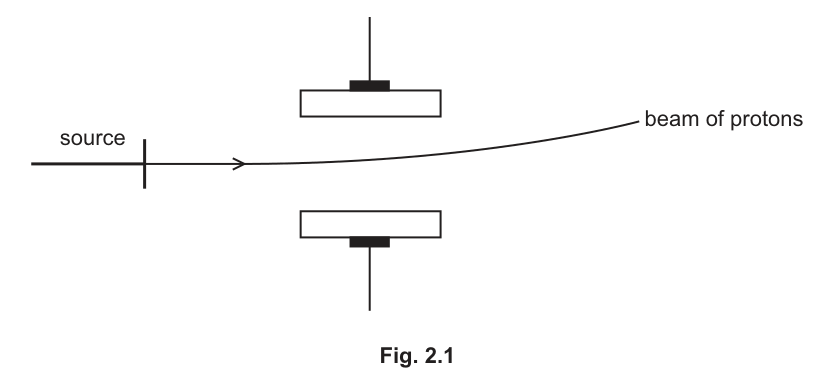
Fig. 2.1 shows the behaviour of a beam of protons in an electric field.
Complete Fig. 2.1 to show the behaviour of separate beams of neutrons and electrons in the same electric field.
Label your diagram clearly. Assume that the beams of each particle are moving at the same velocity.
Answer
Neutron beam: A horizontal straight line from the source, passing undeflected between the plates.
Electron beam: A curve deflecting downwards (towards the lower plate), with a greater curvature (deflected more) than the proton beam.
Labels: 'beam of neutrons' for the straight line, 'beam of electrons' for the downward curve.
Working
- Protons (+) deflect upwards, so the upper plate is negative and lower plate is positive.
- Neutrons (0) are neutral, so no deflection.
- Electrons (-) are attracted to the positive (lower) plate, so they deflect downwards.
- Electrons have much less mass than protons (), so for the same velocity and charge magnitude, acceleration is much greater, causing greater deflection.
Neutron beam: straight line. Electron beam: curves downwards, more deflected than protons.
Background Concept
When a beam of charged particles passes through an electric field (created by two parallel charged plates), the particles experience a force , where is the charge and is the electric field strength. This force causes the particles to deflect towards the plate of opposite charge. The acceleration of the particle is given by . Therefore, the deflection depends on the charge-to-mass ratio () of the particle.
Neutral particles (like neutrons) have , so they experience no force and travel in a straight line.
Understanding the Question
Fig 2.1 shows a beam of protons deflecting upwards towards the upper plate. This tells us the upper plate is negative (attracting the positive protons) and the lower plate is positive. We need to draw the paths of a neutron beam and an electron beam in the same field, assuming they all have the same initial velocity.
Approach
- Determine the plate charges from the proton beam's deflection.
- Predict the neutron beam's path (neutral -> no deflection).
- Predict the electron beam's path (negative charge -> deflected towards positive plate; low mass -> greater deflection).
- Draw and label the paths.
Step-by-Step Reasoning
- Analyze the proton beam: Protons are positive (). They deflect upwards, so they are attracted to the upper plate. Therefore, the upper plate is negative and the lower plate is positive.
- Neutron beam: Neutrons have no charge (). They are unaffected by the electric field. Path: Straight horizontal line from the source, passing straight through between the plates. (1 mark)
- Electron beam: Electrons have a negative charge (). They will be attracted to the positive plate, which is the lower plate. Path: Curves downwards towards the lower plate. (1 mark)
- Magnitude of deflection: The force is for both protons and electrons (same magnitude of charge). However, the mass of an electron is much smaller than the mass of a proton (). Since , the electron's acceleration is much greater. Therefore, the electron beam is deflected more (has a tighter curve) than the proton beam. (1 mark)
Key Takeaways
- Neutral particles: no deflection.
- Opposite charges attract: electrons deflect opposite to protons.
- Lower mass (with same charge magnitude) means greater acceleration and greater deflection.
Common Mistakes
- Drawing the electron beam deflecting upwards (forgetting electrons are negative).
- Drawing the electron beam with less deflection than the proton beam (forgetting electrons are much lighter).
- Failing to label the beams clearly.
Things to Be Careful About
- Ensure the electron curve is visibly more curved (deflected more) than the proton curve.
- The neutron beam must be a perfectly straight line, not slightly curved.
- Label both new beams clearly as 'beam of neutrons' and 'beam of electrons'.
State what is observed when dilute hydrochloric acid is added to separate samples of barium oxide and barium carbonate.
barium oxide
barium carbonate
Answer
barium oxide: The white solid disappears / dissolves.
barium carbonate: Effervescence (bubbling / fizzing) occurs and the white solid disappears / dissolves.
Working
- BaO + 2HCl BaCl(aq) + HO(l) (neutralisation, solid dissolves)
- BaCO + 2HCl BaCl(aq) + HO(l) + CO(g) (gas evolved = effervescence, solid dissolves)
BaO: solid dissolves. BaCO3: effervescence and solid dissolves.
Background Concept
Group 2 oxides (MO) are basic and react with acids to form a salt and water (neutralisation reaction). Group 2 carbonates (MCO) react with acids to form a salt, water, and carbon dioxide gas. Both barium oxide and barium carbonate are white solids. Barium chloride (BaCl) is soluble in water, so the solid will dissolve in both cases.
Understanding the Question
We need to describe the visual observations when dilute hydrochloric acid (HCl) is added to separate samples of barium oxide (BaO) and barium carbonate (BaCO). 'Observation' means what you can see, hear, or feel, not the chemical equation.
Approach
- Recall the reaction of a metal oxide with an acid: salt + water. No gas is produced. The solid dissolves.
- Recall the reaction of a metal carbonate with an acid: salt + water + carbon dioxide. Gas is produced (effervescence) and the solid dissolves.
- Describe the visual changes for each.
Step-by-Step Reasoning
- Barium oxide (BaO):
- Reaction:
- Observation: BaO is a white solid. BaCl is soluble. Therefore, the white solid disappears / dissolves. (1 mark)
- Barium carbonate (BaCO):
- Reaction:
- Observation: CO gas is produced, causing effervescence (bubbling / fizzing). BaCl is soluble, so the white solid disappears / dissolves. Both observations are required. (1 mark)
Key Takeaways
- Oxide + acid salt + water (solid dissolves, no gas).
- Carbonate + acid salt + water + CO (solid dissolves, effervescence).
- Always describe what is seen (dissolves, bubbles) rather than what happens chemically (neutralises, decomposes).
Common Mistakes
- Saying 'it fizzes' for the oxide (no gas is produced).
- Saying 'a gas is produced' without using the term 'effervescence' (though 'gas bubbles' is often acceptable, 'effervescence' is the precise term).
- Forgetting to mention the solid dissappears/dissolves.
- Writing the chemical equation instead of describing the observation.
Things to Be Careful About
The question asks for 'what is observed'. Stick to visual/auditory descriptions: 'solid disappears', 'dissolves', 'effervescence', 'bubbles', 'fizzing'. Do not write equations unless asked.
Answer
Sr + 2H2O -> Sr(OH)2 + H2
Background Concept
Group 2 metals react with water to form the metal hydroxide and hydrogen gas. The reactivity increases down the group. Beryllium does not react with water. Magnesium reacts very slowly with cold water (but readily with steam). Calcium, strontium, and barium react with cold water, with the reaction becoming more vigorous down the group. Strontium reacts with cold water to form strontium hydroxide, which is soluble (or slightly soluble, but typically written as aqueous in this context for excess water), and hydrogen gas.
Understanding the Question
Write a balanced chemical equation for the reaction of strontium (Sr) with an excess of cold water. State symbols are required.
Approach
- Identify the reactants: Strontium metal (Sr) and water (HO).
- Identify the products: Strontium hydroxide (Sr(OH)) and hydrogen gas (H).
- Balance the equation and add state symbols.
Step-by-Step Reasoning
- Unbalanced equation:
- Balance: There are 2 OH groups in Sr(OH), so we need 2 HO. This gives 4 H atoms on the left, and 2 (in hydroxide) + 2 (in hydrogen) = 4 H atoms on the right. Balanced.
- State symbols:
- Strontium is a solid metal: (s)
- Water is a liquid: (l)
- Strontium hydroxide is in solution (excess cold water): (aq)
- Hydrogen is a gas: (g)
- Final equation:
Key Takeaways
Group 2 metals + water metal hydroxide + hydrogen. Remember to balance the equation and include correct state symbols. For excess water, the hydroxide is aqueous.
Common Mistakes
- Forgetting to balance the water (writing Sr + HO Sr(OH) + H).
- Wrong state symbols: water as (g) instead of (l), or Sr(OH) as (s) instead of (aq) (though Sr(OH) is only slightly soluble, in excess cold water it is typically considered aqueous for this level, or (aq) is accepted; mark scheme accepts (aq)).
- Writing H instead of H for hydrogen gas.
Things to Be Careful About
Ensure the equation is fully balanced and state symbols are correct. The mark scheme gives B1 for the correct equation, implying state symbols and balancing are checked.
Answer
The solubility of Group 2 sulfates decreases down the group.
Decreases down the group.
Background Concept
There are two important and opposite solubility trends for Group 2 compounds:
- Hydroxides: Solubility increases down the group. (Be(OH) is insoluble, Mg(OH) is slightly soluble, Ca(OH) is sparingly soluble, Ba(OH) is soluble).
- Sulfates: Solubility decreases down the group. (MgSO is soluble, CaSO is slightly soluble, SrSO is insoluble, BaSO is highly insoluble).
Understanding the Question
The question asks to state the variation in solubility of the Group 2 sulfates down the group. This is a direct recall question.
Approach
Recall the solubility trend for Group 2 sulfates. It is the opposite of the hydroxide trend.
Step-by-Step Reasoning
- Identify the compound: Group 2 sulfates (MgSO, CaSO, SrSO, BaSO).
- Recall the trend: As you go down the group, the sulfates become less soluble.
- State the trend: Solubility decreases down the group. (1 mark)
Key Takeaways
Memorise the two opposite trends:
- Hydroxides: solubility increases down the group.
- Sulfates: solubility decreases down the group.
Common Mistakes
- Confusing the sulfate trend with the hydroxide trend (saying it increases).
- Not specifying 'down the group' (though implied by 'variation... down the group', it's good practice).
- Saying 'becomes insoluble' (it decreases, MgSO is still soluble).
Things to Be Careful About
The question specifically asks about sulfates. Do not give the hydroxide trend. Keep the answer concise: 'decreases'.
The halogens chlorine, bromine and iodine show trends in chemical and physical properties down the group.
Table 3.1 shows some properties of chlorine, bromine and iodine.
Table 3.1
| property | chlorine | bromine | iodine |
|---|---|---|---|
| colour and state at room temperature | green gas | ||
| bond energy / | 242 | 193 | 151 |
| electronegativity | 3.0 | 2.8 | 2.5 |
| formula of sodium halide |
Answer
Bromine: dark red-brown liquid
Iodine: grey / black solid
Bromine: dark red-brown liquid; Iodine: grey / black solid
Background Concept
The halogens (Group 17) exhibit a clear trend in their physical states and colours at room temperature. As you move down the group from chlorine to iodine, the molecules become larger and have more electrons. This increases the strength of the London dispersion forces (instantaneous dipole-induced dipole forces) between the molecules, leading to higher melting and boiling points. Consequently, the state changes from gas (chlorine) to liquid (bromine) to solid (iodine). The colour also deepens due to the decreasing energy gap between molecular orbitals, allowing absorption of lower-energy (longer wavelength) light.
Understanding the Question
The question asks to complete a table providing the colour and state at room temperature for bromine and iodine, given that chlorine is a green gas. This is a direct recall of standard physical properties of the halogens.
Approach
Recall the standard physical descriptions for bromine and iodine at room temperature (approx. 20-25 °C) and write them down.
Step-by-Step Reasoning
- Bromine is the only non-metal that is a liquid at room temperature. Its colour is described as dark red-brown or simply brown.
- Iodine is a solid at room temperature. In its standard state, it appears as grey or black shiny crystals (though it sublimes to give a purple vapour).
Key Takeaways
Memorise the physical states and colours of the first three halogens: Cl₂ (green gas), Br₂ (dark red-brown liquid), I₂ (grey/black solid).
Common Mistakes
- Calling bromine a gas or iodine a gas.
- Describing iodine as purple (purple is the colour of iodine vapour or in non-polar solvents like hexane, not the solid itself).
- Forgetting to specify both the colour and the state.
Things to Be Careful About
Ensure both colour and state are given for each halogen. Mark schemes often require specific wording like 'dark red-brown' for bromine rather than just 'brown', and 'grey' or 'black' for solid iodine.
The bond energy values in Table 3.1 refer to the bond where is the halogen.
Explain the trend in the bond strength of the bond in the halogens.
Answer
As you go down the group, the halogen atoms become larger. This means the distance between the bonding electron pair and the nuclei is greater (longer bond length), resulting in lesser orbital overlap. The attraction between the nuclei and the shared electron pair is weaker, so the bond energy decreases.
Atoms get larger down the group, leading to longer bond lengths and lesser orbital overlap, which weakens the attraction between the nuclei and the bonding electron pair.
Background Concept
The bond energy of the halogens (X-X) decreases down the group: Cl₂ (242 kJ mol⁻¹) > Br₂ (193 kJ mol⁻¹) > I₂ (151 kJ mol⁻¹). Bond energy is a measure of the strength of the covalent bond, which depends on the overlap of the atomic orbitals containing the bonding electron pair.
Understanding the Question
The question asks to explain why the X-X bond strength decreases as you move down Group 17. You must connect the trend in atomic size to the bond length and the resulting bond strength.
Approach
- State that atomic size increases down the group.
- Explain how this affects the bond length and orbital overlap.
- Conclude with the effect on the electrostatic attraction and bond strength.
Step-by-Step Reasoning
- Atomic size: Moving down the group, each halogen atom has an additional electron shell, so the atomic radius increases.
- Bond length and overlap: Because the atoms are larger, the distance between the nuclei and the shared bonding electron pair is greater. This leads to a longer bond length and poorer (lesser) overlap between the valence orbitals (e.g., 3p-3p in Cl₂ vs 5p-5p in I₂).
- Bond strength: Weaker orbital overlap means the electrostatic attraction between the positively charged nuclei and the negatively charged shared electron pair is weaker. Therefore, less energy is required to break the bond, and the bond energy decreases.
Key Takeaways
Bond strength in single bonds between atoms of the same group decreases down the group because increasing atomic size leads to longer bonds and poorer orbital overlap.
Common Mistakes
- Stating that bonds get 'weaker' without explaining why (must mention size, distance, or overlap).
- Confusing bond energy with electronegativity trends.
- Forgetting to mention the electron pair or nuclei.
Things to Be Careful About
Use precise terminology: 'atomic size' or 'atomic radius', 'bond length', 'orbital overlap', and 'attraction'. Avoid vague phrases like 'the bond is longer so it is weaker' without explaining the mechanism (overlap/attraction).
Explain, with the use of an equation, how chlorine, , is used in water purification.
State the role of the active species produced.
Answer
Equation:
Role of active species: HOCl (or ClO⁻) kills bacteria / acts as a disinfectant.
Cl2 + H2O -> HCl + HOCl; HOCl (or ClO-) kills bacteria
Background Concept
Chlorine is widely used to purify drinking water and swimming pool water. When chlorine dissolves in water, it undergoes a disproportionation reaction (it is both oxidised and reduced) to form hydrochloric acid and hypochlorous acid. Hypochlorous acid is a weak acid that partially dissociates to give hypochlorite ions (ClO⁻). Both HOCl and ClO⁻ are strong oxidising agents that kill bacteria and other pathogens by oxidising their cellular components.
Understanding the Question
The question asks for the chemical equation showing how chlorine reacts with water in purification, and the role of the active species produced. You must identify the correct products and state the disinfecting function.
Approach
- Write the balanced equation for the reaction of Cl₂ with H₂O.
- Identify the species responsible for disinfection (HOCl or ClO⁻).
- State its role clearly.
Step-by-Step Reasoning
- Equation: Chlorine reacts with water: . (Note: is a strong acid and fully dissociates, so is also acceptable, but the molecular form is standard for this mark).
- Active species: The active disinfecting agents are hypochlorous acid () and hypochlorite ions (). is generally considered the more effective bactericide.
- Role: These species act as oxidising agents that kill bacteria and other microorganisms (disinfection).
Key Takeaways
Chlorine purification relies on disproportionation to form HOCl/ClO⁻, which are the actual disinfectants. Memorise the equation .
Common Mistakes
- Writing the equation for chlorine with alkali (e.g., forming NaClO) instead of water.
- Stating that Cl₂ itself kills the bacteria (it is the HOCl/ClO⁻ that does, though Cl₂ is the source).
- Forgetting to state the role (killing bacteria/disinfecting).
Things to Be Careful About
Ensure the equation is balanced. State symbols are not always strictly required for this specific mark but are good practice. The active species can be named as HOCl or ClO⁻.
The sodium halides in Table 3.1 also show trends in chemical properties.
Answer
Sodium iodide (NaI)
NaI
Background Concept
When sodium halides react with concentrated sulfuric acid (H₂SO₄), the halide ions can act as reducing agents, reducing the sulfur in H₂SO₄. The reducing ability of the halide ions increases down the group: Cl⁻ < Br⁻ < I⁻. This is because the larger ions (like I⁻) can lose electrons more easily.
- NaCl: Only undergoes a Brønsted-Lowry acid-base reaction (no redox). Products: NaHSO₄ + HCl.
- NaBr: Undergoes redox. Products: NaHSO₄ + HBr + SO₂ + H₂O (HBr reduces H₂SO₄ to SO₂).
- NaI: Undergoes extensive redox. Products: NaHSO₄ + HI + SO₂ + H₂O, and further reduction of SO₂ by HI can produce H₂S, S, and I₂.
Understanding the Question
Identify which sodium halide reacts with concentrated H₂SO₄ to produce hydrogen sulfide (H₂S). This requires the halide to be a strong enough reducing agent to reduce sulfur all the way from +6 (in H₂SO₄) to -2 (in H₂S).
Approach
Recall the products of the reaction of each halide with concentrated H₂SO₄. Iodide is the strongest reducing agent and can reduce sulfur to H₂S.
Step-by-Step Reasoning
- Chloride (Cl⁻) is not a strong enough reducing agent to reduce H₂SO₄; it only forms HCl.
- Bromide (Br⁻) reduces H₂SO₄ to SO₂ (sulfur oxidation state +4).
- Iodide (I⁻) is a much stronger reducing agent. It can reduce H₂SO₄ further to sulfur (S, oxidation state 0) and hydrogen sulfide (H₂S, oxidation state -2).
- Therefore, sodium iodide (NaI) is the halide that forms H₂S.
Key Takeaways
I⁻ is the strongest halide reducing agent. With conc. H₂SO₄, it can reduce sulfur to SO₂, S, and H₂S. Cl⁻ only does acid-base; Br⁻ goes to SO₂; I⁻ goes to SO₂, S, and H₂S.
Common Mistakes
- Choosing NaBr (which only reduces to SO₂).
- Forgetting that H₂S requires a very strong reducing agent.
Things to Be Careful About
The question specifically asks for the formation of H₂S. Only iodide is capable of this reduction under these conditions.
Identify the sodium halide that only undergoes a Brønsted–Lowry acid–base reaction with concentrated .
Answer
Sodium chloride (NaCl)
NaCl
Background Concept
As discussed in (c)(i), the reaction of halides with concentrated H₂SO₄ depends on their reducing power. Chloride ions (Cl⁻) are very poor reducing agents because the Cl-Cl bond is strong and Cl⁻ holds onto its electrons tightly. Therefore, Cl⁻ cannot reduce H₂SO₄. The reaction is purely a Brønsted-Lowry acid-base reaction where Cl⁻ acts as a base and accepts a proton from H₂SO₄.
Understanding the Question
Identify the sodium halide that only undergoes a Brønsted-Lowry acid-base reaction (no redox) with concentrated H₂SO₄.
Approach
Identify the halide with the weakest reducing ability, which is chloride.
Step-by-Step Reasoning
- NaCl + H₂SO₄: . This is a simple acid-base reaction (proton transfer). No change in oxidation states occurs (Cl remains -1, S remains +6).
- NaBr and NaI both undergo redox reactions as their ions are strong enough reducing agents to reduce S(+6) in H₂SO₄.
- Therefore, sodium chloride is the correct answer.
Key Takeaways
Cl⁻ is not a reducing agent towards concentrated H₂SO₄; it only acts as a base. Br⁻ and I⁻ act as reducing agents.
Common Mistakes
- Confusing 'only acid-base' with 'redox'.
- Thinking NaBr only does acid-base (it does redox to SO₂).
Things to Be Careful About
The word 'only' is critical. NaCl is the only halide that does not reduce H₂SO₄.
Answer
A cream (or off-white) precipitate forms.
Cream precipitate
Background Concept
The test for halide ions in solution involves adding dilute nitric acid (to remove interfering ions like carbonate or hydroxide) followed by aqueous silver nitrate (AgNO₃). The silver ions react with halide ions to form insoluble silver halide precipitates with characteristic colours:
- Cl⁻: White precipitate (AgCl), soluble in dilute NH₃(aq).
- Br⁻: Cream (or pale yellow/off-white) precipitate (AgBr), sparingly soluble in dilute NH₃(aq), soluble in concentrated NH₃(aq).
- I⁻: Yellow precipitate (AgI), insoluble in dilute and concentrated NH₃(aq).
Understanding the Question
A student adds AgNO₃(aq) to NaBr(aq). State the observation. (Note: in a real exam, acidification with HNO₃ is standard procedure, but the observation of the precipitate is the key mark here).
Approach
Identify the precipitate formed from Br⁻ and Ag⁺ and state its colour.
Step-by-Step Reasoning
- Reaction: .
- Silver bromide (AgBr) is a cream-coloured (or off-white / pale yellow) solid that precipitates out of solution.
Key Takeaways
Memorise the precipitate colours: Cl = white, Br = cream, I = yellow.
Common Mistakes
- Calling the AgBr precipitate 'white' (that's AgCl) or 'yellow' (that's AgI).
- Saying 'a solid forms' without specifying the colour.
Things to Be Careful About
Use the precise colour term 'cream' or 'off-white' for bromide. 'Pale yellow' is sometimes accepted but 'cream' is the standard CIE marking term.
Iodine monobromide, , is a dark red solid that melts near room temperature.
reacts with propene. The mechanism for this reaction is the same as the mechanism for that of with propene.
Answer
- Instantaneous dipole–induced dipole forces (London dispersion forces)
- Permanent dipole–permanent dipole forces
London dispersion forces and permanent dipole-permanent dipole forces
Background Concept
Intermolecular forces (IMFs) are the forces of attraction between molecules. All molecules, regardless of polarity, experience London dispersion forces (instantaneous dipole-induced dipole forces) due to temporary fluctuations in electron distribution. Polar molecules, which have a permanent dipole moment due to a difference in electronegativity between bonded atoms, also experience permanent dipole-permanent dipole (pd-pd) forces.
Understanding the Question
IBr (iodine monobromide) is a diatomic molecule. Since iodine and bromine have different electronegativities (I = 2.5, Br = 2.8), the I-Br bond is polar, making the molecule polar. Identify all IMFs present.
Approach
- All molecules have London dispersion forces.
- Polar molecules also have permanent dipole-permanent dipole forces.
- IBr does not have H bonded to N, O, or F, so no hydrogen bonding.
Step-by-Step Reasoning
- London dispersion forces: Present in all molecules, including IBr, due to instantaneous dipoles.
- Permanent dipole-permanent dipole forces: IBr is a polar molecule because bromine is more electronegative than iodine, creating a permanent dipole (). Therefore, pd-pd forces exist between IBr molecules.
- Hydrogen bonding: Not present, as there is no hydrogen.
Key Takeaways
Polar molecules exhibit both London dispersion forces and permanent dipole-permanent dipole forces.
Common Mistakes
- Forgetting London dispersion forces (they are always present).
- Claiming hydrogen bonding is present in IBr.
- Only stating one type of force when two are required.
Things to Be Careful About
Use the full terms or accepted abbreviations: 'instantaneous dipole-induced dipole' (or London/dispersion) AND 'permanent dipole-permanent dipole'.
Answer
Electrophilic addition
Electrophilic addition
Background Concept
Alkenes contain a carbon-carbon double bond (C=C), which is a region of high electron density. This makes alkenes susceptible to attack by electrophiles (electron-pair acceptors). The characteristic reaction of alkenes is electrophilic addition, where the pi bond breaks and two new sigma bonds form, adding atoms across the double bond.
Understanding the Question
The question states that IBr reacts with propene via the same mechanism as HBr with propene. Name this mechanism.
Approach
Recall the standard mechanism for the addition of hydrogen halides (HX) or interhalogens (XY) to alkenes.
Step-by-Step Reasoning
- The pi electrons in the C=C bond of propene attack the electrophilic end of the polar IBr molecule (the Iδ+ end).
- This breaks the I-Br bond and forms a new C-I bond, leaving a carbocation intermediate.
- The bromide ion (Br⁻) then attacks the carbocation to form the final product.
- This two-step process is called electrophilic addition.
Key Takeaways
Addition reactions across C=C bonds involving electrophiles are named 'electrophilic addition'.
Common Mistakes
- Calling it 'nucleophilic addition' (that's for carbonyls like aldehydes/ketones).
- Calling it 'substitution' or 'elimination'.
Things to Be Careful About
Ensure the full name 'electrophilic addition' is used. 'Addition' alone is not enough.
The reaction of with propene forms two structural isomers.
Draw the two structural isomers shown by these molecules.
Answer
The two structural isomers are:
- 1-bromo-2-iodopropane
- 2-bromo-1-iodopropane
1-bromo-2-iodopropane and 2-bromo-1-iodopropane (see diagram)
Background Concept
When an unsymmetrical reagent like IBr (or HBr) adds to an unsymmetrical alkene like propene (), two structural isomers can form depending on which carbon the electrophile attaches to. This is governed by Markovnikov's rule, which states that the electrophile adds to the carbon with the most hydrogen atoms (or forms the more stable carbocation intermediate).
Understanding the Question
Draw the two structural isomers formed when IBr reacts with propene. The image shows blank boxes for skeletal structures.
Approach
- Identify the two possible orientations of addition: I adds to C1 or C2; Br adds to the other.
- Draw the skeletal structures for both 1-bromo-2-iodopropane and 2-bromo-1-iodopropane.
Step-by-Step Reasoning
- Propene is (carbons numbered 1, 2, 3 from right to left for IUPAC, but let's just use positions: C1 is CH₂, C2 is CH, C3 is CH₃).
- Isomer 1: I adds to C2 (the middle carbon), Br adds to C1. Product: . Name: 1-bromo-2-iodopropane.
- Isomer 2: Br adds to C2 (the middle carbon), I adds to C1. Product: . Name: 2-bromo-1-iodopropane.
- Both are structural isomers (specifically, position isomers) because the functional groups (halogens) are in different positions on the carbon chain.
Key Takeaways
Unsymmetrical addition to unsymmetrical alkenes gives two possible structural isomers. Draw them clearly using skeletal or displayed formulae.
Common Mistakes
- Drawing the same molecule twice (e.g., rotating it and not realising it's the same).
- Incorrect carbon chain length (must be 3 carbons).
- Forgetting to show the halogen atoms attached to the correct carbons.
Things to Be Careful About
Ensure the skeletal structures are drawn correctly: a 3-carbon chain (zig-zag line with 2 segments), with I and Br attached to the correct vertices. Mark schemes accept skeletal structures as shown in Fig 2.
Answer
Position isomerism
Position isomerism
Background Concept
Structural isomers have the same molecular formula but different structural formulae. The main types are:
- Chain isomerism: Different arrangements of the carbon skeleton (e.g., butane vs. methylpropane).
- Position isomerism: Same carbon skeleton and functional groups, but the functional groups are in different positions (e.g., propan-1-ol vs. propan-2-ol).
- Functional group isomerism: Different functional groups (e.g., ethanol vs. dimethyl ether).
Understanding the Question
The two products from (d)(iii) are 1-bromo-2-iodopropane and 2-bromo-1-iodopropane. They have the same carbon chain and the same halogen atoms, but the halogens are attached to different carbon atoms. Identify the type of isomerism.
Approach
Compare the structures: same chain, same functional groups, different positions. This is position isomerism.
Step-by-Step Reasoning
- Both molecules have a 3-carbon chain (propane backbone).
- Both have one bromine and one iodine atom.
- In one isomer, Br is on C1 and I is on C2. In the other, I is on C1 and Br is on C2.
- Since only the position of the halogen atoms differs, this is position isomerism (also called regioisomerism).
Key Takeaways
When the carbon skeleton and functional groups are the same but their locations on the chain differ, it is position isomerism.
Common Mistakes
- Calling it 'chain isomerism' (the carbon chain is the same: propane in both cases).
- Calling it 'stereoisomerism' (these are not stereoisomers; they are structural isomers).
Things to Be Careful About
Use the exact term 'position isomerism'. 'Regioisomerism' is also acceptable but 'position' is the standard CIE term.
Answer
IBr is a polar molecule, with iodine being the electrophile (). Attack by on propene forms a secondary carbocation intermediate (), which is more stable than the primary carbocation. Therefore, 1-bromo-2-iodopropane is the major product.
IBr is polar with I as the electrophile (Iδ+); attack forms a more stable secondary carbocation intermediate, so 1-bromo-2-iodopropane is the major product.
Background Concept
In the electrophilic addition of a polar molecule like IBr to an unsymmetrical alkene, the bond breaks heterolytically. The more electropositive atom (the one with lower electronegativity) acts as the electrophile. In IBr, iodine (EN = 2.5) is less electronegative than bromine (EN = 2.8), so the bond is polarised as . Iodine acts as the electrophile ().
Markovnikov's rule states that the electrophile adds to the carbon of the double bond that has the most hydrogen atoms, because this leads to the formation of the more stable carbocation intermediate. Carbocation stability increases with the number of alkyl groups attached (tertiary > secondary > primary) due to the electron-donating inductive effect and hyperconjugation.
Understanding the Question
Explain why the two structural isomers do not form in equal amounts. You must identify the electrophile, the intermediate formed, and why one is preferred.
Approach
- State that IBr is polar and identify the electrophile (Iδ+).
- Explain that attack by I+ on propene can form two different carbocations.
- Compare the stability of the secondary vs. primary carbocation.
- Conclude that the more stable intermediate leads to the major product.
Step-by-Step Reasoning
- Polarity of IBr: IBr is polar because Br is more electronegative than I. The dipole is . Thus, is the electrophile.
- Carbocation formation: When attacks propene ():
- If it attacks C1 (the CH₂ end), a secondary carbocation forms at C2: . This is a secondary carbocation and is more stable.
- If it attacks C2 (the CH end), a primary carbocation forms at C1: . This is a primary carbocation and is less stable.
- Major product: The reaction proceeds predominantly via the more stable secondary carbocation intermediate. The bromide ion () then attacks this intermediate to form 1-bromo-2-iodopropane as the major product.
- Therefore, the isomers do not form in equal amounts; the one from the secondary carbocation is the major product.
Key Takeaways
In electrophilic addition of polar reagents to unsymmetrical alkenes, the electrophile (the less electronegative atom) adds first to form the most stable carbocation, leading to the major product (Markovnikov's rule).
Common Mistakes
- Identifying Br as the electrophile (it is the more electronegative atom, so it is the nucleophile/leaving group as Br⁻).
- Not explaining why one carbocation is more stable (must mention secondary vs primary and stability).
- Saying 'Markovnikov's rule' without explaining the underlying reason (carbocation stability).
Things to Be Careful About
- Clearly state that I is the electrophile ( or ).
- Use the term 'secondary carbocation' and 'more stable'.
- The mark scheme accepts 'I and Br have different electronegativities / IBr is a polar molecule' as one point, and 'secondary carbocation is more stable' as the second point.
Fig. 4.1 shows compounds J to M, each of which contains four carbon atoms.
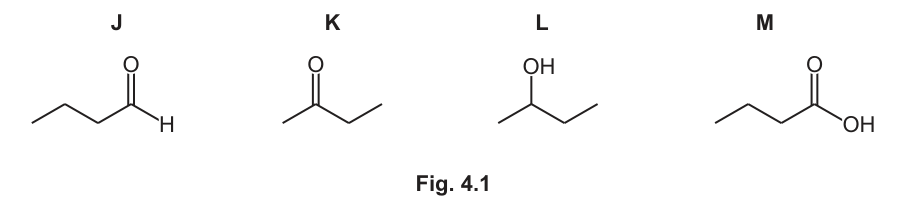
Table 4.1 gives details of tests on J to M. In each test, only two compounds give a positive result.
Complete Table 4.1.
Table 4.1
| reagent | observation of positive result | compounds that give a positive result |
|---|---|---|
| acidified | J and L | |
| alkaline | yellow precipitate | |
| orange precipitate | J and K | |
Answer
| reagent | observation of positive result | compounds that give a positive result |
|---|---|---|
| acidified | (solution) turns from orange to green | J and L |
| alkaline | yellow precipitate forms | K and L |
| 2,4-dinitrophenylhydrazine / 2,4-DNPH | orange precipitate forms | J and K |
| effervescence / bubbles of gas | L and M |
See table above
Background Concept
Organic functional groups can be identified by their characteristic reactions with specific reagents.
- Aldehydes (like J, butanal) are oxidised by acidified potassium dichromate(VI) from orange to green, and give a positive iodoform test only if they contain a group (butanal does not). They react with 2,4-dinitrophenylhydrazine (2,4-DNPH) to give an orange precipitate.
- Ketones (like K, butanone) are not oxidised by acidified . Butanone contains a group, so it gives a positive iodoform test (yellow precipitate). It reacts with 2,4-DNPH to give an orange precipitate.
- Secondary alcohols (like L, butan-2-ol) are oxidised by acidified (orange to green). Butan-2-ol contains a group, so it gives a positive iodoform test. Alcohols react with sodium metal to produce hydrogen gas (effervescence). They do not react with 2,4-DNPH.
- Carboxylic acids (like M, butanoic acid) are not oxidised by acidified , do not give an iodoform test, do not react with 2,4-DNPH, but react with sodium metal to produce hydrogen gas (effervescence).
Understanding the Question
The question provides skeletal structures for four compounds: J (butanal, aldehyde), K (butanone, ketone), L (butan-2-ol, secondary alcohol), and M (butanoic acid, carboxylic acid). A table lists four tests, with some information missing. The task is to complete the table by providing the observation for the first test, the compounds for the second and fourth tests, and the reagent for the third test. Each test gives a positive result for exactly two compounds.
Approach
Identify the functional group in each compound. Then, for each reagent, determine which functional groups react positively and what the observation is. Fill in the missing cells accordingly.
Step-by-Step Reasoning
- Acidified : This is an oxidising agent. It oxidises aldehydes (J) to carboxylic acids and secondary alcohols (L) to ketones. The dichromate ion (, orange) is reduced to (green). Observation: (solution) turns from orange to green. Compounds: J and L (given).
- Alkaline : This is the iodoform test. It gives a positive result (yellow precipitate of ) for compounds containing a group (methyl ketones) or a group (secondary alcohols oxidisable to methyl ketones). K (butanone, ) and L (butan-2-ol, ) both give positive results. Compounds: K and L.
- Orange precipitate with J and K: This is the test for carbonyl compounds (aldehydes and ketones). The reagent is 2,4-dinitrophenylhydrazine (or 2,4-DNPH). Observation: orange precipitate forms. Compounds: J and K (given).
- : Sodium metal reacts with compounds containing an acidic hydrogen, such as alcohols and carboxylic acids, producing hydrogen gas. L (butan-2-ol) and M (butanoic acid) both react. Observation: effervescence (or bubbles of gas / hydrogen evolved). Compounds: L and M.
Key Takeaways
- Acidified potassium dichromate(VI) oxidises aldehydes and secondary alcohols (orange to green).
- Iodoform test (alkaline ) is positive for methyl ketones and secondary alcohols with a methyl group on the carbinol carbon.
- 2,4-DNPH tests for the carbonyl group () in aldehydes and ketones.
- Sodium metal tests for acidic hydrogens in alcohols and carboxylic acids.
Common Mistakes
- Writing 'green solution' without mentioning the initial orange colour or the colour change.
- Confusing the iodoform test reagent with Tollens' or Fehling's reagent.
- Forgetting that carboxylic acids also react with sodium metal to produce hydrogen gas.
- Writing 'precipitate' without specifying the colour (yellow for iodoform, orange for 2,4-DNPH).
Things to Be Careful About
- The question states 'only two compounds give a positive result' for each test. Ensure your answers are consistent with this constraint.
- Use precise terminology: 'effervescence' or 'bubbles' for gas evolution with sodium, not 'fizzing'.
- 2,4-dinitrophenylhydrazine can be abbreviated as 2,4-DNPH, but the full name is safer.
K reacts with in the presence of a catalyst, forming N.
Complete Fig. 4.2 to show the mechanism for this reaction.
Include charges, dipoles, lone pairs of electrons and curly arrows, as appropriate.
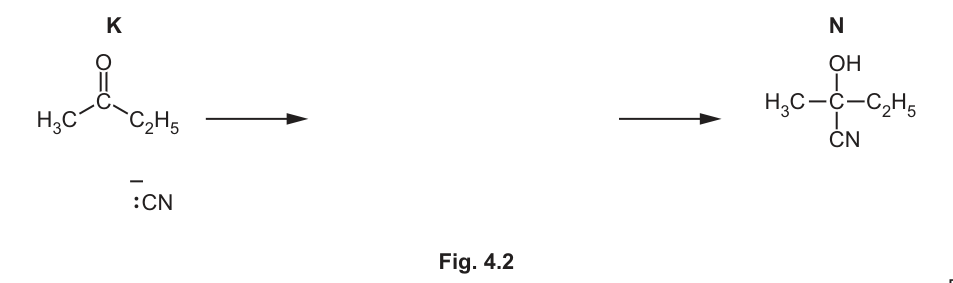
Answer
See mechanism diagram
Background Concept
Nucleophilic addition to carbonyl compounds involves the attack of a nucleophile on the electron-deficient carbonyl carbon. The bond is polarised because oxygen is more electronegative than carbon, creating a charge on carbon and a charge on oxygen. Cyanide ion () is a good nucleophile. The reaction of a ketone with (catalysed by ) produces a hydroxynitrile (cyanohydrin).
Understanding the Question
Compound K is butanone (). It reacts with / to form N. The question asks to complete the mechanism diagram (Fig. 4.2) showing the nucleophilic addition. The starting materials are butanone and . The final product N is 2-hydroxy-2-methylbutanenitrile (shown as ).
Approach
Draw the mechanism in two main stages:
- Nucleophilic attack by on the carbonyl carbon, breaking the pi bond to form an intermediate alkoxide ion.
- Protonation of the alkoxide ion by (from or acid workup) to form the final hydroxynitrile product.
Include all required annotations: dipoles on , lone pairs, charges, and curly arrows showing electron movement.
Step-by-Step Reasoning
- Dipoles and lone pairs: In butanone, draw on the carbonyl carbon and on the carbonyl oxygen. Show the lone pair on the carbon of the cyanide ion and its negative charge.
- First curly arrow: Draw a curly arrow from the lone pair on the carbon of to the carbonyl carbon of butanone.
- Second curly arrow: Draw a curly arrow from the centre of the double bond to the oxygen atom, representing the breaking of the pi bond and formation of a lone pair on oxygen.
- Intermediate: Draw the intermediate structure: . Show the negative charge on the oxygen and its three lone pairs. The carbon is now bonded to , , , and .
- Third curly arrow: Draw a curly arrow from a lone pair on the negatively charged oxygen () to a hydrogen ion ().
- Final product: The product is N, where the oxygen is now protonated to form an group. (The product structure is already partially shown in Fig. 4.2).
Key Takeaways
- Nucleophilic addition to carbonyls begins with attack on the carbon.
- The pi bond breaks, placing a negative charge on oxygen.
- The intermediate is an alkoxide ion, which is then protonated to give the final product.
- All curly arrows must start from a lone pair or bond and point to an atom or bond.
Common Mistakes
- Drawing curly arrows from the negative charge instead of from the lone pair.
- Forgetting the and dipoles on the bond.
- Drawing the intermediate with a positive charge on oxygen or forgetting the negative charge.
- Using a full molecule instead of and in the mechanism steps.
- Drawing the arrow from the bond to the carbon instead of to the oxygen.
Things to Be Careful About
- The cyanide ion is , not without the lone pair. The nucleophilic atom is carbon.
- The intermediate must show the correct connectivity: the group and the are both attached to the former carbonyl carbon.
- Ensure all charges and lone pairs are explicitly drawn as required by the mark scheme.
Answer
hydroxynitrile
hydroxynitrile
Background Concept
When a carbonyl compound (aldehyde or ketone) reacts with hydrogen cyanide (), the product contains both a hydroxyl group () and a nitrile group () on the same carbon atom. These compounds are called hydroxynitriles (or cyanohydrins).
Understanding the Question
Compound N is formed from butanone and . Its structure is . It contains an group and a group. The question asks for the class of compound.
Approach
Identify the functional groups in N: hydroxyl () and nitrile (). The combined class name is hydroxynitrile.
Step-by-Step Reasoning
Compound N has an group (hydroxy) and a group (nitrile) on the same carbon. Therefore, it belongs to the class of compounds called hydroxynitriles.
Key Takeaways
- Addition of to carbonyls produces hydroxynitriles.
- Nomenclature combines the names of the functional groups present.
Common Mistakes
- Calling it a 'cyanohydrin' (acceptable in some contexts, but 'hydroxynitrile' is the standard CIE term).
- Calling it an 'alcohol' or 'nitrile' alone, ignoring the other functional group.
- Writing 'hydroxyl nitrile' instead of 'hydroxynitrile'.
Things to Be Careful About
- Use the exact term 'hydroxynitrile' as expected in the mark scheme.
Answer
a carbon atom bonded to four different atoms or groups
a carbon atom bonded to four different atoms or groups
Background Concept
A chiral centre (or stereocentre) in an organic molecule is typically a carbon atom that is bonded to four different atoms or groups of atoms. This arrangement means the molecule lacks a plane of symmetry and can exist as a pair of non-superimposable mirror images (enantiomers). Chiral molecules can rotate plane-polarised light.
Understanding the Question
Compound N (2-hydroxy-2-methylbutanenitrile) has a central carbon bonded to: , , , and . These are four different groups, so that carbon is a chiral centre. The question asks for the definition of a chiral centre.
Approach
State the standard definition: a carbon atom with four different atoms or groups attached.
Step-by-Step Reasoning
A chiral centre is defined as an atom (usually carbon) that is bonded to four different atoms or functional groups. In N, the central carbon is bonded to methyl, ethyl, hydroxy, and cyano groups, which are all different, making it chiral.
Key Takeaways
- Chirality requires four different substituents on a tetrahedral carbon.
- Enantiomers arise from chiral centres.
Common Mistakes
- Saying 'four different groups' without specifying 'carbon atom' or 'bonded to'.
- Saying 'four different atoms' (groups can be atoms or groups of atoms).
- Confusing chiral centre with geometric isomerism (cis/trans requires ).
Things to Be Careful About
- The definition must include 'four different' and 'atoms or groups'.