Chemistry 9701/22 — October/November 2024
Cambridge AS Level · AS Level Structured Questions · worked solutions for every part, with the mark scheme
Topics Atoms, Molecules and Stoichiometry · Atomic Structure · Chemical Bonding · Hydrocarbons · Chemical Periodicity · Nitrogen Compounds · +12 more
Vanadium, niobium and tantalum are metals in the same group of the Periodic Table.
The shorthand electronic configuration of vanadium in the ground state is .
Answer
Lowest energy state (of the atom).
Lowest energy state
Background Concept
Every atom has a specific arrangement of electrons that corresponds to its lowest possible total energy. This arrangement is called the ground state electronic configuration. When an atom absorbs energy (for example, from heat or light), one or more electrons can be promoted to higher energy levels. The atom is then said to be in an excited state. Excited states are unstable, and the electrons will eventually fall back to lower energy levels, releasing energy in the process (often as photons of light, which is the basis of emission spectra).
Understanding the Question
The question asks for a definition of the term 'ground state' in the context of an atom's electronic configuration. The command word is 'State', which requires a concise, direct definition without elaboration.
Approach
Recall the standard IUPAC-accepted definition of ground state for an atom: the state where all electrons occupy the lowest available energy orbitals, meaning no external energy has been added to promote them.
Step-by-Step Reasoning
- Identify the key concept: the energy state of an atom's electrons.
- Formulate the definition: The ground state is the lowest energy state of the atom.
- Add qualifying context (optional but good for clarity): This is the state with no external energy added, or where electrons are not promoted to higher energy levels.
- The mark scheme accepts 'lowest energy state' as the primary creditable point.
Key Takeaways
- Ground state: Lowest energy configuration of electrons.
- Excited state: One or more electrons have absorbed energy and moved to a higher energy orbital.
Common Mistakes
- Writing 'the state with the most electrons' (all atoms have a fixed number of electrons regardless of state).
- Writing 'the state with no energy' (atoms always possess internal energy; it is the lowest possible energy state, not zero energy).
- Confusing ground state with 'ground level' or 'ground state of the nucleus'.
Things to Be Careful About
- Keep the definition concise. 'Lowest energy state' is sufficient and exactly what the mark scheme rewards. Avoid over-elaborating unless asked to explain.
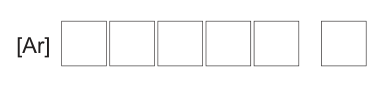
Answer
See diagram
Background Concept
The electrons-in-boxes (or orbital filling) diagram represents the distribution of electrons in the orbitals of an atom's outer shells. Each box represents one orbital, and arrows (↑ and ↓) represent electrons with opposite spins (Pauli exclusion principle).
Two key rules govern how these boxes are filled:
- Aufbau principle: Orbitals are filled from lowest to highest energy. For the 3d and 4s subshells, the 4s orbital is lower in energy than the 3d orbitals, so 4s fills first.
- Hund's rule: Within a subshell of degenerate orbitals (like the five 3d orbitals), electrons occupy empty orbitals singly with parallel spins before pairing up. This minimises electron-electron repulsion.
Understanding the Question
The question provides the shorthand configuration of vanadium: . It asks to draw this using the electrons-in-boxes notation. The provided diagram (Fig 1.1) shows five boxes for the 3d subshell and one box for the 4s subshell, all initially empty.
Approach
- Fill the 4s box first with 2 electrons (paired, opposite spins).
- Distribute the 3 electrons in the 3d boxes according to Hund's rule: one electron in each of the first three boxes, all with upward spin.
Step-by-Step Reasoning
- The configuration is .
- The part means the 4s orbital (the single box on the right) contains 2 electrons. By the Pauli exclusion principle, they must have opposite spins: one up (↑) and one down (↓).
- The part means there are 3 electrons in the 3d subshell (the five adjacent boxes on the left).
- By Hund's rule, these 3 electrons will occupy separate orbitals with parallel spins to minimise repulsion. So, the first three 3d boxes each get one up arrow (↑), and the remaining two 3d boxes are empty.
- The final diagram has [Ar] on the left, then three boxes with ↑, two empty boxes, and finally the 4s box with ↑↓.
Key Takeaways
- Always fill 4s before 3d when drawing the configuration, even though 3d is written first in the shorthand notation.
- Apply Hund's rule to degenerate orbitals: fill singly before pairing.
Common Mistakes
- Pairing electrons in the 3d subshell too early (e.g., ↑↓ in the first box, ↑ in the second, empty others). This violates Hund's rule.
- Putting the paired electrons in the 3d subshell and leaving 4s with one electron. This violates the Aufbau principle (4s is lower energy than 3d for neutral atoms in this region).
- Forgetting that the 4s box is separate from the 3d boxes in the diagram.
Things to Be Careful About
- The mark scheme allows the 3 d electrons to go in any of the d orbitals (e.g., they could be in boxes 3, 4, 5 instead of 1, 2, 3), as long as they are unpaired and parallel. However, the standard convention is to fill from left to right. Ensure the 4s box clearly contains a pair.
Working
The electronic configuration of argon (Ar) is .
Vanadium adds , which contains no p-electrons.
Total p-electrons = .
Answer
12
12
Background Concept
The noble gas shorthand notation represents the full electronic configuration of argon, which accounts for the first 18 electrons. To count specific types of electrons (like p-electrons), one must expand the noble gas core or carefully track which subshells contain them.
The subshells are s, p, d, f. Each s holds 2, each p holds 6, each d holds 10, each f holds 14. Argon's configuration is .
Understanding the Question
The question asks for the total number of electrons in the p sub-shells of a vanadium atom. Vanadium's full configuration is .
Approach
- Identify all p-subshells in the full electronic configuration.
- Sum the electrons in those subshells.
Step-by-Step Reasoning
- Expand : .
- Add the vanadium valence electrons: .
- Full configuration: .
- Identify p-subshells: and .
- Count electrons: .
- The and subshells contain d and s electrons respectively, so they contribute 0 to the p-electron count.
Key Takeaways
- When asked to count electrons in a specific subshell type (s, p, d, f) for an element with a noble gas core, expand the core to identify all such subshells.
- Argon () has 12 p-electrons (). Any element in period 3 or later that doesn't add p-electrons (like transition metals in period 4) will still have 12 p-electrons.
Common Mistakes
- Forgetting to count the p-electrons in the noble gas core (answering 0 or just counting valence p-electrons if any).
- Miscounting the capacity of p-subshells (thinking p holds 2 or 10 instead of 6).
- Including d-electrons in the p-count.
Things to Be Careful About
- Ensure you are counting electrons, not orbitals. A p-subshell has 3 orbitals but holds up to 6 electrons. Here, both filled p-subshells hold 6 electrons each.
Pelopium was the suggested name for a new element discovered in a mineral.
Pelopium was later found to be a mixture of niobium, , and tantalum, .
Only one naturally occurring isotope exists for each of and .
Complete Table 1.1.
Table 1.1
| isotope | relative isotopic mass | number of protons | number of neutrons |
|---|---|---|---|
| 92.91 | |||
| 180.95 |
Answer
| isotope | relative isotopic mass | number of protons | number of neutrons |
|---|---|---|---|
| 92.91 | 41 | 52 | |
| 180.95 | 73 | 108 |
Working:
- For : protons = 41; neutrons = .
- For : protons = 73; neutrons = .
Nb: 41 protons, 52 neutrons; Ta: 73 protons, 108 neutrons
Background Concept
Isotope notation is written as , where:
- X is the chemical symbol.
- Z (subscript) is the proton number (atomic number), which defines the element.
- A (superscript) is the mass number (nucleon number), which is the total number of protons and neutrons in the nucleus.
The number of neutrons is calculated as .
Understanding the Question
The question provides a table with two isotopes: and . The relative isotopic masses are given. The candidate must fill in the number of protons and neutrons for each.
Approach
- Read the proton number directly from the subscript (Z).
- Calculate the neutron number by subtracting the proton number from the mass number (A - Z).
Step-by-Step Reasoning
- For :
- Proton number (Z) = 41 (from the subscript).
- Mass number (A) = 93 (from the superscript).
- Neutron number = .
- For :
- Proton number (Z) = 73 (from the subscript).
- Mass number (A) = 181 (from the superscript).
- Neutron number = .
Key Takeaways
- Isotope notation : Z is protons, A is protons + neutrons.
- Neutrons = A - Z.
- The relative isotopic mass is close to the mass number but not exactly an integer due to binding energy and the mass of neutrons vs protons.
Common Mistakes
- Confusing the mass number (superscript) with the neutron number.
- Subtracting incorrectly (e.g., , but writing 118).
- Forgetting that the proton number is the subscript, not the relative isotopic mass.
Things to Be Careful About
- Ensure the values are placed in the correct columns. The table asks for 'number of protons' and 'number of neutrons', not mass number.
- The relative isotopic mass (92.91, 180.95) is not used in this part; it is provided for part (iii). Ignore it here.
Answer
The mass of an atom of an isotope relative to of the mass of a carbon-12 atom.
(Alternatively: on a scale in which a carbon-12 atom has a mass of exactly 12 units.)
Mass of an atom of an isotope relative to 1/12 of the mass of a carbon-12 atom
Background Concept
Relative masses are used because actual masses of atoms are incredibly small (e.g., kg). The unified atomic mass unit (u or Da) is defined as of the mass of a carbon-12 atom.
- Relative isotopic mass: The mass of a specific isotope of an element relative to of the mass of a carbon-12 atom.
- Relative atomic mass (): The weighted average mass of an atom of the element (considering all naturally occurring isotopes and their abundances) relative to of the mass of a carbon-12 atom.
Understanding the Question
The question asks for the definition of 'relative isotopic mass'. The command word is 'Define', requiring a precise, textbook definition.
Approach
State the two key components of the definition:
- What is being measured: the mass of an atom of a specific isotope.
- What it is compared to: of the mass of a carbon-12 atom (or the unified atomic mass unit).
Step-by-Step Reasoning
- The mark scheme requires two marks (M1 and M2).
- M1: Must mention 'mass of an (atom of an) isotope'.
- M2: Must mention 'relative/compared to of the mass of a carbon-12 atom' OR 'on a scale where C-12 is exactly 12'.
- Combining these: 'The mass of an atom of an isotope relative to of the mass of a carbon-12 atom.'
Key Takeaways
- Distinguish between relative isotopic mass (single isotope) and relative atomic mass (average of isotopes).
- The reference standard is always of a carbon-12 atom.
Common Mistakes
- Defining relative atomic mass instead of relative isotopic mass (mentioning 'average' or 'naturally occurring' is wrong for isotopic mass).
- Saying 'relative to hydrogen' (this is an old, incorrect definition).
- Forgetting the fraction (just saying 'relative to carbon-12' is incomplete; it must be 1/12th of it).
- Saying 'mass number' instead of 'relative mass' (mass number is an integer count of nucleons; relative isotopic mass is a precise measured value like 92.91).
Things to Be Careful About
- The mark scheme accepts alternative valid routes, such as defining it in terms of 1 mole of substance (mass of 1 mol of isotope relative to 1/12 mass of 1 mol of C-12, which is 12 g). However, the single-atom definition is more direct and standard for this level.
A sample of pelopium contains by mass and by mass .
Calculate the theoretical relative atomic mass of pelopium based on these data and Table 1.1.
Give your answer to two decimal places.
Show your working.
Working
Relative atomic mass () =
Rounding to two decimal places:
Answer
100.92
100.92
Background Concept
The relative atomic mass () of an element is the weighted average mass of its atoms relative to of the mass of a carbon-12 atom. When an element exists as a mixture of isotopes (like pelopium, which is a mixture of Nb and Ta), the is calculated using the relative isotopic masses and their percentage abundances.
Formula:
or equivalently, using fractional abundance (percentage / 100):
Understanding the Question
Pelopium is a mixture of 90.9% (relative isotopic mass 92.91) and 9.1% (relative isotopic mass 180.95). The question asks to calculate the theoretical relative atomic mass of pelopium to two decimal places.
Approach
- Convert percentage abundances to fractional abundances (divide by 100).
- Multiply each isotope's relative isotopic mass by its fractional abundance.
- Sum the results.
- Round to the required significant figures (two decimal places).
Step-by-Step Reasoning
- Fractional abundance of Nb = .
- Fractional abundance of Ta = .
- Check: (correct, abundances sum to 100%).
- Contribution from Nb = .
- Contribution from Ta = .
- Total .
- Round to two decimal places: .
Key Takeaways
- Relative atomic mass is a weighted average, not a simple average.
- Always convert percentages to decimals (or divide the final sum by 100) before calculating.
- The result should be between the masses of the lightest and heaviest isotopes (100.92 is between 92.91 and 180.95, and closer to 92.91 because Nb is more abundant).
Common Mistakes
- Using percentage values directly without dividing by 100 (e.g., , which is wrong).
- Calculating a simple average: (ignores abundance).
- Rounding too early in the calculation (keep full precision until the final step).
- Rounding to the wrong number of decimal places (question asks for two decimal places).
Things to Be Careful About
- The mark scheme awards 1 mark for the correct calculation setup () and 1 mark for the correct final answer (100.92).
- Error carried forward (ecf) is allowed: if a candidate used wrong abundances but applied the formula correctly, they can still get the second mark.
- Ensure the final answer has no units (relative atomic mass is dimensionless).
Oxygen is a Group 16 element.
Answer
4Na(s) + O2(g) -> 2Na2O(s); S(s) + O2(g) -> SO2(g)
Background Concept
When elements react with oxygen, they undergo combustion. Group 1 metals like sodium react vigorously to form ionic oxides (), while non-metals like sulfur in Period 3 react to form covalent molecular oxides (). Writing these equations requires knowing the correct stoichiometry and including the appropriate state symbols: (s) for solid sodium and sulfur, (g) for oxygen gas, and (s) for the solid oxide products.
Understanding the Question
The question asks for balanced chemical equations for the reactions of sodium with oxygen and sulfur with oxygen. It is a straightforward recall and balancing task.
Approach
Identify the reactants and products. Sodium burns in oxygen to form sodium oxide (). Sulfur burns in oxygen to form sulfur dioxide (). Balance the atoms on both sides and add state symbols.
Step-by-Step Reasoning
- Sodium and oxygen: Sodium is a Group 1 metal with a +1 oxidation state, and oxygen is Group 16 with a -2 oxidation state, giving the formula . Balancing the equation: . Add states: .
- Sulfur and oxygen: Sulfur burns in oxygen to predominantly form sulfur dioxide, . The equation is already balanced: . Add states: .
Key Takeaways
Always remember to balance equations and include state symbols (s, l, g, aq) as they are often required for full marks in CIE Chemistry. Group 1 metals form normal oxides (), while sulfur forms (not ) upon direct combustion.
Common Mistakes
- Writing instead of (ignoring the +1/-2 charge balance).
- Forgetting state symbols, especially (g) for .
- Writing for the sulfur reaction; direct combustion of sulfur yields .
Things to Be Careful About
Ensure the equations are fully balanced. For sodium, 4 atoms are needed on the left to match 4 on the right in .
Draw a dot-and-cross diagram to show the species present in .
Draw outer electrons only.
Answer
Dot-and-cross diagram showing Al3+ and [O]2- with 8 outer electrons on oxide ion.
Background Concept
Aluminium oxide () is an ionic compound formed between a metal (Al, Group 13) and a non-metal (O, Group 16). Aluminium has 3 outer electrons and loses them to form . Oxygen has 6 outer electrons and gains 2 to complete its octet, forming . In a dot-and-cross diagram for ionic compounds, we show the outer electrons of the anion, using different symbols (dots and crosses) to distinguish which atom contributed them. Cations are shown with a charge and no outer electrons (or empty brackets), while anions are shown with brackets, a charge, and 8 outer electrons.
Understanding the Question
Draw a dot-and-cross diagram for showing only outer electrons. This means drawing one aluminium ion and one oxide ion (representing the 1:3 ratio conceptually for the diagram, or just the species present).
Approach
Aluminium loses 3 electrons to become (no outer electrons shown). Oxygen gains 2 electrons to become (8 outer electrons: 6 original + 2 from Al). Draw and an oxide ion with 8 outer electrons (e.g., 6 dots, 2 crosses), surrounded by brackets with a charge.
Step-by-Step Reasoning
- Aluminium ion: atom has 3 outer electrons. It loses all 3 to achieve a noble gas configuration. Draw with no dots or crosses around it.
- Oxide ion: atom has 6 outer electrons. It gains 2 electrons (from Al) to have 8 outer electrons. Draw an oxygen symbol 'O' surrounded by 8 electrons (e.g., 6 blue dots and 2 red crosses). Place square brackets around the ion and write as the charge outside the top right bracket.
Key Takeaways
For ionic dot-and-cross diagrams, the cation has no outer electrons shown (it lost them), and the anion has a full octet (8 electrons). Always include charges and brackets for the anion.
Common Mistakes
- Drawing covalent bonds (lines or shared pairs) instead of ionic transfer.
- Forgetting the brackets and charge on the oxide ion.
- Showing 7 electrons on the oxide ion instead of 8.
Things to Be Careful About
The question says 'draw outer electrons only'. Do not draw inner shell electrons for oxygen (the 1s2 pair). The aluminium ion has no outer electrons, so nothing is drawn around it.
The maximum oxidation state of the Period 3 elements in their oxides varies across the period.
State and explain the variation.
Answer
- The maximum oxidation state increases across the period (from +1 to +7).
- This is because the number of valence (outer shell) electrons available to be lost, shared, or donated in bonding increases across the period.
Increases; as number of valence electrons available for bonding increases.
Background Concept
Oxidation state (or oxidation number) in compounds reflects the number of electrons an atom loses, gains, or shares. For main group elements in Period 3, the maximum oxidation state corresponds to the number of electrons in the outer shell (valence electrons). Sodium has 1, magnesium has 2, aluminium has 3, silicon has 4, phosphorus has 5, sulfur has 6, and chlorine has 7.
Understanding the Question
State and explain how the maximum oxidation state of Period 3 elements varies in their oxides as you move from left to right across the period.
Approach
First, state the trend: it increases. Then, explain why: the number of outer (valence) electrons increases, and these are the electrons available for bonding (lost in ionic oxides or shared in covalent oxides).
Step-by-Step Reasoning
- State the trend: Moving from Na to Cl, the maximum oxidation state increases (e.g., +1 in , +2 in , +3 in , +4 in , +5 in , +6 in , +7 in ).
- Explain the variation: The maximum oxidation state is determined by the number of valence electrons an atom can use. As you move across Period 3, the number of outer shell electrons increases from 1 to 7. Therefore, more electrons can be involved in bonding (lost to form cations or shared to form covalent bonds), leading to a higher maximum oxidation state.
Key Takeaways
The maximum oxidation state of a main group element equals its group number (or number of valence electrons). Across a period, this number increases, so the maximum oxidation state increases.
Common Mistakes
- Saying 'oxidation state increases because atomic number increases' (too vague; must mention valence electrons).
- Forgetting to state the trend clearly before explaining it.
Things to Be Careful About
Use precise terminology: 'valence electrons' or 'outer shell electrons', not just 'electrons'. Specify that these are the electrons available for bonding.
reacts with both inorganic and organic compounds.
Complete Table 2.1 to give details of the reactions of some Period 3 oxides with .
Table 2.1
| Period 3 oxide | product of reaction with | pH of solution formed |
|---|---|---|
Answer
| Period 3 oxide | product of reaction with | pH of solution formed |
|---|---|---|
| MgO | ||
MgO: pH 8-12; P4O10: product H3PO4, pH 1-4
Background Concept
Period 3 oxides show a transition from basic to acidic as you move across the period. Magnesium oxide () is a basic oxide that reacts with water to form the weak base magnesium hydroxide, . Phosphorus(V) oxide () is an acidic oxide that reacts vigorously with water to form phosphoric acid, .
Understanding the Question
Complete a table with the missing oxide for the basic product , and the missing product and pH for the acidic oxide .
Approach
Identify the oxide that forms with water (it must be ). Determine the pH of a magnesium hydroxide suspension (weak base, pH 8-12). Identify the product of with water () and its pH (weak acid, pH 1-4).
Step-by-Step Reasoning
- Row 1: The product is . The oxide that reacts with water to form this is magnesium oxide, . is sparingly soluble and acts as a weak base, so the pH of the solution will be alkaline, typically between 8 and 12.
- Row 2: The oxide is . This is a strongly acidic oxide. It reacts with water to form phosphoric acid: . The product is . Phosphoric acid is a weak acid, but at typical concentrations formed, the pH will be acidic, between 1 and 4.
Key Takeaways
Basic oxides (left side of Period 3) form alkaline solutions with water. Acidic oxides (right side) form acidic solutions. The pH ranges reflect the strength of the resulting base or acid.
Common Mistakes
- Writing or other incorrect formulas for the oxide.
- Giving a pH of exactly 14 for (it is sparingly soluble, so it's a weak base, not a strong base like NaOH).
- Writing or incorrect acid formulas for the phosphorus product.
Things to Be Careful About
The mark scheme accepts a range for pH (e.g., 8-12 and 1-4). Do not give a single exact value unless sure. Ensure the chemical formula for phosphoric acid is correct: .
Answer
CH3CN + 2H2O + H+ -> CH3COOH + NH4+
Background Concept
Nitriles () can be hydrolysed in the presence of water and an acid catalyst (or base). Acidic hydrolysis of a nitrile produces a carboxylic acid and an ammonium ion. The reaction requires 2 molecules of water. The acts as a catalyst and is consumed to form .
Understanding the Question
Write the balanced equation for the reaction of propanenitrile () with water and hydrogen ions. The template is given:
Approach
Identify the products: carboxylic acid () and ammonium ion (). Balance the oxygen and hydrogen atoms. 2 are needed to provide the oxygen for the carboxylic acid and the hydrogens for the ammonium ion. 1 is needed to balance the charge and provide the final hydrogen for .
Step-by-Step Reasoning
- Reactants: , , .
- Products: The group is converted to a group (carboxylic acid) and the nitrogen becomes (ammonium ion). So products are and .
- Balancing: Left side has 1 C (from CN) + 1 O (from water) -> need 2 O for COOH, so 2 . Left side H: 3 (from CH3) + 4 (from 2H2O) + 1 (from H+) = 8 H. Right side H: 3 (from CH3) + 1 (from COOH) + 4 (from NH4+) = 8 H. Balanced.
- Final equation: .
Key Takeaways
Acidic hydrolysis of nitriles yields carboxylic acids and ammonium ions. Basic hydrolysis yields carboxylate ions and ammonia gas. Always balance carefully; 2 waters are needed.
Common Mistakes
- Writing instead of (in acidic conditions, ammonia is protonated to ammonium).
- Forgetting the on the left or getting the coefficient of water wrong (must be 2).
- Writing instead of (forgetting the methyl group).
Things to Be Careful About
The question provides the template with dots for coefficients. Ensure you fill them correctly: 2 for , 1 (implicit) for .
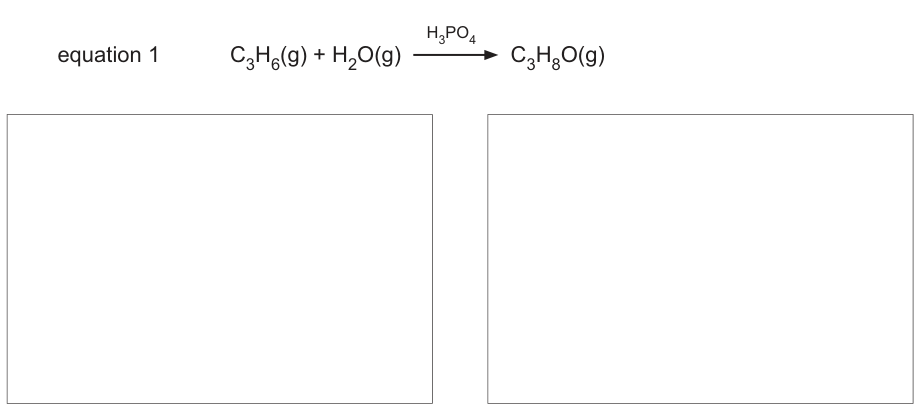
Answer
Structures of propan-1-ol and propan-2-ol.
Background Concept
The reaction shown is the hydration of propene () with steam () over a phosphoric acid () catalyst. This is an electrophilic addition reaction. The double bond in propene can be attacked by the electrophile () at either carbon, leading to two possible carbocation intermediates and thus two different alcohol products: propan-1-ol (primary) and propan-2-ol (secondary). The major product is propan-2-ol due to the greater stability of the secondary carbocation (Markovnikov's rule), but the question asks for the structures of both alcohols formed.
Understanding the Question
Draw the structures of the two alcohols () formed from the reaction of with .
Approach
Propene is . Adding across the double bond gives either (propan-1-ol) or (propan-2-ol). Draw both skeletal or displayed structures.
Step-by-Step Reasoning
- Identify the reactant: is propene, .
- Addition of water: Water adds across the C=C bond. The OH group can attach to carbon 1 or carbon 2.
- Isomer 1 (anti-Markovnikov/primary): OH on C1: (propan-1-ol).
- Isomer 2 (Markovnikov/secondary): OH on C2: (propan-2-ol).
- Draw structures: Draw skeletal structures showing the 3-carbon chain with the OH group on the end carbon for propan-1-ol, and on the middle carbon for propan-2-ol.
Key Takeaways
Hydration of unsymmetrical alkenes produces a mixture of alcohol isomers. Both must be drawn if asked for 'the two alcohols'. Propan-2-ol is the major product, but propan-1-ol is also formed.
Common Mistakes
- Drawing only one alcohol (usually the major product, propan-2-ol).
- Drawing incorrect carbon chains (e.g., 4 carbons).
- Forgetting the OH group or drawing an ether.
Things to Be Careful About
The question asks for 'structures', so skeletal or displayed formulas are acceptable. Ensure the molecular formula is (saturated alcohol).
Answer
- Alkyl groups (in alcohols) are electron-donating (they have a positive inductive effect).
- This strengthens the O—H bond (or makes the hydrogen less partially positive), making it less likely to be donated as compared to water.
Alkyl groups are electron-donating (positive inductive effect), strengthening the O-H bond and making H+ less likely to be donated.
Background Concept
Acidity is the ability to donate a proton (). For alcohols () and water (), the acidity depends on the ease of breaking the O-H bond and the stability of the resulting anion (alkoxide vs hydroxide ). Alkyl groups are electron-donating groups. They push electron density towards the oxygen atom via the sigma bonds (positive inductive effect).
Understanding the Question
Explain why alcohols are less acidic than water. This is a conceptual explanation requiring the use of the inductive effect.
Approach
Compare the alkyl group in alcohols to the hydrogen in water. The alkyl group donates electron density to oxygen. This affects the O-H bond.
Step-by-Step Reasoning
- Identify the difference: Alcohols have an alkyl group (R) attached to the oxygen, while water has a hydrogen atom.
- Inductive effect: Alkyl groups are electron-donating (positive inductive effect). They push electron density towards the electronegative oxygen atom.
- Effect on O-H bond: This increased electron density on oxygen strengthens the O-H bond (makes it less polar, or reduces the partial positive charge on the hydrogen atom).
- Result on acidity: A stronger O-H bond means it is harder to break, and the hydrogen is less likely to be donated as . Therefore, alcohols are weaker acids than water.
Key Takeaways
Electron-donating groups (like alkyls) decrease acidity by strengthening the bond to the acidic proton. Electron-withdrawing groups (like halogens) increase acidity by weakening the bond and stabilizing the conjugate base.
Common Mistakes
- Saying 'alkyl groups are electron-withdrawing' (wrong direction of inductive effect).
- Saying 'alkyl groups make the O-H bond weaker' (opposite effect).
- Not mentioning the inductive effect or electron donation explicitly.
Things to Be Careful About
Use precise terms: 'electron-donating', 'positive inductive effect', 'strengthens the O-H bond', 'less likely to donate H+'. Do not just say 'it makes it less acidic' without explaining why.
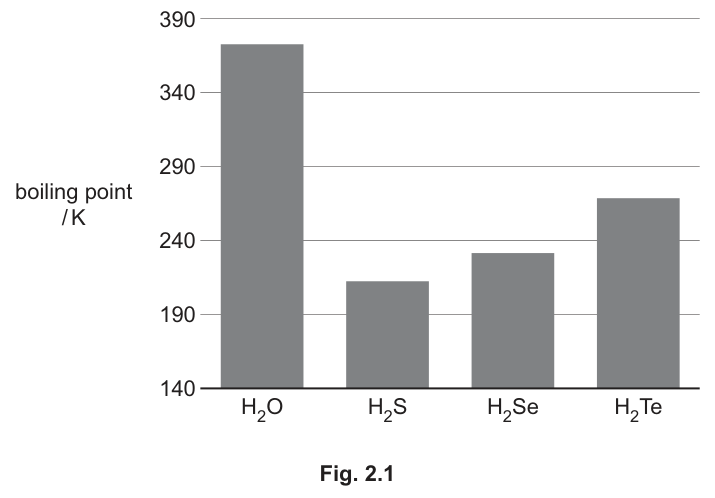
Fig. 2.1 shows the boiling points of and other Group 16 hydrides.
Answer
- From to , the molecules have a greater number of electrons (or larger electron clouds).
- This leads to stronger instantaneous dipole–induced dipole (London dispersion) forces, requiring more energy to overcome.
Answer
- From to , the molecules have a greater number of electrons (or larger electron clouds).
- This leads to stronger instantaneous dipole–induced dipole (London dispersion) forces, requiring more energy to overcome.
Greater number of electrons -> stronger instantaneous dipole-induced dipole / London dispersion forces.
Background Concept
Boiling points of molecular substances depend on the strength of intermolecular forces. For Group 16 hydrides (, , ), the primary intermolecular forces are instantaneous dipole–induced dipole forces (also called London dispersion forces or van der Waals forces). The strength of these forces increases with the number of electrons in the molecule (or the size of the electron cloud), as larger electron clouds are more polarisable.
Understanding the Question
Explain the trend in boiling points from to as shown in the bar chart (boiling point increases).
Approach
State that the number of electrons increases down the group. Explain that more electrons lead to stronger London dispersion forces. Conclude that more energy is needed to overcome these forces.
Step-by-Step Reasoning
- Trend observation: Boiling point increases from (213 K) to (271 K).
- Electron count: Moving down Group 16 from S to Te, the atoms get larger and have more electrons. (18 e-), (34 e-), (54 e-).
- Polarisability: Larger electron clouds are more easily distorted (more polarisable), leading to stronger temporary (instantaneous) dipoles.
- Intermolecular forces: Stronger instantaneous dipole–induced dipole (London) forces exist between the molecules.
- Energy required: More thermal energy (higher temperature) is required to overcome these stronger intermolecular forces, hence the higher boiling point.
Key Takeaways
For molecules without hydrogen bonding, boiling point increases down a group due to increasing London dispersion forces from greater electron count and polarisability.
Common Mistakes
- Saying 'molecular mass increases' without linking it to electrons/polarisability (mark scheme prefers electrons/dispersion forces).
- Calling them 'van der Waals forces' without specifying 'instantaneous dipole-induced dipole' or 'London dispersion' (though 'van der Waals' is often accepted, be precise).
- Forgetting to mention that more energy is required to overcome the forces.
Things to Be Careful About
Use the term 'instantaneous dipole–induced dipole' or 'London dispersion forces'. 'Van der Waals' is a broader term that can include dipole-dipole, so be specific.
Answer
- is the only hydride in this series that exhibits hydrogen bonding.
- Hydrogen bonds are much stronger than the instantaneous dipole–induced dipole (London dispersion) forces present in the other hydrides, requiring significantly more energy to break.
Answer
- is the only hydride in this series that exhibits hydrogen bonding.
- Hydrogen bonds are much stronger than the instantaneous dipole–induced dipole (London dispersion) forces present in the other hydrides, requiring significantly more energy to break.
H2O has hydrogen bonding, which is much stronger than the other intermolecular forces (London forces).
Background Concept
Water () has an anomalously high boiling point compared to the other Group 16 hydrides (, , ). This is because oxygen is highly electronegative and small, allowing it to form strong hydrogen bonds with the hydrogen atoms of neighbouring water molecules. Hydrogen bonding is a particularly strong type of dipole-dipole interaction.
Understanding the Question
Explain why the boiling point of (373 K) is much higher than that of (213 K), despite having a higher molecular mass.
Approach
Identify that water has hydrogen bonding, which the others lack. State that hydrogen bonds are stronger than the London dispersion forces in the other hydrides.
Step-by-Step Reasoning
- Anomaly observation: has a much higher boiling point than expected from the trend of to .
- Hydrogen bonding: Oxygen is highly electronegative (3.5) and has lone pairs. This allows water molecules to form hydrogen bonds (O-H...O) with each other. Sulfur is less electronegative (2.5) and larger, so does not form significant hydrogen bonds.
- Strength comparison: Hydrogen bonds are significantly stronger (typically 10-40 kJ/mol) than the instantaneous dipole–induced dipole (London dispersion) forces that are the main intermolecular forces in , , and (typically 1-10 kJ/mol).
- Energy required: Much more thermal energy is required to break the extensive hydrogen bonding network in water, resulting in a much higher boiling point.
Key Takeaways
Hydrogen bonding occurs when H is bonded to N, O, or F. It causes anomalously high boiling points, melting points, and solubilities. Water is a classic example due to its ability to form up to 4 hydrogen bonds per molecule.
Common Mistakes
- Saying 'water has stronger van der Waals forces' (vague and incorrect; it's specifically hydrogen bonding).
- Not mentioning that hydrogen bonds are stronger than the forces in the other molecules.
- Forgetting to state that only water (or H2O) has hydrogen bonding in this series.
Things to Be Careful About
Be explicit: 'hydrogen bonding' is the key phrase. Do not just say 'dipole-dipole'; hydrogen bonding is a specific, stronger subset. Mention that it is 'much stronger' to explain the large difference in boiling points.
Nitrogen and phosphorus are elements in Group 15 of the Periodic Table.
Nitrogen is found in inorganic compounds such as nitrogen oxides (), nitrates and nitric acid.
Answer
- Natural occurrence: lightning
- Man-made occurrence: internal combustion engines
Natural: lightning; Man-made: internal combustion engines
Background Concept
Nitrogen oxides () are gases containing nitrogen and oxygen, most commonly and . They are significant atmospheric pollutants involved in the formation of acid rain, photochemical smog, and the depletion of the ozone layer. Their sources are broadly categorised into natural processes and anthropogenic (man-made) activities.
Understanding the Question
The question asks for one example each of a natural and a man-made source of in the atmosphere. This is a direct recall question testing knowledge of the environmental chemistry of nitrogen.
Approach
Recall the primary mechanisms by which nitrogen and oxygen combine in the atmosphere. Naturally, the extreme heat of lightning strikes provides the activation energy for and to react. Man-made sources primarily involve high-temperature combustion processes where air is used as the oxidant.
Step-by-Step Reasoning
- Natural Source: During a lightning strike, the temperature in the air channel can exceed . This immense energy breaks the strong triple bond in and the double bond in , allowing nitrogen atoms to combine with oxygen atoms to form , which subsequently oxidises to in the atmosphere.
- Man-made Source: In internal combustion engines (petrol and diesel), air is drawn in and compressed. The high temperatures and pressures inside the cylinder cause atmospheric nitrogen and oxygen to react, forming and . These are expelled in the exhaust gases. Other man-made sources include power stations and industrial furnaces.
Key Takeaways
- Lightning is the major natural source of atmospheric .
- Internal combustion engines are the major man-made source of atmospheric .
- Both sources rely on high temperatures to overcome the activation energy for the reaction between and .
Common Mistakes
- Confusing sources of with sources of (volcanic eruptions, burning fossil fuels containing sulfur).
- Stating "factories" or "power stations" without specifying the combustion process, though these are generally accepted, "internal combustion engines" is the most precise and common answer expected.
- Stating "volcanic eruptions" as a source of ; while they emit gases, they are primarily associated with .
Things to Be Careful About
- Ensure you provide one of each type (natural and man-made) as requested.
- Use the term "internal combustion engines" rather than just "cars" or "vehicles" for a more scientific answer.
Answer
OR
2NO2 + H2O -> HNO2 + HNO3
Background Concept
Acid rain is caused by the dissolution of acidic oxides, primarily sulfur dioxide () and nitrogen oxides (), in atmospheric water. Nitrogen dioxide () is a particularly important contributor. When reacts with water, it undergoes disproportionation (oxidation states of N change from +4 to +3 and +5) to form nitrous acid () and nitric acid (). In the presence of oxygen, the can be further oxidised to , or the overall reaction can be written to produce only nitric acid.
Understanding the Question
The question asks for an equation describing the role of in the direct formation of acid rain. This means writing the reaction between and water that produces acids.
Approach
Identify the reactants ( and ) and the products ( and , or just if is included). Balance the equation ensuring conservation of mass and charge.
Step-by-Step Reasoning
- Disproportionation in water: reacts with water. Nitrogen is in the +4 oxidation state. It disproportionates to +3 (in ) and +5 (in ).
- Oxidation to nitric acid: Alternatively, in the presence of atmospheric oxygen, can react to form only nitric acid. Both equations are accepted by the mark scheme. The first is the direct hydrolysis; the second represents the overall process in oxygen-rich air.
Key Takeaways
- is an acidic oxide.
- Its reaction with water produces acids, lowering the pH of rainwater.
- can undergo disproportionation.
Common Mistakes
- Writing the reaction of with water (which does not occur directly to form acid).
- Forgetting to balance the equation.
- Writing as or incorrect formulas for the acids.
- Including state symbols incorrectly (though often ignored unless specified, aqueous/gas phases are implied).
Things to Be Careful About
- Ensure the equation is balanced.
- Do not confuse this with the formation of from (), which is a step before acid rain formation.
- The mark scheme accepts either the disproportionation equation or the oxidation equation.
Peroxyacetyl nitrate, PAN, is a component of photochemical smog.
Describe how PAN forms from .
Answer
reacts with unburned hydrocarbons (or volatile organic compounds, VOCs).
NO2 reacts with unburned hydrocarbons/VOCs
Background Concept
Photochemical smog is a mixture of pollutants formed when sunlight acts on nitrogen oxides and volatile organic compounds (VOCs) in the atmosphere. Peroxyacetyl nitrate (PAN) is a key component and a powerful lachrymator (tear-inducing). Its formation involves a complex series of radical reactions initiated by sunlight, where plays a crucial role in oxidising hydrocarbons.
Understanding the Question
The question asks for a description of how PAN forms from . It is looking for the other reactant(s) required for this process.
Approach
Recall the definition and formation conditions of photochemical smog. Identify the two main precursor groups: nitrogen oxides and hydrocarbons.
Step-by-Step Reasoning
- PAN is a secondary pollutant.
- It forms in the atmosphere through photochemical reactions.
- The essential reactants are nitrogen dioxide () and unburned hydrocarbons (VOCs) emitted from vehicle exhausts and industrial solvents.
- Sunlight provides the energy for the reaction.
Key Takeaways
- PAN formation requires , hydrocarbons (VOCs), and sunlight.
- It is a component of photochemical smog.
Common Mistakes
- Stating that PAN forms from instead of .
- Forgetting to mention hydrocarbons or VOCs.
- Confusing PAN with smog caused by sulfur dioxide (London-type smog).
Things to Be Careful About
- The mark scheme specifically looks for the reaction with "unburned hydrocarbons" or "VOCs". Simply saying "pollutants" is too vague.
Nitric acid reacts with basic oxides to form nitrates.
Write an equation for the reaction of nitric acid with calcium oxide.
Answer
2HNO3 + CaO -> Ca(NO3)2 + H2O
Background Concept
Nitric acid () is a strong acid. Calcium oxide () is a basic oxide. The reaction between an acid and a base (or basic oxide) is a neutralisation reaction, producing a salt and water. The salt formed is a nitrate. Since calcium is in Group 2, it forms a ion, so the formula of calcium nitrate is .
Understanding the Question
Write the balanced chemical equation for the reaction between nitric acid and calcium oxide.
Approach
- Identify reactants: and .
- Identify products: Salt () and water ().
- Write the skeleton equation.
- Balance the atoms.
Step-by-Step Reasoning
- Skeleton:
- Balance nitrate ions: There are 2 groups on the right, so we need 2 on the left.
- Balance hydrogen: 2 H on left, 2 H on right (in water). Balanced.
- Balance oxygen (excluding nitrate): 1 O in , 1 O in . Balanced.
- Balance calcium: 1 Ca on each side. Balanced.
Key Takeaways
- Acid + Metal Oxide -> Salt + Water.
- Correct formula of calcium nitrate is .
Common Mistakes
- Writing the formula of calcium nitrate as (ignoring the 2+ charge on Ca).
- Failing to balance the equation.
- Writing as a reactant instead of (the question specifies calcium oxide).
Things to Be Careful About
- Ensure brackets are used correctly in the formula .
- State symbols are not explicitly required by the mark scheme text provided, but are good practice.
Answer
Brown fumes are given off.
Brown fumes
Background Concept
Most metal nitrates (except those of alkali metals) decompose on strong heating to form the metal oxide, nitrogen dioxide, and oxygen. Nitrogen dioxide () is a brown gas. Calcium nitrate decomposes according to the equation:
Understanding the Question
Describe what is seen when solid calcium nitrate is heated strongly. This asks for a qualitative observation.
Approach
Identify the gaseous products of the decomposition and their physical appearance.
Step-by-Step Reasoning
- The decomposition produces and .
- Oxygen is a colourless gas.
- Nitrogen dioxide is a brown gas.
- Therefore, the visible observation is the evolution of brown fumes.
Key Takeaways
- Thermal decomposition of Group 2 nitrates produces .
- is brown.
- Observation questions require describing what is seen, not naming the products.
Common Mistakes
- Stating "nitrogen dioxide is produced" (this is an inference/conclusion, not an observation).
- Stating "gas is evolved" (too vague; must specify colour).
- Confusing with the decomposition of carbonates (which releases , a colourless gas).
Things to Be Careful About
- Use the term "fumes" or "gas" with the colour "brown".
- Do not mention the solid residue unless asked, as the change from white solid to white solid is not a distinctive observation.
A common test for nitrates is the reaction with and . Equation 1 shows the reaction.
Answer
+5
+5
Background Concept
The oxidation state (or oxidation number) is a measure of the degree of oxidation of an atom in a substance. For a polyatomic ion, the sum of the oxidation states of all atoms must equal the overall charge of the ion. Oxygen generally has an oxidation state of -2.
Understanding the Question
Deduce the oxidation state of nitrogen in the nitrate ion, .
Approach
Set up an algebraic equation based on the known oxidation state of oxygen and the overall charge of the ion.
Step-by-Step Reasoning
- Let be the oxidation state of nitrogen.
- The oxidation state of oxygen is -2.
- There are 3 oxygen atoms.
- The overall charge of the nitrate ion is -1.
- Equation:
- Solve:
Key Takeaways
- Sum of oxidation states in an ion equals the ion's charge.
- Oxygen is usually -2.
- Nitrogen in nitrates is in the +5 state.
Common Mistakes
- Forgetting the overall charge of the ion and setting the sum to 0.
- Incorrectly assigning the oxidation state of oxygen.
Things to Be Careful About
- Include the sign (+) in the answer.
Answer
Aluminium (or Al)
Aluminium
Background Concept
Oxidation is defined as an increase in oxidation number (loss of electrons). The species that is oxidised acts as the reducing agent. We need to track the oxidation numbers of the elements in the reactants and products to identify which one increases.
Understanding the Question
Identify the species that is oxidised in the given equation:
Approach
Compare the oxidation states of the key elements (N, Al, O, H) on both sides of the equation.
Step-by-Step Reasoning
- Nitrogen: In , N is +5. In , H is +1, so N is -3. The oxidation number decreases (+5 to -3), so nitrogen is reduced.
- Aluminium: In elemental Al, the oxidation number is 0. In , OH is -1, so Al is +3. The oxidation number increases (0 to +3), so aluminium is oxidised.
- Oxygen/Hydrogen: Remain -2 and +1 respectively throughout.
Key Takeaways
- Oxidation = Increase in oxidation number.
- Elemental metals have an oxidation number of 0.
- Al is oxidised to (in the complex).
Common Mistakes
- Identifying the species reduced () instead of the one oxidised.
- Saying "Nitrogen" instead of "Nitrate ion" or "Aluminium" instead of "Al".
Things to Be Careful About
- The question asks for the species, so "Al" or "Aluminium" is correct.
Answer
acts as a base by accepting a proton ().
H+ acceptor
Background Concept
According to the Brønsted-Lowry theory, a base is defined as a proton () acceptor. Ammonia () has a lone pair of electrons on the nitrogen atom, which allows it to form a coordinate bond with a proton, producing the ammonium ion ().
Understanding the Question
Describe how is able to act as a base.
Approach
State the Brønsted-Lowry definition of a base and apply it to ammonia.
Step-by-Step Reasoning
- Identify the definition: Base = Proton acceptor.
- Apply to : It accepts an ion.
- (Optional context): It uses its lone pair to bond with the proton.
Key Takeaways
- Brønsted-Lowry bases accept protons.
- Ammonia is a classic example of a weak base.
Common Mistakes
- Defining a base as an electron pair donor (Lewis definition) without mentioning protons, unless the question allows it. However, "H+ acceptor" is the specific answer required here.
- Saying "donates OH-" (Arrhenius definition, which is incorrect for ammonia gas).
Things to Be Careful About
- Use the term "proton" or "H+".
Answer
Tetrahedral
Tetrahedral
Background Concept
The shape of a complex ion can be predicted using VSEPR (Valence Shell Electron Pair Repulsion) theory. In , the central aluminium ion () is bonded to four hydroxide ligands. There are 4 bonding pairs of electrons and 0 lone pairs on the central atom.
Understanding the Question
Suggest the shape of the ion.
Approach
Count the number of electron domains around the central atom.
Step-by-Step Reasoning
- Central atom: Al.
- Ligands: 4 OH groups.
- Total electron pairs around Al: 4 bonding pairs.
- Arrangement that minimises repulsion for 4 pairs: Tetrahedral.
- Bond angle: .
Key Takeaways
- 4 bonding pairs, 0 lone pairs = Tetrahedral.
- Many complexes are tetrahedral or octahedral depending on coordination number.
Common Mistakes
- Confusing with trigonal planar (3 pairs) or octahedral (6 pairs).
- Miscounting the number of ligands.
Things to Be Careful About
- Ensure the spelling is correct.
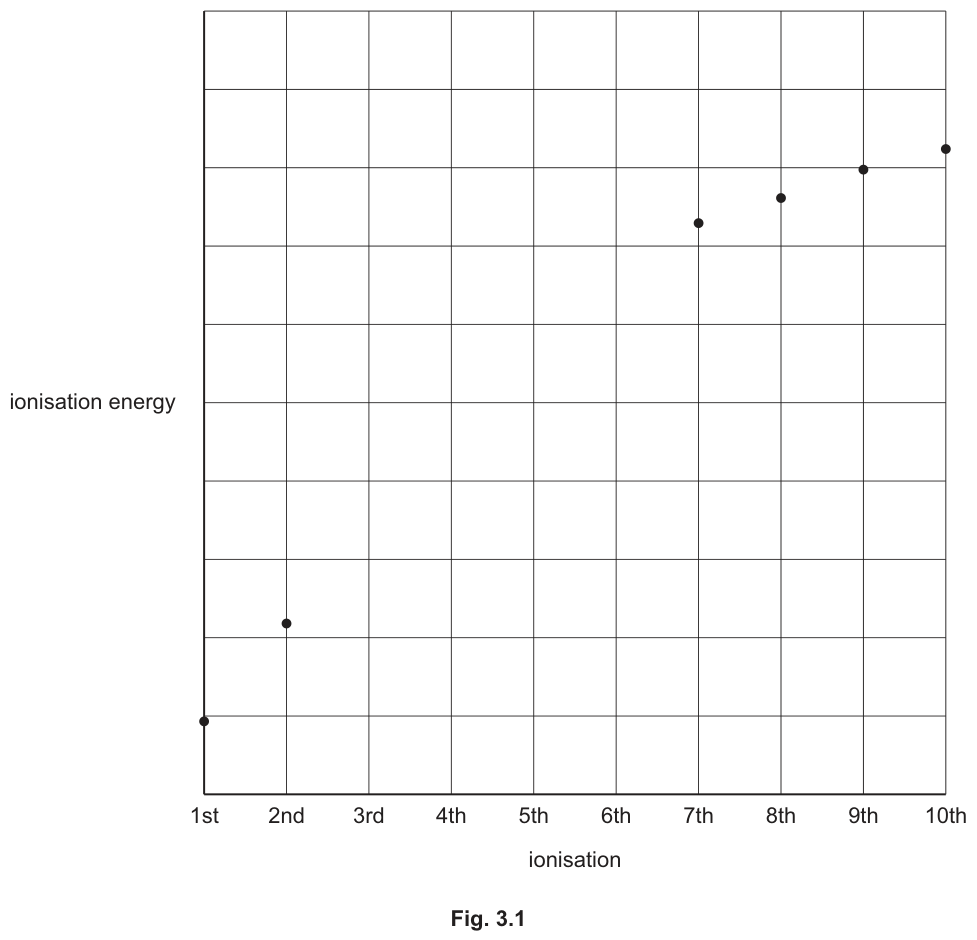
Fig. 3.1 shows a sketch of some of the ionisation energies of phosphorus, P.
Answer
P2+(g) -> P3+(g) + e-
Background Concept
The -th ionisation energy is the energy required to remove one electron from each ion in one mole of gaseous ions with a charge of . Therefore, the third ionisation energy involves removing an electron from a gaseous ion to form a gaseous ion.
Understanding the Question
Construct an equation to represent the third ionisation energy of phosphorus (P).
Approach
- Start with the species resulting from the second ionisation: .
- Remove one electron.
- End with the resulting species: .
- Include state symbols (g).
Step-by-Step Reasoning
- Reactant:
- Product:
- Equation:
Key Takeaways
- IE1:
- IE2:
- IE3:
- State symbols are crucial.
Common Mistakes
- Starting with neutral P.
- Omitting state symbols.
- Writing the electron as instead of .
Things to Be Careful About
- Ensure the charge on the reactant is 2+ and the product is 3+.
Answer
The points for the 3rd, 4th, 5th, and 6th ionisations should be plotted showing a general increase, with the 6th point being significantly higher than the 5th, marking a large jump.
See diagram
Background Concept
Successive ionisation energies always increase because it becomes harder to remove an electron from an increasingly positive ion. However, there are "jumps" in magnitude when an electron is removed from a new, inner principal shell closer to the nucleus. Phosphorus (atomic number 15) has the electron configuration . The 3rd shell contains 5 electrons. Therefore, the first 5 ionisations remove electrons from the 3rd shell. The 6th ionisation removes an electron from the 2nd shell, resulting in a very large increase in energy.
Understanding the Question
Complete the graph for the 3rd to 6th ionisation energies of P.
Approach
- Determine the electron configuration of P.
- Identify the shell boundaries.
- Plot the points: 3rd, 4th, 5th should be relatively low and increasing gradually (same shell). 6th should be much higher (new shell).
Step-by-Step Reasoning
- Configuration: . Outer shell (n=3) has 5 electrons.
- IE1-IE5: Removing electrons from the 3rd shell. Energy increases gradually.
- IE6: Removing an electron from the 2nd shell (n=2). This is much closer to the nucleus and experiences greater effective nuclear charge. Huge jump in energy.
- Graphing:
- 3rd: Higher than 2nd.
- 4th: Higher than 3rd.
- 5th: Higher than 4th.
- 6th: Significantly higher than 5th (the jump).
- 7th-10th: Given on the graph, they are high and increasing gradually (removing from n=2).
- The plotted points for 3, 4, 5 should follow the trend of the 1st and 2nd points (low, gradual increase). The 6th point should be high, comparable to or slightly lower than the 7th point shown on the graph.
Key Takeaways
- Large jumps in IE indicate a change in principal quantum number (shell).
- Number of electrons in outer shell = number of IEs before the first major jump.
- P has 5 valence electrons -> jump after IE5.
Common Mistakes
- Plotting the jump after IE3 (confusing with Group 3 elements).
- Not making the 6th IE high enough.
- Plotting the 3rd, 4th, 5th IEs too high.
Things to Be Careful About
- The relative height of the 6th point is the key discriminator for the second mark. It must show the large gap between the 5th and 6th ionisations.
Complete Table 3.1 to show the properties of nitrogen and phosphorus in their standard states.
Table 3.1
| nitrogen | phosphorus | |
|---|---|---|
| state and appearance of standard state | colourless gas | white solid |
| electrical conductivity | poor | |
| type of bonding | ||
| type of structure | simple |
Answer
| nitrogen | phosphorus | |
|---|---|---|
| state and appearance of standard state | colourless gas | white solid |
| electrical conductivity | poor | poor |
| type of bonding | covalent | covalent |
| type of structure | simple | simple |
Nitrogen conductivity: poor; Nitrogen bonding: covalent; Phosphorus bonding: covalent; Phosphorus structure: simple
Background Concept
Nitrogen and phosphorus are non-metals in Group 15. In their standard states, they exist as discrete molecules ( and ). The atoms within the molecules are held together by covalent bonds. The molecules are held together by weak intermolecular forces (van der Waals). They do not contain free ions or delocalised electrons, so they are poor electrical conductors. Their structures are described as "simple molecular".
Understanding the Question
Complete the table for the properties of nitrogen and phosphorus in their standard states.
Approach
- Electrical conductivity: Non-metals generally do not conduct electricity (except graphite). So, both are poor.
- Type of bonding: Both are non-metals bonding with themselves. This is covalent bonding.
- Type of structure: They exist as small molecules (, ), not giant lattices. This is a simple molecular structure.
Step-by-Step Reasoning
- Nitrogen conductivity: Poor (no mobile charge carriers).
- Nitrogen bonding: Covalent (sharing of electrons between N atoms).
- Phosphorus bonding: Covalent (sharing of electrons between P atoms).
- Phosphorus structure: Simple (molecular).
Key Takeaways
- Group 15 elements in standard states are simple molecular covalent substances.
- Poor conductors of electricity.
Common Mistakes
- Stating metallic bonding.
- Stating giant covalent structure.
- Confusing conductivity with solubility.
Things to Be Careful About
- Ensure the terms match the level of detail expected (e.g., "covalent" not "polar covalent").
A form of solid nitrogen has a lattice structure similar to solid iodine.
Identify the type of lattice structure of solid nitrogen.
Answer
Simple molecular lattice
Simple molecular
Background Concept
Solid iodine consists of molecules held together in a crystal lattice by weak van der Waals forces. This is known as a simple molecular lattice. The question states that solid nitrogen has a similar structure.
Understanding the Question
Identify the type of lattice structure of solid nitrogen.
Approach
Recognise that molecules, like molecules, form a solid held by intermolecular forces.
Step-by-Step Reasoning
- Iodine forms a simple molecular lattice.
- Nitrogen is stated to have a similar structure.
- Therefore, solid nitrogen has a simple molecular lattice.
Key Takeaways
- Halogens and Group 15 diatomic molecules form simple molecular solids.
- The lattice points are occupied by molecules, not atoms or ions.
Common Mistakes
- Saying "covalent lattice" (implies giant covalent like diamond).
- Saying "metallic".
Things to Be Careful About
- The term "simple molecular" is the precise answer.
At very high temperatures, phosphorus can form molecules.
contains a triple bond, .
Answer
- One bond formed by head-on overlap of p (or sp) orbitals.
- Two bonds formed by side-on overlap of p orbitals.
1 sigma bond (head-on overlap), 2 pi bonds (side-on overlap)
Background Concept
A triple bond consists of one sigma () bond and two pi () bonds. The sigma bond is formed by the end-to-end (head-on) overlap of atomic orbitals along the internuclear axis. The pi bonds are formed by the lateral (side-on) overlap of unhybridised p orbitals above and below the internuclear axis.
Understanding the Question
Describe the formation of the bond in terms of orbital overlap.
Approach
Break down the triple bond into its components (1 sigma, 2 pi) and describe the overlap type for each.
Step-by-Step Reasoning
- Sigma bond: Formed by the head-on overlap of orbitals (typically p-orbitals or hybrid orbitals) along the axis connecting the two nuclei.
- Pi bonds: Formed by the side-on overlap of parallel p-orbitals. There are two such pairs of orbitals (e.g., and ), resulting in two pi bonds.
Key Takeaways
- Triple bond = 1 sigma + 2 pi.
- Sigma = head-on overlap.
- Pi = side-on overlap.
Common Mistakes
- Describing only one type of bond.
- Confusing head-on and side-on overlap.
- Not mentioning the number of pi bonds (must be two).
Things to Be Careful About
- Use the terms "head-on" and "side-on" (or "end-to-end" and "lateral").
- Specify the number of sigma and pi bonds.
The bond energy of is . The bond energy of is .
Compare the reactivity of and . Explain your answer.
Answer
is more reactive than because the bond is weaker (lower bond energy) than the bond.
P2 is more reactive because P-P bond is weaker
Background Concept
Reactivity of diatomic molecules with triple bonds is largely determined by the energy required to break the bond. A higher bond energy means the molecule is more stable and less reactive. Nitrogen () is famously unreactive due to its exceptionally strong triple bond (). Phosphorus () has a much weaker triple bond ().
Understanding the Question
Compare the reactivity of and and explain the answer using the given bond energies.
Approach
Link the lower bond energy of to easier bond breaking and thus higher reactivity.
Step-by-Step Reasoning
- Compare bond energies: .
- The bond is weaker.
- Less energy is needed to break the bond.
- Therefore, is more reactive than .
Key Takeaways
- Bond strength inversely correlates with reactivity for bond-breaking steps.
- is inert due to high bond energy.
- is reactive due to lower bond energy.
Common Mistakes
- Stating is more reactive.
- Explaining based on atomic size without linking to bond energy/strength.
Things to Be Careful About
- Explicitly state which is more reactive and link it to the bond energy value provided.
Bromoalkanes are used widely in industry, although there is increasing concern about their environmental impact.
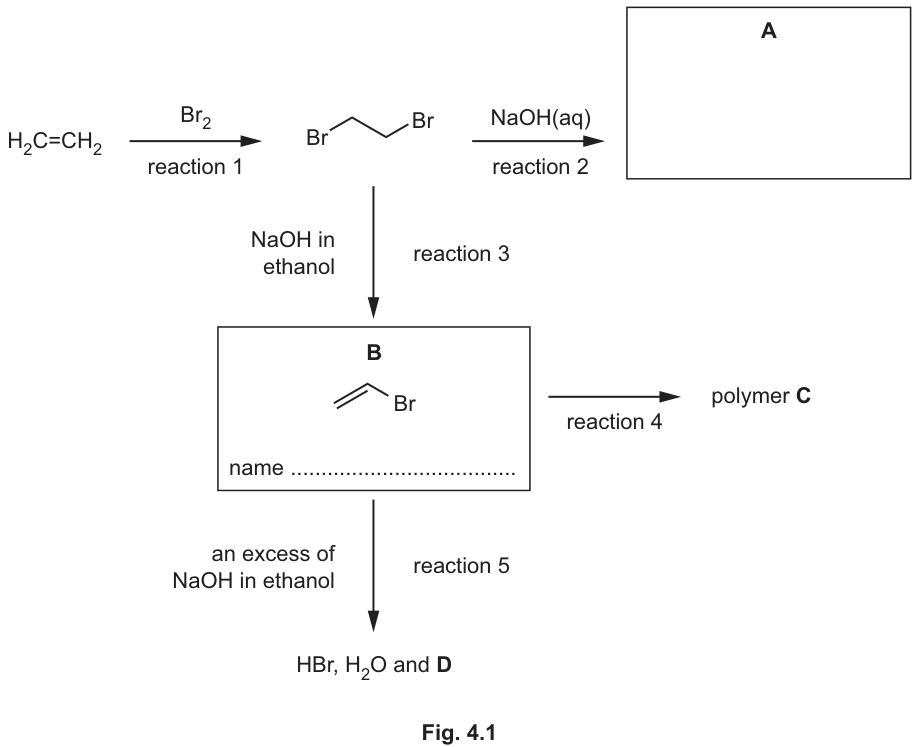
Fig. 4.1 shows a reaction scheme involving 1,2-dibromoethane.
Complete Fig. 4.2 to show the mechanism for the formation of 1,2-dibromoethane in reaction 1.
Include charges, dipoles, lone pairs of electrons and curly arrows as appropriate.
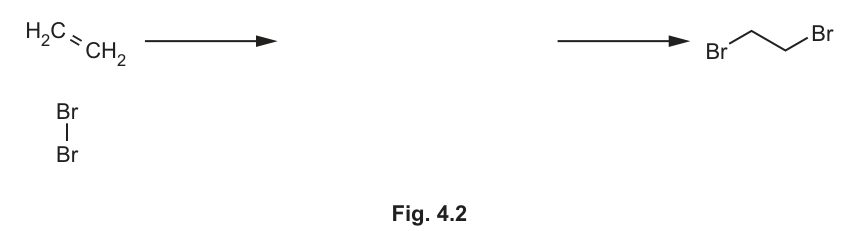
Answer
The mechanism for electrophilic addition of to ethene:
- The electrons in the C=C bond repel the electron cloud of , inducing a dipole:
- Curly arrow from the C=C double bond to the
- Curly arrow from the Br—Br bond to the other Br (heterolytic fission)
- Intermediate: carbocation with
- Curly arrow from a lone pair on to the
Electrophilic addition mechanism: dipole in Br2, curly arrow from C=C to Br(delta+), curly arrow from Br-Br bond to other Br, carbocation intermediate, curly arrow from Br- lone pair to C+
Background Concept
Electrophilic addition is the characteristic reaction of alkenes with non-polar molecules like . The electron-rich bond of the alkene acts as a nucleophile, attacking an electrophile. In the case of bromine, the molecule is initially non-polar, but as it approaches the electron cloud of the double bond, the electrons repel the bonding electrons in Br—Br, inducing a temporary dipole (). This makes the nearer bromine atom electrophilic.
The mechanism proceeds in two stages: (1) the electrons attack the electrophilic bromine, and the Br—Br bond breaks heterolytically to give a carbocation intermediate and a bromide ion; (2) the bromide ion (nucleophile) attacks the carbocation to give the final product.
Understanding the Question
The question asks you to complete a mechanism diagram showing the reaction of ethene with bromine to form 1,2-dibromoethane. You must include charges, dipoles, lone pairs, and curly arrows. The mark scheme awards 3 marks based on the number of correct points out of 5 (5 points = 3 marks, 4 or 3 points = 2 marks, 2 points = 1 mark).
Approach
Draw the mechanism in two stages:
- Stage 1: Show the induced dipole on Br₂, a curly arrow from the C=C bond to Br, and a curly arrow from the Br—Br bond to the other Br. Draw the resulting carbocation intermediate with a positive charge on one carbon and the bromine attached to the other carbon, plus the bromide ion.
- Stage 2: Show a curly arrow from a lone pair on Br⁻ to the positively charged carbon.
Step-by-Step Reasoning
Point 1 — Dipole on Br₂: The electrons of the double bond repel the electrons in the Br—Br bond, creating an induced dipole. Write .
Point 2 — Curly arrow from C=C to Br: The electron pair in the bond moves towards the electrophilic (partially positive) bromine atom. The arrow starts at the double bond and ends at the .
Point 3 — Curly arrow from Br—Br bond to other Br: The Br—Br bond breaks heterolytically. The bonding pair moves entirely to the more electronegative (distal) bromine, forming . The arrow starts at the bond and ends at the second Br.
Point 4 — Correct intermediate: After the first step, one carbon bears a positive charge (carbocation) and the other carbon is bonded to a Br atom. The structure is , with shown separately (with lone pairs and a negative charge).
Point 5 — Curly arrow from lone pair on Br⁻ to C: The bromide ion acts as a nucleophile, donating a lone pair to the electron-deficient carbon. The arrow starts at a lone pair on Br⁻ and ends at the positively charged carbon.
Key Takeaways
- Electrophilic addition involves an induced dipole in a non-polar molecule.
- Curly arrows always show the movement of electron pairs (from electron-rich to electron-poor).
- The first step produces a carbocation intermediate; the second step is nucleophilic attack.
- Heterolytic fission of Br—Br gives Br⁻ (with 3 lone pairs and a full negative charge).
Common Mistakes
- Drawing the curly arrow from Br to C instead of from C=C to Br (wrong direction).
- Forgetting the induced dipole labels ( and ).
- Not showing the positive charge on the carbocation intermediate.
- Omitting lone pairs on .
- Drawing the arrow from the Br—Br bond to the wrong bromine atom.
- Showing a homolytic fission (fishhook arrows) instead of heterolytic fission.
Things to Be Careful About
- The mark scheme uses a partial credit system: 5 correct points = 3 marks, 4 or 3 = 2 marks, 2 = 1 mark. Ensure you include all five elements.
- Charges must be clearly shown on the carbocation and on the bromide ion.
- The intermediate must show the correct connectivity (Br attached to one carbon, positive charge on the other).
The enthalpy change of reaction 1, .
The enthalpy change of formation of ethene, .
Calculate the enthalpy change of formation of 1,2-dibromoethane.
Working
Since is an element in its standard state, .
Answer
-37.8 kJ mol^-1
Background Concept
The enthalpy change of a reaction can be calculated from enthalpies of formation using Hess's Law: . A key principle is that the standard enthalpy of formation of any element in its most stable form (its standard state) is defined as zero. Bromine in its standard state is , so .
Understanding the Question
We are given kJ mol⁻¹ for the addition of Br₂ to ethene, and kJ mol⁻¹. We must find .
Approach
Write the Hess's Law expression for the reaction, substitute known values, and solve for the unknown enthalpy of formation.
Step-by-Step Reasoning
The reaction is:
Applying Hess's Law:
Since Br₂ is an element in its standard state, .
Substituting:
Key Takeaways
- Always remember that of elements in their standard states is zero.
- The sign convention in Hess's Law: products minus reactants.
- A negative means the compound is more stable than its constituent elements.
Common Mistakes
- Forgetting that and trying to include a non-zero value.
- Getting the sign wrong: writing instead of .
- Confusing the direction of the equation (reactants minus products instead of products minus reactants).
Things to Be Careful About
- The answer must include the unit kJ mol⁻¹.
- Pay attention to the sign of the given values: is negative, is positive.
Answer
Compound A: Reaction 2 uses — nucleophilic substitution of both Br atoms by OH groups.
Compound B: Reaction 3 uses NaOH in ethanol — elimination of one HBr from 1,2-dibromoethane.
Name of B: bromoethene
A = ethane-1,2-diol (HOCH₂CH₂OH); B = bromoethene
Background Concept
Halogenoalkanes undergo two main reactions with hydroxide ions depending on conditions:
- Nucleophilic substitution with aqueous NaOH (or KOH): OH⁻ replaces the halogen, forming an alcohol.
- Elimination with ethanolic NaOH (or KOH) under heat: OH⁻ removes a proton from a carbon adjacent to the C—X bond, and X⁻ leaves, forming a C=C double bond (alkene).
When a dihalogenoalkane like 1,2-dibromoethane reacts with aqueous NaOH, both bromine atoms can be substituted to give a diol. With ethanolic NaOH, elimination of one HBr gives a bromoalkene.
Understanding the Question
We need to identify compound A (from reaction 2: 1,2-dibromoethane + NaOH(aq)) and name compound B (from reaction 3: 1,2-dibromoethane + NaOH in ethanol, which gives the structure shown as H₂C=CHBr).
Approach
- For A: aqueous NaOH promotes substitution. Both Br atoms are replaced by OH groups → ethane-1,2-diol.
- For B: ethanolic NaOH promotes elimination. One HBr is removed from 1,2-dibromoethane → bromoethene (H₂C=CHBr).
Step-by-Step Reasoning
Compound A: 1,2-dibromoethane () + 2NaOH(aq) → + 2NaBr. This is a double nucleophilic substitution giving ethane-1,2-diol.
Compound B: 1,2-dibromoethane + NaOH(ethanol) → + NaBr + H₂O. This is an elimination reaction (removal of one HBr). The product has a C=C double bond with one Br still attached. The IUPAC name is bromoethene (or vinyl bromide).
Key Takeaways
- Aqueous NaOH → substitution (replaces halogen with OH).
- Ethanolic NaOH → elimination (removes HX, forms C=C).
- A dihalogenoalkane can undergo either reaction depending on conditions.
Common Mistakes
- Confusing the conditions: drawing elimination for aqueous NaOH or substitution for ethanolic NaOH.
- Drawing A as a mono-substituted product (2-bromoethanol) instead of the diol.
- Misnaming B as 'bromoethylene' or '1-bromoethene' (the '1-' is unnecessary since there's only one possible position).
Things to Be Careful About
- The question asks to draw A and name B — don't reverse these.
- For drawing A, show the full displayed or skeletal structure with both OH groups.
Answer
The repeat unit of polymer C (poly(bromoethene)) is
Repeat unit: -[CH2-CHBr]- with dashed bonds extending from each end carbon
Background Concept
Addition polymerisation involves the opening of C=C double bonds in monomers to form long chains. The repeat unit is derived from the monomer by converting the double bond to a single bond and adding dashed bonds at each end to show the continuation of the chain.
For bromoethene (), the bond breaks and each carbon forms a new single bond to an adjacent monomer unit.
Understanding the Question
We need to draw one repeat unit of polymer C, which is formed by addition polymerisation of compound B (bromoethene, ).
Approach
Take the monomer structure, replace the C=C double bond with a C—C single bond, and add dashed bonds extending from each carbon to indicate the chain continues.
Step-by-Step Reasoning
Monomer:
Repeat unit:
In the displayed formula:
- Left carbon: bonded to two H atoms and has a dashed bond extending left.
- Right carbon: bonded to one H and one Br, and has a dashed bond extending right.
- The two carbons are joined by a single bond.
Key Takeaways
- The repeat unit has the same atoms as the monomer but with the double bond opened.
- Dashed bonds at each end show the polymer chain continues.
- The Br atom remains attached to one carbon in the repeat unit.
Common Mistakes
- Forgetting the dashed bonds at the ends.
- Drawing the Br on the wrong carbon.
- Including the double bond in the repeat unit.
- Drawing the repeat unit without showing all H atoms (for a displayed formula).
Things to Be Careful About
- Ensure the repeat unit shows all atoms explicitly (H and Br on each carbon).
- The dashed bonds must extend from the correct positions (from the carbon atoms, not from H or Br).
In reaction 5, compound B reacts with an excess of dissolved in ethanol. The products are , and an unsaturated hydrocarbon D.
Suggest the identity of D.
Answer
Compound B is bromoethene (). With excess NaOH in ethanol, a second elimination of HBr occurs, forming a triple bond.
D is ethyne ( or ).
C2H2 (ethyne)
Background Concept
Elimination reactions remove atoms from adjacent carbons to form a multiple bond. A single elimination from a haloalkane gives an alkene (C=C). A second elimination from an alkene bearing a halogen can give an alkyne (C≡C), as the remaining H and X are removed from adjacent carbons that already share a double bond.
Understanding the Question
Compound B is bromoethene (). Reaction 5 uses an excess of NaOH in ethanol, which promotes elimination. The products are HBr, H₂O, and an unsaturated hydrocarbon D. We need to identify D.
Approach
Starting from bromoethene, eliminate one molecule of HBr: remove H from one carbon and Br from the adjacent carbon. Since these carbons already share a double bond, the result is a triple bond — ethyne.
Step-by-Step Reasoning
Bromoethene:
The OH⁻ removes a proton from the CH₂ group while Br⁻ leaves from the adjacent carbon. The existing double bond plus the new bond formed by electron redistribution gives a triple bond:
D = ethyne ()
Key Takeaways
- Double elimination from a dihalogenoalkane (or sequential elimination) can produce an alkyne.
- An excess of NaOH in ethanol ensures both elimination steps occur.
- The molecular formula C₂H₂ is the only unsaturated hydrocarbon with two carbons that has a triple bond.
Common Mistakes
- Suggesting ethene as D (this would require no elimination from bromoethene, just substitution of Br by H, which is not what happens).
- Writing the formula as C₂H₄ by mistake.
- Confusing the product with a different isomer.
Things to Be Careful About
- The question specifies 'unsaturated hydrocarbon', confirming D contains only C and H with a multiple bond.
- The products listed (HBr, H₂O) confirm an elimination has occurred.
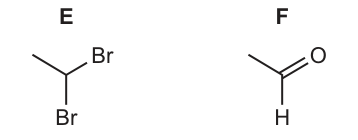
Compound E is the only isomer of 1,2-dibromoethane.
Alkaline hydrolysis of E gives compound F.
Answer
Structural isomerism (positional isomerism)
structural (positional) isomerism
Background Concept
Structural isomers have the same molecular formula but different structural formulae (different connectivity). Positional isomerism is a subtype where the functional group or substituent is attached at a different position on the same carbon skeleton.
Understanding the Question
1,2-dibromoethane has Br atoms on adjacent carbons (). Compound E (1,1-dibromoethane) has both Br atoms on the same carbon (). The molecular formula is the same () but the position of the Br atoms differs.
Approach
Compare the two structures: same molecular formula, same carbon skeleton (two carbons), but the Br atoms are bonded to different positions → positional isomerism, which is a type of structural isomerism.
Step-by-Step Reasoning
- 1,2-dibromoethane: (Br on carbons 1 and 2)
- 1,1-dibromoethane: (both Br on carbon 1)
The difference is purely in the position of the bromine atoms → positional (structural) isomerism.
Key Takeaways
- Positional isomerism is a subset of structural isomerism.
- The carbon skeleton remains the same; only the position of the substituent changes.
Common Mistakes
- Saying 'geometric isomerism' or 'optical isomerism' — these require different conditions (restricted rotation or chiral centre respectively).
- Saying 'chain isomerism' — the carbon chain is identical (both are two-carbon chains).
Things to Be Careful About
- 'Structural' is acceptable as the general term; 'positional' is more specific. Either should earn the mark.
Answer
Aldehyde
aldehyde
Background Concept
The aldehyde functional group is —CHO (a carbonyl group C=O with at least one H attached to the carbonyl carbon). In compound F (ethanal, ), the structure shows a C=O with an H on the carbonyl carbon, confirming it is an aldehyde.
Understanding the Question
Compound F is shown as , which is ethanal. We need to name the homologous series.
Approach
Identify the functional group: C=O bonded to at least one H → aldehyde.
Step-by-Step Reasoning
The structure of F shows:
- A methyl group ()
- A carbonyl group (C=O)
- A hydrogen atom directly bonded to the carbonyl carbon
This —CHO arrangement is the defining feature of aldehydes.
Key Takeaways
- Aldehydes have the —CHO group (carbonyl + H on the same carbon).
- Ketones have the carbonyl bonded to two carbon groups (no H on the carbonyl carbon).
- The general formula for aldehydes is .
Common Mistakes
- Saying 'carbonyl compound' — while technically correct, the question asks for the specific homologous series.
- Confusing with 'ketone' — ethanal has an H on the carbonyl carbon, so it is an aldehyde.
Things to Be Careful About
- The question asks for the homologous series, not the compound name. 'Aldehyde' is the series; 'ethanal' is the compound.
Complete Table 4.1 to state what is observed when F reacts with the reagents listed.
Table 4.1
| reagent | observation with F |
|---|---|
| 2,4-dinitrophenylhydrazine (2,4-DNPH reagent) | |
| Tollens' reagent | |
| alkaline |
Answer
| Reagent | Observation with F |
|---|---|
| 2,4-DNPH | orange (yellow/red) precipitate |
| Tollens' reagent | silver mirror (grey/black precipitate) |
| alkaline | yellow precipitate |
2,4-DNPH: orange/yellow/red precipitate; Tollens': silver mirror; alkaline I2: yellow precipitate
Background Concept
Compound F is ethanal (), which contains:
- A carbonyl group (C=O) → gives a positive 2,4-DNPH test (orange/yellow precipitate of hydrazone).
- An aldehyde group (—CHO) → gives a positive Tollens' test (silver mirror) because aldehydes are readily oxidised.
- A arrangement → gives a positive iodoform test (yellow precipitate of ) with alkaline iodine.
Understanding the Question
We need to state what is observed when ethanal reacts with three different reagents. Each test targets a different structural feature of ethanal.
Approach
- 2,4-DNPH tests for the presence of any carbonyl group (aldehyde or ketone).
- Tollens' reagent specifically tests for aldehydes (which can be oxidised to carboxylic acids).
- Alkaline (iodoform test) detects groups.
Step-by-Step Reasoning
2,4-DNPH: Ethanal has a C=O group. The 2,4-dinitrophenylhydrazine condenses with the carbonyl to form an orange/yellow/red precipitate (the hydrazone derivative).
Tollens' reagent: Ethanal is an aldehyde. Tollens' reagent () oxidises the aldehyde to a carboxylate, and Ag⁺ is reduced to metallic silver, forming a silver mirror on the test tube (or a grey/black precipitate of silver).
Alkaline : Ethanal contains the group (methyl carbonyl). The iodoform reaction produces (tri-iodomethane), which is a yellow precipitate with an antiseptic smell.
Key Takeaways
- 2,4-DNPH is a general test for carbonyl compounds (aldehydes AND ketones).
- Tollens' distinguishes aldehydes from ketones (only aldehydes give a positive result).
- The iodoform test detects or groups.
Common Mistakes
- Saying 'silver precipitate' for Tollens' without specifying 'mirror' (though grey/black precipitate is also accepted per the mark scheme).
- Saying 'no reaction' for the iodoform test — ethanal DOES give a positive iodoform test because it has .
- Confusing the colour of the 2,4-DNPH precipitate (it is orange/yellow/red, not white or blue).
Things to Be Careful About
- The mark scheme accepts 'red', 'orange', or 'yellow' for the 2,4-DNPH precipitate.
- For Tollens', both 'silver mirror' and 'grey/black precipitate' are acceptable.
- The iodoform test requires the group specifically; not all aldehydes give a positive result (e.g., propanal does not, but ethanal does).
Compound F reacts with reagent G to form compound H.
The infrared spectrum of H is shown in Fig. 4.3.
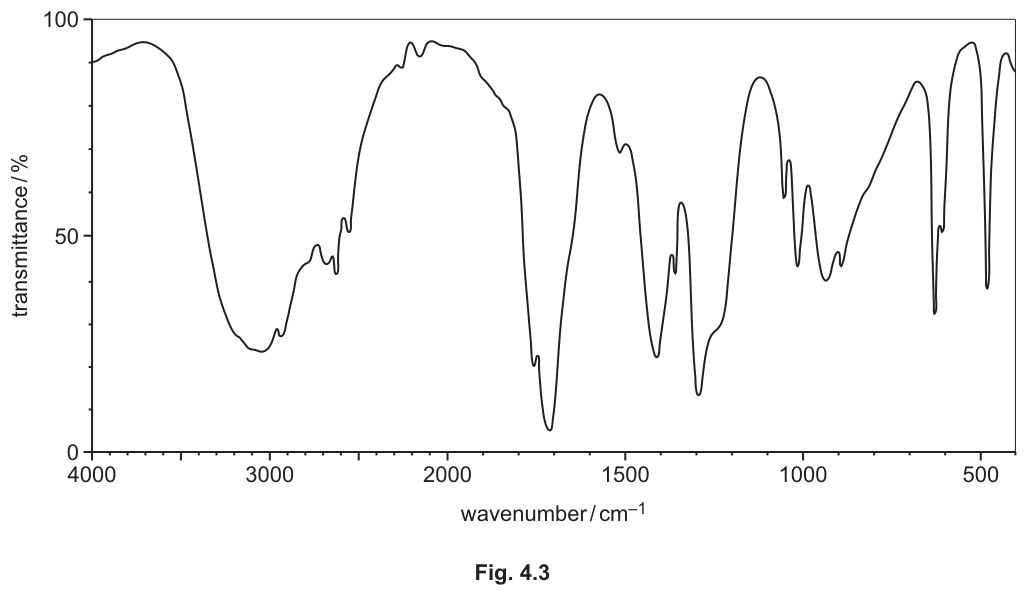
Table 4.2
| bond | functional groups containing the bond | characteristic infrared absorption range (in wavenumbers) / |
|---|---|---|
| C–O | hydroxy, ester | 1040–1300 |
| C=C | aromatic compound, alkene | 1500–1680 |
| C=O | amide carbonyl, carboxyl ester | 1640–1690 1670–1740 1710–1750 |
| CN | nitrile | 2200–2250 |
| C–H | alkane | 2850–2950 |
| N–H | amine, amide | 3300–3500 |
| O–H | carboxyl hydroxy | 2500–3000 3200–3600 |
H also shows a molecular ion peak at in its mass spectrum.
Use the information in (e), Fig. 4.3 and Table 4.2 to deduce the structure of H. Explain your answer fully.
Working
From the IR spectrum and Table 4.2:
- A broad absorption in the range 2500–3000 cm⁻¹ indicates an O–H bond in a carboxyl group (carboxylic acid).
- A strong absorption in the range 1670–1750 cm⁻¹ indicates a C=O bond (carbonyl/carboxyl).
- The molecular ion peak at gives .
: ✓
Answer
H is ethanoic acid ()
CH3COOH (ethanoic acid)
Background Concept
Infrared spectroscopy identifies functional groups by their characteristic bond absorptions. A carboxylic acid shows two key features: (1) a very broad O—H stretch in the 2500–3000 cm⁻¹ range (distinctly different from the sharper alcohol O—H at 3200–3600 cm⁻¹), and (2) a strong C=O stretch around 1700–1750 cm⁻¹. The mass spectrum's molecular ion peak gives the relative molecular mass, which can confirm or rule out candidate structures.
Understanding the Question
Compound F is ethanal (, ). It reacts with reagent G to form compound H. We are given the IR spectrum of H (showing a broad absorption around 3000 cm⁻¹ and a strong peak around 1720 cm⁻¹) and a molecular ion peak at . We must deduce the structure of H and explain our reasoning.
Approach
- Identify the functional groups from the IR absorptions.
- Use the molecular mass to confirm the identity.
- The combination of carboxylic acid O—H and C=O with uniquely identifies ethanoic acid.
Step-by-Step Reasoning
Evidence 1 — Broad absorption 2500–3000 cm⁻¹: This is the characteristic O—H stretch of a carboxylic acid (the mark scheme specifies this range from Table 4.2 for 'carboxyl' O—H). This is much broader and at lower wavenumber than an alcohol O—H (3200–3600 cm⁻¹) because of strong hydrogen bonding in the carboxyl group.
Evidence 2 — Strong absorption ~1720 cm⁻¹: This falls within the 1670–1750 cm⁻¹ range for C=O in a carboxyl group (per Table 4.2). This confirms the presence of a carbonyl.
Evidence 3 — : The molecular ion peak at means the compound has a relative molecular mass of 60. For ethanoic acid (): . ✓
Conclusion: H is ethanoic acid, . This is consistent with F (ethanal) being oxidised to the corresponding carboxylic acid.
Key Takeaways
- A broad O—H absorption at 2500–3000 cm⁻¹ is diagnostic of a carboxylic acid (not an alcohol, which absorbs at 3200–3600 cm⁻¹).
- The C=O in a carboxylic acid appears at 1670–1750 cm⁻¹.
- The molecular ion peak provides the molecular mass, which confirms the identity.
- Combining multiple spectroscopic pieces of evidence is essential for unambiguous structure determination.
Common Mistakes
- Identifying the broad O—H as an alcohol O—H (wrong range — alcohol O—H is at higher wavenumber and less broad).
- Forgetting to mention the molecular mass as supporting evidence.
- Suggesting a different compound with (e.g., propanal has , not 60; methyl ethanoate has ).
- Not linking the evidence to the specific wavenumber ranges given in Table 4.2.
Things to Be Careful About
- The mark scheme requires specific points: M1 (identify H correctly), M2 (broad absorption 3600–2500 → O—H), M3 (either C=O absorption 1670–1750, OR C—O absorption 1040–1300, OR molecular mass = 60). You need M1 plus two of the M3 points.
- Always quote the wavenumber range from the table to justify your identification.
Answer
Oxidising agent
oxidising agent
Background Concept
Aldehydes can be oxidised to carboxylic acids using mild or strong oxidising agents. Common oxidising agents include acidified potassium dichromate () or Tollens' reagent. The oxidation involves the addition of an oxygen atom to the carbonyl carbon (or equivalently, the removal of H₂ from the aldehyde group).
Understanding the Question
Reagent G converts compound F (ethanal) to compound H (ethanoic acid). We need to state the role of G.
Approach
Compare F and H: ethanal () → ethanoic acid (). The —CHO group has gained an oxygen atom, which is oxidation. Therefore G must be an oxidising agent.
Step-by-Step Reasoning
- F = (ethanal)
- H = (ethanoic acid)
- The conversion involves adding [O] to the aldehyde → oxidation
- Therefore G is an oxidising agent
Examples of suitable oxidising agents: acidified , or , or Tollens' reagent.
Key Takeaways
- Aldehyde → carboxylic acid = oxidation (gain of O or loss of H₂).
- The role of the reagent is described as 'oxidising agent'.
Common Mistakes
- Saying 'reducing agent' — this would convert the aldehyde to an alcohol, not a carboxylic acid.
- Saying 'catalyst' — G is consumed in the reaction.
- Naming a specific reagent without stating its role (the question asks for the role, not the name).
Things to Be Careful About
- The question asks for the role of reagent G, not its identity. 'Oxidising agent' is the required answer.