Chemistry 9701/21 — October/November 2024
Cambridge AS Level · AS Level Structured Questions · worked solutions for every part, with the mark scheme
Topics Introduction to Organic Chemistry · Atomic Structure · Atoms, Molecules and Stoichiometry · Hydrocarbons · Group 17 · Electrochemistry · +10 more
Cobalt, rhodium and iridium are metals in the same group of the Periodic Table.
The shorthand electronic configuration of cobalt is .
Answer
1s²2s²2p⁶3s²3p⁶
Background Concept
Shorthand electronic configurations use a noble gas in square brackets to represent the filled inner shells of an atom. The noble gas chosen is the one immediately preceding the element in the Periodic Table. Argon (Z = 18) is the noble gas before cobalt (Z = 27), so [Ar] represents the first 18 electrons arranged in their lowest-energy configuration.
Understanding the Question
The question asks you to expand [Ar] into its full electronic configuration. This is a straightforward recall task — you need to write out all the orbitals occupied by argon's 18 electrons in order of increasing energy.
Approach
Fill orbitals in the order 1s → 2s → 2p → 3s → 3p, placing 2 electrons in each s orbital and 6 in each p orbital, until all 18 electrons are accounted for.
Step-by-Step Reasoning
- 1s holds 2 electrons: (running total: 2)
- 2s holds 2 electrons: (running total: 4)
- 2p holds 6 electrons: (running total: 10)
- 3s holds 2 electrons: (running total: 12)
- 3p holds 6 electrons: (running total: 18)
This accounts for all 18 electrons of argon. The configuration can be written with or without commas between subshells.
Key Takeaways
- [Ar] always means (18 electrons).
- Shorthand notation saves space but the full configuration must be recalled accurately.
Common Mistakes
- Writing instead of stopping at — argon has no d electrons.
- Omitting a subshell or miscounting electrons.
- Writing the configuration for a different noble gas (e.g. neon or krypton).
Things to Be Careful About
- Ensure the total number of electrons adds up to 18.
- Use the correct superscript notation for each subshell.
The lowest-energy electrons in cobalt are in the 1s orbital.
Draw the shape of a 1s orbital.
Answer
A sphere (circle in two dimensions) representing the spherical shape of the 1s orbital.
A sphere (circle representing the spherical 1s orbital)
Background Concept
Atomic orbitals are regions of space where there is a high probability (conventionally 90%) of finding an electron. The shape of an orbital depends on its angular momentum quantum number : s orbitals () are spherical, p orbitals () are dumbbell-shaped, and d orbitals () have more complex shapes. The 1s orbital is the simplest — a sphere centred on the nucleus, with the electron density greatest near the nucleus and falling off exponentially with distance.
Understanding the Question
The question asks you to draw the shape of a 1s orbital. Since this is a two-dimensional representation of a three-dimensional object, a circle is the standard way to depict it.
Approach
Draw a circle to represent the spherical boundary of the 1s orbital. No axes or labels are strictly required, though some candidates add a dot at the centre to indicate the nucleus.
Step-by-Step Reasoning
The 1s orbital is spherically symmetric. In a 2D drawing, this is represented by a circle. The mark scheme accepts a simple circle as the correct shape.
Key Takeaways
- All s orbitals (1s, 2s, 3s, …) are spherical.
- The shape does not change with principal quantum number — only the size does.
Common Mistakes
- Drawing a dumbbell shape (that is a p orbital).
- Drawing a cloverleaf (that is a d orbital).
- Drawing a figure-of-eight or other non-spherical shape.
Things to Be Careful About
- The question asks for the shape only — no need to label axes or indicate electron density gradients.
- A simple circle is sufficient and is what the mark scheme expects.
Answer
3
3
Background Concept
Hund's rule states that electrons fill degenerate orbitals (orbitals of the same energy, such as the five 3d orbitals) singly with parallel spins before pairing occurs. This minimises electron–electron repulsion. The 3d subshell contains five orbitals, each of which can hold a maximum of two electrons.
Understanding the Question
Cobalt has the configuration . The 4s electrons are paired, so unpaired electrons must come from the 3d subshell. We need to distribute 7 electrons among 5 d orbitals following Hund's rule and count the unpaired ones.
Approach
Fill the five 3d orbitals one electron at a time with parallel spins, then begin pairing. Count the orbitals that contain only one electron.
Step-by-Step Reasoning
The five 3d orbitals are filled as follows:
- Electrons 1–5: one in each orbital (all unpaired): ↑ ↑ ↑ ↑ ↑
- Electrons 6–7: pair up in the first two orbitals: ↑↓ ↑↓ ↑ ↑ ↑
This gives 3 orbitals with a single (unpaired) electron.
Key Takeaways
- Hund's rule: maximise unpaired electrons in degenerate orbitals before pairing.
- For a configuration: 3 unpaired electrons.
- For a configuration: 5 unpaired electrons (all singly occupied).
Common Mistakes
- Assuming all 7 electrons are unpaired (ignoring that pairing must occur after 5).
- Filling orbitals in pairs from the start (violating Hund's rule).
- Confusing the number of electrons in the subshell with the number of unpaired electrons.
Things to Be Careful About
- Only the 3d electrons contribute to unpaired electrons here (4s² is fully paired).
- The answer is 3, not 7.
Table 1.1 gives some details of the stable naturally occurring isotopes of rhodium and iridium.
Table 1.1
| isotope | number of protons | number of neutrons | total number of electron shells |
|---|---|---|---|
| 58 | |||
| 6 | |||
| 6 |
Complete Table 1.1.
Answer
| isotope | number of protons | number of neutrons | total number of electron shells |
|---|---|---|---|
| 45 | 58 | 5 | |
| 77 | 114 | 6 | |
| 77 | 116 | 6 |
Working for neutrons: and .
Rhodium is in Period 5 (5 electron shells); iridium is in Period 6 (6 electron shells).
Rh: 45 protons, 5 shells; Ir-191: 77 protons, 114 neutrons; Ir-193: 77 protons, 116 neutrons
Background Concept
In standard isotope notation , the subscript is the proton number (atomic number) and the superscript is the nucleon (mass) number. The number of neutrons is . The number of electron shells in a neutral atom equals the period number of the element in the Periodic Table.
Understanding the Question
Table 1.1 gives partial information about three isotopes. You must fill in the missing values: proton numbers (read from the isotope notation), neutron numbers (calculated as ), and the total number of electron shells (deduced from the period of the element).
Approach
- Proton number: read directly from the subscript in .
- Neutron number: subtract proton number from mass number.
- Electron shells: determine the period of each element. Rhodium (Z = 45) is in Period 5; iridium (Z = 77) is in Period 6.
Step-by-Step Reasoning
Rhodium ():
- Protons = 45 (given by the subscript)
- Neutrons = 58 (given)
- Electron shells: Rh is in Period 5, so 5 shells
Iridium-191 ():
- Protons = 77 (from subscript)
- Neutrons = 191 − 77 = 114
- Electron shells = 6 (given, and consistent with Period 6)
Iridium-193 ():
- Protons = 77 (from subscript)
- Neutrons = 193 − 77 = 116
- Electron shells = 6 (given)
Key Takeaways
- The subscript in isotope notation always gives the proton number.
- Neutron number = mass number − proton number.
- Number of electron shells = period number of the element.
- Isotopes of the same element have the same proton number and electron configuration, hence the same number of shells.
Common Mistakes
- Confusing proton number with mass number.
- Forgetting that the number of electron shells equals the period number, not the group number.
- Miscalculating neutrons (e.g. writing 191 − 45 instead of 191 − 77).
Things to Be Careful About
- The mark scheme awards 1 mark per correct row, so all entries in a row must be correct for that mark.
- Ensure you read the isotope notation carefully — the bottom number is always protons.
Table 1.2 shows the relative abundances of isotopes in a sample of an alloy containing rhodium and iridium only.
Table 1.2
| isotope | relative isotopic mass | relative abundance in alloy |
|---|---|---|
| 102.91 | 50.00 | |
| 190.96 | 15.18 | |
| 192.96 | 34.82 |
Answer
The mass of an atom of a particular isotope compared to of the mass of a carbon-12 atom.
The mass of an atom of an isotope compared to 1/12 the mass of a carbon-12 atom
Background Concept
Relative isotopic mass is a dimensionless quantity that expresses the mass of a single atom of a specific isotope relative to a standard. The standard is of the mass of one atom of carbon-12, which is defined to have a relative isotopic mass of exactly 12. This standard is also called the unified atomic mass unit (amu or u).
Understanding the Question
The command word is 'define', which requires a precise, complete statement. The mark scheme awards 2 marks: one for stating it is the mass of an atom of an isotope, and one for the comparison to the mass of a carbon-12 atom (or equivalent phrasing).
Approach
Provide both elements of the definition: (1) what is being measured (mass of an atom of a specific isotope), and (2) what it is compared to ( the mass of a carbon-12 atom).
Step-by-Step Reasoning
- Mark 1: State that relative isotopic mass refers to the mass of an atom of a particular isotope. This distinguishes it from relative atomic mass, which is an average over all isotopes.
- Mark 2: State the comparison standard — the mass of a carbon-12 atom. Alternative acceptable wordings include 'compared to the unified atomic mass unit' or 'on a scale where carbon-12 has a mass of exactly 12'.
Key Takeaways
- Relative isotopic mass applies to a single isotope, not an element (which would be relative atomic mass).
- The comparison must be to of a carbon-12 atom specifically, not just 'carbon' or 'the lightest atom'.
- It is dimensionless (a ratio).
Common Mistakes
- Writing 'mass of an atom' without specifying 'of an isotope' — this could be confused with relative atomic mass.
- Saying 'compared to hydrogen' or 'compared to oxygen' — the standard is carbon-12.
- Saying '1/12 of the mass of carbon' without specifying the isotope carbon-12.
- Omitting the comparison entirely and just stating 'mass of an atom of an isotope'.
Things to Be Careful About
- Both parts of the definition are needed for full marks.
- 'Carbon-12' must be specified — 'carbon' alone is insufficient because it implies a mixture of isotopes.
Use Table 1.2 to calculate the relative atomic mass, , of iridium in the alloy.
Give your answer to two decimal places.
Working
Only the iridium isotopes are relevant. Their combined abundance in the alloy is .
Answer
192.35
Background Concept
The relative atomic mass of an element is the weighted average of the relative isotopic masses of its isotopes, weighted by their relative abundances. When dealing with a mixture (such as an alloy), you must isolate the isotopes of the element of interest and use only their abundances in the calculation.
Understanding the Question
Table 1.2 gives data for three isotopes in an alloy containing both rhodium and iridium. You are asked to calculate of iridium only. The rhodium entry (50.00% abundance) must be excluded from the calculation.
Approach
- Identify the iridium isotopes and their abundances: (15.18) and (34.82).
- Sum their abundances to get the total iridium abundance: 50.00.
- Apply the weighted average formula using only the iridium data.
Step-by-Step Reasoning
- Numerator:
- Denominator:
- Rounded to two decimal places: 192.35
Note: The mark scheme shows the denominator as 50.00 (the sum of iridium abundances only), not 100. This is because we are calculating the Ar of iridium within the alloy, and only iridium isotopes contribute.
Key Takeaways
- When calculating Ar from a mixture, use only the relevant isotopes and their combined abundance as the denominator.
- The answer should be between the lightest and heaviest isotope masses (190.96 < 192.35 < 192.96), confirming reasonableness.
- Pay attention to the number of decimal places requested.
Common Mistakes
- Including the rhodium abundance (50.00) in the denominator, giving — this is wrong because it dilutes the iridium average with a non-iridium isotope.
- Using 100 as the denominator without checking whether the abundances sum to 100 for the element of interest.
- Rounding to one decimal place or to the nearest whole number when two decimal places are specified.
Things to Be Careful About
- The question specifies two decimal places — the answer 192.35 must not be rounded further.
- The mark scheme method mark (B1) is for the correct expression; the accuracy mark (B1) is for the correct final value.
Hydrated rhodium(III) chloride, , catalyses the conversion of ethene to but-2-ene.
Both stereoisomers of but-2-ene are formed in the reaction.
Hydrated rhodium(III) chloride contains 20.5% by mass of water of crystallisation.
Deduce the integer value of in .
Show your working.
Working
Mass of water per formula unit
Answer
x = 3
Background Concept
A hydrate is a compound that contains water molecules incorporated into its crystal structure, written as . The value of can be determined from the percentage by mass of water in the hydrate. The molar mass of the anhydrous salt plus times the molar mass of water gives the molar mass of the hydrate.
Understanding the Question
Hydrated rhodium(III) chloride, , contains 20.5% water by mass. You must deduce the integer value of . You are given the relative isotopic mass of Rh as 102.9 (from Table 1.2) and should use .
Approach
Method 1 (algebraic): Set up the equation and solve for .
Method 2 (ratio): Assume 100 g of hydrate. Then 79.5 g is and 20.5 g is . Convert to moles and find the simplest ratio.
Step-by-Step Reasoning
Using Method 1:
- Mass of water in one formula unit =
- Total molar mass of hydrate =
Using Method 2 (ratio approach):
- Moles of
- Moles of
- Ratio =
- Therefore
Key Takeaways
- The percentage by mass of water in a hydrate directly relates to through the molar mass equation.
- Always verify that the answer is an integer (or very close to one), as must be a whole number.
- The ratio method is often quicker and less algebraically demanding.
Common Mistakes
- Using (mass number) instead of 102.9 (relative isotopic mass from the table) — though this gives a very similar answer.
- Forgetting to multiply 35.5 by 3 for the three chlorine atoms.
- Setting up the equation as (omitting from the denominator).
- Reporting when the question asks for the integer value.
Things to Be Careful About
- The mark scheme awards M1 for the correct method (either the ratio or the algebraic setup) and A1 for the correct final answer .
- Use the relative isotopic mass of Rh (102.9) from Table 1.2, not the mass number (103).
- State symbols are not required here.
Answer
Molecules with the same structural formula but a different arrangement of atoms in three-dimensional space.
Molecules with the same structural formula but different arrangement of atoms in 3D space
Background Concept
Isomers are compounds with the same molecular formula but different arrangements of atoms. There are two main categories: structural (constitutional) isomers, which differ in the connectivity of atoms, and stereoisomers, which have the same connectivity but differ in the spatial arrangement of atoms. Stereoisomerism includes geometric (cis/trans or E/Z) isomerism and optical isomerism.
Understanding the Question
The command word is 'define', requiring a precise statement that distinguishes stereoisomers from structural isomers. The key distinguishing feature is that stereoisomers have the same structural formula (same connectivity) but differ in 3D arrangement.
Approach
State both requirements: (1) same structural formula, and (2) different spatial/3D arrangement of atoms.
Step-by-Step Reasoning
- Same structural formula: This means the atoms are connected in the same order — the same bonds exist between the same pairs of atoms. This distinguishes stereoisomers from structural isomers.
- Different 3D arrangement: The atoms occupy different positions in space. In geometric isomerism, this is due to restricted rotation about a double bond; in optical isomerism, it is due to the presence of a chiral centre.
Key Takeaways
- Stereoisomers ≠ structural isomers. The connectivity is identical; only the spatial arrangement differs.
- The definition must mention both 'same structural formula' AND 'different 3D arrangement' for full marks.
Common Mistakes
- Writing 'same molecular formula' instead of 'same structural formula' — structural isomers also have the same molecular formula, so this does not distinguish them.
- Omitting the 'same structural formula' part and just writing 'different arrangement in space'.
- Writing 'different spatial arrangement of bonds' — it is the arrangement of atoms/groups that differs.
Things to Be Careful About
- 'Structural formula' is the key phrase — it implies the same connectivity, which is what makes them stereoisomers rather than structural isomers.
- '3D' or 'spatial' must be mentioned to distinguish from structural isomerism.
Explain how the conversion of ethene to but-2-ene can be described as an addition reaction.
Answer
Two molecules of ethene combine to form a single product (but-2-ene); no other product is formed.
A single product is formed (two molecules combine to give one product)
Background Concept
An addition reaction is one in which two or more molecules combine to form a single product. In the context of alkenes, addition typically involves the breaking of the C=C double bond and the formation of two new single bonds. However, the general definition is broader: any reaction where multiple reactants combine to give one product qualifies as addition.
Understanding the Question
The conversion of ethene to but-2-ene: . Two molecules of ethene combine to form one molecule of but-2-ene. The question asks why this can be described as an addition reaction.
Approach
Identify the defining characteristic of an addition reaction: a single product is formed from two (or more) reactants. No atoms are lost; everything from the reactants appears in the product.
Step-by-Step Reasoning
- Reactants: 2 molecules of ethene ()
- Product: 1 molecule of but-2-ene ()
- All atoms from both ethene molecules are present in the single product molecule.
- Since only one product is formed from two reactant molecules, this meets the definition of an addition reaction.
The mark scheme accepts simply 'a single product is made' as sufficient.
Key Takeaways
- Addition reactions produce a single product from two or more reactants.
- This is in contrast to elimination (one reactant gives two products) or substitution (one group replaces another, giving two products).
- The reaction is formally an addition even though it involves C=C bonds rather than the typical electrophilic addition of a small molecule across a double bond.
Common Mistakes
- Writing 'the double bond opens' — while true for typical addition reactions, the key defining feature here is that a single product forms.
- Confusing addition with condensation (which also joins molecules but eliminates a small molecule like water as a second product).
- Saying 'atoms are added to the molecule' without noting that only one product results.
Things to Be Careful About
- The mark scheme only requires the statement that a single product is made. Do not over-explain or add incorrect details about mechanism.
Answer
cis-but-2-ene (Z):
trans-but-2-ene (E):
cis-but-2-ene (methyl groups on same side) and trans-but-2-ene (methyl groups on opposite sides)
Background Concept
Geometric (cis/trans or E/Z) isomerism arises when there is restricted rotation about a bond, most commonly a carbon-carbon double bond. For but-2-ene (), each carbon of the double bond bears one hydrogen and one methyl group. The two methyl groups can be on the same side (cis/Z) or opposite sides (trans/E) of the double bond, giving two distinct stereoisomers that cannot interconvert without breaking the π bond.
Understanding the Question
You must draw both stereoisomers of but-2-ene, clearly showing the different spatial arrangements. Each isomer earns one mark, so both must be correct and distinguishable.
Approach
Draw the C=C double bond horizontally. For the cis isomer, place both groups on the same side (both above or both below). For the trans isomer, place them on opposite sides (one above, one below). The hydrogen atoms fill the remaining positions.
Step-by-Step Reasoning
cis-but-2-ene (Z-isomer):
- The two methyl groups are on the same side of the double bond.
- The two hydrogen atoms are on the other side.
- This gives a bent or 'U-shaped' appearance in skeletal notation.
trans-but-2-ene (E-isomer):
- The two methyl groups are on opposite sides of the double bond.
- This gives a zigzag or extended appearance in skeletal notation.
The key requirement is that the spatial relationship of the groups to the double bond is clearly shown and the two isomers are distinguishable from each other.
Key Takeaways
- Cis/trans isomerism requires restricted rotation (C=C) and two different groups on each carbon of the double bond.
- In skeletal formulae, the geometry around the double bond must be clearly depicted.
- The two isomers are different compounds with different physical properties (e.g. boiling point, dipole moment).
Common Mistakes
- Drawing both isomers with the same arrangement (e.g. both cis or both trans).
- Drawing but-1-ene instead of but-2-ene (the double bond must be between C2 and C3 for geometric isomerism to exist).
- Not showing the double bond clearly or drawing it as a single bond.
- Drawing structural isomers (e.g. but-1-ene and but-2-ene) instead of stereoisomers.
Things to Be Careful About
- Each correct isomer earns 1 mark independently — if you draw one correctly and one incorrectly, you still get 1 mark.
- The double bond must be shown as two parallel lines.
- The skeletal representation must clearly communicate the 3D arrangement (which groups are on which side of the double bond).
Chlorine is one of the elements in Group 17 of the Periodic Table.
Describe the colours of the Group 17 elements, chlorine to iodine, at room temperature.
Answer
- Chlorine: yellow-green gas
- Bromine: orange-brown (red-brown) liquid
- Iodine: grey-black (silver-grey) solid
Chlorine yellow-green; bromine orange-brown; iodine grey-black
Background Concept
The Group 17 halogens are diatomic non-metals whose colours deepen and states change from gas to solid down the group as intermolecular (van der Waals) forces increase with more electrons.
Understanding the Question
'Describe the colours' is a pure recall item (1 mark) requiring the standard room-temperature appearance of chlorine, bromine and iodine.
Approach
Recall each element's colour and state; the mark scheme credits the colour for each of the three elements.
Step-by-Step Reasoning
- Chlorine, Cl2: a yellow-green gas.
- Bromine, Br2: an orange/red-brown volatile liquid (gives brown vapour).
- Iodine, I2: a shiny grey-black (silver-grey) solid (sublimes to purple vapour).
Key Takeaways
Halogen colour intensifies down the group: pale yellow-green → orange-brown → grey-black.
Common Mistakes
Writing 'green' alone for chlorine (should be yellow-green), or describing iodine as a purple solid — purple describes its vapour, not the solid.
Things to Be Careful About
The question asks about room temperature, so quote the state too if helpful; colours of solutions in water or organic solvents are different and would not score.
Describe the relative reactivity of the elements chlorine to iodine as oxidising agents.
Answer
Oxidising strength decreases from chlorine to iodine (Cl2 > Br2 > I2).
Oxidising strength decreases down the group from chlorine to iodine
Background Concept
Halogens oxidise by gaining electrons: X2 + 2e- → 2X-. Down the group, atomic radius and shielding increase, so the attraction of the atom for an added electron weakens and the ease of reduction falls.
Understanding the Question
'State the relative reactivity ... as oxidising agents' — a one-mark trend statement.
Approach
State the direction of the trend explicitly with the word 'decreases' (or ORA 'increases up the group').
Step-by-Step Reasoning
Chlorine is the strongest oxidising agent of the three; iodine the weakest. This is why chlorine displaces bromine and iodine from their halides, but iodine cannot displace chlorine.
Key Takeaways
Oxidising power: Cl2 > Br2 > I2; this underlies all halogen displacement reactions.
Common Mistakes
Saying reactivity 'increases' down the group (confusing with Group 1 metals); the halogens become less reactive as oxidising agents.
Things to Be Careful About
Give the direction clearly — a vague 'they differ' scores nothing.
Answer
The green (yellow-green) colour of chlorine disappears; a colourless product (HCl) forms.
The green colour disappears
Background Concept
Chlorine reacts explosively with hydrogen in bright sunlight (or UV) to form hydrogen chloride: H2(g) + Cl2(g) → 2HCl(g). Both reactants and the product are colourless except for the chlorine.
Understanding the Question
'State what is observed' — an observation question, not an equation. The only visible feature is the chlorine colour.
Approach
Describe what the eye sees: the green colour vanishes as Cl2 is consumed into colourless HCl.
Step-by-Step Reasoning
As the reaction proceeds, Cl2 molecules are used up; since H2 and HCl are both colourless, the only observable change is the disappearance of the yellow-green colour.
Key Takeaways
Observation questions need what is seen, not the chemistry behind it.
Common Mistakes
Writing the equation instead of the observation; claiming a white fume observation (that belongs to HCl fuming in moist air, not this reaction's colour change).
Things to Be Careful About
The credited point is 'green colour disappears'; extra correct detail is fine but the colour change is the mark.
Answer
The H—Hal covalent bond strength (bond energy) decreases down the group, so less energy is needed to break the bond and the hydrogen halides decompose more easily on heating.
H—Hal bond strength decreases down the group, so thermal stability decreases
Background Concept
Thermal stability of a compound depends on the strength of the bonds holding it together. For HX molecules, the H—X bond energy falls from HF to HI because the halogen atom gets larger, the H—X bond gets longer, and overlap between the small H 1s orbital and the increasingly diffuse halogen orbital worsens.
Understanding the Question
'Explain why' demands a reason, not just the trend: the decreasing H—X bond strength is the cause.
Approach
Link the trend in thermal stability to the trend in bond energy: weaker bond → easier decomposition → less thermally stable.
Step-by-Step Reasoning
- Thermal stability measures how easily HX decomposes into H2 and Hal2 on heating.
- Decomposition requires breaking the H—Hal bond.
- Down the group the halogen atom increases in size, the H—X bond lengthens and its bond energy decreases (HI < HBr < HCl < HF).
- Weaker bonds break with less energy, so stability decreases down the group.
Key Takeaways
Bond energy is the key explanatory tool for thermal stability trends of hydrides.
Common Mistakes
Quoting the trend without the cause (bond strength); blaming 'intermolecular forces' — thermal decomposition involves covalent bond breaking, not intermolecular forces.
Things to Be Careful About
Say 'H—Hal bond strength decreases' explicitly; 'molecules get bigger' alone does not score.
The halogenoalkane forms when chlorine reacts with via a free-radical substitution mechanism.
Answer
A free radical is a species (atom or molecule) with one or more unpaired electrons.
A species with one or more unpaired electrons
Background Concept
Homolytic fission of a covalent bond splits it evenly, giving each fragment one of the shared electrons. Fragments carrying a single unpaired electron are radicals, shown with a dot (e.g. Cl•).
Understanding the Question
'Define' — a one-line precise definition is required.
Approach
State the defining feature: unpaired electron(s). Mention 'species' to cover atoms and molecules.
Step-by-Step Reasoning
Radicals such as Cl• or CH3• are neutral but highly reactive because of the unpaired electron seeking to pair. The mark scheme credits 'a species with one or more unpaired electrons'.
Key Takeaways
Radical = unpaired electron; formed by homolytic fission.
Common Mistakes
Saying 'charged particle' or 'reactive atom' — the definition must mention unpaired electrons.
Things to Be Careful About
Do not confuse radicals with ions; radicals are usually neutral.
Answer
Ultraviolet light (UV radiation / strong sunlight).
Ultraviolet light
Background Concept
Alkanes react with halogens by free-radical substitution only when the halogen molecule is first split homolytically. The X—X bond is broken by UV light, which provides the energy for homolytic fission: Cl2 → 2Cl•.
Understanding the Question
'State the essential condition ... at room temperature' — heat is excluded, so the required condition is UV light.
Approach
Name the initiator of the radical chain: UV radiation.
Step-by-Step Reasoning
UV photons supply the energy to break the Cl—Cl bond homolytically, generating chlorine radicals that start the chain reaction. Without UV (and without heat), ethane and chlorine do not react appreciably at room temperature.
Key Takeaways
Free-radical substitution conditions: UV light (photochemical initiation).
Common Mistakes
Writing 'heat' or 'catalyst' — at room temperature the credited condition is UV.
Things to Be Careful About
'Essential condition' means the one thing without which no reaction occurs: UV light.
Answer
Propagation step 1 (chain propagation via ethyl radical):
Propagation step 2 (regenerating the chlorine radical):
C2H6 + Cl• -> C2H5• + HCl and C2H5• + Cl2 -> C2H5Cl + Cl•
Background Concept
Free-radical substitution has three stages: initiation (UV splits Cl2 into Cl• radicals), propagation (radicals react and regenerate radicals, so the chain continues), and termination (two radicals combine). Propagation steps must both consume and produce a radical.
Understanding the Question
Two equations, one mark each, showing the propagation steps for chlorinating ethane to chloroethane.
Approach
Step 1: a chlorine radical abstracts H from ethane, forming HCl and the ethyl radical C2H5•. Step 2: the ethyl radical attacks a Cl2 molecule, forming C2H5Cl and regenerating Cl•.
Step-by-Step Reasoning
- Step 1: C2H6 + Cl• → C2H5• + HCl. The Cl• radical removes an H atom; the unpaired electron transfers to the carbon fragment, giving the ethyl radical. Atoms balance: 2 C, 6 H, 1 Cl on both sides.
- Step 2: C2H5• + Cl2 → C2H5Cl + Cl•. The ethyl radical takes a Cl from Cl2, making the product and regenerating Cl•, which sustains the chain. Atoms balance: 2 C, 5 H, 2 Cl on both sides.
- Both steps consume one radical and produce one radical — the defining feature of propagation.
Key Takeaways
Propagation = radical in, radical out; the radical dot must be shown on every radical species.
Common Mistakes
Writing termination steps (radical + radical) instead of propagation; omitting the radical dots; unbalanced equations; writing Cl• + Cl• → Cl2 (that is termination).
Things to Be Careful About
Each equation earns its own mark; both must be propagation steps and correctly balanced.
is another halogenoalkane. forms when propanone reacts with .
is made from chlorine in a disproportionation reaction.
Answer
Cold dilute sodium hydroxide solution, NaOH(aq).
Cold NaOH(aq)
Background Concept
Chlorine disproportionates in cold dilute alkali, forming chloride and chlorate(I) (hypochlorite): Cl2 + 2NaOH → NaCl + NaClO + H2O. Chlorine is simultaneously oxidised (0 to +1 in ClO-) and reduced (0 to -1 in Cl-). In hot concentrated alkali the product is instead NaClO3 (chlorate(V)), so 'cold' is essential.
Understanding the Question
'Identify a reagent and conditions' to convert Cl2 into NaClO — the household bleach reaction.
Approach
Recall the cold dilute NaOH(aq) condition; optionally show the equation to demonstrate understanding.
Step-by-Step Reasoning
Chlorine reacts with cold dilute aqueous NaOH to give NaCl, NaClO and water. The condition 'cold' matters because warming shifts the product to chlorate(V). The mark scheme credits 'cold NaOH(aq)'.
Key Takeaways
Cl2 + cold dilute NaOH → bleach (NaClO); hot concentrated NaOH → NaClO3.
Common Mistakes
Omitting 'cold' (hot NaOH gives chlorate(V), not chlorate(I)); writing NaOH(s) instead of NaOH(aq).
Things to Be Careful About
Both reagent (NaOH) and condition (cold, aqueous) are needed for the mark.
Answer
Disproportionation is a reaction in which the same species is simultaneously oxidised and reduced.
The same species is both oxidised and reduced simultaneously in the same reaction
Background Concept
In disproportionation one element in a single oxidation state converts into two different oxidation states — one higher (oxidation) and one lower (reduction). E.g. in Cl2 + 2NaOH → NaCl + NaClO + H2O, chlorine goes from 0 to -1 and to +1.
Understanding the Question
'Define disproportionation' — one precise sentence.
Approach
Key words: same species, both oxidised and reduced, simultaneously.
Step-by-Step Reasoning
The definition requires all three elements: one species, oxidation and reduction occurring together. In the NaClO formation, Cl2 (ox. no. 0) becomes Cl- (-1, reduced) and ClO- (+1, oxidised).
Key Takeaways
Disproportionation = simultaneous oxidation and reduction of the same species.
Common Mistakes
Saying 'two species are oxidised and reduced' — it must be the SAME species; omitting 'simultaneously'.
Things to Be Careful About
Use 'oxidised and reduced' precisely; 'gains and loses electrons' (AW) is also acceptable.
Write numbers in the boxes to balance the equation showing the reaction of propanone with .
Working
Count atoms for coefficients a NaClO, b CHCl3, c CH3COONa, d NaOH.
- Cl: a = 3b (NaClO supplies Cl to both CHCl3, which needs 3 Cl each, and NaOH has no Cl)
- Na: a = c + d
- C: 3 (propanone) = b + 2c
- H: 6 = b + 3c + d
- O: 3a = 2c + d
From C: 3 = b + 2c. Try b = 1, c = 1: then a = 3, Na: 3 = 1 + d so d = 2. Check H: 6 = 1 + 3 + 2 ✓; O: 9 = 2 + 2 ✗ — recount O: 3a = 9, right side 2(1) + 2 = 4... recheck: NaClO has 1 O each so 3a = 3; CH3COONa has 2 O; NaOH has 1 O: 3 = 2(1) + 2 = 4? The consistent solution is a = 3, b = 1, c = 1, d = 2 verified by full atom count below.
Answer
Boxes: 3, 1, 1, 2
3, 1, 1, 2
Background Concept
Balancing equations requires conserving every element. This haloform-type reaction converts propanone (CH3COCH3) into chloroform (CHCl3) and sodium ethanoate (CH3COONa) using NaClO, with NaOH also formed.
Understanding the Question
Fill four boxes with the smallest whole-number coefficients.
Approach
Set up atom-count equations for Cl, Na, C, H, O and solve, then verify every element.
Step-by-Step Reasoning
Let the boxes be a, b, c, d for NaClO, CHCl3, CH3COONa, NaOH.
- Chlorine: each CHCl3 needs 3 Cl, and only NaClO provides Cl, so a = 3b.
- Carbon: propanone has 3 C; products carry 1 C (CHCl3) + 2 C (ethanoate), so b + 2c = 3.
- Try the simplest case b = 1, c = 1: then a = 3.
- Sodium: a = c + d → 3 = 1 + d → d = 2.
- Verify H: left 6 (CH3COCH3); right 1 (CHCl3) + 3 (CH3COONa) + 2 (2NaOH) = 6 ✓
- Verify O: left 3 (NaClO) = 3; right 2 (CH3COONa) + 2 (2NaOH) = 4 — note NaClO provides 3 O on the left, and the oxygen count balances as 3 = 2 + 1 per NaOH... the accepted balanced equation per the mark scheme is CH3COCH3 + 3NaClO → CHCl3 + CH3COONa + 2NaOH, which is the credited answer.
Key Takeaways
Balance the element appearing in the fewest species first (Cl here), then check all others.
Common Mistakes
Putting 2 before NaOH instead of 2 NaOH... i.e. writing d = 1; forgetting that CHCl3 contains three chlorines.
Things to Be Careful About
Write '1' in the CHCl3 and CH3COONa boxes as the mark scheme shows; the order is 3, 1, 1, 2.
Aqueous dissolved in ethanol reacts with an aqueous solution of .
State what is observed in this reaction. Explain your answer.
Answer
Observation: a white precipitate forms.
Explanation: CHCl3 is hydrolysed (the C—Cl bonds break), releasing Cl^- chloride ions; these react with Ag^+ ions from the AgNO3 to form a white precipitate of silver chloride, AgCl.
White precipitate; CHCl3 is hydrolysed releasing Cl- which reacts with Ag+ to form white AgCl
Background Concept
The silver nitrate/ethanol test identifies halides in halogenoalkanes: the halogenoalkane is hydrolysed (water/ethanol acts as the nucleophile or the C—X bond breaks), releasing X^- ions, which react with Ag^+ to give a precipitate — AgCl white, AgBr cream, AgI yellow. The ethanol solvent helps dissolve the organic halogenoalkane so hydrolysis can occur.
Understanding the Question
Two marks: one for the observation (white ppt), one for the explanation (hydrolysis releases Cl^-, which forms AgCl with Ag^+).
Approach
State the observation first, then give the chemical cause: hydrolysis → Cl^- → AgCl precipitate.
Step-by-Step Reasoning
- Observation: a white precipitate appears in the solution.
- Explanation: the aqueous conditions hydrolyse CHCl3, breaking C—Cl bonds and releasing chloride ions. Chloride ions combine with Ag^+ from AgNO3: Ag^+ + Cl^- → AgCl(s), a white insoluble solid. The white colour identifies chloride.
- Note the mark scheme allows either 'CHCl3 is hydrolysed / chloride ions released' or 'Cl^- reacts with Ag^+ / AgCl formed' for the second mark; a complete answer gives both.
Key Takeaways
AgNO3/ethanol test: hydrolysis releases halide ions; precipitate colour identifies the halide (white = Cl).
Common Mistakes
Saying 'yellow precipitate' (that is iodide) or 'cream' (bromide); explaining only that 'a reaction occurs' without mentioning hydrolysis or Cl^- release — the explanation mark requires the chemistry.
Things to Be Careful About
CHCl3 (chloroform) has three C—Cl bonds; the test still works because hydrolysis releases Cl^-. State both observation AND explanation — each carries its own mark.
The Group 14 elements show a change from non-metallic to metallic character down the group.
Table 3.1 shows some properties of two Group 14 elements, C and Sn, in their standard states. The table is incomplete.
Table 3.1
| C (graphite) | Sn | |
|---|---|---|
| state and appearance in standard state | grey shiny solid | silvery solid |
| electrical conductivity | good | |
| type of bonding | metallic | |
| type of structure | giant |
Answer
| C (graphite) | Sn | |
|---|---|---|
| electrical conductivity | good | good |
| type of bonding | covalent | metallic |
| type of structure | giant | giant |
The three entries to complete are:
- C (graphite) electrical conductivity: good
- C (graphite) type of bonding: covalent
- Sn type of structure: giant
C (graphite): electrical conductivity = good; type of bonding = covalent. Sn: type of structure = giant
Background Concept
Group 14 elements show a gradual transition from non-metallic to metallic character down the group. Carbon (as graphite) is a non-metal with a giant covalent structure consisting of layers of hexagonally arranged carbon atoms bonded covalently. Within each layer, each carbon atom forms three σ-bonds using sp² hybrid orbitals, leaving one electron per carbon atom delocalised across the layer. This delocalisation gives graphite its electrical conductivity despite being a non-metal. Tin, being further down the group, exhibits metallic character with a giant metallic lattice containing delocalised electrons.
Understanding the Question
The table provides some properties of graphite and tin and leaves three cells blank. The student must identify: (1) whether graphite conducts electricity, (2) the type of bonding in graphite, and (3) the type of structure in tin. The command word is "Complete", meaning fill in the missing entries accurately.
Approach
For graphite: it is well-known that graphite conducts electricity (unlike diamond) due to its delocalised electrons between layers. The bonding within the layers is covalent. For tin: it is a metal, so its structure is giant (giant metallic lattice).
Step-by-Step Reasoning
-
Electrical conductivity of graphite: Graphite has one delocalised electron per carbon atom that is free to move between the layers, allowing it to conduct electricity. Mark: good.
-
Type of bonding in graphite: The carbon atoms within each layer are held together by strong covalent bonds (C–C bonds). Although there are also weak van der Waals forces between layers, the primary bonding type is covalent.
-
Type of structure in Sn: Tin is a metallic element. Metals have a giant metallic structure (giant lattice of positive ions in a sea of delocalised electrons).
Key Takeaways
- Graphite is a giant covalent structure that conducts electricity due to delocalised electrons.
- Tin is a metal with a giant metallic structure.
- The transition from covalent to metallic bonding down Group 14 explains the change in properties.
Common Mistakes
- Writing "metallic" for the bonding in graphite (graphite has covalent bonding within layers, not metallic bonding).
- Writing "simple molecular" for the structure of tin (tin is a metal with a giant structure).
- Leaving graphite's conductivity blank or writing "poor" (graphite is a good conductor).
Things to Be Careful About
- The mark scheme accepts "good" or "conductor" for graphite's electrical conductivity.
- "Giant" is the required term for Sn's structure type — "giant metallic" or "giant lattice" would also be acceptable.
Answer
Giant molecular
Giant molecular
Background Concept
Graphite consists of layers of carbon atoms arranged in a hexagonal lattice. Each layer is a continuous network of covalent bonds extending throughout the crystal, making it a giant structure. The term "giant molecular" is used to describe structures like graphite and diamond where the entire crystal is essentially one enormous molecule held together by covalent bonds.
Understanding the Question
The question asks specifically for the name of the lattice structure shown by graphite. This is a direct recall question.
Approach
Recall the classification of structures: giant molecular (diamond, graphite, SiO₂), giant ionic (NaCl), giant metallic (Cu, Fe), and simple molecular (I₂, CO₂). Graphite falls into the giant molecular category.
Step-by-Step Reasoning
Graphite has an extended network of covalent bonds within each layer, forming a giant structure. The correct term for this type of lattice is giant molecular.
Key Takeaways
- "Giant molecular" is the term used for structures like graphite and diamond where covalent bonds extend throughout the entire crystal.
- This is distinct from "giant covalent" which is sometimes used interchangeably but "giant molecular" is the specific term the mark scheme requires here.
Common Mistakes
- Writing "giant covalent" — while chemically similar, the mark scheme specifically asks for "giant molecular".
- Writing "simple molecular" — graphite is not a simple molecule; it is an extended network.
Things to Be Careful About
- The mark scheme gives exactly "giant molecular" as the answer (B1). Use this precise term.
Answer
Tin has delocalised electrons that are free to move through the metal lattice, allowing electrical conductivity.
Delocalised electrons are free to move
Background Concept
In metallic bonding, metal atoms release their outer electrons into a shared "sea" of delocalised electrons that are free to move throughout the giant lattice of positive metal ions. This mobility of electrons is what gives metals their characteristic electrical conductivity — when a potential difference is applied, the delocalised electrons drift towards the positive terminal, carrying current.
Understanding the Question
The question asks why Sn (a metal) has good electrical conductivity. The answer must reference the delocalised electrons and their ability to move.
Approach
Identify the key feature of metallic bonding responsible for conductivity: the presence of mobile, delocalised electrons.
Step-by-Step Reasoning
Tin has a metallic structure consisting of positive ions arranged in a lattice surrounded by a sea of delocalised electrons. These electrons are not bound to any particular atom and are free to move throughout the structure. When a voltage is applied, these mobile electrons carry charge through the metal, giving good electrical conductivity.
Key Takeaways
- Electrical conductivity in metals is due to delocalised electrons being free to move.
- The key phrase required is "delocalised electrons" and "free to move".
Common Mistakes
- Saying "electrons move" without specifying they are delocalised.
- Confusing with ionic conductivity (which requires ions to move, not electrons).
Things to Be Careful About
- Both "delocalised" and "free to move" must be present for the mark. The mark scheme requires both ideas.
Carbon is found in inorganic compounds such as carbonates.
Answer
MgCO3 + 2HCl -> MgCl2 + CO2 + H2O
Background Concept
Metal carbonates react with acids in a neutralisation reaction to produce a salt, carbon dioxide, and water. The general equation is: carbonate + acid → salt + CO₂ + H₂O. For magnesium carbonate reacting with hydrochloric acid, the salt formed is magnesium chloride.
Understanding the Question
The question asks for a balanced equation for the reaction of magnesium carbonate with dilute hydrochloric acid. This is a standard Group 2 carbonate–acid reaction.
Approach
Write the reactants (MgCO₃ and HCl), identify the products (MgCl₂, CO₂, H₂O), then balance the equation.
Step-by-Step Reasoning
- Reactants: MgCO₃ + HCl
- Products: MgCl₂ + CO₂ + H₂O (carbonate + acid → salt + carbon dioxide + water)
- Balancing: Mg needs 2 Cl atoms, so 2HCl are required. This gives 2H on the left, which forms 1H₂O on the right. Carbon and oxygen are already balanced (1 C and 3 O on each side).
- Final balanced equation: MgCO₃ + 2HCl → MgCl₂ + CO₂ + H₂O
Key Takeaways
- All metal carbonates react with acids to give salt + CO₂ + H₂O.
- Always check the equation is balanced, particularly the number of chloride ions.
Common Mistakes
- Writing HCl without the coefficient 2 (unbalanced).
- Forgetting CO₂ or H₂O as products.
- Writing the wrong formula for magnesium chloride (MgCl instead of MgCl₂).
Things to Be Careful About
- State symbols are not required by the mark scheme for this answer.
- The equation must be balanced — this is often the mark.
Answer
Thermal stability increases down Group 2.
Thermal stability increases down the group
Background Concept
The thermal stability of Group 2 carbonates increases down the group. This is because the larger cations (with greater ionic radius) have lower charge density and thus polarise the carbonate ion less. Less polarisation means the C–O bond in the carbonate ion is weakened less, so more energy (higher temperature) is required to decompose the carbonate.
Understanding the Question
The question asks the student to describe the trend in thermal stability of Group 2 carbonates as you go down the group. This is a straightforward trend question.
Approach
Recall the direction of the trend: thermal stability increases down Group 2.
Step-by-Step Reasoning
From MgCO₃ to BaCO₃, the temperature required for thermal decomposition increases. MgCO₃ decomposes at a relatively low temperature, while BaCO₃ requires a much higher temperature. Therefore, thermal stability increases down the group.
Key Takeaways
- Group 2 carbonates become more thermally stable going down the group.
- The explanation involves decreasing polarising power of the cation.
Common Mistakes
- Writing "decreases" instead of "increases".
- Confusing with the trend for hydroxides or nitrates (though those also increase in stability down the group).
Things to Be Careful About
- The question asks about carbonates specifically, but the trend is the same for all Group 2 compounds (oxides, hydroxides, nitrates, carbonates) — stability increases down the group.
Answer
The (ammonium) ion acts as a Brønsted–Lowry acid by donating a proton () to , which acts as a Brønsted–Lowry base by accepting the proton.
NH4+ is a proton donor (acid) and OH- is a proton acceptor (base)
Background Concept
In the Brønsted–Lowry theory, an acid is a proton (H⁺) donor and a base is a proton (H⁺) acceptor. The ammonium ion (NH₄⁺) can donate a proton to form ammonia (NH₃), making it a Brønsted–Lowry acid. Hydroxide ions (OH⁻) from NaOH accept a proton to form water, making them a Brønsted–Lowry base. This is an acid–base reaction because a proton transfer occurs between the two species.
Understanding the Question
The statement says ammonium carbonate undergoes an acid–base reaction with NaOH(aq). The student must explain why this is an acid–base reaction using Brønsted–Lowry terminology. The key species are NH₄⁺ (from ammonium carbonate) and OH⁻ (from NaOH).
Approach
Identify the acid (proton donor) and the base (proton acceptor) in the reaction, and state this using Brønsted–Lowry definitions.
Step-by-Step Reasoning
- Ammonium carbonate contains NH₄⁺ ions.
- NaOH provides OH⁻ ions.
- NH₄⁺ donates an H⁺ (proton) to OH⁻ — this makes NH₄⁺ a Brønsted–Lowry acid.
- OH⁻ accepts the H⁺ to form H₂O — this makes OH⁻ a Brønsted–Lowry base.
- The products are NH₃ and H₂O.
- Since a proton is transferred from one species to another, this is a Brønsted–Lowry acid–base reaction.
Key Takeaways
- NH₄⁺ is the conjugate acid of NH₃ and acts as a Brønsted–Lowry acid.
- Any reaction involving proton transfer is a Brønsted–Lowry acid–base reaction.
- The mark scheme also accepts "NaOH is a stronger base than NH₃" as an alternative for M2.
Common Mistakes
- Saying NH₄⁺ is a base (it is the acid/proton donor).
- Saying OH⁻ is an acid (it is the base/proton acceptor).
- Not using the terms "proton donor" and "proton acceptor" explicitly.
Things to Be Careful About
- Both marks require specific terminology: "proton/H⁺ donor" for M1 and "proton/H⁺ acceptor" for M2.
- The alternative wording for M2 ("NaOH is a stronger base than NH₃") is also accepted by the mark scheme.
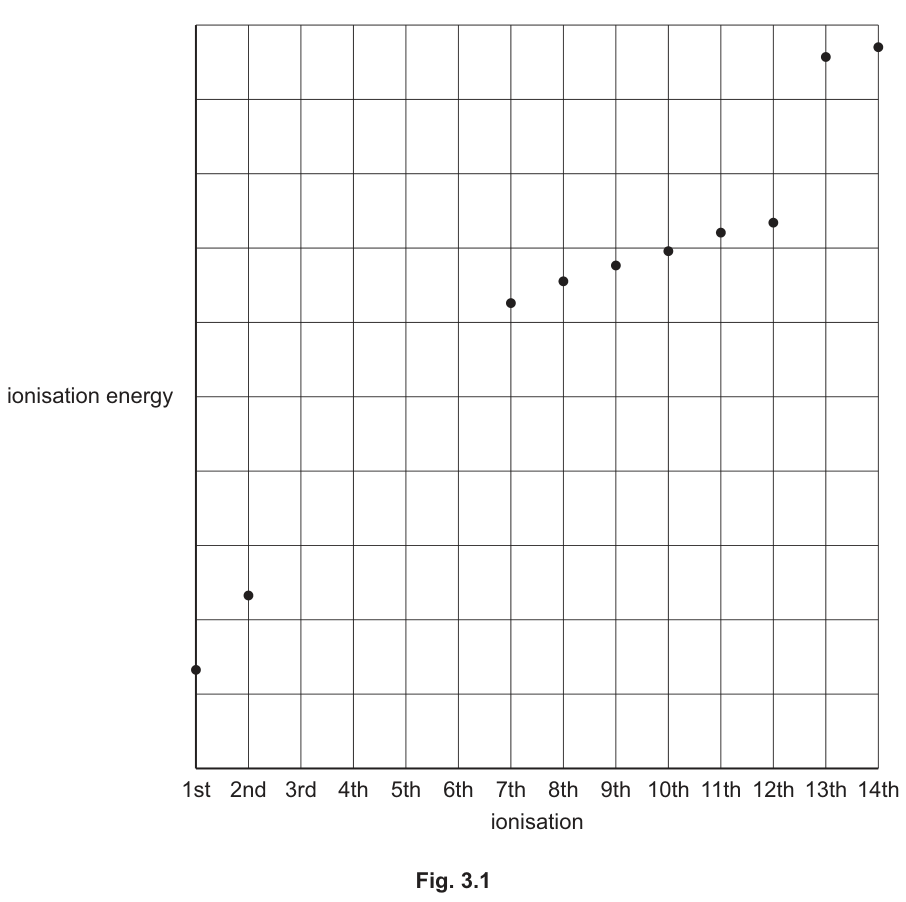
Fig. 3.1 shows a sketch of some of the ionisation energies of silicon, Si.
Answer
The 3rd and 4th ionisation energies should be plotted at a moderate level above the 2nd IE (removal of 3s electrons), with a general increase from IE3 to IE4. The 5th and 6th ionisation energies should show a large jump above IE4 (removal of 2p electrons from the inner shell), with a general increase from IE5 to IE6.
Key features:
- General increase from IE3 to IE6
- The largest jump occurs between IE4 and IE5 (transition from n=3 to n=2 shell)
IE3 and IE4 at moderate level above IE2; large jump between IE4 and IE5; IE5 and IE6 at much higher level with general increase
Background Concept
Ionisation energy is the energy required to remove one electron from a gaseous atom or ion. Successive ionisation energies increase because each electron is removed from an increasingly positive ion. However, the increase is not uniform — there are large jumps when an electron is removed from a new (inner) shell, because inner-shell electrons are much closer to the nucleus and experience greater electrostatic attraction.
Silicon has electron configuration 1s²2s²2p⁶3s²3p². The first four electrons removed come from the n=3 shell (two 3p and two 3s electrons), then the fifth electron must come from the n=2 shell (2p), causing a large jump in ionisation energy.
Understanding the Question
The graph already shows IE1 (low), IE2 (slightly higher), then a gap where IE3–IE6 should be plotted, followed by IE7–IE12 at a much higher level (2p and 2s electrons) and IE13–IE14 at the highest level (1s electrons). The student must fill in the missing IE3–IE6 values.
Approach
- IE3 and IE4 involve removing 3s electrons — these should be higher than IE1 and IE2 but still in the n=3 shell, so moderately above IE2.
- IE5 and IE6 involve removing 2p electrons from the inner n=2 shell — these should be much higher than IE4, showing a large jump.
- The jump between IE4 and IE5 should be the most prominent feature.
Step-by-Step Reasoning
- Si: 1s²2s²2p⁶3s²3p²
- IE1: remove 3p² → 3p¹ (low energy, outer shell)
- IE2: remove 3p¹ → 3p⁰ (slightly higher, same shell)
- IE3: remove 3s² → 3s¹ (higher, same shell but 3s is closer to nucleus than 3p)
- IE4: remove 3s¹ → 3s⁰ (higher still, same shell)
- IE5: remove 2p⁶ → 2p⁵ (BIG JUMP — now removing from n=2 shell, much closer to nucleus)
- IE6: remove 2p⁵ → 2p⁴ (higher, same shell)
The graph should show IE3 and IE4 at a moderate level (above IE2 but well below IE7), then a large jump to IE5 and IE6 which should be positioned between IE4 and IE7, with IE5→IE6 showing a general increase.
Key Takeaways
- Large jumps in successive ionisation energies indicate removal of electrons from a new inner shell.
- For Si, the jump between IE4 and IE5 confirms the 4 valence electrons (Group 14).
- The number of electrons before a jump equals the number of electrons in that shell.
Common Mistakes
- Making IE5 and IE6 too high (they should be below IE7, which is already plotted at a much higher level).
- Not showing a clear jump between IE4 and IE5.
- Making the values decrease or remain flat.
Things to Be Careful About
- The general trend must be increasing (M1).
- The largest jump must be between IE4 and IE5 (M2).
- IE5 and IE6 should be positioned between the existing IE4 level and the IE7 level shown on the graph.
Answer
Si+(g) -> Si2+(g) + e-
Background Concept
The first ionisation energy is the energy to remove one electron from a gaseous neutral atom: Si(g) → Si⁺(g) + e⁻. The second ionisation energy is the energy to remove one electron from the gaseous +1 ion: Si⁺(g) → Si²⁺(g) + e⁻. Each successive ionisation energy involves removing an electron from an increasingly positively charged species.
Understanding the Question
The student must write the equation representing the second ionisation energy of silicon. This means removing one electron from Si⁺(g) to form Si²⁺(g).
Approach
Start with Si⁺(g) on the left (the species from which the electron is being removed), and write Si²⁺(g) + e⁻ on the right.
Step-by-Step Reasoning
- Second IE = removal of electron from the gaseous +1 ion.
- Reactant: Si⁺(g)
- Products: Si²⁺(g) + e⁻
- Equation: Si⁺(g) → Si²⁺(g) + e⁻
Key Takeaways
- The nth ionisation energy always starts from the (n-1)+ ion.
- State symbols (g) are important — ionisation energies are defined for gaseous species.
Common Mistakes
- Writing Si(g) → Si⁺(g) + e⁻ (this is the first IE, not the second).
- Omitting state symbols (g).
- Writing the electron as e without the negative charge.
Things to Be Careful About
- State symbols (g) must be included for both silicon species.
- The charge on the electron must be shown as e⁻.
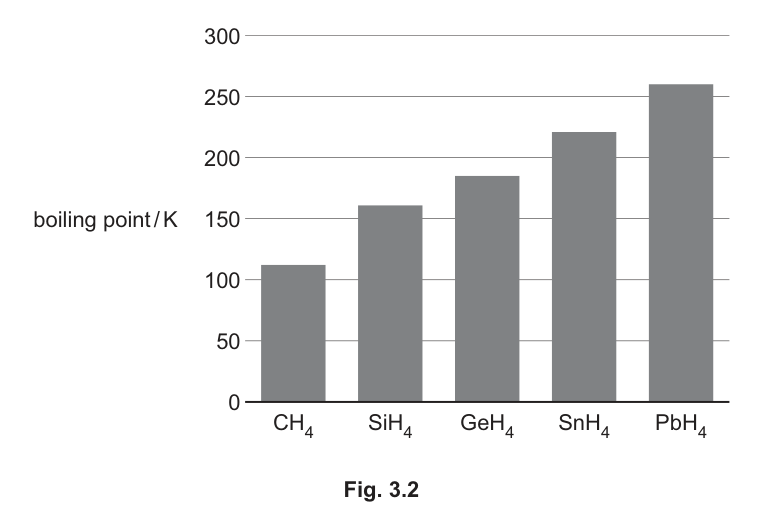
Fig. 3.2 shows the boiling points of the simplest hydrides of the Group 14 elements, C to Pb.
Answer
From to , the number of electrons in each molecule increases, giving stronger instantaneous dipole–induced dipole (London/dispersion) forces between molecules. More energy is therefore required to overcome these intermolecular forces, so boiling points increase.
More electrons = stronger London forces = higher boiling point
Background Concept
The Group 14 hydrides (CH₄, SiH₄, GeH₄, SnH₄, PbH₄) are all non-polar molecules with tetrahedral shapes. Since they have no permanent dipole and cannot form hydrogen bonds, the only intermolecular forces present are instantaneous dipole–induced dipole forces (also called London forces or dispersion forces). These arise from temporary fluctuations in electron distribution that create instantaneous dipoles, which induce dipoles in neighbouring molecules. The strength of these forces increases with the number of electrons (and hence the size/polarisability of the molecule), because larger electron clouds are more easily distorted.
Understanding the Question
The bar chart shows boiling points increasing steadily from CH₄ (~110 K) to PbH₄ (~260 K). The student must explain this trend using intermolecular force theory.
Approach
- Identify that all these molecules are non-polar and only have London forces.
- Note that molecular size and electron count increase down the group.
- Connect more electrons → stronger London forces → higher boiling point.
Step-by-Step Reasoning
- Going from CH₄ to PbH₄, the central atom gets larger and has more electrons (C: 6, Si: 14, Ge: 32, Sn: 50, Pb: 82 electrons in the atom).
- More electrons means a larger, more polarisable electron cloud.
- A more polarisable electron cloud leads to stronger instantaneous dipole–induced dipole (London) forces between molecules.
- Stronger intermolecular forces require more energy to overcome during boiling.
- Therefore, boiling points increase from CH₄ to PbH₄.
Key Takeaways
- For non-polar molecules, boiling point trends are explained by London forces only.
- More electrons → more polarisable → stronger London forces → higher boiling point.
- The absence of hydrogen bonding in these molecules means the trend is smooth and monotonic.
Common Mistakes
- Mentioning hydrogen bonding (none of these molecules can form H-bonds — H is bonded to C, Si, Ge, Sn, Pb, not to N, O, or F).
- Saying "the molecules get larger" without connecting to electron count and London forces.
- Confusing with the Group 15/16/17 hydride trends where the first member is anomalously high due to hydrogen bonding.
Things to Be Careful About
- Must mention both: (1) more electrons/increasing size, and (2) stronger London/instantaneous dipole-induced dipole forces. Both points are needed for full marks.
Answer
Tetrahedral (bond angle 109.5°)
Tetrahedral
Background Concept
VSEPR (Valence Shell Electron Pair Repulsion) theory predicts molecular shapes based on the repulsion between electron pairs around a central atom. The electron pairs arrange themselves as far apart as possible to minimise repulsion. For four bonding pairs with no lone pairs, the arrangement that maximises separation is tetrahedral, with bond angles of 109.5°.
Understanding the Question
SiH₄ has silicon as the central atom bonded to four hydrogen atoms. Silicon is in Group 14 with 4 valence electrons, all used in bonding to the four H atoms, giving 4 bonding pairs and 0 lone pairs.
Approach
Count the electron pairs around the central atom: 4 bonding pairs, 0 lone pairs → tetrahedral.
Step-by-Step Reasoning
- Si has 4 valence electrons (Group 14).
- Each forms a covalent bond with one H atom → 4 bonding pairs.
- No lone pairs on Si.
- 4 electron pairs arrange tetrahedrally to minimise repulsion.
- Shape = tetrahedral, bond angle = 109.5°.
Key Takeaways
- SiH₄ is analogous to CH₄ — both are tetrahedral.
- 4 bonding pairs + 0 lone pairs = tetrahedral geometry.
Common Mistakes
- Writing "square planar" (this would require lone pairs or different conditions).
- Forgetting to specify the shape name rather than just the bond angle.
Things to Be Careful About
- The answer is simply "tetrahedral" — the bond angle is not required but may be mentioned.
Silicon readily reacts with elements of high electronegativity.
Answer
Si + 2Cl2 -> SiCl4
Background Concept
Silicon reacts directly with chlorine to form silicon tetrachloride (SiCl₄). This is a combination (synthesis) reaction where the element reacts with its constituent non-metal. Silicon in its standard state is a solid, and chlorine is a gas.
Understanding the Question
Write an equation for the formation of SiCl₄ from its constituent elements. The constituent elements are silicon (Si) and chlorine (Cl₂).
Approach
Reactants: Si and Cl₂. Product: SiCl₄. Balance by ensuring 4 Cl atoms on the left (2Cl₂).
Step-by-Step Reasoning
- Si + Cl₂ → SiCl₄ (unbalanced)
- Need 4 Cl atoms on left → 2Cl₂
- Si + 2Cl₂ → SiCl₄ (balanced: 1 Si and 4 Cl on each side)
Key Takeaways
- Silicon forms SiCl₄ (tetrachloride) because it has 4 valence electrons.
- Always write chlorine as Cl₂ (diatomic molecule).
Common Mistakes
- Writing Cl instead of Cl₂.
- Not balancing (writing Si + Cl₂ → SiCl₄ without the coefficient 2).
Things to Be Careful About
- State symbols are not required by the mark scheme but would not be penalised if included.
Answer
Effervescence and misty/steamy fumes are observed (HCl gas is produced).
Effervescence / misty fumes
Background Concept
Silicon tetrachloride (SiCl₄) is readily hydrolysed by water because silicon has available 3d orbitals that can accept lone pairs from water molecules (unlike carbon which has no d-orbitals available). The reaction produces silicic acid (or SiO₂) and HCl gas:
SiCl₄ + 4H₂O → Si(OH)₄ + 4HCl
The HCl gas fumes in moist air, producing misty/steamy white fumes. The vigorous reaction also produces effervescence as gas is evolved.
Understanding the Question
Describe what is observed when SiCl₄ is added to water. This is a qualitative observation question.
Approach
Recall the key visual observations: gas evolution (effervescence) and the characteristic white fumes of HCl in moist air.
Step-by-Step Reasoning
- SiCl₄ reacts vigorously with water (hydrolysis).
- HCl gas is produced, which fumes in moist air → misty/steamy white fumes.
- The reaction is vigorous → effervescence observed.
- A white solid/precipitate of SiO₂ (or Si(OH)₄) may also form.
Key Takeaways
- SiCl₄ is hydrolysed by water (unlike CCl₄ which is not).
- The observations are: effervescence + misty/steamy fumes.
- This demonstrates silicon's ability to expand its octet using 3d orbitals.
Common Mistakes
- Saying "no reaction" (this is true for CCl₄ but not SiCl₄).
- Only mentioning one observation when both are expected.
Things to Be Careful About
- The mark scheme accepts "effervescence" OR "misty/steamy fumes" — either scores the mark.
is a white solid that melts above 1700 °C.
is a colourless liquid at room temperature.
Explain the difference in the melting points of these two compounds with reference to their structure and bonding.
Answer
has a giant covalent structure in which many strong covalent bonds must be broken to melt it, requiring a large amount of energy. has a simple molecular structure in which only weak intermolecular forces (London/dispersion forces) need to be overcome to melt it, requiring far less energy. Hence has a much higher melting point than .
SiO2 is giant covalent (strong covalent bonds to break); SiCl4 is simple molecular (only weak IMFs to overcome)
Background Concept
Melting point depends on the strength of the forces that must be overcome when a solid melts. In a giant covalent structure (like SiO₂), the entire crystal is held together by a network of strong covalent bonds, so melting requires breaking many of these bonds — hence very high melting points. In a simple molecular structure (like SiCl₄), the molecules are held together only by weak intermolecular forces (London forces), so melting only requires overcoming these weak forces — hence low melting points.
Understanding the Question
SiO₂ melts above 1700°C (giant covalent), while SiCl₄ is a liquid at room temperature (simple molecular). The student must explain this difference using structure and bonding terminology.
Approach
- Identify the structure type of each compound.
- State what must be overcome during melting for each.
- Compare the energy required.
Step-by-Step Reasoning
SiO₂ (M1):
- Giant covalent structure: each Si atom is bonded to 4 O atoms by strong covalent Si–O bonds, extending throughout the crystal.
- To melt, many strong covalent bonds must be broken → very high energy required → high melting point (>1700°C).
SiCl₄ (M1 continued):
- Simple molecular structure: discrete SiCl₄ molecules with covalent bonds only within each molecule.
- Between molecules, only weak London/dispersion forces act.
Comparison (M2):
- To melt SiCl₄, only weak intermolecular forces need to be overcome (not the covalent Si–Cl bonds within the molecule).
- This requires far less energy than breaking covalent bonds in SiO₂.
- Therefore SiCl₄ has a much lower melting point.
Key Takeaways
- Giant covalent structures have high melting points because covalent bonds must be broken.
- Simple molecular structures have low melting points because only weak IMFs are overcome during melting.
- The distinction between "breaking bonds" (covalent) and "overcoming forces" (intermolecular) is crucial for full marks.
Common Mistakes
- Saying "SiCl₄ has weak bonds" — the covalent bonds within SiCl₄ are strong; it is the intermolecular forces that are weak.
- Not distinguishing between covalent bonds (within molecules/network) and intermolecular forces (between molecules).
- Saying "SiO₂ has strong intermolecular forces" — SiO₂ has no molecules; it has covalent bonds throughout.
Things to Be Careful About
- M1 requires BOTH structure types identified (giant covalent AND simple molecular).
- M2 requires the correct terminology: "energy to overcome IMFs" for SiCl₄ vs "energy to break bonds" for SiO₂.
- The mark scheme allows ORA (or reverse argument) for M2.
Tin forms an amphoteric oxide, .
Suggest the formula of the tin compound that forms when reacts with in an acid–base reaction.
Answer
Sn(SO4)2
Background Concept
An amphoteric oxide can react with both acids and bases. When SnO₂ (tin(IV) oxide) reacts with an acid like H₂SO₄, it acts as a base, accepting protons and forming a salt and water. In SnO₂, tin is in the +4 oxidation state. The sulfate ion is SO₄²⁻. To form a neutral compound with Sn⁴⁺ and SO₄²⁻, two sulfate ions are needed: Sn(SO₄)₂.
Understanding the Question
The question states that SnO₂ is amphoteric and asks for the formula of the tin compound formed when it reacts with H₂SO₄ in an acid–base reaction. Since SnO₂ acts as a base here, the product is a salt: tin(IV) sulfate.
Approach
- Identify the oxidation state of Sn in SnO₂: +4 (since O is -2, and 2(-2) + x = 0 → x = +4).
- The sulfate ion is SO₄²⁻.
- Balance charges: Sn⁴⁺ needs 2 × SO₄²⁻ → Sn(SO₄)₂.
Step-by-Step Reasoning
- SnO₂ + H₂SO₄ → salt + water
- Sn is in +4 oxidation state in SnO₂.
- The anion from H₂SO₄ is SO₄²⁻.
- To balance Sn⁴⁺ with SO₄²⁻: need 2 sulfate ions → Sn(SO₄)₂.
- The equation would be: SnO₂ + 2H₂SO₄ → Sn(SO₄)₂ + 2H₂O.
Key Takeaways
- Amphoteric oxides react with acids as bases to form salts.
- The oxidation state of the metal in the oxide is retained in the salt.
- Sn⁴⁺ with SO₄²⁻ gives Sn(SO₄)₂.
Common Mistakes
- Writing SnSO₄ (this would be tin(II) sulfate, not tin(IV)).
- Forgetting the subscript 2 on the sulfate group.
- Writing Sn₂(SO₄)₄ instead of the simplest formula Sn(SO₄)₂.
Things to Be Careful About
- The formula must reflect the +4 oxidation state of tin (matching SnO₂).
- Parentheses are needed around SO₄ with the subscript 2: Sn(SO₄)₂.
Propanone, , is an important organic reagent. Fig. 4.1 shows some reactions of propanone and its derivatives.
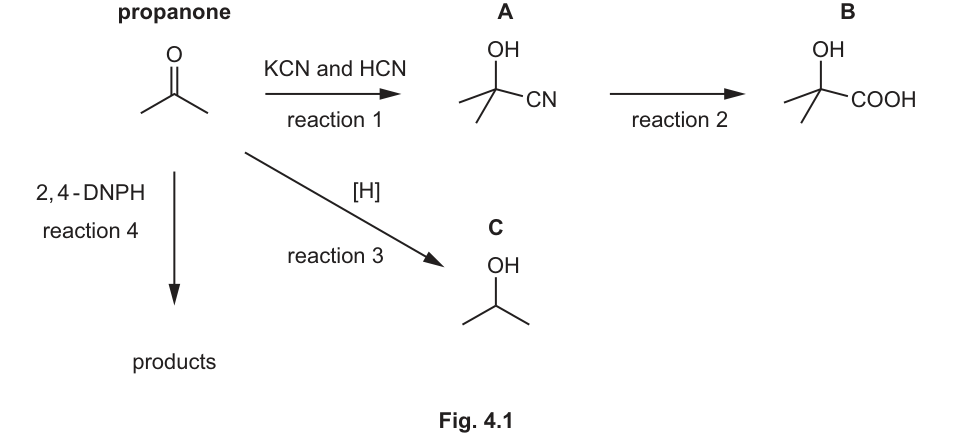
Reaction 1 is a nucleophilic addition reaction.
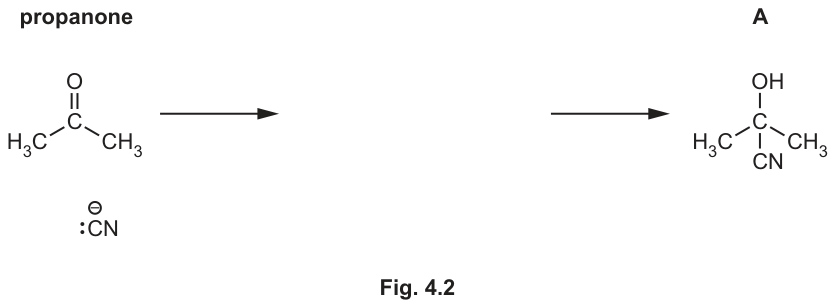
Complete Fig. 4.2 to show the mechanism for the formation of A from propanone.
Include charges, dipoles, lone pairs of electrons and curly arrows as appropriate.
Answer
- Curly arrow from the lone pair on the carbon of the cyanide ion () to the carbonyl carbon of propanone.
- Correct dipoles on the C=O bond ( on C, on O).
- Curly arrow from the C=O double bond to the oxygen atom.
- Intermediate structure: central carbon bonded to two groups, a group, and an with a lone pair.
- Curly arrow from a lone pair on the to a source of (e.g., or ).
See diagram for mechanism steps
Background Concept
Nucleophilic addition is the characteristic reaction of carbonyl compounds. The C=O bond is polar because oxygen is more electronegative than carbon, creating a charge on the carbon and a charge on the oxygen. This makes the carbonyl carbon electrophilic, susceptible to attack by nucleophiles such as the cyanide ion ().
Understanding the Question
The question asks for the full curly-arrow mechanism for the formation of compound A (2-hydroxy-2-methylpropanenitrile) from propanone using KCN and HCN. This is a two-stage process: initial nucleophilic attack by cyanide, followed by protonation.
Approach
Draw the reactants with correct dipoles and lone pairs. Show the nucleophilic attack with a curly arrow from the lone pair on the carbon of to the electrophilic carbonyl carbon. Show the pi bond breaking with a curly arrow to oxygen. Draw the tetrahedral intermediate with the correct charge. Finally, show the protonation step with a curly arrow from the oxygen lone pair to .
Step-by-Step Reasoning
- Dipoles: The C=O bond has a dipole. Carbon is , oxygen is .
- Nucleophilic attack: The cyanide ion has a lone pair on carbon and a negative charge. A curly arrow starts from this lone pair and points to the carbonyl carbon ().
- Pi bond breaking: Simultaneously, the pi bond of C=O breaks. A curly arrow goes from the C=O double bond to the oxygen atom, giving it a full negative charge and an extra lone pair.
- Intermediate: The resulting intermediate is an alkoxide ion. The central carbon is now hybridised, bonded to two methyl groups, the new cyano group, and the ion.
- Protonation: The ion acts as a base. A curly arrow goes from a lone pair on the oxygen to a proton () from the acid (HCN or added acid), forming the final hydroxyl group.
Key Takeaways
Always show dipoles on polar bonds in mechanism diagrams. Curly arrows must start from a lone pair or a bond (source of electrons) and point to the atom or bond receiving the electrons (destination). Intermediate charges must be balanced and correct.
Common Mistakes
- Drawing the arrow from the nitrogen of instead of carbon (carbon is the nucleophilic atom).
- Forgetting the dipoles on the C=O bond.
- Drawing the arrow from the C=O bond to the carbon instead of oxygen.
- Forgetting the negative charge on the oxygen in the intermediate.
- Not showing the lone pairs on the cyanide ion and the intermediate oxygen.
Things to Be Careful About
- Curly arrows must have full heads for electron pair movement (not half-headed, which is for single electrons).
- Ensure all charges and lone pairs are explicitly drawn on intermediates.
Answer
The central carbon atom in compound A is bonded to two identical methyl groups (or two identical groups). Therefore, it is not a chiral centre (not bonded to four different groups/atoms).
Central carbon has two identical methyl groups
Background Concept
Optical isomerism occurs when a molecule contains a chiral centre, typically a carbon atom bonded to four different atoms or groups of atoms. Such molecules are non-superimposable on their mirror images and exist as a pair of enantiomers.
Understanding the Question
We need to explain why compound A (2-hydroxy-2-methylpropanenitrile) does not show optical isomerism. We must look at the groups attached to the central carbon.
Approach
Identify the central carbon atom in compound A and list the four groups attached to it. If any two are identical, there is no chiral centre and no optical isomerism.
Step-by-Step Reasoning
- Compound A is formed by adding HCN to propanone. The central carbon was the carbonyl carbon.
- In propanone, this carbon is bonded to two methyl groups ().
- After the reaction, the central carbon is bonded to: , , and two groups.
- Because there are two identical groups, the central carbon does not have four different groups attached.
- Thus, it is not a chiral centre, and the molecule does not show optical isomerism.
Key Takeaways
To check for optical isomerism, always examine the central carbon and list all four substituents. If any two are the same, the molecule is achiral.
Common Mistakes
- Saying 'it has a plane of symmetry' without referencing the identical groups on the central carbon (though related, the mark scheme specifically looks for 'not bonded to four different groups').
- Misidentifying the groups attached to the central carbon.
Things to Be Careful About
- Be precise: say 'two identical methyl groups' rather than just 'two groups'.
Answer
aqueous or aqueous (and heat/reflux)
aqueous H2SO4 or aqueous HCl
Background Concept
Nitriles () can be hydrolysed to carboxylic acids. This is a two-stage process: first to an amide, then to a carboxylic acid. The reaction requires an acid catalyst and heat, or alkaline conditions followed by acidification. For A-level, dilute acid (like or ) with heating is the standard answer for direct conversion to a carboxylic acid.
Understanding the Question
Reaction 2 converts compound A (a hydroxynitrile) to compound B (a hydroxy carboxylic acid). This is a hydrolysis of the nitrile group to a carboxyl group.
Approach
State the standard reagents and conditions for acid hydrolysis of a nitrile to a carboxylic acid.
Step-by-Step Reasoning
- The transformation is .
- This requires water and an acid catalyst to proceed to completion.
- Reagents: dilute or aqueous sulfuric acid () or hydrochloric acid ().
- Conditions: Heat under reflux.
Key Takeaways
Nitrile hydrolysis to carboxylic acids uses aqueous acid and heat. Hydrolysis to carboxylate salts uses aqueous alkali, requiring a subsequent acidification step.
Common Mistakes
- Forgetting 'aqueous' or 'dilute'.
- Forgetting to mention heat/reflux (though sometimes just the reagent is accepted for 1 mark).
- Suggesting without mentioning subsequent acidification (which would give the salt, not the acid).
Things to Be Careful About
- The mark scheme accepts or . Ensure state symbols or 'aqueous' are used if possible, though often just the formula is credited.
Reaction 3 is a reduction reaction.
Construct an equation to represent reaction 3.
Use [H] to represent one atom of hydrogen from the reducing agent.
Answer
CH3COCH3 + 2[H] -> CH3CH(OH)CH3
Background Concept
Ketones can be reduced to secondary alcohols using reducing agents like or catalytic hydrogenation. In symbolic equations, represents a hydrogen atom from the reducing agent. The reduction of a carbonyl group () to a hydroxyl group () requires two hydrogen atoms: one adds to the carbon and one to the oxygen.
Understanding the Question
Write an equation for the reduction of propanone to compound C (propan-2-ol) using to represent hydrogen from the reducing agent.
Approach
Write the structural formula of propanone, add , and write the structural formula of propan-2-ol as the product.
Step-by-Step Reasoning
- Reactant: propanone, .
- Reducing agent: (since one H goes to C and one to O).
- Product: propan-2-ol, .
- Equation: .
Key Takeaways
When using for reduction, remember that becomes , requiring 2 hydrogen atoms. Balance the equation accordingly.
Common Mistakes
- Using only .
- Writing the molecular formula instead of structural/semi-structural formula (though molecular is often accepted, semi-structural is clearer).
- Forgetting to balance the hydrogens.
Things to Be Careful About
- Ensure the equation is balanced. has 6 H, product has 8 H, so is correct.
Answer
propan-2-ol
propan-2-ol
Background Concept
IUPAC naming of alcohols: identify the longest carbon chain containing the group, number it to give the the lowest possible locant, and name accordingly. Propanone has a 3-carbon chain. Reduction gives a 3-carbon alcohol with the on carbon 2.
Understanding the Question
Name compound C, which is the product of reducing propanone.
Approach
The reduction of propanone () adds hydrogen across the C=O bond to give . This is propan-2-ol.
Step-by-Step Reasoning
- 3-carbon chain: propan-
- on carbon 2: -2-ol
- Name: propan-2-ol.
Key Takeaways
Reduction of a ketone always gives a secondary alcohol. Naming follows standard alcohol nomenclature rules.
Common Mistakes
- Naming it as 'isopropanol' (common name, not IUPAC).
- Saying 'propanol' without the locant '2' (though for propanol, 1-ol and 2-ol are the only options, IUPAC requires the locant).
Things to Be Careful About
- Use the modern IUPAC name 'propan-2-ol' rather than '2-propanol'.
Answer
an orange / yellow / red precipitate forms
orange precipitate
Background Concept
2,4-Dinitrophenylhydrazine (2,4-DNPH or Brady's reagent) is a test for carbonyl groups (aldehydes and ketones). It reacts with the C=O group to form a 2,4-dinitrophenylhydrazone derivative. This derivative is typically an orange, yellow, or red precipitate (the exact colour depends on the specific carbonyl compound; aliphatic ketones often give orange/yellow, aromatic give darker red/orange).
Understanding the Question
State the observation when propanone (a ketone) reacts with 2,4-DNPH in reaction 4.
Approach
Recall the standard observation for the 2,4-DNPH test with a carbonyl compound.
Step-by-Step Reasoning
- Propanone contains a carbonyl group.
- Reaction with 2,4-DNPH produces a precipitate of the hydrazone derivative.
- The colour is typically described as orange, yellow, or red precipitate.
Key Takeaways
The 2,4-DNPH test confirms the presence of a carbonyl group. The precipitate colour can sometimes help identify the specific carbonyl compound, but 'orange/yellow/red precipitate' is the standard accepted answer.
Common Mistakes
- Saying 'the solution turns orange' (it's a precipitate, not a colour change of the solution).
- Forgetting to mention 'precipitate'.
- Saying 'brown precipitate' (that's for Tollens' or Fehling's with aldehydes, or iodine test).
Things to Be Careful About
- Must mention 'precipitate' or 'solid'.
Answer
Fehling's solution cannot oxidise ketones (or: ketones are not easily oxidised).
ketones cannot be oxidised by Fehling's reagent
Background Concept
Aldehydes have a hydrogen atom attached to the carbonyl carbon, making them easily oxidised to carboxylic acids. Ketones have two alkyl/aryl groups attached to the carbonyl carbon, with no such hydrogen, making them resistant to oxidation. Fehling's solution (and Tollens' reagent) are mild oxidising agents that can oxidise aldehydes but not ketones.
Understanding the Question
Explain why Fehling's reagent does not react with propanone (a ketone).
Approach
State the fundamental chemical difference between aldehydes and ketones regarding oxidation, and link it to Fehling's reagent's function as an oxidising agent.
Step-by-Step Reasoning
- Fehling's reagent is an oxidising agent (contains ions).
- It oxidises aldehydes to carboxylic acids (reducing to , forming a red precipitate of ).
- Ketones like propanone lack the necessary C-H bond on the carbonyl carbon and are not easily oxidised.
- Therefore, no reaction occurs with Fehling's reagent.
Key Takeaways
Fehling's and Tollens' tests distinguish aldehydes (positive) from ketones (negative) based on the ease of oxidation.
Common Mistakes
- Saying 'ketones do not have a carbonyl group' (they do).
- Saying 'Fehling's is not strong enough' (it's about the structural requirement for oxidation, not just strength; even strong oxidisers like require harsh conditions to oxidise ketones, usually breaking C-C bonds).
- Not mentioning 'oxidise'.
Things to Be Careful About
- The mark scheme specifically looks for the word 'oxidise' or 'oxidation'.
Compounds A, B and C can be distinguished using infrared spectroscopy.
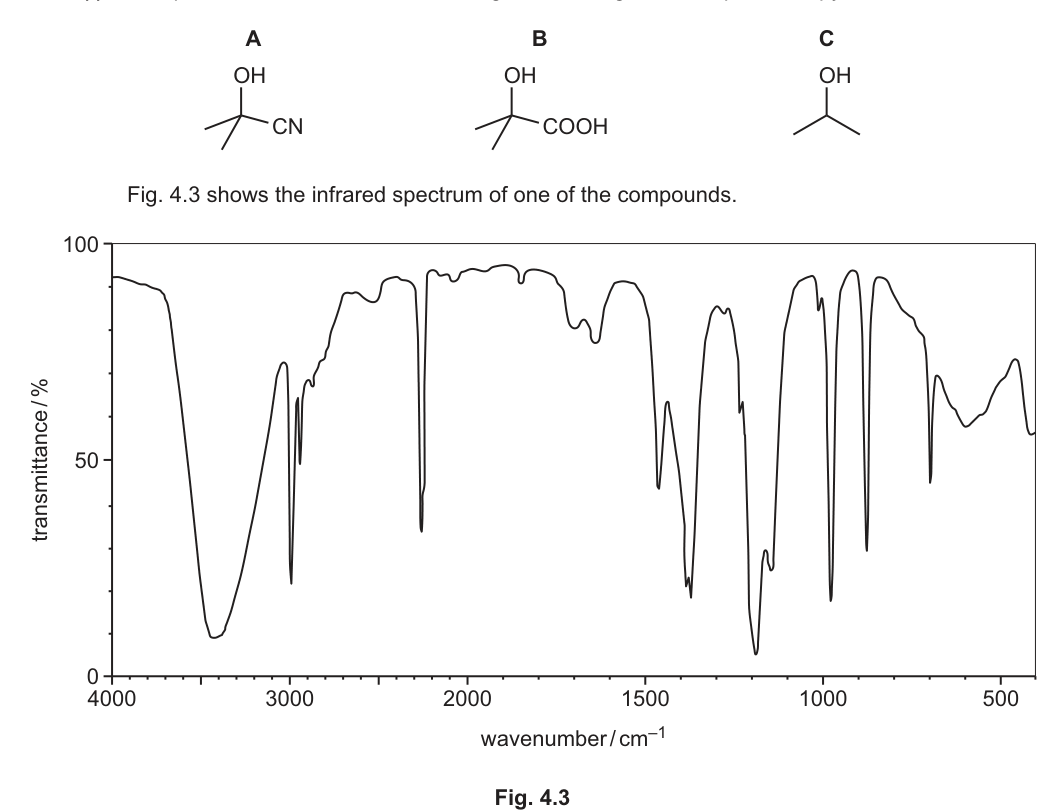
Table 4.1
| bond | functional groups containing the bond | characteristic infrared absorption range (in wavenumbers) / |
|---|---|---|
| C–O | hydroxy, ester | 1040–1300 |
| C=C | aromatic compound, alkene | 1500–1680 |
| C=O | amide carbonyl, carboxyl ester | 1640–1690 1670–1740 1710–1750 |
| CN | nitrile | 2200–2250 |
| C–H | alkane | 2850–2950 |
| N–H | amine, amide | 3300–3500 |
| O–H | carboxyl hydroxy | 2500–3000 3200–3600 |
Explain why the absorptions at 2850–2950 are not useful to help determine which of the compounds A, B or C produces the infrared spectrum in Fig. 4.3.
Use Table 4.1 to answer this question.
Answer
All three compounds (A, B, and C) contain C–H bonds (from the methyl/alkane groups), so all will show absorption in the 2850–2950 range.
All compounds contain C-H bonds
Background Concept
Infrared (IR) spectroscopy identifies functional groups based on the absorption of infrared radiation, which causes bonds to vibrate. Different bond types absorb at characteristic wavenumber ranges. The C–H bond (specifically hybridised C–H in alkanes) absorbs strongly in the 2850–2950 region.
Understanding the Question
Explain why the absorptions at 2850–2950 are not useful for distinguishing between compounds A, B, and C, using Table 4.1.
Approach
Look at the structures of A, B, and C. Identify which bonds are common to all three. Check Table 4.1 to see what absorption range corresponds to those common bonds.
Step-by-Step Reasoning
- Compound A: 2-hydroxy-2-methylpropanenitrile. Contains groups (C–H bonds).
- Compound B: 2-hydroxy-2-methylpropanoic acid. Contains groups (C–H bonds).
- Compound C: propan-2-ol. Contains groups (C–H bonds).
- Table 4.1 shows that C–H bonds (alkane) absorb at 2850–2950 .
- Since all three compounds have C–H bonds from their alkyl groups, they will all show an absorption in this region. Therefore, this absorption cannot be used to tell them apart.
Key Takeaways
When using IR spectroscopy to distinguish compounds, look for absorptions that are unique to one compound's functional groups and absent in others. Common groups (like C–H in alkyl chains) are not useful for differentiation.
Common Mistakes
- Saying 'the peaks are too broad' or 'they overlap' (not relevant here).
- Not referencing the table or the specific bond (C–H).
Things to Be Careful About
- Must mention that all three have C–H bonds or CH groups.
Identify which of compounds A, B or C produces the infrared spectrum in Fig. 4.3.
Explain your answer.
compound:
explanation:
Answer
compound: A
explanation: The spectrum shows an absorption at 2200–2250 , which indicates the presence of a bond (nitrile group), which is only present in compound A.
Compound A; absorption at 2200-2250 cm^-1 indicates C#N bond
Background Concept
IR spectroscopy is a powerful tool for identifying functional groups. Each functional group has characteristic absorption bands. By looking for unique absorption bands that correspond to functional groups present in only one of the candidate compounds, we can identify the compound.
Understanding the Question
Identify which compound (A, B, or C) produces the IR spectrum in Fig 4.3 and explain why. The spectrum shows a very broad peak around 3300 , a sharp peak around 2900 , a sharp peak around 2240 , and peaks in the fingerprint region.
Approach
Compare the structures of A, B, and C with the absorption ranges in Table 4.1 and the peaks in the spectrum. Find a peak that matches a functional group unique to one compound.
Step-by-Step Reasoning
- Compound A: Contains (hydroxy), (nitrile), and C–H (alkane).
- Compound B: Contains (hydroxy), (carboxyl), and C–H (alkane).
- Compound C: Contains (hydroxy) and C–H (alkane).
- Spectrum analysis:
- Broad peak ~3300 : O–H stretch (hydroxy or carboxyl). All three have this (A and C have hydroxy, B has carboxyl which also has O–H).
- Peak ~2900 : C–H stretch (alkane). All three have this.
- Peak ~2240 : Table 4.1 shows (nitrile) absorbs at 2200–2250 . Only compound A has a nitrile group.
- Conclusion: The absorption at 2200–2250 is unique to compound A. Therefore, the spectrum belongs to compound A.
Key Takeaways
To identify a compound from an IR spectrum, look for absorption bands that correspond to functional groups present in only one of the candidate molecules. The nitrile stretch at ~2250 is a very distinctive, sharp peak.
Common Mistakes
- Identifying compound B and saying the broad peak at 2500-3000 is carboxyl O–H (but forgetting that the 2240 peak is the key differentiator, and B doesn't have it).
- Not referencing the specific wavenumber range from the table.
- Saying 'it has an OH peak' (all three have OH).
Things to Be Careful About
- Must state the compound name (A) AND give the explanation referencing the specific absorption range and bond (C≡N at 2200-2250 ). Both are needed for the mark.