Chemistry 9701/11 — October/November 2024
Cambridge AS Level · answer key with instant marking and worked solutions
Topics Introduction to Organic Chemistry · Atoms, Molecules and Stoichiometry · Hydrocarbons · Group 2 · Group 17 · Chemical Bonding · +15 more
Tap an option under each question to check it — your score builds as you go.
In this question Q is used to represent a halogen atom.
Magnesium and calcium each form a compound with chlorine and a compound with bromine.
One of these compounds contains:
- the element in Group 2 with the higher first ionisation energy and
- the element in Group 17 with the higher Q–Q bond energy.
What is the formula of this compound?
Options
A
B
C
D
Working
First ionisation energy decreases down Group 2, so Mg has the higher first ionisation energy.
Q–Q bond energy decreases down Group 17, so Cl has the higher Q–Q bond energy.
The compound must contain Mg and Cl.
Answer
A —
A
Background Concept
Two periodic trends are needed here.
First ionisation energy is the energy required to remove one mole of electrons from one mole of gaseous atoms to form one mole of gaseous 1+ ions. Down a group, the atomic radius increases and there is more shielding by inner electron shells. The outer electron is therefore less strongly attracted to the nucleus, so less energy is needed to remove it. First ionisation energy decreases down Group 2: Mg has a higher first ionisation energy than Ca.
Covalent bond energy is the energy required to break one mole of a covalent bond in the gaseous state. For the halogen molecules, the X–X bond energy decreases down Group 17. As atomic radius increases down the group, the X–X bond length increases and the overlap between the two atomic orbitals becomes weaker, so the bond is weaker. Thus Cl–Cl has a higher bond energy than Br–Br.
Understanding the Question
The question asks you to choose one compound from four possible combinations of a Group 2 element (Mg or Ca) and a halogen (Cl or Br). The compound must contain:
- the Group 2 element with the higher first ionisation energy;
- the halogen with the higher Q–Q bond energy.
No calculation is needed. You simply need to compare the two elements within each group and then combine the winners.
Approach
Handle the two trends separately:
- Compare Mg and Ca using first ionisation energy.
- Compare Cl and Br using Q–Q bond energy.
- Combine the two chosen elements and write the correct formula.
The formula is determined by the charges of the ions: magnesium and calcium both form 2+ ions, while chlorine and bromine both form 1- ions. So the compound will have the general formula .
Step-by-Step Reasoning
Step 1: Choose the Group 2 element.
Mg is above Ca in Group 2. Down the group, the atomic radius increases and shielding increases, so the outer electron is held less tightly. Therefore the first ionisation energy of Mg is higher than that of Ca. The required Group 2 element is Mg.
Step 2: Choose the halogen.
Cl is above Br in Group 17. The Cl–Cl bond is shorter and stronger than the Br–Br bond because the atoms are smaller and the orbital overlap is better. Therefore the Q–Q bond energy of Cl is higher. The required halogen is Cl.
Step 3: Write the formula.
Magnesium forms and chlorine forms . The neutral compound is therefore .
This corresponds to option A.
The other options are incorrect because:
- contains the wrong halogen (Br has lower Q–Q bond energy).
- contains the wrong Group 2 element (Ca has lower first ionisation energy).
- contains neither of the required elements.
Key Takeaways
- First ionisation energy decreases down a group because atomic radius and shielding increase.
- Halogen X–X bond energy decreases down Group 17 because bond length increases and orbital overlap weakens.
- When a question asks you to combine two separate trends, deal with each trend independently before writing the final formula.
- Ionic formula writing depends on the charges of the ions, not on the periodic trends.
Common Mistakes
- Saying that Ca has the higher first ionisation energy because it is heavier. Mass is not the deciding factor; atomic radius and shielding are.
- Saying that Br–Br has the higher bond energy because Br has more electrons. More electrons do not make a covalent bond stronger; shorter bonds with better orbital overlap are stronger.
- Choosing CaCl2 or CaBr2 because calcium is more reactive. Reactivity is not the property asked about.
- Writing MgCl instead of MgCl2. Magnesium is in Group 2 and forms a 2+ ion, so two chloride ions are needed.
Things to Be Careful About
- Read “higher first ionisation energy” carefully; it is not the same as electronegativity or reactivity.
- “Q–Q bond energy” refers to the bond in the halogen molecule, e.g. Cl–Cl, not to a bond in a compound.
- Compare elements only within their own group; do not compare Mg with Cl directly.
- Make sure the final formula is electrically neutral.
Compound X contains two elements, Y and Z.
Element Y is in Period 2 of the Periodic Table. In one atom of element Y, the p sub-shell has all three orbitals occupied; only one of these three orbitals is fully occupied.
Element Z is in Period 3 of the Periodic Table. In one atom of element Z, the p sub-shell has only two orbitals occupied.
What is the formula of compound X?
Options
A
B
C
D
Working
Element Y: the p sub-shell has three orbitals. All three are occupied and only one is fully occupied, so the p sub-shell contains electrons: . The Period 2 element with is oxygen.
Element Z: only two p orbitals are occupied, so the p sub-shell contains electrons: . The Period 3 element with is silicon.
Oxygen and silicon form the covalent compound silicon dioxide.
Answer
C —
C
Background Concept
Electrons occupy sub-shells made of orbitals. A p sub-shell contains three orbitals, each able to hold up to two electrons. Hund's rule says that electrons first enter each orbital singly before any orbital receives a second electron. So the way orbitals are occupied tells us exactly how many p electrons an atom has:
- one occupied orbital:
- two occupied orbitals:
- three occupied orbitals, all singly:
- three occupied orbitals, one doubly occupied:
- three occupied orbitals, two doubly occupied:
- three occupied orbitals, all doubly occupied:
Combining this p-electron count with the period (the shell number) identifies the element.
Understanding the Question
This is a deduction question: from orbital-occupancy clues, identify two elements Y and Z, then choose the formula of the compound X they form. The stem gives two clues: Y is in Period 2 and its p sub-shell has all three orbitals occupied but only one fully occupied; Z is in Period 3 and only two of its p orbitals are occupied. We need to translate orbital occupancy into electron configuration and then into element identity.
Approach
Count p electrons from the orbital description. For Y, all three orbitals are occupied and only one is full: one orbital with two electrons and two orbitals with one electron each, so four p electrons. Since Y is in Period 2, its outer shell is , so it has ; the element is oxygen. For Z, only two orbitals are occupied, meaning two p electrons; Period 3 gives ; the element is silicon. Then identify the compound of oxygen and silicon among the options.
Step-by-Step Reasoning
-
Identify Y. A p sub-shell always has three orbitals. 'All three orbitals are occupied' means each has at least one electron. 'Only one of these three orbitals is fully occupied' means exactly one orbital has two electrons and the other two have one each. Total p electrons = , so Y has configuration ending . In Period 2, the element with is oxygen (O).
-
Identify Z. 'Only two orbitals are occupied' means the p sub-shell has two electrons, each in its own orbital: . In Period 3, this is silicon (Si).
-
Choose the formula. Oxygen and silicon combine as silicon dioxide, . This matches option C.
-
Check the other options. would need Y = C (Period 2, but , not ) and Z = Cl (Period 3, but , not ). has Y = Si, which is Period 3, not Period 2. has Y = S (Period 3) and Z = O (Period 2), with the period clues reversed and the wrong occupancies. Only fits both clues.
Key Takeaways
- The number of occupied p orbitals and whether any are doubly occupied fixes the number of p electrons.
- The period number gives the principal quantum shell, so period + p-electron count identifies the element.
- Once the two elements are known, the formula of their compound follows from normal valency: silicon forms four bonds and oxygen forms two, giving .
Common Mistakes
- Counting only the 'fully occupied' orbital and forgetting the two singly occupied orbitals: Y would be wrongly identified as (carbon) instead of (oxygen).
- Thinking 'only two orbitals are occupied' means three p electrons. Hund's rule prevents pairing before all three orbitals are singly occupied, so two occupied orbitals means , not .
- Mixing up Period 2 and Period 3 elements, for example choosing S and O for ; the period clues must be matched to the correct element.
- Writing the wrong ratio in the formula: silicon dioxide is , not or .
Things to Be Careful About
- A 'fully occupied' orbital contains two electrons; an 'occupied' orbital contains at least one.
- Apply Hund's rule consistently when converting orbital occupancy to electron count.
- Use the period to fix the shell number: Period 2 means , Period 3 means .
- In the final formula, silicon's valency is 4 and oxygen's is 2, so the simplest ratio is 1:2, giving .
Glauber’s salt consists of crystals of hydrated sodium sulfate, , which can be used for the manufacture of detergents.
When a sample of Glauber’s salt was heated, of water was removed leaving of anhydrous .
What is the value of in ?
Options
A 1
B 8.85
C 10
D 11.25
Working
Molar mass of
Moles of
Moles of
Answer
C ()
C
Background Concept
Glauber's salt is a hydrated salt, meaning each formula unit contains a fixed number of water molecules trapped in the crystal lattice. These water molecules are called water of crystallisation. When the salt is heated, this water is driven off, leaving the anhydrous salt. The ratio of water molecules to salt formula units is given by in .
Understanding the Question
The question gives the mass of water removed () and the mass of anhydrous salt left behind (). To find , we need the mole ratio of water to anhydrous salt — this ratio IS the value of .
Approach
- Calculate the molar mass of anhydrous .
- Convert the mass of anhydrous salt to moles.
- Convert the mass of water to moles (molar mass ).
- Divide moles of water by moles of salt to get .
Step-by-Step Reasoning
Step 1 — Molar mass of :
Step 2 — Moles of anhydrous salt:
Step 3 — Moles of water:
Step 4 — Mole ratio:
So the formula is , matching option C.
Key Takeaways
- Water of crystallisation is found by comparing moles of water to moles of anhydrous salt.
- Always use the molar mass of the anhydrous salt, not the hydrated one, when converting the remaining mass.
- The mole ratio is a pure number — it has no units.
Common Mistakes
- Using the mass of the hydrated salt instead of the anhydrous salt in the mole calculation.
- Forgetting to divide by the molar mass of water (using incorrectly, or using of the whole hydrated salt).
- Rounding too early: the ratio rounds to , and a student might incorrectly pick if they divide masses directly instead of moles.
Things to Be Careful About
- The masses given are for two different substances (water vs salt); never combine them directly.
- Check that the final is a sensible whole number — hydrated salts typically have small integer values of .
- Option B () and D () are traps derived from incorrect mass-to-mole handling; option A () is far too small and would imply almost no water.
What contains the greatest number of the named particles?
Options
A of argon atoms at room conditions
B of carbon dioxide molecules
C of magnesium atoms
D of water molecules
Working
At room conditions, 1 mol of gas occupies .
- A:
- B: ;
- C: ;
- D: ;
The greatest number of particles is the greatest amount in moles, which is option D.
Answer
D
D
Background Concept
The number of particles in a sample depends on the amount of substance in moles, not directly on its mass or volume. One mole of any substance contains Avogadro's constant, particles. At room temperature and pressure (r.t.p.), one mole of any gas occupies .
Understanding the Question
We are asked to compare the number of named particles in four different samples:
- of argon atoms
- of carbon dioxide molecules
- of magnesium atoms
- of water molecules
Because the units are different, we cannot compare the numbers directly. We must convert each quantity to moles.
Approach
Convert every option to moles:
- For a gas volume: divide by the molar volume at r.t.p., .
- For a mass: divide by the molar mass ( or ).
Then compare the mole values. The larger the number of moles, the larger the number of particles.
Step-by-Step Reasoning
-
Option A: of argon at r.t.p.
Argon is monatomic, so this is mol of Ar atoms. -
Option B: of carbon dioxide.
This is mol of CO molecules. -
Option C: of magnesium.
This is mol of Mg atoms. -
Option D: of water.
This is mol of HO molecules.
Comparing: . Therefore, option D contains the greatest number of particles.
Key Takeaways
- The number of particles is proportional to the amount in moles, not to mass or volume.
- For gases at r.t.p., use .
- For solids, liquids, or gases given in grams, use the molar mass to find moles.
- Always compare moles when asked to compare numbers of particles.
Common Mistakes
- Using instead of for room conditions. The question specifies room conditions, so is correct.
- Thinking that a larger mass always means more particles. Mass must be converted to moles first.
- Using the wrong molar mass, e.g. treating Mg as instead of ; this would still not change the final answer because option D is clearly larger.
- Forgetting that argon exists as atoms, not molecules, but this does not affect the comparison here.
Things to Be Careful About
- Use the correct molar masses: CO = 44, HO = 18, Mg = 24.
- Recognise that the named particle is different in each option: atoms for Ar and Mg, molecules for CO and HO.
- At r.t.p. the molar volume is ; at s.t.p. it would be , but the question says room conditions.
Phosphorus forms a compound with hydrogen called phosphine, . This compound can react with a hydrogen ion, .
Which type of interaction occurs between and ?
Options
A dative covalent bond
B dipole–dipole forces
C hydrogen bond
D ionic bond
Working
has a lone pair of electrons on the phosphorus atom. is an electron-pair acceptor. The lone pair is donated to , forming a covalent bond in which both electrons come from one atom.
This is a dative (coordinate) covalent bond.
Answer
A
A
Background Concept
Phosphorus has five valence electrons. In , phosphorus forms three covalent bonds to hydrogen atoms, using three of these electrons. The remaining two valence electrons stay on phosphorus as a lone pair.
A dative covalent bond (also called a coordinate bond) is a covalent bond in which both of the shared electrons are supplied by one atom. The atom that supplies the electron pair is the donor; the atom that accepts the pair is the acceptor. Once formed, a dative covalent bond is no different in strength or nature from an ordinary covalent bond.
A hydrogen ion, , has no electrons of its own. It is therefore an electron-pair acceptor. When it meets a molecule with a lone pair, such as , it can accept that lone pair to form a new covalent bond.
Understanding the Question
The question asks which type of interaction occurs between and . This is a classification question: you must identify the bonding interaction, not just describe it. The options are dative covalent bond, dipole–dipole forces, hydrogen bond, and ionic bond.
The key observation is that has a lone pair on phosphorus, and is a bare proton with no electrons. This is exactly the situation that produces a coordinate bond, just as forms with .
Approach
- Determine the electron structure of : three bonding pairs and one lone pair on P.
- Recognise that is an electron-pair acceptor.
- Identify the bond formed as one where the lone pair on P is shared with : a dative covalent bond.
- Eliminate the other options by recognising that they describe different situations.
Step-by-Step Reasoning
- Phosphorus is in Group 15 and has five valence electrons. In , three electrons form P–H bonds, leaving one lone pair on P.
- is a hydrogen atom that has lost its electron, so it is just a proton with no valence electrons.
- The lone pair on phosphorus can be donated to , forming . Both electrons in the new P–H bond come from the phosphorus lone pair, so the bond is dative covalent.
- Why not the other options?
- Dipole–dipole forces are intermolecular attractions between neutral molecules. Here is an ion, and a covalent bond is being formed, not an intermolecular attraction.
- A hydrogen bond requires a hydrogen atom covalently bonded to a very electronegative atom such as N, O, or F. Phosphorus is not sufficiently electronegative, and the interaction here is a bond formation, not a hydrogen bond.
- An ionic bond involves transfer of electrons and attraction between opposit charged ions. is already an ion, but it gains a shared electron pair rather than a complete transfer, so the product is a covalently bonded ion, .
Key Takeaways
- A lone pair can be donated to an electron-pair acceptor to form a dative covalent bond.
- behaves like in this respect, although phosphorus is less electronegative than nitrogen.
- Dative covalent bonds are common whenever a molecule with a lone pair reacts with a species that needs an electron pair, such as .
Common Mistakes
- Choosing hydrogen bond: this is tempting because contains hydrogen, but hydrogen bonding requires H bonded to N, O, or F, and the interaction here is a bond-forming reaction, not an intermolecular force.
- Choosing ionic bond: is an ion, but the product is formed by sharing an electron pair, not by complete electron transfer.
- Thinking that dative bonds are weaker or different from ordinary covalent bonds after formation; they are identical once formed.
Things to Be Careful About
- Recognise that "dative covalent" and "coordinate" mean the same thing.
- Remember that has a lone pair even though phosphorus is not very electronegative.
- Do not confuse an intermolecular force, such as dipole–dipole or hydrogen bonding, with an intramolecular covalent bond formed between and .
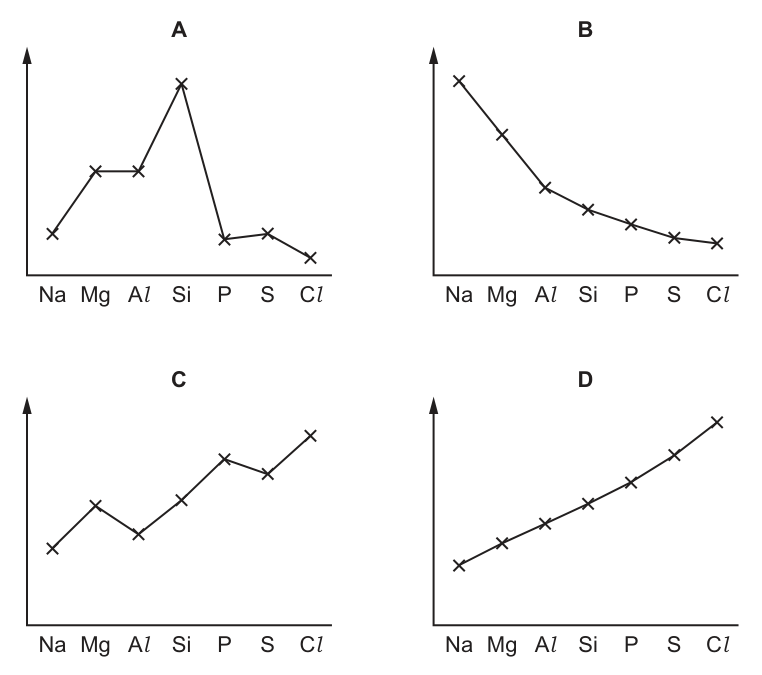
The graphs show trends in four physical properties of elements in Period 3, excluding argon.
Which graph has electronegativity on the y-axis?
Options
A A
B B
C C
D D
Working
Graph A peaks at Si, characteristic of melting point (giant covalent structure of Si).\nGraph B shows a continuous decrease, characteristic of atomic radius (increasing nuclear charge pulls electrons closer).\nGraph C shows a general increase with dips at Al and S, characteristic of first ionisation energy.\nGraph D shows a steady, continuous increase from Na to Cl, which is the trend for electronegativity (increasing nuclear charge and decreasing atomic radius).\n\n## Answer
D
D
Background Concept
Across Period 3 (Na, Mg, Al, Si, P, S, Cl), four key physical properties exhibit distinct trends due to changes in atomic structure, nuclear charge, and bonding type:
- Atomic radius decreases steadily because the increasing nuclear charge pulls the electron shell closer, with electrons added to the same principal quantum level.
- First ionisation energy generally increases for the same reason, but with two notable dips: one at Al (electron removed from a higher-energy 3p orbital rather than a 3s orbital) and one at S (electron removed from a paired 3p orbital, increasing electron-electron repulsion).
- Melting point rises from Na to Si due to the transition from metallic bonding to a giant covalent structure (Si), then falls sharply for P, S, and Cl because these exist as simple molecular substances with weak van der Waals forces.
- Electronegativity (the ability of an atom to attract bonding electrons in a covalent bond) increases steadily across the period. This is because nuclear charge increases while atomic radius decreases, resulting in a stronger electrostatic attraction for shared electrons.
Understanding the Question
The question provides four line graphs (A, B, C, D) plotting different physical properties against the Period 3 elements Na through Cl. The task is to identify which graph represents the trend for electronegativity.
Approach
The strategy is to match the distinctive shape of each graph to the known trends of Period 3 properties. By eliminating the graphs that correspond to atomic radius, ionisation energy, and melting point, the remaining graph must be electronegativity.
Step-by-Step Reasoning
- Graph A shows a value that rises, plateaus slightly, peaks at Si, and then drops sharply. This matches the melting point trend: metallic bonding in Na, Mg, Al increases in strength, Si has a giant covalent lattice with a very high melting point, and P, S, Cl are simple molecules with low melting points.
- Graph B shows a continuous, smooth decrease from Na to Cl. This matches the atomic radius trend, as the increasing nuclear charge without additional electron shells pulls the outermost electrons closer to the nucleus.
- Graph C shows a general upward trend but with distinct dips at Al and S. This matches the first ionisation energy trend. The dip at Al occurs because the outermost electron is in a 3p orbital (higher energy, further from nucleus) rather than a 3s orbital. The dip at S occurs because the outermost electron is removed from a paired 3p orbital, where electron-electron repulsion makes it easier to remove.
- Graph D shows a steady, continuous increase from Na to Cl with no dips or drops. This matches the electronegativity trend. Because nuclear charge increases and atomic radius decreases steadily across the period, the attraction for bonding electrons increases smoothly without the quantum-mechanical anomalies that affect ionisation energy.
Key Takeaways
Memorise the characteristic shapes of the four main Period 3 property trends. Electronegativity is unique in that it increases steadily across the period without the dips seen in first ionisation energy.
Common Mistakes
Confusing the dip at Al in ionisation energy with the trend for electronegativity. Electronegativity does not have dips; it increases steadily because it is a continuous measure of nuclear attraction for shared electrons, not a discrete energy required to remove an electron.
Things to Be Careful About
Ensure you do not confuse atomic radius (which decreases) with electronegativity (which increases). Both are driven by the same underlying factors (increasing nuclear charge, constant shell number), but they measure opposite aspects of the atom's pull on electrons.
The element tin exists in two forms, grey tin and white tin.
Some properties of grey tin and white tin are shown.
| grey tin | white tin | |
|---|---|---|
| boiling point / K | 2543 | 2533 |
| electrical conductivity | none in solid or liquid | good in solid and liquid |
| malleability | brittle | malleable |
Which structural change might take place when grey tin changes to white tin?
Options
A giant covalent to giant ionic
B giant covalent to giant metallic
C giant ionic to giant covalent
D giant ionic to giant metallic
Working
Grey tin is brittle and conducts electricity in neither the solid nor the liquid state. This is characteristic of a giant covalent structure, not a giant ionic structure (ionic solids conduct when molten) and not a metallic structure.
White tin is malleable and conducts electricity well in both the solid and the liquid state. This is characteristic of a giant metallic structure, in which delocalised electrons carry charge and layers of cations can slide.
Therefore the change is giant covalent to giant metallic.
Answer
B
B
Background Concept
Allotropes are different structural forms of the same element in the same physical state. Tin exists as grey tin and white tin, and the two forms have different arrangements of atoms, so they have different physical properties.
The key idea is that physical properties can be used to deduce the type of giant structure:
- Giant covalent structures, such as diamond, consist of atoms joined by a network of strong covalent bonds. There are no free electrons or ions, so they do not conduct electricity in the solid or liquid state. They are often hard but brittle.
- Giant metallic structures consist of positive ions in a regular lattice surrounded by a sea of delocalised electrons. The delocalised electrons carry charge, so metals conduct electricity in both the solid and liquid states. Layers of ions can slide over each other, making metals malleable and ductile.
- Giant ionic structures consist of oppositely charged ions in a lattice. In the solid state the ions are fixed, so the solid does not conduct electricity; when molten or dissolved in water, the ions are free to move and the substance conducts.
The very high boiling points of both grey tin and white tin show that both are giant structures with strong bonding, but the difference in conductivity and malleability reveals that the type of giant structure is different.
Understanding the Question
The question provides a table of properties for grey tin and white tin: boiling point, electrical conductivity, and malleability. It asks which structural change might take place when grey tin changes to white tin.
This is not a question about a chemical reaction or about the elements involved. It is a question about identifying the type of giant structure from physical properties, then selecting the correct change from the four options.
Approach
The best strategy is to treat the properties as fingerprints for the type of structure:
- Look at electrical conductivity in both the solid and liquid states.
- Look at malleability.
- Deduce the structure of grey tin.
- Deduce the structure of white tin.
- Match the change to the options.
Conductivity is especially useful because it distinguishes metallic, ionic, and covalent structures. Malleability then confirms whether a structure is metallic.
Step-by-Step Reasoning
Grey tin:
- It has no electrical conductivity in the solid state or the liquid state.
- A metallic structure would conduct in the solid state because delocalised electrons are free to move.
- A giant ionic structure would not conduct as a solid, but it would conduct when molten because the ions become mobile. Grey tin does not conduct when liquid, so it cannot be ionic.
- A giant covalent structure has no free electrons or mobile ions, so it does not conduct in either state. This matches grey tin.
- Grey tin is also brittle, which is consistent with a giant covalent network rather than a metallic structure.
So grey tin is a giant covalent structure.
White tin:
- It has good electrical conductivity in both the solid and liquid states.
- This is the classic behaviour of a metallic structure because the sea of delocalised electrons remains available to carry charge in both states.
- White tin is malleable, which is also characteristic of a metal: layers of positive ions can slide over one another without breaking the metallic bonding.
So white tin is a giant metallic structure.
Choosing the option:
The change is therefore from a giant covalent structure to a giant metallic structure.
- A is wrong because white tin is not giant ionic.
- B is correct.
- C is wrong because grey tin is not giant ionic.
- D is wrong because grey tin is not giant ionic.
Key Takeaways
- Physical properties such as electrical conductivity and malleability can be used to deduce the type of giant structure.
- Conductivity in the solid state distinguishes metallic structures from ionic and covalent structures.
- Conductivity in the liquid state distinguishes ionic structures from covalent network structures.
- Malleability is a strong indicator of a metallic structure.
- Allotropes of the same element can have very different structures and therefore very different physical properties.
Common Mistakes
- Assuming that a substance that does not conduct as a solid must be ionic. In fact, ionic solids do not conduct either; they only conduct when molten or in aqueous solution.
- Assuming that all non-metals form simple molecular structures. Grey tin is a non-metal allotrope but forms a giant covalent structure.
- Forgetting to consider conductivity in the liquid state. This is the key piece of evidence that rules out a giant ionic structure for grey tin.
- Confusing malleability with hardness. Malleability means the substance can be hammered or bent without breaking, which is a metallic property.
Things to Be Careful About
- Read the table carefully: grey tin has no conductivity in either state, while white tin conducts well in both states. The phrase "in solid or liquid" is crucial.
- The high boiling points of both forms are consistent with giant structures, but they do not by themselves distinguish covalent from metallic or ionic.
- An allotrope change is a physical change in structure, not a chemical change producing a new element.
- When matching to options, make sure the direction of the change is correct: grey tin to white tin, not the reverse.
Which solid has a simple molecular lattice?
Options
A calcium fluoride
B nickel
C silicon(IV) oxide
D sulfur
Working
A simple molecular lattice consists of discrete molecules held together by weak intermolecular forces.
Calcium fluoride is an ionic lattice, nickel is a metallic lattice, and silicon(IV) oxide is a giant covalent lattice. Sulfur exists as discrete S molecules, so it has a simple molecular lattice.
Answer
D
D
Background Concept
Solids can be classified by the type of particles they contain and how those particles are held together.
- Ionic lattice: oppositely charged ions held by strong electrostatic forces, e.g. calcium fluoride.
- Metallic lattice: positive metal ions in a sea of delocalised electrons, e.g. nickel.
- Giant covalent lattice: a network of atoms joined by covalent bonds, e.g. silicon(IV) oxide.
- Simple molecular lattice: discrete molecules held together by weak intermolecular forces, e.g. sulfur.
The key distinction is whether the solid is made of separate molecules or of one continuous network of atoms/ions.
Understanding the Question
This is a one-mark recall question. It asks you to choose, from four common solids, the one that has a simple molecular lattice. The command is essentially "identify" — you need to know the structure of each solid, not calculate anything.
Approach
Go through each option and recall its structure and bonding. Eliminate any solid that is ionic, metallic, or giant covalent. The remaining one must be simple molecular.
Step-by-Step Reasoning
- Calcium fluoride, CaF — a compound of a metal and a non-metal. It forms an ionic lattice of Ca and F ions. Not molecular.
- Nickel, Ni — a metal. Its atoms are held in a metallic lattice with delocalised electrons. Not molecular.
- Silicon(IV) oxide, SiO — each silicon atom is covalently bonded to four oxygen atoms and each oxygen to two silicon atoms, forming a giant covalent network. It has no discrete molecules, so it is not simple molecular.
- Sulfur, S — sulfur exists as discrete S rings. Within each ring the S atoms are joined by covalent bonds, but between rings only weak van der Waals forces act. This is a simple molecular lattice.
Therefore the correct option is D.
Key Takeaways
- Simple molecular solids are made of discrete molecules; the weak forces between molecules explain their low melting and boiling points.
- Giant covalent solids such as SiO are not molecular even though they contain covalent bonds.
- Recognising the type of particle (molecule, ion, atom, metal ion) is the fastest way to classify a solid's lattice.
Common Mistakes
- Choosing silicon(IV) oxide because it contains covalent bonds. Covalent bonds alone do not make a solid molecular — the structure must consist of discrete molecules.
- Thinking all non-metal solids are molecular. Silicon(IV) oxide is a counterexample because it is a giant covalent network.
- Confusing a metallic lattice with a molecular one because both may be described as "regular arrangements".
Things to Be Careful About
- Sulfur is usually written as S, not S, when referring to its molecular structure.
- Simple molecular solids are soft, have low melting points, and do not conduct electricity, unlike ionic, metallic, or giant covalent solids.
- The term "lattice" applies to all four structures; the key word is "simple molecular", which specifically means discrete molecules.
The standard enthalpy change of combustion of carbon is .
The standard enthalpy change of combustion of hydrogen is .
The standard enthalpy change of formation of butane is .
What is the standard enthalpy change of combustion of butane?
Options
A
B
C
D
Working
Combustion of butane:
Using Hess's law (combustion data for the elements):
Answer
B ()
B
Background Concept
This question tests Hess's law: the enthalpy change of a reaction is independent of the route taken, depending only on the initial and final states. Two useful consequences are:
- The enthalpy of combustion of a compound can be found from the enthalpies of combustion of its constituent elements:
- The enthalpy of formation is the enthalpy change when one mole of a compound forms from its elements in their standard states.
Understanding the Question
We are given:
- (combustion of carbon)
- (combustion of hydrogen)
- (formation of butane)
We must find the standard enthalpy change of combustion of butane, .
Approach
The combustion of butane produces and . The same products can be reached by first forming butane from its elements (formation), then burning those elements. Equating these two routes via Hess's law gives a direct formula.
Step-by-Step Reasoning
-
Write the combustion equation for butane:
-
Identify the elements and their combustion enthalpies:
- Carbon: 4 moles, each →
- Hydrogen: 5 moles of , each →
-
Apply Hess's law:
The combustion enthalpy of butane equals the sum of the combustion enthalpies of its elements minus the enthalpy of formation of butane (because formation is the reverse of "decomposing" the compound into elements):
-
Calculate:
-
Match to the options: Option B is .
Key Takeaways
- The general formula for combustion of a hydrocarbon is:
- Formation enthalpy is subtracted because forming the compound from elements is the reverse of the "decomposition" step in the cycle.
Common Mistakes
- Forgetting to subtract the formation enthalpy — this gives (not an option, but a common slip).
- Adding the formation enthalpy instead of subtracting — this gives (option C), a classic distractor.
- Using the wrong number of moles of — butane has 10 H atoms, so 5 moles of are needed, not 10.
Things to Be Careful About
- All values are negative (exothermic), so watch the signs when combining.
- The formation enthalpy of butane is negative, so subtracting it means adding its magnitude.
- Double-check the stoichiometry of the combustion equation before multiplying.
Things to Be Careful About
- All values are negative (exothermic), so watch the signs when combining.
- The formation enthalpy of butane is negative, so subtracting it means adding its magnitude.
- Double-check the stoichiometry of the combustion equation before multiplying.
Three processes are described.
1
2
3
Which statement is correct?
Options
A None of the processes have a positive enthalpy change.
B Only process 1 has a positive enthalpy change.
C Only process 2 has a positive enthalpy change.
D Only process 3 has a positive enthalpy change.
Working
Process 1 is a neutralisation reaction: . Neutralisation is exothermic, so is negative.
Process 2 is the combustion of methane: . Combustion is exothermic, so is negative.
Process 3 is the condensation of ammonia: . Condensation releases energy, so is negative.
All three processes are exothermic; none has a positive enthalpy change.
Answer
A
A
Background Concept
The enthalpy change of a process, , is the heat energy transferred at constant pressure. Its sign tells us the direction of energy flow between the system and the surroundings:
- Exothermic ( negative): the system releases energy to the surroundings, usually as heat. The products are more stable (lower in energy) than the reactants.
- Endothermic ( positive): the system absorbs energy from the surroundings. The products are higher in energy than the reactants.
Certain classes of reaction are always (or almost always) exothermic because bond-forming or particle-attraction steps release more energy than is consumed:
- Neutralisation: acid + base → salt + water. The formation of the strong O–H bonds in water releases energy.
- Combustion: a fuel reacts with oxygen. The C=O and O–H bonds formed in and are very strong, releasing far more energy than is needed to break the fuel's bonds.
- Condensation (gas → liquid) and freezing (liquid → solid): as particles come closer together, intermolecular forces form, releasing energy. The reverse processes (vaporisation, melting) are endothermic.
Understanding the Question
This question presents three chemical or physical processes and asks which statement about their enthalpy changes is correct. The options all concern whether "none", or "only one" of the processes has a positive enthalpy change. The key task is to assign the correct sign of to each process by recognising the type of process it is. No numerical calculation is needed — this is purely qualitative recognition.
Approach
For each process, identify what kind of transformation it represents:
- — this is the ionic equation for a neutralisation reaction.
- — this is the combustion of methane.
- — this is condensation of ammonia from gas to liquid.
Then recall the sign of for each class and decide whether any is positive.
Step-by-Step Reasoning
Process 1 — neutralisation.
This is the net ionic equation for any acid–base neutralisation. The standard enthalpy of neutralisation for a strong acid and strong base is about , which is exothermic. The formation of the covalent O–H bonds in water releases more energy than is required to separate the ions. So .
Process 2 — combustion.
This is the complete combustion of methane, the standard enthalpy of combustion of methane being about . Breaking the bonds in and requires energy, but forming the very strong C=O bonds in and O–H bonds in water releases much more. The net effect is a large release of energy, so .
Process 3 — condensation.
When ammonia gas condenses, its molecules come closer together and hydrogen bonds (and weaker van der Waals forces) form between them. Forming these intermolecular forces releases energy. Condensation is therefore exothermic, so . (The reverse process, vaporisation, is endothermic.)
Conclusion. All three processes are exothermic. None has a positive enthalpy change, so the correct option is A.
Key Takeaways
- The sign of is determined by the type of process: neutralisation, combustion, and condensation are all exothermic (negative ); vaporisation, melting, and thermal decomposition are typically endothermic (positive ).
- Recognising the class of a reaction from its equation is often all that is needed to assign the sign of .
- Condensation and freezing release energy because forming intermolecular forces is exothermic; the reverse changes (vaporisation, melting) absorb energy.
Common Mistakes
- Thinking condensation is endothermic because "going from gas to liquid" sounds like gaining order. In fact, forming bonds/forces always releases energy; it is vaporisation that absorbs energy.
- Confusing the sign convention: a negative means exothermic (energy released), and a positive means endothermic (energy absorbed).
- Assuming all reactions with gases are endothermic — combustion involves gases but is strongly exothermic because of the strong bonds formed in the products.
Things to Be Careful About
- The question asks which statement is correct about a positive enthalpy change. Since all three processes are exothermic, the answer is the option that says "none" have a positive enthalpy change.
- Note that process 3 is a physical change (condensation), not a chemical reaction; the same sign logic applies because it involves forming intermolecular forces.
- No calculation is required here, but in a calculation question you would need to be careful with the sign of and with state symbols, since the state of water (liquid vs gas) affects the value of for combustion.
In alkaline solution, ions oxidise ions to ions. The ions are reduced to .
What is the ratio of the two ions in the balanced chemical equation for this reaction?
Options
| A | 2 | 3 |
| B | 3 | 2 |
| C | 4 | 7 |
| D | 7 | 4 |
Working
Oxidation number changes:
- Mn in : ; Mn in :
- Each gains electrons.
- S in : ; S in :
- Each loses electrons.
Balance electrons: lowest common multiple of and is .
- gain electrons
- lose electrons
So the ratio is .
Answer
A (2 : 3)
A
Background Concept
This question tests redox balancing. In a redox reaction, oxidation and reduction happen simultaneously, and the total number of electrons lost by the reducing agent must exactly equal the total number of electrons gained by the oxidising agent. The quickest way to find the stoichiometric ratio is to compare the change in oxidation number of each element.
Understanding the Question
The permanganate ion is reduced to in alkaline solution, while the sulfite ion is oxidised to sulfate . We are asked for the ratio of to in the balanced equation — i.e. how many of each ion must react so that electrons balance.
Approach
- Find the oxidation number of Mn in both and .
- Find the oxidation number of S in both and .
- Work out electrons gained per and lost per .
- Scale both so the electrons gained equal the electrons lost.
Step-by-Step Reasoning
Step 1 — Oxidation number of Mn.
In , O is each, so Mn is . In , O is each, so Mn is . Change: , a gain of electrons per .
Step 2 — Oxidation number of S.
In , O is each, so S is . In , O is each, so S is . Change: , a loss of electrons per .
Step 3 — Balance electrons.
The lowest common multiple of and is . Therefore permanganate ions gain electrons and sulfite ions lose electrons.
Step 4 — Ratio.
, which is option A.
As a check, the balanced equation is:
Atoms and charge balance correctly.
Key Takeaways
- Oxidation number changes directly tell you how many electrons each species transfers.
- The stoichiometric ratio is found by making electrons gained equal electrons lost.
- Always check the final equation balances for both atoms and charge.
Common Mistakes
- Using the wrong oxidation number for Mn in (, not ).
- Reversing the ratio — the question asks for first, then .
- Forgetting that is oxidised (loses electrons), not reduced.
Things to Be Careful About
- In alkaline solution the reduction product of permanganate is (Mn ), not (which forms in acid).
- Oxygen is always in these ions (except in peroxides), so oxidation numbers are easy to assign.
- Read the ratio order in the question carefully before selecting an option.
Lithium reacts with nitrogen at room temperature to form solid .
Three vessels of equal volume are connected by taps 1 and 2 as shown.

At the start, taps 1 and 2 are closed, the left-hand vessel is evacuated, the middle vessel has the indicated reaction at equilibrium and the right-hand vessel contains lithium only.
Which action would allow the equilibrium mixture to contain the most ammonia?
Options
A Keep both taps 1 and 2 closed.
B Open both taps 1 and 2.
C Open tap 1 only.
D Open tap 2 only.
Working
The equilibrium in the middle vessel is:
Left side: 4 moles of gas. Right side: 2 moles of gas.
Opening tap 1 connects the middle vessel to the evacuated vessel, increasing the total gas volume and decreasing the total pressure. By Le Chatelier's principle, the equilibrium shifts to the side with more moles of gas (the left) to counteract the pressure decrease. This reduces the amount of .
Opening tap 2 connects the middle vessel to the vessel containing solid lithium. Lithium reacts with nitrogen:
This removes from the equilibrium mixture. By Le Chatelier's principle, the equilibrium shifts to the left to replace the lost , reducing the amount of .
Opening both taps combines both effects, reducing even further.
Keeping both taps closed leaves the equilibrium undisturbed, so the amount of remains at its original equilibrium value — the maximum possible under these conditions.
Answer
A
A
Background Concept
Le Chatelier's principle states that if a dynamic equilibrium is disturbed by changing the conditions, the position of equilibrium shifts to counteract the change and re-establish equilibrium.
For the Haber process equilibrium:
- Pressure effect: The left side has 4 moles of gas; the right side has 2 moles. Increasing pressure shifts equilibrium to the right (fewer moles of gas). Decreasing pressure shifts it to the left (more moles of gas).
- Concentration effect: Removing a reactant shifts equilibrium to the left to replace it. Removing a product shifts equilibrium to the right to replace it.
Lithium is a reactive metal that reacts readily with nitrogen at room temperature to form lithium nitride:
Understanding the Question
We have three connected vessels:
- Left: evacuated (vacuum, zero gas)
- Middle: equilibrium mixture of , , and
- Right: solid lithium
We want to find which action maximises the amount of in the middle vessel at the new equilibrium.
Approach
Evaluate each option by asking: does the disturbance shift the equilibrium to the right (more ) or to the left (less )?
- Opening tap 1 → volume change → pressure change → Le Chatelier shift
- Opening tap 2 → chemical reaction removing a reactant → Le Chatelier shift
- Both closed → no disturbance → original equilibrium maintained
Step-by-Step Reasoning
Option A — Keep both taps closed:
No disturbance is applied. The system remains at its original equilibrium. The amount of is whatever it was initially. This is our baseline.
Option C — Open tap 1 only:
The evacuated vessel is connected to the middle vessel. The gas now occupies twice the volume (two equal vessels instead of one). Total pressure drops. Le Chatelier's principle: the system shifts to counteract the pressure drop by producing more gas molecules. The left side has 4 moles of gas vs 2 on the right, so equilibrium shifts left. Amount of decreases.
Option D — Open tap 2 only:
Lithium reacts with nitrogen gas: . Nitrogen is removed from the equilibrium mixture. Le Chatelier's principle: the system shifts to replace the lost , so equilibrium shifts left. Amount of decreases.
Option B — Open both taps:
Both disturbances act simultaneously. Pressure drops (tap 1) AND nitrogen is removed (tap 2). Both shifts are to the left. Amount of decreases the most.
Therefore, keeping both taps closed (Option A) preserves the original equilibrium and gives the most ammonia.
Key Takeaways
- Le Chatelier's principle applies to any disturbance: pressure changes, concentration changes, temperature changes.
- Removing a reactant always shifts equilibrium toward the reactants (left), reducing product yield.
- Increasing volume (decreasing pressure) shifts equilibrium toward the side with more moles of gas.
- The option that causes no disturbance preserves the maximum product amount.
Common Mistakes
- Assuming opening tap 2 would increase : Students sometimes think lithium "helps" the reaction. In reality, lithium consumes , a reactant, which starves the equilibrium and shifts it left.
- Confusing the direction of the pressure shift: Remember: fewer moles of gas on the right (2) vs more on the left (4). Pressure decrease → shift to MORE moles → left → less .
- Thinking "evacuated" means it absorbs gas: The evacuated vessel simply provides extra volume, reducing pressure. It does not chemically interact.
Things to Be Careful About
- Count moles of gas on each side of the equilibrium carefully: on the left, on the right.
- State symbols matter: is solid, so it doesn't contribute to gas moles.
- The question asks for the "most ammonia" — this means the option that causes the least reduction (or no reduction) from the original equilibrium amount.
- Keep taps closed = no change = original equilibrium = maximum under these conditions. Any action taken makes things worse.
When of hydrogen gas and of iodine gas are heated at until equilibrium is established, the equilibrium mixture contains of hydrogen iodide.
The equation for the reaction is as follows.
What is the correct expression for the equilibrium constant ?
Options
A
B
C
D
Working
The reaction is:
For every 2 mol of HI formed, 1 mol of H and 1 mol of I are consumed.
Equilibrium moles:
- H: mol
- I: mol
- HI: mol
Since all species are in the same container, the volume cancels, so mole amounts can be used directly in :
Answer
C
C
Background Concept
For a reversible reaction at equilibrium, the equilibrium constant is the ratio of the equilibrium concentrations of products to reactants, each raised to the power of its stoichiometric coefficient.
For the reaction
Although is defined using concentrations in mol dm, when all species are in the same container of volume , each concentration is . Substituting these into the expression gives:
So the volume cancels and equilibrium mole amounts can be used directly.
Understanding the Question
The question gives the initial amounts of H and I, and the equilibrium amount of HI. We are asked to choose the correct expression for from four options. The key is that must use equilibrium amounts, not initial amounts, so we first need to work out how much H and I remain at equilibrium.
The container volume is not given, but that does not matter because it cancels in the expression for this reaction.
Approach
- Use the stoichiometry of the equation to find how much H and I have reacted.
- Subtract the reacted amounts from the initial amounts to find the equilibrium amounts.
- Write the expression and substitute the equilibrium amounts.
Step-by-Step Reasoning
- Initial amounts: H = 0.20 mol, I = 0.15 mol, HI = 0 mol.
- At equilibrium, HI = 0.26 mol, so the change in HI is +0.26 mol.
- From the equation, 2 mol HI are produced from 1 mol H and 1 mol I. Therefore, the amount of H consumed is:
and the amount of I consumed is also 0.13 mol.
- Equilibrium amount of H:
- Equilibrium amount of I:
- Substitute into the expression:
This matches option C.
Why the other options are wrong:
- Option A uses in the numerator, which incorrectly treats the coefficient 2 as a multiplier of the amount rather than as a power.
- Option B squares , making the same error and also using initial amounts in the denominator.
- Option D uses 0.13 and 0.13 in the denominator, which are the amounts consumed, not the equilibrium amounts remaining.
Key Takeaways
- Always use equilibrium amounts, not initial amounts, in .
- Use the stoichiometry of the balanced equation to find how much of each reactant is consumed.
- The stoichiometric coefficients become powers in the expression.
- When all species are in the same container, the volume cancels and mole amounts can be used directly.
Common Mistakes
- Using initial moles (0.20 and 0.15) instead of equilibrium moles (0.07 and 0.02).
- Forgetting that 0.26 mol of HI is produced from 0.13 mol of each reactant, not 0.26 mol.
- Writing the numerator as instead of .
- Inverting the expression, putting reactants over products.
Things to Be Careful About
- The coefficient 2 in front of HI means the concentration of HI is squared in the numerator.
- The volume is not needed because it cancels, but if the volume were different for different species, concentrations would have to be used.
- For this reaction, the units of cancel because there are two moles of gas on each side of the equation, so is dimensionless.
In acidic conditions, iodine reacts with propanone in a substitution reaction.
The kinetics of the reaction are investigated using a colorimeter. As the reacts, the yellow/brown colour of the fades to colourless, changing the absorbance of the solution.
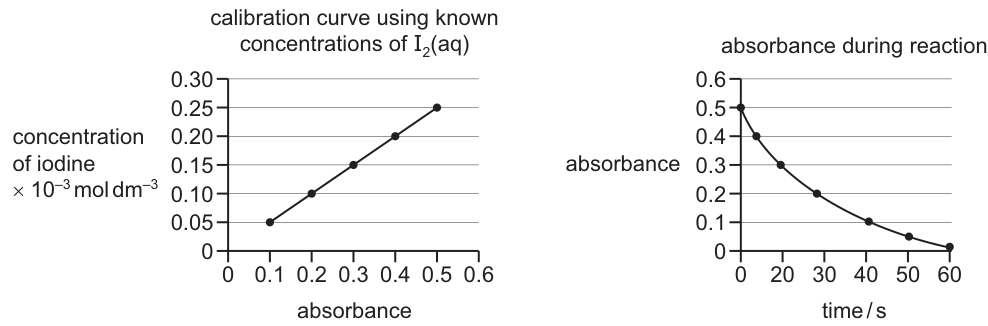
Known concentrations of are used to prepare a calibration curve graph and the absorbance is then measured as the reaction proceeds.
What is the rate of reaction at ?
Options
A
B
C
D
Working
Step 1: Determine the relationship between absorbance and concentration.
From the calibration curve, an absorbance of corresponds to a concentration of . The relationship is linear:
Step 2: Find the gradient of the tangent at .
On the absorbance vs. time graph, at , the absorbance is . Drawing a tangent at this point, it passes through and .
Step 3: Calculate the rate of reaction.
The rate of reaction is the rate of change of concentration of :
Answer
A
A
Background Concept
The rate of a reaction at a specific instant (the instantaneous rate) is given by the gradient of the tangent to the concentration-time curve at that time. Since concentration is directly proportional to absorbance (according to Beer-Lambert law), the gradient of an absorbance-time curve is also proportional to the rate of reaction. A calibration curve is used to establish the exact proportionality constant between absorbance and concentration, allowing the conversion of an absorbance gradient into a concentration gradient.
Understanding the Question
We are given two graphs: a calibration curve plotting iodine concentration against absorbance, and an absorbance-time graph for the reaction. We need to find the rate of reaction at . This requires finding the rate of change of iodine concentration at that specific time, which means finding the gradient of the tangent to the absorbance-time graph at and then converting that gradient into concentration units using the calibration curve.
Approach
- Use the calibration curve to find the conversion factor between absorbance and concentration of .
- Draw (or estimate) a tangent to the absorbance-time curve at and calculate its gradient ().
- Multiply the absorbance gradient by the conversion factor to get the rate of change of concentration. The rate of reaction is the positive value of this gradient (since is a reactant, its concentration decreases).
Step-by-Step Reasoning
Step 1: Calibration curve analysis
Looking at the left graph, the y-axis is concentration of iodine and the x-axis is absorbance. The line passes through . This means an absorbance of corresponds to a concentration of . Since the line passes through the origin, the relationship is:
Step 2: Tangent gradient at
On the right graph, at , the absorbance is . The curve is decreasing. To find the instantaneous rate, we need the gradient of the tangent at this point. Observing the points on the curve: at , ; at , ; at , . These three points are nearly collinear, so the tangent at can be approximated by the line connecting and .
This means the absorbance is decreasing at a rate of per second.
Step 3: Calculate the rate
The rate of reaction with respect to is:
This matches option A.
Key Takeaways
- The instantaneous rate of reaction is found from the gradient of the tangent to the concentration-time (or proportional property-time) graph at the desired time.
- Calibration curves are essential for converting instrumental readings (like absorbance) into concentration values.
- Always check the axes labels and multipliers (e.g., ) on graphs to avoid order-of-magnitude errors.
Common Mistakes
- Reading the wrong gradient: Using the average rate between two points instead of the instantaneous rate (tangent gradient) at . For example, using gives an average rate of , which is incorrect.
- Ignoring the multiplier on the y-axis: The calibration curve y-axis is . Forgetting this leads to an answer times too large (e.g., , option C).
- Sign errors: Rate is defined as a positive quantity. Forgetting to negate the negative gradient of the reactant's concentration-time graph.
Things to Be Careful About
- Tangent accuracy: When drawing a tangent by eye, ensure it is a straight line that just touches the curve at the point of interest and represents the local slope. Using points too far apart on a curved graph will give the average rate, not the instantaneous rate.
- Axis orientation: In the calibration curve, absorbance is on the x-axis and concentration on the y-axis. Be careful not to invert the ratio when calculating the conversion factor.
- Units: Ensure the final rate has the correct units of , accounting for the factor from the concentration axis.
The diagram shows a Boltzmann distribution curve.
The axes are not labelled.
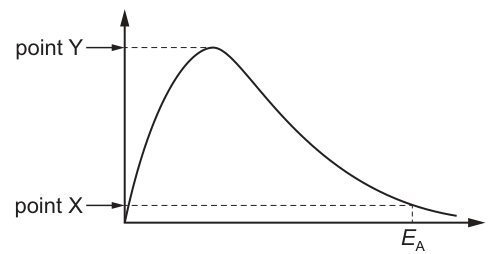
Points X and Y are points on the vertical axis.
What is represented by both points X and Y?
Options
| point X | point Y | |
|---|---|---|
| A | number of molecules with energy equal to | largest number of molecules with the same energy |
| B | number of molecules with energy equal to or greater than | largest number of molecules with the same energy |
| C | number of molecules with energy equal to | the amount of energy of the greatest number of molecules |
| D | number of molecules with energy equal to or greater than | the amount of energy of the greatest number of molecules |
Working
The vertical axis of a Boltzmann distribution curve represents the number of molecules (or relative number of molecules), and the horizontal axis represents molecular energy.
-
Point Y is at the peak of the curve. The peak height is the maximum value on the vertical axis, representing the largest number of molecules. These molecules all possess the same energy (the most probable energy, corresponding to the x-coordinate of the peak). Thus, Y represents the largest number of molecules with the same energy.
-
Point X is on the vertical axis at the height of the curve corresponding to energy on the horizontal axis. The height of the curve at any specific energy value gives the number of molecules having that exact energy. Thus, X represents the number of molecules with energy equal to . Note that the number of molecules with energy greater than or equal to would be represented by the area under the curve to the right of , not the height at .
Comparing this with the options:
- Options B and D are incorrect because the height at is not the number of molecules with energy .
- Options C and D are incorrect because point Y is a value on the vertical axis (number of molecules), not an energy value.
Answer
A
A
Background Concept
A Boltzmann distribution (or Maxwell-Boltzmann distribution) curve describes the distribution of molecular energies in a gas at a constant temperature.
- The horizontal axis represents the molecular energy (usually kinetic energy).
- The vertical axis represents the number of molecules (or the relative number/probability of finding a molecule with that energy).
- The curve starts at the origin (0 energy, 0 molecules), rises to a peak, and then tails off asymptotically towards the horizontal axis (very high energy, very few molecules).
- The peak of the curve corresponds to the most probable energy (), which is the energy possessed by the largest number of molecules.
- The area under the entire curve represents the total number of molecules in the sample.
- The area under the curve to the right of the activation energy () represents the number (or fraction) of molecules with energy greater than or equal to (the activated molecules).
- The height of the curve at any specific energy value on the x-axis gives the number of molecules that have that exact energy .
Understanding the Question
The question provides an unlabelled Boltzmann distribution curve with two points, X and Y, marked on the vertical axis. Point Y is aligned with the peak of the curve, and point X is aligned with the height of the curve at the horizontal position . We need to determine the physical meaning of the values represented by points X and Y on the vertical axis.
Approach
To solve this, we must first deduce what the axes represent based on standard Boltzmann distribution graphs. Then, we interpret the vertical coordinate (y-value) at the specific horizontal positions indicated by the dashed lines for X and Y. We must be careful to distinguish between a value at a point (the height of the curve) and an accumulated value (the area under the curve).
Step-by-Step Reasoning
- Identify the axes: In a Boltzmann distribution, the y-axis is the number of molecules and the x-axis is energy. Therefore, any point on the vertical axis represents a count or number of molecules.
- Analyze Point Y: Point Y is on the vertical axis, corresponding to the maximum height of the curve (the peak). The peak height is the largest number of molecules. Since this is a single point on the curve, all these molecules share the same energy (the most probable energy at the peak's x-value). Thus, Y represents the largest number of molecules with the same energy.
- Analyze Point X: Point X is on the vertical axis, corresponding to the height of the curve at the horizontal position . The height of the curve at is the number of molecules that have exactly energy . Thus, X represents the number of molecules with energy equal to .
- Evaluate distractors:
- The number of molecules with energy equal to or greater than is found by calculating the area under the curve to the right of , not by reading the height at . This makes options B and D incorrect for point X.
- Point Y is a value on the vertical axis (a number of molecules), not a value on the horizontal axis (an amount of energy). This makes options C and D incorrect for point Y.
- Conclusion: Option A correctly describes both points.
Key Takeaways
- On a Boltzmann distribution graph, the height at a specific energy gives the number of molecules with that energy.
- The area under a section of the curve gives the number of molecules within that energy range (e.g., area to the right of = activated molecules).
- The peak represents the most probable energy and the highest number of molecules possessing that energy.
Common Mistakes
- Confusing height with area: A very common error is thinking that the height of the curve at represents the number of molecules with energy . Students often memorize "area to the right of = activated molecules" but forget that the height at is just the number of molecules with exactly that energy. Since energy is continuous, the number of molecules with exactly is technically infinitesimal in a continuous distribution, but in the context of these exam graphs, the height represents the relative number of molecules in the narrow energy bin around .
- Confusing axes: Reading a value on the y-axis as an energy value. Point Y is clearly a count (number of molecules), not an energy amount.
Things to Be Careful About
- Always check which axis is which. Even if unlabelled, standard convention (and the presence of on the horizontal axis) confirms x = energy, y = number of molecules.
- Pay close attention to the command words and options: "equal to" vs "equal to or greater than". "Equal to" implies a specific point (height), "greater than" implies a range (area).
What are the acid–base nature and structure of ?
Options
| acid–base nature | structure | |
|---|---|---|
| A | acidic | giant covalent lattice |
| B | acidic | simple molecular |
| C | basic | giant covalent lattice |
| D | basic | simple molecular |
Working
Sulfur is a non-metal, so its oxide is acidic. It dissolves in water to form sulfurous acid: .
exists as discrete molecules held together by weak van der Waals forces — it is a gas at room temperature. This is a simple molecular structure, not a giant covalent lattice.
Answer
B
B
Background Concept
Sulfur dioxide () is an oxide of a non-metal (sulfur). Two independent properties are being tested here: its acid–base nature and its structure.
Acid–base nature of oxides: Metal oxides are typically basic (they react with acids to form salts and water), whereas non-metal oxides are typically acidic (they react with bases, or dissolve in water to give acidic solutions). is a non-metal oxide, so it is acidic. When it dissolves in water it forms sulfurous acid, , which is a weak acid — this is one reason is a major contributor to acid rain.
Structure: The structure of a substance refers to how its particles are arranged and bonded. is a simple molecular (covalent) substance: each molecule contains one sulfur atom double-bonded to two oxygen atoms (). The individual molecules are held together only by weak van der Waals (dispersion) forces, which is why is a gas at room temperature with a low boiling point. A giant covalent lattice (such as diamond or silicon dioxide, ) would consist of an extended network of atoms all covalently bonded to each other, giving a very high melting point and a solid at room temperature.
Understanding the Question
This multiple-choice question asks you to match two properties of : its acid–base nature (acidic or basic) and its structure (giant covalent lattice or simple molecular). The correct combination is B: acidic and simple molecular. The question is testing recall of two well-known facts about a common non-metal oxide.
Approach
Recall the two properties of directly:
- Acid–base nature: Sulfur is a non-metal, so its oxide is acidic. The reaction confirms this.
- Structure: is a small covalent molecule that is a gas at room temperature, so it has a simple molecular structure — not a giant covalent lattice.
Then match these to the options given.
Step-by-Step Reasoning
- Acid–base nature: is an oxide of a non-metal. Non-metal oxides are acidic. When dissolves in water it forms sulfurous acid, . This rules out options C and D, which say "basic".
- Structure: is a discrete molecule () with weak intermolecular forces. It is a gas at room temperature (boiling point about ). This is characteristic of a simple molecular structure. A giant covalent lattice would be a solid with a very high melting point (like , which melts around ). This rules out option A.
The only option that combines "acidic" with "simple molecular" is B.
Key Takeaways
- Non-metal oxides are acidic; metal oxides are basic.
- is an acidic oxide that forms in water and contributes to acid rain.
- Simple molecular substances exist as discrete molecules with weak intermolecular forces, giving low melting/boiling points; giant covalent lattices are extended covalent networks with very high melting points.
Common Mistakes
- Confusing with : (silicon dioxide, sand) is a giant covalent lattice, whereas is a simple molecular gas. The one-letter difference in the element symbol changes the structure entirely.
- Assuming all non-metal oxides are gases: Some non-metal oxides, such as , are giant covalent solids. The physical state at room temperature is a strong clue to the structure.
- Thinking is basic because it is a "sulfur compound": The acid–base nature is determined by whether the element is a metal or non-metal, not by the element itself. Sulfur is a non-metal, so its oxide is acidic.
Things to Be Careful About
- Distinguish clearly between simple molecular and giant covalent structures — this distinction is a frequent exam target.
- Remember that forms an acidic solution in water (, sulfurous acid) — a weak acid.
- The fact that is a gas at room temperature is a quick indicator of its simple molecular structure.
Elements X and Y are in Period 3 of the Periodic Table. Element X is either phosphorus or sulfur. Element Y is either sodium or magnesium.
Element X forms an oxide that reacts with water to give a solution containing the aqueous anion .
One mole of element Y reacts with one mole of chlorine molecules. At the end of the reaction, all of the element Y and all of the chlorine molecules have been used up.
What are elements X and Y?
Options
| X | Y | |
|---|---|---|
| A | phosphorus | sodium |
| B | phosphorus | magnesium |
| C | sulfur | sodium |
| D | sulfur | magnesium |
Working
For X: the oxide reacts with water to give the anion . If X were phosphorus, the anion would be phosphate, , not . If X is sulfur, reacts with water to give sulfuric acid, which contains sulfate, . So X is sulfur.
For Y: one mole of Y reacts with one mole of .
- Sodium: — 1 mol needs 2 mol Na.
- Magnesium: — 1 mol Mg reacts with 1 mol .
So Y is magnesium.
Answer
D (sulfur and magnesium)
D
Background Concept
Period 3 elements form oxides whose acid–base behaviour and anion formulae depend on the element. Sulfur forms and ; is the acidic oxide that reacts with water to give sulfuric acid, , which contains the sulfate anion . Phosphorus forms , which reacts with water to give phosphoric acid, , whose anions are , and — none of which has the formula .
Metals react with chlorine to form ionic chlorides. The stoichiometry depends on the charge of the metal ion: group 1 metals form (so 2 mol metal per 1 mol ), whereas group 2 metals form (so 1 mol metal per 1 mol ).
Understanding the Question
We are given two clues. First, element X (either phosphorus or sulfur) forms an oxide that reacts with water to give an aqueous solution containing the anion . Second, one mole of element Y (either sodium or magnesium) reacts exactly with one mole of chlorine molecules, with no reactant left over. We need to identify X and Y from these clues.
Approach
Use the anion formula to decide whether X is phosphorus or sulfur. Then use the 1:1 mole ratio with chlorine to decide whether Y is sodium or magnesium. The key is to write the correct formula of the anion formed by each candidate oxide and the correct balanced equation for each metal with chlorine.
Step-by-Step Reasoning
Identifying X
- If X were phosphorus, the oxide would react with water to give . The anion would then be , but phosphate is . The charge does not match.
- If X is sulfur, the oxide reacts with water: Sulfuric acid ionises to give sulfate, , which matches . Hence X is sulfur.
Identifying Y
- Sodium is a group 1 metal and forms . The balanced equation is: This requires 2 mol Na for every 1 mol , not 1 mol Na.
- Magnesium is a group 2 metal and forms : Here 1 mol Mg reacts exactly with 1 mol , matching the condition. Hence Y is magnesium.
Therefore X is sulfur and Y is magnesium, which is option D.
Key Takeaways
- The formula and charge of the anion produced by an oxide reveal the identity of the element: sulfate is , phosphate is .
- The stoichiometry of a metal reacting with chlorine depends on the charge of the metal ion: group 1 gives a 2:1 mole ratio with , group 2 gives a 1:1 ratio.
- Always write and balance the equation before comparing mole ratios.
Common Mistakes
- Assuming phosphorus gives instead of — the charge of the phosphate ion is often forgotten.
- Writing without balancing, which incorrectly suggests a 1:1 ratio for sodium.
- Confusing the oxide formulae: gives sulfuric acid, while gives sulfurous acid (), which would not give .
Things to Be Careful About
- State symbols are not essential here, but the anion charge is crucial: has a 2− charge, so it must be sulfate, not phosphate.
- When balancing equations, check both atoms and charges. For , the equation is already balanced, giving the required 1:1 mole ratio.
- The phrase "all of the element Y and all of the chlorine molecules have been used up" means the mole ratio must be exactly 1:1, which eliminates sodium.
Q is a semi-conductor. The chloride of Q reacts with water to form white fumes and an acidic solution.
Which Period 3 element is Q?
Options
A magnesium
B aluminium
C silicon
D phosphorus
Working
Silicon is the only Period 3 metalloid, so it behaves as a semi-conductor. Its tetrachloride hydrolyses in water:
The HCl formed gives white/steamy fumes and dissolves to give an acidic solution. Magnesium, aluminium and phosphorus are not semi-conductors.
Answer
C (silicon)
C
Background Concept
Across Period 3, the elements show a gradual change from metallic to non-metallic behaviour. Sodium, magnesium and aluminium are metals; silicon is a metalloid (semi-conductor); phosphorus, sulfur, chlorine and argon are non-metals. The chlorides follow the same trend: metal chlorides are ionic solids that dissolve in water to give neutral or slightly acidic solutions, whereas non-metal chlorides are covalent molecular compounds that hydrolyse with water, releasing hydrogen chloride (HCl). The HCl escapes as white/steamy fumes and, when dissolved, forms an acidic solution.
Understanding the Question
The question gives two properties of element Q: it is a semi-conductor, and its chloride reacts with water to form white fumes and an acidic solution. We must identify which of the four Period 3 elements — magnesium, aluminium, silicon, phosphorus — fits both clues. The key is to recognise that silicon is the metalloid semi-conductor, and that its tetrachloride, SiCl4, is a covalent chloride that hydrolyses to give HCl.
Approach
Use the two clues in turn. First, which of the four elements is a semi-conductor? Only silicon. Second, check the chloride behaviour: SiCl4 is a covalent tetrachloride that reacts with water to give HCl (white fumes) and an acidic solution. Both clues point to silicon, so the answer is C.
Step-by-Step Reasoning
- Semi-conductor: Across Period 3, the metals (Na, Mg, Al) conduct electricity as solids, while the non-metals (P, S, Cl, Ar) are insulators. Silicon, a metalloid, is the semi-conductor. So Q must be silicon.
- Chloride with water: SiCl4 is a covalent liquid at room temperature. On adding water, it hydrolyses:
The HCl produced gives white/steamy fumes and dissolves in water to give an acidic solution. This matches the description exactly.
- Check the other options: magnesium and aluminium are metals, not semi-conductors, so A and B are ruled out. Phosphorus is a non-metal and is not a semi-conductor, so D is ruled out. Only silicon satisfies both clues.
Key Takeaways
- Silicon is the Period 3 metalloid — the semi-conductor.
- Covalent non-metal chlorides hydrolyse in water, releasing HCl (white/steamy fumes) and giving an acidic solution; ionic metal chlorides generally do not.
- In a two-clue identification question, the element must satisfy both properties simultaneously.
Common Mistakes
- Choosing phosphorus (D) because its chlorides also hydrolyse with water — but phosphorus is not a semi-conductor.
- Choosing aluminium (B) because AlCl3 reacts with water — but aluminium is a metal, not a semi-conductor.
- Forgetting that the white fumes are HCl, not the chloride itself.
Things to Be Careful About
- The equation SiCl4 + 2H2O → SiO2 + 4HCl is the simplest balanced form; some texts write SiCl4 + 3H2O → H2SiO3 + 4HCl (forming silicic acid), which is also acceptable.
- Include state symbols: SiCl4(l), H2O(l), SiO2(s), HCl(g).
- Note that "white fumes" is the observation for HCl(g), and "acidic solution" is because HCl(aq) is a strong acid.
V and W are two compounds. Each one contains a different Group 2 element.
A sample of each solid is added to water, shaken, and the pH of the resulting solution is measured.
| compound | V | W |
|---|---|---|
| pH | 13.6 | 9.4 |
Which row could identify V and W?
Options
| V | W | |
|---|---|---|
| A | ||
| B | ||
| C | ||
| D |
Working
A pH of 13.6 is strongly alkaline, so V must be a soluble hydroxide. Solubility of Group 2 hydroxides increases down the group, so dissolves to give a strongly alkaline solution.
A pH of 9.4 is only weakly alkaline, so W must be a sparingly soluble hydroxide — .
The sulfates do not fit: is insoluble and does not give a strongly alkaline solution. Hence V = and W = .
Answer
C
C
Background Concept
Group 2 (alkaline earth) metals form hydroxides, , whose solubility in water varies down the group: it increases from Be to Ba. is essentially insoluble, is only sparingly soluble, is slightly soluble, while and are appreciably soluble. When a hydroxide dissolves, it releases ions, so the pH of the resulting solution reflects both how soluble the hydroxide is and how much is released. A soluble hydroxide such as gives a strongly alkaline solution (pH ≈ 13), whereas a sparingly soluble one such as gives only a weakly alkaline solution (pH ≈ 9). The opposite trend applies to the sulfates: solubility of Group 2 sulfates decreases down the group ( is soluble, is essentially insoluble).
Understanding the Question
Two solids, V and W, each containing a different Group 2 element, are added to water and the pH measured. V gives pH 13.6 (strongly alkaline), W gives pH 9.4 (weakly alkaline). The options offer pairs of a sulfate and a hydroxide. The question tests whether you know which Group 2 compound produces a strongly versus weakly alkaline solution in water — that is, the solubility of the hydroxides.
Approach
Ask what each compound does in water. A hydroxide can release and raise pH; a sulfate cannot (it is a salt of a strong acid). Compare the two hydroxides: the more soluble one, , gives the higher pH (13.6 → V); the sparingly soluble one, , gives the lower pH (9.4 → W). Then check that the sulfate options are inconsistent with an alkaline pH.
Step-by-Step Reasoning
- pH 13.6 is strongly alkaline. Only a soluble hydroxide can produce such a high concentration. is the soluble Group 2 hydroxide (solubility of hydroxides increases down the group), so V = .
- pH 9.4 is weakly alkaline. is sparingly soluble, releasing only a small amount of , so W = .
- Eliminate the sulfates. is essentially insoluble in water (solubility of Group 2 sulfates decreases down the group), so it would give a nearly neutral pH, not 13.6. is soluble, but the sulfate ion is not basic; in fact undergoes hydrolysis giving a slightly acidic solution. Neither fits either pH.
- Therefore the only consistent row is C: V = , W = .
Distractor analysis: options A and B pair the sulfates — impossible because neither sulfate produces an alkaline solution. Option D reverses the hydroxides — cannot give pH 13.6 because it is only sparingly soluble.
Key Takeaways
Solubility of Group 2 hydroxides increases down the group; solubility of the sulfates decreases down the group. The pH of a solution of a Group 2 hydroxide is a direct measure of its solubility and hence identifies the element.
Common Mistakes
- Assuming all Group 2 hydroxides are strongly alkaline — is only sparingly soluble.
- Confusing the two solubility trends: hydroxides increase down the group, sulfates decrease.
- Thinking or gives an alkaline solution — sulfates are not basic; is insoluble and is slightly acidic by hydrolysis.
Things to Be Careful About
- Remember the direction of the hydroxide solubility trend (increases down the group).
- Note that pH is a logarithmic scale — a difference of about 4 pH units (13.6 vs 9.4) reflects a huge difference in concentration, consistent with a soluble versus sparingly soluble hydroxide.
- The sulfate options are distractors: a salt of a strong acid does not give an alkaline solution.
Compound L decomposes on heating. One of the products is gas M.
M reacts with unburned hydrocarbons to form peroxyacetyl nitrate, PAN.
What could be the formula of L?
Options
A
B
C
D
Working
PAN forms when nitrogen oxides () react with unburned hydrocarbons in photochemical smog. Gas M must therefore be a nitrogen oxide, .
Nitrates decompose on heating to give nitrogen dioxide. Calcium nitrate, , decomposes to give , and .
Answer
B —
B
Background Concept
Peroxyacetyl nitrate (PAN) is a secondary air pollutant found in photochemical smog. It forms when nitrogen oxides ( — mainly NO and NO₂) react with unburned hydrocarbons (volatile organic compounds) in the presence of sunlight. The nitrogen oxides come from high-temperature combustion, such as vehicle exhausts. So, if a gas M reacts with unburned hydrocarbons to form PAN, M must be a nitrogen oxide.
Separately, the thermal decomposition of metal nitrates is a well-known Group 2 reaction. When a Group 2 nitrate such as calcium nitrate is heated strongly, it decomposes to give the metal oxide, nitrogen dioxide and oxygen:
This is the source of that links back to PAN formation.
Understanding the Question
The question sets up a chain: compound L decomposes on heating → gas M → M reacts with unburned hydrocarbons → PAN. We are asked to identify the formula of L from four options. The key insight is that PAN requires , so M must be a nitrogen oxide. Then we need to identify which compound on the list decomposes to give a nitrogen oxide.
Approach
- Recognise that PAN is formed from + hydrocarbons, so M = (or NO).
- Identify which type of compound decomposes to give : nitrates.
- Check each option: which is a valid nitrate formula?
Step-by-Step Reasoning
- PAN is formed from (nitrogen oxides) reacting with unburned hydrocarbons in photochemical smog. Therefore gas M must be (or NO).
- Which of the options decomposes to give a nitrogen oxide? Nitrates do. Group 2 nitrates decompose on heating:
- Option A: — this is not a valid formula. Calcium is and nitrate is , so the correct formula requires two nitrate ions: .
- Option B: — this is calcium nitrate, a valid formula. It decomposes on heating to give , which forms PAN with hydrocarbons. ✓
- Option C: — magnesium carbonate decomposes on heating to give MgO and . does not form PAN. ✗
- Option D: — this is not a valid formula. Magnesium is and carbonate is , so the correct formula is , not . ✗
Therefore the answer is B.
Key Takeaways
- PAN formation requires — recognise this as the key to tracing back to a nitrate source.
- Group 2 nitrates decompose to give + + metal oxide.
- Group 2 carbonates decompose to give + metal oxide.
- Always check the validity of ionic formulae: charges must balance.
Common Mistakes
- Choosing (option C) because it decomposes on heating — but it gives , not a nitrogen oxide, so it cannot form PAN.
- Not recognising that PAN requires — this is the key connection.
- Choosing (option A) without checking the formula validity — needs two ions.
- Confusing the decomposition products of nitrates () with those of carbonates ().
Things to Be Careful About
- The correct formula of calcium nitrate is , not .
- State symbols in the decomposition equation: .
- The distinction between nitrates and carbonates in thermal decomposition.
- PAN forms from + hydrocarbons — the is the key link.
In reaction 1, concentrated sulfuric acid is added to potassium chloride and the fumes produced are bubbled into aqueous potassium iodide solution.
In reaction 2, potassium chloride is dissolved in aqueous ammonia and this is then added to aqueous silver nitrate.
What are the observations for reactions 1 and 2?
Options
| observation for reaction 1 | observation for reaction 2 | |
|---|---|---|
| A | brown solution | colourless solution |
| B | brown solution | white precipitate |
| C | colourless solution | colourless solution |
| D | colourless solution | white precipitate |
Working
Reaction 1: concentrated H2SO4 with KCl gives HCl fumes.
HCl is not an oxidising agent, so it does not oxidise I⁻ to I₂. The KI solution remains colourless.
Reaction 2: aqueous ammonia complexes Ag⁺ as [Ag(NH₃)₂]⁺, so AgCl does not precipitate. The solution remains colourless.
Answer
C
C
Background Concept
This question tests two classic halide reactions.
- Concentrated sulfuric acid with a chloride – For chlorides, concentrated H2SO4 acts only as an acid, producing hydrogen chloride gas:
HCl is not an oxidising agent. By contrast, concentrated H2SO4 can oxidise bromide and iodide ions to bromine and iodine, but it does not oxidise chloride ions. When HCl gas is bubbled into aqueous KI, no redox reaction occurs because HCl cannot oxidise I⁻ to I₂.
- Silver halide formation and its solubility in ammonia – Ag⁺ reacts with Cl⁻ to give a white precipitate of AgCl. However, AgCl is soluble in aqueous ammonia because ammonia forms a stable complex with silver(I):
If ammonia is present before Ag⁺ and Cl⁻ are mixed, the Ag⁺ is complexed as [Ag(NH₃)₂]⁺ and AgCl does not precipitate.
Understanding the Question
The question gives two reactions and asks for the observation in each.
- Reaction 1: concentrated H2SO4 is added to KCl; the fumes produced are bubbled into aqueous KI.
- Reaction 2: KCl is dissolved in aqueous ammonia, and this solution is added to aqueous AgNO3.
The options combine two possible observations: brown solution (which would indicate iodine formation) or colourless solution for reaction 1, and colourless solution or white precipitate for reaction 2. The correct combination is C: both are colourless.
Approach
For each reaction, decide whether a coloured species or a precipitate is formed.
- Reaction 1: Identify the gas produced by concentrated H2SO4 with KCl. It is HCl, not an oxidising agent. Therefore, when it meets KI, no I₂ is formed, so no brown colour appears.
- Reaction 2: Recognise that aqueous ammonia complexes Ag⁺. Since the KCl is already in ammonia before it is added to AgNO3, the Ag⁺ is tied up as [Ag(NH₃)₂]⁺ and cannot form AgCl. No white precipitate forms.
Step-by-Step Reasoning
Reaction 1
Concentrated H2SO4 reacts with KCl to produce HCl gas:
The HCl fumes are bubbled into aqueous KI. In solution, HCl simply provides H⁺ and Cl⁻; it has no oxidising power. Iodide ions are not oxidised to iodine, so no brown colour from I₂ appears. The solution remains colourless.
If the gas had been chlorine, it would oxidise I⁻ to I₂ and give a brown solution, but chlorine is not produced from KCl and concentrated H2SO4.
Reaction 2
KCl is dissolved in aqueous ammonia, so the solution contains K⁺, Cl⁻ and NH₃. When this is added to aqueous AgNO3, the Ag⁺ first encounters ammonia. Ag⁺ forms the soluble complex ion:
Because the Ag⁺ is complexed, the concentration of free Ag⁺ is too low for AgCl to precipitate. Even if a little AgCl formed momentarily, it would dissolve in the ammonia. The final solution is colourless.
Therefore, reaction 1 gives a colourless solution and reaction 2 gives a colourless solution. The correct option is C.
Key Takeaways
- Concentrated H2SO4 with a chloride gives HCl, not an oxidising gas.
- HCl cannot oxidise iodide ions, so KI remains colourless.
- Aqueous ammonia complexes Ag⁺ as [Ag(NH₃)₂]⁺, preventing AgCl precipitation.
- The order of addition matters: adding ammonia after AgCl has formed dissolves the precipitate; having ammonia present before mixing prevents the precipitate from forming.
Common Mistakes
- Assuming HCl oxidises I⁻ to I₂. HCl is not an oxidising agent; only oxidising halogens such as Cl₂ would produce iodine.
- Expecting a white precipitate in reaction 2 because AgCl is normally insoluble. This ignores the effect of the ammonia present in the solution.
- Confusing this with the standard halide test, where AgNO3 is added first and then ammonia is added to distinguish AgCl, AgBr and AgI.
Things to Be Careful About
- Use the correct product for concentrated H2SO4 with KCl: HCl, not Cl₂.
- Remember that a brown solution in a KI test means I₂ has been formed; no oxidising agent means no brown colour.
- Note that dilute aqueous ammonia is sufficient to dissolve AgCl, while more concentrated ammonia is needed for AgBr and AgI is essentially insoluble in ammonia.
The table refers to the hydrogen halides.
Which row is correct?
Options
| oxidation | thermal stability | |
|---|---|---|
| A | easier to oxidise down the group | increases down the group |
| B | more difficult to oxidise down the group | increases down the group |
| C | easier to oxidise down the group | decreases down the group |
| D | more difficult to oxidise down the group | decreases down the group |
Working
Down the group :
- Thermal stability: the H–X bond enthalpy decreases down the group (), so the hydrogen halides decompose more readily on heating — thermal stability decreases down the group.
- Ease of oxidation: the halide ion becomes a stronger reducing agent down the group ( is the strongest reducing agent), so the hydrogen halides become easier to oxidise down the group.
Answer
C
C
Background Concept
Hydrogen halides (, , , ) are covalent molecular compounds of hydrogen and the halogens. Two separate trends govern their behaviour down Group 17, and both trace back to the increase in atomic size as you descend the group.
Thermal stability is the resistance of a compound to decomposition on heating. For a hydrogen halide, decomposition requires breaking the H–X bond:
The H–X bond enthalpy decreases down the group: (~569 kJ mol⁻¹), (~431 kJ mol⁻¹), (~366 kJ mol⁻¹), (~299 kJ mol⁻¹). The halogen atom gets larger down the group, so the H–X bond becomes longer, and a longer bond is weaker. A weaker bond needs less energy to break, so the compound decomposes more readily on heating. Thermal stability therefore decreases down the group: is the most stable and the least.
Ease of oxidation describes how readily the hydrogen halide is oxidised to the elemental halogen:
Here the halide ion is the reducing agent — it loses electrons. Down the group, the halide ion becomes a stronger reducing agent. The ion is larger and the outer electrons are further from the nucleus and more shielded, so they are lost more easily. is an extremely weak reducing agent ( is essentially impossible to oxidise by common oxidants), while is a strong reducing agent ( is oxidised even by air).
Understanding the Question
This multiple-choice question presents a two-column table about hydrogen halides. The first column asks about the ease of oxidation down the group; the second about thermal stability down the group. Each option pairs one direction for oxidation ("easier" or "more difficult") with one direction for thermal stability ("increases" or "decreases"). The task is to recall the correct direction of each trend and find the option that combines both correctly.
No data or figures are given — this is pure recall of two Group 17 trends.
Approach
For each property, determine the direction of the trend from to :
- Thermal stability: connect it to H–X bond enthalpy, which decreases down the group.
- Ease of oxidation: connect it to the reducing power of the halide ion, which increases down the group.
Then match the combination to one of the four options.
Step-by-Step Reasoning
Thermal stability trend:
- Decomposition of requires breaking the H–X bond.
- Bond enthalpy decreases down the group () because the halogen atom is larger and the bond is longer and weaker.
- Less energy is needed to break the bond in than in , so decomposes most readily.
- Conclusion: thermal stability decreases down the group.
Ease of oxidation trend:
- Oxidation of produces the halogen: .
- The halide ion is the reducing agent. Down the group, the ion becomes larger and the outer electron is held less tightly, so it is lost more easily.
- is a very weak reducing agent; is a strong reducing agent.
- Conclusion: hydrogen halides become easier to oxidise down the group.
Combining the trends:
- Easier to oxidise down the group ✓
- Decreases down the group ✓
- This combination is option C.
Why the other options are wrong:
- A: correct on oxidation ("easier") but wrong on stability ("increases" — it actually decreases).
- B: wrong on both — "more difficult to oxidise" (it is easier) and "increases" for stability (it decreases).
- D: wrong on oxidation ("more difficult to oxidise") even though the stability part is correct.
Key Takeaways
- Thermal stability of hydrogen halides decreases down the group because H–X bond enthalpy decreases.
- Reducing power of halide ions (and hence ease of oxidation of the hydrogen halides) increases down the group.
- Both trends share a common cause: the increasing size of the halogen atom down the group.
- When a question pairs two trends, check each independently before selecting the option.
Common Mistakes
- Thinking thermal stability increases down the group because "bigger atoms form stronger bonds" — the opposite is true: bigger atoms form longer, weaker bonds.
- Confusing the oxidation of hydrogen halides with the oxidising power of halogens. Halogens become weaker oxidising agents down the group, which means the halide ions become stronger reducing agents — so hydrogen halides become easier to oxidise, not harder.
- Mixing up "easier to oxidise" with "more difficult to oxidise" — is easily oxidised (it is a strong reducing agent), so is the easiest hydrogen halide to oxidise.
Things to Be Careful About
- The question is about hydrogen halides (), not the halogens () themselves. The trends are related but distinct.
- "Ease of oxidation" refers to the hydrogen halide being oxidised to the halogen — this is the reverse of the halogen acting as an oxidising agent.
- Thermal stability specifically concerns resistance to decomposition on heating, which is governed by the H–X bond enthalpy.
- Remember the order: is the most stable and hardest to oxidise; is the least stable and easiest to oxidise.
of nitrogen monoxide reacts with of carbon monoxide on the surface of the catalytic converter in the exhaust system of a car.
What is the total volume of the product gases measured at room conditions?
Options
A
B
C
D
Working
Molar masses:
- NO: 14 + 16 = 30 g mol⁻¹
- CO: 12 + 16 = 28 g mol⁻¹
Moles:
- NO: 7.5 / 30 = 0.25 mol
- CO: 7.0 / 28 = 0.25 mol
Catalytic converter reaction:
2NO + 2CO → N2 + 2CO2
0.25 mol NO reacts with 0.25 mol CO, so both are used up completely.
Products:
- N2: 0.25 / 2 = 0.125 mol
- CO2: 0.25 mol
Total gas moles = 0.125 + 0.25 = 0.375 mol
At room conditions, 1 mol gas = 24 dm³.
Volume = 0.375 × 24 = 9.0 dm³
Answer
C (9.0 dm³)
C
Background Concept
In a car catalytic converter, nitrogen monoxide and carbon monoxide are converted into less harmful gases:
2NO + 2CO → N2 + 2CO2
This is a redox reaction in which NO is reduced to N2 and CO is oxidised to CO2. For gas volume calculations at room conditions, the molar volume is 24 dm³ mol⁻¹.
Understanding the Question
We are given the masses of two reactants, NO and CO, and asked for the total volume of the product gases at room conditions. This requires:
- writing the balanced equation
- converting masses to moles
- checking whether one reactant is in excess
- calculating the moles of each gaseous product
- converting total moles of gas to volume
Approach
- Write the balanced equation for the catalytic converter reaction.
- Calculate the number of moles of NO and CO from their masses.
- Compare the mole ratio with the balanced equation to identify the limiting reagent.
- Use the limiting reagent to calculate the moles of N2 and CO2 produced.
- Add the product moles and multiply by the molar gas volume at room conditions.
Step-by-Step Reasoning
Molar mass of NO = 14 + 16 = 30 g mol⁻¹
Moles of NO = 7.5 / 30 = 0.25 mol
Molar mass of CO = 12 + 16 = 28 g mol⁻¹
Moles of CO = 7.0 / 28 = 0.25 mol
The balanced equation shows that NO and CO react in a 1:1 mole ratio:
2NO + 2CO → N2 + 2CO2
Since both are present as 0.25 mol, neither is in excess; both react completely.
From the equation:
- 2 mol NO produces 1 mol N2, so 0.25 mol NO produces 0.125 mol N2.
- 2 mol CO produces 2 mol CO2, so 0.25 mol CO produces 0.25 mol CO2.
Total moles of product gases = 0.125 + 0.25 = 0.375 mol
At room conditions, 1 mol of gas occupies 24 dm³.
Volume = 0.375 × 24 = 9.0 dm³
Therefore, the correct option is C.
Key Takeaways
- The catalytic converter reaction is 2NO + 2CO → N2 + 2CO2.
- Always start gas volume calculations from the balanced equation and moles.
- When two reactants are given, check for a limiting reagent.
- At room conditions, use 24 dm³ mol⁻¹ as the molar gas volume.
Common Mistakes
- Using the total moles of reactants instead of the total moles of products. This would give 0.50 mol and 12 dm³, which is option D but is incorrect.
- Forgetting that N2 is also a product and only counting CO2.
- Using 22.4 dm³ mol⁻¹, which is for standard temperature and pressure, not room conditions.
- Misreading the mole ratio and thinking 0.25 mol NO gives 0.25 mol N2.
Things to Be Careful About
- Molar masses: NO is 30 g mol⁻¹, CO is 28 g mol⁻¹.
- The reaction consumes NO and CO in equal mole amounts, so equal given masses do not mean equal moles.
- The total gas volume depends on the total moles of all gaseous products, not on the volume of the reactants.
- Room conditions in Cambridge A-Level chemistry usually mean 24 dm³ mol⁻¹.
Three statements about ammonia molecules and ammonium ions are given.
1 In aqueous solution, ammonia molecules form coordinate bonds with hydroxide ions.
2 Ammonium ions are Brønsted–Lowry acids.
3 The H–N–H bond angle is larger in the ammonium ion than in the ammonia molecule.
Which statements are correct?
Options
A 1 and 2 only
B 1 and 3 only
C 2 and 3 only
D 1, 2 and 3
Working
Statement 1 — In aqueous solution, ammonia accepts a proton from water:
It does not form a coordinate bond with hydroxide ions. The coordinate bond in the ammonium ion is formed when the lone pair on nitrogen is donated to a hydrogen ion, . So statement 1 is false.
Statement 2 — can donate a proton, , to a base, so it is a Brønsted–Lowry acid. Statement 2 is true.
Statement 3 — has three bonding pairs and one lone pair, giving a bond angle of about . has four bonding pairs and no lone pairs, giving a regular tetrahedral bond angle of . So the H–N–H bond angle is larger in the ammonium ion. Statement 3 is true.
Answer
C (2 and 3 only)
C
Background Concept
This question brings together three ideas from bonding and acid–base chemistry.
A coordinate (dative) bond is a covalent bond in which both electrons in the shared pair come from one atom. In the ammonium ion, , the lone pair on nitrogen is donated to a hydrogen ion, , forming a fourth N–H bond. Once formed, this bond is indistinguishable from the other three N–H bonds.
A Brønsted–Lowry acid is a proton donor. Any species that can donate to another species is an acid, regardless of whether it is a molecule or an ion. The ammonium ion is the conjugate acid of ammonia because it can donate a proton to reform .
The VSEPR model predicts molecular shape from the number of bonding pairs and lone pairs around the central atom. Lone pairs repel more strongly than bonding pairs, so they compress bond angles. Ammonia has three bonding pairs and one lone pair, giving a pyramidal shape with a bond angle of about . Ammonium has four bonding pairs and no lone pairs, giving a regular tetrahedral shape with a bond angle of .
Understanding the Question
Three statements are given about ammonia molecules and ammonium ions, and we must decide which are correct. The answer options combine the statements: 1 and 2 only, 1 and 3 only, 2 and 3 only, or 1, 2 and 3. The correct approach is to test each statement independently and then match the true statements to the option.
The key chemical situation is the behaviour of ammonia in water. Ammonia is a weak base: it accepts a proton from water, producing hydroxide ions and ammonium ions. This equilibrium is central to judging statement 1.
Approach
Evaluate each statement one at a time.
- Check whether ammonia forms a coordinate bond with hydroxide ions in aqueous solution. Write the equilibrium between ammonia and water and identify what actually forms.
- Check whether the ammonium ion can donate a proton. Use the Brønsted–Lowry definition of an acid.
- Compare the number of lone pairs and bonding pairs around nitrogen in and , then apply VSEPR to compare bond angles.
Finally, combine the true statements and select the matching option.
Step-by-Step Reasoning
Statement 1: Ammonia molecules form coordinate bonds with hydroxide ions.
In water, ammonia acts as a base by accepting a proton from water:
The proton is transferred from water to ammonia, and the hydroxide ion is produced as a separate ion. No bond forms between and . The coordinate bond in the ammonium ion is between nitrogen and the hydrogen ion that came from water:
Here the lone pair on nitrogen is donated to . Hydroxide ions are not electron-pair acceptors in this situation, so statement 1 is false.
Statement 2: Ammonium ions are Brønsted–Lowry acids.
An acid is a proton donor. The ammonium ion can donate a proton to water or to hydroxide ions:
Because can donate , it is a Brønsted–Lowry acid. Statement 2 is true.
Statement 3: The H–N–H bond angle is larger in the ammonium ion than in the ammonia molecule.
In , nitrogen has four electron pairs: three bonding pairs and one lone pair. The lone pair occupies more space and repels the bonding pairs more strongly, compressing the H–N–H bond angle to about .
In , nitrogen has four bonding pairs and no lone pairs. The four pairs arrange symmetrically in a tetrahedron, giving equal bond angles of .
Since is larger than , statement 3 is true.
Therefore the correct statements are 2 and 3, which corresponds to option C.
Key Takeaways
- Ammonia is a base because it accepts a proton, not because it forms a bond with hydroxide ions.
- A coordinate bond forms when a lone pair is donated to an electron-pair acceptor, such as .
- The ammonium ion is the conjugate acid of ammonia and can donate a proton.
- Lone pairs compress bond angles; removing the lone pair by forming increases the bond angle from about to .
- In combined-statement multiple-choice questions, test each statement separately before choosing an option.
Common Mistakes
- Thinking statement 1 is true because ammonia is a base. Ammonia does accept a proton, but it does not coordinate to hydroxide ions. The hydroxide ion is produced, not bonded to ammonia.
- Confusing a coordinate bond with an ionic interaction or a hydrogen bond. A coordinate bond is a covalent bond with both electrons supplied by one atom.
- Assuming and have the same shape. The lone pair in ammonia changes the shape from tetrahedral to pyramidal and reduces the bond angle.
- Using the Lewis definition instead of the Brønsted–Lowry definition. A Brønsted–Lowry acid is a proton donor, not an electron-pair acceptor.
Things to Be Careful About
- Use the Brønsted–Lowry definition precisely: acid = proton donor, base = proton acceptor.
- Remember that the bond angle in ammonia is approximately , not ; the ammonium ion is the one with the larger angle.
- When writing the equilibrium of ammonia in water, include the reversible arrow because it is a weak-base equilibrium.
- In the final answer, make sure the selected option matches the set of true statements: here, 2 and 3 only.
Ethene reacts with steam in the presence of sulfuric acid.
Which type of reaction is this?
Options
A acid–base
B addition
C hydrolysis
D substitution
Working
Ethene, , contains a double bond. Water adds across this double bond, breaking the bond and forming a single saturated product, ethanol, . Two reactants combine to give one product, with no small molecule eliminated and no atom replaced — the defining feature of an addition reaction.
Answer
B
B
Background Concept
Alkenes are unsaturated hydrocarbons that contain a carbon–carbon double bond. The double bond consists of one sigma () bond and one pi () bond. The bond is formed by sideways overlap of p orbitals and is weaker and more exposed than the bond, so it is easily broken. The electron density of the bond makes the double bond electron-rich, so it behaves as a nucleophile and is attracted to electrophiles (electron-poor species).
Because of this, alkenes characteristically undergo electrophilic addition reactions: an electrophile is attracted to the double bond, the bond breaks, and new atoms or groups become attached to the two carbon atoms of the double bond. No atoms are lost from the molecule — the number of groups attached to the carbon skeleton increases.
The reaction in this question is the industrial hydration of ethene to form ethanol:
This is catalysed by an acid (sulfuric or phosphoric acid). The acid protonates the alkene to form a carbocation intermediate, and water then attacks the carbocation, followed by loss of a proton to give the alcohol. The overall effect is that water adds across the double bond — an addition reaction.
Understanding the Question
The question presents the balanced equation for the reaction of ethene with steam in the presence of sulfuric acid and asks simply: "Which type of reaction is this?" The four options are acid–base, addition, hydrolysis, and substitution. The command word "Which type" asks for classification, not for a mechanism or a product. The key is to recognise what happens to the carbon skeleton: the double bond is converted to a single bond and water is incorporated into the product.
Approach
The fastest route is to identify the functional group (the double bond) and recall the characteristic reaction type of alkenes — addition. Then confirm by inspecting the equation: two reactants ( and ) combine to give exactly one product (). No small molecule is lost and no atom is replaced, which rules out substitution and hydrolysis. There is also no proton transfer between an acid and a base that leaves the carbon skeleton unchanged, which rules out acid–base.
Step-by-Step Reasoning
- Identify the functional group: ethene, , is an alkene containing a double bond.
- Recall the characteristic reaction of alkenes: because of the electron-rich bond, alkenes undergo addition reactions in which the double bond opens and new atoms attach to the two carbon atoms.
- Check the equation: . Two molecules combine to form a single product. The hydrogen and hydroxyl of water become attached to the two carbons of the former double bond. This is the signature of an addition reaction.
- Eliminate the distractors:
- Acid–base (A): an acid–base reaction involves transfer of a proton () between species, with no change to the carbon skeleton. Here the carbon skeleton changes (the double bond is saturated), so this is not acid–base chemistry, even though an acid is used as a catalyst.
- Hydrolysis (C): hydrolysis is the breaking of a bond in a molecule by reaction with water, typically splitting a molecule into two parts (for example, an ester or a halogenoalkane reacting with water). Here water is added across a double bond to form a single product; no molecule is split, so this is not hydrolysis.
- Substitution (D): substitution involves replacing one atom or group in a molecule by another atom or group. In this reaction no atom or group is replaced — atoms are added to the two carbons of the double bond. So this is not substitution.
- Conclusion: the reaction is an addition reaction, option B.
Key Takeaways
- Alkenes undergo addition reactions because the bond of the double bond is easily broken and can accept new atoms.
- The hydration of ethene (reaction with steam over an acid catalyst) is an industrially important addition reaction that produces ethanol.
- A quick way to classify a reaction is to look at the equation: two reactants forming one product with no small molecule lost is addition; replacing an atom is substitution; splitting a molecule with water is hydrolysis.
Common Mistakes
- Choosing hydrolysis because water is a reactant. Water being present does not make a reaction a hydrolysis. Hydrolysis requires a bond in a molecule to be broken by water, splitting the molecule. Here water is added across a double bond to give a single product.
- Confusing addition with substitution. Substitution replaces one atom or group with another; addition increases the number of atoms attached to the carbon skeleton without removing any. In this reaction nothing is removed.
- Thinking the acid catalyst makes it an acid–base reaction. The sulfuric acid is a catalyst; it is not consumed and does not change the reaction type. The carbon skeleton is altered, which is not characteristic of an acid–base reaction.
Things to Be Careful About
- The reaction is specifically an electrophilic addition (the mechanism involves attack of the alkene on an electrophile), but the question only asks for the general type, so "addition" is the correct and sufficient answer.
- Note that the acid catalyst (sulfuric acid) is regenerated at the end of the mechanism — it does not appear in the overall equation and does not affect the classification.
- When classifying reactions, always focus on what happens to the carbon skeleton and the atoms involved, not on the reagents used or the presence of a catalyst.
Compound Z has the molecular formula .
Compound Z reacts with propan-1-ol in the presence of concentrated .
The diagram shows the skeletal formulae of three compounds, S, T and U.

What are the possible skeletal formulae of the products of the reaction between compound Z and propan-1-ol?
Options
A S and T
B U only
C S and U
D T only
Working
Compound Z has the molecular formula . This formula corresponds to a saturated carboxylic acid with 4 carbon atoms (general formula for ). The possible structural isomers of that are carboxylic acids are:
- Butanoic acid:
- 2-Methylpropanoic acid:
Compound Z reacts with propan-1-ol () in the presence of concentrated . This is a Fischer esterification reaction, producing an ester and water.
The reaction with butanoic acid yields propyl butanoate:
The reaction with 2-methylpropanoic acid yields propyl 2-methylpropanoate:
Both products must have a propyl group () attached to the ester oxygen, and a 4-carbon acyl chain attached to the carbonyl carbon.
Analyzing the given skeletal formulae:
- S shows a propyl group attached to the oxygen, but the acyl chain has only 3 carbons (propanoate part). This is propyl propanoate (). Incorrect.
- T shows a propyl group attached to the oxygen, and a branched 4-carbon acyl chain (2-methylpropanoate part). This is propyl 2-methylpropanoate. Correct.
- U shows a butyl group attached to the oxygen (4-carbon alcohol chain). This would require butan-1-ol, not propan-1-ol. Incorrect.
Only T is a possible product.
Answer
D
D
Background Concept
Esterification is a condensation reaction between a carboxylic acid and an alcohol, typically catalysed by a strong acid such as concentrated . The general equation is:
The product is an ester. The naming convention for esters is alkyl alkanoate: the alkyl part comes from the alcohol (the group attached to the single-bonded oxygen), and the alkanoate part comes from the carboxylic acid (the group containing the carbonyl ).
The molecular formula is characteristic of saturated, acyclic carboxylic acids and esters. To distinguish between them in a reaction context, we look at the reaction conditions. Reaction with an alcohol and acid catalyst to form a new product is the hallmark of a carboxylic acid undergoing esterification.
Understanding the Question
We are given:
- Compound Z: molecular formula .
- Reactant: propan-1-ol (), a 3-carbon primary alcohol.
- Conditions: concentrated (acid catalyst).
- Three candidate product structures (S, T, U) shown as skeletal formulae.
We need to determine which of the shown structures could be formed from the reaction of Z with propan-1-ol.
Approach
- Identify Compound Z: Use the molecular formula and the reaction context to deduce that Z is a carboxylic acid. Draw the possible carboxylic acid isomers with 4 carbons.
- Predict the products: React each isomer of Z with propan-1-ol to predict the possible ester products. Note that the ester must contain a propyl group from the alcohol and a 4-carbon acyl group from the acid.
- Evaluate the options: Interpret the skeletal formulae of S, T, and U. Determine the alkyl and acyl parts of each ester and check if they match the predicted products.
Step-by-Step Reasoning
Step 1: Identify Compound Z
Compound Z has the formula . The degree of unsaturation is , indicating one double bond or ring. Given the reaction with an alcohol and acid catalyst, Z is a carboxylic acid containing a double bond. The possible straight-chain and branched carboxylic acids with 4 carbons are:
- Butanoic acid:
- 2-Methylpropanoic acid:
Step 2: Predict the ester products
Propan-1-ol is . In the ester product, the from the acid's and the from the alcohol combine to form water. The remaining parts join as .
- From butanoic acid + propan-1-ol: propyl butanoate. The alkyl group is propyl (), and the acyl group is butanoyl (). Total carbons = 7.
- From 2-methylpropanoic acid + propan-1-ol: propyl 2-methylpropanoate. The alkyl group is propyl, and the acyl group is 2-methylpropanoyl (). Total carbons = 7.
Step 3: Evaluate the skeletal formulae
- Structure S: The group attached to the single-bonded oxygen is a 3-carbon chain (propyl). The group attached to the carbonyl carbon is a 3-carbon chain (propanoyl). This is propyl propanoate (). It would come from propanoic acid () and propan-1-ol (). This does not match our 7-carbon product.
- Structure T: The group attached to the single-bonded oxygen is a 3-carbon chain (propyl). The group attached to the carbonyl carbon is a branched 4-carbon chain (2-methylpropanoyl). This is propyl 2-methylpropanoate. This matches the product from 2-methylpropanoic acid and propan-1-ol.
- Structure U: The group attached to the single-bonded oxygen is a 4-carbon chain (butyl). The group attached to the carbonyl carbon is a 3-carbon chain (propanoyl). This is butyl propanoate. It would come from propanoic acid and butan-1-ol. Since we are using propan-1-ol, the alcohol part must have 3 carbons, not 4. This is incorrect.
Therefore, only T is a possible product.
Key Takeaways
- The molecular formula can represent carboxylic acids or esters; reaction context (esterification with an alcohol) identifies it as a carboxylic acid here.
- In esterification, the alcohol provides the alkyl group attached to the ether-like oxygen, and the carboxylic acid provides the acyl group attached to the carbonyl carbon.
- Skeletal formulae must be read carefully: count the carbon atoms on each side of the ester linkage () to determine the names and structures of the parent acid and alcohol.
Common Mistakes
- Confusing the alkyl and acyl sides: Students often misidentify which part of the ester comes from the alcohol and which from the acid. Remember: the alcohol loses its , leaving the alkyl group attached to the single-bonded oxygen. The acid loses its , leaving the acyl group attached to the carbonyl carbon.
- Miscounting carbons in skeletal formulae: In skeletal structures, every vertex and end of a line is a carbon atom. For example, in structure U, the chain on the left of the oxygen has 4 vertices/ends (butyl), not 3. Counting incorrectly leads to wrong ester names.
- Assuming only one acid isomer: Compound Z could be either butanoic acid or 2-methylpropanoic acid. Students might only consider the straight-chain isomer and miss that branched products are also possible, though in this specific question, only one of the possible products (T) is listed among the correct options.
Things to Be Careful About
- Molecular formula interpretation: has an index of hydrogen deficiency (IHD) of 1. While it could be an unsaturated alcohol or an ether-alcohol, the reaction conditions (acid catalyst + alcohol) strongly imply a carboxylic acid undergoing esterification.
- Skeletal formula reading: Always trace the carbon chain carefully. A zig-zag line with 3 segments represents 4 carbons. Ensure you count the carbonyl carbon as part of the acyl chain.
- Option elimination: Even if you correctly identify T, you must verify that S and U are definitively wrong. S has the wrong number of total carbons (6 instead of 7), and U has the wrong alcohol chain length (butyl instead of propyl).
Geraniol and nerol are isomers of each other.
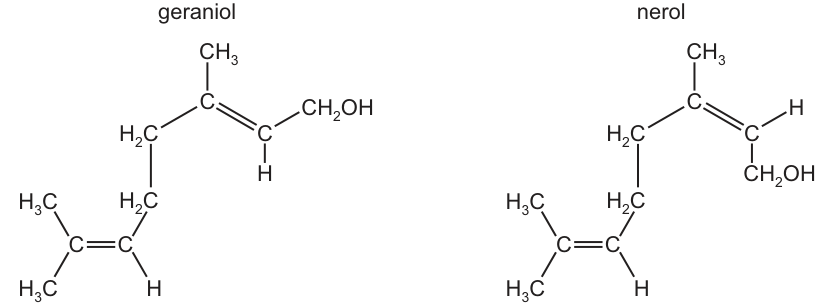
Which type of isomerism is shown here?
Options
A chain
B geometrical (cis / trans)
C optical
D positional
Working
Both geraniol and nerol have the same molecular formula () and the same connectivity of atoms (same functional groups in the same positions). Therefore, they are not chain, positional, or functional group isomers.
The difference lies in the arrangement of groups around the double bond near the top right of the structures:
- In geraniol, the group and the main carbon chain are on opposite sides of the double bond (trans or E configuration).
- In nerol, the group and the main carbon chain are on the same side of the double bond (cis or Z configuration).
This type of stereoisomerism, arising from restricted rotation around a bond with different groups attached to each carbon, is geometrical isomerism (cis/trans isomerism).
Answer
B
B
Background Concept
Isomerism is the phenomenon where two or more compounds have the same molecular formula but different arrangements of atoms. Isomers are broadly classified into two categories:
-
Structural (Constitutional) Isomerism: Atoms are connected in a different order. This includes:
- Chain isomerism: Different carbon skeleton arrangements (e.g., butane vs. methylpropane).
- Positional isomerism: Same functional group at different positions on the carbon chain (e.g., propan-1-ol vs. propan-2-ol).
- Functional group isomerism: Different functional groups (e.g., ethanol vs. dimethyl ether).
-
Stereoisomerism: Atoms are connected in the same order but have a different spatial arrangement. This includes:
- Geometrical (cis/trans or E/Z) isomerism: Occurs due to restricted rotation, typically around a double bond. For this to occur, each carbon atom of the double bond must be attached to two different groups.
- Optical isomerism: Occurs when a molecule is non-superimposable on its mirror image, usually due to the presence of a chiral centre (a carbon atom bonded to four different groups).
Understanding the Question
The question provides the structural formulas of two isomers, geraniol and nerol, and asks to identify the specific type of isomerism shown. The options are chain, geometrical (cis/trans), optical, and positional. We must analyze the structures to see how they differ.
Approach
To determine the type of isomerism:
- Verify that the molecular formulas are the same (they are stated to be isomers).
- Check the connectivity of the atoms. If the connectivity differs (e.g., branching or functional group position), it is structural isomerism (chain or positional). If connectivity is identical, proceed to stereoisomerism.
- Look for features that cause stereoisomerism: a double bond with different substituents on each carbon (geometrical) or a chiral carbon (optical).
Step-by-Step Reasoning
- Check connectivity: Both molecules have a 10-carbon chain (actually a branched chain: 3-methyl-6-(hydroxymethyl)octa-2,7-diene derivative structure, specifically 3,7-dimethylocta-2,6-dien-1-ol). The group is at the end of the chain. The double bonds are at the same positions. The connectivity is identical, so it is not chain or positional isomerism. This eliminates options A and D.
- Check for optical isomerism: Optical isomers require a chiral centre ( bonded to 4 different groups). In these acyclic structures, the carbons are either part of double bonds (sp2, planar, not chiral) or are or groups (attached to at least two identical H atoms). There is no chiral centre. This eliminates option C.
- Check for geometrical isomerism: Look at the double bond closer to the functional group (the one at C2-C3 in IUPAC numbering, though drawn at the top right here).
- The left carbon of this double bond is attached to a group and a chain. These are different.
- The right carbon is attached to a atom and a group. These are different.
- Since both carbons of the double bond have two different groups attached, geometrical isomerism is possible.
- In geraniol (left structure), the bulky group and the main chain are on opposite sides of the double bond (trans/E). In nerol (right structure), they are on the same side (cis/Z).
- Therefore, the isomerism is geometrical (cis/trans). This matches option B.
Key Takeaways
- Always check connectivity first to rule out structural isomerism (chain/positional).
- Geometrical isomerism requires restricted rotation (like a bond) AND two different groups on each carbon of the double bond.
- Cis/trans nomenclature is based on the relative positions of similar or high-priority groups across the double bond.
Common Mistakes
- Confusing positional and geometrical isomerism: Positional isomers have the functional group at a different carbon (e.g., butan-1-ol vs butan-2-ol). Here, the is at the same position; only the geometry around the double bond changes.
- Missing the geometrical isomerism condition: Students might see a double bond and assume geometrical isomerism, but it only exists if each carbon of the double bond has two different groups. (e.g., propene, , does not show geometrical isomerism because the first carbon has two H atoms).
- Assuming optical isomerism: Without a chiral centre (a carbon with 4 different substituents), optical isomerism is not possible.
Things to Be Careful About
- Identifying the correct double bond: There are two double bonds in the molecule. The one at the bottom left () has a carbon with two methyl groups (actually, looking at the diagram, it's wait, the bottom left is . The carbon has two methyl groups, so no geometrical isomerism there. The geometrical isomerism is specifically at the other double bond where the groups are different: .
- Terminology: "Geometrical isomerism" is the older term, often used interchangeably with "cis-trans isomerism" at AS level. The more modern IUPAC system uses E/Z, but the question uses "geometrical (cis / trans)".
Which compound has the greatest number of stereoisomers?
Options
A 2-methylhex-2-ene
B 3-methylhex-2-ene
C 4-methylhex-2-ene
D 5-methylhex-2-ene
Working
A 2-methylhex-2-ene: CH3-C(CH3)=CH-CH2-CH2-CH3
- C2 has two identical CH3 groups, so no E/Z isomerism.
- No chiral centre.
- 1 structure.
B 3-methylhex-2-ene: CH3-CH=C(CH3)-CH2-CH2-CH3
- E/Z isomerism possible.
- No chiral centre.
- 2 stereoisomers.
C 4-methylhex-2-ene: CH3-CH=CH-CH(CH3)-CH2-CH3
- E/Z isomerism possible.
- C4 is chiral (attached to H, CH3, CH2CH3 and the alkenyl group).
- 2 × 2 = 4 stereoisomers.
D 5-methylhex-2-ene: CH3-CH=CH-CH2-CH(CH3)-CH3
- E/Z isomerism possible.
- C5 has two identical CH3 groups, so no chiral centre.
- 2 stereoisomers.
Answer
C
C
Background Concept
Stereoisomers are compounds with the same structural formula but different spatial arrangements. Two main types are relevant here:
- E/Z (geometric) isomerism arises when there is restricted rotation around a C=C bond and each carbon of the double bond has two different groups attached.
- Optical isomerism arises when a molecule contains a chiral centre — usually a carbon atom bonded to four different groups.
When both types are possible in the same molecule, the total number of stereoisomers is often the product of the number of E/Z forms and the number of optical forms, provided there is no symmetry that reduces the count.
Understanding the Question
We are asked to identify which of the four isomeric alkenes has the greatest number of stereoisomers. This means we must check each compound for:
- Possible E/Z isomerism around the C=C bond.
- Any chiral centre in the molecule.
Then combine these possibilities to find the total number of stereoisomers.
Approach
- Draw or write the structural formula of each alkene.
- Check the two carbon atoms of the C=C bond: if either has two identical groups, no E/Z isomerism is possible.
- Check every sp3 carbon for a chiral centre: four different groups attached.
- Multiply the number of E/Z forms by the number of optical forms (2^n for n chiral centres, but here only one chiral centre is possible).
Step-by-Step Reasoning
A: 2-methylhex-2-ene
Structure: CH3-C(CH3)=CH-CH2-CH2-CH3
- The C2 carbon of the double bond is attached to two CH3 groups (one from the chain and one as the methyl substituent).
- Since these two groups are identical, no E/Z isomerism is possible.
- No chiral centre exists.
- Total: 1 structure.
B: 3-methylhex-2-ene
Structure: CH3-CH=C(CH3)-CH2-CH2-CH3
- C2 has H and CH3; C3 has CH3 and CH2CH2CH3. These are different, so E/Z isomerism is possible (2 forms).
- No chiral centre.
- Total: 2 stereoisomers.
C: 4-methylhex-2-ene
Structure: CH3-CH=CH-CH(CH3)-CH2-CH3
- C2 has H and CH3; C3 has H and the C4 group. E/Z isomerism is possible (2 forms).
- C4 is attached to H, CH3, CH2CH3 and the alkenyl group — four different groups, so it is chiral.
- Each E/Z form can exist as a pair of enantiomers.
- Total: 2 × 2 = 4 stereoisomers.
D: 5-methylhex-2-ene
Structure: CH3-CH=CH-CH2-CH(CH3)-CH3
- C2 and C3 allow E/Z isomerism (2 forms).
- C5 is attached to H, CH2 (C4), CH3 (substituent) and CH3 (end of chain). Two of these are identical CH3 groups, so C5 is not chiral.
- Total: 2 stereoisomers.
Therefore, compound C has the greatest number of stereoisomers.
Key Takeaways
- To count stereoisomers, always check both E/Z isomerism and chiral centres.
- A carbon of a C=C bond with two identical groups cannot give E/Z isomers.
- A chiral centre must have four different groups attached.
- When both E/Z and optical isomerism occur, multiply the possibilities (unless symmetry reduces the count).
Common Mistakes
- Forgetting to check whether each alkene carbon has two identical groups.
- Assuming every carbon with a branch is chiral, without checking whether two groups are identical.
- Overlooking the possibility of E/Z isomerism in compounds that also have a chiral centre.
Things to Be Careful About
- Draw the full structure rather than relying only on the name.
- In option D, the terminal CH3 and the methyl substituent on C5 are identical, so C5 is not chiral.
- In option A, the two CH3 groups on C2 make E/Z isomerism impossible.
- The correct answer is C, which combines both E/Z and optical isomerism to give four stereoisomers.
Vitamin A contains retinol.
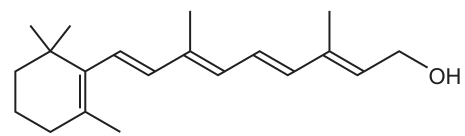
Under appropriate conditions, acidified can be used to break C=C bonds.
After these bonds have been broken, further oxidation of the fragments may occur.
Under which conditions is the acidified used and what do the final oxidation products include?
Options
| conditions | final oxidation products | |
|---|---|---|
| A | cold, dilute | aldehydes and carboxylic acids |
| B | cold, dilute | ketones and carboxylic acids |
| C | hot, concentrated | aldehydes and carboxylic acids |
| D | hot, concentrated | ketones and carboxylic acids |
Working
Cold, dilute acidified oxidises alkenes to 1,2-diols (it does not break the bond). Hot, concentrated acidified cleaves the bond (oxidative cleavage).
When a bond is cleaved by hot, concentrated acidified :
- A carbon with two alkyl groups becomes a ketone.
- A carbon with one alkyl group and one hydrogen becomes a carboxylic acid (any intermediate aldehyde is further oxidised to a carboxylic acid by the strong oxidising agent).
Therefore, the final oxidation products include ketones and carboxylic acids.
Answer
D
D
Background Concept
Potassium manganate(VII) () is a powerful oxidising agent whose behaviour with alkenes depends critically on the reaction conditions:
- Cold, dilute, neutral or alkaline (Baeyer's reagent) adds across the double bond to form a 1,2-diol (glycol). The bond is not broken.
- Hot, concentrated, acidified causes oxidative cleavage of the bond, breaking it completely into two fragments.
For oxidative cleavage, the product at each carbon of the original double bond depends on its substitution:
- (two alkyl groups) ketone ()
- (one alkyl group, one hydrogen) carboxylic acid (). The aldehyde () that would initially form is immediately oxidised further by the hot, concentrated acidified .
- (two hydrogens, terminal alkene) carbon dioxide ()
Understanding the Question
The question provides the skeletal structure of retinol (Vitamin A), which contains a cyclohexene ring and a polyene chain with multiple bonds. It asks for:
- The conditions under which acidified breaks bonds.
- The final oxidation products after these bonds are broken and any further oxidation occurs.
Approach
First, eliminate the wrong conditions: cold, dilute does not break bonds, so options A and B are incorrect. This leaves hot, concentrated conditions (C and D).
Second, determine the final products. Hot, concentrated acidified is a strong oxidising agent. Any aldehyde formed during cleavage will be oxidised to a carboxylic acid. Therefore, aldehydes cannot be final products. The products will be ketones (from trisubstituted/tetrasubstituted carbons) and carboxylic acids (from disubstituted carbons with at least one H). This points to option D.
Step-by-Step Reasoning
-
Conditions for bond cleavage: Cold, dilute performs syn-dihydroxylation, yielding a diol. To break the bond entirely, we need oxidative cleavage, which requires hot, concentrated acidified . This eliminates options A and B.
-
Predicting cleavage products in retinol: Retinol contains trisubstituted and disubstituted double bonds (e.g., the ring double bond is trisubstituted: ). Cleavage of yields a ketone () and a carboxylic acid ().
-
Final oxidation state: Because the reagent is hot, concentrated, and acidified, it is a very strong oxidising agent. If an aldehyde () were to form (from a group), it would be further oxidised to a carboxylic acid (). Thus, aldehydes are not final products. This eliminates option C.
-
Conclusion: The conditions are hot and concentrated, and the final products include ketones and carboxylic acids. Option D is correct.
Key Takeaways
- Cold, dilute gives diols; hot, concentrated acidified cleaves bonds.
- Aldehydes are intermediates in oxidative cleavage with hot concentrated and are not final products; they are oxidised to carboxylic acids.
- Trisubstituted alkene carbons () yield ketones upon cleavage.
Common Mistakes
- Choosing cold, dilute conditions: This is a common error if students confuse dihydroxylation with oxidative cleavage. Cold dilute does not break the bond.
- Selecting aldehydes as final products: Students often forget that hot concentrated acidified is a strong oxidising agent and will oxidise aldehydes further to carboxylic acids. Aldehydes are only the final products if a milder reagent like ozonolysis with a reducing workup (e.g., or ) is used.
- Confusing with : While both are oxidising agents, the specific conditions and alkene cleavage behaviour are distinct to in this context.
Things to Be Careful About
- Always check the conditions (cold/dilute vs. hot/concentrated/acidified) when dealing with and alkenes.
- Remember that aldehydes are not stable under hot, concentrated, acidified oxidising conditions; they will always be oxidised to carboxylic acids in this context.
- Pay attention to the substitution of each carbon in the bond to correctly predict whether a ketone or carboxylic acid (or ) will form.
The structure of limonene is shown.
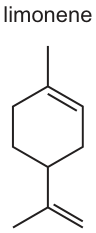
What are the number of moles of carbon dioxide and water produced when a sample of limonene is completely combusted in oxygen?
Options
| number of moles of carbon dioxide | number of moles of water | |
|---|---|---|
| A | 4 | 3 |
| B | 5 | 4 |
| C | 5 | 8 |
| D | 9 | 7 |
Working
The skeletal structure of limonene contains 10 carbon atoms and 16 hydrogen atoms, giving the molecular formula . The empirical formula is .
The balanced equation for the complete combustion of the empirical formula is:
Alternatively, for 1 mole of limonene ():
The ratio of moles of to produced is , which simplifies to . Option B provides this exact ratio (5 moles of and 4 moles of ), corresponding to the combustion of 0.5 moles of limonene or 1 mole of its empirical formula.
Answer
B
B
Background Concept
Complete combustion of a hydrocarbon in excess oxygen produces carbon dioxide and water. The balanced chemical equation is:
Every carbon atom in the hydrocarbon becomes one molecule of , and every two hydrogen atoms become one molecule of . Therefore, the molar ratio of to produced is , which is identical to the ratio derived from the empirical formula of the hydrocarbon.
Understanding the Question
The question asks for the number of moles of and produced when a sample of limonene is completely combusted. An image of the skeletal formula is provided. The options give pairs of numbers for and . Since the question does not specify the amount of limonene (e.g., 1 mole), the options must represent the stoichiometric ratio of the products, or the values for a specific sub-molar amount like the empirical formula.
Approach
- Count the carbon and hydrogen atoms in the skeletal structure to determine the molecular formula.
- Write the balanced combustion equation for the molecular formula (or simplify to the empirical formula).
- Compare the resulting molar ratio of to with the given options.
Step-by-Step Reasoning
Step 1: Determine the molecular formula from the skeletal structure.
- The main ring is a cyclohexene ring (6 carbons).
- There is a methyl group () attached to one of the double-bonded carbons (1 carbon).
- There is an isopropenyl group () attached to the ring (3 carbons).
- Total carbon atoms = .
- Counting the hydrogens: the ring carbons have hydrogens. The methyl group has 3 hydrogens. The isopropenyl group has hydrogens. Total hydrogen atoms = .
- Molecular formula: .
Step 2: Write the combustion equation.
- For 1 mole of :
- This produces 10 moles of and 8 moles of .
Step 3: Match with the options.
- The ratio of to is , which simplifies to .
- Looking at the options, only Option B ( and ) matches this ratio. This corresponds to the combustion of moles of limonene, or equivalently, the combustion of 1 mole of its empirical formula :
- Options A, C, and D do not match the ratio and are therefore incorrect.
Key Takeaways
- Skeletal structures omit carbon and hydrogen symbols; you must count vertices and line ends for carbons and add hydrogens to satisfy carbon's four bonds.
- The ratio of to in complete combustion depends only on the empirical formula of the hydrocarbon, not the molecular formula.
Common Mistakes
- Miscounting hydrogens in skeletal structures: forgetting that vertices and ends of lines represent carbon atoms, and that hydrogens are implied to complete four bonds per carbon.
- Assuming the question requires exactly 1 mole of the molecular formula and rejecting the correct option because is not explicitly listed, without realising it simplifies to .
Things to Be Careful About
- Always check if the given options represent a simplified ratio or a specific molar amount. In combustion questions where the sample mass/moles isn't given, look for the simplest integer ratio of products.
- Ensure the skeletal formula is read correctly: double bonds reduce the number of hydrogens on those carbons by one each.
The reaction of chlorine with methane is carried out in the presence of light.
What is the function of the light?
Options
A to break the C–H bonds in methane
B to break the chlorine molecules into atoms
C to break the chlorine molecules into ions
D to heat the mixture
Working
The reaction of chlorine with methane is a free-radical substitution. In the initiation step, light provides the energy for homolytic fission of the bond, producing two chlorine radicals (atoms), . It does not break bonds (those are broken in the propagation steps) and it does not form ions (fission is homolytic, not heterolytic).
Answer
B
B
Background Concept
The reaction of chlorine with methane in the presence of ultraviolet light is a free-radical substitution. It proceeds in three stages: initiation, propagation, and termination. In the initiation step, UV light supplies the energy required to break the covalent bond homolytically, meaning each chlorine atom retains one of the shared electrons. This produces two chlorine radicals, , which are highly reactive species each carrying an unpaired electron. The light does not break the bonds in methane; those are broken during the propagation steps when a chlorine radical abstracts a hydrogen atom. Because the fission is homolytic, ions are not formed at any stage.
Understanding the Question
The question asks for the specific role of light in the chlorination of methane. This is a recall question about the initiation step of the free-radical substitution mechanism. The key point is that light supplies the activation energy for the homolytic fission of the chlorine molecule, and nothing else.
Approach
Recall the three stages of free-radical substitution: initiation (light breaks into two radicals), propagation ( abstracts an H atom from , then the resulting reacts with ), and termination (radical–radical combination). The light acts only in the initiation step, breaking the bond.
Step-by-Step Reasoning
- The reaction is photochemical: it requires light.
- Light of suitable wavelength provides the energy to break the bond: . This is homolytic fission because each chlorine atom takes one electron from the shared pair.
- Chlorine radicals are the reactive chain carriers that initiate the mechanism.
- Option A is wrong: the bonds are not broken by light; they are broken in the propagation step when abstracts a hydrogen atom.
- Option C is wrong: the fission is homolytic (giving radicals), not heterolytic (giving ions). Ions play no part in this mechanism.
- Option D is wrong: light does not merely heat the mixture; it delivers discrete quanta of energy that break a specific bond.
Key Takeaways
- Free-radical substitution has three stages: initiation, propagation, termination.
- Homolytic fission produces radicals; heterolytic fission produces ions.
- Light is required only for the initiation step.
Common Mistakes
- Choosing A: thinking light breaks bonds. In fact, a chlorine radical breaks the bond during propagation.
- Choosing C: confusing homolytic and heterolytic fission. Light causes homolytic fission, producing atoms (radicals), not ions.
- Choosing D: thinking light merely heats the mixture, when its role is to supply the energy for bond breaking.
Things to Be Careful About
- The "atoms" in option B are chlorine radicals (), uncharged atoms with an unpaired electron.
- The initiation step requires UV light; the reaction does not proceed in the dark at room temperature.
When X is added to and heated under reflux, pentan-2-ol is made.
Which organic product is made when X is heated with a solution of KCN dissolved in ethanol?

Options
A A
B B
C C
D D
Working
Step 1: Identify X
Pentan-2-ol is . Hydrolysis of a halogenoalkane with under reflux replaces the halogen with . Therefore X is 2-halopentane: (a secondary halogenoalkane).
Step 2: Reaction with KCN in ethanol
Heating a halogenoalkane with dissolved in ethanol causes nucleophilic substitution: replaces the halogen. The attacks C2 (the carbon bearing the halogen), giving:
Step 3: Name the product
The carbon is C1. The longest chain containing C1 has 6 carbons:
Main chain: 6 carbons → hexanenitrile. Methyl group on C2 → 2-methylhexanenitrile.
This matches structure D.
Answer
D
D
Background Concept
Halogenoalkanes undergo two main types of reaction with nucleophiles, depending on the conditions:
- , heated under reflux: Nucleophilic substitution where replaces the halogen, producing an alcohol. The aqueous solvent favours substitution over elimination.
- dissolved in ethanol, heated: Nucleophilic substitution where replaces the halogen, producing a nitrile. The ethanolic solvent and the strong nucleophile drive this reaction.
In both cases, the nucleophile attacks the carbon atom bonded to the halogen (the electrophilic carbon). For a secondary halogenoalkane like 2-halopentane, the mechanism is predominantly (backside attack), but the key point for this question is that the replaces the halogen at the same carbon atom.
Naming nitriles: the carbon of the group is always designated as C1. The main chain must include this carbon. Substituents are numbered from C1.
Understanding the Question
We are given two pieces of information:
- X + , reflux → pentan-2-ol
- X + in ethanol, heat → ? (one of A, B, C, D)
We must deduce the structure of X from the first reaction, then predict the product of the second reaction, and identify which option matches.
Pentan-2-ol has the structure — a 5-carbon chain with the group on carbon 2.
Approach
- Deduce X: Since hydrolysis of X with aqueous NaOH gives pentan-2-ol, X must be the halogenoalkane with the halogen on carbon 2 of a pentane chain — i.e., 2-halopentane ().
- Predict the KCN product: Replace the halogen on C2 with , giving .
- Name and match: Count the longest chain including the carbon (6 carbons = hexanenitrile), identify the methyl branch on C2 → 2-methylhexanenitrile. Match to option D.
Step-by-Step Reasoning
Step 1 — Identify X:
The reaction is a nucleophilic substitution. The replaces the halogen at the same carbon. Since the product is pentan-2-ol (), the halogen must be on carbon 2 of a pentane chain. Therefore:
This is a secondary halogenoalkane.
Step 2 — Predict the product with KCN/ethanol:
in ethanol provides , a good nucleophile. It attacks the electrophilic carbon (C2, bearing the halogen) and displaces the halide ion:
The product is .
Step 3 — Name the nitrile:
Draw the structure with the carbon as C1:
Wait — let me recount. The chain from C1 through C5 is only 5 carbons. But there is also the branch on C2. The longest continuous chain that includes C1 (the carbon) is:
C1() — C2() — C3() — C4() — C5()
That's 5 carbons. But the on C2 is also a carbon. The longest chain including C1 is actually:
(branch) — C2 — C3 — C4 — C5 = 5 carbons, plus C1 = 6 carbons total.
Let me re-number properly. The main chain must be the longest carbon chain that includes the carbon:
Main chain: 6 carbons → hexanenitrile
Substituent: methyl group on C2 → 2-methyl
Full name: 2-methylhexanenitrile
This matches structure D in Fig. 32.
Why not the other options?
- A (hexanenitrile): This would come from 1-halopentane (), which gives pentan-1-ol on hydrolysis, not pentan-2-ol.
- B (2-methylpentanenitrile): This has only 6 carbons total but with a different branching pattern. It would come from a different halogenoalkane (e.g., 2-halo-3-methylbutane or similar).
- C (heptanenitrile): This is a straight 7-carbon nitrile, which would come from 1-halohexane. Wrong carbon count and wrong branching.
Key Takeaways
- Aqueous NaOH + reflux on a halogenoalkane → alcohol (substitution). The position of the tells you where the halogen was.
- KCN in ethanol + heat on a halogenoalkane → nitrile (substitution). The replaces the halogen at the same carbon.
- When naming nitriles, the carbon is always C1, and the main chain must include it. This often adds one carbon to the apparent chain length of the original halogenoalkane.
- Always count the total number of carbons carefully — the carbon counts as part of the main chain.
Common Mistakes
- Forgetting that the CN carbon is C1: Students often name the product as if the group is a substituent on the original pentane chain, giving "2-cyanopentane" instead of the correct IUPAC name. The carbon is always C1 in nitrile nomenclature.
- Miscounting the chain length: The product has 6 carbons in the main chain (not 5), because the carbon adds one. Calling it "2-methylpentanenitrile" (option B) is wrong — that would have only 5 carbons in the main chain plus a methyl, but the structure doesn't match.
- Confusing the conditions: Using in ethanol (which gives elimination to an alkene) instead of (which gives substitution to an alcohol). The question clearly states aqueous NaOH with reflux.
- Assuming the product has the same number of carbons as the starting material: The adds a carbon, so the nitrile product has one more carbon than the halogenoalkane reactant.
Things to Be Careful About
- State symbols and conditions matter: vs in ethanol give completely different products (alcohol vs alkene). Always note the solvent.
- Nitrile naming: The carbon in is C1. Draw out the full structure and count the longest chain including this carbon before naming.
- Secondary halogenoalkanes: 2-halopentane is secondary, so both and can operate, but the regiochemistry (where the nucleophile attacks) is the same — at the carbon bearing the halogen.
- Image reading: Carefully match the skeletal structures in Fig. 32 to the names. Option D shows a branched nitrile with the on a carbon that has a methyl branch and a butyl chain — this is 2-methylhexanenitrile.
1-chlorobutane and 1-iodobutane both react with aqueous sodium hydroxide by a nucleophilic substitution mechanism.
Which reaction has the greatest rate under the same conditions and which mechanism is followed by this reaction?
Options
| greatest rate | mechanism | |
|---|---|---|
| A | 1-chlorobutane | |
| B | 1-chlorobutane | |
| C | 1-iodobutane | |
| D | 1-iodobutane |
Working
1-Iodobutane reacts faster than 1-chlorobutane because the C–I bond is weaker than the C–Cl bond, so iodide is the better leaving group.
Both 1-chlorobutane and 1-iodobutane are primary halogenoalkanes, so the mechanism is (no stable carbocation intermediate is formed).
Answer
D
D
Background Concept
Nucleophilic substitution is the reaction in which a nucleophile (here ) attacks the carbon atom bearing the halogen and displaces the halide ion. Two limiting mechanisms exist.
- (substitution, nucleophilic, unimolecular): two steps. The halogen leaves first, forming a carbocation, then the nucleophile attacks. The rate depends only on the concentration of the halogenoalkane. This mechanism is favoured by tertiary halogenoalkanes because they form relatively stable tertiary carbocations.
- (substitution, nucleophilic, bimolecular): one step. The nucleophile attacks the carbon from the back while the halide leaves from the front (a concerted process). The rate depends on the concentrations of both the halogenoalkane and the nucleophile. This mechanism is favoured by primary halogenoalkanes because a primary carbocation would be far too unstable to form.
The rate of either mechanism also depends on how easily the halide ion leaves, i.e. on the leaving group ability. A better leaving group is one that departs more readily: the weaker the carbon–halogen bond and the more stable the resulting halide ion in solution, the faster the substitution.
Understanding the Question
Two primary halogenoalkanes, 1-chlorobutane and 1-iodobutane, both react with aqueous sodium hydroxide by nucleophilic substitution. The question asks two things at once: which compound has the greater rate under the same conditions, and which mechanism that faster reaction follows. The four options pair each compound with either or , so you must get both halves right to select the correct letter.
Approach
There are two independent deductions to make.
- Which halogenoalkane reacts faster? Compare the carbon–halogen bond strengths and the stability of the leaving halide ions. The weaker the bond and the more stable the leaving ion, the faster the reaction.
- Which mechanism is followed? Look at the structure of the halogenoalkane. Both are primary (the halogen is attached to a terminal carbon), so neither can form a stable carbocation; both react by .
Combining these gives the answer directly.
Step-by-Step Reasoning
Step 1 — Compare leaving group ability.
For the reaction to occur, the halide must leave as . The ease of this departure is governed by the strength of the C–X bond and the stability of the halide ion.
- The C–I bond is weaker than the C–Cl bond (bond enthalpy of C–I is roughly 228 kJ mol versus about 338 kJ mol for C–Cl).
- Iodide, , is a larger ion than chloride, , so its negative charge is spread over a greater volume and it is better stabilised in aqueous solution.
Both factors mean iodide is a better leaving group than chloride. Consequently, 1-iodobutane reacts faster than 1-chlorobutane under identical conditions. This eliminates options A and B.
Step 2 — Identify the mechanism.
1-iodobutane is a primary halogenoalkane. An mechanism would require the formation of a primary carbocation, , which is very unstable and is not formed under these conditions. Primary halogenoalkanes therefore react by the one-step mechanism, in which attacks the carbon simultaneously with the departure of . This eliminates option C.
Step 3 — Select the answer.
The fastest reaction is that of 1-iodobutane, and it follows . The correct option is D.
Why the distractors are wrong:
- A and B pair the slower reactant (1-chlorobutane) with each mechanism — chloride is a worse leaving group, so these are wrong on the first criterion.
- C correctly identifies 1-iodobutane as faster but wrongly assigns ; a primary halogenoalkane cannot form the required primary carbocation.
Key Takeaways
- Leaving group ability increases down Group 17: , because the C–X bond weakens and the halide ion becomes more stable as the atom gets larger.
- The mechanism of nucleophilic substitution is determined by the structure of the halogenoalkane: primary → , tertiary → , secondary → can follow either.
- When comparing rates of substitution of halogenoalkanes, always consider the leaving group ability (bond strength and ion stability) as well as the substrate structure.
Common Mistakes
- Thinking fluorine-containing compounds react fastest. Fluoride is actually the worst leaving group because the C–F bond is the strongest and is a small, poorly stabilised ion. Iodide is the best leaving group.
- Assigning to primary halogenoalkanes. A primary carbocation is too unstable to form, so primary halogenoalkanes react by . Only tertiary (and some secondary) halogenoalkanes follow .
- Confusing the two criteria. The question asks for the mechanism of the fastest reaction. Even if a student correctly identifies 1-iodobutane as faster, choosing loses the mark.
Things to Be Careful About
- Both compounds are primary, so the mechanism is the same (); the only difference between them is the leaving group, which controls the rate.
- The mechanism is a property of the substrate structure, not of the halogen identity. Replacing Cl with I changes the rate but not the mechanism for a given primary substrate.
- In the exam, read the options as a pair: you need the correct compound and the correct mechanism together.
Compound Y reacts with alkaline . When the products of this reaction are acidified, a dicarboxylic acid is produced. The formula of the dicarboxylic acid is where R consists of one or more groups.
Which compound is Y?
Options
A pentan-1,4-diol
B pentan-1,5-diol
C pentan-2,3-diol
D pentan-2,4-diol
Working
The iodoform reaction (alkaline ) occurs with groups. Each such group is oxidised and cleaved to give and a carboxylate ().
For a dicarboxylic acid to be produced, Y must have groups at both ends.
Pentan-2,4-diol:
- Both ends are groups.
- Each undergoes the iodoform reaction to give a carboxylate.
- After acidification: (R = ).
Answer
D (pentan-2,4-diol)
D
Background Concept
The iodoform (tri-iodomethane) reaction is a characteristic test for the group (methyl ketones) and groups (secondary alcohols with a methyl group attached to the carbon bearing the OH). When a compound containing such a group is treated with alkaline iodine ( in NaOH), the group is oxidised and cleaved, producing yellow iodoform () and a carboxylate salt. Upon acidification, the carboxylate becomes a carboxylic acid.
The reaction for a group:
The carbon–carbon bond between the and the CO is broken, and the carbon that was attached to the becomes a carboxylate carbon.
Understanding the Question
The question asks us to identify which pentanediol, when treated with alkaline , produces a dicarboxylic acid after acidification. The key is that each group in the molecule will undergo the iodoform reaction, converting that end of the molecule into a carboxylate group.
For the product to be a dicarboxylic acid, BOTH ends of the diol must be groups, so that both ends are converted to COOH groups. The central groups remain as the R part.
Approach
- Recall the iodoform reaction and which groups it affects.
- Examine each option to see which ends of the molecule are groups.
- Determine which diol has groups at both ends.
Step-by-Step Reasoning
Option A: pentan-1,4-diol =
- One end is (C4–C5), which undergoes iodoform → .
- The other end is (C1), a primary alcohol. Under the mild iodoform conditions, this is oxidised to an aldehyde (CHO), not a carboxylic acid.
- Product: — not a dicarboxylic acid. ✗
Option B: pentan-1,5-diol =
- No group present. No iodoform reaction occurs. ✗
Option C: pentan-2,3-diol =
- C2 has , which undergoes iodoform → .
- C3 has . This is a secondary alcohol, oxidised to a ketone ( at C3). But this ketone is not a methyl ketone (the CO is attached to on one side and on the other), so no further iodoform cleavage.
- Product: — not a dicarboxylic acid. ✗
Option D: pentan-2,4-diol =
- Both ends are groups (C2 and C4).
- Each undergoes iodoform → .
- The central (C3) remains.
- After acidification: — a dicarboxylic acid with R = . ✓
Key Takeaways
- The iodoform reaction cleaves the C–C bond between and CO in a group (or which is first oxidised to ).
- A group is converted to a carboxylate (then carboxylic acid on acidification).
- For a diol to give a dicarboxylic acid via the iodoform reaction, both ends must be groups.
Common Mistakes
- Thinking that a primary alcohol end () is oxidised to a carboxylic acid under iodoform conditions — it's only oxidised to an aldehyde under these mild conditions.
- Not recognising that C3 in pentan-2,3-diol gives a ketone that is NOT a methyl ketone, so no second iodoform cleavage occurs.
- Forgetting that the iodoform reaction requires a or group specifically — a general secondary alcohol ( where R and R′ are not H or ) does not undergo the reaction.
Things to Be Careful About
- The iodoform test is specific: only and groups react.
- After the reaction, the product must be acidified to convert carboxylate salts to carboxylic acids.
- The R group in must be one or more groups — pentan-2,4-diol gives R = , which satisfies this.
Which alcohol gives only one possible oxidation product when warmed with dilute acidified potassium dichromate(VI)?
Options
A butan-1-ol
B butan-2-ol
C 2-methylpropan-1-ol
D 2-methylpropan-2-ol
Working
Butan-2-ol is a secondary alcohol. Oxidation of a secondary alcohol with acidified potassium dichromate(VI) gives a single ketone, butan-2-one.
- A butan-1-ol (primary) → butanal, then butanoic acid (two possible products)
- B butan-2-ol (secondary) → butan-2-one only
- C 2-methylpropan-1-ol (primary) → 2-methylpropanal, then 2-methylpropanoic acid (two possible products)
- D 2-methylpropan-2-ol (tertiary) → not oxidised by dichromate(VI)
Answer
B — butan-2-ol
B
Background Concept
Alcohols are classified by the number of carbon atoms directly attached to the carbon bearing the –OH group:
- Primary (–CH₂OH): oxidation gives an aldehyde, which can be further oxidised to a carboxylic acid.
- Secondary (–CHOH–): oxidation gives a ketone, which is not further oxidised under these conditions.
- Tertiary (–COH): no hydrogen on the carbon bearing –OH, so it cannot be oxidised by acidified dichromate(VI).
Acidified potassium dichromate(VI) (K₂Cr₂O₇/H₂SO₄) is a common oxidising agent; its colour changes from orange to green when it is reduced.
Understanding the Question
The question asks which alcohol gives only one possible oxidation product. This means the alcohol must be oxidised to exactly one organic product, with no further oxidation possible (or no alternative product).
Approach
- Identify the class of each alcohol (primary, secondary, tertiary).
- Recall what product each class gives on oxidation.
- Check whether more than one product is possible (e.g. a primary alcohol can stop at the aldehyde or go on to the acid).
- Select the alcohol that gives exactly one product.
Step-by-Step Reasoning
- A — butan-1-ol (CH₃CH₂CH₂CH₂OH): primary alcohol. Oxidation first gives butanal, then butanoic acid. Two possible products → not correct.
- B — butan-2-ol (CH₃CH(OH)CH₂CH₃): secondary alcohol. Oxidation gives only butan-2-one (a ketone). Ketones resist further oxidation → exactly one product → correct.
- C — 2-methylpropan-1-ol ((CH₃)₂CHCH₂OH): primary alcohol. Oxidation gives 2-methylpropanal, then 2-methylpropanoic acid. Two possible products → not correct.
- D — 2-methylpropan-2-ol ((CH₃)₃COH): tertiary alcohol. No hydrogen on the carbon bearing –OH, so it is not oxidised by acidified dichromate(VI). It gives no oxidation product → not correct.
Key Takeaways
- Primary alcohols → aldehyde → carboxylic acid (two possible oxidation products).
- Secondary alcohols → ketone (one product).
- Tertiary alcohols → not oxidised by dichromate(VI).
- The question's phrase "only one possible product" points directly at a secondary alcohol.
Common Mistakes
- Confusing butan-1-ol with butan-2-ol — the position of the –OH group determines the class.
- Thinking a tertiary alcohol is oxidised; it is not, because there is no C–H on the alcohol carbon.
- Forgetting that a primary alcohol can give two products (aldehyde and acid).
Things to Be Careful About
- Read the names carefully: "butan-1-ol" vs "butan-2-ol" vs "2-methylpropan-1-ol" vs "2-methylpropan-2-ol".
- The oxidising agent here is acidified dichromate(VI); under gentle distillation a primary alcohol stops at the aldehyde, but under reflux it goes to the acid — either way, two products are possible, so primary alcohols are excluded.
Which compound, on reaction with hydrogen cyanide, produces a compound with a chiral centre?
Options
A
B
C
D
Working
HCN adds across the C=O bond of an aldehyde or ketone to form a hydroxynitrile. The product has a chiral centre only if the carbon that was the carbonyl carbon is bonded to four different groups.
- A : the central carbon is attached to , , and — four different groups, so it is chiral.
- B : two identical ethyl groups, so not chiral.
- C is an ester, not an aldehyde or ketone; HCN does not give a chiral hydroxynitrile here.
- D : the central carbon has two atoms, so not chiral.
Answer
A ()
A
Background Concept
Hydrogen cyanide adds across the carbon–oxygen double bond of an aldehyde or ketone in a nucleophilic addition reaction. The product is a hydroxynitrile (cyanohydrin). For an aldehyde RCHO, the product is RCH(OH)CN; for a ketone R1COR2, the product is R1R2C(OH)CN. The carbonyl carbon changes from trigonal planar sp2 to tetrahedral sp3. A chiral centre is a carbon atom bonded to four different atoms or groups, so a molecule containing one can exist as two enantiomers. The deciding test here is whether the newly formed carbon has four different substituents.
Understanding the Question
The question gives four compounds and asks which one, after reaction with HCN, produces a product with a chiral centre. It is not asking whether the starting material is chiral; the product's newly formed carbon must be checked. Options A and B are an aldehyde and a ketone; C is an ester; D is methanal. For each, we need to identify the HCN addition product and decide whether the carbon that was originally the carbonyl carbon is chiral.
Approach
For each carbonyl compound, write the HCN addition product: the CN group bonds to the carbonyl carbon and the H bonds to the oxygen, giving an –OH group on the same carbon. Then list the four groups on that carbon. If all four are different, the product is chiral. A symmetrical ketone gives two identical groups on the central carbon, so it cannot be chiral. Methanal gives two H atoms, so it cannot be chiral. Esters do not undergo this addition to give a cyanohydrin.
Step-by-Step Reasoning
- Option A: . The former carbonyl carbon is bonded to , , and . These are four different groups, so the product has a chiral centre. This is the correct option.
- Option B: is pentan-3-one, a symmetrical ketone. HCN addition gives . The central carbon is bonded to two identical ethyl groups, so it is not chiral.
- Option C: is methyl ethanoate, an ester. HCN does not add to an ester carbonyl in the same way to give a hydroxynitrile, so no chiral product is formed.
- Option D: . The central carbon is bonded to two H atoms, so it cannot be chiral.
Therefore the correct answer is A.
Key Takeaways
- HCN addition to aldehydes and ketones gives hydroxynitriles and can create a chiral centre.
- To test chirality, check whether the carbon formed from the carbonyl carbon is bonded to four different groups.
- Methanal and symmetrical ketones cannot give a chiral product; aldehydes RCHO with R ≠ H can.
- This reaction is also a useful way to extend a carbon chain by one carbon.
Common Mistakes
- Checking the starting material for chirality instead of the product.
- Assuming every ketone gives a chiral product; symmetrical ketones have two identical groups.
- Forgetting that methanal gives a product with two H atoms on the central carbon.
- Treating an ester as if it undergoes the same HCN addition as an aldehyde or ketone.
- Confusing a chiral centre with any carbon attached to four groups; the groups must all be different.
Things to Be Careful About
- In the product, the –OH and –CN are attached to the same carbon that was the carbonyl carbon.
- HCN is toxic and is usually generated in situ from NaCN/KCN and dilute acid; this is practical context, not needed for the answer.
- The mark scheme rewards the recognition that gives with four different groups.
- If a ketone has two different alkyl groups, its HCN product can be chiral; only symmetrical ketones are excluded by this argument.
The diagram shows three reactions of ethanal. In each case, an excess of ethanal is used.
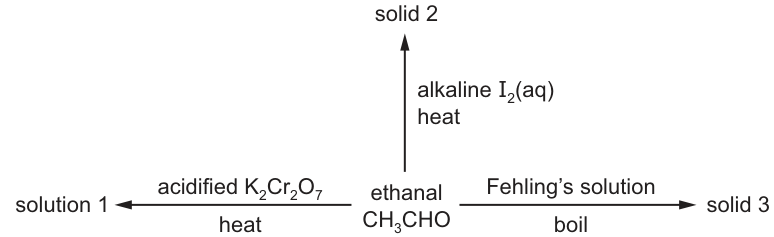
Observations are made after each of the three reactions.
What are the colours of solution 1 and solids 2 and 3?
Options
| solution 1 | solid 2 | solid 3 | |
|---|---|---|---|
| A | green | yellow | silver mirror |
| B | green | yellow | red |
| C | orange | red | silver mirror |
| D | orange | red | red |
Answer
Solution 1 (green): Ethanal is oxidised by warm, acidified potassium dichromate(VI) to ethanoic acid. The orange dichromate(VI) ions () are reduced to green chromium(III) ions ().
Solid 2 (yellow): Ethanal contains a group. Reaction with alkaline iodine produces tri-iodomethane (), which is a pale yellow precipitate (solid).
Solid 3 (red): Ethanal reduces the blue copper(II) ions in Fehling's solution to copper(I) oxide (), which is a red (brick-red) precipitate (solid).
Correct Option: B
B
Background Concept
Aldehydes are characterised by the carbonyl group () at the end of a carbon chain. This structure makes them susceptible to oxidation and gives them specific reactivity patterns that distinguish them from ketones.
- Oxidation: Aldehydes are easily oxidised to carboxylic acids. Common oxidising agents include acidified potassium dichromate(VI) () and Fehling's solution (or Tollens' reagent). Ketones cannot be oxidised under these conditions.
- Tri-iodomethane (Iodoform) Test: Compounds containing a methyl carbonyl group (), which includes ethanal and methyl ketones, react with alkaline iodine () to form tri-iodomethane (), a pale yellow solid.
- Fehling's and Tollens' Tests: These are specific tests for aldehydes. Fehling's solution contains ions (blue) and is reduced to (red precipitate). Tollens' reagent contains ions and is reduced to metallic silver (silver mirror).
Understanding the Question
The question provides a reaction flowchart starting with ethanal () and asks for the colours of the products in three separate reactions:
- Reaction 1: Oxidation with acidified and heat.
- Reaction 2: Reaction with alkaline and heat.
- Reaction 3: Reaction with Fehling's solution and boiling.
We must identify the chemical species formed in each case and their corresponding colours.
Approach
Evaluate each reaction pathway individually based on the functional group present in ethanal ():
- It is an aldehyde, so it will be oxidised by strong oxidising agents (dichromate) and mild oxidising agents (Fehling's).
- It has a group, so it will give a positive iodoform test.
Step-by-Step Reasoning
1. Reaction with acidified (Solution 1)
- Ethanal is oxidised to ethanoic acid ().
- The oxidising agent, dichromate(VI) (), is orange. Upon accepting electrons (being reduced), it forms chromium(III) ions (), which are green.
- Since excess ethanal is used, all the dichromate is reduced.
- Result: Solution 1 is green.
2. Reaction with alkaline (Solid 2)
- Ethanal has the structure , which contains the group required for the tri-iodomethane reaction.
- The reaction produces tri-iodomethane (), commonly known as iodoform.
- Iodoform is a pale yellow solid (precipitate).
- Result: Solid 2 is yellow.
3. Reaction with Fehling's solution (Solid 3)
- Fehling's solution contains hydrated copper(II) ions, , which are blue.
- Aldehydes reduce to copper(I) oxide, , which is an insoluble red (brick-red) solid.
- (Note: If Tollens' reagent were used, the product would be a silver mirror. The question specifies Fehling's solution).
- Result: Solid 3 is red.
Conclusion:
- Solution 1: green
- Solid 2: yellow
- Solid 3: red
- This matches option B.
Key Takeaways
- Aldehydes vs. Ketones: Aldehydes are reducing agents; ketones are not. This is the basis for Fehling's and Tollens' tests.
- Methyl Carbonyls: The group gives a positive iodoform test (yellow precipitate). Ethanal is the only aldehyde that gives this test.
- Colour Changes: Memorise the colours of key reagents and products: orange green ; blue (Fehling's) red ; pale yellow .
Common Mistakes
- Confusing Fehling's and Tollens' reagents: Students often mix up the products. Fehling's gives a red precipitate (); Tollens' gives a silver mirror ().
- Forgetting the iodoform test conditions: The reagent is alkaline iodine (), not just iodine. The product is , a yellow solid, not a solution.
- Ignoring the 'excess' ethanal: If dichromate were in excess, the solution might remain orange or turn a mixture of colours. With excess ethanal, all dichromate is reduced to green .
Things to Be Careful About
- State symbols and phases: Solid 2 and Solid 3 are precipitates (solids). Solution 1 is a liquid mixture.
- Specific reagents: Ensure you read "Fehling's solution" and not "Tollens' reagent". They look similar in flowcharts but produce different products (red solid vs. silver mirror).
- Ethanal specificity: Ethanal is unique among aldehydes in giving the iodoform test because it is the only one with a group. Higher aldehydes (propanal, butanal) do not give this test.
reacts to form alcohol Y via the reaction sequence shown.

Which row names the molecule X and the class of alcohol Y?
Options
| name of molecule X | class of alcohol Y | |
|---|---|---|
| A | 2,2-dimethylbutanoic acid | primary |
| B | 3,3-dimethylbutanoic acid | tertiary |
| C | dimethylpropanoic acid | primary |
| D | dimethylpropanoic acid | tertiary |
Working
Reaction 1: Hydrolysis of the nitrile
Starting material: (2,2-dimethylpropanenitrile).
Acid hydrolysis of a nitrile () with produces a carboxylic acid ().
The molecule X is .
Name: The longest carbon chain containing the carboxyl group has 3 carbons (propanoic acid). There are two methyl groups on carbon-2. Thus, X is 2,2-dimethylpropanoic acid (often referred to as dimethylpropanoic acid in simplified naming).
Reaction 2: Reduction of the carboxylic acid
Reagent: (lithium aluminium hydride) is a strong reducing agent.
It reduces carboxylic acids to primary alcohols.
The molecule Y is (2,2-dimethylpropan-1-ol).
In Y, the carbon atom bonded to the group is attached to only one other carbon atom (the central quaternary carbon). Therefore, Y is a primary alcohol.
Matching the options:
- Name of X: dimethylpropanoic acid (2,2-dimethylpropanoic acid)
- Class of alcohol Y: primary
This corresponds to row C.
Answer
C
C
Background Concept
Hydrolysis of Nitriles:
Nitriles () contain a carbon-nitrogen triple bond. Under acidic conditions (e.g., dilute or with heat), nitriles are hydrolysed first to amides and then to carboxylic acids () and ammonium ions (). This reaction increases the carbon chain length by one atom (the nitrile carbon becomes the carboxyl carbon).
Reduction of Carboxylic Acids:
Carboxylic acids are resistant to mild reducing agents like . However, strong reducing agents such as lithium aluminium hydride () in dry ether, followed by acid workup, reduce carboxylic acids all the way to primary alcohols (). The carbonyl group () is reduced to a methylene group () bearing a hydroxyl group.
Classification of Alcohols:
Alcohols are classified based on the number of carbon atoms attached to the carbon bearing the hydroxyl () group:
- Primary (1°): The carbon is attached to 1 other carbon (or 0 in the case of methanol).
- Secondary (2°): The carbon is attached to 2 other carbons.
- Tertiary (3°): The carbon is attached to 3 other carbons.
Understanding the Question
The question presents a two-step reaction sequence starting from .
- Reaction 1: Acidic hydrolysis () converts the nitrile into molecule X.
- Reaction 2: Reduction with converts X into alcohol Y.
The task is to identify the name of X and the class of alcohol Y from the given options.
Approach
- Analyze the starting material: . Draw out the structure to visualize the carbon skeleton. It is a central carbon bonded to three methyl groups and a cyano group ().
- Determine X: Apply the hydrolysis reaction. The group becomes . Name the resulting carboxylic acid using IUPAC rules.
- Determine Y: Apply the reduction reaction. reduces to . Draw the structure of Y.
- Classify Y: Look at the carbon attached to the group in Y and count the attached carbons to determine if it is primary, secondary, or tertiary.
- Select the correct option: Match the findings with the table rows.
Step-by-Step Reasoning
Step 1: Structure of the starting nitrile
The formula can be expanded as:
This is 2,2-dimethylpropanenitrile. The longest chain containing the nitrile carbon has 3 carbons (propanenitrile). Carbon-1 is the nitrile carbon. Carbon-2 has two methyl substituents.
Step 2: Reaction 1 - Hydrolysis to form X
Reagent: (acid hydrolysis).
Reaction: .
The group is replaced by .
Structure of X: .
Naming X: Longest chain containing is 3 carbons (propanoic acid). Numbering starts at the carboxyl carbon (C1). C2 has two methyl groups. Name: 2,2-dimethylpropanoic acid. (Note: "dimethylpropanoic acid" in the options is a common shorthand for this). Options A and B suggest a butanoic acid chain (4 carbons), which is incorrect because the nitrile carbon is C1 and the central carbon is C2, giving a 3-carbon chain.
Step 3: Reaction 2 - Reduction to form Y
Reagent: (lithium aluminium hydride).
Reaction: Carboxylic acids are reduced to primary alcohols.
.
Structure of Y: .
Name of Y: 2,2-dimethylpropan-1-ol.
Step 4: Classify alcohol Y
Look at the carbon atom bonded to the group (the carbon).
It is bonded to:
- 2 hydrogen atoms
- 1 oxygen atom (in )
- 1 carbon atom (the central quaternary carbon )
Since the hydroxyl-bearing carbon is attached to only one other carbon atom, Y is a primary alcohol.
Step 5: Match with options
- X: dimethylpropanoic acid (2,2-dimethylpropanoic acid)
- Y: primary alcohol
Row C matches these criteria.
Key Takeaways
- Nitriles () hydrolyse to carboxylic acids (), extending the carbon chain by one atom.
- reduces carboxylic acids to primary alcohols ().
- Classifying alcohols depends on the substitution of the carbon bearing the group, not the bulkiness of the rest of the molecule. Even though the rest of the molecule is bulky (tert-butyl group), the alcohol is primary because the is on a group at the end of the chain.
Common Mistakes
- Miscounting the carbon chain: Students might count the central carbon as part of a longer chain or misidentify the nitrile carbon. Remember, the nitrile carbon is C1. So is a 3-carbon chain (propane derivative), not 4 (butane). This eliminates options A and B immediately.
- Confusing reduction products: Thinking reduces carboxylic acids to aldehydes or secondary alcohols. It reduces them fully to primary alcohols.
- Misclassifying the alcohol: Seeing the bulky group and assuming the alcohol is tertiary. The classification depends only on the carbon attached to the . Here, that carbon is a , attached to one C, so it's primary. A tertiary alcohol would have the on a carbon attached to three other carbons (e.g., ).
Things to Be Careful About
- Nomenclature: IUPAC naming requires identifying the longest chain containing the principal functional group. For , the chain is 3 carbons long (propanoic acid), not 4. The methyls are substituents on C2.
- Reagent specificity: cannot reduce carboxylic acids; only strong reducers like can. This is a key distinction in organic synthesis.
- Structure drawing: Drawing out the full structure of helps avoid errors in counting carbons and determining substitution patterns. Condensed formulas can be misleading if not expanded.
The diagram shows a section of an addition polymer. The polymer is made using two different monomers.
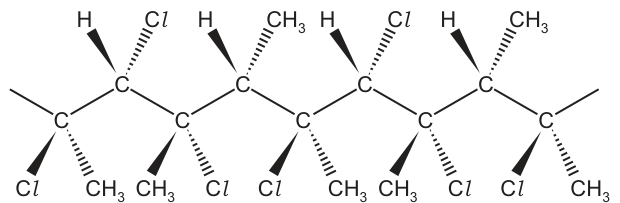
What are the names of the two monomers needed to make this polymer?
Options
A 1,2-dichloropropene and 2-chlorobut-2-ene
B 2,3-dichlorobut-2-ene and chloropropene
C 1,2-dichloropropene and chloroethene
D chloropropene and 2-chlorobut-2-ene
Working
To identify the monomers, divide the polymer backbone into repeating units of two carbon atoms each (the two carbons that were originally part of the C=C double bond in each monomer).
- Unit 1: One backbone carbon is bonded to and ; the other is bonded to and . Closing the backbone C–C bond back into a C=C double bond gives the monomer , which is named 1,2-dichloropropene.
- Unit 2: One backbone carbon is bonded to two groups; the other is bonded to and . Closing the bond gives the monomer , which is named 2-chlorobut-2-ene.
The two monomers required are 1,2-dichloropropene and 2-chlorobut-2-ene.
Answer
A
A
Background Concept
Addition polymers are formed when monomers containing a carbon–carbon double bond (C=C) react together. The -bond breaks, and the monomers link via new C–C -bonds to form a long chain. A key feature of addition polymerisation is that the repeating unit of the polymer always contains exactly two carbon atoms from each monomer. To deduce the original monomer from a polymer structure, you can mentally isolate pairs of adjacent backbone carbons, remove the bonds connecting them to neighbouring repeating units, and restore the C=C double bond between the pair. The substituents attached to those two carbons in the polymer are exactly the same as those attached to the double-bonded carbons in the monomer.
Understanding the Question
The question provides a diagram of a section of an addition polymer and asks for the names of the two different monomers used to make it. The polymer backbone is a chain of carbon atoms, each bearing various substituents (, , ) shown with wedge and dash bonds to indicate 3D stereochemistry. The task is to split the backbone into two-carbon repeating units, deduce the alkene structure for each, and name them using IUPAC nomenclature.
Approach
- Scan the backbone from left to right and group the carbons into pairs of two. Each pair represents one monomer unit.
- For each pair, identify the four substituents attached to the two backbone carbons.
- Mentally remove the bonds linking the pair to the rest of the chain and form a C=C double bond between the two carbons.
- Write the structural formula of the resulting alkene and apply IUPAC naming rules (longest chain containing the double bond, lowest locants for the double bond and substituents).
- Match the derived names with the given options.
Step-by-Step Reasoning
Pair 1 (leftmost):
- Left carbon: bonded to (wedge) and (dash).
- Right carbon: bonded to (wedge) and (dash).
- Monomer structure: .
- Naming: The longest chain containing the C=C bond has 3 carbons (propene). Numbering from the right gives the double bond locant 1 and chlorine atoms at positions 1 and 2. Name: 1,2-dichloropropene.
Pair 2:
- Left carbon: bonded to (wedge) and (dash).
- Right carbon: bonded to (wedge) and (dash).
- Monomer structure: .
- Naming: The longest chain containing the C=C bond has 4 carbons (butene). Numbering from the right gives the double bond locant 2 and a chlorine at position 2. Name: 2-chlorobut-2-ene.
Pairs 3 and 4:
- These pairs show the same substituent combinations as Pairs 2 and 1 respectively, but in reverse order along the backbone. This is expected in addition polymers where monomers can add in alternating orientations (head-to-tail or tail-to-head). They do not introduce new monomers.
The two distinct monomers are 1,2-dichloropropene and 2-chlorobut-2-ene, which corresponds to option A.
Key Takeaways
- Addition polymer repeating units always contain two backbone carbons derived from the original C=C double bond.
- To find the monomer, isolate pairs of backbone carbons, remove inter-unit bonds, and restore the double bond.
- IUPAC naming of the deduced alkene must prioritise the lowest locants for the double bond, then for substituents.
Common Mistakes
- Counting repeating units incorrectly: Grouping three or four backbone carbons as one unit, which leads to incorrect monomer structures.
- Ignoring substituents: Failing to notice the groups or misreading wedge/dash bonds as part of the backbone rather than substituents.
- Wrong numbering in nomenclature: Numbering the alkene chain from the wrong end, e.g., calling "3-chlorobut-2-ene" instead of "2-chlorobut-2-ene".
Things to Be Careful About
- The wedge and dash bonds indicate stereochemistry (3D arrangement) but do not change the connectivity or the identity of the monomer. Ignore them when deducing the alkene structure; focus only on which atoms are attached to which backbone carbon.
- Ensure state symbols and formal charges are not needed here, but do ensure your IUPAC names use correct punctuation (commas between numbers, hyphens between numbers and letters).
- Option C (chloroethene) would only produce a polymer with and on alternating carbons and no groups, which contradicts the diagram.
The diagram shows the mass spectrum of a sample of chlorine. Peaks V, W, X, Y and Z are labelled.
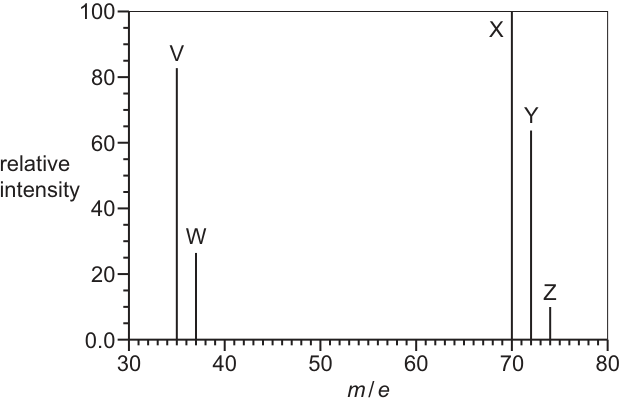
Which statements about this spectrum are correct?
1 The relative atomic mass of chlorine can be calculated from the abundances and values of 2 of the 5 peaks.
2 of the species responsible for peak Z contains molecules.
3 The relative molecular mass of chlorine can be calculated from the abundances and values of peaks X, Y and Z.
Options
A 1, 2 and 3
B 1 and 2 only
C 1 and 3 only
D 2 and 3 only
Working
Statement 1: Chlorine has two isotopes, and . Peaks V () and W () correspond to the atomic ions and . The relative atomic mass is the weighted average of these isotopic masses, so it can be calculated using the abundances and values of just these two peaks. Statement 1 is correct.
Statement 2: Peak Z is at , which corresponds to the molecular ion . The species responsible is the molecule, which has a molar mass of .
Statement 2 is correct.
Statement 3: Chlorine gas exists as diatomic molecules. The possible molecular ions are (, peak X), (, peak Y), and (, peak Z). The relative molecular mass of chlorine gas is the weighted average of these molecular masses, which can be calculated using the abundances and values of peaks X, Y, and Z. Statement 3 is correct.
Since statements 1, 2, and 3 are all correct, the answer is A.
Answer
A
A
Background Concept
Mass spectrometry measures the mass-to-charge ratio () of ions. For elements that exist as diatomic molecules (like ), the mass spectrum will show two types of peaks:
- Atomic ion peaks: Formed from the individual isotopes of the element (e.g., and ). These are used to calculate the relative atomic mass () of the element.
- Molecular ion peaks: Formed from the diatomic molecules, which can be combinations of different isotopes (e.g., , , ). These are used to calculate the relative molecular mass () of the substance.
The relative atomic mass is calculated as: .
The mole concept links mass to the number of particles: , and number of particles , where .
Understanding the Question
The question provides a mass spectrum of chlorine with five labelled peaks: V (), W (), X (), Y (), and Z (). We must evaluate three statements about this spectrum to determine which combination is correct.
Approach
- Identify the chemical species responsible for each peak by recognising that chlorine is diatomic () and has two major isotopes ( and ).
- Evaluate Statement 1 by checking if the atomic ion peaks are sufficient for .
- Evaluate Statement 2 by identifying the species at peak Z and performing a mole calculation.
- Evaluate Statement 3 by checking if the molecular ion peaks are sufficient for .
Step-by-Step Reasoning
Evaluating Statement 1:
Chlorine has two stable isotopes: and . In the mass spectrometer, these are ionised to form and . These correspond to peaks V () and W (). The relative atomic mass of chlorine is the weighted average of the masses of these two isotopes. Therefore, we only need the values and relative abundances of peaks V and W to calculate . Statement 1 is correct.
Evaluating Statement 2:
Peak Z is at . Since chlorine is diatomic, this peak corresponds to the molecular ion formed from two atoms: . The neutral molecule is , which has a molar mass of .
We are given of this species.
Number of molecules .
Statement 2 is correct.
Evaluating Statement 3:
Chlorine gas () can be formed from any combination of the two isotopes. The possible molecular ions are:
- : (Peak X)
- : (Peak Y)
- : (Peak Z)
The relative molecular mass of chlorine gas is the weighted average of the masses of these three molecular species. Therefore, we can calculate using the values and relative abundances of peaks X, Y, and Z. Statement 3 is correct.
Since all three statements are correct, the answer is A.
Key Takeaways
- For diatomic elements, a mass spectrum shows both atomic ion peaks (for ) and molecular ion peaks (for ).
- The molecular ion peaks for a diatomic element with two isotopes will always be at , , and , reflecting the three possible combinations of the isotopes.
- When calculating the number of molecules for a specific isotopic species (like ), use the exact molar mass of that isotopic molecule, not the average of the element.
Common Mistakes
- Confusing atomic and molecular peaks: Students may calculate the moles in Statement 2 using the average molar mass of chlorine () instead of the specific molar mass of the molecule (). This would give an incorrect number of molecules.
- Forgetting chlorine is diatomic: Students might assume peak Z corresponds to a single atom or ion with mass 74, missing that it is a molecule.
- Misinterpreting Statement 1: Thinking that all 5 peaks are needed to calculate , when in fact only the atomic isotope peaks (V and W) are required.
Things to Be Careful About
- State symbols and species: Always clarify whether a peak represents an atomic ion () or a molecular ion (). The value for a molecular ion is roughly twice that of the atomic ion for the same isotope.
- Molar mass of isotopic molecules: The molar mass of is exactly , not or the average .
- Significant figures: In Statement 2, has 3 sig figs, and has 4 sig figs. The calculation yields exactly , which is consistent.
Your score so far
Answer a question to start scoring
Your marks add up here as you work through the paper.