Chemistry 9701/23 — May/June 2024
Cambridge AS Level · AS Level Structured Questions · worked solutions for every part, with the mark scheme
Topics Nitrogen and Sulfur · Chemical Bonding · Equilibria · Reaction Kinetics · Halogen Compounds · Nitrogen Compounds · +9 more
Answer
- N₂ molecules have a very strong N≡N triple covalent bond, so a large amount of energy is needed to break it.
- N₂ molecules are non-polar, so they do not readily react with polar reagents.
N₂ has a strong triple bond and is non-polar, so it is very unreactive.
Background Concept
Nitrogen exists as diatomic molecules joined by a triple covalent bond, N≡N. This triple bond has a very high bond energy (about 944 kJ mol⁻¹), far greater than the O=O double bond or typical single bonds. In addition, the two nitrogen atoms have identical electronegativities, so the electron pair in each bond is shared equally and the molecule is completely non-polar.
Understanding the Question
'Explain' requires you to give reasons, not just state that nitrogen is unreactive. Two marks means two distinct reasons.
Approach
Link reactivity to (1) the energy barrier to breaking the bond and (2) the polarity of the molecule, which governs attraction to polar/reactive species.
Step-by-Step Reasoning
- The N≡N triple bond is very strong, so a large activation energy is required to dissociate N₂ into reactive nitrogen atoms. This is why nitrogen only reacts under harsh conditions (e.g. the Haber process uses high temperature, high pressure and an iron catalyst).
- Because both atoms are identical, the molecule is non-polar; it has no δ+ centre for nucleophiles to attack and no δ− centre for electrophiles, so polar reactions are disfavoured.
Key Takeaways
Unreactivity of a molecule can be explained by bond strength (kinetic/energetic factor) and polarity (electronic factor).
Common Mistakes
Writing only 'nitrogen is very stable' without saying why (the strong triple bond). Saying the bond is 'strong' but attributing it to a double bond. Forgetting the non-polar point, which is a separate mark.
Things to Be Careful About
Say 'triple covalent bond' explicitly — 'strong bond' alone may not earn the mark. Both marks are independent; give both reasons.
Covalent bonds can be bonds or bonds.
Complete Table 1.1 to show the number of and bonds in a molecule of N₂ and to describe how the orbitals overlap to form and bonds.
Table 1.1
| bond | bond | |
|---|---|---|
| number of bonds in N₂ | ||
| how the orbitals overlap |
Answer
| bond | bond | |
|---|---|---|
| number of bonds in N₂ | 1 | 2 |
| how the orbitals overlap | direct (end-on / head-on) overlap of orbitals | sideways overlap of adjacent p orbitals |
1 sigma bond (direct overlap) and 2 pi bonds (sideways overlap of p orbitals).
Background Concept
A σ bond forms from the direct (end-on/head-on) overlap of orbitals along the internuclear axis, giving electron density concentrated between the nuclei. A π bond forms from the sideways (lateral) overlap of two adjacent p orbitals, with electron density above and below the internuclear axis. A single bond is one σ bond; a double bond is one σ plus one π; a triple bond is one σ plus two π.
Understanding the Question
You must complete Table 1.1 for N₂, which contains a triple bond N≡N: give the count of σ and π bonds and describe how the orbitals overlap in each case.
Approach
Recall the composition of a triple bond (1 σ + 2 π), then state the overlap mode for each type.
Step-by-Step Reasoning
- N≡N consists of one σ bond (from direct overlap along the axis, e.g. of p orbitals or sp hybrids) and two π bonds (from sideways overlap of the two pairs of remaining p orbitals, one above/below and one in front/behind the axis).
- The σ overlap is described as 'direct'; the π overlap is 'sideways overlap of adjacent p orbitals'.
Key Takeaways
Bond order composition: single = 1σ; double = 1σ + 1π; triple = 1σ + 2π. σ = end-on overlap; π = sideways overlap of p orbitals.
Common Mistakes
Saying N₂ has 3 σ bonds (confusing bond order with bond type). Describing π overlap as 'end-on'. Writing 'sideways overlap' without mentioning p orbitals.
Things to Be Careful About
Use the exact phrases 'direct overlap' and 'sideways overlap of adjacent p orbitals' — vague wording such as 'they share electrons' scores nothing.
A sample of Al reacts with an excess of Cl₂.
State the oxidation number of Al in the product of the reaction.
Answer
+III (+3)
+3
Background Concept
Aluminium reacts with chlorine to form aluminium chloride, AlCl₃. Chlorine is assigned −1 in its chlorides, so aluminium must be +3 to balance the charges.
Understanding the Question
'State' demands a one-line answer: the oxidation number of Al in the product (AlCl₃).
Approach
Write the product formula, assign Cl as −1, and balance to find Al's oxidation number.
Step-by-Step Reasoning
Al + Cl₂ → AlCl₃ (with excess Cl₂, aluminium is fully oxidised to its highest chloride). In AlCl₃: 3 × (−1) + x = 0, so x = +3.
Key Takeaways
Oxidation number of an element in a simple binary compound follows from the fixed oxidation number of the other element.
Common Mistakes
Writing just '3' without the positive sign, or writing '+3' without indicating it is the oxidation number of Al.
Things to Be Careful About
Oxidation numbers should be given with sign before number: +3 (or +III).
State what determines the maximum oxidation number of the Period 3 elements in their oxides.
Answer
The number of outer-shell (valence) electrons in the atom.
The number of outer (valence) electrons.
Background Concept
Across Period 3, the maximum oxidation number in the oxides (e.g. Na₂O +1, MgO +2, Al₂O₃ +3, SiO₂ +4, P₄O₁₀ +5, SO₃ +6, Cl₂O₇ +7) equals the number of electrons in the outermost shell of the atom. All these electrons can, in principle, be involved in bonding with oxygen.
Understanding the Question
'State what determines' — you must name the controlling factor, not give examples.
Approach
Recall the periodic pattern: maximum oxidation number = group number = number of valence electrons.
Step-by-Step Reasoning
The highest oxidation state shown by a Period 3 element in its oxides corresponds to the total removal/sharing of all its outer-shell electrons, so it is determined by the number of valence electrons (which increases from 1 to 7 across the period).
Key Takeaways
Maximum oxidation number in oxides = number of outer-shell electrons across Period 3.
Common Mistakes
Saying 'the group number' without linking to electrons, or mentioning proton number/atomic radius.
Things to Be Careful About
The mark scheme wants 'number of outer/valence electrons' — phrase it in terms of electrons.
Separate samples of aluminium oxide, Al₂O₃, and phosphorus(V) oxide, P₄O₁₀, react with an excess of NaOH(aq) at room temperature.
Answer
Both Al₂O₃ and P₄O₁₀ are solids at room temperature.
Both are solid (s).
Background Concept
Al₂O₃ has a giant ionic lattice with strong electrostatic attractions, giving a very high melting point (about 2072 °C) — solid at room temperature. P₄O₁₀ is a molecular compound but with strong intermolecular forces (many electrons, large molecules) giving a high melting point (about 340 °C) — also solid at room temperature.
Understanding the Question
'Give the state' — a one-line factual answer for each oxide.
Approach
Recall melting points relative to room temperature for both oxides.
Step-by-Step Reasoning
Both oxides melt far above room temperature, so both are solids. Al₂O₃ because of its giant ionic lattice; P₄O₁₀ because of its large molecular size and strong van der Waals forces.
Key Takeaways
Period 3 oxides from Al to P are all solids at room temperature.
Common Mistakes
Assuming P₄O₁₀ is a liquid or gas because it is molecular — its intermolecular forces are strong enough to make it solid.
Things to Be Careful About
The mark requires BOTH states stated as solid.
Write an equation for the reaction of each oxide with an excess of NaOH(aq) at room temperature.
Answer
Aluminium oxide (amphoteric oxide, acting as an acid with excess NaOH):
Phosphorus(V) oxide (acidic oxide):
Al2O3 + 2NaOH + 3H2O -> 2NaAl(OH)4; P4O10 + 12NaOH -> 4Na3PO4 + 6H2O
Background Concept
Across Period 3, oxides change from basic (Na₂O, MgO) through amphoteric (Al₂O₃) to acidic (SiO₂, P₄O₁₀, SO₃). An amphoteric oxide reacts with both acids and bases; with excess NaOH, Al₂O₃ acts as an acid, forming the aluminate ion, usually written as NaAl(OH)₄ or Na[Al(OH)₄] (equivalently NaAlO₂ + 2H₂O). P₄O₁₀ is the acid anhydride of phosphoric acid: it reacts with water to give H₃PO₄, which is then neutralised by NaOH to sodium phosphate, Na₃PO₄ (with excess NaOH, the fully neutralised salt forms).
Understanding the Question
You need one balanced equation per oxide with excess NaOH(aq) at room temperature. 'Excess' matters: for P₄O₁₀ it ensures the salt is Na₃PO₄ (fully neutralised), not an acid salt.
Approach
For Al₂O₃, form sodium aluminate, NaAl(OH)₄, balancing Al, Na, O and H. For P₄O₁₀, either go via P₄O₁₀ + 6H₂O → 4H₃PO₄ then neutralise with 12NaOH, or write the overall equation directly and balance.
Step-by-Step Reasoning
- Al₂O₃: Al₂O₃ + 2NaOH + 3H₂O → 2NaAl(OH)₄. Check: Al: 2 = 2; Na: 2 = 2; O: 3 + 2 + 3 = 8, and 2 × 4 = 8; H: 2 + 6 = 8, and 2 × 4 = 8. Balanced.
- P₄O₁₀: P₄O₁₀ + 6H₂O → 4H₃PO₄; 4H₃PO₄ + 12NaOH → 4Na₃PO₄ + 12H₂O. Overall (cancelling 6H₂O): P₄O₁₀ + 12NaOH → 4Na₃PO₄ + 6H₂O. Check: P: 4 = 4; Na: 12 = 12; O: 10 + 12 = 22, and 16 + 6 = 22; H: 12 = 12. Balanced.
Key Takeaways
Amphoteric Al₂O₃ dissolves in excess NaOH to give aluminate; acidic P₄O₁₀ reacts with alkali to give phosphate and water.
Common Mistakes
Writing Al₂O₃ + NaOH → NaAlO₂ + H₂O unbalanced, or omitting the water needed to balance the aluminate equation. Using NaH₂PO₄ or Na₂HPO₄ instead of Na₃PO₄ despite the word 'excess'. Forgetting state symbols or failing to balance Na.
Things to Be Careful About
Both equations must be fully balanced — each carries its own mark. With excess NaOH, the product is the fully neutralised phosphate, Na₃PO₄.
The oxide of silicon reacts with calcium oxide in an addition reaction to produce calcium silicate, CaSiO₃. The oxidation number of calcium in CaSiO₃ is +II.
Working
In CaSiO₃: Ca is +2, each O is −2.
Answer
Silicon is +IV (+4).
+4
Background Concept
The sum of oxidation numbers in a neutral compound is zero. Oxygen is almost always −2 in oxides; calcium (Group 2) is +2 in its compounds.
Understanding the Question
You are told Ca is +II in CaSiO₃ and must deduce the oxidation number of Si.
Approach
Apply the sum rule: +2 + x + 3(−2) = 0 and solve for x.
Step-by-Step Reasoning
+2 + x − 6 = 0, so x = +4. This matches silicon's maximum oxidation state of +4, consistent with its four valence electrons.
Key Takeaways
Oxidation-number deduction from formulae using the sum-to-zero rule.
Common Mistakes
Forgetting to multiply the oxygen oxidation number by 3, or writing the answer without the sign.
Things to Be Careful About
Give the sign explicitly: +4 (or +IV).
Calcium oxide can be made from calcium carbonate in a single-step reaction.
Identify the type of reaction that occurs.
Answer
Thermal decomposition (of calcium carbonate, on heating):
Thermal decomposition
Background Concept
Group 2 carbonates decompose on heating to the metal oxide and carbon dioxide. For calcium: CaCO₃ → CaO + CO₂. This is a decomposition reaction driven by heat (limestone calcination in the lime kiln).
Understanding the Question
'Identify the type of reaction' — a one-phrase answer; the equation is optional but shows the chemistry.
Approach
Recall that the only single-step route from CaCO₃ to CaO is heating.
Step-by-Step Reasoning
Heating CaCO₃ breaks it down into two products, CaO and CO₂ — a single reactant forming multiple products with heat, i.e. thermal decomposition.
Key Takeaways
Metal carbonates decompose on heating to oxide + CO₂; the term is 'thermal decomposition'.
Common Mistakes
Writing just 'decomposition' (acceptable to some but 'thermal decomposition' is the precise term), or 'combustion'/'neutralisation', which are wrong.
Things to Be Careful About
Include the word 'thermal' — the reaction requires heat and the mark scheme expects 'thermal decomposition'.
N₂(g) reacts with H₂(g) in the Haber process, as shown in reaction 1.
Table 2.1 shows the different conditions used to produce three equilibrium mixtures, A, B and C.
Table 2.1
| A | B | C | |
|---|---|---|---|
| initial molar ratio of N₂ : H₂ added | 1 : 3 | 1 : 3 | 1 : 3 |
| temperature / °C | 500 | 500 | 1000 |
| pressure / atm | 1000 | 1000 | 1000 |
| iron present in mixture | no | yes | no |
| percentage yield of NH₃(g) at equilibrium | 58 |
Describe and explain the change, if any, to the percentage yield of NH₃(g) produced in B compared to A.
Answer
The percentage yield in B is still 58% — there is no change. Iron is a catalyst, and a catalyst speeds up the forward and reverse reactions equally, so the position of equilibrium (and hence the yield) is unchanged.
58% / no change, because iron is a catalyst and catalysts do not affect the position of equilibrium
Background Concept
A catalyst provides an alternative reaction pathway of lower activation energy, lowering the activation energy of the forward and reverse reactions by the same amount. It therefore speeds up both directions equally, so equilibrium is reached faster but the equilibrium position — and therefore the yield — is unchanged.
Understanding the Question
Mixtures A and B differ only in whether iron is present (A: no, B: yes), with identical temperature (500 °C) and pressure (1000 atm). The command word 'describe and explain' requires both the change (if any) and the reason.
Approach
Compare the conditions of A and B, note the only difference is the iron, recall that iron is the catalyst in the Haber process, and apply the rule that catalysts do not shift equilibrium.
Step-by-Step Reasoning
Since temperature and pressure are identical, the equilibrium position in B is the same as in A, so the yield remains 58%. The iron lowers for the forward reaction and the reverse reaction equally, so both rates increase by the same factor and equilibrium is reached more quickly at the same composition. Both parts (the value 58% / 'no change' AND the catalyst explanation) are needed for the single mark.
Key Takeaways
Catalysts affect rate, never yield or /. In industrial processes such as the Haber process, the catalyst's role is purely to reach equilibrium faster.
Common Mistakes
Saying the yield increases because the catalyst 'helps the reaction go faster' — faster forward rate alone would be wrong; the reverse rate increases equally. Also, only giving 'no change' without the catalyst explanation scores nothing.
Things to Be Careful About
Both elements are required in one mark: the unchanged yield (or 58%) AND the reason (iron is a catalyst / catalysts don't affect yield).
Describe and explain the change, if any, to the percentage yield of NH₃(g) produced in C compared to A.
Answer
The yield of NH₃ in C is less than in A (). The forward reaction is exothermic ( negative), so raising the temperature shifts the equilibrium position to the left (in the endothermic direction), producing less NH₃.
Lower yield in C than A, because the forward reaction is exothermic so increasing temperature shifts equilibrium to the left
Background Concept
Le Chatelier's principle: when a change is made to a system at equilibrium, the system shifts to oppose the change. For an exothermic forward reaction, increasing temperature adds heat, which the system opposes by favouring the endothermic (reverse) direction. Equilibrium constant for an exothermic reaction decreases with increasing temperature.
Understanding the Question
C differs from A only in temperature: 1000 °C instead of 500 °C, same pressure, no catalyst in either. ΔH = −x kJ mol⁻¹ tells us the forward reaction is exothermic.
Approach
Identify the direction of the exothermic change, then apply Le Chatelier's principle to the temperature increase.
Step-by-Step Reasoning
The forward reaction releases heat (ΔH < 0). Raising the temperature from 500 °C to 1000 °C shifts equilibrium in the endothermic, reverse direction, decomposing NH₃ back to N₂ and H₂. Therefore the percentage yield in C is less than 58%. Both the comparison ('less yield in C') AND the reason ('forward reaction is exothermic') are required for the mark.
Key Takeaways
For exothermic equilibria, yield falls as temperature rises — this is why the Haber process uses a compromise temperature (~450 °C) rather than a low temperature (rate too slow) or high yield considerations alone.
Common Mistakes
Saying yield increases because higher temperature means 'more reaction' — the shift is to the reverse direction here. Omitting the word 'exothermic' loses the mark; 'equilibrium shifts left' alone without the exothermic reason is insufficient.
Things to Be Careful About
Quote the ΔH sign explicitly: the forward reaction is exothermic, so heat can be treated as a product; adding heat pushes the equilibrium backwards.
Describe and explain the change to the rate of the forward reaction that occurs to establish the equilibrium in C compared to A.
You do not need to refer to the Boltzmann distribution in your answer.
Answer
Increasing the temperature from 500 °C to 1000 °C increases the kinetic energy of the gas molecules, so:
- M1 a greater proportion of collisions involve particles with energy , so there is a greater frequency of effective (successful) collisions.
- M2 the initial rate of the forward reaction therefore increases.
The rate of the forward reaction increases, because more particles have E > Ea so the frequency of effective collisions increases
Background Concept
Collision theory: for a reaction to occur, particles must collide with energy at least equal to the activation energy and with the correct orientation. Raising temperature increases the average kinetic energy of particles, so a larger fraction of collisions exceed — these are 'effective collisions'. (The Boltzmann distribution shows this graphically, but the question says it need not be referenced.)
Understanding the Question
Compare the rate of the forward reaction establishing equilibrium in C (1000 °C) with A (500 °C), same pressure. Two marks: one for the collision explanation, one for the conclusion about rate.
Approach
Link temperature → particle kinetic energy → proportion of collisions with → frequency of effective collisions → rate.
Step-by-Step Reasoning
At 1000 °C the molecules move faster and have more kinetic energy. More collisions involve particles whose combined energy exceeds , so more collisions per unit time are successful (effective). Since rate depends on the frequency of effective collisions, the initial rate of the forward reaction increases. Note: a common misconception is that the total number of collisions increases significantly — the key factor is the increase in the fraction of collisions with .
Key Takeaways
Temperature increases rate mainly by increasing the proportion of molecules exceeding , not primarily by increasing collision frequency.
Common Mistakes
Saying only 'more collisions' without specifying effective collisions with — this does not earn M1. Forgetting to state the rate increases (M2). Referring to the catalyst — there is no iron in A or C.
Things to Be Careful About
Use the phrase 'frequency of effective collisions' and '' precisely; the mark scheme requires both the energy criterion and the rate conclusion.
Answer
Units: each partial pressure is in atm, so
Kp = (pNH3)^2 / (pN2)(pH2)^3, units atm^-2
Background Concept
For a gaseous equilibrium, is written using partial pressures in place of concentrations, with each pressure raised to the power of its stoichiometric coefficient in the balanced equation. For , ammonia (coefficient 2) goes on top squared; nitrogen and hydrogen go on the bottom, hydrogen cubed.
Understanding the Question
Two marks: one for the correct expression, one for the units given the partial pressures are in atm.
Approach
Write products over reactants with stoichiometric powers, then combine the powers of atm: top , bottom , giving .
Step-by-Step Reasoning
The expression follows directly from the equation's stoichiometry. The unit deduction: . If partial pressures were quoted in Pa, the units would be Pa⁻²; here atm is the convention used throughout the question.
Key Takeaways
Units of are found by combining powers of the pressure unit exactly as in the expression. Heterogeneous equilibria (pure solids/liquids) are omitted, but all species here are gases so all appear.
Common Mistakes
Writing concentrations [] instead of partial pressures ; forgetting the cube on ; giving units as atm² (inverted) or atm⁻¹.
Things to Be Careful About
Powers come from the balancing coefficients, not from the number of atoms. Double-check the exponent arithmetic for the units.
Equilibrium mixture D is made when 1.0 mol of N₂(g) and 3.0 mol of H₂(g) are added to a sealed container at 750 °C and 1000 atm and left to reach equilibrium. This mixture contains 1.16 mol of NH₃(g).
Calculate the mole fraction of NH₃(g) in D.
Working
Initial: 1.0 mol N₂, 3.0 mol H₂. At equilibrium, 1.16 mol NH₃ has formed.
From the equation, 2 mol NH₃ forms from 1 mol N₂ and 3 mol H₂, so forming 1.16 mol NH₃ consumes:
Equilibrium amounts:
Total moles at equilibrium:
Mole fraction of NH₃:
Answer
(no units, as mole fraction is a ratio)
0.41
Background Concept
In an equilibrium mixture, the amount of each species present is found from an ICE (Initial–Change–Equilibrium) table using the stoichiometry of the balanced equation. The mole fraction of a gas is its amount divided by the total amount of all gases: .
Understanding the Question
1.0 mol N₂ and 3.0 mol H₂ react at 750 °C and 1000 atm; at equilibrium 1.16 mol NH₃ is present. Find the mole fraction of NH₃.
Approach
Work backwards from the NH₃ formed to find how much N₂ and H₂ were consumed (stoichiometric ratio 1 : 3 : 2), subtract from the initial amounts, sum all equilibrium moles, then divide NH₃ by the total.
Step-by-Step Reasoning
- M1: N₂ at equilibrium = mol; H₂ at equilibrium = mol. These follow from the 1 : 3 : 2 ratio.
- M2: total = mol; , which rounds to 0.41.
Key Takeaways
Always build the equilibrium amounts from the stoichiometric ratios before computing mole fractions. Mole fractions are dimensionless.
Common Mistakes
Dividing 1.16 by the initial total (4.0) instead of the equilibrium total (2.84). Forgetting that N₂ and H₂ amounts decrease while NH₃ increases. Using ratio 1:1 instead of 1:2 for N₂:NH₃.
Things to Be Careful About
The total moles at equilibrium (2.84) is less than the initial 4.0 mol because the forward reaction reduces the number of gas molecules (4 → 2). Mole fraction has no units.
The mole fraction of N₂(g) is 0.625 in a new equilibrium mixture, E.
Calculate the partial pressure of N₂(g) in E when the total pressure is 1000 atm.
Working
Answer
625 atm
Background Concept
Dalton's law of partial pressures: the partial pressure of a gas in a mixture equals its mole fraction multiplied by the total pressure, .
Understanding the Question
Given and total pressure 1000 atm, find .
Approach
Direct substitution into .
Step-by-Step Reasoning
atm. The mole fraction is dimensionless, so the partial pressure carries the unit of total pressure, atm.
Key Takeaways
Partial pressure = mole fraction × total pressure; this is the bridge between mole fractions (part ii) and the expression (part i).
Common Mistakes
Dividing instead of multiplying; omitting the unit atm; confusing mole fraction with percentage (0.625 is already a fraction, not 62.5% needing conversion — well, 0.625 × 1000 is correct as is).
Things to Be Careful About
Always include the unit atm in the final answer.
When oxides of nitrogen escape into the atmosphere they may be involved in:
- formation of acid rain from sulfur dioxide
- formation of photochemical smog.
Identify the role of NO and NO₂ in the formation of H₂SO₄ from SO₂ in the atmosphere to produce acid rain.
Use relevant equations to support your answer.
Answer
NO and NO₂ act as catalysts in the oxidation of SO₂ to SO₃ in the atmosphere.
The catalytic cycle:
NO₂ is regenerated, so it is not consumed overall. The SO₃ then reacts with water (moisture/rainwater) in the atmosphere to form sulfuric acid:
NO/NO2 act as a catalyst; SO2 + NO2 -> SO3 + NO and 2NO + O2 -> 2NO2; SO3 + H2O -> H2SO4
Background Concept
Oxides of nitrogen (NO, NO₂) in the atmosphere can catalyse the oxidation of sulfur dioxide to sulfur trioxide, which is normally a slow reaction. A catalyst is a substance that speeds up a reaction without being consumed — it is regenerated in a later step of the cycle. The SO₃ produced dissolves in atmospheric water vapour to give H₂SO₄, a major component of acid rain.
Understanding the Question
Three marks: (1) identify the role (catalyst), (2) write the two equations showing the catalytic activity of NO₂, (3) describe/equation for the production of H₂SO₄ from SO₃ and water.
Approach
State the role first, then present the two-step cycle in which NO₂ oxidises SO₂ and is regenerated from NO by O₂, then show SO₃ hydrating to sulfuric acid.
Step-by-Step Reasoning
- M1: NO and NO₂ act as catalysts — they are regenerated, so they speed up SO₂ oxidation without being used up.
- M2: In step 1, NO₂ oxidises SO₂ to SO₃ and is itself reduced to NO: . In step 2, NO is re-oxidised by atmospheric oxygen back to NO₂: . Adding the two equations gives the overall with NO₂ unchanged — proof of catalysis.
- M3: SO₃ reacts with rainwater/moisture to form sulfuric acid, , which falls as acid rain.
Key Takeaways
NOx catalyses SO₂ oxidation in the atmosphere; acid rain's sulfuric acid arises from hydrated SO₃. Recognising a catalytic cycle means spotting the species that is consumed in one step and regenerated in another.
Common Mistakes
Calling NO/NO₂ 'reactants' rather than catalysts. Writing only one of the two cycle equations. Writing an unbalanced equation for the NO re-oxidation (must be ). Omitting the H₂SO₄ formation step.
Things to Be Careful About
All three marks need to be earned: the role, both equations, and the acid formation. Equations must be balanced.
Answer
- Unburned hydrocarbons (from vehicle exhausts) combine with NO and/or NO₂ in the atmosphere.
- These reactions (driven by sunlight) form PAN (peroxyacetyl nitrate), a component of photochemical smog.
Unburned hydrocarbons combine with NO/NO2 to form PAN (peroxyacetyl nitrate), a component of photochemical smog
Background Concept
Photochemical smog forms in sunny urban atmospheres when nitrogen oxides (mainly from vehicle exhausts) react with unburned hydrocarbons in sunlight-driven (photochemical) reactions. A characteristic harmful product is peroxyacetyl nitrate, CH₃COOONO₂ (PAN), an eye and respiratory irritant. Ozone is also formed in these photochemical reactions.
Understanding the Question
Two marks: M1 — unburned hydrocarbons combine with NO and/or NO₂; M2 — the product named is PAN (peroxyacetyl nitrate).
Approach
Link the two pollutant sources (NOx and hydrocarbons) to the smog product by name.
Step-by-Step Reasoning
Vehicle exhausts emit both NOx and unburned hydrocarbons. In sunlight, these undergo photochemical reactions in which the hydrocarbons combine with NO/NO₂, ultimately forming PAN (peroxyacetyl nitrate) along with ozone. PAN is one of the defining harmful components of photochemical smog. Both the combination step and the named product are needed for the two marks.
Key Takeaways
Photochemical smog requires three ingredients: NOx, unburned hydrocarbons, and sunlight; PAN is the named product to quote in exams.
Common Mistakes
Mentioning only NOx without the unburned hydrocarbons (M1 lost). Naming ozone but not PAN — the mark scheme specifically credits PAN. Spelling: peroxyacetyl nitrate (also accepted as peroxyacyl nitrate).
Things to Be Careful About
The question says 'outline', so a brief two-point answer suffices, but both the reactant pairing and the product PAN must appear.
Write an equation to show the reaction for the standard enthalpy change of formation of H₂O. Include state symbols.
Answer
H2(g) + 1/2O2(g) -> H2O(l)
Background Concept
The standard enthalpy change of formation, , is defined as the enthalpy change when one mole of a compound is formed from its elements in their standard states, under standard conditions (298 K and 1 atm). The standard state of an element is its most stable form at those conditions. For hydrogen and oxygen, the standard states are the diatomic gases and .
Understanding the Question
This part asks for the equation that represents the standard enthalpy change of formation of water. The command is "Write an equation" — so the answer is the balanced equation itself, with state symbols. Two marks are available: one for the correct equation and one for the state symbols.
Approach
Apply the definition directly: one mole of must appear as the product, and the reactants must be the elements in their standard states. Balance the equation so that exactly one mole of water is produced.
Step-by-Step Reasoning
- Identify the elements: hydrogen and oxygen.
- Their standard states: and .
- One mole of water is formed: .
- Water is a liquid at 298 K and 1 atm, so the state symbol is (l), not (g).
- The coefficient on is essential: the definition requires exactly one mole of product, so only half a mole of oxygen is needed.
Key Takeaways
The definition of always involves one mole of product formed from elements in their standard states. This equation is the foundation for Hess's law calculations using formation data.
Common Mistakes
- Writing — this forms two moles of water, so it is not the formation equation.
- Forgetting state symbols — a separate mark is awarded for them.
- Writing instead of — water is liquid at standard conditions.
- Writing instead of — oxygen's standard state is the diatomic molecule.
Things to Be Careful About
- The coefficient is correct and necessary — do not double it.
- Every species must carry a state symbol: (g), (g), (l).
- The equation must be balanced: 2 H atoms and 1 O atom on each side.
Water is one of the products in the reaction of B₂O₃ and NH₃, as shown in reaction 2.
Table 3.1 shows information about the standard enthalpy change of formation, , of some substances.
Table 3.1
| substance | / kJ mol |
|---|---|
| B₂O₃ | -1264 |
| NH₃ | -46 |
| BN | -134 |
| H₂O | -286 |
Calculate the enthalpy change, , for reaction 2 using the data from Table 3.1.
Working
Answer
+230 kJ mol⁻¹
+230 kJ mol^-1
Background Concept
Hess's law states that the enthalpy change of a reaction is independent of the route taken, depending only on the initial and final states. This allows the enthalpy change of any reaction to be calculated from standard enthalpy changes of formation using:
Each formation enthalpy is multiplied by the stoichiometric coefficient of the substance in the balanced equation.
Understanding the Question
Reaction 2 is . Table 3.1 provides for B₂O₃ (−1264 kJ mol⁻¹), NH₃ (−46 kJ mol⁻¹), BN (−134 kJ mol⁻¹), and H₂O (−286 kJ mol⁻¹). We must calculate for this reaction.
Approach
Apply the Hess's law formula: sum the formation enthalpies of the products (each multiplied by its coefficient), subtract the sum for the reactants (each multiplied by its coefficient). Be meticulous with signs — subtracting a negative value is equivalent to adding its magnitude.
Step-by-Step Reasoning
- Products: kJ
- Reactants: kJ
- kJ mol⁻¹
The mark scheme writes this in the equivalent expanded form:
The positive sign indicates the reaction is endothermic — energy is absorbed.
Key Takeaways
Hess's law converts formation data into reaction enthalpies. The two critical skills are multiplying by stoichiometric coefficients and handling negative signs correctly.
Common Mistakes
- Forgetting to multiply a formation enthalpy by its stoichiometric coefficient.
- Sign errors: subtracting a negative formation enthalpy adds its magnitude, so becomes when subtracted.
- Confusing products and reactants in the formula.
- Omitting the unit (kJ mol⁻¹) from the final answer.
Things to Be Careful About
- Use the exact coefficients from the given balanced equation (2 for NH₃ and BN, 3 for H₂O, 1 for B₂O₃).
- The answer is positive (+230 kJ mol⁻¹), indicating an endothermic reaction.
- The mark scheme awards M1 for the correct expression with correct stoichiometry and M2 for the correct numerical calculation — show the full expression to secure both.
Boron carbide is a hard crystalline solid that has a melting point greater than 2000 °C.
Answer
Giant covalent (macromolecular) structure
Giant covalent (macromolecular) structure
Background Concept
The physical properties of a solid reflect its structure and bonding. A giant covalent (macromolecular) structure consists of a 3D network of atoms joined by strong covalent bonds — for example, diamond, silicon dioxide, or silicon carbide. Such solids are extremely hard, have very high melting points (because breaking the solid requires breaking strong covalent bonds throughout the lattice), and are typically insoluble in water.
Understanding the Question
Boron carbide is described as "a hard crystalline solid that has a melting point greater than 2000 °C." We must suggest the structure and bonding that account for these properties. The command word is "Suggest" — a one-line answer identifying the structure type is expected.
Approach
Correlate the given properties with known structure types. Extreme hardness and a melting point above 2000 °C are the classic signatures of a giant covalent structure. Ionic solids have high melting points but are brittle, not typically described as "hard" in the same way; metallic solids are malleable and ductile; simple molecular solids have low melting points.
Step-by-Step Reasoning
- Hardness means strong resistance to deformation — strong bonds throughout the material.
- A melting point above 2000 °C means a huge amount of energy is needed to separate the particles — strong bonds must be broken throughout the lattice.
- Only a giant covalent structure satisfies both: every atom is joined to its neighbours by strong covalent bonds in an extended 3D network.
- The mark scheme accepts "giant (molecular and) covalent" — the key term is "giant covalent" (or "macromolecular").
Key Takeaways
Structure can be deduced from physical properties: giant covalent → hard, very high melting point, insoluble, non-conducting (or semiconducting).
Common Mistakes
- Writing just "covalent" — this is insufficient; the "giant" (or "macromolecular") qualifier is required.
- Saying "ionic" — ionic solids have high melting points but are brittle and typically soluble in water; the extreme hardness points to covalent bonding.
- Saying "simple molecular" — such solids have low melting points because only weak intermolecular forces hold the molecules together.
Things to Be Careful About
- The mark scheme requires "giant covalent" — "giant molecular" alone may not score; include "covalent".
- No further explanation is needed — one mark, one line.
100 g of pure boron carbide contains 78.26 g of boron.
Calculate the empirical formula of boron carbide.
Show your working.
Working
Mass of C = 100 − 78.26 = 21.74 g
Ratio B : C = 7.246 : 1.812 = 4.00 : 1.00
Answer
B₄C
B4C
Background Concept
The empirical formula is the simplest whole-number ratio of atoms of each element in a compound. To find it from mass data: convert each element's mass to moles (mass ÷ relative atomic mass), then divide every mole value by the smallest one to obtain the ratio, and round to whole numbers.
Understanding the Question
100 g of boron carbide contains 78.26 g of boron. The remainder must be carbon. We must calculate the empirical formula, showing working. Two marks: one for the mole calculations, one for the ratio and formula.
Approach
- Find the mass of carbon by subtraction: 100 − 78.26 = 21.74 g.
- Convert each mass to moles using and .
- Divide both mole values by the smaller to get the ratio.
- Round to the nearest whole numbers to obtain the empirical formula.
Step-by-Step Reasoning
- Mass of C = 100 − 78.26 = 21.74 g
- mol B = 78.26 / 10.8 = 7.246 mol
- mol C = 21.74 / 12 = 1.812 mol
- Ratio B : C = 7.246 : 1.812 = 4.00 : 1.00
- The ratio is essentially 4 : 1, so the empirical formula is B₄C (or CB₄).
The mark scheme notes the ratio is 7.246 to 7.25 : 1.817 to 1.82 = 3.99 to 3.98 : 1, confirming B₄C.
Key Takeaways
The empirical formula calculation is a core stoichiometric skill: mass → moles → ratio → formula. It appears regularly in AS papers.
Common Mistakes
- Forgetting to subtract the boron mass from 100 g to find the carbon mass.
- Using the wrong relative atomic masses (e.g., B = 11 instead of 10.8).
- Not simplifying the ratio to whole numbers (leaving 7.246 : 1.812).
- Rounding incorrectly — 7.246/1.812 = 3.999, clearly 4.
Things to Be Careful About
- The ratio is extremely close to 4 : 1, so rounding is unambiguous.
- Both B₄C and CB₄ are accepted by the mark scheme.
- Show the division step clearly to secure both marks.
NH₃(g) reacts with HCl(g) to produce NH₄Cl(s), as shown.
Draw a diagram to show the ionic, covalent and coordinate bonding present in a formula unit of NH₄Cl.
Answer
The diagram must show:
- An ammonium ion and a chloride ion to represent the ionic bond.
- Four N—H bonds within the ammonium ion. Three should be shown as standard covalent bonds (lines or shared pairs). One must be shown as a coordinate (dative) bond, typically indicated by an arrow pointing from the nitrogen lone pair to the hydrogen, or by using a different symbol (e.g., a dot and a cross) for just one of the bonding pairs.
See diagram
Background Concept
Ammonium chloride () is an ionic compound composed of the ammonium cation () and the chloride anion (). The bond between these ions is ionic. Within the ammonium ion, the nitrogen atom is bonded to four hydrogen atoms. Three of these bonds are formed by the sharing of one electron from nitrogen and one from hydrogen (covalent bonds). The fourth bond is formed when the nitrogen atom donates its lone pair of electrons to a hydrogen ion (); this is a coordinate (or dative covalent) bond. In a coordinate bond, both electrons in the shared pair come from the same atom.
Understanding the Question
The question asks for a diagram of a formula unit of that explicitly shows ionic, covalent, and coordinate bonding. This means we must draw the ion and the ion, show the ionic attraction between them, and detail the bonding inside the ammonium ion to distinguish the three covalent bonds from the one coordinate bond.
Approach
- Draw the ion as a central nitrogen bonded to four hydrogens, enclosed in square brackets with a positive charge.
- Draw the ion with its lone pairs and negative charge.
- In the ion, draw three standard covalent bonds (lines or two dots/crosses) and one coordinate bond (an arrow from N to H, or a unique symbol for one pair).
- Ensure the ionic nature is clear by showing the separate ions (often with brackets around the polyatomic ion).
Step-by-Step Reasoning
- Ionic bonding: The compound is made of and . We draw these as separate entities, often bracketing the ammonium ion to show it is a polyatomic ion. The electrostatic attraction between and is the ionic bond.
- Covalent bonding: Nitrogen has 5 valence electrons. It shares three with three hydrogen atoms (each contributing 1 electron). These are standard covalent bonds.
- Coordinate bonding: The nitrogen now has a lone pair. It reacts with (which has 0 electrons). Nitrogen donates both electrons to form the N—H bond. This is shown with an arrow from N to H, or by using a different electron symbol (e.g., dots for N, crosses for H) for just one of the four bonds.
Key Takeaways
- Ionic compounds containing polyatomic ions (like ammonium) have ionic bonds between the ions and covalent/coordinate bonds within the polyatomic ion.
- A coordinate bond is a covalent bond where both shared electrons come from the same atom.
Common Mistakes
- Drawing as a single molecule with all bonds the same. It is ionic, so and must be distinct.
- Failing to show the coordinate bond differently from the covalent bonds (e.g., using an arrow or different electron symbols).
- Forgetting the charges on the ions or the brackets around the ammonium ion.
Things to Be Careful About
- Ensure the arrow for the coordinate bond points from the electron donor (N) to the acceptor (H).
- The chloride ion should show its full outer shell (8 electrons) and the negative charge.
An exothermic reaction occurs when NH₄⁺(aq) is added to OH⁻(aq).
Answer
acid–base reaction
acid–base reaction
Background Concept
In the Brønsted-Lowry theory, an acid is a proton () donor and a base is a proton acceptor. When ammonium ions () react with hydroxide ions (), the ammonium ion donates a proton to the hydroxide ion to form ammonia () and water ().
Understanding the Question
The question states that an exothermic reaction occurs between and and asks to identify the type of reaction.
Approach
Recognise that acts as an acid (donating ) and acts as a base (accepting ). This is a classic acid-base neutralisation or proton transfer reaction.
Step-by-Step Reasoning
- has an extra proton compared to , so it can donate it.
- can accept a proton to become .
- Therefore, a proton is transferred from acid to base. This is an acid-base reaction.
Key Takeaways
- Ammonium ion is a weak acid. Hydroxide is a strong base. Their reaction is an acid-base reaction.
Common Mistakes
- Calling it a 'neutralisation' reaction. While technically true in a broad sense, 'acid-base reaction' is the precise term expected for proton transfer between ions.
Things to Be Careful About
- Use the exact terminology from the mark scheme: 'acid–base reaction'.
Answer
NH4+ + OH- -> NH3 + H2O
Background Concept
Writing ionic equations involves showing only the species that actually change during the reaction. Here, loses a proton to become , and gains a proton to become .
Understanding the Question
Construct an ionic equation for the reaction of and .
Approach
Write the reactants on the left and products on the right. Balance atoms and charge.
Reactants: , . Products: , .
Charge: on left. on right. Balanced.
Step-by-Step Reasoning
- Ammonium ion () donates to hydroxide ().
- Adding them: .
Key Takeaways
- Proton transfer equations must balance mass and charge.
Common Mistakes
- Including state symbols incorrectly (though often not strictly required unless specified, the mark scheme doesn't show them, but is also correct. The mark scheme just gives the ions/molecules).
- Forgetting to balance the hydrogen atoms.
Things to Be Careful About
- Ensure the equation is balanced. N: 1->1, H: 4+1=5 -> 3+2=5, O: 1->1. Charge: 0->0.
Substitution reactions of NH₃ and OH⁻ with halogenoalkanes both involve a lone pair of electrons.
Answer
nucleophile
nucleophile
Background Concept
In nucleophilic substitution reactions, a nucleophile is an electron-pair donor (Lewis base) that attacks an electron-deficient atom (electrophile). Both (lone pair on N) and (lone pairs on O, negative charge) act as nucleophiles when reacting with halogenoalkanes.
Understanding the Question
Name the role of and in substitution reactions with halogenoalkanes.
Approach
Both species have lone pairs of electrons to donate to the electron-deficient carbon atom in the halogenoalkane. Therefore, they are nucleophiles.
Step-by-Step Reasoning
- Halogenoalkanes have a polar C-X bond, making the carbon .
- and have lone pairs.
- They donate electron pairs to the carbon. This defines a nucleophile.
Key Takeaways
- Species with lone pairs that attack electron-deficient carbons are nucleophiles.
Common Mistakes
- Calling them 'bases'. While they can act as bases (leading to elimination), in the context of substitution reactions forming amines/alcohols, their role is specifically as nucleophiles.
Things to Be Careful About
- Use the spelling 'nucleophile'.
Suggest which species, NH₃ or OH⁻, is more reactive during these reactions. Explain your answer.
Answer
is more reactive.
Explanation: is negatively charged, so it is more strongly attracted to the (or carbocation intermediate) in the halogenoalkane.
OR
is more reactive.
Explanation: Nitrogen is less electronegative than oxygen, so its lone pair electrons are less tightly held and more available to donate.
OH- is more reactive because it is negatively charged and more attracted to the C(delta+).
Background Concept
Nucleophilicity is a kinetic concept describing how fast a nucleophile attacks an electrophile. It often correlates with basicity (thermodynamic stability of the conjugate acid) but is also influenced by charge and electronegativity.
- Charge: A negatively charged species is generally more reactive (more nucleophilic) than its neutral conjugate acid. E.g., > .
- Electronegativity: Across a period, electronegativity increases. Higher electronegativity means the nucleus holds electrons more tightly, making them less available for donation. N (3.0) is less electronegative than O (3.5), so N holds its lone pair less tightly than O.
Understanding the Question
Suggest which is more reactive, or , and explain.
Approach
We can argue for either, provided the reasoning is chemically sound.
Argument 1 ( more reactive): Focus on charge. The negative charge creates a stronger electrostatic attraction to the carbon.
Argument 2 ( more reactive): Focus on electronegativity. N is less electronegative than O, so the lone pair is more polarizable/available.
Step-by-Step Reasoning
- Option A (): has a full negative charge. The halogenoalkane carbon is . Opposite charges attract strongly. The electrostatic attraction lowers the activation energy for the attack. Thus, is more reactive.
- Option B (): Compare N and O. O is more electronegative than N. Therefore, O holds its lone pair more tightly (closer to the nucleus). N holds its lone pair less tightly, making it easier to donate to form a new bond. Thus, could be considered more reactive (though in practice, is often faster due to charge, both arguments are accepted in CIE mark schemes as long as the logic holds).
Key Takeaways
- Reactivity of nucleophiles can be explained by charge (anions > neutral) or electronegativity (less EN > more EN within a period).
Common Mistakes
- Saying ' is a stronger base' without linking it to reactivity/nucleophilicity in a clear way (though often accepted, 'more attracted to C delta+' is safer).
- Confusing nucleophilicity with basicity without explanation.
Things to Be Careful About
- The mark scheme accepts either answer as long as the explanation matches. If you say , use the charge argument. If you say , use the electronegativity/holding of electrons argument.
When 2-bromo-2-methylpropane reacts with OH⁻, two mechanisms, and , both occur. The mechanism has a slower rate.
Fig. 4.1 shows the reaction pathway diagram for the mechanism.
Sketch a graph on Fig. 4.1 to show the reaction pathway for the mechanism.
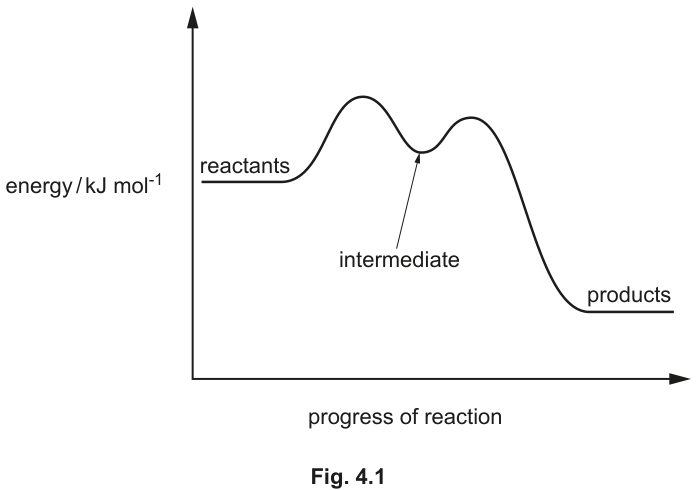
Answer
The sketch must show:
- The curve starting at the same energy level as the reactants in Fig 4.1.
- The curve finishing at the same energy level as the products in Fig 4.1.
- A single hump (one transition state) representing the SN2 mechanism.
- The peak of this single hump must be higher than both peaks (transition states) of the SN1 curve shown in Fig 4.1, because the SN2 reaction is slower (higher activation energy).
See diagram
Background Concept
- SN1 mechanism: Two steps. Step 1: Loss of leaving group to form carbocation (slow, high activation energy, rate-determining). Step 2: Nucleophile attacks carbocation (fast). The energy profile has two humps with a valley (intermediate) in between.
- SN2 mechanism: One step. Nucleophile attacks and leaving group leaves simultaneously. The energy profile has a single hump (one transition state).
- Rate and Activation Energy: A slower reaction has a higher activation energy (). The problem states SN2 is slower, so its transition state energy must be higher than the rate-determining step of SN1.
Understanding the Question
Fig 4.1 shows the SN1 pathway (two humps). We need to sketch the SN2 pathway on the same axes. SN2 is slower.
Approach
- Start at the same reactant energy level.
- End at the same product energy level (thermodynamics don't change with mechanism).
- Draw a single curve (one hump) because SN2 is a concerted one-step mechanism.
- Ensure the peak is higher than the highest peak of the SN1 curve (the first peak in SN1 is usually the RDS, and since SN2 is slower, its is larger).
Step-by-Step Reasoning
- Start/End: The overall enthalpy change () is the same for both mechanisms. So start and end points are identical.
- Shape: SN2 is one step, so one hump (no intermediate valley).
- Height: Rate = . SN1 rate = . The problem states SN2 is slower. This implies the activation energy for the SN2 transition state is higher than the activation energy for the SN1 rate-determining step (the first peak).
- So, draw a single peak that goes above the first peak of the SN1 curve.
Key Takeaways
- SN1 has 2 steps (2 humps, 1 intermediate). SN2 has 1 step (1 hump, no intermediate).
- Slower reaction = higher activation energy = higher peak on energy profile.
Common Mistakes
- Drawing the SN2 curve starting or ending at a different energy level.
- Drawing two humps for SN2 (that's SN1).
- Drawing the SN2 peak lower than the SN1 peaks (that would mean SN2 is faster).
Things to Be Careful About
- The axes are Energy vs Progress of Reaction. Ensure the single hump is clearly higher than the existing curve's maximum.
Complete Fig. 4.2 to show the mechanism for the reaction that occurs when reacts with to produce .
Include charges, dipoles, lone pairs of electrons and curly arrows, as appropriate.
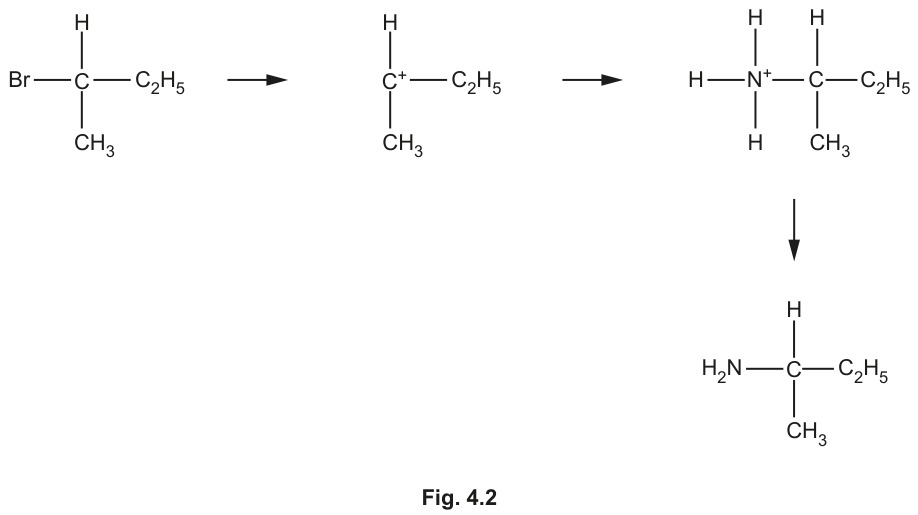
Answer
The mechanism involves three steps (completing Fig 4.2):
- Heterolytic fission of C-Br: Draw a dipole on the C-Br bond (). Draw a curly arrow from the C-Br bond to the Br atom (showing bond breaking to form ). This leads to the carbocation intermediate .
- Nucleophilic attack: Draw a lone pair on the nitrogen of . Draw a curly arrow from the lone pair on N to the positively charged carbon () of the carbocation. This forms the bond between N and C, resulting in an intermediate with a positively charged nitrogen: .
- Deprotonation: Draw a curly arrow from a lone pair on a nitrogen of another molecule (or just show the loss of ) to one of the H atoms on the group. Alternatively, draw a curly arrow from the N-H bond (in the protonated amine intermediate) to the N atom. The mark scheme specifically asks for: "curly arrow showing bond between N—H breaking and pointing towards the N". So, on the intermediate , draw a curly arrow from the N-H bond to the N atom. This removes a proton, leaving the lone pair on N, forming the final amine and .
Note: The question asks to complete Fig 4.2. Fig 4.2 shows the skeletal structures. You must add the arrows and lone pairs.
- Step 1: Arrow from C-Br bond to Br. Dipole on C-Br.
- Step 2: Lone pair on N of incoming . Arrow from lone pair to .
- Step 3: Arrow from N-H bond (in the group attached to carbon) to the N atom.
See diagram
Background Concept
SN1 mechanism with ammonia:
- Ionisation: The C-Br bond breaks heterolytically. Br takes the electron pair, forming and a carbocation. This is the slow step.
- Nucleophilic attack: Ammonia () uses its lone pair to attack the carbocation. This forms a C-N bond. The nitrogen now has 4 bonds and a positive charge ( group).
- Deprotonation: Another ammonia molecule (acting as a base) removes a proton from the positively charged nitrogen to form the neutral amine and ammonium ion ().
Understanding the Question
Complete the mechanism in Fig 4.2 for + . The figure shows the skeletal progression: Reactant -> Carbocation -> Protonated amine -> Final amine. We need to add the curly arrows, lone pairs, and dipoles.
Approach
- Step 1 (Reactant -> Carbocation): Show C-Br bond breaking. Arrow from bond to Br. Dipole on C-Br.
- Step 2 (Carbocation -> Protonated amine): Show attacking. Lone pair on N. Arrow from lone pair to .
- Step 3 (Protonated amine -> Final amine): Show loss of . Arrow from N-H bond to N.
Step-by-Step Reasoning
- M1 (Dipole/Arrow on C-Br): The C-Br bond is polar. C is , Br is . Draw arrow from the middle of the C-Br bond to Br. This represents the heterolytic fission.
- M2 (Lone pair/Arrow attacking C+): The carbocation is electron deficient. has a lone pair on N. Draw the lone pair. Draw arrow from lone pair to the .
- M3 (Arrow N-H breaking): The intermediate is . To get to , an H must leave as . The bond electrons stay on N. Draw arrow from the N-H bond (sigma bond) to the N atom. This reforms the lone pair on N.
Key Takeaways
- SN1 mechanism involves carbocation intermediate.
- Ammonine acts as a nucleophile then a base.
- Curly arrows must start from electrons (lone pair or bond) and go to atom or bond.
Common Mistakes
- Drawing arrow from to C-Br bond (that's SN2).
- Forgetting the positive charge on N in the intermediate.
- Drawing arrow from H to N (wrong direction).
Things to Be Careful About
- The mark scheme specifies: "curly arrow showing bond between N—H breaking and pointing towards the N". Ensure this is clear.
Answer
(ammonium bromide)
NH4Br
Background Concept
In the reaction of a halogenoalkane with ammonia, the ammonia acts as a nucleophile. After the initial substitution, the intermediate ammonium salt is deprotonated by another ammonia molecule. The leaving group (halide ion) pairs with the ammonium ion () formed in the deprotonation step.
Understanding the Question
Identify the inorganic product in the reaction of 2-bromobutane with .
Approach
The organic product is the amine. The bromide ion () from the first step and the proton () removed in the last step combine with ammonia to form ammonium bromide ().
Step-by-Step Reasoning
- Leaving group: .
- Proton source: The protonated amine intermediate loses to another , forming .
- Product: .
Key Takeaways
- Excess ammonia is used to minimize further substitution, but is always a byproduct.
Common Mistakes
- Writing . In the presence of excess ammonia, would be neutralised to .
Things to Be Careful About
- Name or formula is acceptable. or ammonium bromide.
Answer
butan-2-amine
butan-2-amine
Background Concept
Amines are named by adding the suffix '-amine' to the alkane name, or by using the prefix 'amino-'. For IUPAC naming of primary amines: identify the longest carbon chain containing the group, number the chain to give the group the lowest possible number, and add '-amine'.
Understanding the Question
Systematic name for .
Approach
- Structure: .
- Longest chain: 4 carbons -> butane.
- Substituent: at carbon 2.
- Name: butan-2-amine.
Step-by-Step Reasoning
- Chain: C-C-C-C. 4 carbons = butane.
- Functional group: amine ().
- Numbering: From left, amine is at C2. From right, amine is at C3. Choose lower number: 2.
- Name: butan-2-amine.
Key Takeaways
- IUPAC naming for amines: alkan-#-amine.
Common Mistakes
- Naming it '2-aminobutane' (acceptable in some contexts but 'butan-2-amine' is preferred IUPAC for the principal functional group).
- 'butylamine' (too vague).
Things to Be Careful About
- Ensure the number indicates the position of the amine group on the chain.
Complete Table 4.1 by drawing the structural formula of the intermediate that is formed when 2-bromo-2-methylpropane reacts in an reaction.
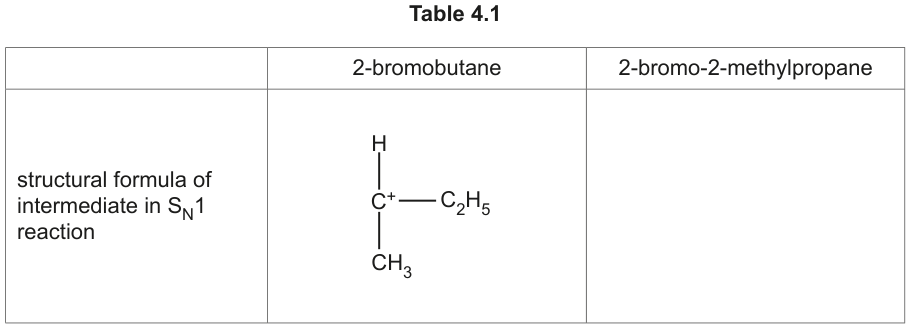
Answer
The intermediate is the 2-methylpropan-2-yl cation (tert-butyl cation).
Structure: A central carbon atom with a positive charge (), bonded to three methyl groups ().
See diagram
Background Concept
In the SN1 reaction of 2-bromo-2-methylpropane (), the first step is the loss of the bromide ion to form a carbocation. Since the bromine is on a tertiary carbon, the resulting carbocation is tertiary.
Understanding the Question
Draw the structural formula of the intermediate in the SN1 reaction of 2-bromo-2-methylpropane.
Approach
- Remove Br and the electron pair.
- The carbon that held Br now has a positive charge.
- It is bonded to three methyl groups.
Step-by-Step Reasoning
- Reactant: 2-bromo-2-methylpropane. Central C bonded to Br, CH3, CH3, CH3.
- Ionisation: C-Br bond breaks. Br leaves as .
- Intermediate: Central C with + charge, bonded to three CH3 groups.
Key Takeaways
- SN1 of tertiary halogenoalkanes gives tertiary carbocations.
Common Mistakes
- Drawing the wrong carbon skeleton.
- Forgetting the positive charge.
Things to Be Careful About
- 'Structural formula' usually means showing all bonds (displayed formula) or at least the connectivity clearly. The example for 2-bromobutane shows a central C+ with bonds to H, CH3, C2H5. For 2-bromo-2-methylpropane, it's a central C+ with bonds to CH3, CH3, CH3.
Identify the halogenoalkane in Table 4.1 that has the greater tendency to react using the mechanism. Explain your answer.
Answer
Halogenoalkane: 2-bromo-2-methylpropane.
Explanation: It forms a more stable carbocation (tertiary carbocation). The three alkyl groups (methyl groups) have a positive inductive effect, releasing electron density towards the positively charged carbon, stabilising the charge. 2-bromobutane forms a secondary carbocation, which is less stable.
2-bromo-2-methylpropane; more stable carbocation due to inductive effect of alkyl groups.
Background Concept
SN1 reactions proceed via a carbocation intermediate. The rate-determining step is the formation of this carbocation. Therefore, the stability of the carbocation determines the reactivity towards SN1.
- Carbocation stability: Tertiary () > Secondary () > Primary () > Methyl.
- Reason: Alkyl groups are electron-donating via the inductive effect (sigma bond polarization). They push electron density towards the electron-deficient positive carbon, dispersing the charge and stabilising the ion.
Understanding the Question
Identify which halogenoalkane (2-bromobutane or 2-bromo-2-methylpropane) has a greater tendency to react via SN1 and explain.
Approach
- Identify the carbocation formed by each.
- Compare their stability.
- Link stability to SN1 reactivity (more stable carbocation = faster SN1).
Step-by-Step Reasoning
- 2-bromobutane: . Loss of Br gives . This is a secondary () carbocation (C+ bonded to 2 carbons).
- 2-bromo-2-methylpropane: . Loss of Br gives . This is a tertiary () carbocation (C+ bonded to 3 carbons).
- Comparison: Tertiary carbocations are more stable than secondary due to the inductive effect of more alkyl groups.
- Conclusion: 2-bromo-2-methylpropane reacts faster via SN1 because it forms the more stable tertiary carbocation.
Key Takeaways
- SN1 reactivity increases with carbocation stability: .
- Inductive effect stabilises carbocations.
Common Mistakes
- Saying '2-bromobutane is more reactive' (wrong).
- Explaining stability using 'hyperconjugation' (correct but often beyond A-level detail; 'inductive effect' is the key A-level term).
- Forgetting to mention 'inductive effect' or 'alkyl groups'.
Things to Be Careful About
- Must name the correct halogenoalkane: 2-bromo-2-methylpropane.
- Explanation must mention 'more stable carbocation' and 'inductive effect' or 'electron releasing/positive inductive effect of alkyl groups'.
M reacts to form R by the addition of one reagent, as shown in Fig. 5.1.
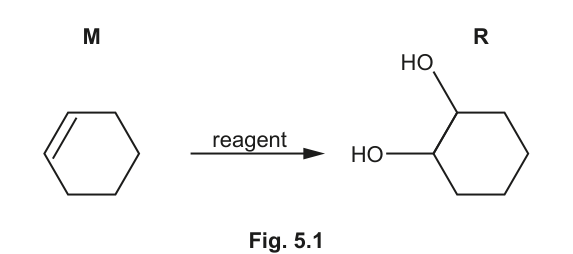
Identify the reagent and conditions for this reaction.
Answer
cold dilute (potassium manganate(VII))
cold dilute KMnO4 (potassium manganate(VII))
Background Concept
Alkenes can be oxidised to form diols (compounds with two hydroxyl groups on adjacent carbons). This is known as hydroxylation or dihydroxylation. The most common reagent for this transformation in A-Level chemistry is cold, dilute, alkaline potassium manganate(VII) solution (), also known as Baeyer's reagent. The reaction is a syn-addition, meaning both OH groups add to the same face of the double bond. The purple is reduced to brown during the process.
Understanding the Question
The question shows cyclohexene (M) being converted directly to cyclohexane-1,2-diol (R) in a single step. The two OH groups are on adjacent carbons where the double bond previously was. The command word 'identify' requires naming the reagent and stating the conditions.
Approach
Recognise that the transformation is an alkene → vicinal diol (1,2-diol). This is the classic oxidation of an alkene using cold dilute .
Step-by-Step Reasoning
- The starting material is cyclohexene, which has a C=C double bond.
- The product is cyclohexane-1,2-diol, which has two OH groups on adjacent carbons.
- This is a syn-dihydroxylation (both OH groups added to the same side of the former double bond).
- The reagent that achieves this in one step is cold, dilute, alkaline .
- 'Cold' is essential because heating with would cleave the C=C bond to form dicarboxylic acids or ketones.
Key Takeaways
- Cold dilute converts alkenes to vicinal diols (syn-addition of two OH groups).
- Hot concentrated cleaves the double bond entirely — the conditions matter enormously.
- This is a useful one-step route to a diol from an alkene.
Common Mistakes
- Writing 'KMnO4' without specifying 'cold' and 'dilute' — the conditions are part of the mark.
- Confusing this with the bromine water test or with acidified (which is used for oxidising alcohols/aldehydes, not for diol formation from alkenes).
- Writing 'alkaline' is acceptable but not strictly required by the mark scheme; 'cold dilute' is the essential qualifier.
Things to Be Careful About
- The word 'cold' must appear — without it, the answer is incomplete.
- State 'dilute' as well to distinguish from the hot concentrated conditions that cause oxidative cleavage.
R is also made from M by two steps, as shown in Fig. 5.2.
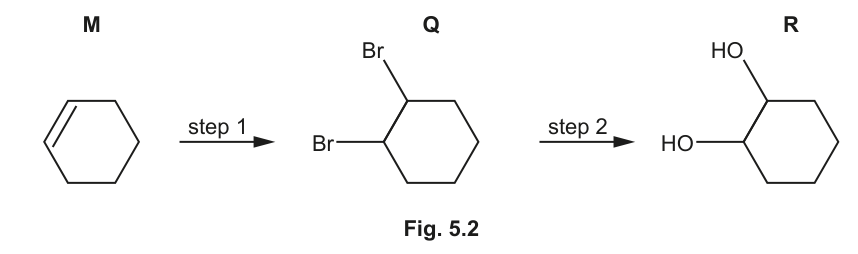
Answer
Step 1: (in the dark)
Step 2: + heat
Step 1: Br2 (in the dark); Step 2: NaOH(aq) + heat
Background Concept
The conversion of an alkene to a diol via a two-step route involves first adding a halogen across the double bond (electrophilic addition) to form a vicinal dihalide, then substituting the halogen atoms with hydroxyl groups via nucleophilic substitution using aqueous hydroxide.
Electrophilic addition of to an alkene proceeds via a cyclic bromonium ion intermediate, resulting in anti-addition of the two bromine atoms. The reaction is typically carried out in the dark to prevent free-radical substitution from occurring instead.
Nucleophilic substitution of a haloalkane with aqueous replaces the halogen with an OH group. The hydroxide ion acts as the nucleophile. Heating is required to provide sufficient activation energy for the substitution to proceed at a reasonable rate.
Understanding the Question
The scheme shows cyclohexene (M) → 1,2-dibromocyclohexane (Q) → cyclohexane-1,2-diol (R). Part (i) asks for the reagents and conditions for each step separately.
Approach
- Step 1: alkene → vicinal dibromide. This is halogenation with .
- Step 2: vicinal dibromide → vicinal diol. This is nucleophilic substitution of both Br atoms by OH⁻ using aqueous NaOH with heat.
Step-by-Step Reasoning
- Step 1: The double bond in cyclohexene reacts with . The molecule is polarised as it approaches the electron-rich π bond, forming a bromonium ion intermediate. The second Br⁻ attacks from the opposite face (anti-addition). The condition 'in the dark' prevents competing free-radical substitution of C–H bonds. Each Br added = 1 mark.
- Step 2: Each C–Br bond in Q undergoes nucleophilic substitution. The OH⁻ ion from aqueous NaOH attacks the carbon bearing Br, displacing Br⁻. Both Br atoms are replaced, giving the diol R. Heat is needed to overcome the activation energy. Aqueous conditions favour substitution over elimination.
Key Takeaways
- in the dark adds across C=C via electrophilic addition.
- Aqueous NaOH + heat substitutes halogen with OH via nucleophilic substitution.
- 'In the dark' is an important condition for bromination of alkenes (prevents radical pathway).
- Aqueous conditions favour substitution; alcoholic KOH would favour elimination.
Common Mistakes
- Writing 'light' or 'UV' instead of 'dark' for step 1 — this would promote free-radical substitution of C–H bonds instead of addition to the double bond.
- Writing 'KOH in ethanol' for step 2 — this would cause elimination (forming an alkyne or diene) rather than substitution.
- Omitting 'heat' for step 2 — nucleophilic substitution of haloalkanes requires heating.
- Writing 'NaOH(aq)' without specifying 'aqueous' or 'heat'.
Things to Be Careful About
- For step 1, the mark scheme specifically credits ' (in the dark)'. The 'in the dark' qualifier may be needed for full marks.
- For step 2, both the reagent () and the condition (heat) must be stated.
Answer
electrophilic addition
electrophilic addition
Background Concept
The addition of a halogen (such as or ) to an alkene proceeds by the electrophilic addition mechanism. The π electrons of the double bond polarise the halogen molecule, creating a temporary dipole. The slightly positive end of the halogen molecule acts as the electrophile and is attracted to the electron-rich double bond. A cyclic halonium ion intermediate forms, followed by attack by the halide ion from the opposite face.
Understanding the Question
Step 1 in Fig. 5.2 is the reaction of cyclohexene with to form 1,2-dibromocyclohexane. The question asks for the name of the mechanism.
Approach
Recognise that the addition of a halogen across a carbon-carbon double bond is a classic example of electrophilic addition.
Step-by-Step Reasoning
- The C=C double bond is electron-rich (π electrons are exposed above and below the plane).
- is non-polar but becomes polarised as it approaches the double bond (induced dipole).
- The bromine acts as an electrophile, accepting a pair of electrons from the π bond.
- A cyclic bromonium ion forms, then attacks from the opposite side.
- The overall mechanism is classified as electrophilic addition.
Key Takeaways
- Halogen addition to alkenes is always electrophilic addition.
- The key feature is the initial attack by an electrophile (the polarised ) on the electron-rich π bond.
Common Mistakes
- Writing 'nucleophilic addition' — the alkene is the nucleophile (electron donor), not the electrophile.
- Writing 'free radical substitution' — that is the mechanism for alkanes with halogens under UV light.
- Writing 'electrophilic substitution' — that applies to aromatic compounds like benzene, not alkenes.
Things to Be Careful About
- The full term 'electrophilic addition' is required; 'addition' alone would not earn the mark.
The infrared spectrum of R is shown in Fig. 5.3.
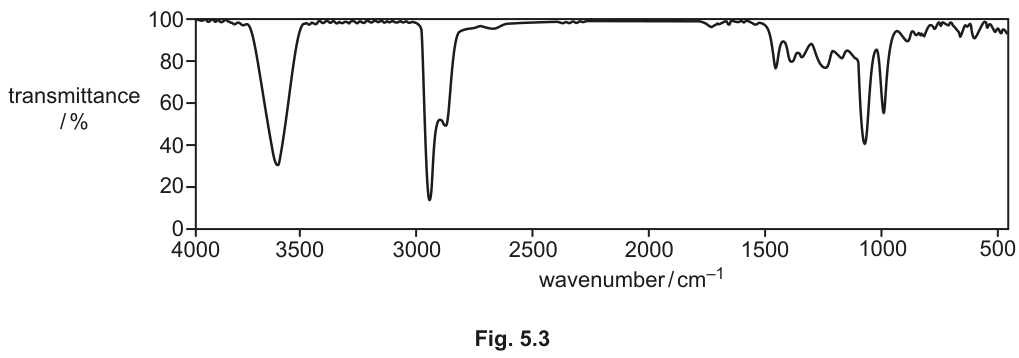
Table 5.1
| bond | functional groups containing the bond | characteristic infrared absorption range (in wavenumbers) / cm |
|---|---|---|
| C–O | hydroxy, ester | 1040–1300 |
| C=C | aromatic compound, alkene | 1500–1680 |
| C=O | amide carbonyl, carboxyl ester | 1640–1690 1670–1740 1710–1750 |
| CN | nitrile | 2200–2250 |
| C–H | alkane | 2850–2950 |
| N–H | amine, amide | 3300–3500 |
| O–H | carboxyl hydroxy | 2500–3000 3200–3650 |
Use the absorptions in the region above 1500 cm in Table 5.1 when answering this question.
- Add F to Fig. 5.3 to identify the peak that is present in an infrared spectrum of both Q and R. Identify the bond that corresponds to the absorption for F.
- Add G to Fig. 5.3 to identify the peak that is not present in an infrared spectrum of Q. Identify the bond that corresponds to the absorption for G.
Answer
F: Peak at approximately (in the range –), corresponding to the C–H bond (alkane). This peak is present in both Q and R because both contain C–H bonds in the cyclohexane ring.
G: Broad peak at approximately (in the range –), corresponding to the O–H bond (in hydroxy/alcohol groups). This peak is absent from Q because Q has no O–H groups (it has Br in place of OH).
F: C-H (around 2900 cm-1); G: O-H (around 3300 cm-1)
Background Concept
Infrared (IR) spectroscopy identifies functional groups by measuring the absorption of IR radiation at characteristic wavenumbers corresponding to bond vibrations. Each type of bond absorbs in a specific region of the spectrum. The data table provided gives the characteristic absorption ranges for various bonds.
When comparing IR spectra of two compounds, peaks that appear in both spectra correspond to bonds present in both molecules, while peaks unique to one compound correspond to bonds present only in that compound.
Understanding the Question
Compound R is cyclohexane-1,2-diol (has C–H and O–H bonds). Compound Q is 1,2-dibromocyclohexane (has C–H bonds but no O–H bonds). The question asks to identify:
- F: a peak present in BOTH Q and R (common bond)
- G: a peak present in R but NOT in Q (unique to R)
Only absorptions above are to be considered.
Approach
- Look at the IR spectrum of R above : there is a broad peak around and a sharp peak around .
- From Table 5.1: – = C–H (alkane); – = O–H (hydroxy).
- Both Q and R have C–H bonds (cyclohexane ring), so C–H appears in both spectra → this is F.
- Only R has O–H bonds (Q has Br, not OH), so O–H is absent from Q → this is G.
Step-by-Step Reasoning
- Peak F (~2900 cm⁻¹): This sharp absorption falls in the – range, corresponding to C–H stretching in an alkane. Both 1,2-dibromocyclohexane (Q) and cyclohexane-1,2-diol (R) contain C–H bonds in their cyclohexane rings, so this peak appears in both spectra. F is therefore the C–H peak.
- Peak G (~3300 cm⁻¹): This broad absorption falls in the – range, corresponding to O–H stretching in a hydroxy group. R has two OH groups, but Q has two Br atoms instead — no O–H bonds. Therefore this peak is present in R but absent from Q. G is the O–H peak.
- The broadness of the O–H peak (compared to the sharp C–H peak) is due to hydrogen bonding between alcohol molecules.
Key Takeaways
- C–H (alkane) absorbs around – and is present in virtually all organic molecules with saturated C–H bonds.
- O–H (alcohol) absorbs broadly around – due to hydrogen bonding.
- When comparing spectra, identify which bonds are common and which are unique to each compound.
- The broadness of a peak is a useful diagnostic feature (O–H is broad, C–H is sharp).
Common Mistakes
- Labelling F as the O–H peak and G as the C–H peak (reversed).
- Choosing a peak below — the question explicitly restricts to absorptions above .
- Identifying F as C=C — Q and R are both saturated (no C=C bond present in either).
- Not specifying the bond type alongside the peak position.
Things to Be Careful About
- The question requires BOTH the peak identification (label F or G at the correct position) AND the bond name. Missing either half loses the mark.
- The C–H peak must be in the – range (not the – range which is for carboxylic acid O–H).
- The O–H peak must be identified as the hydroxy/alcohol O–H (–), not the carboxylic acid O–H (–).
Y is made from Q in a three-step reaction.
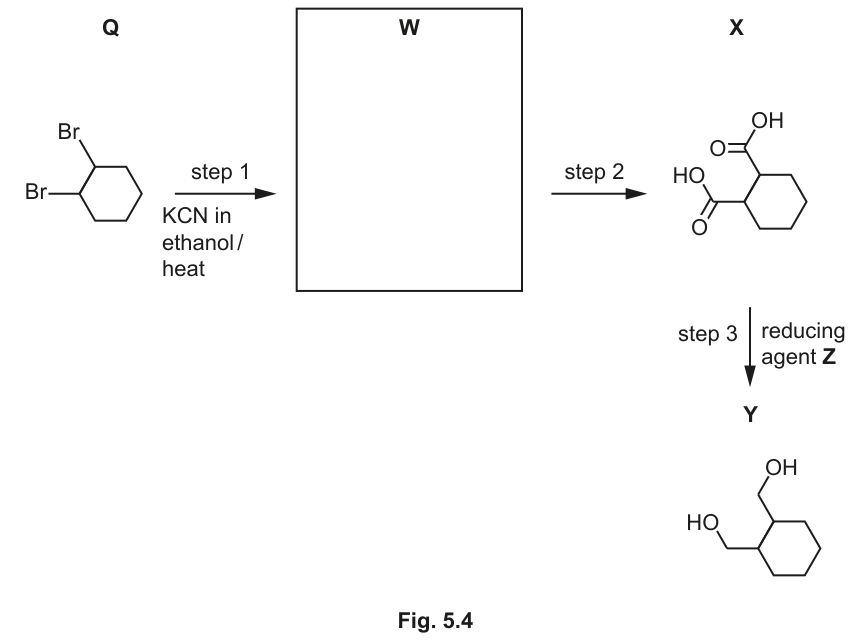
Answer
W is cyclohexane-1,2-dicarbonitrile (1,2-dicyanocyclohexane):
The structure is a cyclohexane ring with a group on each of two adjacent carbons.
cyclohexane-1,2-dicarbonitrile: C6H10(CN)2
Background Concept
Nucleophilic substitution of haloalkanes with potassium cyanide (KCN) in ethanol under heat replaces the halogen atom with a cyano (–CN) group. The cyanide ion () acts as the nucleophile, attacking the carbon bonded to the halogen and displacing the halide ion. This reaction is important because it extends the carbon chain by one carbon atom per substitution.
When a dihalide undergoes double substitution, both halogen atoms are replaced, giving a dinitrile.
Understanding the Question
Q is 1,2-dibromocyclohexane. It reacts with KCN in ethanol under heat (step 1) to form W. Since Q has two Br atoms on adjacent carbons, both are replaced by CN groups to form a dinitrile.
Approach
- Recognise that KCN provides as the nucleophile.
- Both C–Br bonds undergo nucleophilic substitution.
- Each Br is replaced by a C≡N group.
- Draw the cyclohexane ring with two –CN groups on adjacent carbons.
Step-by-Step Reasoning
- The ion attacks the carbon bearing Br (the δ⁺ carbon due to the polar C–Br bond).
- The C–Br bond breaks heterolytically, releasing .
- This occurs at both C–Br positions in Q.
- The product W is 1,2-dicyanocyclohexane (cyclohexane-1,2-dicarbonitrile), with the molecular formula .
- The structure shows a cyclohexane ring with –C≡N on each of two adjacent carbons.
Key Takeaways
- KCN in ethanol/heat converts haloalkanes to nitriles via nucleophilic substitution.
- Each substitution adds one carbon to the chain (C from the CN group).
- A dihalide gives a dinitrile if both halogens are substituted.
Common Mistakes
- Drawing only one CN group (forgetting that both Br atoms are replaced).
- Drawing –NC instead of –CN (the carbon of CN bonds to the ring, not the nitrogen).
- Drawing the CN groups on non-adjacent carbons.
- Writing the formula as if the CN is attached through N rather than C.
Things to Be Careful About
- The C≡N triple bond must be shown (or at least the connectivity must make clear it is carbon-attached).
- Both substituents must be on adjacent carbons (1,2-relationship preserved from Q).
In step 2, W is heated with HCl(aq) to produce X and an inorganic product.
Identify the formula of the inorganic product.
Answer
NH4Cl
Background Concept
Nitriles () can be hydrolysed under acidic conditions (heating with dilute HCl) to form carboxylic acids. The mechanism involves protonation of the nitrogen, nucleophilic attack by water on the carbon, and successive additions of water until the C≡N triple bond is fully hydrolysed to give –COOH and . In the presence of HCl, the ammonium ion forms as the inorganic product.
The overall reaction for a single nitrile group is:
Understanding the Question
W (the dinitrile) is heated with aqueous HCl to produce X (the dicarboxylic acid) and an inorganic product. The question asks for the formula of that inorganic product.
Approach
- Each –CN group is hydrolysed to –COOH.
- The nitrogen from each –CN becomes .
- With HCl present, combines with to form .
Step-by-Step Reasoning
- W has two –CN groups. Both are hydrolysed by HCl(aq) + heat.
- Each –CN → –COOH, releasing one N atom that becomes .
- Two ions combine with two ions → .
- The inorganic product is (ammonium chloride).
Key Takeaways
- Acid hydrolysis of nitriles gives carboxylic acids + .
- Alkaline hydrolysis (with NaOH) would give a carboxylate salt + .
- The inorganic product depends on whether acid or base is used for hydrolysis.
Common Mistakes
- Writing '' instead of '' — under acidic conditions, ammonia is protonated to and exists as the salt .
- Writing '' as the inorganic product — HCl is a reactant, not a product.
- Writing '' — this does not form under acidic conditions.
Things to Be Careful About
- The question specifies HCl(aq) (acidic conditions), so the product is , not .
- The formula must be written correctly: .
In step 3, X reacts with reducing agent Z to produce Y.
Complete the equation for the reaction of X with Z.
Use a molecular formula to represent the organic product.
Use [H] to represent one atom of hydrogen from Z.
Working
Each group is reduced to :
Two COOH groups require and produce .
Answer
C8H12O4 + 8[H] -> C8H16O2 + 2H2O
Background Concept
Carboxylic acids can be reduced to primary alcohols using strong reducing agents such as lithium tetrahydridoaluminate(III) (). The reduction converts the –COOH group to –CH₂OH. In terms of the [H] notation used in A-Level chemistry, each –COOH → –CH₂OH conversion requires 4[H] and releases one .
The reasoning: –COOH has the composition C, 2O, H (on the OH). –CH₂OH has the composition C, 3H, O. To go from –COOH to –CH₂OH, we need to remove one oxygen (as ) and add two hydrogens. Writing with [H]: . Check: Left = C + 2O + H + 4H = C + 2O + 5H. Right = C + 3H + O + 2H + O = C + 2O + 5H. ✓
Understanding the Question
X is cyclohexane-1,2-dicarboxylic acid (). It is reduced by agent Z to give Y, 1,2-bis(hydroxymethyl)cyclohexane (). The equation must be completed with the correct coefficient for [H] and the organic product formula.
Approach
- Identify that two –COOH groups are being reduced to two –CH₂OH groups.
- Each reduction requires 4[H] and produces 1 .
- Total: 8[H] needed, 2 produced.
- Write the balanced equation.
Step-by-Step Reasoning
- X = (cyclohexane ring + 2 COOH groups)
- Y = (cyclohexane ring + 2 CH₂OH groups)
- Change in H: more H in Y. But we also produce water.
- Let the equation be:
- Oxygen balance: , so .
- Hydrogen balance: , so .
- Therefore:
Key Takeaways
- Reduction of –COOH to –CH₂OH requires 4[H] per group and releases 1 .
- For a dicarboxylic acid, double these amounts.
- Always check atom balance (C, H, O) in the final equation.
Common Mistakes
- Writing 4[H] instead of 8[H] (forgetting there are two COOH groups).
- Omitting from the products.
- Writing the wrong molecular formula for Y (e.g. ).
- Using instead of [H] — the question specifies using [H].
Things to Be Careful About
- The question requires a molecular formula for the organic product, not a structural formula.
- The coefficient of [H] must be 8 (not 4, not 6).
- Water must appear as a product with coefficient 2.
Answer
(lithium tetrahydridoaluminate(III))
LiAlH4
Background Concept
The reduction of carboxylic acids to primary alcohols requires a strong hydride reducing agent. At A-Level, the standard reagent is lithium tetrahydridoaluminate(III), (also called lithium aluminium hydride). This is used in dry ether (anhydrous conditions), followed by hydrolysis with dilute acid. is NOT strong enough to reduce carboxylic acids — it only reduces aldehydes and ketones.
Understanding the Question
The question asks to identify reducing agent Z, which converts the dicarboxylic acid X to the diol Y. This is a reduction of –COOH to –CH₂OH.
Approach
Recall that carboxylic acids require the stronger reducing agent (not ) for reduction to alcohols.
Step-by-Step Reasoning
- The reaction is –COOH → –CH₂OH (reduction of a carboxylic acid to a primary alcohol).
- This requires a strong reducing agent capable of delivering hydride to the carbonyl carbon of the acid.
- provides which delivers hydride () to the electrophilic carbon.
- is too mild to reduce carboxylic acids (it works for aldehydes and ketones only).
- Therefore Z = .
Key Takeaways
- reduces: carboxylic acids, esters, acyl chlorides, aldehydes, ketones.
- reduces: aldehydes and ketones only (not acids or esters).
- must be used in dry ether (reacts violently with water).
Common Mistakes
- Writing '' — this cannot reduce carboxylic acids.
- Writing ' with Ni catalyst' — this reduces C=C bonds, not COOH groups under normal conditions.
- Writing 'LiAlH4 in water' — it must be in dry/anhydrous ether.
Things to Be Careful About
- The correct formula is (not or ).
- Acceptable alternative name: lithium aluminium hydride, or lithium tetrahydridoaluminate(III).