Chemistry 9701/21 — May/June 2024
Cambridge AS Level · AS Level Structured Questions · worked solutions for every part, with the mark scheme
Topics Chemical Bonding · Atoms, Molecules and Stoichiometry · Electrochemistry · Chemical Periodicity · Equilibria · Hydrocarbons · +8 more
The elements of Group 17 are called halogens.
Complete Table 1.1.
Table 1.1
| halogen | colour at 293 K |
|---|---|
| chlorine | |
| bromine | |
| iodine |
Answer
| halogen | colour at 293 K |
|---|---|
| chlorine | (pale) green |
| bromine | brown (red-brown) |
| iodine | (dark) grey (solid) |
Chlorine: green; bromine: brown; iodine: dark grey
Background Concept
The halogens are diatomic molecular elements, , and , whose physical appearance at room temperature (293 K) is standard recall material for the 9701 syllabus. Their colours arise from the absorption of certain wavelengths of visible light by the molecules.
Understanding the Question
The command word is 'Complete Table 1.1' — a pure recall task: state the colour of each halogen at 293 K.
Approach
Recall the three standard colours in order down the group.
Step-by-Step Reasoning
- Chlorine is a pale green (yellow-green) gas.
- Bromine is a brown (red-brown), volatile liquid — its vapour is also brown.
- Iodine is a dark grey (black-grey) crystalline solid that sublimes to give a purple vapour.
All three colours must be correct for the single mark.
Key Takeaways
Learn the halogen colours as a fixed set: green → brown → grey down the group.
Common Mistakes
- Writing 'purple' for iodine: that is the colour of its vapour; the solid is dark grey.
- Writing 'red' or 'orange' for bromine — the accepted colour is brown (red-brown).
- Giving only two of the three colours correctly: the mark requires all three.
Things to Be Careful About
The question specifies 293 K (room temperature), so describe the physical state as it exists at that temperature — chlorine gas, bromine liquid, iodine solid.
State the trend in volatility of the halogens chlorine, bromine and iodine. Explain your answer.
Answer
- Volatility decreases down the group from chlorine to iodine.
- The halogen molecules contain more electrons going down the group.
- Therefore the strength of the instantaneous dipole–induced dipole (van der Waals') forces of attraction between molecules increases, so more energy is needed to separate the molecules.
Volatility decreases down the group because the molecules have more electrons, giving stronger instantaneous dipole–induced dipole (van der Waals) forces.
Background Concept
Volatility is the ease with which a substance evaporates. For molecular elements like the halogens, volatility depends entirely on the strength of the intermolecular forces between molecules — not on the covalent bonds within them. The relevant intermolecular force here is the instantaneous dipole–induced dipole force (London/dispersion force), which arises when momentary uneven electron distributions in one molecule induce dipoles in neighbouring molecules. The more electrons a molecule has, the more polarisable its electron cloud is, and the stronger these forces become.
Understanding the Question
The command word is 'State ... Explain your answer' — you must give the trend (1 mark) and a full causal explanation (2 marks) linking electron number to intermolecular force strength.
Approach
State the trend, then build the explanation in two logical steps: electron count → force strength → volatility.
Step-by-Step Reasoning
- Trend (M1): Volatility decreases down the group: (gas) > (volatile liquid) > (solid).
- Electron count (M2): Going from to to , each molecule contains more electrons (larger atoms, more shells).
- Force strength (M3): More electrons mean a more polarisable electron cloud, so the instantaneous dipole–induced dipole forces between molecules are stronger. Stronger intermolecular attraction means more energy is needed to vaporise the substance, so volatility falls.
Key Takeaways
For halogens (and any non-polar molecular substance), volatility, melting point and boiling point all increase as molecular size/electron number increases, because van der Waals forces strengthen.
Common Mistakes
- Saying 'stronger van der Waals forces' without the causal chain through electron number — M2 and M3 are separate marks.
- Talking about covalent bond strength: the X–X bond is irrelevant to volatility; the question concerns forces between molecules.
- Saying 'mass increases' without linking mass to electron number and polarisability.
- Calling the forces 'permanent dipole' forces — the halogen molecules are non-polar.
Things to Be Careful About
Use the exact phrase 'instantaneous dipole–induced dipole forces' (or 'van der Waals' forces') — vague terms like 'intermolecular attraction' alone may not earn M3. Ensure the direction of the trend is explicit: volatility decreases down the group.
Iodine is made by reacting bromine with sodium iodide.
Answer
Br2 + 2I^- -> 2Br^- + I2
Background Concept
A more reactive (more oxidising) halogen displaces a less reactive halide ion from solution. Bromine is a stronger oxidising agent than iodine, so it oxidises iodide ions to iodine while itself being reduced to bromide ions. Sodium ions are spectator ions and are omitted from the ionic equation.
Understanding the Question
'Construct an ionic equation' means writing only the reacting species (no spectator ions such as ), correctly balanced for atoms and charge.
Approach
Write the redox displacement: gains electrons, loses electrons. Combine and balance.
Step-by-Step Reasoning
- Half-reactions: and .
- Adding gives .
- Check: atoms balance (2 Br, 2 I each side); charge balances (−2 on both sides).
Key Takeaways
Displacement reactions of halogens are single-displacement redox reactions; the ionic equation omits spectator ions.
Common Mistakes
- Writing instead of (unbalanced).
- Including — it is a spectator ion and should not appear in an ionic equation.
- Writing the products as and (reversing the reaction).
Things to Be Careful About
Check the charge balance as well as the atom balance — both sides must total −2 here.
Answer
Bromine is the oxidising agent, because it removes electron(s) from the iodide ions, (equivalently, it increases the oxidation number of iodine from −1 in to 0 in ).
Bromine is the oxidising agent because it removes electrons from iodide ions (oxidises I^- to I2).
Background Concept
An oxidising agent is a species that oxidises another species by accepting electrons from it; the oxidising agent is itself reduced. Equivalently, it causes the oxidation number of the other species to increase.
Understanding the Question
'State the role of bromine ... Explain your answer' — name the role (1 mark) AND give the electron or oxidation-number justification; the mark requires both parts together.
Approach
Identify which species gains electrons (bromine), then justify using either electron transfer or oxidation number change.
Step-by-Step Reasoning
- In the equation , bromine gains electrons: . A species that accepts electrons is an oxidising agent.
- The iodide ion's oxidation number rises from −1 to 0 in — it has been oxidised by the bromine.
Key Takeaways
Oxidising agent = electron acceptor = causes oxidation number of the other species to increase; it is itself reduced.
Common Mistakes
- Saying 'bromine is oxidised' — bromine is reduced; it causes oxidation.
- Giving the role without the explanation (or vice versa) — the mark requires both.
- Confusing oxidising agent with reducing agent.
Things to Be Careful About
The explanation must mention electron removal from iodide OR the increase in oxidation number of iodide — a vague 'it takes electrons' without naming from what may not score.
Concentrated sulfuric acid is added to separate samples containing equal amounts of NaCl, NaBr and NaI. All three samples initially react to produce the hydrogen halide.
Write an equation to describe the acid–base reaction that occurs when concentrated sulfuric acid reacts with NaBr.
Answer
(or, alternatively)
NaBr + H2SO4 -> HBr + NaHSO4
Background Concept
Concentrated sulfuric acid is a strong acid and its first proton transfer to a solid halide salt is a straightforward acid–base (proton transfer) reaction: the halide ion acts as a Brønsted–Lowry base, accepting H⁺ to form the hydrogen halide. The acid's conjugate base is , giving sodium hydrogensulfate, , at room temperature.
Understanding the Question
'Write an equation to describe the acid–base reaction' — only the initial proton-transfer step is required, not the subsequent redox reactions that concentrated can also undergo with Br⁻ and I⁻.
Approach
Swap the acid's H⁺ for the metal: NaBr + H₂SO₄ → HBr + NaHSO₄. Check atom balance.
Step-by-Step Reasoning
- The Br⁻ ion is protonated: .
- The remaining pairs with to give .
- The equation is balanced as written (1 Na, 1 Br, 2 H, 1 S, 4 O each side).
- Alternatively, with excess/heat the full neutralisation gives — both forms are credited.
Key Takeaways
The first reaction of any solid halide with concentrated is acid–base, producing the hydrogen halide and .
Common Mistakes
- Writing with only 1 NaBr (unbalanced).
- Writing (incorrect formula for sodium sulfate/hydrogensulfate).
- Including the redox products (, ) — the question asks only for the acid–base step.
Things to Be Careful About
Either (1:1) or (2:1) is accepted, but the equation must be internally balanced with the salt you choose.
Deduce which sodium halide, NaCl, NaBr or NaI, produces the largest percentage yield of hydrogen halide when concentrated sulfuric acid is added. Explain your answer by considering the relative reactivity of the halide ions as reducing agents.
identity of sodium halide:
explanation:
Answer
Identity of sodium halide: NaCl (sodium chloride)
Explanation:
- is not a strong enough reducing agent to reduce the sulfur in , so all the chloride is converted to HCl, which is not consumed in any further reaction.
- and are strong enough reducing agents to react further with (the S in) concentrated , so some of the HBr/HI produced is oxidised (to /), lowering the yield of hydrogen halide.
NaCl — Cl^- is too weak a reducing agent to reduce H2SO4, whereas Br^- and I^- reduce the sulfuric acid further, consuming some of the HBr/HI formed.
Background Concept
Reducing power of the halide ions increases down Group 17: . This is because the halide ion gets larger, so the outer electrons are further from the nucleus and more shielded, and are lost more easily. Concentrated sulfuric acid contains sulfur in the +6 oxidation state and can itself be reduced (to , S or ) by a sufficiently strong reducing agent. So while all three halides initially give the hydrogen halide by acid–base reaction, and especially then reduce the acid further, and the hydrogen halide is simultaneously oxidised to the free halogen — consuming some of the HBr/HI product.
Understanding the Question
'Deduce which sodium halide produces the largest percentage yield of hydrogen halide' — you must pick one (1 mark) and explain using the relative reducing-agent strength of the halide ions (2 marks). The key insight is that yield is reduced when the hydrogen halide is destroyed in a secondary redox reaction.
Approach
Ask: for which halide does no further (redox) reaction occur after the acid–base step? That halide gives 100% conversion to hydrogen halide and hence the largest yield.
Step-by-Step Reasoning
- Identity (M1): NaCl. Chloride is the weakest reducing agent of the three.
- Why Cl⁻ gives full yield (M2): is not a strong enough reducing agent to reduce the S in , so no secondary redox reaction occurs — every mole of NaCl ends up as HCl.
- Why Br⁻ and I⁻ lose yield (M3): and are strong enough reducing agents to react further with the sulfur in ; e.g. . This consumes some of the hydrogen halide, so the percentage yield of HBr/HI is lower. (For iodide the reduction goes further, even to .)
The alternative acceptable reasoning is the general trend: reducing ability increases down the group, so Cl⁻ cannot reduce the acid while Br⁻/I⁻ can.
Key Takeaways
- Halide reducing power increases down Group 17 (larger ion, more shielding, electrons lost more easily).
- Concentrated is an oxidising agent; only sufficiently strong reducing halides (Br⁻, I⁻) reduce it.
- Percentage yield of hydrogen halide is highest for the halide that undergoes no further redox reaction.
Common Mistakes
- Choosing NaI because 'I⁻ is the best reducing agent' — being a good reducing agent means the acid gets reduced more, destroying more HI, so the yield is lowest, not highest.
- Explaining only in terms of the halide ions without linking to the yield of the hydrogen halide product.
- Saying 'Cl⁻ is less reactive' without specifying 'less strong a reducing agent / cannot reduce '.
Things to Be Careful About
The explanation must explicitly compare: Cl⁻ not strong enough to reduce , while Br⁻ and I⁻ are strong enough to react further with it. Mentioning the sulfur in being reduced makes the redox chemistry explicit and secures the marks.
Sulfur chloride, , is a liquid at room temperature. When is added to water, misty fumes are seen and a solution is made that turns universal indicator red.
Answer
hydrolysis
hydrolysis
Background Concept
When certain covalent chlorides of Period 3 elements (such as SiCl₄, PCl₃, SCl₂) are added to water, they react vigorously. The reaction involves the breaking of polar Covalent bonds by water molecules, producing hydrogen chloride gas (observed as misty fumes) and an acidic solution. This type of reaction with water is specifically called hydrolysis.
Understanding the Question
The question states that SCl₂ is added to water, producing misty fumes and an acidic solution (turns universal indicator red). We are asked to name the general type of reaction occurring.
Approach
Recognise that the reaction of a compound with water to break it down into acidic (and sometimes other) products is defined as hydrolysis. No calculation or complex deduction is needed; it is a direct recall of terminology for this class of reactions.
Step-by-Step Reasoning
- SCl₂ contains polar S–Cl bonds.
- Water acts as a nucleophile, attacking the sulfur atom and breaking the S–Cl bonds.
- HCl is produced, which forms misty fumes in moist air and dissolves to give an acidic solution.
- The reaction of a substance with water to decompose it is termed hydrolysis.
Key Takeaways
Covalent chlorides of non-metals (especially Period 3) typically undergo hydrolysis with water, releasing HCl gas and forming acidic solutions.
Common Mistakes
- Writing 'oxidation' or 'reduction': while redox may occur in some chloride hydrolyses, the primary descriptive term for reaction with water is hydrolysis.
- Writing 'dissolution': SCl₂ does not simply dissolve; it chemically reacts with water.
Things to Be Careful About
Use the precise term 'hydrolysis'. Do not overcomplicate with redox terminology unless specifically asked about electron transfer.
Name a chloride of a different Period 3 element that is also a liquid at room temperature and produces misty fumes when added to water.
Answer
silicon(IV) chloride (or silicon tetrachloride)
(accept phosphorus(III) chloride or phosphorus trichloride)
silicon(IV) chloride
Background Concept
In Period 3, the chlorides show a trend in physical state and reactivity with water:
- NaCl, MgCl₂, AlCl₃ (solid, ionic or giant covalent lattice)
- SiCl₄ (liquid, covalent, reacts vigorously with water to give misty fumes of HCl and H₂SiO₃)
- PCl₃ (liquid, covalent, reacts with water to give misty fumes of HCl and H₃PO₃)
- PCl₅ (solid)
- S₂Cl₂, SCl₂ (liquids, react with water)
- Cl₂ (gas, disproportionates)
Understanding the Question
We need a chloride of a different Period 3 element that is a liquid at room temperature and produces misty fumes with water. SCl₂ is already given. We must identify another from the list above.
Approach
Scan the Period 3 chlorides for liquids at room temperature: SiCl₄ and PCl₃ are the standard examples. Both react with water to produce HCl gas (misty fumes).
Step-by-Step Reasoning
- Silicon(IV) chloride, SiCl₄, is a liquid at room temperature.
- SiCl₄(l) + 2H₂O(l) → SiO₂(s) + 4HCl(g). The HCl forms misty fumes.
- Phosphorus(III) chloride, PCl₃, is also a liquid and reacts: PCl₃ + 3H₂O → H₃PO₃ + 3HCl.
- Either name is acceptable.
Key Takeaways
SiCl₄ and PCl₃ are the classic examples of liquid Period 3 chlorides that hydrolyse to produce misty fumes of HCl.
Common Mistakes
- Naming NaCl or MgCl₂: these are solids and do not produce misty fumes.
- Naming PCl₅: this is a solid at room temperature.
- Forgetting the Roman numeral or oxidation state in the name (e.g., just 'silicon chloride' is ambiguous; silicon(IV) chloride is precise).
Things to Be Careful About
Ensure the element is from Period 3 and the chloride is a liquid. SiCl₄ and PCl₃ are the safest and most standard answers.
A molecule of contains two S–Cl covalent bonds.
Complete the dot-and-cross diagram in Fig. 2.1 to show the arrangement of the outer electrons in a molecule of .
Use to show electrons from the chlorine atoms.
Use to show electrons from the sulfur atom.
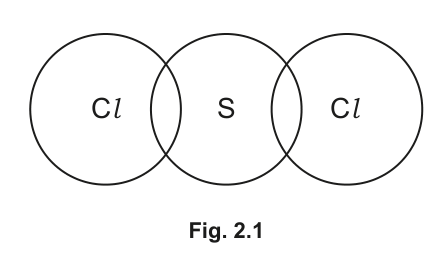
Answer
- Central S atom with 4 non-bonding electrons (dots, •) arranged as two lone pairs.
- Two Cl atoms, each with 6 non-bonding electrons (crosses, ×) arranged as three lone pairs.
- One shared pair (•×) between S and each Cl in the overlapping regions.
Dot-and-cross diagram: S has 2 lone pairs (4 dots), each Cl has 3 lone pairs (6 crosses), and each S-Cl bond has 1 dot and 1 cross.
Background Concept
A dot-and-cross diagram shows the arrangement of outer (valence) electrons in a covalent molecule. Electrons from one atom are typically shown as dots (•) and from the other as crosses (×). Shared pairs (bonds) sit in the overlap between atoms. Lone pairs (non-bonding pairs) sit outside the overlap on the respective atoms.
Sulfur is in Group 16, so it has 6 outer electrons. Chlorine is in Group 17, so it has 7 outer electrons.
Understanding the Question
We must complete the diagram for SCl₂, using × for Cl electrons and • for S electrons. The molecule has two S–Cl single bonds.
Approach
- Determine outer electrons: S (6), Cl (7 each). Total = 20.
- Form two S–Cl bonds: uses 4 electrons (2 from S, 2 from Cl).
- Remaining electrons: S has 4 left (2 lone pairs), each Cl has 6 left (3 lone pairs).
- Place them in the diagram according to the symbols specified.
Step-by-Step Reasoning
- Bonding pairs: In each overlap (S–Cl region), place one • (from S) and one × (from Cl). This represents the shared pair in the covalent bond.
- Lone pairs on S: S has 6 outer electrons; 2 are used in bonding. 4 remain. Place them as two lone pairs (4 •) around the central S atom, outside the overlaps.
- Lone pairs on Cl: Each Cl has 7 outer electrons; 1 is used in bonding. 6 remain. Place them as three lone pairs (6 ×) around each Cl atom, outside the overlap.
- Check total: 2 bonds (4 e⁻) + 2 lone pairs on S (4 e⁻) + 6 lone pairs on Cls (12 e⁻) = 20 e⁻. Correct.
Key Takeaways
Always count total valence electrons first. Ensure the correct symbol (• or ×) is used for each atom's electrons, and that lone pairs are placed on the correct atom.
Common Mistakes
- Using the same symbol for both atoms' electrons (e.g., all dots).
- Forgetting lone pairs on sulfur (S needs an octet, so 2 lone pairs).
- Placing too many or too few electrons in the bonds or lone pairs.
Things to Be Careful About
The question explicitly states: 'Use × to show electrons from the chlorine atoms. Use • to show electrons from the sulfur atom.' Mixing these up loses marks. Also, ensure lone pairs are clearly shown as separate pairs, not just 4 or 6 dots scattered randomly.
Predict the shape of, and bond angle in, a molecule of by using VSEPR theory.
shape:
bond angle:
Answer
shape: non-linear (or bent)
bond angle: 103–105°
shape: non-linear; bond angle: 103–105°
Background Concept
VSEPR (Valence Shell Electron Pair Repulsion) theory states that electron pairs (bonding and lone pairs) around a central atom arrange themselves to minimise repulsion. Lone pairs repel more strongly than bonding pairs, compressing bond angles.
For a central atom with 4 electron domains (2 bonding pairs + 2 lone pairs), the basic arrangement is tetrahedral (109.5°). With 2 lone pairs, the molecular shape is 'bent' or 'non-linear', and the bond angle is less than 109.5° (typically around 104.5° for water, and 103–105° for SCl₂).
Understanding the Question
Predict the shape and bond angle of SCl₂ using VSEPR theory. S is the central atom.
Approach
- Count electron domains around S: 2 bonding pairs (to Cl) + 2 lone pairs = 4 domains.
- Basic geometry: tetrahedral.
- Molecular shape (ignoring lone pairs for name): non-linear / bent.
- Bond angle: <109.5° due to lone pair repulsion. For SCl₂, it is 103–105°.
Step-by-Step Reasoning
- Sulfur has 6 outer electrons. It forms 2 single bonds with Cl atoms, using 2 electrons. 4 electrons remain as 2 lone pairs.
- Total electron domains = 4 (2 bonding + 2 lone pair).
- Electron geometry is tetrahedral.
- Molecular shape is determined by the positions of atoms only: non-linear (or bent / angular).
- Lone pairs repel bonding pairs more strongly, reducing the Cl–S–Cl bond angle from the ideal 109.5°. In SCl₂, this angle is 103–105°.
Key Takeaways
4 electron domains with 2 lone pairs → non-linear shape, bond angle <109.5°. Compare with water (H₂O) which has the same arrangement.
Common Mistakes
- Saying 'tetrahedral' for the shape: tetrahedral is the electron geometry, not the molecular shape.
- Giving the bond angle as exactly 109.5°: lone pairs compress the angle.
- Saying 'linear': this would be for 2 domains with 0 lone pairs (e.g., BeCl₂ gas).
Things to Be Careful About
The mark scheme accepts 'non-linear' or 'bent'. For the angle, give a value in the range 103–105°. Do not just say '<109.5°' without a specific value if the mark scheme asks for a prediction (though '<109.5' is often accepted, 103-105 is precise for SCl₂). Actually, CIE often accepts <109.5, but 103-105 is the specific value for SCl₂/Water-like molecules. I will provide 103-105° as per mark scheme.
Solid magnesium nitride, , is a crystalline solid.
Deduce the oxidation numbers of magnesium and nitrogen in magnesium nitride to complete Table 2.1.
Table 2.1
| oxidation number in | |
|---|---|
| magnesium | |
| nitrogen |
Answer
| oxidation number in Mg₃N₂ | |
|---|---|
| magnesium | +2 (or 2+) |
| nitrogen | –3 (or 3–) |
magnesium: +2; nitrogen: -3
Background Concept
Oxidation numbers in binary ionic compounds follow group trends. Group 2 metals (like Mg) always have an oxidation number of +2. Nitrogen, being in Group 15 and more electronegative than magnesium, takes an oxidation number of -3 in nitrides (N³⁻).
Understanding the Question
Deduce the oxidation numbers of Mg and N in Mg₃N₂.
Approach
- Mg is Group 2 → +2.
- N is Group 15, forms N³⁻ → -3.
- Check: 3(+2) + 2(-3) = 0. Correct.
Step-by-Step Reasoning
- Magnesium is an alkaline earth metal (Group 2), so it loses 2 electrons to form Mg²⁺. Oxidation number = +2.
- Nitrogen is a non-metal (Group 15) and is more electronegative than Mg. It gains 3 electrons to form N³⁻. Oxidation number = -3.
- The formula Mg₃N₂ balances the charges: 3 × (+2) + 2 × (-3) = 0.
Key Takeaways
Group 2 elements are always +2. In binary compounds with metals, Group 15 elements are -3.
Common Mistakes
- Giving nitrogen as +5 or -5: nitrogen is -3 in nitrides.
- Forgetting the sign: oxidation numbers must include + or -.
Things to Be Careful About
Write '+2' and '-3' (or '2+' and '3-'). The mark scheme accepts both formats.
Magnesium nitride reacts with an excess of water to produce ammonia and magnesium hydroxide only. Construct an equation to describe this reaction.
Answer
Mg3N2 + 6H2O -> 3Mg(OH)2 + 2NH3
Background Concept
Writing and balancing chemical equations from word descriptions requires identifying reactants and products, writing their correct formulae, and then balancing atoms on both sides.
Understanding the Question
Reactants: magnesium nitride (Mg₃N₂) and water (H₂O, excess).
Products: ammonia (NH₃) and magnesium hydroxide (Mg(OH)₂) only.
Approach
- Write unbalanced equation: Mg₃N₂ + H₂O → Mg(OH)₂ + NH₃
- Balance Mg: 3 on left → 3Mg(OH)₂ on right.
- Balance N: 2 on left → 2NH₃ on right.
- Balance O: 3 × 2 = 6 O on right → 6H₂O on left.
- Check H: 6 × 2 = 12 H on left. Right: 3 × 2 (from OH) + 2 × 3 (from NH₃) = 6 + 6 = 12 H. Balanced.
Step-by-Step Reasoning
- Unbalanced:
- Mg: 3 on left, so need 3 Mg(OH)₂.
- N: 2 on left, so need 2 NH₃.
- Now right side has 3×2 = 6 O atoms and (3×2)+(2×3) = 12 H atoms.
- Left side needs 6 H₂O to provide 6 O and 12 H.
- Final balanced equation:
- State symbols are not explicitly required by the mark scheme for this part, but if included: Mg₃N₂(s) + 6H₂O(l) → 3Mg(OH)₂(s) + 2NH₃(g). The mark scheme does not show state symbols in the answer line, so they are optional or ignored.
Key Takeaways
Always balance metals first, then non-metals, then H and O. Check your work by counting all atoms.
Common Mistakes
- Forgetting to multiply NH₃ by 2 (gives 1 N on right instead of 2).
- Balancing H before O, leading to fractional coefficients for water.
- Writing MgOH instead of Mg(OH)₂.
Things to Be Careful About
Ensure the formula for magnesium hydroxide is Mg(OH)₂, not MgOH. Ammonia is NH₃, not NH₄ (that's ammonium).
Explain why the solution produced in the reaction in (c)(ii) has a pH greater than 7. Refer to the products of the reaction in your answer.
Answer
- The solution contains OH⁻(aq) ions (from Mg(OH)₂), making it alkaline.
- Ammonia (NH₃) is a weak base that reacts with water (acid-base reaction) to produce OH⁻(aq) ions: .
- Alternatively, Mg(OH)₂ is slightly soluble and dissociates to give OH⁻(aq).
- The presence of OH⁻(aq) means pH > 7.
The products are Mg(OH)₂ (source of OH⁻) and NH₃ (weak base that reacts with water to form OH⁻), both making the solution alkaline (pH > 7).
Background Concept
A pH greater than 7 indicates an alkaline solution, which has a higher concentration of hydroxide ions (OH⁻) than hydrogen ions (H⁺). This can arise from:
- A soluble or slightly soluble base (like Mg(OH)₂) dissociating to release OH⁻.
- A weak base (like NH₃) reacting with water to accept a proton, leaving excess OH⁻.
Understanding the Question
Explain why the solution from (c)(ii) has pH > 7, referring to the products (Mg(OH)₂ and NH₃).
Approach
Identify the basic nature of both products and how they generate OH⁻(aq) in water.
- Mg(OH)₂ is a base (metal hydroxide). Even though it is sparingly soluble, the dissolved part dissociates: Mg(OH)₂(s) ⇌ Mg²⁺(aq) + 2OH⁻(aq).
- NH₃ is a weak base. In water: NH₃(aq) + H₂O(l) ⇌ NH₄⁺(aq) + OH⁻(aq).
Both processes increase [OH⁻], so pH > 7.
Step-by-Step Reasoning
- The reaction produces Mg(OH)₂ and NH₃.
- Mg(OH)₂ is a metal hydroxide (base). It is slightly soluble in water and dissociates to give OH⁻(aq) ions: .
- NH₃ is a weak base (non-metal hydride). It reacts with water in an acid-base reaction: .
- Both reactions produce OH⁻(aq) ions in solution.
- An increase in [OH⁻(aq)] means the solution is alkaline, so pH > 7.
Key Takeaways
Both metal hydroxides (even slightly soluble ones) and ammonia produce OH⁻ ions in water, leading to alkaline solutions.
Common Mistakes
- Saying 'Mg(OH)₂ is soluble': it is only slightly soluble/sparingly soluble, but enough to give pH > 7.
- Forgetting to mention NH₃'s basicity: the question says 'refer to the products', so both must be addressed or at least the main source of OH⁻.
- Saying 'NH₃ is a base' without explaining how (i.e., it produces OH⁻ with water).
Things to Be Careful About
The mark scheme gives 2 marks: M1 for OH⁻(aq) from Mg(OH)₂, M2 for either the acid-base reaction of NH₃ with water OR the dissociation of Mg(OH)₂. Ensure you mention OH⁻(aq) explicitly. State symbols are not strictly required but good practice.
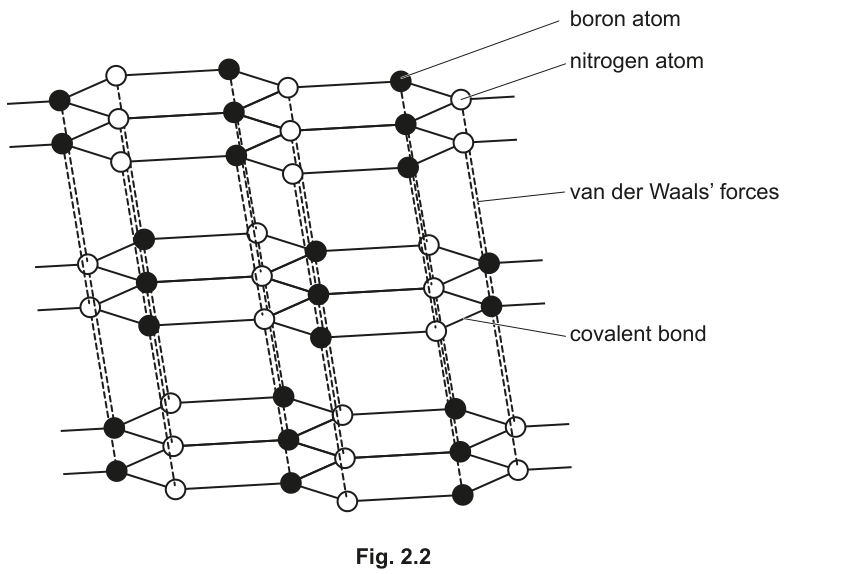
Boron nitride is a white solid that melts above 2900 °C.
Fig. 2.2 shows part of the lattice structure of a crystal of boron nitride.
Answer
BN
BN
Background Concept
The empirical formula of a giant covalent structure can be deduced from its lattice diagram by determining the ratio of atoms in the repeating unit. In a layered structure like graphite or boron nitride, each layer has a consistent ratio of atoms.
Understanding the Question
Fig 2.2 shows a layered lattice of boron (white circles) and nitrogen (black circles) atoms. We need the empirical formula.
Approach
Look at a single layer or the overall ratio. Each boron atom is bonded to 3 nitrogen atoms, and each nitrogen atom is bonded to 3 boron atoms. The ratio is 1:1.
Step-by-Step Reasoning
- In the diagram, every white circle (B) is surrounded by 3 black circles (N), and every black circle (N) is surrounded by 3 white circles (B).
- The bonding is symmetric: B–N bonds alternate.
- The ratio of B to N atoms is 1:1.
- Therefore, the empirical formula is BN.
Key Takeaways
In a structure where atoms alternate in a 1:1 ratio and each has the same coordination number, the empirical formula is 1:1.
Common Mistakes
- Counting atoms in a specific patch and getting a wrong ratio due to edge effects. Always look at the bonding environment (coordination number) or a full repeating unit.
- Writing B₂N₂: empirical formula must be the simplest whole number ratio.
Things to Be Careful About
The question asks for the empirical formula, so BN is correct, not B₂N₂ or BN₃.
Suggest the identity of another crystalline solid that has atoms arranged in layers similar to that of solid boron nitride.
Answer
graphite
graphite
Background Concept
Boron nitride (BN) exists in two main forms: hexagonal BN (h-BN) and cubic BN (c-BN). Hexagonal BN has a layered structure very similar to graphite. In both h-BN and graphite, atoms are arranged in hexagonal rings in layers, with weak van der Waals forces between the layers. This gives both materials similar properties (e.g., softness, lubricity, high melting point).
Understanding the Question
Suggest another crystalline solid with atoms arranged in layers similar to solid boron nitride (as shown in Fig 2.2).
Approach
Recall the classic example of a layered giant covalent structure: graphite.
Step-by-Step Reasoning
- Fig 2.2 shows layers of hexagonal rings with weak forces between layers.
- Graphite (C) has the exact same layered hexagonal structure.
- Therefore, graphite is the answer.
Key Takeaways
Graphite and hexagonal boron nitride are isomorphous; they share the same layered structure.
Common Mistakes
- Saying 'diamond': diamond is a 3D tetrahedral giant covalent structure, not layered.
- Saying 'silicon': silicon has a diamond-like structure, not layered.
- Saying 'iodine': iodine is molecular (I₂), not giant covalent layered.
Things to Be Careful About
'Graphite' is the standard and expected answer. 'Graphene' is a single layer, but the question asks for a 'crystalline solid', so graphite (the bulk solid) is more appropriate, though graphene is often accepted. Stick to graphite.
Answer
If a change in conditions is applied to a system at dynamic equilibrium, the equilibrium shifts in the direction that minimises (opposes) the change in conditions.
When a change in conditions is applied to a system at equilibrium, the equilibrium shifts to minimise the change in conditions.
Background Concept
Le Chatelier's principle describes how a reversible reaction at dynamic equilibrium responds when conditions (concentration, pressure, or temperature) are changed. At equilibrium the forward and reverse rates are equal, so concentrations are constant. A change in conditions disturbs this balance; the system responds by shifting the position of equilibrium — favouring either the forward or reverse reaction — in the direction that reduces (minimises) the effect of the change.
Understanding the Question
The command word is 'define', so a precise two-part statement is required: (1) the equilibrium shifts, and (2) it shifts so as to minimise/oppose the change. Each half earns one mark.
Approach
Learn the definition in two clauses. The mark scheme explicitly credits M1 'the equilibrium shifts' and M2 'to minimise the change in conditions'. Both ideas must be present.
Step-by-Step Reasoning
- M1: A change in conditions causes the equilibrium to shift — i.e. the system is no longer at the original position of equilibrium and the forward/reverse rates become temporarily unequal until a new equilibrium is reached.
- M2: The direction of that shift is such that the change in conditions is minimised (opposed) — the system counteracts the imposed change as far as it can, though it cannot undo it completely.
Key Takeaways
Le Chatelier's principle is a qualitative rule, not a calculation. Always phrase it as 'shifts to minimise/oppose the change' — vague answers like 'moves to the right' without context do not define the principle.
Common Mistakes
- Writing only 'the equilibrium shifts' without saying why or in what manner — this loses M2.
- Saying the shift 'reverses' or 'undoes' the change completely — it only minimises it.
- Confusing the principle with statements about rate (a change in conditions also changes rate, but that is not what the definition asks).
Things to Be Careful About
Use the words 'minimise' or 'oppose' exactly; examiners look for them. Do not mention specific conditions (temperature, pressure) in the definition unless asked — keep it general.
Reaction 1 describes the reversible reaction between yellow and colourless to produce red .
A mixture of , and is at equilibrium at 20 °C.
The temperature of this mixture is then increased to 50 °C and allowed to reach equilibrium.
Deduce the changes that occur, if any, in the equilibrium mixture at 50 °C compared to the equilibrium mixture at 20 °C.
-
change in appearance:
-
change in relative concentration of :
-
change in value of the equilibrium constant, :
Answer
- Change in appearance: the mixture becomes paler red / more yellow.
- Change in relative concentration of : lower.
- Change in value of : lower.
The forward reaction is exothermic ( negative), so raising the temperature shifts the equilibrium in the endothermic (reverse) direction to minimise the temperature rise. Less (red) is formed, so the red colour fades and the yellow of becomes more apparent. Since the reverse shift lowers relative to and , decreases.
Paler red / more yellow; [FeSCN2+] lower; Kc lower.
Background Concept
For an exothermic forward reaction ( negative), increasing the temperature adds heat to the system. By Le Chatelier's principle, the equilibrium shifts in the endothermic direction — here the reverse reaction — to absorb the added heat. Crucially, a temperature change is the only condition change that alters the value of : for an exothermic reaction, decreases as temperature rises (and increases as temperature falls). Concentration and pressure changes shift the position of equilibrium but leave unchanged.
Understanding the Question
Reaction 1 is exothermic in the forward direction and produces the red complex from yellow and colourless . The mixture is heated from 20 °C to 50 °C. You must deduce three things: the visible change, the change in , and the change in .
Approach
First identify the direction of the shift using the sign of . Then translate that shift into (a) the colour observed, (b) the concentration of the red species, and (c) the effect on using the rule that temperature is the only factor that changes .
Step-by-Step Reasoning
- The forward reaction is exothermic. Heating the mixture is 'adding heat', so the equilibrium shifts in the reverse (endothermic) direction to minimise the change.
- Reverse shift means decomposes back to and . The concentration of the red complex falls (M2), so the red colour fades — the mixture appears paler red or more yellow (M1).
- Because the equilibrium position has moved against the product, the ratio is smaller at the new equilibrium. Since equals exactly this ratio, must be lower at 50 °C than at 20 °C (M3). This is consistent with the general rule: for an exothermic reaction, decreases with increasing temperature.
Key Takeaways
- Temperature increase shifts an exothermic equilibrium backwards and decreases ; the reverse holds for endothermic reactions.
- Colour observations must be linked to species concentrations: red fades because the red complex concentration falls.
- Only temperature changes the value of — a very common exam discriminator.
Common Mistakes
- Saying the mixture becomes 'redder' — students often assume heating increases reaction rate and hence product; rate is not position of equilibrium.
- Stating is unchanged 'because only depends on temperature' — the logic is right but the conclusion is backwards: temperature HAS changed, so changes.
- Describing the colour as 'less red' without an acceptable alternative like 'paler red' or 'more yellow' — be specific.
Things to Be Careful About
Quote the sign of explicitly in your reasoning ('forward reaction is exothermic') — it anchors the whole argument. All three parts here are consequences of one shift; if you get the direction wrong, all three marks are lost, so check the sign of first.
In another experiment, equimolar amounts of and are mixed together and allowed to reach equilibrium. The total volume of the mixture is .
At equilibrium the mixture contains:
Calculate the initial amount, in mol, of added to to produce this mixture.
initial amount of = .............................. mol
Working
Since and react 1:1 and equimolar amounts were mixed, at equilibrium:
Initial (and ) = equilibrium value + amount converted to :
Answer
Initial amount of = mol
4.00 x 10^-5 mol
Background Concept
In an equilibrium mixture, the amount of product formed equals the amount of reactants consumed (for a 1:1 stoichiometry). So the initial concentration of a reactant = its equilibrium concentration + the concentration of product formed. To convert concentration to amount, use , with in dm³ (divide cm³ by 1000).
Understanding the Question
Equimolar and are mixed in a total volume of 25.0 cm³. At equilibrium, and mol dm⁻³. You must work backwards to find how much was added initially.
Approach
Build an ICE-style bookkeeping argument. Because the reaction is 1:1:1 and the starting amounts of and were equal, their equilibrium concentrations are equal. The amount of that reacted equals the amount of formed. Add that back to the equilibrium concentration to get the initial concentration, then multiply by the volume.
Step-by-Step Reasoning
- M1: The present at equilibrium ( mol dm⁻³) was formed from equal concentrations of and . So the initial concentration of each reactant was mol dm⁻³.
- M2: Convert to moles using the total volume of 25.0 cm³ = 0.0250 dm³:
Because equimolar amounts were added, this is also the initial amount of .
Key Takeaways
- For a 1:1 equilibrium with equimolar starting reactants, equilibrium concentrations of the reactants are equal.
- Initial = equilibrium + amount reacted (for a reactant).
- with in dm³ is the bridge between concentration and moles.
Common Mistakes
- Forgetting to add the concentration back, giving mol dm⁻³ and hence mol.
- Using the volume as 25.0 instead of 0.0250 dm³, giving an answer 1000× too large.
- Assuming at equilibrium is unknown and getting stuck — the equimolar condition makes it equal to .
Things to Be Careful About
Keep powers of ten tidy: , not . Give the final answer to 3 significant figures () to match the data's precision.
Calculate for reaction 1 and state its units.
Show your working.
= ..............................
units: ..............................
Working
At equilibrium, mol dm⁻³ and mol dm⁻³.
Units:
Answer
; units =
Kc = 178, units mol^-1 dm^3
Background Concept
For a general equilibrium , . The units of follow from the powers in this expression: units = . Here there is one product and two reactants, each to the power 1, so the units are .
Understanding the Question
You are given two equilibrium concentrations and must calculate for reaction 1, showing working, and state its units. The third equilibrium concentration, , comes from the equimolar argument in part (i): it equals mol dm⁻³.
Approach
Write the expression for reaction 1, substitute all three equilibrium concentrations, evaluate, then derive the units from the concentration powers in the expression.
Step-by-Step Reasoning
- — one species on top, two on the bottom, all to the power 1.
- Substitute: numerator ; denominator .
- (3 s.f.).
- Units: top has , bottom has , so units .
Key Takeaways
- Always write the expression from the balanced equation before substituting.
- Units of come from the difference in the number of concentration terms above and below the line.
- Equilibrium concentrations of reactants can often be deduced from stoichiometry rather than given directly.
Common Mistakes
- Using the initial concentration of () instead of the equilibrium concentration () — uses only equilibrium values.
- Writing the units as 'mol dm⁻³' by habit — here there is one more concentration term on the bottom, so the units are the inverse.
- Arithmetic slips with powers of ten: , not or .
Things to Be Careful About
Check whether the question expects to a specific number of significant figures — 178 (3 s.f.) matches the data. If a mark scheme shows without units, the units mark is still usually separate and required, so always state them.
Answer
The enthalpy change when one mole of a compound is formed from its elements in their standard states.
The enthalpy change when one mole of a compound is formed from its elements in their standard states.
Background Concept
Enthalpy changes are measured at constant pressure. The standard enthalpy change of formation, , is the enthalpy change when one mole of a compound is formed from its elements in their standard states, all substances being in their standard states at 298 K and 101 kPa.
Understanding the Question
The question asks for a definition. The mark scheme splits this into two marks: the enthalpy/energy change idea, and the condition that one mole of a compound is formed from its elements in their standard states.
Approach
State the definition directly, making sure both required parts are present: “one mole of a compound” and “from its elements in their standard states”.
Step-by-Step Reasoning
- M1: The quantity is an enthalpy or energy change.
- M2: It is the change when one mole of a compound (or substance) is formed from its elements, and those elements must be in their standard states.
The phrase “standard states” means the most stable form of each element at 298 K and 101 kPa, for example , and .
Key Takeaways
A formation definition must always include three ideas: one mole of product, formation from elements, and standard states.
Common Mistakes
- Missing “one mole” — the definition is per mole of compound formed.
- Saying “from its elements” without “standard states” — the standard states are required for the definition.
- Using “compound” only when the mark scheme also allows “substance” — either is acceptable.
Things to Be Careful About
Include the standard conditions (298 K and 101 kPa) if you mention them, but the essential wording is “one mole” and “standard states”. Do not confuse this with enthalpy change of combustion or atomisation.
Iron is made when iron(III) oxide is heated with carbon monoxide, as shown by reaction 2.
Table 4.1 shows enthalpy change of formation data measured at 298 K and 101 kPa.
Table 4.1
| substance | equation | value for / |
|---|---|---|
Complete Table 4.1 by adding equations with relevant state symbols to represent:
- standard enthalpy change of formation for
- standard enthalpy change of formation for CO.
Answer
For :
For CO:
2Fe(s) + 3/2O2(g) -> Fe2O3(s); C(s) + 1/2O2(g) -> CO(g)
Background Concept
A standard enthalpy change of formation equation always has one mole of the compound as the product, and the reactants are the elements in their standard states. Coefficients may be fractional because the product must be exactly one mole. Standard states at 298 K and 101 kPa are , and .
Understanding the Question
Table 4.1 already gives the equation for . We must add the corresponding formation equations for and CO, with correct state symbols.
Approach
For each compound, write the elements in their standard states on the left, put one mole of the compound on the right, then balance by adjusting coefficients, using fractions if necessary.
Step-by-Step Reasoning
For : the elements are and . Start with . Balance Fe: . Balance O: three O atoms on the right, so on the left. The balanced formation equation is .
For CO: elements are and . Start with . Balance O: one O atom on the right, so on the left. The equation is .
The product coefficient is 1 in both cases, as required for a formation equation.
Key Takeaways
Formation equations always have one mole of product; fractional coefficients for reactants are normal. State symbols are essential.
Common Mistakes
- Writing : this is a valid reaction but not a formation equation because two moles of are formed.
- Missing state symbols, especially (s) for Fe and C and (g) for .
- Using instead of — graphite is the standard state of carbon.
Things to Be Careful About
Use a fraction for when needed. The mark scheme accepts fractional coefficients. Always include state symbols.
Use the data in Table 4.1 to calculate the enthalpy change of reaction, , in , for reaction 2.
Show your working.
= ..............................
Working
Using :
Answer
-24.8 kJ mol^-1
Background Concept
Hess's law states that the enthalpy change of a reaction is independent of the route taken. Therefore, using standard enthalpy changes of formation,
Each term is multiplied by the stoichiometric coefficient of the substance in the balanced equation. Elements in their standard states have .
Understanding the Question
Reaction 2 is . Table 4.1 gives formation data for , CO and . We need to calculate in .
Approach
Identify products and reactants, multiply each formation enthalpy by its coefficient, subtract the sum for reactants from the sum for products.
Step-by-Step Reasoning
Products: 3 mol , so contribution kJ.
Reactants: 1 mol and 3 mol CO, so contribution kJ.
kJ mol.
The negative sign shows the reaction is exothermic.
Key Takeaways
Use formation data with Hess's law: products minus reactants, with stoichiometric coefficients. Check signs carefully.
Common Mistakes
- Forgetting to multiply by coefficients, especially 3 for CO and .
- Sign errors when subtracting a negative reactant sum.
- Using bond enthalpies instead of formation enthalpies.
- Omitting units or writing kJ instead of kJ mol.
Things to Be Careful About
The answer is per mole of reaction as written. The mark scheme allows error carried forward if the correct expression is set up with the three values and correct stoichiometry, even if arithmetic is wrong. Include the negative sign and the unit.
Hydrocarbon molecules contain covalent bonds.
Answer
(electrostatic) attraction between the nuclei of two atoms and a shared pair of electrons.
(electrostatic) attraction between the nuclei of two atoms and a shared pair of electrons.
Background Concept
A covalent bond is the fundamental bonding interaction in molecular compounds. It arises when two non-metal atoms share one or more pairs of valence electrons to achieve a stable electronic configuration (typically a full outer shell). The bonding force is the electrostatic attraction between the positively charged nuclei of the bonded atoms and the negatively charged shared electron pair(s) located between them.
Understanding the Question
Part (a) asks for a definition of a covalent bond. This is a standard recall question testing precise chemical terminology. The mark scheme specifically looks for the mention of 'attraction', 'nuclei' (or nucleus), and 'shared pair of electrons'.
Approach
Recall the formal definition of a covalent bond. Ensure all key components are present: the particles involved (nuclei, shared electrons) and the nature of the force (electrostatic attraction).
Step-by-Step Reasoning
- Identify the particles: two atoms (specifically their nuclei) and the shared electrons.
- Identify the force: electrostatic attraction.
- Combine: (electrostatic) attraction between nuclei of two atoms and shared pair of electrons.
Key Takeaways
Definitions in chemistry must be precise. 'Attraction between atoms and electrons' is not enough; you must specify nuclei and shared pair.
Common Mistakes
- Saying 'attraction between two atoms and electrons' (missing 'nuclei' and 'shared pair').
- Saying 'sharing of electrons' (this describes the mechanism, not the bond itself, which is the attractive force).
Things to Be Careful About
Always include 'electrostatic' if possible, though 'attraction' alone is often accepted. Ensure 'nuclei' is plural if referring to two atoms.
A C=C bond in an alkene is made from a bond and a bond.
Answer
sp^2
Background Concept
Hybridisation is the concept of mixing atomic orbitals to form new, equivalent hybrid orbitals suitable for the geometry of the molecule. In ethene () and other alkenes, each carbon atom is bonded to three other atoms (one carbon and two hydrogens, or similar groups). To achieve this trigonal planar geometry with bond angles of approximately , the carbon atom mixes one orbital and two orbitals to form three hybrid orbitals. The remaining unhybridised orbital is perpendicular to the plane of the hybrid orbitals and forms the bond.
Understanding the Question
Part (b)(i) asks for the hybridisation of the carbon atoms involved in the double bond in an alkene.
Approach
Recall the hybridisation state of carbons in alkenes. Carbon atoms forming a double bond (and bonded to three groups total) are hybridised.
Step-by-Step Reasoning
- Identify the bonding environment of the carbon in : it has 3 sigma bonds and 1 pi bond.
- Steric number = 3 (3 sigma bonds, 0 lone pairs).
- Steric number 3 corresponds to hybridisation.
Key Takeaways
- Alkane carbons (): (tetrahedral, ).
- Alkene carbons (): (trigonal planar, ).
- Alkyne carbons (): (linear, ).
Common Mistakes
- Confusing with or .
- Writing 'sp2' instead of '' (superscript is important).
Things to Be Careful About
Ensure the superscript is clear: , not sp2.
Draw labelled diagrams to show, in terms of orbital overlap, how the and bonds are made in a C=C bond.
bond
bond
Answer
bond:
bond:
Diagram showing head-on overlap of sp2 orbitals for sigma bond; diagram showing sideways overlap of p orbitals for pi bond.
Background Concept
A carbon-carbon double bond () consists of one (sigma) bond and one (pi) bond.
- bond: Formed by the direct (head-on) overlap of two hybrid orbitals (e.g., ) along the internuclear axis. This overlap is strong and allows free rotation.
- bond: Formed by the sideways (lateral) overlap of two unhybridised orbitals that are parallel to each other and perpendicular to the internuclear axis. The electron density is concentrated above and below the plane of the atoms.
Understanding the Question
Part (b)(ii) asks for labelled diagrams showing how the and bonds are formed in terms of orbital overlap in a bond.
Approach
Draw two separate diagrams:
- For the bond: Show two orbitals overlapping end-to-end.
- For the bond: Show two orbitals overlapping side-by-side.
Label the orbitals and the type of overlap.
Step-by-Step Reasoning
bond diagram:
- Draw two hybrid orbitals (often drawn as dumbbells with one large lobe).
- Position them along a horizontal axis (internuclear axis).
- Show them overlapping directly head-on in the region between the nuclei.
- Label as '' or 'hybrid orbital' and indicate 'direct overlap' or 'head-on overlap'.
bond diagram:
- Draw two unhybridised orbitals (dumbbells with two lobes of equal size).
- Position them parallel to each other, perpendicular to the internuclear axis (e.g., vertical if the axis is horizontal).
- Show them overlapping sideways above and below the internuclear axis.
- Label as '' or '' and indicate 'sideways overlap'.
Key Takeaways
- bonds are always formed by head-on overlap (s-s, s-p, p-p, or hybrid orbitals).
- bonds are always formed by sideways overlap of parallel orbitals.
- The bond is stronger than the bond due to greater orbital overlap.
Common Mistakes
- Drawing the bond overlap along the internuclear axis (that would be a bond).
- Forgetting to label the orbitals (e.g., '' orbitals).
- Drawing the bond using orbitals (while technically possible for bonds, in alkenes it's -).
Things to Be Careful About
- Ensure the diagrams clearly distinguish between head-on and sideways overlap.
- Labels are crucial: mark ' (orbitals)' for the bond diagram.
In electrophilic reactions involving alkenes the bond of C=C is broken.
Suggest one difference between and bonds that explains why the bond is broken in electrophilic addition reactions involving alkenes.
Answer
The electrons in the bond are further from the nuclei (than those in the bond), so the electrostatic attraction to the nuclei is weaker (making them more available to be attacked by electrophiles).
The electrons in the pi bond are further from the nuclei, resulting in weaker attraction.
Background Concept
Electrophilic addition reactions occur at the double bond because the bond is a region of high electron density. However, not all electrons in the double bond are equally accessible. The bond electrons are held tightly between the nuclei along the internuclear axis. The bond electrons are located in lobes above and below the plane of the molecule, further away from the direct line between the nuclei.
Understanding the Question
Part (c)(i) asks for a difference between and bonds that explains why the bond is broken (rather than the bond) during electrophilic addition.
Approach
Compare the position of the electrons in and bonds relative to the nuclei. Explain how this position affects the strength of the electrostatic attraction and thus the bond strength/reactivity.
Step-by-Step Reasoning
- In a bond, the electron density is concentrated above and below the internuclear axis, further away from the positively charged nuclei.
- In a bond, the electron density is concentrated directly between the nuclei, closer to them.
- Coulomb's law states that electrostatic attraction decreases with distance. Therefore, the attraction between the nuclei and the electrons is weaker than for the electrons.
- Because the electrons are less tightly held (weaker attraction), they are more easily donated to an electrophile, leading to the breaking of the bond.
Key Takeaways
- bonds are weaker and more reactive than bonds partly because their electrons are further from the nuclei.
- This makes bonds the site of attack in electrophilic addition reactions.
Common Mistakes
- Saying ' bonds are weaker' without explaining why (the question asks for the difference that explains why it's broken).
- Saying ' bonds have more electrons' (both have 2 electrons).
- Forgetting to mention 'distance from nuclei' or 'attraction'.
Things to Be Careful About
- The mark scheme accepts either 'pi electrons further away -> weaker attraction' OR 'sigma electrons closer -> stronger attraction'. Ensure the logic is clear.
Complete Fig. 5.1 to show the mechanism for the electrophilic addition of hydrogen bromide to 2-methylpropene to produce the major organic product.
Include charges, dipoles, lone pairs of electrons and curly arrows, as appropriate.
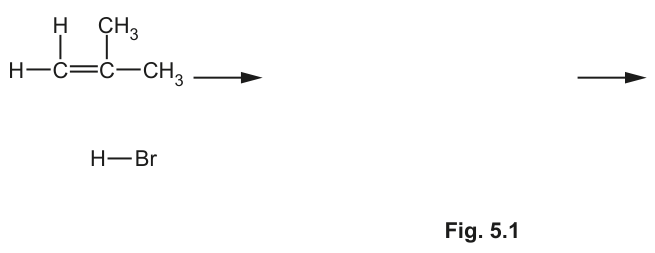
Answer
Step 1:
Step 2:
(See detailed mechanism below for full structure)
Overall Mechanism Description:
- Curly arrow from the double bond to the of (which has on and on ).
- Curly arrow from the bond to the atom.
- Intermediate formed: tertiary carbocation (-methylpropan--yl cation, ) and bromide ion ( with 3 lone pairs).
- Curly arrow from a lone pair on to the positively charged carbon () of the carbocation.
- Final product: -bromo--methylpropane ().
See mechanism diagram: HBr adds to 2-methylpropene via tertiary carbocation intermediate to form 2-bromo-2-methylpropane.
Background Concept
Electrophilic addition to alkenes involves the attack of an electrophile (like from ) on the electron-rich bond. The mechanism proceeds in two main steps:
- Formation of carbocation: The electrons attack the electrophile, breaking the bond and forming a carbocation intermediate. Markovnikov's rule dictates that the hydrogen adds to the carbon with more hydrogens, forming the more stable carbocation (tertiary > secondary > primary).
- Nucleophilic attack: The nucleophile (bromide ion, ) attacks the carbocation to form the final product.
Curly arrows show the movement of electron pairs. They always start from a lone pair or a bond (source of electrons) and point to the atom or bond receiving the electrons (destination). Dipoles (, ) show bond polarity. Charges (, ) show formal charges on ions.
Understanding the Question
Part (c)(ii) asks to complete the mechanism for the electrophilic addition of to -methylpropene () to produce the major organic product. The starting material is given in Fig 5.1. We need to add dipoles, curly arrows, the intermediate, and the final product.
Approach
- Dipoles: is more electronegative than , so has on and on .
- Step 1 (Electrophilic attack): Draw a curly arrow from the double bond to the of . Draw a curly arrow from the bond to .
- Intermediate: Determine the carbocation. adds to the end (Markovnikov) to form the more stable tertiary carbocation: . Draw with lone pairs.
- Step 2 (Nucleophilic attack): Draw a curly arrow from a lone pair on to the of the carbocation.
- Product: -bromo--methylpropane.
Step-by-Step Reasoning
Initial Setup:
- Reactant: -methylpropene (). In Fig 5.1, it's drawn as (actually the image shows , which is the same).
- Reagent: . Add dipoles: .
Step 1:
- Arrow 1: From the center of the double bond to the atom of . (This breaks the bond and forms a bond).
- Arrow 2: From the center of the bond to the atom. (This breaks the bond heterolytically, giving both electrons to ).
- Intermediate: The adds to the carbon (the one with more hydrogens). The other carbon (the one with two methyl groups) becomes positively charged. This is a tertiary carbocation: . Draw it with a '+' charge on the central carbon. Draw with 3 lone pairs (6 dots) and a '-' charge.
Step 2:
- Arrow 3: From a lone pair on to the positively charged carbon () of the carbocation. (This forms the bond).
- Product: is now bonded to the central carbon. The product is -bromo--methylpropane: .
Key Takeaways
- Always show dipoles on polar reagents like .
- Curly arrows start from electrons (bond or lone pair) and go to the atom/bond being formed.
- Follow Markovnikov's rule: H adds to the carbon with more H's to form the most stable carbocation.
- Show all lone pairs and charges in intermediates.
Common Mistakes
- Drawing the arrow from bond to (wrong direction).
- Forming the wrong carbocation (primary instead of tertiary) - violates Markovnikov's rule.
- Forgetting the lone pairs on .
- Forgetting the '+' charge on the carbocation or '-' charge on bromide.
- Drawing the arrow from to (arrows must show electron movement, so from lone pair to ).
Things to Be Careful About
- The question asks for the major organic product. For -methylpropene + , the major product is -bromo--methylpropane (tertiary bromide). The minor product would be -bromo--methylpropane.
- Ensure the structure of -methylpropene is correctly interpreted from Fig 5.1. It is .
- In the intermediate, the carbon with the '+' charge should be clearly marked.
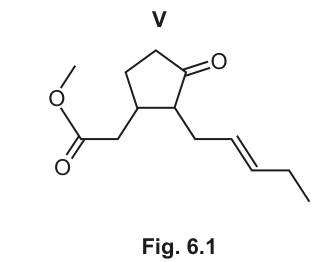
V shows stereoisomerism.
Answer
Stereoisomers have the same structural formula (and same molecular formula) but a different arrangement of atoms or groups in space.
Same structural formula but different arrangement of atoms/groups in space
Background Concept
Isomerism in organic chemistry is broadly divided into structural (constitutional) isomerism, where atoms are bonded in a different order, and stereoisomerism, where the bonding sequence is identical but the three-dimensional arrangement differs. Stereoisomerism itself has two main types: geometrical (cis/trans or E/Z) arising from restricted rotation around a C=C double bond or in a ring, and optical arising from chiral centres (carbon atoms bonded to four different groups). The defining feature that unites all stereoisomers is that the connectivity is unchanged; only the spatial orientation differs.
Understanding the Question
The command word is 'explain what is meant by', which for a definition question requires a precise, complete statement. The mark scheme awards the mark for stating that the molecules share the same structural (and molecular) formula but differ in the arrangement of atoms/groups in space.
Approach
Recall the standard textbook definition and ensure both halves are present: identical formula/connectivity AND different 3D arrangement. Omitting either half loses the mark.
Step-by-Step Reasoning
The phrase 'same structural formula' establishes that the connectivity is identical (this distinguishes stereoisomerism from structural isomerism). The phrase 'different arrangement of atoms/groups in space' establishes that the molecules differ only in 3D orientation (this captures both optical and geometrical cases). Together these constitute the full definition worth the single mark.
Key Takeaways
A complete definition of stereoisomerism must mention both the identical connectivity and the differing spatial arrangement. The general phrase 'arrangement in space' covers both cis/trans and optical isomerism.
Common Mistakes
Stating only 'different arrangement in space' without noting the same structural formula is incomplete. Confusing stereoisomerism with structural isomerism (different bonding order) is wrong. Saying 'different molecular formula' is incorrect — stereoisomers share the same molecular formula.
Things to Be Careful About
Use the word 'space' (or '3D arrangement'); a vague 'different shape' may not be credited. The mark scheme accepts 'same molecular formula' as an alternative phrasing.
Answer
Number of stereoisomers = 8.
Reasoning: V has 2 chiral centres (the two ring carbons bearing the side chains) and 1 C=C double bond capable of cis/trans (E/Z) isomerism. The two chiral centres give optical arrangements, and the C=C doubles this to .
8
Background Concept
The number of stereoisomers a molecule can have is governed by its stereogenic elements. Each chiral centre (a carbon with four different groups) can exist in two configurations (R or S), so n chiral centres give up to optical isomers (assuming no internal symmetry creating meso forms). Independently, each C=C double bond where both carbons carry two different substituents can be either cis (Z) or trans (E), giving a factor of 2 per such bond. When both types are present, the total number of stereoisomers is (one factor of 2 per geometrical bond).
Understanding the Question
Compound V is a cyclopentanone ring. Looking at Fig. 6.1, two ring carbons are substituted: one bears the ester side chain and the other bears the alkenyl side chain. Each of these substituted ring carbons is bonded to four different groups (H, the side chain, and two different ring paths), so both are chiral centres. The side chain also contains one C=C double bond with different groups on each carbon, giving geometrical isomerism. The task is to deduce the total number and justify it.
Approach
Count the chiral centres (2) and the geometrical double bonds (1). Apply . The mark scheme wants M1 = 8 and M2 = the reasoning naming 2 chiral centres AND 1 C=C producing cis/trans.
Step-by-Step Reasoning
The ring carbon attached to the ester side chain: its four substituents are H, the group, and the two ring directions (one leading toward the C=O, the other toward the other chiral centre) which are different — hence chiral. The ring carbon attached to the alkenyl side chain is likewise chiral by the same argument. That is 2 chiral centres → optical combinations. The internal C=C in the side chain has H and ring-alkyl on one carbon and H and ethyl on the other, so it can be E or Z → factor of 2. Total = . There is no symmetry that would reduce this to meso forms because the two chiral centres carry different side chains.
Key Takeaways
Combine the optical () and geometrical (×2 per C=C) contributions multiplicatively. Always check each substituted ring carbon for chirality and each double bond for the 'two different groups on each carbon' condition.
Common Mistakes
Forgetting the C=C and answering 4. Forgetting one chiral centre and answering 4 (from 1 chiral + 1 C=C) or 2. Not recognising ring carbons as chiral centres. Assuming meso reduction when the two centres are different.
Things to Be Careful About
Both marks must be present: the correct number AND the reasoning that names both the chiral centres and the C=C. Stating '8' with no explanation scores only M1.
Answer
C13H20O3
Background Concept
In a skeletal (line-angle) formula, carbon atoms sit at each vertex and line-end, and hydrogen atoms attached to carbon are omitted but implied so that each carbon has four bonds. Heteroatoms (O here) and hydrogens on heteroatoms are shown explicitly. The molecular formula is obtained by tallying all C, H, and O atoms.
Understanding the Question
From Fig. 6.1, V is a cyclopentanone ring (5 carbons) bearing a ketone oxygen, an ester side chain , and an alkenyl side chain . We must count all atoms to give the molecular formula.
Approach
Count carbons by region, then hydrogens by satisfying tetravalency at each carbon, then oxygens by inspection.
Step-by-Step Reasoning
Carbons: ring = 5; ester side chain = 3; alkenyl side chain = 5. Total C = 5 + 3 + 5 = 13. Oxygens: ketone = 1; ester has 2 (one C=O, one C-O-C) = 2. Total O = 3. Hydrogens: ring CH2 (top) = 2; two ring CH (substituted) = 1 each = 2; ring CH2 (the two remaining ring CH2 are the top one already counted and... recounting the cyclopentanone ring: C1=O, C2(H)(sidechain), C3(H2), C4(H)(sidechain), C5(H2) → ring H = 1+2+1+2 = 6; ester = 2, = 3; alkenyl = 2, = 2, = 2, = 3. Total H = 6 + 2 + 3 + 2 + 2 + 2 + 3 = 20. Hence .
Key Takeaways
Systematic region-by-region counting prevents errors. Remember implicit hydrogens on skeletal carbons and that carbonyl carbons carry no hydrogen.
Common Mistakes
Miscounting ring hydrogens (each substituted ring carbon has only one H). Forgetting the methyl hydrogen on the ester. Writing an incorrect H count like 22 or 18.
Things to Be Careful About
The double bond reduces the hydrogen count by 2 relative to the saturated analogue; ensure the ketone and ester carbons are not given hydrogens.
Answer
Ester, ketone (carbonyl), and alkene (C=C double bond).
ester, ketone (carbonyl), alkene (C=C)
Background Concept
Functional groups are the reactive atom arrangements that define a compound's chemistry. In V we have a C=O within a ring flanked by carbons (a ketone), a linkage (an ester), and a C=C (an alkene).
Understanding the Question
The command word 'name all' requires every distinct functional group to be listed; the mark scheme awards the single mark only when all three are present.
Approach
Scan the structure for each characteristic group: C=O not at a chain end and not in an acid/ester = ketone; -COO- = ester; C=C = alkene.
Step-by-Step Reasoning
The ring C=O bonded to two carbons is a ketone (carbonyl). The group is an ester. The side-chain C=C is an alkene. All three must be named.
Key Takeaways
Distinguish a ketone carbonyl from an ester carbonyl; an ester contains the additional C-O-C oxygen. The C=C is a functional group in its own right.
Common Mistakes
Naming the ester's C=O separately as a ketone (the ester group includes its carbonyl). Omitting the alkene. Calling the ketone an aldehyde.
Things to Be Careful About
The mark scheme requires all three (ester AND ketone/carbonyl AND alkene/C=C) for the one mark.
Fig. 6.2 shows two reactions involving V.
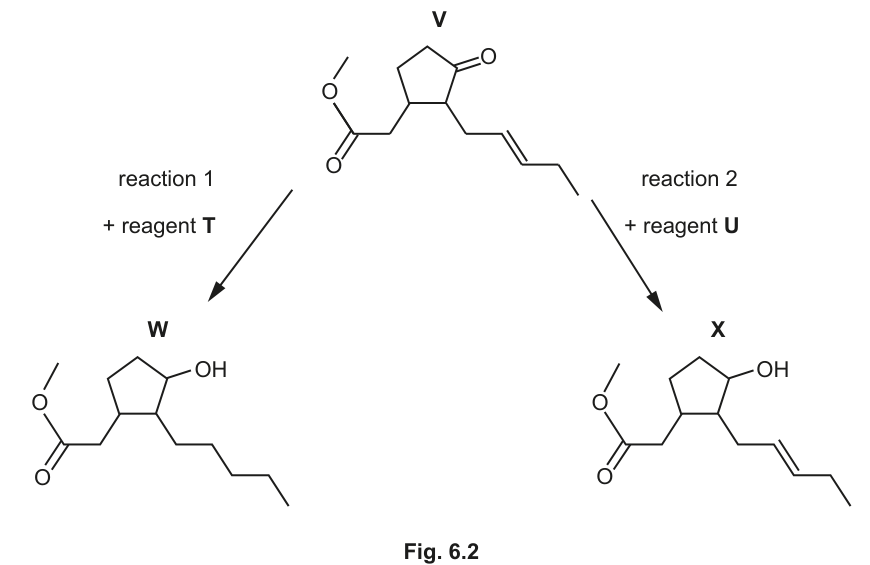
Answer
Reagent T acts as a reducing agent for both the C=O (ketone) group and the C=C (alkene) group.
reducing agent for C=O and C=C
Background Concept
Reduction in organic chemistry corresponds to gain of hydrogen (or loss of oxygen). A reagent that adds hydrogen across a C=O to give an alcohol, and across a C=C to give an alkane, is functioning as a reducing agent (e.g. catalytic hydrogenation with Ni/Pt adds H2 to both types of multiple bond). The ester group in V is unchanged in W, so T is selective for the ketone and alkene.
Understanding the Question
Fig. 6.2 shows V → W with reagent T: the ketone becomes a secondary alcohol (OH) and the C=C becomes a saturated alkyl chain, while the ester remains. The task is to state the role of T for each group that reacts.
Approach
Identify the two groups that changed (C=O and C=C) and label T's role as reducing agent for each.
Step-by-Step Reasoning
C=O → CH-OH is a reduction (gain of H). C=C → C-C is also a reduction (addition of H2). Hence T is a reducing agent toward both the carbonyl and the alkene. The ester is untouched, so it is not part of the answer.
Key Takeaways
Recognise reduction by the gain of hydrogen at a multiple bond. A reagent that reduces both C=O and C=C is a reducing agent (e.g. H2/Ni).
Common Mistakes
Calling T an oxidising agent or a catalyst without the 'reducing agent' role. Including the ester as reacting.
Things to Be Careful About
The mark requires 'reducing agent' applied to BOTH C=O and C=C for the one mark.
Answer
Sodium borohydride, .
NaBH4 (sodium borohydride)
Background Concept
is a mild hydride reducing agent that reduces aldehydes and ketones to alcohols but does not reduce isolated C=C double bonds or esters under normal conditions. This selectivity contrasts with catalytic hydrogenation (H2/Ni), which reduces C=C as well.
Understanding the Question
In V → X (Fig. 6.2), only the ketone is reduced to a secondary alcohol; the C=C and the ester remain. We must suggest a reagent U that achieves this selective reduction.
Approach
Choose the reagent known to reduce ketones selectively without touching alkenes: .
Step-by-Step Reasoning
The product X retains the C=C (visible in Fig. 6.2) and the ester, but the C=O is now OH. A hydride donor that targets only the carbonyl is required, which is (used in aqueous/ethanol solution). would also reduce the ester, so it is not appropriate; /Ni would reduce the C=C. Hence U = .
Key Takeaways
reduces aldehydes/ketones only; is stronger and also reduces esters/acids; catalytic hydrogenation reduces C=C.
Common Mistakes
Suggesting (would reduce the ester too) or /Ni (would reduce the C=C too).
Things to Be Careful About
The reagent must leave both the C=C and the ester intact, matching product X exactly.
Both functional groups in one molecule of Y react with an inorganic reagent to form one molecule of Q and one molecule of methanol, , as shown in Fig. 6.3.
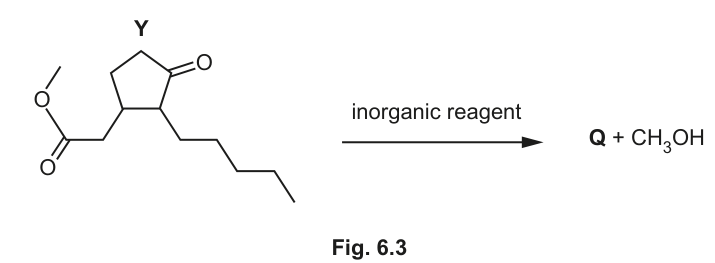
Part of the mass spectrum for Q is shown in Fig. 6.4. Only peaks with m/e greater than 198 are shown.
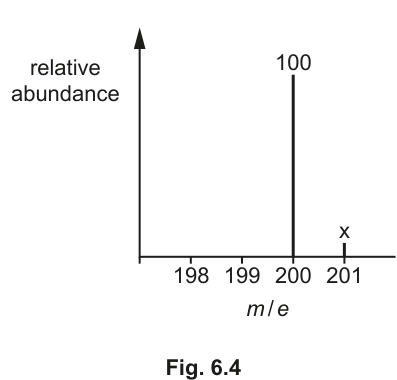
Calculate the relative abundance, x, of the peak at m/e = 201.
Show your working.
x = ..............................
Working
The molecular ion of Q is at m/e = 200. Q is formed from Y by hydrolysis of the ester, losing (mass 32), so Y has and Q has 12 fewer mass units; the number of carbon atoms in Q is .
The [M+1] peak arises from , contributing about per carbon atom:
Answer
x = 13.2
13.2
Background Concept
In a mass spectrum the molecular ion peak (M) corresponds to the molecule containing the most abundant isotopes (, , ). A small peak at M+1 comes mainly from molecules containing one atom. Because is about 1.1% abundant relative to , the relative height of the M+1 peak compared with M is approximately (number of carbon atoms). Thus when M is set to 100.
Understanding the Question
Fig. 6.4 shows M at m/e = 200 (abundance 100) and the M+1 peak at m/e = 201 with abundance x. We must calculate x. To do so we need the number of carbons in Q. Q is produced from Y by reaction of the ester with an inorganic reagent (aqueous hydroxide/acid hydrolysis) releasing ; the mark scheme indicates Q has carbons (Y has 13 carbons; loss of the methyl carbon of methanol leaves 12 in Q).
Approach
Deduce for Q, then apply .
Step-by-Step Reasoning
Y has the same carbon skeleton as V (13 C). Hydrolysis of the ester cleaves off the of methanol, so Q retains 12 carbons (the carboxylate/acid carbon stays in Q). The M+1/M ratio = , so with M = 100, x = 13.2. (Equivalently .)
Key Takeaways
The M+1 peak height relative to M gives the carbon count via the 1.1%-per-carbon factor; conversely, knowing the carbon count lets you predict x. Track how many carbons remain in Q after losing methanol.
Common Mistakes
Using n = 13 (the carbon count of Y/V) instead of 12 for Q, giving x = 14.3. Forgetting that methanol's methyl carbon is removed from Q.
Things to Be Careful About
The 1.1% contribution is per carbon; the formula assumes the dominant M+1 source is (oxygen/hydrogen contributions are negligible here).
Q contains only hydroxyl functional groups.
Complete Table 6.1 to show the observations that occur when 2,4-dinitrophenylhydrazine (2,4-DNPH reagent) is added to separate samples of Y and Q.
Table 6.1
| observation on addition of 2,4-DNPH reagent | |
|---|---|
| Y | |
| Q |
Answer
| observation on addition of 2,4-DNPH reagent | |
|---|---|
| Y | orange precipitate |
| Q | no precipitate (no reaction) |
Y: orange precipitate; Q: no precipitate
Background Concept
2,4-Dinitrophenylhydrazine (2,4-DNPH, Brady's reagent) reacts with aldehydes and ketones (the C=O carbonyl) to give an orange/yellow-red precipitate of a hydrazone. It is a positive test for the presence of a carbonyl group. Compounds lacking a C=O (e.g. alcohols, carboxylic acids, esters under these conditions, diols) give no precipitate.
Understanding the Question
Y is the saturated analogue of V that still contains the ketone C=O (Fig. 6.3 shows Y with a ketone and an ester). Q, formed by hydrolysis of the ester with the inorganic reagent, contains only hydroxyl groups (per the question stem) — i.e. the ketone has also been reduced/absent in Q, leaving a diol. We must give the observation for each.
Approach
Y has a C=O → positive (orange precipitate). Q has no C=O (only OH groups) → negative (no precipitate).
Step-by-Step Reasoning
Y retains the ketone carbonyl, so 2,4-DNPH gives an orange precipitate. Q is stated to contain only hydroxyl functional groups, so there is no carbonyl to react; the solution remains clear with no precipitate.
Key Takeaways
2,4-DNPH detects carbonyls (aldehydes/ketones) with an orange precipitate; its absence of reaction indicates no carbonyl is present.
Common Mistakes
Saying Q gives an orange precipitate (Q has no C=O). Confusing 2,4-DNPH with Tollens'/Fehling's (which distinguish aldehyde vs ketone, not presence/absence of carbonyl).
Things to Be Careful About
Both observations must be correct for the single mark; 'orange precipitate' (or yellow/red) for Y and 'no precipitate / no reaction' for Q.
Under certain conditions, 0.0020 mol of Q reacts with an excess of sodium to produce a total of of gas at s.t.p.
Calculate the number of hydroxyl groups present in a molecule of Q.
Show your working.
number of hydroxyl groups = ..............................
Working
Each hydroxyl group reacts with sodium as:
so .
Moles of ... using at s.t.p.:
Moles of OH groups = .
Per molecule: .
Answer
number of hydroxyl groups = 2
2
Background Concept
Sodium metal reacts with each hydroxyl (O-H) group of an alcohol to liberate hydrogen gas: . Thus two moles of OH groups produce one mole of , i.e. each OH contributes mol . At s.t.p. one mole of gas occupies (or at room temperature; the question specifies s.t.p., so use 22400).
Understanding the Question
0.0020 mol of Q (a diol candidate) reacts with excess Na to give of at s.t.p. We must find how many OH groups each molecule of Q contains.
Approach
Convert the gas volume to moles of , double it to get moles of OH, then divide by moles of Q to get OH per molecule.
Step-by-Step Reasoning
. Since , moles of OH = . With 0.0020 mol of Q present, OH per molecule = . Hence Q is a diol with 2 hydroxyl groups, consistent with part (ii) where Q had no carbonyl.
Key Takeaways
The Na–alcohol reaction gives a clean ratio; combining it with the ideal-gas volume at s.t.p. lets you count OH groups per molecule.
Common Mistakes
Using 24000 instead of 22400 (the question says s.t.p.). Forgetting the factor of 2 between OH and , giving 1 OH. Mis-dividing the mole ratio.
Things to Be Careful About
State the relationship (M1) and then use the data to reach 2 (M2); both are needed.
Use Table 6.2 to describe and explain two differences between the infrared spectrum of Y and Q in the region above .
Table 6.2
| bond | functional groups containing the bond | characteristic infrared absorption range (in wavenumbers) / |
|---|---|---|
| C–O | hydroxy, ester | 1040–1300 |
| C=C | aromatic compound, alkene | 1500–1680 |
| C=O | amide carbonyl, carboxyl ester | 1640–1690 1670–1740 1710–1750 |
| CN | nitrile | 2200–2250 |
| C–H | alkane | 2850–2950 |
| N–H | amine, amide | 3300–3500 |
| O–H | carboxyl hydroxy | 2500–3000 3200–3650 |
Answer
- Y has a strong absorption (peak/trough) in the range due to the C=O (ketone) bond; Q has no such absorption because it has no carbonyl group.
- Q has a broad absorption in the range due to the O-H (hydroxyl) bond; Y has no such absorption because it has no hydroxyl group.
Y: C=O peak 1670-1740 cm-1 (Q none); Q: O-H peak 3200-3650 cm-1 (Y none)
Background Concept
Infrared spectroscopy detects bond vibrations; each bond type absorbs over a characteristic wavenumber range. A C=O stretch appears as a strong peak around 1670–1740 cm⁻¹ (for ketones/carbonyls), while an O-H stretch of an alcohol appears as a broad peak around 3200–3650 cm⁻¹. Comparing two spectra reveals which functional groups are present or absent.
Understanding the Question
Y contains a ketone C=O and an ester but no hydroxyl; Q (the diol product) contains hydroxyl groups but no carbonyl. Using Table 6.2, describe and explain two differences above 1500 cm⁻¹.
Approach
For each difference, name the absorption range, the bond responsible, and which molecule has it and which lacks it, tying it to the functional-group difference.
Step-by-Step Reasoning
Difference 1: Y shows a peak at 1670–1740 cm⁻¹ (C=O of the ketone); Q does not, because Q has no carbonyl (it was reduced/lost). Difference 2: Q shows a broad peak at 3200–3650 cm⁻¹ (O-H of the hydroxyl groups); Y does not, because Y has no hydroxyl. Both the observation (range + bond) and the explanation (group present/absent) are needed for each mark.
Key Takeaways
IR differences between two compounds map directly onto their functional-group differences; quote the wavenumber range, the bond, and the reason.
Common Mistakes
Quoting the C-O range (1040–1300), which is below 1500 and outside the requested region. Saying both have C=O or both have O-H. Failing to explain why the peak is present/absent.
Things to Be Careful About
Restrict to the region above 1500 cm⁻¹ (so C-O is excluded). Use the exact ranges from Table 6.2 and link each to the correct molecule.