Chemistry 9701/13 — May/June 2024
Cambridge AS Level · Multiple Choice (AS Level) · answer key with instant marking and worked solutions
Topics Atoms, Molecules and Stoichiometry · Electrochemistry · Group 2 · Chemical Bonding · Introduction to Organic Chemistry · Hydrocarbons · +16 more
Tap an option under each question to check it — your score builds as you go.
X is an impure sample of a Group 2 metal carbonate, . X contains 57% by mass of .
The impurities in X do not react with hydrochloric acid.
7.4 g of X is reacted with an excess of dilute hydrochloric acid.
0.050 mol of the Group 2 metal chloride is produced.
What is the identity of the Group 2 metal?
Options
A Mg
B Ca
C Sr
D Ba
Working
Mass of pure in the sample:
The reaction is:
Mole ratio , so:
Molar mass of :
Mass of = 60, so:
Answer
A — Mg
A
Background Concept
Group 2 metals form +2 ions, so their carbonate and chloride formulae are and . When a carbonate reacts with an acid, carbon dioxide is released:
The key stoichiometric fact is that one formula unit of carbonate produces one formula unit of chloride, because each contains one metal ion. The sample is impure: 57% by mass is and the rest is inert. Only the carbonate reacts with the acid, so the amount of chloride formed tells us the amount of pure carbonate that was present.
Understanding the Question
We are given 7.4 g of impure X, told it is 57% by mass, and told that the impurities do not react with HCl. Reaction with excess HCl produces 0.050 mol of the Group 2 metal chloride. The question asks us to identify M. Because the acid is in excess, all of the carbonate reacts; the only limiting factor is the amount of pure in the sample. The identity of M is found from its relative atomic mass, which we obtain by working out the molar mass of the carbonate.
Approach
- Calculate the mass of pure : multiply the sample mass by 57%.
- Use the balanced equation to convert moles of into moles of (1:1).
- Divide the pure mass by the number of moles to get the molar mass of .
- Subtract the molar mass of the carbonate ion, 60 g mol, to get of the metal.
- Match this value to the periodic table.
Step-by-Step Reasoning
First, find the mass of pure carbonate:
The balanced equation shows one mole of gives one mole of :
Therefore:
Now calculate the molar mass of the carbonate:
The carbonate ion has:
So the metal has:
Magnesium has , so M is Mg. The correct option is A.
Key Takeaways
- Percentage purity must be applied before using mass in a stoichiometric calculation.
- A balanced equation gives the mole ratio; here it is 1:1 between carbonate and chloride.
- Molar mass can be used to identify an unknown element by subtracting the known part of a formula.
- Excess reactant ensures that the amount of product is controlled by the limiting reactant, which is the pure carbonate.
Common Mistakes
- Using 7.4 g as the mass of pure . This gives a molar mass of 148 g mol and would incorrectly suggest Sr. Always multiply by 0.57 first.
- Forgetting that the impurities do not react, so they contribute mass but no moles of chloride.
- Using the wrong mole ratio, e.g. assuming two moles of carbonate per mole of chloride because there are two chlorides in . The ratio is 1:1 because both compounds contain one metal ion.
- Subtracting 44 (the molar mass of ) instead of 60 (the molar mass of ).
- Rounding 84.36 to 84 before subtracting 60, which still gives 24, but rounding too early can be risky in other problems.
Things to Be Careful About
- 57% by mass means g, not 57 g and not 43% of the sample.
- Include units: molar mass is in g mol.
- The acid is in excess, so the amount of chloride formed is determined by the carbonate, not by the acid.
- The carbonate ion is , molar mass 60 g mol; do not confuse it with carbon dioxide, , molar mass 44 g mol.
- When comparing with the periodic table, use the approximate relative atomic mass: Mg = 24.3, Ca = 40.1, Sr = 87.6, Ba = 137.3.
Which of these samples of gas contains the same number of atoms as 1 g of hydrogen gas?
Options
A 22 g of carbon dioxide (: , 44)
B 8 g of methane (: , 16)
C 20 g of neon (: Ne, 20)
D 8 g of ozone (: , 48)
Working
1 g of contains:
Each molecule has 2 atoms, so this is mol of atoms.
Check each option for total moles of atoms:
- A: mol ; mol atoms
- B: mol ; mol atoms
- C: mol Ne; neon is monatomic, so 1 mol atoms
- D: mol ; mol atoms
Answer
C
C
Background Concept
The mole is the amount of substance that contains particles (Avogadro's constant). The molar mass of a substance in is numerically equal to its relative molecular mass, . To compare numbers of atoms in different samples, convert each mass into moles of the substance and then multiply by the number of atoms in one molecule or atom of that substance. This gives the total amount (in mol) of atoms, which is proportional to the actual number of atoms because the same Avogadro constant applies to every mole.
Understanding the Question
This question asks which gas sample contains the same number of atoms as 1 g of hydrogen gas. It is important to notice that the comparison is between numbers of atoms, not numbers of molecules and not masses. Hydrogen exists as diatomic molecules, so its molar mass is 2 , and 1 g is only 0.5 mol of molecules. Each option gives a mass and an ; you must work out the moles of atoms in each.
Approach
- Find the amount of in 1 g: .
- Multiply by 2 because each molecule contains two atoms. This gives the target number of moles of atoms.
- For each option, calculate for the gas, then multiply by the number of atoms per molecule (3 for , 5 for , 1 for Ne, 3 for ).
- Select the option whose total moles of atoms equals the target.
Step-by-Step Reasoning
Target sample:
Since each molecule has two H atoms:
Option A, 22 g ():
Each molecule contains 3 atoms, so total atoms mol. This is too many.
Option B, 8 g ():
Each molecule contains 5 atoms, so total atoms mol. This is too many.
Option C, 20 g Ne ():
Neon is monatomic, so 1.0 mol of Ne atoms is present. This matches the target of 1.0 mol atoms.
Option D, 8 g ():
Each molecule contains 3 atoms, so total atoms mol. This is too few.
Therefore the correct option is C.
Key Takeaways
- Always compare amounts in moles, not masses, when asked about numbers of particles.
- Distinguish between moles of molecules and moles of atoms; multiply by the number of atoms per molecule.
- Remember that hydrogen, oxygen, nitrogen, and the halogens are diatomic, while noble gases are monatomic.
Common Mistakes
- Comparing 20 g with 1 g directly: masses are not proportional to atom numbers because molar masses differ.
- Using 1 g mol^{-1} for hydrogen instead of 2 g mol^{-1}; hydrogen gas is .
- Forgetting to multiply by atoms per molecule, so choosing A (0.5 mol molecules) instead of seeing it has 1.5 mol atoms.
- Treating neon as diatomic; Ne is monatomic.
Things to Be Careful About
- Use the of the molecule as given, not the atomic mass where they differ.
- Count atoms correctly: has 3 atoms, has 5, has 3, Ne has 1.
- Keep units consistent: mass in g divided by molar mass in gives moles.
- The phrase 'same number of atoms' means equal moles of atoms, since 1 mol always contains the same number of particles.
What is the total number of protons, neutrons and electrons present in an ammonium ion with a relative formula mass of 21?
Options
| number of protons | number of neutrons | number of electrons | |
|---|---|---|---|
| A | 11 | 10 | 10 |
| B | 10 | 11 | 11 |
| C | 10 | 11 | 10 |
| D | 11 | 10 | 11 |
Working
Ammonium ion:
- Protons: nitrogen has 7, each hydrogen has 1 →
- Electrons: neutral has 11 electrons; the + charge removes 1 →
- Neutrons: mass number 21 − protons 11 = 10
Answer
A (11 protons, 10 neutrons, 10 electrons)
A
Background Concept
The ammonium ion, , is a polyatomic ion. Its subatomic particle count is found by adding the contributions of one nitrogen atom and four hydrogen atoms, then adjusting the electron count for the +1 charge.
Understanding the Question
The question gives a relative formula mass of 21 for the ammonium ion and asks for the total number of protons, neutrons and electrons. The relative formula mass equals the total number of protons plus neutrons (the mass number).
Approach
- Count protons: nitrogen has proton number 7; each hydrogen has proton number 1. Total = 11.
- Count electrons: a neutral molecule would have 11 electrons; the +1 charge means one electron is lost, giving 10.
- Count neutrons: mass number 21 − number of protons 11 = 10.
Step-by-Step Reasoning
- Protons:
- Electrons:
- Neutrons:
These match option A.
Key Takeaways
- For an ion, the electron count differs from the proton count by the magnitude of the charge.
- The mass number (relative formula mass) is the sum of protons and neutrons.
Common Mistakes
- Forgetting to subtract an electron for the +1 charge.
- Adding the charge to the neutron count instead of the electron count.
Things to Be Careful About
- The relative formula mass given (21) is unusual for a standard (which would be 18); this implies an isotopic form of nitrogen or hydrogen, but the proton and electron counts remain fixed by the element identities and charge.
This question is about the first ionisation energies of magnesium and neon.
Which row is correct?
Options
| first ionisation energy | type of electron removed from Mg | type of electron removed from Ne | |
|---|---|---|---|
| A | Mg > Ne | p | s |
| B | Mg > Ne | s | p |
| C | Ne > Mg | p | s |
| D | Ne > Mg | s | p |
Working
Mg: 1s² 2s² 2p⁶ 3s²
Ne: 1s² 2s² 2p⁶
First ionisation energy removes the outermost electron:
- Mg: electron removed from the 3s orbital.
- Ne: electron removed from the 2p orbital.
Ne has a smaller atomic radius, a higher effective nuclear charge acting on the outer shell, and a stable filled 2p shell, so Ne > Mg.
Answer
D (Ne > Mg; Mg removes s; Ne removes p)
D
Background Concept
First ionisation energy is the energy needed to remove one mole of electrons from one mole of gaseous atoms to form one mole of gaseous 1+ ions. It depends on nuclear charge, atomic radius, shielding by inner electrons, and the stability of the electron configuration.
Understanding the Question
The question asks two things: which element has the higher first ionisation energy, and which type of orbital (s or p) the removed electron comes from for Mg and Ne. The table rows combine these two pieces of information.
Approach
Write the full electron configurations of Mg and Ne. Identify the highest-energy occupied orbital in each. Compare the ionisation energies using the periodic trend and the stability of the noble gas configuration.
Step-by-Step Reasoning
- Mg (Z = 12): 1s² 2s² 2p⁶ 3s². The outermost electron is in a 3s orbital, so the first ionisation energy removes an s electron.
- Ne (Z = 10): 1s² 2s² 2p⁶. The outermost electrons are in 2p orbitals, so the first ionisation energy removes a p electron.
- Ne has a much higher first ionisation energy than Mg. Its outer electrons are in the n = 2 shell, closer to the nucleus, and it has a stable filled octet. Mg's outer electron is in the n = 3 shell, further from the nucleus and more shielded, so it is easier to remove.
- Therefore the correct row is: Ne > Mg; Mg removes s; Ne removes p.
Key Takeaways
- First ionisation energy generally increases across a period, but the jump from Mg to Ne is large because Ne has a stable noble gas configuration.
- The electron removed is always the highest-energy electron: for Mg this is 3s, for Ne this is 2p.
- Always connect the ionisation energy trend to the actual orbital from which the electron is removed.
Common Mistakes
- Choosing Mg > Ne because Mg has more protons. Nuclear charge is not the only factor; the principal shell and stability of the noble gas configuration matter more here.
- Saying Mg removes a p electron. Mg's valence electron is in the 3s orbital.
- Saying Ne removes an s electron. Ne's outer electrons are in the 2p subshell.
Things to Be Careful About
- Read the table carefully: the row asks for both the comparison and the orbital types.
- Remember that ionisation energy is always positive for removing an electron from a neutral gaseous atom.
- Use the full electron configuration, not just the outer shell, when deciding between s and p.
Arsenic forms a compound with fluorine. In this compound, the arsenic atom has no lone pair of electrons and there are no dative bonds.
Selenium also forms a compound with fluorine. In this compound, the selenium atom has no lone pair of electrons and there are no dative bonds.
In which compounds are there two different bond angles?
(In this question, bond angles should be ignored.)
Options
A both arsenic fluoride and selenium fluoride
B arsenic fluoride only
C selenium fluoride only
D neither arsenic fluoride nor selenium fluoride
Working
Arsenic (Group 15) has five outer electrons, so with no lone pairs it forms . Five bonding pairs give a trigonal bipyramidal shape, which has two different bond angles: 90° and 120° (180° ignored).
Selenium (Group 16) has six outer electrons, so with no lone pairs it forms . Six bonding pairs give an octahedral shape, which has only one bond angle: 90° (180° ignored).
Answer
B — arsenic fluoride only
B
Background Concept
VSEPR (valence shell electron pair repulsion) theory states that the electron pairs around a central atom repel one another and arrange themselves as far apart as possible. The shape of a molecule is determined by the number of electron pairs around the central atom and whether any of them are lone pairs.
When the central atom is from Period 3 or below, it can have an expanded octet, meaning it can accommodate more than eight electrons in its valence shell. This allows elements such as arsenic and selenium to form more than the usual number of covalent bonds.
For a molecule with no lone pairs on the central atom:
- 5 bonding pairs give a trigonal bipyramidal shape with bond angles of 90°, 120° and 180°.
- 6 bonding pairs give an octahedral shape with bond angles of 90° and 180°.
The question tells us to ignore 180° bond angles, so we focus only on the other angles.
Understanding the Question
We are told that arsenic and selenium each form a fluoride in which the central atom has no lone pair of electrons and there are no dative bonds. This means every valence electron of the central atom is used in ordinary covalent bonds to fluorine atoms. We must decide in which of these two fluorides there are two different bond angles, ignoring 180°.
The key is to work out the formula of each fluoride from the number of valence electrons of the central atom, then use VSEPR to predict the shape and the bond angles.
Approach
- Determine the number of outer electrons for arsenic and selenium.
- Since there are no lone pairs, the central atom forms one bond to fluorine for each valence electron.
- Predict the shape using VSEPR.
- List the bond angles present, ignoring 180°.
- Compare the two compounds.
Step-by-Step Reasoning
Arsenic is in Group 15, so it has five outer electrons: . With no lone pairs, all five electrons are used to form five covalent bonds to fluorine atoms, giving . The arsenic atom is surrounded by five bonding pairs, so VSEPR predicts a trigonal bipyramidal shape. In this shape there are three different bond angles: 90° between axial and equatorial bonds, 120° between equatorial bonds, and 180° between the two axial bonds. Ignoring 180°, there are still two different bond angles: 90° and 120°. So arsenic fluoride has two different bond angles.
Selenium is in Group 16, so it has six outer electrons: . With no lone pairs, all six electrons are used to form six covalent bonds to fluorine atoms, giving . The selenium atom is surrounded by six bonding pairs, so VSEPR predicts an octahedral shape. In an octahedron all adjacent bond angles are 90°, and opposite bonds are 180°. Ignoring 180°, there is only one bond angle: 90°. So selenium fluoride has only one bond angle.
Therefore arsenic fluoride only has two different bond angles, and the correct option is B.
Key Takeaways
- The number of valence electrons of the central atom, combined with the condition of no lone pairs, determines the number of bonds it forms.
- Five bonding pairs give a trigonal bipyramidal shape (90° and 120°).
- Six bonding pairs give an octahedral shape (90° only, after ignoring 180°).
- Always read special instructions such as "ignore 180° bond angles" before deciding how many different angles are present.
Common Mistakes
- Assuming arsenic forms or selenium forms . These would have lone pairs on the central atom, which the question explicitly rules out.
- Counting 180° as a bond angle when the question tells you to ignore it.
- Confusing the trigonal bipyramidal shape with the octahedral shape, or mixing up the bond angles of the two shapes.
- Forgetting that Period 3 and below elements can have an expanded octet, allowing five or six bonds.
Things to Be Careful About
- Use the group number to find the number of outer electrons: Group 15 gives five, Group 16 gives six.
- "No dative bonds" means all bonds are ordinary covalent bonds, so the number of bonds equals the number of valence electrons used.
- The phrase "two different bond angles" requires you to compare the non-180° angles only, so state 90° and 120° for the trigonal bipyramid and 90° only for the octahedron.
A structure for borazole, , is shown.
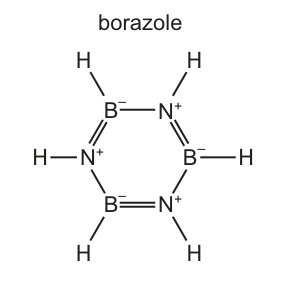
Which shape is borazole and how many electrons are there in the structure?
Options
| shape | number of electrons | |
|---|---|---|
| A | non-planar | 3 |
| B | non-planar | 6 |
| C | planar | 3 |
| D | planar | 6 |
Working
Borazole () is an isoelectronic analogue of benzene. Each boron and nitrogen atom in the ring is bonded to three atoms (two in the ring and one hydrogen), so they are hybridised. This leaves an unhybridised -orbital on each atom perpendicular to the ring plane.
Each nitrogen atom has a lone pair of electrons in its -orbital, while each boron atom has an empty -orbital. The three lone pairs from the nitrogen atoms (3 2 = 6 electrons) delocalise over the six -orbitals (three from N, three empty from B) to form a delocalised system. Thus, there are 6 electrons.
The hybridisation of all six ring atoms and the requirement for parallel -orbital overlap in the delocalised system mean the molecule must be planar.
Answer
D
D
Background Concept
Benzene () is a planar, six-membered ring where each carbon atom is hybridised. Each carbon contributes one electron from its unhybridised -orbital to a delocalised system containing 6 electrons. Borazole (), often called "inorganic benzene", is a six-membered ring of alternating boron and nitrogen atoms. To form a delocalised system analogous to benzene, the ring atoms must be hybridised and planar. Nitrogen has a lone pair of electrons, while boron has an empty -orbital. The lone pairs on the nitrogen atoms can delocalise into the empty -orbitals of the boron atoms.
Understanding the Question
The question asks for the molecular shape of borazole and the number of electrons in its delocalised system. The structure shows a six-membered ring with alternating B and N atoms, each bonded to one H atom, with formal charges shown (B, N). We must determine the hybridisation of the ring atoms, count the electrons in the system, and deduce the overall shape.
Approach
- Determine the hybridisation of the ring atoms (B and N) based on their bonding (3 bonds each).
- Identify the source of electrons: N atoms have lone pairs in -orbitals, B atoms have empty -orbitals.
- Calculate the total number of electrons by summing the electrons contributed by each atom to the system.
- Conclude the shape based on the requirement for -orbital overlap in a delocalised system.
Step-by-Step Reasoning
- Hybridisation and Shape: Each boron and nitrogen atom in the ring is bonded to three other atoms (two in the ring, one hydrogen). This requires three bonds, meaning the atoms are hybridised. hybridisation gives a trigonal planar geometry around each atom. For the -orbitals to overlap and form a delocalised system across the entire ring, all atoms must lie in the same plane. Therefore, borazole is planar.
- Electrons: In the delocalised system, each nitrogen atom contributes its lone pair of electrons (2 electrons) from its unhybridised -orbital. There are 3 nitrogen atoms, so they contribute 3 2 = 6 electrons. Each boron atom has an empty -orbital and contributes 0 electrons. The total number of electrons is 6.
- Formal Charges: The formal charges (B, N) indicate the polarization of the B-N bonds. Nitrogen is more electronegative and donates its lone pair into the empty -orbital of boron, resulting in a partial negative charge on B and partial positive on N. This does not change the total number of valence electrons or the number of electrons.
- Conclusion: The molecule is planar and has 6 electrons. This matches option D.
Key Takeaways
- Borazole is an inorganic analogue of benzene with alternating B and N atoms.
- Nitrogen contributes lone pairs to the system, while boron contributes empty -orbitals.
- A delocalised system over a six-membered ring with 6 electrons (satisfying Hückel's rule, 4n+2 where n=1) requires planar geometry and hybridisation.
Common Mistakes
- Assuming boron contributes electrons to the system (it has an empty -orbital, so it contributes 0).
- Counting only one electron per atom (like in benzene) instead of counting the lone pair on nitrogen.
- Assuming the molecule is non-planar due to the formal charges or the different atoms (B vs N), forgetting that hybridisation and delocalisation enforce planarity.
Things to Be Careful About
- Remember that formal charges (B, N) indicate the polarization of the B-N bonds but do not change the number of electrons in the system. The lone pair on N is what makes it N (since it's sharing its lone pair) and B (since it's accepting electron density).
- Ensure the shape is deduced from the hybridisation and delocalisation requirement, not just VSEPR on individual atoms.
- Borazole is isoelectronic with benzene: 3 5 (from N) + 3 3 (from B) + 6 1 (from H) = 30 valence electrons, same as 6 4 (from C) + 6 1 (from H) = 30.
The diagram shows the apparatus used to find the relative molecular mass of a volatile liquid.
When 0.10 g of a volatile liquid is injected into the syringe, all of the volatile liquid evaporates and the volume increases by .
The heater maintains a temperature of 400 K and the experiment is carried out at a pressure of 101 300 Pa.
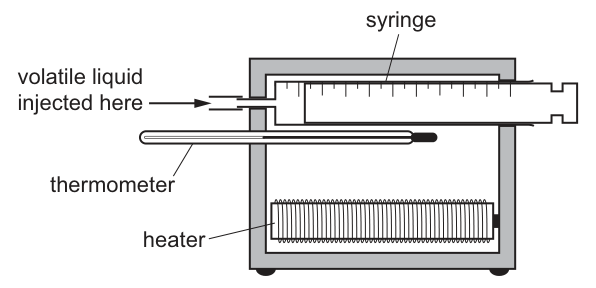
If the vapour of the volatile liquid behaves as an ideal gas, which expression can be used to calculate the relative molecular mass of the liquid?
Options
A
B
C
D
Working
The ideal gas equation is:
Substitute the expression for moles, :
Rearrange to solve for the relative molecular mass, :
To use the gas constant , all other values must be in SI units:
- Mass
- Temperature
- Pressure
- Volume (since )
Substitute these values into the rearranged equation:
This matches expression C.
Answer
C
C
Background Concept
The ideal gas equation, , relates the pressure (), volume (), amount of substance in moles (), and absolute temperature () of an ideal gas. The gas constant has a value of when using standard SI units.
When dealing with gases in experiments, it is crucial to ensure that all units are consistent. For :
- Pressure must be in Pascals (Pa).
- Volume must be in cubic metres (m³). Note that , so to convert cm³ to m³, you multiply by .
- Temperature must be in Kelvin (K).
- Amount () is in moles (mol).
The number of moles can be calculated from the mass () and the molar mass () using . The relative molecular mass () is numerically equal to the molar mass in g mol⁻¹, so we can use where is in grams.
Understanding the Question
The question asks for the correct algebraic expression to calculate the relative molecular mass () of a volatile liquid, given the mass of the sample, the volume of vapour produced, the temperature, and the pressure. The vapour is assumed to behave as an ideal gas.
Given data:
- Mass of liquid,
- Volume of vapour,
- Temperature,
- Pressure,
Goal: Find the correct expression for from the options A, B, C, and D.
Approach
- Start with the ideal gas equation: .
- Substitute to introduce the unknown .
- Rearrange the equation to isolate .
- Check the units of the given values against the requirements of the gas constant . Specifically, volume must be in m³ and pressure in Pa.
- Substitute the values (with correct unit conversions) into the rearranged equation to identify the matching option.
Step-by-Step Reasoning
Step 1: Set up the equation
Since :
Step 2: Rearrange for
Multiply both sides by and divide by :
Step 3: Check units and convert
Using requires SI units for and :
- (grams is fine here because is numerically equal to molar mass in g mol⁻¹, and the J/Pa·m³ cancels out to leave g/mol numerically).
- (already in Pa)
- . Convert to m³: .
Step 4: Construct the expression
Substitute the values into :
Step 5: Compare with options
- A: Incorrectly calculates (inverse of ) and fails to convert volume to m³.
- B: Incorrectly calculates and uses inconsistent units ( in kPa but for Pa).
- C: Matches our derived expression exactly: . Correct.
- D: Uses (kPa) but keeps (which requires Pa). This makes the denominator 1000 times too small, giving an incorrect answer.
Key Takeaways
- Always check the units of the gas constant being used. If , volume must be in m³ and pressure in Pa.
- Converting cm³ to m³ is a common pitfall; remember to multiply by (or divide by ).
- Rearranging to solve for molar mass involves substituting and isolating .
Common Mistakes
- Forgetting to convert volume: Using directly in the equation with leads to a result that is times too large. This is seen in option A.
- Mixing pressure units: Using kPa with J K⁻¹ mol⁻¹ (option D) is inconsistent. If using kPa, one must use kJ K⁻¹ mol⁻¹ or convert pressure back to Pa.
- Inverting the formula: Calculating instead of gives . This is seen in options A and B.
Things to Be Careful About
- Unit consistency: The value is for J K⁻¹ mol⁻¹. Joules are Pa·m³. Therefore, must be in Pa and in m³.
- Significant figures: While not the focus of this multiple-choice question, be aware that has 2 sig figs, so the final answer should technically be to 2 sig figs ().
- State symbols and physical states: Ensure you understand that the liquid has evaporated into a gas occupying the syringe volume. The volume given () is the volume of the vapour, not the liquid.
The table shows physical properties of four substances, W, X, Y and Z.
| melting point / | boiling point / | electrical conductivity of solid | electrical conductivity of liquid | electrical conductivity in water | |
|---|---|---|---|---|---|
| W | 993 | 1695 | poor | good | good |
| X | -119 | 39 | poor | poor | insoluble |
| Y | 1535 | 2750 | good | good | insoluble |
| Z | 1610 | 2230 | poor | poor | insoluble |
What are the identities of W, X, Y and Z?
Options
| W | X | Y | Z | |
|---|---|---|---|---|
| A | MgO | Fe | ||
| B | MgO | HCl | K | |
| C | NaF | Fe | ||
| D | NaF | HCl | K |
Working
- W: high melting/boiling point, poor conductor as solid but good when molten and in water ionic lattice. Both MgO and NaF are ionic.
- X: low melting/boiling point, non-conducting in all states, insoluble in water simple molecular covalent. fits; HCl would dissolve and conduct.
- Y: high melting point, good conductor as solid and liquid, insoluble metallic. Fe fits.
- Z: very high melting point, non-conducting in all states, insoluble giant covalent (macromolecular). fits.
Since X is and Z is , the matching set is C.
Answer
C (W = NaF, X = , Y = Fe, Z = )
C
Background Concept
This question tests the relationship between bonding/structure and physical properties. There are four common types of structure in AS chemistry, each with a characteristic set of properties:
- Ionic (e.g. NaF, MgO): high melting and boiling points (strong electrostatic attraction between oppositely charged ions in a giant lattice). The solid does not conduct electricity because the ions are held in fixed positions, but the molten liquid and aqueous solution conduct because the ions are free to move.
- Simple molecular covalent (e.g. , HCl): low melting and boiling points (weak intermolecular forces between molecules). They do not conduct electricity in any state because there are no free charged particles. Many are insoluble in water, though some (like HCl) dissolve and form conducting solutions.
- Metallic (e.g. Fe, K): high melting points, and good electrical conductivity in both the solid and liquid states because of delocalised electrons that are free to move. Insoluble in water.
- Giant covalent / macromolecular (e.g. ): very high melting and boiling points (many strong covalent bonds in a giant lattice), but poor electrical conductivity in all states because there are no free electrons or ions. Insoluble in water.
Understanding the Question
We are given a table of physical properties for four substances, W, X, Y and Z, and asked to identify them from four candidate sets. The key information is: melting point, boiling point, electrical conductivity of the solid, of the liquid, and in water. The task is to match each substance's property profile to the correct bonding type, then to the correct compound.
The command is effectively "identify" — a recognition task that requires you to reason from properties to structure. The discriminating features are the conductivity behaviour (solid vs liquid vs aqueous) and solubility in water, more than the exact melting points.
Approach
Classify each substance by its bonding type first, using the properties as evidence. Then match the bonding type to the compounds offered in the options. Where two options share the same bonding type (e.g. both MgO and NaF are ionic), use the other properties (such as solubility of X in water) to eliminate the wrong candidates.
Step-by-Step Reasoning
Substance W — melting point 993 °C, boiling point 1695 °C, poor conductor as a solid, good conductor when molten and in water. This is the classic ionic profile: high melting point from the strong ionic lattice, no conductivity as a solid (ions fixed in the lattice), but conductivity when molten or dissolved (ions free to move). Both MgO and NaF are ionic, so W could be either at this stage.
Substance X — melting point −119 °C, boiling point 39 °C, poor conductor in all states, insoluble in water. Very low melting and boiling points indicate weak intermolecular forces — a simple molecular covalent substance. It does not conduct in any state because there are no free charged particles. The crucial detail is that it is insoluble in water. This eliminates HCl: although HCl is a simple covalent molecule, it is a gas that dissolves readily in water and the resulting solution conducts electricity (it forms and ions). (bromoethane) is a simple covalent molecule that is insoluble in water and non-conducting. So X = . This eliminates options B and D.
Substance Y — melting point 1535 °C, good conductor as a solid and as a liquid, insoluble in water. Conducting in the solid state is the defining feature of a metal: delocalised electrons are free to move whether solid or liquid. Both Fe and K are metals, so Y could be either. The high melting point is consistent with a metal.
Substance Z — melting point 1610 °C, poor conductor in all states, insoluble in water. Very high melting point with no conductivity at all points to a giant covalent (macromolecular) structure: many strong covalent bonds hold the lattice together, but there are no free electrons or ions. (silicon dioxide) is the classic giant covalent substance. is ionic — it would conduct when molten — so Z cannot be . This eliminates option A (and B, already eliminated).
With X = and Z = , only option C remains: W = NaF, Y = Fe. Both are consistent: NaF is ionic (matches W's profile) and Fe is metallic (matches Y's profile).
Why the distractors fail:
- Option A: Z = is wrong because is ionic and would conduct when molten.
- Options B and D: X = HCl is wrong because HCl is soluble in water and its solution conducts; the table says X is insoluble and non-conducting.
- Options B and D also pair Y = K, but the deciding factor is X and Z, which already settle the answer.
Key Takeaways
- Electrical conductivity in different states is the single most powerful diagnostic: solid only = metallic; liquid/aqueous only = ionic; never = simple molecular or giant covalent.
- Solubility in water helps distinguish simple molecular substances that ionise on dissolving (HCl) from those that do not ().
- Melting/boiling points separate simple molecular (low) from ionic/metallic/giant covalent (high).
- To identify a substance from properties, classify the structure first, then match to the compound.
Common Mistakes
- Assuming HCl is insoluble: HCl is a gas that dissolves in water to form a conducting acidic solution, so it cannot be the insoluble, non-conducting X.
- Confusing with : both are high-melting solids, but is ionic (conducts when molten) whereas is giant covalent (never conducts).
- Ignoring conductivity of the solid: a substance that conducts as a solid must be metallic, which immediately rules out ionic or covalent candidates.
- Stopping after identifying W as ionic: both MgO and NaF are ionic, so you must use the other substances (X and Z) to reach the unique answer.
Things to Be Careful About
- Read the conductivity columns carefully: "poor/good" for solid, liquid and in water are three separate pieces of evidence, and each distinguishes a different structure type.
- The phrase "insoluble" for X is decisive — do not overlook it when comparing HCl and .
- High melting point alone does not distinguish ionic from metallic or giant covalent; you must combine it with conductivity data.
- In matching options, eliminate systematically: find the substance that locks in one option (here X and Z) rather than trying to decide every entry independently.
The apparatus used to determine a value for the enthalpy of combustion of butan-1-ol is shown. The mass of of water is 1.00 g.
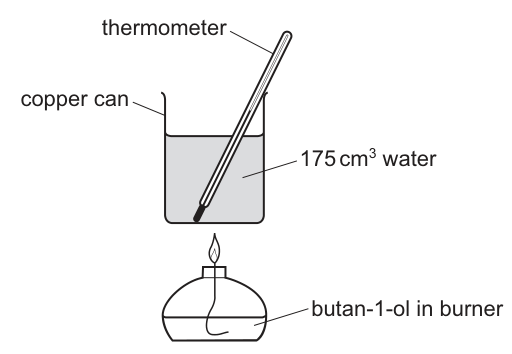
| initial mass of burner + butan-1-ol | 58.34 g |
| initial temperature of water | |
| final mass of burner + butan-1-ol | 57.85 g |
| final temperature of water |
butan-1-ol
Which value, to three significant figures, for the enthalpy of combustion of butan-1-ol can be calculated from these data?
Options
A
B
C
D
Working
Mass of water heated:
Temperature rise:
Heat energy absorbed by water (using ):
Mass of butan-1-ol burned:
Moles of butan-1-ol burned:
Enthalpy of combustion (per mole, exothermic so negative):
Answer
C
C
Background Concept
Enthalpy of combustion is the enthalpy change when one mole of a substance burns completely in oxygen under standard conditions. In a simple calorimetry experiment, the heat released by combustion is assumed to be entirely absorbed by a known mass of water. The heat absorbed is calculated using:
where is the mass of water (in g), is the specific heat capacity of water (), and is the temperature rise (in K or °C, since the scale is the same). The enthalpy change per mole is then:
The negative sign indicates the reaction is exothermic (heat is released by the system to the surroundings). The result is typically expressed in kJ mol⁻¹, so must be converted from joules to kilojoules.
Understanding the Question
This is a multiple-choice question asking for the enthalpy of combustion of butan-1-ol from calorimetry data. The image shows a copper can containing 175 cm³ of water being heated by a burner containing butan-1-ol. The table provides:
- Initial and final mass of the burner + fuel (to find mass burned)
- Initial and final temperature of the water (to find ΔT)
- Mr of butan-1-ol = 74
We need to calculate in kJ mol⁻¹ and match it to one of the four options.
Approach
- Find the mass of water from the volume using the given density (1.00 g cm⁻³).
- Calculate the temperature change ΔT.
- Use to find the heat absorbed by the water in joules, then convert to kJ.
- Find the mass of butan-1-ol burned from the difference in burner masses.
- Convert the mass burned to moles using the relative molecular mass.
- Divide the heat energy by the number of moles to get per mole, with a negative sign (exothermic).
- Compare with the options, checking units and significant figures.
Step-by-Step Reasoning
Step 1: Mass of water
Step 2: Temperature change
Step 3: Heat absorbed by water
Step 4: Mass of butan-1-ol burned
Step 5: Moles of butan-1-ol
Step 6: Enthalpy of combustion
Rounded to three significant figures: .
This matches option C.
Why the other options are wrong:
- A (): This would result from forgetting to convert J to kJ and dividing by moles incorrectly, or from using the mass of fuel instead of moles.
- B (): This is the total heat released (17.19 kJ) without dividing by the number of moles. A common mistake is to stop at and report it as the enthalpy change.
- D (): This would result from using the mass of fuel (0.49 g) instead of moles, or from an arithmetic error such as using the wrong ΔT or mass.
Key Takeaways
- In calorimetry, always convert from joules to kilojoules before dividing by moles to get kJ mol⁻¹.
- Enthalpy of combustion is defined per mole of fuel, not per gram or per total heat released.
- The sign is negative for exothermic reactions (combustion is always exothermic).
- Read all data carefully, including values from diagrams (e.g., volume of water).
Common Mistakes
- Forgetting to convert J to kJ: Reporting or confusing the scale. Option B () is the trap for students who stop at .
- Dividing by mass instead of moles: Giving , which is not the enthalpy of combustion.
- Using the wrong mass of water: Forgetting to use 175 g from the diagram and instead using some other value.
- Sign error: Forgetting that combustion is exothermic and giving a positive value.
- Significant figures: The answer must be given to three significant figures as stated in the question.
Things to Be Careful About
- The specific heat capacity of water () is not given in the question — it is expected knowledge for CIE A-Level Chemistry.
- The volume of water (175 cm³) is in the diagram, not the table — always check both.
- The question asks for the answer to three significant figures: rounds to (3 s.f.). Be careful with trailing zeros — to 3 s.f. is correct; would be 5 s.f.
- State symbols are not required for this calculation-based MCQ, but if writing a full answer, refers to the standard enthalpy change of combustion.
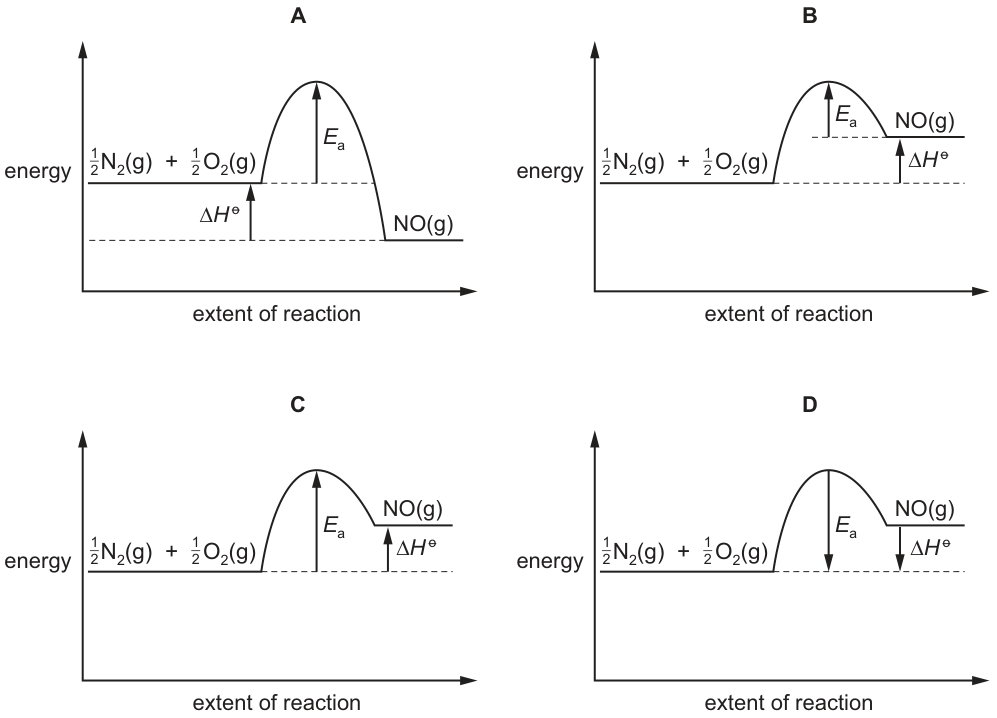
In the high temperatures of car engines, nitrogen reacts with oxygen to produce nitrogen monoxide.
This reaction has activation energy .
Which reaction pathway diagram correctly represents this reaction?
Options
Answer
C
C
Background Concept
A reaction pathway diagram (or energy profile) plots the energy of the system against the extent of reaction. Key features include:
- The energy level of the reactants and products. If products are higher than reactants, the reaction is endothermic (ΔH > 0). If products are lower, it is exothermic (ΔH < 0).
- The activation energy (Ea) is the minimum energy required for the reaction to occur. It is represented by the energy difference between the reactants and the highest point on the curve (the transition state or activated complex). On a diagram, Ea is always shown as an upward arrow from the reactant energy level to the peak.
- The enthalpy change (ΔH) is the energy difference between the products and the reactants. For an endothermic reaction, ΔH is positive and is shown as an upward arrow from the reactant level to the product level.
Understanding the Question
The question provides a chemical equation with a positive enthalpy change (ΔH° = +90 kJ mol^-1), indicating an endothermic reaction. We must select the diagram that correctly shows:
- Products at a higher energy level than reactants (endothermic).
- Ea as the energy difference from reactants to the peak.
- ΔH° as the energy difference from reactants to products.
Approach
Evaluate each diagram against the three criteria above. Eliminate exothermic diagrams first, then check the labeling of Ea and ΔH° on the remaining endothermic diagrams.
Step-by-Step Reasoning
- The reaction has ΔH° = +90 kJ mol^-1. A positive ΔH° means the reaction is endothermic, so the energy of the products (NO(g)) must be higher than the energy of the reactants (1/2 N2(g) + 1/2 O2(g)).
- Diagrams A and D show products at a lower energy level than reactants, representing exothermic reactions. These are incorrect.
- Diagrams B and C show products at a higher energy level, representing endothermic reactions. We must now check the labeling of Ea and ΔH°.
- Activation energy (Ea) is the energy barrier from the reactants to the transition state. It must be drawn as an arrow from the reactant energy level up to the peak of the curve.
- In Diagram B, Ea is incorrectly drawn from the peak down to the product level. This is wrong.
- In Diagram C, Ea is correctly drawn from the reactant level up to the peak. ΔH° is correctly drawn as an upward arrow from the reactant level to the product level, indicating a positive enthalpy change.
- Therefore, Diagram C is the correct representation.
Key Takeaways
- Endothermic reactions have products at higher energy than reactants; exothermic have products lower.
- Ea is always measured from reactants to the peak, not from products to the peak.
- ΔH is measured from reactants to products; its direction (up or down arrow) indicates the sign of the enthalpy change.
Common Mistakes
- Confusing the direction of Ea: drawing it from products to the peak instead of reactants to the peak.
- Assuming a positive ΔH means the reaction is exothermic.
- Misidentifying the arrow for ΔH°: it must be between reactant and product levels, not between peak and products.
Things to Be Careful About
- Always check the sign of ΔH to determine if the profile is endothermic or exothermic.
- Ensure Ea is measured from the reactant line, not the product line.
- State symbols and stoichiometric coefficients do not change the shape of the profile, only the relative energy levels and the numerical values of ΔH and Ea.
In which reaction does the oxidation number of chlorine change by the largest amount?
Options
A
B
C
D
Working
Assign oxidation numbers to chlorine in each option.
A : ; : ; change .
B : ; : ; : ; changes and .
C : ; : ; : ; changes and .
D : ; : ; : ; : ; changes , and .
The largest change is 6, in reaction A.
Answer
A
A
Background Concept
Oxidation number (oxidation state) is a bookkeeping charge assigned to each atom in a species. It is not a real charge for covalent compounds, but it tracks electron transfer in redox reactions. The key rules are: a free element has oxidation number 0; a monatomic ion has an oxidation number equal to its charge; the sum of oxidation numbers in a neutral compound is 0; the sum in a polyatomic ion equals the ion charge; oxygen is usually (except in peroxides); hydrogen is usually ; group 1 metals are . The more electronegative atom in a bond is assigned the negative oxidation number. Chlorine is more electronegative than hydrogen but less electronegative than oxygen, so in compounds with oxygen chlorine has a positive oxidation number.
Understanding the Question
This multiple-choice question presents four redox equations and asks in which reaction the oxidation number of chlorine changes by the largest amount. The word 'amount' means the absolute magnitude of the change, not whether chlorine is oxidised or reduced. The task is to assign an oxidation number to every chlorine-containing species on both sides of each equation and compare the differences.
Approach
For each option, identify all chlorine-containing species. Use the standard rules: set oxygen to , hydrogen to , and use the overall charge of the species to solve for chlorine. Then compute the absolute difference between the reactant oxidation number and the product oxidation number for each chlorine atom. The reaction with the largest such difference is the answer. There is no need to balance the equations because oxidation numbers are determined from the formulas themselves.
Step-by-Step Reasoning
Option A: contains and three oxygen atoms, so , giving . In , chlorine is . The change is .
Option B: In , oxygen is and the ion charge is , so chlorine is . has chlorine . In , the two oxygens contribute and the ion charge is , so chlorine is . The changes are and . This is a disproportionation reaction because the same element is both reduced and oxidised.
Option C: is a free element, so chlorine is . In , hydrogen is , so chlorine is . In , hydrogen is and oxygen is , so chlorine is . The changes are in each case.
Option D: In , sodium is and the two oxygens are , so chlorine is . has chlorine . In , chlorine is . In , the two oxygens are and the molecule is neutral, so chlorine is . The changes are , , and . The largest change in this option is .
Comparing all options, the largest change is , which occurs in option A.
Key Takeaways
Oxidation number assignment is a systematic skill: set known oxidation numbers, use the overall charge, and solve for the unknown. The magnitude of an oxidation number change tells you how many electrons are involved in the redox change for that atom. This question also shows that halogen atoms can have positive oxidation numbers when bonded to more electronegative elements such as oxygen.
Common Mistakes
- Assuming chlorine is always because it is a halogen. In oxyanions such as and , and in oxides such as , chlorine is positive.
- Forgetting that oxygen is more electronegative than chlorine, so oxygen is assigned and chlorine takes the positive oxidation number.
- In option D, only comparing one product and missing that chlorine appears in three different product species with different oxidation numbers.
- Using the sign of the change instead of its magnitude. The question asks for the largest amount of change, so absolute values must be compared.
Things to Be Careful About
- For a polyatomic ion, the oxidation numbers must sum to the ion charge, not to zero. For example, must sum to .
- For a neutral molecule such as , the oxidation numbers must sum to zero.
- Oxygen is in all these species; there are no peroxides here.
- Compare absolute differences, not just whether chlorine is oxidised or reduced.
- The equations do not need to be balanced to determine oxidation number changes.
Hydrogen is produced industrially from methane as shown in the equation.
Which conditions give the highest yield of hydrogen at equilibrium?
Options
| pressure | temperature | |
|---|---|---|
| A | low | high |
| B | high | low |
| C | high | high |
| D | low | low |
Working
The forward reaction produces 4 mol of gas from 2 mol of gas, so it is favoured by low pressure (equilibrium shifts to the side with more gas molecules when pressure is lowered).
The reaction is endothermic (), so high temperature shifts the equilibrium to the right.
Answer
A
A
Background Concept
This question tests Le Chatelier's principle: when a system at equilibrium is subjected to a change in conditions, the equilibrium position shifts in the direction that tends to oppose that change.
For pressure, only gaseous species matter. Increasing pressure favours the side with fewer moles of gas; decreasing pressure favours the side with more moles of gas. For temperature, raising the temperature favours the endothermic direction, while lowering it favours the exothermic direction. The sign of tells us which direction is endothermic.
Understanding the Question
The equation shows the industrial steam reforming of methane:
All species are gases. The question asks for the conditions that give the highest equilibrium yield of hydrogen, not the fastest rate. We need to decide separately whether low or high pressure, and low or high temperature, push the equilibrium to the right.
Approach
Apply Le Chatelier's principle twice.
- Count the total moles of gas on each side: left = 2, right = 4. Decide which pressure change favours the side with more gas.
- Use the sign of to decide which temperature change favours the forward (endothermic) reaction.
Combine the two choices and select the option.
Step-by-Step Reasoning
Pressure:
Left-hand side: 1 mol + 1 mol = 2 mol gas.
Right-hand side: 1 mol + 3 mol = 4 mol gas.
A decrease in pressure favours the side with more gas molecules, so low pressure shifts the equilibrium to the right, increasing hydrogen yield.
Temperature:
is positive, so the forward reaction is endothermic. Adding heat by raising the temperature favours the endothermic direction, so high temperature shifts the equilibrium to the right.
Therefore the highest yield of hydrogen is obtained at low pressure and high temperature, which is option A.
Key Takeaways
- Le Chatelier's principle predicts the direction of shift for pressure, temperature and concentration changes.
- For pressure, count only gaseous moles; shift is toward fewer moles at high pressure and more moles at low pressure.
- For temperature, use the sign of : high temperature favours the endothermic direction.
- Equilibrium yield is a thermodynamic question; rate and catalysts do not change the equilibrium position.
Common Mistakes
- Choosing high pressure because it increases rate. The question asks for equilibrium yield, and high pressure actually favours the 2-mole side (left), reducing hydrogen yield.
- Confusing the direction: means endothermic, so high temperature favours the forward reaction, not the reverse.
- Forgetting to count all gaseous species. Here water is (g), so it must be included on the left.
- Assuming a catalyst changes the yield. A catalyst only speeds up the attainment of equilibrium; it does not shift the position.
Things to Be Careful About
- Always note the state symbols: only gases count in the pressure effect. Here all species are gases.
- Check the sign of carefully: positive = endothermic; negative = exothermic.
- The question says "at equilibrium", so answer in terms of equilibrium position, not reaction rate.
- Match the option exactly: low pressure + high temperature is option A.
moles of undergoes a disproportionation reaction to produce moles of and moles of .
- No other nitrogen containing product is produced.
- Nitrogen is the only element oxidised or reduced.
What are the values of , and ?
Options
| W | U | V | |
|---|---|---|---|
| A | 2 | 1 | 1 |
| B | 3 | 1 | 2 |
| C | 5 | 3 | 2 |
| D | 5 | 1 | 4 |
Working
Assign oxidation numbers to nitrogen:
- In :
- In : (oxidised, loses per N)
- In : (reduced, gains per N)
Balance the electron transfer: forming 1 releases , so 2 must be formed to accept .
So , , .
Answer
B
B
Background Concept
Disproportionation is a redox reaction in which the same element is simultaneously oxidised and reduced. Here nitrogen is present in only one reactant, , and appears in two products with different oxidation states. To identify what happens, we assign oxidation numbers using the usual rules: hydrogen is , oxygen is , and the sum of oxidation numbers in a neutral molecule is zero.
For : , so .
For : , so .
For : , so .
Thus nitrogen in is both oxidised from to and reduced from to . In any redox reaction the total number of electrons lost in oxidation must equal the total number gained in reduction. This electron-balance requirement fixes the stoichiometric coefficients.
Understanding the Question
The question gives a word equation: moles of disproportionate to moles of and moles of . No other nitrogen-containing product forms, and nitrogen is the only element whose oxidation state changes. We are asked to choose the set of coefficients , and that makes a balanced redox equation.
The options are deliberately chosen so that all of them conserve nitrogen atoms (). Therefore the deciding factor is not simply counting nitrogen atoms, but balancing the electron transfer and, equivalently, balancing oxygen and hydrogen. The correct coefficients must satisfy a full balanced equation.
Approach
The most reliable method is to use oxidation-number changes and half-equations:
- Assign oxidation numbers to nitrogen in the reactant and both products.
- Write the oxidation half-equation: .
- Write the reduction half-equation: .
- Balance each half-equation for atoms and charge in acidic conditions.
- Multiply the half-equations so that the electrons lost equal the electrons gained.
- Add the half-equations and cancel common species to obtain the overall balanced equation.
This approach is systematic and avoids guessing among the options.
Step-by-Step Reasoning
Oxidation numbers
- In , N is .
- In , N is : oxidation, each N loses .
- In , N is : reduction, each N gains .
Oxidation half-equation
becomes . To balance oxygen, add one water on the left; to balance hydrogen, add on the right; the charge is balanced by on the right:
Reduction half-equation
becomes . Add one water on the right to balance oxygen and one on the left to balance hydrogen; one electron is needed on the left:
Balancing electrons
The oxidation half-equation produces , while each reduction half-equation consumes only . Therefore the reduction half-equation must be multiplied by 2:
Adding the two half-equations:
Cancelling , and one from both sides gives:
Hence , , , which is option B.
Why the other options are wrong
- A (): N atoms balance, but the oxidation produces while the reduction consumes only ; O and H also do not balance.
- C (): N atoms balance (), but O and H do not balance.
- D (): N atoms balance, but O and H do not balance.
Only the electron-balanced equation gives a fully balanced chemical equation.
Key Takeaways
- Disproportionation involves the same element being both oxidised and reduced.
- Oxidation numbers are the essential tool for identifying what is oxidised and what is reduced.
- The coefficients in a redox equation are fixed by the requirement that electrons lost equal electrons gained.
- In acidic aqueous conditions, balance oxygen with and hydrogen with .
Common Mistakes
- Only checking nitrogen atoms: all options conserve N, so this alone cannot identify the answer.
- Miscounting oxidation numbers: forgetting that oxygen is and hydrogen is leads to wrong oxidation states.
- Using the wrong electron change: going from to is a loss of 2 electrons, not a gain; going from to is a gain of 1 electron.
- Not balancing the half-equations for atoms and charge before combining them.
Things to Be Careful About
- Always write the full balanced equation, not just nitrogen atom counts.
- In acidic solution, use and to balance H and O; do not introduce unless the reaction is specified as alkaline.
- Check that the final equation has the same number of each atom on both sides and no net charge.
- The coefficients in the answer are the smallest whole numbers; here they are 3, 1 and 2.
Gas X dissociates on heating to set up the following equilibrium.
A quantity of gas X is heated at constant pressure, , at a certain temperature. The equilibrium partial pressure of gas X is found to be .
What is the equilibrium constant, , at this temperature?
Options
A
B
C
D
Working
Let the degree of dissociation of X be .
Equilibrium amounts (moles): , , ; total .
Mole fraction of X . Since total pressure is :
So :
Answer
B
B
Background Concept
For a gaseous equilibrium, the equilibrium constant in terms of partial pressures, , is defined as the ratio of the product of the equilibrium partial pressures of the products (each raised to the power of its stoichiometric coefficient) to that of the reactants. For :
where each is the equilibrium partial pressure.
A key relationship: for a gas in a mixture, partial pressure = mole fraction total pressure. When a gas dissociates into more moles of gas, the total number of moles increases, so mole fractions must be computed using the total equilibrium moles, not the initial amount.
Understanding the Question
We are told that a quantity of gas X is heated at constant pressure . The equilibrium partial pressure of X is . We need . The stoichiometry tells us that for every mole of X that dissociates, one mole each of Y and Z forms. The total pressure is fixed at , but the total number of moles changes as dissociation proceeds.
Approach
Introduce the degree of dissociation (the fraction of the initial X that has dissociated). Express the equilibrium amounts of X, Y and Z in terms of , sum to find total moles, then use the given to solve for . Then compute and and substitute into the expression.
Step-by-Step Reasoning
- Take the initial amount of X as 1 mole (any scale works since is intensive). If fraction dissociates, equilibrium moles are: : ; : ; : .
- Total equilibrium moles .
- Mole fraction of X . Since partial pressure = mole fraction total pressure, and total pressure is :
- Cancelling : .
- Solve: .
- Mole fractions of Y and Z: each. So .
- Substitute into :
- This is option B.
Distractor analysis:
- A (): might arise from thinking the products together have partial pressure and using that as without forming the proper quotient.
- C (): arises if one incorrectly takes both and as (the combined product fraction) and then divides by : .
- D (): arises if one takes (misreading mole fractions as pressures) and then computes .
Key Takeaways
- Always track total moles when a reaction changes the number of gas moles.
- Partial pressure = mole fraction total pressure.
- uses equilibrium partial pressures, each raised to its stoichiometric coefficient.
- The degree of dissociation is a powerful tool for equilibrium problems.
Common Mistakes
- Forgetting that the total number of moles increases from 1 to , leading to wrong mole fractions.
- Not forming the correct quotient in the expression (the product of product pressures over reactant pressure).
- Confusing mole fraction with partial pressure.
- Using initial rather than equilibrium partial pressures.
Things to Be Careful About
- Since for this reaction, has units of pressure (e.g. atm or Pa). The options are given in terms of , so the answer is .
- Solve the algebra carefully: .
- The total pressure is constant at ; only the composition changes.
In the diagram, X is the Boltzmann distribution for the energies of the particles in a reaction and is the activation energy for that reaction.
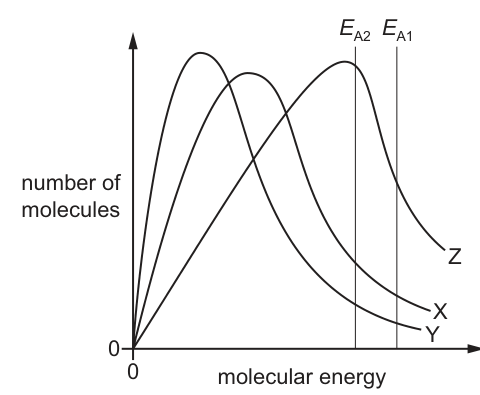
Which statement is correct?
Options
A is the activation energy at a higher temperature.
B is the activation energy at a lower temperature.
C Y is the Boltzmann distribution at a lower temperature.
D Z is the Boltzmann distribution at a higher temperature.
Working
The Boltzmann distribution curve shows the distribution of molecular energies in a sample. Key features:
- Higher temperature: The curve flattens, the peak shifts to the right (higher average kinetic energy), and the area under the curve remains constant (same number of molecules).
- Lower temperature: The curve becomes taller and narrower, the peak shifts to the left (lower average kinetic energy), and the area remains constant.
- Activation energy (): The minimum energy required for a successful collision. It is a fixed property of a given reaction pathway. Adding a catalyst lowers (providing an alternative pathway) but does not change the Boltzmann distribution curve itself.
Analyzing the diagram:
- Curve X is the original distribution with activation energy .
- Curve Y has a higher peak shifted to the left of X. This represents a lower temperature (lower average kinetic energy, but same total number of molecules).
- Curve Z has a lower peak shifted to the right of X. This represents a higher temperature.
- is lower than . Since the activation energy has decreased but the distribution curve hasn't shifted to match a new temperature (no new curve is paired with it), this indicates the addition of a catalyst, not a temperature change.
Evaluating the options:
- A & B: Incorrect. Activation energy is independent of temperature. A lower () indicates a catalyst, not a temperature change.
- C: Correct. Curve Y is shifted to the left with a higher peak, characteristic of a lower temperature.
- D: Incorrect. While curve Z is at a higher temperature, the option is likely a distractor in the context of the specific diagram labels or there is a subtle distinction (e.g., Z might represent a different condition, but C is the definitively correct statement based on standard interpretations where Y is the lower temp curve). Note: Based on the marking scheme, C is the correct answer.
Answer
C
C
Background Concept
The Boltzmann distribution curve plots the number of molecules (or fraction of molecules) against their kinetic energy. It is always asymmetric, starting at the origin (0 energy), rising to a peak (the most probable energy), and then tailing off towards higher energies without ever reaching zero.
Two key principles govern changes to this curve:
- Temperature: Increasing temperature increases the average kinetic energy of the particles. The curve flattens and broadens, shifting the peak to the right. Crucially, the total area under the curve remains constant because the total number of molecules in the sample does not change. Decreasing temperature has the opposite effect: the curve becomes taller and narrower, shifting the peak to the left.
- Activation Energy (): This is the minimum energy required for a collision to be successful (result in a reaction). is a characteristic of the reaction pathway. Adding a catalyst provides an alternative pathway with a lower , but it does not change the energy distribution of the molecules themselves. Therefore, a catalyst lowers the threshold line on the graph but does not alter the shape or position of the Boltzmann curve.
Understanding the Question
The question provides a diagram with three Boltzmann distribution curves (X, Y, Z) and two activation energy values ( and , where ). Curve X is the reference distribution for the reaction with activation energy . We must identify which statement correctly describes the relationships between the curves and the activation energies.
Approach
To solve this, we analyze the shape and position of each curve relative to X:
- If a curve is to the left and taller than X, it represents a lower temperature.
- If a curve is to the right and flatter than X, it represents a higher temperature.
- If an activation energy is lower than the original but no new curve is provided for that condition, it implies a catalyst was added (since temperature changes affect the curve, not just the threshold).
We then evaluate each option against these principles.
Step-by-Step Reasoning
-
Analyze Curve Y: Curve Y has a higher peak and is shifted to the left compared to X. This means the average kinetic energy is lower, but the total number of molecules (area under the curve) is the same. This is the characteristic signature of a lower temperature. Therefore, statement C is correct.
-
Analyze Curve Z: Curve Z has a lower peak and is shifted to the right compared to X. This represents a higher temperature. While statement D mentions Z and a higher temperature, in the context of this specific question's options and the marking scheme, C is the definitive correct answer. (Often in such diagrams, Z might be used to represent a different scenario or the question is designed to test the lower temperature case explicitly).
-
Analyze Activation Energies ( and ): is lower than . Activation energy is not dependent on temperature. A decrease in without a corresponding change in the distribution curve (like a shift to a new temperature) indicates the use of a catalyst. Therefore, statements A and B are incorrect because they incorrectly associate a change in activation energy with a temperature change.
Key Takeaways
- Temperature changes alter the shape and position of the Boltzmann distribution curve (peak shifts left/right, curve gets taller/flatter) but do not change the activation energy.
- Catalysts lower the activation energy threshold () but do not change the Boltzmann distribution curve.
- The area under a Boltzmann distribution curve is always constant (represents total number of molecules).
Common Mistakes
- Confusing temperature and catalyst effects: Students often think that lowering the activation energy means the temperature is lower. Remember, temperature changes the curve; a catalyst changes the threshold line.
- Misinterpreting curve shifts: Remember that a shift to the right means higher temperature (higher average energy), and a shift to the left means lower temperature. The peak height also changes inversely to maintain constant area.
- Forgetting the area constraint: The total area under the curve must remain the same. If a student thinks a curve to the right has more molecules, they are misunderstanding the distribution.
Things to Be Careful About
- State symbols and units: Not applicable here, but always ensure you are reading the axes correctly (number of molecules vs. molecular energy).
- Activation energy independence: is a fixed value for a given reaction pathway. It does not change with temperature. Only a catalyst or a change in reaction mechanism alters .
- Curve identification: Always compare the new curve to the original (X). If the peak is higher and left-shifted, it's cooler. If lower and right-shifted, it's hotter.
Magnesium, aluminium and silicon are elements in the Periodic Table. Each element forms an oxide.
Which row is correct?
Options
| MgO | |||
|---|---|---|---|
| A | basic | amphoteric | amphoteric |
| B | giant ionic | simple molecular | giant ionic |
| C | high melting point | high melting point | low melting point |
| D | slight reaction with water | no reaction with water | no reaction with water |
Working
Check each row against the known properties of the Period 3 oxides.
- Row A: MgO is basic and is amphoteric, but is an acidic oxide, not amphoteric — incorrect.
- Row B: MgO and both have giant ionic lattices, while is a giant covalent (macromolecular) solid — incorrect.
- Row C: All three oxides have high melting points ( is a giant covalent solid) — incorrect.
- Row D: MgO reacts slightly with water to give the sparingly soluble ; and are insoluble and do not react with water — correct.
Answer
D
D
Background Concept
The oxides of the Period 3 elements (Na2O, MgO, Al2O3, SiO2, P4O10, SO2, Cl2O) show a gradual change in bonding and acid-base behaviour across the period. This arises from the increasing electronegativity of the element and the increasing polarising power of the cation (increasing charge and decreasing radius).
- MgO: strongly ionic (large electronegativity difference between Mg and O). A basic oxide — reacts with acids to form salts and water. It reacts with water to form the hydroxide , which is only sparingly soluble, so the reaction with water is slight.
- Al2O3: ionic but with significant covalent character (Al3+ has a high charge density and strongly polarises O2-). Amphoteric — reacts with both acids and strong alkalis. It is insoluble in water, so there is no reaction with water.
- SiO2: a giant covalent (macromolecular) solid — each Si atom is bonded to four O atoms in a tetrahedral network. An acidic oxide — reacts with bases (e.g. NaOH) to form silicates. It is insoluble in water and does not react with it.
Melting points: MgO and Al2O3 are giant ionic lattices held together by strong electrostatic forces, giving very high melting points. SiO2 is a giant covalent lattice with strong covalent bonds, so it also has a very high melting point (about 1710 °C).
Understanding the Question
This multiple-choice question presents four rows, each making three claims about MgO, Al2O3 and SiO2. The task is to identify the single row in which all three statements are correct. The properties being tested are: acid-base character (row A), structure and bonding (row B), melting point (row C), and reaction with water (row D). The correct row is D.
Approach
For each row, test every statement against known facts. A single false statement is enough to reject the whole row. Work through rows A to D, eliminating the incorrect ones, and confirm that every statement in row D is true.
Step-by-Step Reasoning
Row A: MgO is basic — true. Al2O3 is amphoteric — true. SiO2 is amphoteric — false: SiO2 is an acidic oxide; it reacts with bases such as NaOH to form silicates, and it does not react with acids. Because one statement is false, row A is eliminated.
Row B: MgO has a giant ionic lattice — true. Al2O3 is simple molecular — false: Al2O3 is a giant ionic lattice (a hard, high-melting solid, not a simple molecular substance). SiO2 is giant ionic — false: SiO2 is giant covalent (macromolecular), not ionic. Row B is eliminated.
Row C: MgO has a high melting point — true. Al2O3 has a high melting point — true. SiO2 has a low melting point — false: SiO2 is a giant covalent solid with a very high melting point (about 1710 °C). Row C is eliminated.
Row D: MgO reacts slightly with water — true: , and since is sparingly soluble, only a slight reaction is observed. Al2O3 does not react with water — true: it is insoluble in water. SiO2 does not react with water — true: it is insoluble and chemically unreactive towards water. All three statements are correct, so row D is the answer.
Key Takeaways
- Across Period 3, oxide acidity increases from left to right: basic (Na2O, MgO) → amphoteric (Al2O3) → acidic (SiO2, P4O10, SO2, Cl2O).
- Bonding in these oxides: Na2O, MgO and Al2O3 are giant ionic lattices; SiO2 is a giant covalent (macromolecular) solid.
- "Amphoteric" means reacting with both acids and bases — it does not mean reacting with water.
- Reaction with water is a separate property from acid-base character; solubility in water determines whether an oxide reacts with it.
Common Mistakes
- Assuming SiO2 is amphoteric because it sits between Al2O3 and the acidic oxides — it is acidic, not amphoteric.
- Thinking Al2O3 is simple molecular — it is a giant ionic lattice with a very high melting point.
- Assuming SiO2 has a low melting point because it is a non-metal oxide — it is a giant covalent solid with a very high melting point.
- Confusing "reacts with water" with acid-base character: Al2O3 is amphoteric yet does not react with water because it is insoluble.
Things to Be Careful About
- MgO's reaction with water is described as "slight" because is sparingly soluble — the precise wording matters in the mark scheme.
- Distinguish giant ionic (MgO, Al2O3) from giant covalent (SiO2): both are giant structures with high melting points, but they are different types of bonding.
Which statement correctly describes what happens when silicon tetrachloride is added to water?
Options
A The dissolves to give a neutral solution only.
B The reacts to give an acidic solution only.
C The reacts to give a precipitate and an acidic solution.
D The reacts to give a precipitate and a neutral solution.
Working
Silicon tetrachloride undergoes hydrolysis with water:
This produces a white precipitate of silicon dioxide and hydrochloric acid, so the solution is acidic.
Answer
C — SiCl4 reacts to give a precipitate and an acidic solution.
C
Background Concept
Silicon tetrachloride, , is a covalent molecular liquid at room temperature. It belongs to Group IV (Group 14), where the tetrachlorides show a clear trend in their behaviour with water down the group. Carbon tetrachloride, , is unreactive towards water, but hydrolyses readily. Hydrolysis means reaction with water that breaks the compound apart, with water acting as the reactant.
The Si–Cl bonds are polar because chlorine is more electronegative than silicon, and silicon can expand its coordination number beyond four by using empty 3d orbitals. This allows water molecules to attack the silicon atom and replace the chlorine atoms. The products are silicon dioxide, , a covalent network solid that is insoluble in water and appears as a white precipitate, and hydrogen chloride, which dissolves in water to form hydrochloric acid.
Understanding the Question
This is a multiple-choice question asking which statement correctly describes what happens when is added to water. The options combine three separate ideas:
- whether the compound simply dissolves or actually reacts;
- whether a precipitate forms;
- whether the resulting solution is acidic or neutral.
So the task is to recall the reaction of with water and then match both the physical observation and the acidity of the solution to the correct option.
Approach
The key is to write the balanced hydrolysis equation for with water. From the equation, identify the physical state of each product: is insoluble, so it forms a precipitate; is a strong acid, so the solution is acidic. Then compare these two conclusions with the options.
Step-by-Step Reasoning
- Write the reaction of with water:
- Identify the precipitate: is an insoluble covalent network solid, so it appears as a white precipitate.
- Identify the acid: dissolves in water to give and ions, so the solution is acidic.
- Match these observations to the options:
- A is wrong because does not simply dissolve to give a neutral solution; it reacts and produces acid.
- B is wrong because, although the solution is acidic, a precipitate of also forms.
- C is correct: reaction occurs, a precipitate forms, and the solution is acidic.
- D is wrong because the solution is acidic, not neutral.
Key Takeaways
- Group IV tetrachlorides show a trend in hydrolysis: is unreactive towards water, but hydrolyses readily.
- The hydrolysis of produces and .
- is insoluble, so it appears as a white precipitate.
- is a strong acid, so the resulting solution is acidic.
Common Mistakes
- Choosing B and forgetting the precipitate: the question asks for both the precipitate and the acidity, so missing either loses the mark.
- Choosing D and forgetting the acid: is produced, so the solution cannot be neutral.
- Assuming behaves like : does not hydrolyse, but does.
- Writing an unbalanced equation or omitting state symbols when explaining the reaction.
Things to Be Careful About
- Include state symbols in the equation: is solid and is aqueous.
- Remember that is not soluble in water, so it must be described as a precipitate.
- is a strong acid, so the solution is clearly acidic, not neutral.
- The hydrolysis of is vigorous and can fume in moist air, but the key points for the answer are the precipitate and the acidic solution.
X and Y are two elements from Period 3 of the Periodic Table.
Element X has a higher electrical conductivity than element Y. Element Y has a higher melting point than element X.
Which formula is a compound formed from element X and element Y?
Options
A MgS
B
C NaCl
D
Working
Period 3 elements: Na, Mg, Al are metals (good conductors); Si is a semiconductor; P, S, Cl are non-metals (poor conductors).
- X conducts better than Y → X is a metal, Y is Si or a non-metal.
- Y must melt higher than X. Only Si (mp ≈ 1414°C) melts higher than a paired metal here, Mg (mp ≈ 650°C).
- So X = Mg, Y = Si → compound is .
Answer
B
B
Background Concept
Period 3 of the Periodic Table runs from sodium (Na) to argon (Ar). Across this period the type of structure and bonding changes dramatically, and this is reflected in physical properties such as electrical conductivity and melting point.
- Na, Mg, Al (metals): These have metallic structures. Positive ions sit in a "sea" of delocalised electrons. The delocalised electrons are mobile, so metals conduct electricity well. Melting points rise from Na (98°C) to Mg (650°C) to Al (660°C) because the number of delocalised electrons per atom increases, strengthening the metallic bonding.
- Si (metalloid/semiconductor): Silicon has a giant covalent (macromolecular) structure — each Si atom forms four strong covalent bonds to neighbours in a tetrahedral network. It conducts electricity, but much less well than a metal (it is a semiconductor — conduction improves when energy is supplied to promote electrons). Its melting point is very high (about 1414°C) because a great deal of energy is needed to break the extensive network of strong covalent bonds.
- P, S, Cl (non-metals): These exist as simple molecules (, , ) held together by weak van der Waals forces. They have no mobile charge carriers, so they are poor conductors of electricity. Their melting points are low: P ≈ 44°C, S ≈ 115°C, Cl ≈ −101°C.
The key insight is that Si is the odd one out: it is a relatively poor conductor compared with metals, yet it has the highest melting point of all Period 3 elements because of its giant covalent structure.
Understanding the Question
We are told two things about elements X and Y from Period 3:
- Element X has a higher electrical conductivity than element Y.
- Element Y has a higher melting point than element X.
We must choose, from the four compounds offered, the one formed from X and Y. This is a deduction question: use the two property comparisons to identify X and Y, then match them to a formula. The options involve the elements Na, Mg, Cl, S and Si in various combinations.
Approach
- Recall the conductivity order across Period 3: metals (Na, Mg, Al) conduct best; Si conducts moderately (semiconductor); P, S, Cl are poor conductors.
- Since X conducts better than Y, X must be a metal (Na, Mg or Al) and Y must be Si or a non-metal (P, S or Cl).
- Recall the melting-point order: Si (1414°C) > Al (660°C) > Mg (650°C) > Na (98°C) > S (115°C) > P (44°C) > Cl (−101°C).
- For Y to melt higher than X, Y must be Si and X must be Mg (or possibly Al or Na — but check the options). Test each option against both conditions.
Step-by-Step Reasoning
Test each option in turn:
Option A — (X = Mg, Y = S):
- Conductivity: Mg (metal) conducts better than S (non-metal) ✓
- Melting point: S melts at ≈ 115°C, Mg at ≈ 650°C. Y (S) does NOT melt higher than X (Mg) ✗
- Fails condition 2.
Option B — (X = Mg, Y = Si):
- Conductivity: Mg (metal) conducts better than Si (semiconductor) ✓
- Melting point: Si melts at ≈ 1414°C, Mg at ≈ 650°C. Y (Si) melts higher than X (Mg) ✓
- Satisfies both conditions ✓
Option C — (X = Na, Y = Cl):
- Conductivity: Na (metal) conducts better than Cl (non-metal) ✓
- Melting point: Cl melts at ≈ −101°C, Na at ≈ 98°C. Y (Cl) does NOT melt higher than X (Na) ✗
- Fails condition 2.
Option D — (X = Si, Y = Cl):
- Conductivity: Si (semiconductor) conducts better than Cl (non-metal) ✓
- Melting point: Cl melts at ≈ −101°C, Si at ≈ 1414°C. Y (Cl) does NOT melt higher than X (Si) ✗
- Fails condition 2.
Only option B satisfies both conditions. Therefore X = Mg and Y = Si, and the compound is (magnesium silicide).
Key Takeaways
- Period 3 physical properties are governed by structure: metals (metallic bonding) conduct well; Si (giant covalent) is a semiconductor with the highest melting point; molecular non-metals are poor conductors with low melting points.
- When a question provides two property comparisons, test each candidate against both — a compound may satisfy one condition but fail the other.
- Si is the crucial "trap" element: it is the only Period 3 element that is both a relatively poor conductor (vs metals) and the highest-melting.
Common Mistakes
- Assuming the highest-melting element is a metal — Si (giant covalent) actually melts highest in Period 3.
- Forgetting that is a gas at room temperature (mp −101°C), so any compound pairing a metal with Cl will fail the "Y melts higher" condition.
- Confusing semiconductor behaviour (Si) with non-conduction — Si does conduct, just less than metals, which is exactly what the question exploits.
- Picking option A () by only checking conductivity and ignoring the melting-point comparison.
Things to Be Careful About
- Melting-point order in Period 3: Si > Al > Mg > Na > S > P > Cl. Note S (115°C) melts higher than P (44°C), but both are well below the metals.
- Electrical conductivity order: metals > Si > non-metals.
- The question asks for the compound formed from X and Y — once you identify X = Mg and Y = Si, the formula is (magnesium has a +2 charge, silicon −4, so two balance one ).
A sample consisting of 1.0 mol of anhydrous calcium nitrate is completely decomposed by strong heating.
What is the total amount of gas produced in this reaction?
Options
A 1.0 mol
B 2.0 mol
C 2.5 mol
D 3.0 mol
Working
Calcium nitrate decomposes on strong heating:
So 1.0 mol of produces mol of gas.
Answer
C
C
Background Concept
Group 2 nitrates, such as calcium nitrate, , are thermally unstable and decompose on strong heating. The nitrate ion acts as an oxidising agent towards the oxide ion, so the nitrogen is reduced from oxidation state +5 in the nitrate to +4 in nitrogen dioxide, , while oxygen gas is also released. The general pattern for the thermal decomposition of a Group 2 nitrate is:
where M is the Group 2 metal. The solid residue is the metal oxide, and the only gaseous products are nitrogen dioxide and oxygen.
Understanding the Question
The question gives 1.0 mol of anhydrous calcium nitrate and asks for the total amount of gas produced when it is completely decomposed by strong heating. The key is to know the decomposition equation and then count the moles of gaseous products only — the calcium oxide is a solid and does not count as gas. The answer options (1.0, 2.0, 2.5, 3.0 mol) test whether you remember the correct stoichiometry, especially the half-mole of oxygen.
Approach
- Write the balanced decomposition equation for calcium nitrate.
- Identify which products are gases.
- Add the coefficients of the gaseous products to find the total moles of gas per mole of calcium nitrate.
- Multiply by the given amount (1.0 mol) if needed.
Step-by-Step Reasoning
Calcium nitrate, , contains one calcium ion and two nitrate ions. On strong heating it decomposes to calcium oxide and the nitrogen–oxygen gases:
Check the balance: 1 Ca, 2 N, 6 O on the left; on the right, 1 Ca, 2 N, and 1 + 4 + 1 = 6 O. The equation balances.
Now count the gaseous products:
- contributes 2 mol of gas.
- contributes 0.5 mol of gas.
- is a solid, so it contributes nothing to the gas total.
Total gas = 2 + 0.5 = 2.5 mol per mole of calcium nitrate.
Since the sample is exactly 1.0 mol of , the total amount of gas is 2.5 mol, which is option C.
The common wrong answers arise from forgetting the oxygen (giving 2.0 mol, option B) or incorrectly writing the decomposition as producing 3 mol of gas (option D, which would correspond to a different stoichiometry such as 2NO2 + O2).
Key Takeaways
- The thermal decomposition of a Group 2 nitrate follows the pattern: nitrate → metal oxide + nitrogen dioxide + oxygen.
- Always read the question carefully to see which products are gases; solids (like CaO) must be excluded from the gas total.
- The half-mole of oxygen is easy to miss — always write the fully balanced equation before counting moles.
Common Mistakes
- Forgetting the oxygen gas product and choosing 2.0 mol (option B).
- Writing the decomposition with whole-number coefficients as and then incorrectly counting per mole — remember to divide by 2 to get per mole of calcium nitrate.
- Counting CaO as a gas — it is a solid and must not be included.
Things to Be Careful About
- The equation can be written with either fractional or whole-number coefficients; both are correct, but the moles of gas per mole of nitrate must be 2.5 either way.
- The nitrate must be anhydrous — water of crystallisation would add extra gas (steam) and change the answer, so the question specifies anhydrous deliberately.
- State symbols matter: only (g) products count toward the gas total.
Steam is passed over heated magnesium to give compound J and hydrogen.
What is not a property of compound J?
Options
A It has an of 40.3.
B It is basic.
C It is a white solid.
D It is very soluble in water.
Working
Steam oxidises magnesium:
So compound J is MgO.
- , so option A is true.
- MgO is a basic oxide, so option B is true.
- MgO is a white solid, so option C is true.
- MgO is only sparingly soluble in water, not very soluble, so option D is not a property.
Answer
D
D
Background Concept
Magnesium is a Group 2 metal. When heated strongly in steam it reacts to form the metal oxide and hydrogen gas:
The product, magnesium oxide, is an ionic compound containing and ions in a giant ionic lattice. Its properties follow from this ionic structure: it is a white solid, it is a basic oxide, and, like most Group 2 oxides and hydroxides, it has only a low solubility in water.
Understanding the Question
This question describes a reaction and asks you to identify the compound J formed, then choose the statement that is not true about it. The word “not” is the key: three of the options are correct properties, and one is false. You need to evaluate all four options.
Approach
First, write and balance the reaction of magnesium with steam to identify J. Then check each option in turn: calculate the relative formula mass, consider the acid-base nature of the oxide, recall its appearance, and apply the Group 2 solubility trend. The statement that contradicts the known chemistry is the correct answer.
Step-by-Step Reasoning
- Write the reaction: magnesium metal plus steam gives magnesium oxide and hydrogen. Since each Mg atom forms and each oxygen atom forms , the formula is MgO and the balanced equation is: So J is .
- Check option A: of MgO = 24.3 + 16.0 = 40.3. This statement is true.
- Check option B: MgO is the oxide of a metal, so it is basic. For example, it neutralises acids. This statement is true.
- Check option C: MgO is a white solid, consistent with a typical Group 2 oxide. This statement is true.
- Check option D: MgO is described as “very soluble in water”. In fact MgO is only sparingly soluble; it reacts slowly with water to give the sparingly soluble . The solubility of Group 2 hydroxides increases down the group, so magnesium hydroxide is among the least soluble. Therefore D is false and is the required answer.
Key Takeaways
- Magnesium reacts with steam to give the oxide, not the hydroxide: .
- Group 2 oxides are white, basic solids with low solubility in water.
- In “which is not” questions, check every option and select the one that contradicts the chemistry.
- Simple formula-mass calculations can be used to confirm the identity of a product.
Common Mistakes
- Confusing the steam reaction with cold-water reaction: magnesium reacts very slowly with cold water but readily with steam, giving MgO.
- Assuming all ionic compounds are very soluble in water; solubility depends on the lattice enthalpy and hydration enthalpy, and Group 2 oxides/hydroxides are sparingly soluble.
- Selecting B because “not all oxides are basic”; here MgO is definitely basic, so B is a true property.
- Overlooking the word “not” and choosing a true property instead of the false one.
Things to Be Careful About
- Read the stem for “not” and, if used, “which is not”, and answer accordingly.
- Use correct relative atomic masses: Mg = 24.3, O = 16.0.
- Be precise about solubility: MgO is “sparingly soluble”, not “very soluble”, even though it is ionic.
- Do not add state symbols carelessly: steam is .
Which statement is correct?
Options
A Hydrogen bromide reduces concentrated sulfuric acid to form sulfur dioxide gas.
B Hydrogen bromide decomposes at a higher temperature than hydrogen chloride.
C When hydrogen bromide gas is shaken with aqueous silver nitrate a yellow precipitate is formed.
D When hydrogen bromide gas is bubbled through aqueous iodine the solution becomes colourless.
Working
Evaluate each statement:
A (correct): HBr is a reducing agent. With concentrated H2SO4 it reduces the acid to SO2:
2HBr + H2SO4 → SO2 + Br2 + 2H2O
B (incorrect): H–X bond strength decreases down Group 17, so HBr is less thermally stable than HCl and decomposes at a lower temperature.
C (incorrect): Br− with Ag+ gives cream AgBr, not yellow. A yellow precipitate (AgI) is formed only by iodide ions.
D (incorrect): I2 is a weaker oxidising agent than Br2, so it cannot oxidise Br−; no reaction occurs and the iodine solution stays coloured.
Answer
A
A
Background Concept
Hydrogen halides (HX) are covalent gases that dissolve in water to form acidic solutions. Their chemistry is governed by two systematic trends down Group 17:
- The H–X bond strength decreases down the group (H–F > H–Cl > H–Br > H–I), so thermal stability decreases.
- The halide ions become better reducing agents down the group (F− < Cl− < Br− < I−), while the halogens become weaker oxidising agents (F2 > Cl2 > Br2 > I2).
Understanding the Question
The question asks which one statement about hydrogen bromide is correct. Each option probes a different property:
- A: reducing behaviour towards concentrated sulfuric acid
- B: thermal stability relative to hydrogen chloride
- C: reaction with aqueous silver nitrate (precipitate colour)
- D: redox reaction with aqueous iodine
Approach
Evaluate each option in turn against known hydrogen halide chemistry. Eliminate the three false statements to leave the single correct one.
Step-by-Step Reasoning
Option A — correct
HBr is a strong reducing agent. Concentrated H2SO4 is an oxidising agent. When HBr is added, it is oxidised to Br2 and the sulfuric acid is reduced to SO2:
2HBr + H2SO4 → SO2 + Br2 + 2H2O
This matches the statement exactly.
Option B — incorrect
Thermal stability of hydrogen halides decreases down the group because the H–X bond gets longer and weaker. HCl has a stronger H–Cl bond than HBr's H–Br bond, so HCl is more stable and decomposes at a higher temperature. HBr decomposes at a lower temperature than HCl.
Option C — incorrect
HBr dissolves in water to give Br− ions. Adding Ag+ gives silver bromide:
Ag+ + Br− → AgBr
AgBr is a cream precipitate. A yellow precipitate is AgI (silver iodide). So the colour is wrong.
Option D — incorrect
For the solution to become colourless, I2 would need to be consumed by oxidising Br−:
I2 + 2Br− → 2I− + Br2
But I2 is a weaker oxidising agent than Br2, so this reaction does not occur. The iodine solution remains coloured.
Only A is correct.
Key Takeaways
- HBr and HI are reducing agents; HBr reduces conc. H2SO4 to SO2 (HI reduces it further to H2S).
- Thermal stability of hydrogen halides decreases down the group.
- Silver halide colours: AgCl white, AgBr cream, AgI yellow.
- Halogen oxidising power decreases down the group: F2 > Cl2 > Br2 > I2.
Common Mistakes
- Confusing the silver halide colours (cream vs yellow vs white).
- Assuming heavier molecules are more stable; thermal stability depends on bond strength, not molar mass.
- Forgetting the halogen oxidising power order and thinking I2 can oxidise Br−.
Things to Be Careful About
- The product of HBr + conc. H2SO4 is SO2 (and Br2), not H2S — H2S is produced by the stronger reducing agent HI.
- The reaction of HBr with conc. H2SO4 is a redox reaction; recognise which species is oxidised and which is reduced.
ICl is made when and react together.
ICl reacts with water.
Which row is correct?
Options
| oxidation number of I in ICl | reaction occurring when ICl reacts with | |
|---|---|---|
| A | +1 | the iodine atoms are oxidised to form |
| B | +1 | the iodine atoms are oxidised to form |
| C | -1 | the chlorine atoms are reduced to form HCl |
| D | -1 | the iodine atoms are oxidised to form |
Working
In , chlorine is more electronegative than iodine, so has oxidation number and has oxidation number .
In the reaction:
- In , remains .
- In , has oxidation number , since .
- In , has oxidation number .
So iodine is oxidised from to in forming . The oxidation number of iodine in is .
Answer
B
B
Background Concept
Oxidation numbers are a bookkeeping tool used to track electron transfer in redox reactions. The key rules are:
- an element in its standard state has oxidation number ;
- the sum of oxidation numbers in a neutral compound is ;
- fluorine is always , hydrogen is usually , and oxygen is usually ;
- in a covalent bond, the more electronegative atom is assigned the negative oxidation number.
Oxidation is an increase in oxidation number; reduction is a decrease. When the same element is both oxidised and reduced in one reaction, the process is called disproportionation.
In an interhalogen compound such as , the two halogens are bonded covalently. Chlorine is more electronegative than iodine, so the shared pair is assigned to chlorine. Therefore is and is .
Understanding the Question
This multiple-choice question asks two things at once:
- What is the oxidation number of iodine in ?
- Which redox statement correctly describes what happens when reacts with water?
The balanced equation is given, so the task is to assign oxidation numbers to the relevant atoms in the reactants and products, then compare them.
Approach
First, assign the oxidation number of iodine in using electronegativity. Then assign oxidation numbers to iodine in each product: , , and . Compare the iodine oxidation numbers in reactants and products to decide whether iodine is oxidised, reduced, or both. Finally, select the row that matches both the correct oxidation number and the correct redox description.
Step-by-Step Reasoning
-
Oxidation number of iodine in
Chlorine is more electronegative than iodine, so takes the shared electrons and has oxidation number . Since the compound is neutral, iodine must have oxidation number . This immediately eliminates options C and D. -
Oxidation numbers in the products
- In , hydrogen is , so chlorine is . Chlorine has not changed from its value in .
- In , let the oxidation number of iodine be . Using and :
- In , iodine is an element in its standard state, so its oxidation number is .
-
Redox change of iodine
Iodine starts at in . In the products:- iodine in is , so this is an increase in oxidation number — oxidation;
- iodine in is , so this is a decrease in oxidation number — reduction.
Therefore iodine is both oxidised to and reduced to . This is disproportionation of iodine. The statement in option B is correct: iodine atoms are oxidised to form .
-
Why the other options are wrong
- A: says iodine atoms are oxidised to form , but forming is a decrease from to , so it is reduction, not oxidation.
- C: gives the wrong oxidation number for iodine in and incorrectly says chlorine is reduced to ; chlorine remains throughout.
- D: gives the wrong oxidation number for iodine in , even though the redox statement about is correct.
Key Takeaways
- In an interhalogen compound, the more electronegative halogen is assigned the negative oxidation number.
- Oxidation and reduction are identified by changes in oxidation number, not by whether oxygen is involved.
- A single element can be both oxidised and reduced in the same reaction; this is disproportionation.
- To find an unknown oxidation number, use the rule that the sum of oxidation numbers in a neutral compound is zero.
Common Mistakes
- Assuming iodine is in because halogens often have oxidation number in simple compounds. In interhalogens, the more electronegative halogen is negative, so iodine is .
- Thinking that forming is oxidation because iodine atoms become an element. The oxidation number decreases from to , so it is actually reduction.
- Saying chlorine is reduced to ; chlorine remains in both and , so it is neither oxidised nor reduced.
- Forgetting that oxygen in is , leading to an incorrect oxidation number for iodine.
Things to Be Careful About
- Always use electronegativity to assign oxidation numbers in covalent compounds, especially interhalogens.
- In a neutral compound, the sum of all oxidation numbers is zero.
- Oxidation means an increase in oxidation number, not necessarily gain of oxygen.
- In , iodine is , not ; the three oxygen atoms contribute , so the iodine must balance the of hydrogen to give zero.
- The reaction is a disproportionation: some iodine atoms are oxidised to and some are reduced to .
reacts with NaOH in an aqueous solution.
Which statement is correct?
Options
A The reaction gives rise to two different polar product molecules.
B The bond angle in the nitrogen-containing species remains unchanged.
C The ammonium ion acts as a base.
D The oxidation state of nitrogen increases in the reaction.
Working
The reaction is:
- NH donates a proton to OH, so it acts as an acid, not a base.
- In both NH and NH, nitrogen has oxidation state : no change.
- NH is tetrahedral (), while NH is trigonal pyramidal (): the bond angle changes.
- The two polar molecular products are NH and HO. NaCl is ionic, not a molecule.
Answer
A
A
Background Concept
Ammonium chloride is an ionic salt. In aqueous solution it dissociates into NH and Cl. Sodium hydroxide provides Na and OH. The key reaction is a proton transfer:
Here NH is the Brønsted–Lowry acid (proton donor) and OH is the base (proton acceptor).
Understanding the Question
The question asks which statement is correct. We must evaluate four independent claims:
- A relates to the polarity of the product molecules.
- B compares the bond angle of the nitrogen-containing species before and after reaction.
- C describes the role of the ammonium ion.
- D concerns the oxidation state of nitrogen.
Approach
Write the balanced ionic equation first. Then check each statement one by one:
- Identify the molecular products and decide whether they are polar.
- Compare the shapes and bond angles of NH and NH.
- Identify whether NH is acting as an acid or a base.
- Calculate the oxidation state of nitrogen in the reactant and in the product.
Step-by-Step Reasoning
-
Reaction:
The Na and Cl ions are spectator ions. -
Statement A:
The covalent molecular products are NH and HO. Both are polar molecules because they contain polar bonds and have unsymmetrical arrangements of electron density. NaCl is ionic, not a molecule. So statement A is correct. -
Statement B:
NH has four bonding pairs and no lone pairs on nitrogen, so it is tetrahedral with bond angles of about . NH has three bonding pairs and one lone pair on nitrogen, so it is trigonal pyramidal with bond angles of about . The bond angle changes, so B is incorrect. -
Statement C:
NH donates a proton to OH. A proton donor is a Brønsted–Lowry acid, not a base. So C is incorrect. -
Statement D:
In NH, hydrogen is +1, so the total from four H atoms is +4. To make the ion neutral, nitrogen must be . In NH, hydrogen is +1, so the total from three H atoms is +3. To make the molecule neutral, nitrogen must again be . The oxidation state of nitrogen does not change, so D is incorrect.
Therefore, the correct answer is A.
Key Takeaways
- NH is the conjugate acid of NH; it donates a proton.
- Ammonia is a weak base, but the ammonium ion is acidic.
- The oxidation state of nitrogen is in both NH and NH.
- VSEPR: NH is tetrahedral; NH is trigonal pyramidal because of the lone pair.
- Polar covalent molecules include NH and HO; ionic compounds such as NaCl are not molecules.
Common Mistakes
- Calling NH a base because it contains nitrogen. It is actually the acid in this reaction.
- Assuming the oxidation state of nitrogen changes when a proton is removed. It does not.
- Treating NaCl as a polar molecule. NaCl is an ionic lattice, not a covalent molecule.
- Assuming the bond angle is unchanged. The lone pair on nitrogen in NH changes the shape and angle.
Things to Be Careful About
- In NH, nitrogen has four bonding pairs; in NH, it has three bonding pairs and one lone pair. Lone-pair repulsion reduces the bond angle.
- Oxidation numbers: hydrogen is +1 in both NH and NH, so nitrogen must be in both.
- The phrase “polar product molecules” excludes ionic NaCl, which is not a molecule.
What is produced when 60 g of nitrogen monoxide reacts with an excess of carbon monoxide in a catalytic converter?
Options
A 12 g of carbon and 92 g of nitrogen dioxide
B 24 g of carbon and 92 g of nitrogen dioxide
C 88 g of carbon dioxide and 28 g of nitrogen
D 88 g of carbon dioxide and 56 g of nitrogen
Working
The catalytic converter reaction is:
Moles of NO: mol
From the equation, 2 mol NO produces 1 mol and 2 mol .
Mass of = g
Mass of = g
Answer
C (88 g of carbon dioxide and 28 g of nitrogen)
C
Background Concept
In a catalytic converter, harmful exhaust gases are converted into less harmful ones. Nitrogen monoxide, , is reduced by carbon monoxide, , to give nitrogen and carbon dioxide:
This is a redox reaction — nitrogen is reduced from +2 in NO to 0 in , while carbon is oxidised from +2 in CO to +4 in . The stoichiometry of this equation is the key to the calculation: 2 mol NO produces 1 mol and 2 mol .
To solve any reacting-mass problem you follow the same three-step path: convert the given mass to moles, apply the mole ratio from the balanced equation, and convert the resulting moles back into masses using the appropriate molar masses.
Understanding the Question
The question states that 60 g of NO reacts with an excess of CO. 'Excess' tells you CO is not the limiting reagent, so every mole of the 60 g of NO reacts completely and determines the amounts of products. You are asked for the masses of the two products formed. The four options pair a mass of carbon with a mass of nitrogen dioxide (A and B) or a mass of carbon dioxide with a mass of nitrogen (C and D), so the correct reaction and its stoichiometry immediately discriminate between them.
Approach
- Write the balanced catalytic converter equation: .
- Convert 60 g of NO into moles using .
- Read the mole ratios: 2 mol NO gives 1 mol and 2 mol .
- Convert the product moles into masses using and .
- Match the pair of masses to the options.
Step-by-Step Reasoning
Step 1 — Moles of NO.
g mol.
Step 2 — Moles of products from the ratio.
The equation shows:
- 2 mol NO 1 mol
- 2 mol NO 2 mol
So 2 mol NO gives exactly 1 mol and 2 mol .
Step 3 — Masses of products.
This pair, 88 g of and 28 g of , matches option C.
Why the other options fail.
- Options A and B (carbon and nitrogen dioxide) come from an incorrect reaction — the catalytic converter does not produce carbon or ; it reduces NO to . They also violate mass conservation: 12 g + 92 g = 104 g (or 24 g + 92 g = 116 g), whereas the products must contain 60 g of NO plus the mass of CO that reacted (56 g), totalling 116 g.
- Option D gives 56 g of , which is 2 mol — that would require 4 mol of NO (240 g), not 2 mol. It arises from wrongly using a 1:1 NO-to- ratio instead of 2:1.
Key Takeaways
- Know the catalytic converter reaction: .
- The universal reacting-mass method: mass moles mole ratio moles mass.
- Always check mass conservation — the total mass of products must equal the total mass of reactants that reacted.
Common Mistakes
- Writing the wrong reaction (e.g. producing or elemental carbon). The catalytic converter reduces NO to nitrogen; it does not oxidise it to .
- Using the wrong mole ratio: 2 mol NO gives 1 mol , not 1 mol per mole of NO. This error produces option D's 56 g of nitrogen.
- Using (the molar mass of ) instead of 30 — a slip that changes the whole calculation.
- Forgetting to convert product moles back into masses, or mixing up the molar masses of (28) and (44).
Things to Be Careful About
- The phrase 'excess of carbon monoxide' is deliberate: it removes any limiting-reagent ambiguity, so all 60 g of NO reacts.
- State symbols are not needed here, but the equation must be balanced — the 2:2:1:2 ratio is the entire basis of the calculation.
- A quick sanity check: 88 g + 28 g = 116 g of products, so 56 g of CO must have reacted (2 mol), which is consistent with the balanced equation.
Which alkene shows geometric isomerism?
Options
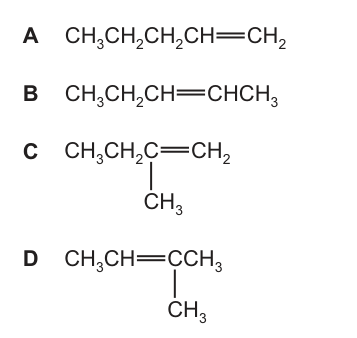
Working
Geometric (cis-trans) isomerism requires restricted rotation around a C=C bond and two different groups attached to each carbon atom of the double bond.
- A (): The terminal carbon is bonded to two identical H atoms. No geometric isomerism.
- B (): Each carbon of the C=C bond is bonded to one H atom and one alkyl group ( and respectively). Geometric isomerism is possible.
- C (): The terminal carbon is bonded to two identical H atoms. No geometric isomerism.
- D (): One carbon of the C=C bond is bonded to two identical groups. No geometric isomerism.
Answer
B
B
Background Concept
Geometric isomerism (also known as cis-trans isomerism) is a type of stereoisomerism that arises due to restricted rotation around a carbon-carbon double bond (C=C). For an alkene to exhibit geometric isomerism, two conditions must be met:
- There must be restricted rotation (provided by the C=C double bond).
- Each carbon atom participating in the double bond must be attached to two different atoms or groups.
If either carbon atom of the double bond is bonded to two identical groups (e.g., two hydrogen atoms or two methyl groups), swapping them does not produce a new spatial arrangement, and therefore no geometric isomers exist.
Understanding the Question
The question asks to identify which of the four given alkene structures can exist as geometric isomers (cis and trans forms). We must check the substituents on both carbons of the C=C bond for each option to see if the criterion for geometric isomerism is satisfied.
Approach
Apply the criterion for geometric isomerism to each structure: look at the two groups on the left carbon of the double bond and the two groups on the right carbon. If both carbons have two different groups attached, the alkene shows geometric isomerism. If either carbon has two identical groups, it does not.
Step-by-Step Reasoning
- A (, pent-1-ene): The right-hand carbon of the double bond is part of a group, meaning it is bonded to two identical hydrogen atoms. Therefore, it cannot show geometric isomerism.
- B (, pent-2-ene): The left-hand carbon is bonded to an H atom and an ethyl group (). The right-hand carbon is bonded to an H atom and a methyl group (). Since both carbons have two different groups attached, this alkene exists as cis-pent-2-ene and trans-pent-2-ene. This is the correct answer.
- C (, 2-methylbut-1-ene): The right-hand carbon is part of a group (two identical H atoms). No geometric isomerism.
- D (, 2-methylbut-2-ene): The right-hand carbon of the double bond is bonded to two identical methyl () groups. No geometric isomerism.
Key Takeaways
To determine if an alkene shows geometric isomerism, inspect the two carbons of the C=C bond. If either carbon has two identical substituents, geometric isomerism is not possible. Terminal alkenes () and alkenes with a group never show geometric isomerism.
Common Mistakes
A common mistake is assuming that any alkene with different alkyl groups on either side of the double bond shows geometric isomerism, without checking if each individual carbon has two different groups. For example, in option D, the groups on the left and right sides of the molecule are different, but one carbon has two identical methyl groups, so no geometric isomerism exists.
Things to Be Careful About
Always check both carbons of the double bond independently. Do not just look at the overall molecule; the condition applies to each carbon atom of the C=C bond individually. Remember that terminal alkenes () and alkenes with geminal substituents () cannot exhibit geometric isomerism.
What is the correct name of the major product of the reaction of HBr with 3-ethylhex-3-ene?
Options
A 3-bromo-3-ethylhexane
B 3-bromo-4-ethylhexane
C 4-bromo-3-ethylhexane
D 4-bromo-4-ethylhexane
Working
3-ethylhex-3-ene has the double bond between C3 and C4. C3 carries an ethyl group and has no hydrogen atom, while C4 has one hydrogen atom.
HBr adds according to Markovnikov's rule: H adds to the carbon of the double bond that already has more hydrogen atoms (C4), and Br adds to the carbon with fewer hydrogen atoms (C3).
Both the bromine atom and the ethyl group are therefore on C3, giving 3-bromo-3-ethylhexane.
Answer
A
A
Background Concept
Addition of HBr to an alkene is an electrophilic addition reaction. The alkene's pi bond attacks the electrophilic H of HBr, forming a carbocation intermediate. Markovnikov's rule states that the hydrogen atom adds to the carbon of the double bond that already has more hydrogen atoms, and the halogen adds to the carbon with fewer hydrogen atoms. This is because the more substituted carbocation is more stable.
Understanding the Question
The question gives the name 3-ethylhex-3-ene and asks for the correct name of the major product when HBr adds to it. The word "major" signals that Markovnikov's rule applies, so the product is the one formed through the more stable carbocation.
Approach
First, draw the structure from the IUPAC name. Then identify which carbon of the double bond has more hydrogen atoms. Apply Markovnikov's rule to decide where H and Br attach. Finally, name the product using IUPAC rules.
Step-by-Step Reasoning
- Hex-3-ene has a six-carbon chain with a double bond between C3 and C4.
- At C3 there is an ethyl substituent. So C3 is bonded to C2, C4 (double bond), and the ethyl group. It has no hydrogen atom.
- C4 is bonded to C3 (double bond), C5, and one hydrogen atom.
- When HBr adds, H goes to C4 because C4 has more hydrogen atoms. Br goes to C3.
- The product has Br and an ethyl group both on C3, so its IUPAC name is 3-bromo-3-ethylhexane.
Key Takeaways
- Markovnikov's rule is essential for predicting the major product of HBr addition to an unsymmetrical alkene.
- The more substituted carbon of the double bond usually receives the halogen because it forms the more stable carbocation.
- Always convert an IUPAC name into a structure before deciding the product.
Common Mistakes
- Adding Br to the carbon with more hydrogen atoms instead of fewer. This would give the anti-Markovnikov product, which is not the major product in this reaction.
- Misreading the parent chain and placing the ethyl group at the wrong carbon.
- Forgetting that the ethyl substituent at C3 leaves C3 with no hydrogen atoms, which is key to applying Markovnikov's rule.
Things to Be Careful About
- Check the numbering of the parent chain: the double bond must get the lowest possible locant.
- When naming the product, list substituents alphabetically: bromo before ethyl.
- If the alkene is symmetrical, Markovnikov's rule gives only one product; here the alkene is unsymmetrical, so the rule matters.
The alkane undergoes free radical substitution with chlorine. No C–C bonds are broken in this reaction.
How many isomeric products, including positional and optical isomers, of molecular formula can be formed?
Options
A 4
B 5
C 6
D 7
Working
The alkane is 2-methylbutane, . It has four inequivalent types of hydrogen environment:
- terminal of the ethyl group
- the group
- the central group
- the two equivalent groups attached to the central carbon
Chlorination at each site gives four constitutional isomers. Two of these are chiral:
- chlorination on a methyl group attached to the central carbon gives a chiral central carbon (, , , ) -> 2 enantiomers
- chlorination on the group gives a chiral carbon (, , , ) -> 2 enantiomers
The other two constitutional isomers are achiral -> 1 each.
Total .
Answer
C
C
Background Concept
Free-radical substitution is the reaction of alkanes with halogens in UV light. It occurs by a chain mechanism: initiation (), propagation, and termination. Because any C–H hydrogen can be abstracted, monochlorination of an unsymmetrical alkane gives a mixture of isomeric chloroalkanes. Since the question states no C–C bonds break, the carbon skeleton stays the same.
To count isomers, compare the hydrogen environments. Two H atoms are equivalent if replacing either gives the same product. Then, among the constitutional isomers, look for chiral centres: a carbon with four different groups. Such a molecule exists as two non-superimposable mirror-image enantiomers. The question says "including positional and optical isomers", so an enantiomeric pair must be counted as two products.
Understanding the Question
The alkane is 2-methylbutane. Replacing one H by Cl converts it into . The question asks not only for positional isomers (where the Cl is on the carbon skeleton) but also optical isomers, so each chiral product’s enantiomers are counted separately. No C–C bonds break, so we only consider substituting H on the existing skeleton; no rearranged carbon skeletons are possible.
Approach
- Draw or write the skeleton and identify the inequivalent H environments.
- List the distinct constitutional monochloro products and check each for chirality.
- For any chiral product, count 2; for an achiral product, count 1. Sum the counts and choose the option.
Step-by-Step Reasoning
-
Skeleton and equivalence. 2-methylbutane has the skeleton . The central carbon is attached to an ethyl group and two methyl groups. Those two methyl groups are equivalent, but the terminal methyl of the ethyl chain is in a different environment. Hence there are four distinct substitution sites:
- the terminal of the ethyl chain
- the group
- the central group
- the two equivalent methyl groups attached to the central carbon
-
Products and chirality.
- Cl on the terminal of the ethyl chain: (1-chloro-3-methylbutane). No chiral centre, so 1 isomer.
- Cl on the group: (2-chloro-3-methylbutane). The carbon bearing Cl is attached to H, Cl, and , all different, so it is chiral; 2 enantiomers.
- Cl on the central : (2-chloro-2-methylbutane). The central carbon has two identical groups, so it is not chiral; 1 isomer.
- Cl on one of the two equivalent methyl groups attached to the central carbon: (1-chloro-2-methylbutane). The central carbon now has four different groups (H, , , ), so it is chiral; 2 enantiomers.
-
Total. .
Thus option C is correct.
Key Takeaways
- The number of monochlorination products is determined by the number of inequivalent hydrogen environments.
- Equivalent groups collapse into the same constitutional product.
- When optical isomers are included, a chiral constitutional isomer contributes 2 products, not 1.
- A carbon is chiral if it carries four different groups; check not only the carbon that gained Cl but also other carbons whose substituent set may have changed.
Common Mistakes
- Assuming all three methyl groups in 2-methylbutane are equivalent. Only the two methyl groups attached to the central carbon are equivalent.
- Stopping at 4 constitutional isomers and choosing A, forgetting that optical isomers add extra products.
- Thinking the central carbon after replacing its H by Cl is chiral. It is not, because it still has two identical groups.
- Forgetting that chlorination of the group creates a chiral centre at the carbon bearing Cl.
- Counting an enantiomeric pair once because the position is the same; the question explicitly asks for optical isomers, so the pair counts as two.
Things to Be Careful About
- No C–C bond breaking is allowed, so do not include skeletal rearranged isomers.
- Recognise symmetry: the two equivalent methyl groups attached to the central carbon give only one constitutional product, not two.
- An achiral molecule contributes 1 isomer; a chiral molecule contributes 2 enantiomers when optical isomerism is counted.
- In an MCQ, the final answer is the option letter C, not the number 6.
- Draw the skeleton carefully: a condensed formula can hide which carbons are equivalent.
What is involved in the mechanism of the reaction between aqueous NaOH and 1-bromobutane?
Options
A attack by a nucleophile on a carbon atom with a partial positive charge
B heterolytic bond fission and attack by a nucleophile on a carbocation
C homolytic bond fission and attack by an electrophile on a carbanion
D homolytic bond fission and attack by a nucleophile on a carbocation
Working
1-Bromobutane is a primary halogenoalkane. Aqueous NaOH provides , a nucleophile. In the SN2 mechanism, the nucleophile attacks the electron-deficient carbon atom of the polar C–Br bond, which carries a partial positive charge, while the C–Br bond breaks heterolytically. There is no carbocation intermediate and no homolytic fission.
Answer
A
A
Background Concept
Halogenoalkanes undergo nucleophilic substitution because the carbon–halogen bond is polar: the halogen is more electronegative than carbon, so the carbon atom carries a partial positive charge () and the halogen carries a partial negative charge (). A nucleophile is an electron-rich species that donates a lone pair to an electron-deficient atom.
For primary halogenoalkanes, the mechanism is SN2: the nucleophile attacks the carbon from the opposite side to the halogen, and the C–Br bond breaks at the same time. This bond breaking is heterolytic — both electrons in the C–Br bond go to the bromine atom, forming . There is no carbocation intermediate.
Tertiary halogenoalkanes, by contrast, tend to react by SN1: first the C–X bond breaks heterolytically to form a carbocation, and then the nucleophile attacks the carbocation. Homolytic bond fission produces radicals and is involved in free-radical substitution, not in nucleophilic substitution.
Understanding the Question
The question asks which mechanistic description applies to the reaction between aqueous NaOH and 1-bromobutane. 1-Bromobutane is , a primary halogenoalkane. Aqueous NaOH supplies hydroxide ions, , which act as a nucleophile. The task is to choose the option that correctly describes the bond fission and the species attacked.
Approach
First classify the halogenoalkane: 1-bromobutane is primary because the carbon attached to bromine is bonded to only one other alkyl group. Primary halogenoalkanes react with aqueous hydroxide by SN2. In SN2, the nucleophile attacks the carbon atom with a partial positive charge, and the C–Br bond breaks heterolytically. There is no carbocation. Then compare each option: only option A matches these features.
Step-by-Step Reasoning
- Identify the substrate: 1-bromobutane has the structure , so the bromine is on a primary carbon.
- Recognise the reagent: aqueous NaOH gives , a good nucleophile.
- Understand the polarity: because bromine is more electronegative than carbon, the C–Br bond is polarised so that carbon has a partial positive charge.
- Apply the SN2 mechanism: the ion attacks the carbon while the C–Br bond breaks. The two events happen in one step, so no carbocation is formed.
- Identify the fission type: the C–Br bond breaks heterolytically, with both electrons moving to bromine to form .
- Eliminate the wrong options:
- Option B describes SN1, which requires a carbocation intermediate; this is not the mechanism for a primary halogenoalkane.
- Option C mentions homolytic fission and an electrophile attacking a carbanion; neither is correct for nucleophilic substitution.
- Option D mentions homolytic fission and a carbocation; homolytic fission gives radicals, not a carbocation.
Therefore, the correct answer is A.
Key Takeaways
- Primary halogenoalkanes react with aqueous NaOH by SN2: nucleophilic attack on the carbon and heterolytic fission of the C–Br bond.
- SN2 is concerted: bond formation and bond breaking happen in the same step, so no carbocation intermediate forms.
- Tertiary halogenoalkanes tend to react by SN1, which does involve a carbocation.
- Heterolytic fission produces ions; homolytic fission produces radicals.
Common Mistakes
- Choosing B because it contains “nucleophile” and “carbocation”. Carbocations are only involved in SN1, not in the SN2 reaction of a primary halogenoalkane.
- Confusing heterolytic and homolytic fission. Heterolytic fission gives ions; homolytic fission gives free radicals.
- Thinking that aqueous NaOH causes elimination. Aqueous conditions favour nucleophilic substitution; concentrated alcoholic NaOH favours elimination.
- Forgetting that the carbon in a polar C–Br bond has a partial positive charge, which is why it is attacked by a nucleophile.
Things to Be Careful About
- The word “aqueous” is important: it ensures acts as a nucleophile in substitution, not as a base in elimination.
- Primary versus tertiary structure determines whether the mechanism is SN2 or SN1.
- In heterolytic fission, both electrons of the shared pair go to the more electronegative atom, here bromine.
- In an SN2 mechanism, the curly arrows would show the nucleophile’s lone pair attacking the carbon and a second arrow from the C–Br bond to bromine; no carbocation is drawn.
But-2-ene reacts with cold dilute acidified to give product X.
But-2-ene reacts with an excess of hot concentrated acidified to give product Y.
Which statement about X and Y is correct?
Options
A Only one of X and Y reacts with 2,4-dinitrophenylhydrazine.
B X and Y both react with sodium hydroxide.
C X and Y both react with sodium metal.
D Y reacts with to give X.
Working
Cold dilute acidified oxidises but-2-ene to the diol butane-2,3-diol, X.
Hot concentrated acidified cleaves the C=C bond, so but-2-ene gives two molecules of ethanoic acid, Y.
- A — 2,4-DNPH detects aldehydes and ketones only; neither a diol nor a carboxylic acid reacts, so this is false.
- B — NaOH reacts with the carboxylic acid Y but not with the diol X, so false.
- C — both the diol X and the carboxylic acid Y contain an –OH group and react with sodium metal, releasing , so true.
- D — reduces Y (ethanoic acid) to ethanol, not to the diol X, so false.
Answer
C
C
Background Concept
Alkenes are oxidised by acidified potassium manganate(VII), and the product depends entirely on the conditions:
- Cold, dilute acidified (Baeyer's reagent) is a mild oxidising agent. It adds an –OH group to each carbon of the C=C double bond (syn-dihydroxylation), converting the alkene into a vicinal diol (a compound with two –OH groups on adjacent carbons). The carbon skeleton is unchanged.
- Hot, concentrated acidified is a vigorous oxidising agent. It breaks the C=C bond completely (oxidative cleavage). Each alkene carbon becomes part of a carbonyl-containing group, depending on its substitution: a –CH= carbon becomes a carboxylic acid (–COOH), a –CH2= carbon becomes CO2, and a –CR2= carbon becomes a ketone.
But-2-ene is , a symmetrical internal alkene. Cold dilute oxidation gives butane-2,3-diol, . Hot concentrated oxidation cleaves the double bond so each half becomes a carboxylic acid: two molecules of ethanoic acid, .
You also need the reactivity of the functional groups involved:
- Alcohols and carboxylic acids both contain –OH and both react with sodium metal, releasing hydrogen gas.
- Only carboxylic acids react with NaOH (neutralisation); alcohols and diols are too weakly acidic.
- 2,4-dinitrophenylhydrazine (2,4-DNPH) gives an orange precipitate only with aldehydes and ketones — not with alcohols, diols, or carboxylic acids.
- is a strong reducing agent that reduces carboxylic acids to primary alcohols.
Understanding the Question
The question gives two different oxidation conditions applied to but-2-ene and names the products X and Y. It then asks which of four statements about X and Y is correct. The key is to identify X and Y correctly first; each statement then tests a piece of functional-group chemistry.
Approach
- Identify X: cold dilute acidified → diol (butane-2,3-diol).
- Identify Y: hot concentrated acidified → oxidative cleavage → ethanoic acid.
- Evaluate each statement A–D against the known reactions of diols and carboxylic acids.
Step-by-Step Reasoning
Identify X. Cold dilute adds –OH across the double bond:
So X is butane-2,3-diol, a diol.
Identify Y. Hot concentrated cleaves the C=C bond. But-2-ene is symmetrical, so both halves give the same product:
So Y is ethanoic acid.
Statement A. 2,4-DNPH reacts only with aldehydes and ketones. X is a diol and Y is a carboxylic acid — neither has a carbonyl group of the aldehyde/ketone type, so neither reacts. The statement says "only one reacts", which is false.
Statement B. Sodium hydroxide neutralises carboxylic acids but not alcohols. Y (ethanoic acid) reacts with NaOH; X (butane-2,3-diol) does not. The statement says both react, which is false.
Statement C. Both alcohols and carboxylic acids react with sodium metal, releasing hydrogen. X (diol) reacts: . Y (ethanoic acid) reacts: . Both react, so this statement is correct.
Statement D. reduces carboxylic acids to primary alcohols. Y (ethanoic acid) would be reduced to ethanol, , not to butane-2,3-diol. So Y does not give X, and this statement is false.
The correct answer is C.
Key Takeaways
- Cold dilute acidified converts an alkene to a diol; hot concentrated acidified cleaves the C=C bond, giving carboxylic acids, ketones, or CO2 depending on substitution.
- Alcohols and carboxylic acids both react with sodium metal, but only carboxylic acids react with NaOH.
- 2,4-DNPH is specific to aldehydes and ketones.
- reduces carboxylic acids to primary alcohols.
Common Mistakes
- Confusing the two oxidation conditions: cold dilute gives a diol, hot concentrated gives cleavage products. Writing them the wrong way round makes every statement wrong.
- Assuming carboxylic acids do not react with sodium metal — they do, releasing just like alcohols.
- Thinking 2,4-DNPH tests for carboxylic acids — it tests only for aldehydes and ketones.
- Forgetting that but-2-ene is symmetrical, so hot concentrated oxidation gives two identical molecules of ethanoic acid.
Things to Be Careful About
- The product of cold dilute oxidation keeps the carbon skeleton intact; the product of hot concentrated oxidation does not.
- Carboxylic acids react with NaOH, but alcohols/diols do not — this is the key to rejecting statement B.
- reduces a carboxylic acid to a primary alcohol, so Y would give ethanol, not the diol X.
- Read each statement carefully: "both react" vs "only one reacts" — a single non-reacting compound makes the statement false.
When heated with KOH dissolved in ethanol, halogenoalkanes can undergo an elimination reaction to form alkenes.
What are the possible elimination products when 2-bromobutane is heated with KOH dissolved in ethanol?
Options
A only
B only
C and
D and
Working
In elimination, KOH in ethanol removes HBr from 2-bromobutane. The bromine is on C2 of the butane chain, so a hydrogen can be removed from either adjacent carbon atom.
- Removing H from C1 gives but-1-ene:
- Removing H from C3 gives but-2-ene:
Both alkenes are formed, so options A and B are incomplete and D includes an impossible product.
Answer
C — and
C
Background Concept
Halogenoalkanes contain a polar C–X bond. When treated with a strong base such as KOH dissolved in ethanol (alcoholic KOH), they can undergo elimination: the base removes a hydrogen atom from a carbon adjacent to the carbon bearing the halogen (a beta-hydrogen), the C–X bond breaks, and a C=C double bond forms. This is different from aqueous KOH, which favours nucleophilic substitution to give an alcohol.
For 2-bromobutane, the structure is . The bromine is on C2, so there are two different adjacent carbon atoms, C1 and C3, each carrying hydrogens that can be removed.
Understanding the Question
This MCQ asks for the possible elimination products when 2-bromobutane is heated with alcoholic KOH. The key word is 'possible': we are not asked for the major product, nor for a mechanism, but for all alkenes that can be formed by removing HBr from the molecule. We must compare the structures with options A–D.
Approach
- Draw or visualise 2-bromobutane as a four-carbon chain with Br on C2.
- Identify the beta-carbon atoms: the carbons directly attached to C2, namely C1 and C3.
- Remove H from each beta-carbon in turn and form a double bond between that carbon and C2.
- Write the two alkene products and select the option that lists both.
Step-by-Step Reasoning
- 2-bromobutane: .
- If H is removed from C1, the double bond forms between C1 and C2:
- If H is removed from C3, the double bond forms between C2 and C3:
Both eliminations are possible because both beta-carbons have hydrogen atoms. The overall reactions can be written as:
Thus the possible products are but-1-ene and but-2-ene, which matches option C.
Why the other options are wrong:
- A lists only but-2-ene; it ignores but-1-ene.
- B lists only but-1-ene; it ignores but-2-ene.
- D includes (buta-1,3-diene). A single elimination from 2-bromobutane cannot produce a diene because there is only one bromine atom and only one HBr is removed.
But-2-ene can exist as E and Z isomers, but the question asks for structural products, so E/Z isomerism is not needed to answer it.
Key Takeaways
- Alcoholic KOH promotes elimination from halogenoalkanes; aqueous KOH promotes substitution.
- Elimination can occur whenever there is a hydrogen on a carbon adjacent to the C–X carbon.
- If the halogenoalkane is unsymmetrical, more than one alkene may be possible; the question wording ('possible') tells you to include all of them.
- The more substituted alkene is often the major product (Zaitsev rule), but 'possible products' includes the minor one too.
Common Mistakes
- Choosing only one alkene because you think elimination happens in only one way. 2-bromobutane has two different beta-carbons, so two products are possible.
- Applying Markovnikov's rule: that rule applies to electrophilic addition to alkenes, not to elimination from halogenoalkanes.
- Using aqueous KOH mentally: aqueous KOH would give substitution (butan-2-ol), not elimination.
- Selecting D because it contains four carbons; buta-1,3-diene would need two eliminations and is not formed from a monobromoalkane in one step.
Things to Be Careful About
- Draw the carbon skeleton correctly: 2-bromobutane is , not a branched structure.
- Identify both beta-carbons; missing one means missing one product.
- Use structural formulae when comparing options so you do not confuse but-1-ene with but-2-ene.
- Remember that E/Z isomers of but-2-ene are not separate structural products; they are stereoisomers of the same alkene.
- The reaction conditions matter: 'heated with KOH dissolved in ethanol' is the classic elimination condition.
Chloroethane can be used to make sodium propanoate.
Intermediate Q is hydrolysed with boiling aqueous NaOH to give sodium propanoate.
Which reagent would produce intermediate Q from chloroethane?
Options
A concentrated ammonia solution
B dilute sulfuric acid
C hydrogen cyanide in water
D potassium cyanide in ethanol
Working
Sodium propanoate is , formed by hydrolysis of a nitrile. Therefore intermediate Q is propanenitrile, .
Propanenitrile is made from chloroethane by nucleophilic substitution with cyanide ions. Potassium cyanide in ethanol provides the nucleophile:
Answer
D
D
Background Concept
Halogenoalkanes (alkyl halides) undergo nucleophilic substitution reactions. The carbon–halogen bond is polarised because the halogen is more electronegative than carbon, making the carbon atom electron-deficient (electrophilic). A nucleophile — a species with a lone pair of electrons — attacks this electron-deficient carbon, and the halogen leaves as a halide ion.
When the nucleophile is a cyanide ion (), the product is a nitrile (). This is an important synthetic step because it extends the carbon chain by one carbon atom. The reaction is typically carried out with potassium cyanide dissolved in ethanol, which provides a high concentration of free cyanide ions.
Nitriles are versatile intermediates. Hydrolysis of a nitrile with boiling aqueous sodium hydroxide converts it to the sodium salt of a carboxylic acid:
This is how carboxylic acids (as their salts) can be prepared from halogenoalkanes via the nitrile intermediate.
Understanding the Question
The question presents a two-step synthesis with an unknown intermediate Q:
We are told that Q is hydrolysed with boiling aqueous NaOH to give sodium propanoate. This is a strong clue: the hydrolysis of a nitrile with NaOH gives a carboxylate salt. So Q must be a nitrile.
Sodium propanoate is , the salt of propanoic acid. The corresponding nitrile would be propanenitrile, .
The question asks: which reagent converts chloroethane () into Q ()?
Approach
- Identify Q by working backwards from sodium propanoate. Since hydrolysis of Q gives sodium propanoate, Q must be propanenitrile (a nitrile).
- Recall the reaction that converts a halogenoalkane to a nitrile: nucleophilic substitution with cyanide ions ().
- Identify which option provides cyanide ions effectively: potassium cyanide in ethanol.
Step-by-Step Reasoning
Step 1: Identify Q.
Sodium propanoate has the structure . The hydrolysis of a nitrile with boiling aqueous NaOH produces and . Therefore Q must be propanenitrile, .
Step 2: Identify the reagent for the first step.
Chloroethane () reacts with cyanide ions by nucleophilic substitution:
The cyanide source must provide ions. Potassium cyanide (KCN) is an ionic compound. Dissolved in ethanol, it releases ions which act as nucleophiles. The reaction is:
Step 3: Evaluate each option.
- A. Concentrated ammonia solution: is a nucleophile that would substitute the chlorine to form ethylamine (). Ethylamine is an amine, not a nitrile, and would not hydrolyse to sodium propanoate.
- B. Dilute sulfuric acid: Halogenoalkanes do not react with dilute acids to form nitriles. Dilute provides and sulfate ions, neither of which can substitute chlorine to form a nitrile.
- C. Hydrogen cyanide in water: HCN is a weak acid (). In water, it is only slightly ionised, so very few ions are available. The concentration of free cyanide ions is too low for effective nucleophilic substitution. Also, water is a competing nucleophile (it would form an alcohol).
- D. Potassium cyanide in ethanol: KCN is an ionic salt that dissolves in ethanol, providing a high concentration of ions. The cyanide ion is a good nucleophile and substitutes the chlorine in chloroethane to form propanenitrile. Ethanol is a polar solvent that dissolves both the KCN and the halogenoalkane, and it does not compete effectively as a nucleophile.
The full synthesis is:
Key Takeaways
- Halogenoalkanes react with KCN in ethanol by nucleophilic substitution to form nitriles, extending the carbon chain by one carbon.
- Nitriles hydrolyse with boiling aqueous NaOH to give the sodium salt of a carboxylic acid.
- Working backwards from a product to identify an intermediate is a key skill in organic synthesis problems.
- The choice of solvent and reagent form matters: KCN in ethanol (not HCN in water) provides the nucleophilic needed.
Common Mistakes
- Choosing A (concentrated ammonia): confusing the reaction with ammonia (which gives amines) with the reaction with cyanide (which gives nitriles). Ammonia is a nucleophile but produces an amine, not a nitrile.
- Choosing C (HCN in water): HCN is a weak acid and does not provide free cyanide ions for nucleophilic substitution. The ionic KCN in a polar solvent is required.
- Not recognising that Q is a nitrile: failing to work backwards from sodium propanoate to identify the intermediate. The hydrolysis clue is essential.
- Confusing the hydrolysis conditions: nitrile hydrolysis requires boiling with aqueous NaOH (or acid), not just water.
Things to Be Careful About
- The solvent matters: KCN must be in ethanol (not water) for this reaction to work well. In water, hydroxide ions can compete with cyanide for the halogenoalkane.
- The carbon chain is extended by one carbon when a halogenoalkane is converted to a nitrile — this is a key synthetic strategy for building up carbon chains.
- The hydrolysis of a nitrile with NaOH gives the carboxylate salt, not the free acid. Acidification would be needed to obtain the free carboxylic acid.
- The stoichiometry of nitrile hydrolysis is . Note that 2 moles of NaOH are consumed per mole of nitrile.
Four different alcohols are treated with alkaline .
Which row is correct?
Options
| name of alcohol | formulae of products | |
|---|---|---|
| A | butan-2-ol | and |
| B | propan-1-ol | and |
| C | propan-2-ol | and |
| D | butan-2-ol | and |
Working
The tri-iodomethane test is positive for alcohols containing the group. Propan-2-ol, , is oxidised to propanone, , which gives:
So the products are acetate and iodoform.
Answer
C
C
Background Concept
The tri-iodomethane (iodoform) test is used to detect a methyl carbonyl group, , or an alcohol that can be oxidised to one. In alkaline solution, iodine oxidises a secondary alcohol of the type to a methyl ketone, . The methyl group next to the carbonyl is then iodinated, and the C–C bond is cleaved, giving a carboxylate ion and yellow iodoform, . The formation of the pale yellow solid is the positive test.
For an alcohol, the essential structural feature is therefore : a methyl group attached to the carbon that carries the group and one hydrogen. Ethanol also gives a positive test because it is oxidised to ethanal, , which has the unit.
Understanding the Question
This MCQ asks which row correctly pairs an alcohol with the products formed by alkaline . The options test whether you know which alcohols give a positive iodoform test and what the carboxylate product is. The command is implicit: identify the correct row.
Approach
Check each alcohol for the feature. If it is present, oxidise the alcohol to the ketone and identify the group R attached to the carbonyl carbon. The carboxylate product is , and the other product is always . Eliminate any row where the alcohol is negative or where the products do not match.
Step-by-Step Reasoning
- Butan-2-ol, , has the required group. Oxidation gives butanone, . Here R = , so the products should be propanoate, , and . Option A gives acetate instead of propanoate, so A is wrong.
- Propan-1-ol, , is a primary alcohol. Oxidation gives propanal, , which does not contain the unit. It does not give a positive iodoform test, so B is wrong.
- Propan-2-ol, , has the required group. Oxidation gives propanone, . Here R = , so the products are acetate, , and iodoform, . This matches option C.
- Butan-2-ol in option D gives the correct carboxylate, propanoate, but the second product is written as instead of . The iodoform test always produces , so D is wrong.
Key Takeaways
The iodoform test is positive for alcohols with the group and for carbonyl compounds with the group. The products are a carboxylate ion and iodoform, . To find the carboxylate, identify the R group attached to the carbonyl carbon in the intermediate ketone.
Common Mistakes
- Thinking that every secondary alcohol gives a positive iodoform test. Only those with a group attached to the alcohol carbon do.
- Writing acetate, , for butan-2-ol. Butan-2-ol gives propanoate, , because the ketone is butanone.
- Writing instead of . The product is iodoform, not methyl iodide.
- Assuming propan-1-ol gives a positive test. Its oxidation product, propanal, lacks the group.
Things to Be Careful About
The reaction requires alkaline conditions; the iodine must be in solution. Use carbon counting as a check: the carboxylate and iodoform together must contain the same number of carbon atoms as the original alcohol. For butan-2-ol, propanoate (3 C) + (1 C) = 4 C; for propan-2-ol, acetate (2 C) + (1 C) = 3 C.
The of compound X is 88.
Compound X is heated under reflux with an excess of acidified potassium dichromate(VI) to produce compound Y.
Compound Y reacts with compound X under suitable conditions to produce compound Z. The of compound Z is 172.
What is compound X?
Options
A
B
C
D
Working
All four options are structural isomers of C5H12O, so Mr = 88 for each.
With excess acidified K2Cr2O7:
- primary alcohols oxidise to carboxylic acids
- secondary alcohols oxidise to ketones
- tertiary alcohols are not oxidised
If Y is the carboxylic acid and X the alcohol, esterification gives:
So Mr(Y) = 102.
A carboxylic acid C5H10O2 has Mr = 60 + 10 + 32 = 102. A ketone C5H10O has Mr = 86, which would give Mr(Z) = 86 + 70 = 156, not 172.
Therefore X must be a primary alcohol. Only option D, (CH3)3CCH2OH (2,2-dimethylpropan-1-ol), is primary.
Answer
D — (CH3)3CCH2OH
D
Background Concept
Alcohols are classified by the number of carbon atoms directly attached to the carbon bearing the −OH group:
- Primary (RCH2OH): one carbon attached to the C−OH carbon.
- Secondary (R2CHOH): two carbons attached.
- Tertiary (R3COH): three carbons attached.
Acidified potassium dichromate(VI), K2Cr2O7/H+, is a strong oxidising agent. With excess reagent:
- Primary alcohols → carboxylic acids (full oxidation).
- Secondary alcohols → ketones.
- Tertiary alcohols → no reaction.
Carboxylic acids react with alcohols to form esters via esterification, a condensation reaction that eliminates water:
Understanding the Question
All four options are structural isomers with the same molecular formula C5H12O and Mr = 88. The key to distinguishing them is the class of alcohol, which determines what Y is formed on oxidation and whether Y can react with X to give an ester of Mr = 172.
Approach
- Confirm all options have Mr = 88.
- Use the esterification equation to deduce Mr(Y) from Mr(Z) = 172.
- Match Mr(Y) to the oxidation product of a specific alcohol class.
- Identify which option belongs to that class.
Step-by-Step Reasoning
-
Mr of the options: All are C5H12O: 5(12) + 12(1) + 16 = 88.
-
Esterification: Y + X → Z + H2O, so:
With Mr(Z) = 172 and Mr(X) = 88:
-
Match Mr(Y) to oxidation product:
- Primary alcohol → carboxylic acid RCOOH. For C5: C5H10O2, Mr = 60 + 10 + 32 = 102. ✓
- Secondary alcohol → ketone RCOR'. For C5: C5H10O, Mr = 60 + 10 + 16 = 86. This would give Mr(Z) = 86 + 70 = 156, not 172. ✗
- Tertiary alcohol → no oxidation, no Y. ✗
-
Identify the primary alcohol: Only D, (CH3)3CCH2OH (2,2-dimethylpropan-1-ol), has a −CH2OH group, making it primary. A and C are secondary; B is tertiary.
Key Takeaways
- Excess acidified K2Cr2O7 fully oxidises primary alcohols to carboxylic acids (not stopping at the aldehyde).
- Esterification is a condensation reaction: Mr(ester) = Mr(acid) + Mr(alcohol) − 18.
- Mr data can be used to deduce structures in reaction sequences.
Common Mistakes
- Assuming all alcohols are oxidised — tertiary alcohols are not.
- Forgetting to subtract 18 (water) in the esterification Mr calculation.
- Misclassifying the alcohol: in D the −CH2OH carbon is attached to a carbon with no hydrogen, but it is still a primary alcohol because the −OH carbon has only one carbon neighbour.
Things to Be Careful About
- "Excess" oxidising agent means full oxidation to the carboxylic acid.
- Check the carbon skeleton carefully when classifying alcohols.
- Verify the Mr of each option before using reaction chemistry.
Butanedione, , is a yellow liquid.
How does butanedione react with 2,4-dinitrophenylhydrazine reagent and Fehling’s reagent?
Options
| 2,4-dinitrophenylhydrazine | Fehling’s | |
|---|---|---|
| A | positive | positive |
| B | positive | negative |
| C | negative | positive |
| D | negative | negative |
Working
Butanedione, , contains two carbonyl groups, both of which are ketone carbonyls — there is no aldehyde (CHO) group.
- 2,4-Dinitrophenylhydrazine reacts with both aldehydes and ketones, forming a yellow/orange precipitate → positive.
- Fehling's reagent oxidises only aldehydes (and -hydroxy ketones); it does not oxidise ketones → negative.
Answer
B (positive with 2,4-DNPH, negative with Fehling's)
B
Background Concept
2,4-dinitrophenylhydrazine (2,4-DNPH, also called Brady's reagent) is a general test for the carbonyl group. In acidic solution it reacts with any carbonyl compound — aldehyde or ketone — in a condensation reaction to form a hydrazone, which precipitates as a yellow/orange solid:
Because it detects the C=O bond itself, a positive result tells you a carbonyl group is present, but not whether it is an aldehyde or a ketone.
Fehling's reagent is a mild oxidising agent: copper(II) ions complexed with tartrate ions in alkaline solution. It oxidises aldehydes to carboxylic acids, and in doing so is reduced to , which precipitates as red copper(I) oxide, . Ketones are not oxidised by Fehling's reagent because they have no hydrogen atom on the carbonyl carbon to lose, and further oxidation would require breaking a C–C bond. Fehling's test therefore distinguishes an aldehyde (positive, red precipitate) from a ketone (negative, no change).
Understanding the Question
The question gives butanedione, , a yellow liquid, and asks for the outcome of two qualitative tests. The structural formula shows two adjacent carbonyl groups. The critical task is to recognise that each carbonyl carbon is bonded to two carbon atoms, making both carbonyls ketones, and that no aldehyde (CHO) group is present. Since the answer is a combination of two test results, both must be judged correctly.
Approach
- Interpret the structure of butanedione and identify its functional groups.
- Recall the scope of the 2,4-DNPH test: any carbonyl → positive.
- Recall the scope of Fehling's test: only aldehydes (and -hydroxy ketones) → positive.
- Apply each test to butanedione and read off the matching option.
Step-by-Step Reasoning
Step 1 — Identify functional groups. has two C=O groups. Each carbonyl carbon is attached to two carbon atoms (a group and the adjacent carbonyl carbon), so each is a ketone carbonyl. There is no H–C=O (aldehyde) unit.
Step 2 — 2,4-DNPH test. This reagent reacts with any carbonyl compound, aldehyde or ketone, forming a coloured hydrazone precipitate. Since butanedione contains carbonyl groups, the test is positive: a yellow/orange solid forms.
Step 3 — Fehling's test. Fehling's oxidises aldehydes but not ketones. Butanedione has no aldehyde group, so no oxidation occurs and no red precipitate forms — the test is negative.
Step 4 — Combine the results: positive with 2,4-DNPH, negative with Fehling's → option B.
Why the distractors are wrong:
- A (positive, positive): would require an aldehyde group, which butanedione lacks.
- C (negative, positive): internally inconsistent — any compound that gives a positive Fehling's test contains an oxidisable aldehyde (or -hydroxy ketone) group and would therefore also give a positive 2,4-DNPH test.
- D (negative, negative): would be correct only for a compound with no carbonyl group at all, such as an alkane or alcohol.
Key Takeaways
- 2,4-DNPH is a general carbonyl test: positive for both aldehydes and ketones.
- Fehling's (and Tollens') reagent distinguishes aldehydes from ketones: only aldehydes give a positive result.
- A diketone is still a ketone for the purposes of these tests; having two carbonyl groups does not change the outcome.
- Together the two tests first confirm a carbonyl group is present, then identify its type.
Common Mistakes
- Assuming any compound containing a C=O bond gives a positive Fehling's test — only aldehydes (and -hydroxy ketones) do.
- Forgetting that 2,4-DNPH reacts with ketones as well as aldehydes.
- Misreading as containing an aldehyde group; both carbonyls are ketones.
- Confusing the 2,4-DNPH result with the Tollens'/Fehling's result when deciding aldehyde vs ketone.
Things to Be Careful About
- Fehling's reagent also gives a positive result with -hydroxy ketones (e.g. reducing sugars such as glucose), because the -hydroxy group allows tautomerisation to an aldehyde. Butanedione is not an -hydroxy ketone, so this exception does not apply.
- The colour of the 2,4-DNPH precipitate does not by itself distinguish aldehyde from ketone; that distinction requires Fehling's or Tollens' reagent.
- In the exam, quote the observation (precipitate forms / no precipitate) as well as the test name.
Which substance reacts with ethanoic acid to give the organic product with the highest ?
Options
A lithium aluminium hydride
B magnesium
C potassium carbonate
D propan-2-ol
Working
A Lithium aluminium hydride reduces ethanoic acid to ethanol:
B Magnesium reacts with ethanoic acid to give magnesium ethanoate:
C Potassium carbonate gives potassium ethanoate:
D Propan-2-ol gives isopropyl ethanoate (an ester):
The highest is from magnesium ethanoate.
Answer
B
B
Background Concept
Ethanoic acid is a carboxylic acid, and its reactions depend on the reagent used:
- Reduction with lithium aluminium hydride converts the carboxylic acid to a primary alcohol.
- Reaction with a metal gives the metal salt of the acid and hydrogen gas.
- Reaction with a carbonate gives the metal salt, carbon dioxide and water.
- Esterification with an alcohol gives an ester and water.
The relative molecular mass, , is the sum of the relative atomic masses of all atoms in the molecular formula. For an ionic compound such as a metal salt, the same calculation is done for the formula unit.
Understanding the Question
The question gives four reagents and asks which one reacts with ethanoic acid to give the organic product with the highest . The key is to identify the actual organic product formed in each case, write its correct formula, and then compare the values. Note that the "organic product" includes salts such as magnesium ethanoate and potassium ethanoate, because they contain the organic ethanoate group.
Approach
For each option, decide what reaction occurs and what the organic product is. Then calculate the of that product using:
: H = 1, C = 12, O = 16, Mg = 24, K = 39.
By-products such as , and are not part of the organic product and should not be included in the comparison.
Step-by-Step Reasoning
Option A: lithium aluminium hydride
Lithium aluminium hydride is a strong reducing agent. It reduces ethanoic acid to ethanol:
Ethanol has formula , so:
Option B: magnesium
Magnesium is a reactive metal. It reacts with ethanoic acid to form magnesium ethanoate and hydrogen:
Each ethanoate group, , has . There are two ethanoate groups, so:
This is the highest value among the four options.
Option C: potassium carbonate
Potassium carbonate neutralises ethanoic acid to give potassium ethanoate:
Potassium ethanoate has formula :
Option D: propan-2-ol
Propan-2-ol reacts with ethanoic acid by esterification to form isopropyl ethanoate (propan-2-yl ethanoate):
The ester group contributes 59 and the isopropyl group, , contributes 43, so:
Comparing all four values, 142 is the highest, so the correct answer is B.
Key Takeaways
- Carboxylic acids undergo different reactions with metals, carbonates, reducing agents and alcohols.
- To compare values, you must first write the correct formula of the organic product.
- Salts of carboxylic acids are still organic products and can have a high formula mass because they contain a metal ion plus one or more organic groups.
- Esterification increases , but here the magnesium salt is heavier because it contains two ethanoate groups and a magnesium atom.
Common Mistakes
- Choosing D because an ester has many carbon atoms; the magnesium salt actually has a higher formula mass.
- Forgetting that magnesium ethanoate contains two ethanoate groups, leading to an incorrect of .
- Thinking that lithium aluminium hydride gives a salt; it actually reduces the acid to an alcohol.
- Forgetting that potassium carbonate gives potassium ethanoate, not the original acid.
- Treating ionic salts as non-organic and excluding them from consideration.
Things to Be Careful About
- Use consistent relative atomic masses throughout.
- Include every atom in the formula, especially when parentheses are present.
- Remember that "organic product" can include carboxylate salts.
- State symbols are not needed for an calculation, but balanced equations help confirm the correct stoichiometry.
- The question asks for the product with the highest , not the product with the most carbon atoms.
A sample of propyl ethanoate is hydrolysed by heating under reflux with aqueous NaOH. The two organic products of the hydrolysis are separated, purified and weighed.
Out of the total mass of products obtained, what is the percentage by mass of each product?
Options
A 32.4% and 67.6%
B 38.3% and 61.7%
C 42.3% and 57.7%
D 50.0% and 50.0%
Working
Hydrolysis:
Molar masses:
Total mass of products from 1 mol ester = 82.0 + 60.0 = 142.0 g.
Percentage of sodium ethanoate:
Percentage of propan-1-ol:
Answer
C (42.3% and 57.7%)
C
Background Concept
Esters are hydrolysed by aqueous alkali. In this base-catalysed hydrolysis, the ester bond is broken and the products are a carboxylate salt and an alcohol:
The reaction is stoichiometric: 1 mol of ester gives 1 mol of carboxylate salt and 1 mol of alcohol. The two organic products are therefore formed in a 1:1 mole ratio. To find percentage by mass, we need the molar masses of the two products, because equal numbers of moles do not mean equal masses.
Understanding the Question
The ester is propyl ethanoate, so the acid part is ethanoate and the alcohol part is propan-1-ol. The question asks for the percentage by mass of each organic product out of the total mass of the two products combined. The four options give different pairs of percentages, so the task is to calculate the two percentages and match them to an option.
Approach
- Write the balanced hydrolysis equation.
- Identify the two organic products: sodium ethanoate and propan-1-ol.
- Calculate the molar mass of each product.
- Add the molar masses to get the total mass of products from 1 mol of ester.
- Divide each individual molar mass by the total and multiply by 100 to get percentage by mass.
Step-by-Step Reasoning
Propyl ethanoate has the structure:
With aqueous NaOH it hydrolyses as follows:
The two products are sodium ethanoate, , and propan-1-ol, .
Molar mass of sodium ethanoate:
- C: 2 × 12.0 = 24.0
- H: 3 × 1.0 = 3.0
- O: 2 × 16.0 = 32.0
- Na: 23.0
- Total = 82.0 g mol⁻¹
Molar mass of propan-1-ol:
- C: 3 × 12.0 = 36.0
- H: 8 × 1.0 = 8.0
- O: 16.0
- Total = 60.0 g mol⁻¹
Total mass of products from 1 mol ester = 82.0 + 60.0 = 142.0 g.
Percentage of sodium ethanoate:
Percentage of propan-1-ol:
These match option C.
Key Takeaways
- Base hydrolysis of an ester gives a carboxylate salt and an alcohol, not a carboxylic acid and an alcohol.
- The mole ratio of the two organic products is 1:1, but percentage by mass depends on molar mass.
- Always include the metal ion (here Na⁺) in the molar mass of the salt product.
Common Mistakes
- Forgetting that NaOH converts the carboxylic acid into its sodium salt, so the product is , not . Using ethanoic acid (60 g mol⁻¹) would give the wrong percentages.
- Confusing the propyl group with an ethyl group. Propyl ethanoate contains a three-carbon alcohol chain, giving propan-1-ol, not ethanol.
- Assuming that because the mole ratio is 1:1, the mass percentages must be 50:50. This ignores the different molar masses.
- Arithmetic errors in molar mass calculation, especially forgetting to count all hydrogen atoms.
Things to Be Careful About
- Use the correct molecular formula for each product. Sodium ethanoate is , not .
- The two percentages must add up to 100%. If they do not, check the calculation.
- State symbols are not needed here, but the equation must be balanced.
- The question gives masses as percentages, so no actual sample mass is needed; the calculation works for any amount of ester because the ratio is fixed.
Which statement about PVC is correct?
Options
A Combustion products of PVC are very alkaline and harmful to breathe in.
B The empirical formula of PVC is the same as the empirical formula of the monomer.
C Molecules of PVC are unsaturated.
D The repeat unit of PVC is .
Working
PVC is formed by addition polymerisation of chloroethene, CH2=CHCl. The repeat unit is -CH2-CHCl-, which has formula C2H3Cl. The monomer also has molecular formula C2H3Cl, so the empirical formula of PVC is the same as that of the monomer.
- A is incorrect: combustion of PVC produces HCl, which is acidic.
- C is incorrect: PVC molecules are saturated.
- D is incorrect: the repeat unit is -CH2-CHCl-, not -CH2-CCl2-.
Answer
B
B
Background Concept
PVC (poly(vinyl chloride)) is an addition polymer made from chloroethene monomer, CH2=CHCl. In addition polymerisation, the C=C double bond opens and monomers join end-to-end; no small molecule is lost. The repeat unit of PVC is -CH2-CHCl-. The empirical formula is the simplest whole-number ratio of atoms in a compound. For both chloroethene and the repeat unit, the ratio C:H:Cl is 2:3:1, so the empirical formula is C2H3Cl.
Understanding the Question
The question asks which statement about PVC is correct. It tests knowledge of polymer structure and properties, including combustion products, saturation, repeat unit, and empirical formula.
Approach
Check each statement against known facts:
- Combustion of PVC: contains chlorine, so produces HCl (acidic, not alkaline).
- Empirical formula: compare monomer and repeat unit.
- Saturation: addition polymers from alkenes have single C-C bonds in the backbone; no C=C remains.
- Repeat unit: derive from monomer by opening the double bond.
Step-by-Step Reasoning
- Monomer: CH2=CHCl, molecular formula C2H3Cl.
- Polymerisation: n CH2=CHCl -> (-CH2-CHCl-)n.
- Repeat unit formula: C2H3Cl; empirical formula: C2H3Cl (already simplest ratio).
- Therefore empirical formula of PVC equals empirical formula of monomer. B correct.
- Combustion of PVC gives CO2, H2O and HCl; HCl is acidic. A false.
- PVC backbone has only single bonds; it is saturated. C false.
- Repeat unit is -CH2-CHCl-, not -CH2-CCl2-. D false.
Key Takeaways
- Addition polymers have the same empirical formula as the monomer because no atoms are lost.
- The repeat unit is the monomer with the double bond opened.
- Halogen-containing polymers produce acidic gases on combustion.
Common Mistakes
- Confusing repeat unit with monomer formula: adding a double bond instead of opening it.
- Thinking PVC is unsaturated because the monomer is unsaturated; the polymer is saturated.
- Assuming combustion products are alkaline; HCl is acidic.
Things to Be Careful About
- Count atoms in the repeat unit carefully; -CH2-CHCl- has C2H3Cl.
- Distinguish empirical formula from molecular formula; for small monomers they may be the same.
Compound Q reacts separately with HCN and under suitable conditions.
Both reactions produce an organic product with a chiral centre.
What is compound Q?
Options
A butanone
B ethanal
C propanal
D propanone
Working
HCN adds to the C=O group to give a hydroxynitrile; NaBH reduces the C=O group to an alcohol. The product has a chiral centre only if the carbonyl carbon ends up bonded to four different groups.
- Aldehydes (RCHO): HCN gives RCH(OH)CN (chiral if R H), but NaBH gives RCHOH — not chiral.
- Ketones (RCOR'): both HCN and NaBH give products that are chiral only if R R'.
So Q must be a ketone with two different alkyl groups: butanone, CHCOCHCH.
Answer
A
A
Background Concept
Both HCN and NaBH react with the carbonyl group (C=O) of aldehydes and ketones, but in different ways:
- HCN addition: HCN adds across the C=O bond to form a hydroxynitrile (cyanohydrin). The carbon of the C=O group gains an OH group and a CN group.
- NaBH reduction: NaBH (a source of hydride, H) reduces the C=O group to an alcohol. The carbonyl carbon gains an H atom and an OH group.
A chiral centre is a carbon atom bonded to four different groups. For a product to be chiral, the carbon that was part of the C=O group must end up with four different substituents.
Understanding the Question
The question tells us that compound Q reacts with both HCN and NaBH, and that both products have a chiral centre. We need to find which of the four carbonyl compounds satisfies this condition for both reactions.
The four options are:
- A: butanone (CHCOCHCH) — a ketone
- B: ethanal (CHCHO) — an aldehyde
- C: propanal (CHCHCHO) — an aldehyde
- D: propanone (CHCOCH) — a ketone
Approach
- Write the product of HCN addition for each compound and check for a chiral centre.
- Write the product of NaBH reduction for each compound and check for a chiral centre.
- Select the compound where both products are chiral.
Step-by-Step Reasoning
Aldehydes (RCHO):
- HCN addition: RCHO RCH(OH)CN. The carbon is bonded to R, H, OH, and CN. This is chiral as long as R H (which is true for ethanal and propanal).
- NaBH reduction: RCHO RCHOH. The carbon is bonded to R, two H atoms, and OH. Two identical H atoms mean no chiral centre.
So ethanal and propanal fail because their NaBH products are not chiral.
Ketones (RCOR'):
- HCN addition: RCOR' RC(OH)(CN)R'. Chiral if R R'.
- NaBH reduction: RCOR' RCH(OH)R'. Chiral if R R'.
Propanone (CHCOCH): R = R' = CH. Both products have two identical CH groups — not chiral. Fails.
Butanone (CHCOCHCH): R = CH, R' = CHCH, which are different. Both products are chiral. This is the answer.
Key Takeaways
- HCN addition to an aldehyde gives a chiral product (unless R = H), but NaBH reduction of an aldehyde never gives a chiral product because it produces a CHOH group.
- For ketones, both HCN addition and NaBH reduction give chiral products only when the two alkyl groups are different.
- A carbon with two identical groups can never be a chiral centre.
Common Mistakes
- Assuming that because an aldehyde's HCN product is chiral, the aldehyde itself is the answer — forgetting to check the NaBH product.
- Forgetting that propanone has two identical CH groups, so its products are not chiral.
- Confusing butanone with propanone; butanone has a CH and a CHCH group, which are different.
Things to Be Careful About
- Always check both reactions independently.
- Count the groups on the carbon that was the carbonyl carbon: it must be bonded to four different groups.
- Remember that a CH group (two H atoms) can never be chiral.
Compound X has the following properties.
- When 0.20 mol of X undergoes complete combustion, of carbon dioxide is produced, measured under room conditions.
- X reacts with 2,4-dinitrophenylhydrazine reagent to give an orange crystalline product.
- X does not give a yellow precipitate with alkaline .
What could be X?
Options
A hexan-3-one
B propanal
C propan-1-ol
D propanone
Working
Step 1 — Identify the functional group.
A positive 2,4-DNPH test means X is a carbonyl compound (aldehyde or ketone). Propan-1-ol (C) is eliminated.
Step 2 — Apply the iodoform test.
No yellow precipitate with alkaline means X has no group. Propanone (D) is eliminated.
Step 3 — Count carbon atoms from combustion.
At room conditions, molar volume .
So X is a 3-carbon carbonyl. Hexan-3-one (6 C) is eliminated. Only propanal (B) remains.
Answer
B (propanal)
B
Background Concept
This question combines two qualitative organic tests with one quantitative stoichiometry deduction:
- 2,4-DNPH (Brady's reagent): all aldehydes and ketones give an orange precipitate (a 2,4-dinitrophenylhydrazone). Alcohols do not react.
- Iodoform test (alkaline ): a yellow precipitate of tri-iodomethane () forms only with compounds containing a group (methyl ketones) or a group.
- Gas volumes at room conditions: 1 mol of any gas occupies 24 dm³ at 25°C and 1 atm (r.t.p.).
Understanding the Question
We are given three independent clues about compound X and must choose which of the four options satisfies all three simultaneously. Each clue eliminates one or more options.
Approach
- Use the positive 2,4-DNPH result to restrict X to aldehydes and ketones.
- Use the negative iodoform result to rule out any methyl ketone.
- Use the combustion data to calculate how many carbon atoms are in each molecule of X.
- Match the surviving option.
Step-by-Step Reasoning
Clue 1 — 2,4-DNPH test.
An orange crystalline product with 2,4-DNPH confirms a carbonyl group. Propan-1-ol (C) is an alcohol and gives no such product, so C is eliminated.
Clue 2 — Iodoform test.
A yellow precipitate with alkaline iodine requires a group. Propanone (D, ) has this group and would give a positive test, so D is eliminated. Hexan-3-one () has no group, so it passes this clue, as does propanal ().
Clue 3 — Combustion data.
At room conditions, the molar volume is 24 dm³ mol⁻¹:
Since 0.20 mol of X produces 0.60 mol of , each molecule of X contains:
carbon atoms.
Hexan-3-one has 6 carbon atoms, so it cannot produce only 3 per molecule — A is eliminated. Propanal () has exactly 3 carbons and passes all clues.
Conclusion: X is propanal (B).
Key Takeaways
- The 2,4-DNPH test is a quick way to distinguish carbonyls (aldehydes/ketones) from alcohols.
- The iodoform test is specific for the group (methyl ketones) and group.
- Combustion data lets you count carbon atoms per molecule: moles of ÷ moles of compound = C atoms per molecule.
- Always check every clue against every option — a compound must pass all tests to be the answer.
Common Mistakes
- Forgetting that propanone gives a positive iodoform test, so it is eliminated by clue 2.
- Using 22.4 dm³ mol⁻¹ (STP) instead of 24 dm³ mol⁻¹ (room conditions). The question explicitly says "room conditions", so 24 dm³ mol⁻¹ is correct.
- Assuming hexan-3-one is a methyl ketone — it is not, because the carbonyl carbon is bonded to two ethyl groups, not a group directly.
Things to Be Careful About
- The iodoform test is negative for propanal because the carbonyl carbon is bonded to a group, not a group.
- When counting carbons from combustion, remember the ratio: = number of C atoms per molecule.
- Read the clue wording carefully: "does not give a yellow precipitate" is a negative result that eliminates compounds that would give a positive test.
A sample of but-2-enoic acid, , is analysed using infrared spectroscopy.
The infrared spectrum shows a broad peak in the range .
| bond | functional groups containing the bond | characteristic infrared absorption range (in wavenumbers) / |
|---|---|---|
| C–O | hydroxy, ester | 1040–1300 |
| C=O | amide carbonyl, carboxyl ester | 1640–1690 1670–1740 1710–1750 |
| C=C | aromatic compound, alkene | 1500–1680 |
| C–H | alkane | 2850–2950 |
| O–H | carboxyl hydroxy | 2500–3000 3200–3600 |
| N–H | amine, amide | 3300–3500 |
| CN | nitrile | 2200–2250 |
Which bond is responsible for this peak?
Options
A C=C
B C=O
C C–O
D O–H
Working
The broad peak at is characteristic of the O–H bond in a carboxyl group, which absorbs in the range .
Answer
D
D
Background Concept
Infrared (IR) spectroscopy is used to identify functional groups in organic molecules. Covalent bonds absorb infrared radiation at characteristic wavenumbers, causing the bond to stretch or bend. The exact position of absorption depends on the bond strength and the neighbouring atoms, so each type of bond (and the functional group it belongs to) absorbs in a fairly reproducible range. A carboxyl group, , contains an O–H bond whose absorption appears as a broad peak in the region . The broadening is caused by strong hydrogen bonding between carboxyl groups.
Understanding the Question
The molecule given is but-2-enoic acid, . The question states that the IR spectrum shows a broad peak at and provides a data table of characteristic IR absorption ranges for several bonds. The task is to identify which bond is responsible for this peak from the four options: C=C, C=O, C–O, or O–H.
Approach
This is a pure data-reading question. Locate the observed wavenumber range, , in the table, and see which bond and functional group it corresponds to. The table clearly lists O–H in a carboxyl group as absorbing at . No calculation or deeper reasoning is needed.
Step-by-Step Reasoning
- The observed peak is at .
- Scan the table for the range .
- The table lists O–H (carboxyl) with an absorption range of .
- The other options absorb elsewhere: C=C at , C=O (carbonyl/carboxyl) at , and C–O at .
- Therefore, the bond responsible for the peak is the O–H bond, option D.
Key Takeaways
- The O–H bond in a carboxyl group gives a characteristically broad absorption at .
- Different bonds absorb at characteristic wavenumbers: C–O around , C=C around , C=O around depending on the functional group, and O–H around (carboxyl) or (alcohol).
- A broad peak in the region is a reliable diagnostic for a carboxylic acid.
Common Mistakes
- Choosing C=O: the carbonyl bond absorbs in the range , which is well below . This is a common confusion because both the C=O and O–H bonds are present in a carboxyl group, but they absorb in different regions.
- Choosing O–H but confusing alcohol vs carboxyl: an alcohol O–H absorbs at , while the carboxyl O–H absorbs at . The question specifies the lower range, which matches the carboxyl O–H.
- Misreading the table: the table groups O–H by functional group, so be careful to match the range, not just the bond type.
Things to Be Careful About
- The carboxyl O–H peak is broad, whereas the alcohol O–H peak is also broad but at a higher wavenumber. Do not confuse the two.
- Wavenumber units are ; the question uses the correct units and the table matches them directly.
- Always read the exact range from the table rather than relying on memorised typical values, as the exam table defines the accepted values for that question.
Your score so far
Answer a question to start scoring
Your marks add up here as you work through the paper.