Chemistry 9701/12 — May/June 2024
Cambridge AS Level · Multiple Choice (AS Level) · answer key with instant marking and worked solutions
Topics Atoms, Molecules and Stoichiometry · Introduction to Organic Chemistry · Chemical Bonding · Hydroxy Compounds · Carbonyl Compounds · Chemical Periodicity · +14 more
Tap an option under each question to check it — your score builds as you go.
Which pair of formulae is correct?
Options
A Ag₂CO₃ and (NH₄)₃NO₃
B K₂HCO₃ and Zn₃(PO₄)₂
C AgHCO₃ and K₃PO₄
D ZnCO₃ and (NH₄)₂PO₄
Working
Check each pair by balancing ionic charges:
- A: Ag⁺ with CO₃²⁻ gives Ag₂CO₃ (correct); NH₄⁺ with NO₃⁻ gives NH₄NO₃, not (NH₄)₃NO₃ (incorrect).
- B: K⁺ with HCO₃⁻ gives KHCO₃, not K₂HCO₃ (incorrect); Zn²⁺ with PO₄³⁻ gives Zn₃(PO₄)₂ (correct).
- C: Ag⁺ with HCO₃⁻ gives AgHCO₃ (correct); K⁺ with PO₄³⁻ gives K₃PO₄ (correct).
- D: Zn²⁺ with CO₃²⁻ gives ZnCO₃ (correct); NH₄⁺ with PO₄³⁻ gives (NH₄)₃PO₄, not (NH₄)₂PO₄ (incorrect).
Only C has both formulae correct.
Answer
C
C
Background Concept
Ionic compounds are electrically neutral overall. The formula of an ionic compound is written so that the total positive charge equals the total negative charge. This means you must know the charge on each ion:
- Ag⁺, K⁺, NH₄⁺ are +1
- Zn²⁺ is +2
- CO₃²⁻, SO₄²⁻, PO₄³⁻ are polyatomic anions
- HCO₃⁻ (hydrogencarbonate) is −1
- NO₃⁻ (nitrate) is −1
- PO₄³⁻ (phosphate) is −3
When combining ions, use subscripts to balance charges. For example, Ca²⁺ and PO₄³⁻ combine as Ca₃(PO₄)₂ because 3 × (+2) = +6 balances 2 × (−3) = −6.
Understanding the Question
The question gives four pairs of formulae and asks which pair is entirely correct. You must check every formula in each pair — a pair is only correct if both formulae are correct. This is a common exam style: one wrong formula in a pair makes the whole option wrong.
Approach
For each option, write the ions, note their charges, and check whether the subscripts balance the total charge. Move quickly through the options, eliminating any that contain a single incorrect formula.
Step-by-Step Reasoning
Option A:
- Ag₂CO₃: Ag⁺ and CO₃²⁻ → 2 × (+1) + (−2) = 0, so Ag₂CO₃ is correct.
- (NH₄)₃NO₃: NH₄⁺ and NO₃⁻ are both 1:1 ions, so the formula should be NH₄NO₃. The subscript 3 on NH₄ is wrong. This option is incorrect.
Option B:
- K₂HCO₃: K⁺ and HCO₃⁻ are both 1:1 ions, so the formula should be KHCO₃. The subscript 2 on K is wrong. This option is incorrect.
- Zn₃(PO₄)₂: Zn²⁺ and PO₄³⁻ → 3 × (+2) = +6 and 2 × (−3) = −6, so Zn₃(PO₄)₂ is correct.
Option C:
- AgHCO₃: Ag⁺ and HCO₃⁻ are both 1:1 ions, so AgHCO₃ is correct.
- K₃PO₄: K⁺ and PO₄³⁻ → 3 × (+1) = +3 and 1 × (−3) = −3, so K₃PO₄ is correct.
- Both are correct, so C is the answer.
Option D:
- ZnCO₃: Zn²⁺ and CO₃²⁻ are both 2:2, so ZnCO₃ is correct.
- (NH₄)₂PO₄: NH₄⁺ is +1 and PO₄³⁻ is −3, so three NH₄⁺ are needed: (NH₄)₃PO₄. The subscript 2 is wrong. This option is incorrect.
Key Takeaways
- Always balance total positive and total negative charges when writing ionic formulae.
- Common 1:1 pairs like K⁺/HCO₃⁻ or Ag⁺/HCO₃⁻ need no subscripts.
- Polyatomic ions with charges of different magnitude (e.g. +1 vs −3) require brackets and subscripts: (NH₄)₃PO₄.
- In a "which pair is correct" question, one wrong formula disqualifies the entire option — check every formula.
Common Mistakes
- Assuming that because one formula in a pair is correct, the whole pair is correct.
- Forgetting the charge on a polyatomic ion (e.g. phosphate is −3, not −2).
- Writing (NH₄)₃NO₃ instead of NH₄NO₃ — the ammonium and nitrate charges are both 1, so no subscript is needed on either.
Things to Be Careful About
- Memorise the charges of common polyatomic ions: nitrate NO₃⁻, hydrogencarbonate HCO₃⁻, carbonate CO₃²⁻, sulfate SO₄²⁻, phosphate PO₄³⁻.
- Brackets are used only when a polyatomic ion appears more than once in the formula (e.g. Zn₃(PO₄)₂, (NH₄)₃PO₄).
How many molecules are present in 62 g of solid white phosphorus, P₄?
Options
A
B
C
D
Working
Answer
C
C
Background Concept
The mole is the amount of substance that contains the Avogadro constant, , of particles (). The number of particles in a sample is found by multiplying the amount in moles by :
To find from a given mass, divide the mass by the molar mass of the substance:
A key trap in this question is identifying the particle. White phosphorus exists as molecules, not individual P atoms. The molar mass must therefore be calculated for the whole molecule, not for a single phosphorus atom.
Understanding the Question
The question gives a mass of solid white phosphorus, 62 g, and asks how many molecules are present. The options are all expressed in terms of , the Avogadro constant. So the answer must be a simple multiple or fraction of . The command word is implicit — a calculation. The crucial detail is that the species is , so each molecule contains four phosphorus atoms and has a molar mass of 124 g mol⁻¹.
Approach
- Find the molar mass of by multiplying the relative atomic mass of phosphorus (31) by 4.
- Convert the given mass (62 g) into moles using .
- Multiply the number of moles by to get the number of molecules, and match the result to the options.
Step-by-Step Reasoning
Step 1 — Molar mass of P₄.
Phosphorus has a relative atomic mass of 31. Since one molecule contains four phosphorus atoms:
Step 2 — Amount in moles.
Using :
Step 3 — Number of molecules.
Each mole contains molecules, so 0.5 mol contains:
This matches option C. Option A () would be the number of molecules in 124 g; option B () would correspond to 248 g; option D () would correspond to 31 g, i.e. the number of P atoms in 62 g of if one mistakenly treated the mass as one mole of atoms.
Key Takeaways
- Always identify the actual particle in the formula: molecules, not P atoms.
- The number of particles = (mass ÷ molar mass) × .
- When the answer options are expressed in terms of , the working naturally produces a multiple or fraction of .
Common Mistakes
- Using the atomic mass of P (31) instead of the molecular mass of (124). This would give 2 mol and the wrong answer B ().
- Confusing atoms with molecules: 62 g of contains 2 mol of P atoms but only 0.5 mol of molecules.
- Forgetting to divide by the molar mass before multiplying by .
Things to Be Careful About
- State the particle clearly — the question asks for molecules, so the unit is the counting particle.
- Keep units consistent: mass in grams with molar mass in g mol⁻¹ gives moles directly.
- The relative atomic mass of phosphorus is 31 (to the nearest whole number), which is the standard value used in this syllabus.
The first eight successive ionisation energies for two elements of Period 3 of the Periodic Table are shown in the graphs.
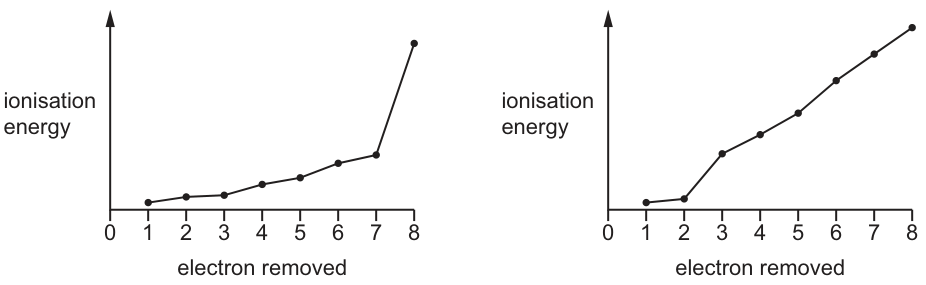
What is the formula of the ionic compound formed from these elements?
Options
A MgCl₂
B CaBr₂
C Na₂S
D K₂Se
Working
Graph 1 shows a large jump in ionisation energy between the 7th and 8th electrons removed, indicating 7 outer-shell electrons. This is a Group 17 Period 3 element, chlorine (Cl), which forms Cl⁻.
Graph 2 shows a large jump between the 2nd and 3rd electrons removed, indicating 2 outer-shell electrons. This is a Group 2 Period 3 element, magnesium (Mg), which forms Mg²⁺.
Balancing the charges (one Mg²⁺ requires two Cl⁻) gives the formula MgCl₂.
Answer
A
A
Background Concept
Successive ionisation energies increase gradually as electrons are removed from the same principal energy level (shell). However, a very large jump in ionisation energy occurs when an electron is removed from a shell closer to the nucleus, because inner-shell electrons experience a much greater effective nuclear charge and are held more tightly. The position of this large jump indicates the number of valence (outer-shell) electrons, which directly corresponds to the element's group number in the Periodic Table.
Understanding the Question
We are given two graphs showing the first eight successive ionisation energies for two unknown elements, both confirmed to be in Period 3. We must use the position of the large jumps in each graph to determine the number of outer-shell electrons for each element, identify their groups, deduce their identities, and finally write the formula of the ionic compound they form.
Approach
- Identify the number of valence electrons for the element in Graph 1 by finding where the large jump occurs.
- Identify the number of valence electrons for the element in Graph 2 using the same method.
- Map these group numbers to Period 3 elements to find their chemical symbols and typical ionic charges.
- Combine the ions in a ratio that balances the overall charge to write the empirical formula.
Step-by-Step Reasoning
- Graph 1: The ionisation energy increases steadily from the 1st to the 7th electron removed. Between the 7th and 8th electrons, there is a very large jump. This means the first 7 electrons are removed from the outer shell, and the 8th electron is being removed from a full inner shell (the noble gas core). The element has 7 valence electrons, placing it in Group 17. The Period 3 Group 17 element is chlorine (Cl). Chlorine gains one electron to achieve a stable octet, forming a Cl⁻ ion.
- Graph 2: The ionisation energy increases steadily from the 1st to the 2nd electron removed. Between the 2nd and 3rd electrons, there is a large jump. This indicates the first 2 electrons are removed from the outer shell, and the 3rd is removed from a full inner shell. The element has 2 valence electrons, placing it in Group 2. The Period 3 Group 2 element is magnesium (Mg). Magnesium loses two electrons to achieve a stable octet, forming a Mg²⁺ ion.
- Formula construction: To form a neutral ionic compound, the total positive charge must equal the total negative charge. One Mg²⁺ ion (charge +2) requires two Cl⁻ ions (charge -1 each) to balance. The resulting empirical formula is MgCl₂.
- Checking options: Option A is MgCl₂, which matches our derivation. Options B, C, and D include elements like Ca, K, Br, and Se, which are not in Period 3 (Ca and K are Period 4; Br and Se are Period 4), so they can be immediately discarded.
Key Takeaways
- A large jump in successive ionisation energies indicates the removal of an electron from a new, inner principal energy level closer to the nucleus.
- The number of electrons removed before the large jump equals the number of valence electrons, which determines the group number.
- Combining group numbers with the constraint that the specified elements must belong to the stated period allows accurate prediction of ionic compound formulas.
Common Mistakes
- Misreading the graph and counting the jump incorrectly (e.g., thinking the jump is after the 6th electron instead of the 7th).
- Forgetting to check the period constraint, leading to incorrect element identification (e.g., choosing fluorine or oxygen instead of chlorine, ignoring that they are Period 2).
- Confusing the total number of electrons removed with the number of valence electrons.
Things to Be Careful About
- Always count the number of electrons removed before the large jump to find the number of valence electrons. The jump itself is between electron and electron .
- Ensure the identified elements actually belong to the period specified in the question (Period 3 here). This is a critical filter that eliminates distractor options like CaBr₂ or K₂Se.
- When writing the ionic formula, ensure the charges are balanced to give a neutral compound; do not simply concatenate the symbols without considering the stoichiometry (e.g., writing MgCl instead of MgCl₂).
In which pairs are both species free radicals?
1 Cl and O
2 Cl⁻ and O²⁻
3 Cl and O⁻
4 Cl⁺ and O²⁺
Options
A 1, 3 and 4
B 1 and 3 only
C 1 only
D 2 only
Working
A free radical is any species that contains one or more unpaired electrons.
- Cl: 3p⁵ → one unpaired electron → radical
- O: 2p⁴ → two unpaired electrons → radical
- Cl⁻: 3p⁶ → all electrons paired → not a radical
- O²⁻: 2p⁶ → all electrons paired → not a radical
- Cl⁺: 3p⁴ → unpaired electrons present → radical
- O²⁺: 2p² → unpaired electrons present → radical
So the pairs in which both species are free radicals are 1, 3 and 4.
Answer
A (1, 3 and 4)
A
Background Concept
A free radical is any species that has one or more unpaired electrons. Free radicals are highly reactive because an unpaired electron strongly tends to pair up with another electron. The definition does not require the species to be neutral: charged species can also be radicals if they contain unpaired electrons.
To decide whether a species is a radical, count its total electrons and write the outer electron configuration. Then apply Hund's rule: electrons occupy orbitals singly before pairing.
Understanding the Question
The question lists four pairs of species and asks in which pairs both species are free radicals. It is not enough for one member of a pair to be a radical; both must have unpaired electrons.
Approach
For each species, determine the number of electrons after applying the charge, then look at the outermost p sub-shell. If the p sub-shell is not completely filled (not p⁶), there will usually be unpaired electrons.
Step-by-Step Reasoning
-
Cl
- Neutral chlorine has 17 electrons: [Ne] 3s² 3p⁵.
- 3p⁵ has one unpaired electron.
- Cl is a free radical.
-
O
- Neutral oxygen has 8 electrons: 1s² 2s² 2p⁴.
- 2p⁴ has two unpaired electrons.
- O is a free radical.
-
Cl⁻
- Chloride has 18 electrons: [Ne] 3s² 3p⁶.
- 3p⁶ is completely filled; all electrons are paired.
- Cl⁻ is not a free radical.
-
O²⁻
- Oxide ion has 10 electrons: 1s² 2s² 2p⁶.
- 2p⁶ is completely filled; all electrons are paired.
- O²⁻ is not a free radical.
-
Cl⁺
- Cl⁺ has 16 electrons: [Ne] 3s² 3p⁴.
- 3p⁴ has two unpaired electrons.
- Cl⁺ is a free radical, even though it is positively charged.
-
O²⁺
- O²⁺ has 6 electrons: 1s² 2s² 2p².
- 2p² has two unpaired electrons.
- O²⁺ is a free radical, even though it is positively charged.
Now check each pair:
- Pair 1: Cl and O → both radicals ✔
- Pair 2: Cl⁻ and O²⁻ → neither is a radical ✘
- Pair 3: Cl and O⁻ → both radicals ✔
- Pair 4: Cl⁺ and O²⁺ → both radicals ✔
Therefore, the correct answer is A.
Key Takeaways
- A free radical is defined by the presence of unpaired electrons, not by whether the species is neutral.
- Noble-gas configurations such as 3p⁶ or 2p⁶ have all electrons paired and are not radicals.
- p², p³, p⁴ and p⁵ configurations all contain unpaired electrons.
Common Mistakes
- Assuming that ions cannot be radicals. Cl⁺ and O²⁺ are charged but still have unpaired electrons.
- Thinking that a positive charge means all electrons are removed from the outer shell. Only the required number of electrons is removed, leaving unpaired electrons in the p sub-shell.
- Forgetting that O²⁻ has a filled 2p⁶ configuration and therefore no unpaired electrons.
Things to Be Careful About
- Always apply the charge when counting electrons.
- Remember Hund's rule: electrons do not pair until each orbital in a sub-shell has one electron.
- Check both species in each pair, not just one.
Which shape is correctly predicted by VSEPR theory?
Options
| number of bonded electron pairs | number of lone pairs | shape | |
|---|---|---|---|
| A | 2 | 2 | linear |
| B | 2 | 2 | tetrahedral |
| C | 3 | 1 | pyramidal |
| D | 3 | 1 | trigonal planar |
Working
VSEPR theory: the molecular shape is determined by the total number of electron pairs (bonding pairs + lone pairs) around the central atom, which repel to minimise repulsion.
- A and B: 2 bonded + 2 lone = 4 electron pairs → tetrahedral electron-pair arrangement. With 2 lone pairs the molecular shape is bent (angular), not linear or tetrahedral. ✗
- C: 3 bonded + 1 lone = 4 electron pairs → tetrahedral electron-pair arrangement. With 1 lone pair the molecular shape is pyramidal. ✓
- D: 3 bonded + 1 lone = 4 electron pairs → tetrahedral electron-pair arrangement, giving a pyramidal shape, not trigonal planar (trigonal planar needs 3 bonded pairs and 0 lone pairs). ✗
Answer
C — 3 bonded electron pairs and 1 lone pair gives a pyramidal shape.
C
Background Concept
VSEPR (Valence Shell Electron Pair Repulsion) theory predicts molecular shape from the number of electron pairs (both bonding and lone) surrounding a central atom. Electron pairs repel each other and arrange themselves as far apart as possible. The total number of electron pairs determines the electron-pair geometry, while lone pairs, which repel more strongly than bonding pairs, compress bond angles and alter the observed molecular shape.
Key electron-pair geometries:
- 2 electron pairs → linear (e.g. BeCl2)
- 3 electron pairs → trigonal planar (e.g. BF3)
- 4 electron pairs → tetrahedral (e.g. CH4)
When lone pairs are present, the molecular shape differs from the electron-pair geometry:
- 4 pairs with 1 lone pair → pyramidal (e.g. NH3)
- 4 pairs with 2 lone pairs → bent/angular (e.g. H2O)
Understanding the Question
The question lists four combinations of bonded electron pairs and lone pairs, each paired with a shape, and asks which combination is correctly predicted by VSEPR theory. The trap is that the total number of electron pairs (bonding + lone) sets the electron-pair geometry, and the lone pairs then replace atom positions, changing the molecular shape.
Approach
- For each option, add the bonded pairs and lone pairs to get the total number of electron pairs.
- Determine the electron-pair geometry from the total.
- Account for the lone pairs: each lone pair occupies a position but holds no atom, altering the molecular shape.
- Compare the resulting molecular shape with the shape given in the option.
Step-by-Step Reasoning
- A (2 bonded, 2 lone): Total = 4 pairs → tetrahedral electron-pair arrangement. With 2 lone pairs, the shape is bent (angular), e.g. H2O. Not linear. ✗
- B (2 bonded, 2 lone): Same as A — bent, not tetrahedral. ✗
- C (3 bonded, 1 lone): Total = 4 pairs → tetrahedral electron-pair arrangement. With 1 lone pair, the shape is pyramidal, e.g. NH3. ✓
- D (3 bonded, 1 lone): Same electron-pair arrangement as C — pyramidal, not trigonal planar. Trigonal planar requires 3 bonded pairs and 0 lone pairs. ✗
Therefore, C is the correct answer.
Key Takeaways
- The total number of electron pairs (bonding + lone) determines the electron-pair geometry.
- Lone pairs reduce the number of atoms but keep the electron-pair geometry, changing the molecular shape.
- 4 electron pairs with 1 lone pair → pyramidal; with 2 lone pairs → bent.
Common Mistakes
- Confusing electron-pair geometry with molecular shape. Both NH3 and H2O have tetrahedral electron-pair geometry, but their molecular shapes are pyramidal and bent respectively.
- Thinking 2 bonded + 2 lone gives a linear shape — it actually gives a bent shape.
- Forgetting that trigonal planar requires exactly 3 bonded pairs and no lone pairs.
Things to Be Careful About
- Always count lone pairs as electron pairs — they are not invisible; they affect the shape.
- Remember that lone pairs repel more strongly than bonding pairs, so bond angles are compressed (e.g. NH3 is about 107°, H2O about 104.5°).
- Read the options carefully — both C and D have the same electron-pair counts but different shapes; only C is correct.
In which species does the underlined atom have an incomplete outer shell?
Options
A BF₃
B CH₃⁻
C F₂O
D H₃O⁺
Working
- A: BF3 — B has 3 valence electrons. It forms three B-F bonds and has no lone pair, so there are 6 electrons around B. The outer shell is incomplete.
- B: CH3- — C has 4 valence electrons, forms three C-H bonds and has one lone pair, giving 8 electrons around C. The octet is complete.
- C: F2O — O has 6 valence electrons, forms two O-F bonds and has two lone pairs, giving 8 electrons around O. The octet is complete.
- D: H3O+ — O has 6 valence electrons, forms three O-H bonds and has one lone pair, giving 8 electrons around O. The octet is complete.
Answer
A
A
Background Concept
Atoms in covalent molecules are usually described as having a complete outer shell when they are surrounded by eight valence electrons, known as the octet rule. For second-period elements such as boron, carbon, nitrogen, oxygen and fluorine, the valence shell is the second shell, which can hold a maximum of eight electrons. Some atoms, especially boron, can be stable with only six valence electrons around them; such species are described as electron-deficient or having an incomplete octet.
Understanding the Question
The question asks which underlined atom has an incomplete outer shell. We must count the electrons that actually surround the underlined atom in its molecule or ion, not just the electrons it contributes as a free atom. For each option, add the electrons in bonds (two per bond) and any lone pairs on the atom, and adjust for any charge on the species.
Approach
For each species, identify the central/underlined atom, count its valence electrons in the free atom, then add shared electrons from bonds and lone pairs, and apply the charge. If the total is 8, the octet is complete; if it is 6, the outer shell is incomplete.
Step-by-Step Reasoning
- A: BF3 — Boron has 3 valence electrons. It forms three single B-F bonds, so there are 3 bonding pairs = 6 electrons around B. There is no lone pair. Total = 6, so the outer shell is incomplete.
- B: CH3- — Carbon has 4 valence electrons. It forms three C-H bonds and carries one lone pair. Total around C = 3 bonding pairs (6) + 1 lone pair (2) = 8. The octet is complete.
- C: F2O — Oxygen has 6 valence electrons. It forms two O-F bonds and has two lone pairs. Total around O = 2 bonding pairs (4) + 2 lone pairs (4) = 8. The octet is complete.
- D: H3O+ — Oxygen has 6 valence electrons. It forms three O-H bonds and has one lone pair. Total around O = 3 bonding pairs (6) + 1 lone pair (2) = 8. The octet is complete.
Only BF3 has an incomplete outer shell, so the answer is A.
Key Takeaways
- The octet rule counts all electrons around an atom: bonding pairs and lone pairs.
- Boron compounds such as BF3 are classic electron-deficient species with only six valence electrons.
- A negative or positive charge changes the electron count and must be included.
Common Mistakes
- Counting only the atom's own valence electrons and forgetting the electrons contributed by bonds.
- Thinking that three bonds means a full octet; three bonds plus no lone pair gives only six electrons.
- Forgetting to include the lone pair on carbon in CH3- or on oxygen in F2O and H3O+.
Things to Be Careful About
- In H3O+, the positive charge means one electron has been removed, but oxygen still has three bonding pairs and one lone pair, giving eight electrons.
- The underlined atom is the one to focus on; the other atoms in the formula are not being tested.
In this question it should be assumed that nitrogen behaves as an ideal gas under the conditions stated.
Which volume is occupied by 1.00 g of nitrogen at 50.0 °C and at a pressure of 120 kPa?
Options
A 0.124 dm³
B 0.799 dm³
C 1.60 dm³
D 22.4 dm³
Working
Answer
B
B
Background Concept
The ideal gas equation, , relates the pressure, volume, temperature and amount of a gas. The gas constant fixes the units that must be used: pressure in pascals (Pa), volume in cubic metres (m³), temperature in kelvin (K) and amount in moles (mol). Because the question gives the mass of gas rather than the amount, we first convert mass to moles using . Nitrogen is a diatomic molecule, , so its molar mass is .
Understanding the Question
We are told to assume nitrogen behaves as an ideal gas. We are given 1.00 g of at 50.0 °C and 120 kPa, and asked to select the volume occupied from four options. This is a direct application of ; the challenge is handling the units correctly — temperature must be in kelvin, pressure in pascals, and the final volume converted from m³ to dm³.
Approach
The strategy is to convert every quantity into the units required by , then rearrange for .
- Find the amount of nitrogen in moles: .
- Convert the temperature from °C to K by adding 273.15.
- Convert the pressure from kPa to Pa (multiply by 1000).
- Rearrange to give and substitute.
- Convert the volume from m³ to dm³ (multiply by 1000) to match the answer options.
Step-by-Step Reasoning
Step 1 — amount of nitrogen.
Step 2 — temperature in kelvin.
Step 3 — pressure in pascals.
Step 4 — apply the ideal gas equation.
Step 5 — convert to dm³.
Since :
This matches option B.
Why the distractors are wrong:
- Option C (1.60 dm³) arises from using (for a single nitrogen atom) instead of 28.0 for . That doubles the number of moles and hence doubles the volume.
- Option A (0.124 dm³) arises from using — forgetting to add 273.15 — which makes the volume too small by roughly a factor of 6.5.
- Option D (22.4 dm³) is the molar volume of an ideal gas at STP (0 °C, 1 atm). It ignores both the mass (1 g, not 1 mol) and the given conditions.
Key Takeaways
- Always express temperature in kelvin when using .
- Always use SI units: pascals for pressure, cubic metres for volume.
- Remember that nitrogen is diatomic: , not 14.0.
- Convert the final volume to the unit requested by the question (dm³).
- The molar volume applies only at STP and for one mole — it is not a general constant.
Common Mistakes
- Using for nitrogen instead of 28.0 — this doubles the moles and gives option C.
- Forgetting to convert °C to K, giving option A.
- Mixing units, e.g. using kPa with m³, which produces a volume about 1000 times too large.
- Assuming the volume is regardless of conditions (option D).
Things to Be Careful About
- The gas constant requires p in Pa and V in m³. If you use kPa, you must convert to Pa first.
- , so converting from m³ to dm³ means multiplying by 1000.
- Report the final answer to an appropriate number of significant figures — here the data are given to three significant figures, so 0.799 dm³ is appropriate.
Consider the following four compounds.
1 (CH₃)₃CH
2 CH₃CH₂CH₂OH
3 CH₃CH₂CH₂SH
4 CH₃CH₂CH₂CH₃
What is the order of increasing boiling point of the compounds (lowest first)?
Options
A 1 → 4 → 2 → 3
B 1 → 4 → 3 → 2
C 4 → 1 → 2 → 3
D 4 → 1 → 3 → 2
Working
Compound 1 (2-methylpropane) and compound 4 (butane) are non-polar alkanes, so only van der Waals forces act between their molecules. The branched isomer 1 has a smaller surface area and therefore weaker van der Waals forces than the straight-chain isomer 4, so 1 boils below 4.
Compound 2 (propan-1-ol) can form strong O–H hydrogen bonds. Compound 3 (propan-1-thiol) has a less polar S–H bond and forms only weaker dipole/van der Waals interactions, so 3 boils below 2. Both functionalised compounds boil above both alkanes.
Overall order: 1 → 4 → 3 → 2.
Answer
B
B
Background Concept
The boiling point of a molecular substance is the temperature at which its vapour pressure equals atmospheric pressure. It reflects the total strength of the intermolecular forces that must be overcome. The main types, in order of increasing strength, are induced dipole–induced dipole (London/van der Waals) forces, permanent dipole–dipole forces, and hydrogen bonding.
For non-polar molecules, van der Waals forces depend on surface area and number of electrons. Branched isomers have a more compact shape, less contact surface, and therefore weaker van der Waals forces than their straight-chain isomers. For polar molecules, the functional group controls the dominant interaction: an O–H group can form strong hydrogen bonds, whereas an S–H group is much less polar and does not hydrogen bond nearly as effectively.
Understanding the Question
We are given four small organic compounds: two C4 alkanes (one branched, one straight-chain), a C3 alcohol, and a C3 thiol. The question asks for the order of increasing boiling point, lowest first. This is a conceptual ranking, not a calculation. The options differ mainly in two places: whether the branched alkane or the straight-chain alkane is lower, and whether the thiol or the alcohol is higher.
Approach
First separate the non-polar alkanes from the polar functionalised compounds. For the two alkanes, compare branching and surface area. For the two functionalised compounds, compare the strength of the intermolecular forces available: O–H hydrogen bonding versus the weaker S–H interactions. Then combine the two groups into a single order.
Step-by-Step Reasoning
-
Compounds 1 and 4 are both C4H10 alkanes: 2-methylpropane and butane. They are non-polar, so only van der Waals forces act. Compound 1 is branched, giving a more compact shape and less surface contact, so its van der Waals forces are weaker and it boils lower than compound 4. Thus 1 < 4.
-
Compound 2 is propan-1-ol. The O–H group can form hydrogen bonds, which are much stronger than van der Waals forces. It therefore has the highest boiling point of the four compounds.
-
Compound 3 is propan-1-thiol. The S–H bond is less polar than O–H, and sulfur does not form hydrogen bonds as effectively as oxygen. The main interactions in the thiol are dipole–dipole and van der Waals forces, which are stronger than those in alkanes but weaker than the hydrogen bonding in the alcohol. Hence 3 < 2.
-
Combining these comparisons gives 1 < 4 < 3 < 2, which is option B.
For reference, approximate boiling points are: 2-methylpropane about -12 °C, butane about -0.5 °C, propan-1-thiol about 68 °C, and propan-1-ol about 97 °C. These values confirm the ranking.
Key Takeaways
- Boiling point generally follows: branched non-polar < straight-chain non-polar < polar (dipole–dipole) < hydrogen-bonded.
- Branching lowers the boiling point of an alkane by reducing surface area and weakening van der Waals forces.
- O–H hydrogen bonding is much stronger than the interactions available in a thiol, so an alcohol boils higher than the corresponding thiol.
Common Mistakes
- Assuming all C4 alkanes have the same boiling point; branching matters.
- Thinking that a thiol hydrogen-bonds as strongly as an alcohol; S–H is much less polar than O–H.
- Confusing “increasing” with “decreasing” and choosing the highest-boiling compound first.
- Using molar mass alone; compounds 2 and 3 have lower molar masses than the alkanes but still boil higher because of their polar interactions.
Things to Be Careful About
- Read “increasing” as lowest first.
- Recognise that compounds 1 and 4 are structural isomers, so the branching effect is the key difference between them.
- Strong hydrogen bonding requires H attached to N, O, or F; S–H does not give comparable hydrogen bonding.
- In an MCQ, eliminate options by testing the two key comparisons: 1 vs 4 and 2 vs 3.
Ethane can react with fluorine to produce 1,2-difluoroethane, C₂H₄F₂.
| bond | energy / kJ mol⁻¹ |
|---|---|
| C–H | 410 |
| C–C | 350 |
| F–F | 158 |
| H–F | 562 |
What is the bond energy of the C–F bond in 1,2-difluoroethane?
Options
A 407 kJ mol⁻¹
B 474 kJ mol⁻¹
C 486 kJ mol⁻¹
D 972 kJ mol⁻¹
Working
Bonds broken in reactants:
Bonds formed in products:
Answer
C — 486 kJ mol⁻¹
C
Background Concept
Bond energy (bond dissociation enthalpy) is the energy required to break one mole of a specific covalent bond in the gaseous state. Breaking bonds is endothermic (energy must be put in), while forming bonds is exothermic (energy is released).
For any reaction, the enthalpy change can be approximated using:
This is an approximation because tabulated bond energies are average values taken over many different compounds.
Understanding the Question
We are given the reaction:
Bond energies are provided for C–H, C–C, F–F and H–F. The C–F bond energy is unknown and must be deduced from the overall enthalpy change.
Approach
- Write out the structural formulae so every bond is visible.
- Count every bond broken in the reactants and sum their energies.
- Count every bond formed in the products, treating the C–F bond energy as an unknown .
- Substitute into and solve for .
Step-by-Step Reasoning
Step 1 — Bonds in the reactants.
- Ethane, (structure ), contains 1 C–C bond and 6 C–H bonds.
- Energy = .
- Two molecules of contain 2 F–F bonds.
- Energy = .
- Total energy to break all reactant bonds = .
Step 2 — Bonds in the products.
- 1,2-Difluoroethane, , contains 1 C–C, 4 C–H and 2 C–F bonds.
- Energy = .
- Two molecules of HF contain 2 H–F bonds.
- Energy = .
- Total energy released on forming all product bonds = .
Step 3 — Apply the bond-energy equation.
So the C–F bond energy is 486 kJ mol⁻¹, which is option C.
Key Takeaways
- Always convert molecular formulae into structural formulae before counting bonds.
- The bond-energy method uses ; a negative means more energy is released in bond formation than is absorbed in bond breaking.
- When one bond energy is unknown, set it as a variable and solve.
Common Mistakes
- Counting 6 C–H bonds in the product instead of 4 — the two hydrogens replaced by fluorine are gone.
- Forgetting that means two F–F bonds, not one.
- Forgetting the two C–F bonds in the product — the molecule is 1,2-difluoroethane, so there are two fluorine atoms.
- Mixing up which side is "broken" and which is "formed", producing the wrong sign in the equation.
Things to Be Careful About
- The reaction is exothermic ( is negative), so the total bond energy of products is greater than that of reactants.
- Bond energies are average values, so the result is an approximation.
- Keep units consistent — all energies here are in kJ mol⁻¹.
- Check the arithmetic at the end: gives , not 972 (which is the energy for two C–F bonds).
Which equation has an enthalpy change equal to the standard enthalpy of formation of sodium oxide?
Options
A
B
C
D
Working
The standard enthalpy of formation of a compound is the enthalpy change when one mole of the compound is formed from its elements in their standard states.
For sodium oxide, :
- one mole of must appear as the product;
- the reactants must be the elements in their standard states: and ;
- the equation must be balanced.
This matches option C.
Answer
C
C
Background Concept
The standard enthalpy change of formation, , is defined as the enthalpy change when one mole of a compound is formed from its elements in their standard states under standard conditions (usually 298 K and 1 atm pressure). For sodium oxide, the elements are sodium metal, , and oxygen gas, . The standard state of an element is its most stable physical form at those conditions: sodium is a solid, oxygen is a gas.
Because enthalpy is an extensive property, the enthalpy change for a reaction is proportional to the amount of substance. Forming two moles of releases twice the enthalpy change of forming one mole. This is why the definition insists on exactly one mole of product.
Understanding the Question
This is a definition-based multiple-choice question. It asks which equation, among four, has an enthalpy change equal to the standard enthalpy of formation of sodium oxide. You are not given any numerical data; you only need to apply the definition precisely. The command word is implicit: identify the equation that matches the definition.
Approach
Apply the definition step by step:
- The product must be exactly one mole of .
- The reactants must be the elements in their standard states: and .
- The equation must be balanced.
Then check each option against these three requirements.
Step-by-Step Reasoning
- Option A: forms only half a mole of sodium oxide. The enthalpy change would be half of the standard enthalpy of formation, so A is incorrect.
- Option B: is not balanced: there is one Na atom on the left but two on the right, and two O atoms on the left but one on the right. It cannot represent the formation of sodium oxide, so B is incorrect.
- Option C: is balanced, has one mole of as product, and uses the elements in their standard states. This is exactly the definition, so C is correct.
- Option D: is balanced, but it forms two moles of sodium oxide. The enthalpy change would be twice the standard enthalpy of formation, so D is incorrect.
Therefore, the correct answer is C.
Key Takeaways
- The standard enthalpy of formation always refers to forming one mole of a compound from its elements in their standard states.
- Fractional coefficients are allowed for reactants in a formation equation, because the product must have coefficient 1.
- Always check state symbols: the elements must be in their standard states.
- Enthalpy is extensive: doubling the amount of substance doubles the enthalpy change.
Common Mistakes
- Choosing D because it is a balanced equation with whole-number coefficients. It forms two moles of product, so it represents twice the standard enthalpy of formation.
- Choosing B without checking that it is balanced. A formation equation must be balanced.
- Thinking that fractional coefficients are not allowed. In enthalpy of formation equations, fractional coefficients for reactants are standard and necessary.
- Forgetting that sodium's standard state is solid and oxygen's is gas; state symbols matter.
Things to Be Careful About
- The definition requires exactly one mole of product; the coefficient of must be 1.
- The reactants must be elements in their standard states: and , not or .
- Check balancing of both atoms and charge (though charge is not relevant here).
- In an exam, if you are unsure, write the formation equation yourself and compare it with the options.
Nitrogen dioxide reacts with water.
Which statement about this reaction is correct?
Options
A Both products are formed because oxygen atoms gain electrons.
B Nitrogen atoms undergo disproportionation.
C The oxidation number of hydrogen is increased.
D Water acts as an oxidising agent.
Working
Assign oxidation numbers:
- In , N is +4, because O is -2.
- In , N is +3.
- In , N is +5.
So nitrogen is reduced from +4 to +3 and oxidised from +4 to +5 in the same reaction. This is disproportionation.
Answer
B
B
Background Concept
Disproportionation is a redox reaction in which the same element is simultaneously oxidised and reduced. One part of the element increases in oxidation number (loses electrons) while another part decreases in oxidation number (gains electrons).
To detect this, assign oxidation numbers using the standard rules:
- The oxidation number of oxygen is usually -2.
- The oxidation number of hydrogen is usually +1.
- In a neutral molecule, the sum of all oxidation numbers is zero.
An oxidising agent is the species that is reduced (gains electrons); a reducing agent is the species that is oxidised (loses electrons).
Understanding the Question
This question gives the reaction between nitrogen dioxide and water:
It asks which statement about the reaction is correct. The options test whether you can follow the oxidation numbers of nitrogen, oxygen, and hydrogen, and whether you can identify disproportionation and the role of water.
Approach
Assign oxidation numbers to every element in the reactants and products. Then compare the oxidation numbers of each element before and after the reaction. Look for one element that appears with a higher oxidation number in one product and a lower oxidation number in another product. That is the signature of disproportionation.
Step-by-Step Reasoning
-
Oxidation number of N in NO
Let the oxidation number of N be .
So nitrogen is +4 in .
-
Oxidation number of N in HNO
So nitrogen is +3 in .
-
Oxidation number of N in HNO
So nitrogen is +5 in .
-
Compare oxidation numbers
Nitrogen changes from +4 in to +3 in and to +5 in . The same element is both reduced (+4 to +3) and oxidised (+4 to +5). This is disproportionation.
-
Check the other options
- A is incorrect. Oxygen remains -2 in water and in both products; oxygen atoms do not gain electrons.
- C is incorrect. Hydrogen remains +1 in water and in both acids; its oxidation number is unchanged.
- D is incorrect. Water is not reduced, so it does not act as an oxidising agent. The oxidising and reducing behaviour comes from itself.
Therefore, the correct statement is B.
Key Takeaways
- Oxidation numbers are a bookkeeping tool for tracking electron transfer.
- Disproportionation occurs when one element is both oxidised and reduced in the same reaction.
- To identify disproportionation, assign oxidation numbers to all atoms and look for one element appearing at two different oxidation numbers in the products.
- An oxidising agent is reduced; a reducing agent is oxidised.
Common Mistakes
- Incorrectly assigning the oxidation number of nitrogen in or . Remember that the sum of oxidation numbers in a neutral molecule must be zero.
- Thinking oxygen gains electrons because oxygen is part of the product acids. Oxygen remains -2 throughout.
- Confusing the oxidising agent with the species that is oxidised. Water is not oxidised or reduced here.
- Forgetting that disproportionation requires the same element to appear at both higher and lower oxidation numbers in the products.
Things to Be Careful About
- Use the oxidation number of oxygen as -2 and hydrogen as +1 unless a special case such as a peroxide is involved.
- Check every element in the equation, not just the one mentioned in the options.
- In a neutral molecule, the oxidation numbers must sum to zero; in an ion, they must sum to the ionic charge.
- The reaction is already balanced, so no balancing is needed, but the oxidation-number analysis must still be done carefully.
Phosphorus reacts with concentrated sulfuric acid to produce phosphoric acid, sulfur dioxide and water.
, , , and are all whole numbers.
The equation can be balanced by using oxidation numbers.
What is the value of the sum ?
Options
A 10
B 14
C 15
D 16
Working
Assign oxidation numbers:
- P: 0 → +5 in H3PO4 (each P loses 5 electrons).
- S: +6 → +4 in SO2 (each S gains 2 electrons).
To balance electron transfer, 2 P atoms lose 10 electrons and 5 S atoms gain 10 electrons:
So:
Balance H and O:
Check: H: 10 left = 6 + 4 right; O: 20 left = 8 + 10 + 2 right.
Thus:
Answer
D
D
Background Concept
This question combines redox chemistry with balancing equations. In redox reactions, oxidation numbers change because electrons are transferred. Phosphorus is oxidised from 0 in elemental P to +5 in phosphoric acid, while sulfur is reduced from +6 in sulfuric acid to +4 in sulfur dioxide. Balancing a redox equation requires equal total electrons lost and gained.
Understanding the Question
We are given an unbalanced equation with coefficients a–e and asked to find the sum of those coefficients. The clue "balanced by using oxidation numbers" tells us to use electron transfer rather than trial-and-error atom balancing.
Approach
- Assign oxidation numbers to each element.
- Determine the electron change per atom for the oxidised and reduced species.
- Find the smallest whole-number ratio that makes electrons lost equal electrons gained.
- Balance atoms other than H and O.
- Balance H and O using water.
- Sum all coefficients.
Step-by-Step Reasoning
-
Oxidation numbers:
- P in elemental P = 0.
- P in H3PO4: H is +1, O is −2, so P must be +5.
- S in H2SO4: H is +1, O is −2, so S must be +6.
- S in SO2: O is −2, so S must be +4.
-
Each P atom loses 5 electrons: 0 → +5.
Each S atom gains 2 electrons: +6 → +4. -
The lowest common multiple of 5 and 2 is 10.
- 2 P atoms lose 10 electrons.
- 5 S atoms gain 10 electrons.
Therefore b = 2 and d = 5.
-
Phosphorus atoms: c = b = 2.
Sulfur atoms: a = d = 5. -
Hydrogen atoms:
- Left: 5 H2SO4 gives 10 H.
- Right: 2 H3PO4 gives 6 H, so water must provide 4 H.
- Therefore e = 2.
-
Oxygen check:
- Left: 5 × 4 = 20 O.
- Right: 2 × 4 + 5 × 2 + 2 × 1 = 8 + 10 + 2 = 20 O.
-
Sum of coefficients:
a + b + c + d + e = 5 + 2 + 2 + 5 + 2 = 16.
Key Takeaways
- The oxidation-number method balances electron transfer first, then atoms.
- Use the oxidised/reduced species ratio to fix two coefficients immediately.
- Always finish by checking both atoms and, where relevant, charge.
Common Mistakes
- Forgetting that elemental phosphorus has oxidation number 0.
- Using the wrong oxidation number for P in H3PO4, such as +3.
- Balancing atoms before balancing electrons, which often gives incorrect whole-number coefficients.
- Forgetting to include water when balancing hydrogen and oxygen.
Things to Be Careful About
- Sulfur in H2SO4 is +6, not +4.
- Phosphorus in H3PO4 is +5.
- Use the smallest whole-number coefficients; multiplying the equation would change the sum.
- Verify every element at the end, especially oxygen.
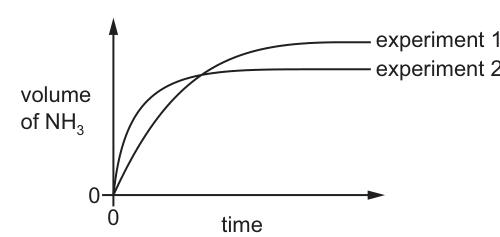
The volume of ammonia produced against time is measured in two experiments.
In experiment 1, 3 mol of H₂(g) and 1 mol of N₂(g) react together at 45 °C and a pressure of 200 atm.
A graph showing the volume of ammonia produced against time is plotted.
Experiment 2 is then performed. Experiment 2 differs from experiment 1 in one condition only.
How does experiment 2 differ from experiment 1?
Options
A An iron catalyst is present in experiment 2.
B 2 mol of helium gas is present in the reaction mixture in experiment 2.
C A pressure of 250 atm is used in experiment 2.
D A temperature of 600 °C is used in experiment 2.
Working
Experiment 2 has a steeper initial slope than experiment 1, meaning the rate of reaction is faster. This could be caused by a higher temperature, higher pressure, or a catalyst.
Experiment 2 reaches a lower final volume of NH₃, meaning the equilibrium position has shifted to the left (towards the reactants) compared to experiment 1.
The forward reaction is exothermic (). According to Le Chatelier's principle, increasing the temperature shifts the equilibrium position to the left to absorb the added heat, reducing the yield of NH₃.
Increasing the temperature also increases the rate of reaction, which explains the steeper initial slope.
Therefore, experiment 2 must use a higher temperature.
Answer
D
D
Background Concept
The Haber process involves the reversible, exothermic reaction: , .
Le Chatelier's principle states that if a dynamic equilibrium is disturbed by changing the conditions, the position of equilibrium shifts to counteract the change. For an exothermic reaction, increasing the temperature favors the reverse (endothermic) reaction, shifting the equilibrium to the left and decreasing the yield of products.
Reaction rate is affected by temperature, pressure, concentration, and catalysts. Increasing temperature increases the kinetic energy of particles, leading to more frequent and more energetic collisions, thus increasing the rate of reaction. A catalyst increases the rate by providing an alternative pathway with a lower activation energy, but it does not affect the position of equilibrium.
Understanding the Question
We are given a graph of the volume of ammonia produced against time for two experiments. Experiment 1 is the baseline (45 °C, 200 atm). Experiment 2 differs in only one condition. The graph shows that experiment 2 has a steeper initial gradient (faster initial rate) but a lower final plateau (less ammonia at equilibrium). We need to identify which single change from the options causes both of these effects.
Approach
We analyze the two features of the graph separately:
- Rate of reaction: The steeper initial slope of experiment 2 means the reaction is faster. This points to a higher temperature, higher pressure, or the presence of a catalyst.
- Equilibrium position: The lower final volume of NH₃ in experiment 2 means the equilibrium has shifted to the left (towards N₂ and H₂). We apply Le Chatelier's principle to see which of the rate-increasing changes (higher T, higher P, catalyst) also shifts the equilibrium to the left for this specific exothermic reaction.
Step-by-Step Reasoning
- Option A (Iron catalyst): A catalyst increases the rate of both forward and reverse reactions equally. It would give a steeper initial slope, but the final volume of NH₃ (equilibrium position) would remain the same. This contradicts the graph.
- Option B (2 mol helium gas): Helium is an inert gas. Adding it at constant volume does not change the partial pressures of the reacting gases, so it has no effect on the rate or equilibrium position. If added at constant pressure, the volume increases, partial pressures decrease, rate decreases, and equilibrium shifts to the side with more moles (left), but the rate would be slower, not faster. This contradicts the graph.
- Option C (Pressure of 250 atm): Increasing pressure from 200 atm to 250 atm increases the concentration of gases, increasing the rate (steeper slope). However, Le Chatelier's principle predicts that increasing pressure shifts the equilibrium to the side with fewer moles of gas. The reactants have 4 moles (1 N₂ + 3 H₂) and the products have 2 moles (2 NH₃). Thus, increasing pressure shifts the equilibrium to the right, producing more NH₃. The plateau would be higher, not lower. This contradicts the graph.
- Option D (Temperature of 600 °C): Increasing the temperature from 45 °C to 600 °C increases the kinetic energy of the particles, leading to a faster reaction rate (steeper initial slope). The forward reaction is exothermic (). Increasing the temperature shifts the equilibrium to the left (the endothermic direction) to absorb the excess heat. This results in a lower yield of NH₃ at equilibrium (lower plateau). This matches both features of the graph perfectly.
Key Takeaways
When interpreting equilibrium graphs, always consider both the rate (initial slope) and the equilibrium position (final plateau) separately. A change like temperature affects both, but in opposite directions for exothermic reactions (higher T = faster rate but lower yield). Catalysts only affect the rate, not the yield. Pressure changes affect both, but shift equilibrium towards the side with fewer gas moles.
Common Mistakes
- Assuming a catalyst changes the equilibrium position: A catalyst speeds up the attainment of equilibrium but does not change the final yield.
- Forgetting the stoichiometry of the gases when applying Le Chatelier's principle to pressure changes: 4 moles of reactant gas vs 2 moles of product gas means increased pressure favors the product.
- Confusing the effect of temperature on exothermic vs endothermic reactions: For exothermic reactions, higher temperature shifts equilibrium to the left (reactants).
Things to Be Careful About
- Read the graph axes carefully: volume of NH₃ vs time. The plateau represents the equilibrium amount, not the rate.
- Ensure you identify the correct feature (slope vs plateau) for rate vs equilibrium position.
- Check the sign of to determine if the forward reaction is exothermic or endothermic before applying Le Chatelier's principle for temperature changes.
Which reaction has an equilibrium constant, , that has no units?
Options
A
B
C
D
Working
For , the units depend on the change in the number of moles of gas, .
A: , so the pressure terms cancel and has no units.
Answer
A
A
Background Concept
For a gaseous equilibrium, the equilibrium constant is written using partial pressures. Its units are determined by the stoichiometry of the balanced equation. If the total number of moles of gaseous products equals the total number of moles of gaseous reactants, the pressure terms in the expression cancel completely, leaving a dimensionless constant. If the numbers are different, the expression retains pressure units such as atm, Pa, or kPa raised to a power.
Understanding the Question
The question asks which reaction has a with no units. This is purely a stoichiometric test: count the moles of gas on each side of each balanced equation. The reaction where the total gaseous coefficients are equal on both sides will have a unitless .
Approach
For each option, calculate . If , the pressure units cancel and has no units. If , the units of are .
Step-by-Step Reasoning
-
Option A:
- Reactants: 1 + 1 = 2 moles of gas
- Products: 2 moles of gas
- , so has no units.
-
Option B:
- Reactants: 3 + 1 = 4 moles of gas
- Products: 2 moles of gas
- , so would have units of , e.g. .
-
Option C:
- Reactants: 2 moles of gas
- Products: 1 mole of gas
- , so would have units of , e.g. .
-
Option D:
- Reactants: 2 + 1 = 3 moles of gas
- Products: 2 moles of gas
- , so would have units of , e.g. .
Only Option A has , so only its has no units.
Key Takeaways
- The units of depend on the change in the number of moles of gas, .
- When , is dimensionless.
- Always count only gaseous species when determining the units of ; pure solids and liquids do not appear in the expression.
Common Mistakes
- Counting all species, including solids and liquids, when determining . Only gases contribute to the pressure terms.
- Confusing with : units depend on concentration, but the same logic applies using mol dm.
- Forgetting that coefficients in the balanced equation are the powers in the equilibrium expression, so they must be used when counting moles of gas.
Things to Be Careful About
- Ensure the equation is balanced before counting coefficients.
- If , the numerical value of is independent of the pressure units used, because the units cancel exactly.
- For reactions with , the numerical value of changes if the pressure unit changes, because the units do not cancel.
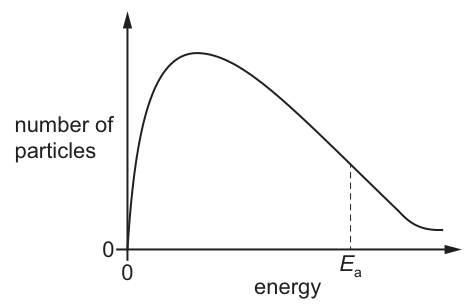
Gas Q decomposes slowly at room temperature.
The Boltzmann distribution curve for gas Q at room temperature is shown.
Which change occurs when a catalyst is added to gas Q?
Options
A The peak of the curve moves to the right on the diagram.
B The number of particles with enough energy to decompose increases.
C The kinetic energy of the unreacted particles increases.
D The value of decreases, moving the vertical dotted line to the right on the diagram.
Working
A catalyst provides an alternative reaction pathway with a lower activation energy ().
On a Boltzmann distribution graph at constant temperature:
- The curve itself (including its peak position) remains unchanged because the temperature (and thus the average kinetic energy of the particles) is constant.
- The vertical dotted line representing moves to the left, to a lower energy value.
- The area under the curve to the right of the new line is larger than the original area.
- This area represents the number of particles with kinetic energy greater than or equal to .
Therefore, with a lower , a greater proportion of particles have sufficient energy to react, so the number of particles with enough energy to decompose increases.
Answer
B
B
Background Concept
A Boltzmann distribution curve shows the distribution of kinetic energies of particles in a gas or liquid at a specific temperature. The x-axis represents kinetic energy (increasing to the right) and the y-axis represents the number of particles. The curve starts at the origin, rises to a peak (the most probable energy), and then tails off to the right. The total area under the curve represents the total number of particles in the sample.
The area under the curve to the right of a vertical line drawn at the activation energy () represents the number of particles with kinetic energy greater than or equal to . These are the particles that have sufficient energy to undergo successful collisions and react.
A catalyst increases the rate of reaction by providing an alternative reaction pathway with a lower activation energy. It does this without being consumed in the overall reaction. Crucially, a catalyst does not change the temperature of the system, nor does it change the total number of particles or their overall energy distribution.
Understanding the Question
The question describes the decomposition of gas Q at room temperature and shows its Boltzmann distribution curve with the activation energy marked. We are asked to identify what happens to the diagram and the particles when a catalyst is added. The temperature is held constant at room temperature.
Approach
We need to evaluate each option by considering two key facts about adding a catalyst at constant temperature:
- The temperature is constant, so the average kinetic energy and the shape/position of the Boltzmann distribution curve remain unchanged.
- The activation energy is lowered. On an energy axis increasing to the right, a lower means the vertical line moves to the left.
We then check how these changes affect the area under the curve to the right of the line.
Step-by-Step Reasoning
- Option A: "The peak of the curve moves to the right." The position of the peak (most probable energy) and the overall shape of the curve depend only on temperature. Since the temperature is constant (room temperature), the curve does not shift. This option is incorrect.
- Option B: "The number of particles with enough energy to decompose increases." A catalyst lowers , moving the vertical dotted line to the left. The area under the curve to the right of this new, lower line is larger than the original area. This larger area represents a greater number of particles with energy . Therefore, more particles have enough energy to decompose. This option is correct.
- Option C: "The kinetic energy of the unreacted particles increases." The average kinetic energy of the particles is directly proportional to the absolute temperature. Since the temperature is constant, the average kinetic energy of all particles (reacted or unreacted) remains unchanged. This option is incorrect.
- Option D: "The value of decreases, moving the vertical dotted line to the right on the diagram." While it is true that decreases, the x-axis represents energy increasing to the right. A decrease in the value means the line must move to the left (towards lower energy values), not the right. This option is incorrect.
Key Takeaways
- A catalyst lowers the activation energy () by providing an alternative pathway.
- On a Boltzmann distribution graph, this is represented by the vertical line moving to the left.
- The curve itself does not change shape or position unless the temperature changes.
- The area under the curve to the right of increases, meaning a greater proportion of particles can react.
Common Mistakes
- Confusing the direction of the line movement: Students often think "lower activation energy" means moving right because they associate catalysts with "increasing" the rate. Remember, the x-axis is energy increasing to the right, so a lower energy value is to the left.
- Thinking the curve shifts: Some students believe the curve shifts right or changes shape when a catalyst is added. The curve only changes if the temperature changes (shifting right and flattening for higher temperatures).
- Confusing catalyst effects with temperature effects: A catalyst increases the number of successful collisions by lowering the energy threshold (), whereas increasing temperature increases the number of successful collisions by giving more particles higher kinetic energy (shifting the curve).
Things to Be Careful About
- Always check the direction of the axes. Energy increases to the right, so a decrease in is a leftward shift.
- Ensure you distinguish between the number of particles with enough energy (area to the right of ) and the average kinetic energy (related to the peak/temperature). A catalyst affects the former without affecting the latter.
Which statement is correct?
Options
A Aluminium chloride has a giant ionic lattice of and ions.
B Sodium chloride dissolves in water, forming hydrogen chloride and sodium hydroxide.
C The strong covalent bonds in silicon chloride prevent it from reacting with water.
D When phosphorus(V) chloride is added to water, the resulting solution conducts electricity.
Working
Phosphorus(V) chloride reacts with water:
Both products are acids that ionise in water to give ions, so the solution conducts electricity. The other statements are incorrect: is covalent (dimeric ), dissolves to give and ions, and hydrolyses readily with water.
Answer
D
D
Background Concept
Chlorides of elements show a trend in bonding across the Periodic Table. Electropositive metals such as sodium form ionic chlorides, , with a giant ionic lattice. As elements become more electronegative and the cation becomes smaller and more highly charged, the chloride becomes increasingly covalent: is covalent and exists as the dimer , not as a giant ionic lattice. Non-metal chlorides such as and are covalent molecular compounds. Many covalent chlorides react with water by hydrolysis, because water can attack the electron-deficient central atom and the chloride ligands leave as . The resulting solution conducts electricity only if it contains mobile ions.
Understanding the Question
This multiple-choice question asks which of four statements about chlorides is correct. It tests two linked ideas: the type of bonding/lattice in a chloride, and what happens when that chloride is added to water. Statement D is the one to verify: phosphorus(V) chloride reacts with water to give acidic products that ionise, producing a conducting solution.
Approach
Check each statement against known chemistry. For A, recall the structure of . For B, recall what happens when an ionic lattice dissolves. For C, recall whether reacts with water. For D, write the hydrolysis of and decide whether the products give ions in water.
Step-by-Step Reasoning
- A is incorrect. is covalent, not a giant ionic lattice. In the solid and in non-aqueous conditions it forms the dimer with bridging chlorine atoms. The ion is small and highly charged, so it strongly polarises the chloride ions, making the bonding predominantly covalent.
- B is incorrect. When dissolves in water, the lattice breaks up and the ions are hydrated: . It does not form and ; those would be the products of electrolysis of brine, not simple dissolution.
- C is incorrect. is a covalent molecular liquid that hydrolyses readily: . The fact that its covalent bonds are strong does not prevent reaction; water attacks silicon and forms strong Si-O bonds, while HCl is released.
- D is correct. hydrolyses vigorously: . Both and are acids that ionise in water, giving , , and related ions. Because the solution contains mobile ions, it conducts electricity.
Key Takeaways
- Bonding in chlorides changes from ionic to covalent across a period as cation charge density increases.
- Ionic chlorides dissolve by dissociation into hydrated ions.
- Covalent chlorides often hydrolyse with water, releasing and forming an oxide or oxoacid.
- Electrical conductivity of an aqueous solution requires the presence of mobile ions.
Common Mistakes
- Choosing A because contains aluminium and chlorine; it is covalent, not a giant ionic lattice.
- Choosing B because the formula suggests and water could give and ; dissolution is simply ion separation.
- Choosing C because "strong covalent bonds" sounds like a reason for unreactivity; hydrolysis can still occur and break those bonds.
- Writing an unbalanced hydrolysis equation for or ; check atoms on both sides.
Things to Be Careful About
- Include state symbols in hydrolysis equations: , , , .
- Remember that "conducts electricity" refers to mobile ions in solution, not to the covalent compound itself.
- Do not confuse with ionic chlorides such as ; the small, highly charged ion causes covalent character.
- In hydrolysis of , the solid product is , not silicic acid unless excess water is considered; either is acceptable at this level, but the key point is that is produced.
A mixture of calcium carbonate, calcium nitrate, strontium carbonate and strontium nitrate is thermally decomposed. The decomposition reaction of each substance goes to completion. Each substance is anhydrous.
How many different products are formed?
Options
A 4
B 5
C 7
D 8
Working
Thermal decompositions:
Distinct products: CaO, SrO, CO2, NO2, O2 = 5.
Answer
B
B
Background Concept
Group 2 carbonates and nitrates both undergo thermal decomposition, but they give different sets of products.
- A Group 2 carbonate decomposes to the metal oxide and carbon dioxide:
- An anhydrous Group 2 nitrate decomposes to the metal oxide, nitrogen dioxide and oxygen:
This is different from Group 1 nitrates, which usually give the nitrite and oxygen. Because calcium and strontium are both Group 2 metals, their carbonates and nitrates follow the same patterns above. The phrase "anhydrous" tells us there is no water of crystallisation, so no water is produced.
Understanding the Question
The mixture contains four solids: CaCO3, Ca(NO3)2, SrCO3 and Sr(NO3)2. All four decompose completely. The question asks for the number of different products formed. This is a counting question about distinct chemical substances, not about the total number of product molecules or the total number of decomposition equations.
Approach
Write (or recall) the decomposition of each compound. Then list the products and remove duplicates. Carbon dioxide appears from both carbonates; nitrogen dioxide and oxygen appear from both nitrates; the metal oxides are different for calcium and strontium. Count the unique species.
Step-by-Step Reasoning
- Calcium carbonate:
- Strontium carbonate:
- Calcium nitrate:
- Strontium nitrate:
Now collect the distinct products:
- CaO (from CaCO3 and Ca(NO3)2)
- SrO (from SrCO3 and Sr(NO3)2)
- CO2 (from both carbonates)
- NO2 (from both nitrates)
- O2 (from both nitrates)
That gives five different products: CaO, SrO, CO2, NO2 and O2. The correct option is B.
Key Takeaways
- Group 2 carbonates: oxide + CO2.
- Anhydrous Group 2 nitrates: oxide + NO2 + O2.
- "Different products" means distinct chemical species; common products are counted once.
Common Mistakes
- Counting total product molecules across all four equations (2 + 2 + 3 + 3 = 10) instead of distinct products. This would give 10, which is not even an option, but it shows the wrong approach.
- Forgetting that CO2 is produced by both carbonates, or that NO2 and O2 are produced by both nitrates, leading to overcounting.
- Using the Group 1 nitrate decomposition (nitrite + O2) for calcium and strontium nitrates. Group 2 nitrates give the oxide, NO2 and O2.
- Forgetting the oxygen gas produced by nitrate decomposition, which would give only 4 products and option A.
- Thinking CaO and SrO are the same because both are Group 2 oxides; they are different compounds and both must be counted.
Things to Be Careful About
- The question says the substances are anhydrous. If water of crystallisation were present, water would be an additional product.
- "Different products" refers to different chemical substances, not different numbers of moles or different product molecules.
- Balance the nitrate equations to see that O2 is a product; an unbalanced or incorrect nitrate decomposition is the most likely source of error.
- State symbols are not needed for the count, but they help confirm that CO2, NO2 and O2 are gases and therefore separate products.
W is a solid that reacts with water to produce an alkaline solution.
The addition of two drops of dilute to this alkaline solution produces a white precipitate.
What could be the identity of solid W?
Options
A magnesium hydroxide
B magnesium oxide
C barium oxide
D phosphorus oxide
Working
The solid must be an oxide: oxides react with water, whereas magnesium hydroxide itself does not react with water to form a new alkaline product. Phosphorus oxide gives an acidic solution, so it is eliminated.
Of the remaining options, barium oxide produces barium hydroxide:
With dilute sulfuric acid, barium ions form insoluble white barium sulfate:
Magnesium sulfate is soluble, so magnesium hydroxide or oxide would give no precipitate.
Answer
C — barium oxide
C
Background Concept
Group 2 metals form ionic oxides such as and . These are basic oxides: they react with water to form the metal hydroxide, giving an alkaline solution. By contrast, non-metal oxides such as phosphorus(V) oxide are acidic and produce acidic solutions with water. Another key trend is that the solubility of Group 2 sulfates decreases down the group: is soluble, while is very insoluble and appears as a white precipitate.
Understanding the Question
The question gives two observations about solid W: it reacts with water to give an alkaline solution, and addition of two drops of dilute to that solution produces a white precipitate. We need the solid whose chemistry matches both observations. The first observation rules out acidic oxides; the second distinguishes between possible metal hydroxides by their sulfate solubility.
Approach
Start with observation 1: identify which solids can react with water to give an alkaline solution. This eliminates phosphorus oxide. Then use observation 2: add sulfate ions (from dilute sulfuric acid) to the alkaline solution and ask which cation forms an insoluble white sulfate. Only barium does so among the options.
Step-by-Step Reasoning
- Phosphorus oxide, , reacts with water to form phosphoric acid, so the solution would be acidic, not alkaline. Eliminate D.
- Magnesium hydroxide is already a hydroxide and does not react with water to form a new alkaline product; it is only sparingly soluble. Even if its suspension is alkaline, adding sulfate gives soluble , so no white precipitate forms. Eliminate A.
- Magnesium oxide does react with water: , giving an alkaline solution. However, is soluble, so dilute sulfuric acid would not give a white precipitate. Eliminate B.
- Barium oxide reacts with water: , giving an alkaline solution. On adding dilute sulfuric acid, barium ions react with sulfate ions: . Barium sulfate is white and insoluble, so a white precipitate is observed. Therefore W is barium oxide, option C.
The phrase 'two drops' simply means a small amount of sulfuric acid is added; it supplies sulfate ions without dissolving the precipitate, because is insoluble even in dilute acid.
Key Takeaways
- Metal oxides are generally basic; non-metal oxides are generally acidic.
- Group 2 oxides react with water to form alkaline hydroxide solutions.
- The solubility of Group 2 sulfates decreases down the group; is a classic white precipitate.
- Qualitative observations such as 'white precipitate with sulfate' can identify a cation.
Common Mistakes
- Choosing magnesium oxide because it gives an alkaline solution, while forgetting that its sulfate is soluble and would not precipitate.
- Choosing phosphorus oxide because it is an oxide, while ignoring that it gives an acidic, not alkaline, solution.
- Assuming that any alkaline solution will give a white precipitate with sulfuric acid; only cations forming insoluble sulfates do.
- Writing the precipitate as barium sulfite or forgetting the (s) state symbol.
Things to Be Careful About
- Use the correct formula and balance the equation for oxide with water.
- The precipitate is , white and insoluble; do not confuse it with soluble .
- State symbols matter: , , .
- Remember the acid-base nature of oxides: metal oxides are basic, non-metal oxides are acidic.
Chlorine gas is reacted with cold aqueous sodium hydroxide.
Which statement is correct for this reaction?
Options
A Chlorine is both oxidised and reduced.
B Chlorine is neither oxidised nor reduced.
C Chlorine is oxidised but not reduced.
D Chlorine is reduced but not oxidised.
Working
In cold aqueous sodium hydroxide, chlorine disproportionates:
The oxidation state of chlorine changes from 0 in to in (reduction) and to in (oxidation).
Therefore chlorine is both oxidised and reduced.
Answer
A — chlorine is both oxidised and reduced.
A
Background Concept
This question tests disproportionation, a special type of redox reaction in which the same element is both oxidised and reduced. To recognise it, you assign oxidation numbers to each atom before and after the reaction.
Key oxidation-number rules used here:
- An element in its free state has oxidation number 0, so each chlorine atom in has oxidation number 0.
- In a monatomic ion, the oxidation number equals the ionic charge, so chlorine in has oxidation number .
- In a polyatomic ion such as , the sum of oxidation numbers equals the charge of the ion. Oxygen is normally , so for : , giving .
Reduction is a decrease in oxidation number (gain of electrons); oxidation is an increase in oxidation number (loss of electrons). When one element simultaneously increases and decreases in oxidation number, it has been disproportionated.
Understanding the Question
The question asks which statement correctly describes what happens to chlorine when reacts with cold aqueous sodium hydroxide. The four options describe whether chlorine is oxidised, reduced, both, or neither. You are not asked to write the equation, but the equation is the key to deciding the answer.
The reaction with cold NaOH is:
This is a standard Group 17 reaction and is a classic example of disproportionation.
Approach
- Write the balanced equation for chlorine with cold aqueous sodium hydroxide.
- Assign oxidation numbers to chlorine in the reactant and in each chlorine-containing product.
- Compare the oxidation numbers: if chlorine goes from 0 to a lower value, it is reduced; if it goes to a higher value, it is oxidised.
- If both changes occur, chlorine is both oxidised and reduced, which is disproportionation.
Step-by-Step Reasoning
In , each chlorine atom has oxidation number 0 because it is an element in its standard state.
In the product , chlorine is present as , so its oxidation number is . This is a decrease from 0, so chlorine has been reduced.
In the product , the chlorine is part of the hypochlorite ion, . Since oxygen is and the overall charge is , chlorine must have oxidation number . This is an increase from 0, so chlorine has been oxidised.
Therefore, in the same reaction, some chlorine atoms are reduced and some are oxidised. This is exactly what is meant by disproportionation. The correct option is therefore A.
Why the other options are wrong:
- B says chlorine is neither oxidised nor reduced. This is false because the oxidation number clearly changes from 0 to and to .
- C says chlorine is oxidised but not reduced. This ignores the formation of in .
- D says chlorine is reduced but not oxidised. This ignores the formation of in .
Key Takeaways
- Disproportionation occurs when the same element is both oxidised and reduced in one reaction.
- Chlorine with cold aqueous NaOH gives chloride, , and hypochlorite, , showing oxidation states and .
- Always assign oxidation numbers systematically before deciding whether a species is oxidised or reduced.
- The product depends on conditions: cold NaOH gives hypochlorite, while hot concentrated NaOH gives chlorate, , where chlorine reaches .
Common Mistakes
- Forgetting that is the free element and therefore has oxidation number 0.
- Assigning chlorine in an oxidation number of by treating it as a simple halide ion. The correct value is .
- Thinking that because chlorine forms , it is only reduced. The hypochlorite product shows simultaneous oxidation.
- Confusing cold and hot alkali conditions. Cold NaOH gives ; hot concentrated NaOH gives .
Things to Be Careful About
- Oxidation numbers are bookkeeping charges, not actual ionic charges in covalent species such as .
- In , oxygen is and the sum of oxidation numbers must equal the ion charge, .
- The question is multiple choice, so the final answer is simply the correct option letter, but you should still be able to justify it with the balanced equation and oxidation-number changes.
Sodium is added to water to form solution Y. The pH of solution Y is measured.
When powdered substance X is added to solution Y, the pH falls.
Which two compounds could each be substance X?
Options
A and
B and
C and
D and
Working
Sodium reacts with water to form NaOH(aq):
Solution Y is therefore strongly alkaline. For the pH to fall, substance X must remove ions from solution:
- : — removes , pH falls.
- : amphoteric — — removes , pH falls.
- : basic oxide — — adds , pH rises.
- : neutral salt — no significant effect on pH.
Answer
A
A
Background Concept
When an alkali metal such as sodium is added to water, it reacts vigorously to produce the metal hydroxide and hydrogen gas:
The resulting solution is strongly alkaline because it contains a high concentration of ions (pH ≈ 13–14).
The question then asks which added substances can lower this pH. For the pH of an alkaline solution to fall, ions must be removed from solution (or ions added). This can happen in several ways:
- Precipitation — a metal cation reacts with to form an insoluble hydroxide, removing from solution.
- Amphoteric behaviour — a hydroxide that can act as an acid dissolves in excess alkali, consuming ions.
- Neutralisation — an acidic substance reacts with .
Conversely, a basic oxide (like ) will raise the pH by producing more , and a neutral salt (like ) will have no effect.
Understanding the Question
The question describes a two-step scenario:
- Sodium is added to water → solution Y (NaOH(aq), strongly alkaline).
- Powdered substance X is added → pH falls.
We need to identify which TWO compounds from the options could each be X. The key is to determine, for each candidate compound, whether it would lower the pH of a strongly alkaline solution. The command is essentially "deduce" — we must reason about the acid-base behaviour of each compound rather than recall a single fact.
Approach
- Identify solution Y as NaOH(aq) — strongly alkaline.
- For each candidate compound, determine its behaviour in the presence of excess :
- Does it react with (removing them, lowering pH)?
- Does it produce more (raising pH)?
- Does it do nothing (no pH change)?
- Select the pair where BOTH compounds lower the pH.
Step-by-Step Reasoning
Step 1: Identify solution Y
Sodium is a Group 1 metal. It reacts vigorously with water:
Solution Y is NaOH(aq), which is strongly alkaline (pH ≈ 13–14) due to the high concentration of ions.
Step 2: Evaluate each compound
(magnesium chloride):
When is added to the NaOH solution, the ions react with ions:
Magnesium hydroxide is sparingly soluble, so it precipitates. This removes ions from solution, lowering the pH. ✓
(aluminium hydroxide):
is amphoteric — it can act as both an acid and a base. In the presence of excess (from the NaOH solution), it dissolves by reacting as an acid:
This consumes ions, lowering the pH. ✓
(potassium oxide):
is a basic oxide. It reacts with water to form potassium hydroxide:
This ADDS more ions to the solution, RAISING the pH, not lowering it. ✗
(sodium chloride):
is a neutral salt formed from a strong acid (HCl) and a strong base (NaOH). Neither nor reacts significantly with water or with ions. The pH is essentially unchanged. ✗
Step 3: Select the pair
Only and both lower the pH. This is Option A.
Why the distractors are wrong:
- Option B ( and ): raises the pH, so this pair cannot both work.
- Option C ( and ): has no effect on pH, so this pair cannot both work.
- Option D ( and ): Neither compound lowers the pH.
Key Takeaways
- Amphoteric hydroxides (like ) react with both acids AND bases — in excess alkali they dissolve as , consuming .
- Small, highly charged cations (like ) precipitate as hydroxides when is added, removing and lowering pH.
- Basic oxides (like ) raise the pH of water by forming hydroxides.
- Neutral salts (like ) do not affect pH.
- The pH of a solution depends on the concentration of / ions — anything that removes from an alkaline solution lowers the pH.
Common Mistakes
- Thinking Al(OH)₃ is insoluble in everything: IS insoluble in water, but it is amphoteric and dissolves in excess strong alkali. This is a classic trap — students often forget that amphoteric hydroxides dissolve in both acids and bases.
- Confusing K₂O with an acidic oxide: is a basic oxide (Group 1 metal oxide). It raises pH, not lowers it. Students sometimes forget that metal oxides are basic.
- Thinking NaCl is acidic: is a neutral salt formed from a strong acid (HCl) and a strong base (NaOH). Neither ion hydrolyses significantly in water.
- Not recognising MgCl₂ as pH-lowering: is a small, highly charged ion that both hydrolyses in water (making solutions slightly acidic) and precipitates as when is added. The precipitation is the key effect here.
Things to Be Careful About
- The question asks which TWO compounds could EACH be X — both must work independently, not together.
- "pH falls" — the solution starts strongly alkaline, so even a small drop in pH means is being consumed.
- dissolves in excess — this is the key amphoteric behaviour tested here.
- Do not confuse (sparingly soluble) with the soluble hydroxides of Group 1 metals.
- The equation for dissolving in alkali is often written as — the aluminate ion. Some syllabi write it as .
The table shows statements about some of the properties of halogens and their compounds and explanations for these properties.
Which row shows a correct statement about the property and a correct explanation for the statement?
Options
| statement | explanation | |
|---|---|---|
| A | iodine is a solid at room temperature | the I–I bond strength is high |
| B | the decomposition of hydrogen iodide is more endothermic than the decomposition of hydrogen chloride | chlorine is more reactive than iodine |
| C | when chlorine is bubbled into aqueous potassium iodide, a purple solution is seen | chlorine is a stronger oxidising agent than iodine |
| D | when concentrated sulfuric acid is added to solid potassium iodide, a purple vapour is seen | iodide ions are being oxidised to iodine by the sulfuric acid |
Working
Evaluate each row:
- A: Iodine is a solid at room temperature because of strong van der Waals forces between I2 molecules, not because of a strong I–I bond. The explanation is incorrect.
- B: The decomposition of hydrogen iodide is less endothermic than that of hydrogen chloride because the H–I bond is weaker than the H–Cl bond. The explanation is also irrelevant.
- C: Chlorine oxidises iodide ions to iodine, but in aqueous solution iodine is brown, not purple. A purple colour is seen only in a non-polar organic solvent or as iodine vapour. The statement is incorrect.
- D: Concentrated sulfuric acid oxidises iodide ions to iodine, producing a purple vapour. This statement and explanation are both correct.
Answer
D
D
Background Concept
Halogens are oxidising agents and their oxidising strength decreases down Group 17. Chlorine can oxidise iodide ions to iodine, but iodine cannot oxidise chloride ions. Concentrated sulfuric acid can also act as an oxidising agent towards halide ions, especially iodide ions, producing iodine vapour.
Understanding the Question
This is a matching question. Each row gives a property of a halogen or halogen compound and an explanation. You must identify the row in which both the statement and the explanation are correct.
Approach
Check each row independently. For each statement, decide whether it is factually true. For each explanation, decide whether it correctly accounts for the statement.
Step-by-Step Reasoning
- Row A: Iodine is indeed a solid at room temperature. However, this is due to strong induced dipole–dipole (van der Waals) forces between large I2 molecules, not to the strength of the covalent I–I bond. So the explanation is wrong.
- Row B: Hydrogen iodide decomposes more readily than hydrogen chloride because the H–I bond is weaker than the H–Cl bond. Therefore the decomposition of HI is less endothermic, not more endothermic. The explanation about chlorine being more reactive is also not the correct reason.
- Row C: Chlorine is a stronger oxidising agent than iodine, so it does displace iodine from aqueous potassium iodide. However, iodine in water gives a brown solution, not a purple one. Purple iodine is seen in organic solvents or as a vapour. So the statement is false.
- Row D: Concentrated sulfuric acid oxidises iodide ions to iodine. The iodine vapour is purple. This is a correct statement with a correct explanation.
Key Takeaways
- Physical state of halogens is governed by van der Waals forces, not covalent bond strength.
- Bond strength decreases down Group 17 for hydrogen halides, so HI is less stable and decomposes more easily.
- Aqueous iodine is brown; purple iodine is observed in organic solvents or as vapour.
- Concentrated sulfuric acid can oxidise iodide ions to iodine.
Common Mistakes
- Confusing the brown colour of aqueous iodine with the purple colour of iodine vapour or iodine in an organic solvent.
- Thinking that the solid state of iodine is caused by strong covalent bonds.
- Assuming that a stronger oxidising agent always gives a visible colour change in water; the colour depends on the medium.
Things to Be Careful About
- Read the explanation as well as the statement. A true statement with a wrong explanation is still incorrect.
- Remember that "more reactive" is not automatically the correct explanation for a thermodynamic property such as enthalpy change.
- In redox reactions of halogens, identify the oxidation state changes: iodide is oxidised to iodine, while chlorine is reduced to chloride.
Which statement describes a property of an ammonium ion?
Options
A An aqueous ammonium ion is a weak Brønsted–Lowry base.
B Aqueous ammonium sulfate reacts with dilute hydrochloric acid to make ammonia gas.
C An ammonium ion has a pyramidal shape with an H–N–H bond angle of 107°.
D The four N–H covalent bonds in an ammonium ion are identical to each other.
Working
A — is a weak Brønsted–Lowry acid (donates H), not a base. ✗
B — Ammonium salts release NH only with strong bases (e.g. NaOH), not with HCl. ✗
C — is tetrahedral (109.5°); pyramidal with 107° describes NH. ✗
D — All four N–H bonds in are equivalent — the charge is delocalised over the ion. ✓
Answer
D
D
Background Concept
The ammonium ion, , forms when ammonia () accepts a proton (H) from an acid. Ammonia is a weak Brønsted–Lowry base; its conjugate acid is the ammonium ion. The ion has a tetrahedral shape with four equivalent N–H bonds.
Understanding the Question
The question lists four statements about the ammonium ion and asks which one correctly describes a property of it. Three are false and one is true — we must evaluate each.
Approach
Check each option against known facts:
- Acid-base behaviour of
- Reaction of ammonium salts with acids vs bases
- Shape and bond angle of vs
- Equivalence of the N–H bonds
Step-by-Step Reasoning
Option A: can donate a proton to form , so it is a weak Brønsted–Lowry acid, not a base. False.
Option B: Ammonium salts (like ammonium sulfate) release ammonia gas when treated with a strong base such as NaOH, not with an acid like HCl. Adding HCl would not liberate . False.
Option C: The ammonium ion has four bonding pairs and no lone pairs, so VSEPR predicts a tetrahedral shape with H–N–H bond angles of 109.5°. The pyramidal shape with 107° describes ammonia (), which has one lone pair. False.
Option D: In , the positive charge is delocalised across the ion, and all four N–H bonds are identical in length and strength. True.
Key Takeaways
- is the conjugate acid of .
- Ammonium salts release with strong bases, not acids.
- is tetrahedral (109.5°); is pyramidal (107°).
- All four N–H bonds in are equivalent.
Common Mistakes
- Confusing (acid) with (base).
- Thinking ammonium salts evolve with acids rather than bases.
- Mixing up the shape of (tetrahedral) with (pyramidal).
Things to Be Careful About
- The ammonium ion is the conjugate acid, not the base.
- The bond angle for is 109.5°, not 107°.
- All four N–H bonds are identical — the charge is delocalised.
Catalytic converters are fitted in the exhaust systems of many cars.
Gas X:
- causes acid rain if it is released into the air
- is removed from car exhaust fumes by a catalytic converter.
What is gas X?
Options
A carbon dioxide
B carbon monoxide
C hydrocarbon vapour
D nitrogen dioxide
Working
The two clues identify the gas:
- Acid rain is caused by oxides of nitrogen and sulfur. Among the options, only (nitrogen dioxide) is a nitrogen oxide that forms acidic rainwater.
- Catalytic converters remove , and unburnt hydrocarbons from exhaust fumes.
Therefore gas X is nitrogen dioxide.
Answer
D
D
Background Concept
Acid rain is rain with a pH below about 5.6, caused by acidic oxides dissolving in atmospheric water. The main anthropogenic sources are sulfur dioxide () from burning fossil fuels and nitrogen oxides (, mainly and ) from high-temperature combustion in engines. reacts with water and oxygen in the atmosphere to form nitric acid. Catalytic converters in cars are designed to reduce harmful emissions: they convert carbon monoxide to carbon dioxide, unburnt hydrocarbons to and water, and nitrogen oxides back to nitrogen gas. So a gas that both causes acid rain and is removed by a catalytic converter is nitrogen dioxide.
Understanding the Question
The question gives two clues: the gas causes acid rain if released into the air, and it is removed from car exhaust fumes by a catalytic converter. We must choose one gas from four options. This tests environmental chemistry of combustion pollutants. The phrase "causes acid rain" is the key discriminator because several options are removed by catalytic converters, but only one is an acid-rain-forming oxide.
Approach
For each option, check two things: (1) Does it cause acid rain? (2) Is it removed by a catalytic converter? Eliminate any gas that fails either condition. The only option satisfying both is nitrogen dioxide.
Step-by-Step Reasoning
- Carbon dioxide (): a product of complete combustion and a greenhouse gas. It is not removed by a catalytic converter; in fact, it is produced. Although it dissolves in water to give weakly acidic carbonic acid, it is not classified as an acid-rain pollutant in this context. Eliminate.
- Carbon monoxide (): a toxic product of incomplete combustion. It is removed by catalytic converters (oxidised to ), but it does not cause acid rain. Eliminate.
- Hydrocarbon vapour: unburnt fuel from the engine. It is removed by catalytic converters and can contribute to photochemical smog, but it does not cause acid rain. Eliminate.
- Nitrogen dioxide (): produced in high-temperature combustion. It is an acidic oxide that forms nitric acid in rainwater, and catalytic converters reduce to nitrogen gas. It satisfies both clues. Therefore the correct option is D.
Key Takeaways
- Acid rain is caused by oxides of nitrogen and sulfur, not by carbon monoxide, hydrocarbons, or carbon dioxide.
- Catalytic converters remove carbon monoxide, unburnt hydrocarbons, and nitrogen oxides, while producing carbon dioxide and nitrogen.
- In multiple-choice questions, use every clue to eliminate options systematically.
Common Mistakes
- Choosing carbon monoxide because it is a known pollutant removed by catalytic converters. However, carbon monoxide is toxic but does not cause acid rain.
- Choosing carbon dioxide because it dissolves in water to give an acidic solution. In the A-Level context, acid rain is specifically linked to and , and is not removed by catalytic converters.
- Confusing hydrocarbon vapour with an acid-rain cause; it is more associated with photochemical smog.
Things to Be Careful About
- "Acid rain" in this syllabus refers to oxides of nitrogen and sulfur; do not generalise to any acidic oxide.
- Catalytic converters remove , , and hydrocarbons, but they do not remove .
- Read "if released into the air" as an environmental effect, not necessarily a toxicity issue.
In the general formula of which class of compound is the ratio of hydrogen atoms to carbon atoms the highest?
Options
A alcohols
B aldehydes
C carboxylic acids
D halogenoalkanes
Working
For a saturated acyclic monohydric alcohol: , so H : C = .
Aldehydes have and carboxylic acids have , both giving H : C = .
Halogenoalkanes have , giving H : C = .
The alcohol ratio is greater than and greater than .
Answer
A
A
Background Concept
A homologous series can be represented by a general formula that shows the ratio of atoms in the molecule. For saturated acyclic compounds:
- monohydric alcohols:
- aldehydes:
- monocarboxylic acids:
- monohalogenoalkanes:
The hydrogen-to-carbon ratio is obtained directly from these formulae by comparing the coefficient of H with the coefficient of C.
Understanding the Question
The question asks which class of compound has the highest ratio of hydrogen atoms to carbon atoms. It is not asking which class has the most hydrogen atoms in total, nor which has the greatest number of hydrogens for a particular molecule. We need to compare the general formulae and express each H : C ratio in terms of .
Approach
Write the general formula for each class, then form the ratio of hydrogen atoms to carbon atoms. Oxygen and halogen atoms do not affect this ratio. Compare the expressions:
- alcohol:
- aldehyde:
- carboxylic acid:
- halogenoalkane:
Since is a positive integer, is always larger than , which is always larger than .
Step-by-Step Reasoning
-
Alcohols — a saturated monohydric alcohol has the general formula . The H : C ratio is . For example, methanol has H : C = 4 : 1.
-
Aldehydes — a saturated aldehyde has the general formula . The H : C ratio is . For example, methanal has H : C = 2 : 1.
-
Carboxylic acids — a saturated monocarboxylic acid has the general formula . The oxygen atoms do not affect the H : C ratio, so it is again .
-
Halogenoalkanes — a monohalogenoalkane has the general formula . The H : C ratio is . For example, has H : C = 3 : 1.
Comparing the expressions, the alcohol has the largest H : C ratio for every value of . Therefore the correct option is A.
Key Takeaways
- General formulae encode atom ratios directly.
- The H : C ratio is found from the coefficients in the general formula; atoms other than carbon and hydrogen are ignored for this ratio.
- A saturated alcohol has the same number of hydrogens as the corresponding alkane, whereas aldehydes, acids and halogenoalkanes have fewer hydrogens because of the functional group or the halogen substituent.
- For large molecules, all these ratios approach 2 : 1, but the alcohol remains slightly higher because of the extra two hydrogens in .
Common Mistakes
- Choosing halogenoalkanes because a halogen replaces only one hydrogen: in fact a monohalogenoalkane has one fewer hydrogen than the alkane, while an alcohol has the same number of hydrogens as the alkane.
- Comparing the total number of hydrogen atoms instead of the ratio. A large aldehyde and a small alcohol could have very different total numbers of H atoms, but the question asks for the ratio.
- Forgetting that oxygen atoms do not count in the H : C ratio. Carboxylic acids contain two oxygen atoms but still have the same H : C ratio as aldehydes.
- Assuming the same value of for all classes when comparing. The general formula comparison already shows which class is always higher.
Things to Be Careful About
- Use the saturated acyclic general formulae; cyclic or polyfunctional compounds would have different formulae.
- The ratio is hydrogen : carbon, not carbon : hydrogen.
- For halogenoalkanes, the formula assumes one halogen atom per molecule; polyhalogenoalkanes would have different ratios.
- In the final answer, give the option letter as well as the class name if asked.
Which statement is correct?
Options
A Adding sodium oxide to water gives a lower pH solution than adding silicon oxide to water.
B The oxidation state of sodium in its chloride is higher than the oxidation state of silicon in its chloride.
C The atomic radius of sodium is larger than that of silicon.
D The melting point of the chloride of sodium is lower than the melting point of the chloride of silicon.
Working
- A — Na2O is a basic oxide: it reacts with water to give NaOH(aq), a strongly alkaline solution (high pH). SiO2 is an acidic oxide and gives a weakly acidic solution. So adding Na2O gives a higher pH, not lower. ✗
- B — In NaCl, sodium has oxidation state +1. In SiCl4, silicon has oxidation state +4. Silicon's oxidation state is higher, not sodium's. ✗
- C — Across Period 3, atomic radius decreases as nuclear charge increases. Na (Group 1) has the largest atomic radius in Period 3; Si (Group 14) is smaller. ✓
- D — NaCl is an ionic lattice with a high melting point. SiCl4 is a simple molecular substance with weak van der Waals forces and a low melting point. NaCl melts at a higher temperature. ✗
Answer
C
C
Background Concept
In Period 3, elements change from metals (Na, Mg, Al) to a metalloid/semiconductor (Si) to non-metals (P, S, Cl, Ar). As you move across the period, the nuclear charge increases while the shielding from inner electrons stays roughly constant, so the atomic radius decreases. This metallic-to-non-metallic transition governs many properties: oxides change from basic to acidic, chlorides change from ionic to covalent molecular, and oxidation states in chlorides increase with group number.
Understanding the Question
The question asks which ONE of four statements comparing sodium (Na) and silicon (Si) is correct. Each statement tests a different property: oxide pH, oxidation state in the chloride, atomic radius, and chloride melting point. You must evaluate all four and pick the only true one.
Approach
Go through each statement systematically using known Period 3 trends:
- A: Acid-base behaviour of the oxides with water.
- B: Oxidation states of the elements in their chlorides.
- C: Atomic radius trend across the period.
- D: Melting points of the chlorides, linked to their bonding and structure.
Step-by-Step Reasoning
Statement A — Na2O is a metal oxide, so it is basic. It reacts with water to form NaOH, a strong alkali, giving a high pH. SiO2 is a non-metal (acidic) oxide; it is largely insoluble but forms a weakly acidic solution. Therefore adding Na2O raises the pH compared with adding SiO2. The statement claims Na2O gives a lower pH, so it is wrong.
Statement B — In NaCl, sodium has oxidation state +1 (its only common oxidation state as a Group 1 metal). In SiCl4, silicon has oxidation state +4 (Group 14 element). So silicon's oxidation state in its chloride is higher than sodium's. The statement claims the reverse, so it is wrong.
Statement C — Across Period 3, atomic radius decreases from left to right because the increasing nuclear charge pulls the outer electrons closer. Sodium, being the first element in the period, has the largest atomic radius; silicon, further to the right, is smaller. This statement is correct.
Statement D — NaCl is an ionic compound with a giant ionic lattice, held together by strong electrostatic forces, so it has a high melting point (801 °C). SiCl4 is a simple molecular substance with weak van der Waals forces between molecules, so it has a low melting point (−70 °C). Thus NaCl melts at a higher temperature than SiCl4. The statement claims the opposite, so it is wrong.
Only statement C is correct.
Key Takeaways
- Atomic radius decreases across a period as nuclear charge increases.
- Metal oxides are basic; non-metal oxides are acidic.
- Metal chlorides are ionic with high melting points; non-metal chlorides are covalent molecular with low melting points.
- The oxidation state of a non-metal in its chloride is often its group number (e.g. Si in SiCl4 is +4).
Common Mistakes
- Confusing SiO2 (giant covalent, very high melting) with SiCl4 (simple molecular, low melting). They have completely different structures.
- Thinking that all oxides give neutral or acidic solutions — metal oxides give alkaline solutions.
- Mixing up which element has the higher oxidation state or the larger atomic radius.
Things to Be Careful About
- SiO2 is a giant covalent solid with a very high melting point, but SiCl4 is a simple molecular liquid with a low melting point. Do not transfer the properties of the oxide to the chloride.
- Na2O gives an alkaline solution; SiO2 gives an acidic solution. Remember the metal/non-metal oxide rule.
- When comparing atomic radii, always consider the position in the period and the trend across the period, not just the group.
Z is a gaseous hydrocarbon which has a density of under room conditions.
Z reacts with an excess of hot concentrated acidified . Only one type of carboxylic acid is formed in this reaction.
What is Z?
Options
A but-2-ene
B 2,3-dimethylbut-2-ene
C hex-2-ene
D hex-3-ene
Working
Under room conditions, molar volume = 24.0 dm³ mol⁻¹.
Density = 3.50 × 10⁻³ g cm⁻³ = 3.50 g dm⁻³.
Molar mass = density × molar volume = 3.50 × 24.0 = 84.0 g mol⁻¹.
For a hydrocarbon, this fits an alkene CₙH₂ₙ: 12n + 2n = 14n = 84 → n = 6, so Z is a hexene (C₆H₁₂).
Hot concentrated acidified KMnO₄ cleaves the C=C bond. A terminal CH₂ group is oxidised to CO₂; an internal C=C with H on each carbon gives carboxylic acids.
Only one type of carboxylic acid is formed when the alkene is symmetrical about the double bond. Hex-3-ene, CH₃CH₂CH=CHCH₂CH₃, gives two molecules of propanoic acid only.
Answer
D — hex-3-ene.
D
Background Concept
Hot concentrated acidified KMnO₄ is a strong oxidising agent that cleaves alkenes at the C=C double bond. The products depend on the groups attached:
- A carbon with two H atoms (terminal CH₂) is oxidised to CO₂.
- A carbon with one H and one alkyl group (RCH=) is oxidised to a carboxylic acid RCOOH.
- A carbon with no H atoms (R₂C=) is oxidised to a ketone R₂C=O (under these conditions, fully substituted alkenes do not give carboxylic acids).
Also, at room temperature and pressure, 1 mole of any gas occupies approximately 24 dm³. Density = mass/volume, so molar mass = density × molar volume.
Understanding the Question
We need to identify Z, a gaseous hydrocarbon, given its density and the fact that oxidative cleavage with hot acidified KMnO₄ produces only one type of carboxylic acid. The options are all alkenes. The density tells us the molar mass; the oxidation behaviour tells us the symmetry of the alkene.
Approach
- Convert density to g dm⁻³.
- Use molar volume to find molar mass.
- Determine molecular formula (C₆H₁₂).
- Consider oxidative cleavage products for each C₆H₁₂ option and select the one giving only one carboxylic acid.
Step-by-Step Reasoning
- Density = 3.50 × 10⁻³ g cm⁻³ = 3.50 g dm⁻³ (since 1 dm³ = 1000 cm³).
- Molar mass = density × molar volume = 3.50 × 24.0 = 84.0 g mol⁻¹.
- For an alkene CₙH₂ₙ, molar mass = 14n. 14n = 84 ⇒ n = 6. So Z is C₆H₁₂.
- Check options:
- A but-2-ene: C₄H₈, molar mass 56 — excluded by density.
- B 2,3-dimethylbut-2-ene: C₆H₁₂, molar mass 84 — possible by density, but its C=C carbons have no H, so oxidation gives a ketone, not a carboxylic acid. Excluded.
- C hex-2-ene: CH₃CH=CHCH₂CH₂CH₃ — cleavage gives ethanoic acid (CH₃COOH) and butanoic acid (CH₃CH₂CH₂COOH), two different carboxylic acids. Excluded.
- D hex-3-ene: CH₃CH₂CH=CHCH₂CH₃ — cleavage gives two molecules of propanoic acid (CH₃CH₂COOH), only one type. Correct.
Key Takeaways
- Gas density at rtp can be converted to molar mass using molar volume 24 dm³ mol⁻¹.
- Oxidative cleavage of alkenes with hot acidified KMnO₄ is a useful way to deduce alkene structure from product carboxylic acids.
- Symmetrical alkenes give only one carboxylic acid (or one ketone) on cleavage.
Common Mistakes
- Forgetting to convert density units from g cm⁻³ to g dm⁻³.
- Thinking 2,3-dimethylbut-2-ene gives a carboxylic acid; in fact, fully substituted alkene carbons give ketones.
- Confusing hex-2-ene and hex-3-ene; check the position of the double bond and the symmetry.
Things to Be Careful About
- Use the correct molar volume (24 dm³ mol⁻¹ at rtp; 22.4 dm³ mol⁻¹ at stp).
- Remember that terminal CH₂ groups give CO₂, not carboxylic acids.
- "Only one type of carboxylic acid" means the alkene must be symmetrical around the C=C, or the two sides must produce identical acid groups.
Compound X can be oxidised to compound Y.
Compound Y gives a yellow precipitate with alkaline .
What is compound X?
Options
A butan-1-ol
B butan-2-ol
C methylpropan-1-ol
D methylpropan-2-ol
Working
- A yellow precipitate with alkaline is the tri-iodomethane (iodoform) test: a positive result means compound Y contains the group (a methyl ketone).
- Compound X is an alcohol that oxidises to Y, so X must be a secondary alcohol with the group.
- Butan-2-ol, , oxidises to butan-2-one, , which has the group.
- Butan-1-ol (primary) gives butanal; methylpropan-1-ol (primary) gives 2-methylpropanal; methylpropan-2-ol (tertiary) cannot be oxidised.
Answer
B — butan-2-ol
B
Background Concept
Alcohols are classified by the number of carbon atoms attached to the carbon bearing the group:
- Primary: the carbon is attached to one other carbon (e.g. butan-1-ol, ).
- Secondary: the carbon is attached to two other carbons (e.g. butan-2-ol, ).
- Tertiary: the carbon is attached to three other carbons (e.g. 2-methylpropan-2-ol, ).
Oxidation with acidified :
- Primary aldehyde carboxylic acid.
- Secondary ketone.
- Tertiary no reaction (no H on the carbon).
The tri-iodomethane (iodoform) test: warm the compound with alkaline iodine (NaOH + ). A pale yellow precipitate of (iodoform) forms if the compound contains the group (methyl ketones) or a group (which is oxidised to under the test conditions). Ethanol also gives a positive result.
Understanding the Question
X is an alcohol that can be oxidised to Y. Y gives a yellow precipitate with alkaline , so Y has the group. Therefore X must be an alcohol whose oxidation product is a methyl ketone — i.e. a secondary alcohol with the structure.
Approach
For each option, classify the alcohol, predict the oxidation product, and check whether that product contains the group.
Step-by-Step Reasoning
- A. butan-1-ol — primary alcohol. Oxidises to butanal (), then butanoic acid. Neither has . ✗
- B. butan-2-ol — secondary alcohol, . Oxidises to butan-2-one, , which has . ✓
- C. methylpropan-1-ol (2-methylpropan-1-ol) — primary alcohol, . Oxidises to 2-methylpropanal, , which lacks . ✗
- D. methylpropan-2-ol (2-methylpropan-2-ol) — tertiary alcohol, . Cannot be oxidised. ✗
Only B works.
Key Takeaways
- Secondary alcohols oxidise to ketones; only those with give a positive iodoform test.
- The iodoform test is specific for the group (and ).
- Tertiary alcohols are not oxidised.
Common Mistakes
- Assuming every secondary alcohol gives a positive iodoform test — only those with a group on the carbinol carbon do.
- Forgetting that tertiary alcohols cannot be oxidised.
- Confusing the oxidation of primary alcohols (aldehyde/acid) with ketone formation.
Things to Be Careful About
- The yellow precipitate is (iodoform), not a silver mirror (that's Tollens' reagent) or a red precipitate (Fehling's).
- The test requires the group specifically — not any ketone.
Aqueous NaOH reacts with 1-bromopropane to give propan-1-ol.
What should be included in a diagram of the first step in the mechanism?
Options
A a curly arrow from a lone pair on the ion to the atom of 1-bromopropane
B a curly arrow from the atom of 1-bromopropane to the ion
C a curly arrow from the C–Br bond to the C atom
D the homolytic fission of the C–Br bond
Working
The reaction is a nucleophilic substitution. The ion is the nucleophile: it has a lone pair and attacks the electron-deficient () carbon of the polar C–Br bond. A curly arrow always shows the movement of an electron pair from the electron-rich species to the electron-poor species, so the first step shows a curly arrow from the lone pair on to the atom.
Answer
A
A
Background Concept
1-bromopropane is a halogenoalkane. The C–Br bond is polar because bromine is more electronegative than carbon, so the carbon atom carries a partial positive charge () and the bromine a partial negative charge (). This makes the carbon electrophilic (electron-poor and attracted to electron-rich species).
Aqueous NaOH provides ions, which have lone pairs on the oxygen atom and therefore act as nucleophiles (electron-rich, electron-pair donors). The reaction is a nucleophilic substitution: the attacks the carbon, forms a new C–O bond, and the bromide ion leaves as the leaving group.
In mechanism diagrams, a curly arrow represents the movement of a pair of electrons. The arrow always starts at the electron source (a lone pair or a bond) and points to the electron destination (where the new bond forms). The arrowhead shows the direction of electron movement.
Understanding the Question
The question asks what the first step of the mechanism diagram should show for the reaction of aqueous NaOH with 1-bromopropane to give propan-1-ol. This is a standard nucleophilic substitution (SN2) mechanism. The first step is the nucleophilic attack of on the electrophilic carbon. We must choose the option that correctly shows this using the curly-arrow convention.
Approach
Identify the two key species: the nucleophile (, which has a lone pair) and the electrophile (the carbon of the C–Br bond). Then apply the rule that a curly arrow starts at the electron-rich source (the lone pair on ) and points to the electron-poor destination (the carbon). Evaluate each option against this rule.
Step-by-Step Reasoning
- Identify the polarity of the C–Br bond. Bromine is more electronegative than carbon, so the bonding pair is pulled towards bromine. Carbon becomes and bromine becomes .
- Identify the nucleophile. The ion has lone pairs on oxygen, making it an electron-rich nucleophile.
- Determine the first step of the mechanism. The nucleophile attacks the electrophilic carbon, forming a new C–O bond. In the SN2 mechanism this happens in a single concerted step: as the C–O bond forms, the C–Br bond breaks and departs.
- Draw the curly arrow correctly. The arrow must start at the lone pair on the oxygen of and point towards the carbon atom of 1-bromopropane. This is exactly option A.
- Why the others are wrong:
- Option B shows the arrow from the atom to the ion. This is backwards — it would imply electrons flow from the electron-poor carbon to the electron-rich hydroxide, which is chemically impossible.
- Option C shows a curly arrow from the C–Br bond to the carbon atom. This would represent the bond pair moving entirely onto carbon, i.e. heterolytic fission of C–Br occurring first to form a carbanion/carbocation. That is not the first step; the C–Br bond only breaks as the nucleophile attacks, and the electron pair leaves with bromine, not with carbon.
- Option D describes homolytic fission of the C–Br bond, which would produce free radicals. Nucleophilic substitution is an ionic (heterolytic) process, not a radical process, so this is incorrect.
Key Takeaways
- A curly arrow always shows the movement of an electron pair from an electron-rich source (lone pair or bond) to an electron-poor destination.
- In nucleophilic substitution, the nucleophile's lone pair attacks the carbon of the polar C–X bond.
- The C–Br bond is polarised because Br is more electronegative than C.
- Nucleophilic substitution involves heterolytic (ionic) fission, never homolytic (radical) fission.
Common Mistakes
- Drawing the arrow in the wrong direction (from the electrophile to the nucleophile) — this is option B and is a very common error. The arrow must start at the electron-rich species.
- Choosing homolytic fission (option D) — confusing radical mechanisms with ionic nucleophilic substitution.
- Showing the C–Br bond breaking first (option C) — in SN2 the attack and departure happen together; the first arrow shown is the nucleophilic attack.
Things to Be Careful About
- The curly arrow must start exactly at the lone pair on the nucleophile and end at the carbon — the arrowhead placement matters.
- Remember that the C–Br bond breaks heterolytically: both electrons of the bond go to bromine when it leaves as .
- The question asks for the first step only; do not include the departure of the leaving group in the first arrow.
In which reaction is the organic compound oxidised?
Options
A
B
C
D
Working
Aldehydes are oxidised by Tollens' reagent to carboxylate salts/acids; is reduced to silver. reduces the aldehyde to a primary alcohol, concentrated dehydrates the alcohol to an alkene, and dilute hydrolyses the ester. Only reaction A oxidises the organic compound.
Answer
A
A
Background Concept
Organic oxidation and reduction are most reliably tracked by changes at the carbon atom of the functional group. Oxidation means the carbon gains oxygen or loses hydrogen; reduction means it gains hydrogen or loses oxygen. In oxidation-number terms, the aldehyde carbon in has oxidation state +1, while the carboxylic acid carbon in has oxidation state +3, so converting an aldehyde to a carboxylic acid is an oxidation. Tollens' reagent (ammoniacal silver nitrate, ) is a mild oxidising agent that oxidises aldehydes to carboxylate salts, while is reduced to metallic silver, giving the familiar silver mirror. By contrast, is a powerful hydride reducing agent that reduces aldehydes to primary alcohols. Concentrated is a dehydrating agent that removes water from an alcohol to form an alkene, and dilute catalyses the hydrolysis of an ester to a carboxylic acid and an alcohol; neither of these last two processes is a redox reaction of the organic molecule.
Understanding the Question
The question gives four reactions, each starting with a different organic compound and a named reagent, and asks in which one the organic compound is oxidised. This is not asking for the most vigorous reaction or the one that forms a coloured product; it is asking you to classify each reaction as oxidation, reduction, or neither. The command word 'in which' means only one option should satisfy the condition, so the other three must be reduction or non-redox processes.
Approach
Start by recalling the role of each reagent: Tollens' reagent is an oxidising agent for aldehydes; is a reducing agent; concentrated phosphoric acid dehydrates alcohols; dilute sulfuric acid hydrolyses esters. Then apply these roles to the organic starting materials. The only reaction in which the organic compound itself is oxidised is the aldehyde with Tollens' reagent.
Step-by-Step Reasoning
Option A: is butanal, an aldehyde. Tollens' reagent oxidises the aldehyde group to a carboxylate group, so the product is butanoate ion (or butanoic acid after acidification). The aldehyde carbon changes from oxidation state +1 to +3, and is reduced to . This is an oxidation of the organic compound, so A is correct.
Option B: is a reducing agent. It reduces butanal to butan-1-ol, . The aldehyde carbon gains hydrogen and its oxidation state falls, so this is reduction, not oxidation.
Option C: Concentrated causes dehydration of propan-1-ol to propene, . Water is removed, but no oxidising agent is involved and the carbon skeleton undergoes elimination rather than a change in oxidation state; this is not oxidation.
Option D: Dilute hydrolyses the ester to ethanoic acid and ethanol. The functional groups are converted without any change in oxidation state, so this is not oxidation.
Therefore the only reaction in which the organic compound is oxidised is A.
Key Takeaways
- Tollens' reagent is both a chemical test for aldehydes and a reagent that oxidises them to carboxylic acids.
- and reduce carbonyl compounds; they are reducing agents.
- Dehydration and hydrolysis are not redox reactions; they do not change the oxidation state of the carbon skeleton.
- Recognising whether a reagent is an oxidising or reducing agent is the key to classifying organic reactions.
Common Mistakes
- Choosing B because the aldehyde reacts with : that reaction is a reduction, not an oxidation.
- Thinking that removal of water in option C is oxidation: dehydration is an elimination, not a redox process.
- Confusing Tollens' reagent with Fehling's reagent; both oxidise aldehydes, but the question only needs the fact that Tollens' oxidises the aldehyde.
- Forgetting that the silver mirror in the Tollens' test is the reduction product of , which confirms that the aldehyde is being oxidised.
Things to Be Careful About
- Tollens' reagent is ammoniacal silver nitrate; it oxidises aldehydes, not ketones.
- must be used in anhydrous conditions and reduces to ; it is a reducing agent, not an oxidising agent.
- In option C the reagent is concentrated , not an oxidising acid such as acidified ; the function is dehydration.
- In option D dilute is just an acid catalyst for hydrolysis; no oxidation number changes occur.
1 mole of each of the following four compounds is reacted separately with:
- an excess of sodium
- an excess of sodium carbonate.
Which compound produces the same volume of gas with each of the two reagents?
Options
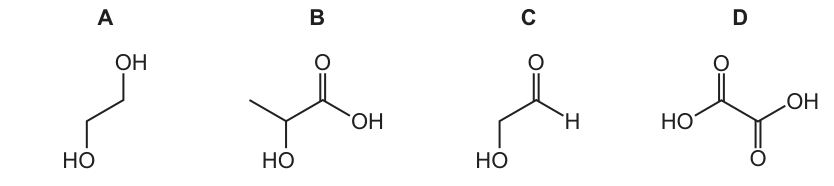
Working
Reaction with excess sodium (Na):
Sodium reacts with acidic hydrogen atoms (those attached to oxygen) to produce hydrogen gas ().
- Alcohols (): . (1 mol produces 0.5 mol )
- Carboxylic acids (): . (1 mol produces 0.5 mol )
- Aldehydes (): No reaction with Na.
Reaction with excess sodium carbonate ():
Sodium carbonate reacts only with acids stronger than carbonic acid (i.e., carboxylic acids) to produce carbon dioxide gas ().
- Carboxylic acids (): . (2 mol produces 1 mol , so 1 mol produces 0.5 mol )
- Alcohols (): No reaction (alcohols are weaker acids than carbonic acid).
Analysis of Options (1 mole of each compound):
-
A (Propan-1,3-diol): 2 groups.
- With Na: mol .
- With : 0 mol gas (no reaction).
- Volumes differ.
-
B (2-hydroxypropanoic acid): 1 , 1 .
- With Na: mol .
- With : mol (only reacts).
- Volumes differ (1 mol vs 0.5 mol).
-
C (3-hydroxypropanal): 1 , 1 .
- With Na: mol (only reacts).
- With : 0 mol gas (no reaction).
- Volumes differ.
-
D (Ethanedioic acid): 2 groups.
- With Na: mol . (Equation: )
- With : mol . (Equation: )
- Volumes are the same (1 mole of gas each).
Answer
D
Background Concept
This question tests the understanding of the acidity of different organic functional groups and their reactions with specific reagents.
-
Sodium Metal (Na): Sodium is a reactive metal that reacts with compounds containing acidic hydrogen atoms—specifically, hydrogen atoms attached to electronegative atoms like oxygen. In organic chemistry, this includes alcohols () and carboxylic acids (). The reaction produces hydrogen gas () and a salt (alkoxide or carboxylate). Aldehydes and ketones do not have acidic hydrogens that react with sodium metal to produce gas.
- General equation: .
- Stoichiometry: 2 moles of acidic H produce 1 mole of . Thus, 1 mole of or group produces 0.5 moles of .
-
Sodium Carbonate (): This is a basic salt. It reacts with acids that are stronger than carbonic acid () to produce carbon dioxide gas (), water, and a salt. Carboxylic acids are stronger acids than carbonic acid (and phenols, though not present here), so they react. Alcohols are weaker acids than water/carbonic acid and do not react with sodium carbonate.
- General equation: .
- Stoichiometry: 2 moles of produce 1 mole of . Thus, 1 mole of group produces 0.5 moles of .
-
Gas Volumes: According to Avogadro's law, equal volumes of gases at the same temperature and pressure contain the same number of moles. Therefore, if two reactions produce the same number of moles of gas, they will produce the same volume of gas.
Understanding the Question
We are given four compounds (A, B, C, D) and asked to find which one produces the same volume of gas when reacted separately with:
- Excess sodium ()
- Excess sodium carbonate ()
Since we start with 1 mole of each compound, we need to calculate the moles of gas produced in each reaction for each compound and compare them. The gas produced with Na is hydrogen (), and the gas produced with is carbon dioxide ().
Approach
- Identify the functional groups in each compound (A, B, C, D) from the provided structures.
- Determine which functional groups react with Na and which react with .
- Calculate the moles of gas produced by 1 mole of each compound with each reagent using the stoichiometry of the reactions.
- Compare the moles of gas. The correct compound will have equal moles of gas for both reagents.
Step-by-Step Reasoning
Compound A: Propan-1,3-diol ()
- Functional groups: Two alcohol groups ().
- With Na: Both groups react. .
- With : Alcohols do not react. Gas = 0 mol.
- Result: 1 mol vs 0 mol. Incorrect.
Compound B: 2-hydroxypropanoic acid ()
- Functional groups: One alcohol (), one carboxylic acid ().
- With Na: Both react. . . Total = 1 mol .
- With : Only reacts. . Total = 0.5 mol .
- Result: 1 mol vs 0.5 mol. Incorrect.
Compound C: 3-hydroxypropanal ()
- Functional groups: One alcohol (), one aldehyde ().
- With Na: Only reacts. .
- With : Neither reacts (aldehydes and alcohols are not acidic enough). Gas = 0 mol.
- Result: 0.5 mol vs 0 mol. Incorrect.
Compound D: Ethanedioic acid ()
- Functional groups: Two carboxylic acid groups ().
- With Na: Both react. .
- Equation: .
- With : Both react. .
- Equation: .
- Result: 1 mol vs 1 mol . Since moles are equal, volumes are equal. Correct.
Key Takeaways
- Sodium metal reacts with all acidic hydrogens (alcohols and carboxylic acids) to produce .
- Sodium carbonate reacts only with carboxylic acids (not alcohols) to produce .
- Always check the stoichiometry: 2 moles of acidic groups produce 1 mole of gas ( or ).
- For volumes to be equal, the number of moles of gas produced must be equal.
Common Mistakes
- Assuming alcohols react with sodium carbonate: Alcohols are weaker acids than carbonic acid and do not react with . Only carboxylic acids (and phenols) do.
- Forgetting stoichiometry: Thinking 1 mole of produces 1 mole of . The balanced equation shows 2 moles of acid are needed for 1 mole of .
- Confusing the gases: Remember Na produces and produces .
Things to Be Careful About
- State symbols and balancing: Ensure equations are balanced correctly to determine the mole ratio.
- Functional group identification: Carefully distinguish between alcohols (), carboxylic acids (), and aldehydes (). In compound B, there is both an alcohol and an acid. In compound D, there are two acids.
- Avogadro's Law: Remember that comparing volumes of gas is equivalent to comparing moles of gas (at constant T and P).
Which reaction will distinguish between propan-1-ol and propan-2-ol?
Options
A warming with acidified
B warming with acidified
C dehydration, followed by reaction with
D mild oxidation, followed by reaction with Fehling’s reagent
Working
Propan-1-ol is a primary alcohol; propan-2-ol is a secondary alcohol.
- A and B: Both primary and secondary alcohols are oxidised by acidified KMnO4 and acidified K2Cr2O7 (both would show a colour change). No distinction.
- C: Both propan-1-ol and propan-2-ol dehydrate to the same alkene, propene, which decolourises Br2(aq). No distinction.
- D: Mild oxidation of propan-1-ol gives propanal (an aldehyde), which gives a brick-red precipitate with Fehling's reagent. Mild oxidation of propan-2-ol gives propanone (a ketone), which does not react with Fehling's reagent. This distinguishes them.
Answer
D
D
Background Concept
Primary alcohols (R-CH2OH) are oxidised to aldehydes (R-CHO) and then to carboxylic acids (R-COOH). Secondary alcohols (R2CHOH) are oxidised to ketones (R-CO-R'). Aldehydes are readily oxidised and give a positive Fehling's test (brick-red precipitate of Cu2O) and Tollens' test (silver mirror); ketones do not.
Understanding the Question
The question asks which reaction gives a different observable outcome for propan-1-ol (primary) and propan-2-ol (secondary), so we can tell them apart.
Approach
For each option, determine the product(s) for each alcohol and whether the observable result differs.
Step-by-Step Reasoning
- A: Acidified KMnO4 oxidises both primary and secondary alcohols. Both cause the purple KMnO4 to decolourise. Same result — cannot distinguish.
- B: Acidified K2Cr2O7 similarly oxidises both; orange → green for both. Same result — cannot distinguish.
- C: Both alcohols dehydrate (conc. H2SO4, heat) to propene (CH3CH=CH2). Propene decolourises Br2(aq). Same result — cannot distinguish.
- D: Mild oxidation (e.g. acidified K2Cr2O7, distil) of propan-1-ol gives propanal (CH3CH2CHO), an aldehyde → positive Fehling's (brick-red). Mild oxidation of propan-2-ol gives propanone (CH3COCH3), a ketone → negative Fehling's (no change). Different results — distinguishes.
Key Takeaways
To distinguish primary from secondary alcohols: oxidise them first, then test the product with Fehling's or Tollens' reagent (aldehyde vs ketone).
Common Mistakes
- Assuming KMnO4 or K2Cr2O7 distinguish primary/secondary — both are oxidised, so no distinction.
- Forgetting that both alcohols dehydrate to the same alkene (propene) here.
Things to Be Careful About
- "Mild oxidation" of a primary alcohol stops at the aldehyde; vigorous oxidation goes to the carboxylic acid.
- Fehling's reagent tests for aldehydes only; ketones give no reaction.
Compound T has the skeletal formula shown.
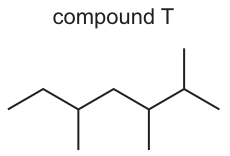
Which structure is a structural isomer of compound T?
Options

Working
Compound T has the molecular formula . A structural isomer must have the same molecular formula but a different structural formula.
- A: Same connectivity as T (identical molecule), not an isomer.
- B: Molecular formula . Not an isomer.
- C: Molecular formula . Not an isomer.
- D: Molecular formula , with a different carbon chain arrangement. This is a structural isomer of T.
Answer
D
D
Background Concept
Structural isomers are compounds that have the same molecular formula (same number and types of atoms) but different structural formulae (different arrangement of atoms). For alkanes with the general formula , any two compounds with the same are structural isomers, provided they are not identical molecules drawn in different orientations.
Understanding the Question
We are given the skeletal formula of compound T and four options (A, B, C, D). We need to identify which option is a structural isomer of T. This means we must find the option that has the same molecular formula as T but is not the same molecule.
Approach
- Determine the molecular formula of compound T by counting the number of carbon and hydrogen atoms in its skeletal structure.
- Determine the molecular formula for each option (A, B, C, D).
- Eliminate options that do not have the same molecular formula as T (they cannot be isomers).
- Among the remaining options with the correct molecular formula, eliminate any that are identical to T (just drawn differently). The remaining option is the structural isomer.
Step-by-Step Reasoning
- Compound T: Counting the vertices and ends in the skeletal formula for T gives 9 carbon atoms. As an alkane, its formula is . Its IUPAC name is 2,5-dimethylheptane (or similar, depending on exact chain tracing, but the key is ).
- Option A: Counting carbons gives 9. However, tracing the longest chain and substituents reveals it is identical to compound T, just rotated or flipped. An identical molecule is not a structural isomer.
- Option B: Counting carbons gives 8. The molecular formula is . Since the molecular formula differs from T, it cannot be an isomer.
- Option C: Counting carbons gives 8. The molecular formula is . Again, different molecular formula, so not an isomer.
- Option D: Counting carbons gives 9. The molecular formula is . The structure is a branched nonane (e.g., 2-methyloctane or similar), which has a different connectivity than T. Thus, it is a structural isomer.
Key Takeaways
- Structural isomerism requires both the same molecular formula and a different structural arrangement.
- Skeletal formulae can be drawn in various orientations; always determine the IUPAC name or carefully trace the longest chain to check if two structures are identical.
- Counting carbon atoms is the quickest way to eliminate options that cannot be isomers.
Common Mistakes
- Identifying identical molecules as isomers: Students often pick an option that is just a rotated version of the original molecule. Remember, identical molecules are not isomers.
- Miscounting carbons in skeletal structures: Forgetting that every vertex and end of a line represents a carbon atom can lead to incorrect molecular formulas.
- Confusing structural isomers with stereoisomers: The question asks for structural isomers, so any option with the same connectivity (even if drawn differently) is incorrect.
Things to Be Careful About
- Always count the total number of carbon atoms first. If the molecular formulas don't match, it's not an isomer.
- When comparing skeletal structures, try to find the longest continuous carbon chain and number it from the end that gives the lowest locants to the substituents. This reveals the IUPAC name and confirms whether two structures are identical.
The diagram shows a simplified structure of coenzyme .
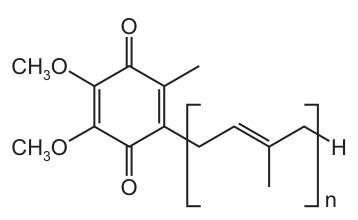
Which row describes the structure of coenzyme correctly?
Options
| the coenzyme is | number of bonds in one molecule | |
|---|---|---|
| A | an aldehyde | |
| B | an aldehyde | |
| C | a ketone | |
| D | a ketone |
Working
The carbonyl groups () in the ring are each bonded to two other carbon atoms within the ring structure. This defines them as ketone groups (the ring is a quinone, a type of diketone), not aldehyde groups, which would require a group with a hydrogen atom attached to the carbonyl carbon.
Counting the bonds:
- In the six-membered ring: there are 2 bonds and 2 bonds. Each double bond contains 1 bond, giving bonds.
- In the side chain: there are repeating units, each containing one double bond, giving bonds.
- Total bonds = .
Answer
D
D
Background Concept
In organic chemistry, carbonyl compounds are classified based on the atoms attached to the carbonyl carbon (). If the carbonyl carbon is bonded to at least one hydrogen atom, it is an aldehyde (). If it is bonded to two carbon atoms, it is a ketone. Every double bond ( or ) consists of one (sigma) bond and one (pi) bond. Therefore, counting the number of double bonds in a molecule directly gives the number of bonds.
Understanding the Question
The question provides a simplified structural diagram of coenzyme and asks to identify its correct functional group classification (aldehyde or ketone) and the total number of bonds in one molecule. The structure consists of a central six-membered ring with two methoxy groups (), a methyl group, two carbonyl groups, and a long hydrocarbon side chain containing repeating isoprenoid units.
Approach
- Examine the carbonyl () groups in the ring to determine if they are aldehydes or ketones based on their bonding environment.
- Systematically count all double bonds ( and ) in the ring and multiply by the number of repeating units in the side chain to find the total number of bonds.
Step-by-Step Reasoning
Functional group identification:
The diagram shows two groups within the six-membered ring. Looking at the carbons of these carbonyl groups, each is bonded to two other carbon atoms within the ring (and no hydrogen atoms). By definition, a carbonyl group bonded to two carbons is a ketone. An aldehyde must have a hydrogen atom attached to the carbonyl carbon (i.e., ). Thus, the molecule is a ketone (specifically, it is a benzoquinone derivative, which is a cyclic diketone). This eliminates options A and B.
Counting bonds:
- Ring: The six-membered ring contains two double bonds and two double bonds. Each double bond contributes exactly one bond. Therefore, the ring contributes bonds.
- Side chain: The side chain is denoted with a repeating unit in brackets with a subscript . The repeating unit is , which contains one double bond. With such units, the side chain contributes bonds.
- Total: Adding the ring and side chain contributions gives bonds, or .
This matches row D.
Key Takeaways
- Ketones have the carbonyl carbon bonded to two other carbons, whereas aldehydes have it bonded to at least one hydrogen.
- Every double bond, whether carbon-carbon or carbon-oxygen, contains exactly one bond.
- When counting bonds in molecules with repeating units, always multiply the number of bonds in one repeat unit by the number of repeats ().
Common Mistakes
- Misidentifying the functional group: Students may see and assume it is an aldehyde without checking what else is attached to the carbonyl carbon. Remember, aldehydes must have a hydrogen on the carbonyl carbon ().
- Forgetting ring double bonds: When counting bonds, students often only count the side chain or only the ring, missing the bonds in the quinone ring or the bonds themselves.
- Misinterpreting the repeating unit: Forgetting to multiply the side chain double bonds by , or miscounting the number of double bonds within a single repeating unit.
Things to Be Careful About
- Functional group definitions: Strictly adhere to the structural definitions: aldehyde = , ketone = . Quinones are a specific type of cyclic diketone and fall under the ketone category for this classification.
- Counting bonds correctly: Remember that a double bond = 1 + 1 , and a triple bond = 1 + 2 . Only double and triple bonds contribute bonds; single bonds do not.
The molecule of limonene, , contains a 6-membered ring. This is the only cyclic component in its structure.
Which volume of hydrogen, at room conditions, is required to react completely with the C=C double bonds in one mole of limonene?
Options
A 12 dm³
B 24 dm³
C 48 dm³
D 72 dm³
Working
A saturated acyclic alkane with 10 carbons has formula .
The single ring removes 2 H atoms, so a saturated monocyclic alkane is .
Limonene is , which is 4 H atoms fewer than . This corresponds to two C=C double bonds.
Each C=C bond reacts with 1 mol of , so 1 mol limonene requires 2 mol .
At room conditions, molar volume = 24 dm³ mol⁻¹.
Answer
C
C
Background Concept
Limonene is a hydrocarbon. A saturated acyclic alkane with carbon atoms has the general formula . Every ring and every C=C double bond in the molecule reduces the number of hydrogen atoms by 2 compared with the saturated acyclic alkane. This is the idea of degree of unsaturation: a ring counts as one degree, and a double bond counts as one degree.
Hydrogenation of a C=C double bond adds across the double bond, converting it into a C–C single bond. Exactly 1 mol of is consumed per mole of C=C double bonds.
At room conditions (about 25 °C and 1 atm), the molar volume of any gas is approximately 24 dm³ mol⁻¹. This is the value used in CIE A-Level questions unless the question specifies s.t.p., for which 22.4 dm³ mol⁻¹ would be used.
Understanding the Question
The question states that limonene has the molecular formula and contains exactly one ring, a 6-membered ring. It asks for the volume of hydrogen, at room conditions, needed to react completely with all the C=C double bonds in one mole of limonene.
The key hidden step is to work out how many C=C double bonds are present. The formula alone gives the total number of degrees of unsaturation, but one of those degrees is already used by the ring. The remaining degrees must be double bonds.
Approach
- Write the formula of the saturated acyclic alkane with the same number of carbons: .
- Account for the one ring: a ring removes 2 H atoms, giving .
- Compare the actual formula, , with . The difference of 4 H atoms corresponds to two C=C double bonds.
- Convert the number of double bonds into moles of needed: each C=C needs 1 mol .
- Convert moles of into volume using the molar volume at room conditions, 24 dm³ mol⁻¹.
Step-by-Step Reasoning
- A saturated acyclic alkane with 10 carbons is .
- Limonene contains one ring. Forming a ring removes two hydrogen atoms, so a saturated monocyclic alkane would be .
- The actual formula is , which is 4 H atoms fewer than . Since each C=C double bond removes 2 H atoms from the saturated formula, 4 H atoms fewer means there must be two C=C double bonds.
- Hydrogenation of each C=C bond uses one molecule of :
So 1 mol of limonene requires 2 mol of .
- At room conditions, 1 mol of gas occupies 24 dm³, so:
Therefore the correct option is C.
Why the other options are wrong:
- A, 12 dm³ would correspond to 0.5 mol of , which is not a whole number of double bonds per mole of limonene.
- B, 24 dm³ would be the volume needed for only one C=C double bond. This would be the answer if the ring had not been accounted for correctly.
- D, 72 dm³ would be the volume needed for three C=C double bonds. This is the mistake made when the ring is counted as a double bond instead of being subtracted from the total degree of unsaturation.
Key Takeaways
- For a hydrocarbon with rings and double bonds:
- A ring and a double bond each contribute one degree of unsaturation.
- Each C=C double bond reacts with exactly 1 mol of per mole of compound.
- At room conditions, use 24 dm³ mol⁻¹ as the molar volume of a gas.
Common Mistakes
- Counting the ring as a C=C double bond, leading to three double bonds and the incorrect answer 72 dm³.
- Forgetting that the ring removes 2 H atoms, so the formula has only two double bonds, not three.
- Using 22.4 dm³ mol⁻¹ instead of 24 dm³ mol⁻¹ for room conditions.
- Thinking that each C=C bond requires 2 mol of ; in fact, one mole of adds across one C=C bond.
Things to Be Careful About
- Read the phrase “room conditions” carefully: it signals the use of 24 dm³ mol⁻¹, not the s.t.p. value of 22.4 dm³ mol⁻¹.
- When comparing formulae, always start from the saturated acyclic alkane, then subtract 2 H for the ring, then subtract 2 H for each double bond.
- Check the stoichiometry of hydrogenation: 1 mol per C=C bond.
- Give the final volume in dm³ and make sure the units match the molar volume used.
1-bromopropane reacts with hot ethanolic NaOH.
What is the molecular formula of the product in this reaction?
Options
A
B
C
D
Working
Hot ethanolic NaOH favours elimination over substitution. 1-bromopropane, , loses HBr to give propene:
Propene has molecular formula .
Answer
A —
A
Background Concept
Halogenoalkanes can react with hydroxide ions in two different ways. In aqueous NaOH, the hydroxide ion acts as a nucleophile and replaces the halogen atom, giving an alcohol. In hot ethanolic NaOH, the hydroxide ion acts as a base and removes a hydrogen atom from the carbon atom adjacent to the carbon bearing the halogen (the -carbon). The pair of electrons from the C–H bond moves to form a C=C bond, and the halogen leaves as a halide ion. This is an elimination reaction, also called dehydrohalogenation, and it produces an alkene.
For a halogenoalkane of general formula , elimination of HX gives an alkene . The carbon skeleton is unchanged, but two hydrogen atoms (one from the -carbon and the halogen from the halogen-bearing carbon) are lost.
Understanding the Question
This multiple-choice question asks for the molecular formula of the product when 1-bromopropane is treated with hot ethanolic NaOH. The phrase “hot ethanolic” is the crucial clue: it tells you the reaction is elimination, not nucleophilic substitution. The options include an alkene (), an alkane (), and two oxygen-containing formulas, one of which would correspond to an alcohol (). You need to identify the correct product and then count its atoms.
Approach
Start by writing the structure of 1-bromopropane: . Recognise that hot ethanolic NaOH causes elimination. Remove HBr from adjacent carbons to form a C=C bond. The product is propene, . Count the carbon and hydrogen atoms to get the molecular formula, then match it to the options.
Step-by-Step Reasoning
- Identify the starting material: 1-bromopropane is a three-carbon chain with a bromine atom on the first carbon: .
- Under hot ethanolic conditions, the hydroxide ion acts as a base. It removes a hydrogen from the second carbon (the -carbon) while the C–Br bond breaks. A double bond forms between the first and second carbons.
- The organic product is propene: .
- Count the atoms: three carbons and six hydrogens, so the molecular formula is .
- Match this to the options: option A is .
Why the other options are wrong:
- B () is propane, a saturated alkane. It would require hydrogenation of propene, not elimination of a bromoalkane.
- D () is propan-1-ol, the product of nucleophilic substitution with aqueous NaOH. The hot ethanolic conditions change the mechanism to elimination.
- C () is not a valid neutral molecular formula for a stable compound here; it would be a radical or ion. It is a distractor.
Key Takeaways
- The solvent and temperature control whether a halogenoalkane undergoes substitution or elimination.
- Aqueous NaOH substitution (alcohol).
- Hot ethanolic NaOH elimination (alkene).
- Elimination removes H and X from adjacent carbons, forming a C=C bond and reducing the hydrogen count by two.
- For an alkene with carbons, the molecular formula is .
Common Mistakes
- Choosing D because you think NaOH always gives an alcohol. The “hot ethanolic” condition is the signal for elimination.
- Forgetting to count hydrogens correctly: propene has six hydrogens, not eight.
- Selecting B because it looks like a simple hydrocarbon; propane has no double bond and is not formed here.
- Being tempted by C, which is not a valid neutral formula; check that the formula obeys the usual valency rules.
Things to Be Careful About
- Read the conditions carefully: “hot ethanolic” vs “aqueous” changes the answer completely.
- When counting atoms, remember that forming a C=C bond removes two hydrogen atoms from the saturated haloalkane.
- In an exam, if you are unsure, draw the displayed formula of the reactant and product before counting.
- The bromine atom is lost as and the hydrogen from the -carbon ends up in water; the alkene has no halogen or oxygen.
A sample of pent-2-en-4-ol, , contains all the possible stereoisomers of this compound.
How many stereoisomers are there in the sample?
Options
A 2
B 3
C 4
D 5
Working
The structure is .
- The C=C double bond has different groups on each carbon, so E/Z (cis/trans) isomerism is possible: 2 forms.
- The carbon carrying the OH group is attached to four different groups, so it is a chiral centre: 2 optical forms (R and S).
Total stereoisomers .
Answer
C
C
Background Concept
Stereoisomers have the same structural formula but differ in the spatial arrangement of their atoms. Two types are relevant here. Geometrical (E/Z or cis/trans) isomerism arises when there is restricted rotation about a C=C double bond and each doubly bonded carbon carries two different groups. Optical isomerism arises when a carbon atom is bonded to four different groups; such a chiral centre gives two non-superimposable mirror-image forms, labelled R and S. When a molecule contains both a C=C and a chiral centre, the stereoisomers are the combinations of the two independent stereogenic elements, unless symmetry (for example a meso compound) reduces the count.
Understanding the Question
Pent-2-en-4-ol has formula . The name tells us the longest chain has five carbons, with a double bond between C2 and C3, and an OH group on C4. The sample contains all possible stereoisomers, so we must count every distinct spatial arrangement. The question is asking how many stereoisomers exist in total, so we need to identify all sources of stereoisomerism and combine them.
Approach
- Write the structure from the name.
- Check the C=C for possible E/Z isomerism.
- Check every carbon for a possible chiral centre.
- Multiply the number of geometric forms by the number of optical forms, provided the stereogenic elements are independent and there is no symmetry that creates a meso form.
Step-by-Step Reasoning
The structure is . Numbering the chain from left to right: C1 is , C2 and C3 are the doubly bonded carbons, C4 carries the OH group, and C5 is .
- Geometric isomerism: At the C2=C3 double bond, C2 is attached to and H; C3 is attached to and H. Because each carbon has two different substituents, the double bond can adopt an E arrangement or a Z arrangement. This gives 2 geometric isomers.
- Optical isomerism: C4 is attached to four different groups: H, OH, , and . These are all different, so C4 is a chiral centre. It can exist as the R enantiomer or the S enantiomer, giving 2 optical forms.
- Combining: There is no symmetry that makes any of these forms identical, and there is only one chiral centre, so no meso compound is possible. The total number of stereoisomers is therefore .
Option C is correct. Option A (2) counts only the geometric isomers; option B (3) might count one of the sources incorrectly; option D (5) overcounts.
Key Takeaways
- To count stereoisomers, identify every stereogenic element: each C=C that can show E/Z and each chiral centre.
- Multiply the independent counts together.
- Check for symmetry/meso compounds only when there are two or more chiral centres.
Common Mistakes
- Forgetting the chiral centre and counting only the E/Z isomers.
- Thinking a carbon is chiral when it has two identical groups; here C4 is genuinely chiral because all four groups differ.
- Overcounting by adding rather than multiplying the geometric and optical possibilities.
- Misreading the name and placing the OH or the double bond on the wrong carbon.
Things to Be Careful About
- The IUPAC name pent-2-en-4-ol fixes the double bond between C2 and C3 and the OH on C4; the correct structure is essential.
- A chiral centre must have four different groups: at C4 the groups are H, OH, , and .
- With one chiral centre there is no possibility of a meso form, so all combinations are distinct.
- Use the product rule for independent stereogenic elements: geometric forms × optical forms.
Which pair of reagents reacts to form a product with a chiral carbon atom?
Options
A
B
C
D
Working
A CH3CH=CH2 + HBr → CH3CH(Br)CH3 (2-bromopropane).
The carbon bonded to Br carries two identical CH3 groups → not chiral.
B (CH3)2C=O + NaBH4 → (CH3)2CHOH (propan-2-ol).
The carbon bonded to OH carries two identical CH3 groups → not chiral.
C CH3CH2CHO + HCN → CH3CH2CH(OH)CN (2-hydroxybutanenitrile).
The carbon bonded to OH and CN carries four different groups (CH3CH2, OH, CN, H) → chiral.
D CH3COOH + CH3CH2OH → CH3COOCH2CH3 (ethyl ethanoate).
No carbon carries four different groups → not chiral.
Answer
C
C
Background Concept
A chiral (asymmetric) carbon atom is one bonded to four different groups. Such a molecule can exist as two non-superimposable mirror images, called enantiomers. To test for chirality, look at every carbon in the product and ask: are all four substituents different?
Understanding the Question
The question gives four reagent pairs and asks which forms a product with a chiral carbon. You must know the product of each reaction and then apply the chirality test.
Approach
- Predict each product (electrophilic addition, reduction, nucleophilic addition, esterification).
- Inspect each carbon for four different groups.
- Select the pair whose product passes the test.
Step-by-Step Reasoning
A: Propene with HBr undergoes electrophilic addition. Markovnikov's rule places Br on the more substituted carbon, giving 2-bromopropane, CH3CH(Br)CH3. The central carbon is bonded to H, Br, and two identical CH3 groups — three different groups, so not chiral.
B: Propanone with NaBH4 is reduced to propan-2-ol, (CH3)2CHOH. The alcohol carbon is bonded to H, OH, and two identical CH3 groups — not chiral.
C: Propanal with HCN undergoes nucleophilic addition (the cyanide ion attacks the carbonyl carbon). The product is 2-hydroxybutanenitrile, CH3CH2CH(OH)CN. The carbon that was the carbonyl carbon now carries four different groups: CH3CH2, OH, CN, and H. This is a chiral centre. ✓
D: Ethanoic acid with ethanol undergoes esterification to give ethyl ethanoate, CH3COOCH2CH3. The carbonyl carbon is bonded to two oxygen atoms (not four different groups), and the CH2 carbon is bonded to two hydrogen atoms. No chiral carbon exists.
Key Takeaways
- A chiral centre is a carbon with four different substituents.
- Addition of HCN to an aldehyde RCHO creates a chiral centre: RCH(OH)CN.
- Reduction of a symmetrical ketone (e.g. propanone) gives an alcohol with two identical groups — not chiral.
- Markovnikov addition can place two identical groups on the same carbon, removing chirality.
Common Mistakes
- Assuming 1-bromopropane forms from propene + HBr (it is 2-bromopropane by Markovnikov).
- Thinking the ester carbonyl carbon is chiral — it is bonded to two oxygens.
- Forgetting that propan-2-ol from propanone has two identical CH3 groups.
Things to Be Careful About
- Check every carbon in the product, not just the most obvious one.
- NaBH4 only reduces C=O; it does not reduce C=C or other groups.
- HCN adds to aldehydes and unsymmetrical ketones to give chiral products; with symmetrical ketones like propanone the product is not chiral.
The diagrams show the structures of two esters, X and Y, that are formed in ripening apples.
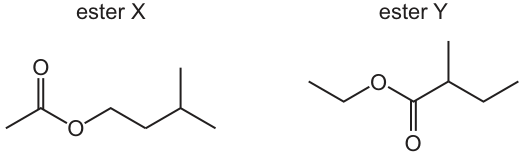
Which carboxylic acids are formed when these esters are hydrolysed by ?
Options
| ester X | ester Y | |
|---|---|---|
| A | ||
| B | ||
| C | ||
| D |
Working
Acid-catalysed hydrolysis of an ester (using ) breaks the ester linkage to form a carboxylic acid and an alcohol. The carboxylic acid is derived from the acyl group () of the ester, while the alcohol is derived from the alkoxy group ().
Ester X:
The structure is .
The acyl group is .
Hydrolysis yields the carboxylic acid (ethanoic acid) and the alcohol (3-methylbutan-1-ol).
Ester Y:
The structure is .
The acyl group is .
Hydrolysis yields the carboxylic acid (2-methylbutanoic acid) and the alcohol (ethanol).
Comparing these results with the given options:
- Ester X
- Ester Y
This matches option B.
Answer
B
B
Background Concept
Esters () are carboxylic acid derivatives formed by the condensation reaction between a carboxylic acid () and an alcohol (), typically catalysed by an acid like concentrated . The reaction is reversible. When an ester is heated with dilute aqueous acid (such as ), it undergoes hydrolysis, breaking the ester bond ( single bond adjacent to the carbonyl group) to regenerate the original carboxylic acid and alcohol.
In the ester structure :
- The acyl group is . This part becomes the carboxylic acid () upon hydrolysis.
- The alkoxy group is . This part becomes the alcohol () upon hydrolysis.
Understanding the Question
The question provides skeletal structures for two esters, X and Y, found in ripening apples. We are asked to identify the carboxylic acids formed when these esters are hydrolysed by aqueous sulfuric acid (). We must correctly interpret the skeletal formulae to identify which part of each molecule corresponds to the carboxylic acid component (the acyl group).
Approach
- Identify the ester linkage: Locate the group in each structure.
- Separate the molecule: Break the bond between the carbonyl carbon () and the single-bonded oxygen ().
- The fragment containing the becomes the carboxylic acid (add an to the carbonyl carbon).
- The fragment containing the single-bonded oxygen becomes the alcohol (add an to the oxygen).
- Determine the acids: Write down the formula for the carboxylic acid derived from each ester and match with the options.
Step-by-Step Reasoning
Ester X Analysis:
- Looking at the left structure in Fig 38.1, we see a group attached to an oxygen, which is attached to a carbon chain .
- The acyl group (acid part) is .
- Upon hydrolysis, this becomes (ethanoic acid / acetic acid).
- The alkoxy group is , which becomes 3-methylbutan-1-ol.
- Therefore, for ester X, the carboxylic acid is . This eliminates options C and D.
Ester Y Analysis:
- Looking at the right structure in Fig 38.1, we see an ethyl group attached to a carbonyl carbon, which is attached to a branched chain .
- The structure is .
- The acyl group (acid part) is . Note that the carbonyl carbon is attached to a group which has a methyl branch and an ethyl group.
- Upon hydrolysis, this acyl group becomes (2-methylbutanoic acid).
- The alkoxy group is , which becomes ethanol ().
- Therefore, for ester Y, the carboxylic acid is .
Matching with Options:
- Ester X acid:
- Ester Y acid:
- This combination corresponds exactly to Option B.
Key Takeaways
- Acid hydrolysis of an ester () produces a carboxylic acid () and an alcohol ().
- The carboxylic acid comes from the acyl side () of the ester, not the alkoxy side.
- Skeletal formulae must be read carefully: vertices and ends of lines represent carbon atoms. Branches are additional lines off the main chain.
Common Mistakes
- Confusing the acid and alcohol parts: Students often break the ester bond incorrectly or assume the right-hand side of the formula is always the acid. Remember: the side is the acid.
- Misreading skeletal structures: In Ester Y, the chain can be misread. The carbonyl carbon is attached to a with a methyl group and an ethyl group. This is 2-methylbutanoic acid, not 3-methylpentanoic acid or propanoic acid.
- Ignoring the question: The question asks for the carboxylic acids, not the alcohols. Selecting the alcohols (3-methylbutan-1-ol and ethanol) would lead to an incorrect answer not listed, but confusing the two parts is a common trap.
Things to Be Careful About
- Ester linkage orientation: In condensed formulae like , the attached to is the acid part, and the attached to the single is the alcohol part.
- Skeletal formula interpretation: Ensure you count carbons correctly. In Ester Y, the acid chain is attached to , making it a 4-carbon chain (butanoic acid) with a methyl group at position 2.
- Hydrolysis conditions: Dilute catalyses hydrolysis. Concentrated would also hydrolyse it but would produce the carboxylate salt (), not the free carboxylic acid (unless acidified afterwards). The question specifies , so the free acid is formed directly.
An addition polymer is made from monomer Z.
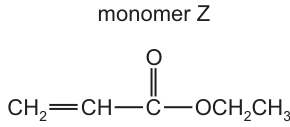
What is the structure of the polymer made from this monomer?
Options
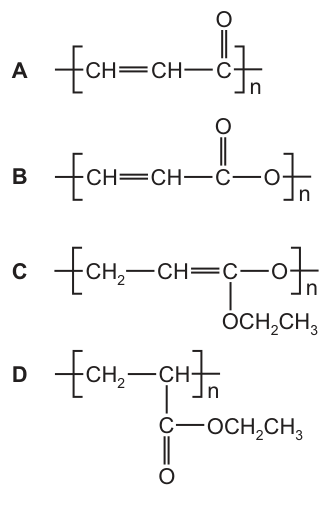
Answer
D
D
Background Concept
Addition polymerisation occurs when unsaturated monomers (typically containing a C=C double bond) react together without losing any atoms. The pi bond of the alkene breaks, and new sigma bonds form between the monomer units to create a long-chain polymer. The repeat unit of the polymer has a carbon backbone derived from the original C=C bond, with all original substituents retained on their respective carbon atoms. Unlike condensation polymerisation, no small molecules (such as water) are eliminated during the process.
Understanding the Question
The question provides the structure of monomer Z, which is ethyl acrylate (CH2=CH-C(=O)-OCH2CH3). It asks to identify the correct structure of the addition polymer formed from this monomer among four options (A, B, C, D). The task is to determine the correct repeat unit by applying the principles of addition polymerisation to the given alkene monomer.
Approach
To determine the polymer structure, identify the C=C double bond in the monomer. In the polymer repeat unit, this double bond becomes a single bond connecting two carbon atoms in the main chain. All other atoms and groups (the ester side chain) remain attached to the same carbon atoms as in the monomer. Draw the repeat unit by placing brackets around the new single-bonded backbone and appending 'n' to indicate the number of repeating units. Compare this derived structure with the given options to find the match.
Step-by-Step Reasoning
- Examine the monomer Z: CH2=CH-C(=O)-OCH2CH3. The reactive site is the C=C double bond between the first two carbon atoms. The third carbon is part of an ester group (-C(=O)OCH2CH3) attached to the second carbon of the double bond.
- During addition polymerisation, the C=C pi bond breaks. The two carbon atoms that were double-bonded now form single bonds with adjacent monomer units.
- The repeat unit therefore has a -CH2-CH- backbone. The carbon that originally bore the ester group (the CH carbon) retains the -C(=O)OCH2CH3 substituent.
- The correct repeat unit is -[CH2-CH(C(=O)OCH2CH3)]-n, which can be written with the side chain hanging below or above the main chain.
- Evaluate the options:
- Option A: Retains a C=C double bond in the backbone and is missing the ethyl group of the ester. Incorrect.
- Option B: Retains a C=C double bond and is missing the ethyl group. Incorrect.
- Option C: Has a double bond in the backbone and incorrect connectivity. Incorrect.
- Option D: Shows a -CH2-CH- backbone with the -C(=O)OCH2CH3 group attached to the CH carbon. This matches the expected structure. Correct.
Key Takeaways
In addition polymerisation, the C=C double bond of the monomer opens up to form a saturated carbon-carbon backbone in the polymer. Substituents on the monomer's double-bonded carbons become side chains on the polymer backbone. The repeat unit is enclosed in square brackets with a subscript 'n' to denote the repeating nature of the structure.
Common Mistakes
- Keeping the C=C double bond in the polymer backbone. Addition polymerisation saturates the backbone; the double bond is consumed to form new sigma bonds between monomers.
- Losing atoms from the side chain. The ester group (-COOCH2CH3) must remain fully intact in the repeat unit. Options A and B incorrectly truncate this group by removing the ethyl (-CH2CH3) portion.
- Misplacing the side chain. The ester group is attached to the CH carbon (the substituted carbon of the alkene), not the CH2 carbon.
Things to Be Careful About
- Always ensure the repeat unit has a fully saturated carbon backbone (-C-C-) for addition polymers derived from alkenes.
- Check that all atoms from the monomer are present in the repeat unit; no atoms are lost in addition polymerisation.
- Use square brackets and the subscript 'n' to denote the repeating nature of the polymer structure.
- Distinguish between addition polymerisation (no loss of small molecules) and condensation polymerisation (loss of small molecules like water). This monomer undergoes addition polymerisation.
Compound X reacts with acidified to form compound Y.
The infrared spectrum of compound Y is shown.
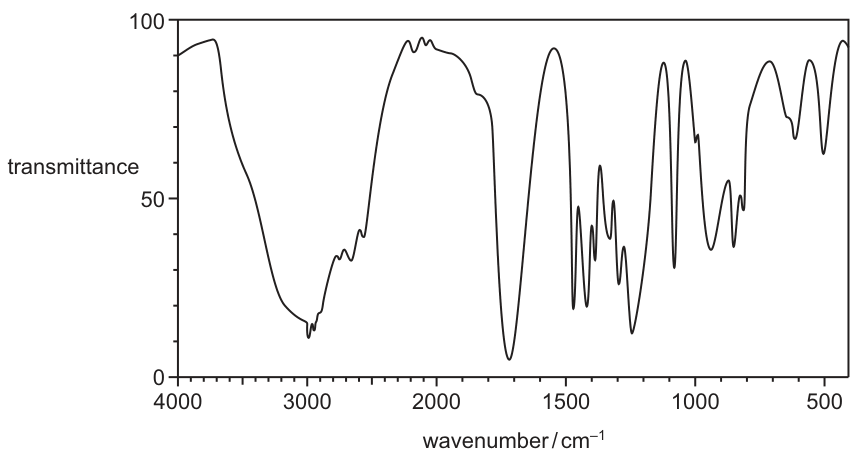
| bond | functional groups containing the bond | characteristic infrared absorption range (in wavenumbers) / cm⁻¹ |
|---|---|---|
| C–O | hydroxy, ester | 1040–1300 |
| C=C | aromatic compound, alkene | 1500–1680 |
| C=O | amide carbonyl, carboxyl ester | 1640–1690 1670–1740 1710–1750 |
| C≡N | nitrile | 2200–2250 |
| C–H | alkane | 2850–2950 |
| N–H | amine, amide | 3300–3500 |
| O–H | carboxyl hydroxy | 2500–3000 3200–3600 |
What is the identity of compound X?
Options
A propan-1-ol
B propan-2-ol
C propanone
D propanoic acid
Working
The IR spectrum of compound Y shows a very broad, strong absorption band from 2500 to 3300 cm⁻¹ (O–H stretch of a carboxylic acid) and a strong absorption at ~1720 cm⁻¹ (C=O stretch of a carboxylic acid). Thus, Y is propanoic acid.
Compound X is oxidised by acidified K₂Cr₂O₇ to form propanoic acid. Primary alcohols are oxidised to carboxylic acids. Propan-1-ol is a primary alcohol that oxidises to propanoic acid. Propan-2-ol oxidises to propanone. Propanone and propanoic acid do not undergo further oxidation with acidified K₂Cr₂O₇.
Therefore, X is propan-1-ol.
Answer
A
A
Background Concept
Infrared (IR) spectroscopy is used to identify functional groups in organic molecules based on the absorption of infrared radiation, which causes covalent bonds to vibrate. Different functional groups absorb at characteristic wavenumbers. A broad O–H absorption from 2500 to 3300 cm⁻¹ combined with a strong C=O absorption around 1700–1750 cm⁻¹ is diagnostic of a carboxylic acid (–COOH). An alcohol O–H stretch is sharper and appears at 3200–3600 cm⁻¹. Primary alcohols (RCH₂OH) can be oxidised by strong oxidising agents like acidified potassium dichromate(VI) (K₂Cr₂O₇) first to an aldehyde and then to a carboxylic acid. Secondary alcohols (R₂CHOH) oxidise to ketones (R₂C=O), which cannot be further oxidised under these conditions. Tertiary alcohols and ketones do not react with acidified K₂Cr₂O₇.
Understanding the Question
We are given that compound X is oxidised by acidified K₂Cr₂O₇ to give compound Y. We are also given the IR spectrum of Y and a table of characteristic IR absorption ranges. We need to identify Y from its IR spectrum, then deduce X from the fact that it oxidises to Y. The options are propan-1-ol, propan-2-ol, propanone, and propanoic acid.
Approach
- Analyse the IR spectrum of Y using the provided table to identify the functional groups present.
- Determine the identity of compound Y.
- Use the reaction between X and acidified K₂Cr₂O₇ to determine the class of compound X and its identity from the given options.
Step-by-Step Reasoning
- Identify functional groups in Y: The IR spectrum shows a very broad, strong absorption band from 2500 to 3300 cm⁻¹. According to the table, this is the O–H stretch of a carboxyl group (carboxylic acid). There is also a very strong, sharp absorption at approximately 1720 cm⁻¹, which falls in the 1710–1750 cm⁻¹ range for the C=O stretch of an ester or carboxyl group. The combination of a broad O–H (2500–3300 cm⁻¹) and a C=O (1710–1750 cm⁻¹) uniquely identifies a carboxylic acid. (Note: an alcohol O–H is 3200–3600 cm⁻¹, which is narrower and does not extend down to 2500 cm⁻¹).
- Identify compound Y: The options for X are all 3-carbon compounds. Oxidation of a 3-carbon compound gives a 3-carbon product. The carboxylic acid with 3 carbons is propanoic acid (CH₃CH₂COOH). Thus, Y is propanoic acid.
- Deduce compound X: X reacts with acidified K₂Cr₂O₇ (an oxidising agent) to form propanoic acid.
- A) propan-1-ol: A primary alcohol. Primary alcohols are oxidised by acidified K₂Cr₂O₇ to aldehydes and then to carboxylic acids. Propan-1-ol oxidises to propanoic acid. This matches.
- B) propan-2-ol: A secondary alcohol. Secondary alcohols oxidise to ketones. Propan-2-ol oxidises to propanone, not propanoic acid.
- C) propanone: A ketone. Ketones are not oxidised by acidified K₂Cr₂O₇.
- D) propanoic acid: A carboxylic acid. Carboxylic acids cannot be further oxidised by acidified K₂Cr₂O₇.
Therefore, X must be propan-1-ol.
Key Takeaways
- IR spectroscopy can identify functional groups: a broad O–H band (2500–3300 cm⁻¹) overlapping with C–H stretches indicates a carboxylic acid, whereas a sharper O–H band (3200–3600 cm⁻¹) indicates an alcohol.
- Acidified K₂Cr₂O₇ is a strong oxidising agent that converts primary alcohols to carboxylic acids and secondary alcohols to ketones, but does not oxidise ketones or carboxylic acids further.
Common Mistakes
- Confusing the O–H stretch of a carboxylic acid (broad, 2500–3300 cm⁻¹) with that of an alcohol (sharper, 3200–3600 cm⁻¹). The broadness and lower wavenumber range of the carboxylic acid O–H are due to strong hydrogen bonding in the dimer.
- Forgetting that secondary alcohols oxidise to ketones, not carboxylic acids.
- Assuming propanoic acid could be X, not realising that carboxylic acids do not react with acidified K₂Cr₂O₇.
Things to Be Careful About
- Always check the exact wavenumber ranges in the provided table. The carboxyl O–H is 2500–3000 cm⁻¹, while the hydroxy O–H is 3200–3600 cm⁻¹. The spectrum clearly shows absorption extending down to 2500 cm⁻¹, confirming carboxylic acid.
- Remember that acidified K₂Cr₂O₇ oxidises primary alcohols all the way to carboxylic acids under reflux conditions, which is the standard assumption unless "distillation" is specified for aldehyde formation. Here, the product is a carboxylic acid, consistent with complete oxidation of a primary alcohol.
Your score so far
Answer a question to start scoring
Your marks add up here as you work through the paper.
1 question has no answer key yet and is not scored.