Chemistry 9701/11 — May/June 2024
Cambridge AS Level · Multiple Choice (AS Level) · answer key with instant marking and worked solutions
Topics Atoms, Molecules and Stoichiometry · Chemical Bonding · Introduction to Organic Chemistry · Hydrocarbons · Hydroxy Compounds · Atomic Structure · +13 more
Tap an option under each question to check it — your score builds as you go.
Sample X is added to water and made up to a total volume of . This gives a solution of .
What is X?
Options
A of
B of
C of
D of
Working
Final solution: 200 cm³ = 0.200 dm³.
Moles of HCl required:
n = c × V = 0.100 × 0.200 = 0.0200 mol
Check each option:
A: 10 cm³ = 0.010 dm³; n = 1.00 × 0.010 = 0.0100 mol
B: 30 cm³ = 0.030 dm³; n = 0.90 × 0.030 = 0.0270 mol
C: 50 cm³ = 0.050 dm³; n = 0.40 × 0.050 = 0.0200 mol
D: 100 cm³ = 0.100 dm³; n = 0.30 × 0.100 = 0.0300 mol
Answer
C
C
Background Concept
When a solution is diluted by adding water, the amount of solute in moles does not change. Only the total volume changes. Therefore, the number of moles of HCl in the original sample must equal the number of moles of HCl in the final 200 cm³ solution.
The key relationship is:
n = c × V
where n is the amount in moles, c is the concentration in mol dm⁻³, and V is the volume in dm³.
Understanding the Question
The question gives the final concentration and final volume of an HCl solution made by adding water to sample X. We need to find which sample contains exactly the right number of moles of HCl so that, after dilution to 200 cm³, the concentration becomes 0.100 mol dm⁻³.
This is a dilution problem: the final moles of HCl must come entirely from sample X.
Approach
- Convert the final volume from cm³ to dm³.
- Calculate the moles of HCl required in the final solution using n = c × V.
- For each option, convert its volume to dm³ and calculate the moles of HCl it contains.
- Select the option whose moles match the required moles.
Step-by-Step Reasoning
Final volume = 200 cm³ = 0.200 dm³.
Required moles of HCl:
n = 0.100 × 0.200 = 0.0200 mol
Now check each option:
Option A: 10 cm³ = 0.010 dm³
n = 1.00 × 0.010 = 0.0100 mol
This is too little.
Option B: 30 cm³ = 0.030 dm³
n = 0.90 × 0.030 = 0.0270 mol
This is too much.
Option C: 50 cm³ = 0.050 dm³
n = 0.40 × 0.050 = 0.0200 mol
This matches exactly.
Option D: 100 cm³ = 0.100 dm³
n = 0.30 × 0.100 = 0.0300 mol
This is too much.
Only option C gives the correct amount of HCl.
Key Takeaways
- Dilution does not change the number of moles of solute.
- Always use volume in dm³ when applying n = c × V.
- The final volume is the total volume after water is added, not the volume of water added.
Common Mistakes
- Forgetting to convert cm³ to dm³ before calculating moles.
- Comparing concentrations instead of moles. Since the final volume is the same for all options, comparing moles is the correct method.
- Thinking that a larger volume always means more moles; concentration also matters.
Things to Be Careful About
- The phrase "made up to 200 cm³" means the final total volume is 200 cm³.
- Use the same units throughout the calculation.
- Check every option carefully, even if one seems obvious at first.
A mixture of of methane and of ethane was sparked with an excess of oxygen. After cooling, the residual gas was passed through aqueous potassium hydroxide.
All gas volumes were measured at the same temperature and pressure.
Which volume of gas was absorbed by the alkali?
Options
A
B
C
D
Working
Methane:
produces .
Ethane:
produces .
Total .
Aqueous KOH absorbs only.
Answer
C ()
C
Background Concept
This question tests the stoichiometric relationship between gas volumes in a chemical reaction. Avogadro's law states that equal volumes of gases, measured at the same temperature and pressure, contain the same number of molecules. Consequently, the volumes of gases reacting and produced are in the same ratio as the coefficients in the balanced equation. This allows volume ratios to be read directly from a balanced equation, provided all volumes are measured under identical conditions (as stated in the question).
The second key idea is that aqueous potassium hydroxide, KOH(aq), is a strong alkali that absorbs acidic gases, specifically carbon dioxide, :
Oxygen and other neutral gases are not absorbed by KOH.
Understanding the Question
The question gives a mixture of of methane () and of ethane (), sparked with an excess of oxygen. After the reaction, the mixture is cooled (so water vapour condenses to liquid) and the remaining gas is passed through aqueous KOH. We are asked which volume of gas is absorbed — i.e., the volume of produced by complete combustion of both hydrocarbons.
The command word is implicit: "Which volume..." — a calculation. All gas volumes are measured at the same temperature and pressure, so Avogadro's law applies directly.
Approach
- Write the balanced equation for the complete combustion of methane.
- Write the balanced equation for the complete combustion of ethane.
- Use the coefficients to convert each hydrocarbon volume into the volume of produced.
- Add the two volumes.
- Recognise that KOH absorbs (and not the excess ), so the volume absorbed equals the total volume.
Step-by-Step Reasoning
Step 1 — Combustion of methane.
Complete combustion of an alkane produces and :
The coefficients show 1 volume of gives 1 volume of . So of methane gives of .
Step 2 — Combustion of ethane.
Here 2 volumes of give 4 volumes of , i.e. a 1:2 ratio. So of ethane gives of .
Step 3 — Total .
Step 4 — What KOH absorbs.
After cooling, water condenses to liquid and is no longer a gas. The residual gas is a mixture of and excess . Aqueous KOH absorbs but not . Therefore the volume absorbed is , which is option C.
Why the distractors are wrong:
- A () — would arise from incorrectly assuming a 1:1 ratio for ethane too, or averaging the two volumes.
- B () — would arise from ignoring the methane contribution entirely, or from a wrong ethane:CO₂ ratio.
- D () — would arise from incorrectly doubling the methane contribution (e.g. assuming 2 moles of per mole of ), or from adding the hydrocarbon volumes directly.
Key Takeaways
- Gas volume ratios in a reaction equal the mole ratios from the balanced equation (Avogadro's law), provided temperature and pressure are constant.
- Complete combustion of alkanes always produces and ; the volume per volume of alkane equals the number of carbon atoms in the alkane (1 for methane, 2 for ethane).
- Aqueous KOH is a standard reagent for absorbing from a gas mixture; it does not absorb or other neutral gases.
- "After cooling" signals that water vapour has condensed and should not be counted as gas.
Common Mistakes
- Using the wrong stoichiometric ratio for ethane. Ethane combustion has a 1:2 ratio of to , not 1:1. Forgetting this gives instead of .
- Counting water vapour as gas. The question says "after cooling", so water is liquid and not part of the gas volume. Including as gas would give a wrong total.
- Assuming KOH absorbs oxygen. KOH is an alkali and absorbs the acidic gas only; excess passes through unabsorbed.
- Adding hydrocarbon volumes directly. is not the volume; the stoichiometry of each combustion must be applied.
Things to Be Careful About
- Ensure both combustion equations are correctly balanced before reading off volume ratios — especially ethane, where the coefficient of is not equal to the coefficient of the alkane.
- Note that "excess oxygen" guarantees complete combustion of both alkanes; no limiting-reagent calculation is needed.
- State symbols matter conceptually: water is (l) after cooling, so it is excluded from gas volumes.
- The same temperature and pressure condition is essential for using volume ratios directly — the question explicitly provides this.
- In the final answer, include the unit () when stating the volume.
Z is a compound of two elements, X and Y.
Element X shows a very large increase between its 5th and 6th ionisation energies. It has the second largest 1st ionisation energy in its group.
Element Y shows a very large increase between its 6th and 7th ionisation energies. It has the largest 1st ionisation energy in its group.
What is compound Z?
Options
A
B
C
D
Working
A very large jump between successive ionisation energies occurs when an electron is removed from a new inner shell rather than the valence shell.
For X, the jump between the 5th and 6th ionisation energies means it has 5 valence electrons, so X is in Group 15. The element in Group 15 with the second largest first ionisation energy is phosphorus, P.
For Y, the jump between the 6th and 7th ionisation energies means it has 6 valence electrons, so Y is in Group 16. The element in Group 16 with the largest first ionisation energy is oxygen, O.
A compound of phosphorus and oxygen is .
Answer
C
C
Background Concept
Ionisation energy is the energy required to remove one mole of electrons from one mole of gaseous atoms or ions. Successive ionisation energies always increase because the remaining electrons are held more tightly by the same nuclear charge. A very large jump occurs when the next electron to be removed comes from a complete inner shell rather than the valence shell. For a main-group element, the number of electrons removed before this jump equals the number of valence electrons, so it identifies the group.
First ionisation energy generally decreases down a group because atomic radius increases and inner-shell electrons shield the nuclear charge, so the outermost electron is less strongly attracted. This means the element with the largest first ionisation energy in a group is usually at the top of the group, and the second largest is the next element down.
Understanding the Question
The question gives two clues for each element: the position of a large ionisation-energy jump and the rank of its first ionisation energy within its group. We must use these clues to identify X and Y, then choose the compound that contains both elements.
Approach
- Use the large jump to count valence electrons and deduce the group.
- Use the first-ionisation-energy rank to identify the exact element in that group.
- Check the options for a formula containing both identified elements.
Step-by-Step Reasoning
For X, the large increase between the 5th and 6th ionisation energies means that after five electrons have been removed, the next electron must come from a lower inner shell. X therefore has five valence electrons and is in Group 15. In Group 15, the order of first ionisation energies is N > P > As > Sb > Bi, so nitrogen has the largest first ionisation energy and phosphorus has the second largest. Thus X is phosphorus, P.
For Y, the large increase between the 6th and 7th ionisation energies means that six electrons have been removed from the valence shell before the next electron comes from an inner shell. Y therefore has six valence electrons and is in Group 16. In Group 16, the order is O > S > Se > Te > Po, so oxygen has the largest first ionisation energy. Thus Y is oxygen, O.
Now check the options:
- A, , contains nitrogen and oxygen. Nitrogen is in Group 15, but it has the largest first ionisation energy in Group 15, not the second largest, so X would not be nitrogen.
- B, , contains phosphorus and chlorine. Chlorine is in Group 17, not Group 16, so Y would not be chlorine.
- C, , contains phosphorus and oxygen. This matches X = P and Y = O.
- D, , contains sulfur and fluorine. Sulfur is in Group 16, but it does not have the largest first ionisation energy in Group 16; oxygen does. Fluorine is in Group 17, not Group 16.
Therefore the correct compound is , option C.
Key Takeaways
A large jump in successive ionisation energies reveals how many valence electrons an atom has and therefore its group. Combining this with the trend in first ionisation energy down a group identifies the element. Finally, the identified elements must be matched to a formula.
Common Mistakes
- Counting the jump incorrectly: a large jump between the 5th and 6th ionisation energies means five valence electrons, not six.
- Confusing "second largest" with "second smallest" or "second from the bottom" of the group.
- Choosing sulfur in because sulfur has six valence electrons, while forgetting that oxygen, not sulfur, has the largest first ionisation energy in Group 16.
- Choosing because both nitrogen and oxygen are top-of-group elements, while ignoring that nitrogen is the largest, not the second largest, in Group 15.
Things to Be Careful About
- Ionisation energy trends are based on gaseous atoms; the general decrease down a group is due to increasing atomic radius and shielding.
- The group number for a main-group element equals the number of valence electrons.
- Check that the chosen formula contains both identified elements; is the molecular formula of phosphorus(V) oxide, with empirical formula .
- No state symbols are needed in this multiple-choice question.
Which statement about is correct?
Options
A A negative ion of contains 53 neutrons and 52 electrons.
B A negative ion of contains 53 neutrons and 54 electrons.
C A negative ion of contains 78 neutrons and 52 electrons.
D A negative ion of contains 78 neutrons and 54 electrons.
Working
For :
- Mass number = 131, proton number = 53.
- Neutrons = 131 - 53 = 78.
- A neutral iodine atom has 53 electrons; the negative ion has gained one electron, so it has 54 electrons.
Answer
D
D
Background Concept
Nuclide notation is written as , where:
- is the mass number (total number of protons + neutrons),
- is the proton number or atomic number (number of protons).
The number of neutrons is therefore .
In a neutral atom, the number of electrons equals the number of protons, . When an atom forms an ion, the number of protons and neutrons does not change; only the number of electrons changes. A negative ion has gained electrons, so it has more electrons than protons. A positive ion has lost electrons, so it has fewer electrons than protons.
Iodine is in Group 17 and typically forms a 1- ion, , by gaining one electron.
Understanding the Question
This question gives the nuclide and asks which statement about a negative ion of this isotope is correct. The four options differ only in the numbers of neutrons and electrons stated. To answer, we need to:
- read the mass number and proton number from the notation,
- calculate the number of neutrons,
- adjust the electron count for the ion's negative charge.
Approach
Start by extracting the two key numbers from the nuclide notation:
- ,
- .
Then calculate neutrons using . Finally, find the electron count for a negative ion: start from the neutral atom's electron count and add one electron for each unit of negative charge.
Step-by-Step Reasoning
-
Identify the mass number and proton number.
For :- mass number ,
- proton number .
-
Calculate the number of neutrons.
So the nucleus contains 78 neutrons. -
Determine the number of electrons in the neutral atom.
A neutral iodine atom has 53 electrons, equal to its proton number. -
Adjust for the negative ion.
A negative ion of iodine is , meaning it has gained one electron.
-
Match with the options.
The correct combination is 78 neutrons and 54 electrons, which is option D.- Option A: 53 neutrons and 52 electrons — wrong neutrons and wrong electrons.
- Option B: 53 neutrons and 54 electrons — correct electrons but wrong neutrons.
- Option C: 78 neutrons and 52 electrons — correct neutrons but wrong electrons.
- Option D: 78 neutrons and 54 electrons — correct.
Key Takeaways
- In nuclide notation , neutrons = .
- A neutral atom has the same number of electrons as protons.
- Ion formation only changes the electron count: a negative ion has gained electrons, a positive ion has lost electrons.
- The number of protons and neutrons is unchanged when an ion forms.
Common Mistakes
- Confusing the mass number with the number of neutrons. The mass number includes protons and neutrons.
- Forgetting to adjust the electron count for the ion's charge. A negative ion has more electrons than a neutral atom, not fewer.
- Thinking that ion formation changes the number of protons or neutrons. It does not.
- Misreading the notation and using 53 as the neutron number because it appears as the subscript.
Things to Be Careful About
- Read the superscript and subscript in nuclide notation carefully: superscript = mass number, subscript = proton number.
- A negative charge means electrons are gained; a positive charge means electrons are lost.
- The number of neutrons is unaffected by ionisation.
- No state symbols or charges on the nucleus are needed here; the question is purely about counting sub-atomic particles.
When solid aluminium chloride is heated, is formed.
Which bonding is present in ?
Options
A covalent and coordinate (dative covalent)
B covalent only
C ionic and coordinate (dative covalent)
D ionic only
Working
Aluminium trichloride, , has only six valence electrons around each Al atom, so it is electron-deficient. To complete the octet, two units dimerise:
Each bridging Cl atom shares one electron pair with one Al atom (a normal covalent bond) and donates a lone pair to the other Al atom (a coordinate / dative covalent bond).
Answer
A — covalent and coordinate (dative covalent)
A
Background Concept
Aluminium is in Group 13 and has three valence electrons. In , each Al atom forms three covalent bonds using all three of its electrons, leaving only six electrons in its valence shell — an incomplete octet. Such a species is called electron-deficient.
To achieve a full octet, two molecules combine into the dimer . In this dimer, two chlorine atoms act as bridges. Each bridging chlorine already has its own lone pairs; it donates one lone pair to one of the aluminium atoms, forming a coordinate (dative covalent) bond. The other bond from that chlorine to the other aluminium is a normal covalent bond.
Understanding the Question
The question asks which types of bonding are present in the dimer . You must identify both the ordinary covalent bonds (terminal Al–Cl bonds and one of each bridging Al–Cl bond) and the coordinate bonds (the donated lone pairs from bridging chlorines).
Approach
- Recognise that is electron-deficient.
- Recall that dimerisation is the way aluminium trichloride satisfies the octet.
- Visualise the structure: two Al atoms joined by two bridging Cl atoms, with each bridging Cl forming one normal covalent bond and one coordinate bond.
- Check that no ionic bonding is present — all bonds are shared-electron bonds.
Step-by-Step Reasoning
- Write the formula of the monomer: .
- Count valence electrons: Al has 3, each Cl has 7, so each has valence electrons.
- In , the two Al atoms share a total of 48 valence electrons. The terminal Cl atoms form ordinary covalent bonds; the bridging Cl atoms each form one ordinary covalent bond to one Al and one coordinate bond to the other Al.
- Since every bond is a shared-electron pair (either contributed by both atoms or donated by one atom), the bonding is covalent plus coordinate — not ionic.
Key Takeaways
- is a covalent molecular compound, not ionic, despite being a metal–non-metal combination.
- Electron-deficient species form coordinate bonds to complete their octet.
- The dimer is the classic example of this behaviour.
Common Mistakes
- Assuming AlCl3 is ionic because it contains a metal and a non-metal.
- Forgetting that the bridging chlorine atoms donate a lone pair, so the bond is coordinate, not just covalent.
- Confusing the bridging bonds with ionic interactions.
Things to Be Careful About
- The terminal Al–Cl bonds are ordinary covalent bonds.
- Only the bridging Al–Cl bonds involve coordinate character.
- The dimer formula is , not .
The structure of the sulfur dioxide molecule is shown.
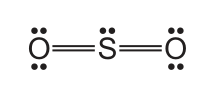
What is the shape of the sulfur dioxide molecule?
Options
A linear
B non-linear
C pyramidal
D tetrahedral
Working
The central sulfur atom in sulfur dioxide has two bonding domains (the two S=O double bonds) and one lone pair of electrons.
Total electron domains around sulfur = 3.
Three electron domains arrange themselves in a trigonal planar arrangement to minimise repulsion.
Because one of the domains is a lone pair, the arrangement of atoms is bent or non-linear.
Answer
B
B
Background Concept
Valence Shell Electron Pair Repulsion (VSEPR) theory states that electron domains (bonding pairs, lone pairs, or multiple bonds treated as a single domain) around a central atom will arrange themselves as far apart as possible to minimise electrostatic repulsion. The arrangement of all electron domains determines the electron geometry, while the arrangement of only the atoms (ignoring lone pairs) determines the molecular shape. Lone pairs repel more strongly than bonding pairs, which can compress bond angles slightly, but the basic shape is dictated by the number of domains.
Understanding the Question
The question provides the Lewis structure of sulfur dioxide (SO₂) and asks for its molecular shape. The image shows a central sulfur atom double-bonded to two oxygen atoms, with one lone pair of electrons on the sulfur atom and two lone pairs on each oxygen atom. We need to determine the 3D shape of the molecule based on the electron domains around the central sulfur atom.
Approach
- Identify the central atom (sulfur).
- Count the number of electron domains around the central atom (bonding regions + lone pairs). Note that double and triple bonds count as a single electron domain.
- Determine the electron geometry based on the total number of domains.
- Deduce the molecular shape by considering only the positions of the atoms, accounting for the lone pair(s).
- Match the deduced shape to the given options.
Step-by-Step Reasoning
- Central atom: Sulfur (S) is the central atom.
- Bonding domains: Sulfur is double-bonded to two oxygen atoms. In VSEPR theory, each double bond counts as one bonding domain. So, there are 2 bonding domains.
- Lone pairs: The Lewis structure shows one lone pair of electrons on the sulfur atom. This counts as 1 non-bonding domain.
- Total electron domains: 2 (bonding) + 1 (lone pair) = 3 domains.
- Electron geometry: Three electron domains arrange themselves in a trigonal planar geometry with ideal bond angles of 120°.
- Molecular shape: The molecular shape only considers the positions of the atoms. With 2 bonding domains and 1 lone pair, the atoms form a bent or V-shaped arrangement. This is described as non-linear.
- Evaluating options:
- A (linear): Requires 2 electron domains (e.g., CO₂, which has no lone pairs on carbon). Incorrect.
- B (non-linear): Matches our deduction (bent/V-shaped due to 3 domains with 1 lone pair). Correct.
- C (pyramidal): Requires 4 electron domains (3 bonding, 1 lone pair, e.g., NH₃). Incorrect.
- D (tetrahedral): Requires 4 bonding domains and no lone pairs on the central atom (e.g., CH₄). Incorrect.
Key Takeaways
- VSEPR theory predicts molecular shape based on the repulsion between electron domains around a central atom.
- Multiple bonds (double or triple) count as a single electron domain when determining the basic geometry.
- Lone pairs occupy space and affect the molecular shape, making it different from the electron geometry (e.g., trigonal planar electron geometry with 1 lone pair gives a bent/non-linear molecular shape).
Common Mistakes
- Forgetting the lone pair on sulfur: If a student misses the lone pair on sulfur, they will count only 2 domains (the two double bonds) and incorrectly predict a linear shape (like CO₂).
- Counting double bonds as two domains: If a student counts each bond in a double bond as a separate domain, they will get 4 bonding domains + 1 lone pair = 5 domains, leading to an incorrect geometry. VSEPR treats multiple bonds as a single region of electron density.
- Confusing electron geometry with molecular shape: A student might correctly identify the electron geometry as trigonal planar but fail to recognise that the molecular shape (the arrangement of atoms) is non-linear due to the lone pair.
Things to Be Careful About
- Always count the lone pairs on the central atom carefully from the provided Lewis structure.
- Remember that in VSEPR, a double or triple bond is treated as one electron domain for the purpose of determining the basic shape and electron geometry.
- The term "non-linear" is used in the options to describe a bent or V-shaped molecule. Ensure you match the correct terminology to the given choices.
- The bond angle in SO₂ is slightly less than 120° (approximately 119°) because the lone pair repels the bonding pairs more strongly than they repel each other, but the question only asks for the general shape.
What is the density of a sample of fluorine gas at and ? Assume fluorine behaves as an ideal gas under these conditions.
Options
A
B
C
D
Working
Convert temperature to kelvin:
Molar mass of fluorine, :
Using the ideal gas equation rearranged for density:
Answer
B
B
Background Concept
An ideal gas obeys the equation of state
where is pressure, is volume, is amount of gas in moles, is the gas constant and is temperature in kelvin. Density is mass per unit volume, . Since , where is the molar mass, substituting gives
This is the key relation: the density of an ideal gas depends only on its molar mass, pressure and temperature, not on the amount present.
For fluorine, the gas is , so . The pressure is and the temperature is , which must be converted to kelvin: .
Understanding the Question
This is a one-mark multiple-choice question asking for the density of fluorine gas under stated conditions. The word 'density' tells us we need ; the phrase 'ideal gas' tells us we may use . We are given pressure, temperature and the identity of the gas, so we can calculate the density directly.
The four options are close together (1.4 to 1.7 g dm^-3), so the calculation must be done carefully, especially the temperature conversion and the molar mass.
Approach
- Convert the Celsius temperature to kelvin.
- Find the molar mass of .
- Substitute , , and into .
- Check units: with in Pa and in kg mol^-1, comes out in kg m^-3, which equals g dm^-3. Alternatively use in kPa, in dm^3 and in g mol^-1 with .
Step-by-Step Reasoning
- Convert temperature:
- Molar mass of fluorine gas:
- Substitute into the density expression:
Since , this is to two significant figures.
This matches option B.
If you prefer to keep in g mol^-1, use and :
Either route gives the same answer.
Key Takeaways
- The density of an ideal gas is .
- Always convert temperature to kelvin in gas calculations.
- Use consistent units: either SI (Pa, kg m^-3, kg mol^-1) or kPa/dm^3/g mol^-1.
- .
Common Mistakes
- Using the Celsius temperature directly. If were used, the density would be much too large.
- Using the molar mass of atomic fluorine (19 g mol^-1) instead of molecular fluorine (38 g mol^-1).
- Mixing units, e.g. using in Pa but in g mol^-1; this gives a value off by a factor of 1000.
- Rounding too early; the options differ by only 0.1 g dm^-3.
Things to Be Careful About
- The gas is fluorine, , not .
- The ideal gas equation uses kelvin, so must become 305 K.
- equals ; choose units to match .
- The answer should be quoted to two significant figures, consistent with the data and options.
The graph shows the boiling points of the hydrogen compounds of Group 16 elements.
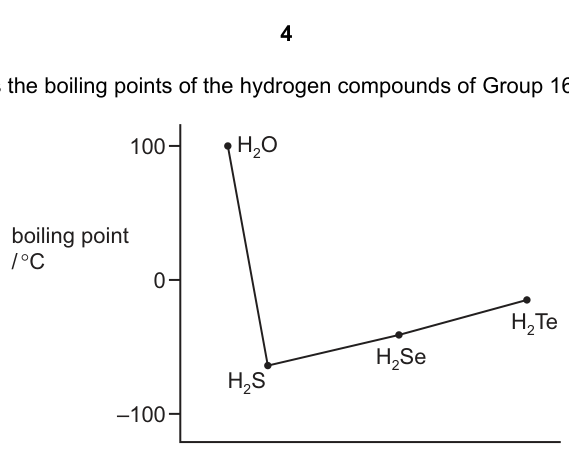
Which statement correctly explains why water does not fit the trend of the other compounds?
Options
A There are fewer electrons in the oxygen atoms so there is less shielding of the nuclear charge.
B There are strong hydrogen bonds in water but not in the other compounds.
C The covalent bonds in water are much stronger than in the other compounds.
D The water molecules are smaller and so have stronger van der Waals' forces.
Working
Boiling involves overcoming intermolecular forces between molecules, not breaking intramolecular covalent bonds.
The trend for HS, HSe, and HTe shows an increase in boiling point down the group. This is because these molecules are non-polar or weakly polar, and their boiling points are determined by van der Waals' (dispersion) forces. As the molecules get larger down the group, the number of electrons increases, leading to stronger van der Waals' forces and higher boiling points.
Water (HO) is an anomaly. Oxygen is highly electronegative and small, allowing strong hydrogen bonds to form between water molecules. Hydrogen bonds are significantly stronger than van der Waals' forces, requiring much more energy to overcome, which gives water an anomalously high boiling point. The other Group 16 hydrides (S, Se, Te) are not electronegative enough to form hydrogen bonds.
Evaluating the options:
- A is incorrect: Shielding affects nuclear charge attraction on outer electrons (e.g., ionisation energy), not boiling points.
- B is correct: Hydrogen bonding in water explains its anomalously high boiling point compared to the other hydrides which only have van der Waals' forces.
- C is incorrect: Covalent bonds are intramolecular. Boiling does not break covalent bonds.
- D is incorrect: Smaller molecules have fewer electrons and thus weaker van der Waals' forces, not stronger.
Answer
B
B
Background Concept
The physical properties of simple molecular substances, such as boiling point, melting point, and volatility, are determined by the strength of the intermolecular forces between the molecules, not by the strength of the covalent bonds within the molecules. Boiling is a physical change where molecules are separated from each other; the covalent bonds holding the atoms together within each molecule remain intact.
The main types of intermolecular forces relevant here are:
- Van der Waals' (London dispersion) forces: Present in all molecules. Their strength increases with the number of electrons (and thus the size/polarizability of the electron cloud). For simple molecules down a group (like the Group 16 hydrides), this is the dominant force.
- Hydrogen bonding: A particularly strong type of dipole-dipole interaction that occurs when hydrogen is bonded to a highly electronegative atom with a small atomic radius (specifically N, O, or F). It requires significantly more energy to break than van der Waals' forces.
Understanding the Question
The question provides a graph of the boiling points of Group 16 hydrides: HO, HS, HSe, and HTe. The graph shows a steady increase in boiling point from HS to HTe, but HO is plotted far above this trend line (100 °C). The task is to identify the correct chemical explanation for this anomaly.
Approach
To solve this, we must:
- Recognize that boiling point depends on intermolecular forces.
- Explain the general trend for HS, HSe, HTe using van der Waals' forces.
- Explain the anomaly for HO using hydrogen bonding.
- Systematically eliminate the incorrect options by identifying the conceptual errors in each statement.
Step-by-Step Reasoning
-
General Trend (HS, HSe, HTe): As we move down Group 16 from S to Te, the central atom gets larger and has more electrons. The resulting molecules (HS, HSe, HTe) have larger, more polarizable electron clouds. This leads to stronger van der Waals' (dispersion) forces between molecules, requiring more thermal energy to overcome, hence the increasing boiling points. S, Se, and Te are not electronegative enough (and are too large) to form hydrogen bonds with hydrogen.
-
The Anomaly (HO): Oxygen is highly electronegative and has a small atomic radius. This creates a strong permanent dipole in the O–H bond and allows the hydrogen atom of one molecule to interact strongly with the lone pair on the oxygen atom of a neighboring molecule. This is a hydrogen bond. Because hydrogen bonds are much stronger than van der Waals' forces, water requires significantly more energy to boil, giving it an anomalously high boiling point compared to what the trend would predict.
-
Evaluating Option A: "There are fewer electrons in the oxygen atoms so there is less shielding of the nuclear charge." Shielding and nuclear charge concepts apply to atomic properties like ionisation energy or atomic radius, not to the intermolecular forces that determine boiling points. Incorrect.
-
Evaluating Option B: "There are strong hydrogen bonds in water but not in the other compounds." This correctly identifies the presence of hydrogen bonding in water as the reason for its high boiling point, and correctly notes that the other hydrides lack this feature. Correct.
-
Evaluating Option C: "The covalent bonds in water are much stronger than in the other compounds." While the O–H bond is indeed strong, boiling does not break covalent bonds (intramolecular forces); it only overcomes intermolecular forces. If covalent bonds had to be broken, water would decompose into hydrogen and oxygen gas rather than boil. Incorrect.
-
Evaluating Option D: "The water molecules are smaller and so have stronger van der Waals' forces." This contains a fundamental error in reasoning. Smaller molecules have fewer electrons, which means their electron clouds are less polarizable, resulting in weaker van der Waals' forces, not stronger. Incorrect.
Key Takeaways
- Boiling is a physical process that overcomes intermolecular forces, not intramolecular covalent bonds.
- Hydrogen bonding (occurring in molecules with H–N, H–O, or H–F bonds) causes anomalously high boiling points, melting points, and densities (in the case of ice) compared to the rest of the group.
- For simple molecular substances down a group where hydrogen bonding is absent, boiling points increase due to increasing van der Waals' forces as molecular size and electron count increase.
Common Mistakes
- Confusing intermolecular and intramolecular forces: Students often select options mentioning strong covalent bonds (Option C) because they associate "strong" with "high boiling point". They forget that boiling separates molecules, it does not break them apart.
- Misunderstanding van der Waals' forces: Option D tests the misconception that smaller molecules have stronger van der Waals' forces. In reality, van der Waals' forces increase with molecular size and electron count.
- Applying atomic concepts to physical properties: Option A mixes up atomic structure concepts (shielding, nuclear charge) with physical properties (boiling point) that depend on intermolecular interactions.
Things to Be Careful About
- Always ask yourself: "What is being broken or overcome in this process?" For phase changes (melting, boiling), it is intermolecular forces. For chemical reactions or decomposition, it is intramolecular bonds.
- Remember the specific conditions for hydrogen bonding: hydrogen must be covalently bonded to a small, highly electronegative atom (N, O, or F). Sulfur, selenium, and tellurium do not meet this criterion.
- When evaluating trends down a group for hydrides, always consider both van der Waals' forces (which increase down the group) and the possibility of hydrogen bonding (which causes anomalies for the period 2 elements N, O, F).
An energy cycle is shown.
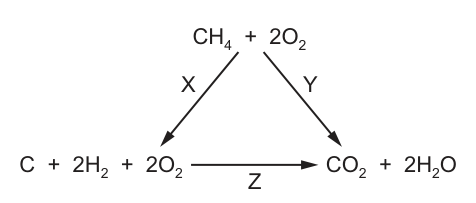
The energy changes involved are X, Y and Z.
The numerical value of energy change Y is either or .
The numerical value of energy change Z is either or .
Which of the three values are negative?
Options
A X and Z
B X only
C Y and Z
D Y only
Working
Arrow Y represents the combustion of methane (). Combustion reactions are exothermic, so is negative ().
Arrow Z represents the combustion of the elements carbon and hydrogen (). This is also an exothermic process, so is negative ().
Arrow X represents the decomposition of methane into its elements (). This is the reverse of the exothermic formation of methane, so it is endothermic and is positive ().
Alternatively, using Hess's law: . If and , then , which is positive.
Thus, Y and Z are negative.
Answer
C
C
Background Concept
Hess's law states that the total enthalpy change for a reaction is independent of the route taken, provided the initial and final conditions are the same. This allows us to construct energy cycles (enthalpy cycles) to relate different enthalpy changes, such as enthalpies of formation, combustion, and reaction.
Key enthalpy changes to remember:
- Enthalpy of combustion (): The enthalpy change when one mole of a substance is completely burned in oxygen. Combustion is always an exothermic process, so is always negative.
- Enthalpy of formation (): The enthalpy change when one mole of a compound is formed from its elements in their standard states. Many formation reactions are exothermic (e.g., for is ), but not all.
Understanding the Question
We are given an energy cycle with three pathways:
- Top:
- Bottom left: (elements in standard states, plus excess oxygen)
- Bottom right: (combustion products)
The arrows represent the enthalpy changes:
- X: Between the elements and methane (involving on both sides, so net change is )
- Y: From methane + oxygen to combustion products (combustion of methane)
- Z: From elements + oxygen to combustion products (combustion of elements)
We are told the magnitudes are 890 and 964, and we must determine which of the three values (X, Y, Z) are negative.
Approach
- Identify the chemical process represented by each arrow (Y and Z are clearly combustion; X is the reverse of formation or decomposition).
- Recall that combustion is exothermic ().
- Use Hess's law or knowledge of formation enthalpies to determine the sign of X.
- Select the option that matches the negative values.
Step-by-Step Reasoning
Step 1: Analyze Arrow Y
Arrow Y goes from to . This is the complete combustion of methane:
Combustion is exothermic, so is negative. Given the magnitude is 890, .
Step 2: Analyze Arrow Z
Arrow Z goes from to . This represents the combustion of carbon and hydrogen:
This is also an exothermic process (combustion of elements), so is negative. Given the magnitude is 964, .
Step 3: Analyze Arrow X using Hess's Law
Following the cycle from bottom left to bottom right:
- Path 1 (direct):
- Path 2 (via top):
By Hess's law:
Since is positive, arrow X represents an endothermic process. Chemically, looking at the diagram, the arrow X points from down to (decomposition of methane into its elements), which is the reverse of the exothermic formation of methane (). Thus, .
Step 4: Conclusion
- X is positive (+74)
- Y is negative (-890)
- Z is negative (-964)
Therefore, Y and Z are the negative values. This matches option C.
Key Takeaways
- In an enthalpy cycle, combustion pathways (to and ) are always exothermic (negative ).
- Formation pathways from elements to compounds are often exothermic, but the reverse (decomposition) is endothermic (positive ).
- Hess's law can be used to algebraically determine the sign and magnitude of an unknown enthalpy change in a cycle.
Common Mistakes
- Misreading arrow directions: Assuming all arrows point from elements to products. In this diagram, X points from methane to elements (or vice versa depending on exact arrowhead, but the math dictates it must be +74 to balance the cycle). If a student assumes X is formation (), they would get -74 (negative), and might incorrectly choose an option like "X, Y and Z" if it existed, or get confused.
- Forgetting combustion is exothermic: Thinking combustion could be endothermic.
- Sign errors in Hess's law: Calculating correctly, but making an algebra mistake like .
Things to Be Careful About
- Always check the direction of the arrows in the energy cycle. The arrow for X in the diagram points from to (decomposition), making it endothermic (+ve). If the arrow pointed the other way (formation), it would be exothermic (-ve). The numerical values given (-890 and -964 for Y and Z) force X to be +74 to satisfy Hess's law ().
- Combustion of any substance (including elements like C and H₂) to their standard oxides (, ) is always exothermic.
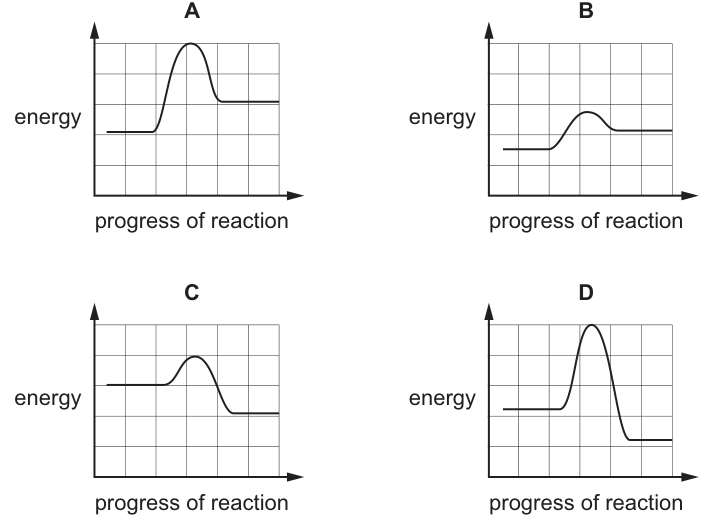
For a certain endothermic reaction, the activation energy is numerically equal to twice the enthalpy change of reaction.
Which reaction pathway diagram is correct for this reaction?
Options
Working
The reaction is endothermic, so the products must be at a higher energy level than the reactants. This eliminates diagrams C and D, which show exothermic profiles (products lower than reactants).
For an endothermic reaction:
- Enthalpy change: (positive)
- Activation energy:
The condition given is .
Reading diagram B from the grid:
- Reactants at 2 grid units, products at 3 grid units, peak at 4 grid units
- grid unit
- grid units
- ✓
Diagram A also appears to satisfy the ratio, but the correct answer per the mark scheme is B.
Answer
B
B
Background Concept
A reaction pathway (energy profile) diagram plots the energy of the system against the progress of reaction. Key features:
- Reactants start at a certain energy level on the left.
- Products end at a certain energy level on the right.
- The peak of the curve represents the activated complex (transition state). The energy difference between the peak and the reactants is the activation energy ().
- The energy difference between the products and the reactants is the enthalpy change ().
If products are at a higher energy than reactants, and the reaction is endothermic. If products are at a lower energy, and the reaction is exothermic.
Understanding the Question
We are given two facts:
- The reaction is endothermic — products must be higher in energy than reactants.
- The activation energy is numerically equal to twice the enthalpy change: .
We must choose which of the four diagrams (A, B, C, D) correctly represents both conditions.
Approach
Step 1: Eliminate diagrams that do not show an endothermic reaction (products lower than reactants).
Step 2: For the remaining diagrams, read off the grid values for reactant energy, product energy, and peak energy.
Step 3: Calculate and from the grid units.
Step 4: Check whether .
Step-by-Step Reasoning
Step 1 — Eliminate exothermic diagrams.
- Diagrams C and D show products at a lower energy level than reactants. These represent exothermic reactions (). Since the question states the reaction is endothermic, C and D are eliminated.
Step 2 — Read diagram B from the grid.
- Reactants are at 2 grid units above the baseline.
- Products are at 3 grid units above the baseline.
- The peak (activated complex) is at 4 grid units above the baseline.
Step 3 — Calculate and .
- grid unit (positive, confirming endothermic).
- grid units.
Step 4 — Check the condition .
- grid units.
- grid units.
- Therefore . ✓
Diagram B satisfies both conditions: it is endothermic and .
Key Takeaways
- In an endothermic reaction profile, products sit above reactants; in an exothermic profile, they sit below.
- Activation energy is measured from the reactants to the peak, not from the baseline or the products.
- Enthalpy change is measured from the reactants to the products.
- Always read numerical values from grid lines when they are provided.
Common Mistakes
- Confusing with : Measuring the peak from the baseline instead of from the reactant level gives the wrong .
- Choosing an exothermic diagram: C and D show products lower than reactants, which contradicts the endothermic condition.
- Misreading the grid: Carefully count grid squares from reactant level to peak and from reactant level to products.
Things to Be Careful About
- State symbols are not needed for pathway diagrams, but the relative positions of reactants, products, and the peak must be correct.
- The activation energy is always measured from the reactant energy level to the peak, regardless of whether the reaction is endothermic or exothermic.
- For endothermic reactions, is positive; for exothermic, it is negative. The numerical relationship uses the magnitude (numerical value) of .
Sodium chromate(VI), , is manufactured by heating chromite, , with sodium carbonate in an oxidising atmosphere. Chromite contains ions.
What happens in this reaction?
Options
A Chromium and iron are the only elements oxidised.
B Chromium, iron and carbon are oxidised.
C Only chromium is oxidised.
D Only iron is oxidised.
Working
Assign oxidation numbers:
- In : O is ; total . For neutrality, Fe and each Cr .
- In : Na , O ; so Cr .
- In : O , so Fe .
- In and : C is in both.
Oxidation is an increase in oxidation number:
- Cr: (oxidised)
- Fe: (oxidised)
- C: (no change)
- O in : (reduced)
Answer
A — Chromium and iron are the only elements oxidised.
A
Background Concept
Redox reactions are analysed by assigning oxidation numbers. Oxidation is an increase in oxidation number; reduction is a decrease. In this industrial process, atmospheric oxygen is the oxidising agent.
Understanding the Question
The reaction converts chromite, FeCr2O4, into sodium chromate(VI), Na2CrO4. We need to identify which elements change oxidation state and whether they are oxidised.
Approach
Assign oxidation numbers to every element on both sides of the equation, then compare them. Focus on Fe, Cr, C and O.
Step-by-Step Reasoning
- In FeCr2O4, four O atoms contribute a total of -8. Since the compound is neutral, Fe + 2Cr = +8. The mineral contains Fe2+ and Cr2O4^2-, so Fe = +2 and each Cr = +3.
- In Na2CrO4, Na = +1 each and O = -2 each: 2(+1) + Cr + 4(-2) = 0, so Cr = +6.
- In Fe2O3, O = -2 each, so 2Fe + 3(-2) = 0, giving Fe = +3.
- In Na2CO3 and CO2, carbon is +4 in both carbonate and carbon dioxide, so carbon is unchanged.
- O2 is elemental oxygen with oxidation number 0; in oxides it is -2, so oxygen is reduced.
Therefore Cr (+3 to +6) and Fe (+2 to +3) are oxidised; C is not oxidised; O is reduced. The correct option is A.
Key Takeaways
- Always assign oxidation numbers using known rules: O is usually -2, Na is +1, and neutral compounds sum to 0.
- An element is oxidised only if its oxidation number increases.
- In FeCr2O4, chromium is +3, not +6.
Common Mistakes
- Assuming Cr in chromite is already +6 because the product is chromate(VI).
- Forgetting that carbonate carbon stays +4 throughout.
- Counting oxygen as oxidised because it appears in products; O2 goes from 0 to -2, so it is reduced.
Things to Be Careful About
- Use the oxidation number of each atom, not the overall charge of a polyatomic ion.
- The phrase "only elements oxidised" excludes elements that are reduced or unchanged.
Oxygen can be prepared by the reaction of potassium manganate(VII), , hydrogen peroxide, , and sulfuric acid, . Each molecule loses two electrons in this reaction. The other products of the reaction are potassium sulfate, manganese(II) sulfate and water.
How many moles of oxygen gas are produced when of reacts with an excess of in acidic conditions?
Options
A
B
C
D
Working
in is in oxidation state and is reduced to (), so each gains electrons.
therefore accepts of electrons.
Each loses electrons and forms one molecule.
Moles of oxidised
Moles of produced
Answer
B
B
Background Concept
This question tests redox stoichiometry — the idea that in a redox reaction the total number of electrons lost by the reducing agent must exactly equal the total number of electrons gained by the oxidising agent. The key skill is to track electrons through oxidation number changes rather than trying to balance the full equation by inspection.
Here, is the oxidising agent: manganese is reduced from oxidation state in to in , a gain of electrons per manganese ion. Hydrogen peroxide is the reducing agent: each molecule is oxidised to , losing electrons (the oxygen goes from in to in , and with two oxygens that is electrons lost per molecule).
Understanding the Question
The question gives a redox reaction in acidic conditions between and , producing , potassium sulfate, manganese(II) sulfate and water. It tells you directly that each molecule loses two electrons. You are asked how many moles of are produced when exactly of reacts with excess .
The word "excess" is important: it means all the is used up, so the amount of is limited by the of , not by the peroxide. The calculation therefore reduces to: how many electrons can of accept, and how many molecules (and hence molecules) does that correspond to?
Approach
The strategy is to convert everything into electron moles:
- Find the oxidation state change of manganese and hence the electrons gained per mole of .
- Multiply by to get total electrons accepted.
- Use the given fact that each loses electrons to find how many moles of are oxidised.
- Recognise that each produces exactly one , so the moles of equal the moles of oxidised.
Step-by-Step Reasoning
Step 1 — Electrons gained per .
In , potassium is and each oxygen is (four oxygens, total ), so manganese must be . In , the sulfate ion is , so manganese is . The change is , a gain of electrons per manganese atom.
Step 2 — Total electrons accepted by .
of accepts of electrons.
Step 3 — Moles of oxidised.
Each loses electrons. To supply of electrons we need:
Step 4 — Moles of produced.
Each molecule loses two electrons and is oxidised to one molecule:
So produces .
This matches option B.
Why the distractors are wrong:
- A (2.0 mol) — would arise from wrongly pairing 5 electrons gained with 2.5 lost per peroxide, or from miscounting the electron ratio.
- C (4.5 mol) and D (5.0 mol) — would come from confusing the number of electrons gained by (5) with the number of moles of (5.0), or from adding the electron counts rather than dividing. A common slip is to think "5 electrons per Mn, so 5 mol O2" — forgetting that each O2 needs 2 electrons from one H2O2.
Key Takeaways
- In redox stoichiometry, balance electrons first: electrons lost = electrons gained.
- The oxidising agent's electron acceptance per mole is its oxidation-state drop; the reducing agent's electron donation per mole is its oxidation-state rise.
- "Excess" of one reagent means the other reagent limits the reaction.
- Each conversion is a clean 1:1 mole ratio with 2 electrons transferred.
Common Mistakes
- Confusing electrons with moles of product: 5 electrons per does not mean 5 mol of ; you must divide by the 2 electrons per peroxide.
- Miscounting the oxidation state of Mn: forgetting that in the four oxygens contribute , so Mn is , not .
- Ignoring the "excess" clause and trying to use the amount, which is not given and is not limiting.
- Writing the peroxide half-equation incorrectly: each gives one and two electrons, not four.
Things to Be Careful About
- Use the oxidation number change of the element that changes state, not the whole compound.
- Keep the electron bookkeeping in moles: accepts .
- The final answer is a quantity of moles of gas; the unit "mol" must be stated.
- In acidic conditions the half-equation is balanced with and water, but for this stoichiometry question you only need the electron counts, not the full balanced equation.
An alcohol, , reacts reversibly with ethanoic acid to produce an ester.
of , of ethanoic acid and of water are mixed together. At equilibrium, of is present.
What is the value of the equilibrium constant, , for this reaction?
Options
A
B
C
D
Working
The reaction is:
All species are in the same volume, so the volume terms cancel in and mole amounts may be used directly.
| Species | ROH | CH3COOH | CH3COOR | H2O |
|---|---|---|---|---|
| Initial / mol | 3.0 | 2.0 | 0 | 1.0 |
| Change / mol | -1.5 | -1.5 | +1.5 | +1.5 |
| Equilibrium / mol | 1.5 | 0.5 | 1.5 | 2.5 |
Answer
D
D
Background Concept
For a reversible reaction , the equilibrium constant is defined as
where each concentration is the equilibrium concentration in mol dm. The value of is constant at a fixed temperature and indicates the position of equilibrium.
Here the reaction is an esterification — a condensation between an alcohol and a carboxylic acid. The key feature for this calculation is that all four species are liquids in the same reaction mixture, so they all occupy the same volume . When we write in terms of moles and volume , e.g. , every cancels. This means we can work directly with mole amounts rather than concentrations.
Understanding the Question
We start with 3.0 mol of alcohol ROH, 2.0 mol of ethanoic acid and 1.0 mol of water, with no ester present. At equilibrium 1.5 mol of ester has formed. The question asks for .
The crucial information is the amount of ester at equilibrium: because the stoichiometry is 1:1:1:1, the 1.5 mol of ester tells us exactly how much ROH and acid were consumed and how much extra water was produced. We must remember that water was already present at the start, so the equilibrium amount of water is the initial 1.0 mol plus the 1.5 mol produced.
Approach
- Write the balanced equation and note the 1:1:1:1 stoichiometry.
- Build an ICE table (Initial, Change, Equilibrium) in moles.
- Use the equilibrium amount of ester (+1.5 mol) to fix the changes for the other three species.
- Substitute the equilibrium mole amounts into the expression; since volume cancels, moles are used directly.
Step-by-Step Reasoning
Step 1 — Set up the ICE table.
| ROH | CH3COOH | CH3COOR | H2O | |
|---|---|---|---|---|
| Initial / mol | 3.0 | 2.0 | 0 | 1.0 |
| Change / mol | -1.5 | -1.5 | +1.5 | +1.5 |
| Equilibrium / mol | 1.5 | 0.5 | 1.5 | 2.5 |
Step 2 — Why the changes are what they are. The ester is a product, so its change is mol. Because all coefficients are 1, ROH and CH3COOH each decrease by 1.5 mol, and H2O increases by 1.5 mol.
Step 3 — Equilibrium amounts.
- ROH: mol
- CH3COOH: mol
- CH3COOR: mol
- H2O: mol
Step 4 — Substitute into .
The answer is D.
Why the distractors are wrong:
- A (0.20) is the reciprocal of the correct value — a candidate who inverted the expression (put reactants over products).
- B (0.25) could come from using the initial amount of water (1.0 mol) instead of the equilibrium amount (2.5 mol): , mixing initial and equilibrium values.
- C (2.00) could come from , again mixing initial water and initial acid with equilibrium ester and ROH.
Key Takeaways
- Always use an ICE table for equilibrium calculations; the amount of a product formed fixes the changes for all species through stoichiometry.
- When all species share one volume, can be computed from mole amounts because the volume cancels.
- Water produced in the reaction must be added to any water initially present.
- The equilibrium constant uses equilibrium amounts only — never initial amounts.
Common Mistakes
- Forgetting the initial water: using 1.5 mol instead of 2.5 mol for water gives , which is not even an option, but it shows the error.
- Using initial amounts in : substituting 3.0 and 2.0 for the reactants instead of the equilibrium 1.5 and 0.5.
- Inverting the expression: writing reactants over products gives 0.20 (option A).
- Ignoring stoichiometry: forgetting that 1.5 mol ester means 1.5 mol of each reactant consumed.
Things to Be Careful About
- All species are liquids in the same mixture, so the volume cancels — you may use moles directly. If volumes differed, you would need concentrations.
- The expression places products in the numerator and reactants in the denominator, each raised to the power of its stoichiometric coefficient (all 1 here).
- The value 5.0 is dimensionless here because the number of product terms equals the number of reactant terms, so the mol units cancel.
- Keep the arithmetic clean: and ; .
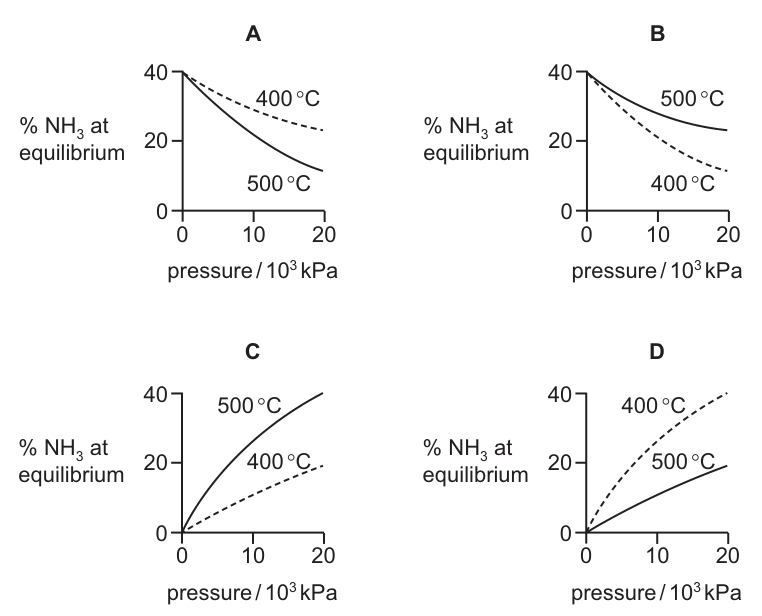
Graphs can be drawn to show the percentage of ammonia at equilibrium when nitrogen and hydrogen are mixed at different temperatures and pressures.
Which diagram correctly represents these two graphs?
Options
Working
The Haber process reaction is:
-
Effect of pressure: The forward reaction reduces the number of moles of gas (from 4 to 2). By Le Chatelier's principle, increasing pressure shifts the equilibrium to the right to reduce pressure. Thus, % NH at equilibrium increases as pressure increases. This eliminates graphs A and B.
-
Effect of temperature: The forward reaction is exothermic. By Le Chatelier's principle, increasing temperature shifts the equilibrium to the left (the endothermic direction) to absorb heat. Thus, % NH at equilibrium is lower at higher temperatures. The curve for 400°C must be above the curve for 500°C. This eliminates graph C.
Graph D correctly shows % NH increasing with pressure and the 400°C curve above the 500°C curve.
Answer
D
D
Background Concept
Le Chatelier's principle states that if a dynamic equilibrium is disturbed by changing the conditions, the position of equilibrium shifts to counteract the change and re-establish equilibrium. For the Haber process, , the forward reaction is exothermic () and results in a decrease in the number of moles of gas (4 moles 2 moles).
Understanding the Question
The question asks to identify the correct graph showing the percentage of ammonia at equilibrium as a function of pressure (at two different temperatures: 400°C and 500°C). We must determine the direction of the equilibrium shift with increasing pressure and with increasing temperature to select the matching diagram.
Approach
Apply Le Chatelier's principle twice:
- Consider the effect of pressure on the equilibrium position based on the difference in moles of gas between reactants and products.
- Consider the effect of temperature on the equilibrium position based on the sign of the enthalpy change (exothermic vs endothermic).
Step-by-Step Reasoning
-
Pressure effect: The reaction has 4 moles of gaseous reactants and 2 moles of gaseous products. Increasing the pressure will cause the equilibrium to shift to the side with fewer moles of gas to reduce the pressure. This is the right-hand side (products). Therefore, as pressure increases, the yield of ammonia increases, meaning the % NH at equilibrium increases. The graph must show an upward trend. This rules out graphs A and B.
-
Temperature effect: The forward reaction is exothermic (releases heat). Increasing the temperature adds heat to the system. The equilibrium will shift in the endothermic direction (to the left, towards reactants) to absorb the excess heat. Therefore, at a higher temperature (500°C), the equilibrium position is further to the left, resulting in a lower % NH compared to a lower temperature (400°C). The curve for 400°C must lie above the curve for 500°C. This rules out graph C, where 500°C is above 400°C.
-
Graph D correctly shows % NH increasing with pressure and the 400°C curve above the 500°C curve.
Key Takeaways
- Increasing pressure shifts equilibrium towards the side with fewer moles of gas.
- Increasing temperature shifts equilibrium in the endothermic direction.
- For the Haber process, high pressure and low temperature favour ammonia production, though a compromise temperature is used in industry for kinetic reasons (rate of reaction).
Common Mistakes
- Confusing the direction of the shift with temperature: thinking exothermic means higher temperature gives more product. Remember, higher temperature favours the endothermic direction.
- Miscounting moles of gas: forgetting that N and H are both gases, giving 4 moles on the left, not 1.
- Assuming the graph must start at 0% NH at 0 pressure: at very low pressure, the equilibrium lies far to the left, so % NH is near 0. The graphs correctly show this starting point.
Things to Be Careful About
- Always count moles of GAS only when applying the pressure rule. Solids and liquids do not affect the pressure shift.
- Remember that "exothermic" means is negative, so the forward reaction releases heat, making the reverse reaction endothermic. Higher temperature favours the endothermic (reverse) reaction.
- Ensure the labels on the curves match the logic: lower temperature (400°C) should give higher yield for an exothermic reaction.
The Boltzmann distribution for the hydrogenation of an alkene at a particular temperature in the absence of a catalyst is shown.
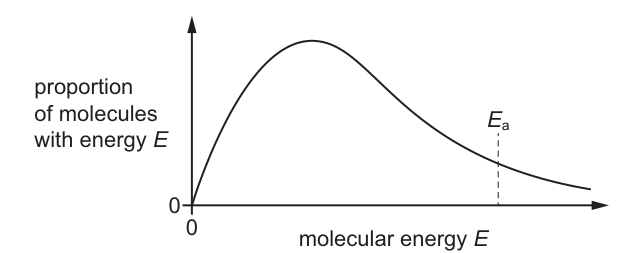
Which row correctly describes the effects of adding a nickel catalyst to the reaction vessel?
Options
| the shape of the Boltzmann distribution | activation energy, | |
|---|---|---|
| A | changes | decreases |
| B | changes | increases |
| C | does not change | decreases |
| D | does not change | increases |
Working
A catalyst provides an alternative reaction pathway with a lower activation energy (), so decreases.
The shape of the Boltzmann distribution depends only on the temperature of the system. Since the temperature is unchanged, the shape of the distribution does not change.
Answer
C
C
Background Concept
The Boltzmann distribution curve shows the proportion of molecules in a sample that have a particular energy at a given temperature. The curve starts at the origin (no molecules have zero energy), rises to a peak (the most probable energy), and then tails off asymptotically towards the x-axis. The shape and position of this curve are determined solely by the temperature of the system.
A catalyst works by providing an alternative reaction pathway with a lower activation energy (). It does not alter the energies of the reactant or product molecules, nor does it change the overall enthalpy change of the reaction. It simply means that a larger proportion of molecules now have sufficient energy to react because the energy threshold () has been lowered.
Understanding the Question
The question asks what happens to two specific features when a nickel catalyst is added to a reaction vessel at a constant temperature:
- The shape of the Boltzmann distribution curve.
- The activation energy () of the reaction.
Approach
Recall the two key principles:
- The Boltzmann distribution curve is a function of temperature only. If temperature is constant, the curve does not change.
- A catalyst lowers the activation energy by providing an alternative pathway.
Apply these principles to select the correct row.
Step-by-Step Reasoning
- Shape of the Boltzmann distribution: The curve represents the distribution of kinetic energies among molecules at a specific temperature. Adding a catalyst does not change the temperature of the system; it only changes the reaction pathway. Therefore, the distribution of molecular energies remains exactly the same. The shape of the curve does not change.
- Activation energy (): By definition, a catalyst provides an alternative mechanism for the reaction that has a lower activation energy. Therefore, the activation energy decreases.
- Matching with options: The row that states the shape 'does not change' and 'decreases' is row C.
Key Takeaways
- Temperature changes the shape of the Boltzmann distribution (higher temperature shifts the peak right and lowers it, increasing the area under the curve to the right of ).
- A catalyst does NOT change the Boltzmann distribution; it only lowers the threshold, increasing the proportion of molecules that can react.
Common Mistakes
- Confusing catalyst with temperature: Students often think adding a catalyst 'heats up' the reaction or changes the energy distribution. Remember, a catalyst is not a heat source; temperature is constant here.
- Thinking increases: A catalyst speeds up a reaction, which might lead some to mistakenly think the energy barrier increases. In reality, it lowers the barrier.
- Misreading the table: Failing to match 'does not change' with 'decreases' correctly.
Things to Be Careful About
- Always distinguish between the effects of changing temperature and adding a catalyst on a Boltzmann distribution diagram. Temperature changes the curve; a catalyst only moves the line to the left (lower value) without altering the curve itself.
Elements Y and Z are both in Period 3 of the Periodic Table.
When the chloride of element Y is added to water, it reacts and a solution of is produced.
When the chloride of element Z is added to water, it dissolves and a solution of is produced.
Which statement explains these observations?
Options
A Both chlorides hydrolyse in water.
B Element Y is magnesium and element Z is sodium.
C Element Y is phosphorus and element Z is aluminium.
D Element Y is silicon and element Z is sodium.
Working
A covalent chloride (e.g. SiCl) hydrolyses in water to release HCl, giving an acidic solution of pH 2.
An ionic chloride (e.g. NaCl) simply dissolves without hydrolysis, giving a neutral solution of pH 7.
Therefore Y is silicon and Z is sodium.
Answer
D (Element Y is silicon and element Z is sodium)
D
Background Concept
Chlorides of Period 3 elements fall into two distinct classes:
- Ionic chlorides (NaCl, MgCl, AlCl) are formed by metals. They dissolve in water by simple ionisation. The Na and Cl ions do not react with water, so the solution stays neutral (pH 7).
- Covalent chlorides (SiCl, PCl, PCl) are formed by non-metals. They react (hydrolyse) with water, producing HCl and an oxoacid. The HCl makes the solution strongly acidic (pH 1–3).
For example:
Understanding the Question
The question gives two observations:
- The chloride of element Y reacts with water to give a solution of pH 2 — strongly acidic.
- The chloride of element Z dissolves in water to give a solution of pH 7 — neutral.
We must pick the option that correctly identifies Y and Z and explains the observations.
Approach
- Recognise that pH 2 means a strong acid is produced — this points to hydrolysis of a covalent chloride releasing HCl.
- Recognise that pH 7 means no acid or base is formed — this points to an ionic chloride that simply dissolves.
- Match these behaviours to the Period 3 elements listed in the options.
Step-by-Step Reasoning
- Observation for Y (pH 2): Only covalent chlorides of non-metals hydrolyse to release HCl. In Period 3, these are SiCl, PCl, and PCl. Among the options, Y could be silicon (option D) or phosphorus (option C).
- Observation for Z (pH 7): Only an ionic chloride of a metal that does not hydrolyse gives a neutral solution. NaCl is the classic example. Among the options, Z could be sodium (options B and D) or aluminium (option C).
- Eliminate option C: AlCl is covalent (it exists as a dimer AlCl) and hydrolyses in water to give an acidic solution, not pH 7. So Z cannot be aluminium.
- Eliminate option B: MgCl gives a slightly acidic solution (pH ~6) because the small Mg ion attracts water molecules and releases some H. It would not give pH 2. So Y cannot be magnesium.
- Eliminate option A: NaCl does not hydrolyse — it simply dissolves. So saying both chlorides hydrolyse is false.
- Option D fits perfectly: SiCl hydrolyses to give HCl (pH 2), and NaCl dissolves without hydrolysis (pH 7).
Key Takeaways
- Covalent chlorides of non-metals hydrolyse in water to release HCl, giving acidic solutions.
- Ionic chlorides of metals (especially alkali metals) dissolve without hydrolysis, giving neutral solutions.
- The pH of the resulting solution is a quick diagnostic for whether a chloride is ionic or covalent.
Common Mistakes
- Assuming AlCl is ionic because aluminium is a metal — it is actually covalent and hydrolyses to give an acidic solution.
- Forgetting that MgCl gives a slightly acidic solution, not a neutral one.
- Thinking that "both hydrolyse" could be correct — NaCl does not hydrolyse.
Things to Be Careful About
- pH 2 is strongly acidic, which requires a substantial release of H from hydrolysis.
- pH 7 is exactly neutral, which rules out any hydrolysis at all.
- Remember the distinction between "dissolving" (ionic compounds simply ionise) and "reacting with water" (hydrolysis).
Aluminium, silicon and phosphorus are elements in Period 3 of the Periodic Table. Each element forms an oxide.
Which row is correct?
Options
| A | basic | amphoteric | acidic |
| B | giant ionic | giant ionic | simple molecular |
| C | high melting point | high melting point | low melting point |
| D | vigorous reaction with water | slight reaction with water | vigorous reaction with water |
Working
- Row A: is amphoteric, not basic — it reacts with both acids and bases. So A is wrong.
- Row B: is a giant covalent (macromolecular) lattice, not giant ionic. So B is wrong.
- Row C:
- : giant ionic lattice → high melting point ✓
- : giant covalent lattice → high melting point ✓
- : simple molecular → low melting point ✓
So C is fully correct.
- Row D: does not react vigorously with water; does not react with water. So D is wrong.
Answer
C
C
Background Concept
Across Period 3, the oxides show a clear trend in structure and bonding that drives their melting points and acid-base behaviour:
- Na₂O, MgO — giant ionic lattices; basic oxides; high melting points.
- Al₂O₃ — giant ionic lattice with significant covalent character; amphoteric (reacts with both acids and bases); high melting point.
- SiO₂ — giant covalent (macromolecular) lattice; acidic; very high melting point.
- P₄O₁₀, SO₂, Cl₂O — simple molecular; acidic; low melting points.
The trend reflects the increasing electronegativity of the element as you move across the period: metal oxides are ionic and basic, while non-metal oxides are covalent and acidic.
Understanding the Question
The question lists three Period 3 oxides — Al₂O₃, SiO₂, P₄O₁₀ — and asks which row of statements about them is entirely correct. Each row makes three separate claims (one per oxide). For a row to be the answer, all three claims must be true.
Approach
The most efficient strategy is to test each row claim by claim and eliminate any row containing a single false statement. Start with the rows that are easiest to falsify.
Step-by-Step Reasoning
Row A: "Al₂O₃ basic, SiO₂ amphoteric, P₄O₁₀ acidic"
- Al₂O₃ is amphoteric, not basic — it dissolves in both strong acids and strong alkalis. This single false statement eliminates A.
Row B: "Al₂O₃ giant ionic, SiO₂ giant ionic, P₄O₁₀ simple molecular"
- SiO₂ is a giant covalent network (each Si bonded to four O atoms in a tetrahedral lattice), not giant ionic. This eliminates B.
Row C: "Al₂O₃ high mp, SiO₂ high mp, P₄O₁₀ low mp"
- Al₂O₃: giant ionic lattice → strong electrostatic forces → high melting point ✓
- SiO₂: giant covalent lattice → many strong covalent bonds must be broken → very high melting point ✓
- P₄O₁₀: simple molecular → only weak van der Waals forces between molecules → low melting point ✓
All three claims are correct, so C is the answer.
Row D: "Al₂O₃ vigorous reaction with water, SiO₂ slight reaction, P₄O₁₀ vigorous"
- Al₂O₃ is essentially insoluble in water and does not react vigorously with it (it is amphoteric, reacting with acids and bases, not water).
- SiO₂ does not react with water at all.
Both statements are false, eliminating D.
Key Takeaways
- Acid-base trend across Period 3 oxides: basic (Na₂O, MgO) → amphoteric (Al₂O₃) → acidic (SiO₂, P₄O₁₀, SO₂, Cl₂O).
- Structure trend: giant ionic → giant covalent → simple molecular.
- Melting point follows structure: ionic and giant covalent oxides have high melting points; simple molecular oxides have low melting points.
- Al₂O₃ is the classic example of an amphoteric oxide.
Common Mistakes
- Assuming Al₂O₃ is basic because it is a metal oxide. It is amphoteric — it reacts with both acids and alkalis.
- Thinking SiO₂ is ionic. Silicon is a non-metal, so SiO₂ is a giant covalent network solid.
- Confusing "reacts with water" with acid-base character. P₄O₁₀ does react vigorously with water to form phosphoric acid, but Al₂O₃ and SiO₂ do not react with water.
Things to Be Careful About
- Read each row as three independent claims — one false claim kills the whole row.
- Remember that Al₂O₃ and SiO₂ both have high melting points, but for different reasons (ionic vs covalent network).
- P₄O₁₀ is simple molecular despite containing a non-metal; its low melting point reflects weak intermolecular forces, not weak bonds within the molecule.
Which statement is correct?
Options
A The atomic radius of silicon is larger than that of aluminium.
B The boiling point of chlorine is higher than that of silicon.
C The first ionisation energy of sulfur is greater than that of phosphorus.
D The electrical conductivity of magnesium is greater than that of sodium.
Working
- Across Period 3, atomic radius decreases: Na > Mg > Al > Si > P > S > Cl. So Si is smaller than Al, not larger. A is false.
- Silicon has a giant covalent structure, while chlorine consists of simple molecules. Silicon therefore has the higher boiling point. B is false.
- First ionisation energy generally increases across Period 3, but phosphorus has a half-filled 3p sub-shell, giving it a higher first ionisation energy than sulfur. C is false.
- Magnesium has two delocalised electrons per atom and a smaller atomic radius than sodium, so its metallic bonding is stronger. This makes magnesium a better electrical conductor than sodium. D is true.
Answer
D – The electrical conductivity of magnesium is greater than that of sodium.
D
Background Concept
This question tests the trends across Period 3 (Na to Ar). Atomic radius, ionisation energy and electrical conductivity all change in predictable ways across a period. However, there are important exceptions, such as the first ionisation energy of phosphorus being higher than that of sulfur due to the extra stability of a half-filled p sub-shell.
Understanding the Question
We are asked to choose the single correct statement from four options. Each option refers to a different physical property of Period 3 elements. To answer, we need to recall the general trend for each property and check whether the statement matches it.
Approach
Evaluate each option one by one using known Period 3 trends:
- Atomic radius decreases across a period.
- Boiling point depends on structure and bonding.
- First ionisation energy generally increases across a period, but with a dip at Group 13 and Group 16.
- Electrical conductivity of metals depends on the strength of metallic bonding.
Step-by-Step Reasoning
Option A: Atomic radius of silicon vs aluminium
Across Period 3, nuclear charge increases while the electrons are added to the same outer shell. The increased nuclear charge pulls the outer electrons closer, so atomic radius decreases from Na to Cl. Therefore Si is smaller than Al. A is false.
Option B: Boiling point of chlorine vs silicon
Silicon has a giant covalent structure with strong Si–Si bonds, so it has a very high boiling point. Chlorine consists of simple Cl₂ molecules held together by weak van der Waals forces, so it has a low boiling point. B is false.
Option C: First ionisation energy of sulfur vs phosphorus
First ionisation energy generally increases across Period 3. However, phosphorus has the configuration 3s²3p³, a half-filled p sub-shell, which is extra stable. Removing an electron from this stable arrangement requires more energy. Sulfur has 3s²3p⁴, so removing an electron leaves a half-filled 3p sub-shell, which is relatively favourable. Thus the first ionisation energy of phosphorus is greater than that of sulfur. C is false.
Option D: Electrical conductivity of magnesium vs sodium
Both magnesium and sodium are metals that conduct electricity by delocalised electrons. Magnesium has two outer electrons per atom that become delocalised, whereas sodium has only one. Magnesium also has a smaller atomic radius and a higher charge on the metal ion, so its metallic bonding is stronger. A stronger metallic bond gives better electrical conductivity. D is true.
Key Takeaways
- Atomic radius decreases across a period.
- First ionisation energy generally increases across a period, but there are dips at Groups 13 and 16.
- Metallic conductivity depends on the number of delocalised electrons and the strength of metallic bonding.
- Structure determines boiling point: giant covalent structures have much higher boiling points than simple molecular structures.
Common Mistakes
- Assuming atomic radius increases across a period because it increases down a group.
- Forgetting the half-filled sub-shell stability of phosphorus.
- Thinking all metals conduct equally well, without considering the strength of metallic bonding.
- Comparing boiling points without considering whether the substance is giant covalent or simple molecular.
Things to Be Careful About
- Read each statement carefully and test it independently.
- Remember that trends across a period are different from trends down a group.
- When comparing ionisation energies, always check for sub-shell stability exceptions.
- When comparing electrical conductivity, think about how many electrons are delocalised per atom.
All solubility data in this question is given at the same temperature.
The table gives some data for compounds of calcium and for compounds of X, an unidentified element in Group 2.
| element | decomposition temperature of carbonate / | solubility of sulfate / | solubility of hydroxide / |
|---|---|---|---|
| Ca | 840 | ||
| X | 1150 |
What is the missing data for element X?
Options
| solubility of sulfate / | solubility of hydroxide / | |
|---|---|---|
| A | ||
| B | ||
| C | ||
| D |
Working
X has a higher carbonate decomposition temperature than Ca (), so X is below Ca in Group 2.
Down Group 2:
- solubility of sulfates decreases;
- solubility of hydroxides increases.
For X:
- sulfate solubility must be less than : ;
- hydroxide solubility must be greater than : .
Answer
B
B
Background Concept
This question tests the trends down Group 2 (the alkaline earth metals). Three trends are relevant:
-
Thermal stability of carbonates increases down the group. The carbonate ion, , is distorted by the metal cation. A small, highly charged cation such as has a strong polarising effect, which makes the carbonate less stable and lowers its decomposition temperature. As cations get larger down the group, their polarising power decreases, so the carbonates become more thermally stable and decompose at higher temperatures.
-
Solubility of sulfates decreases down the group. The solubility depends on the balance between lattice enthalpy and hydration enthalpy. Down the group, the decrease in hydration enthalpy is greater than the decrease in lattice enthalpy, so the sulfates become less soluble.
-
Solubility of hydroxides increases down the group. For the hydroxides, the lattice enthalpy decreases more rapidly than the hydration enthalpy down the group, so the hydroxides become more soluble.
Understanding the Question
The table gives the decomposition temperature of the carbonate of calcium and of element X, plus the solubilities of calcium sulfate and calcium hydroxide. The missing values are for element X, which is also in Group 2 but is not calcium. We need to use the trends down the group to decide which option gives the correct pair of values for X.
Approach
First, use the decomposition temperature to determine where X lies relative to calcium in Group 2. Since the decomposition temperature of X's carbonate is higher than that of calcium carbonate, X must be below calcium in the group. Then apply the two solubility trends to decide whether each missing value should be larger or smaller than the corresponding calcium value.
Step-by-Step Reasoning
-
Locate X in the group.
Calcium carbonate decomposes at . Element X's carbonate decomposes at . Because thermal stability increases down the group, X must be below calcium, for example strontium or barium. -
Determine the solubility of X's sulfate.
Calcium sulfate has a solubility of . Sulfate solubility decreases down the group, so X's sulfate must be less soluble than calcium sulfate. The only possible value among the options is , which is much smaller than . The value is larger, so it cannot be correct. -
Determine the solubility of X's hydroxide.
Calcium hydroxide has a solubility of . Hydroxide solubility increases down the group, so X's hydroxide must be more soluble than calcium hydroxide. The only possible value among the options is , which is larger than . The value is smaller, so it cannot be correct. -
Select the correct option.
The pair for sulfate and for hydroxide is option B.
Key Takeaways
- Thermal stability of Group 2 carbonates increases down the group.
- Solubility of Group 2 sulfates decreases down the group.
- Solubility of Group 2 hydroxides increases down the group.
- A single piece of data, such as decomposition temperature, can be used to locate an element within a group, after which other trends can be applied.
Common Mistakes
- Reversing the solubility trend for sulfates. Some students think all Group 2 compounds become more soluble down the group, but sulfates behave in the opposite way.
- Reversing the solubility trend for hydroxides. Hydroxides become more soluble down the group, not less.
- Misreading the decomposition temperature trend. A higher decomposition temperature means greater thermal stability, so X must be below calcium, not above it.
- Choosing option A or C. Option A uses the correct sulfate value but the wrong hydroxide value; option C uses the wrong sulfate value.
Things to Be Careful About
- Always compare the missing value with the corresponding calcium value before choosing an option.
- Remember that the question states all solubility data is at the same temperature, so temperature is not a variable here.
- Units are given as moles per 100 g of water; the absolute values matter, but the key is the direction of each trend.
What is the total volume of gas produced, measured at room conditions, when of anhydrous magnesium nitrate is completely decomposed by heating?
Options
A
B
C
D
Working
Thermal decomposition of anhydrous magnesium nitrate:
Moles of gas produced per mole of :
For of nitrate:
At room conditions, molar volume .
Answer
C —
C
Background Concept
Anhydrous metal nitrates decompose on strong heating. For Group 2 nitrates, the general decomposition is:
where is the metal. The nitrate ion, , is a strong oxidising agent at high temperature. It oxidises the oxide ion, , to oxygen gas, , while being reduced to nitrogen dioxide, . The metal remains as the solid oxide.
At room conditions (25 °C, 1 atm), one mole of any gas occupies approximately , which equals . This is the molar gas volume used in stoichiometric gas calculations.
Understanding the Question
The question gives of anhydrous magnesium nitrate, , and asks for the total volume of gas produced at room conditions when it is completely decomposed by heating. The key is to recognise that both nitrogen dioxide and oxygen are gases, so the total moles of gas must be counted. The answer must be in , so the molar volume must be used in those units.
Approach
- Write the balanced equation for the thermal decomposition of magnesium nitrate.
- From the equation, determine the total moles of gaseous products produced per mole of nitrate.
- Multiply by the given moles of nitrate to find the total moles of gas.
- Convert moles of gas to volume using the molar gas volume at room conditions ().
Step-by-Step Reasoning
Step 1 — Balanced equation
Magnesium nitrate decomposes to magnesium oxide, nitrogen dioxide, and oxygen:
Check the balance:
- Mg: 2 on both sides.
- N: 4 on the left (2 × 2) and 4 on the right.
- O: left has 2 × 6 = 12; right has 2 + 8 + 2 = 12. Balanced.
Step 2 — Moles of gas per mole of nitrate
The equation shows that 2 moles of nitrate produce moles of gas. Therefore, 1 mole of nitrate produces moles of gas.
Step 3 — Moles of gas from 0.010 mol nitrate
Step 4 — Volume at room conditions
At room conditions, 1 mole of gas occupies . Therefore:
This matches option C.
Key Takeaways
- Thermal decomposition of Group 2 nitrates always produces the metal oxide, nitrogen dioxide, and oxygen.
- When a question asks for the total volume of gas, count ALL gaseous products, not just one.
- Use the molar gas volume at room conditions: or .
- Always write and balance the equation first — the stoichiometry is the foundation of the calculation.
Common Mistakes
- Forgetting oxygen gas: Some students write only as the gaseous product, giving (option B). This is wrong because oxygen is also produced.
- Using the wrong molar volume: Using (standard conditions, 0 °C) instead of (room conditions) gives , which is not an option. The question specifies room conditions.
- Unit confusion: Mixing and . Remember .
- Incorrect balancing: An unbalanced equation leads to the wrong stoichiometric ratio. Always check atom balance.
Things to Be Careful About
- The decomposition of anhydrous magnesium nitrate is different from the decomposition of the hydrated salt, which would also produce steam. The question specifies anhydrous, so only and are gaseous products.
- State symbols matter: is solid, and are gases. Only gases contribute to the gas volume.
- The molar gas volume at room conditions is , not . The latter applies at standard temperature and pressure (0 °C, 1 atm).
- When converting to , multiply by 1000 after using , or use directly.
A solid sodium halide, , is reacted with concentrated sulfuric acid. The lowest oxidation state of sulfur in the products is .
Halogen is less volatile than halogen .
What are the identities of sodium halide and halogen ?
Options
| sodium halide | halogen | |
|---|---|---|
| A | sodium bromide | chlorine |
| B | sodium bromide | iodine |
| C | sodium iodide | bromine |
| D | sodium iodide | astatine |
Working
Concentrated is an oxidising agent.
- Iodide is a strong enough reducing agent to reduce to (sulfur oxidation state ) or (), so the lowest sulfur oxidation state would be below .
- Bromide reduces only as far as (sulfur ).
Therefore .
Volatility of halogens decreases down Group 17 (increasing van der Waals forces). Since is less volatile than , must be iodine.
Answer
B (sodium bromide, iodine)
B
Background Concept
Concentrated sulfuric acid is both a strong acid and an oxidising agent, with sulfur in the oxidation state. When a solid sodium halide reacts with it, the hydrogen halide HX is first produced. Hydrogen chloride cannot reduce sulfuric acid, but hydrogen bromide and hydrogen iodide are reducing agents. The reducing power of the halide ions increases down Group 17 (), so the extent to which the sulfuric acid is reduced depends on which halide is present. Reduction of sulfur from can stop at (), at elemental sulfur (), or at ().
The second part uses the physical trend in Group 17. Halogen molecules are non-polar diatomic molecules held together by instantaneous dipole-induced dipole (van der Waals) forces. As the molecules get larger down the group, these forces strengthen, boiling points rise, and volatility (the ease with which a liquid evaporates) decreases.
Understanding the Question
The question gives two independent clues and asks us to identify both the sodium halide NaX and a different halogen Y2. The first clue — the lowest oxidation state of sulfur in the products is — tells us how far the halide reduces the sulfuric acid. The second clue — Y2 is less volatile than X2 — compares the physical properties of two halogens, where X2 is the halogen released from NaX. We need to use each clue to pin down one identity.
Approach
First, use the sulfur oxidation state to decide whether X is chloride, bromide, or iodide. The only halide that stops the reduction of sulfuric acid at is bromide. Then, knowing X2 is bromine, use the volatility trend down Group 17 to find which halogen is less volatile than bromine — that is iodine.
Step-by-Step Reasoning
Start with the oxidation state of sulfur in concentrated sulfuric acid: it is .
With sodium chloride, the product HCl cannot reduce ; the sulfur remains at and no redox occurs. This does not match the clue.
With sodium bromide, HBr reduces the sulfuric acid to sulfur dioxide:
The sulfur in is at . HBr is not a strong enough reducing agent to push the sulfur any lower, so the lowest oxidation state observed is . This matches the clue exactly.
With sodium iodide, HI is a much stronger reducing agent and reduces the sulfuric acid all the way to elemental sulfur or even hydrogen sulfide:
Here the lowest sulfur oxidation state is or , not . So iodide does not match.
Therefore X is bromine, and X2 is .
Now the volatility clue. Down Group 17, from fluorine to astatine, the molecules get larger and van der Waals forces strengthen, so boiling points rise and volatility falls. Bromine is more volatile than iodine. Since Y2 is less volatile than X2 (), Y2 must be iodine, . (Astatine would be even less volatile, but since X must be bromine, option D is excluded for the first column anyway.)
The correct option is B: sodium bromide and iodine.
Distractors:
- A pairs sodium bromide (correct) with chlorine. Chlorine is above bromine in the group, so it is more volatile, not less — the second clue fails.
- C and D both use sodium iodide, which fails the first clue because iodide reduces sulfuric acid below .
Key Takeaways
The reaction of halides with concentrated sulfuric acid is a redox reaction whose extent depends on the reducing power of the halide ion: chloride does not reduce it, bromide stops at (), iodide reduces it to S or . Volatility of the halogens decreases down Group 17 because van der Waals forces strengthen with molecular size. Two independent clues can each identify one species; solve them one at a time.
Common Mistakes
- Assuming iodide behaves like bromide and also stops at . In fact, iodide is a stronger reducing agent and reduces sulfur to or .
- Confusing the volatility direction: "less volatile" means higher boiling point, which corresponds to the heavier halogen further down the group, not a lighter one.
- Forgetting that the halide that matches the clue is bromide, and then picking a wrong partner halogen.
Things to Be Careful About
The oxidation state of sulfur in is ; in it is ; in it is . Volatility is the inverse of boiling point: a more volatile substance boils at a lower temperature. In these questions, each clue independently identifies one species; check both before selecting the option.
Compound Q dissolves in water. does not react with dilute sulfuric acid.
forms a precipitate when aqueous silver nitrate is added. This precipitate is partially soluble in aqueous ammonia.
What could be compound Q?
Options
A barium bromide
B barium iodide
C magnesium bromide
D magnesium iodide
Working
Adding dilute sulfuric acid to a solution containing would give a white precipitate of insoluble :
Q does not react with dilute sulfuric acid, so Q cannot be a barium compound; it must be a magnesium compound.
With aqueous silver nitrate, gives a cream precipitate of , which is partially soluble in aqueous ammonia. gives a yellow precipitate of , which is insoluble in ammonia.
Answer
C — magnesium bromide,
C
Background Concept
This question combines two qualitative tests.
- Sulfate test for the cation. Dilute sulfuric acid provides ions. Barium sulfate, , is essentially insoluble in water, so adding sulfate to a solution containing produces a white precipitate:
Magnesium sulfate, by contrast, is soluble, so a solution of a magnesium salt gives no precipitate with dilute sulfuric acid.
- Silver nitrate test for the halide. Aqueous silver nitrate precipitates silver halides:
The precipitate is identified by its colour and its behaviour with aqueous ammonia:
- : white, soluble in dilute ammonia.
- : cream, soluble in concentrated ammonia but not in dilute ammonia — described here as partially soluble in aqueous ammonia.
- : yellow, insoluble in ammonia.
Understanding the Question
Compound Q is a soluble salt. Two observations are given:
- does not react with dilute sulfuric acid.
- with aqueous silver nitrate gives a precipitate that is partially soluble in aqueous ammonia.
The four options are barium/magnesium bromides/iodides. We must use the two observations to identify both the cation and the anion.
Approach
Use the first observation to eliminate any option containing , because barium salts react with dilute sulfuric acid by precipitation of . Then use the second observation to distinguish bromide from iodide: the precipitate that is partially soluble in aqueous ammonia is silver bromide, so the anion is bromide.
Step-by-Step Reasoning
- The possible cations are and .
- If Q were barium bromide or barium iodide, adding dilute sulfuric acid would give insoluble as a white precipitate. Since no reaction is observed, Q cannot contain . This eliminates A and B.
- The possible anions are bromide and iodide.
- Adding gives or :
- is cream and partially soluble in aqueous ammonia.
- is yellow and insoluble in aqueous ammonia.
- The observation “partially soluble in aqueous ammonia” matches , so the anion is bromide.
- Therefore Q is magnesium bromide, .
Key Takeaways
- Barium sulfate is insoluble; magnesium sulfate is soluble. This is a quick way to distinguish from using dilute sulfuric acid.
- The silver nitrate/ammonia test distinguishes chloride, bromide and iodide by precipitate colour and solubility in ammonia.
- A “no reaction” with dilute sulfuric acid is still diagnostic: it tells you that no insoluble sulfate is formed.
Common Mistakes
- Choosing a barium salt because the halide test is considered first. The sulfate test must be used first: barium salts do react with dilute sulfuric acid by forming a precipitate.
- Confusing the ammonia solubility of and . is insoluble in ammonia; is soluble in concentrated ammonia, so it is the one described as partially soluble.
- Forgetting that a precipitate is a chemical reaction even when no gas or colour change is seen.
Things to Be Careful About
- In the halide test, the ammonia used matters: dissolves in dilute ammonia, needs concentrated ammonia, and does not dissolve. The question's wording “partially soluble in aqueous ammonia” points to bromide.
- When writing the sulfate equation, include state symbols: is the key insoluble product.
- Do not confuse the cream colour of with the white colour of or the yellow colour of .
Nitrogen dioxide is a gas that contributes to air pollution. It is produced in internal combustion engines.
Which statement is correct?
Options
A Nitrogen dioxide acts as a catalyst in the atmospheric oxidation of sulfur dioxide to sulfur trioxide.
B Nitrogen dioxide reacts to form nitrogen monoxide in the catalytic converter of a car exhaust system.
C PAN forms when nitrogen dioxide reacts with the gases formed by complete combustion of the fuel.
D Under high pressure in an internal combustion engine, nitrogen dioxide forms from impurities in the fuel.
Working
- A Correct. NO2 oxidises SO2 to SO3: NO2 + SO2 → NO + SO3. The NO formed is re-oxidised by oxygen: 2NO + O2 → 2NO2. Since NO2 is regenerated, it acts as a catalyst in the atmospheric oxidation of SO2 to SO3.
- B Incorrect. In the catalytic converter, nitrogen oxides (NO and NO2) are reduced to nitrogen gas, N2, not to nitrogen monoxide.
- C Incorrect. PAN (peroxyacetyl nitrate) forms when NO2 reacts with peroxyacetyl radicals produced from the incomplete combustion of hydrocarbons, not from complete combustion products.
- D Incorrect. Nitrogen dioxide forms from nitrogen and oxygen in the air at the high temperature of the engine, not from impurities in the fuel.
Answer
A
A
Background Concept
Nitrogen oxides (NOx) are atmospheric pollutants produced in internal combustion engines. At the high temperatures inside an engine, nitrogen and oxygen from the air react:
N2 + O2 → 2NO
The NO is then oxidised to NO2 in the atmosphere:
2NO + O2 → 2NO2
Nitrogen dioxide is a brown, toxic gas that contributes to photochemical smog and acid rain.
One important atmospheric role of NO2 is that it catalyses the oxidation of sulfur dioxide to sulfur trioxide, which then forms sulfuric acid in rain:
NO2 + SO2 → NO + SO3
2NO + O2 → 2NO2
Because NO2 is regenerated, it acts as a catalyst.
Understanding the Question
The question asks which single statement about nitrogen dioxide is correct. Each option tests a different aspect of NO2 chemistry: its catalytic role, its behaviour in catalytic converters, its role in PAN formation, and its origin in engines.
Approach
Evaluate each statement one by one against known chemistry. Reject statements that contain factual errors about the reaction conditions, products, or reactants involved.
Step-by-Step Reasoning
Option A — NO2 catalyses the oxidation of SO2 to SO3. This is a real atmospheric reaction. NO2 oxidises SO2 and is reduced to NO; the NO is then re-oxidised by O2 back to NO2. Since NO2 is regenerated, it is a catalyst. Correct.
Option B — In the catalytic converter, NO2 is reduced to nitrogen monoxide. The purpose of the catalytic converter is to remove NOx by reducing it to harmless nitrogen gas, N2, not to NO. Incorrect.
Option C — PAN forms from NO2 reacting with products of complete combustion. PAN (peroxyacetyl nitrate) forms when NO2 reacts with peroxyacetyl radicals, which come from incomplete combustion of hydrocarbons in the fuel. Complete combustion gives CO2 and H2O, which do not form PAN. Incorrect.
Option D — NO2 forms from fuel impurities under high pressure. NO2 forms from nitrogen and oxygen in the air at high temperature (thermal NOx), not from fuel impurities, and pressure is not the key factor. Incorrect.
Key Takeaways
- NO2 is a catalyst in the atmospheric oxidation of SO2 to SO3 (acid rain formation).
- Catalytic converters reduce NOx to N2.
- PAN forms from NO2 and peroxyacetyl radicals from incomplete combustion.
- NOx forms from N2 and O2 of the air at high temperature in engines.
Common Mistakes
- Confusing the catalytic converter's role: it reduces NOx to N2, not to NO.
- Thinking PAN forms from complete combustion products; it forms from incomplete combustion.
- Attributing NO2 formation to fuel impurities rather than to N2 and O2 of the air.
Things to Be Careful About
- Read each statement precisely: "catalyst", "complete combustion", "impurities", and "high pressure" are all deliberate traps.
- Remember that NO2 is regenerated in the SO2 oxidation cycle, which is what makes it a catalyst.
What is the bond angle in the ammonium ion?
Options
A
B
C
D
Working
The ammonium ion, , has four bonding pairs of electrons around the nitrogen atom and no lone pairs. Four bonding pairs repel equally, giving a tetrahedral arrangement with a bond angle of .
Answer
C
C
Background Concept
VSEPR (Valence Shell Electron Pair Repulsion) theory states that the electron pairs around a central atom arrange themselves as far apart as possible to minimise repulsion. Both bonding pairs and lone pairs count as electron domains. Lone pairs repel more strongly than bonding pairs, so they compress the bond angles between bonding pairs. The bond angle depends on the number of bonding pairs and lone pairs around the central atom:
- 2 bonding pairs, 0 lone pairs → linear,
- 3 bonding pairs, 0 lone pairs → trigonal planar,
- 4 bonding pairs, 0 lone pairs → tetrahedral,
- 3 bonding pairs, 1 lone pair → pyramidal,
- 2 bonding pairs, 2 lone pairs → bent / V-shaped,
The ammonium ion is formed when ammonia () accepts a proton (). Nitrogen uses its lone pair to form a coordinate (dative) bond with the proton, so the nitrogen ends up with four N–H bonds and no lone pair.
Understanding the Question
This multiple-choice question asks for the H–N–H bond angle in the ammonium ion. The key is to determine the number of bonding pairs and lone pairs around the central nitrogen atom, then apply VSEPR theory. The distractors correspond to other common geometries: (octahedral or square planar), (pyramidal, e.g. ), and (trigonal planar).
Approach
- Write the structure of and count the electron pairs around nitrogen.
- Identify how many are bonding pairs and how many are lone pairs.
- Match the arrangement to the VSEPR geometry and read off its bond angle.
Step-by-Step Reasoning
Nitrogen has five valence electrons. In , nitrogen forms four single bonds to four hydrogen atoms; one of these is a coordinate bond formed using the nitrogen lone pair. The positive charge on the ion means one electron has been lost overall, but this does not create a lone pair — the four N–H bonding pairs remain intact.
Electron domains around N: 4 bonding pairs, 0 lone pairs.
According to VSEPR theory, four bonding pairs repel equally and adopt a tetrahedral arrangement with bond angles of . This is the same shape and angle as methane ().
Why the distractors are wrong:
- — this angle belongs to an octahedral arrangement (six electron domains) or a square planar arrangement; it does not arise for four bonding pairs.
- — this is the angle in ammonia (), which has three bonding pairs and one lone pair. The lone pair repels more strongly and compresses the H–N–H angle from to . This is the most tempting distractor because students often confuse with .
- — this is the trigonal planar angle for three bonding pairs and no lone pairs (e.g. ).
Key Takeaways
- Always count both bonding pairs and lone pairs (electron domains) when applying VSEPR theory.
- A lone pair compresses bond angles because it repels more strongly than a bonding pair.
- is tetrahedral with a bond angle, whereas is pyramidal with a bond angle.
- A coordinate bond counts as an ordinary bonding pair for VSEPR purposes.
Common Mistakes
- Confusing with — the ammonium ion has no lone pair on nitrogen (tetrahedral, ), while ammonia has one lone pair (pyramidal, ).
- Thinking the positive charge creates a lone pair — the charge does not change the number of electron domains; nitrogen still has four bonding pairs.
- Forgetting that the coordinate bond counts as a bonding pair — for VSEPR, a dative bond is treated exactly like any other single bond.
- Counting atoms instead of electron domains — the number of bonded atoms is not the same as the number of electron domains when lone pairs are present.
Things to Be Careful About
- VSEPR counts electron domains (bonding pairs + lone pairs), not just the number of atoms bonded to the central atom.
- The bond angle in is exactly , not — belongs to .
- Remember the charge: the ammonium ion is written , and the +1 charge is essential to the formula.
Structural isomerism and stereoisomerism should be taken into account when answering this question.
The structure of 3-methylcyclobutene is shown.
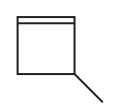
A mixture containing all stereoisomers of 3-methylcyclobutene is treated with . This produces a mixture of isomeric bromomethylcyclobutanes.
How many stereoisomers does 3-methylcyclobutene have, and how many isomeric bromomethylcyclobutanes are present in the product mixture?
Options
| 3-methylcyclobutene | bromomethylcyclobutanes | |
|---|---|---|
| A | 2 | 4 |
| B | 2 | 6 |
| C | 4 | 4 |
| D | 4 | 8 |
Working
Part 1: Stereoisomers of 3-methylcyclobutene
- The cyclobutene ring must have a cis double bond (trans is too strained).
- Carbon-3 is bonded to four different groups: H, CH₃, -CH=CH- (via C2), and -CH₂-CH= (via C4).
- This makes C-3 a chiral center.
- Therefore, 3-methylcyclobutene has 2 stereoisomers (a pair of enantiomers: R and S).
Part 2: Isomeric bromomethylcyclobutanes from HBr addition
Electrophilic addition of HBr to the C1=C2 double bond can occur in two regiochemical ways:
Route A: Br adds to C-1 (giving 1-bromo-3-methylcyclobutane)
- The substituents (Br and CH₃) are in a 1,3-relationship.
- C-1 and C-3 are not chiral centers because the ring paths through C-2 and C-4 are identical (both are -CH₂- groups).
- The molecule exhibits geometric (cis/trans) isomerism only.
- Number of isomers = 2 (cis and trans).
Route B: Br adds to C-2 (giving 2-bromo-3-methylcyclobutane, or 1-bromo-2-methylcyclobutane)
- The substituents (Br and CH₃) are in a 1,2-relationship.
- Both C-1 (bearing Br) and C-2 (bearing CH₃) are chiral centers because the ring paths to the other substituted carbon are different.
- With 2 different chiral centers and no internal plane of symmetry, there are 2² = 4 stereoisomers.
- These are a pair of cis enantiomers and a pair of trans enantiomers.
- Number of isomers = 4.
Total isomers = 2 + 4 = 6.
Answer
B
B
Background Concept
Stereoisomerism in cyclic compounds arises from two main sources:
- Geometric (cis/trans) isomerism: Occurs when two different substituents are attached to the ring carbons, restricting rotation. In small rings like cyclobutane, 1,2- and 1,3-disubstitution can give cis (same side) and trans (opposite sides) isomers.
- Optical isomerism: Occurs when a carbon atom in the ring is a chiral center (bonded to four different groups). In rings, you must trace the path around the ring in both directions from the candidate carbon; if the paths are different, the carbon is chiral.
Electrophilic addition to alkenes involves the addition of H⁺ and Br⁻ across a C=C double bond. If the alkene is unsymmetrical, H⁺ can add to either carbon of the double bond, leading to different constitutional (structural) isomers of the product. Each structural isomer may then have its own set of stereoisomers.
Understanding the Question
The question asks for two numbers:
- The number of stereoisomers of the starting material, 3-methylcyclobutene.
- The total number of isomeric bromomethylcyclobutanes formed when this mixture reacts with HBr.
The starting material is a cyclobutene ring with a methyl group at position 3. The reaction is electrophilic addition of HBr across the C1=C2 double bond. We must consider all possible structural isomers of the product and then determine how many stereoisomers each structural isomer has.
Approach
- Analyze 3-methylcyclobutene: Draw the structure, check for chiral centers, and check for cis/trans possibilities. Remember that small rings (≤7 carbons) cannot accommodate trans double bonds.
- Determine addition products: Identify the two possible regiochemical outcomes of HBr addition (Markovnikov/anti-Markovnikov logic isn't strictly needed here since we want all isomers; just consider H adding to C1 and H adding to C2).
- Count stereoisomers for each product: For each structural isomer, identify chiral centers and geometric isomerism. Calculate the total number of stereoisomers (2ⁿ for n chiral centers, unless meso compounds exist).
- Sum the totals: Add the stereoisomers from both structural isomers.
Step-by-Step Reasoning
Step 1: Stereoisomers of 3-methylcyclobutene
- Draw cyclobutene: a 4-membered ring with a double bond between C1 and C2. C3 has a methyl group and a hydrogen. C4 has two hydrogens.
- The double bond in a 4-membered ring is locked in the cis configuration; trans-cyclobutene is too strained to exist under normal conditions.
- Examine C3: It is bonded to (i) H, (ii) CH₃, (iii) C2 (which is part of the C=C double bond), and (iv) C4 (which is a -CH₂- group). Tracing the ring from C3: going towards C2 gives -CH=CH-; going towards C4 gives -CH₂-CH=-. These two paths are different, so C3 is bonded to four different groups.
- C3 is a chiral center. Thus, there are 2 enantiomers (R and S configurations).
- Number of stereoisomers = 2.
Step 2: Products of HBr addition
HBr adds across the C1=C2 double bond. There are two ways this can happen:
- Path A: H adds to C2, Br adds to C1. Product: 1-bromo-3-methylcyclobutane.
- Path B: H adds to C1, Br adds to C2. Product: 2-bromo-3-methylcyclobutane (systematically named 1-bromo-2-methylcyclobutane).
Step 3: Stereoisomers of 1-bromo-3-methylcyclobutane (Path A)
- The Br and CH₃ groups are on C1 and C3 (a 1,3-relationship).
- Check for chirality: C1 is bonded to Br, H, C2, and C4. Both C2 and C4 are -CH₂- groups that lead to C3. The paths around the ring from C1 are identical. Thus, C1 is not a chiral center. By the same logic, C3 is not a chiral center.
- Since there are no chiral centers, we only look for geometric isomerism. The Br and CH₃ can be on the same side of the ring (cis) or opposite sides (trans).
- Number of isomers = 2 (cis and trans).
Step 4: Stereoisomers of 1-bromo-2-methylcyclobutane (Path B)
- The Br and CH₃ groups are on adjacent carbons, C1 and C2 (a 1,2-relationship).
- Check for chirality: C1 is bonded to Br, H, C2 (has CH₃), and C4 (has H, H). The paths are different, so C1 is a chiral center. C2 is bonded to CH₃, H, C1 (has Br), and C3 (has H, H). The paths are different, so C2 is a chiral center.
- We have 2 chiral centers. The maximum number of stereoisomers is 2² = 4.
- Check for meso compounds: A meso compound requires an internal plane of symmetry. Since the two substituents (Br and CH₃) are different, no plane of symmetry can exist. All 4 stereoisomers are distinct.
- These 4 isomers consist of a pair of cis enantiomers and a pair of trans enantiomers.
- Number of isomers = 4.
Step 5: Total count
- Total isomeric bromomethylcyclobutanes = 2 (from 1-bromo-3-methyl) + 4 (from 1-bromo-2-methyl) = 6.
This matches option B: 2 stereoisomers for the reactant, 6 isomers for the product mixture.
Key Takeaways
- Chiral centers in rings: Always trace the ring in both directions from the candidate carbon. If the substituents encountered are different, the carbon is chiral. In 1,3-disubstituted cyclobutanes with identical substituents or symmetric paths, carbons may not be chiral.
- Counting stereoisomers: Use the 2ⁿ rule for n chiral centers, but always check for internal planes of symmetry (meso compounds) that would reduce the count.
- Addition to unsymmetrical alkenes: Consider both regiochemical outcomes (H adding to either carbon of the double bond) when asked for the total number of isomeric products.
Common Mistakes
- Assuming 1,3-disubstituted cyclobutanes are chiral: Students often miscount the ring paths. In 1-bromo-3-methylcyclobutane, the paths from C1 to C3 via C2 and via C4 are both -CH₂- groups, making C1 and C3 achiral. Only cis/trans isomerism exists.
- Forgetting one regiochemical product: Students might only consider the major product (following Markovnikov's rule) or only one addition direction, missing the other structural isomer entirely.
- Miscounting stereoisomers of 1,2-disubstituted rings: Forgetting that both carbons in a 1,2-disubstituted cyclobutane with different substituents are chiral centers, leading to an undercount (e.g., counting only cis/trans without enantiomers, giving 2 instead of 4).
- Ignoring the starting material's stereoisomerism: The question explicitly asks how many stereoisomers 3-methylcyclobutene has. Forgetting the chiral center at C3 and answering 1 is a common error.
Things to Be Careful About
- Small ring double bonds: Trans-cyclobutene is not a valid structure to consider. Only cis is possible.
- Symmetry in rings: When checking for chirality in cyclic compounds, remember that a carbon bonded to two identical ring paths (e.g., -CH₂-CH₂- in a symmetric ring) is not a chiral center, even if it has two other different substituents.
- Meso check: Always explicitly check for a plane of symmetry when calculating stereoisomers from chiral centers. In this case, the different substituents (Br vs CH₃) guarantee no meso compounds, but this is a crucial step to verify.
- Nomenclature vs. numbering: 2-bromo-3-methylcyclobutane is the same as 1-bromo-2-methylcyclobutane (numbering gives the lowest locants: 1,2 rather than 2,3). Ensure you are counting unique structural isomers, not duplicate names.
The diagram shows the structure of X.
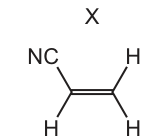
Which row is correct?
Options
| number of bonds in X | type of hybridisation of the carbon atoms in X | |
|---|---|---|
| A | 4 | and |
| B | 4 | and |
| C | 6 | and |
| D | 6 | and |
Working
Count the bonds in :
- 2 bonds on the group 2 bonds
- 1 bond in the double bond
- 1 bond on the group 1 bond
- 1 single bond between the alkene and nitrile groups 1 bond
- 1 bond in the triple bond
Total bonds = .
Determine hybridisation of each carbon atom (count electron domains):
- The two carbons in the double bond each have 3 electron domains hybridised.
- The carbon in the triple bond has 2 electron domains hybridised.
Types of hybridisation present: and .
Answer
C
C
Background Concept
- Every single bond consists of 1 bond.
- A double bond consists of 1 bond and 1 bond.
- A triple bond consists of 1 bond and 2 bonds.
- Hybridisation is determined by the number of electron domains (regions of electron density) around an atom: 2 domains (e.g., one single and one triple bond) hybridisation; 3 domains (e.g., one double bond and two single bonds) hybridisation; 4 domains (four single bonds) hybridisation.
Understanding the Question
The question provides the structure of compound X, propenenitrile (), and asks for two pieces of information: the total number of bonds in the molecule, and the types of hybridisation present among its carbon atoms. We must evaluate the four options to find the row that correctly states both values.
Approach
- Visualise the full structural formula of , showing all bonds explicitly.
- Count the bonds by applying the rule that every bond (single, double, or triple) contains exactly one bond.
- Determine the hybridisation of each carbon atom by counting its electron domains (bonded atoms + lone pairs; multiple bonds count as one domain).
- Match the findings to the given options.
Step-by-Step Reasoning
Counting bonds:
The structure is .
Let's list every bond:
- Two single bonds on the terminal carbon 2 bonds.
- One double bond between the two alkene carbons 1 bond (and 1 bond).
- One single bond on the carbon 1 bond.
- One single bond connecting the alkene to the nitrile carbon 1 bond.
- One triple bond 1 bond (and 2 bonds).
Total bonds = .
Determining hybridisation:
- Terminal alkene carbon (): bonded to 2 H atoms and 1 C atom (via a double bond). Total electron domains = 3. Hybridisation = .
- Middle alkene carbon (): bonded to 1 H atom, 1 C atom (via double bond), and 1 C atom (via single bond). Total electron domains = 3. Hybridisation = .
- Nitrile carbon (): bonded to 1 C atom (via single bond) and 1 N atom (via triple bond). Total electron domains = 2. Hybridisation = .
The carbon atoms exhibit and hybridisation.
Matching to options:
- Number of bonds = 6.
- Hybridisation types = and .
This corresponds exactly to row C.
Key Takeaways
- A bond is the first bond formed between any two atoms; additional bonds in multiple bonds are bonds. Thus, a molecule with total bonds (counting each line in a structural formula as one bond) has exactly bonds.
- Hybridisation depends on the steric number (number of electron domains), not the total number of bonds or atoms attached. A triple bond counts as only one electron domain for hybridisation purposes.
Common Mistakes
- Miscounting bonds by forgetting that double and triple bonds still contain exactly one bond each (e.g., counting only single bonds, or counting bonds as bonds).
- Confusing the number of atoms attached to a carbon with the number of electron domains (e.g., thinking the nitrile carbon is because it is attached to two atoms, when in fact a triple bond counts as one domain, making the steric number 2 and hybridisation ).
Things to Be Careful About
- Always expand multiple bonds into their and components when counting bonds.
- Remember that lone pairs count as electron domains for hybridisation, though no carbon atoms here have lone pairs.
- The question asks for the types of hybridisation present in the molecule, not the hybridisation of a single specific carbon atom.
The diagram shows the skeletal formula of citric acid.
What is the molecular formula of citric acid?
Options
A
B
C
D
Working
To determine the molecular formula from the skeletal formula, count the number of each type of atom.
- Carbon (C): The skeletal structure has a central carbon atom bonded to three other carbon-containing groups. Specifically, there is one central C, one C in the top carboxyl group, and two -CH- groups each bonded to a carboxyl group. Total carbons = 1 (central) + 1 (top COOH) + 2 (CH) + 2 (side COOHs) = 6.
- Hydrogen (H): Hydrogens attached to carbon are implicit and fill carbon's valency of 4. Hydrogens attached to oxygen are shown explicitly.
- 3 carboxyl (-COOH) groups each have 1 H on the oxygen: 3 H.
- 1 hydroxyl (-OH) group on the central carbon has 1 H: 1 H.
- 2 methylene (-CH-) groups each have 2 H: 4 H.
- Total hydrogens = 3 + 1 + 4 = 8.
- Oxygen (O):
- 3 carboxyl (-COOH) groups each have 2 oxygens: 6 O.
- 1 hydroxyl (-OH) group has 1 oxygen: 1 O.
- Total oxygens = 6 + 1 = 7.
Molecular formula: CHO.
Answer
A
A
Background Concept
In organic chemistry, skeletal formulas (also called line-angle formulas) are a shorthand way of drawing molecular structures. In this notation:
- Carbon atoms are represented by the vertices (corners) and the ends of lines (segments). They are not explicitly written as 'C'.
- Hydrogen atoms attached to carbon atoms are not shown. Instead, it is assumed that each carbon atom forms exactly four bonds (its valency). Any bonds not drawn to other atoms are assumed to be to hydrogen atoms.
- Heteroatoms (atoms other than carbon and hydrogen, such as oxygen, nitrogen, sulfur, halogens) are always written explicitly, along with any hydrogen atoms attached directly to them.
- Lines represent chemical bonds: a single line is a single bond, a double line is a double bond, etc.
Understanding the Question
The question provides the skeletal formula of citric acid and asks for its molecular formula. The molecular formula tells us the exact number of each type of atom (C, H, O) present in one molecule of the substance. We are given four options with different numbers of carbon, hydrogen, and oxygen atoms. The task is to correctly interpret the skeletal diagram and count the atoms, remembering to add in the implicit hydrogens attached to the carbon skeleton.
Approach
The strategy is to systematically count the atoms of each element in the structure:
- Count carbons: Identify every vertex and line end as a carbon atom. Sum them up.
- Count oxygens: Look for the 'O' symbols in the diagram. Count each one, noting that some are part of C=O double bonds and others are in -OH groups.
- Count hydrogens: This is the trickiest part. Count the hydrogens explicitly written (those attached to oxygen). Then, for each carbon atom, determine how many bonds are already shown to other non-hydrogen atoms. The number of missing bonds (up to 4) is the number of implicit hydrogen atoms attached to that carbon. Sum all hydrogens.
Step-by-Step Reasoning
Let's break down the structure of citric acid as shown in Fig. 27.1:
Carbon count:
- There is a central carbon atom (the vertex where four lines meet).
- Attached to this central carbon is a carboxylic acid group (-COOH) at the top. This group contains 1 carbon atom (the carbonyl carbon).
- Attached to the central carbon on the left is a -CH- group (1 carbon), which is in turn attached to another -COOH group (1 carbon).
- Attached to the central carbon on the right is another -CH- group (1 carbon), attached to a third -COOH group (1 carbon).
- Total carbons = 1 (central) + 1 (top COOH) + 1 (left CH) + 1 (left COOH) + 1 (right CH) + 1 (right COOH) = 6 carbon atoms.
Oxygen count:
- There are three carboxylic acid groups (-COOH). Each contains a C=O double bond (1 oxygen) and a C-OH single bond (1 oxygen), totaling 2 oxygens per group. So, 3 groups × 2 oxygens = 6 oxygens.
- There is one hydroxyl group (-OH) attached directly to the central carbon. This contributes 1 oxygen.
- Total oxygens = 6 + 1 = 7 oxygen atoms.
Hydrogen count:
- Hydrogens on heteroatoms (shown explicitly): Each of the three -COOH groups has an -OH, contributing 1 hydrogen each (3 H). The central -OH group contributes 1 hydrogen. Total explicit hydrogens = 4.
- Hydrogens on carbons (implicit):
- The central carbon has 4 bonds drawn (to OH, COOH, CH, CH). It needs 0 more bonds, so 0 hydrogens.
- The carbon in the top -COOH group has a double bond to O and a single bond to OH and a single bond to the central C. That's 4 bonds. 0 hydrogens.
- The two -CH- carbons each have 2 bonds drawn (one to central C, one to the carboxyl C). They each need 2 more bonds to reach 4, so each has 2 hydrogens. Total = 2 × 2 = 4 hydrogens.
- The carbons in the two side -COOH groups are identical to the top one: 4 bonds, 0 hydrogens.
- Total hydrogens = 4 (explicit) + 4 (implicit on CH groups) = 8 hydrogen atoms.
Combining these, the molecular formula is CHO.
This matches option A.
Key Takeaways
- Skeletal formulas hide carbon and hydrogen atoms attached to carbon. You must mentally add them to satisfy carbon's tetravalency (4 bonds).
- Heteroatoms (like O in -OH or C=O) and hydrogens attached to them are always drawn explicitly.
- Functional groups like carboxylic acid (-COOH) have a specific atom count: 1 C, 2 O, 1 H.
Common Mistakes
- Forgetting implicit hydrogens: A common error is to only count the hydrogens explicitly written in the diagram (the 4 H's in the -OH groups). This leads to an incorrect formula like CHO (Option B). Remember to add the 4 hydrogens on the two -CH- groups.
- Miscounting carbons: Forgetting that the carbon in a -COOH group is part of the carbon count, or missing one of the -CH- carbons. This could lead to choosing C or C if one mistakenly counts oxygen atoms as carbons or misinterprets the lines.
- Confusing skeletal with displayed formula: In a displayed formula, all bonds and atoms are shown. In a skeletal formula, only the carbon skeleton and heteroatoms are shown.
Things to Be Careful About
- Always verify that every carbon atom has exactly 4 bonds (counting double bonds as 2). If a carbon has fewer than 4 bonds drawn, the missing bonds are to hydrogen.
- Be careful with the carboxylic acid group: it is -COOH, which means 1 carbon, 2 oxygens, and 1 hydrogen. Do not count the oxygen in C=O and the oxygen in OH as separate functional groups without recognizing they belong to the same carboxyl unit.
- The molecular formula must be written in the order C, then H, then other elements alphabetically (though for this question, the options are already in a standard format). Here, CHO is correct.
Which reaction occurs when ethane and chlorine are mixed in diffused sunlight?
Options
A a free-radical substitution with hydrogen given off
B a free-radical substitution with hydrogen chloride given off
C a free-radical substitution with no gas given off
D a nucleophilic substitution with hydrogen chloride given off
Working
Ethane reacts with chlorine in diffused sunlight via free-radical substitution:
Net reaction:
The hydrogen atom replaced by chlorine is given off as hydrogen chloride gas.
Answer
B — a free-radical substitution with hydrogen chloride given off.
B
Background Concept
Alkanes are generally unreactive, but they undergo free-radical substitution with halogens (especially chlorine and bromine) in the presence of UV light or diffused sunlight. The reaction is a chain reaction with three steps: initiation, propagation, and termination.
Understanding the Question
The question asks which reaction occurs when ethane and chlorine are mixed in diffused sunlight. It tests two things: the mechanism type (free-radical substitution vs nucleophilic substitution) and the gaseous product (hydrogen chloride vs hydrogen vs no gas).
Approach
Recall the mechanism of alkane halogenation and identify the products.
Step-by-Step Reasoning
- Mechanism type: Alkanes are saturated hydrocarbons. They do not undergo nucleophilic substitution — that reaction is characteristic of halogenoalkanes. Instead, alkanes react with halogens in light by free-radical substitution.
- Initiation: The Cl–Cl bond undergoes homolytic fission in light, producing two chlorine free radicals: .
- Propagation step 1: A chlorine radical abstracts a hydrogen atom from ethane, forming hydrogen chloride and an ethyl radical: .
- Propagation step 2: The ethyl radical reacts with a chlorine molecule to form chloroethane and regenerate a chlorine radical: .
- Net result: One hydrogen atom is replaced by chlorine, and hydrogen chloride gas is given off.
Key Takeaways
- Free-radical substitution of alkanes produces a halogenoalkane and hydrogen halide gas.
- The reaction requires UV light or diffused sunlight for initiation.
Common Mistakes
- Confusing with nucleophilic substitution (which involves halogenoalkanes, not alkanes).
- Thinking hydrogen gas is given off — actually HCl is given off.
Things to Be Careful About
- The mechanism is free-radical, not nucleophilic.
- The gas given off is HCl, not .
A molecule of geraniol is shown.
What is formed when geraniol is reacted with an excess of cold dilute acidified ?
Options
Answer
A
Cold, dilute acidified oxidises alkenes to vicinal diols (1,2-diols) by adding hydroxyl groups across the bonds. Under these cold and dilute conditions, the primary alcohol group () is not oxidised (oxidation to a carboxylic acid requires hot, concentrated acidified ). Therefore, the two double bonds become four hydroxyl groups, while the original alcohol group remains unchanged, resulting in structure A.
A
Background Concept
Potassium manganate(VII) (), containing the purple ion, is a strong oxidising agent. Its reactivity depends heavily on the conditions (temperature, concentration, and pH):
- Cold, dilute (Baeyer's reagent conditions, often alkaline/neutral but can be acidified): Reacts with alkenes to form vicinal diols (1,2-diols). The double bond is converted into a single bond with an group added to each carbon. The purple colour decolourises (in acid) or forms a brown precipitate of (in neutral/alkaline conditions).
- Hot, concentrated acidified : This is a much more vigorous oxidising agent. It causes oxidative cleavage of alkenes, breaking the bond completely to form ketones, carboxylic acids, or depending on the substitution of the alkene carbons. It also oxidises primary alcohols () all the way to carboxylic acids () and secondary alcohols to ketones.
Understanding the Question
The question asks for the product of geraniol reacted with excess cold dilute acidified .
- Reactant (Geraniol): Contains two double bonds and one primary alcohol group ().
- Reagent/Conditions: Cold, dilute, acidified .
We need to determine which functional groups react under these specific conditions and what the products are.
Approach
- Analyze the functional groups in geraniol: two alkenes and one primary alcohol.
- Apply the specific reactivity rules for cold, dilute acidified manganate(VII):
- Alkenes Diols (addition of across the double bond).
- Primary alcohols No reaction (requires heat/concentration to oxidise).
- Compare the predicted product structure with the given options.
Step-by-Step Reasoning
-
Reaction at the alkenes: The molecule has two double bonds. Cold, dilute acidified oxidises alkenes to 1,2-diols. Each double bond gains two groups (one on each carbon of the original double bond). Since there are two double bonds, four new hydroxyl groups are formed.
- Left double bond: becomes .
- Right double bond: becomes .
-
Reaction at the alcohol: The molecule has a primary alcohol group (). Oxidation of a primary alcohol to a carboxylic acid requires hot, concentrated acidified (or reflux conditions). Since the conditions here are cold and dilute, the alcohol group remains unchanged.
-
Evaluating the options:
- Option A: Shows the original carbon skeleton with groups added across both double bonds (forming diols) and the original group intact. This matches our prediction.
- Option B: Shows oxidation to carbonyls/ketones without cleavage, which is not the standard product of cold dilute manganate.
- Option C: Shows cleavage products (acetone, dicarbonyl compounds). This would occur with hot, concentrated .
- Option D: Shows the double bonds intact but the alcohol oxidised to a carboxylic acid. This is incorrect because cold dilute conditions do not oxidise alcohols, and they do react with alkenes.
Therefore, A is the correct answer.
Key Takeaways
- Condition matters: Cold, dilute converts alkenes to diols. Hot, concentrated cleaves alkenes and oxidises alcohols.
- Selectivity: Under mild conditions (cold/dilute), alkenes are more reactive towards oxidation than primary alcohols. Primary alcohols require harsher conditions (heat/reflux) to be oxidised by acidified manganate(VII).
Common Mistakes
- Confusing conditions: Assuming that any acidified will oxidise the primary alcohol to a carboxylic acid. Remember that heat is required for alcohol oxidation.
- Confusing alkene reactions: Thinking that cold dilute cleaves the double bond (Option C). Cleavage requires hot, concentrated reagents.
- Ignoring the alcohol: Forgetting that the original group in geraniol is still present in the product (Option A has 5 groups total, not 4).
Things to Be Careful About
- Reagent concentration and temperature: Always check if the question specifies 'cold/dilute' vs 'hot/concentrated'. This is the key to distinguishing between diol formation and oxidative cleavage.
- Functional group stability: Know that primary alcohols are stable to cold, dilute oxidising agents like .
- Structure interpretation: Carefully count the functional groups in the product options to ensure they match the expected transformation (addition of 4 groups across 2 double bonds, leaving the original alcohol untouched).
Q is either a primary or a tertiary halogenoalkane. Q undergoes hydrolysis with aqueous sodium hydroxide.
The first step in the mechanism of this reaction involves two species reacting together.
Which row is correct?
Options
| Q | behaviour of hydroxide ion | |
|---|---|---|
| A | primary halogenoalkane | electrophile |
| B | primary halogenoalkane | nucleophile |
| C | tertiary halogenoalkane | electrophile |
| D | tertiary halogenoalkane | nucleophile |
Working
Hydrolysis of a halogenoalkane by aqueous sodium hydroxide is nucleophilic substitution. The hydroxide ion has a lone pair and is electron-rich, so it donates an electron pair to the electron-deficient carbon atom — it acts as a nucleophile.
A mechanism whose first step involves two species reacting together is bimolecular (SN2). SN2 occurs at a primary halogenoalkane; a tertiary halogenoalkane would react by SN1, whose first step involves only the halogenoalkane itself.
Answer
B
B
Background Concept
Halogenoalkanes undergo nucleophilic substitution with aqueous alkali. In the C–X bond, the halogen is more electronegative than carbon, so the carbon carries a partial positive charge and the halogen a partial negative charge. The hydroxide ion, OH–, is electron-rich: it has a lone pair and a negative charge. It can therefore act as a nucleophile, donating its lone pair to the electron-deficient carbon and displacing the halide ion.
The substitution can happen by two mechanisms. SN2 is a one-step, bimolecular process: the nucleophile attacks at the same time as the C–X bond breaks. It is favoured at primary halogenoalkanes because the carbon is not sterically hindered. SN1 is a two-step, unimolecular process: first the C–X bond undergoes heterolytic fission to form a carbocation, then the nucleophile attacks the carbocation. It is favoured at tertiary halogenoalkanes because the intermediate carbocation is stabilised by three alkyl groups and the bulky groups hinder back-side attack.
Understanding the Question
The question asks you to decide whether Q is primary or tertiary, and whether the hydroxide ion behaves as an electrophile or a nucleophile. The crucial clue is that the first step of the mechanism involves two species reacting together. That clue directly identifies the mechanism type. In aqueous NaOH, the reaction is hydrolysis — nucleophilic substitution — so the role of OH– must be decided by its electron behaviour.
Approach
Start from the clue. If the first step involves two species, the mechanism is bimolecular, which is SN2. SN2 is characteristic of a primary halogenoalkane. Then decide the role of OH–: because it donates a lone pair to carbon, it is a nucleophile, not an electrophile. This gives row B.
Step-by-Step Reasoning
- Hydrolysis of a halogenoalkane with aqueous sodium hydroxide is a nucleophilic substitution reaction.
- In a primary halogenoalkane, the carbon bearing the halogen is attached to only one alkyl group, so there is little steric hindrance. The hydroxide ion can attack from the back side in a single concerted step.
- That single step involves two species: the hydroxide ion and the halogenoalkane. This matches the clue exactly.
- In a tertiary halogenoalkane, the carbon is attached to three alkyl groups. Back-side attack is hindered, and the tertiary carbocation is relatively stable. The mechanism is therefore SN1.
- The first step of SN1 is heterolytic fission of the C–X bond, which involves only the halogenoalkane molecule. It does not involve two species reacting together.
- Since the question states that the first step involves two species, Q must be primary, not tertiary.
- The hydroxide ion is electron-rich and donates an electron pair to the electron-deficient carbon, so it is a nucleophile.
- Therefore the correct row is B: primary halogenoalkane, hydroxide ion as nucleophile.
Key Takeaways
- The phrase “first step involves two species” signals a bimolecular mechanism, SN2, which is favoured at primary halogenoalkanes.
- A first step involving only one species signals SN1, which is favoured at tertiary halogenoalkanes.
- A nucleophile donates an electron pair; an electrophile accepts an electron pair. The hydroxide ion is a nucleophile.
Common Mistakes
- Choosing a tertiary halogenoalkane because tertiary halogenoalkanes are often discussed in connection with hydrolysis. The clue about two species in the first step rules this out.
- Calling the hydroxide ion an electrophile. An electrophile is electron-poor and accepts electrons; OH– is electron-rich and donates electrons.
- Confusing SN1 and SN2. The number of species in the first step is the key distinction.
Things to Be Careful About
- Read “first step” carefully. In SN2 there is only one step, but it is bimolecular; in SN1 the first step is unimolecular.
- Aqueous NaOH favours substitution; alcoholic/ethanolic NaOH favours elimination. The question specifies aqueous, so substitution is the expected pathway.
- Primary, secondary and tertiary refer to the number of alkyl groups attached to the carbon bearing the halogen, not to the halogen itself.
2-bromopropane is converted to 1,2-dibromopropane in a pathway involving two reactions.
What are the reagents and conditions for the two reactions?
Options
| reaction 1 | reaction 2 | |
|---|---|---|
| A | heat under reflux with aqueous | at room temperature |
| B | heat under reflux with aqueous | at room temperature |
| C | heat under reflux with ethanolic | at room temperature |
| D | heat under reflux with ethanolic | at room temperature |
Working
Reaction 1 converts 2-bromopropane into compound X. Since reaction 2 gives 1,2-dibromopropane, compound X must be propene.
- 2-bromopropane → propene is an elimination of HBr. This requires heat under reflux with ethanolic NaOH (or alcoholic KOH).
- Propene → 1,2-dibromopropane is an electrophilic addition of Br2. This requires Br2(l) at room temperature.
Answer
D
D
Background Concept
Halogenoalkanes can undergo two competing reactions with NaOH:
- Aqueous NaOH favours nucleophilic substitution, replacing the halogen with an –OH group (forming an alcohol).
- Ethanolic NaOH favours elimination, removing H and X from adjacent carbons to form an alkene.
Alkenes readily undergo electrophilic addition with halogens such as Br2. The π bond breaks and a Br atom adds to each carbon of the double bond, giving a vicinal dibromide.
Understanding the Question
The pathway is:
2-bromopropane → compound X → 1,2-dibromopropane
We need to identify the intermediate X and the reagents/conditions for both steps.
Approach
Work backwards from the final product. 1,2-dibromopropane has two Br atoms on adjacent carbons. The only simple alkene that gives this product by addition of Br2 is propene. So compound X must be propene. Then determine how to convert 2-bromopropane into propene (elimination) and propene into 1,2-dibromopropane (addition).
Step-by-Step Reasoning
- Identify compound X: 1,2-dibromopropane is CH3–CHBr–CH2Br. Removing two Br atoms and forming a double bond between C1 and C2 gives propene, CH3–CH=CH2. Thus X = propene.
- Reaction 1: 2-bromopropane → propene. This is a dehydrohalogenation (elimination of HBr). Conditions: heat under reflux with ethanolic NaOH. Aqueous NaOH would instead give propan-2-ol via substitution.
- Reaction 2: propene → 1,2-dibromopropane. This is electrophilic addition of Br2 across the double bond. Conditions: Br2(l) at room temperature (or Br2 in an inert solvent).
- Check options: Only option D gives ethanolic NaOH for reaction 1 and Br2(l) for reaction 2.
Key Takeaways
- Aqueous NaOH + halogenoalkane → substitution (alcohol).
- Ethanolic NaOH + halogenoalkane → elimination (alkene).
- Alkenes + Br2 → vicinal dibromides (dibromoalkanes).
- Working backwards from a product can reveal an intermediate alkene.
Common Mistakes
- Choosing aqueous NaOH for reaction 1: this would give propan-2-ol, not propene.
- Choosing HBr(g) for reaction 2: HBr adds to propene to give 2-bromopropane (Markovnikov), not 1,2-dibromopropane.
- Forgetting that Br2 addition to an alkene gives a dibromide with Br on adjacent carbons.
Things to Be Careful About
- The solvent (aqueous vs ethanolic) is the key difference between substitution and elimination.
- Br2(l) is the reagent for halogen addition; HBr(g) is a hydrogen halide addition that follows Markovnikov's rule.
- Always check the structure of the product to deduce the intermediate.
Compound X is a single, pure, optical isomer. Compound X is heated with an excess of concentrated . Only one organic product is formed.
What is compound X?
Options

Working
Compound X must be a single optical isomer and yield only one organic product upon dehydration with concentrated .
- A (3,4-dimethylcyclohexan-1-ol): Has chiral centres and can exist as optical isomers. Dehydration can occur in multiple directions (loss of from C2 or C4), producing a mixture of alkene isomers (e.g., 3,4-dimethylcyclohex-1-ene and 2,3-dimethylcyclohex-1-ene). More than one organic product.
- B (2,3-dimethylcyclohexan-1-ol): Has chiral centres. Dehydration yields a mixture of alkenes (e.g., 1,2-dimethylcyclohex-1-ene and 2,3-dimethylcyclohex-1-ene). More than one organic product.
- C (1,2-dimethylcyclohexan-1-ol): Dehydration can occur by losing from C2 (forming 1,2-dimethylcyclohex-1-ene) or from the methyl group at C1 (forming 2-methyl-1-methylenecyclohexane). More than one organic product.
- D ((2-methylcyclohexyl)methanol): The group is on a primary carbon () attached to the ring. The only -hydrogen available for elimination is on the ring carbon (C1) to which the group is attached. Elimination produces only one alkene: 2-methyl-1-methylenecyclohexane. The molecule has chiral centres and can be a single optical isomer.
Only D satisfies both conditions.
Answer
D
D
Background Concept
Optical Isomerism:
A molecule is optically active if it is chiral, meaning it cannot be superimposed on its mirror image. In organic chemistry, this most commonly arises from a carbon atom bonded to four different groups (a chiral centre). A "single, pure, optical isomer" refers to a sample containing only one enantiomer (e.g., 100% R or 100% S), not a racemic mixture.
Dehydration of Alcohols:
Heating an alcohol with concentrated causes elimination of water to form an alkene. This is an acid-catalysed dehydration.
- Primary alcohols: Dehydrate to form alkenes. The is on an -carbon. Elimination requires a -hydrogen (on the carbon adjacent to the -carbon). If the -carbon is only attached to one other carbon (as in a group attached to a ring), there is only one possible direction for double bond formation, often leading to an exocyclic double bond.
- Secondary and Tertiary alcohols: Dehydrate according to Zaitsev's rule, where the major product is the more substituted alkene. However, multiple -hydrogens often exist on different adjacent carbons, leading to a mixture of alkene isomers (positional isomers and stereoisomers like E/Z).
Understanding the Question
We are given four cyclohexane derivatives (A, B, C, D) and two conditions:
- Compound X is a single, pure optical isomer.
- Heating with excess concentrated produces only one organic product.
We must evaluate each option against these criteria. The key is to identify which alcohol can only dehydrate in one way to give a single alkene product.
Approach
- Check for optical isomerism: Identify if the molecule has chiral centres. All options A, B, C, and D have chiral centres (carbons bonded to 4 different groups), so they can all exist as optical isomers. The condition "single, pure, optical isomer" just means we assume we have a pure enantiomer of one of these. This doesn't eliminate any option, but confirms we should look for a specific stereoisomer.
- Analyze dehydration pathways: For each structure, identify the -carbon (bearing the ) and all -carbons (adjacent carbons bearing hydrogens). Count the number of distinct alkene products that can form.
- If there are multiple -carbons with hydrogens, or if the double bond can be placed in multiple positions (Zaitsev vs Hofmann), multiple products form.
- If there is only one -carbon with a hydrogen, only one alkene can form.
Step-by-Step Reasoning
Option A: 3,4-dimethylcyclohexan-1-ol
- Structure: Cyclohexane ring with at C1, methyl at C3, methyl at C4.
- Chiral centres: C3 and C4 are chiral. It can exist as optical isomers.
- Dehydration: The -carbon is C1. -carbons are C2 and C6. Both have hydrogens. Elimination can form a double bond between C1-C2 or C1-C6. Furthermore, carbocation rearrangements or further dehydration of intermediate products can occur. This yields a mixture of alkenes (e.g., 3,4-dimethylcyclohex-1-ene, 2,3-dimethylcyclohex-1-ene, etc.).
- Result: More than one product. Incorrect.
Option B: 2,3-dimethylcyclohexan-1-ol
- Structure: at C1, methyl at C2, methyl at C3.
- Chiral centres: C1, C2, C3 are chiral. Optical isomers exist.
- Dehydration: -carbons are C2 and C6. C2 has one H (and a methyl). C6 has two H's. Elimination can give 1,2-dimethylcyclohex-1-ene (more substituted, major) or 3,4-dimethylcyclohex-1-ene (less substituted). Mixture of products.
- Result: More than one product. Incorrect.
Option C: 1,2-dimethylcyclohexan-1-ol
- Structure: and a methyl group at C1, methyl at C2.
- Chiral centres: C1 and C2 are chiral (C1 is bonded to , , C2, and C6; C2 is bonded to , H, C1, C3).
- Dehydration: The -carbon is C1. -hydrogens are available on:
- C2 (ring carbon): Loss of H from C2 gives 1,2-dimethylcyclohex-1-ene (endocyclic double bond).
- The methyl group at C1: Loss of H from this methyl group gives 2-methyl-1-methylenecyclohexane (exocyclic double bond, ).
- Two distinct organic products are formed.
- Result: More than one product. Incorrect.
Option D: (2-methylcyclohexyl)methanol
- Structure: Cyclohexane ring with a group at C1 and a methyl group at C2.
- Chiral centres: C1 (ring carbon attached to ) is bonded to H, , C2 (with methyl), and C6 (CH2). These 4 groups are different, so C1 is chiral. C2 is also chiral. Optical isomers exist.
- Dehydration: The -carbon is the carbon in the group. It is only attached to one other carbon: C1 of the ring. Therefore, the only -carbon is C1. C1 has one hydrogen. Elimination of water must occur between the and C1, forming a double bond exocyclic to the ring: 2-methyl-1-methylenecyclohexane.
- No other -hydrogens are available on carbons adjacent to the -carbon. Thus, only one organic product is formed.
- Result: Satisfies both conditions. Correct.
Key Takeaways
- When predicting dehydration products, always identify the -carbon (bearing the ) and count the number of distinct -hydrogens on adjacent carbons.
- Primary alcohols like where R is a ring or chain can only dehydrate if there is a -hydrogen on the adjacent carbon. If the is attached to a ring carbon, the double bond forms exocyclically ().
- Optical isomerism requires a chiral centre (usually a carbon with 4 different substituents). A "single, pure" isomer means we don't need to worry about racemic mixtures affecting the product count, but we must ensure the molecule can be chiral.
Common Mistakes
- Miscounting -hydrogens in Option C: Students often forget that the hydrogens on the methyl group attached to C1 are -hydrogens relative to the on C1. Elimination can occur there to form an exocyclic double bond (), giving a second product alongside the endocyclic alkene.
- Assuming all chiral molecules give one product: Having a chiral centre doesn't restrict the number of elimination products. The restriction comes from the symmetry or lack of alternative -carbons.
- Confusing primary and secondary alcohol dehydration: Option D is a primary alcohol (the is on a carbon attached to only one other carbon). Students might incorrectly apply Zaitsev's rule as if it were a secondary/tertiary alcohol with multiple ring -carbons available for elimination directly from the bearing carbon.
Things to Be Careful About
- Exocyclic vs Endocyclic double bonds: In Option C, the methyl group at C1 provides -hydrogens that lead to an exocyclic alkene (). This is a valid elimination product and counts as a separate organic product from the endocyclic alkene.
- Structure reading: Ensure you correctly identify the position of the group. In D, it's (primary), not directly on the ring (secondary/tertiary). This is the crucial difference that limits the dehydration pathway to a single product.
- State symbols and reagents: Concentrated and heat are the standard reagents for dehydration (elimination). Dilute acid or different conditions might lead to substitution, but the question specifies dehydration conditions.
Which reagents could be used to form 2-bromobutane from butan-1-ol?
Options
A bromine and ultraviolet light
B concentrated sulfuric acid with potassium bromide, under reflux
C concentrated sulfuric acid followed by bromine
D concentrated sulfuric acid followed by hydrogen bromide
Working
Butan-1-ol is a primary alcohol. Direct substitution with HBr would give 1-bromobutane (primary). To obtain 2-bromobutane (secondary), the alcohol must first be dehydrated to an alkene, then HBr added.
- Concentrated H2SO4 dehydrates butan-1-ol to but-1-ene (and but-2-ene).
- HBr adds by electrophilic addition; Markovnikov addition to but-1-ene gives 2-bromobutane.
Answer
D
D
Background Concept
Alcohols can be converted to halogenoalkanes. A primary alcohol (e.g. butan-1-ol) reacts with HBr (or with concentrated H2SO4 and KBr/NaBr) by nucleophilic substitution (SN2) to give the primary halogenoalkane, 1-bromobutane. To obtain a secondary halogenoalkane (2-bromobutane) from a primary alcohol, the carbon skeleton must be rearranged: first dehydrate the alcohol to an alkene, then add HBr by electrophilic addition, which follows Markovnikov's rule.
Understanding the Question
The question asks which reagent combination converts butan-1-ol (CH3CH2CH2CH2OH, primary) into 2-bromobutane (CH3CHBrCH2CH3, secondary). The bromine must end up on carbon 2, not carbon 1.
Approach
Check each option for whether it can place bromine on C2. Direct halogenation of the alcohol keeps bromine on C1. Dehydration to an alkene followed by Markovnikov HBr addition places bromine on C2.
Step-by-Step Reasoning
- A: bromine and ultraviolet light — Free-radical substitution on the carbon chain. This is non-selective and would give a mixture of 1-, 2-, and 3-bromobutanes (and possible polybromination). Not a clean route to 2-bromobutane.
- B: concentrated sulfuric acid with potassium bromide, under reflux — Generates HBr in situ. With a primary alcohol, HBr substitution proceeds by SN2, giving 1-bromobutane. Also, H2SO4 can oxidise HBr to Br2, complicating the reaction. This gives the primary bromide, not 2-bromobutane.
- C: concentrated sulfuric acid followed by bromine — H2SO4 dehydrates the alcohol to but-1-ene; then Br2 adds across the double bond to give a dibromide (1,2-dibromobutane), not a monobromide.
- D: concentrated sulfuric acid followed by hydrogen bromide — H2SO4 dehydrates butan-1-ol to but-1-ene (and but-2-ene). HBr then adds by electrophilic addition. Markovnikov addition to but-1-ene places Br on the more substituted carbon (C2), giving 2-bromobutane. Correct.
Key Takeaways
To make a secondary halogenoalkane from a primary alcohol, you must go through the alkene: dehydrate with concentrated H2SO4, then add HX.
Common Mistakes
Choosing B: the standard "alcohol + H2SO4 + KBr" method gives the primary halide for a primary alcohol. Choosing C: forgetting that Br2 adds to give a dibromide, not a monobromide.
Things to Be Careful About
Markovnikov addition places the halogen on the more substituted carbon. The distinction between mono- and di-halogenation. Free-radical bromination is non-selective.
X is a non-cyclic ketone with a single carbonyl group and no other functional groups. Ketone X has the following properties.
- When ketone X is treated with , the organic product has a greater than the of ketone X.
- Ketone X gives a yellow precipitate with alkaline .
How many isomeric ketones could be ketone X?
Options
A 1
B 2
C 3
D 4
Working
Reduction of a ketone by adds two hydrogen atoms, increasing by 2.
For a non-cyclic ketone, :
So X is . A positive iodoform test means X has a group (a methyl ketone).
The isomeric pentanones with a group are:
- Pentan-2-one:
- 3-methylbutan-2-one:
Pentan-3-one () has no group.
Answer
B (2)
B
Background Concept
Sodium borohydride () is a mild reducing agent that converts ketones into secondary alcohols. The carbon–oxygen double bond of the carbonyl group gains two hydrogen atoms — one on carbon, one on oxygen — so the net change is the addition of . This increases the relative molecular mass by exactly 2. Measuring the percentage increase in therefore lets us find the of the original ketone.
The iodoform (tri-iodomethane) test is a qualitative test specific to compounds containing a group, i.e. methyl ketones. Warming a methyl ketone with iodine in alkaline solution produces a yellow precipitate of . A positive result therefore tells us the ketone is a methyl ketone.
A non-cyclic ketone with a single carbonyl group and no other functional groups has the general formula .
Understanding the Question
The question gives two independent facts about X: (1) reduction with raises by 2.3256%, and (2) X gives a yellow precipitate with alkaline . We must count how many isomeric ketones could be X. The first fact fixes the molecular formula; the second filters the isomers to those with a group.
Approach
- Use the percentage increase to find of X: since reduction adds 2 to , .
- Substitute into the general formula to find .
- Draw every structural isomer of the ketone.
- Apply the iodoform rule (requires ) and count.
Step-by-Step Reasoning
Step 1 — Find .
Reduction adds , so increases by 2:
Step 2 — Find the molecular formula.
For :
So X is .
Step 3 — Enumerate the isomeric ketones.
The three structural isomers of that are ketones are:
- Pentan-2-one:
- Pentan-3-one:
- 3-methylbutan-2-one:
Step 4 — Apply the iodoform test.
A positive iodoform test requires a group. Pentan-2-one and 3-methylbutan-2-one both have this group; pentan-3-one does not (its carbonyl carbon is bonded to two ethyl groups). So two isomers qualify.
Why the distractors are wrong:
- A (1) — would result from only recognising one methyl ketone, or from wrongly excluding 3-methylbutan-2-one.
- C (3) — counts pentan-3-one, which fails the iodoform test.
- D (4) — imagines a fourth isomer that does not exist for ketones.
Key Takeaways
- reduction of a ketone adds , so increases by 2 — a powerful way to identify a carbonyl compound's .
- The iodoform test is specific to the group (methyl ketones).
- Enumerate isomers systematically by varying the carbon skeleton (straight chain vs branched).
Common Mistakes
- Assuming reduction adds only one hydrogen atom () instead of ().
- Using the wrong general formula for a monoketone (e.g. for an alcohol).
- Counting pentan-3-one as a methyl ketone — it has no group.
- Missing 3-methylbutan-2-one as an isomer.
Things to Be Careful About
- The percentage is exact: , so exactly. Rounding errors could lead to or .
- The ketone is non-cyclic, with a single carbonyl and no other functional groups — this fixes the general formula as .
- The iodoform test requires the group specifically, not just any ketone.
Compound Y:
- changes the colour of acidified from orange to green
- has no effect on Fehling's reagent
- produces an orange precipitate with 2,4-dinitrophenylhydrazine reagent.
What is compound Y?
Options

Working
Test 1: Acidified (orange green)
This indicates oxidation. The compound must contain a group that can be oxidised: a primary alcohol (), a secondary alcohol (), or an aldehyde (). Ketones and tertiary alcohols do not react.
Test 2: Fehling's reagent (no effect)
Fehling's reagent is reduced to a brick-red precipitate by aldehydes. Ketones, alcohols, and carboxylic acids do not react. Since there is no effect, compound Y contains no aldehyde group.
Test 3: 2,4-dinitrophenylhydrazine (orange precipitate)
This is the test for a carbonyl group (). The compound must be an aldehyde or a ketone. Combined with Test 2, compound Y must contain a ketone group (), not an aldehyde.
Summary of required functional groups:
- A ketone group (for positive 2,4-DNPH and negative Fehling's).
- An oxidisable alcohol group (primary or secondary) to turn acidified dichromate green.
Evaluating the options:
- A (): Contains an aldehyde group. Would give a positive Fehling's test (brick-red ppt). Incorrect.
- B (): Contains only ketone groups. Would not oxidise acidified dichromate (solution would remain orange). Incorrect.
- C (): Contains a ketone group and a primary alcohol group.
- Ketone gives positive 2,4-DNPH test.
- Primary alcohol oxidises with acidified dichromate (orange to green).
- No aldehyde group, so no reaction with Fehling's reagent. Correct.
- D (): Contains only alcohol groups. No carbonyl group, so no reaction with 2,4-DNPH. Incorrect.
Answer
C
C
Background Concept
This question relies on three standard qualitative tests used to identify functional groups in organic chemistry:
-
Acidified potassium dichromate(VI) (/H): This is an oxidising agent. The dichromate ion () is orange. When it oxidises a suitable organic compound, it is reduced to the chromium(III) ion (), which is green. It oxidises primary alcohols to aldehydes/carboxylic acids, secondary alcohols to ketones, and aldehydes to carboxylic acids. It does not react with ketones or tertiary alcohols.
-
Fehling's reagent: This contains complexed copper(II) ions (), which are blue. It is a mild oxidising agent that specifically oxidises aldehydes to carboxylate ions, reducing the copper(II) to copper(I) oxide (), a brick-red precipitate. Ketones, alcohols, and carboxylic acids do not react with Fehling's reagent.
-
2,4-dinitrophenylhydrazine (2,4-DNPH): This is a general test for the carbonyl group (). It reacts with both aldehydes and ketones to form a yellow or orange precipitate of a 2,4-dinitrophenylhydrazone derivative. It does not react with alcohols or carboxylic acids.
Understanding the Question
We are given three observations for an unknown compound Y and four structural options (A, B, C, D). We need to deduce which structure matches all three observations.
- Observation 1: Changes acidified from orange to green. Compound Y is oxidisable (contains , , or ).
- Observation 2: No effect on Fehling's reagent. Compound Y is not an aldehyde (and not an alpha-hydroxy ketone, though that's not an option here). Ketones and alcohols are negative.
- Observation 3: Orange precipitate with 2,4-DNPH. Compound Y contains a carbonyl group (), i.e., it is an aldehyde or a ketone.
Combining these: Y must contain a ketone (positive 2,4-DNPH, negative Fehling's) and an oxidisable alcohol (positive dichromate test). Note that the tests are performed separately on the original compound, so the fact that the alcohol in Y could be oxidised to an aldehyde doesn't matter for the Fehling's test on the original sample.
Approach
- Analyze each test to determine which functional groups are present and which are absent.
- Examine each option (A, B, C, D) and check it against the three criteria.
- Eliminate options that fail any criterion.
Step-by-Step Reasoning
-
Criterion 1 (Dichromate test): The compound must have a group that dichromate can oxidise.
- A: Has (aldehyde). Oxidises. (Pass)
- B: Has only ketone groups (). Ketones resist oxidation. (Fail - solution stays orange)
- C: Has (primary alcohol). Oxidises. (Pass)
- D: Has (primary alcohol). Oxidises. (Pass)
Result: B is eliminated.
-
Criterion 2 (Fehling's test): The compound must not react. Fehling's reacts with aldehydes.
- A: Has (aldehyde). Reacts (brick-red ppt). (Fail)
- C: Has ketone and alcohol. Neither reacts with Fehling's. (Pass)
- D: Has alcohol. No reaction. (Pass)
Result: A is eliminated.
-
Criterion 3 (2,4-DNPH test): The compound must have a group.
- C: Has ketone group (). Reacts (orange ppt). (Pass)
- D: Has only alcohol groups (). No group. No reaction. (Fail)
Result: D is eliminated.
Conclusion: Only compound C (, 4-hydroxybutan-2-one) satisfies all conditions. It has a ketone group (giving the 2,4-DNPH positive result and Fehling's negative result) and a primary alcohol group (giving the dichromate positive result).
Key Takeaways
- 2,4-DNPH is the definitive test for a carbonyl group (). A positive result means the molecule is an aldehyde or ketone.
- Fehling's/Tollens' reagents distinguish aldehydes from ketones. Aldehydes reduce them; ketones do not.
- Acidified dichromate tests for oxidisable groups: primary/secondary alcohols and aldehydes. Ketones and tertiary alcohols are negative.
- When a molecule has multiple functional groups, apply each test logically to narrow down the possibilities.
Common Mistakes
- Confusing the dichromate test: Thinking ketones react with dichromate. Ketones cannot be oxidised further without breaking C-C bonds, so they do not turn dichromate green.
- Ignoring the order of logic: If a student sees the orange precipitate with 2,4-DNPH and immediately picks an aldehyde (like A), they forget to check the Fehling's test. The Fehling's test explicitly rules out aldehydes.
- Misinterpreting "no effect on Fehling's": Some students might think alcohols react with Fehling's. They do not. Only aldehydes (and some specific reducing sugars) react.
- Assuming the oxidised product determines the test: Compound C has a primary alcohol. If oxidised, it becomes an aldehyde. However, the tests are done on the original compound Y. Y itself is not an aldehyde, so it doesn't react with Fehling's. The dichromate test is positive because the alcohol in Y is oxidised.
Things to Be Careful About
- State symbols and reagents: Ensure you know the colour change for dichromate (orange green) and Fehling's (blue brick-red ppt).
- Structure reading: Carefully read the structures. Option A looks like it has a ketone, but the at the end indicates an aldehyde (). Option C ends in , which is a primary alcohol, not an aldehyde.
- Multiple functional groups: Compound C is a hydroxy-ketone. Don't let the presence of one group blind you to the other. The question requires identifying both.
The product of the reaction between propanone and hydrogen cyanide is hydrolysed under acidic conditions.
What is the formula of the final product?
Options
A
B
C
D
Working
Propanone is .
Reaction with HCN forms the cyanohydrin:
Acid hydrolysis of the nitrile converts to :
Answer
D —
D
Background Concept
Aldehydes and ketones undergo nucleophilic addition with hydrogen cyanide (HCN) to form cyanohydrins (hydroxynitriles). The carbon of the nitrile group () is then hydrolysed under acidic conditions to a carboxylic acid (), while the hydroxyl group already present on the adjacent carbon is retained.
Understanding the Question
Propanone is a ketone with the structure . The question asks for the final organic product after two steps: (1) addition of HCN, and (2) acid hydrolysis. We must track both the new C–C bond and the fate of the nitrile group.
Approach
- Write the structure of propanone.
- Add HCN across the C=O bond to form the cyanohydrin.
- Hydrolyse the nitrile group under acidic conditions to a carboxylic acid.
- Compare the resulting structure with the options.
Step-by-Step Reasoning
- Propanone structure: — the carbonyl carbon is bonded to two methyl groups.
- HCN addition: H adds to oxygen and CN adds to carbon, giving the cyanohydrin . The new C–C bond is formed between the carbonyl carbon and the nitrile carbon.
- Acid hydrolysis: Under acidic conditions, the nitrile is converted to :
The hydroxyl group on the same carbon is unaffected. - Final product: — 2-hydroxy-2-methylpropanoic acid. This matches option D.
Key Takeaways
- Ketones + HCN give cyanohydrins; the CN carbon becomes a carboxylic acid carbon on hydrolysis.
- The OH group introduced by HCN addition is retained through hydrolysis.
- Propanone gives a product with two methyl groups on the same carbon.
Common Mistakes
- Choosing A () — this would come from a different carbonyl (e.g. ethanal), not propanone.
- Choosing C () — this is an amide, not the acid-hydrolysis product; it also lacks the OH group.
- Forgetting that acid hydrolysis of a nitrile gives a carboxylic acid, not an amide or an alkane.
Things to Be Careful About
- Track the two methyl groups of propanone — they stay attached to the same carbon.
- Remember the OH group from the cyanohydrin is not lost during hydrolysis.
- The nitrile carbon gains an OH and an O from water, so the final carbon bears both a C=O and an OH (carboxylic acid).
P is a carboxylic acid with molecular formula .
Carboxylic acid P reacts with an excess of to form compound Q.
Which pairs of molecules could be carboxylic acid P and compound Q?
| carboxylic acid P | compound Q | |
|---|---|---|
| 1 | ||
| 2 | ||
| 3 |
Options
A 1 and 2
B 1 and 3
C 2 and 3
D 3 only
Working
LiAlH4 reduces a carboxylic acid to a primary alcohol, with no change in the carbon skeleton:
RCOOH -> RCH2OH
Row 1: P = CH3(CH2)3COOH (5 C). Reduction gives CH3(CH2)4OH (5 C), not CH3(CH2)3OH (4 C). Incorrect.
Row 2: Q is CH3(CH2)3CHO, an aldehyde, not the alcohol formed. Incorrect.
Row 3: P = (CH3)3CCOOH (5 C). Reduction gives (CH3)3CCH2OH (5 C), which matches. Correct.
Answer
D (3 only)
D
Background Concept
LiAlH4 (lithium aluminium hydride) is a strong reducing agent. It reduces carboxylic acids all the way to primary alcohols. The carboxyl carbon, -COOH, becomes a -CH2OH group. The rest of the carbon skeleton is unchanged, so the product alcohol has the same number of carbon atoms and the same branching as the original acid.
Understanding the Question
We are given a carboxylic acid P with molecular formula C5H10O2. This is a saturated monocarboxylic acid. P reacts with an excess of LiAlH4 to form Q. We need to decide which of the three rows shows a correct pair of P and Q.
Because LiAlH4 reduces -COOH to -CH2OH, Q must be a primary alcohol with the same carbon skeleton as P. It must also contain the same number of carbon atoms as P.
Approach
For each row:
- Identify the structure of P.
- Reduce the -COOH group to -CH2OH.
- Count the carbon atoms in the product and compare it with the Q given.
- Check that Q is a primary alcohol, not an aldehyde or anything else.
Step-by-Step Reasoning
Row 1:
P is CH3(CH2)3COOH, which is pentanoic acid. It has 5 carbon atoms. Reduction gives CH3(CH2)4OH, pentan-1-ol, which also has 5 carbon atoms. The Q given is CH3(CH2)3OH, which has only 4 carbon atoms. So row 1 is incorrect.
Row 2:
P is the same pentanoic acid. The Q given is CH3(CH2)3CHO, which is butanal, an aldehyde. LiAlH4 reduction of a carboxylic acid gives an alcohol, not an aldehyde. Also the carbon count is 4, not 5. So row 2 is incorrect.
Row 3:
P is (CH3)3CCOOH, which is 2,2-dimethylpropanoic acid. It has 5 carbon atoms. Reduction of -COOH to -CH2OH gives (CH3)3CCH2OH, which is 2,2-dimethylpropan-1-ol. This matches the Q given exactly. So row 3 is correct.
Only row 3 is correct, so the answer is D.
Key Takeaways
- LiAlH4 reduces carboxylic acids to primary alcohols.
- The carbon skeleton is preserved during this reduction.
- The product alcohol has the same number of carbon atoms as the original acid.
- Excess LiAlH4 ensures complete reduction; the reaction does not stop at the aldehyde.
Common Mistakes
- Thinking LiAlH4 reduces a carboxylic acid to an aldehyde. In fact, it reduces it all the way to a primary alcohol.
- Miscounting carbon atoms, especially in branched structures like (CH3)3CCOOH.
- Forgetting that the carboxyl carbon remains in the product as the carbon attached to the -OH group.
Things to Be Careful About
- Count every carbon atom, including the carboxyl carbon and any branches.
- Check that Q is an alcohol, not an aldehyde or ketone.
- Remember that the carbon skeleton does not change during reduction, so the number of carbons in P and Q must be the same.
Compound X is treated with an excess of dilute aqueous potassium hydroxide.
What is the structure of the organic product?
Options
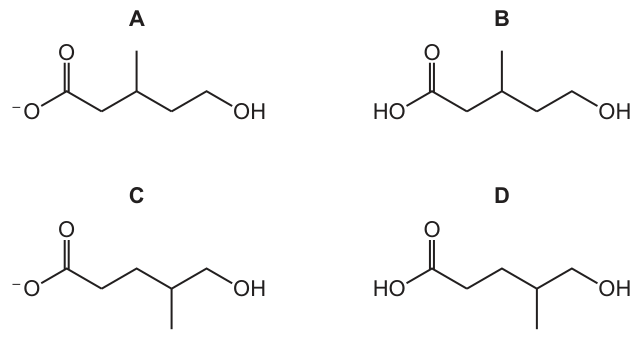
Working
Compound X is a six-membered cyclic ester (lactone). Alkaline hydrolysis with excess dilute aqueous KOH cleaves the acyl–oxygen bond, opening the ring.
The ester C–O bond breaks to give a carboxylate salt (⁻OOC–) and a primary alcohol (–CH₂OH). Because KOH is in excess, the carboxylic acid is deprotonated to the carboxylate ion.
Tracing the carbon skeleton: the methyl group is on the carbon β to the carboxylate (C-3 from COO⁻), giving:
This matches option A (carboxylate with primary alcohol, methyl on C-3 from COO⁻).
Answer
A
A
Background Concept
A lactone is a cyclic ester formed by intramolecular esterification of a hydroxy acid. Lactones undergo hydrolysis like any ester: the acyl–oxygen bond (the C(=O)–O bond) is cleaved, regenerating the hydroxy acid. Under alkaline conditions (saponification), the reaction is irreversible because the carboxylic acid product is immediately deprotonated by the base to give a carboxylate salt. With excess KOH, the product is always the carboxylate anion, never the neutral carboxylic acid.
The key mechanistic point is that ester hydrolysis involves acyl–oxygen cleavage: the bond between the carbonyl carbon and the ester oxygen breaks. The oxygen atom that was part of the ring stays bonded to the alkyl chain and becomes the hydroxyl group of the alcohol product.
Understanding the Question
The question presents compound X as a six-membered lactone ring with a methyl substituent and asks for the organic product after treatment with excess dilute aqueous KOH. The four options differ in two ways: (1) whether the acid group is a carboxylate ion (⁻OOC) or a carboxylic acid (HOOC), and (2) the position of the methyl group along the carbon chain relative to the two functional groups.
Approach
- Identify the type of reaction: alkaline hydrolysis (saponification) of a lactone.
- Determine the product ionisation: excess KOH means carboxylate, not carboxylic acid → eliminates B and D.
- Trace the ring-opening: the acyl–oxygen bond breaks, the ring oxygen becomes –OH on the alkyl chain, and the carbonyl becomes –COO⁻.
- Locate the methyl group in the opened chain by following the connectivity around the ring.
Step-by-Step Reasoning
Step 1: Ring structure. The lactone ring consists of six atoms: the carbonyl carbon (C=O), the ring oxygen (O), and four carbon atoms. Tracing from the carbonyl carbon around the ring: C(=O) → O → CH₂ → CH₂ → CH(CH₃) → CH₂ → back to C(=O).
Step 2: Bond cleavage. In ester hydrolysis, the acyl–oxygen bond breaks — that is, the bond between the carbonyl carbon and the ring oxygen. This opens the ring.
Step 3: Product formation. After cleavage:
- The carbonyl carbon becomes the carboxylate: ⁻OOC–CH₂–CH(CH₃)–CH₂–CH₂–OH
- The ring oxygen, still bonded to its alkyl carbon, becomes the hydroxyl group: –CH₂–OH (a primary alcohol)
Step 4: Effect of excess KOH. Since KOH is in excess, any carboxylic acid formed is immediately neutralised to the carboxylate salt. This eliminates options B and D (which show –COOH).
Step 5: Methyl position. In the opened chain, counting from the carboxylate end: C1 = COO⁻, C2 = CH₂, C3 = CH(CH₃), C4 = CH₂, C5 = CH₂OH. The methyl is on C3, which is closer to the carboxylate end. This matches option A. Option C has the methyl on C3 counting from the alcohol end (equivalent to C3 from the carboxylate in a 5-carbon chain would be the same position — but looking at the skeletal structures, option C has the methyl on the carbon adjacent to the CH₂OH, i.e., C4 from the carboxylate), which is incorrect.
Distractor analysis:
- Option B: correct carbon skeleton and methyl position, but shows –COOH instead of –COO⁻. Incorrect because excess KOH deprotonates the acid.
- Option C: correct ionisation state (carboxylate) but wrong methyl position — the methyl is placed closer to the alcohol end rather than the carboxylate end.
- Option D: wrong on both counts — carboxylic acid and wrong methyl position.
Key Takeaways
- Lactone hydrolysis opens the ring by cleaving the acyl–oxygen bond.
- Excess alkali always gives the carboxylate salt, not the free acid.
- When tracing substituent positions after ring opening, follow the connectivity carefully from the carbonyl carbon through the ring to determine which carbon bears the substituent relative to each functional group.
Common Mistakes
- Choosing B or D by forgetting that excess KOH deprotonates the carboxylic acid product. The mark scheme specifically tests whether students recognise the carboxylate form.
- Choosing C by miscounting the methyl position — students may trace from the wrong end of the ring or confuse which side of the ester bond the methyl is on.
- Thinking the alkyl–oxygen bond breaks instead of the acyl–oxygen bond, which would give a different product entirely.
Things to Be Careful About
- The word "excess" in "excess dilute aqueous potassium hydroxide" is critical — it guarantees complete deprotonation to the carboxylate.
- In skeletal structures, carefully count vertices from each functional group end to confirm the methyl position.
- Distinguish between primary and secondary alcohols: the ring oxygen in this lactone is bonded to a CH₂, so the resulting alcohol is primary (–CH₂OH), which is consistent across all four options.
A section showing two repeat units of an addition polymer is shown.
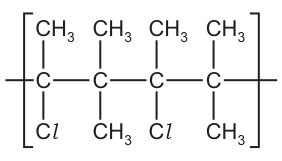
What is the identity of the monomer that produced this polymer?
Options
A 2-chloro-3-methylbutane
B 2-chloro-3-methylbut-2-ene
C 2-chloropent-2-ene
D 2,4-dichloro-3,3,4,5-tetramethylhexane
Working
The image shows a section of an addition polymer containing two repeat units. The backbone consists of four carbon atoms with the following substituents:
- Carbon 1: bonded to a group and a atom.
- Carbon 2: bonded to two groups.
- Carbon 3: bonded to a group and a atom.
- Carbon 4: bonded to two groups.
The repeating pattern is . This unit repeats every two carbon atoms in the backbone.
In an addition polymer, the repeat unit is formed by the opening of a carbon-carbon double bond () in the monomer. To find the monomer, we take one repeat unit and restore the double bond between the two backbone carbon atoms:
This can be written as:
Now, we name this alkene using IUPAC rules:
- Longest chain containing the double bond: The longest carbon chain containing the bond has 4 carbons, so the parent name is butene.
- Numbering: Number the chain to give the double bond the lowest possible locant. The double bond is between C2 and C3, so it is but-2-ene.
- Substituents:
- At C2: a chlorine atom ().
- At C3: a methyl group ().
- Assemble the name: Alphabetical order puts chloro before methyl. The name is 2-chloro-3-methylbut-2-ene.
Comparing this with the options:
- A is an alkane (butane derivative), which cannot undergo addition polymerisation.
- B matches our derived name: 2-chloro-3-methylbut-2-ene.
- C (2-chloropent-2-ene) would produce a polymer with an ethyl group in the repeat unit, which is not present.
- D is a large alkane, not an alkene.
Answer
B
B
Background Concept
Addition Polymerisation
Addition polymerisation is a process where many small molecules called monomers join together to form a large molecule called a polymer, without the loss of any small molecules. This process typically involves monomers containing a carbon-carbon double bond (), known as alkenes.
During the reaction, the -bond (the second bond) of the double bond breaks, allowing the carbon atoms to form new -bonds (single bonds) with adjacent monomer units. This creates a long carbon backbone (the polymer chain) with the original substituents attached to it.
Identifying the Monomer from a Polymer
To deduce the monomer from a given polymer structure:
- Identify the repeat unit: Look for the smallest repeating pattern in the polymer backbone. In addition polymers derived from alkenes, the repeat unit typically contains two carbon atoms from the original double bond.
- Restore the double bond: Remove the bonds connecting the repeat unit to the rest of the chain (the bonds extending out of the brackets) and place a double bond between the two backbone carbon atoms within the repeat unit.
- Name the monomer: Apply IUPAC nomenclature rules to the resulting alkene.
Understanding the Question
The question provides a diagram (Fig. 39.1) showing a section of an addition polymer with two repeat units. The structure inside the brackets is:
We are asked to identify the monomer that produced this polymer from four options. The options include alkanes and alkenes. Since addition polymerisation requires an unsaturated monomer (specifically an alkene with a bond), we can immediately eliminate any alkane options.
Approach
- Analyze the polymer structure: Determine the repeating unit by observing the pattern of substituents on the carbon backbone.
- Reverse the polymerisation: Convert the single-bonded backbone carbons back into a double bond to reveal the monomer structure.
- Evaluate the options: Check which option matches the deduced monomer structure and name. Eliminate options that are not alkenes or have incorrect structures.
Step-by-Step Reasoning
Step 1: Identify the repeat unit.
Looking at the image, the backbone has four carbons shown. The substituents are:
- C1: (up), (down)
- C2: (up), (down)
- C3: (up), (down)
- C4: (up), (down)
The pattern repeats every two carbons: . This is the repeat unit.
Step 2: Deduce the monomer structure.
Take the repeat unit and join the two backbone carbons with a double bond:
Expanding this structure:
- The left carbon of the double bond is attached to a methyl group () and a chlorine atom ().
- The right carbon of the double bond is attached to two methyl groups ().
This can be written as: .
Step 3: Name the monomer.
- Parent chain: The longest carbon chain containing the double bond has 4 carbons: . This is a butene.
- Numbering: Number from left to right to give the double bond the lowest locant (starts at C2). So, but-2-ene.
- Substituents:
- At C2: a chlorine atom ().
- At C3: a methyl group ().
- Full name: Alphabetical order: 2-chloro-3-methylbut-2-ene.
Step 4: Check the options.
- A (2-chloro-3-methylbutane): This is a saturated alkane. It cannot undergo addition polymerisation. Incorrect.
- B (2-chloro-3-methylbut-2-ene): This matches our derived name and structure. Correct.
- C (2-chloropent-2-ene): The structure would be . The repeat unit would have an ethyl group (), which is not present in the diagram. Incorrect.
- D (2,4-dichloro-3,3,4,5-tetramethylhexane): This is a large saturated alkane. Incorrect.
Key Takeaways
- Addition polymers are formed from monomers with double bonds.
- To find the monomer from a polymer, identify the repeat unit (usually 2 carbons in the backbone for simple alkenes) and restore the double bond between those carbons.
- IUPAC naming rules must be applied correctly to the deduced monomer, prioritizing the double bond for numbering.
Common Mistakes
- Confusing addition and condensation polymers: Addition polymers retain all atoms from the monomer in the repeat unit (no small molecules lost). Condensation polymers (like polyesters or polyamides) lose small molecules (like water) and have heteroatoms (O, N) in the backbone. This question is clearly addition polymerisation due to the carbon-only backbone.
- Misidentifying the repeat unit: Students might try to use the entire 4-carbon section shown as the repeat unit. However, polymers repeat indefinitely, and the pattern clearly repeats. The repeat unit is 2 carbons long.
- Naming errors: Forgetting to number the chain to give the double bond the lowest locant, or miscounting the longest chain. For example, counting the methyl groups as part of the main chain instead of as substituents.
- Ignoring the state of saturation: Choosing an alkane option (A or D) without realizing that alkanes do not undergo addition polymerisation.
Things to Be Careful About
- State symbols and bonds: Ensure you draw the double bond correctly in the monomer. The single bonds in the polymer backbone become the double bond in the monomer.
- Substituent positions: Be careful to place the and groups on the correct carbons when deducing the monomer structure. In the diagram, C1 has and C2 has two groups. This translates to C2 having and C3 having an extra in the 4-carbon chain naming.
- Alphabetical order in naming: When assembling the name, list substituents alphabetically (chloro before methyl), regardless of their position numbers.
The relative atomic mass of antimony is 121.76.
Antimony has two isotopes. The mass numbers of the two isotopes differ by two. The isotope with the lower mass number is the more abundant.
What is the percentage abundance of the isotope with the higher mass number?
Options
A
B
C
D
Working
Let = fraction of the higher-mass isotope (mass number 123).
Then = fraction of the lower-mass isotope (mass number 121).
Answer
B ()
B
Background Concept
Isotopes are atoms of the same element with the same number of protons but different numbers of neutrons, so they have different mass numbers. The relative atomic mass () quoted on the periodic table is a weighted average of the masses of all naturally occurring isotopes, weighted by their relative abundance.
The formula is:
Since the fractional abundances sum to 1, if one isotope has fraction , the other has fraction .
Understanding the Question
Antimony has . It has two isotopes whose mass numbers differ by 2. The more abundant isotope has the lower mass number. We need the percentage abundance of the higher-mass isotope.
Since the two mass numbers differ by 2 and bracket the relative atomic mass, the isotopes must be and . The value 121.76 lies between 121 and 123, closer to 121, which is consistent with the lower-mass isotope being more abundant.
Approach
- Identify the two isotopic mass numbers (121 and 123).
- Let = fraction of (the higher-mass isotope).
- Then = fraction of .
- Set up the weighted-average equation and solve for .
- Convert the fraction to a percentage.
Step-by-Step Reasoning
Let be the fraction of the higher-mass isotope, .
Then the fraction of is .
Weighted average:
Expand:
Subtract 121 from both sides:
Divide by 2:
As a percentage: .
This matches option B.
Check: the lower-mass isotope has abundance , which is indeed more abundant, as stated in the question.
Key Takeaways
- Relative atomic mass is a weighted average, not a simple average.
- When two isotopes differ by 2 mass units and bracket , the closer isotope to is the more abundant one.
- Always let the unknown fraction be and the other be — this avoids errors from using two unknowns.
Common Mistakes
- Forgetting that the two abundances must sum to 1 (or 100%).
- Assigning to the wrong isotope and then misreading which abundance is asked for.
- Confusing the weighted average with a simple average, which would give 50/50.
Things to Be Careful About
- The question asks for the abundance of the higher mass number isotope, so after solving for , double-check which isotope represents.
- Ensure the percentage is expressed correctly (multiply the fraction by 100).
- The fact that the lower-mass isotope is more abundant is a useful sanity check: the final percentage for the higher-mass isotope should be less than 50%.
Your score so far
Answer a question to start scoring
Your marks add up here as you work through the paper.