Chemistry 9701/22 — February/March 2024
Cambridge AS Level · AS Level Structured Questions · worked solutions for every part, with the mark scheme
Topics Chemical Bonding · Hydrocarbons · Halogen Compounds · Atoms, Molecules and Stoichiometry · States of Matter · Electrochemistry · +11 more
Bismuth is an element in Group 15 of the Periodic Table.
Bismuth has metallic bonding.
Draw a labelled diagram to show the metallic bonding in bismuth.
Answer
A regular three-dimensional lattice of positive ions (cations) surrounded by a sea of delocalised electrons.
Regular lattice of positive ions surrounded by delocalised electrons (see diagram)
Background Concept
Metallic bonding is the electrostatic attraction between a regular, three-dimensional lattice of positive metal ions (cations) and a 'sea' of delocalised electrons. The delocalised electrons are valence electrons that have been removed from their parent atoms and are free to move throughout the entire metallic structure. This model explains the typical properties of metals, such as high electrical and thermal conductivity, malleability, and ductility.
Understanding the Question
The question asks for a labelled diagram showing the metallic bonding in bismuth, a Group 15 element that exhibits metallic bonding. You need to represent the two key components: the positive ions and the delocalised electrons, and clearly label them.
Approach
Draw a regular, repeating arrangement of circles with a '+' sign inside to represent the positive metal ions. Scatter smaller circles with a '-' sign (or simply '-' signs) between the ions to represent the delocalised electrons. Add clear labels for 'positive ions' and 'delocalised electrons'.
Step-by-Step Reasoning
- Positive ions: Metal atoms lose their valence electrons to form cations. In a solid metal, these cations are arranged in a regular, repeating 3D lattice. Draw rows or a grid of circles containing a '+' sign.
- Delocalised electrons: The valence electrons are not bound to any specific ion; they are free to move throughout the structure. Represent these as smaller circles with a '-' sign, or just '-' signs, distributed in the spaces between the positive ions.
- Labels: Clearly label the '+' circles as 'positive ions' (or 'metal cations') and the '-' symbols as 'delocalised electrons'.
Key Takeaways
Metallic bonding is always modelled as a regular lattice of positive ions in a sea of delocalised electrons. Diagrams must show both components clearly and be labelled.
Common Mistakes
- Drawing covalent bonds between the metal ions (metals do not form directional covalent bonds in their bulk structure).
- Forgetting to label the diagram.
- Showing electrons as belonging to specific atoms rather than being delocalised throughout the lattice.
Things to Be Careful About
Ensure the arrangement of ions looks regular and repeating (like a grid or close-packed layers). The electrons must be shown between the ions, not attached to them. Labels are essential to score the mark.
Bismuth reduces water to form bismuth oxide, . A colourless gas that ignites with a squeaky pop also forms.
Answer
2Bi + 3H2O -> Bi2O3 + 3H2
Background Concept
When a metal reduces water, it typically forms a metal oxide (or hydroxide) and hydrogen gas. The metal is oxidised, and the hydrogen in water is reduced from an oxidation state of +1 to 0 in H2. Balancing such equations requires ensuring that the number of atoms of each element and the total charge are equal on both sides.
Understanding the Question
The question states that bismuth reduces water to form bismuth oxide (Bi2O3) and a colourless gas that ignites with a squeaky pop. The 'squeaky pop' test is the standard identification for hydrogen gas (H2). You need to write a balanced symbol equation for this reaction.
Approach
- Write the unbalanced equation with the known reactants (Bi, H2O) and products (Bi2O3, H2).
- Balance the bismuth atoms.
- Balance the oxygen atoms by adjusting the coefficient of H2O.
- Balance the hydrogen atoms by adjusting the coefficient of H2.
- Add state symbols where appropriate (though the mark scheme does not strictly require them for this specific mark, it is good practice).
Step-by-Step Reasoning
- Reactants and products: Bi + H2O -> Bi2O3 + H2
- Balance Bi: There are 2 Bi atoms on the right, so put a 2 in front of Bi on the left: 2Bi + H2O -> Bi2O3 + H2
- Balance O: There are 3 O atoms on the right (in Bi2O3), so put a 3 in front of H2O: 2Bi + 3H2O -> Bi2O3 + H2
- Balance H: There are 6 H atoms on the left (3 x 2), so put a 3 in front of H2 on the right: 2Bi + 3H2O -> Bi2O3 + 3H2
- Final check: 2 Bi, 3 O, 6 H on both sides. The equation is balanced.
Key Takeaways
Always identify the products from the description (e.g., 'squeaky pop' = H2) before balancing. Count atoms of each element systematically: balance metals first, then non-metals like oxygen, and finally hydrogen.
Common Mistakes
- Forgetting to balance the equation (e.g., Bi + H2O -> Bi2O3 + H2).
- Writing the wrong product for hydrogen (e.g., H instead of H2).
- Incorrectly balancing oxygen and hydrogen simultaneously.
Things to Be Careful About
Ensure the subscripts in the formulae (Bi2O3, H2O, H2) are correct and not mixed up with coefficients. The mark scheme accepts the equation without state symbols, but including them (s, l, g) is good practice and shows chemical understanding.
is a yellow insoluble solid that melts at . The molten compound conducts electricity.
Deduce the structure and bonding of . Explain your answer.
Answer
- Structure and bonding: Giant ionic structure (or giant ionic lattice).
- Explanation: The high melting point (1090 K) indicates strong electrostatic forces of attraction between oppositely charged ions in a giant lattice. The fact that it conducts electricity only when molten indicates the presence of mobile ions that are free to move and carry charge in the liquid state, which is characteristic of ionic compounds.
Giant ionic structure; high melting point indicates strong ionic bonds; conducts when molten due to mobile ions
Background Concept
The physical properties of a substance are direct consequences of its structure and bonding.
- Giant ionic lattices consist of a regular arrangement of alternating positive and negative ions held together by strong electrostatic forces. Breaking these forces requires a lot of energy, leading to high melting and boiling points.
- Electrical conductivity in ionic compounds occurs only when the ions are free to move. In a solid lattice, ions are fixed in place, so they do not conduct. When molten (or dissolved in water), the lattice breaks down, and the ions become mobile, allowing them to carry electrical charge.
Understanding the Question
You are given two key properties of Bi2O3: it has a high melting point (1090 K) and it conducts electricity when molten. You must deduce the structure and bonding and explain how these properties support your deduction.
Approach
- Use the high melting point to argue for a giant structure with strong bonds (giant ionic or giant covalent).
- Use the electrical conductivity when molten to distinguish between ionic and giant covalent (giant covalent like diamond does not conduct when molten, ionic does).
- Conclude it is a giant ionic structure and explicitly link each property to the bonding model.
Step-by-Step Reasoning
- Deduce structure/bonding: The combination of a high melting point and conductivity when molten is the classic signature of a giant ionic structure.
- Explain melting point: A melting point of 1090 K is very high. This means a large amount of energy is required to overcome the forces holding the structure together. In an ionic lattice, these are strong electrostatic forces of attraction between the positive and negative ions throughout the giant lattice.
- Explain conductivity: Solid ionic compounds do not conduct electricity because the ions are fixed in the lattice. When melted, the lattice breaks down, and the ions become mobile (free to move). These mobile ions can carry charge, allowing the molten compound to conduct electricity. This rules out giant covalent (which doesn't conduct) and simple molecular (which has low melting points).
Key Takeaways
Always link the physical property directly to the structural feature: high melting point -> strong bonds in a giant lattice; molten conductivity -> mobile ions -> ionic bonding.
Common Mistakes
- Saying 'it conducts because it has electrons' (ionic compounds conduct via ions, not delocalised electrons).
- Stating 'strong bonds' without specifying electrostatic forces between ions.
- Forgetting to mention that the lattice is giant.
Things to Be Careful About
The mark scheme specifically looks for 'giant' and 'ionic' as the structure/bonding deduction, and links the melting point to strong forces/lattice, and conductivity to molten/mobile ions. Ensure both halves of the explanation are present.
can be used to form , as shown in equation 1.
Deduce the oxidation number of Bi in and in .
oxidation number of Bi:
in ................................................. in ...........................................................
Answer
- in : +3
- in : +5
+3 in Bi2O3; +5 in NaBiO3
Background Concept
Oxidation number (or oxidation state) is the charge an atom would have if all bonds to atoms of different elements were 100% ionic. Rules for assigning oxidation numbers include: oxygen is usually -2 (except in peroxides), alkali metals (Group 1) are +1, and the sum of oxidation numbers in a neutral compound is zero.
Understanding the Question
You need to calculate the oxidation number of bismuth (Bi) in two different compounds: Bi2O3 and NaBiO3.
Approach
Apply the standard oxidation number rules to each compound, setting the sum of all oxidation numbers to zero.
Step-by-Step Reasoning
-
In Bi2O3:
- Oxygen has an oxidation number of -2.
- Let the oxidation number of Bi be .
- Sum: .
- Oxidation number of Bi is +3.
-
In NaBiO3:
- Sodium (Group 1) has an oxidation number of +1.
- Oxygen has an oxidation number of -2.
- Let the oxidation number of Bi be .
- Sum: .
- Oxidation number of Bi is +5.
Key Takeaways
Always use the known oxidation numbers of oxygen (-2) and Group 1 metals (+1) as anchors to solve for the unknown element. The sum must equal the overall charge of the species (0 for neutral compounds).
Common Mistakes
- Forgetting to multiply the oxidation number of oxygen by its subscript (e.g., using -2 instead of -6 for O3).
- Missing the contribution of sodium in NaBiO3 (treating it as if only Bi and O are present).
Things to Be Careful About
Ensure algebraic signs are correct. means , so , not -3.
Answer
Bi2O3
Bi2O3
Background Concept
- Oxidation is the loss of electrons, resulting in an increase in oxidation number.
- Reduction is the gain of electrons, resulting in a decrease in oxidation number.
- The reducing agent is the substance that causes reduction in another species by losing electrons itself (i.e., it is oxidised).
- The oxidising agent is the substance that causes oxidation in another species by gaining electrons itself (i.e., it is reduced).
Understanding the Question
In equation 1: , you need to identify the reducing agent.
Approach
Determine the oxidation number of the key elements (Bi and O) on both sides of the equation. The element that is oxidised (increases in oxidation number) belongs to the reducing agent.
Step-by-Step Reasoning
-
Track Bismuth (Bi):
- In reactant , Bi is +3 (calculated in part c(i)).
- In product , Bi is +5 (calculated in part c(i)).
- Bi goes from +3 to +5. It has lost electrons, so Bi is oxidised.
-
Track Oxygen (O):
- In , O is 0.
- In products, O is -2.
- O goes from 0 to -2. It has gained electrons, so O is reduced.
-
Identify agents:
- Since Bi in is oxidised, acts as the reducing agent.
- Since O in is reduced, acts as the oxidising agent.
Key Takeaways
The reducing agent is the reactant containing the element that is oxidised (oxidation number increases). Always check the oxidation numbers of all elements that change.
Common Mistakes
- Confusing the reducing agent with the element that is reduced. Remember: the reducing agent gets oxidised.
- Forgetting to check the oxidation state of oxygen in O2 (which is 0, not -2).
Things to Be Careful About
The question asks for the 'reducing agent', which is the whole compound (), not just the element (Bi). Writing 'Bi' would likely lose a mark.
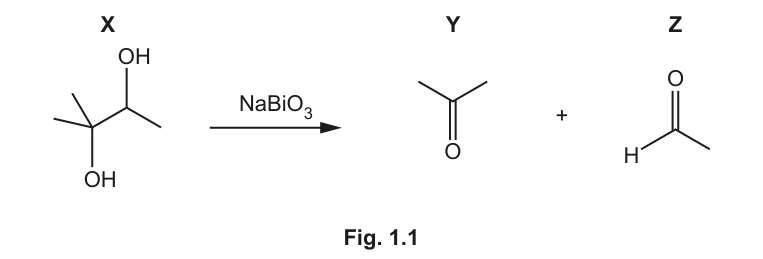
is an oxidising agent with similar properties to .
Fig. 1.1 shows an example of the use of as an oxidising agent.
Answer
An oxidising agent is a substance that gains electrons (or causes another substance to lose electrons) in a redox reaction.
A substance that gains electrons / causes electron loss
Background Concept
In redox reactions, electron transfer is the fundamental process. The substance that accepts electrons is reduced and is called the oxidising agent because it forces the other reactant to lose electrons (be oxidised). Mnemonic: OIL RIG (Oxidation Is Loss, Reduction Is Gain) or LEO says GER (Lose Electrons Oxidation, Gain Electrons Reduction). The agent is named for what it does to the other substance, not what happens to itself.
Understanding the Question
You need to provide a standard chemical definition of an oxidising agent.
Approach
State clearly that an oxidising agent gains electrons or causes another species to lose electrons.
Step-by-Step Reasoning
- An oxidising agent facilitates oxidation of another substance.
- To oxidise another substance, it must take electrons from it.
- Therefore, the oxidising agent itself gains electrons (and is reduced).
Key Takeaways
Always define agents in terms of electron transfer: oxidising agent = gains electrons; reducing agent = loses electrons.
Common Mistakes
- Saying 'an oxidising agent is oxidised' (this is the opposite of the truth; it is reduced).
- Vague answers like 'it helps reactions happen'.
Things to Be Careful About
Use precise terminology: 'gains electrons' or 'causes electron loss'. Avoid saying 'it has oxygen' (though historically true, it is not the modern definition and doesn't apply to all oxidising agents like KMnO4 or NaBiO3 in this context).
Compound X forms when methylbut-2-ene reacts with .
State the essential conditions for this reaction.
Answer
Cold and dilute (usually in alkaline/aqueous conditions).
Cold and dilute
Background Concept
Alkenes react with acidified or alkaline potassium manganate(VII) () depending on the conditions:
- Cold, dilute, alkaline : Forms a 1,2-diol (glycol). The purple is reduced to brown (in alkaline) or colourless (in acid, though acid is less common for diol formation to avoid cleavage).
- Hot, concentrated, acidified : Cleaves the C=C bond completely, forming ketones and/or carboxylic acids depending on the substituents.
Understanding the Question
Compound X is a diol (1,2-diol) formed from methylbut-2-ene. The question asks for the essential conditions for to produce a diol rather than cleaving the molecule.
Approach
Recall the standard conditions for the dihydroxylation of alkenes using .
Step-by-Step Reasoning
- To stop the oxidation at the diol stage and prevent oxidative cleavage of the C=C bond, the must be cold and dilute.
- (Optional but good context: it is typically used in alkaline or neutral aqueous solution, where a brown precipitate of forms, but 'cold and dilute' is the key marking phrase for the conditions on the itself).
Key Takeaways
Condition control is vital in organic chemistry. Cold/dilute gives diols; hot/concentrated gives cleavage products.
Common Mistakes
- Saying 'acidified' (this promotes cleavage).
- Saying 'hot' (this promotes cleavage).
- Forgetting 'dilute'.
Things to Be Careful About
The mark scheme specifically looks for 'cold' and 'dilute'. Mentioning 'alkaline' is often accepted or implied, but 'cold and dilute' are the primary discriminating factors.
Complete Table 1.1 to show what is observed when compounds Y and Z react separately with the named reagents.
Table 1.1
| reagent | observation with Y | observation with Z |
|---|---|---|
| no reaction | ||
| alkaline | ||
| 2,4-dinitrophenylhydrazine (2,4-DNPH) | ||
| Tollens' reagent |
Answer
| reagent | observation with Y (propanone) | observation with Z (ethanal) |
|---|---|---|
| no reaction | no reaction | |
| alkaline | yellow precipitate | yellow precipitate |
| 2,4-dinitrophenylhydrazine (2,4-DNPH) | red / orange / yellow precipitate | red / orange / yellow precipitate |
| Tollens' reagent | no reaction | silver mirror |
(Note: Y is propanone, a ketone with a group. Z is ethanal, an aldehyde with a group.)
See table above
Background Concept
Carbonyl compounds (aldehydes and ketones) can be distinguished and identified using specific chemical tests:
- 2,4-DNPH: Reacts with all carbonyl compounds (aldehydes and ketones) to form a yellow, orange, or red precipitate (a 2,4-dinitrophenylhydrazone). It tests for the presence of the C=O group.
- Tollens' reagent (ammoniacal silver nitrate, ): Oxidises aldehydes to carboxylic acids, reducing to metallic silver, which forms a silver mirror on the test tube. Ketones do not react (no mirror).
- Alkaline iodine (iodoform test, in ): Tests for a methyl ketone ( group) or a methyl carbinol ( group). It produces a yellow precipitate of triiodomethane (). Ethanal () also gives a positive test because it contains the fragment.
- Sodium carbonate (): Reacts with carboxylic acids to produce gas. Aldehydes and ketones are not acidic enough to react, so there is no reaction.
Understanding the Question
- Compound Y is propanone (), a ketone. It has a group.
- Compound Z is ethanal (), an aldehyde. It has a group.
- You must predict the observation for each reagent with both Y and Z.
Approach
Evaluate each reagent against the structural features of Y and Z:
- Does it have a C=O group? (Tests with 2,4-DNPH)
- Is it an aldehyde or ketone? (Tests with Tollens')
- Does it have a or group? (Tests with alkaline )
- Is it acidic? (Tests with )
Step-by-Step Reasoning
- : Neither propanone nor ethanal is a carboxylic acid. Both are neutral. Observation: no reaction for both.
- Alkaline (Iodoform test):
- Y (propanone) has the group. Positive test: yellow precipitate ().
- Z (ethanal) has the group (which contains ). Positive test: yellow precipitate.
- 2,4-DNPH: Both Y and Z contain a C=O group. Positive test: red/orange/yellow precipitate for both.
- Tollens' reagent:
- Y (ketone) cannot be oxidised. Negative test: no reaction.
- Z (aldehyde) is oxidised to ethanoic acid, reducing to Ag. Positive test: silver mirror.
Key Takeaways
Memorise the specific structural requirements for each carbonyl test: 2,4-DNPH for C=O, Tollens' for aldehydes, alkaline for methyl carbonyls ( or ).
Common Mistakes
- Thinking Tollens' reagent reacts with ketones.
- Forgetting that ethanal gives a positive iodoform test (many students only associate it with methyl ketones).
- Confusing the colour of the 2,4-DNPH precipitate (must be red, orange, or yellow; 'white' or 'blue' is wrong).
Things to Be Careful About
- Ensure the table is completed for both columns. A missing observation in one column loses a mark.
- 'Yellow precipitate' is the specific observation for the iodoform test; 'precipitate' alone is not enough.
- 'Silver mirror' is the specific observation for Tollens'; 'grey precipitate' or 'silver' alone might not score.
Construct an equation for the reaction of Z with .
Use [H] to represent an atom of hydrogen from the reducing agent.
Answer
CH3CHO + 2[H] -> CH3CH2OH
Background Concept
Aldehydes can be reduced to primary alcohols using reducing agents like sodium borohydride () or lithium aluminium hydride (). In simplified equations, the reducing agent is often represented by , which denotes a hydrogen atom (or a hydride ion plus a proton ). The reduction of an aldehyde involves adding two hydrogen atoms across the C=O double bond: one to the carbon and one to the oxygen.
Understanding the Question
Compound Z is ethanal (). You need to write the equation for its reaction with , using to represent the reducing agent.
Approach
- Identify the product: reduction of an aldehyde gives a primary alcohol. Ethanal -> ethanol ().
- Balance the equation using . The C=O becomes CH-OH, requiring 2 hydrogen atoms.
Step-by-Step Reasoning
- Reactant: (ethanal).
- Product: (ethanol).
- Reduction: The C=O double bond is reduced to a C-O single bond, and the carbon gains an H, the oxygen gains an H. Total of 2 H atoms added.
- Equation: .
Key Takeaways
Aldehydes reduce to primary alcohodes; ketones reduce to secondary alcohols. The notation represents the addition of two hydrogen atoms (reduction).
Common Mistakes
- Writing the wrong product (e.g., carboxylic acid, which is oxidation, not reduction).
- Using instead of (the mark scheme specifically asks for to represent atoms from the reducing agent).
- Forgetting to balance the hydrogens.
Things to Be Careful About
The question explicitly says: 'Use [H] to represent an atom of hydrogen from the reducing agent.' Therefore, you must write , not or .
can be used to determine the concentration of . The ionic equation for the reaction is shown in equation 2.
A student uses the following procedure in an experiment.
- Add of a saturated solution of to a volumetric flask.
- Add distilled water to the flask to make a diluted solution.
- Titrate a sample of the diluted solution with .
The sample of the diluted solution of reacts completely with exactly of .
Calculate the concentration, in , of in the saturated solution.
Show your working.
Working
-
Moles of used:
-
Moles of in the sample (from equation 2, ratio ):
-
Moles of in the diluted solution (dilution factor = ):
-
Concentration of in the saturated solution (the diluted solution was made from of the saturated solution, so moles are conserved):
(Alternatively: )
Answer
0.344 mol dm-3
Background Concept
This is a titration calculation involving a redox reaction and a dilution step. The key principles are:
- Titration: Use (with in ) to find moles of the titrant.
- Stoichiometry: Use the molar ratio from the balanced equation to find moles of the analyte in the titrated sample.
- Dilution: Moles are conserved during dilution ( or simply scaling the moles by the dilution factor). The concentration of the original saturated solution can be found by dividing the total moles in the diluted volume by the original volume taken.
Understanding the Question
- A sample of saturated is diluted to ().
- A aliquot of this diluted solution is titrated with .
- The titre is .
- Equation 2: (ratio ).
- Find the concentration of in the original saturated solution.
Approach
- Calculate moles of used in the titration.
- Use the 2:5 ratio to find moles of in the aliquot.
- Scale up to find moles of in the full diluted solution (multiply by ).
- These moles came from the original of saturated solution. Calculate the concentration: (with ).
Step-by-Step Reasoning
-
Moles of titrant ():
-
Moles of in sample:
From the equation, 5 moles of react with 2 moles of . -
Moles of in the diluted solution:
The sample is of the total . -
Concentration in the saturated solution:
The of originally came from () of the saturated solution.(Note: The mark scheme shows a slightly different grouping: , then . Both are mathematically identical and correct.)
Key Takeaways
In dilution-titration problems, always track the moles. Calculate moles in the aliquot, scale to the total diluted volume, and then use the original volume to find the original concentration. Do not mix up the dilution factor (total volume / aliquot volume) with the concentration dilution factor.
Common Mistakes
- Forgetting to convert to for the titre volume.
- Using the wrong stoichiometric ratio (e.g., 5:2 instead of 2:5 for Mn:Bi).
- Forgetting to account for the dilution step (calculating the concentration of the diluted solution instead of the saturated one).
- Dividing by 1000 twice or missing a factor of 10 in the dilution calculation.
Things to Be Careful About
- Significant figures: The data given (21.50, 0.100, 25.00, 100.0, 1.00) has 3 or 4 sig figs. The answer has 3 sig figs, which is appropriate.
- Ensure state symbols or units are correct in intermediate steps if required, though for the final answer, 'mol dm^-3' is essential.
- The equation uses , but the titrant is . Since NaBiO3 dissociates to give , 1 mole of NaBiO3 gives 1 mole of . This is a subtle point that doesn't change the math but is good to understand.
Chlorine, , reacts with many elements and compounds to form chlorides.
Table 2.1 shows information about some chlorides of Period 3 elements.
Complete Table 2.1.
Table 2.1
| Na | Mg | Si | |
|---|---|---|---|
| formula of chloride | |||
| structure of chloride | giant | ||
| bonding of chloride | covalent | ||
| pH of solution formed on addition of chloride to water | 6.2 |
Answer
| Na | Mg | Si | |
|---|---|---|---|
| formula of chloride | NaCl | MgCl | SiCl |
| structure of chloride | giant | giant | simple |
| bonding of chloride | ionic | ionic | covalent |
| pH of solution formed | 7 | 6.2 | 1–4 |
See completed table above.
Background Concept
The properties of Period 3 chlorides change across the period as the bonding changes from ionic (metals on the left) to covalent (non-metals on the right). Sodium chloride (NaCl) and magnesium chloride (MgCl) are giant ionic lattices. Silicon tetrachloride (SiCl) is a simple covalent molecule. When added to water, ionic chlorides of Group 1 and 2 (except Mg which is slightly acidic due to polarisation) dissolve to give neutral or near-neutral solutions. Simple covalent chlorides like SiCl react vigorously with water (hydrolyse) to form acidic solutions (HCl and HSiO or SiO·HO), giving a low pH (1–4). MgCl hydrolyses slightly to give a weakly acidic solution (pH ~6.2).
Understanding the Question
The question asks to complete a table comparing the chloride of sodium (Na), magnesium (Mg), and silicon (Si). We need to provide the formula, structure type, bonding type, and the pH of the aqueous solution formed. The table already gives 'giant' structure for NaCl, 'covalent' bonding for SiCl, and pH 6.2 for MgCl.
Approach
- Formulae: Use group numbers to determine oxidation states: Na, Mg, Si, Cl. Formulas are NaCl, MgCl, SiCl.
- Structure and Bonding: Na and Mg are metals; their chlorides are giant ionic lattices. Si is a metalloid/non-metal; SiCl is a simple molecular structure with covalent bonding.
- pH: NaCl is neutral (pH 7). MgCl is given as 6.2. SiCl hydrolyses to form HCl, which is a strong acid, so pH is 1–4.
Step-by-Step Reasoning
- NaCl: Sodium is a Group 1 metal. Formula is NaCl. It forms a giant ionic lattice with ionic bonding. Dissolving in water gives Na and Cl, neither hydrolyses significantly, so pH = 7.
- MgCl: Magnesium is a Group 2 metal. Formula is MgCl. Giant ionic lattice, ionic bonding. The small, highly charged Mg ion polarises water molecules slightly, releasing H, giving a weakly acidic pH of 6.2 (given).
- SiCl: Silicon is a Group 4 element. Formula is SiCl. It forms simple covalent molecules. In water, it hydrolyses: SiCl(l) + 2HO(l) → SiO(s) + 4HCl(aq). The HCl makes the solution strongly acidic, pH 1–4.
Key Takeaways
- Period 3 chlorides transition from ionic (NaCl, MgCl) to covalent (SiCl) across the period.
- Ionic chlorides of reactive metals give neutral solutions; covalent chlorides hydrolyse to give acidic solutions.
- Mg is an exception among Group 2 chlorides in giving a slightly acidic solution due to cation polarisation.
Common Mistakes
- Writing SiCl instead of SiCl (silicon is Group 4, needs 4 bonds).
- Describing SiCl as having a 'giant' structure or 'ionic' bonding.
- Giving pH = 7 for SiCl (forgetting hydrolysis produces HCl).
- Writing 'molecular' instead of 'simple' for the structure of SiCl (though 'molecular' is often accepted, 'simple' is the precise term used in mark schemes to contrast with 'giant').
Things to Be Careful About
- Ensure formulae are correctly sub-scripted (MgCl, SiCl).
- The pH for SiCl is a range (1–4) because it depends on concentration, but must be clearly acidic.
- Do not confuse the bonding in MgCl (ionic) with SiCl (covalent).
When reacts with cold , is both oxidised and reduced. The products are , water and G.
State the type of redox reaction in which the same species is both oxidised and reduced.
Answer
Disproportionation.
Disproportionation
Background Concept
In a disproportionation reaction, the same element in a single reactant is simultaneously oxidised and reduced. This means the oxidation state of the element increases in one product and decreases in another.
Understanding the Question
The question states that Cl reacts with cold NaOH(aq) and is both oxidised and reduced. We need to name this type of reaction.
Approach
Recall the definition of a reaction where a single species is both oxidised and reduced.
Step-by-Step Reasoning
- Chlorine (oxidation state 0) forms NaCl (Cl is -1, reduced) and NaClO (Cl is +1, oxidised).
- Since Cl is both oxidised and reduced, the reaction is a disproportionation.
Key Takeaways
- Disproportionation involves the same element changing to a higher and lower oxidation state.
- Halogens disproportionating in alkali is a classic example (cold vs hot conditions give different products).
Common Mistakes
- Writing 'redox' (too general; the question asks for the specific type).
- Confusing with 'comproportionation' (the reverse process).
Things to Be Careful About
- Use the exact term 'disproportionation'.
Answer
NaClO (or sodium chlorate(I)).
NaClO
Background Concept
When chlorine reacts with cold dilute sodium hydroxide, it disproportionates to form sodium chloride (NaCl) and sodium chlorate(I) (NaClO), also known as sodium hypochlorite. This is the basis of bleach production.
Equation: Cl(g) + 2NaOH(aq) → NaCl(aq) + NaClO(aq) + HO(l)
Understanding the Question
The reaction produces NaCl, water, and G. We need to identify G.
Approach
Compare with the standard cold disproportionation equation for Cl and NaOH.
Step-by-Step Reasoning
- Reactants: Cl + NaOH
- Products given: NaCl, HO, G
- Balancing the equation: Cl + 2NaOH → NaCl + NaClO + HO
- Therefore, G is NaClO (sodium chlorate(I)).
Key Takeaways
- Cold alkali + Cl → chloride + chlorate(I) (hypochlorite).
- Hot alkali + Cl → chloride + chlorate(V) (chlorate). See part (b)(iii).
Common Mistakes
- Writing 'chlorine water' or 'HClO' (the product in alkaline solution is the salt, NaClO).
- Writing NaClO (this is formed in hot conditions).
Things to Be Careful About
- Naming: NaClO is sodium chlorate(I) or sodium hypochlorite. Both are acceptable, but the formula NaClO is unambiguous.
Answer
3Cl2 + 6NaOH -> NaClO3 + 5NaCl + 3H2O
Background Concept
The products of chlorine disproportionation depend on temperature.
- Cold: Cl + 2NaOH → NaCl + NaClO + HO (chlorate(I), Cl is +1)
- Hot: 3Cl + 6NaOH → NaClO + 5NaCl + 3HO (chlorate(V), Cl is +5)
The hot reaction is thermodynamically more favourable; chlorate(I) disproportionates further to chlorate(V) and chloride when heated.
Understanding the Question
Write the equation for Cl reacting with hot NaOH(aq).
Approach
Recall the hot disproportionation products: chloride (Cl) and chlorate(V) (ClO). Balance the redox half-equations or use oxidation number changes.
Step-by-Step Reasoning
- Reduction: Cl + 2e → 2Cl (oxidation state 0 to -1)
- Oxidation: Cl + 6OH → 2ClO + 3HO + 10e (oxidation state 0 to +5)
- Multiply reduction by 5 to balance electrons: 5Cl + 10e → 10Cl
- Add: 6Cl + 6OH → 2ClO + 10Cl + 3HO
- Simplify (divide by 2): 3Cl + 3OH → ClO + 5Cl + 1.5HO
- Multiply by 2 to get whole numbers for NaOH/HO: 3Cl + 6NaOH → NaClO + 5NaCl + 3HO
Key Takeaways
- Cold NaOH + Cl → NaClO (chlorate(I)).
- Hot NaOH + Cl → NaClO (chlorate(V)).
- Always check the temperature condition in the question.
Common Mistakes
- Writing the cold equation (NaClO product) instead of the hot one.
- Incorrect balancing (e.g., missing the 5NaCl).
- Forgetting state symbols (though often not strictly required unless specified, good practice: (g), (aq), (l)).
Things to Be Careful About
- The equation is 3Cl + 6NaOH → NaClO + 5NaCl + 3HO. Do not write 1:1 ratio.
Describe fully what is observed when is added to the aqueous solution of the chloride of sodium, followed by dilute .
Answer
- A white precipitate is formed.
- The precipitate dissolves in dilute ammonia.
Working
The aqueous solution of sodium chloride contains Cl ions.
Test: Add AgNO(aq) → AgCl(s) (white ppt).
Add dilute NH(aq) → [Ag(NH)](aq) (soluble complex), ppt dissolves.
White precipitate; dissolves in dilute ammonia.
Background Concept
The test for halide ions (Cl, Br, I) uses aqueous silver nitrate (acidified with dilute HNO to remove carbonate/sulfite interference).
- Cl + Ag → AgCl(s) [white precipitate]
- Br + Ag → AgBr(s) [cream precipitate]
- I + Ag → AgI(s) [yellow precipitate]
Solubility in ammonia:
- AgCl dissolves in dilute NH(aq).
- AgBr dissolves in concentrated NH(aq).
- AgI is insoluble in ammonia.
Understanding the Question
Describe observations when AgNO(aq) is added to aqueous NaCl (chloride solution), followed by dilute NH(aq).
Approach
Recall the standard test for Cl ions: reagent, observation with AgNO, observation with dilute NH.
Step-by-Step Reasoning
- Addition of AgNO(aq): The solution contains Na and Cl (from NaCl). Ag reacts with Cl to form silver chloride, AgCl, which is a white precipitate.
- Addition of dilute NH(aq): Silver chloride is soluble in dilute ammonia because it forms the diamminesilver(I) complex ion.
The precipitate dissolves to give a colourless solution.
Key Takeaways
- Cl gives a white ppt with AgNO that dissolves in dilute NH.
- Br gives a cream ppt that dissolves in conc. NH.
- I gives a yellow ppt that is insoluble in NH.
Common Mistakes
- Forgetting to mention the colour of the precipitate (must say 'white').
- Saying the ppt 'reacts' with ammonia (it dissolves/complexes, 'reacts' is vague).
- Confusing dilute and concentrated ammonia solubility rules.
Things to Be Careful About
- The question asks to 'describe fully what is observed'. Give both observations: ppt formation and subsequent dissolution.
- Specify 'dilute' ammonia as given in the question.
An excess of reacts with phosphorus to form .
is a simple molecule in the gas phase.
It also exists in a solid form as two ions, and .
Complete Table 2.2 to identify the shapes of each of these species.
Table 2.2
| species | |||
|---|---|---|---|
| shape | tetrahedral |
Answer
| species | PCl | PCl | PCl |
|---|---|---|---|
| shape | trigonal bipyramidal | tetrahedral | octahedral |
PCl5: trigonal bipyramidal; PCl6-: octahedral
Background Concept
VSEPR (Valence Shell Electron Pair Repulsion) theory predicts molecular shapes based on the number of bonding pairs (BP) and lone pairs (LP) around the central atom. Electron pairs arrange themselves to minimise repulsion.
- 5 BP, 0 LP → Trigonal bipyramidal (e.g., PCl)
- 4 BP, 0 LP → Tetrahedral (e.g., CH, PCl)
- 6 BP, 0 LP → Octahedral (e.g., SF, PCl)
Phosphorus is in Group 15, so it has 5 valence electrons. It can expand its octet using empty d-orbitals.
Understanding the Question
Complete the table with the shapes of PCl, PCl, and PCl. PCl is given as tetrahedral.
Approach
Determine the number of electron domains (bonding pairs + lone pairs) for the central P atom in each species.
Step-by-Step Reasoning
- PCl: P has 5 valence electrons. Forms 5 single bonds with 5 Cl atoms. 5 BP, 0 LP. Total 5 domains. Shape: trigonal bipyramidal.
- PCl: P has 5 valence electrons. Positive charge means 1 less electron → 4 valence electrons. Forms 4 bonds with Cl. 4 BP, 0 LP. Total 4 domains. Shape: tetrahedral (given).
- PCl: P has 5 valence electrons. Negative charge means 1 more electron → 6 valence electrons. Forms 6 bonds with Cl. 6 BP, 0 LP. Total 6 domains. Shape: octahedral.
Key Takeaways
- P can form 5 or 6 bonds (expanded octet).
- Cation removes an electron (PCl has 4 bonds), anion adds an electron (PCl has 6 bonds).
- Shapes follow standard VSEPR: 5=trigonal bipyramidal, 6=octahedral.
Common Mistakes
- Thinking PCl has a lone pair (it doesn't, 5 bonds use all 5 valence electrons).
- Confusing trigonal bipyramidal with square pyramidal (square pyramidal is 5 BP + 1 LP, e.g., BrF).
Things to Be Careful About
- Ensure correct spelling: 'trigonal bipyramidal' and 'octahedral'.
reacts with J to form .
Identify J and state the type of reaction.
J: ................................. type of reaction: .............................................................................
Answer
J: HO (or water)
type of reaction: hydrolysis
J: H2O; type: hydrolysis
Background Concept
Covalent chlorides of non-metals (like SiCl, PCl, PCl) react vigorously with water. This is a hydrolysis reaction where the chloride bonds are broken by water, typically forming an oxyacid (or oxide/hydroxide) and HCl.
Example: PCl(l) + 4HO(l) → HPO(aq) + 5HCl(aq)
Understanding the Question
PCl reacts with J to form HPO. Identify J and the reaction type.
Approach
HPO contains oxygen. The oxygen must come from J. Water is the common reagent that hydrolyses chlorides to oxyacids.
Step-by-Step Reasoning
- Reactant: PCl. Product: HPO (phosphoric acid).
- To get oxygen and hydrogen into the product, J must be water (HO).
- The reaction breaks P-Cl bonds and forms P-OH bonds. This is the definition of hydrolysis.
- Equation: PCl + 4HO → HPO + 5HCl.
Key Takeaways
- Covalent chlorides hydrolyse in water.
- Hydrolysis of PCl gives HPO and HCl (fuming white smoke of HCl is often observed).
Common Mistakes
- Identifying J as 'oxygen' (O) - chlorides don't react with O to form oxyacids directly.
- Calling the reaction 'oxidation' - oxidation states don't change significantly (P is +5 in both PCl and HPO).
Things to Be Careful About
- 'Hydrolysis' is the specific term. 'Dissolution' is not correct as a chemical reaction type here.
reacts readily with propene to form K, 1,2-dichloropropane.
K can be used to form L.
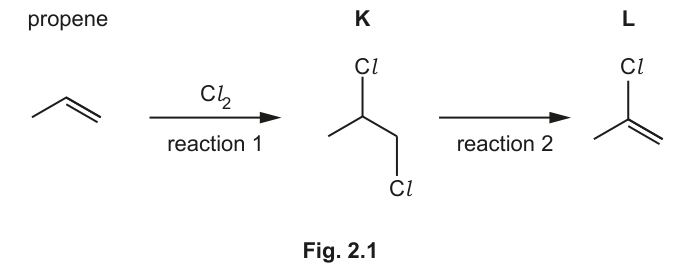
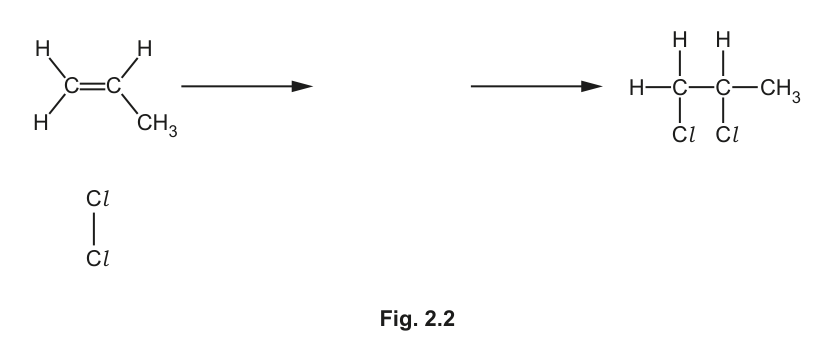
Complete Fig. 2.2 to show the mechanism for the reaction of with propene in reaction 1.
Include charges, dipoles, lone pairs of electrons and curly arrows, as appropriate.
Answer
Step 1:
- Curly arrow from the C=C double bond to the closer Cl atom (labelled ).
- Curly arrow from the Cl–Cl bond to the further Cl atom (labelled ).
- Dipole on Cl: closer Cl is , further Cl is .
Intermediate:
- Carbocation formed on the central carbon (C2) of the propane chain.
- Cl atom bonded to C1 (the end carbon).
- Positive charge on C2.
Step 2:
- Curly arrow from a lone pair on the Cl ion to the positively charged carbon (C2).
- Final product: 1,2-dichloropropane.
Working
See diagram description below for full details of arrows and charges.
See mechanism diagram below.
Background Concept
Alkenes undergo electrophilic addition with halogens (Cl, Br). The mechanism occurs in two steps:
- Formation of the carbocation: The -electrons of the C=C bond attack the electrophilic halogen molecule. The halogen molecule becomes polarised (induced dipole) by the approaching electron-rich alkene. A curly arrow goes from the C=C bond to one halogen atom, and another from the halogen-halogen bond to the other atom (heterolytic fission). This forms a halogen-substituted carbocation and a halide ion.
- Nucleophilic attack: The halide ion (nucleophile) attacks the carbocation (electrophile) using a lone pair to form the second C-X bond.
Markovnikov's Rule: In asymmetric alkenes, the hydrogen (or the electrophile in the first step if considering the intermediate stability) adds to the carbon with more hydrogens to form the more stable carbocation. For Cl addition, the Cl equivalent adds to the less substituted carbon to leave the positive charge on the more substituted (more stable) carbon.
Understanding the Question
Draw the mechanism for the reaction of propene (CHCH=CH) with Cl to form 1,2-dichloropropane. Include charges, dipoles, lone pairs, and curly arrows.
Approach
- Draw propene and Cl with an induced dipole.
- Show the first step: arrow from C=C to Cl(), arrow from Cl-Cl to Cl().
- Draw the intermediate: secondary carbocation on C2, Cl on C1.
- Show the second step: arrow from Cl lone pair to C.
Step-by-Step Reasoning
- Reactants: Propene is CH–CH=CH. Cl is non-polar but becomes polarised near the alkene: Cl–Cl.
- Step 1 (Electrophilic attack):
- A curly arrow starts from the center of the C=C double bond and points to the Cl atom that is closer (the one).
- A second curly arrow starts from the Cl–Cl bond and points to the further Cl atom (the one), showing heterolytic fission.
- This breaks the -bond and the Cl–Cl bond.
- Intermediate:
- The Cl atom is now bonded to the terminal carbon (C1, the CH end).
- The central carbon (C2, the CH end) loses a bond and becomes a carbocation (C). This is a secondary carbocation, which is more stable than the primary one that would form if Cl added to C2.
- The other chlorine is now a chloride ion, Cl, with 4 lone pairs and a negative charge.
- Step 2 (Nucleophilic attack):
- A curly arrow starts from a lone pair on the Cl ion and points to the positively charged carbon (C2).
- This forms the second C–Cl bond, giving 1,2-dichloropropane (CH–CHCl–CHCl).
Key Takeaways
- Electrophilic addition involves two steps: carbocation formation, then nucleophilic attack.
- The induced dipole on the halogen is crucial; arrows must show the flow of electrons from electron-rich to electron-poor.
- The carbocation forms on the more substituted carbon (Markovnikov-like stability).
Common Mistakes
- Drawing arrows from the Cl atom to the C=C bond (electrons flow from nucleophile/electron-rich to electrophile/electron-poor).
- Forgetting the dipole on Cl ( and ).
- Drawing the wrong carbocation (primary instead of secondary).
- Forgetting the lone pairs and charge on the Cl ion in the second step.
- Drawing the final product as the intermediate (forgetting the second step arrow).
Things to Be Careful About
- Curly arrows must start from a bond or lone pair (electron source) and end at an atom or bond (electron destination).
- The intermediate must clearly show the positive charge on the correct carbon (C2, not C1 or C3).
- State symbols are not required for mechanisms, but charges and dipoles are essential.
Answer
Reagent: NaOH (or KOH) in ethanol (or ethanolic)
Condition: Heat (or reflux)
NaOH in ethanol, heat
Background Concept
Halogenoalkanes can undergo two main reactions with hydroxide ions (OH):
- Nucleophilic substitution (forming alcohols): Favourable with aqueous NaOH/KOH and heat.
- Elimination (forming alkenes): Favourable with ethanolic (alcoholic) NaOH/KOH and heat. The OH acts as a base, removing a proton from a -carbon, while the halide leaves.
Understanding the Question
Reaction 2 converts K (1,2-dichloropropane) to L (2-chloropropene). This is an elimination of HCl (dehydrohalogenation). We need the reagent and conditions for elimination.
Approach
Recall the standard conditions for elimination vs substitution. Elimination requires a strong base in a non-aqueous solvent (ethanol) and heat.
Step-by-Step Reasoning
- To eliminate HCl from a halogenoalkane to form an alkene, we need a base.
- Reagent: NaOH or KOH.
- Solvent: Must be ethanol (not water, to avoid substitution). So, 'NaOH in ethanol' or 'ethanolic NaOH'.
- Condition: Heat (or reflux). Heat favours elimination over substitution entropically.
Key Takeaways
- Aqueous OH → substitution (alcohol).
- Ethanolic OH + heat → elimination (alkene).
Common Mistakes
- Writing 'NaOH(aq)' (this gives substitution).
- Forgetting 'heat' or 'reflux'.
- Writing 'HSO' (this is for dehydration of alcohols, not dehydrohalogenation).
Things to Be Careful About
- Must specify 'ethanol' or 'ethanolic'. 'NaOH' alone is not enough.
- 'Heat' is a required condition.
Answer
The monomer L is 2-chloropropene: CH=C(Cl)CH.
The repeat unit is:
(With dashed bonds extending from the two central carbons to indicate the polymer chain)
Working
Monomer: CH=C(Cl)(CH)
Break the C=C double bond to form single bonds in the polymer chain.
Each carbon in the repeat unit retains its substituents.
Left C (from CH): bonded to 2 H's.
Right C (from C(Cl)(CH)): bonded to Cl and CH.
Repeat unit: -[CH2-C(Cl)(CH3)]- with dashed bonds at ends.
Background Concept
In addition polymerisation, the -bond of the alkene monomer breaks, and the carbons form new -bonds with adjacent monomers. The repeat unit is the smallest structural unit that repeats in the polymer chain.
To draw a repeat unit:
- Draw the monomer with the C=C double bond vertical or horizontal.
- Break the double bond to a single bond.
- Extend bonds from both carbons with dashed lines (or just lines with dots/ellipses) to show continuation.
- Keep all substituents attached to their respective carbons.
Understanding the Question
Draw one repeat unit of the polymer formed from L (2-chloropropene).
L is CH=C(Cl)–CH (the Cl and CH are on the same carbon, C2).
Approach
Identify the monomer structure, break the double bond, and arrange substituents on the repeat unit carbons.
Step-by-Step Reasoning
- Monomer L: 2-chloropropene. Structure: HC=C(Cl)(CH).
- C1 (terminal): bonded to 2 H atoms.
- C2 (central): bonded to 1 Cl atom and 1 CH group.
- Polymerisation: The double bond opens up.
- Repeat unit: A two-carbon chain (the backbone).
- One carbon (from C1) is bonded to 2 H atoms.
- The other carbon (from C2) is bonded to a Cl atom and a CH group.
- Dashed bonds extend from both backbone carbons to indicate the repeating chain.
Structure:
  Cl   H
  |    |
--C -- C--
  |    |
 CH3   H
(Note: The orientation can vary, e.g., Cl and CH on the same carbon, H's on the other. The key is the connectivity: one C has Cl and CH, the other has two H's.)
Key Takeaways
- Add polymers have the same atoms as the monomer (no loss of small molecules).
- The repeat unit has single bonds in the backbone and dashed bonds at the ends.
- Substituents stay on the same carbon as in the monomer.
Common Mistakes
- Drawing the repeat unit with a double bond (it's an addition polymer, so backbone is single bonds).
- Forgetting the dashed bonds at the ends (indicates it's a repeat unit, not a molecule).
- Putting Cl and CH on different carbons (they were on the same carbon in the monomer).
- Writing 'CHCHCl–CHCl' as the repeat unit (that's the monomer K, not L's polymer).
Things to Be Careful About
- Ensure the repeat unit is enclosed in brackets or has clear dashed bonds.
- The formula is often written as poly(2-chloropropene) or poly(propene chloride). The repeat unit is –[CH–C(Cl)(CH)]–.
Nitrogen, , is generally an unreactive molecule but it does react under certain conditions.
Give two reasons to explain the lack of reactivity of nitrogen.
-
................................................................................................................................................
-
................................................................................................................................................
Answer
- Strong triple bond / high triple bond enthalpy (941 kJ mol⁻¹).
- Non-polar molecule (no permanent dipole).
Strong triple bond; non-polar molecule
Background Concept
Nitrogen gas () is the most abundant gas in the atmosphere. Its chemical inertness under standard conditions is a fundamental concept in nitrogen chemistry. This stability arises from two main factors: the strength of the bond holding the atoms together and the electronic symmetry of the molecule.
Understanding the Question
The question asks for two reasons why is unreactive. This is a standard recall question testing knowledge of the physical properties of the nitrogen molecule that prevent it from undergoing reactions easily.
Approach
Identify the bond type in and calculate/remember its bond enthalpy. Determine the polarity of the molecule based on electronegativity differences.
Step-by-Step Reasoning
- Bond Strength: Nitrogen atoms are joined by a triple bond (). The bond enthalpy is very high, approximately 941 kJ mol⁻¹. Breaking this bond requires a large amount of energy, so reactions with have high activation energies and are slow at room temperature.
- Polarity: Both atoms are identical, so the electronegativity difference is zero. The molecule is non-polar. This means there is no permanent dipole to attract nucleophiles (electron pair donors) or electrophiles (electron pair acceptors), which are the usual participants in many reaction mechanisms.
Key Takeaways
The unreactivity of is due to the high bond enthalpy of the triple bond and the lack of polarity (no dipoles to attract attacking species).
Common Mistakes
- Stating "nitrogen is a noble gas" (it is not; it is a non-metal diatomic molecule).
- Saying "it has no lone pairs" (nitrogen has a lone pair on each atom).
- Vague answers like "it is stable" without explaining why (bond strength/polarity).
Things to Be Careful About
Ensure you mention "triple bond" or "bond enthalpy" specifically. "Strong bond" is often acceptable, but "triple bond" is more precise. For the second point, "non-polar" is the key term.
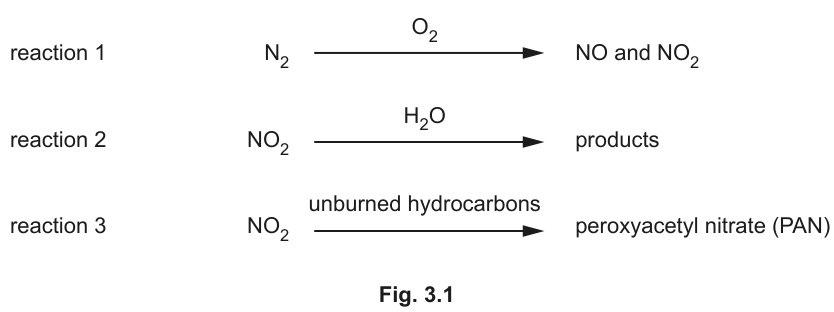
can react with oxygen in an internal combustion engine to form a mixture of and .
Fig. 3.1 shows a reaction scheme involving .
Answer
(Or )
N2 + 1.5O2 -> NO + NO2
Background Concept
In internal combustion engines, the high temperatures (around 2000-3000 K) provide enough energy to break the strong bond and bond, allowing nitrogen and oxygen from the air to react. This forms nitrogen oxides, primarily and .
Understanding the Question
Reaction 1 shows reacting with to form a mixture of and . We need to write a balanced equation representing this process.
Approach
Write the reactants (, ) and products (, ). Balance the atoms. The mark scheme accepts fractional coefficients if the simplest ratio is maintained, or integer coefficients.
Step-by-Step Reasoning
Reactants: and . Products: and .
Equation: .
Balancing N: 2 on left, 2 on right (1 in NO, 1 in NO2). Balanced.
Balancing O: 2 on left. On right, 1 (in NO) + 2 (in NO2) = 3. So we need 1.5 .
Equation: .
Multiplying by 2 to remove fractions: .
Key Takeaways
High temperatures in engines allow and to react, forming a mixture of oxides.
Common Mistakes
- Writing (this is the formation of NO only, not the mixture specified).
- Incorrect balancing.
Things to Be Careful About
The question asks for a mixture, so both and must appear in the products.
Answer
(nitrous acid) and (nitric acid).
HNO2 and HNO3
Background Concept
Nitrogen dioxide () reacts with water in the atmosphere (or in industrial scrubbers) in a disproportionation reaction. One nitrogen atom is oxidised and the other is reduced.
Understanding the Question
Reaction 2 shows reacting with . We need to identify the products.
Approach
Recall the reaction: . The products are nitric acid and nitrous acid.
Step-by-Step Reasoning
reacts with water to form a mixture of nitric acid () and nitrous acid (). This is a key step in the formation of acid rain.
Key Takeaways
+ water -> + . This leads to acid rain.
Common Mistakes
- Writing only (missing the nitrous acid).
- Writing (this happens with limited water or different conditions, but the standard reaction with excess water/liquid gives the acids).
Things to Be Careful About
Give the formulae as requested. and .
Answer
Photochemical smog.
Photochemical smog
Background Concept
Reaction 3 shows reacting with unburned hydrocarbons (from vehicle exhaust) to form peroxyacetyl nitrate (PAN). PAN is a major component of photochemical smog.
Understanding the Question
State one environmental consequence of reaction 3.
Approach
Reaction 3 produces PAN. PAN is associated with photochemical smog.
Step-by-Step Reasoning
The reaction of nitrogen oxides with hydrocarbons in the presence of sunlight leads to the formation of photochemical smog (containing PAN). This reduces visibility and causes respiratory problems.
Key Takeaways
NOx + hydrocarbons + sunlight -> photochemical smog (PAN).
Common Mistakes
- Saying "acid rain" (that's from reaction 2 / SO2).
- Saying "global warming" (that's from CO2 / greenhouse gases, though NO2 is a greenhouse gas, the specific product PAN is linked to smog).
Things to Be Careful About
The question asks for the consequence of reaction 3 specifically. Reaction 3 makes PAN. PAN causes photochemical smog.
The Haber process involves the reaction of and to form ammonia, .
A catalyst is used, which allows the process to be carried out at a lower temperature and pressure.
Use the information in (c) to complete Table 3.1.
Table 3.1
| compound | enthalpy change of formation, / |
|---|---|
Answer
| compound | enthalpy change of formation, / kJ mol⁻¹ |
|---|---|
| 0 | |
| 0 | |
| –46 |
Working:
N2: 0, H2: 0, NH3: -46
Background Concept
The standard enthalpy change of formation () is the enthalpy change when 1 mole of a compound is formed from its elements in their standard states under standard conditions. By definition, for any element in its standard state is zero.
Understanding the Question
Complete the table with values for , , and . We are given the overall reaction enthalpy for .
Approach
- Identify for elements (, ) -> 0.
- Use the equation to find for .
Step-by-Step Reasoning
- and are elements in standard states, so their is 0 kJ mol⁻¹.
- For the reaction , .
- .
- .
- .
Key Takeaways
of elements is zero. Use Hess's law / enthalpy cycle to find formation enthalpies from reaction enthalpies.
Common Mistakes
- Forgetting that is per mole of product formed. The reaction forms 2 moles of , so divide by 2.
- Writing 0 for .
Things to Be Careful About
Signs are crucial. The reaction is exothermic (-92), so formation of ammonia must be negative.
Answer
It provides an alternative reaction pathway with a lower activation energy, increasing the rate of reaction.
Provides alternative pathway with lower activation energy
Background Concept
A catalyst increases the rate of a reaction by providing an alternative mechanism (pathway) that has a lower activation energy () than the uncatalysed reaction. It does not change the enthalpy change of the reaction () or the position of equilibrium.
Understanding the Question
Explain how the presence of a catalyst affects the Haber process reaction.
Approach
State the definition of catalytic action in terms of activation energy and pathway.
Step-by-Step Reasoning
The catalyst (iron) allows the reaction to proceed via a different mechanism (adsorption of gases onto the iron surface, weakening bonds). This new pathway has a lower activation energy. More molecules have energy , so the rate increases.
Key Takeaways
Catalyst = lower via alternative pathway. Rate increases. Equilibrium position unchanged.
Common Mistakes
- Saying "catalyst lowers the activation energy of the forward reaction only" (it lowers it for both forward and reverse).
- Saying "catalyst increases the yield" (it does not; it just speeds up reaching equilibrium).
- Saying "catalyst provides energy" (it doesn't).
Things to Be Careful About
Must mention "lower activation energy" and "alternative pathway/mechanism".
State and explain the effect, if any, on the rate of the Haber process as the pressure is lowered.
Answer
The rate is lowered. Lower pressure means the gas particles are more spread out (fewer particles per unit volume), so there is a lower frequency of successful collisions between reactant molecules.
Rate lowered due to lower frequency of successful collisions
Background Concept
For gaseous reactions, pressure is proportional to concentration (). Increasing pressure increases the number of particles per unit volume (concentration). According to collision theory, a higher concentration leads to a higher frequency of collisions, and thus a higher frequency of successful collisions (collisions with energy and correct orientation), increasing the rate.
Understanding the Question
State and explain the effect of lowering the pressure on the rate of the Haber process.
Approach
- State the effect on rate (lower).
- Explain why: Pressure down -> Volume up (or particles spread out) -> Concentration down -> Collision frequency down -> Rate down.
Step-by-Step Reasoning
- Lowering pressure reduces the concentration of the gas reactants ( and ).
- With fewer particles in the same volume (or particles further apart), the frequency of collisions between reactant molecules decreases.
- Consequently, the frequency of successful collisions decreases, so the rate of reaction is lowered.
Key Takeaways
Pressure affects rate for gases by changing concentration. Lower pressure = lower rate.
Common Mistakes
- Confusing rate with equilibrium position. (Lower pressure shifts equilibrium to the left (fewer moles of gas), but the question asks about rate). Even if equilibrium shifts left, the rate is slower because concentrations are lower.
- Saying "lower pressure means molecules move slower" (temperature is constant, so average kinetic energy/speed is constant).
Things to Be Careful About
The question asks about rate, not equilibrium yield. Be precise: rate is lowered because collision frequency is lower.
The molecule has a double covalent bond between its nitrogen atoms. This consists of a and a bond.
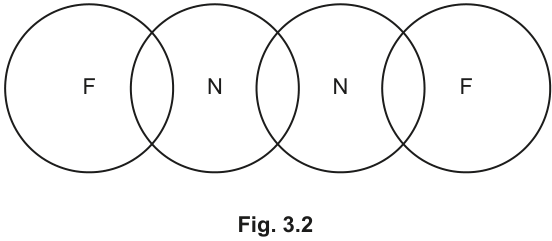
Answer
(See diagram below)
- F–N single bond (1 bonding pair).
- N=N double bond (2 bonding pairs).
- Each F atom has 3 lone pairs (6 electrons).
- Each N atom has 1 lone pair (2 electrons).
Dot-and-cross diagram: F-N=N-F with correct lone pairs
Background Concept
(diazene difluoride) is analogous to ethene () but with N and F. The structure is F–N=N–F. Each nitrogen forms a double bond with the other nitrogen and a single bond with a fluorine. Nitrogen is in Group 5, so it has 5 valence electrons. Fluorine is in Group 7, so it has 7 valence electrons.
Understanding the Question
Complete the dot-and-cross diagram for , showing outer electrons only. The skeleton is F-N-N-F.
Approach
- Determine bonding: N=N double bond, F-N single bonds.
- Count valence electrons: electrons.
- Distribute electrons: Bonding pairs use electrons. Remaining 16 electrons go to lone pairs.
- F needs 3 lone pairs (6 e- each). N needs 1 lone pair (2 e- each) to complete octet.
Step-by-Step Reasoning
- Bonding:
- N–N: Double bond. Use 4 electrons (2 from each N). In dot-and-cross, show 4 crosses (or 2 dots + 2 crosses) in the overlap region.
- F–N: Single bond. Use 2 electrons (1 from F, 1 from N). Show 1 dot and 1 cross in overlap.
- Lone Pairs:
- Each F has 7 valence e-. 1 used in bond. 6 left -> 3 lone pairs. (Show as 6 dots).
- Each N has 5 valence e-. 3 used in bonds (1 for F-N, 2 for N=N). 2 left -> 1 lone pair. (Show as 2 crosses).
Key Takeaways
Dot-and-cross diagrams must show bonding pairs in overlaps and lone pairs on atoms. Octets must be satisfied.
Common Mistakes
- Drawing N-N single bond (incorrect structure).
- Missing lone pairs on Nitrogen (N has 1 lone pair here).
- Wrong number of electrons in overlaps.
Things to Be Careful About
The question says "show outer electrons only". Inner shells of F (2s2 2p5 -> 7 outer) are shown. N (2s2 2p3 -> 5 outer) are shown. Ensure distinct symbols (dots and crosses) for the two different atoms contributing to bonds.
Answer
sp²
sp2
Background Concept
Hybridisation is determined by the number of electron domains (bonding pairs + lone pairs) around the central atom.
- 2 domains -> sp (linear, 180°)
- 3 domains -> sp² (trigonal planar, 120°)
- 4 domains -> sp³ (tetrahedral, 109.5°)
Understanding the Question
Deduce the hybridisation of the N atoms in .
Approach
Count electron domains around N. Each N has 1 double bond (counts as 1 domain), 1 single bond (counts as 1 domain), and 1 lone pair (counts as 1 domain). Total = 3 domains.
Step-by-Step Reasoning
Nitrogen is bonded to F (single bond) and N (double bond) and has 1 lone pair.
Number of regions of electron density = 3 (1 sigma bond to F, 1 sigma bond to N, 1 lone pair). Note: the pi bond does not add a domain for hybridisation.
3 domains -> sp² hybridisation.
Key Takeaways
Double bond counts as 1 domain for hybridisation. Lone pairs count as domains.
Common Mistakes
- Counting the pi bond as a separate domain.
- Saying sp³ (thinking 4 bonds total).
Things to Be Careful About
Hybridisation is based on sigma bonds + lone pairs, not total bonds.
Answer
Diagram: Two lobes of electron density (orbitals) located above and below the plane of the atoms (the internuclear axis), with a node between them.
Description: Formed by the side-on overlap of unhybridised 2p orbitals (one from each nitrogen atom) that are perpendicular to the plane of the molecule.
Side-on overlap of 2p orbitals forming pi bond above and below axis
Background Concept
A double bond consists of one sigma () bond and one pi () bond. The sigma bond is formed by head-on overlap of orbitals (sp²-sp² in this case). The pi bond is formed by side-on overlap of unhybridised p-orbitals. The p-orbitals must be parallel and perpendicular to the plane of the sigma bond framework.
Understanding the Question
Draw a diagram of the pi bond between the N atoms and describe how it forms.
Approach
- Draw the pi orbital: two lobes (electron density clouds) above and below the internuclear axis (the line connecting the nuclei). Often drawn as two ovals or clouds, one shaded, one unshaded, or just outlines.
- Describe: Unhybridised 2p orbitals on each N atom overlap side-on.
Step-by-Step Reasoning
- Diagram: The internuclear axis is horizontal. The pi orbital consists of two lobes, one above and one below this axis. There is a nodal plane containing the nuclei where electron density is zero.
- Description: Each nitrogen atom has an unhybridised 2p orbital (perpendicular to the sp² plane). These two 2p orbitals are parallel. They overlap side-on (laterally) to form the pi bond. The electron density is concentrated above and below the plane of the atoms.
Key Takeaways
Pi bond = side-on overlap of p-orbitals. Electron density above and below the internuclear axis.
Common Mistakes
- Drawing the pi bond as being in the plane (that's a sigma bond or wrong orientation).
- Saying "overlap of sp² orbitals" (sp² form sigma bonds).
- Not mentioning "side-on" or "lateral" overlap.
Things to Be Careful About
The diagram should clearly show the lobes above and below the axis, not on the axis. The description must mention 2p orbitals and side-on overlap.
Compound S is used in food flavourings. A possible synthesis of S is shown in Fig. 4.1.
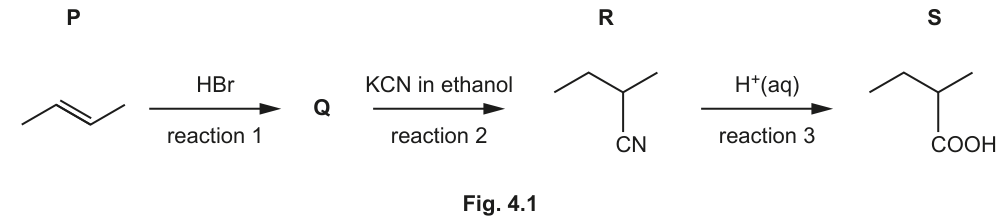
P, Q, R and S show stereoisomerism.
Complete Table 4.1 by identifying with a tick () the type of stereoisomerism that each molecule shows.
The type of stereoisomerism shown by Q is given.
Table 4.1
| P | Q | R | S | |
|---|---|---|---|---|
| geometrical isomerism | ||||
| optical isomerism |
Answer
| P | Q | R | S | |
|---|---|---|---|---|
| geometrical isomerism | ||||
| optical isomerism |
P: geometrical only; Q: optical only; R: optical only; S: optical only.
Background Concept
Stereoisomers have the same structural formula but differ in the spatial arrangement of atoms. Two types are tested at AS level. Geometrical (cis–trans / E–Z) isomerism arises from restricted rotation about a carbon–carbon double bond; it is only possible when each carbon of the C=C carries two different groups. Optical isomerism arises from a chiral centre — a carbon atom bonded to four different groups — giving two non-superimposable mirror-image forms (enantiomers).
Understanding the Question
The reaction scheme (Fig. 4.1) gives: P = but-2-ene (); Q = 2-bromobutane (); R = 2-methylbutanenitrile; S = 2-methylbutanoic acid. For each, tick the row(s) of stereoisomerism it shows. Q is already given as optical.
Approach
For each molecule ask two independent questions: (i) does it have a C=C where both carbons bear two different groups? → geometrical. (ii) does it have a carbon with four different groups? → optical.
Step-by-Step Reasoning
P (but-2-ene, ): the C=C has and H on each carbon — two different groups on both carbons → geometrical ✓. No carbon carries four different groups → optical ✗.
Q (2-bromobutane): no C=C → geometrical ✗. The C-2 bears H, Br, , (four different) → optical ✓ (given).
R (2-methylbutanenitrile): the carbon bearing CN also bears H, and — four different groups → optical ✓; no C=C → geometrical ✗.
S (2-methylbutanoic acid): the carbon bearing COOH also bears H, and — four different groups → optical ✓; no C=C → geometrical ✗.
Key Takeaways
Geometrical needs a double bond with two different groups on each carbon; optical needs one carbon with four different groups. The two are independent — a molecule can show one, the other, both, or neither.
Common Mistakes
Ticking geometrical for Q, R or S (no C=C present). Ticking optical for P (but-2-ene has no chiral carbon). Assuming the C=C in but-2-ene cannot give geometrical isomerism because the two ends look similar — it still qualifies since each carbon has H and CH.
Things to Be Careful About
Check both carbons of the double bond for geometrical isomerism, and check that the four groups on the candidate chiral carbon are genuinely all different (e.g. in R and S the ethyl and methyl groups are distinct).
Answer
(2-bromobutane)
CH3CHBrCH2CH3
Background Concept
Addition of HBr to an unsymmetrical alkene is an electrophilic addition: the bond attacks , the most stable carbocation forms, and attacks it. For but-2-ene, both carbons of the double bond are equivalent, so a single product, 2-bromobutane, results.
Understanding the Question
Reaction 1 in Fig. 4.1 converts P (but-2-ene) into Q using HBr. Give the structural formula of Q.
Approach
Add H and Br across the C=C of ; the product is a bromoalkane.
Step-by-Step Reasoning
But-2-ene is . Adding HBr gives . This matches the scheme because Q then reacts with KCN to give R, a nitrile with the CN on the second carbon (2-methylbutanenitrile), confirming Br was on C-2. The structural formula is .
Key Takeaways
Electrophilic addition of HX to an alkene yields a haloalkane; the position of the halogen is fixed by the structure of the alkene.
Common Mistakes
Writing 1-bromobutane (wrong carbon). Drawing the alkene again or omitting the Br.
Things to Be Careful About
Show all atoms/bonds clearly in a structural formula; ensure the carbon skeleton has four carbons with Br on C-2.
Answer
Nucleophilic substitution
nucleophilic substitution
Background Concept
Haloalkanes react with the cyanide ion (from KCN in ethanolic solution) by nucleophilic substitution: the lone pair on carbon of attacks the electron-deficient C bonded to halogen, displacing and forming a nitrile. This lengthens the carbon chain by one.
Understanding the Question
Reaction 2 converts Q (2-bromobutane) into R (a nitrile) using KCN in ethanol. Name the mechanism.
Approach
Identify that a halogen is replaced by CN — a substitution driven by a nucleophile.
Step-by-Step Reasoning
The C–Br bond is polarised; is the nucleophile and replaces . The mechanism is therefore nucleophilic substitution.
Key Takeaways
KCN in ethanol converts a haloalkane to a nitrile by nucleophilic substitution, adding one carbon to the chain.
Common Mistakes
Naming it elimination (that uses hot ethanolic NaOH/KOH to give an alkene) or electrophilic addition.
Things to Be Careful About
Use the full term 'nucleophilic substitution'; 'substitution' alone is usually insufficient.
Working
Acid hydrolysis of a nitrile gives a carboxylic acid and ammonium ion:
Answer
C4H9CN + 2H2O + H+ -> C4H9COOH + NH4+
Background Concept
Nitriles () are hydrolysed by heating with aqueous acid () to give a carboxylic acid () and an ammonium ion. The C≡N triple bond is converted to C=O plus the nitrogen leaves as ; two water molecules supply the oxygen and hydrogens, and one protonates the nitrogen.
Understanding the Question
Reaction 3 hydrolyses R () with to give S (). Complete and balance the equation.
Approach
Write reactants (nitrile + water + H) and products (carboxylic acid + ammonium), then balance atoms and charge.
Step-by-Step Reasoning
Start: . The product gains one O and the N becomes . Add to supply the O and H, and to give nitrogen its four hydrogens and balance charge. Check: left H = 9+4+1 = 14; right H = 9+1+4 = 14 ✓. O: left 2, right 2 ✓. N: 1 each ✓. Charge: left +1, right +1 ✓. Balanced equation:
Key Takeaways
Acid hydrolysis of a nitrile: nitrile + 2HO + H → carboxylic acid + NH.
Common Mistakes
Writing instead of in acid; omitting water or H; wrong coefficient of water.
Things to Be Careful About
Ensure the charge balances (+1 each side) and that the alkyl group is unchanged.
Compounds S and T react to form organic compound U, which has a single functional group.
Table 4.2 shows some data from the mass spectrum of U.
Use the data from Table 4.2 to show that U contains 7 carbon atoms.
Show your working.
Table 4.2
| peak | relative abundance |
|---|---|
| 7.2 | |
| 0.55 |
Working
The [M+1] peak arises from , which is about 1.1% abundant relative to .
Answer
7 carbon atoms
7
Background Concept
In a mass spectrum the molecular ion peak corresponds to the molecule with all . The small peak is due to molecules containing one atom. Since is about 1.1% as abundant as , each carbon atom contributes ~1.1% to the ratio. Thus number of C = (ratio of M+1 to M) / 1.1%.
Understanding the Question
Given = 7.2 and = 0.55 (relative abundances), show U contains 7 carbons.
Approach
Compute the ratio , express as a percentage, and divide by 1.1.
Step-by-Step Reasoning
Ratio = , i.e. 7.64%. Number of C = . Equivalently . Rounding to the nearest whole number gives 7 carbon atoms. (Error carried forward from the ratio is acceptable.)
Key Takeaways
Number of carbon atoms = (abundance of [M+1] / abundance of M) / 0.011.
Common Mistakes
Forgetting to divide by 1.1 (or 0.011); using the wrong peak ratio; reporting 6.94 without rounding to 7.
Things to Be Careful About
Use the relative abundance ratio, not the absolute values alone, and round to a whole number of carbons.
Fig. 4.2 shows the infrared spectrum of U.
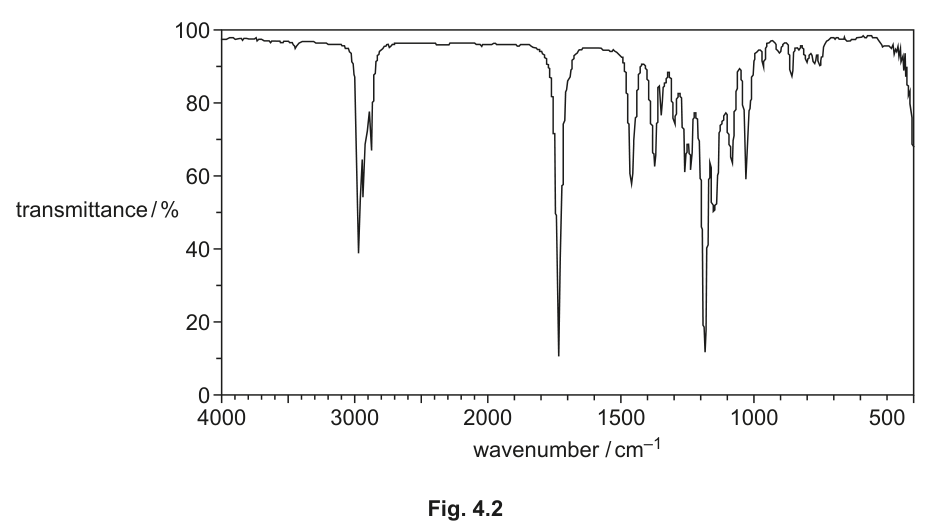
Table 4.3 shows characteristic infrared absorption ranges.
Table 4.3
| bond | functional groups containing the bond | characteristic infrared absorption range (in wavenumbers) / |
|---|---|---|
| C–O | hydroxy, ester | 1040–1300 |
| C=C | aromatic compound, alkene | 1500–1680 |
| C=O | amide carbonyl, carboxyl ester | 1640–1690 1670–1740 1710–1750 |
| CN | nitrile | 2200–2250 |
| C–H | alkane | 2850–2950 |
| N–H | amine, amide | 3300–3500 |
| O–H | carboxyl hydroxy | 2500–3000 3200–3650 |
Use Fig. 4.2 and Table 4.3 to identify the functional group present in U.
Explain your answer fully.
functional group: .................................................................................................................
explanation: ........................................................................................................................
Answer
Functional group: ester
Explanation: absorption at about (within –) indicates a C=O (carbonyl) stretch of an ester, and absorption at about (within –) indicates a C–O stretch. There is no broad O–H absorption, so it is not a carboxylic acid.
ester
Background Concept
IR spectroscopy identifies functional groups by the wavenumbers at which bonds absorb. A C=O stretch appears strongly in the 1640–1750 cm region; the exact sub-range distinguishes amide, carbonyl/carboxyl and ester. A C–O single-bond stretch (in esters and alcohols) appears 1040–1300 cm. An O–H stretch of a carboxylic acid is very broad (2500–3000 cm); an alcohol O–H is broad (3200–3650 cm).
Understanding the Question
Using Fig. 4.2 and Table 4.3, identify the single functional group in U and explain fully.
Approach
Read the major absorptions from the spectrum and match them to bonds; combine the evidence.
Step-by-Step Reasoning
The spectrum shows a strong sharp peak near 1740 cm → C=O stretch (ester range 1710–1750 cm). A strong peak near 1200 cm → C–O stretch (1040–1300 cm). A C=O plus a C–O together, with no broad O–H band, uniquely indicate an ester. (A carboxylic acid would also show the broad O–H; an amide would show N–H near 3300–3500 cm.)
Key Takeaways
Ester = C=O (~1740 cm) + C–O (~1200 cm) with no O–H.
Common Mistakes
Identifying only the carbonyl and calling it a ketone/aldehyde (ignoring C–O); missing the absence of O–H; citing only one absorption for the explanation mark.
Things to Be Careful About
Quote both wavenumber ranges from the table and link each to the correct bond; the explanation mark needs both pieces of evidence.
T also has a single functional group.
Use the information in (c)(i) and your answer to (c)(ii) to identify T and U.
Draw the structures of T and U in the boxes.
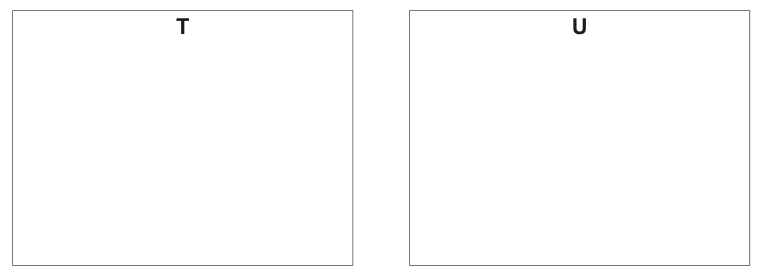
Answer
T = ethanol,
U = ethyl 2-methylbutanoate,
T = ethanol (CH3CH2OH); U = ethyl 2-methylbutanoate (CH3CH2CH(CH3)COOCH2CH3)
Background Concept
An ester forms by condensation of a carboxylic acid with an alcohol, losing water: . The acyl part () comes from the acid and the –OR' part from the alcohol. Counting carbons across the ester lets you work out how many come from each partner.
Understanding the Question
S is 2-methylbutanoic acid (, 5 carbons). S + T → U + HO, U is an ester with 7 carbons. Identify T and U and draw both.
Approach
U has 7 carbons; the acid contributes 5, so the alcohol contributes 2 → T is ethanol. Combine S's acyl group with the ethoxy group to draw U.
Step-by-Step Reasoning
From (c)(i) U has 7 C. S = 2-methylbutanoic acid has 5 C. The ester's alkoxy group must therefore have 7 − 5 = 2 C → from ethanol (), which has a single functional group (–OH) as required. Hence T = ethanol. The ester U is ethyl 2-methylbutanoate: , retaining the chiral methyl branch at the 2-position of the acyl chain. Draw T as HO–CH–CH and U as the corresponding ester (see diagrams).
Key Takeaways
In ester formation the carbon count of the alcohol = total ester carbons − acid carbons; the –O– in the ester links the two fragments.
Common Mistakes
Assigning the 2 carbons to the acid side; drawing U as an ether or ketone; placing the ester oxygen on the wrong side of the C=O; losing the methyl branch of S.
Things to Be Careful About
Show all atoms and bonds (displayed formula) for full marks; the C=O and the single-bonded O must be on the same carbon; keep the chiral branch.