Chemistry 9701/12 — February/March 2024
Cambridge AS Level · Multiple Choice (AS Level) · answer key with instant marking and worked solutions
Topics Introduction to Organic Chemistry · Carbonyl Compounds · Hydroxy Compounds · Atomic Structure · Atoms, Molecules and Stoichiometry · Chemical Bonding · +16 more
Tap an option under each question to check it — your score builds as you go.
Which species contains the same number of neutrons as and the same number of electrons as ?
Options
A
B
C
D
Working
: neutrons = 14 − 6 = 8; electrons = 6.
: neutrons = 23 − 11 = 12; electrons = 11 − 1 = 10.
The required species has 8 neutrons and 10 electrons.
Checking the options for 8 neutrons and 10 electrons: only has both (neutrons = 16 − 8 = 8; electrons = 8 + 2 = 10).
Answer
D
D
Background Concept
The nucleus of an atom contains protons and neutrons. The mass number (A, top-left in the notation ) is the total number of protons plus neutrons. The proton number (Z, bottom-left) is the number of protons. The number of neutrons is therefore A − Z.
In a neutral atom, the number of electrons equals the number of protons. In an ion, the charge tells you how many electrons have been gained or lost: a negative charge means electrons have been gained (add the magnitude of the charge to Z), a positive charge means electrons have been lost (subtract the magnitude of the charge from Z).
Understanding the Question
We are given two reference species — and — and asked to find a species that matches BOTH the neutron count of the first and the electron count of the second. This is a two-condition matching problem: the correct species must satisfy both conditions simultaneously, so each option must be checked against both.
Approach
- Determine the neutron count of : A − Z.
- Determine the electron count of : Z − 1 (because of the +1 charge).
- For each option, compute the number of neutrons and the number of electrons, and check both conditions.
Step-by-Step Reasoning
For : A = 14, Z = 6, so neutrons = 14 − 6 = 8. Neutral carbon has 6 electrons.
For : A = 23, Z = 11, so neutrons = 23 − 11 = 12. The +1 charge means one electron has been lost: electrons = 11 − 1 = 10.
So the target species must have 8 neutrons and 10 electrons.
Now check each option:
A : neutrons = 17 − 9 = 8 ✓; electrons = 9 (neutral) ✗. Fails the electron condition.
B : neutrons = 16 − 7 = 9 ✗; electrons = 7 + 3 = 10 ✓. Fails the neutron condition.
C : neutrons = 20 − 10 = 10 ✗; electrons = 10 ✓. Fails the neutron condition.
D : neutrons = 16 − 8 = 8 ✓; electrons = 8 + 2 = 10 ✓. Satisfies both conditions.
Key Takeaways
- Neutrons = mass number − proton number.
- For an ion, electrons = proton number − charge (charge is signed; e.g. for O²⁻, charge = −2, so electrons = 8 − (−2) = 10).
- When a question requires two simultaneous conditions, check both for every option.
Common Mistakes
- Forgetting to account for the charge when counting electrons — treating an ion as if it were neutral.
- Subtracting the wrong way: neutrons = A − Z, not Z − A.
- Confusing mass number with proton number.
- Only checking one of the two conditions and picking a species that matches just one.
Things to Be Careful About
- The notation : top-left is mass number, bottom-left is proton number.
- For a negative ion, ADD the magnitude of the charge to the proton number to get electrons (e.g. N³⁻ has 7 + 3 = 10 electrons).
- For a positive ion, SUBTRACT the magnitude of the charge (e.g. Na⁺ has 11 − 1 = 10 electrons).
- The question asks for a species with "the same number of neutrons as C" AND "the same number of electrons as Na⁺" — both conditions must hold.
Which process has the largest enthalpy change per mole?
Options
A
B
C
D
Working
Each process removes an electron from a gaseous ion, so the enthalpy change is a successive ionisation energy.
All four ions have the electron configuration [Ne]:
- Al³⁺: [Ne]
- P⁵⁺: [Ne]
- S⁶⁺: [Ne]
- Si⁴⁺: [Ne]
Removing an electron from the same [Ne] shell requires more energy when the nuclear charge is larger. The nuclear charges are:
- Al: 13
- P: 15
- S: 16
- Si: 14
The largest nuclear charge is S (16), so the 7th ionisation energy of S is the largest.
Answer
C
C
Background Concept
Ionisation energy is the energy required to remove one mole of electrons from one mole of gaseous atoms or ions. Successive ionisation energies increase because each electron is removed from an increasingly positive ion, and the remaining electrons are held more tightly.
A particularly large jump in ionisation energy occurs when an electron is removed from a stable noble-gas core (e.g., [Ne]) rather than from an outer shell.
Understanding the Question
The question asks which of four ionisation processes has the largest enthalpy change per mole. All four are successive ionisations of gaseous ions. The key is to compare how tightly the electron being removed is held.
Approach
- Write the electron configuration of each ion.
- Identify which shell the electron is being removed from.
- Compare the nuclear charge (proton number) for ions where the electron comes from the same shell.
- The process with the highest nuclear charge and same-shell removal has the largest ionisation energy.
Step-by-Step Reasoning
- A: Al³⁺ has configuration [Ne]. Removing an electron gives Al⁴⁺. This is the 4th ionisation energy of Al. The electron comes from the [Ne] core.
- B: P⁵⁺ has configuration [Ne]. Removing an electron gives P⁶⁺. This is the 6th ionisation energy of P. The electron comes from the [Ne] core.
- C: S⁶⁺ has configuration [Ne]. Removing an electron gives S⁷⁺. This is the 7th ionisation energy of S. The electron comes from the [Ne] core.
- D: Si⁴⁺ has configuration [Ne]. Removing an electron gives Si⁵⁺. This is the 5th ionisation energy of Si. The electron comes from the [Ne] core.
All four remove an electron from a [Ne] core. The energy needed increases with nuclear charge because the 2p electrons are pulled more strongly toward the nucleus. The nuclear charges are:
- Al: 13
- P: 15
- S: 16
- Si: 14
The largest nuclear charge is S (16), so the 7th ionisation energy of S is the largest. Hence the answer is C.
Key Takeaways
- Successive ionisation energies always increase.
- A large jump occurs when removing an electron from a noble-gas core.
- When comparing removal from the same shell, the ion with the higher nuclear charge has the higher ionisation energy.
Common Mistakes
- Assuming the ion with the highest charge always has the highest ionisation energy without checking the shell.
- Forgetting that the electron configuration of the ion matters — here all four have [Ne].
- Confusing the number of electrons removed with the energy required; the energy depends on nuclear charge and shell, not just the ion charge.
Things to Be Careful About
- Always write the electron configuration of the ion before comparing.
- Remember that the proton number (nuclear charge) is the decisive factor when the shell is the same.
- The enthalpy change is positive (endothermic) for all these ionisations; the question asks for the largest magnitude.
Which sodium compound contains 74.2% by mass of sodium?
Options
A sodium carbonate
B sodium chloride
C sodium hydroxide
D sodium oxide
Working
For each compound, calculate the relative molecular mass and the percentage by mass of sodium.
- Sodium carbonate, Na2CO3: Mr = (2 × 23) + 12 + (3 × 16) = 106; %Na = (46 ÷ 106) × 100 = 43.4%
- Sodium chloride, NaCl: Mr = 23 + 35.5 = 58.5; %Na = (23 ÷ 58.5) × 100 = 39.3%
- Sodium hydroxide, NaOH: Mr = 23 + 16 + 1 = 40; %Na = (23 ÷ 40) × 100 = 57.5%
- Sodium oxide, Na2O: Mr = (2 × 23) + 16 = 62; %Na = (46 ÷ 62) × 100 = 74.2%
Answer
D — sodium oxide
D
Background Concept
Percentage by mass of an element in a compound is calculated using:
percentage by mass = (total mass of the element in one formula unit ÷ relative molecular mass of the compound) × 100
This uses the relative atomic masses of the elements and the subscripts in the chemical formula.
Understanding the Question
The question asks which sodium compound contains 74.2% sodium by mass. The four options are common sodium compounds: sodium carbonate, sodium chloride, sodium hydroxide, and sodium oxide. We need to determine the formula of each and calculate the percentage of sodium in each.
Approach
- Write the correct formula for each compound.
- Calculate the relative molecular mass (Mr) using relative atomic masses: Na = 23, C = 12, O = 16, H = 1, Cl = 35.5.
- Find the total mass of sodium atoms in one formula unit.
- Divide the sodium mass by Mr and multiply by 100.
- Compare the result with 74.2%.
Step-by-Step Reasoning
- Sodium carbonate is Na2CO3. Mr = 2(23) + 12 + 3(16) = 106. Sodium mass = 2 × 23 = 46. Percentage = 46/106 × 100 = 43.4%.
- Sodium chloride is NaCl. Mr = 23 + 35.5 = 58.5. Sodium mass = 23. Percentage = 23/58.5 × 100 = 39.3%.
- Sodium hydroxide is NaOH. Mr = 23 + 16 + 1 = 40. Sodium mass = 23. Percentage = 23/40 × 100 = 57.5%.
- Sodium oxide is Na2O. Mr = 2(23) + 16 = 62. Sodium mass = 2 × 23 = 46. Percentage = 46/62 × 100 = 74.2%.
The only compound matching 74.2% is sodium oxide.
Key Takeaways
- Always multiply the relative atomic mass of an element by its subscript in the formula.
- Percentage by mass is a ratio of the mass of the element to the total formula mass, expressed as a percentage.
- Accurate relative atomic masses matter; using Cl = 35 rather than 35.5 would change the result.
Common Mistakes
- Forgetting to multiply sodium's atomic mass by 2 in Na2CO3 and Na2O.
- Using the wrong relative atomic mass for chlorine, such as 35 instead of 35.5.
- Confusing sodium hydroxide with sodium oxide and not checking both formulas carefully.
Things to Be Careful About
- Read the formula from the name correctly: sodium oxide is Na2O, not NaO.
- Carry out the division before multiplying by 100.
- Compare all four options; more than one may seem plausible if you only estimate.
- Use consistent units; the percentage is unitless after the × 100.
What is the maximum volume of sulfur dioxide gas measured at room conditions produced from burning of diesel fuel containing of sulfur?
Options
A
B
C
D
Working
Sulfur burns to sulfur dioxide:
Moles of sulfur atoms:
At room conditions, 1 mol of gas occupies 24 dm³:
Answer
D
D
Background Concept
When a fuel containing sulfur is burned, the sulfur is oxidised to sulfur dioxide gas. The key reaction is:
One mole of sulfur atoms produces one mole of sulfur dioxide molecules. Therefore, the amount of SO₂ formed is directly equal to the amount of sulfur burned.
At room temperature and pressure, one mole of any gas occupies 24 dm³. This is often written as 24,000 cm³.
Understanding the Question
The question gives a volume of diesel fuel, but the chemically important information is the mass of sulfur present: 0.8346 g. The volume of fuel is not needed for the calculation because the sulfur content is already stated. We are asked for the maximum volume of sulfur dioxide that can be produced, meaning we assume all the sulfur is converted into SO₂.
Approach
- Write the balanced equation for the combustion of sulfur.
- Convert the mass of sulfur into moles using its molar mass.
- Use the molar gas volume at room conditions to find the volume of SO₂.
- Convert the volume from dm³ to cm³ if needed.
Step-by-Step Reasoning
- Molar mass of sulfur, S, is approximately 32.1 g mol⁻¹.
- Moles of sulfur:
- From the equation, 1 mol S gives 1 mol SO₂, so 0.0260 mol SO₂ is produced.
- Volume at room conditions:
- Since 1 dm³ = 1000 cm³:
This matches option D.
Key Takeaways
- The volume of a gas at room conditions is calculated using the molar volume 24 dm³ mol⁻¹.
- The stoichiometric ratio between S and SO₂ is 1:1, so the mole calculation is direct.
- The volume of fuel is irrelevant once the mass of sulfur is given.
Common Mistakes
- Using 22.4 dm³ mol⁻¹, which is the molar volume at standard temperature and pressure, not room conditions. This gives 582 cm³, which is option C.
- Forgetting to convert dm³ to cm³, which would give 0.624 dm³ instead of 624 cm³.
- Using the volume of diesel fuel in the calculation instead of the mass of sulfur.
Things to Be Careful About
- Always check whether the question specifies room conditions or standard conditions.
- Pay attention to units: cm³, dm³, and m³ are all different.
- The word "maximum" tells you to assume complete conversion of sulfur to sulfur dioxide.
Which row shows the correct number of covalent bonds in a molecule of methylpropene?
Options
| total number of sigma () bonds in the molecule | total number of pi () bonds in the molecule | |
|---|---|---|
| A | 10 | 1 |
| B | 10 | 2 |
| C | 11 | 1 |
| D | 11 | 2 |
Working
Methylpropene has the structure .
The C=C double bond contributes 1 bond and 1 bond.
Counting bonds:
- C=C: 1
- C–C single bonds (2): 2
- C–H bonds (8): 8
Total = 1 + 2 + 8 = 11
Total = 1
Answer
C (11 , 1 )
C
Background Concept
Covalent bonds form when atomic orbitals overlap and share electrons. A sigma () bond is formed by the end-on (head-on) overlap of orbitals along the internuclear axis — it is always the first bond between any two atoms. A pi () bond is formed by the side-on (lateral) overlap of parallel p orbitals, and can only exist as a second or third bond in a multiple bond. Therefore:
- A single bond = 1 bond
- A double bond = 1 + 1 bond
- A triple bond = 1 + 2 bonds
To count bonds in a molecule, draw the full structural formula and count every bond between every pair of atoms, remembering that each multiple bond contributes exactly one bond plus additional bonds.
Understanding the Question
The question asks for the total number of and covalent bonds in one molecule of methylpropene. Methylpropene (2-methylpropene) has the molecular formula and the structural formula . The key is to count every bond in the molecule systematically: the C=C double bond, the two C–C single bonds, and all eight C–H bonds.
Approach
- Draw the full structural formula of methylpropene.
- Count the C=C double bond — it contributes 1 and 1 .
- Count all single bonds (C–C and C–H) — each contributes 1 .
- Sum the bonds and record the bonds.
Step-by-Step Reasoning
Structure:
Bonds present:
- C1=C2 double bond: 1 + 1
- C2–C3 single bond: 1
- C2–C4 single bond: 1
- C1–H (2 bonds): 2
- C3–H (3 bonds): 3
- C4–H (3 bonds): 3
Total = 1 + 1 + 1 + 2 + 3 + 3 = 11
Total = 1
So the correct row is C: 11 and 1 .
Why the distractors are wrong:
- A (10 , 1 ): undercounts bonds by one — likely forgot one C–H or C–C bond.
- B (10 , 2 ): wrong on both counts — undercounts and wrongly counts 2 (there is only one double bond).
- D (11 , 2 ): correct count but wrongly counts 2 — only one double bond exists.
Key Takeaways
- Every single bond is one bond; every double bond is one + one .
- Draw the full structure before counting — never count from the molecular formula alone.
- Count systematically: multiple bonds first, then single bonds by type.
Common Mistakes
- Counting the C=C as two bonds instead of one + one .
- Forgetting to count one of the C–H bonds (e.g., treating a methyl group as instead of ).
- Counting bonds by the number of double bonds incorrectly (e.g., thinking there are two double bonds in methylpropene).
Things to Be Careful About
- Methylpropene has exactly one C=C double bond — the name tells you: "propene" gives the C=C, "methyl" is a substituent.
- Count all hydrogens: means 8 C–H bonds.
- A bond count must equal the total number of bonds minus the number of bonds.
Aluminium chloride exists as molecules at room temperature. When heated to a high temperature, molecules are formed.
What are the arrangements of the bonding pairs of electrons around the aluminium atom in the two forms of aluminium chloride?
Options
| A | planar | planar |
| B | planar | tetrahedral |
| C | tetrahedral | tetrahedral |
| D | tetrahedral | octahedral |
Working
AlCl₃:
The aluminium atom has 3 bonding pairs and no lone pairs. According to VSEPR theory, 3 bonding pairs arrange themselves as far apart as possible in a trigonal planar arrangement, which is planar.
Al₂Cl₆:
Each aluminium atom is bonded to two terminal chlorine atoms and two bridging chlorine atoms, giving 4 bonding pairs around each Al. Four bonding pairs adopt a tetrahedral arrangement.
Answer
B
B
Background Concept
VSEPR (Valence Shell Electron Pair Repulsion) theory predicts the shape of a molecule from the number of bonding pairs and lone pairs around the central atom. The electron pairs repel each other and arrange themselves as far apart as possible. For 3 bonding pairs and no lone pairs, the shape is trigonal planar. For 4 bonding pairs and no lone pairs, the shape is tetrahedral.
Understanding the Question
The question asks for the arrangement of bonding pairs around the aluminium atom in two different forms of aluminium chloride: the monomer AlCl₃ and the dimer Al₂Cl₆. We need to determine whether each is planar, tetrahedral, or octahedral.
Approach
- Determine the number of bonding pairs around Al in AlCl₃.
- Determine the number of bonding pairs around each Al in Al₂Cl₆.
- Apply VSEPR theory to assign the shape.
- Match the result to the options.
Step-by-Step Reasoning
AlCl₃:
- Aluminium has 3 valence electrons and forms 3 covalent bonds with three chlorine atoms.
- There are no lone pairs on the aluminium atom.
- Total electron pairs around Al = 3 bonding pairs + 0 lone pairs = 3.
- Three electron pairs repel equally and adopt a trigonal planar arrangement, which is planar.
Al₂Cl₆:
- In the dimer, each aluminium atom is bonded to two terminal chlorine atoms and two bridging chlorine atoms.
- Each Al atom therefore has 4 bonding pairs.
- There are no lone pairs on aluminium.
- Four electron pairs repel equally and adopt a tetrahedral arrangement.
Thus, AlCl₃ is planar and Al₂Cl₆ is tetrahedral, which corresponds to option B.
Key Takeaways
- VSEPR theory uses the total number of electron pairs (bonding + lone) to predict shape.
- 3 bonding pairs → trigonal planar; 4 bonding pairs → tetrahedral.
- In Al₂Cl₆, the bridging chlorine atoms contribute to a fourth bonding pair around each aluminium, making it tetrahedral.
Common Mistakes
- Assuming Al₂Cl₆ is planar because AlCl₃ is planar.
- Forgetting that bridging chlorine atoms are counted as bonding pairs for each aluminium atom.
- Confusing the number of atoms bonded with the number of electron pairs when lone pairs are present.
Things to Be Careful About
- Aluminium in AlCl₃ is an exception to the octet rule; it has only 6 electrons in its valence shell.
- In Al₂Cl₆, coordinate (dative) bonds are formed between chlorine lone pairs and aluminium atoms, but the electron-pair arrangement around aluminium is still tetrahedral.
- Always count the total number of electron pairs around the central atom, not just the number of bonded atoms.
The table shows the physical properties of four substances.
Which substance has a giant covalent structure?
Options
| melting point / | boiling point / | electrical conductivity of solid | electrical conductivity of liquid | electrical conductivity of aqueous solution | |
|---|---|---|---|---|---|
| A | –119 | 39 | poor | poor | insoluble |
| B | –115 | –85 | poor | poor | good |
| C | 993 | 1695 | poor | good | good |
| D | 1160 | 2230 | poor | poor | insoluble |
Working
A giant covalent structure (e.g. diamond, graphite, silicon dioxide) has a very high melting point and boiling point, and does not conduct electricity as a solid or liquid because there are no free ions or electrons. It is also insoluble in water.
Substance D has melting point 1160 , boiling point 2230 , poor conductivity in both solid and liquid states, and is insoluble in water — these match a giant covalent structure.
Answer
D
D
Background Concept
Substances can be classified by their structure and bonding into four main types: giant ionic, giant metallic, giant covalent (macromolecular), and simple molecular. Each type has a characteristic set of physical properties:
- Giant ionic (e.g. NaCl): high melting/boiling point; poor conductor as a solid (ions fixed in lattice); good conductor when molten or in aqueous solution (ions free to move); often soluble in water.
- Giant metallic (e.g. Fe): high melting/boiling point; good conductor as a solid and when molten (delocalised electrons); insoluble in water.
- Giant covalent (e.g. diamond, SiO): very high melting/boiling point (strong covalent bonds throughout the lattice); poor conductor as a solid and when molten (no free ions or electrons); insoluble in water.
- Simple molecular (e.g. I, CH): low melting/boiling point (weak intermolecular forces); poor conductor in all states; solubility varies.
The question tests the ability to identify a giant covalent structure from a table of physical properties.
Understanding the Question
We are given a table with melting point, boiling point, electrical conductivity of the solid, electrical conductivity of the liquid, and electrical conductivity of the aqueous solution for four substances (A, B, C, D). The task is to identify which one has a giant covalent structure. The key discriminating features are the very high melting/boiling points and the poor electrical conductivity in both the solid and liquid states, combined with insolubility in water.
Approach
- Recall the characteristic properties of a giant covalent structure.
- For each substance, check whether its properties match those of a giant covalent structure.
- Select the substance that matches all the key criteria: very high melting/boiling point, poor conductivity in solid and liquid, and insolubility in water.
Step-by-Step Reasoning
Let us examine each substance in turn:
Substance A — melting point –119 , boiling point 39 . These are very low values, typical of a simple molecular substance with weak intermolecular forces. It is insoluble in water. This does NOT match a giant covalent structure because the melting and boiling points are far too low.
Substance B — melting point –115 , boiling point –85 . Again, very low melting and boiling points, indicating a simple molecular substance. Its aqueous solution conducts electricity well, suggesting it forms ions when dissolved (e.g. a molecular acid like HCl). This does NOT match a giant covalent structure.
Substance C — melting point 993 , boiling point 1695 . These are high values. It is a poor conductor as a solid but a good conductor as a liquid and in aqueous solution. This pattern is characteristic of a giant ionic structure: in the solid state the ions are held in a fixed lattice and cannot move, so it does not conduct; when molten or dissolved, the ions are free to move and carry charge. This is NOT a giant covalent structure.
Substance D — melting point 1160 , boiling point 2230 . These are very high values, consistent with a giant covalent lattice where many strong covalent bonds must be broken. It is a poor conductor as a solid and as a liquid (no free electrons or ions), and it is insoluble in water. This matches a giant covalent structure (like diamond or silicon dioxide).
Therefore, the correct answer is D.
Key Takeaways
- A giant covalent structure is identified by: very high melting and boiling points, poor electrical conductivity in both solid and liquid states, and insolubility in water.
- The key distinction from a giant ionic structure is the conductivity of the liquid state: ionic compounds conduct when molten, while giant covalent compounds do not.
- The key distinction from a simple molecular structure is the melting/boiling point: simple molecular substances have low melting and boiling points.
Common Mistakes
- Confusing giant covalent with giant ionic: both have high melting points, but ionic compounds conduct electricity when molten or in aqueous solution, whereas giant covalent compounds do not. Substance C is the ionic one.
- Confusing giant covalent with simple molecular: simple molecular substances have low melting/boiling points, so A and B cannot be giant covalent.
- Ignoring the insolubility criterion: giant covalent structures are insoluble in water because the strong covalent bonds are not broken by water; this helps rule out substances that dissolve.
Things to Be Careful About
- Read the table columns carefully: conductivity is given separately for solid, liquid, and aqueous solution, and each state matters.
- Note the units of temperature and the sign (negative values indicate low melting/boiling points).
- Remember that "poor" conductivity in the liquid state is a decisive test: it rules out ionic and metallic structures, leaving only giant covalent or simple molecular, and the high melting point then selects giant covalent.
At room temperature and pressure, is a liquid and is a gas.
What is the reason for this difference of state?
Options
A O has higher first and second ionisation energies than S.
B The covalent bond between O and H is stronger than the covalent bond between S and H.
C There is significant hydrogen bonding between molecules but not between molecules.
D The instantaneous dipole-induced dipole forces between molecules are stronger than the instantaneous dipole-induced dipole forces between molecules.
Working
Water molecules contain O–H bonds and oxygen is sufficiently electronegative for hydrogen bonding to occur between molecules. cannot form hydrogen bonds because sulfur is much less electronegative. The hydrogen bonds between water molecules are far stronger than the instantaneous dipole–induced dipole forces between molecules, so more energy is needed to separate water molecules. Hence water is a liquid and is a gas at room temperature.
Answer
C
C
Background Concept
Physical state at a given temperature is determined by the strength of the intermolecular forces between molecules. The stronger these forces, the more energy is needed to separate the molecules, so the higher the boiling point. There are several types of intermolecular force: instantaneous dipole–induced dipole (London) forces, permanent dipole–permanent dipole forces, and hydrogen bonding. Hydrogen bonding is a particularly strong type of permanent dipole–permanent dipole interaction that occurs when a hydrogen atom is covalently bonded to a highly electronegative atom — nitrogen, oxygen, or fluorine. Because these atoms pull electron density strongly away from hydrogen, the hydrogen carries a substantial partial positive charge and can attract lone pairs on neighbouring molecules.
Understanding the Question
This is a conceptual recall question asking for the reason why is a liquid while is a gas at room temperature and pressure. The key is to recognise that the state depends on intermolecular forces, not on the strength of the covalent bonds within each molecule. Options A and B describe intramolecular properties (ionisation energies and covalent bond strength), which do not determine the physical state. Option D invokes London forces, but these are actually stronger for because it is a larger molecule with more electrons — which contradicts the observed state. Only option C correctly identifies hydrogen bonding as the decisive factor.
Approach
The strategy is to compare the intermolecular forces in the two substances. First, decide what determines state: the strength of intermolecular forces. Second, identify which forces operate in water and which in hydrogen sulfide. Water should show hydrogen bonding because O is highly electronegative; hydrogen sulfide should not, because S is far less electronegative. Since hydrogen bonds are much stronger than London forces, water needs more energy to boil and is therefore a liquid at room temperature.
Step-by-Step Reasoning
- Recognise that the physical state at room temperature depends on the strength of intermolecular forces: stronger forces mean a higher boiling point, so the substance is more likely to be a liquid or solid.
- Consider water: each molecule has O–H bonds. Oxygen is very electronegative, so the O–H bond is highly polar and the hydrogen carries a large partial positive charge. This allows hydrogen bonding between water molecules — the hydrogen of one molecule is attracted to the lone pair on the oxygen of another.
- Consider hydrogen sulfide: the S–H bond is much less polar because sulfur is far less electronegative than oxygen. Consequently, cannot form hydrogen bonds and only experiences weak London forces.
- Compare the magnitudes: hydrogen bonds are considerably stronger than the London forces between molecules. More energy is therefore required to separate water molecules, giving water a higher boiling point and making it a liquid at room temperature, while is a gas.
- Eliminate the distractors: A is wrong because ionisation energies describe removing electrons from atoms and have no bearing on the physical state of a molecular substance. B is wrong because the covalent O–H bond strength affects chemical reactivity (bond breaking), not the intermolecular forces that govern state. D is wrong because actually has more electrons than , so its London forces are stronger, not weaker — and the dominant force in water is hydrogen bonding, not London forces.
Key Takeaways
- The physical state of a substance is governed by the strength of its intermolecular forces, not by intramolecular bond strength.
- Hydrogen bonding requires hydrogen covalently bonded to a highly electronegative atom — N, O, or F. Sulfur is not electronegative enough, so shows no hydrogen bonding.
- Hydrogen bonds are much stronger than ordinary van der Waals (London) forces, which is why water has an anomalously high boiling point compared with similar hydrides.
Common Mistakes
- Choosing B: confusing the strength of the covalent O–H bond with the forces between molecules. The state depends on intermolecular forces, not on how strongly atoms are held within a molecule.
- Thinking can form hydrogen bonds: sulfur is not sufficiently electronegative, so the S–H bond is too weakly polar for hydrogen bonding.
- Choosing D: assuming the larger, heavier molecule has stronger London forces and that this explains the difference. In fact has more electrons and stronger London forces than , so D contradicts the observed states; the real difference is hydrogen bonding in water.
Things to Be Careful About
- Always distinguish intermolecular forces (which determine boiling point and state) from intramolecular covalent bonds (which determine chemical reactivity).
- Remember the condition for hydrogen bonding: H bonded to N, O, or F. Sulfur, chlorine, and phosphorus do not qualify.
- Note that London forces increase with the number of electrons (molecular size), so they are stronger for than for — the opposite of what option D claims.
The enthalpy change for a reaction can be calculated from values of:
- enthalpies of formation,
- enthalpies of combustion,
- bond energies, .
The enthalpy change of the reaction given = .
Which expression could be used to calculate ?
Options
A
B
C
D
Answer
The question text, options, and any accompanying images were not provided in the input. Without this content, a correct solution cannot be written. The marking scheme indicates the correct answer is B.
B
Background Concept
No background concept can be identified because the question content was not provided.
Understanding the Question
The input contained only the question number (9), an empty mark entries list, and the correct answer (B). The actual question text, the four options (A–D), and any images were missing.
Approach
Without the question stem and options, it is impossible to determine which chemistry topic is being tested or how to arrive at the correct answer.
Step-by-Step Reasoning
No reasoning can be performed without the question content.
Key Takeaways
When question content is missing, classification and solution writing are impossible. The correct answer letter alone (B) does not reveal the underlying chemistry.
Common Mistakes
N/A — no question content to analyse.
Things to Be Careful About
If you encounter a question object without text or options, request the full question before attempting to classify or solve it.
Which reaction has an enthalpy change equal to the standard enthalpy change of formation of propane?
Options
A
B
C
D
Working
The standard enthalpy change of formation, , is defined as the enthalpy change when one mole of a compound is formed from its constituent elements in their standard states under standard conditions (298 K, 1 atm).
For propane (C₃H₈):
- Carbon standard state: C(s) (graphite)
- Hydrogen standard state: H₂(g)
- Propane standard state: C₃H₈(g) (boiling point about −42 °C, so a gas at 298 K)
Only option C shows every species in its standard state:
Answer
C
C
Background Concept
The standard enthalpy change of formation () is the enthalpy change when one mole of a compound is formed from its constituent elements in their standard states, measured under standard conditions (298 K and 1 atm).
Three conditions must hold simultaneously:
- Exactly one mole of the compound is produced.
- The reactants are the constituent elements in their standard states (the most stable form at 298 K and 1 atm).
- The product is also in its standard state.
Understanding the Question
We are given four candidate equations and must identify which one has an enthalpy change equal to of propane, C₃H₈. The trap is in the physical states: options A and B use carbon as a gas and/or hydrogen as atoms, while option D shows propane as a liquid.
Approach
For each option, compare the physical state of every species against its standard state:
- Carbon: standard state is C(s) (graphite) — not C(g).
- Hydrogen: standard state is H₂(g) — not H(g).
- Propane: standard state is C₃H₈(g) — propane is a gas at 298 K (boiling point about −42 °C), not a liquid.
The correct equation must have all three species in their standard states.
Step-by-Step Reasoning
Option A:
- Carbon is gaseous, but its standard state is solid graphite. ✗
Option B:
- Carbon is gaseous (wrong standard state) and hydrogen is atomic H(g), but its standard state is H₂(g). ✗
Option C:
- Carbon is solid graphite ✓, hydrogen is H₂(g) ✓, propane is a gas ✓. ✅
Option D:
- Carbon and hydrogen are correct, but propane is shown as a liquid. Propane's standard state is a gas at 298 K. ✗
Therefore, the answer is C.
Key Takeaways
- The standard enthalpy change of formation always involves elements in their standard states forming one mole of compound in its standard state.
- Know the standard states of common elements: C(s) (graphite), H₂(g), O₂(g), N₂(g), etc.
- Check whether the product is a gas, liquid, or solid at 298 K — many small organic compounds like propane are gases.
Common Mistakes
- Choosing A or B because the carbon is shown as C(g) — forgetting that carbon's standard state is solid graphite.
- Choosing D because the carbon and hydrogen states are correct — forgetting that propane is a gas, not a liquid, at room temperature.
- Confusing formation with atomisation (atomisation uses gaseous atoms like C(g) and H(g)).
Things to Be Careful About
- Standard conditions are 298 K and 1 atm.
- The most stable allotrope of carbon at 298 K is graphite, written as C(s).
- Propane's boiling point is about −42 °C, so it is a gas under standard conditions.
One of the reactions in the rechargeable lead / acid battery is shown.
Which statement about this reaction is correct?
Options
A Lead is both oxidised and reduced.
B Lead is neither oxidised nor reduced.
C Lead is oxidised only.
D Lead is reduced only.
Working
Assign oxidation numbers to lead in each species:
- : oxidation number = 0
- : Pb = +4 (since O = -2)
- : Pb = +2 (since = -2)
Changes:
- : 0 +2 — oxidation (loss of electrons)
- Pb in : +4 +2 — reduction (gain of electrons)
Lead is therefore both oxidised and reduced.
Answer
A
A
Background Concept
Oxidation and reduction are defined by changes in oxidation number. Oxidation is an increase in oxidation number (loss of electrons); reduction is a decrease in oxidation number (gain of electrons). The oxidation number of an element in its elemental form is 0. In compounds, oxygen normally has oxidation number -2 and hydrogen +1; the sum of oxidation numbers in a neutral compound is 0, and in a polyatomic ion it equals the ionic charge.
In the lead/acid battery discharge reaction, lead appears in two different forms on the reactant side: elemental lead and lead(IV) oxide . Both are converted to lead(II) sulfate . This is a comproportionation reaction — two different oxidation states of the same element converge on a single intermediate oxidation state, in this case +2.
Understanding the Question
The question presents the overall discharge reaction of the rechargeable lead/acid battery and asks which statement about the behaviour of lead is correct. The four options ask whether lead is oxidised, reduced, both, or neither. To decide, we must assign oxidation numbers to lead in each species — , , and — and compare them.
Approach
- Assign oxidation numbers to lead in each reactant and product.
- Compare the oxidation number of lead in the reactants with that in the product.
- Identify oxidation (increase in oxidation number) and/or reduction (decrease in oxidation number).
- Select the option that matches the findings.
Step-by-Step Reasoning
Step 1: Assign oxidation numbers.
- : elemental form, oxidation number = 0.
- : each O is -2, so Pb + 2(-2) = 0, giving Pb = +4.
- : the sulfate ion has overall charge -2, so Pb + (-2) = 0, giving Pb = +2.
Step 2: Compare reactant and product oxidation states.
- (oxidation number 0) (oxidation number +2): the oxidation number increases by 2, so this lead atom is oxidised (it loses 2 electrons).
- Pb in (oxidation number +4) (oxidation number +2): the oxidation number decreases by 2, so this lead atom is reduced (it gains 2 electrons).
Step 3: Both processes occur for lead — one lead atom is oxidised while another is reduced. This is a comproportionation reaction: two different oxidation states (0 and +4) combine to give a single intermediate state (+2).
Step 4: Option A is correct: "Lead is both oxidised and reduced."
Why the other options are wrong:
- B: Incorrect — lead does change oxidation state (both forms of lead change from 0 and +4 to +2).
- C: Incorrect — only the elemental lead is oxidised; the lead in is reduced.
- D: Incorrect — only the lead in is reduced; the elemental lead is oxidised.
Key Takeaways
- Oxidation number assignment is the essential tool for identifying redox processes.
- In a single reaction, the same element can be both oxidised and reduced when it appears in two different oxidation states that converge to a common intermediate state (comproportionation).
- The lead/acid battery exploits this dual behaviour of lead in its discharge reaction.
Common Mistakes
- Forgetting that contains lead in the +4 oxidation state and assuming it behaves like elemental lead.
- Confusing comproportionation with disproportionation (where a single species splits into two different oxidation states).
- Thinking that because lead appears on both sides of the equation, it must be "neither oxidised nor reduced" — the oxidation states must actually be compared.
Things to Be Careful About
- Assign oxidation numbers correctly: O is -2 in ; the sulfate ion is -2 overall, so Pb in is +2.
- Remember that the oxidation number of an element in its elemental form is 0.
- The question asks specifically about lead, not about the sulfur or oxygen atoms.
is an oxidising agent. Its reaction with is shown in the following ionic equation.
What are and when the equation is balanced?
Options
| X | Y | |
|---|---|---|
| A | 1 | 1 |
| B | 1 | 3 |
| C | 1 | 5 |
| D | 5 | 1 |
Working
Assign oxidation numbers:
- In , Mn is +7; in , Mn is +2. Reduction: +5 per Mn.
- In , Fe is +2; in , Fe is +3. Oxidation: +1 per Fe.
To balance electrons transferred, 5 Fe are oxidised for every 1 Mn reduced.
So and .
Answer
C
C
Background Concept
Potassium manganate(VII) is a strong oxidising agent. In acidic solution, is reduced to , while is oxidised to . Balancing a redox equation requires both mass and charge balance; the oxidation-number method or half-equation method can be used.
Understanding the Question
The equation has coefficients and in front of and respectively. We need the smallest whole-number coefficients that balance atoms and charge. The options give possible and .
Approach
Find oxidation number changes for Mn and Fe. Since total electrons lost must equal total electrons gained, set the Fe coefficient so that oxidation number increase per Fe times number of Fe equals reduction decrease per Mn times number of Mn. Then balance H+ and H2O.
Step-by-Step Reasoning
- Oxidation numbers: Mn in : O is -2, total -8; charge -1, so Mn = +7. = +2. Change = -5 (reduction).
- = +2; = +3. Change = +1 (oxidation).
- For one Mn, need 5 Fe: +5 total oxidation balances -5 reduction.
- Put X=1, Y=5: .
- Balance O: left has 4 O, right needs 4 .
- Balance H: right has 8 H from 4 , so left needs 8 .
- Check charge: left . Right . Balanced.
Thus , , option C.
Key Takeaways
- In acidic redox, involves 5 electrons; involves 1 electron.
- Always balance atoms and charge.
- The oxidation-number change method is quick for finding coefficients.
Common Mistakes
- Forgetting to balance oxygen with water and hydrogen with H+.
- Using the wrong oxidation number for Mn in .
- Confusing X and Y: X is the coefficient of , Y is the coefficient of .
Things to Be Careful About
- In acidic solution, H+ and H2O are used; in alkaline solution, OH- and H2O are used.
- The coefficient Y is for , not .
- Ensure the final equation uses the smallest whole-number coefficients.
Nitrogen and hydrogen are mixed in a reaction vessel. The reaction reaches equilibrium giving a mixture of nitrogen, hydrogen and ammonia gases.
The mixture of gases present at equilibrium at a total pressure of is shown.
| gas | number of mol in mixture |
|---|---|
| nitrogen | 180 |
| hydrogen | 590 |
| ammonia | 160 |
What is the equilibrium constant, , for the forward reaction?
Options
A
B
C
D
Working
Total amount of gas:
Partial pressure of each gas:
For :
Answer
A —
A
Background Concept
For a gaseous equilibrium such as , the equilibrium constant is written using the partial pressures of the gases. For a general reaction
In a mixture of gases, the partial pressure of one gas is the pressure it would exert if it alone occupied the container. It is found from its mole fraction multiplied by the total pressure:
The units of depend on the change in the number of moles of gas, . Here , so the units are .
Understanding the Question
We are told that an equilibrium mixture contains 180 mol nitrogen, 590 mol hydrogen and 160 mol ammonia at a total pressure of 300 atm. The reaction is the Haber process equilibrium:
The question asks for the equilibrium constant for the forward reaction. We cannot use the mole amounts directly in ; we must first convert them into partial pressures, then substitute into the correct expression.
Approach
The calculation follows four steps:
- Add the three amounts to find the total number of moles of gas.
- Divide each amount by the total to get the mole fraction of each gas.
- Multiply each mole fraction by the total pressure, 300 atm, to obtain the partial pressure of each gas.
- Write the expression for the forward reaction and substitute the partial pressures.
The forward reaction has ammonia as the product, so is squared in the numerator. Nitrogen and hydrogen are reactants, so appears to the first power and to the third power in the denominator.
Step-by-Step Reasoning
Total moles in the equilibrium mixture:
Mole fractions:
Partial pressures:
Now substitute into the expression:
Evaluating:
The units are , so the answer is , option A.
Key Takeaways
- A partial pressure is a mole fraction multiplied by the total pressure.
- The equilibrium constant for a gas reaction uses partial pressures, not mole numbers or mole fractions.
- The stoichiometric coefficients become the powers in the expression.
- The units of depend on ; here they are .
- For the forward reaction, products are in the numerator and reactants in the denominator.
Common Mistakes
- Using the mole amounts directly in the expression instead of converting to partial pressures.
- Forgetting to cube because the coefficient of hydrogen is 3.
- Writing the expression upside down, putting reactants over products. That would give the for the reverse reaction, which is option D.
- Forgetting to include ammonia in the total number of moles when calculating mole fractions.
- Using the total pressure as the partial pressure of each gas.
- Quoting the value without units, or giving the wrong units such as .
Things to Be Careful About
- Keep pressure units consistent; here the total pressure is given in atm, so partial pressures are in atm.
- The exponent on is 3, not 1.
- The units of are because .
- Give the final value to three significant figures, matching the data.
- If the question asked for the reverse reaction, would be the reciprocal, , which is option D.
A mixture of hydrogen gas and iodine gas is placed in a reaction vessel of volume at temperature .
The reaction is allowed to come to equilibrium.
All substances remain in the gaseous state.
Argon gas is then pumped into the reaction vessel. The temperature in the vessel is maintained at .
How are the rate of the forward reaction and the partial pressure of at equilibrium affected?
Options
| rate of forward reaction | partial pressure of HI at equilibrium | |
|---|---|---|
| A | increased | increased |
| B | increased | unaffected |
| C | unaffected | increased |
| D | unaffected | unaffected |
Working
At constant volume, adding argon increases the total pressure but does not change the partial pressures of H2, I2 or HI, because the moles of each reacting gas and the volume are unchanged.
The rate of the forward reaction depends on the concentrations of H2 and I2; these are unchanged, so the rate is unaffected.
The equilibrium position depends on the partial pressures of the reacting species; since these are unchanged, the equilibrium does not shift and the partial pressure of HI at equilibrium is unaffected.
Answer
D — unaffected; unaffected
D
Background Concept
In a gaseous equilibrium, the position of equilibrium and the rate of the forward reaction depend on the concentrations, or partial pressures, of the reacting species. They do not depend directly on the total pressure of the system. An inert gas such as argon does not take part in the reaction, so its effect depends on whether the volume is fixed or free to change.
Understanding the Question
We have the equilibrium H2 + I2 ⇌ 2HI in a fixed volume V at temperature T. Argon is pumped into the vessel while T is kept constant. We need to decide how the rate of the forward reaction and the equilibrium partial pressure of HI change.
The key point is that the vessel volume is fixed. Adding argon raises the total pressure, but it does not change the partial pressures of H2, I2 or HI, because each reacting gas still occupies the same volume and has the same number of moles.
Approach
- Recognise that argon is inert and does not appear in the equilibrium expression.
- Note that the volume is constant, so the partial pressure of each reacting gas is unchanged.
- Relate the forward rate to the concentrations of H2 and I2.
- Apply Le Chatelier's principle to the equilibrium using the partial pressures of the reacting gases, not the total pressure.
Step-by-Step Reasoning
- Partial pressure of a gas is given by p = nRT/V. Since V and T are constant and the moles of H2, I2 and HI are unchanged, each partial pressure is unchanged.
- Adding argon increases the total pressure, but argon's partial pressure is separate. It does not alter the partial pressures of the reacting gases.
- The forward rate is proportional to the concentrations of the reactants, rate = k[H2][I2]. Since these concentrations are unchanged, the rate is unaffected.
- Le Chatelier's principle says that a system at equilibrium responds to a change in concentration or partial pressure of a species involved in the equilibrium. Adding an inert gas at constant volume does not change any of those concentrations, so there is no shift.
- Therefore the partial pressure of HI at equilibrium remains the same.
Key Takeaways
- Adding an inert gas at constant volume has no effect on a gaseous equilibrium or on the rate of a reaction involving gases.
- Adding an inert gas at constant pressure would increase the total volume, lowering the concentrations of all gases; the equilibrium would then shift toward the side with more moles of gas if the reaction has Δn ≠ 0.
- For H2 + I2 ⇌ 2HI, Δn = 0, so even a volume change would not shift the equilibrium, though it would still change the rate.
Common Mistakes
- Thinking that an increase in total pressure must shift the equilibrium by Le Chatelier's principle. The principle applies to changes in the partial pressures or concentrations of the reacting species, not to the pressure of an inert gas.
- Confusing constant volume with constant pressure. If the vessel is rigid, adding argon cannot change the partial pressures of the reacting gases.
Things to Be Careful About
- Read carefully whether the volume is fixed or the piston is free to move.
- Rate depends on concentrations, not on total pressure.
- For this particular reaction, the number of gas moles on each side is equal, so volume changes would not shift the equilibrium, but they would still change the rate.
Two experiments are carried out to study the reaction between zinc and sulfuric acid.
- experiment 1: Small lumps of zinc are added to excess dilute sulfuric acid.
- experiment 2: The reaction is carried out at a lower temperature and with one other change.
Both experiments produce the same total volume of gas and are completed in the same time.
What is the second change made in experiment 2?
Options
A A catalyst is added.
B A greater mass of zinc is added.
C A greater volume of sulfuric acid is added.
D Larger lumps of zinc are used.
Working
The reaction is . A lower temperature decreases the rate of reaction, so experiment 2 needs a change that increases the rate to finish in the same time.
A catalyst increases the rate of reaction without being consumed and without changing the amount of product. Since both experiments produce the same total volume of gas, the same mass of zinc must react — so a greater mass of zinc (B) would give more gas, a greater volume of acid (C) has no effect as the acid is already in excess, and larger lumps of zinc (D) would decrease the surface area and slow the reaction further.
Answer
A
A
Background Concept
The reaction between zinc and sulfuric acid is a classic metal–acid reaction:
The rate of any reaction is governed by collision theory: particles must collide with sufficient energy (at least the activation energy) and with the correct orientation. For a solid–aqueous reaction like this one, the rate depends on:
- Temperature: a higher temperature gives particles more kinetic energy, so collisions are more frequent and more energetic — the rate increases.
- Surface area of the solid: smaller lumps expose a larger surface area, so more zinc atoms are available to collide with ions — the rate increases.
- Concentration of the acid: a higher concentration means more ions per unit volume, so collisions are more frequent — the rate increases.
- Catalyst: a catalyst provides an alternative reaction pathway with a lower activation energy, so a greater fraction of collisions are successful — the rate increases without the catalyst being consumed.
The total volume of gas produced depends only on the amount of zinc that reacts (stoichiometry), not on the rate. Since the acid is in excess, the limiting reactant is the zinc.
Understanding the Question
The question sets up two experiments that both produce the same total volume of gas and finish in the same time. Experiment 2 is run at a lower temperature — which on its own would make the reaction slower, so it would take longer to finish. The "one other change" must therefore be something that speeds the reaction up enough to compensate, so that it still finishes in the same time as experiment 1. The "same total volume of gas" tells us that the same amount of zinc reacted in both experiments.
Approach
- Identify the effect of the lower temperature: it slows the reaction down.
- The compensating change must increase the rate of reaction.
- The change must NOT alter the total gas yield, because the volume of gas is the same in both experiments.
- Test each option against both criteria: does it increase the rate, and does it leave the yield unchanged?
Step-by-Step Reasoning
Let us examine each option in turn.
Option A — a catalyst is added. A catalyst lowers the activation energy by providing an alternative pathway. This increases the rate of reaction without being consumed and without changing the amount of product formed. The same mass of zinc reacts, producing the same volume of , but faster — exactly compensating for the lower temperature. This is the correct answer.
Option B — a greater mass of zinc is added. Because the acid is in excess, adding more zinc means more zinc reacts, producing MORE gas. This directly contradicts the condition that both experiments produce the same total volume of gas. Furthermore, adding more solid does not itself increase the rate of reaction. This is wrong.
Option C — a greater volume of sulfuric acid is added. The acid is already in excess in experiment 1. Adding more acid at the same concentration does not change the concentration of ions, so the rate is unchanged. The reaction would still be slower because of the lower temperature and would take longer. This is wrong.
Option D — larger lumps of zinc are used. Larger lumps have a smaller surface area than the same mass of small lumps. A smaller surface area DECREASES the rate of reaction. Combined with the lower temperature, the reaction would be even slower and take even longer. This is wrong.
Therefore the correct option is A.
Key Takeaways
- A catalyst increases the rate of a reaction without being consumed and without changing the yield.
- The amount of gas produced depends on the amount of limiting reactant, not on the rate of reaction.
- Factors that increase rate: higher temperature, larger surface area, higher concentration, and a catalyst.
- When one factor slows a reaction, another factor must speed it up to keep the completion time the same.
Common Mistakes
- Choosing B: confusing "more reactant" with "faster reaction". A greater mass of zinc changes the yield (more gas), which contradicts the given condition of the same total volume of gas.
- Choosing C: thinking that the volume of acid affects the rate. The rate depends on concentration, not volume, and the acid is already in excess.
- Choosing D: confusing "larger lumps" with "more surface area". Larger lumps actually have a smaller surface area, which slows the reaction further.
- Forgetting that a catalyst changes only the rate, not the amount of product formed.
Things to Be Careful About
- The phrase "excess dilute sulfuric acid" is crucial: it means the zinc is the limiting reactant, so adding more acid has no effect on the rate or yield.
- "Same total volume of gas" is the key clue that the same mass of zinc reacted — this rules out option B.
- "Completed in the same time" links the rates of the two experiments — the compensating change must increase the rate.
- A catalyst speeds up both the forward and reverse reactions equally; it never changes the yield of a reaction.
The relative magnitude of the property X of five elements is shown. P, Q, R, S and T are all in Period 3 and have consecutive atomic numbers.
The letters are not the actual chemical symbols of the elements.
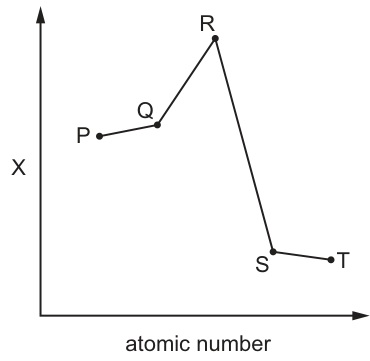
Which row is correct for property X and element R?
Options
| property X | element R | |
|---|---|---|
| A | electrical conductivity | |
| B | electronegativity | |
| C | melting point | |
| D | second ionisation energy |
Working
The five elements P, Q, R, S, T are consecutive in Period 3. Test each option by checking whether the property trend matches the graph: moderate → slightly higher → peak → sharp drop → very low.
Option A — electrical conductivity, R = Al
If R = Al, then P = Na, Q = Mg, S = Si, T = P.
Electrical conductivity: Na (good) < Mg (good) < Al (excellent, highest in Period 3) > Si (semiconductor, much lower) > P (non-metal, very low).
This matches the graph pattern perfectly.
Option B — electronegativity, R = Si
If R = Si, then P = Al, Q = Si, S = P, T = S (wait — R = Si means P = Al, Q = ?, let me re-index: if R = Si, atomic numbers are 13, 14, 15, 16, 17 → P = Al, Q = Si, R = P, S = S, T = Cl. But the option says R = Si, so P = Mg, Q = Al, R = Si, S = P, T = S.
Electronegativity increases steadily across Period 3: Mg < Al < Si < P < S. No peak and drop. Does not match.
Option C — melting point, R = Al
If R = Al, then P = Na, Q = Mg, S = Si, T = P.
Melting points: Na (98 °C) < Mg (650 °C) < Al (660 °C) < Si (1410 °C, giant covalent) > P (44 °C).
The peak is at Si, not Al. Does not match.
Option D — second ionisation energy, R = Si
If R = Si, then P = Al, Q = Si... wait, R = Si means P = Mg, Q = Al, R = Si, S = P, T = S.
Second ionisation energy generally decreases from Na to Ar (with variations due to electron configuration). It does not show a sharp peak at Si followed by a drop to very low values. Does not match.
Answer
A
Answer
A (property X = electrical conductivity, element R = Al)
A
Background Concept
Period 3 elements (Na, Mg, Al, Si, P, S, Cl, Ar) show characteristic trends in physical and chemical properties as atomic number increases. Understanding these trends is essential for identifying elements from property graphs.
Electrical conductivity in Period 3 is dominated by metallic bonding. Na, Mg, and Al are metals with delocalised electrons, giving good conductivity. Al has three delocalised electrons per atom (compared to one for Na and two for Mg), giving it the highest electrical conductivity of any Period 3 element. Si is a metalloid/semiconductor with conductivity many orders of magnitude lower than the metals. P, S, and Cl are non-metals with very poor conductivity.
Electronegativity (Pauling scale) increases steadily across Period 3 from left to right: Na (0.9) < Mg (1.2) < Al (1.5) < Si (1.8) < P (2.1) < S (2.5) < Cl (3.0). This is because nuclear charge increases while shielding remains roughly constant, pulling bonding electrons closer.
Melting points in Period 3 show a distinctive pattern: metals (Na, Mg, Al) have moderate to high melting points that increase with the number of delocalised electrons and decreasing atomic radius. Si has a giant covalent (macromolecular) structure with very strong Si–Si bonds, giving it the highest melting point (1410 °C). P, S, and Cl are simple molecular with weak van der Waals forces, giving very low melting points.
Second ionisation energy is the energy required to remove a second electron. Across Period 3, second IE generally decreases from Na to Ar because the second electron is removed from increasingly higher energy levels (3s then 3p) and from atoms with increasing nuclear charge but the same principal quantum number. There is no sharp peak at any element followed by a dramatic drop to very low values.
Understanding the Question
The question provides a graph of property X versus atomic number for five consecutive Period 3 elements labelled P, Q, R, S, T (not actual symbols). The graph shows:
- P: moderate value
- Q: slightly higher than P
- R: a peak, significantly higher than Q
- S: a sharp drop to a very low value (lower than P)
- T: slightly higher than S but still very low
We must determine which property X and which element R (among the given options) is consistent with this pattern. The elements are consecutive, so if R has atomic number Z, then P = Z−2, Q = Z−1, S = Z+1, T = Z+2.
Approach
Test each option by:
- Identifying the five consecutive elements (P, Q, R, S, T) based on the given R.
- Checking whether the known trend for property X across those five elements matches the graph pattern (moderate → slightly higher → peak → sharp drop → very low).
The key discriminator is the sharp drop after R and the very low values for S and T. This pattern is characteristic of a transition from metallic to non-metallic character, which is most dramatically seen in electrical conductivity.
Step-by-Step Reasoning
Option A: property X = electrical conductivity, R = Al
- R = Al (atomic number 13), so P = Na (11), Q = Mg (12), S = Si (14), T = P (15).
- Electrical conductivity values (approximate, in 10^7 S m⁻¹):
- Na: ~2.1 (good conductor)
- Mg: ~2.3 (slightly better than Na)
- Al: ~3.8 (highest in Period 3 — three delocalised electrons per atom, small atomic radius)
- Si: ~10⁻³ to 10³ (semiconductor — many orders of magnitude lower than metals)
- P (white): ~10⁻¹⁴ (very poor conductor, non-metal)
- Trend: moderate (Na) → slightly higher (Mg) → peak (Al) → sharp drop (Si) → very low (P). ✓ Matches the graph.
Option B: property X = electronegativity, R = Si
- R = Si (atomic number 14), so P = Mg (12), Q = Al (13), S = P (15), T = S (16).
- Electronegativity: Mg (1.2) < Al (1.5) < Si (1.8) < P (2.1) < S (2.5).
- This is a steady increase with no peak and no drop. ✗ Does not match.
Option C: property X = melting point, R = Al
- R = Al (atomic number 13), so P = Na (11), Q = Mg (12), S = Si (14), T = P (15).
- Melting points (°C): Na (98) < Mg (650) < Al (660) < Si (1410) > P (44).
- The peak is at Si (giant covalent structure), not Al. The graph shows the peak at R = Al, which is wrong. ✗ Does not match.
Option D: property X = second ionisation energy, R = Si
- R = Si (atomic number 14), so P = Mg (12), Q = Al (13), S = P (15), T = S (16).
- Second IE values (kJ mol⁻¹): Mg (1451) > Al (1799) > Si (1577) > P (1899) > S (2251).
- The trend is irregular but does not show a sharp peak at Si followed by a drop to very low values. In fact, second IE generally increases or fluctuates moderately across this range. ✗ Does not match.
Only Option A produces the graph pattern shown.
Key Takeaways
- Electrical conductivity in Period 3 peaks at Al due to the combination of three delocalised electrons per atom and a small atomic radius, then drops dramatically at Si (semiconductor) and P (non-metal).
- Melting points peak at Si (giant covalent), not Al, so a graph peaking at Al cannot represent melting point for these elements.
- Electronegativity increases monotonically across Period 3 — no peaks or drops.
- When matching a graph to a periodic trend, pay attention to the shape: monotonic increase/decrease, a single peak, or a sharp discontinuity.
Common Mistakes
- Confusing melting point peak with conductivity peak: Students often remember that Period 3 melting points peak somewhere in the middle and assume it must be Al. In fact, Si has the highest melting point due to its giant covalent structure. The peak at Al in the graph rules out melting point.
- Misidentifying the elements: Forgetting that P, Q, R, S, T are consecutive and misaligning the atomic numbers. Always write out the actual elements first.
- Assuming electronegativity has a peak: Electronegativity increases steadily across a period; it does not peak and drop within the period.
- Ignoring the sharp drop: The drop from R to S is dramatic (several orders of magnitude for conductivity). Only a metal-to-non-metal/metalloid transition produces such a drop.
Things to Be Careful About
- The graph shows relative magnitude, not absolute values. The sharp drop from R to S is the key feature — it must represent a change of several orders of magnitude, which only electrical conductivity shows (metal to semiconductor/non-metal).
- State symbols and exact values are not needed here; focus on the qualitative trend shape.
- When testing each option, always re-derive the full set of five elements from the given R before checking the trend. Misaligning P, Q, R, S, T is the most common source of error.
Element X is in Period 3. Element X reacts with oxygen to produce a solid, Y.
When solid Y is added to water, a solution with a pH of less than 7 is produced.
What is the identity of element X?
Options
A sodium
B silicon
C phosphorus
D sulfur
Working
- Sodium (A): 4Na + O₂ → 2Na₂O. Na₂O is a solid; with water it gives NaOH, a strong base, pH > 7. Not X.
- Silicon (B): Si + O₂ → SiO₂. SiO₂ is a solid but is insoluble in water and does not form an acidic solution. Not X.
- Phosphorus (C): P₄ + 5O₂ → P₄O₁₀ (solid). With water: P₄O₁₀ + 6H₂O → 4H₃PO₄, an acid, pH < 7. ✓
- Sulfur (D): S + O₂ → SO₂, which is a gas, not a solid. Not X.
Answer
C (phosphorus)
C
Background Concept
Period 3 elements form oxides whose acid-base behaviour with water varies across the period. Metal oxides (Na₂O, MgO) are basic and give alkaline solutions; non-metal oxides (P₄O₁₀, SO₂, SO₃) are acidic and give acidic solutions; amphoteric oxides (Al₂O₃) are in between. The question tests the ability to correlate the physical state of the oxide and the pH of its aqueous solution with the identity of the element.
Understanding the Question
We need to find which Period 3 element, X, forms a solid oxide Y that gives an acidic solution (pH < 7) when added to water. The key clues: Y is a solid, and the aqueous solution is acidic.
Approach
Go through each option, write the oxide formed, note its physical state, and determine the pH of its aqueous solution. Eliminate those that don't match both criteria.
Step-by-Step Reasoning
- Sodium (A): 4Na + O₂ → 2Na₂O. Na₂O is a white solid. With water: Na₂O + H₂O → 2NaOH, a strong base, pH > 7. Eliminate.
- Silicon (B): Si + O₂ → SiO₂. SiO₂ is a giant covalent solid. It is essentially insoluble in water and does not produce an acidic solution. Eliminate.
- Phosphorus (C): P₄ + 5O₂ → P₄O₁₀ (phosphorus(V) oxide), a white solid. With water: P₄O₁₀ + 6H₂O → 4H₃PO₄, phosphoric acid, pH < 7. This matches.
- Sulfur (D): S + O₂ → SO₂. SO₂ is a gas at room temperature, not a solid. Even though SO₂ with water gives sulfurous acid (acidic), the physical state doesn't match. Eliminate.
Therefore X is phosphorus.
Key Takeaways
- Period 3 oxides show a trend: basic (Na₂O, MgO) → amphoteric (Al₂O₃) → acidic (P₄O₁₀, SO₂, SO₃).
- Non-metal oxides are typically acidic and react with water to form acids.
- The physical state of the oxide is an important clue: SO₂ is a gas, P₄O₁₀ is a solid.
Common Mistakes
- Choosing sulfur because SO₂ gives an acidic solution, forgetting that SO₂ is a gas, not a solid.
- Thinking SiO₂ gives an acidic solution; it is insoluble and doesn't react with water to form acid under normal conditions.
Things to Be Careful About
- Read the question carefully: it specifies that Y is a solid.
- Recall the physical states of the common Period 3 oxides.
This question refers to isolated gaseous species.
The species , and are isoelectronic. This means they have the same number of electrons.
In which order do their radii increase?
Options
| smallest | largest | ||
|---|---|---|---|
| A | |||
| B | |||
| C | |||
| D |
Working
For isoelectronic species (same number of electrons), the radius decreases as the nuclear charge (proton number) increases, because the greater positive charge pulls the same electron cloud more strongly.
Nuclear charges: has 11 protons, has 10 protons, has 9 protons.
Therefore the radius increases in the order: < < .
Answer
C (, , )
C
Background Concept
Isoelectronic species are atoms or ions that have the same number of electrons. Here, (9 protons, 10 electrons), (10 protons, 10 electrons), and (11 protons, 10 electrons) all have 10 electrons. The key idea is that for a given number of electrons, the size of the species depends on the nuclear charge — the number of protons. A greater nuclear charge attracts the electron cloud more strongly, pulling it closer and making the species smaller. This is a fundamental principle in understanding atomic and ionic radii trends.
Understanding the Question
The question asks for the order of increasing radii of three isoelectronic species. The stem tells us they are isoelectronic, meaning they share the same electron count. We need to compare their sizes, which depends on their nuclear charges. The answer options present different orderings, and we must pick the one that correctly ranks them from smallest to largest.
Approach
Identify the nuclear charge (proton number) of each species. Since all have the same number of electrons, the species with the highest nuclear charge will be the smallest, and the one with the lowest nuclear charge will be the largest. Arrange them accordingly.
Step-by-Step Reasoning
- Count the protons: has 9 protons (fluorine's atomic number is 9), has 10, has 11.
- All species have 10 electrons ( gained one, lost one, is neutral).
- The electron cloud is attracted by the nuclear charge. With more protons, the attraction is stronger, so the radius is smaller.
- Therefore, with 11 protons is the smallest, with 10 is intermediate, and with 9 is the largest.
- This gives the order < < , which is option C.
Why the distractors are wrong:
- A: , , — incorrectly places before .
- B: , , — reverses the correct order.
- D: , , — also incorrect ordering.
Key Takeaways
- For isoelectronic species, radius is inversely related to nuclear charge.
- The higher the proton number, the smaller the species, given the same electron count.
Common Mistakes
- Confusing the direction: thinking a higher nuclear charge makes the species larger.
- Forgetting that has more protons than , even though it has the same electrons.
Things to Be Careful About
- Ensure you count protons correctly: has 9, has 10, has 11.
- Remember the order is from smallest to largest, not largest to smallest.
Separate samples of magnesium and calcium are added to an excess of dilute sulfuric acid. The observations are summarised in the table.
| metal | observations |
|---|---|
| magnesium | vigorous reaction, bubbles of gas produced, magnesium completely dissolves |
| calcium | vigorous reaction initially, bubbles of gas produced, reaction soon stops and leaves most of the calcium unreacted |
Which statement explains the difference in these observations?
Options
A Calcium is a better oxidising agent than magnesium.
B Calcium is a better reducing agent than magnesium.
C Magnesium is a more reactive metal with all dilute acids than calcium.
D Magnesium sulfate is more soluble than calcium sulfate.
Working
Both metals react with dilute sulfuric acid to give the sulfate and hydrogen:
The reaction with calcium starts vigorously but soon stops because calcium sulfate is only sparingly soluble and forms an insoluble coating on the calcium surface, preventing further contact with the acid. Magnesium sulfate is soluble, so no coating forms and the magnesium dissolves completely.
Answer
D
D
Background Concept
Group 2 metals react with dilute acids to produce a salt and hydrogen gas. The reactivity of the metals increases down the group, but the solubility of their sulfates decreases down the group: magnesium sulfate is soluble, calcium sulfate is sparingly soluble, and strontium and barium sulfates are essentially insoluble. When a sparingly soluble product forms during a reaction, it can precipitate onto the surface of the metal and act as a physical barrier, preventing further contact between the metal and the acid.
Understanding the Question
The table shows two observations: magnesium reacts vigorously and completely dissolves, while calcium reacts vigorously at first but the reaction soon stops, leaving most of the calcium unreacted. The question asks which statement explains this difference. It is not asking which metal is more reactive, but why the calcium reaction stops prematurely.
Approach
Identify the products of each metal–acid reaction. Then consider the solubility of the sulfate products. The key difference must be a physical barrier formed by an insoluble product, not a difference in reactivity or in oxidising/reducing ability.
Step-by-Step Reasoning
- Write the balanced equations:
- Magnesium sulfate is soluble in water, so it dissolves and leaves the fresh magnesium surface exposed. The reaction therefore continues until all the magnesium is used up.
- Calcium sulfate is only sparingly soluble. It precipitates as a solid layer on the calcium surface, shielding the metal from the acid. This stops the reaction even though calcium remains.
- Option A is incorrect because metals act as reducing agents in these reactions, not oxidising agents. Calcium is a better reducing agent than magnesium, but this does not explain why the reaction stops.
- Option B is true in terms of reactivity, but it does not explain the observation that most of the calcium remains unreacted.
- Option C is false: calcium is more reactive than magnesium with dilute acids in general. The observation is due to the coating, not to lower reactivity.
- Option D correctly identifies the solubility difference as the explanation.
Key Takeaways
- Solubility trend of Group 2 sulfates: MgSO₄ soluble, CaSO₄ sparingly soluble, BaSO₄ insoluble.
- A sparingly soluble product can coat a reactant and stop a reaction.
- In metal–acid reactions, the metal is oxidised (loses electrons) and is the reducing agent; H⁺ is reduced and is the oxidising agent.
Common Mistakes
- Choosing B because calcium is more reactive; reactivity alone does not explain why the reaction stops.
- Confusing oxidising and reducing agents: metals are reducing agents, not oxidising agents.
- Assuming all Group 2 sulfates are soluble; solubility decreases down the group.
Things to Be Careful About
- The question asks for the statement that explains the difference in observations, so focus on the stopping of the reaction.
- Use correct terminology: calcium sulfate is "sparingly soluble" rather than completely insoluble.
- In equations, include state symbols where relevant: Mg(s) + H₂SO₄(aq) → MgSO₄(aq) + H₂(g); Ca(s) + H₂SO₄(aq) → CaSO₄(s) + H₂(g). The (s) on CaSO₄ is the key point.
Dolomite is a double carbonate, , and can be used instead of calcium carbonate for treating acidic soils.
The three statements all refer to the agricultural use of these carbonates.
- Dolomite and calcium carbonate are both less soluble than .
- One mole of dolomite has the same neutralising effect as one mole of calcium carbonate.
- Dolomite and calcium carbonate both increase the pH of acidic soils.
Which statements are correct?
Options
A 1 and 2 only
B 1 and 3 only
C 2 and 3 only
D 1, 2 and 3
Working
Statement 1 — correct. Group 2 carbonates (including and dolomite) are practically insoluble in water, whereas is only slightly soluble. Both carbonates are therefore less soluble than .
Statement 2 — incorrect. One formula unit of dolomite, , contains two carbonate ions, and each neutralises two . One mole of dolomite therefore neutralises twice the acid that one mole of does, so the neutralising effects are not the same.
Statement 3 — correct. Both carbonates react with from acidic soil, removing and raising the pH:
Answer
B (1 and 3 only)
B
Background Concept
Dolomite, , is a double carbonate of calcium and magnesium, while calcium carbonate, , is the familiar single carbonate. Both are Group 2 carbonates used as agricultural liming agents to correct acidic soil. Three ideas are in play.
1. Solubility. Across Group 2 the carbonates are effectively insoluble in water — this is why lime can be spread on fields and then reacts slowly with soil moisture. The hydroxides, by contrast, are sparingly soluble: dissolves enough to form limewater (a dilute alkaline solution), and is even less soluble. So a carbonate is always far less soluble than the hydroxide.
2. Neutilising capacity. Acids are neutralised by any species that consumes . For a carbonate the active reaction is
so each carbonate ion uses up two . The amount of acid one mole of a solid neutralises therefore depends on how many carbonate ions each formula unit contains — not on the metal cation or the molar mass.
3. Effect on pH. Soil acidity means excess in the soil water. Removing by reaction with a base lowers and therefore raises pH. This is the entire purpose of agricultural liming.
Understanding the Question
This is an "evaluate each statement" multiple-choice question: three statements about dolomite versus calcium carbonate in agriculture are given, and the answer option is built from which statements are true. Statement 1 compres the solubility of the two carbonates with that of ; statement 2 compares neutralising capacity mole for mole; statement 3 asks whether either carbonate raises soil pH. The disriminating skills are a confident knowledge of Group 2 solubility and careful stoichiometric counting of carbonate ions per formula unit. No heavy arithmetic is needed — the traps are conceptual.
Approach
Judge each statement independently first, then match the true statements to the answer options. For statement 1, ask: are carbonates less soluble than hydroxide? For statement 2, write the neutralising reaction and count ions on both sides of the "one mole" comparison. For statement 3, ask simply whether carbonates are basic. The option containing exactly the true statements is the correct answer.
Step-by-Step Reasoning
Statement 1 — solubility. All Group 2 carbonates are insoluble in water; and dolomite are no exception. Calcium hydroxide, however, is described as slightly soluble — a small but real amount dissolves to give limewater. Since far less solute dissolves from the carbonates than from the hydroxide, both carbonates are less soluble than . Statement 1 is true.
Statement 2 — neutralising capacity. releases one carbonate ion per formula unit, so one mole of it consumes 2 mol of . Dolomite, , contains two carbonate ions per formula unit and one mole of it consumes 4 mol of — twice as much acid. Therefore one mole of dolomite does not have the same neutralising effect as one mole of calcium carbonate. Statement 2 is false; it is the deliberately subtle trap in this question.
Statement 3 — effect on pH. Both solids react with from acidic soil, removing the acid and driving the soil toward neutrality, i.e. raising the pH. This is precisely why lime is spread on acidic fields. Statement 3 is true.
Combining the judgements: statements 1 and 3 are true, statement 2 is false. This matches option B (1 and 3 only). The other options all fail: A (1 and 2) and C (2 and 3) both require statement 2 to be true; D (all three) repeats that same error.
Key Takeaways
- Group 2 carbonates are insoluble in water; the hydroxides (especially ) are sparingly soluble — know this solubility contrast.
- Neutralising power per mole depends on the number of ions per formula unit, not on the metal or the mass: a double carbonate such as dolomite neutralises twice the acid of a single carbonate.
- Carbonates are bases because they consume , so they raise pH — the chemical basis of agricultural liming.
- In "which statements are correct" MCQs, evaluate each statement fully before reading the options; never infer a statement's truth from the option pattern.
Common Mistakes
- Assuming one mole of any carbonate neutralises the same amount of acid because they are all "carbonates". You must count carbonate ions — dolomite has two per formula unit, doubling its effect.
- Forgetting that is only slightly soluble, not freely soluble — this misunderstanding can make statement 1 seem wrong.
- Thinking "insoluble" means the carbonate dissolves not at all, which is not the point; the statement only requires that less dissolves than from the hydroxide.
- Selecting C or D by assuming statements 2 and 3 are both true without counting carbonate ions in statement 2.
Things to Be Careful About
- Statement 2 is a per-mole comparison: use the reaction to count consumed, and note the double carbonate contributes two .
- State the solubility judgement precisely: carbonates are "insoluble" and calcium hydroxide is "slightly soluble"; that contrast is what statement 1 rewards.
- When combining statements into an option, double-check the option selected contains exactly the true statements and no false one.
This question is about two salts, and .
The two solid salts are separately added to warm concentrated and the results noted.
Aqueous solutions of the two salts are separately added to and then concentrated is added and the results noted.
Which row is correct?
Options
| salt | identity of one product formed with concentrated | observation after and are added | |
|---|---|---|---|
| A | colourless solution | ||
| B | white precipitate | ||
| C | yellow precipitate | ||
| D | colourless solution |
Working
For with concentrated : chloride is not a strong enough reducing agent to reduce , so the only product is — not or . This eliminates options A and B.
For with concentrated : iodide is a strong reducing agent and reduces to , or , so is a valid product.
For the then test:
- gives a white precipitate of , which dissolves in concentrated to give a colourless solution.
- gives a yellow precipitate of , which is insoluble in concentrated .
Only option C combines with (a valid product) and a yellow precipitate (the correct observation for ).
Answer
C
C
Background Concept
This question tests two classic identification tests for halide ions.
1. Reaction with concentrated
Halide ions have different reducing powers, which increase down Group 17:
- is a weak reducing agent and cannot reduce concentrated . The only reaction is acid–base: .
- is a stronger reducing agent and reduces to .
- is the strongest reducing agent and reduces to , , or even .
2. Silver nitrate then ammonia
forms precipitates with halide ions:
- : white precipitate, soluble in dilute ammonia
- : cream precipitate, soluble in concentrated ammonia
- : yellow precipitate, insoluble in concentrated ammonia
The solubility in ammonia is due to formation of the complex ion .
Understanding the Question
The question asks which row correctly pairs a salt with (1) a product formed when it reacts with warm concentrated , and (2) the observation after adding then concentrated . Both tests are standard halide identification tests. We need to check each option's product and observation independently.
Approach
For each salt, determine:
- What happens with concentrated — is the halide a strong enough reducing agent to reduce ? What product is formed?
- What happens with then — what colour is the silver halide precipitate, and does it dissolve in concentrated ?
Then check each option against these facts.
Step-by-Step Reasoning
Step 1: with concentrated
Chloride cannot reduce — it would need to lose electrons to become , but is a weak reducing agent and is not a strong enough oxidising agent to oxidise it. So the product is , not or . Options A and B are wrong on the product.
Step 2: with concentrated
The formed is a strong reducing agent and reduces :
So is a valid product of with concentrated . Options C and D both have valid products ( for C, for D).
Step 3: with then
is a white precipitate. On adding concentrated :
The precipitate dissolves to give a colourless solution. So the observation for is "colourless solution". Option A has this observation correct, but its product () is wrong.
Step 4: with then
is a yellow precipitate. On adding concentrated , does not dissolve — is too large and is too insoluble for the complex-formation equilibrium to favour dissolution. So the observation is "yellow precipitate". Option C has this observation correct.
Step 5: Check each option
- A: , (wrong — should be ), colourless solution (correct) → wrong
- B: , (wrong — should be ), white precipitate (wrong — should be colourless solution after ) → wrong
- C: , (correct), yellow precipitate (correct) → correct
- D: , (correct), colourless solution (wrong — should be yellow precipitate) → wrong
Answer: C
Key Takeaways
- Halide ions have increasing reducing power down the group: . Only and can reduce concentrated (to and to /S/ respectively).
- Silver halide precipitates: white (soluble in dilute ), cream (soluble in concentrated ), yellow (insoluble in concentrated ).
- The ammonia test works because forms the soluble complex , but only if the silver halide is soluble enough for the equilibrium to favour dissolution.
Common Mistakes
- Thinking produces with — it doesn't; chloride is not oxidised by , so the product is .
- Confusing which silver halide dissolves in which ammonia concentration — dissolves in dilute , needs concentrated , does not dissolve even in concentrated .
- Forgetting that can reduce to several products (, S, ), so any of these is a valid "one product".
Things to Be Careful About
- The question asks for "one product formed" — for , multiple products are possible, so is a valid answer even though is also formed.
- The observation is the FINAL result after both and are added — for , the white precipitate dissolves in , so the final observation is a colourless solution, not a white precipitate.
- The reducing power trend of halides is the key to the reaction: only the stronger reducing agents (, ) cause redox.
The diagram shows the process of adding calcium nitrate and strontium nitrate to separate boiling tubes and heating them. Identical conditions are used.
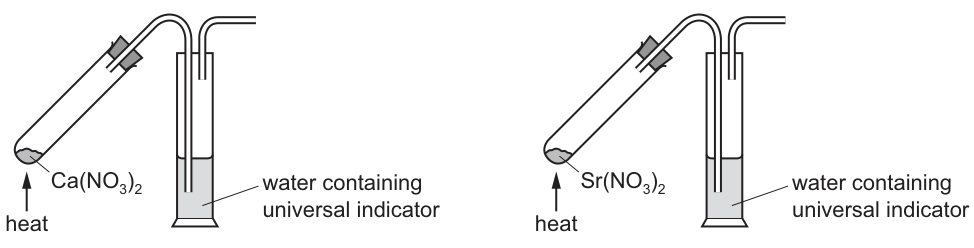
As the reactions proceed, the water containing universal indicator changes colour.
Which row describes the colour change and identifies the nitrate that causes the quickest colour change?
Options
| colour change of universal indicator | nitrate that causes the quickest colour change | |
|---|---|---|
| A | green to blue | |
| B | green to blue | |
| C | green to red | |
| D | green to red |
Working
-
Thermal Decomposition Products: Group 2 nitrates decompose on heating to form the metal oxide, oxygen, and nitrogen dioxide gas.
Nitrogen dioxide () is an acidic gas. When it dissolves in water, it forms nitric acid, lowering the pH. -
Colour Change: The water initially contains universal indicator, which is green at neutral pH. As the acidic dissolves, the solution becomes acidic, turning the indicator from green to red (or yellow/orange/red depending on concentration, but definitely acidic direction, not basic).
- Green to blue indicates a base (incorrect).
- Green to red indicates an acid (correct).
-
Rate of Reaction (Thermal Stability): The thermal stability of Group 2 nitrates increases down the group. Calcium is above strontium in Group 2, so calcium nitrate is less thermally stable than strontium nitrate.
- Less stable compounds decompose more readily and quickly.
- Therefore, decomposes faster than , producing gas at a faster rate.
- This causes the quickest colour change.
Combining these: The colour change is green to red, and causes the quickest change.
Answer
C
C
Background Concept
Thermal Decomposition of Group 2 Nitrates:
When Group 2 metal nitrates are heated, they decompose to produce the metal oxide, oxygen gas, and nitrogen dioxide gas. The general equation is:
Nitrogen dioxide () is a brown, toxic, acidic gas. When it dissolves in water, it reacts to form nitric acid () and nitrous acid (), creating an acidic solution.
Thermal Stability Trend:
Thermal stability of Group 2 compounds (like carbonates and nitrates) increases down the group. This means magnesium nitrate decomposes most easily, while barium nitrate is the most stable and requires the highest temperature to decompose.
Explanation of the Trend (Polarisation):
The nitrate ion () is a large, complex anion. The small, highly charged Group 2 cations () polarise (distort) the electron cloud of the nitrate ion. A smaller cation (like ) has a higher charge density than a larger cation (like ). Higher charge density leads to greater polarisation of the nitrate ion, destabilising it and making it easier to decompose (release and ). Thus, the less stable the salt, the lower the decomposition temperature and the faster the decomposition at a given temperature.
Understanding the Question
The question presents two experimental setups where calcium nitrate and strontium nitrate are heated separately. The gases evolved are bubbled into water containing universal indicator.
- Goal 1: Determine the direction of the colour change of the universal indicator.
- Goal 2: Determine which nitrate causes the colour change more quickly.
We are given four options combining a colour change (green to blue or green to red) and a nitrate ( or ).
Approach
- Identify the gas: Write the decomposition equation to find the gas produced. Determine if the gas is acidic or basic to predict the universal indicator colour change.
- Compare stability: Use the periodicity trend for Group 2 nitrates to decide which compound is less stable and therefore decomposes faster.
Step-by-Step Reasoning
-
Decomposition Products: Both calcium nitrate and strontium nitrate are Group 2 nitrates. They decompose as follows:
The key gas is . is an acidic oxide. When dissolved in water:
(Simplified: formation of nitric acid). The solution becomes acidic. -
Universal Indicator Colour: Universal indicator is green at neutral pH (7). In an acidic solution, it turns yellow, then orange, then red. It turns blue/green/blue for bases. Since the solution becomes acidic, the colour change is green to red. This eliminates options A and B.
-
Rate of Decomposition: We need to compare the thermal stability of and .
- Calcium is in Period 4, Strontium is in Period 5. is smaller than .
- has a higher charge density.
- polarises the ion more strongly than .
- Greater polarisation destabilises the nitrate ion more.
- Therefore, is less thermally stable than .
- A less stable compound decomposes more readily (at a lower temperature or faster at the same temperature). Thus, will produce gas faster.
- Faster production of acidic gas leads to a quicker colour change.
-
Conclusion: The colour change is green to red, and the quickest change is caused by . This matches row C.
Key Takeaways
- Group 2 nitrates decompose to give metal oxide, , and . is acidic.
- Universal indicator goes from green (neutral) to red (acidic) when exposed to .
- Thermal stability of Group 2 nitrates increases down the group ().
- Less stable nitrates (higher up the group) decompose faster/more easily.
Common Mistakes
- Confusing the gas: Thinking the gas is basic (like ammonia) and choosing green to blue. is an acidic gas, not a base.
- Confusing stability with reactivity: Thinking that because Strontium is more 'reactive' in other contexts (like with water), its compounds decompose faster. For thermal decomposition of salts, more stable means harder to decompose. Since stability increases down the group, Sr is more stable, so it decomposes slower. Ca is less stable, so it decomposes faster.
- Forgetting the products: Assuming nitrates decompose to give just (like Group 1 nitrates, except lithium) or nitrites. Group 2 nitrates give the oxide, not the nitrite (except Li which is Group 1).
Things to Be Careful About
- Universal Indicator colours: Remember green is neutral. Blue is alkaline. Red is acidic. forms acid, so it must go towards red.
- Trend direction: Always double-check the trend. Stability increases down Group 2. Reactivity of the metals increases down Group 2. Do not mix these up. For decomposition of salts, higher stability = slower decomposition.
- Equation balancing: Ensure you know the stoichiometry produces 4 moles of for every 2 moles of nitrate, emphasizing the significant amount of acidic gas produced.
The equations for three reactions involving chlorine or its compounds are listed.
Which statement about these equations is correct?
Options
A Equation 1 describes the formation of a compound used to kill bacteria in drinking water.
B Equation 1 does not represent a redox reaction.
C Equation 2 describes the formation of potassium chlorate(IV).
D Equations 2 and 3 both represent disproportionation reactions.
Working
Assign oxidation numbers to chlorine and oxygen in each equation.
Equation 1: has ; has ; has . Oxidation numbers change, so equation 1 is a redox reaction. Statement B is false.
The product is not the compound used to kill bacteria in drinking water; chlorine itself is used for water purification. Statement A is false.
Equation 2: has . In , ; in , . The same element, chlorine, is both oxidised and reduced, so equation 2 is a disproportionation.
Equation 3: has . In , ; in , . Again, chlorine is both oxidised and reduced, so equation 3 is a disproportionation.
is potassium chlorate(V), not potassium chlorate(IV), so statement C is false.
Answer
D
D
Background Concept
Redox reactions involve a change in oxidation number. Oxidation is an increase in oxidation number; reduction is a decrease. To decide whether a reaction is redox, assign oxidation numbers to every element before and after the reaction.
Useful rules: oxygen is usually in compounds, hydrogen is usually , and a Group 1 metal such as potassium is . The sum of oxidation numbers in a neutral compound is zero. For an element in its elemental form, such as or , the oxidation number is zero.
A disproportionation reaction is a special type of redox reaction in which the same element in one reactant is simultaneously oxidised and reduced. One product contains the element at a higher oxidation number and another product contains it at a lower oxidation number.
Chlorine oxoanion names are based on the oxidation number of chlorine: is chlorate(I), is chlorite(III), is chlorate(V), and is chlorate(VII).
Understanding the Question
This multiple-choice question gives three balanced equations involving chlorine or its compounds. Four statements are offered, and only one is correct. The task is to test each statement using oxidation-number reasoning.
- Statement A links equation 1 to water purification.
- Statement B claims equation 1 is not redox.
- Statement C misnames the product of equation 2.
- Statement D claims equations 2 and 3 are both disproportionation reactions.
The key skills are assigning oxidation numbers and recognising disproportionation.
Approach
For each equation, assign oxidation numbers to chlorine and oxygen in the reactants and products. Then decide whether oxidation numbers change and whether the same element is both oxidised and reduced.
- If oxidation numbers change, the reaction is redox.
- If the same element appears in one reactant and ends up at both higher and lower oxidation numbers in the products, it is a disproportionation.
- Check the names of chlorate compounds using the oxidation number of chlorine.
Step-by-Step Reasoning
Equation 1:
In : , each , so .
In : .
In : .
Chlorine changes from to (reduction), and oxygen changes from to (oxidation). Therefore equation 1 is definitely a redox reaction, so statement B is false.
Statement A is also false. The compound used to kill bacteria in drinking water is chlorine, not potassium chloride. Potassium chloride is an ionic salt and is not used as a disinfectant in this way.
Equation 2:
In : .
In : , four atoms give , so .
In : .
Chlorine in the same reactant, , is oxidised from to and reduced from to . This is a disproportionation reaction.
Statement C says equation 2 forms potassium chlorate(IV). This is wrong: is potassium chlorate(V), and is potassium chlorate(VII). There is no chlorate(IV) formed here.
Equation 3:
In : .
In : .
In : .
Chlorine is oxidised from to and reduced from to . This is also a disproportionation reaction.
Since both equation 2 and equation 3 are disproportionation reactions, statement D is correct.
Key Takeaways
- Always assign oxidation numbers before classifying a reaction as redox or non-redox.
- A disproportionation reaction occurs when the same element in one reactant is both oxidised and reduced.
- Chlorate names are linked to the oxidation number of chlorine: chlorate(V) is and chlorate(VII) is .
- Chlorine gas, not potassium chloride, is associated with killing bacteria in drinking water.
Common Mistakes
- Thinking equation 1 is not redox because chlorine changes from to . Oxygen also changes from to , so the reaction is redox.
- Confusing disproportionation with a reaction in which two different elements are oxidised and reduced. Disproportionation requires the same element to undergo both changes.
- Naming as chlorate(IV). The oxidation number of chlorine in is , so it is chlorate(V).
- Assuming that any reaction involving chlorine is a disproportionation. You must check the oxidation numbers of chlorine in the reactant and products.
Things to Be Careful About
- State oxidation numbers explicitly for each species before drawing conclusions.
- Remember that the oxidation number of an element in its elemental form, such as or , is zero.
- In a neutral compound, the sum of all oxidation numbers must be zero.
- Do not rely on memory for chlorate nomenclature; calculate the oxidation number of chlorine from the formula.
- For statement D, verify both equations independently. A statement is only correct if every part of it is correct.
Nitrogen monoxide, , is a primary pollutant produced by petrol engines and is found in their exhaust gases.
Which reaction occurs in a catalytic converter and decreases the emission of nitrogen monoxide?
Options
A
B
C
D
Working
In a catalytic converter, nitrogen monoxide is reduced to harmless nitrogen gas while carbon monoxide is oxidised to carbon dioxide:
This is option C.
Answer
C
C
Background Concept
Nitrogen monoxide, NO, is formed in petrol engines when nitrogen and oxygen in the air react at the high temperatures of combustion. It is a primary pollutant that contributes to photochemical smog and acid rain. Catalytic converters are fitted to vehicle exhausts to remove NO and carbon monoxide, CO, simultaneously.
The catalytic converter promotes a redox reaction. NO, in which nitrogen has an oxidation state of +2, is reduced to N2 (oxidation state 0). CO, in which carbon has an oxidation state of +2, is oxidised to CO2 (oxidation state +4). The products, N2 and CO2, are both naturally present in the atmosphere and are not harmful pollutants.
Understanding the Question
This question asks which of four equations represents the reaction that actually occurs in a catalytic converter and that decreases NO emission. The key is not only that NO is consumed, but also that the nitrogen ends up as harmless N2 rather than being converted to another nitrogen oxide such as NO2.
The wrong options all convert NO to NO2, which is still a pollutant. The correct option must keep nitrogen atoms balanced and produce N2.
Approach
- Recall the purpose of a catalytic converter: convert NO and CO into harmless gases.
- Identify the products: N2 and CO2 are harmless; NO2 is harmful.
- Balance the equation for the reaction of NO with CO.
- Compare with the given options.
Step-by-Step Reasoning
- Option A: NO + CO -> NO2 + C. This produces NO2, which is still an atmospheric pollutant, so it would not reduce nitrogen monoxide emission in the catalytic converter. Also, the reaction is not balanced for oxygen: left has NO + CO (2 O atoms total), right has NO2 (2 O atoms) plus C(s) — wait, actually left: O from NO (1) + O from CO (1) = 2 O; right: O from NO2 = 2 O. C and N balance: left N=1, C=1; right N=1, C=1. It is balanced but produces NO2, not decreasing nitrogen oxide pollution effectively.
- Option B: NO + CO2 -> NO2 + CO. This simply swaps oxygen and carbon atoms; it does not remove NO, and the nitrogen is still in a nitrogen oxide. It is not the catalytic converter reaction.
- Option C: 2NO + 2CO -> N2 + 2CO2. Balanced: N: 2 left, 2 right; C: 2 left, 2 right; O: left 2 (from NO) + 2 (from CO) = 4, right 2×2 = 4. Produces N2 and CO2, both harmless. This is the correct reaction.
- Option D: 2NO + CO2 -> 2NO2 + C. Again produces NO2, and also produces solid carbon, which would deposit in the catalyst. Not the desired reaction.
Thus C is the only reaction that both reduces NO and produces N2.
Key Takeaways
- Catalytic converters remove NO by reducing it to N2 and oxidising CO to CO2.
- The products of a pollution-control reaction should be harmless gases such as N2 and CO2, not NO2 or C.
- Balancing equations and checking oxidation states helps identify correct redox reactions.
Common Mistakes
- Choosing an option that converts NO to NO2: this mistake happens when students only check that NO is consumed, not what it becomes. NO2 is still a nitrogen oxide pollutant.
- Overlooking stoichiometry: an unbalanced or incorrectly balanced equation cannot occur.
- Thinking any reaction involving NO and CO is the catalytic converter reaction; only the one giving N2 and CO2 is correct.
Things to Be Careful About
- Always check both atoms and charge balance in an equation.
- Remember the oxidation states: NO has N at +2, CO has C at +2, N2 has N at 0, CO2 has C at +4. The reduction and oxidation are therefore clearly identified.
- The catalytic converter also removes CO, so the correct equation must include CO as a reactant, not CO2 as a reactant.
The diagram shows the structure of the naturally occurring molecule cholesterol.
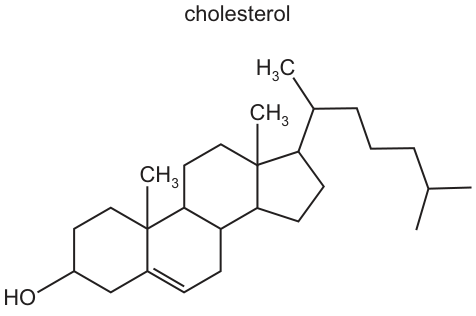
Student X stated that the 17 carbon atoms in the 4 rings all lie in the same plane.
Student Y stated that this molecule displays cis/trans isomerism at the C=C double bond.
Which students are correct?
Options
A both student X and student Y
B neither student X nor student Y
C student X only
D student Y only
Answer
B (neither student X nor student Y)
Reasoning:
- Student X is incorrect: The carbon atoms forming the four fused rings are predominantly hybridized (tetrahedral geometry, bond angles approximately 109.5°). These rings adopt non-planar conformations (e.g., chair conformations for the six-membered rings). Only the two carbon atoms involved in the C=C double bond are hybridized and planar. Therefore, the 17 carbon atoms do not all lie in the same plane.
- Student Y is incorrect: While the carbon atoms of the C=C double bond are attached to different groups, the double bond is located within a six-membered ring. In small rings (six carbons or fewer), the ring structure forces the double bond into a cis configuration. A trans double bond in a six-membered ring is too strained to exist under normal conditions. Therefore, the molecule cannot exist as cis and trans isomers; it does not display cis/trans isomerism.
B
Background Concept
Hybridization and Molecular Geometry:
Carbon atoms can be , , or hybridized.
- carbons (four single bonds) have a tetrahedral geometry with bond angles of approximately 109.5°. They are not planar.
- carbons (one double bond, two single bonds) have a trigonal planar geometry with bond angles of approximately 120°. The atoms directly attached to these carbons lie in the same plane.
Cis/Trans (Geometric) Isomerism:
For a molecule to display cis/trans isomerism around a C=C double bond, two conditions must be met:
- There must be restricted rotation (provided by the pi bond).
- Each carbon atom of the double bond must be attached to two different groups.
Cyclic Alkenes:
When a double bond is part of a ring, the ring size constrains the geometry. For rings with 6 or fewer carbon atoms, the ring is too small to accommodate a trans double bond without breaking or becoming extremely strained. Therefore, double bonds in small rings (like cyclohexene) are fixed in a cis configuration and do not exhibit cis/trans isomerism.
Understanding the Question
The question presents a skeletal structure of cholesterol and asks to evaluate two student statements:
- Student X: Claims the 17 carbon atoms in the four fused rings are all coplanar (in the same plane).
- Student Y: Claims the molecule shows cis/trans isomerism at the C=C double bond.
We need to determine if these statements are true or false based on the structure and chemical principles.
Approach
- Analyze Planarity (Student X): Look at the hybridization of the carbon atoms in the rings. Identify how many are vs . Recall the 3D shape of carbons and the conformation of cyclohexane rings.
- Analyze Isomerism (Student Y): Locate the C=C double bond. Check if each carbon has two different substituents. Crucially, check if the double bond is in a ring and consider the ring size constraints on geometric isomerism.
Step-by-Step Reasoning
Evaluating Student X (Planarity of rings):
- Look at the four fused rings (the steroid nucleus). They consist of three six-membered rings and one five-membered ring.
- Most carbon atoms in these rings are bonded to four other atoms via single bonds (e.g., or groups, or quaternary carbons with methyl groups). These carbons are hybridized.
- hybridized carbons have a tetrahedral shape. They are not flat. For example, a cyclohexane ring adopts a chair conformation, which is non-planar.
- Only the two carbons involved in the C=C double bond are hybridized and trigonal planar.
- Therefore, the 17 carbon atoms in the rings do not all lie in the same plane. Student X is incorrect.
Evaluating Student Y (Cis/Trans Isomerism):
- Locate the C=C double bond in the second ring from the left.
- Let's label the carbons of the double bond as C5 and C6 (using standard steroid numbering, though not strictly necessary if we just look at the diagram).
- One carbon (let's call it C_a) is bonded to a ring carbon (part of the ring chain) and a quaternary ring carbon (the junction with the methyl group). These are two different groups.
- The other carbon (C_b) is bonded to a hydrogen atom (implicit in skeletal structures) and a ring carbon (). These are two different groups.
- Technically, the condition of having different groups on each carbon is met. However, there is a crucial constraint: the double bond is inside a six-membered ring.
- In a six-membered ring, the carbon chain is too short to reach across to the other side of the double bond in a trans arrangement without severe angle strain. Thus, the double bond is locked in a cis configuration.
- Because a stable trans isomer cannot exist, the molecule does not display cis/trans isomerism (i.e., it doesn't have isomers that can be isolated as cis and trans forms). Student Y is incorrect.
Conclusion:
Both students are incorrect. The correct option is B.
Key Takeaways
- Rings are not flat: Unless all carbons in a ring are hybridized (like in benzene), the ring will be non-planar. Cyclohexane rings are specifically non-planar (chair/boat conformations) due to tetrahedral geometry.
- Ring size and isomerism: A double bond in a ring of 6 carbons or fewer cannot show cis/trans isomerism because the ring forces a cis geometry and a trans geometry is impossible/too strained.
Common Mistakes
- Assuming rings are planar: Students often confuse the 2D skeletal representation (which looks flat on paper) with the actual 3D structure. Benzene is planar, but the rings in cholesterol are cyclohexane/cyclopentane derivatives, which are non-planar.
- Ignoring ring constraints for isomerism: Students might see that the C=C carbons have different groups attached and conclude cis/trans isomerism exists, forgetting that the cyclic structure locks the geometry.
- Miscounting substituents: Forgetting the implicit hydrogen on the carbon of the double bond, which is essential for determining if groups are different.
Things to Be Careful About
- State symbols and hybridization: Always check hybridization to determine geometry. = tetrahedral (non-planar), = planar.
- Skeletal structures: Remember that hydrogens on carbons are implied. At the C=C bond, one carbon has an implicit H, the other does not (it has a methyl group or ring junction attached).
- Ring strain: Be aware of the rule that trans double bonds are generally not possible in rings with carbons (for A-Level, is the safe rule).
The drug cortisone has the formula shown.
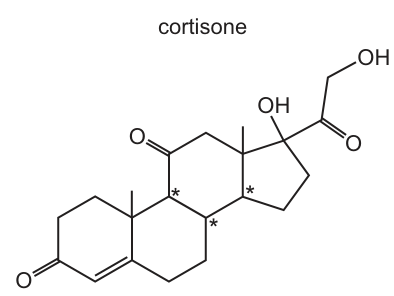
In addition to those chiral centres marked by an asterisk (*), how many other chiral centres are present in the cortisone molecule?
Options
A 0
B 1
C 2
D 3
Answer
D (3)
A chiral centre is a carbon atom bonded to four different groups. In the cortisone molecule, the three unmarked chiral centres are:
- the carbon at the A/B ring junction bearing the methyl group (bonded to CH₃, C1, C5, and C9);
- the carbon at the C/D ring junction bearing the methyl group (bonded to CH₃, C12, C14, and C17);
- the other carbon at the B/C ring junction (bonded to H and three different ring segments).
These three carbons are not marked with an asterisk, giving a total of 3 additional chiral centres.
D
Background Concept
A chiral centre (or stereocentre) in an organic molecule is typically a carbon atom that is bonded to four different groups or atoms. This tetrahedral arrangement means the molecule (or that part of it) lacks a plane of symmetry and can exist as non-superimposable mirror images (enantiomers). In skeletal (line-angle) structures, hydrogen atoms attached to carbons are implied. To identify a chiral centre, you must mentally add the implicit hydrogen and check whether all four substituents on the carbon are distinct.
Ring junction carbons in fused polycyclic systems (like steroids) are common chiral centres. A junction carbon is bonded to two ring carbons on one side, one ring carbon on the other side, and either a hydrogen atom or a substituent (such as a methyl group). If the two ring paths from the junction are different (which they almost always are in asymmetrical fused rings), and the fourth group (H or substituent) differs from the ring carbons, the carbon is chiral.
Understanding the Question
The question provides the skeletal structure of cortisone, a steroid with four fused rings (A, B, C, D). Three chiral centres are already marked with an asterisk (*): one at the B/C ring junction, one at the C/D ring junction (C14), and one on the D ring bearing the hydroxyl group (C17). The task is to count the other (unmarked) chiral centres in the molecule. The command word "how many" requires a numerical count based on applying the definition of a chiral centre to every carbon in the structure.
Approach
Systematically scan every carbon atom in the cortisone skeleton and apply the "four different groups" test. Focus especially on:
- Ring junction carbons, which are often chiral.
- Carbons bearing heteroatoms (O) or methyl groups, which are likely chiral.
- Carbons that are clearly not chiral: those in C=C double bonds (sp², only 3 groups), carbonyl carbons (C=O, sp²), and CH₂ groups (two identical H atoms).
Step-by-Step Reasoning
Let us label the standard steroid ring carbons and check them:
- Ring A (bottom left): Contains a C=O at C3 and a C=C between C4 and C5. C3, C4, and C5 are sp² hybridised (not chiral). C1 and C2 are CH₂ groups (not chiral). C10 is the junction between rings A and B. It is bonded to: a methyl group (CH₃), C1 (CH₂), C5 (CH=), and C9 (CH). All four groups are different. C10 is a chiral centre. It is not marked.
- Ring B (middle left): C6 and C7 are CH₂ groups (not chiral). C8 is the junction between rings B and C. It is bonded to: H, C7 (CH₂), C9 (CH), and C14 (CH). All four are different. C8 is a chiral centre. One of the B/C junction carbons is marked (C9), so C8 is an unmarked chiral centre.
- Ring C (middle right, with C=O at C11): C11 is sp² (not chiral). C12 is CH₂ (not chiral). C13 is the junction between rings C and D. It is bonded to: a methyl group (CH₃), C12 (CH₂), C14 (CH), and C17 (C-OH). All four groups are different. C13 is a chiral centre. It is not marked.
- Ring D (five-membered, right): C15 and C16 are CH₂ groups (not chiral). C17 bears an -OH group and a -COCH₂OH side chain. It is bonded to: OH, the side chain, C13, and C16. It is marked (*).
Counting the unmarked chiral centres: C10, C8, and C13. That is exactly 3 chiral centres.
Key Takeaways
- Always mentally add implicit hydrogens when checking for chiral centres in skeletal structures.
- Ring junction carbons in fused polycyclic systems are frequent chiral centres; check each one individually.
- Carbons with =O or =C are sp² hybridised and cannot be chiral centres. CH₂ groups have two identical substituents (H) and cannot be chiral centres.
Common Mistakes
- Forgetting implicit hydrogens: A student might look at C10 or C13 and think they are bonded to only three things (the two ring carbons and the methyl group), missing the implicit hydrogen. This would lead to undercounting.
- Misidentifying sp² carbons as chiral: Counting the carbonyl carbons (C3, C11) or the alkene carbons (C4, C5) as chiral centres.
- Overlooking methyl-bearing junctions: The carbons at the A/B and C/D ring junctions that bear methyl groups (C10 and C13) are easy to miss because the methyl group is drawn as a simple line, and students may not mentally separate the four distinct bonds.
Things to Be Careful About
- The question asks for the number of other (additional) chiral centres, not the total. Always subtract the marked ones from the total count.
- In skeletal structures, a line ending in nothing is a methyl group (CH₃). Ensure you treat it as a distinct substituent when checking the four-different-groups rule.
- Stereoisomerism in steroids is complex; do not try to draw all the enantiomers. Just apply the local four-group test to each candidate carbon.
But-2-ene reacts with cold dilute acidified to give product X.
But-2-ene reacts with hot concentrated acidified to give product Y.
Which statement about product X and product Y is correct?
Options
A Both product X and product Y will react with 2,4-dinitrophenylhydrazine.
B Neither product X nor product Y will react with 2,4-dinitrophenylhydrazine.
C Product X will react with 2,4-dinitrophenylhydrazine, product Y will not.
D Product Y will react with 2,4-dinitrophenylhydrazine, product X will not.
Working
Cold dilute acidified oxidises but-2-ene to butane-2,3-diol, (X), a diol. Hot concentrated acidified cleaves the C=C bond, giving two molecules of ethanoic acid, (Y), a carboxylic acid.
2,4-DNPH reacts only with aldehydes and ketones. Neither a diol nor a carboxylic acid reacts with 2,4-DNPH.
Answer
B
B
Background Concept
Alkenes contain a C=C double bond, which is electron-rich and susceptible to oxidation. Acidified potassium manganate(VII) () is a strong oxidising agent, and the conditions determine how far the oxidation proceeds:
- Cold dilute acidified performs a mild oxidation: it adds two hydroxyl (OH) groups across the double bond, converting the alkene into a vicinal diol (a glycol). The carbon skeleton is preserved.
- Hot concentrated acidified performs a vigorous oxidation that cleaves the C=C bond entirely. Each carbon of the double bond is oxidised according to its substitution:
- a terminal carbon →
- an carbon → (carboxylic acid)
- an carbon → a ketone
2,4-Dinitrophenylhydrazine (2,4-DNPH, also called Brady's reagent) is a qualitative test that detects aldehydes and ketones. These compounds contain a carbonyl group (C=O) with at least one H or C substituent on the carbonyl carbon. When an aldehyde or ketone reacts with 2,4-DNPH, an orange/yellow precipitate of a 2,4-dinitrophenylhydrazone forms. Carboxylic acids, alcohols, and diols do NOT give this test because they lack the aldehyde/ketone carbonyl group.
Understanding the Question
But-2-ene () is a symmetrical alkene. It is subjected to two different oxidation conditions:
- Cold dilute acidified → product X
- Hot concentrated acidified → product Y
The question asks which of X and Y will react with 2,4-DNPH. To answer, we must identify the functional groups in X and Y, then apply the selectivity of the 2,4-DNPH test.
Approach
- Determine the structure of X from the cold dilute oxidation (diol formation).
- Determine the structure(s) of Y from the hot concentrated oxidation (C=C cleavage).
- Recall that 2,4-DNPH reacts only with aldehydes and ketones.
- Check whether X or Y contains an aldehyde or ketone carbonyl group, and match to the options.
Step-by-Step Reasoning
Step 1 — Product X (cold dilute ):
Cold dilute acidified adds OH groups across the double bond. But-2-ene becomes butane-2,3-diol:
This is a diol (two alcohol groups). It contains no carbonyl group.
Step 2 — Product Y (hot concentrated ):
Hot concentrated acidified cleaves the C=C bond. But-2-ene is symmetrical, so both halves are identical: each fragment becomes (ethanoic acid). Two molecules of ethanoic acid are produced:
Ethanoic acid is a carboxylic acid. Its carbonyl group is part of a -COOH group.
Step 3 — 2,4-DNPH test:
2,4-DNPH reacts with aldehydes (RCHO) and ketones (R₂C=O) to form a coloured precipitate. It does NOT react with:
- alcohols and diols (no carbonyl group),
- carboxylic acids (the carbonyl is in a -COOH group, which does not undergo the condensation with 2,4-DNPH).
Step 4 — Conclusion:
- X (butane-2,3-diol) does NOT react with 2,4-DNPH.
- Y (ethanoic acid) does NOT react with 2,4-DNPH.
Therefore, neither X nor Y reacts with 2,4-DNPH → option B.
Distractor analysis:
- A is wrong because it claims both react — but neither contains an aldehyde or ketone.
- C is wrong because X (a diol) does not react.
- D is wrong because Y (a carboxylic acid) does not react.
Key Takeaways
- Cold dilute : mild oxidation of alkenes → diols (glycols).
- Hot concentrated : vigorous oxidation → C=C cleavage; products depend on the alkene's substitution pattern.
- 2,4-DNPH is specific for aldehydes and ketones; carboxylic acids, alcohols, and diols give no reaction.
- A symmetrical alkene gives identical cleavage products.
Common Mistakes
- Confusing the two oxidation conditions: thinking cold dilute cleaves the double bond, or that hot concentrated merely forms a diol.
- Assuming carboxylic acids react with 2,4-DNPH: they do not — the test is specific for aldehydes and ketones.
- Forgetting the symmetry of but-2-ene: cleavage gives two identical ethanoic acid molecules, not a mixture of different products.
- Thinking 2,4-DNPH detects any carbonyl group: it detects only aldehyde and ketone carbonyls, not the carbonyl within a carboxylic acid.
Things to Be Careful About
- Always read the conditions of the oxidising agent carefully: cold dilute vs hot concentrated give completely different products.
- The 2,4-DNPH test is a qualitative test for aldehydes and ketones only; a positive result is an orange/yellow precipitate.
- When an alkene is cleaved by hot concentrated , count the substituents on each doubly-bonded carbon to predict whether the product is , a carboxylic acid, or a ketone.
A sequence of reactions takes place. The major product is compound Z.
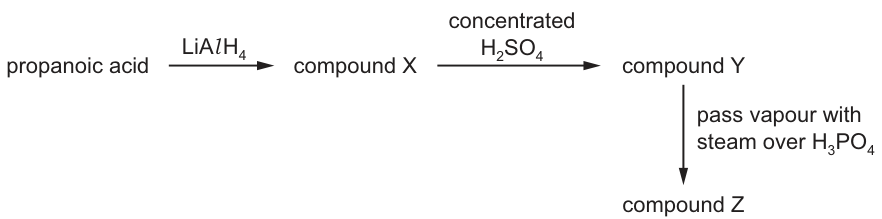
What is compound Z?
Options
A propanone
B propene
C propan-1-ol
D propan-2-ol
Working
Reaction 1: Propanoic acid is reduced by lithium tetrahydridoaluminate (LiAlH). LiAlH is a strong reducing agent that reduces carboxylic acids to primary alcohols.
Compound X is propan-1-ol.
Reaction 2: Propan-1-ol is heated with concentrated HSO, which acts as a dehydrating agent. Primary alcohols undergo elimination (dehydration) to form alkenes.
Compound Y is propene.
Reaction 3: Propene vapour is passed with steam over a phosphoric acid (HPO) catalyst. This is an electrophilic addition (hydration) reaction. Following Markovnikov's rule, the hydrogen atom adds to the less substituted carbon (C1) and the hydroxyl group adds to the more substituted carbon (C2).
Compound Z is propan-2-ol.
Answer
D (propan-2-ol)
D
Background Concept
This question tests the ability to trace a multi-step organic synthesis by recognising standard reagents and their characteristic transformations.
- Reduction of carboxylic acids: Lithium tetrahydridoaluminate (LiAlH, also written LiAlH) is a powerful reducing agent. Unlike the milder sodium tetrahydridoborate (NaBH), LiAlH reduces carboxylic acids all the way to primary alcohols. The reaction must be carried out in anhydrous conditions (often followed by an aqueous acid work-up) because LiAlH reacts violently with water.
- Dehydration of alcohols: Concentrated sulfuric acid (HSO) or concentrated phosphoric acid (HPO) can act as dehydrating agents. When heated with an alcohol, they catalyse an elimination reaction, removing a molecule of water to form an alkene. For primary alcohols like propan-1-ol, this yields an alkene with the double bond at the end of the chain.
- Hydration of alkenes: Passing steam over an alkene in the presence of an acid catalyst (typically HPO or HSO) results in electrophilic addition, forming an alcohol. For unsymmetrical alkenes, the addition follows Markovnikov's rule: the hydrogen from the water adds to the carbon atom of the double bond that already has the greater number of hydrogen atoms, while the hydroxyl group (–OH) adds to the more substituted carbon atom.
Understanding the Question
The question provides a three-step reaction sequence starting from propanoic acid. We are given the reagents for each step and must identify the final major product, compound Z. The options are four different C compounds: propanone, propene, propan-1-ol, and propan-2-ol.
Approach
Work through the reaction scheme sequentially from left to right. For each step, identify the functional group in the starting material, recognise what the reagent does to that functional group, and determine the structure of the product. Keep track of the carbon skeleton to ensure no carbon-carbon bonds are broken or formed.
Step-by-Step Reasoning
Step 1: Reduction of propanoic acid
- Starting material: propanoic acid (CHCHCOOH), a carboxylic acid with 3 carbons.
- Reagent: LiAlH (lithium tetrahydridoaluminate).
- Transformation: LiAlH reduces the carboxylic acid group (–COOH) to a primary alcohol group (–CHOH).
- Product X: propan-1-ol (CHCHCHOH). This eliminates option A (propanone) immediately, as reduction of a carboxylic acid does not yield a ketone.
Step 2: Dehydration of propan-1-ol
- Starting material: compound X (propan-1-ol).
- Reagent: concentrated HSO (with implied heat).
- Transformation: Concentrated sulfuric acid catalyses the elimination of water (dehydration) from the alcohol to form a carbon-carbon double bond.
- Product Y: propene (CHCH=CH). This is an alkene.
Step 3: Hydration of propene
- Starting material: compound Y (propene).
- Reagents: steam (HO) and HPO catalyst.
- Transformation: Electrophilic addition of water across the double bond (hydration).
- Regioselectivity: Propene is an unsymmetrical alkene. The double bond is between C1 and C2. C1 has two hydrogen atoms; C2 has one hydrogen atom and a methyl group. According to Markovnikov's rule, the H atom from HO adds to C1 (the carbon with more hydrogens), and the OH group adds to C2 (the more substituted carbon).
- Product Z: propan-2-ol (CHCH(OH)CH). This is a secondary alcohol.
Comparing this result with the given options, compound Z is propan-2-ol, which corresponds to option D.
Key Takeaways
- LiAlH reduces carboxylic acids to primary alcohols; it does not stop at the aldehyde stage under standard conditions.
- Concentrated HSO with an alcohol causes dehydration (elimination) to form an alkene.
- Hydration of unsymmetrical alkenes with steam and an acid catalyst follows Markovnikov's rule, placing the –OH group on the more substituted carbon of the original double bond.
Common Mistakes
- Choosing C (propan-1-ol): This would happen if a student forgets Markovnikov's rule during the hydration step and assumes the –OH adds to the end of the chain. Alternatively, they might forget that step 2 is a dehydration and think compound Y is still an alcohol, but alcohols do not react with steam over HPO to form propan-1-ol.
- Choosing A (propanone): This would result from incorrectly thinking that LiAlH oxidises the acid or that the sequence involves an oxidation step. LiAlH is a reducing agent.
- Choosing B (propene): This would happen if a student stops at compound Y and forgets to carry out the final hydration step to get compound Z.
Things to Be Careful About
- Always check the number of carbon atoms in the starting material and ensure no C–C bonds are broken or formed during the sequence. Here, all intermediates and products are C compounds.
- Distinguish between the roles of concentrated HSO: it can act as a dehydrating agent (elimination with alcohols) or as a catalyst for hydration (addition with alkenes). The substrate determines the reaction type.
- Ensure you correctly apply Markovnikov's rule for the hydration of propene; the major product is always the more substituted alcohol (propan-2-ol), not the less substituted one (propan-1-ol).
Which statement is correct?
Options
A Bromoethane reacts with to form ethene as a major product.
B 1-chlorobutane reacts more rapidly than 1-bromobutane with at the same temperature.
C Hydrolysis of occurs mostly by the mechanism.
D The ion is less stable than the ion.
Working
A is incorrect: with a primary halogenoalkane favours nucleophilic substitution, giving ethanol; ethene requires alcoholic and heat (elimination).
B is incorrect: the bond is weaker than the bond, so 1-bromobutane reacts more rapidly than 1-chlorobutane.
C is incorrect: is tertiary and hydrolyses mainly by the mechanism, not .
D is correct: a primary carbocation is less stable than a tertiary carbocation because the three alkyl groups donate electron density and stabilise the positive charge.
Answer
D
D
Background Concept
Halogenoalkanes can react by nucleophilic substitution or by elimination. The conditions decide which pathway dominates: aqueous supplies as a nucleophile, favouring substitution, whereas alcoholic with heat favours elimination to form an alkene.
Within substitution, two mechanisms are possible. is a one-step backside attack, favoured by primary halogenoalkanes because the carbon is not sterically hindered. is a two-step mechanism in which the bond breaks first to form a carbocation, followed by attack of the nucleophile; it is favoured by tertiary halogenoalkanes because the tertiary carbocation is much more stable.
The ease of breaking the bond depends on bond strength. The bond is weakest and is strongest, so the order of leaving group ability is .
Carbocation stability follows the order tertiary > secondary > primary > methyl. Alkyl groups are electron-donating and also stabilise the positive charge by hyperconjugation, so more alkyl groups attached to the positively charged carbon make the carbocation more stable.
Understanding the Question
This multiple-choice question asks which one statement about halogenoalkanes is correct. Four different claims are made:
- A links bromoethane with aqueous and claims ethene is the major product.
- B compares the rates of reaction of 1-chlorobutane and 1-bromobutane with .
- C claims that hydrolysis of a tertiary bromide occurs mostly by .
- D compares the stability of a primary carbocation with that of a tertiary carbocation.
The correct statement is D.
Approach
Test each statement against the relevant principle:
- For A, identify the reagents and conditions, and decide whether substitution or elimination is favoured.
- For B, compare the strengths of the and bonds and hence which halide is the better leaving group.
- For C, classify the halogenoalkane as primary, secondary or tertiary, and decide which substitution mechanism is favoured.
- For D, apply the carbocation stability order.
Step-by-Step Reasoning
Statement A
Bromoethane is a primary halogenoalkane. With , the hydroxide ion acts as a nucleophile and the major reaction is nucleophilic substitution to form ethanol:
Elimination to form ethene requires alcoholic and heat. Therefore the statement is false.
Statement B
The rate of nucleophilic substitution depends on the strength of the bond. The bond is weaker than the bond, so is a better leaving group than . Therefore 1-bromobutane reacts more rapidly than 1-chlorobutane with at the same temperature. The statement says the opposite, so it is false.
Statement C
has the halogen attached to a carbon that is bonded to three ethyl groups, so it is a tertiary halogenoalkane. Tertiary halogenoalkanes undergo hydrolysis mainly by the mechanism because the tertiary carbocation formed is stable and because the bulky alkyl groups hinder backside attack. Therefore the statement is false.
Statement D
is a primary carbocation, while is a tertiary carbocation. The three alkyl groups in the tertiary carbocation donate electron density towards the positively charged carbon and stabilise it by hyperconjugation. Hence the tertiary carbocation is more stable than the primary carbocation. Statement D is correct.
Key Takeaways
- Aqueous favours substitution; alcoholic with heat favours elimination.
- Weaker bonds mean better leaving groups and faster substitution: .
- Primary halogenoalkanes tend to react by ; tertiary halogenoalkanes tend to react by .
- Carbocation stability increases with alkyl substitution: tertiary > secondary > primary > methyl.
Common Mistakes
- Assuming that any reaction with gives elimination. The solvent and heating matter: aqueous gives substitution, alcoholic with heat gives elimination.
- Thinking that chlorine is more reactive because it is more electronegative. Reactivity in substitution is governed by bond strength and leaving group ability, so bromine compounds react faster than chlorine compounds.
- Confusing the mechanisms: tertiary halogenoalkanes are sterically hindered and form stable carbocations, so they react by , not .
- Assuming that a more branched carbocation is less stable because it is crowded. In fact, more alkyl substitution stabilises the positive charge.
Things to Be Careful About
- Read the reaction conditions carefully: "" and "alcoholic " lead to different products.
- When comparing rates, keep the temperature and concentration conditions the same, as stated in the question.
- Identify the halogenoalkane class (primary, secondary or tertiary) before deciding on the mechanism.
- Remember the exact carbocation stability order and the reason for it: electron donation and hyperconjugation by alkyl groups.
In the hydrolysis of bromoethane by aqueous , what is the nature of the attacking group and of the leaving group?
Options
| attacking group | leaving group | |
|---|---|---|
| A | electrophile | electrophile |
| B | electrophile | nucleophile |
| C | nucleophile | electrophile |
| D | nucleophile | nucleophile |
Working
Aqueous provides as the attacking species. donates an electron pair to the electron-deficient carbon of bromoethane, so it is a nucleophile. The leaving group is , which departs with the electron pair of the bond, so it is also a nucleophile (a Lewis base).
Answer
D
D
Background Concept
A nucleophile is an electron-rich species that donates a lone pair of electrons to form a new covalent bond. An electrophile is an electron-deficient species that accepts a lone pair. In nucleophilic substitution of a halogenoalkane, the carbon attached to the halogen is electron-deficient because the halogen is more electronegative, so it is attacked by a nucleophile. The halogen atom leaves with both electrons of the carbon–halogen bond, forming a halide ion; because it takes an electron pair with it, the leaving group is itself a nucleophile (a Lewis base).
Understanding the Question
The question asks you to classify the attacking group and the leaving group in the hydrolysis of bromoethane by aqueous . The reaction is a nucleophilic substitution: hydroxide ion replaces bromide. You must decide whether each species is an electrophile (electron-pair acceptor) or a nucleophile (electron-pair donor). The options give all four combinations, so the key is to classify both species correctly.
Approach
Identify the species that attacks the carbon atom and the species that leaves. Aqueous provides , which is electron-rich and has lone pairs, so it must be a nucleophile. The leaving group is the bromide ion, formed when the bond breaks and both electrons stay with bromine. Since it carries the electron pair, it is also a nucleophile. Therefore the correct combination is nucleophile/nucleophile.
Step-by-Step Reasoning
- Bromoethane has a polar bond; the carbon is and the bromine is .
- Aqueous supplies ions. The hydroxide ion has lone pairs on oxygen and is strongly electron-rich, so it acts as a nucleophile and attacks the carbon.
- The attack forms a new bond while the bond breaks heterolytically. Both electrons of the broken bond move to bromine, giving .
- Since carries the electron pair that was the bonding pair, it is an electron-pair donor and is classified as a nucleophile (Lewis base).
- Therefore attacking group = nucleophile, leaving group = nucleophile, matching option D.
- Options A, B and C are wrong because they call either the attacking group or the leaving group an electrophile. Neither nor is electron-pair accepting; both are electron-pair donors.
Key Takeaways
- A nucleophile donates an electron pair; an electrophile accepts an electron pair.
- In nucleophilic substitution, the attacking reagent is always a nucleophile.
- The leaving group leaves with the electron pair of the bond, so it is also a nucleophile (a Lewis base).
- Heterolytic bond fission produces ions: the more electronegative atom keeps the bonding pair.
Common Mistakes
- Calling the attacking group an electrophile: is electron-rich and donates a pair, so it is a nucleophile.
- Calling the leaving group an electrophile: leaves with the electron pair, so it is a nucleophile, not an electron-pair acceptor.
- Thinking that because a species is negatively charged it must be a nucleophile, while ignoring neutral species such as that can also be nucleophiles. Here both and are anionic, but the deciding feature is electron-pair donation.
Things to Be Careful About
- The terms "nucleophile" and "electrophile" refer to electron-pair donation and acceptance, not simply to charge.
- The leaving group always departs with the bonding electron pair, so it is classified as a nucleophile.
- In aqueous , the attacking species is , not water; water is a weaker nucleophile and is not the main attacking group here.
- A one-mark MCQ like this is testing precise terminology, so do not overcomplicate the reasoning.
X is an organic compound containing the elements carbon, hydrogen and oxygen only.
The table shows the observations made from three chemical tests carried out on X.
| reagent added | observation |
|---|---|
| effervescence | |
| effervescence | |
| hot | remains orange |
What is a possible structure of X?
Options
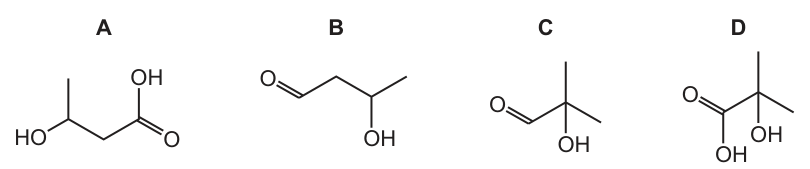
Working
- Test with Na(s): Effervescence indicates the presence of an acidic hydrogen, meaning X contains either an alcohol (–OH) or a carboxylic acid (–COOH) group. All four options contain at least one such group.
- Test with Na₂CO₃(s): Effervescence (release of CO₂) indicates a carboxylic acid group (–COOH). Carboxylic acids are acidic enough to react with carbonates, whereas alcohols are not. This eliminates options B and C, which lack a –COOH group.
- Test with hot H⁺/Cr₂O₇²⁻(aq): The solution remains orange, meaning no oxidation occurred. Acidified potassium dichromate(VI) oxidises primary alcohols, secondary alcohols, and aldehydes (turning the solution green). It does not oxidise tertiary alcohols, ketones, or carboxylic acids. Option A contains a secondary alcohol, which would be oxidised. Option D contains only a carboxylic acid and a tertiary alcohol, neither of which reacts with acidified dichromate.
Only structure D matches all three observations.
Answer
D
D
Background Concept
Organic compounds can be identified by their characteristic reactions with specific reagents. Three key tests for oxygen-containing organic functional groups are:
- Reaction with sodium metal (Na(s)): Sodium reacts with compounds containing acidic hydrogens to produce hydrogen gas (effervescence). Both alcohols (R–OH) and carboxylic acids (R–COOH) react with Na. Phenols also react, but they are not relevant here.
- Reaction with sodium carbonate (Na₂CO₃(s)): This is a test for acidity. Carboxylic acids are strong enough acids to react with carbonates, releasing carbon dioxide gas (effervescence). Alcohols are far too weakly acidic to react with Na₂CO₃; they will show no visible change.
- Oxidation with acidified potassium dichromate(VI) (H⁺/Cr₂O₇²⁻): This reagent is an oxidising agent that turns from orange (Cr₂O₇²⁻) to green (Cr³⁺) when it is reduced. It oxidises:
- Primary alcohols → aldehydes → carboxylic acids
- Secondary alcohols → ketones
- Aldehydes → carboxylic acids
It does not oxidise tertiary alcohols (no hydrogen on the carbon bearing the –OH group), ketones, or carboxylic acids. Under these conditions, the solution remains orange.
Understanding the Question
We are given an unknown organic compound X containing only C, H, and O, and three test results:
- Na(s) → effervescence
- Na₂CO₃(s) → effervescence
- hot H⁺/Cr₂O₇²⁻(aq) → remains orange
We must deduce the functional groups present in X and select the structure from options A, B, C, and D that is consistent with all three observations.
Approach
Evaluate each test to narrow down the required functional groups:
- Na(s) test → at least one –OH or –COOH group.
- Na₂CO₃(s) test → must have a –COOH group.
- Acidified dichromate test → must not have a primary alcohol, secondary alcohol, or aldehyde.
Then, systematically check each option against these three criteria.
Step-by-Step Reasoning
-
Observation 1: Na(s) gives effervescence.
This tells us X has an acidic hydrogen. Options A, C, and D have –OH groups, and A and D have –COOH groups. Option B has an –OH group. All options would give effervescence with Na, so this test alone does not eliminate any option, but it confirms X is not a pure hydrocarbon or ether. -
Observation 2: Na₂CO₃(s) gives effervescence.
This is the critical test. Only carboxylic acids (–COOH) are acidic enough to react with sodium carbonate to release CO₂ gas. Alcohols (–OH) do not react with Na₂CO₃.- Option A: Contains a –COOH group. ✅ Passes.
- Option B: Contains an aldehyde and a secondary alcohol. No –COOH. ❌ Fails.
- Option C: Contains an aldehyde and a tertiary alcohol. No –COOH. ❌ Fails.
- Option D: Contains a –COOH group. ✅ Passes.
We are now left with only A and D.
-
Observation 3: hot H⁺/Cr₂O₇²⁻(aq) remains orange.
This means X contains no oxidisable groups. Specifically, it cannot contain a primary alcohol, secondary alcohol, or aldehyde. Tertiary alcohols, ketones, and carboxylic acids are resistant to oxidation by acidified dichromate.- Option A: Contains a secondary alcohol (–CH(OH)–). This would be oxidised to a ketone, turning the dichromate solution green. ❌ Fails.
- Option D: Contains a tertiary alcohol (–C(OH)(CH₃)₂) and a carboxylic acid (–COOH). Neither of these functional groups can be oxidised by acidified dichromate. The solution remains orange. ✅ Passes.
Structure D is the only compound that satisfies all three observations.
Key Takeaways
- Na vs Na₂CO₃: Both react with carboxylic acids, but only Na reacts with alcohols. Na₂CO₃ is the definitive test to distinguish a carboxylic acid from an alcohol.
- Dichromate oxidation: Remember the rule of thumb for acidified K₂Cr₂O₇: it oxidises anything with a hydrogen on the carbon adjacent to the oxygen (1° and 2° alcohols, aldehydes). Tertiary alcohols and carboxylic acids have no such hydrogen (or are already fully oxidised at that carbon) and do not react.
Common Mistakes
- Thinking alcohols react with Na₂CO₃: Alcohols are very weak acids (weaker than water) and will not produce CO₂ with carbonates. Only carboxylic acids (and stronger acids) do this.
- Assuming tertiary alcohols can be oxidised: Tertiary alcohols lack a hydrogen atom on the carbon bearing the –OH group. Oxidation requires the removal of this hydrogen, so tertiary alcohols are not oxidised by acidified dichromate under normal conditions.
- Misreading skeletal structures: Be careful to correctly identify primary, secondary, and tertiary carbons in skeletal diagrams. In option A, the –OH is on a carbon bonded to two other carbons (secondary), whereas in option D, the –OH is on a carbon bonded to three other carbons (tertiary).
Things to Be Careful About
- Always check the oxidation state of the carbon bearing the –OH group. If it is a tertiary carbon (bonded to 3 other carbons), the alcohol is tertiary and will not be oxidised.
- Ensure you are looking for the absence of reaction in the dichromate test. "Remains orange" is just as informative as "turns green"; it tells you what functional groups are not present.
- State symbols and reagent conditions matter: hot acidified dichromate is a strong oxidising environment. Even if a reaction were slow, the observation "remains orange" definitively rules out oxidisable groups.
How many moles of oxygen gas are needed for the complete combustion of of ?
Options
A 6
B 6.5
C 12
D 13
Working
has 4 C, 10 H and 1 O, so its molecular formula is .
Balanced combustion equation:
The products contain O atoms; 1 O atom is already in the fuel, so must supply 12 O atoms, i.e. 6 molecules of .
Answer
A (6 mol)
A
Background Concept
Complete combustion of an organic compound means burning it in an excess of oxygen so that all carbon is converted to and all hydrogen is converted to . Any oxygen already present in the compound also takes part in the balance: it reduces the amount of that must be supplied. The mole ratio between fuel and oxygen is read directly from the coefficients of the balanced equation.
Understanding the Question
This multiple-choice question asks how many moles of are needed to burn 1 mol of completely. The options are 6, 6.5, 12 and 13. The key is to recognise the molecular formula of the compound and then balance its combustion equation. The answer is not simply the number of oxygen atoms in the products; it is the coefficient of in the balanced equation.
Approach
- Convert the condensed formula into a molecular formula by counting C, H and O atoms.
- Write the skeleton equation: .
- Balance carbon first, then hydrogen, then oxygen.
- Read the coefficient of as the number of moles of oxygen gas needed per mole of fuel.
Step-by-Step Reasoning
Count atoms in the fuel.
contains three methyl groups, , and one central carbon carrying an group:
- Carbon:
- Hydrogen:
- Oxygen:
So the molecular formula is .
Balance carbon.
Each carbon atom becomes one molecule, so 4 C atoms give .
Balance hydrogen.
Each water molecule contains 2 H atoms, so 10 H atoms give .
Balance oxygen.
The right-hand side now has:
- : O atoms
- : O atoms
- Total: 13 O atoms
The fuel already contains 1 O atom, so must supply O atoms. Since each molecule supplies 2 O atoms, the coefficient is .
Thus 1 mol of requires 6 mol of , so A is correct.
Why the distractors are wrong.
- B (6.5) would come from miscounting the hydrogen atoms or from an incorrectly balanced equation.
- C (12) is the number of oxygen atoms that must be supplied by , not the number of molecules; each supplies two O atoms.
- D (13) is the total number of oxygen atoms in the products, forgetting that one is already in the fuel and that oxygen atoms are counted in pairs when using .
Key Takeaways
- Complete combustion always gives and .
- The molecular formula must be found before balancing.
- Oxygen already in the fuel reduces the oxygen needed from .
- Balance C first, H second, O last.
- The coefficient of is a mole ratio: 1 mol of fuel needs 6 mol of .
Common Mistakes
- Forgetting the oxygen in the fuel: this leads to counting 13 O atoms and choosing D.
- Confusing oxygen atoms with oxygen molecules: 12 O atoms is 6 , not 12 ; choosing C.
- Miscounting hydrogens: has 10 H atoms, not 9 or 13.
- Balancing oxygen before carbon and hydrogen: this often produces fractional or incorrect coefficients.
Things to Be Careful About
- In a structured question, include state symbols, e.g. .
- Check the final equation balances: left has 4 C, 10 H and 13 O; right has 4 C, 10 H and 13 O.
- Use the wording "complete combustion"; incomplete combustion would produce or carbon and would need less oxygen.
- The coefficient in the balanced equation gives the mole ratio, so for 1 mol of fuel the required is simply the coefficient.
In which pair will each compound give a different visible result with alkaline ?
Options
A and
B and
C and
D and
Working
The iodoform (tri-iodomethane) test gives a yellow precipitate of with compounds containing the group (methyl ketones and ethanal) or the group (secondary alcohols of the type , including ethanol).
- A — Ethanol () and ethanal () both contain the required group, so both give a yellow precipitate.
- B — Ethanal and propanone () both contain , so both give a yellow precipitate.
- C — Ethanoic acid and pentan-3-one () both lack the required group, so neither reacts.
- D — Ethanol gives a yellow precipitate, but propanal () lacks the group, so it gives no precipitate.
Answer
D
D
Background Concept
The iodoform (tri-iodomethane) test uses alkaline iodine, usually dissolved in aqueous (or /hypoiodite). It is a positive test for two specific structural features:
- A methyl carbonyl group, , found in ethanal and in methyl ketones such as propanone ().
- A secondary alcohol group of the type , which is first oxidised by the iodine to the corresponding methyl ketone, which then undergoes the same reaction.
The outcome is a bright yellow precipitate of iodoform, , which has a distinctive antiseptic smell. The reaction involves repeated iodination of the methyl group adjacent to the carbonyl, followed by cleavage of the bond to release .
Ethanol is the one primary alcohol that gives a positive test, because its structure contains the unit (it is oxidised to ethanal, which then reacts). No other primary alcohol gives a positive result.
Understanding the Question
This multiple-choice question asks you to find the pair in which the two compounds give different visible results with alkaline . That means one compound in the pair must give a positive iodoform test (yellow precipitate) and the other must give a negative result (no precipitate). You are not being asked which compounds react, but which pair shows a contrast.
The key skill is recognising, for each compound, whether it contains the or group.
Approach
For each compound, decide: does it contain a group (methyl ketone or ethanal) or a group (secondary alcohol of the type , or ethanol)? If yes, it gives a yellow precipitate; if no, it gives no visible change. Then compare the two compounds within each pair.
Step-by-Step Reasoning
Option A: Ethanol and ethanal
- Ethanol, : the carbon bearing is bonded to a group, so it has the unit. It is oxidised to ethanal and gives a positive test (yellow precipitate).
- Ethanal, : has the group directly, so it gives a positive test.
- Both positive → same result. Not the answer.
Option B: Ethanal and propanone
- Ethanal: positive, as above.
- Propanone, : a methyl ketone with on both sides of the carbonyl — positive.
- Both positive → same result. Not the answer.
Option C: Ethanoic acid and pentan-3-one
- Ethanoic acid, : although it contains a group attached to a carboxyl carbon, carboxylic acids do not undergo the iodoform reaction. The carboxyl group does not behave like a ketone carbonyl, so no reaction occurs.
- Pentan-3-one, : the carbonyl is flanked by two ethyl groups, so there is no unit (the groups are not directly attached to the ). No reaction.
- Both negative → same result. Not the answer.
Option D: Ethanol and propanal
- Ethanol: positive (yellow precipitate), as explained above.
- Propanal, (): the carbonyl carbon is bonded to an ethyl group and a hydrogen. The group is not directly attached to the , so there is no group. It gives no precipitate.
- One positive, one negative → different visible results. This is the correct answer.
Key Takeaways
- The iodoform test is positive only for (ethanal and methyl ketones) and (secondary alcohols of that type, plus ethanol).
- Ethanol is unique among primary alcohols in giving a positive test, because it is oxidised to ethanal.
- Not all aldehydes give a positive test — only ethanal. Propanal and higher aldehydes do not.
- Not all ketones give a positive test — only methyl ketones ().
- The visible result is the yellow precipitate of ; a negative result is simply no visible change.
Common Mistakes
- Assuming every aldehyde gives a positive iodoform test. Only ethanal does; propanal and higher aldehydes lack the group.
- Assuming every ketone gives a positive test. Only methyl ketones with a group react; pentan-3-one does not.
- Thinking ethanoic acid reacts because it contains a group next to a carbonyl. Carboxylic acids do not undergo the iodoform reaction.
- Forgetting that ethanol is a special case: it is the only primary alcohol that gives a positive result, so a student might wrongly mark ethanol as negative.
- Confusing propanal with ethanal: the must be directly bonded to the , which is true for ethanal but not for propanal.
Things to Be Careful About
- Check the exact position of the group relative to the carbonyl: it must be directly attached to the carbon for a methyl ketone to react.
- For alcohols, the -bearing carbon must carry a group and one hydrogen (); ethanol fits because R = H.
- The reagent is alkaline iodine — the alkaline conditions are essential because the reaction proceeds through the enolate/hypoiodite pathway; acidic iodine would not give the same result.
- The visible result is specifically a yellow precipitate; do not describe it as a colour change of the solution alone.
Which reagent gives a positive result with propanone?
Options
A alkaline
B aqueous bromine
C Fehling’s reagent
D Tollens’ reagent
Working
Propanone, , is a methyl ketone containing the group. Alkaline (the tri-iodomethane / iodoform test) gives a positive result with methyl ketones, forming a yellow precipitate of . Fehling's and Tollens' reagents only oxidise aldehydes, and aqueous bromine tests for unsaturation, so B, C and D give no positive result with propanone.
Answer
A
A
Background Concept
The tri-iodomethane (iodoform) test is a qualitative test for the presence of a methyl ketone group, , or an alcohol group (which is first oxidised to the methyl ketone). The reagent is iodine in alkaline solution, typically dissolved in aqueous sodium hydroxide. In alkaline conditions, the methyl group adjacent to the carbonyl is tri-halogenated, and the resulting group is cleaved to give tri-iodomethane, (iodoform), a pale yellow solid with a characteristic antiseptic smell. A positive result is the appearance of this yellow precipitate.
By contrast, Fehling's reagent (alkaline copper(II) sulfate with sodium potassium tartrate) and Tollens' reagent (ammoniacal silver nitrate) are mild oxidising agents that oxidise aldehydes to carboxylate ions/carboxylic acids. Ketones lack the aldehyde hydrogen on the carbonyl carbon and are not oxidised by these reagents, so they give negative results. Aqueous bromine is used to test for carbon-carbon double bonds: the orange/brown bromine water is decolourised on addition to an alkene.
Understanding the Question
The question asks which of four reagents produces a positive result with propanone. Propanone, , is the simplest ketone, so the question is really testing whether you know which of the listed reagents reacts with a ketone (specifically a methyl ketone) rather than with an aldehyde or an alkene. This is a one-mark recall-and-apply MCQ.
Approach
- Identify the functional group in propanone: a ketone, specifically a methyl ketone with the group.
- Recall what each reagent tests for:
- Alkaline : iodoform test — positive for methyl ketones.
- Aqueous bromine: tests for C=C.
- Fehling's: oxidises aldehydes.
- Tollens': oxidises aldehydes.
- Match propanone's structure to the reagent that reacts with it.
Step-by-Step Reasoning
- Propanone is : a carbonyl group flanked by two methyl groups. It is a ketone, has no aldehyde hydrogen, and has no C=C bond.
- Option A, alkaline : this is the iodoform test. Because propanone contains the group, it gives a positive result — a yellow precipitate of forms. This is the correct answer.
- Option B, aqueous bromine: bromine water is decolourised by alkenes (electrophilic addition across C=C). Propanone has no C=C bond, so no reaction occurs — negative result.
- Option C, Fehling's reagent: oxidises aldehydes to carboxylates (blue solution → brick-red precipitate). Ketones are not oxidised, so propanone gives a negative result.
- Option D, Tollens' reagent: oxidises aldehydes to carboxylates with a silver mirror deposited. Ketones are not oxidised, so propanone gives a negative result.
Therefore A is the only reagent that gives a positive result.
Key Takeaways
- The iodoform test (alkaline ) is positive for methyl ketones () and for ethanol / secondary alcohols with .
- Fehling's and Tollens' reagents distinguish aldehydes from ketones: only aldehydes are oxidised.
- Aqueous bromine is a test for unsaturation (C=C), not for carbonyl groups.
Common Mistakes
- Assuming ketones are oxidised by Fehling's or Tollens' reagent — they are not; only aldehydes are.
- Forgetting that propanone is a methyl ketone and therefore gives the iodoform test.
- Thinking aqueous bromine reacts with the carbonyl group — it reacts with C=C bonds only.
Things to Be Careful About
- The iodoform test requires alkaline conditions (iodine in sodium hydroxide), not just iodine solution.
- The positive result is the yellow precipitate of , not a colour change of the iodine itself.
- Fehling's and Tollens' are mild oxidising agents specific to aldehydes; the distinction between aldehyde and ketone is one of the most frequently tested carbonyl reactions.
Esters can be hydrolysed with an aqueous alkali or an aqueous acid to form two products.
The table compares the two methods.
Which row is correct?
Options
| aqueous alkali | aqueous acid | |
|---|---|---|
| A | complete conversion to a salt and an organic acid | forms an equilibrium mixture with an organic acid and an alcohol |
| B | forms an equilibrium mixture with a salt and an organic acid | complete conversion to a salt and an alcohol |
| C | complete conversion to a salt and an alcohol | forms an equilibrium mixture with an organic acid and an alcohol |
| D | complete conversion to a salt and an alcohol | complete conversion to an organic acid and an alcohol |
Working
Aqueous alkali (saponification) hydrolyses an ester irreversibly to a salt of the carboxylic acid and an alcohol.
Aqueous acid hydrolyses an ester reversibly, giving an equilibrium mixture containing the carboxylic acid and the alcohol.
Row C matches both statements.
Answer
C
C
Background Concept
An ester () is formed by a condensation reaction between a carboxylic acid and an alcohol. Hydrolysis is the reverse process, breaking the ester back into two products using water. The reaction can be driven in two ways:
- Acid-catalysed hydrolysis: the ester is heated with dilute aqueous acid (e.g. dilute or ). This is the exact reverse of esterification, so it is a reversible equilibrium:
The products are the carboxylic acid and the alcohol, but because the reaction is reversible, an equilibrium mixture is obtained — the conversion is not complete.
- Alkaline hydrolysis (saponification): the ester is heated with aqueous alkali such as . The hydroxide ion attacks the ester and the immediate product is the carboxylate salt and the alcohol:
Because the carboxylate salt is formed, the reverse esterification cannot occur (a carboxylate salt cannot re-form an ester with an alcohol under these conditions). The reaction therefore goes to completion — it is essentially irreversible.
Understanding the Question
This is a multiple-choice question asking you to compare the two methods of ester hydrolysis and select the row that correctly describes both. The key distinction is:
- what the two products are (salt vs acid; alcohol is common to both), and
- whether the conversion is complete or forms an equilibrium mixture.
You must recognise that the difference between the two methods lies in the fate of the carboxylic acid part of the ester: with alkali it becomes a salt; with acid it remains the free acid. You must also recognise that reversibility is the hallmark of the acid-catalysed route.
Approach
- Recall the two hydrolysis reactions and their products.
- Note that alkaline hydrolysis gives a salt + alcohol and is complete.
- Note that acid hydrolysis gives the acid + alcohol and is an equilibrium.
- Match both statements to the rows and select the correct option.
Step-by-Step Reasoning
Step 1 — Alkaline hydrolysis. Heating an ester with aqueous produces the sodium salt of the carboxylic acid and the alcohol. For example:
The reaction goes to completion because the carboxylate salt cannot recombine with the alcohol. So the correct description is: complete conversion to a salt and an alcohol.
Step 2 — Acid hydrolysis. Heating an ester with dilute aqueous acid gives the carboxylic acid and the alcohol, but because this is the reverse of esterification, it is a reversible equilibrium:
So the correct description is: forms an equilibrium mixture with an organic acid and an alcohol.
Step 3 — Match to the rows.
- Row A: alkali gives salt + organic acid — wrong (the second product is an alcohol, not an acid).
- Row B: alkali gives an equilibrium mixture with salt + acid — wrong; acid gives complete conversion to salt + alcohol — wrong.
- Row C: alkali gives complete conversion to salt + alcohol — correct; acid gives equilibrium with acid + alcohol — correct. ✓
- Row D: acid gives complete conversion to acid + alcohol — wrong (it is an equilibrium, not complete).
Therefore the correct answer is C.
Key Takeaways
- Alkaline hydrolysis (saponification) is irreversible and gives a salt + alcohol.
- Acid-catalysed hydrolysis is reversible and gives an acid + alcohol as an equilibrium mixture.
- The carboxylate salt is the key: it prevents the reverse esterification, driving alkaline hydrolysis to completion.
Common Mistakes
- Confusing the products of alkaline hydrolysis: writing "salt + acid" instead of "salt + alcohol". The acid is neutralised by the alkali to form the salt, so the free acid is never obtained.
- Forgetting that acid hydrolysis is reversible: stating "complete conversion" for the acid route. The acid-catalysed reaction is an equilibrium.
- Swapping the two methods: attributing the complete conversion to acid hydrolysis and the equilibrium to alkaline hydrolysis.
Things to Be Careful About
- The word "complete" in the options signals the irreversible alkaline route; "equilibrium mixture" signals the reversible acid route.
- In alkaline hydrolysis the alcohol is always one of the products in both methods — the difference is the acid vs salt.
- In the acid-catalysed route, the acid is the free carboxylic acid, not a salt, because no alkali is present to neutralise it.
Structural isomerism only should be considered when answering this question.
How many compounds with molecular formula are primary halogenoalkanes?
Options
A 4
B 5
C 7
D 8
Working
A primary halogenoalkane has the attached to a carbon that is bonded to only one other carbon atom ().
Draw the three carbon skeletons of and count the non-equivalent positions where can replace an H on a primary carbon:
- n-Pentane: 1 non-equivalent primary position.
- 2-Methylbutane: 2 non-equivalent primary positions.
- 2,2-Dimethylpropane: 1 non-equivalent primary position.
Total = 1 + 2 + 1 = 4.
Answer
A (4)
A
Background Concept
Structural isomerism occurs when compounds have the same molecular formula but different order of attachment of atoms. Here all isomers of have the same formula but differ in how the carbon skeleton is arranged or where the bromine atom is attached.
Halogenoalkanes are classified by the carbon atom that carries the halogen. In a primary halogenoalkane, that carbon is bonded to only one other carbon atom, so it has the general unit : one alkyl group, two hydrogen atoms and one bromine atom. Secondary and tertiary halogenoalkanes have the halogen-bearing carbon bonded to two or three carbon atoms respectively. This question asks only for primary ones.
Understanding the Question
We are given the molecular formula , which is a monobrominated pentane. The task is to count how many structural isomers of this formula are primary halogenoalkanes. The instruction "structural isomerism only" means we must not count stereoisomers (cis/trans or optical isomers) as separate compounds. We need to consider every possible carbon skeleton with five carbon atoms and every distinct position on a primary carbon where bromine can be placed.
Approach
First list all carbon skeletons possible for five carbon atoms: n-pentane, 2-methylbutane and 2,2-dimethylpropane. For each skeleton, identify the carbon atoms that are primary (attached to only one other carbon). Then replace one hydrogen on such a carbon with bromine and count unique products, remembering that symmetry can make two positions equivalent. Finally add the counts.
Step-by-Step Reasoning
-
n-Pentane: . The only primary carbons are the two end groups, which are equivalent by reflection. Bromine on either gives 1-bromopentane. Count = 1.
-
2-Methylbutane: . There are three types of primary carbon: the two equivalent methyl groups attached to the central carbon, and the terminal methyl group of the ethyl chain. Bromine on either of the equivalent methyl groups gives the same compound; bromine on the terminal methyl group gives a different one. Count = 2.
-
2,2-Dimethylpropane: central carbon bonded to four equivalent methyl groups. Any of the four positions gives the same compound. Count = 1.
Total = 1 + 2 + 1 = 4. Therefore option A is correct.
Key Takeaways
To count isomers, draw all skeletons first and use symmetry; classify halogenoalkanes by the carbon bearing the halogen; "structural isomerism only" excludes stereoisomers.
Common Mistakes
- Counting every monobrominated isomer (8) instead of only primary ones.
- Counting equivalent positions more than once, especially in 2-methylbutane.
- Overlooking 2,2-dimethylpropane as a possible skeleton.
- Confusing a primary carbon with a terminal carbon in a branched skeleton.
- Including stereoisomers when the question restricts consideration to structural isomerism.
Things to Be Careful About
Check the definition of primary: it is the carbon bearing , not simply a terminal carbon. In 2-methylbutane, two methyl groups are equivalent, so both count once. Use a systematic skeleton-by-skeleton method so no skeleton is missed. Do not count optical isomers because the question says structural isomerism only.
Compound Z is formed by the reaction scheme shown.
What is the formula of compound Z?
Options
A
B
C
D
Working
Step 1: Warm CH3CH2Br with KCN in ethanol replaces the bromine by a cyanide group:
So compound X is propanenitrile, CH3CH2CN.
Step 2: Refluxing a nitrile with dilute HCl hydrolyses it to a carboxylic acid:
Compound Z is propanoic acid, CH3CH2COOH.
Answer
D: CH3CH2COOH
D
Background Concept
Halogenoalkanes undergo nucleophilic substitution. Warm ethanolic KCN supplies the cyanide ion, CN–, which replaces the halogen atom and forms a nitrile (R–CN). Nitriles are useful intermediates: acid hydrolysis (reflux with dilute HCl) converts the –CN group into a –COOH group, giving a carboxylic acid with one more carbon atom than the original halogenoalkane.
Understanding the Question
The scheme shows two steps starting from bromoethane, CH3CH2Br. We need the formula of the final compound Z after both steps.
Approach
Identify what each reagent does: KCN introduces –CN; dilute HCl with reflux hydrolyses –CN to –COOH. Then write the structures and count the carbon atoms.
Step-by-Step Reasoning
- CH3CH2Br + KCN (ethanol, warm) → CH3CH2CN + KBr. Compound X is propanenitrile.
- Reflux CH3CH2CN with dilute HCl: the nitrile is hydrolysed.
CH3CH2CN + 2H2O + HCl → CH3CH2COOH + NH4Cl. - Compound Z is propanoic acid, CH3CH2COOH.
Key Takeaways
- KCN in ethanol converts a halogenoalkane into a nitrile, adding one carbon atom.
- Acid hydrolysis of a nitrile gives a carboxylic acid.
- Count carbon atoms carefully: bromoethane (C2) → propanenitrile (C3) → propanoic acid (C3).
Common Mistakes
- Choosing B (CH3CH2CN): this is compound X, not the final compound Z.
- Choosing C (CH3COOH): this would be ethanoic acid, which has only two carbons; the nitrile step adds a carbon, so the product must have three carbons.
- Choosing A (CH3CH2Cl): this would require a halogen-exchange reaction, not the chemistry shown.
Things to Be Careful About
- The reaction with dilute HCl is hydrolysis, not reduction; it produces a carboxylic acid, not an amine.
- Reflux is needed for complete hydrolysis of the nitrile.
- The formula asked for is Z, not X.
Hydroxyethanal, , is heated under reflux with an excess of acidified until no further oxidation takes place.
What is the skeletal formula of the organic product?
Options
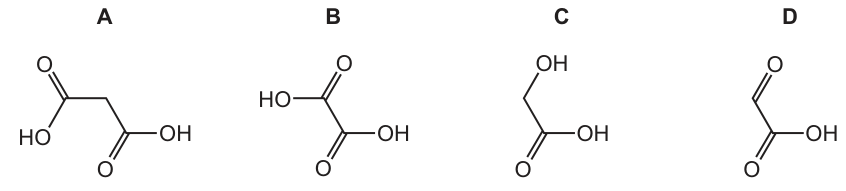
Working
Hydroxyethanal () contains two oxidisable functional groups:
- A primary alcohol group ()
- An aldehyde group ()
Acidified under reflux with excess reagent is a strong oxidising agent. It oxidises:
- Primary alcohols fully to carboxylic acids:
- Aldehydes to carboxylic acids:
Both groups in hydroxyethanal are oxidised to carboxylic acid groups, producing ethanedioic acid (oxalic acid), .
This corresponds to structure B.
Answer
B
B
Background Concept
Oxidation reactions of organic compounds depend heavily on the functional groups present and the reaction conditions.
- Primary alcohols () can be oxidised first to aldehydes () and then further to carboxylic acids (). To stop at the aldehyde, distillation is used. To go all the way to the carboxylic acid, reflux with an excess of a strong oxidising agent (like acidified or ) is required.
- Aldehydes () are easily oxidised to carboxylic acids () by strong oxidising agents. Even mild oxidising agents like Tollens' reagent or Fehling's solution can oxidise aldehydes, but acidified dichromate will do it readily.
- Secondary alcohols oxidise to ketones, which resist further oxidation under these conditions.
- Tertiary alcohols are not oxidised by acidified dichromate under normal conditions.
Understanding the Question
The question asks for the product when hydroxyethanal () is heated under reflux with an excess of acidified .
We must identify all functional groups in the reactant and determine their final oxidation state under these vigorous conditions.
Approach
- Draw or visualise the structure of hydroxyethanal to identify its functional groups.
- Recall the oxidation behaviour of each functional group with excess acidified dichromate under reflux.
- Combine the oxidised groups to form the final product structure.
- Match the predicted product to the given skeletal formula options.
Step-by-Step Reasoning
Step 1: Analyse the reactant
Hydroxyethanal has the formula . Its structure is .
It contains:
- A primary alcohol group: (on carbon 1, if we number from the right, or the left depending on IUPAC, but structurally it's a group attached to a group).
- An aldehyde group: .
Note: The molecule has only two carbon atoms.
Step 2: Apply oxidation rules
The reagent is acidified potassium dichromate(VI) (), which is a strong oxidising agent. The conditions are reflux and excess oxidant.
- The primary alcohol group () will be fully oxidised to a carboxylic acid group ().
- The aldehyde group () will be oxidised to a carboxylic acid group ().
Step 3: Determine the product
Both ends of the two-carbon chain become carboxylic acid groups.
Reactant:
Product: (ethanedioic acid, also known as oxalic acid).
Step 4: Evaluate the options
- A: Shows a three-carbon chain with two carboxylic acid groups (, propanedioic acid). Incorrect number of carbons.
- B: Shows a two-carbon chain with two carboxylic acid groups (, ethanedioic acid). Correct.
- C: Shows a two-carbon chain with a hydroxyl group and a carboxylic acid (, 2-hydroxyethanoic acid). This would be the product if only the aldehyde was oxidised, or if milder conditions were used that didn't affect the alcohol (which isn't the case here; excess dichromate under reflux oxidises primary alcohols too).
- D: Shows a two-carbon chain with an aldehyde and a carboxylic acid (, 2-oxoethanoic acid). This is an intermediate or incorrect oxidation state.
Key Takeaways
- Always check the reaction conditions: reflux + excess oxidant means full oxidation to carboxylic acids for primary alcohols and aldehydes.
- Identify all oxidisable functional groups in a molecule; a molecule can have more than one.
- Count carbon atoms carefully to eliminate options with the wrong carbon skeleton.
Common Mistakes
- Forgetting the aldehyde oxidation: Students might only oxidise the alcohol and stop at the hydroxy acid (Option C), forgetting that acidified dichromate also oxidises aldehydes to carboxylic acids.
- Stopping at the aldehyde stage: If the question said distillation instead of reflux, the alcohol would become an aldehyde, giving an aldehyde-dialdehyde or similar, but here reflux ensures full oxidation.
- Counting carbons incorrectly: Option A has 3 carbons. The reactant hydroxyethanal has only 2 carbons (). Oxidation does not add or remove carbon atoms in this context.
- Confusing reagents: Tollens' reagent oxidises aldehydes but not primary alcohols. Acidified dichromate oxidises both.
Things to Be Careful About
- Reflux vs Distillation: Reflux allows prolonged heating, ensuring the intermediate aldehyde (from alcohol oxidation) is further oxidised to the carboxylic acid. Distillation would remove the aldehyde as it forms, stopping the oxidation there.
- Excess reagent: Ensures all oxidisable groups are fully converted. Limiting reagent might lead to partial oxidation products.
- Skeletal formulae: Read them carefully. A line ending in attached to a carbonyl is a carboxylic acid (). A line ending in not attached to a carbonyl is an alcohol (). A line ending in (with an implicit H) is an aldehyde.
The formula shows the repeat unit of an addition polymer.
What is the correct name of the monomer from which this polymer is made?
Options
A 1-methyl-2-ethylethene
B 1-ethylprop-1-ene
C pent-2-ene
D pent-1-ene
Working
The repeat unit is formed when the C=C bond of the monomer opens and each carbon bonds to the next unit. Reversing this, the monomer is:
The longest chain containing the double bond has five carbon atoms, with the double bond between C-2 and C-3, so the IUPAC name is pent-2-ene.
Answer
C
C
Background Concept
Addition polymers are formed from alkene monomers. The C=C double bond opens and each carbon forms a single bond to the next monomer unit, so the repeat unit of the polymer has a two-carbon backbone with the original substituents still attached. To find the monomer from a repeat unit, break the bonds joining repeat units and restore the double bond between the two backbone carbons. Then name the alkene by IUPAC rules: choose the longest chain containing the C=C, number from the end nearest the double bond, and give the locant.
Understanding the Question
The repeat unit is given as . We need to identify the alkene monomer. The answer options are four alkene names. The question tests whether we can reverse the polymerisation and name the alkene correctly.
Approach
- Identify the two carbon atoms that form the polymer backbone.
- Note the groups attached to each: one has , the other has ; each also has an H atom.
- Break the two bonds that join this repeat unit to its neighbours and form a double bond between the two backbone carbons.
- Write the monomer structure and name it using IUPAC rules.
Step-by-Step Reasoning
The repeat unit is . The two backbone carbons each carry one H atom and one alkyl group. In the monomer, these two carbons are joined by a double bond, so the monomer is .
Count the longest carbon chain that contains the double bond: has five carbons, so the parent alkane is pentane, and the alkene is pentene. Number the chain from the end nearer the double bond: the double bond starts at C-2, so the name is pent-2-ene.
Why the other options are wrong:
- A "1-methyl-2-ethylethene" describes the same connectivity but is not the preferred IUPAC name because the longest chain containing the double bond has five carbons, not two.
- B "1-ethylprop-1-ene" would have a three-carbon chain with an ethyl substituent, which is not the structure here.
- D "pent-1-ene" would be , with the double bond at the end of the chain, not between C-2 and C-3.
Key Takeaways
To find a monomer from an addition polymer repeat unit, restore the C=C double bond between the two backbone carbons and remove the bonds to neighbouring units. Always name the alkene using the longest chain containing the double bond and number from the end nearest the double bond.
Common Mistakes
- Choosing "1-methyl-2-ethylethene" because it seems to describe the substituents; this is not the IUPAC name because the longest chain is pent-2-ene.
- Counting the carbon chain incorrectly and choosing pent-1-ene.
- Forgetting that each backbone carbon in the repeat unit also carries a hydrogen atom, which is needed to reconstruct the alkene correctly.
Things to Be Careful About
- The double bond locant must be the lower number possible.
- The parent chain must include the C=C and be the longest such chain.
- In the repeat unit, the two backbone carbons are not the or groups; those are substituents.
- Use IUPAC nomenclature, not a descriptive name like "1-methyl-2-ethylethene".
The infrared spectrum of a compound is shown.
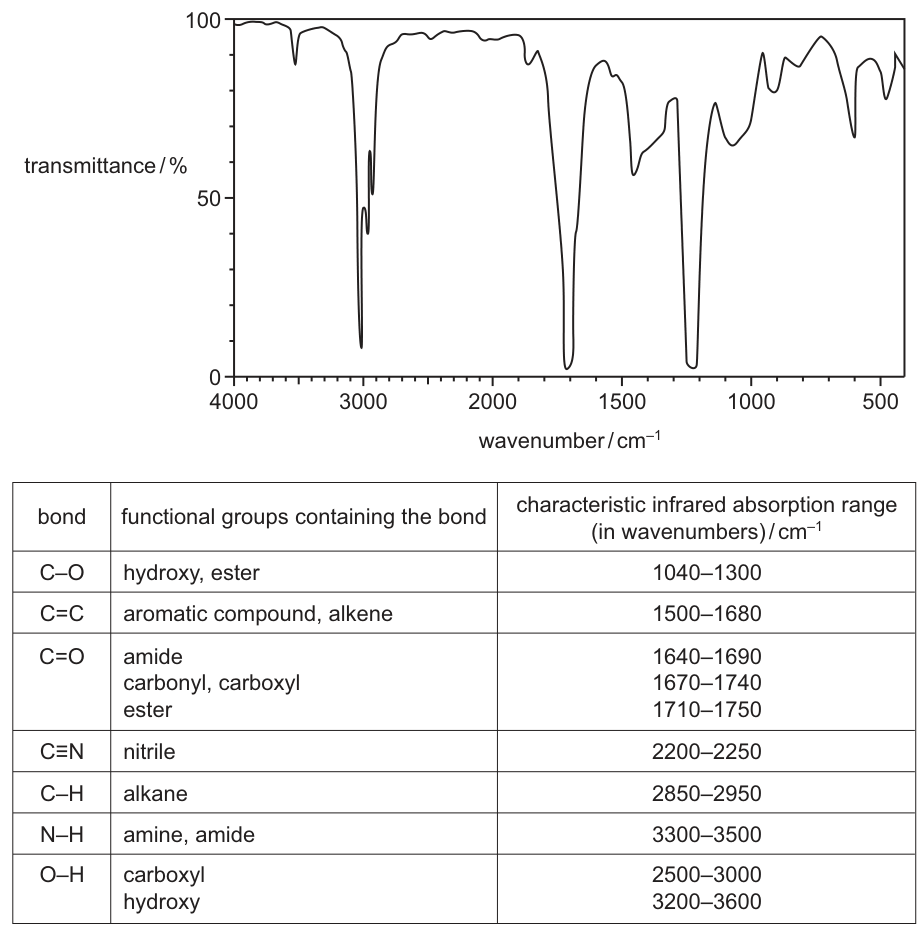
Which functional group could the compound contain?
Options
A alcohol
B carboxylic acid
C ester
D nitrile
Working
The IR spectrum shows the following key features:
- A very strong, sharp absorption peak around 1740 cm, which falls in the C=O range for an ester (1710–1750 cm).
- A strong absorption peak around 1200 cm, which falls in the C–O range (1040–1300 cm).
- Sharp C–H absorption peaks around 2850–2950 cm.
- No broad absorption in the 2500–3000 cm range (which would indicate an O–H bond in a carboxylic acid) or 3200–3600 cm (O–H in an alcohol).
- No absorption around 2200–2250 cm (which would indicate a C≡N bond in a nitrile).
The presence of both C=O (in the ester region) and C–O bonds, without O–H or C≡N, indicates an ester functional group.
Answer
C
C
Background Concept
Infrared (IR) spectroscopy is an analytical technique used to identify functional groups in organic molecules. Different types of chemical bonds absorb infrared radiation at characteristic wavenumbers (measured in cm), causing the bonds to vibrate. The absorption appears as a downward peak on an IR spectrum (transmittance vs. wavenumber). By matching the positions and shapes of the absorption peaks to known characteristic ranges, one can deduce the functional groups present in a compound. Key bonds include C=O (carbonyl), C–O, O–H, N–H, C≡N, and C–H.
Understanding the Question
The question provides an IR spectrum of an unknown compound along with a table of characteristic IR absorption ranges for various bonds and the functional groups that contain them. The candidate must identify which of the four given functional groups (alcohol, carboxylic acid, ester, nitrile) is consistent with the observed peaks in the spectrum.
Approach
- Identify the major absorption peaks in the provided IR spectrum.
- Compare the wavenumbers of these peaks with the ranges given in the table.
- Determine which bonds are present and which are absent.
- Use the presence/absence of specific bonds to eliminate the incorrect functional groups and confirm the correct one.
Step-by-Step Reasoning
- Peak at ~1740 cm: There is a very strong, sharp absorption peak around 1740 cm. According to the table, this falls within the C=O absorption range for an ester (1710–1750 cm). It could also overlap with carboxyl (1670–1740 cm) or amide (1640–1690 cm), but 1740 is squarely in the ester range.
- Peak at ~1200 cm: There is another strong absorption peak around 1200 cm. This matches the C–O absorption range (1040–1300 cm), which is characteristic of both hydroxy (alcohol) and ester functional groups.
- Absence of O–H peaks:
- An alcohol (hydroxy group) would show a broad, strong absorption around 3200–3600 cm. This is absent. Thus, option A (alcohol) is incorrect.
- A carboxylic acid (carboxyl group) would show a very broad absorption spanning 2500–3000 cm due to the O–H bond. The spectrum shows sharp C–H peaks around 2850–2950 cm, but no broad O–H carboxyl peak overlapping them. Thus, option B (carboxylic acid) is incorrect.
- Absence of C≡N peak: A nitrile would show a sharp, medium-strong absorption around 2200–2250 cm. There is no peak in this region. Thus, option D (nitrile) is incorrect.
- Conclusion: The spectrum shows C=O (ester range) and C–O bonds, with no O–H or C≡N bonds. This is the classic IR signature of an ester. Therefore, option C is correct.
Key Takeaways
- IR spectroscopy identifies functional groups based on characteristic bond vibrations.
- A strong peak at ~1740 cm indicates a C=O bond, specifically an ester if it is in the 1710–1750 cm range.
- A strong peak at ~1200 cm indicates a C–O bond.
- The absence of a broad O–H peak (3200–3600 cm for alcohols, 2500–3000 cm for carboxylic acids) rules out alcohols and carboxylic acids.
- The absence of a peak at 2200–2250 cm rules out nitriles.
Common Mistakes
- Confusing the C=O peak of an ester (1710–1750 cm) with that of a carboxylic acid (1670–1740 cm) without checking for the broad O–H peak of the carboxylic acid (2500–3000 cm).
- Missing the C–O peak at ~1200 cm, which is crucial for distinguishing an ester from a ketone (which would have C=O but no C–O).
- Assuming any peak near 3000 cm is an O–H peak, failing to distinguish between the sharp C–H stretches (2850–2950 cm) and the broad O–H stretches.
Things to Be Careful About
- Always check the shape of the O–H peak: alcohols have a broad peak at 3200–3600 cm, while carboxylic acids have a very broad peak that often overlaps the C–H region (2500–3000 cm).
- Pay attention to the exact wavenumber ranges in the provided table, as different carbonyl-containing groups (amide, carboxyl, ester) have slightly different C=O absorption ranges.
- Remember that C–H stretches (2850–2950 cm) are almost always present in organic molecules and are not diagnostic for functional groups on their own; they must be interpreted in context with other peaks.
Your score so far
Answer a question to start scoring
Your marks add up here as you work through the paper.