Chemistry 9701/23 — October/November 2023
Cambridge AS Level · AS Level Structured Questions · worked solutions for every part, with the mark scheme
Topics Atoms, Molecules and Stoichiometry · States of Matter · Chemical Energetics · Carbonyl Compounds · Carboxylic Acids and Derivatives · Introduction to Organic Chemistry · +13 more
The elements phosphorus, sulfur and chlorine are in Period 3 of the Periodic Table.
Table 1.1 shows some properties of the elements P to Cl.
The first ionisation energy of S is not shown.
Table 1.1
| property | P | S | Cl |
|---|---|---|---|
| number of electrons in 3p subshell | |||
| total number of unpaired electrons | |||
| first ionisation energy / kJ mol⁻¹ | 1060 | 1260 | |
| formula of most common anion | P³⁻ | S²⁻ | Cl⁻ |
Complete Table 1.1 to show the number of electrons in the 3p subshell and the total number of unpaired electrons in an atom of P, S and Cl.
Answer
| property | P | S | Cl |
|---|---|---|---|
| number of electrons in 3p subshell | 3 | 4 | 5 |
| total number of unpaired electrons | 3 | 2 | 1 |
P: 3p³, 3 unpaired; S: 3p⁴, 2 unpaired; Cl: 3p⁵, 1 unpaired
Background Concept
The 3p subshell can hold up to 6 electrons across three orbitals (3px, 3py, 3pz). According to Hund's rule, electrons fill each orbital singly before pairing begins, and all unpaired electrons have parallel spins. This gives rise to the pattern of unpaired electrons across the Period 3 elements.
Understanding the Question
We need to determine how many electrons occupy the 3p subshell for P, S, and Cl, and then how many of those are unpaired.
Approach
Write the electron configuration for each element up to the 3p subshell, then apply Hund's rule to determine unpaired electrons.
Step-by-Step Reasoning
- Phosphorus (Z = 15): Configuration ends 3s²3p³. Three electrons in three p-orbitals → all unpaired (one in each orbital). Total unpaired = 3.
- Sulfur (Z = 16): Configuration ends 3s²3p⁴. Four electrons in three p-orbitals → one orbital is paired, two have single electrons. Total unpaired = 2.
- Chlorine (Z = 17): Configuration ends 3s²3p⁵. Five electrons in three p-orbitals → two orbitals are paired, one has a single electron. Total unpaired = 1.
Key Takeaways
Hund's rule is essential for determining unpaired electrons. The number of unpaired electrons in p-subshells follows the pattern 3, 2, 1, 0, 1, 2 for p¹ through p⁶.
Common Mistakes
- Forgetting that pairing only begins after all orbitals have one electron (writing S as having 4 unpaired electrons).
- Confusing the total number of electrons with the number of unpaired electrons.
Things to Be Careful About
The question asks for unpaired electrons in the entire atom, not just the 3p subshell. However, since 3s² is fully paired and all inner shells are filled, the only unpaired electrons are in 3p.
Construct an equation to represent the first ionisation energy of P.
Answer
P(g) → P⁺(g) + e⁻
Background Concept
First ionisation energy is the enthalpy change required to remove one electron from each atom in one mole of gaseous atoms to form one mole of gaseous 1⁺ ions. The equation must show gaseous atoms on both sides.
Understanding the Question
Construct the equation representing the first ionisation energy of phosphorus specifically.
Approach
Write the equation showing a gaseous P atom losing one electron to form a gaseous P⁺ ion.
Step-by-Step Reasoning
- Start with P(g) — must be gaseous
- Remove one electron: P(g) → P⁺(g) + e⁻
- State symbols are essential: both P and P⁺ must be (g)
Key Takeaways
The first ionisation energy equation always involves gaseous atoms forming gaseous 1⁺ ions plus one electron.
Common Mistakes
- Omitting state symbols (the mark is specifically for the correct equation with (g) states).
- Writing P⁺ as P²⁺ or including multiple electrons.
- Using solid state symbols instead of gaseous.
Things to Be Careful About
State symbols (g) are required on both sides of the equation. The electron should be written as e⁻ (not e).
Three possible values for the first ionisation energy of S are given.
Circle the correct value.
Explain your choice by comparing your chosen value to those of P and Cl.
Answer
1000 kJ mol⁻¹
- S has a lower nuclear charge than Cl, so less attraction for outer electrons than Cl; hence S's first IE is lower than Cl's (1260).
- S has a greater nuclear charge than P, but the 3p⁴ configuration means two electrons are paired in one 3p orbital, causing spin-pair repulsion which makes it easier to remove an electron than expected.
- Therefore S's first IE is lower than P's (1060), giving 1000 kJ mol⁻¹.
1000 kJ mol⁻¹
Background Concept
First ionisation energy generally increases across a period due to increasing nuclear charge with the same shielding. However, there are two well-known exceptions in Period 3: between Group 2 and 13 (subshell change from 3s to 3p), and between Group 15 and 16 (spin-pair repulsion in the 3p subshell). In Group 16 elements like oxygen and sulfur, the fourth 3p electron must pair with an existing electron in one of the three p-orbitals, creating electron-electron repulsion that makes that electron slightly easier to remove.
Understanding the Question
We must select the correct first IE for sulfur from three options and justify the choice by comparing to P (1060) and Cl (1260).
Approach
- Recognise that normally IE increases across a period, so S should be between P and Cl.
- But recall the Group 15→16 anomaly: spin-pair repulsion in 3p⁴ makes S's IE lower than expected — specifically lower than P.
- Choose the value below 1060, which is 1000 kJ mol⁻¹.
- Explain with reference to nuclear charge comparisons and the pairing effect.
Step-by-Step Reasoning
- Compared to Cl: S has fewer protons (16 vs 17), so lower nuclear charge and weaker attraction for outer electrons. S's IE must be lower than Cl's (1260). This eliminates 1320.
- Compared to P: S has more protons (16 vs 15), so we might expect a higher IE. However, S has 3p⁴ (one paired set of electrons) while P has 3p³ (all unpaired). The spin-pair repulsion in S's paired 3p electrons makes it easier to remove one, lowering the IE below P's value of 1060.
- Therefore the answer is 1000 kJ mol⁻¹ (the only option below 1060).
Key Takeaways
The Group 15→16 dip in first ionisation energy is a classic exception to the general trend across a period. It arises because the fourth p-electron must pair, introducing repulsion.
Common Mistakes
- Choosing 1160 because it is 'between' P and Cl, ignoring the spin-pair repulsion anomaly.
- Failing to mention the paired electrons in the 3p subshell of sulfur.
- Saying S has 'less nuclear charge than P' (it has more — 16 vs 15 protons).
Things to Be Careful About
You must compare S to BOTH P and Cl. The mark scheme requires: (1) S has less nuclear attraction than Cl (or Cl has stronger attraction), (2) S has less nuclear charge than Cl, (3) S has greater nuclear charge than P BUT spin-pair repulsion in 3p makes IE lower than P. All four points must be addressed for full marks.
P³⁻, S²⁻ and Cl⁻ have the same number of electrons.
Give the full electronic configuration of P³⁻.
Answer
1s² 2s² 2p⁶ 3s² 3p⁶
Background Concept
A phosphide ion P³⁻ is formed when a neutral phosphorus atom (15 electrons) gains three electrons, giving 18 electrons total — the same configuration as argon.
Understanding the Question
Write the full electronic configuration of P³⁻.
Approach
P has 15 electrons. Adding 3 gives 18. Fill orbitals in order: 1s, 2s, 2p, 3s, 3p.
Step-by-Step Reasoning
- P (Z = 15): 1s²2s²2p⁶3s²3p³ (15 electrons)
- P³⁻: add 3 electrons to 3p → 3p⁶
- Result: 1s²2s²2p⁶3s²3p⁶ (18 electrons, same as Ar)
Key Takeaways
Anions of Period 3 elements in Groups 15–17 achieve the noble gas configuration of argon.
Common Mistakes
- Writing the configuration of neutral P instead of P³⁻.
- Forgetting to write the full configuration (using shorthand like [Ne]3s²3p⁶ when full is required).
Things to Be Careful About
The question asks for the 'full' electronic configuration, so shorthand notation using noble gas cores is not acceptable.
State the trend in ionic radius shown by P³⁻, S²⁻ and Cl⁻.
Explain your answer.
Answer
The ionic radius decreases from P³⁻ to S²⁻ to Cl⁻.
All three ions have the same number of electrons (18) and the same shielding. However, the nuclear charge increases from P (15 protons) to S (16) to Cl (17), so the outer electrons experience greater electrostatic attraction to the nucleus, pulling them closer and reducing the radius.
Ionic radius decreases from P³⁻ to Cl⁻ due to increasing nuclear charge with same shielding
Background Concept
When ions are isoelectronic (same number of electrons), the ionic radius depends on the nuclear charge. More protons exert a stronger pull on the same number of electrons, resulting in a smaller radius. This is the opposite of what happens across a period for neutral atoms (where radius also decreases but for a different reason — adding electrons to the same shell while increasing nuclear charge).
Understanding the Question
P³⁻, S²⁻, and Cl⁻ all have 18 electrons. State the trend in ionic radius and explain it.
Approach
Identify that these are isoelectronic species. Compare nuclear charges. Apply the principle that greater nuclear charge with same electron count gives smaller radius.
Step-by-Step Reasoning
- All three ions have 18 electrons → same electron configuration → same shielding.
- Nuclear charge: P = 15, S = 16, Cl = 17.
- Greater nuclear charge → stronger attraction for the same number of electrons → smaller radius.
- Therefore: radius of P³⁻ > S²⁻ > Cl⁻ (decreasing from left to right).
Key Takeaways
For isoelectronic ions, radius decreases with increasing atomic number because the nuclear charge increases while shielding remains constant.
Common Mistakes
- Saying the radius increases (confusing with the trend for neutral atoms gaining electrons).
- Mentioning 'more electron shells' — all three have the same number of shells.
- Forgetting to state that shielding is the same.
Things to Be Careful About
The mark scheme requires any two of: (1) decreases, (2) increased attraction of outer electrons for nucleus, (3) increased nuclear charge, (4) same shielding. Make sure to mention that shielding/electron count is constant.
A student does three tests on separate samples of NaCl(aq).
Complete Table 1.2 with the observations the student makes in each test.
Table 1.2
| test | test | observations |
|---|---|---|
| 1 | addition of a few drops of Br₂(aq) | |
| 2 | addition of a few drops of concentrated H₂SO₄ | |
| 3 | addition of a few drops of dilute AgNO₃(aq) |
Answer
| test | observation |
|---|---|
| 1 — Br₂(aq) added to NaCl(aq) | No visible reaction (solution remains orange/brown) |
| 2 — conc. H₂SO₄ added to NaCl(aq) | No visible reaction (solution remains colourless) |
| 3 — dilute AgNO₃(aq) added to NaCl(aq) | White precipitate forms |
Test 1: no visible reaction; Test 2: no visible reaction; Test 3: white precipitate
Background Concept
Bromine is a weaker oxidising agent than chlorine, so it cannot oxidise Cl⁻ to Cl₂. Concentrated H₂SO₄ can oxidise Br⁻ and I⁻ but not Cl⁻ (chloride is too weak a reducing agent). Silver nitrate gives a characteristic white precipitate of AgCl with chloride ions.
Understanding the Question
Predict observations when three different reagents are added to aqueous sodium chloride.
Approach
For each reagent, determine whether a reaction occurs with Cl⁻ specifically, and if so, what is observed.
Step-by-Step Reasoning
- Test 1 (Br₂ + NaCl): Bromine is below chlorine in Group 17, so it is a weaker oxidising agent. It cannot displace chloride from solution. No reaction occurs; the orange/brown colour of bromine water persists.
- Test 2 (conc. H₂SO₄ + NaCl): Concentrated sulfuric acid is an oxidising agent that can oxidise Br⁻ (to Br₂) and I⁻ (to I₂), but Cl⁻ is too weak a reducing agent. No redox reaction occurs. The solution remains colourless. (Note: acid-base reaction occurs forming HCl gas, but with dilute aqueous NaCl and a few drops of conc. H₂SO₄, no visible change is expected.)
- Test 3 (AgNO₃ + NaCl): Ag⁺(aq) + Cl⁻(aq) → AgCl(s). A white precipitate of silver chloride forms.
Key Takeaways
Chloride is the least reactive halide ion toward oxidising agents. It gives a white precipitate with AgNO₃ but does not react with Br₂ or concentrated H₂SO₄ (in terms of redox).
Common Mistakes
- Saying bromine displaces chlorine (it cannot — wrong direction in the reactivity series).
- Saying conc. H₂SO₄ produces steamy fumes of HCl (this occurs with solid NaCl, not aqueous NaCl with a few drops of acid).
- Saying a cream precipitate forms with AgNO₃ (that is AgBr; AgCl is white).
Things to Be Careful About
The question specifies NaCl(aq) — aqueous solution, not solid. This is important for the H₂SO₄ test: with solid NaCl, you would see steamy fumes of HCl, but with aqueous NaCl and a few drops of conc. acid, no visible reaction is expected.
POCl₃ shows similar chemical properties to PCl₅.
POCl₃ has a melting point of 1 °C and a boiling point of 106 °C.
POCl₃ reacts vigorously with water, forming misty fumes and an acidic solution.
Explain how the information in (d) suggests the structure and bonding of POCl₃ is simple covalent.
Answer
- The relatively low melting point (1 °C) and boiling point (106 °C) indicate weak intermolecular forces (van der Waals' forces), consistent with a simple molecular structure.
- The vigorous reaction with water (hydrolysis) forming misty fumes of HCl indicates covalent bonding (ionic compounds do not hydrolyse in this way).
Low mp/bp → weak intermolecular forces → simple molecular; hydrolysis with water → covalent bonding
Background Concept
Simple molecular (covalent) substances have low melting and boiling points because only weak intermolecular forces (van der Waals' or dipole-dipole) need to be overcome to melt or boil — the strong covalent bonds within molecules are not broken. Additionally, covalent chlorides of non-metals (like PCl₅, SiCl₄) undergo hydrolysis with water, producing acidic solutions and fumes of HCl, whereas ionic chlorides simply dissolve.
Understanding the Question
Use the given physical data (mp, bp) and chemical behaviour (reaction with water) to argue that POCl₃ has simple covalent molecular structure.
Approach
Connect low mp/bp to weak intermolecular forces (simple molecular), and hydrolysis reaction to covalent bonding.
Step-by-Step Reasoning
- Melting and boiling points: 1 °C and 106 °C are very low. Giant ionic or covalent structures have much higher values (hundreds to thousands of °C). Low values indicate only weak intermolecular forces need to be overcome → simple molecular structure.
- Reaction with water: Vigorous hydrolysis producing misty fumes (HCl gas) and an acidic solution is characteristic of covalent chlorides (e.g. PCl₅ + water → H₃PO₄ + HCl). Ionic compounds do not undergo this type of reaction.
Key Takeaways
Physical properties (mp, bp) and chemical reactivity (hydrolysis) together provide strong evidence for simple covalent molecular structure.
Common Mistakes
- Saying 'weak bonds' instead of 'weak intermolecular forces' (the covalent bonds within the molecule are strong).
- Saying the reaction with water shows it is ionic (it shows the opposite — ionic compounds dissolve, not hydrolyse).
Things to Be Careful About
The mark scheme specifically requires: (1) low mp/bp → weak intermolecular/VdW forces, and (2) reaction with water → hydrolysis. Both points must be made.
Construct an equation for the reaction of POCl₃ with water.
POCl₃ + ................................. → .................................
Answer
POCl₃ + 3H₂O → H₃PO₄ + 3HCl
Background Concept
Covalent chlorides of non-metals react with water via hydrolysis. The chlorine atoms are replaced by OH groups, producing HCl (which forms the misty fumes and acidic solution). For POCl₃, all three Cl atoms are replaced, giving phosphoric acid (H₃PO₄) and three HCl.
Understanding the Question
Complete the equation POCl₃ + ... → ... with correct products and balancing.
Approach
Each Cl is replaced by OH, releasing HCl. Three Cl → three HCl. The remaining P with three OH and one O gives H₃PO₄.
Step-by-Step Reasoning
- POCl₃ has 3 Cl atoms that will each be replaced by OH from water.
- Each replacement releases one HCl → 3 HCl.
- Three OH groups + the existing P=O + one H from water gives H₃PO₄.
- Balance: POCl₃ + 3H₂O → H₃PO₄ + 3HCl.
- Check: P: 1=1, O: 1+3=4 ✓, H: 6=3+3=6 ✓, Cl: 3=3 ✓.
Key Takeaways
Hydrolysis of covalent chlorides always produces HCl and the corresponding oxoacid.
Common Mistakes
- Writing H₃PO₃ instead of H₃PO₄ (forgetting the P=O double bond is retained).
- Not balancing the equation (missing the coefficient 3 before H₂O or HCl).
- Writing state symbols incorrectly or omitting them where not required.
Things to Be Careful About
The product is phosphoric acid H₃PO₄ (not H₃PO₃ or HPO₃). The equation must be balanced with 3H₂O and 3HCl.
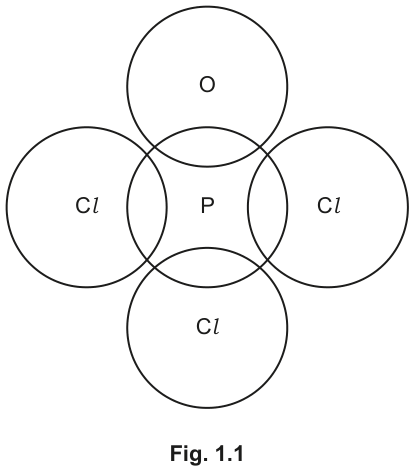
POCl₃ contains a double covalent bond between P and O.
Complete the dot-and-cross diagram, in Fig. 1.1, to show the bonding in POCl₃.
Show outer shell electrons only.
Answer
The dot-and-cross diagram shows:
- P in the centre with a double bond (two shared pairs) to O and single bonds (one shared pair each) to three Cl atoms.
- O has two lone pairs (4 non-bonding electrons).
- Each Cl has three lone pairs (6 non-bonding electrons).
- P has no lone pairs.
- Total of 32 valence electrons shown.
Dot-and-cross diagram of POCl₃: P central, double bond to O (2 lone pairs on O), single bonds to 3 Cl (3 lone pairs each), 32 valence electrons total
Background Concept
In a dot-and-cross diagram, each atom contributes its valence electrons as dots or crosses. Shared pairs (one from each atom) form covalent bonds. Non-bonding electrons appear as lone pairs. The total number of electrons shown equals the sum of all valence electrons in the molecule.
Understanding the Question
Complete the given template (Fig. 1.1) by placing all 32 valence electrons correctly, showing the P=O double bond and P-Cl single bonds, with appropriate lone pairs.
Approach
- Count total valence electrons: P(5) + O(6) + 3×Cl(7) = 5 + 6 + 21 = 32.
- Draw bonds: P=O (4 electrons), 3 × P-Cl (6 electrons) = 10 bonding electrons.
- Distribute remaining 22 electrons as lone pairs: O gets 4 (2 lone pairs), each Cl gets 6 (3 lone pairs) = 4 + 18 = 22 ✓.
- P has no lone pairs (all 5 valence electrons used in bonding).
Step-by-Step Reasoning
- P=O double bond: Two pairs of electrons shared between P and O. Represent as two crosses (from P) and two dots (from O) in the overlap region.
- P-Cl single bonds: One pair shared between P and each Cl. Represent as one cross (from P) and one dot (from Cl) in each overlap.
- O lone pairs: Two pairs of dots on O (outside the overlap with P).
- Cl lone pairs: Three pairs of dots on each Cl (outside the overlap with P).
- P: No lone pairs — all 5 electrons are in bonds (2 in the double bond to O, 1 in each single bond to Cl).
Key Takeaways
Always verify the total electron count. In POCl₃, phosphorus uses all 5 valence electrons in bonding (expanded octet with 10 electrons around P).
Common Mistakes
- Giving P a lone pair (it has none — all 5 electrons are used in bonding).
- Forgetting the double bond between P and O (showing only a single bond).
- Incorrect number of lone pairs on Cl (should be 3 pairs = 6 electrons each).
- Not showing the correct total of 32 electrons.
Things to Be Careful About
The diagram must show outer shell electrons only (as stated in the question). The P=O bond must clearly be a double bond (two shared pairs). Each Cl must have exactly 3 lone pairs plus the 1 bonding pair = 8 electrons around it (octet satisfied).
POCl₃(g) forms when PCl₃(g) reacts with O₂(g).
Table 1.3 gives some relevant data.
Table 1.3
| process | value / kJ mol⁻¹ |
|---|---|
| enthalpy change of formation of PCl₃(g) | -289 |
| enthalpy change of formation of POCl₃(g) | -592 |
| O₂(g) → 2O(g) | +496 |
Define enthalpy change of formation, .
Answer
The enthalpy change when one mole of a compound is formed from its constituent elements in their standard states.
Enthalpy change when one mole of a compound is formed from its constituent elements in their standard states
Background Concept
Standard enthalpy change of formation (ΔH_f^⊖) is a fundamental thermodynamic quantity. It is defined for the formation of exactly one mole of a substance from its elements, with all substances in their standard states (the most stable form at 298 K and 1 atm pressure). By definition, ΔH_f^⊖ of any element in its standard state is zero.
Understanding the Question
Provide the full definition of enthalpy change of formation.
Approach
State both required elements of the definition: (1) one mole of compound formed, (2) from constituent elements in standard states.
Step-by-Step Reasoning
- Key phrase 1: 'enthalpy change when one mole of a compound/substance is formed' — must specify 'one mole'.
- Key phrase 2: 'from its constituent elements in their standard states' — must mention elements and standard states.
- Both phrases are needed for the two marks.
Key Takeaways
The definition of ΔH_f must always include 'one mole' and 'elements in standard states'.
Common Mistakes
- Omitting 'one mole' (saying just 'a compound is formed').
- Omitting 'standard states' (saying 'from its elements').
- Saying 'from its atoms' instead of 'from its elements'.
Things to Be Careful About
Both parts of the definition are separately marked. Missing either 'one mole' or 'standard states' loses one mark.
Calculate the bond energy of P=O in POCl₃ using the data in Table 1.3.
Show your working.
Working
For the reaction:
Using :
Using bond energies (bonds broken bonds formed):
Only the O=O bond is broken and two P=O bonds are formed (P-Cl bonds are unchanged):
Answer
+551 kJ mol⁻¹
Background Concept
Bond energy calculations use the principle that ΔH for a reaction equals the total energy needed to break bonds minus the total energy released when new bonds form. When combined with Hess's law (which relates ΔH to enthalpies of formation), we can solve for an unknown bond energy.
Understanding the Question
Given ΔH_f values for PCl₃ and POCl₃, and the O=O bond energy, calculate the P=O bond energy in POCl₃.
Approach
- Calculate ΔH for the reaction using Hess's law with formation enthalpies.
- Set up a bond energy expression: ΔH = bonds broken − bonds formed.
- Identify which bonds actually change: P-Cl bonds are present in both PCl₃ and POCl₃ (3 per molecule), so they cancel. The net change is: break 1 O=O per 2 POCl₃, form 2 P=O per 2 POCl₃.
- Solve for E(P=O).
Step-by-Step Reasoning
-
Step 1 — ΔH from Hess's law:
ΔH = 2ΔH_f(POCl₃) − 2ΔH_f(PCl₃) − ΔH_f(O₂)
ΔH = 2(−592) − 2(−289) − 0 = −1184 + 578 = −606 kJ mol⁻¹ -
Step 2 — Bond energy expression:
In going from 2PCl₃ + O₂ → 2POCl₃:- Bonds broken: 1 × O=O = 496 kJ
- Bonds formed: 2 × P=O (the new bonds in each POCl₃ that weren't in PCl₃)
- P-Cl bonds: 6 on each side → cancel
ΔH = 496 − 2E(P=O)
-
Step 3 — Solve:
−606 = 496 − 2E(P=O)
2E(P=O) = 496 + 606 = 1102
E(P=O) = 551 kJ mol⁻¹
Key Takeaways
When using bond energies in a Hess's law context, identify which bonds actually change. Bonds present on both sides cancel out. The combination of formation enthalpies and bond energies is a common exam technique.
Common Mistakes
- Including P-Cl bonds in the calculation (they are the same on both sides and cancel).
- Getting the sign wrong in the bond energy expression (ΔH = broken − formed, not formed − broken).
- Forgetting to multiply by 2 (the equation has 2POCl₃, so 2 P=O bonds are formed).
- Using the wrong sign when rearranging: −606 = 496 − 2E means 2E = 496 − (−606) = 496 + 606.
Things to Be Careful About
The O₂ bond energy given (496 kJ mol⁻¹) is for breaking O₂ into 2O atoms — this is the O=O bond dissociation energy. Make sure to use it as a positive value (energy input). The final answer must be positive (bond energies are always positive, representing energy released when the bond forms or energy required to break it).
The rest of this paper
3 more questions- Q2Group 2 · Atoms, Molecules and Stoichiometry · Carbonyl Compounds · Nitrogen Compounds · Carboxylic Acids and Derivatives10M
- Q3Electrochemistry · Reaction Kinetics · Chemical Energetics · States of Matter · Atoms, Molecules and Stoichiometry · Hydroxy Compounds · Introduction to Organic Chemistry · Carbonyl Compounds12M
- Q4Introduction to Organic Chemistry · Hydrocarbons · Polymerisation · Analytical Techniques · Organic Synthesis · Carboxylic Acids and Derivatives16M