Chemistry 9701/21 — October/November 2023
Cambridge AS Level · AS Level Structured Questions · worked solutions for every part, with the mark scheme
Topics States of Matter · Atoms, Molecules and Stoichiometry · Carbonyl Compounds · Carboxylic Acids and Derivatives · Introduction to Organic Chemistry · Atomic Structure · +14 more
The elements phosphorus, sulfur and chlorine are in Period 3 of the Periodic Table.
Table 1.1 shows some properties of the elements P to .
The first ionisation energy of S is not shown.
Table 1.1
| property | P | S | |
|---|---|---|---|
| number of electrons in 3p subshell | |||
| total number of unpaired electrons | |||
| first ionisation energy / | 1060 | 1260 | |
| formula of most common anion |
Complete Table 1.1 to show the number of electrons in the 3p subshell and the total number of unpaired electrons in an atom of P, S and .
Answer
| Property | P | S | Cl |
|---|---|---|---|
| Number of electrons in 3p subshell | 3 | 4 | 5 |
| Total number of unpaired electrons | 3 | 2 | 1 |
P: 3p³, 3 unpaired; S: 3p⁴, 2 unpaired; Cl: 3p⁵, 1 unpaired
Background Concept
The 3p subshell contains three orbitals (, , ), each of which can hold a maximum of two electrons. According to Hund's rule, electrons fill each orbital singly (with parallel spins) before pairing begins. This means that for to , all electrons are unpaired; for , one orbital becomes paired and two remain unpaired; for , two orbitals are paired and one remains unpaired.
Understanding the Question
The question asks you to complete a table showing (1) how many electrons occupy the 3p subshell and (2) the total number of unpaired electrons in a neutral atom of each of P, S, and Cl. The parent stem confirms these are Period 3 elements.
Approach
Write out the full electron configuration of each element, identify the 3p electrons, then apply Hund's rule to determine how many are unpaired.
Step-by-Step Reasoning
Phosphorus (Z = 15): Configuration is . The 3p subshell has 3 electrons. By Hund's rule, each occupies a separate orbital → 3 unpaired electrons.
Sulfur (Z = 16): Configuration is . The 3p subshell has 4 electrons. Three fill singly, the fourth pairs up in one orbital → 2 unpaired electrons.
Chlorine (Z = 17): Configuration is . The 3p subshell has 5 electrons. Two orbitals are full (4 electrons), one has a single electron → 1 unpaired electron.
Key Takeaways
- The number of 3p electrons equals the group number minus 10 for Period 3 elements in groups 13–17.
- Hund's rule governs how electrons distribute among degenerate orbitals before pairing.
Common Mistakes
- Forgetting that the 3s² electrons are paired and not counting them as unpaired.
- Assuming has 4 unpaired electrons (it has 2, because the fourth electron must pair up).
- Confusing the number of electrons in the subshell with the number of unpaired electrons.
Things to Be Careful About
- The question asks for the total number of unpaired electrons in the entire atom, not just in the 3p subshell. However, since all inner shells (1s, 2s, 2p, 3s) are fully filled, all inner electrons are paired, so the total unpaired equals the 3p unpaired count.
Construct an equation to represent the first ionisation energy of P.
Answer
P(g) → P⁺(g) + e⁻
Background Concept
The first ionisation energy is defined as the enthalpy change when one electron is removed from each atom in one mole of gaseous atoms to form one mole of gaseous 1+ ions. The equation must include state symbols (g) to show gaseous atoms and gaseous ions, and must show the electron explicitly.
Understanding the Question
The command word is 'construct an equation' — you must write the balanced chemical equation representing the first ionisation of phosphorus, not merely define it in words.
Approach
Apply the general form: , substituting P for X.
Step-by-Step Reasoning
The equation shows one gaseous phosphorus atom losing one electron to become a gaseous phosphorus ion with a 1+ charge. State symbols (g) are essential because ionisation energy is defined for gaseous species only. The electron is written as .
Key Takeaways
- The first ionisation energy equation always involves gaseous atoms forming gaseous 1+ ions plus one electron.
- State symbols are required for full marks.
Common Mistakes
- Omitting state symbols or writing (s) instead of (g).
- Writing instead of (confusing ionisation with the anion shown in the table).
- Including more than one electron (that would be the second or third ionisation energy).
Things to Be Careful About
- The mark scheme requires (g) on both sides. Without state symbols, the equation is incomplete and will not score.
Three possible values for the first ionisation energy of S are given.
Circle the correct value.
Explain your choice by comparing your chosen value to those of P and .
Answer
The first ionisation energy of S is lower than that of P because in S, two electrons are paired in one 3p orbital, causing spin-pair repulsion which makes it easier to remove an electron.
The first ionisation energy of S is lower than that of Cl because Cl has a greater nuclear charge than S, resulting in stronger attraction to the outer electrons.
1000 kJ mol⁻¹
Background Concept
Across Period 3, first ionisation energy generally increases from left to right due to increasing nuclear charge with the same number of shielding shells. However, there are two notable exceptions: between Mg and Al (Al has a 3p electron that is slightly further from the nucleus than the 3s electrons being removed from Mg), and between P and S. The P–S exception occurs because P has a half-filled 3p subshell (, all unpaired), while S has with one paired orbital. The repulsion between the two electrons sharing an orbital makes it easier to remove one of them from S than from P.
Understanding the Question
Three values are given (1000, 1160, 1320 kJ/mol). You must select the correct one and explain why by comparing it to the known values for P (1060) and Cl (1260). The explanation must address both comparisons: why S < P and why S < Cl.
Approach
- Since S is to the right of P but has a lower IE due to spin-pair repulsion, the value must be less than 1060.
- Since S is to the left of Cl, its IE must be less than 1260.
- The only value less than 1060 is 1000 kJ/mol.
- Explain using nuclear charge (for the S vs Cl comparison) and spin-pair repulsion (for the S vs P comparison).
Step-by-Step Reasoning
Choosing 1000 kJ/mol: The IE of S must be lower than P (1060) because of the paired electron repulsion in the configuration of S. Of the three options, only 1000 is less than 1060.
Comparison with Cl (1260): S has a lower nuclear charge than Cl (16 vs 17 protons), so the outer electrons in S experience less attraction to the nucleus than those in Cl. Therefore S has a lower IE than Cl, consistent with 1000 < 1260.
Comparison with P (1060): Although S has a greater nuclear charge than P (16 vs 15), the fourth 3p electron in S must pair up in an already-occupied orbital. This creates spin-pair repulsion between the two electrons in the same orbital, which destabilises the atom slightly and makes electron removal easier. Hence S has a lower IE than P despite the higher nuclear charge.
Key Takeaways
- The general trend across a period is increasing IE, but electron pairing effects can create exceptions.
- The P–S anomaly is the classic example of spin-pair repulsion in AS-level chemistry.
- Always check that your chosen value is consistent with comparisons to both neighbouring elements.
Common Mistakes
- Choosing 1160 (between P and Cl) because it 'looks like it fits the trend' — this ignores the P–S exception entirely.
- Saying S has a lower nuclear charge than P (it has a higher one — the reason is electron pairing, not nuclear charge).
- Failing to mention spin-pair repulsion when explaining why S < P.
- Only explaining the comparison with one neighbour when the question asks for both.
Things to Be Careful About
- The mark scheme awards separate marks for: choosing the correct value, explaining why S < Cl (nuclear charge argument), and explaining why S < P (spin-pair repulsion). All three must be addressed.
- 'Less nuclear attraction' or 'less nuclear charge' are both acceptable for the Cl comparison.
, and have the same number of electrons.
Give the full electronic configuration of .
Answer
1s² 2s² 2p⁶ 3s² 3p⁶
Background Concept
Phosphorus has atomic number 15, so a neutral P atom has 15 electrons. The ion has gained 3 electrons, giving 18 electrons total — the same as argon. The electronic configuration follows the Aufbau principle: .
Understanding the Question
The stem states that , , and all have the same number of electrons (18). You must give the full configuration of .
Approach
Start with the configuration of neutral P (), add 3 electrons to the 3p subshell to give .
Step-by-Step Reasoning
Neutral P: (15 electrons). Adding 3 electrons fills the 3p subshell: . Total = 18 electrons, matching argon's configuration.
Key Takeaways
- Anions gain electrons; the configuration becomes that of the next noble gas.
- is isoelectronic with Ar, , and .
Common Mistakes
- Writing the configuration of neutral P instead of the ion.
- Forgetting to write all shells (the question asks for 'full' configuration).
- Writing instead of .
Things to Be Careful About
- The question says 'full electronic configuration', so you must write all occupied subshells, not just the outer shell.
State the trend in ionic radius shown by , and .
Explain your answer.
Answer
The ionic radius decreases from to .
All three ions have the same number of electrons (18) and the same shielding, but the nuclear charge increases from P (15) to Cl (17), so the outer electrons experience greater attraction to the nucleus, pulling them closer and reducing the radius.
Decreases from P³⁻ to Cl due to increasing nuclear charge with same shielding
Background Concept
When comparing the sizes of isoelectronic species (ions with the same number of electrons), the key factor is the nuclear charge. More protons in the nucleus attract the same number of electrons more strongly, resulting in a smaller radius. Shielding is identical because the electron configuration is the same.
Understanding the Question
The stem confirms that , , and are isoelectronic (all have 18 electrons). You must state the trend in ionic radius and explain it.
Approach
- State the direction of the trend (decreasing).
- Explain using the concept of increasing nuclear charge acting on the same electron cloud.
Step-by-Step Reasoning
has 15 protons attracting 18 electrons. has 16 protons attracting 18 electrons. has 17 protons attracting 18 electrons. Since the number of electrons and the shielding are the same in all three, the increasing nuclear charge from P to Cl pulls the electron cloud progressively closer to the nucleus. Therefore the radius decreases: .
Key Takeaways
- For isoelectronic species, ionic radius decreases with increasing atomic number (nuclear charge).
- Shielding is constant when electron configurations are identical.
Common Mistakes
- Saying the radius increases because 'there are more protons' — the protons attract electrons inward, making the ion smaller.
- Mentioning 'more shells' — all three have the same number of shells (3).
- Forgetting to state that shielding is the same (the mark scheme may require this as part of the explanation, or it may be implied by 'same number of electrons').
Things to Be Careful About
- The mark scheme accepts 'increased attraction of outer electrons for nucleus' or 'increased nuclear charge' as the explanation, provided 'same shielding' is also mentioned or implied.
A student does three tests on separate samples of .
Complete Table 1.2 with the observations the student makes in each test.
Table 1.2
| test | test | observations |
|---|---|---|
| 1 | addition of a few drops of | |
| 2 | addition of a few drops of concentrated | |
| 3 | addition of a few drops of dilute |
Answer
| Test | Observation |
|---|---|
| 1. Addition of a few drops of | No visible reaction (solution remains orange/brown) |
| 2. Addition of a few drops of concentrated | No visible reaction (solution remains colourless) |
| 3. Addition of a few drops of dilute | White precipitate forms |
Test 1: no visible reaction; Test 2: no visible reaction; Test 3: white precipitate
Background Concept
Bromine is a weaker oxidising agent than chlorine, so it cannot oxidise to — no displacement occurs. Concentrated reacts with solid chlorides to produce fumes, but when added to an aqueous solution of NaCl, the acid is diluted and no visible reaction occurs. The standard test for chloride ions uses dilute : reacts with to form the insoluble white precipitate AgCl.
Understanding the Question
The student performs three tests on separate samples of NaCl(aq). You must give the observation for each. Note the key word 'aqueous' — this affects test 2.
Approach
For each test, consider whether a reaction occurs between the reagent and the ions present ( and in aqueous solution), and describe what would be seen.
Step-by-Step Reasoning
Test 1 — Br₂(aq) + NaCl(aq): Bromine cannot oxidise chloride ions because chlorine is a stronger oxidising agent than bromine. No reaction occurs. The orange/brown colour of bromine water persists (or the solution remains orange/brown). The mark scheme accepts 'no visible reaction' or 'colourless to orange/brown/yellow solution'.
Test 2 — conc. H₂SO₄ + NaCl(aq): Although concentrated H₂SO₄ reacts with solid NaCl to give steamy HCl fumes, here the NaCl is in aqueous solution. The small amount of concentrated acid added to a large volume of water is immediately diluted, so no visible reaction occurs. The solution remains colourless.
Test 3 — dilute AgNO₃ + NaCl(aq): . A white precipitate of silver chloride forms. This is the standard confirmatory test for chloride ions.
Key Takeaways
- Oxidising ability decreases down Group 17: .
- The physical state of the sample (solid vs aqueous) matters for the conc. H₂SO₄ test.
- AgCl is white; AgBr is cream; AgI is yellow.
Common Mistakes
- For test 1, writing that bromine displaces chlorine (it cannot — the reverse is true).
- For test 2, writing 'steamy fumes of HCl' — this would be correct for solid NaCl but not for an aqueous solution.
- For test 3, writing 'cream precipitate' (that's AgBr, not AgCl).
Things to Be Careful About
- The question specifies 'aqueous' NaCl — this is crucial for test 2.
- The mark scheme accepts 'no visible reaction' for both tests 1 and 2, but also allows the colour description for test 1.
shows similar chemical properties to .
has a melting point of and a boiling point of .
reacts vigorously with water, forming misty fumes and an acidic solution.
Explain how the information in (d) suggests the structure and bonding of is simple covalent.
Answer
The relatively low melting point () and boiling point () indicate weak intermolecular (van der Waals) forces between molecules, consistent with a simple molecular structure.
The vigorous reaction with water (hydrolysis) is characteristic of simple covalent chlorides.
Low melting/boiling points indicate weak intermolecular forces; vigorous reaction with water indicates hydrolysis typical of simple covalent chlorides
Background Concept
Simple covalent (molecular) substances have low melting and boiling points because the forces between molecules (van der Waals/dipole-dipole) are much weaker than the covalent bonds within molecules. In Period 3, the chlorides of non-metals (such as , , , ) are simple covalent and undergo hydrolysis with water, producing acidic solutions and misty fumes of HCl. Giant covalent structures (like ) have very high melting points and do not react with water.
Understanding the Question
You are given that has a melting point of 1°C and boiling point of 106°C, and that it reacts vigorously with water forming misty fumes and an acidic solution. You must explain how these two pieces of evidence point to a simple covalent structure.
Approach
Connect each observation to a structural conclusion:
- Low mp/bp → weak forces between particles → molecules held by intermolecular forces → simple molecular structure.
- Vigorous reaction with water (hydrolysis) → characteristic of simple covalent chlorides (as opposed to giant covalent or ionic structures).
Step-by-Step Reasoning
Evidence 1 — Low melting and boiling points: A melting point of 1°C and boiling point of 106°C are far too low for a giant covalent or ionic structure. These values are consistent with discrete molecules held together only by weak van der Waals forces (and possibly dipole-dipole interactions), which require little energy to overcome during melting and boiling.
Evidence 2 — Vigorous reaction with water: Simple covalent chlorides of Period 3 non-metals undergo hydrolysis, producing HCl (misty fumes) and an oxyacid. This behaviour is characteristic of molecules with polar covalent bonds that can be attacked by water. Ionic chlorides (like NaCl) simply dissolve without fuming; giant covalent structures (like diamond or SiO₂) are unreactive with water.
Key Takeaways
- Low melting/boiling points are the hallmark of simple molecular structures.
- Hydrolysis with misty fumes of HCl is characteristic of Period 3 non-metal chlorides.
- The stem states shows similar properties to , which is a known simple covalent molecule.
Common Mistakes
- Saying 'weak covalent bonds' instead of 'weak intermolecular forces' — the covalent bonds within the molecule are strong; it is the forces between molecules that are weak.
- Attributing the low boiling point to the absence of hydrogen bonding without linking it to the molecular structure conclusion.
Things to Be Careful About
- The mark scheme specifically requires 'weak intermolecular forces' or 'van der Waals forces' for the first mark, and 'hydrolysis' for the second mark.
Construct an equation for the reaction of with water.
Answer
POCl₃ + 3H₂O → H₃PO₄ + 3HCl
Background Concept
When covalent chlorides of Period 3 non-metals react with water, the chloride atoms are replaced by hydroxyl groups from water, releasing HCl (which appears as misty fumes in moist air). The phosphorus-containing product is an oxyacid. For , all three Cl atoms are replaced by OH groups, giving phosphoric acid .
Understanding the Question
The stem tells us the products include misty fumes (HCl) and an acidic solution (the oxyacid of phosphorus). You must construct a balanced equation.
Approach
- Identify the products: (phosphoric acid, since P is in the +5 oxidation state in ) and HCl (misty fumes).
- Balance: 3 Cl atoms need 3 HCl, which requires 3 H₂O, giving 3 OH groups on P plus the existing =O, yielding .
Step-by-Step Reasoning
has one P=O bond and three P-Cl bonds. Each P-Cl bond is hydrolysed by one water molecule: . With three such reactions:
Check: P: 1=1 ✓; O: 1+3=4 ✓; H: 6=3+3=6 ✓; Cl: 3=3 ✓.
Key Takeaways
- Hydrolysis of covalent chlorides always produces HCl and the corresponding oxyacid.
- The number of water molecules equals the number of Cl atoms being replaced.
Common Mistakes
- Writing instead of (phosphorus is in the +5 oxidation state in ).
- Not balancing the equation.
- Writing HCl as or as .
Things to Be Careful About
- The equation must be balanced. State symbols are not required by the mark scheme for this part.
contains a double covalent bond between P and O.
Complete the dot-and-cross diagram, in Fig. 1.1, to show the bonding in .
Show outer shell electrons only.
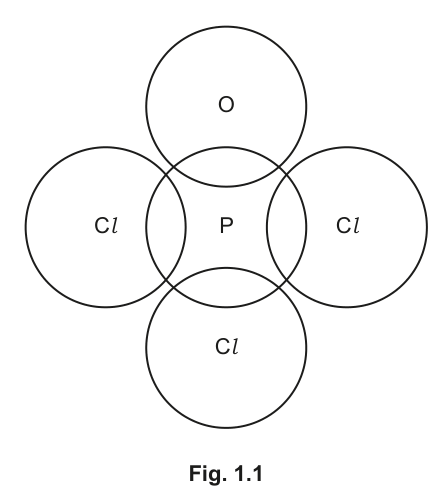
Answer
The diagram shows:
- A P=O double bond (two pairs of shared electrons between P and O)
- Three P–Cl single bonds (one pair of shared electrons between P and each Cl)
- Oxygen has two lone pairs (4 non-bonding electrons)
- Each chlorine has three lone pairs (6 non-bonding electrons)
Dot-and-cross diagram of POCl₃: P=O double bond, three P-Cl single bonds, O with 2 lone pairs, each Cl with 3 lone pairs
Background Concept
In a dot-and-cross diagram, electrons from one atom are shown as dots and from another as crosses. Shared pairs (bonding pairs) appear in the overlap region between atoms. Non-bonding (lone) pairs appear on the individual atoms. Phosphorus in has 5 outer electrons, oxygen has 6, and each chlorine has 7. Total outer electrons = 5 + 6 + (3 × 7) = 32.
The P=O bond is a double bond: two pairs of electrons are shared between P and O. Each P–Cl bond is a single bond: one pair shared. After bonding, P has used 2 electrons for the double bond and 3 for single bonds = 5 electrons (all its valence electrons). Oxygen has contributed 2 electrons to the double bond and retains 4 as lone pairs. Each Cl has contributed 1 to the single bond and retains 6 as lone pairs.
Understanding the Question
You are given an incomplete diagram (Fig. 1.1) showing overlapping circles for P, O, and three Cl atoms. You must complete it by adding all outer shell electrons as dots and crosses, showing the P=O double bond.
Approach
- Place two pairs of shared electrons (one pair dots from O, one pair crosses from P) in the P–O overlap region for the double bond.
- Place one pair of shared electrons (one dot from Cl, one cross from P) in each P–Cl overlap region.
- Add lone pairs: O gets 4 dots (2 pairs), each Cl gets 6 dots (3 pairs).
- Verify total = 32 electrons.
Step-by-Step Reasoning
Bonding electrons:
- P=O double bond: 4 electrons in the overlap (2 crosses from P, 2 dots from O)
- Three P–Cl single bonds: 6 electrons (1 cross + 1 dot each)
- Total bonding = 10 electrons
Non-bonding (lone pair) electrons:
- O: 4 electrons (2 pairs of dots)
- Each Cl: 6 electrons (3 pairs of dots) × 3 = 18 electrons
- Total non-bonding = 22 electrons
Grand total: 10 + 22 = 32 ✓
Key Takeaways
- A double bond in a dot-and-cross diagram is shown as two pairs of electrons in the overlap region.
- Always verify the total electron count matches the sum of all valence electrons.
- P can expand its octet (10 electrons around P in ), but in it has 10 electrons around it (2×2 from double bond + 3×1 from single bonds = 7 shared, but counting pairs: 4 in double bond + 3 in single bonds = 7 pairs... actually P contributes 5 electrons and shares 5 more, giving 10 around P).
Common Mistakes
- Drawing the P–O bond as a single bond instead of a double bond.
- Forgetting lone pairs on O or Cl.
- Using crosses for Cl's lone pairs (Cl's own electrons should be dots, or vice versa — the convention is that each atom's electrons are consistently one type).
- Incorrect total electron count.
Things to Be Careful About
- The mark scheme gives one mark for correct bonding electrons and one for the rest (lone pairs) being correct to give 32 total.
- The convention in the mark scheme's diagram: P's electrons are crosses (×), O's and Cl's electrons are dots (•).
forms when reacts with .
Table 1.3 gives some relevant data.
Table 1.3
| process | value / |
|---|---|
| enthalpy change of formation of | |
| enthalpy change of formation of | |
Define enthalpy change of formation, .
Answer
The enthalpy change when one mole of a compound is formed from its constituent elements in their standard states.
The enthalpy change when one mole of a compound is formed from its constituent elements in their standard states
Background Concept
The standard enthalpy change of formation () is a fundamental thermodynamic quantity. It refers to the heat energy change when exactly one mole of a substance is created from its elements, with all substances in their standard states (the most stable form at 298 K and 1 atm pressure). By convention, of any element in its standard state is zero.
Understanding the Question
The command word is 'define'. You must give the precise definition, including the key phrases: 'one mole', 'formed', 'from its constituent elements', and 'in their standard states'.
Approach
Recall the standard definition verbatim, ensuring all four key phrases are present.
Step-by-Step Reasoning
The mark scheme awards one mark for 'enthalpy change when one mole of a compound/substance is formed' and a second mark for 'from its constituent elements in their standard states'. Both must be present for full marks.
Key Takeaways
- The definition must include: (1) enthalpy change, (2) one mole, (3) formed, (4) from elements, (5) in standard states.
- Missing any one of these loses a mark.
Common Mistakes
- Omitting 'one mole' (saying just 'a compound is formed').
- Omitting 'standard states' or writing 'room temperature' instead.
- Saying 'from its atoms' instead of 'from its constituent elements'.
- Not mentioning 'enthalpy change' and saying 'energy change' (though this may be accepted by AW).
Things to Be Careful About
- 'Standard states' is a specific term — it does not mean 'standard conditions' (which refers to temperature and pressure). The standard state of an element is its most stable physical form at 298 K and 1 atm.
Calculate the bond energy of in using the data in Table 1.3.
Show your working.
Working
Using Hess's law with the formation reactions:
The difference between these gives the reaction:
For this reaction, mole of O=O bonds is broken and 1 mole of P=O bonds is formed:
Answer
+551 kJ mol⁻¹
Background Concept
Bond energy is the average enthalpy change to break one mole of a particular bond in the gaseous state. Hess's law allows us to determine an unknown bond energy by constructing an alternative pathway between the same start and end points. Here, we use formation enthalpies (which give us the overall for the reaction) and the known atomisation enthalpy of to find the P=O bond energy.
The key relationship is: for a reaction, . In the reaction , the bonds broken are O=O, and the bonds formed are 1 P=O (the P–Cl bonds are unchanged).
Understanding the Question
You are given values for and , and the atomisation enthalpy of (, ). You must calculate the P=O bond energy.
Approach
- Use Hess's law to find for the reaction .
- Express this in terms of bond energies: .
- Solve for .
Alternatively, as the mark scheme does it, set up the equation for 2 moles directly:
Step-by-Step Reasoning
Method using the mark scheme's approach (for 2 moles):
The reaction is:
Using Hess's law with formation enthalpies:
Now express using bond energies. In going from to :
- Bonds broken: 1 O=O bond (the P–Cl bonds are unchanged)
- Bonds formed: 2 P=O bonds
The mark scheme's equation:
This rearranges to: , so , giving , .
Key Takeaways
- When using bond energies, only bonds that actually change need to be considered.
- The atomisation enthalpy of (, +496) is the O=O bond energy.
- Hess's law cycles can combine formation data with bond energy data.
Common Mistakes
- Forgetting to account for the factor of 2 (the reaction involves 2 moles of ).
- Using (wrong sign convention; it should be broken minus formed).
- Including P–Cl bonds in the calculation (they are unchanged on both sides).
- Getting the sign wrong: bond breaking is endothermic (positive), bond making is exothermic (negative contribution to ).
Things to Be Careful About
- The atomisation value given (+496) is for , which represents breaking 1 mole of O=O bonds. For the reaction as written (1 mole ), use 496 directly.
- The final answer should be positive (bond energies are always positive, as they represent energy required to break bonds).
- The mark scheme accepts either the 2-mole or 1-mole approach, provided the algebra is correct.
The rest of this paper
3 more questions- Q2Group 2 · Atoms, Molecules and Stoichiometry · Carbonyl Compounds · Nitrogen Compounds · Carboxylic Acids and Derivatives10M
- Q3Electrochemistry · Reaction Kinetics · States of Matter · Atoms, Molecules and Stoichiometry · Hydroxy Compounds · Carbonyl Compounds · Introduction to Organic Chemistry12M
- Q4Introduction to Organic Chemistry · Hydrocarbons · Polymerisation · Analytical Techniques · Organic Synthesis · Halogen Compounds · Carboxylic Acids and Derivatives16M