Chemistry 9701/23 — May/June 2023
Cambridge AS Level · AS Level Structured Questions · worked solutions for every part, with the mark scheme
Topics Atoms, Molecules and Stoichiometry · Chemical Bonding · Analytical Techniques · Carboxylic Acids and Derivatives · Equilibria · Hydroxy Compounds · +11 more
Copper is used in electrical equipment. It has a melting point of 1085 °C.
Identify the lattice structure of copper.
Answer
Giant metallic lattice.
giant metallic
Background Concept
Metals, including transition metals like copper, consist of a regular arrangement of positive ions (cations) in a lattice structure. The outer electrons are delocalised and form a 'sea' that moves freely throughout the lattice. This arrangement is known as a giant metallic lattice.
Understanding the Question
The question asks for the specific type of lattice structure present in solid copper. Given that copper is a metal, we can directly infer its bonding and structural type.
Approach
Recall the standard lattice types: giant ionic, giant covalent, simple molecular, and giant metallic. Since copper is a metal, it must be a giant metallic lattice.
Step-by-Step Reasoning
Copper is a transition metal. Metals do not form simple molecular structures or giant covalent networks (except for metalloids like silicon). They form giant metallic lattices where positive metal ions are held together by delocalised electrons. Therefore, the lattice structure is giant metallic.
Key Takeaways
Metals form giant metallic lattices. This is a fundamental structural classification that explains their physical properties like malleability and electrical conductivity.
Common Mistakes
Writing 'metallic bonding' instead of 'giant metallic lattice'. The question asks for the lattice structure, not the type of bonding.
Things to Be Careful About
Ensure the answer matches the exact terminology expected: 'giant metallic' or 'giant metallic lattice'.
Draw a labelled diagram to show the bonding present in copper.
Answer
See diagram
Background Concept
Metallic bonding is the electrostatic attraction between a lattice of positive metal ions and a sea of delocalised electrons. To represent this in a 2D diagram, we show a regular arrangement of positive ions surrounded by smaller, freely moving electrons.
Understanding the Question
You are asked to draw a labelled diagram showing the bonding in copper. This means depicting the structural components (positive ions and delocalised electrons) and labelling them correctly.
Approach
Draw a regular grid or lattice of circles to represent the positive copper ions. Surround them with smaller circles or dots to represent the delocalised electrons. Ensure both components are clearly labelled.
Step-by-Step Reasoning
- Draw at least four large circles arranged in a regular pattern (e.g., a 2x2 or 3x3 grid) to represent the positive copper ions. You can put a '+' inside them or label them as 'Cu^n+', 'positive ion', or 'cation'.
- Draw smaller circles or dots around and between the large circles to represent the delocalised electrons. You can put a '-' inside them or label them as 'e^-' or 'delocalised electrons'.
- The key is to show that the electrons are separate from and surrounding the positive ions, illustrating the 'sea of electrons' model.
Key Takeaways
A metallic bonding diagram must show both the positive ions (with appropriate labels) and the delocalised electrons (with appropriate labels) in a regular arrangement.
Common Mistakes
Forgetting to label the components. Drawing electrons inside the positive ions (like a dot-and-cross diagram for covalent bonding). Not showing a regular lattice arrangement.
Things to Be Careful About
The mark scheme allows circles with just a '+' to be unlabeled, but if you use empty circles or write 'Cu', you MUST label them as positive ions/cations. Similarly, electrons must be shown as 'e^-', '-', or labelled 'delocalised electrons'.
The relative isotopic masses and natural abundances of the two isotopes in a sample of copper are shown in Table 1.1.
Table 1.1
| isotope | relative isotopic mass | % abundance |
|---|---|---|
| 62.930 | 69.15 | |
| 64.928 | 30.85 |
Define the unified atomic mass unit.
Answer
One twelfth of the mass of a carbon-12 () atom.
1/12 of the mass of a carbon-12 atom
Background Concept
The unified atomic mass unit (u or Da) is a standard unit of mass that quantifies mass on an atomic or molecular scale. It is defined relative to the carbon-12 isotope, which is assigned an exact mass of 12 u.
Understanding the Question
The question asks for the formal definition of the unified atomic mass unit.
Approach
Recall the standard IUPAC definition of the unified atomic mass unit.
Step-by-Step Reasoning
The unified atomic mass unit is defined as exactly one-twelfth of the mass of an unbound neutral atom of carbon-12 in its nuclear and electronic ground state. In exam terms, stating 'one twelfth of the mass of a carbon-12 atom' is sufficient and correct.
Key Takeaways
The unified atomic mass unit is based on the carbon-12 isotope. 1 u = 1/12 × mass of a atom.
Common Mistakes
Saying 'one twelfth of a carbon atom' without specifying the isotope carbon-12. Saying 'atomic mass of carbon-12 divided by 12' is acceptable but the formal definition references 'the mass of a carbon-12 atom'.
Things to Be Careful About
Always specify 'carbon-12' or ''. Do not just say 'carbon', as natural carbon is a mixture of isotopes.
Define relative atomic mass, , in terms of the unified atomic mass unit.
Answer
The average mass of the isotopes of an element compared to the unified atomic mass unit.
average mass of the isotopes of an element compared to the unified atomic mass unit
Background Concept
Relative atomic mass () is a dimensionless quantity that represents the average mass of atoms of an element, taking into account the relative abundances of its naturally occurring isotopes, relative to 1/12 of the mass of a carbon-12 atom (the unified atomic mass unit).
Understanding the Question
The question asks for the definition of relative atomic mass, specifically in terms of the unified atomic mass unit.
Approach
State that it is the average mass of the isotopes of an element, and specify that this is compared to (or divided by) the unified atomic mass unit.
Step-by-Step Reasoning
Relative atomic mass is calculated by weighting the masses of each isotope by their relative abundances. The definition requires stating that it is the 'average mass of the isotopes of an element' and that this is 'compared to the unified atomic mass unit' (or 'relative to 1/12 of the mass of a carbon-12 atom').
Key Takeaways
is a weighted average of isotopic masses, expressed relative to the unified atomic mass unit.
Common Mistakes
Forgetting to mention 'average' or 'weighted average'. Forgetting to mention 'compared to the unified atomic mass unit' or 'relative to 1/12 of carbon-12'.
Things to Be Careful About
Ensure you use the exact phrasing 'average mass of the isotopes' and 'compared to the unified atomic mass unit' as this is what the mark scheme rewards.
Calculate the relative atomic mass, , of copper in this sample using the data in Table 1.1.
Show your working.
Working
Answer
63.55
63.55
Background Concept
The relative atomic mass () of an element is the weighted average of the relative isotopic masses of all its naturally occurring isotopes. The formula is:
Understanding the Question
You are given the relative isotopic masses and percentage abundances of two copper isotopes ( and ) and asked to calculate the relative atomic mass of copper in this sample.
Approach
Multiply each isotopic mass by its percentage abundance (divided by 100) and sum the results.
Step-by-Step Reasoning
- For : mass = 62.930, abundance = 69.15%. Contribution = .
- For : mass = 64.928, abundance = 30.85%. Contribution = .
- Sum the contributions: .
- Rounding to an appropriate number of decimal places (usually 2 for ), we get 63.55.
Key Takeaways
To calculate , always use the formula: sum of (isotopic mass × fractional abundance). Ensure percentages are divided by 100.
Common Mistakes
Forgetting to divide the percentage abundance by 100. Using the wrong isotopic mass for the wrong abundance. Arithmetic errors.
Things to Be Careful About
Check your calculator input. The mark scheme accepts 63.55 or 63.546. Ensure you show your working clearly as requested.
The mass spectrum of a sample of pure copper is shown in Fig. 1.1.
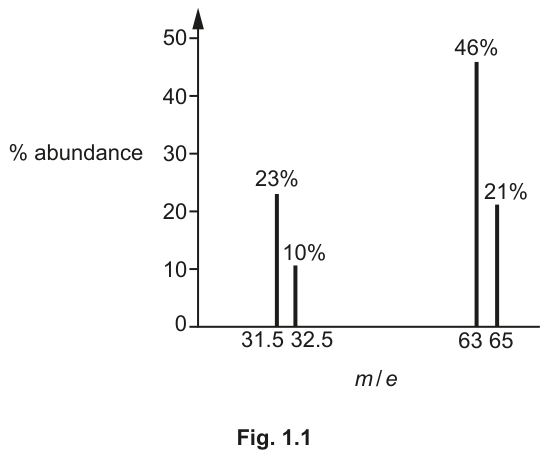
Identify the ion with an abundance of 23% in the sample.
Working
The peak with 23% abundance is at .
Copper has isotopes with mass numbers 63 and 65.
A peak at corresponds to a mass of 63 with a charge of +2 ().
Answer
^{63}Cu^{2+}
Background Concept
In mass spectrometry, the x-axis represents the mass-to-charge ratio (). For singly charged ions (), is numerically equal to the isotopic mass. For doubly charged ions (), is half the isotopic mass.
Understanding the Question
You are given a mass spectrum of copper with peaks at (23%), 32.5 (10%), 63 (46%), and 65 (21%). You need to identify the ion corresponding to the 23% peak at .
Approach
Recognise that the peaks at 63 and 65 correspond to singly charged and ions. The peaks at 31.5 and 32.5 are at half these mass values, indicating they are doubly charged ions of the same isotopes.
Step-by-Step Reasoning
- The main peaks at and correspond to and respectively (assuming unit of charge).
- The peak at has an abundance of 23%.
- Since , this peak corresponds to the isotope with a charge of +2.
- Therefore, the ion is .
Key Takeaways
In mass spectrometry, . If is half the expected mass number, the ion is doubly charged ().
Common Mistakes
Identifying the peak as (mass number must be an integer). Forgetting to include the charge state. Not recognising that 31.5 is half of 63.
Things to Be Careful About
The mass number is always an integer (63 or 65), but the value can be a decimal if the ion is multiply charged. Always write the ion with its mass number and charge: .
When is added to the blue-coloured solution turns brown and a white precipitate of is seen.
The reaction between copper ions and iodide forms only two products.
Complete the equation for this reaction.
Answer
2Cu^{2+} + 4I^- -> 2CuI + I_2
Background Concept
Copper(II) ions () are oxidising agents and can oxidise iodide ions () to iodine (), while being reduced to copper(I) (), which precipitates as copper(I) iodide ().
Understanding the Question
You are given the reactants ( and ) and one product (). You need to deduce the second product and balance the equation. The problem states there are only two products.
Approach
- Identify the redox changes: is reduced to (in ). must be oxidised. The only logical oxidation product of is .
- Write the half-equations and combine them, or balance by inspection.
Step-by-Step Reasoning
- Reduction half-equation: (or simply ).
- Oxidation half-equation: .
- To balance electrons, multiply the reduction half by 2: .
- Combine: .
- The ions combine with the remaining ions to form precipitate. We need 2 more for the .
- Total on the left = .
- Balanced equation: .
Key Takeaways
When balancing redox equations involving precipitation, ensure all atoms and charges are balanced. Copper(II) oxidises iodide to iodine and is reduced to copper(I) iodide.
Common Mistakes
Writing (incorrect iodine species). Forgetting to balance the iodide ions needed for the precipitate.
Things to Be Careful About
The equation must be fully balanced with correct stoichiometric coefficients. The second product is molecular iodine, , not or .
Identify the oxidising agent in this reaction. Explain your answer in terms of electron transfer.
Answer
(or ).
Explanation: has gained / taken electron(s) from iodide (ion).
Cu^{2+} has gained electrons from iodide
Background Concept
An oxidising agent is a species that accepts electrons from another species, thereby causing the other species to be oxidised. The oxidising agent itself is reduced.
Understanding the Question
You need to identify the oxidising agent in the reaction and explain your choice using electron transfer terminology.
Approach
- Identify which species is reduced (gains electrons).
- State that this species is the oxidising agent.
- Explain that it gained electrons from the other reactant.
Step-by-Step Reasoning
- In the reaction, changes oxidation state from +2 to +1 (in ). This is a reduction (gain of electrons).
- changes oxidation state from -1 to 0 (in ). This is an oxidation (loss of electrons).
- Since gains electrons, it is the oxidising agent.
- Explanation: has gained / taken electron(s) from iodide () ions.
Key Takeaways
The oxidising agent is the species that is reduced. Always explain in terms of electron transfer: 'gained electrons' or 'took electrons'.
Common Mistakes
Identifying as the oxidising agent. Explaining using oxidation states instead of electron transfer (e.g., 'Cu decreased in oxidation state' is not sufficient; must say 'gained electrons').
Things to Be Careful About
The mark scheme accepts or as the oxidising agent. The explanation MUST mention electron transfer ('gained' or 'taken' electrons).
State the full electronic configuration of .
Answer
(accept )
1s2 2s2 2p6 3s2 3p6 3d9
Background Concept
Copper (atomic number 29) has an anomalous electron configuration: (or ). This is because a fully filled 3d subshell is particularly stable.
When forming ions, transition metals lose their 4s electrons before their 3d electrons.
Understanding the Question
You need to write the full electronic configuration of the ion.
Approach
- Write the configuration for neutral Cu.
- Remove 2 electrons to form , starting from the 4s subshell.
Step-by-Step Reasoning
- Neutral Cu (29 electrons): .
- To form , remove 2 electrons. The first electron removed is from 4s (leaving 0 electrons in 4s). The second electron is removed from 3d (leaving 9 electrons in 3d).
- Configuration of (27 electrons): .
Key Takeaways
Transition metals lose 4s electrons before 3d electrons when forming positive ions. Copper's anomalous configuration must be remembered.
Common Mistakes
Writing (removing from 3d first, which is wrong). Forgetting the anomalous configuration of neutral Cu and using instead.
Things to Be Careful About
The question asks for the FULL electronic configuration, not the abbreviated form. Ensure all subshells up to 3d are written out with correct superscripts.
The rest of this paper
5 more questions- Q2Chemical Periodicity10M
- Q3Chemical Energetics · Atoms, Molecules and Stoichiometry · Carboxylic Acids and Derivatives · Equilibria8M
- Q4Group 17 · Equilibria10M
- Q5Atoms, Molecules and Stoichiometry · Organic Synthesis · Hydroxy Compounds · Chemical Bonding · Carbonyl Compounds · Carboxylic Acids and Derivatives8M
- Q6Polymerisation · Carbonyl Compounds · Hydroxy Compounds · Analytical Techniques · Introduction to Organic Chemistry · Nitrogen Compounds · Halogen Compounds15M