Chemistry 9701/21 — May/June 2023
Cambridge AS Level · AS Level Structured Questions · worked solutions for every part, with the mark scheme
Topics Carboxylic Acids and Derivatives · Atoms, Molecules and Stoichiometry · Hydrocarbons · Group IV (Group 14) · Introduction to Organic Chemistry · Hydroxy Compounds · +9 more
Tellurium is an element in Group 16. The most common isotope of tellurium is . Its electronic configuration is .
Complete Table 1.1.
Table 1.1
| nucleon number | number of neutrons | number of electrons | |
|---|---|---|---|
Identify the sub-shell in an atom of Te that contains electrons with the lowest energy.
Construct an equation to represent the first ionisation energy of Te.
The radius of Te ions decreases after each successive ionisation.
State two factors that are responsible for the increase in the first six ionisation energies of Te.
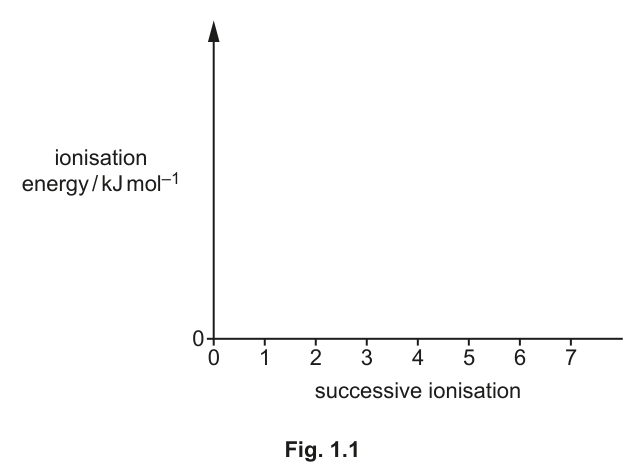
Sketch a graph in Fig. 1.1 to show the trend in the first seven ionisation energies of Te.
Te reacts with at to form . Molecules of are octahedral with bond angles of .
Explain why is octahedral with bond angles of .
reacts with water to form tellurium hydroxide and . The oxidation number of tellurium does not change during this reaction.
Construct an equation for the reaction of with water.
Name the type of reaction that occurs when reacts with water.
The rest of this paper
4 more questions- Q2Chemical Energetics · Atoms, Molecules and Stoichiometry9M
- Q3Group IV (Group 14) · Chemical Periodicity · Group 17 · Electrochemistry · Hydrocarbons · Halogen Compounds · Analytical Techniques15M
- Q4Carboxylic Acids and Derivatives · Hydrocarbons · Atoms, Molecules and Stoichiometry · Introduction to Organic Chemistry · Hydroxy Compounds8M
- Q5Hydrocarbons · Atoms, Molecules and Stoichiometry · Nitrogen and Sulfur · Carboxylic Acids and Derivatives · Hydroxy Compounds · Introduction to Organic Chemistry15M