Chemistry 9701/33 — February/March 2023
Cambridge AS Level · Advanced Practical Skills · worked solutions for every part, with the mark scheme
Topics Manipulation, Measurement and Observation · Analysis, Conclusions and Evaluation · Presentation of Data and Observations · Qualitative Analysis
Some metal carbonates occur in a basic form which means that the metal hydroxide is also present. The formula of one form of basic zinc carbonate is , where is an integer.
In this experiment you will carry out a thermal decomposition to find the relative formula mass, , and the value of for a sample of basic zinc carbonate.
FA 1 is basic zinc carbonate, .
Method
- Weigh the empty crucible with its lid. Record the mass.
- Transfer all the FA 1 from the container into the crucible.
- Weigh the crucible, lid and FA 1. Record the mass.
- Place the crucible and contents on a pipe-clay triangle.
- Heat the crucible gently, with the lid on, for approximately 1 minute.
- Heat strongly, with the lid off, for a further 4 minutes.
- Replace the lid and leave the crucible to cool for at least 5 minutes.
While the crucible is cooling you may wish to begin work on Question 2 or 3.
- When the crucible is cool, weigh the crucible with its lid and contents. Record the mass.
- Place the crucible and contents on the pipe-clay triangle. Remove the lid.
- Heat the crucible strongly for a further 2 minutes.
- Replace the lid and leave the crucible to cool for at least 5 minutes.
- When the crucible is cool, reweigh the crucible with its lid and contents. Record the mass.
- Calculate and record the mass of FA 1 used.
- Calculate and record the mass of residue obtained.
Results
Answer
Results Table
| Measurement | Mass / g |
|---|---|
| Mass of empty crucible and lid | 24.50 |
| Mass of crucible, lid and FA 1 | 26.00 |
| Mass of crucible, lid and residue after first heating | 25.57 |
| Mass of crucible, lid and residue after re-heating | 25.57 |
Calculations
Mass of FA 1 used =
Mass of residue obtained =
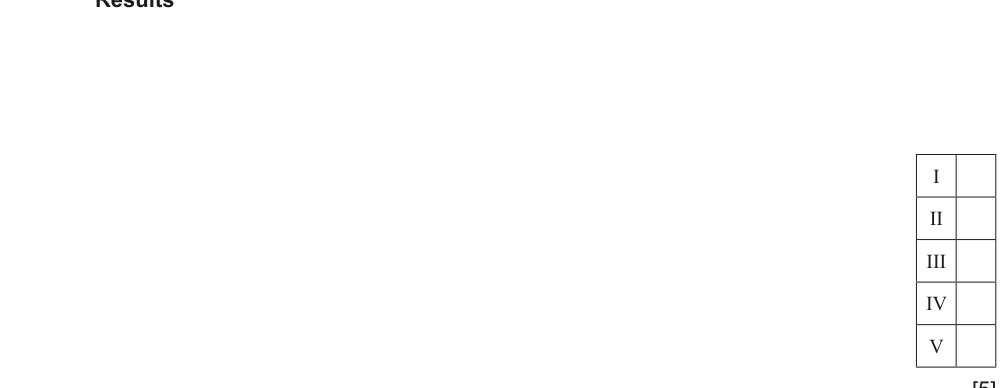
(Note: Columns IV and V are accuracy marks awarded by the supervisor based on the candidate's calculated ratio of mass of FA 1 to mass of residue compared to the supervisor's own calculation.)
Mass of FA 1 = 1.50 g; Mass of residue = 1.07 g (representative values)
Background Concept
This question is an Advanced Practical Skills (Paper 3) investigation into the thermal decomposition of a hydrated basic metal carbonate. The goal is to determine the empirical formula (specifically the value of for the water of crystallisation) by measuring the mass of the reactant before heating and the mass of the solid residue after complete decomposition. The key practical principle is heating to constant mass, ensuring that all volatile products ( and ) have been driven off.
Understanding the Question
The candidate is given the method for heating basic zinc carbonate in a crucible and a blank results table. They must record four balance readings: the empty crucible, the crucible with the sample before heating, the crucible with the residue after the first heating, and the crucible with the residue after a second heating (to confirm constant mass). They then need to calculate the mass of the sample used and the mass of the solid residue obtained. Since this is a practical question, the actual readings depend on the candidate's experiment; the solution provides a representative set of plausible data that yields an integer value for .
Approach
- Table Headings: Provide clear, unambiguous headings for each of the four balance readings, including the correct unit (g).
- Representative Data: Assign plausible masses. A typical crucible mass is around 24-25 g. A sample mass of ~1.5 g is appropriate. The residue mass must be less than the sample mass. The difference between the third and fourth readings must be g to show constant mass has been achieved.
- Subtractions: Calculate the mass of FA 1 (sample) and the mass of the residue (ZnO) by subtracting the empty crucible mass from the relevant totals.
Step-by-Step Reasoning
- Headings (Mark I): The table must clearly label what is being weighed. Acceptable headings include "mass of crucible and lid", "mass of crucible, lid and FA 1", "mass of crucible, lid and residue after heating", and "mass of crucible, lid and residue after re-heating".
- Data Recording (Mark II): All readings must have an unambiguous unit (g) and be recorded to the same number of decimal places (typically 2 for a top-pan balance). The fourth reading must be within 0.05 g of the third reading (and not more than 0.03 g greater), indicating the mass is no longer changing significantly.
- Subtractions (Mark III):
- Mass of FA 1 = (Mass of crucible, lid and FA 1) - (Mass of empty crucible and lid)
- Mass of residue = (Mass of crucible, lid and residue after re-heating) - (Mass of empty crucible and lid)
- Accuracy Marks (IV, V): These are examiner marks. The supervisor calculates the ratio using their own known true values, and the candidate calculates it using their recorded data. If the difference () between the two ratios is , mark IV is awarded; if , mark V is awarded.
Key Takeaways
- Always heat to constant mass to ensure complete reaction.
- Record balance readings with consistent decimal places and clear units.
- Subtract the empty container mass to find the mass of the substance being measured.
Common Mistakes
- Forgetting to include the unit (g) in the table headings or data.
- Recording readings to different numbers of decimal places (e.g., 24.5 and 24.50).
- Failing to subtract the empty crucible mass, and instead just recording the total masses as the "mass of FA 1" and "mass of residue".
- Not heating to constant mass (the fourth reading differs from the third by more than 0.05 g).
Things to Be Careful About
- The fourth weighing must be less than or equal to the third weighing (mass is lost as gases escape), but not more than 0.03 g greater (which would indicate contamination or incomplete cooling/absorption of moisture). A difference of exactly 0.00 g is acceptable and common.
- Use the reading after re-heating (the fourth reading) for the final residue mass, not the first heating, to ensure all volatile products have been removed.
The equation for the thermal decomposition is shown.
Calculate the amount, in mol, of zinc oxide, , formed after heating.
Hence, calculate the amount, in mol, of basic zinc carbonate in your sample of FA 1.
Answer
0.0131 mol ZnO; 0.00438 mol basic zinc carbonate
Background Concept
The thermal decomposition of basic zinc carbonate produces zinc oxide, carbon dioxide, and water vapour. The balanced equation is:
The solid residue left after heating is pure zinc oxide (). By measuring the mass of this residue, we can calculate the number of moles of produced. Using the stoichiometric ratio from the balanced equation (3 moles of are produced for every 1 mole of basic zinc carbonate decomposed), we can determine the number of moles of the original sample.
Understanding the Question
The candidate must calculate the moles of formed from the mass of the residue obtained in part (a), and then use the 3:1 molar ratio to find the moles of basic zinc carbonate in the original sample. The relative formula mass of is 81.4.
Approach
- Calculate moles of : . Use the representative residue mass of 1.07 g and .
- Calculate moles of basic zinc carbonate: From the equation, .
Step-by-Step Reasoning
- Moles of ZnO: The mass of the residue (ZnO) is 1.07 g. The molar mass of ZnO is .
- Moles of basic zinc carbonate: The stoichiometric ratio is 1 : 3 (basic zinc carbonate : ZnO).
- Answers should be given to 2-4 significant figures. 0.0131 and 0.00438 are appropriate.
Key Takeaways
- The solid residue in a carbonate decomposition is the metal oxide. Its mass is used to find moles of product.
- Always use the stoichiometric coefficients from the balanced equation to relate moles of different species.
Common Mistakes
- Using the mass of the original sample (FA 1) to calculate moles of ZnO (wrong substance).
- Forgetting to divide by 3 to find the moles of the original compound.
- Using incorrect molar masses (e.g., using 81 for ZnO instead of 81.4).
Things to Be Careful About
- Ensure the mass used is the final residue mass after constant mass has been achieved, not an intermediate reading.
- Carry unrounded values through to the next calculation to avoid round-off errors, but report final answers to the correct significant figures (2-4 sf as per mark scheme).
Use your answer to (b)(i) and your results in (a) to calculate the relative formula mass, , of basic zinc carbonate, FA 1.
Answer
342
Background Concept
The relative formula mass () of a substance is the sum of the relative atomic masses of all atoms in its formula. In an experimental context, if you know the mass of a sample and the number of moles it contains, you can calculate its experimental using the relationship:
Understanding the Question
The candidate must calculate the experimental of the basic zinc carbonate sample using the mass of FA 1 used (from part a) and the moles of basic zinc carbonate calculated in part (b)(i).
Approach
- Identify the mass of FA 1: 1.50 g.
- Identify the moles of basic zinc carbonate: 0.00438 mol.
- Calculate .
Step-by-Step Reasoning
- Mass of FA 1 = 1.50 g
- Moles of basic zinc carbonate = 0.00438 mol
- The answer should be given to 2-4 significant figures. 342 is appropriate.
Key Takeaways
- can be determined experimentally by dividing the mass of a known quantity of substance by its number of moles.
- This experimental will include the mass of the water of crystallisation.
Common Mistakes
- Using the mass of the residue instead of the mass of the original sample.
- Dividing moles by mass instead of mass by moles.
- Not using the moles of the basic zinc carbonate, but instead using the moles of ZnO.
Things to Be Careful About
- Use the unrounded mole value from part (b)(i) for this calculation to minimize round-off error. For example, , which still rounds to 342.
Use the Periodic Table to calculate the relative formula mass, , of .
Answer
324.2
Background Concept
The relative formula mass is calculated by summing the relative atomic masses () of all the atoms in the formula. For hydrated or basic compounds, this includes the mass of the main salt structure and any water molecules or hydroxide groups.
Understanding the Question
The candidate must calculate the theoretical of the anhydrous basic zinc carbonate part of the formula: . This is done using standard atomic weights from the Periodic Table.
Approach
- Identify the atoms in : 3 Zn, 1 C, 7 O, 4 H.
- Sum their relative atomic masses: .
Step-by-Step Reasoning
- :
- :
- Total
Alternatively, counting atoms directly:
- Zn:
- C:
- O:
- H:
- Total =
Key Takeaways
- Be careful to count all atoms correctly, especially in basic salts with multiple hydroxide groups.
- The of the anhydrous part is a fixed theoretical value, unlike the experimental which includes water.
Common Mistakes
- Miscounting the number of oxygen or hydrogen atoms in . (It is 2 Zn, 4 O, 4 H, not 2 Zn, 2 O, 2 H).
- Forgetting to multiply the entire group by 2.
Things to Be Careful About
- Use the atomic weights provided in the Periodic Table (usually Zn = 65.4, C = 12.0, O = 16.0, H = 1.0).
- The mark scheme accepts 324.2.
Use your answers to (b)(ii) and (b)(iii) to determine the value of in .
Show your working.
Answer
1
Background Concept
The experimental calculated in part (b)(ii) is for the hydrated compound . The theoretical calculated in part (b)(iii) is for the anhydrous part . The difference between these two values is due to the mass of the water of crystallisation, .
Understanding the Question
The candidate must use the experimental and the anhydrous to find the mass contribution of the water molecules, and then divide by the molar mass of water () to find the integer value of .
Approach
- Calculate the mass of : .
- Divide by to find .
- Round to the nearest integer.
Step-by-Step Reasoning
- Experimental (hydrated) = 342
- Theoretical (anhydrous) = 324.2
- Mass of =
- Since must be an integer, .
Key Takeaways
- The difference between the experimental of a hydrated salt and the theoretical of the anhydrous salt gives the total mass of water of crystallisation per mole of salt.
- Dividing this difference by 18.0 gives the number of water molecules, .
- Experimental results will not always give a perfect integer; always round to the nearest whole number.
Common Mistakes
- Subtracting in the wrong order (anhydrous - hydrated, giving a negative value).
- Forgetting to divide by 18.0 (the molar mass of water).
- Not rounding to the nearest integer.
- Using the wrong value for (e.g., 17 or 19).
Things to Be Careful About
- The mark scheme requires showing the working: .
- The final answer must be given as an integer. 0.989 is not acceptable as a final answer; it must be rounded to 1.
The rest of this paper
2 more questions- Q2Manipulation, Measurement and Observation · Presentation of Data and Observations · Analysis, Conclusions and Evaluation17M
- Q3Manipulation, Measurement and Observation · Qualitative Analysis · Analysis, Conclusions and Evaluation13M