Chemistry 9701/36 — October/November 2022
Cambridge AS Level · Advanced Practical Skills · worked solutions for every part, with the mark scheme
Topics Manipulation, Measurement and Observation · Presentation of Data and Observations · Analysis, Conclusions and Evaluation · Qualitative Analysis
In this experiment you will determine the concentration of dilute hydrochloric acid by further diluting it and then titrating with aqueous potassium carbonate.
FB 1 is dilute hydrochloric acid, . This acid will also be used in Question 2.
FB 2 is anhydrous potassium carbonate, .
FB 3 is bromophenol blue indicator.
Method
- Use the pipette to transfer of FB 1 into the volumetric flask.
- Make this solution up to using distilled water.
- Shake the volumetric flask and its contents thoroughly. Label this solution FB 4.
- Fill the burette with FB 4.
- Pipette of FB 2 into a conical flask.
- Add a few drops of FB 3.
- Perform a rough titration and record your burette readings in the space below.
The rough titre is .............................. .
- Carry out as many accurate titrations as you think necessary to obtain consistent results.
- Make sure any recorded results show the precision of your practical work.
- Record in a suitable form below all your burette readings and the volume of FB 4 added in each accurate titration.
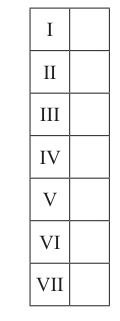
From your accurate titration results, calculate a suitable mean value to be used in your calculations.
Show clearly how you obtained this value.
of FB 2 required .............................. of FB 4.
Calculations
Give your answers to (c)(ii), (c)(iv) and (c)(v) to the appropriate number of significant figures.
Use information on page 2 to calculate the amount, in mol, of potassium carbonate present in of FB 2.
amount of = .............................. mol
Give the ionic equation for the reaction taking place in the titration in (a).
Include state symbols.
........... + ........... .............................. + ..............................
Calculate the concentration, in , of in FB 4.
concentration of in FB 4 = ..............................
Calculate the concentration, in , of in FB 1.
concentration of in FB 1 = ..............................
A student uses a solution containing of hydrated potassium carbonate in the titration in (a) instead of FB 2.
State whether the student’s titre would be larger or smaller than your titre. Explain your answer.
A student carries out the titration described in (a). By mistake, a pipette is used to transfer of FB 1 into a volumetric flask. The solution is made up to with distilled water and labelled FB 4.
State how the subsequent experimental procedure could be modified so that the titre obtained in (b) is not altered by this mistake.
The rest of this paper
2 more questions- Q2Manipulation, Measurement and Observation · Presentation of Data and Observations · Analysis, Conclusions and Evaluation14M
- Q3Qualitative Analysis11M