Chemistry 9701/22 — October/November 2022
Cambridge AS Level · AS Level Structured Questions · worked solutions for every part, with the mark scheme
Topics Chemical Bonding · Equilibria · Atoms, Molecules and Stoichiometry · Halogen Compounds · Atomic Structure · Nitrogen and Sulfur · +10 more
Species such as , and are examples of molecular ions.
Ionic and covalent bonds both involve an electrostatic attraction between different species.
Identify the species that are electrostatically attracted to one another in:
-
an ionic bond
....................................................................................................................................................
-
a covalent bond.
....................................................................................................................................................
Complete Table 1.1 to show the total numbers of protons and electrons in the molecular ions , and .
Table 1.1
| molecular ion | total number of protons | total number of electrons |
|---|---|---|
is a Brønsted–Lowry acid.
Define Brønsted–Lowry acid.
.............................................................................................................................................
.......................................................................................................................................
When is heated with , a pungent gas is produced.
Write an ionic equation for this reaction.
.......................................................................................................................................
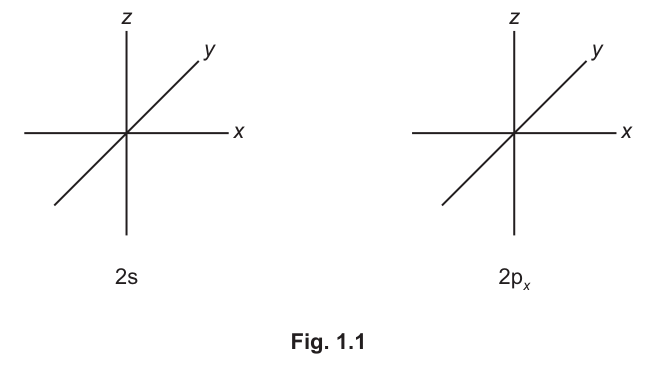
The nitrogen atom in is hybridised. orbitals form from the mixing of one 2s and three 2p orbitals.
Sketch the shapes of a 2s and a orbital on the axes in Fig. 1.1.
There are many naturally occurring hydrated compounds that contain the anion .
Name the anion .
.......................................................................................................................................
Struvite is a soft hydrated mineral with . The anhydrous form of the mineral has the formula .
Calculate the number of molecules of water of crystallisation in struvite.
Give your answer to the nearest integer. Show your working.
number of molecules of water of crystallisation = ..............................
reacts with 2-bromo-2-methylpropane in an reaction.
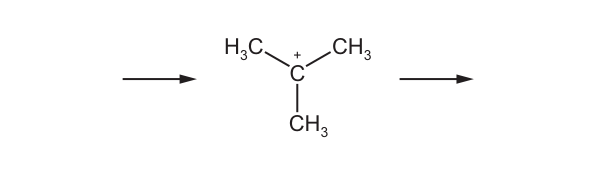
The molecular ion forms as the intermediate in this reaction.
Draw the mechanism for the reaction of with 2-bromo-2-methylpropane.
Include charges, dipoles, lone pairs of electrons and curly arrows as appropriate.
Draw the structures of the organic reactant and organic product.
2-bromo-2-methylpropane is a tertiary bromoalkane.
Define tertiary bromoalkane.
.............................................................................................................................................
.......................................................................................................................................
Organic compound M forms when 2-bromo-2-methylpropane is heated with ethanolic .
Draw the structure of M.
The rest of this paper
2 more questions- Q2Chemical Periodicity · Chemical Bonding · Equilibria · States of Matter · Atoms, Molecules and Stoichiometry · Group 1721M
- Q3Carbonyl Compounds · Hydrocarbons · Introduction to Organic Chemistry · Polymerisation · Analytical Techniques · Organic Synthesis · Halogen Compounds · Carboxylic Acids and Derivatives22M