Chemistry 9701/11 — May/June 2022
Cambridge AS Level · Multiple Choice (AS Level) · answer key with instant marking and worked solutions
Topics Atoms, Molecules and Stoichiometry · Electrochemistry · Nitrogen and Sulfur · Introduction to Organic Chemistry · Group 2 · Chemical Bonding · +16 more
Tap an option under each question to check it — your score builds as you go.
Which atom has its outermost electron in an orbital of the shape shown, with principal quantum number 3?
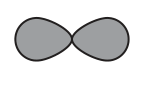
Options
A sodium
B chlorine
C calcium
D bromine
Working
The image shows a dumbbell shape, which is the characteristic shape of a p-orbital. We need to find the atom whose outermost (highest energy) electron occupies a 3p orbital (principal quantum number ).
Let us examine the electron configurations of the outermost electrons for each option:
- A (Sodium): — outermost electron is in a orbital (spherical shape).
- B (Chlorine): — outermost electron is in a orbital (dumbbell shape, ).
- C (Calcium): — outermost electron is in a orbital ().
- D (Bromine): — outermost electron is in a orbital ().
Only chlorine has its outermost electron in a orbital.
Answer
B
B
Background Concept
In atomic structure, electrons occupy orbitals that have specific three-dimensional shapes. The s-orbital is spherically symmetrical around the nucleus. The p-orbital has a dumbbell or double-lobed shape, with two lobes on opposite sides of the nucleus. There are three p-orbitals in each shell (starting from ), oriented along the x, y, and z axes (, , ). The principal quantum number denotes the main energy level or shell of the electron. For a orbital, , meaning the electron is in the third shell.
The electron configuration of an atom describes how its electrons are distributed among these orbitals. The outermost electrons (highest value, and highest energy within that shell for the valence shell) determine the element's position in the periodic table and its chemical properties.
Understanding the Question
The question provides an image of a dumbbell-shaped orbital and asks which of the four given atoms has its outermost electron in such an orbital with a principal quantum number of 3. This translates to finding the atom whose valence electron occupies a orbital.
Approach
- Identify the orbital shape from the image: a dumbbell shape corresponds to a p-orbital.
- Determine the required orbital: principal quantum number and p-orbital means a orbital.
- Write the electron configuration for each option and identify the subshell of the outermost electron.
- Select the option that matches .
Step-by-Step Reasoning
-
Option A: Sodium (Na, atomic number 11)
Electron configuration: or . The outermost electron is in the subshell. An s-orbital is spherical, not dumbbell-shaped. Incorrect. -
Option B: Chlorine (Cl, atomic number 17)
Electron configuration: or . The outermost electrons are in the subshell. The principal quantum number is , and the shape is a dumbbell. This matches all criteria. Correct. -
Option C: Calcium (Ca, atomic number 20)
Electron configuration: . The outermost electron is in the subshell. The principal quantum number is , and the shape is spherical. Incorrect. -
Option D: Bromine (Br, atomic number 35)
Electron configuration: . Although it has p-orbitals occupied, the outermost electrons are in the subshell. The principal quantum number is , not 3. Incorrect.
Key Takeaways
- Orbital shapes: s-orbitals are spherical; p-orbitals are dumbbell-shaped; d-orbitals are generally cloverleaf-shaped.
- Principal quantum number (): For main-group (s- and p-block) elements, the principal quantum number of the outermost electron equals the period number of the element in the periodic table.
- Electron configuration: Writing out the full or noble-gas core configuration is a reliable way to identify the subshell and principal quantum number of the valence electrons.
Common Mistakes
- Confusing orbital shapes: Mistaking the dumbbell shape of a p-orbital for an s-orbital (which is spherical) or a d-orbital (which is cloverleaf-like).
- Ignoring the principal quantum number: Selecting bromine (Option D) because it has p-orbitals, but forgetting to check that the question specifically requires . Bromine's outermost electrons are in , not .
- Misidentifying the outermost electron: For transition metals or elements with d-electrons, the outermost electrons are always in the highest value (e.g., before for filling, but is still ). However, for bromine, the electrons are both the highest and highest energy.
Things to Be Careful About
- Always read the principal quantum number requirement carefully. An atom can have p-orbitals occupied (like or ), but if the question specifies , it must be .
- Ensure you are looking at the outermost (valence) electron, not just any electron in a p-orbital. For example, chlorine has electrons in , but its outermost electrons are in .
- Remember that the principal quantum number of the outermost electron for s- and p-block elements is simply the period number on the periodic table. Chlorine is in Period 3, so its outermost electrons are in .
The rest of this paper
39 more questions- Q2Atomic Structure1M
- Q3Atoms, Molecules and Stoichiometry · Group 21M
- Q4Electrochemistry1M
- Q5Chemical Bonding1M
- Q6Chemical Bonding1M
- Q7States of Matter · Atoms, Molecules and Stoichiometry1M
- Q8Chemical Bonding1M
- Q9Chemical Energetics1M
- Q10Chemical Energetics1M
- Q11Atoms, Molecules and Stoichiometry · Electrochemistry1M
- Q12Electrochemistry1M
- Q13—1M
- Q14Equilibria1M
- Q15Reaction Kinetics1M
- Q16Atoms, Molecules and Stoichiometry1M
- Q17Electrochemistry · Group 171M
- Q18Chemical Periodicity1M
- Q19Atoms, Molecules and Stoichiometry · Chemical Periodicity1M
- Q20Group 21M
- Q21Group 2 · Nitrogen and Sulfur1M
- Q22Group 17 · Nitrogen and Sulfur1M
- Q23Group IV (Group 14)1M
- Q24Atoms, Molecules and Stoichiometry · Nitrogen and Sulfur1M
- Q25Group 171M
- Q26Halogen Compounds · Nitrogen Compounds1M
- Q27Carbonyl Compounds · Introduction to Organic Chemistry1M
- Q28Introduction to Organic Chemistry1M
- Q29Electrochemistry · Nitrogen and Sulfur1M
- Q30Hydrocarbons1M
- Q31Introduction to Organic Chemistry · Halogen Compounds1M
- Q32Halogen Compounds1M
- Q33Atoms, Molecules and Stoichiometry1M
- Q34Hydroxy Compounds · Hydrocarbons1M
- Q35Carbonyl Compounds · Hydroxy Compounds1M
- Q36Carbonyl Compounds1M
- Q37Carboxylic Acids and Derivatives1M
- Q38Hydroxy Compounds · Carboxylic Acids and Derivatives1M
- Q39Introduction to Organic Chemistry · Polymerisation1M
- Q40Analytical Techniques1M