Chemistry 9701/22 — February/March 2022
Cambridge AS Level · AS Level Structured Questions · worked solutions for every part, with the mark scheme
Topics Equilibria · Atomic Structure · Electrochemistry · Atoms, Molecules and Stoichiometry · Chemical Periodicity · Reaction Kinetics · +13 more
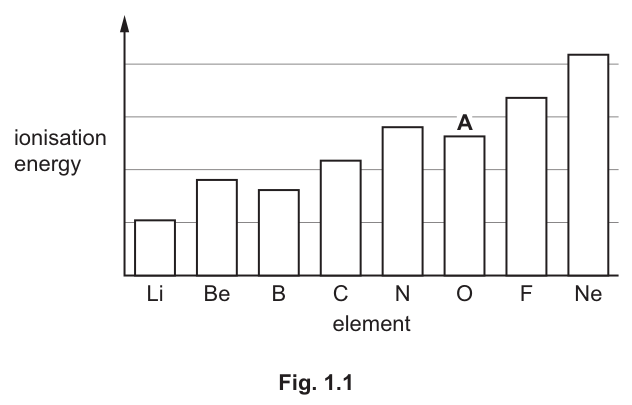
Fig. 1.1 shows how first ionisation energies vary across Period 2.
Construct an equation to represent the first ionisation energy of oxygen.
Include state symbols.
Answer
O(g) -> O+(g) + e-
Background Concept
The first ionisation energy is defined as the enthalpy change when one mole of gaseous atoms loses one mole of gaseous electrons to form one mole of gaseous 1+ ions. The equation representing this process always starts with the neutral atom in the gaseous state and produces the 1+ ion and an electron.
Understanding the Question
The question asks for the equation representing the first ionisation energy of oxygen. This requires writing the standard ionisation equation and applying it specifically to the oxygen atom, ensuring all state symbols are correct.
Approach
Recall the general form for first ionisation energy: . Substitute with oxygen () and verify the state symbols.
Step-by-Step Reasoning
- Start with the neutral oxygen atom in the gaseous state: .
- It loses one electron to form a 1+ ion: .
- The electron is written as .
- Combine these into a balanced equation: .
- Ensure all species have the correct state symbol , as ionisation energies are defined for gaseous species.
Key Takeaways
First ionisation energy equations always involve a neutral gaseous atom producing a 1+ gaseous ion and a gaseous electron. State symbols are mandatory for full marks.
Common Mistakes
- Forgetting state symbols entirely or using incorrect ones (e.g., or ).
- Writing the electron on the left-hand side of the equation.
- Producing a ion (), which would represent the second ionisation energy.
Things to Be Careful About
The mark scheme is strict about state symbols. Even if the equation is balanced correctly, omitting for any species will cost the mark. The electron is typically written as without a state symbol.
State and explain the general trend in first ionisation energies across Period 2.
Answer
- First ionisation energy increases across Period 2.
- The nuclear charge (number of protons) increases across the period.
- The shielding by inner electrons remains similar (constant).
- Therefore, the electrostatic attraction between the nucleus and the outer electrons increases, requiring more energy to remove an outer electron.
Ionisation energy increases across the period due to increasing nuclear charge with similar shielding.
Background Concept
First ionisation energy is the energy required to remove the outermost electron from a gaseous atom. The magnitude of this energy depends on the electrostatic attraction between the positively charged nucleus and the negatively charged outer electron. This attraction is governed by Coulomb's law: it increases with greater nuclear charge and decreases with greater distance or increased shielding from inner electrons.
Understanding the Question
The question asks for the general trend in first ionisation energies across Period 2 (from Li to Ne) and an explanation for this trend. The figure shows an overall upward trend with some dips.
Approach
- State the overall trend observed in the data (increase across the period).
- Explain the trend by identifying the changing factor (nuclear charge/protons) and the constant factor (shielding).
- Link these to the resulting force (increased attraction).
Step-by-Step Reasoning
- Trend: As you move from Li to Ne, the first ionisation energy generally increases. (1 mark)
- Nuclear charge: Each successive element has one more proton in the nucleus, so the nuclear charge increases. (1 mark)
- Shielding: Electrons are being added to the same principal quantum shell (n=2). Inner shell electrons (n=1) remain the same, so shielding of the outer electrons by inner electrons is roughly constant/similar. (1 mark)
- Explanation: Because nuclear charge increases while shielding remains similar, the effective nuclear charge felt by the outer electrons increases. This leads to a stronger electrostatic attraction between the nucleus and the outer electrons, meaning more energy is required to remove one. (This is integrated into the explanation points above).
Key Takeaways
When explaining periodic trends in ionisation energy, always mention the increase in nuclear charge (protons) and the fact that shielding remains relatively constant for electrons in the same shell.
Common Mistakes
- Stating that 'electrons are closer to the nucleus' without justification (distance is roughly similar across a period).
- Saying 'shielding decreases' (it remains similar/constant).
- Failing to mention nuclear charge or protons explicitly.
Things to Be Careful About
The explanation requires three distinct points: the trend, the increase in nuclear charge, and the constant shielding. Mark schemes often award marks for these as separate points. Ensure you explicitly state 'similar shielding' or 'constant shielding'.
Explain why ionisation energy A in Fig. 1.1 does not follow the general trend in first ionisation energies across Period 2.
Answer
- In oxygen, the fourth 2p electron is spin-paired with another electron in the same 2p orbital.
- The repulsion between these spin-paired electrons outweighs the increased nuclear charge.
- This makes it easier to remove the paired electron, causing a drop in ionisation energy compared to nitrogen.
Spin-pair repulsion in the 2p orbital of oxygen outweighs the increased nuclear charge.
Background Concept
While the general trend across a period is an increase in ionisation energy, there are notable dips, such as between Group 2 and Group 13 (Be to B) and between Group 15 and Group 16 (N to O). These dips occur due to subshell structure and electron pairing. For oxygen (Group 16), the electron configuration is . The 2p subshell has three orbitals. According to Hund's rule, the first three electrons occupy separate orbitals with parallel spins. The fourth electron must pair up with one of these in a 2p orbital.
Understanding the Question
Ionisation energy A corresponds to oxygen, which is lower than nitrogen despite having a higher nuclear charge. The question asks to explain this anomaly.
Approach
- Identify the electron configuration of oxygen and nitrogen.
- Explain the electron pairing in oxygen's 2p subshell.
- State that the repulsion between paired electrons reduces the energy needed to remove one, overriding the effect of increased nuclear charge.
Step-by-Step Reasoning
- Nitrogen has a half-filled 2p subshell (), with one electron in each of the three 2p orbitals. Oxygen has , meaning one 2p orbital contains a pair of electrons.
- Electrons are negatively charged and repel each other. The spin-pair repulsion (or electron-electron repulsion) within the same orbital reduces the effective attraction to the nucleus.
- This repulsion outweighs the increased nuclear charge (from 7 protons in N to 8 in O) that would otherwise increase the ionisation energy.
- Consequently, less energy is required to remove the paired electron from oxygen than the unpaired electron from nitrogen.
Key Takeaways
Dips in ionisation energy trends occur when an electron is removed from a paired orbital (Group 16 vs 15) or a higher energy subshell (Group 13 vs 12). Always mention 'repulsion' or 'spin-pair repulsion' and that it 'outweighs' or 'overcomes' the increased nuclear charge.
Common Mistakes
- Saying 'electrons repel each other' without specifying 'spin-paired' or 'in the same orbital'.
- Forgetting to mention that this repulsion 'outweighs' the increased nuclear charge. Simply stating there is repulsion is not enough; you must explain why it causes a drop despite more protons.
- Confusing this with the Be/B dip (which involves removing an electron from a higher energy 2p orbital vs a lower energy 2s orbital).
Things to Be Careful About
Be precise with terminology: use 'spin-pair repulsion' or 'repulsion between electrons in the same orbital'. Do not just say 'electron repulsion'. Also, ensure you compare it to the nuclear charge trend (i.e., the repulsion is significant enough to override the expected increase).
Element E is in Period 3 of the Periodic Table.
The first eight ionisation energy values of E are shown in Table 1.1.
Table 1.1
| ionisation | 1st | 2nd | 3rd | 4th | 5th | 6th | 7th | 8th |
|---|---|---|---|---|---|---|---|---|
| ionisation energy / | 577 | 1820 | 2740 | 11600 | 14800 | 18400 | 23400 | 27500 |
Deduce the full electronic configuration of E.
Explain your answer.
full electronic configuration of E =
explanation
Answer
full electronic configuration of E =
explanation:
- There is a large jump (or greatest increase) in ionisation energy between the 3rd and 4th values.
- This indicates that the 4th electron is removed from a shell closer to the nucleus (or a new principal energy level / inner shell).
- Therefore, there are three electrons in the outer shell.
1s2 2s2 2p6 3s2 3p1; large jump between 3rd and 4th IE indicates 3 outer electrons.
Background Concept
Successive ionisation energies increase because each subsequent electron is removed from an increasingly positive ion, experiencing a stronger attraction to the nucleus. However, a massive jump in ionisation energy occurs when an electron is removed from a principal quantum shell (energy level) closer to the nucleus. This is because inner shell electrons are much closer to the nucleus and experience significantly less shielding, resulting in a much stronger electrostatic attraction.
Understanding the Question
Element E is in Period 3. We are given its first 8 ionisation energies. We need to deduce its full electronic configuration and explain our reasoning based on the data.
Approach
- Look for the largest relative increase (jump) between successive ionisation energies.
- The number of electrons removed before the jump equals the number of electrons in the outer shell.
- Use the period number (Period 3) and the number of outer electrons (Group number) to build the full electronic configuration.
Step-by-Step Reasoning
- Analyze the data:
- 1st to 2nd: (increase of ~1243)
- 2nd to 3rd: (increase of ~920)
- 3rd to 4th: (increase of 8860) — This is the largest jump.
- Subsequent increases are steady:
- Interpret the jump: The massive jump between the 3rd and 4th ionisation energies indicates that the 4th electron is being removed from a shell closer to the nucleus (a new, lower principal quantum shell). This means there are 3 electrons in the outer shell.
- Determine the group and element: Being in Period 3 and having 3 outer electrons places element E in Group 13. This is Aluminium (Al).
- Write the configuration: Aluminium has atomic number 13. The full electronic configuration is .
- Inner shells (n=1 and n=2) account for the first 10 electrons (removals 1-10 would show steady increases with a jump at the 11th, but we only have data up to the 8th).
- The outer shell (n=3) has 3 electrons (), matching the jump after the 3rd ionisation.
Key Takeaways
When given successive ionisation energies, always look for the largest relative jump. The number of electrons removed before the jump tells you the number of valence electrons. Use this to determine the group and then write the full configuration.
Common Mistakes
- Not identifying the correct jump (e.g., looking at absolute values rather than relative increases, though the 3rd to 4th jump is unambiguously the largest here).
- Writing the configuration incorrectly, such as (forgetting the subshell).
- Failing to explain that the jump indicates removal from a shell closer to the nucleus / inner shell.
Things to Be Careful About
- The explanation must explicitly mention the jump between the 3rd and 4th ionisation energies. Just saying 'there is a jump' is not enough; you must specify where.
- The explanation must link the jump to the number of outer electrons (e.g., 'indicates three electrons in the outer shell' or '4th electron is from an inner shell').
- Ensure the full electronic configuration is written in the correct order: . Do not use noble gas shorthand unless asked.
The rest of this paper
3 more questions- Q2Electrochemistry · Atoms, Molecules and Stoichiometry · Chemical Periodicity · Reaction Kinetics · States of Matter · Chemical Energetics · Nitrogen and Sulfur · Equilibria16M
- Q3Group 17 · Group IV (Group 14) · Equilibria · Hydrocarbons · Halogen Compounds20M
- Q4Carbonyl Compounds · Hydroxy Compounds · Introduction to Organic Chemistry · Carboxylic Acids and Derivatives · Polymerisation · Analytical Techniques15M