Chemistry 9701/31 — October/November 2021
Cambridge AS Level · Advanced Practical Skills · worked solutions for every part, with the mark scheme
Topics Manipulation, Measurement and Observation · Analysis, Conclusions and Evaluation · Presentation of Data and Observations · Qualitative Analysis
You will investigate a compound of a Group 1 element to determine which element is present.
Group 1 carbonates decompose to give carbon dioxide when heated to high temperatures.
FA 1 is the carbonate of the element, .
Method
- Weigh a crucible with its lid and record the mass.
- Add 1.40–1.60 g of FA 1 to the crucible.
- Weigh the crucible and its lid with FA 1 and record the mass.
- Place the crucible on the pipe-clay triangle. Heat the crucible, with its lid on, gently for approximately 1 minute. Then heat strongly for another minute.
- Carefully remove the lid. Heat the crucible strongly for 4 minutes.
- Replace the lid and leave the crucible and residue to cool for at least 5 minutes.
While the crucible is cooling you may wish to begin work on Question 2.
- Reweigh the crucible and contents with its lid. Record the mass.
- Remove the lid. Heat the crucible and contents strongly for a further 2 minutes.
- Replace the lid and leave the crucible and residue to cool for at least 5 minutes. Reweigh the crucible and residue with its lid. Record the mass.
- Calculate and record the mass of FA 1 added to the crucible. Calculate the mass of residue obtained.
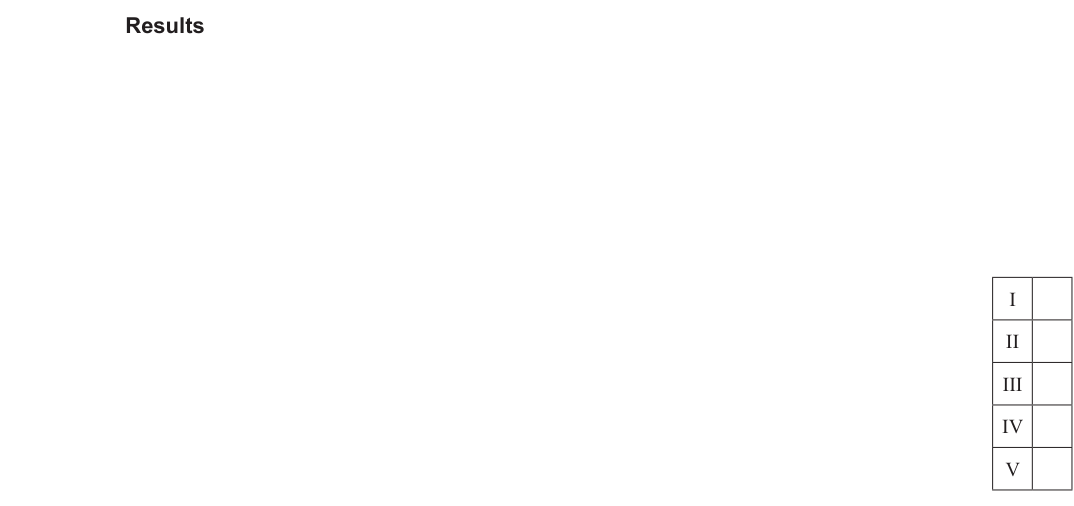
Results
Answer
Representative Results Table
| Heading | Mass / g |
|---|---|
| Mass of crucible and lid | 25.00 |
| Mass of crucible, lid and FA 1 | 26.50 |
| Mass of crucible, lid and residue after 1st heating | 25.88 |
| Mass of crucible, lid and residue after 2nd heating | 25.88 |
| Mass of FA 1 used | 1.50 |
(Note: These are representative values for a 1.50 g sample of . As a candidate-dependent practical, you must record your own readings to the nearest 0.01 g. Ensure the mass of FA 1 is between 1.40 and 1.60 g, and that the mass after the second heating is within 0.05 g of the mass after the first heating to confirm constant mass.)
See representative results table above. Candidate-dependent readings required.
Background Concept
In quantitative thermal decomposition experiments, the goal is to drive a reaction to completion by heating to constant mass. 'Constant mass' means that successive weighings after heating and cooling differ by less than the balance's uncertainty (typically g for a 0.01 g balance). This confirms that all the volatile product (here, gas) has been driven off and no further decomposition is occurring.
Understanding the Question
Part (a) asks you to record the data from the thermal decomposition of FA 1 (). You are given a method that involves four key weighings: the empty crucible, the crucible with the sample before heating, and the crucible with the residue after two successive heatings (to verify constant mass). You must calculate the mass of the sample added and the mass of the residue left behind.
Approach
- Set up a results table with clear, unambiguous headings and correct units (g).
- Record the four weighings to the same number of decimal places (usually 2 for a 0.01 g balance).
- Calculate the mass of FA 1 used (crucible + lid + sample minus crucible + lid).
- Calculate the mass of the residue (crucible + lid + residue minus crucible + lid).
- Ensure the second heating mass is within 0.05 g of the first heating mass to prove constant mass has been reached.
Step-by-Step Reasoning
- Headings (I): The table must clearly label what is being weighed. Acceptable headings include 'Mass of crucible and lid', 'Mass of crucible, lid and FA 1', 'Mass of crucible, lid and residue after 1st heating', 'Mass of crucible, lid and residue after 2nd heating', and 'Mass of FA 1 used'.
- Weighings (II): All four weighings must be recorded. They must be to a consistent number of decimal places (e.g., two decimal places: 25.00, 26.50). The mass of FA 1 calculated must fall between 1.40 g and 1.60 g as specified in the method.
- Constant mass (III): The mass after the second heating must be within 0.05 g of the mass after the first heating. This proves decomposition is complete. The mass of FA 1 and the mass of the residue are then calculated by subtraction.
- Accuracy (IV and V): The ratio of the mass of residue to the mass of FA 1 is compared to the theoretical supervisor value to assess the accuracy of the candidate's technique and balance calibration.
Key Takeaways
Always use clear headings with units in practical results tables. Record all raw data to the same number of decimal places. Calculate derived quantities (like sample mass and residue mass) correctly. Verifying 'constant mass' is the standard way to prove a thermal decomposition is complete.
Common Mistakes
- Using ambiguous headings like 'Mass 1', 'Mass 2', etc., without stating what is being weighed.
- Mixing up decimal places (e.g., recording 25.0 and 26.50).
- Forgetting to subtract the crucible mass to find the mass of FA 1 or the residue.
- Not checking that the second heating mass is within 0.05 g of the first; if it isn't, the decomposition is not complete and the data is invalid.
Things to Be Careful About
- Units must be included in the column heading (e.g., 'Mass / g'), not necessarily in every cell, but consistency is key.
- The mass of FA 1 must be strictly between 1.40 and 1.60 g; outside this range, the mark for II is lost.
- If the second heating mass is more than 0.05 g lower than the first, you must heat again until the mass change is g.
Calculations
Calculate the mass of carbon dioxide produced when the sample of was heated.
Working
Mass of = mass of FA 1 used mass of residue ()
Mass of =
(Alternatively: total mass before heating total mass after 2nd heating = )
Answer
0.62 g
0.62 g
Background Concept
When a carbonate is heated, it decomposes into a metal oxide and carbon dioxide gas. The gas escapes, causing a loss in mass. The mass of the carbon dioxide produced is exactly equal to the total mass lost during the heating process.
Understanding the Question
Part (b)(i) asks for the mass of carbon dioxide produced. You are given the mass of the original carbonate (FA 1) and the mass of the solid residue (the oxide) after complete decomposition.
Approach
The mass of is simply the difference between the mass of the sample before heating and the mass of the residue after heating. You can calculate this either by subtracting the residue mass from the FA 1 mass, or by subtracting the final total mass (crucible + residue) from the initial total mass (crucible + FA 1).
Step-by-Step Reasoning
Using the representative data:
Mass of FA 1 = 1.50 g
Mass of residue () = 0.88 g
Mass of = g.
Using total masses:
Initial total mass = 26.50 g
Final total mass = 25.88 g
Mass of = g.
Both methods yield the same result.
Key Takeaways
The mass loss in a thermal decomposition experiment is always the mass of the gaseous product(s) that have escaped. Always show your working clearly.
Common Mistakes
- Simply copying the mass of the residue or the mass of FA 1 instead of calculating the difference.
- Forgetting to use the correct masses (e.g., using the crucible mass instead of the sample mass).
Things to Be Careful About
Ensure you use your own candidate data, not the representative values shown in the solution. The logic remains the same: mass of gas = mass before heating mass after heating.
Calculate the number of moles of needed to produce the mass of carbon dioxide calculated in (b)(i).
Working
Moles of
From the balanced equation , the molar ratio of to is 1:1.
Therefore, moles of = moles of
Answer
0.0141 mol
0.0141 mol
Background Concept
To find the amount of substance in moles, divide the mass by the molar mass (). The stoichiometry of the balanced chemical equation gives the molar ratio between reactants and products.
Understanding the Question
Part (b)(ii) asks for the number of moles of that decomposed. You have just calculated the mass of produced.
Approach
- Calculate the moles of using its mass and molar mass (44 g mol).
- Use the 1:1 stoichiometric ratio from the given equation to find the moles of .
- Round to 2-4 significant figures.
Step-by-Step Reasoning
Moles of
Rounding to 3 significant figures: 0.0141 mol.
Since 1 mole of produces 1 mole of , the moles of is also 0.0141 mol.
Key Takeaways
Always use the balanced equation to establish the mole ratio. Carry forward your answer from (b)(i) exactly as calculated, even if it has many decimal places, to avoid rounding errors in subsequent parts.
Common Mistakes
- Using the wrong molar mass for (e.g., using 44 for something else, or forgetting to use 44).
- Incorrectly assuming a different stoichiometric ratio.
- Rounding too early (e.g., using 0.014 instead of 0.01409 in part (iii)).
Things to Be Careful About
The mark scheme requires the answer to 2-4 significant figures. 0.0141 is 3 sf, which is acceptable. Ensure you are using the unrounded value from (b)(i) for the next calculation if doing it in one go on a calculator.
Use your answer to (b)(ii) and the information on page 2 to calculate the relative formula mass, , of .
Working
Answer
106
106
Background Concept
The relative formula mass () is the mass of one mole of a substance. It can be calculated experimentally by dividing the mass of a sample by the number of moles in that sample: .
Understanding the Question
Part (b)(iii) asks for the experimental of using the mass of FA 1 (1.50 g) and the moles calculated in (b)(ii).
Approach
Divide the mass of FA 1 by the moles of from (b)(ii).
Step-by-Step Reasoning
Using the unrounded moles from (b)(i) for better accuracy:
Rounding to 3 significant figures gives 106.
Key Takeaways
When calculating experimentally, always use the unrounded mole value from the previous step to minimize cumulative rounding errors.
Common Mistakes
- Using the rounded mole value (0.0141) which gives , still rounding to 106, but it's good practice to keep precision.
- Forgetting the formula and trying to use it the other way around.
Things to Be Careful About
The mark scheme accepts 2-4 significant figures. 106 is 3 sf. Ensure you are using the mass of FA 1, not the mass of the residue.
Use your answer to (b)(iii) to calculate the relative atomic mass, , of . Hence identify .
Explain how you reached your conclusion.
Working
The nearest Group 1 element to is Sodium (Na), which has .
Answer
; X is Sodium (Na). The calculated is closest to the accepted value for Na (23.0).
Ar = 23.2; X is Sodium (Na)
Background Concept
The relative formula mass () is the sum of the relative atomic masses () of all atoms in the formula. For , .
Understanding the Question
Part (b)(iv) asks you to calculate of X from the experimental , and then identify X from the Group 1 elements, explaining your reasoning.
Approach
- Write the expression for of in terms of .
- Substitute the known values (, , ).
- Solve for .
- Compare the result with the values of Group 1 elements (Li=7, Na=23, K=39, Rb=85, Cs=133) and state which is closest, providing a numerical justification.
Step-by-Step Reasoning
Looking at Group 1:
- Li: 6.9
- Na: 23.0
- K: 39.1
The value 23.2 is closest to 23.0 (Sodium). The difference is , which is much smaller than the difference to K (). Therefore, X is Sodium.
Key Takeaways
Algebraic manipulation to isolate the unknown is straightforward. The identification step requires not just stating the name, but explicitly showing why it is the correct element by comparing the calculated value to the known values.
Common Mistakes
- Forgetting that there are two atoms of X in the formula (), leading to and incorrectly identifying Ca (which is not Group 1 anyway).
- Stating 'X is Na' without the explanation or numerical comparison required by the mark scheme.
- Using the rounded (106) which gives exactly; while this is fine, using the unrounded value shows better practice.
Things to Be Careful About
The mark scheme specifically requires you to 'explain how you reached your conclusion'. You must show the calculation for and then state that it is closest to the of Na, perhaps giving the range or the difference. For example: '23.2 is between 15.0 and 31.1, which corresponds to Na' or '23.2 is closest to 23.0 (Na)'.
In this experiment you heated the sample of for approximately 8 minutes.
Explain, using evidence from your results in (a), whether your sample of had decomposed completely.
Answer
The mass after the second heating (25.88 g) is the same as the mass after the first heating (25.88 g), showing no further loss of mass. This indicates that the decomposition of was complete.
(If your data showed a mass loss between the first and second heating, state: 'The mass decreased further, indicating decomposition was not complete and more heating was required.')
Decomposition was complete because there was no change in mass between the first and second heating.
Background Concept
In gravimetric analysis involving heating to constant mass, the reaction is considered complete only when successive weighings show no significant change in mass. This ensures that all the volatile product has been driven off.
Understanding the Question
Part (c) asks you to use your results from (a) to explain whether the decomposition was complete.
Approach
Compare the mass after the first heating (4 minutes) with the mass after the second heating (2 minutes). If they are within 0.05 g of each other, the mass is constant and decomposition is complete.
Step-by-Step Reasoning
In the representative data:
Mass after 1st heating = 25.88 g
Mass after 2nd heating = 25.88 g
Difference = 0.00 g, which is g.
Conclusion: The mass has become constant, meaning no more is being released. The decomposition is complete.
If your actual data showed 25.85 g after the 1st heating and 25.82 g after the 2nd, the difference is 0.03 g (complete). If it showed 25.90 g and 25.80 g, the difference is 0.10 g (>0.05 g), meaning decomposition was not complete.
Key Takeaways
'Constant mass' is the key phrase. Always justify your conclusion by referencing the actual numerical values from your results table.
Common Mistakes
- Just stating 'yes' or 'no' without referencing the data.
- Saying 'the mass didn't change' without noting that it must be within the balance's uncertainty (0.05 g).
Things to Be Careful About
The mark scheme accepts either 'no change in mass' or 'further loss of mass' as the basis for the explanation. Tailor your answer to your actual experimental data. If you had to heat a third time, mention that the mass was still changing.
The rest of this paper
2 more questions- Q2Manipulation, Measurement and Observation · Presentation of Data and Observations · Analysis, Conclusions and Evaluation15M
- Q3Manipulation, Measurement and Observation · Qualitative Analysis · Analysis, Conclusions and Evaluation14M