Chemistry 9701/22 — October/November 2021
Cambridge AS Level · AS Level Structured Questions · worked solutions for every part, with the mark scheme
Topics Chemical Bonding · Atoms, Molecules and Stoichiometry · Electrochemistry · States of Matter · Hydrocarbons · Chemical Energetics · +10 more
Hydrogen iodide, HI, is a colourless gas at room temperature.
Explain why HI has a higher boiling point than HCl and HBr.
The bar chart shows the boiling points of HCl, HBr and HI. The boiling point of HF is not shown.
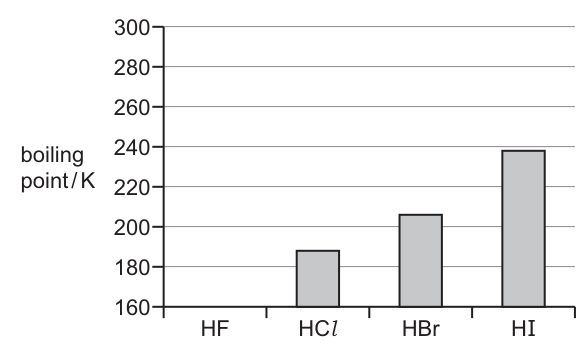
Hydrogen bonds form between HF molecules.
Draw a bar on the bar chart to predict the boiling point of HF.
Explain your answer.
The standard enthalpy change of formation, , of HI(g) is .
Define the term standard enthalpy change of formation.
HI(g) can be formed by reacting H2(g) with I2(g). The reaction is reversible, and an equilibrium forms quickly at high temperatures.
Construct an expression for the equilibrium constant, , for the reaction of H2(g) and I2(g) to form HI(g).
The equilibrium partial pressures of the gases at are as follows.
Calculate for this reaction.
State how the value of would change, if at all, if the reaction were carried out at rather than .
Explain your answer.
HI reacts with oxygen to form iodine and water.
Construct an equation for the reaction of HI with oxygen.
Explain, with reference to oxidation numbers, why this reaction is a redox reaction.
HI(g) can also be formed by the reaction of I2(g) with hydrazine, N2H4(g).
State the change in pressure that would occur when fully reacts with in a sealed container at constant temperature. Explain your answer.
In the laboratory, HI(aq) can be formed in a two-step process.
Draw a ‘dot-and-cross’ diagram of a PI3 molecule.
Name the type of reaction in step 2.
H3PO3(aq) and HI(aq) are both strong Brønsted–Lowry acids.
Give the meaning of the term strong Brønsted–Lowry acid.
Give the formula of the conjugate base of H3PO3.
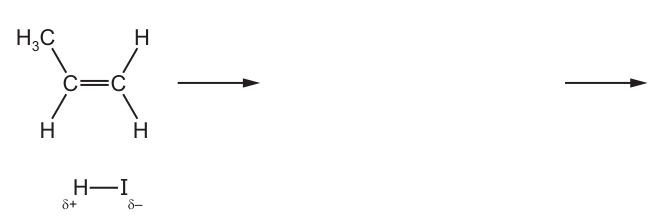
HI(g) reacts with propene, CH3CH=CH2(g) to form a mixture of 1-iodopropane and 2-iodopropane.
Identify which of 1-iodopropane and 2-iodopropane is the major product of this reaction.
Explain your answer.
Complete the diagram to show the mechanism of the reaction between HI and CH3CH=CH2 that forms the major product identified in (g)(i).
Include curly arrows, lone pairs of electrons and charges as necessary.
The rest of this paper
2 more questions- Q2Chemical Periodicity · Atomic Structure · States of Matter · Atoms, Molecules and Stoichiometry · Chemical Bonding17M
- Q3Introduction to Organic Chemistry · Chemical Bonding · Hydrocarbons · Carbonyl Compounds · Analytical Techniques · Electrochemistry · Hydroxy Compounds · Polymerisation · Reaction Kinetics17M