Chemistry 9701/11 — October/November 2021
Cambridge AS Level · Multiple Choice (AS Level) · answer key with instant marking and worked solutions
Topics Chemical Bonding · Atoms, Molecules and Stoichiometry · Halogen Compounds · Introduction to Organic Chemistry · Hydroxy Compounds · Atomic Structure · +13 more
Tap an option under each question to check it — your score builds as you go.
The mass spectrum of a sample of neon is shown. The relative abundance of each peak is written in brackets above it.
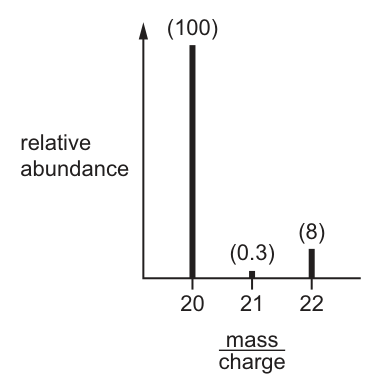
What is the relative atomic mass, , of this sample of neon?
Options
A 20.15
B 20.20
C 21.00
D 21.82
Working
The relative atomic mass () is the weighted average of the isotopic masses, calculated using the relative abundances from the mass spectrum.
Answer
A
A
Background Concept
The relative atomic mass () of an element is the weighted average mass of its naturally occurring isotopes, relative to one-twelfth the mass of a carbon-12 atom. In mass spectrometry, a sample is ionised and accelerated, then deflected by a magnetic field. Ions with different masses (isotopes) follow different paths and are detected at different mass-to-charge ratios (m/z). For singly charged ions (), the m/z value is numerically equal to the isotopic mass. The height of each peak (relative abundance) represents the proportion of that isotope present in the sample. To find , we calculate the mean of these isotopic masses, weighting each by its relative abundance.
Understanding the Question
The question provides a mass spectrum of neon with three peaks at m/z = 20, 21, and 22. The numbers in brackets above each peak are their relative abundances: 100, 0.3, and 8. We are asked to calculate the relative atomic mass () of this specific sample of neon and select the correct value from the given options (A: 20.15, B: 20.20, C: 21.00, D: 21.82).
Approach
The strategy is to apply the formula for the weighted average:
Since the ions are singly charged (), the m/z values (20, 21, 22) are used directly as the isotopic masses. We multiply each mass by its corresponding relative abundance, sum these products to get the numerator, sum the relative abundances to get the denominator, and divide to find the final .
Step-by-Step Reasoning
- Identify isotopic masses and abundances: From the spectrum, the isotopes have masses 20, 21, and 22 with relative abundances 100, 0.3, and 8 respectively.
- Calculate the numerator (sum of mass × abundance):
- Calculate the denominator (total relative abundance):
- Divide to find :
- Match with options: Rounding to two decimal places gives 20.15, which matches option A.
Key Takeaways
- The relative atomic mass is always a weighted average, not a simple arithmetic mean. The denominator must be the sum of the relative abundances, not 100 or the number of isotopes.
- In mass spectrometry, for singly charged ions, the m/z value is the isotopic mass.
Common Mistakes
- Forgetting the denominator: Simply summing the products () and forgetting to divide by the total abundance (). This would lead to an incorrect answer like 2182.3.
- Using a simple average: Adding the masses and dividing by 3 (), which ignores the relative abundances. This matches distractor C.
- Ignoring the smaller peaks: If the 0.3 peak is ignored, the calculation becomes , which coincidentally gives the right answer here, but is conceptually wrong. If the 8 peak is ignored, , which is incorrect.
Things to Be Careful About
- Significant figures: The final answer should be given to an appropriate number of decimal places, typically matching the precision of the options or the input data. Here, two decimal places (20.15) is correct.
- State symbols and charges: Ensure you correctly identify the charge of the ions. If the charge were +2, the isotopic mass would be , but for standard mass spectrometry of noble gases, the charge is +1.
- Total abundance: Always verify that the denominator is the sum of all relative abundances, especially when they do not sum to 100 (as is the case here with 108.3).
The rest of this paper
39 more questions- Q2Atoms, Molecules and Stoichiometry1M
- Q3Atomic Structure1M
- Q4Atomic Structure1M
- Q5Chemical Bonding1M
- Q6States of Matter · Chemical Bonding1M
- Q7Chemical Energetics1M
- Q8Chemical Energetics1M
- Q9Electrochemistry1M
- Q10Equilibria1M
- Q11Reaction Kinetics1M
- Q12Atoms, Molecules and Stoichiometry1M
- Q13Chemical Periodicity1M
- Q14Group 21M
- Q15Group 2 · Atoms, Molecules and Stoichiometry1M
- Q16Group 171M
- Q17Group 17 · Electrochemistry1M
- Q18Chemical Bonding1M
- Q19Nitrogen and Sulfur1M
- Q20Halogen Compounds · Introduction to Organic Chemistry1M
- Q21Introduction to Organic Chemistry · Hydrocarbons1M
- Q22Introduction to Organic Chemistry · Halogen Compounds1M
- Q23Halogen Compounds1M
- Q24Hydroxy Compounds1M
- Q25Hydroxy Compounds · Carbonyl Compounds1M
- Q26Carbonyl Compounds1M
- Q27Carbonyl Compounds · Hydroxy Compounds1M
- Q28Atoms, Molecules and Stoichiometry1M
- Q29Carboxylic Acids and Derivatives1M
- Q30Analytical Techniques1M
- Q31Reaction Kinetics1M
- Q32Equilibria1M
- Q33Chemical Bonding1M
- Q34Atomic Structure1M
- Q35Chemical Bonding1M
- Q36Group 21M
- Q37Hydrocarbons1M
- Q38Hydrocarbons · Introduction to Organic Chemistry1M
- Q39Halogen Compounds1M
- Q40Hydroxy Compounds1M