Chemistry 9701/22 — February/March 2021
Cambridge AS Level · AS Level Structured Questions · worked solutions for every part, with the mark scheme
Topics Chemical Bonding · Reaction Kinetics · States of Matter · Chemical Energetics · Electrochemistry · Hydrocarbons · +12 more
The rate of chemical reactions is affected by changes in temperature and pressure.
Draw a curve on the axes to show the Boltzmann distribution of energy of particles in a sample of gaseous krypton atoms at a given temperature.
Label the curve T1 and label the axes.
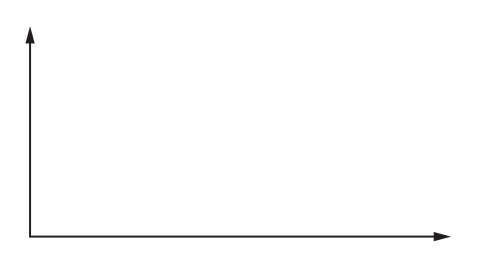
On the diagram in (a)(i), draw a second curve to show the distribution of energies of the krypton atoms at a higher temperature.
Label the second curve T2.
The Boltzmann distribution assumes that the particles behave as an ideal gas.
State two assumptions of the kinetic theory as applied to an ideal gas.
of krypton gas, , is placed in a sealed container at .
Calculate the pressure, in , of in the container.
Assume behaves as an ideal gas.
Show your working.
State and explain the conditions at which krypton behaves most like an ideal gas.
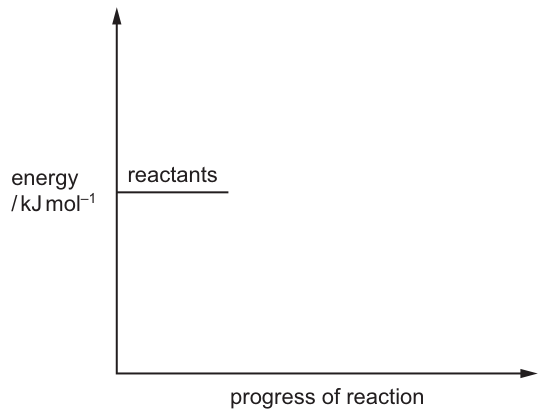
Krypton reacts with fluorine in the presence of ultraviolet light to make krypton difluoride, .
Use this information to complete the reaction profile diagram for the formation of .
Label and on the diagram.
Assume the reaction proceeds in one step.
Explain, in terms of activation energy, , and the collision of particles, how an increase in temperature affects the rate of a chemical reaction.
The rest of this paper
3 more questions- Q2Group 17 · Atomic Structure · Electrochemistry · Chemical Bonding · Chemical Periodicity · States of Matter · Atoms, Molecules and Stoichiometry · Hydrocarbons23M
- Q3Chemical Energetics · Chemical Bonding · Reaction Kinetics · Equilibria · Analytical Techniques · Polymerisation · Carboxylic Acids and Derivatives · Introduction to Organic Chemistry · Nitrogen Compounds13M
- Q4Chemical Bonding · Carbonyl Compounds · Electrochemistry · Hydroxy Compounds · Hydrocarbons10M