Chemistry 9701/22 — October/November 2020
Cambridge AS Level · AS Level Structured Questions · worked solutions for every part, with the mark scheme
Topics Chemical Periodicity · States of Matter · Atoms, Molecules and Stoichiometry · Hydroxy Compounds · Introduction to Organic Chemistry · Hydrocarbons · +7 more
Atoms contain the subatomic particles electrons, protons and neutrons. Protons and electrons were discovered by observations of their behaviours in electric fields.
The diagram shows the behaviour of separate beams of electrons and protons in an electric field.
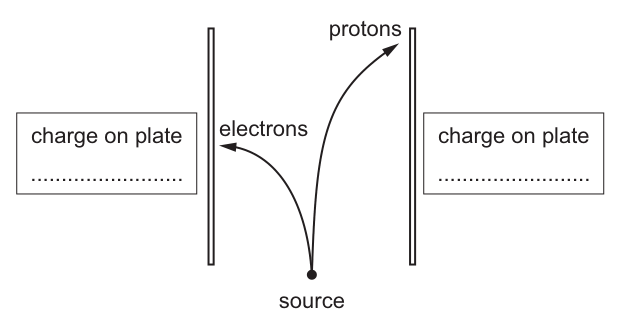
Complete the diagram with the relative charge of each of the electrically charged plates.
Answer
Left plate: positive (+)
Right plate: negative (–)
Electrons (negative) are attracted to the positive plate on the left; protons (positive) are attracted to the negative plate on the right.
Left plate: + (positive); Right plate: – (negative)
Background Concept
When a charged particle passes through an electric field between two oppositely charged plates, it experiences a force. The direction of the force depends on the sign of the particle's charge: positive particles are attracted towards the negative plate and repelled by the positive plate, while negative particles are attracted towards the positive plate. This principle was historically used to discover the electron (J.J. Thomson's cathode ray experiments) and to identify the proton.
Understanding the Question
The diagram shows two beams deflected from a source between two plates. The electron beam deflects towards the left plate, and the proton beam deflects towards the right plate. We must label the relative charge on each plate.
Approach
Identify the charge of each particle (electron = –1, proton = +1), then deduce which plate attracts each beam. The plate that attracts electrons must be positive; the plate that attracts protons must be negative.
Step-by-Step Reasoning
- Electrons carry a relative charge of –1. They deflect towards the left plate, meaning the left plate attracts them. Since opposite charges attract, the left plate must be positive (+).
- Protons carry a relative charge of +1. They deflect towards the right plate, meaning the right plate attracts them. Since opposite charges attract, the right plate must be negative (–).
- This is consistent: the left plate is + and the right plate is –, creating an electric field directed from left to right. The electron (negative) is pushed left (towards +), and the proton (positive) is pushed right (towards –).
Key Takeaways
- The direction of deflection in an electric field reveals the sign of the particle's charge.
- Opposite charges attract; like charges repel.
- This is the basis of mass spectrometry and Thomson's electron discovery.
Common Mistakes
- Confusing which plate attracts which particle. Remember: electrons go to the positive plate, protons go to the negative plate.
- Writing 'positive' for the right plate because protons go there — protons are attracted TO the negative plate, not repelled by it.
Things to Be Careful About
- The question asks for the relative charge on each plate, not the charge on the particles themselves. Be explicit about which plate is which.
On the diagram, draw a line to show how a separate beam of neutrons from the same source behaves in the same electric field.
Answer
A straight vertical line drawn upwards from the source, passing between the two plates without any deflection.
Straight vertical line from source, no deflection
Background Concept
An electric field exerts a force only on charged particles. A neutral particle experiences no net force and therefore travels in a straight line at constant velocity through the field. Neutrons, having no charge, are unaffected by electric (and magnetic) fields.
Understanding the Question
We must show on the diagram how a beam of neutrons from the same source would behave in the same electric field between the two charged plates.
Approach
Since neutrons carry no charge, they experience no force in the electric field and continue in a straight line from the source.
Step-by-Step Reasoning
- Neutrons have a relative charge of 0.
- The force on a charged particle in an electric field is F = qE. With q = 0, the force is zero.
- With no force acting horizontally, the neutron beam continues straight upwards from the source without any deflection.
- The line should be drawn as a straight vertical line from the source, passing between the plates.
Key Takeaways
- Only charged particles are deflected by electric fields.
- The absence of deflection is itself evidence of neutrality — this was how Chadwick identified the neutron.
Common Mistakes
- Drawing a slight curve (the beam must be perfectly straight).
- Drawing the line to one side rather than straight up from the source.
Things to Be Careful About
- The line must be clearly straight and vertical, originating from the same source point as the other beams.
Electrons in atoms up to are distributed in s, p and d orbitals.
State the number of occupied orbitals in an isolated atom of .
| type of orbital | s | p | d |
|---|---|---|---|
| number of orbitals |
Working
Kr (Z = 36):
Answer
| type of orbital | s | p | d |
|---|---|---|---|
| number of orbitals | 4 | 9 | 5 |
- s: = 4 orbitals
- p: (3) + (3) + (3) = 9 orbitals
- d: (5) = 5 orbitals
s = 4, p = 9, d = 5
Background Concept
Each subshell contains a fixed number of orbitals: s has 1, p has 3, d has 5, f has 7. An orbital is 'occupied' if it contains at least one electron. To count occupied orbitals of each type, write the full electron configuration and tally the orbitals in each subshell that contains electrons.
Understanding the Question
We need to determine how many occupied s, p, and d orbitals exist in a ground-state krypton atom (Z = 36). The answer is presented in a table with one number per column.
Approach
Write the full electron configuration of Kr, then for each subshell that contains electrons, add the number of orbitals in that subshell (s = 1, p = 3, d = 5).
Step-by-Step Reasoning
- Kr has 36 electrons. The configuration is: .
- Count occupied s orbitals: (1) + (1) + (1) + (1) = 4.
- Count occupied p orbitals: (3) + (3) + (3) = 9.
- Count occupied d orbitals: (5) = 5.
- Total occupied orbitals = 4 + 9 + 5 = 18 (which makes sense: 36 electrons / 2 per orbital = 18 orbitals, all fully filled).
Key Takeaways
- Each p subshell contains exactly 3 orbitals, each d subshell contains 5, and each s subshell contains 1.
- When a subshell is fully filled (e.g. , ), all its orbitals are occupied.
- The total number of occupied orbitals equals half the total number of electrons (when all are paired).
Common Mistakes
- Counting subshells instead of orbitals (e.g. saying there are 3 p subshells, not 9 p orbitals).
- Forgetting that is occupied in Kr (it comes before in the filling order but after ).
- Writing 1 for each s subshell rather than summing across all s subshells.
Things to Be Careful About
- The question asks for the number of orbitals of each TYPE across the whole atom, not per subshell. Each p subshell contributes 3 orbitals, not 1.
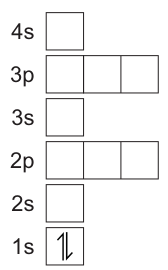
Complete the diagram to show the number and relative energies of the electrons in an isolated atom of .
Working
Si (Z = 14):
Answer
- : ↑↓ (already given)
- : ↑↓
- : ↑↓ ↑↓ ↑↓
- : ↑↓
- : ↑ ↑ (two unpaired electrons in separate orbitals, parallel spins)
- : empty
1s: ↑↓, 2s: ↑↓, 2p: ↑↓ ↑↓ ↑↓, 3s: ↑↓, 3p: ↑ ↑, 4s: empty
Background Concept
The electrons-in-boxes (orbital) diagram represents each orbital as a box and each electron as an arrow (↑ or ↓) indicating its spin. Electrons fill orbitals following three rules: the Aufbau principle (lowest energy first), the Pauli exclusion principle (maximum two electrons per orbital with opposite spins), and Hund's rule (degenerate orbitals are singly occupied with parallel spins before pairing occurs).
Understanding the Question
We are given an empty energy-level diagram for silicon with boxes for 1s, 2s, 2p (×3), 3s, 3p (×3), and 4s. The 1s box already shows two paired arrows. We must complete the diagram by placing all 14 electrons correctly.
Approach
Write the configuration of Si, then distribute electrons into the boxes, applying Hund's rule to the 3p subshell which has only 2 electrons in 3 orbitals.
Step-by-Step Reasoning
- Si has 14 electrons: .
- : 2 electrons → ↑↓ (already shown).
- : 2 electrons → ↑↓.
- : 6 electrons fill all three orbitals → ↑↓ ↑↓ ↑↓.
- : 2 electrons → ↑↓.
- : 2 electrons in 3 degenerate orbitals. By Hund's rule, they occupy separate orbitals with parallel spins → ↑ ↑ (third box empty).
- : empty (0 electrons).
Key Takeaways
- Hund's rule is the critical point for the 3p electrons: they must be in separate boxes with the same spin direction.
- The 4s box remains empty for Si (it would only be occupied from potassium onwards).
- Always check the total number of arrows equals the atomic number.
Common Mistakes
- Pairing the two 3p electrons in the same box (violates Hund's rule).
- Drawing the two 3p electrons with opposite spins in separate boxes (violates Hund's rule — spins must be parallel).
- Placing electrons in 4s before filling 3p.
- Forgetting to fill 2p completely before moving to 3s.
Things to Be Careful About
- The two 3p electrons must be shown as single arrows (↑) in two different boxes, not as a pair in one box. The third 3p box must remain empty.
- Mark schemes typically award 1 mark for correct filling of all paired orbitals and 1 mark specifically for correct Hund's rule application in 3p.
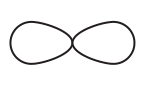
The diagram shows a type of orbital.
State the total number of electrons that exist in all orbitals of this type in an atom of .
Working
The diagram shows a p-orbital (dumbbell / figure-of-eight shape).
F (Z = 9):
Total electrons in p-orbitals = 5
Answer
5
5
Background Concept
An s-orbital is spherical, a p-orbital has a dumbbell (figure-of-eight) shape with two lobes on opposite sides of the nucleus, and a d-orbital typically has a four-lobed cloverleaf shape (or a dumbbell with a torus). The diagram in the question shows the characteristic two-lobed shape of a p-orbital.
Understanding the Question
We must identify the orbital type from its shape (p-orbital), then determine how many electrons in total occupy all orbitals of that type in a fluorine atom.
Approach
- Identify the shape as a p-orbital.
- Write the electron configuration of F.
- Sum all electrons in p-subshells.
Step-by-Step Reasoning
- The figure-of-eight / dumbbell shape identifies this as a p-orbital.
- Fluorine (Z = 9) has configuration .
- The only p-subshell occupied is , which contains 5 electrons.
- Total electrons in all p-orbitals = 5.
Key Takeaways
- Shape recognition: spherical = s, dumbbell = p, cloverleaf = d.
- The question asks for total electrons in ALL orbitals of that type, not the number of orbitals.
Common Mistakes
- Answering 3 (the number of p-orbitals) instead of 5 (the number of electrons in them).
- Misidentifying the shape as a d-orbital (which has four lobes, not two).
- Forgetting to sum across all p-subshells (though for F, only 2p is occupied).
Things to Be Careful About
- 'Total number of electrons' means sum the superscripts of all p-subshells, not count orbitals.
The first ionisation energies of elements in the first row of the d block ( to ) are very similar. For all these elements, it is a 4s electron that is lost during the first ionisation.
Suggest why the first ionisation energies of these elements are very similar.
Answer
- Nuclear charge (number of protons) increases across the series.
- Additional electrons are added to the inner 3d subshell (n = 3).
- These 3d electrons provide increased shielding of the outer 4s electron from the nucleus.
- The increased nuclear charge is effectively offset by the increased shielding, so the overall attraction for the 4s electron remains similar across the series.
(Any three of the above points.)
Nuclear charge increases, but extra 3d electrons increase shielding of the 4s electron, so overall attraction for the outer 4s electron remains similar.
Background Concept
First ionisation energy is the energy required to remove the most loosely held electron from a gaseous atom. Across a period, IE generally increases because nuclear charge increases while shielding stays roughly constant. However, in the d-block (transition metals), the added electrons go into an inner (n–1)d subshell rather than the outermost shell. These inner electrons shield the outer s-electrons effectively, counteracting the increased nuclear charge.
Understanding the Question
We are told that for Sc through Cu, it is always a 4s electron that is removed. We must explain why the first ionisation energies are very similar despite the increasing atomic number. The mark scheme expects three distinct points.
Approach
Identify three competing factors: (1) nuclear charge increases, (2) inner 3d electrons are added, (3) these provide extra shielding. The net effect is that the 4s electron experiences roughly the same effective nuclear charge throughout the series.
Step-by-Step Reasoning
- Nuclear charge increases: As we move from Sc (Z = 21) to Cu (Z = 29), protons are added to the nucleus, which would tend to increase the attraction on the outer 4s electron and raise the IE.
- Extra electrons enter the inner 3d subshell: The additional electrons do not go into the 4s or 4p (outer) shell but into the 3d subshell, which is inside the 4s shell (n = 3 vs n = 4).
- Increased shielding: These 3d electrons shield the 4s electron from the full nuclear charge. The shielding effect increases roughly in proportion to the nuclear charge increase.
- Net result: The effective nuclear charge experienced by the 4s electron changes very little across the series, so the energy needed to remove it (first IE) remains approximately constant.
Key Takeaways
- In the d-block, added electrons go into an inner subshell, so they shield rather than add to the outer electron's experience of nuclear charge.
- The balance between increasing nuclear charge and increasing shielding from inner d-electrons explains the flat IE trend.
- This is different from the s- and p-blocks where added electrons go into the same shell and provide poor shielding, causing IE to rise.
Common Mistakes
- Saying 'shielding increases' without specifying that it is the 3d (inner shell) electrons that provide the extra shielding.
- Saying 'the number of electrons increases' without specifying they go into an inner shell.
- Omitting the point about nuclear charge increasing — the question requires showing both the opposing factors.
- Attributing the similarity to the 4s electrons being in the same shell — the key is that the ADDED electrons are in a DIFFERENT (inner) shell.
Things to Be Careful About
- The mark scheme awards one mark per correct bullet point (max 3). All three must be distinct: (i) nuclear charge increases, (ii) extra electrons in inner shell/3d, (iii) increased shielding → similar overall attraction. Simply saying 'shielding increases' without linking it to the inner d-electrons may not earn the second mark.
Hydron is a general term used to represent the ions , and .
State, in terms of subatomic particles in the nucleus, what is the same about each of these ions and what is different.
same ..........................................................................................................................................
different ......................................................................................................................................
Answer
Same: number of protons (all have 1 proton).
Different: number of neutrons ( has 0, has 1, has 2 neutrons).
Same: number of protons. Different: number of neutrons.
Background Concept
Isotopes are atoms of the same element (same proton number) with different nucleon numbers due to different numbers of neutrons in the nucleus. The three isotopes of hydrogen — protium (), deuterium (), and tritium () — all have one proton but differ in neutron count (0, 1, 2 respectively). The term 'hydron' collectively refers to the ions , , and .
Understanding the Question
We must state what is the same and what is different about these three ions, specifically in terms of subatomic particles in the nucleus. The mark scheme requires the answer to be expressed in terms of protons and neutrons (not electrons or overall charge).
Approach
Compare the nuclear composition of each ion: has 1 proton and 0 neutrons; has 1 proton and 1 neutron; has 1 proton and 2 neutrons.
Step-by-Step Reasoning
- All three are hydrogen isotopes, so they all have the same proton number = 1. This is the 'same'.
- The mass numbers differ (1, 2, 3), which means the number of neutrons differs (0, 1, 2). This is the 'different'.
- Since the question specifies 'in terms of subatomic particles in the nucleus', we must refer to protons and neutrons, not electrons.
Key Takeaways
- Isotopes differ only in neutron number; proton number is identical.
- The question specifically asks about the nucleus, so answers about electrons or ionic charge would not be credited.
Common Mistakes
- Saying 'same number of electrons' — the question restricts to nuclear particles.
- Saying 'same charge' — again, not about subatomic particles in the nucleus.
- Saying 'different mass' without specifying neutrons — the mark scheme requires the answer in terms of subatomic particles.
Things to Be Careful About
- The question explicitly says 'in terms of subatomic particles in the nucleus'. Answers must mention protons and neutrons specifically. Saying 'same atomic number' or 'different mass number' without naming the particles may not gain credit.
The rest of this paper
3 more questions- Q2Chemical Periodicity · States of Matter · Group 2 · Atoms, Molecules and Stoichiometry14M
- Q3Atoms, Molecules and Stoichiometry · States of Matter · Chemical Periodicity · Equilibria · Hydroxy Compounds · Introduction to Organic Chemistry · Hydrocarbons · Chemical Bonding17M
- Q4Hydroxy Compounds · Carbonyl Compounds · Carboxylic Acids and Derivatives · Introduction to Organic Chemistry · Hydrocarbons · Analytical Techniques17M