Chemistry 9701/22 — May/June 2020
Cambridge AS Level · AS Level Structured Questions · worked solutions for every part, with the mark scheme
Topics Atoms, Molecules and Stoichiometry · Introduction to Organic Chemistry · Chemical Bonding · Halogen Compounds · Hydrocarbons · Atomic Structure · +11 more
Gallium is an element in Group 13.
A sample of gallium is analysed using a mass spectrometer. The mass spectrum produced is shown.
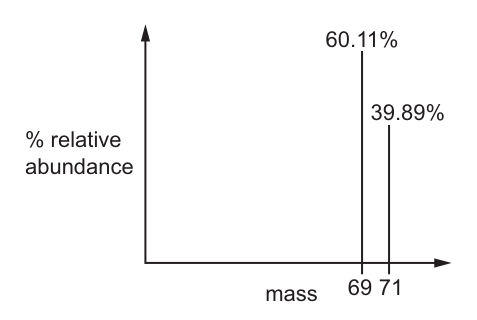
Explain what is meant by the term relative atomic mass.
Calculate the relative atomic mass of gallium in this sample. Give your answer to 4 significant figures.
Show your working.
Complete the table which describes a gaseous atom of gallium.
| isotope | nucleon number | total number of electrons in lowest energy level | type of orbital which contains the electron in the highest energy level |
|---|---|---|---|
When gallium is heated in excess chlorine, gallium trichloride, , is made.
Draw the shape of the gallium trichloride molecule and suggest the bond angle.
shape of molecule
bond angle .................................................................
Gallium oxide, , and aluminium oxide react in the same way with and with .
Suggest the equation for the reaction between and .
Suggest an equation for the reaction between gallium oxide and .
The rest of this paper
4 more questions- Q2Nitrogen and Sulfur · Chemical Bonding · Electrochemistry · Atoms, Molecules and Stoichiometry · States of Matter12M
- Q3Introduction to Organic Chemistry · Reaction Kinetics · Chemical Energetics · Atoms, Molecules and Stoichiometry12M
- Q4Group 17 · Atoms, Molecules and Stoichiometry · Halogen Compounds · Introduction to Organic Chemistry · Hydrocarbons12M
- Q5Hydrocarbons · Hydroxy Compounds · Halogen Compounds · Carbonyl Compounds · Introduction to Organic Chemistry · Nitrogen Compounds · Carboxylic Acids and Derivatives12M