Chemistry 9701/22 — October/November 2019
Cambridge AS Level · AS Level Structured Questions · worked solutions for every part, with the mark scheme
Topics Atoms, Molecules and Stoichiometry · States of Matter · Hydrocarbons · Nitrogen and Sulfur · Equilibria · Chemical Periodicity · +14 more
In the Periodic Table, the p block contains elements whose outer electrons are found in the p subshell.
Elements in the p block show a general increase in first ionisation energy as the atomic number increases.
Draw the shape of a p orbital.
Answer
A vertical figure-of-eight shape consisting of two lobes of equal size on opposite sides of a central nucleus.
See diagram
Background Concept
Electrons in atoms occupy atomic orbitals, which are regions of space where there is a high probability of finding an electron. The shape of these orbitals depends on the subshell: s orbitals are spherical, p orbitals are dumb-bell or figure-of-eight shaped, and d orbitals have more complex clover-leaf shapes. A p subshell contains three orbitals (, , ), each oriented along a different Cartesian axis. They all share the characteristic dumb-bell shape with a nodal plane at the nucleus where the probability of finding the electron is zero.
Understanding the Question
The question simply asks you to draw the shape of a p orbital. This is a direct recall question testing your knowledge of atomic orbital geometry.
Approach
Recall the standard representation of a p orbital: two lobes on opposite sides of the nucleus, aligned along a single axis. Draw it clearly and label the nucleus if required, though the shape itself is the primary mark.
Step-by-Step Reasoning
- Draw a vertical line or axis to represent the orientation (e.g., the y-axis or z-axis).
- Draw two oval or teardrop-shaped lobes, one above and one below the origin (nucleus).
- Ensure the lobes are symmetrical and meet at the nucleus (the nodal plane).
- The mark scheme accepts a simple vertical figure-of-eight shape.
Key Takeaways
- s orbitals are spherical.
- p orbitals are dumb-bell shaped (figure-of-eight) with two lobes.
- The nucleus sits at the center (nodal plane) between the two lobes.
Common Mistakes
- Drawing a single lobe (this is incorrect; p orbitals always have two lobes).
- Drawing the lobes with significantly different sizes.
- Forgetting to show the nucleus or the nodal plane at the center.
Things to Be Careful About
- Keep the drawing clear and symmetrical.
- Do not overcomplicate it; a simple, clean figure-of-eight is exactly what is expected and awarded.
Write an equation to show the first ionisation energy of silicon.
Answer
Si(g) -> Si+(g) + e-
Background Concept
The first ionisation energy is defined as the enthalpy change when one mole of gaseous atoms in the ground state loses one mole of electrons to form one mole of gaseous 1+ ions. The equation must represent this process for a single atom, using appropriate state symbols.
Understanding the Question
You are asked to write the chemical equation that represents the first ionisation energy of silicon. This means removing one electron from a gaseous silicon atom.
Approach
Write the symbol for silicon in the gaseous state on the left, and the silicon 1+ ion and an electron on the right. Ensure all state symbols are correct.
Step-by-Step Reasoning
- Reactant: Silicon atom in the gaseous state: .
- Products: Silicon 1+ ion in the gaseous state: , and an electron: .
- Combine with an arrow: .
- Check state symbols: All must be (g). The electron has no state symbol.
Key Takeaways
- First ionisation energy always starts with a gaseous atom.
- The product is a gaseous 1+ ion and an electron.
- State symbols are mandatory and must be correct.
Common Mistakes
- Forgetting state symbols (especially (g) for the atom and ion).
- Writing the equation for the second ionisation energy (e.g., ).
- Including or other incorrect electron representations.
Things to Be Careful About
- The charge on the ion must be 1+ (written as +, not 2+ or 0).
- The electron is written as , not with a state symbol.
- Ensure the equation is balanced (it is, by definition, for a single atom).
Explain why there is a general increase in first ionisation energies of the elements across Period 3.
Answer
- The shielding effect by inner-shell electrons remains similar (or constant) across the period.
- The proton number (nuclear charge) increases.
- This results in a greater electrostatic attraction between the nucleus and the outer (valence) electrons, requiring more energy to remove them.
Similar shielding, increased nuclear charge, increased nuclear attraction.
Background Concept
Ionisation energy is the energy required to remove an electron from a gaseous atom. Across a period (left to right), the first ionisation energy generally increases. This is because electrons are being added to the same principal energy level (same shell), while protons are being added to the nucleus. The inner electrons shield the outer electrons from the full nuclear charge, but since the shielding electrons are in the same or inner shells and the number of inner shells doesn't change across a period, the shielding effect remains relatively constant.
Understanding the Question
You need to explain why the first ionisation energy generally increases across Period 3 (from Na to Ar). This is a standard periodicity explanation requiring two key points.
Approach
Identify what changes across the period (proton number/nuclear charge) and what stays roughly the same (shielding). Then link these to the force of attraction on the outer electron.
Step-by-Step Reasoning
- Shielding: As we move across Period 3, electrons are added to the same outer shell (n=3). The inner shells (n=1 and n=2) remain unchanged. Therefore, the shielding effect from inner electrons is similar (or constant) across the period.
- Nuclear charge: The proton number increases from 11 (Na) to 18 (Ar). This means the nuclear charge increases.
- Attraction: With similar shielding but a greater nuclear charge, the effective nuclear charge felt by the outer electrons increases. This leads to a stronger electrostatic attraction between the nucleus and the outer electrons.
- Energy required: Because the attraction is stronger, more energy is required to overcome it and remove the outer electron, hence the ionisation energy increases.
Key Takeaways
- Across a period, shielding is roughly constant.
- Nuclear charge increases across a period.
- Increased nuclear charge with constant shielding leads to increased attraction and higher ionisation energy.
Common Mistakes
- Saying "electrons are closer to the nucleus" (this is not the primary reason; the primary reason is increased nuclear charge with constant shielding).
- Saying "shielding decreases" (shielding is roughly constant across a period).
- Forgetting to mention both shielding and nuclear charge; one point is not enough for full marks.
Things to Be Careful About
- Use precise terminology: "nuclear charge" or "proton number", not just "more protons".
- Specify that shielding is "similar" or "constant", not that it changes.
- Link the increased attraction directly to the increased energy required.
Element A is in the p block.
The graph shows the successive ionisation energies for the removal of the first ten electrons of A.
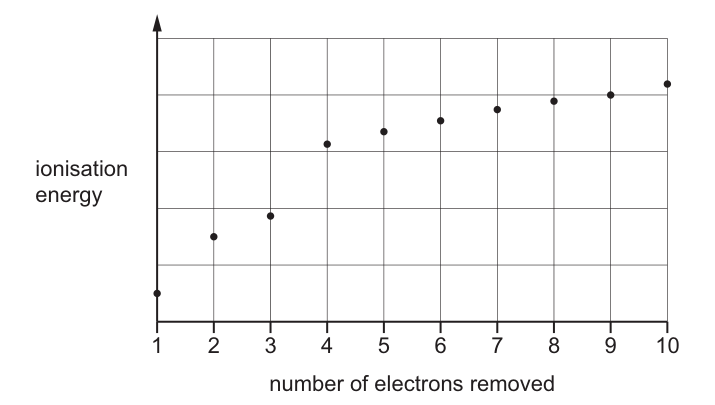
State and explain the group of the Periodic Table that element A belongs to.
group number .............................
explanation .........................................................................................................................
Answer
group number: 3 (or 13)
explanation: There is a large increase in ionisation energy between the removal of the third and fourth electrons (or after the third electron is removed). This indicates that the fourth electron is being removed from a new, inner electron shell that is closer to the nucleus and experiences less shielding.
Group 3 (or 13)
Background Concept
Successive ionisation energies are the energies required to remove electrons one by one from a gaseous atom. When an electron is removed from a new principal energy level (a shell closer to the nucleus), there is a large jump in ionisation energy because the electron is much closer to the nucleus and experiences significantly less shielding from inner electrons. The number of electrons removed before this large jump indicates the number of electrons in the outer shell, which corresponds to the group number (for main group elements).
Understanding the Question
You are given a graph of successive ionisation energies for the first ten electrons of element A. You need to identify the group number and explain your reasoning based on the graph.
Approach
Look for the largest jump (increase) in ionisation energy on the graph. Count how many electrons have been removed before this jump. That number equals the number of outer shell electrons, which gives the group number.
Step-by-Step Reasoning
- Analyze the graph: The x-axis is the number of electrons removed (1 to 10). The y-axis is the ionisation energy.
- Identify the jump: Look for the largest vertical increase between consecutive points. In Fig 1.1, there is a clear, large jump between the 3rd and 4th electrons removed. The first three electrons have relatively low and gradually increasing ionisation energies. The 4th electron requires a significantly higher energy to remove.
- Deduce outer electrons: The large jump after the 3rd electron means the first three electrons were removed from the outer shell, and the 4th electron is being removed from an inner shell. Therefore, element A has 3 electrons in its outer shell.
- Determine group number: Elements with 3 outer electrons belong to Group 3 (or Group 13 in the newer IUPAC numbering).
- Explain: State that there is a large increase between the 3rd and 4th ionisation energies, indicating removal from a new, inner shell closer to the nucleus.
Key Takeaways
- A large jump in successive ionisation energies indicates a change in principal energy level (shell).
- The number of electrons removed before the jump equals the number of outer shell electrons.
- For main group elements, outer shell electrons = group number (Group 3 or 13).
Common Mistakes
- Misreading the graph and identifying the wrong jump (e.g., looking at a small gradual increase instead of the large jump).
- Counting the wrong number of electrons (e.g., saying 4 outer electrons because the jump is at 4, instead of 3).
- Forgetting to explain why there is a jump (inner shell, closer to nucleus, less shielding).
Things to Be Careful About
- Group number can be written as 3 or 13; both are acceptable in CIE.
- The explanation must mention the new inner shell or the change in energy level.
- Do not just say "it has 3 outer electrons" without explaining the significance of the jump in ionisation energy.
Silicon is found in many compounds in the Earth’s crust. Silicon has only three naturally occurring isotopes, , and .
The table shows data for , and .
| relative isotopic mass | 28.0 | 29.0 | 30.0 |
A sample of silicon contains 92.2% . The total percentage abundance of and in the sample is 7.8%.
The relative atomic mass, , of silicon in the sample is 28.09.
Calculate the percentage abundance of .
Give your answer to one decimal place.
Working
Let be the percentage abundance of and be the percentage abundance of .
From the data:
The relative atomic mass is given by:
From (1), . Substitute into (2):
Answer
The percentage abundance of is 1.2%.
1.2%
Background Concept
The relative atomic mass () of an element is the weighted average of the masses of its naturally occurring isotopes, relative to the mass of a atom. It is calculated using the formula:
When dealing with multiple isotopes, you may need to use simultaneous equations if the individual abundances are not all given.
Understanding the Question
You are given the relative isotopic masses of three silicon isotopes (, , ) and the percentage abundance of (92.2%). The total abundance of the other two is 7.8%, and the overall is 28.09. You need to find the percentage abundance of .
Approach
Set up two equations: one for the sum of the unknown abundances, and one for the relative atomic mass. Solve the simultaneous equations to find the abundance of .
Step-by-Step Reasoning
- Define variables: Let abundance of and abundance of .
- Equation 1 (total abundance): .
- Equation 2 ( formula):
- Simplify Equation 2:
- Substitute into Equation 2:
- Check: .
. Correct.
Key Takeaways
- is a weighted average of isotopic masses.
- When total abundance is given but not individual abundances, use simultaneous equations.
- Always check your answer by recalculating .
Common Mistakes
- Forgetting to divide by 100 in the formula.
- Using atomic numbers instead of isotopic masses in the calculation.
- Algebraic errors when solving simultaneous equations.
- Rounding too early (keep full precision until the final answer).
Things to Be Careful About
- The question asks for the answer to one decimal place. is already to one decimal place.
- Ensure the units are correct (percentage abundance is a percentage, so include the % sign in the final answer if required, though the number itself is often accepted).
- Mark scheme allows error carried forward (ecf) if an earlier value is wrong but used correctly.
Silicon reacts with nitrogen gas to form .
is a solid with a melting point of 1900 °C. It is insoluble in water and does not conduct electricity when molten.
Suggest the type of bonding in and structure of . Explain your answer.
Answer
- Structure: Giant (molecular) structure (or giant lattice).
- Bonding: Strong covalent bonds between atoms.
- Explanation: There are no mobile charged particles (or delocalised electrons) to carry charge, so it does not conduct electricity when molten. The strong covalent bonds throughout the giant structure require a large amount of energy to break, giving it a high melting point.
Giant covalent structure; strong covalent bonds; no mobile charged particles.
Background Concept
The physical properties of a substance are determined by its structure and the type of bonding present.
- High melting/boiling points indicate strong bonds or forces holding the particles together.
- Conductivity requires mobile charged particles (ions or delocalised electrons).
- Insolubility in water and non-conductivity when molten rule out ionic compounds (which conduct when molten and often dissolve in water) and metals (which conduct when molten).
- A giant covalent structure (like diamond or silicon dioxide) has high melting points due to strong covalent bonds, does not conduct electricity (no mobile charges), and is often insoluble.
Understanding the Question
Silicon nitride () has a melting point of 1900 °C, is insoluble in water, and does not conduct when molten. You need to suggest its bonding and structure and explain your answer.
Approach
Use the physical properties to deduce the structure and bonding:
- High melting point -> strong bonds.
- No conductivity when molten -> no mobile ions or electrons -> not ionic, not metallic.
- Conclusion -> giant covalent structure with strong covalent bonds.
Step-by-Step Reasoning
- Melting point (1900 °C): This is very high, indicating that strong bonds must be broken to melt the substance. This suggests a giant structure (giant lattice) rather than a simple molecular structure (which would have low melting points due to weak intermolecular forces).
- Conductivity when molten: It does not conduct electricity when molten. Ionic compounds conduct when molten because the ions become mobile. Metals conduct due to delocalised electrons. Since does not conduct, it has no mobile charged particles or delocalised electrons. This rules out ionic and metallic bonding.
- Structure and bonding: The combination of high melting point (strong bonds) and no molten conductivity (no mobile charges) points to a giant covalent structure (also called a macromolecular structure). In this structure, atoms are bonded together by strong covalent bonds in a continuous network.
- Explanation: The high melting point is due to the large amount of energy required to break the strong covalent bonds throughout the giant lattice. The lack of conductivity is because there are no mobile charged particles (ions) or delocalised electrons to carry the electric current.
Key Takeaways
- High melting point + no molten conductivity = giant covalent structure.
- Ionic compounds conduct when molten; covalent compounds (simple or giant) generally do not.
- Giant covalent structures have strong covalent bonds throughout.
Common Mistakes
- Saying "covalent bonding" without specifying "giant" structure (simple molecular covalent compounds have low melting points).
- Saying "no electrons" (there are bonding electrons, just no mobile or delocalised electrons).
- Confusing giant covalent with ionic (ionic conducts when molten).
Things to Be Careful About
- Use precise terminology: "giant covalent structure" or "giant lattice", not just "covalent".
- Specify "strong covalent bonds" (not just "bonds").
- Explain that there are "no mobile charged particles" or "no delocalised electrons" for the conductivity point.
- The mark scheme awards marks for: giant structure (M1), strong covalent bonds (M2), no mobile charged particles (M3).
Sulfur-containing compounds, such as , are found in fossil fuels, and produce when they are burned.
Write the equation to show the complete combustion of .
Answer
C2H5SH + 4.5O2 -> 2CO2 + 3H2O + SO2
Background Concept
Complete combustion of an organic compound containing C, H, and S in excess oxygen produces carbon dioxide (), water (), and sulfur dioxide (). The equation must be balanced so that the number of atoms of each element is the same on both sides.
Understanding the Question
You are asked to write the balanced equation for the complete combustion of ethanethiol (). Note that the molecular formula can be written as .
Approach
- Write the unbalanced equation with correct products.
- Balance carbon atoms.
- Balance hydrogen atoms.
- Balance sulfur atoms.
- Balance oxygen atoms.
Step-by-Step Reasoning
-
Unbalanced equation:
(Note: is the same as )
-
Balance Carbon: 2 C on left -> 2 on right.
-
Balance Hydrogen: 6 H on left -> 3 on right.
-
Balance Sulfur: 1 S on left -> 1 on right (already balanced).
-
Balance Oxygen: Right side has oxygen atoms. Left side needs molecules.
Alternatively, multiply by 2 to get whole numbers: . Both are acceptable, but the mark scheme shows the fractional coefficient for .
Key Takeaways
- Complete combustion of C, H, S compounds gives , , and .
- Balance C, then H, then S, then O last.
- Fractional coefficients for are acceptable when balancing for 1 mole of the organic compound.
Common Mistakes
- Producing instead of (complete combustion of sulfur compounds typically gives unless specified otherwise or in the presence of a catalyst).
- Incorrectly counting hydrogen atoms (e.g., counting as having 5 H instead of 6).
- Balancing oxygen incorrectly.
Things to Be Careful About
- The molecular formula has 6 hydrogen atoms (5 + 1), not 5.
- Ensure the equation is balanced for all elements.
- State symbols are not explicitly required in the mark scheme for this part, but adding them is good practice if you know them (though , , are gases, could be gas or liquid depending on conditions; usually (g) for combustion is fine).
State why the presence of in the atmosphere has environmental consequences. Describe one of the consequences on the environment.
Answer
Why it has consequences: reacts with water vapour (or rain) in the atmosphere to form sulfuric acid (or sulfurous acid), leading to acid rain.
One consequence:
- Lowers the pH of rivers, lakes, and soil, harming aquatic life (fish) and plants.
- OR: Leaches toxic aluminium ions from soil into water bodies.
- OR: Damages, weathers, or erodes buildings and statues (especially those made of limestone/marble).
- OR: Damages crops and forests (deforestation).
Causes acid rain; lowers pH of water bodies / damages buildings / kills aquatic life.
Background Concept
Sulfur dioxide () is a pollutant produced by the combustion of fossil fuels containing sulfur impurities (like coal and oil). In the atmosphere, is oxidised to , which then reacts with water vapour to form sulfuric acid (). This leads to acid rain (pH < 5.6). Acid rain has severe environmental and economic consequences.
Understanding the Question
You need to state why is environmentally harmful and describe one specific consequence of this harm.
Approach
- State the primary mechanism: formation of acid rain.
- List one or more specific consequences from the standard list (ecological, structural, or agricultural impacts).
Step-by-Step Reasoning
-
Why is harmful: is an acidic oxide. When released into the atmosphere, it reacts with oxygen and water vapour to form sulfuric acid (and sulfurous acid). This falls as acid rain.
- Equation (optional but good context):
-
Consequences of acid rain (choose one for the answer):
- Aquatic ecosystems: Lowers the pH of rivers, lakes, and oceans. This can kill fish and other aquatic organisms. It also leaches toxic aluminium ions from soil into the water, which is lethal to fish.
- Terrestrial ecosystems: Lowers soil pH, leaching away essential nutrients (like calcium and magnesium) needed by plants. This damages forests and crops (deforestation).
- Structural damage: Acid rain reacts with calcium carbonate in limestone and marble, weathering and eroding buildings, statues, and monuments.
Key Takeaways
- causes acid rain.
- Acid rain lowers pH of water and soil.
- Effects include killing aquatic life, damaging plants, leaching aluminium, and eroding buildings.
Common Mistakes
- Saying "causes global warming" (this is or methane, not ).
- Saying "destroys the ozone layer" (this is CFCs, not ).
- Vague answers like "pollutes the environment" without specifying acid rain or its effects.
- Not providing a specific consequence (e.g., just saying "harmful to the environment" is not enough; must name a specific effect like killing fish or damaging buildings).
Things to Be Careful About
- The question asks for one consequence, but providing the main reason (acid rain) is the first mark.
- Be specific: "lowers pH" is better than "makes water acidic" (though both may be accepted, precise terminology is safer).
- Ensure the consequence is directly linked to acid rain or pollution.
can react with ozone, , to form in two different reactions.
In one reaction, reacts with until a dynamic equilibrium is established.
State and explain the effect of an increase in pressure on the composition of the equilibrium mixture.
Answer
Effect: No effect (or none).
Explanation: There are equal numbers of moles of gas on both sides of the equilibrium equation (2 moles on the left and 2 moles on the right). Therefore, a change in pressure does not shift the position of the equilibrium.
No effect; equal moles of gas on both sides.
Background Concept
Le Chatelier's principle states that if a dynamic equilibrium is disturbed by changing the conditions, the position of equilibrium shifts to counteract the change. For pressure changes, only reactions involving gases are affected. The system will shift towards the side with fewer moles of gas to reduce the pressure. If the number of moles of gas is the same on both sides, a change in pressure has no effect on the equilibrium position.
Understanding the Question
You are given the equilibrium: . You need to state and explain the effect of an increase in pressure on the composition of the equilibrium mixture.
Approach
- Count the total moles of gas on the reactant side (left).
- Count the total moles of gas on the product side (right).
- Compare the two sides and apply Le Chatelier's principle.
Step-by-Step Reasoning
- Reactant side (left): 1 mole + 1 mole = 2 moles of gas.
- Product side (right): 1 mole + 1 mole = 2 moles of gas.
- Comparison: The number of moles of gas is equal on both sides (2 = 2).
- Application of Le Chatelier's principle: An increase in pressure would normally shift the equilibrium to the side with fewer moles of gas to reduce the pressure. Since both sides have the same number of moles, there is no side to shift towards. Therefore, the position of equilibrium does not change, and the composition of the mixture remains the same.
Key Takeaways
- Pressure only affects equilibria with different numbers of moles of gas on each side.
- Count gaseous moles only; ignore solids and liquids.
- Equal moles of gas on both sides = no effect from pressure change.
Common Mistakes
- Saying the equilibrium shifts to the right or left without justification.
- Forgetting to count the moles of gas correctly (e.g., missing a coefficient).
- Saying "pressure has no effect on all equilibria" (it only has no effect when moles of gas are equal).
Things to Be Careful About
- Ensure you only count gaseous species. (All species in this equation are gases, so this is straightforward, but always check state symbols).
- The explanation must explicitly mention the number of moles of gas on both sides.
- "No effect" is the correct statement for the composition; do not say "equilibrium is not established" or similar nonsense.
In the other reaction, a different equilibrium is established at 300 K as shown.
Suggest a temperature needed to increase the yield of at equilibrium.
Explain your answer.
Answer
Temperature: Any temperature higher than 300 K (e.g., 400 K, 500 K, etc.).
Explanation: The forward reaction is endothermic (). According to Le Chatelier's principle, increasing the temperature shifts the equilibrium to the right (the endothermic direction) to absorb the added heat, thereby increasing the yield of .
Temperature > 300 K; forward reaction is endothermic, so equilibrium shifts right.
Background Concept
Le Chatelier's principle also applies to temperature changes. For an endothermic reaction (), heat is absorbed in the forward direction. Increasing the temperature adds heat to the system, so the equilibrium shifts in the endothermic direction (forward) to absorb the excess heat. For an exothermic reaction (), increasing the temperature shifts the equilibrium in the reverse (endothermic) direction.
Understanding the Question
You are given the equilibrium: . The current temperature is 300 K. You need to suggest a temperature to increase the yield of and explain why.
Approach
- Identify whether the forward reaction is endothermic or exothermic from the sign of .
- Determine how increasing or decreasing temperature affects the equilibrium position.
- Suggest a temperature that shifts the equilibrium to the right (towards products).
Step-by-Step Reasoning
- Enthalpy change: . The positive sign indicates the forward reaction is endothermic (absorbs heat).
- Le Chatelier's principle: To increase the yield of (the product), we need to shift the equilibrium to the right (forward direction).
- Temperature effect: Since the forward reaction is endothermic, increasing the temperature will shift the equilibrium to the right to absorb the added heat.
- Suggest a temperature: The current temperature is 300 K. To shift the equilibrium to the right, we need a temperature higher than 300 K. Any value > 300 K is acceptable (e.g., 400 K, 500 K, 600 K).
- Explanation: State that the forward reaction is endothermic, so increasing temperature shifts the equilibrium to the right (forward direction) to counteract the change, increasing the yield of .
Key Takeaways
- Positive = endothermic forward reaction.
- Increasing temperature shifts equilibrium in the endothermic direction.
- To increase product yield for an endothermic forward reaction, increase temperature.
Common Mistakes
- Saying the forward reaction is exothermic (misreading the sign of ).
- Suggesting a temperature lower than 300 K (this would shift equilibrium to the left, decreasing yield).
- Not explaining why the temperature works (must mention endothermic and shift to right/forward).
- Saying "higher temperature increases the rate" (this is true but doesn't explain the equilibrium shift; must mention position of equilibrium).
Things to Be Careful About
- The question asks for a temperature, not just "increase temperature". Give a specific value > 300 K (e.g., 400 K) or clearly state "any temperature higher than 300 K".
- The explanation must link the endothermic nature of the forward reaction to the shift in equilibrium position.
- Do not confuse this with the previous part (d)(i) where pressure had no effect; here, temperature does affect the equilibrium.
The rest of this paper
3 more questions- Q2Chemical Periodicity · Group 2 · States of Matter · Atoms, Molecules and Stoichiometry · Chemical Bonding11M
- Q3Group 17 · Chemical Bonding · Chemical Periodicity · Electrochemistry · Equilibria · Nitrogen and Sulfur · Halogen Compounds13M
- Q4Halogen Compounds · Hydroxy Compounds · Hydrocarbons · Introduction to Organic Chemistry · Carbonyl Compounds · Atoms, Molecules and Stoichiometry · Polymerisation · Reaction Kinetics · Carboxylic Acids and Derivatives · Analytical Techniques · Nitrogen Compounds17M