Chemistry 9701/23 — May/June 2019
Cambridge AS Level · AS Level Structured Questions · worked solutions for every part, with the mark scheme
Topics Atoms, Molecules and Stoichiometry · States of Matter · Introduction to Organic Chemistry · Atomic Structure · Chemical Bonding · Electrochemistry · +7 more
A sample contains three different types of atom: , and .
State fully, in terms of the numbers of subatomic particles, what these three atoms have in common.
Answer
They all have the same total number of protons and neutrons (a nucleon number of 40).
Same total number of protons and neutrons (nucleon number 40)
Background Concept
Isotopes are atoms of the same element with the same number of protons but different numbers of neutrons. However, this question involves isobars: atoms of different elements that have the same nucleon number (mass number) but different proton numbers. The notation gives the nucleon number (top) and proton number (bottom). The number of neutrons is . For neutral atoms, the number of electrons equals the number of protons.
Understanding the Question
You are given three atoms: , , and . You must state what they have in common and how they differ, specifically using the numbers of subatomic particles (protons, neutrons, electrons).
Approach
Calculate the number of protons, neutrons, and electrons for each atom and compare the sets of numbers.
Step-by-Step Reasoning
- Argon (): , . Protons = 18, Neutrons = , Electrons = 18. Total nucleons = 40.
- Potassium (): , . Protons = 19, Neutrons = , Electrons = 19. Total nucleons = 40.
- Calcium (): , . Protons = 20, Neutrons = , Electrons = 20. Total nucleons = 40.
Comparing these: the number of protons differs (18, 19, 20), the number of neutrons differs (22, 21, 20), and the number of electrons differs (18, 19, 20). The only quantity that is the same for all three is the sum of protons and neutrons (the nucleon number, 40).
Key Takeaways
Isobars have the same mass number (total nucleons) but different atomic numbers. When asked what isomers or isobars have in common in terms of particles, always check the total count of nucleons.
Common Mistakes
Students often assume that because the mass number is the same, the number of neutrons must be the same. This is incorrect; the number of neutrons is , so if changes, neutrons must change to keep constant.
Things to Be Careful About
The question asks for the answer "in terms of the numbers of subatomic particles". Simply saying "they have the same mass number" might not score if the examiner wants the explicit connection to protons + neutrons. Stating "same total number of protons and neutrons" is the safest phrasing.
State fully, in terms of the numbers of all subatomic particles, how these three atoms differ from each other.
Answer
They have different numbers of protons, different numbers of neutrons, and different numbers of electrons.
Different numbers of protons, neutrons, and electrons
Background Concept
As established in part (i), for a neutral atom with notation :
- Number of protons =
- Number of electrons = (since the atom is neutral)
- Number of neutrons =
Understanding the Question
You need to state how the three atoms differ, explicitly mentioning the numbers of all subatomic particles (protons, neutrons, electrons).
Approach
List the three types of particles and state that their counts are different for each atom, as calculated in part (i).
Step-by-Step Reasoning
- Protons: 18, 19, 20 (different)
- Neutrons: 22, 21, 20 (different)
- Electrons: 18, 19, 20 (different)
Therefore, they differ in the number of protons, the number of neutrons, and the number of electrons.
Key Takeaways
Isobars differ in proton number, which forces a difference in neutron number (to maintain the same mass number) and electron number (to maintain neutrality).
Common Mistakes
Forgetting to mention electrons. The question asks for "all subatomic particles". Also, do not say they have different mass numbers; they have the same mass number.
Things to Be Careful About
Ensure you mention all three particles: protons, neutrons, and electrons. Omitting one may cost a mark.
A sample of sulfur contains only two isotopes, and . The relative atomic mass of this sample is 32.09.
| isotope | isotopic mass |
|---|---|
| 32.0 | |
| 34.0 |
Calculate the percentage abundance of the isotopes present in this sample.
Working
Let be the percentage abundance of . Then the percentage abundance of is .
The equation for relative atomic mass is:
Multiply both sides by 100:
Rearrange to solve for :
Percentage abundance of = .
Answer
: 95.5%
: 4.5%
32S: 95.5%, 34S: 4.5%
Background Concept
The relative atomic mass () of an element is the weighted average of the isotopic masses of its naturally occurring isotopes, relative to of the mass of a atom. The formula is:
Alternatively, if using fractional abundances ( where ):
Understanding the Question
You are given a sample of sulfur with two isotopes ( and ) and the overall relative atomic mass (32.09). You need to calculate the percentage abundance of each isotope.
Approach
Define a variable for the percentage abundance of one isotope (e.g., for ). Express the other abundance in terms of (). Substitute these into the equation and solve for .
Step-by-Step Reasoning
- Set up the equation: Let be the % abundance of . The % abundance of is .
- Clear the denominator: Multiply by 100.
- Combine like terms: .
- Solve for :
- Calculate the other percentage: .
So, is 95.5% and is 4.5%.
Key Takeaways
Always ensure the percentages sum to 100%. Using and is a robust method for two-isotope problems.
Common Mistakes
- Forgetting to divide by 100 in the weighted average formula (or multiplying the right side by 100 incorrectly).
- Rounding errors during intermediate steps. Keep precision until the final answer.
- Forgetting to calculate the percentage of the second isotope (giving only 95.5% and no mark for the second value).
Things to Be Careful About
The isotopic masses are given as 32.0 and 34.0. Use these exact values. The final answer should be to an appropriate number of significant figures (usually 3 or 4, here 95.5% and 4.5% are exact based on the calculation).
The electronic configuration of a sulfur atom is .
Identify which orbital in a sulfur atom has the lowest energy.
Answer
1s orbital
1s
Background Concept
In a multi-electron atom, orbital energy depends primarily on the principal quantum number () and the azimuthal quantum number (). The general order of increasing energy is The orbital with the lowest energy is always the 1s orbital, as it is closest to the nucleus and has no radial nodes.
Understanding the Question
Given the configuration , identify the orbital with the lowest energy.
Approach
Look at the configuration. The first subshell listed is 1s, which is always the lowest energy level in any atom.
Step-by-Step Reasoning
The configuration is written in order of increasing energy: . Therefore, the 1s orbital has the lowest energy.
Key Takeaways
Electronic configurations are typically written in order of increasing energy. The first term is always the lowest energy orbital.
Common Mistakes
Confusing lowest energy with highest energy (which would be 3p). Or thinking 2s is lower than 1s.
Things to Be Careful About
Just write "1s" or "1s orbital".
Sketch the shape of a p orbital.
Answer
Dumbbell (or figure-of-eight) shape with two lobes
Background Concept
Atomic orbitals have characteristic shapes defined by the probability density of finding an electron.
- s orbitals are spherical.
- p orbitals are dumbbell-shaped (or figure-of-eight), consisting of two lobes on opposite sides of the nucleus, with a nodal plane passing through the nucleus where the probability of finding an electron is zero.
- There are three p orbitals (), oriented along the x, y, and z axes respectively.
Understanding the Question
Sketch the shape of a p orbital.
Approach
Draw a dumbbell shape. This can be represented as an outline of two touching circles/ovals (figure-of-eight) or as two shaded lobes meeting at a point (the nucleus/nodal plane).
Step-by-Step Reasoning
A p orbital has two lobes of electron density separated by a nodal plane at the nucleus.
- Representation 1: An outline drawing resembling a figure-of-eight or a vertical/horizontal dumbbell.
- Representation 2: Two shaded (grey) lobes meeting at a central point.
Both representations are acceptable in CIE exams. Ensure the drawing clearly shows two distinct lobes.
Key Takeaways
p orbitals are dumbbell-shaped. s orbitals are spherical. d orbitals are more complex (cloverleaf or dumbbell with donut).
Common Mistakes
Drawing a sphere (that's an s orbital). Drawing three lobes (that's a d orbital). Forgetting the nodal plane (the point where they meet).
Things to Be Careful About
The sketch must clearly show two lobes. Labeling is not strictly required for a simple shape sketch unless asked, but drawing axes can help clarity. The provided image in the mark scheme shows both an outline and a shaded version.
During the process of ionisation a sulfur atom loses an electron.
Identify the orbital from which this electron is removed. Explain your answer.
Answer
Orbital: 3p
Explanation: The electron is removed from the 3p orbital because it is the highest energy occupied orbital (or furthest from the nucleus / least attracted to the nucleus), so less energy is required to remove it.
3p; highest energy occupied orbital (least attracted to nucleus)
Background Concept
The first ionisation energy is the energy required to remove one mole of electrons from one mole of gaseous atoms to form one mole of gaseous 1+ ions:
The electron removed is always the one that is easiest to remove, which is the electron in the highest energy occupied orbital (the outermost electron).
Understanding the Question
Given the configuration , identify which orbital the electron comes from during ionisation and explain why.
Approach
- Identify the highest energy subshell in the configuration.
- Explain that electrons in higher energy orbitals are less tightly bound.
Step-by-Step Reasoning
- Identify orbital: The configuration ends in . The subshells in order of energy are . The highest energy occupied orbital is 3p.
- Explanation: The 3p orbital is further from the nucleus than the inner shells (1s, 2s, 2p). Therefore, the electrons in 3p experience more shielding from inner electrons and are less strongly attracted to the nucleus. Alternatively, simply state it is the highest energy orbital, so it takes the least energy to remove an electron from it.
Key Takeaways
First ionisation always removes the outermost electron (highest n, highest l for that n).
Common Mistakes
Saying the electron comes from 3s (incorrect, 3p is higher energy). Giving an explanation like "it's the outermost shell" without mentioning energy or attraction to the nucleus. The mark scheme specifically looks for "less attracted to nucleus" or "highest energy orbital".
Things to Be Careful About
Ensure you specify "3p" and not just "p" or "outer shell". The explanation must link the orbital choice to the energy/attraction.
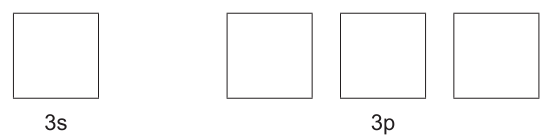
Complete the diagram to show the arrangement of electrons within the third shell of a phosphorus atom.
Answer
3s: 2 paired electrons; 3p: 3 unpaired electrons (one in each box)
Background Concept
Phosphorus (P) has atomic number 15. Its full electronic configuration is .
The third shell () contains the 3s and 3p subshells.
- The 3s subshell has 1 orbital and holds up to 2 electrons.
- The 3p subshell has 3 orbitals () and holds up to 6 electrons.
Hund's Rule: Electrons fill degenerate orbitals (orbitals of the same energy, like the three 3p orbitals) singly first, with parallel spins, before pairing up. This minimises electron-electron repulsion.
Understanding the Question
Complete the diagram for the third shell of phosphorus. The diagram shows one box for 3s and three boxes for 3p. You need to add the electrons.
Approach
- Determine the number of electrons in the third shell: (2 + 3 = 5 electrons).
- Fill the 3s box with 2 electrons (paired, opposite spins).
- Fill the three 3p boxes with 3 electrons (one in each, all with the same spin, e.g., all up).
Step-by-Step Reasoning
- 3s subshell: Contains 2 electrons. Draw one up arrow and one down arrow in the 3s box.
- 3p subshell: Contains 3 electrons. According to Hund's rule, place one electron in each of the three 3p boxes. All arrows should point in the same direction (e.g., all up) to represent parallel spins.
Key Takeaways
Hund's rule is crucial for p, d, and f subshells. Never pair electrons in degenerate orbitals until each orbital has at least one electron.
Common Mistakes
- Pairing electrons in the 3p subshell too early (e.g., 2 up/down in first box, 1 up in second, 0 in third). This violates Hund's rule.
- Forgetting the 3s electrons (only drawing the 3p electrons).
- Drawing arrows in opposite directions in the unpaired 3p orbitals (must be parallel spins).
Things to Be Careful About
The diagram already has the boxes labelled 3s and 3p. Just add the arrows. Ensure the 3s box has 2 arrows (up/down) and the 3p boxes have 3 arrows total (one up in each).
Explain why the first ionisation energy of sulfur is less than that of phosphorus.
Answer
In sulfur, the electron is removed from a 3p orbital that contains a pair of electrons. The paired electrons repel each other, making it easier (requiring less energy) to remove one electron compared to phosphorus, where the 3p electrons are unpaired.
Paired electrons in 3p of S repel each other
Background Concept
Generally, first ionisation energy increases across a period from left to right due to increasing nuclear charge and decreasing atomic radius. However, there are two notable dips:
- Group 2 to Group 13 (e.g., Be to B): The electron is removed from a higher energy p orbital (B: ) rather than the lower energy s orbital (Be: ).
- Group 15 to Group 16 (e.g., N to O, or P to S): The p subshell is half-filled in Group 15 (, one electron in each p orbital). In Group 16 (), the fourth electron must pair up with an existing electron in one of the p orbitals. The electron-electron repulsion in this paired orbital makes it easier to remove one of the paired electrons.
Understanding the Question
Explain why the first ionisation energy of sulfur () is less than that of phosphorus (), despite sulfur having a higher nuclear charge.
Approach
- Write the relevant outer electron configurations for P and S.
- Identify the difference in electron arrangement in the 3p subshell.
- Explain the effect of this difference on the energy required to remove an electron.
Step-by-Step Reasoning
- Phosphorus (P, Z=15): Configuration ends in . The three 3p electrons are unpaired, one in each orbital (). This is a stable, half-filled subshell configuration.
- Sulfur (S, Z=16): Configuration ends in . One of the 3p orbitals now contains a pair of electrons ().
- Explanation: In sulfur, the paired electrons in the 3p orbital repel each other (electron-electron repulsion). This repulsion partially cancels the attraction from the nucleus, making it easier to remove one of the paired electrons. In phosphorus, the electrons are unpaired and experience less repulsion, so more energy is needed to remove one.
Key Takeaways
The dip in IE trend between Group 15 and 16 is due to electron pairing in the p subshell causing repulsion.
Common Mistakes
- Saying "sulfur has a higher nuclear charge so IE should be higher" (true generally, but misses the exception reason).
- Saying "sulfur is larger" (false, sulfur is smaller than phosphorus).
- Not mentioning repulsion between paired electrons. The mark scheme specifically looks for "pair of electrons" and "repel".
Things to Be Careful About
Be precise: say "paired electrons in the 3p orbital repel". Do not just say "electrons repel" generally. Specify that it is the paired electrons in the same orbital.
The rest of this paper
5 more questions- Q2States of Matter · Chemical Bonding · Electrochemistry9M
- Q3Group 2 · States of Matter7M
- Q4Nitrogen and Sulfur · Atoms, Molecules and Stoichiometry · Reaction Kinetics9M
- Q5Nitrogen Compounds · Introduction to Organic Chemistry · Halogen Compounds12M
- Q6Hydrocarbons · Introduction to Organic Chemistry · Hydroxy Compounds11M