Chemistry 9701/22 — May/June 2019
Cambridge AS Level · AS Level Structured Questions · worked solutions for every part, with the mark scheme
Topics Introduction to Organic Chemistry · Atoms, Molecules and Stoichiometry · Chemical Bonding · Equilibria · Group 17 · Chemical Periodicity · +3 more
Methylpropane, , is an isomer of butane, .
Explain why methylpropane and butane are a pair of isomers.
Answer
Both methylpropane and butane have the same molecular formula, , but they have different structural formulae (different arrangements of the carbon skeleton).
Same molecular formula (C4H10) but different structural formulae
Background Concept
Isomers are compounds that share the same molecular formula but differ in the way their atoms are connected or arranged in space. The molecular formula tells you the number of each type of atom present, while the structural formula shows how those atoms are bonded together. Two compounds can have identical atom counts yet different connectivity, making them distinct substances with different physical and chemical properties.
Understanding the Question
The question asks you to explain why methylpropane and butane qualify as a pair of isomers. You need to identify the two criteria that define isomerism and show that both are satisfied by this pair.
Approach
First, confirm that both compounds have the same molecular formula. Then, describe how their structures differ. The explanation must make clear that the difference is in the connectivity (structural formula), not merely a spatial arrangement (which would be stereoisomerism).
Step-by-Step Reasoning
- Butane has the formula — a straight chain of four carbon atoms with ten hydrogen atoms. Its molecular formula is .
- Methylpropane has the formula — a branched chain where one carbon is bonded to three others. Its molecular formula is also .
- Since both have the same molecular formula () but different structural formulae (different carbon skeleton arrangements), they are isomers.
The mark scheme accepts either 'same molecular formula / ' or 'same number of carbon atoms and hydrogen atoms' for the first mark. For the second mark, 'different structural formula' or a description of the different arrangement that does not imply stereoisomerism is credited.
Key Takeaways
- Isomers must have the same molecular formula AND different structural formulae (or different spatial arrangements for stereoisomers).
- Always state both criteria when asked to explain why two compounds are isomers.
Common Mistakes
- Saying only 'they have different structures' without mentioning the same molecular formula — this loses the first mark.
- Saying 'different molecular formula' — this contradicts the definition of isomerism.
- Describing the difference in a way that implies stereoisomerism (e.g. 'different 3D arrangement') when the actual difference is in connectivity.
Things to Be Careful About
- Be precise: 'same molecular formula' is the required terminology, not 'same formula' (which could be ambiguous).
- The mark scheme explicitly rejects descriptions that imply stereoisomerism for this mark.
Identify the type of isomerism shown by methylpropane and butane.
Answer
Structural isomerism (chain isomerism).
Structural isomerism (chain isomerism)
Background Concept
Structural isomerism occurs when compounds have the same molecular formula but different connectivity between atoms. The main sub-types are: chain isomerism (different carbon skeleton arrangements), position isomerism (functional group in a different position), and functional group isomerism (different functional groups). Stereoisomerism, by contrast, involves the same connectivity but different spatial arrangements (cis-trans or optical isomerism).
Understanding the Question
You are asked to name the specific type of isomerism shown by butane and methylpropane. The parent stem has already established that they are isomers with the same molecular formula but different structural formulae.
Approach
Examine how the two structures differ. Butane has a straight four-carbon chain; methylpropane has a branched three-carbon chain with a methyl substituent. The difference is purely in the arrangement of the carbon skeleton, which is the hallmark of chain isomerism — a sub-type of structural isomerism.
Step-by-Step Reasoning
- Butane: — unbranched chain.
- Methylpropane: — branched chain.
- The connectivity of carbon atoms differs (one is straight, one is branched), so this is structural isomerism.
- More specifically, the difference is in the carbon skeleton, so it is chain isomerism.
The mark scheme accepts 'structural' or 'chain' as the answer.
Key Takeaways
- Chain isomerism is a sub-type of structural isomerism where the carbon skeleton arrangement differs.
- In an exam, 'structural isomerism' is sufficient unless the question specifically asks for the sub-type.
Common Mistakes
- Answering 'stereoisomerism' — the atoms are connected differently, not just arranged differently in space.
- Answering 'geometric isomerism' or 'optical isomerism' — these are types of stereoisomerism, not relevant here.
Things to Be Careful About
- 'Structural' and 'chain' are both accepted by the mark scheme; either earns the mark.
When a sample of butane is heated to , in the presence of a catalyst, and allowed to reach equilibrium the following reaction occurs.
State and explain the effect on the composition of this equilibrium mixture when the temperature is increased to .
Answer
The forward reaction is exothermic (). Increasing the temperature causes the equilibrium to shift in the endothermic (reverse) direction, so the proportion of methylpropane decreases and the proportion of butane increases.
Equilibrium shifts left (reverse direction); proportion of methylpropane decreases and proportion of butane increases
Background Concept
Le Chatelier's principle states that if a system at equilibrium is subjected to a change in conditions, the equilibrium position shifts to counteract that change. For temperature, increasing the temperature favours the endothermic direction (the reaction that absorbs heat), because this removes some of the added thermal energy. Decreasing the temperature favours the exothermic direction.
The sign of tells you which direction is exothermic. A negative for the forward reaction means the forward reaction releases heat (exothermic), so the reverse reaction must absorb heat (endothermic).
Understanding the Question
You are given the equilibrium: butane(g) ⇌ methylpropane(g) with . You must state and explain what happens to the composition when temperature is raised from 373 K to 473 K. The command word is 'state and explain', so you need both the prediction and the reasoning.
Approach
- Identify the exothermic direction from the sign of .
- Apply Le Chatelier's principle: increasing temperature favours the endothermic direction.
- State the consequence for the equilibrium composition.
Step-by-Step Reasoning
- means the forward reaction (butane → methylpropane) is exothermic.
- Therefore the reverse reaction (methylpropane → butane) is endothermic.
- Increasing temperature from 373 K to 473 K adds heat to the system.
- By Le Chatelier's principle, the equilibrium shifts to remove the added heat, i.e. in the endothermic (reverse) direction.
- Result: the proportion of methylpropane decreases and the proportion of butane increases.
The mark scheme awards one mark for identifying the forward reaction as exothermic and one mark for stating the correct shift in composition.
Key Takeaways
- Negative = forward reaction is exothermic.
- Increasing temperature always favours the endothermic direction.
- 'State and explain' requires both the observation and the reason.
Common Mistakes
- Saying 'the equilibrium shifts to the right' without checking the sign of — this would be correct only if the forward reaction were endothermic.
- Saying 'the yield of methylpropane increases' — the opposite is true here.
- Forgetting to state the direction of shift and only giving the explanation, or vice versa.
Things to Be Careful About
- The question asks about 'composition of the equilibrium mixture', so you must mention what happens to both species (or at least the product).
- Do not confuse rate effects with equilibrium position effects — temperature increases both forward and reverse rates, but the equilibrium position shifts to the endothermic side.
1 mole of butane gas was added to a closed system, at a constant temperature and pressure. The amount of butane and methylpropane was measured at regular time intervals.
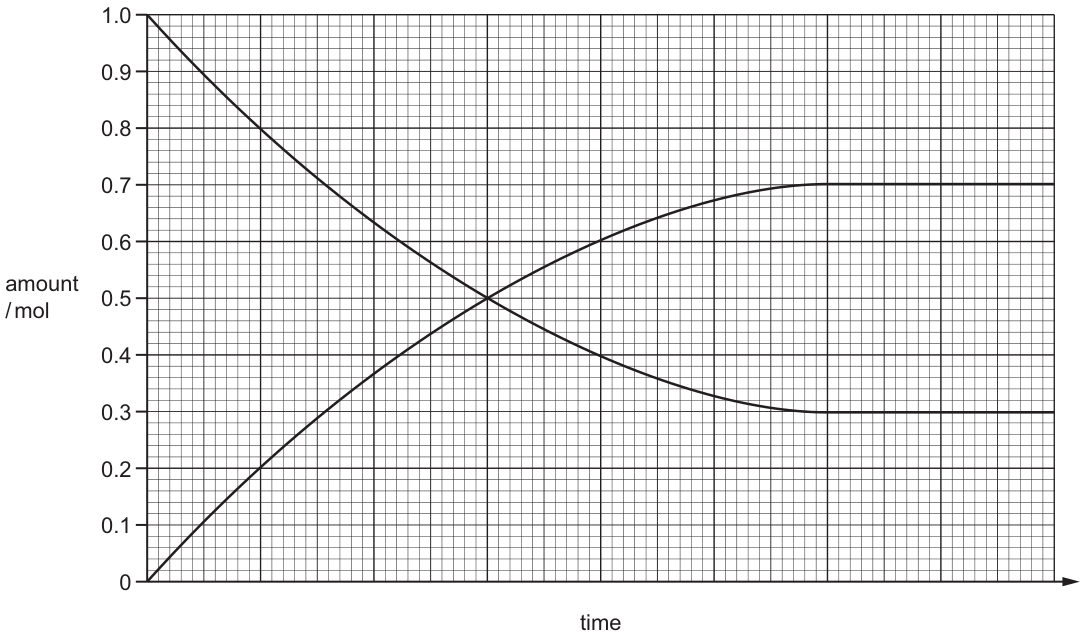
Label the graph with a to show the time taken to reach dynamic equilibrium.
Answer
is marked on the time axis at the point where both curves become horizontal (level off), indicating that the amounts of butane and methylpropane are no longer changing and dynamic equilibrium has been reached.
t marked at the point where both curves become horizontal
Background Concept
Dynamic equilibrium is reached when the forward and reverse reactions occur at equal rates, so the concentrations (or amounts) of all species remain constant over time. On an amount-vs-time graph, this is shown by the curves becoming horizontal — the gradient is zero because no net change is occurring.
Understanding the Question
You are given a graph showing the amounts of butane and methylpropane changing over time. You must label the time at which dynamic equilibrium is first reached. This is where both curves stop changing.
Approach
Identify the point on the time axis beyond which both curves are flat (horizontal). That is where equilibrium is established.
Step-by-Step Reasoning
- The butane curve starts at 1.0 mol and decreases over time.
- The methylpropane curve starts at 0 mol and increases over time.
- Both curves level off (become horizontal) at the same time — this is the point where the net change in amounts stops.
- The mark scheme requires to be placed on the time axis corresponding to the start of the horizontal portion of both curves.
- From the graph, this appears to be at approximately the point where butane reaches 0.3 mol and methylpropane reaches 0.7 mol.
Key Takeaways
- Dynamic equilibrium is identified on a graph by the point where concentrations/amounts become constant (curves flatten).
- Both curves must level off at the same time for the system to be at equilibrium.
Common Mistakes
- Placing at the intersection point of the two curves (where they cross at 0.5 mol) — this is just where the amounts are equal, not where equilibrium is reached.
- Placing at the very end of the graph rather than at the start of the horizontal region.
Things to Be Careful About
- The mark is for showing at the correct position on the time axis — the start of the horizontal part of both curves, not the end.
Use the graph to find the concentration of butane and methylpropane in the mixture at equilibrium.
concentration of butane = ...................................
concentration of methylpropane = ......................
Answer
Since the volume is , concentration = amount in mol.
concentration of butane =
concentration of methylpropane =
concentration of butane = 0.3 mol dm⁻³, concentration of methylpropane = 0.7 mol dm⁻³
Background Concept
Concentration is defined as amount of substance divided by volume: . When the volume is exactly , the numerical value of the concentration in is equal to the amount in moles. This is a deliberate simplification in the question to test whether students understand the relationship between amount and concentration.
Understanding the Question
You must read the equilibrium amounts from the graph and convert them to concentrations. The volume of the closed system is given as .
Approach
Read the final (horizontal) values from the graph for each species, then divide by the volume to get concentration.
Step-by-Step Reasoning
- From the graph, at equilibrium (where curves are horizontal):
- Amount of butane = 0.3 mol
- Amount of methylpropane = 0.7 mol
- Volume =
- Concentration of butane =
- Concentration of methylpropane =
The mark scheme requires both values to be correct for the single mark.
Key Takeaways
- Always check whether you are reading amounts or concentrations from a graph.
- When volume = 1 dm³, the numerical values are identical, but the units differ.
Common Mistakes
- Reading the intersection point (0.5 mol each) instead of the final horizontal values.
- Reporting amounts in mol rather than concentrations in mol dm⁻³ (though numerically identical here, the units matter).
- Confusing which curve is which (butane decreases, methylpropane increases).
Things to Be Careful About
- Both concentrations must be correct for the mark. Getting one right and one wrong scores zero.
- The mark scheme specifies both values with 'AND', meaning both are required.
Write an expression for for this reaction.
Answer
or equivalently:
Kc = [methylpropane] / [butane]
Background Concept
The equilibrium constant is defined as the ratio of the product of equilibrium concentrations of the products (each raised to the power of its stoichiometric coefficient) to the product of equilibrium concentrations of the reactants (each raised to the power of its stoichiometric coefficient). For a reaction , . Pure solids and liquids are omitted; only species in solution or gas phase are included.
Understanding the Question
The reaction is butane(g) ⇌ methylpropane(g), with a 1:1 stoichiometric ratio. You must write the expression. Both species are gases, so both appear in the expression.
Approach
Identify the product (methylpropane) and the reactant (butane). Since both have a coefficient of 1, the expression is simply the ratio of their equilibrium concentrations.
Step-by-Step Reasoning
- Reactant: butane, coefficient = 1
- Product: methylpropane, coefficient = 1
- = [products] / [reactants] = [methylpropane] / [butane]
- No exponents needed since both coefficients are 1.
- Both species are gases, so both are included (no need to omit anything).
The mark scheme accepts either the named form or the formula form.
Key Takeaways
- expression: products on top, reactants on bottom, each raised to their stoichiometric coefficient.
- For 1:1 reactions, the expression is a simple ratio.
Common Mistakes
- Reversing the expression (putting butane on top) — this would give .
- Including a coefficient as an exponent when it is 1 (harmless but unnecessary).
- Forgetting square brackets (concentration notation).
Things to Be Careful About
- Use square brackets [ ] to denote concentration, not parentheses.
- The expression must match the direction of the reaction as written (butane → methylpropane as forward).
Calculate a value for and state its units.
= .............................. units = ..............................
Working
Answer
(or ), units = no units (dimensionless)
The units cancel because the expression has one concentration in the numerator and one in the denominator: .
Kc = 2.3, no units
Background Concept
To calculate , substitute the equilibrium concentrations into the expression. The units of depend on the powers of concentration in the numerator and denominator. If the total power of concentration in the numerator equals that in the denominator, the units cancel and is dimensionless.
For this reaction, . The units would be , which simplifies to no units.
Understanding the Question
Using the concentrations found in part (c)(ii) and the expression from part (c)(iii), calculate the numerical value of and state its units.
Approach
- Substitute the equilibrium concentrations into the expression.
- Perform the division.
- Analyse the units by examining the powers of concentration in numerator and denominator.
Step-by-Step Reasoning
- From part (ii): [methylpropane] = 0.7 mol dm⁻³, [butane] = 0.3 mol dm⁻³
- From part (iii):
- Substitution:
- Rounding to 2 significant figures (consistent with the data):
- Units: = dimensionless, so no units.
The mark scheme awards M1 for the correct value (2.3 or 2.33) and M2 for units consistent with the expression used (no units / dimensionless / none).
Key Takeaways
- is dimensionless when the sum of stoichiometric coefficients of gaseous/aqueous species is the same on both sides of the equation.
- Always state units (or explicitly say 'no units') for .
- The number of significant figures should be consistent with the data given.
Common Mistakes
- Writing units as 'mol dm⁻³' — the units cancel completely.
- Getting the value wrong by reversing numerator and denominator (giving 0.43 instead of 2.3).
- Using the amounts at the intersection point (0.5 mol each) instead of the equilibrium values.
- Rounding to only 1 significant figure (2 instead of 2.3).
Things to Be Careful About
- The mark scheme accepts 2.3 or 2.33 — both are correct.
- Units must be consistent with the expression written in part (iii). If a student wrote an incorrect expression in (iii) but correctly calculated from it, ecf may apply for M1 but M2 requires units consistent with the expression used.
- Do not include units like 'mol dm⁻³' or 'mol⁻¹ dm³' — they cancel to give a dimensionless quantity.
The rest of this paper
4 more questions- Q2Group 17 · Equilibria · Chemical Bonding11M
- Q3Chemical Periodicity · Chemical Bonding · Electrochemistry · Group 1713M
- Q4Hydrocarbons · Atoms, Molecules and Stoichiometry · Introduction to Organic Chemistry · Chemical Bonding14M
- Q5Introduction to Organic Chemistry · Carboxylic Acids and Derivatives · Atoms, Molecules and Stoichiometry12M