Chemistry 9701/22 — February/March 2019
Cambridge AS Level · AS Level Structured Questions · worked solutions for every part, with the mark scheme
Topics Introduction to Organic Chemistry · Atoms, Molecules and Stoichiometry · Chemical Energetics · Hydrocarbons · Carbonyl Compounds · Hydroxy Compounds · +9 more
Nitrogen, , is the most abundant gas in the Earth’s atmosphere and is very unreactive.
State why is very unreactive.
Magnesium and lithium both form nitrides with . These compounds both contain the ion.
Write an equation for the reaction of magnesium with to form magnesium nitride.
Solid lithium nitride, , reacts with water according to the following equation.
State one observation you would make during this reaction.
State the industrial importance of ammonia.
One method of producing is by heating ammonium chloride, , with .
Explain why the reaction of with produces ammonia.
Three oxides of nitrogen, , and , can be formed under different conditions.
Complete the table to give the oxidation numbers of nitrogen in and .
| compound | NO | |
|---|---|---|
| oxidation number of N |
can be formed by different chemical reactions.
Write equations for the formation of by:
-
the reaction of with
-
the thermal decomposition of magnesium nitrate.
Molecules of can be formed by the reaction between and . The bond between the N and O atoms () is a co-ordinate (dative covalent) bond.
The enthalpy change of reaction for this reaction is .
Calculate the bond enthalpy, in , of the bond.
Use relevant data from the Data Booklet to answer this question.
Nitrosyl chloride, , is a reactive gas that is sometimes formed when reacts with .
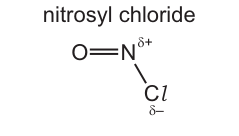
is a strong electrophile and readily undergoes an addition reaction with alkenes.
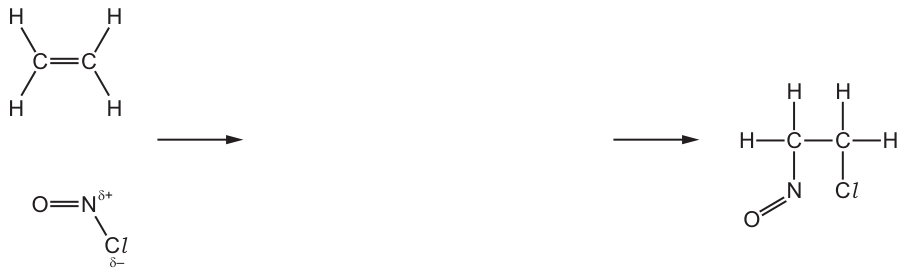
Complete the diagram to show the mechanism of the electrophilic addition reaction of with ethene.
Include all necessary charges, lone pairs and curly arrows, and the structure of the organic intermediate.
The rest of this paper
3 more questions- Q2Atoms, Molecules and Stoichiometry · Chemical Bonding · Atomic Structure · Group 17 · Chemical Energetics · States of Matter25M
- Q3Carbonyl Compounds · Hydroxy Compounds · Introduction to Organic Chemistry · Analytical Techniques9M
- Q4Introduction to Organic Chemistry · Hydrocarbons · Halogen Compounds · Hydroxy Compounds · Carboxylic Acids and Derivatives · Carbonyl Compounds13M