Chemistry 9701/33 — October/November 2018
Cambridge AS Level · Advanced Practical Skills · worked solutions for every part, with the mark scheme
Topics Manipulation, Measurement and Observation · Presentation of Data and Observations · Analysis, Conclusions and Evaluation · Qualitative Analysis
You will determine the enthalpy change, , for the reaction between magnesium and aqueous copper(II) sulfate. To do this you will measure the change in temperature when magnesium powder reacts with aqueous copper(II) sulfate. The magnesium is in excess.
FA 1 is a solution containing copper(II) sulfate, .
FA 2 is magnesium powder, Mg.
Method
- Weigh the container with FA 2 and record the mass in the space below.
- Support the plastic cup in the beaker.
- Use the measuring cylinder to transfer of FA 1 into the plastic cup.
- Place the thermometer in the solution and tilt the cup if necessary so that the bulb of the thermometer is fully covered. Record the temperature at time zero in the table of results.
- Start timing and do not stop the clock until the whole experiment has been completed.
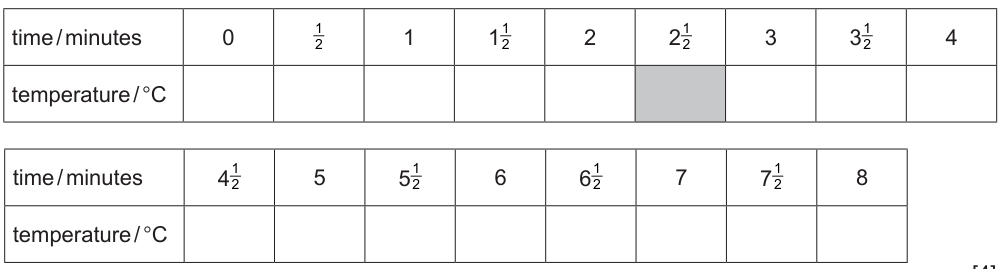
- Record the temperature of the solution every half minute for 2 minutes.
- At minutes carefully transfer all of FA 2 into the solution in the cup and stir the mixture.
- Record the temperature of the mixture at 3 minutes and complete the table by recording the temperature every half minute. Stir the mixture continuously between thermometer readings.
- Weigh the container with any residual FA 2 and record the mass below.
- Calculate and record the mass of FA 2 used.
Keep FA 1 for use in Question 2.
Results
Plot a graph of temperature on the -axis against time on the -axis on the grid below.
The scale for temperature should extend at least above your highest recorded temperature.
You will use the graph to determine the theoretical maximum temperature rise at minutes.
Draw two lines of best fit through the points on your graph, the first for the temperature before adding FA 2 and the second for the cooling of the mixture. Label any points you consider anomalous.

Extrapolate the two lines to minutes, draw a vertical line between the two lines of best fit and so determine the theoretical rise in temperature, , at this time.
Calculations
Use the information given to calculate the concentration of copper(II) sulfate in FA 1 in .
Hence calculate the number of moles of copper(II) sulfate you used in (a).
Use your answer to (b)(ii) to calculate the heat energy evolved when FA 2 is added to FA 1.
(Assume of heat energy changes the temperature of of the mixture by .)
Calculate the enthalpy change, in , when 1 mole of reacts with magnesium.
Show by calculation that the magnesium was in excess.
A student suggested that the calculated enthalpy change would be more accurate if magnesium turnings were used instead of magnesium powder.
State whether you agree with the student and give a reason for your answer.
The enthalpy change determined in (c)(iv) is only an approximation of the actual value.
Suggest and explain one improvement to the method in (a) you would make to increase the accuracy of the experiment.
The rest of this paper
2 more questions- Q2Manipulation, Measurement and Observation · Presentation of Data and Observations · Analysis, Conclusions and Evaluation9M
- Q3Qualitative Analysis · Manipulation, Measurement and Observation · Analysis, Conclusions and Evaluation · Presentation of Data and Observations15M