Chemistry 9701/35 — May/June 2018
Cambridge AS Level · Advanced Practical Skills · worked solutions for every part, with the mark scheme
Topics Manipulation, Measurement and Observation · Presentation of Data and Observations · Analysis, Conclusions and Evaluation · Qualitative Analysis
In this experiment you will determine in the formula of hydrated sodium carbonate, , by titration.
FA 1 is hydrated sodium carbonate, .
FA 2 is hydrochloric acid, .
methyl orange indicator
Method
Making a solution of FA 1
- Record all masses in the space below.
- Weigh the container with FA 1.
- Tip all the solid FA 1 into the beaker.
- Weigh the container with any residual FA 1.
- Add approximately of distilled water to the beaker and stir to dissolve FA 1.
- Transfer the solution to the volumetric flask.
- Rinse the beaker twice, each time with about of distilled water, and add this to the volumetric flask.
- Add distilled water to the volumetric flask to make of solution and shake thoroughly. Label this solution FA 3.
- Calculate and record the mass of FA 1 used to make this solution.
Titration
- Pipette of FA 3 into a conical flask.
- Fill the burette with FA 2.
- Add several drops of methyl orange indicator to the conical flask.
- Carry out a rough titration and record your burette readings in the space below.
The rough titre is .............................. .
- Carry out as many accurate titrations as you think necessary to obtain consistent results.
- Make sure any recorded results show the accuracy of your practical work.
- Record, in a suitable form below, all of your burette readings and the volume of FA 2 added in each accurate titration.
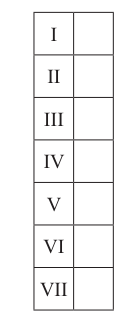
From your accurate titration results, obtain a suitable value for the volume of FA 2 to be used in your calculations. Show clearly how you obtained this value.
of FA 3 required .............................. of FA 2
Calculations
Give your answers to (ii), (iii) and (iv) to the appropriate number of significant figures.
Calculate the number of moles of hydrochloric acid in the volume of FA 2 calculated in (b).
Complete the equation below and include the missing state symbols.
Calculate the number of moles of sodium carbonate in of FA 3.
Calculate the number of moles of sodium carbonate in of FA 3.
Use this answer and your data on page 2 to calculate the relative formula mass, , of hydrated sodium carbonate, .
Calculate the value of in . Give your answer to the nearest whole number.
A student suggested using sulfuric acid in place of the hydrochloric acid used in the experiment above. The mass of FA 1 used was unchanged.
Explain what effect this change would have on the accuracy of the experiment.
The rest of this paper
2 more questions- Q2Manipulation, Measurement and Observation · Presentation of Data and Observations · Analysis, Conclusions and Evaluation11M
- Q3Qualitative Analysis14M