Chemistry 9701/23 — May/June 2018
Cambridge AS Level · AS Level Structured Questions · worked solutions for every part, with the mark scheme
Topics Chemical Bonding · Atoms, Molecules and Stoichiometry · Introduction to Organic Chemistry · States of Matter · Equilibria · Reaction Kinetics · +6 more
The elements sodium to chlorine, in the third period, all form oxides.
Draw a diagram to show the shape of the molecule of each of the oxides, and .
Name each shape.
In each oxygen atom forms a double bond with the sulfur atom.
Explain why the melting point of is higher than that of .
Explain why the melting point of is much higher than that of .
is produced by the reaction between and in the Contact process. A dynamic equilibrium is established.
Explain why increasing the total pressure, at constant temperature, increases the rate of production of and increases the yield of .
The graph shows how the concentrations of all three species in the system change with time for a typical reaction mixture. The gradients of all three lines decrease with time and then level off in this dynamic equilibrium.
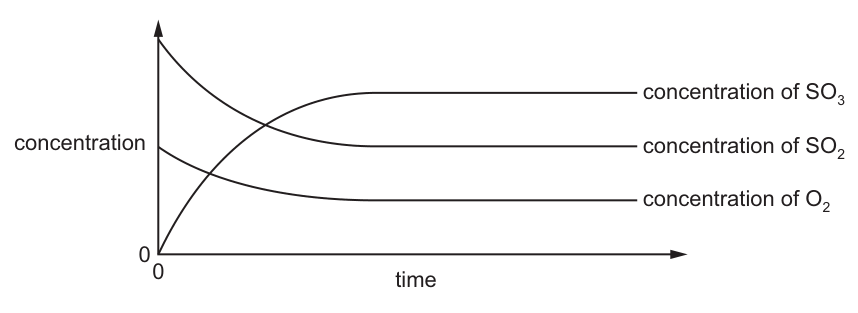
Explain why the gradients of the and lines decrease with time.
Explain why all three lines become horizontal.
Suggest a reason why the initial gradient of the line is steeper than that of the line.
moles of and moles of are sealed in a container with a suitable catalyst, at constant temperature and pressure. The resulting equilibrium mixture contains moles of .
The total volume of the equilibrium mixture is .
Write the expression for the equilibrium constant, , for the reaction between and to produce .
Calculate the amount, in moles, of and in the equilibrium mixture.
Use your answers to (d)(i) and (d)(ii) to calculate the value of for this equilibrium mixture. Give the units of .
The rest of this paper
3 more questions- Q2Introduction to Organic Chemistry · Polymerisation10M
- Q3Group 17 · Chemical Bonding · Atoms, Molecules and Stoichiometry · Electrochemistry15M
- Q4Introduction to Organic Chemistry · Halogen Compounds · Hydroxy Compounds · Carbonyl Compounds13M