Chemistry 9701/21 — May/June 2018
Cambridge AS Level · AS Level Structured Questions · worked solutions for every part, with the mark scheme
Topics Chemical Bonding · Hydrocarbons · Reaction Kinetics · Chemical Energetics · Equilibria · Nitrogen and Sulfur · +8 more
Sulfuric acid is manufactured by the Contact process.
One stage in this process is the conversion of sulfur dioxide into sulfur trioxide in the presence of a heterogeneous catalyst of vanadium(V) oxide, .

State the effect of a catalyst on a reaction.
Explain how a catalyst causes this effect.
State the meaning of the term heterogeneous as applied to catalysts.
Some bond energies are given.
| bond | bond energy / |
|---|---|
| (in ) | 534 |
| 496 |
Use the data, and the enthalpy change for the conversion of sulfur dioxide into sulfur trioxide, to calculate a value for the bond energy in .
The Contact process is usually carried out at a temperature of about and a pressure just above atmospheric pressure. Using a higher or lower temperature and pressure would affect both the rate of production of sulfur trioxide and the yield of sulfur trioxide.
A reaction pathway diagram for both the catalysed and uncatalysed reactions between and is shown.
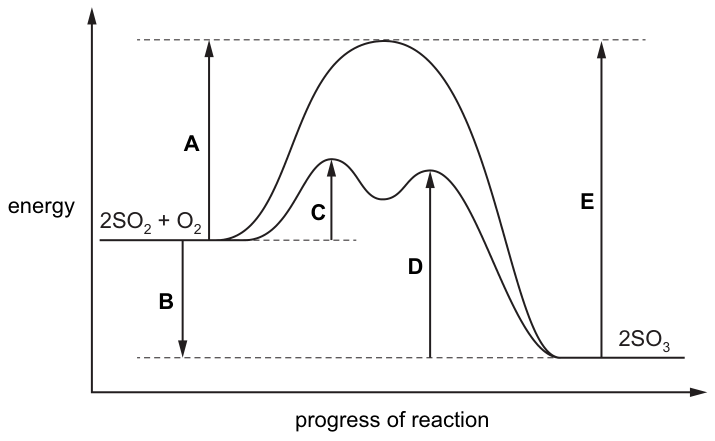
The letters A–E represent energy changes.
Complete the table by stating which letter, A–E, represents the energy change described.
| energy change | letter |
|---|---|
| the energy change for the production of | |
| the activation energy for the production of in the absence of a catalyst | |
| the activation energy for the first step in the decomposition of in the presence of a catalyst |
The equation for this stage of the Contact Process is shown.
State and explain the effect of increasing temperature on the rate of production of .
State and explain the effect of increasing temperature on the yield of .
The produced is converted to sulfuric acid in two stages. In the first stage the is reacted with concentrated sulfuric acid to produce oleum, .
The oleum is then reacted with water to form sulfuric acid.
Suggest an equation for the reaction of oleum, , with water to form sulfuric acid.
reacts with water to form sulfurous acid.
Sulfurous acid is a weak Brønsted–Lowry acid, while sulfuric acid is a strong Brønsted–Lowry acid.
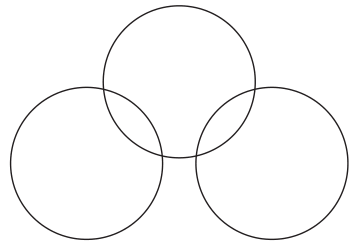
Complete the ‘dot-and-cross’ diagram to show the bonding in a molecule of . Show outer electrons only.
State the meaning of the term strong Brønsted–Lowry acid.
Write an equation to show the acid-base behaviour of sulfuric acid with water. Include state symbols.
The rest of this paper
3 more questions- Q2Chemical Bonding · Hydrocarbons · Atoms, Molecules and Stoichiometry · Polymerisation · Carboxylic Acids and Derivatives9M
- Q3Atomic Structure · Chemical Periodicity · States of Matter16M
- Q4Hydroxy Compounds · Introduction to Organic Chemistry · Hydrocarbons15M