Chemistry 9701/21 — October/November 2017
Cambridge AS Level · AS Level Structured Questions · worked solutions for every part, with the mark scheme
Topics Chemical Bonding · Chemical Energetics · Reaction Kinetics · Equilibria · Atoms, Molecules and Stoichiometry · Atomic Structure · +7 more
Ammonia, , is manufactured from nitrogen and hydrogen by the Haber process.
Some bond energies are given.
Explain the meaning of the term bond energy.
Use the data to calculate a value for the bond energy.
You must show your working.
The Haber process is usually carried out at a temperature of approximately in the presence of a catalyst. Changing the temperature affects both the rate of production of ammonia and the yield of ammonia.
The Boltzmann distribution for a mixture of nitrogen and hydrogen at is shown.
represents the activation energy for the reaction.
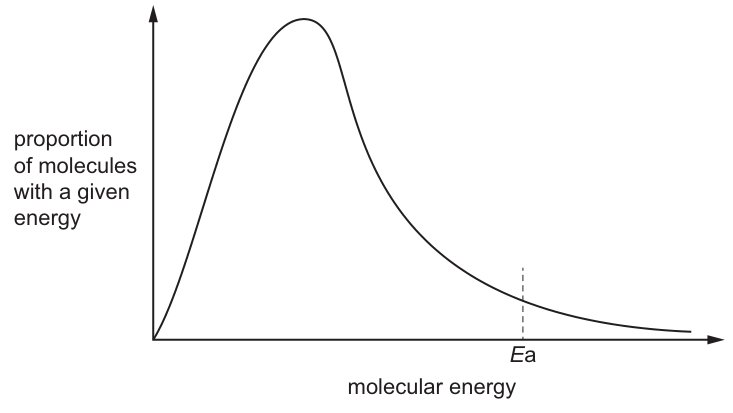
Using the same axes, sketch a second curve to indicate the Boltzmann distribution at a higher temperature.
With reference to the Boltzmann distribution, state and explain the effect of increasing temperature on the rate of production of ammonia.
State and explain the effect of increasing temperature on the yield of ammonia.
Use Le Chatelier’s principle to explain your answer.
At a pressure of , of nitrogen, , was mixed with of hydrogen, . The final equilibrium mixture formed contained of ammonia, .
Calculate the amounts, in mol, of and in the equilibrium mixture.
Calculate the partial pressure of ammonia, , in the equilibrium mixture.
Give your answer to three significant figures.
In another equilibrium mixture the partial pressures are as shown.
| substance | partial pressure / Pa |
|---|---|
Write the expression for the equilibrium constant, , for the production of ammonia from nitrogen and hydrogen.
Calculate the value of for this reaction.
State the units.
This reaction is repeated with the same starting amounts of nitrogen and hydrogen. The same temperature is used but the container has a smaller volume.
State the effects, if any, of this change on the yield of ammonia and on the value of .
The rest of this paper
2 more questions- Q2Atomic Structure · States of Matter · Chemical Periodicity14M
- Q3Halogen Compounds · Hydroxy Compounds · Carbonyl Compounds · Introduction to Organic Chemistry · Hydrocarbons24M