Chemistry 9701/33 — February/March 2017
Cambridge AS Level · Advanced Practical Skills · worked solutions for every part, with the mark scheme
Topics Manipulation, Measurement and Observation · Presentation of Data and Observations · Analysis, Conclusions and Evaluation · Qualitative Analysis
The concentration of hydrogen peroxide may be given in or as 'volume strength'. You will determine the concentration of hydrogen peroxide in and in 'volume strength' by a gas collection method.
Hydrogen peroxide decomposes to form water and oxygen. The reaction is much faster in the presence of a catalyst such as manganese(IV) oxide.
'Volume strength' is defined as the volume of oxygen in produced from the decomposition of of hydrogen peroxide at room temperature and pressure. For example, of '100 volume' hydrogen peroxide will produce of oxygen.
FA 1 is a solution of hydrogen peroxide, .
FA 2 is manganese(IV) oxide, .
Method
Read the whole method before starting any practical work.
The diagram below may help you in setting up your apparatus.
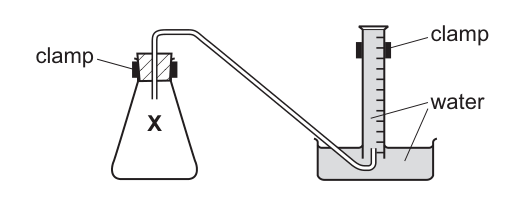
- Fill the tub with water to a depth of about .
- Fill the measuring cylinder completely with water. Hold a piece of paper towel firmly over the top, invert the measuring cylinder and place it in the water in the tub.
- Remove the paper towel and clamp the inverted measuring cylinder so that the open end is in the water just above the base of the tub.
- Rinse the measuring cylinder with a little FA 1 then use it to transfer of FA 1 into the reaction flask labelled X.
- Check that the bung fits tightly in the neck of flask X, clamp flask X and place the end of the delivery tube into the inverted measuring cylinder.
- Remove the bung from the neck of the flask. Tip FA 2 into the hydrogen peroxide and replace the bung immediately. Remove the flask from the clamp and swirl it to mix the contents. Swirl the flask occasionally until no more gas is given off. Replace the flask in the clamp.
- Measure and record the final volume of gas in the measuring cylinder in the space below.
Keep FA 1 for use in Question 2.
Result
Answer
Record the final volume of oxygen gas collected in the measuring cylinder (e.g., V cm³). The value must be within 10% of the supervisor's provided value.
See working / candidate-dependent (must be within 10% of supervisor's value)
Background Concept
In gas collection experiments using water displacement, the volume of gas evolved is measured by the volume of water displaced from an inverted measuring cylinder. The apparatus must be airtight so that all generated gas is directed into the measuring cylinder. Accuracy depends on ensuring the system is sealed before the reaction begins and reading the meniscus at eye level.
Understanding the Question
Part (a) asks you to perform the practical method described and record the final volume of oxygen gas collected in the measuring cylinder. You are not given a specific numerical answer; instead, you must record your experimental result and ensure it is reasonable (within 10% of the supervisor's expected value).
Approach
Simply follow the method, ensure the bung is replaced immediately after adding the catalyst, and read the final volume of gas in the measuring cylinder. Record this value with the correct unit (cm³ or dm³).
Step-by-Step Reasoning
- Perform the experiment as described: add 150 cm³ of FA 1 to flask X, add FA 2, seal immediately, and swirl until gas evolution stops.
- Read the final volume of gas in the inverted 250 cm³ measuring cylinder. This is the volume of oxygen collected.
- Record the value with units (e.g., 145 cm³). Mark schemes for Paper 3 practicals award marks for unambiguous recording (M1) and for the value being within a reasonable range (typically ±10%) of the supervisor's value (M2).
Key Takeaways
Always record practical observations with clear units. In gas collection, ensure the system is sealed before the reaction starts to prevent gas loss, which would lead to an artificially low volume reading.
Common Mistakes
- Forgetting to include units (cm³ or dm³) with the recorded volume.
- Recording a value that is obviously outside the 10% tolerance of the supervisor's value (e.g., due to a leak or premature gas escape).
Things to Be Careful About
Ensure the measuring cylinder is fully filled with water and inverted without trapping air bubbles. Read the meniscus at eye level. The volume recorded is the final reading; since the cylinder was initially full (0 cm³ gas), the final reading is the total volume of oxygen collected.
Calculations
Show your working and appropriate significant figures in the final answer to each step of your calculations.
Use the information on page 2 to calculate the 'volume strength' of FA 1.
'volume strength' of FA 1 = ............................
Working
Volume strength =
Answer
Volume strength = (to 2–4 s.f.)
V(O₂) / 150 (to 2-4 s.f.)
Background Concept
'Volume strength' is a commercial measure of hydrogen peroxide concentration. It is defined as the volume of oxygen gas (in cm³) produced at room temperature and pressure from the decomposition of 1.0 cm³ of the hydrogen peroxide solution. For example, '100 volume' H₂O₂ produces 100 cm³ of O₂ per 1 cm³ of solution.
Understanding the Question
Part (b)(i) asks you to calculate the volume strength of FA 1 using the volume of oxygen gas you collected in part (a). You added 150 cm³ of FA 1 to the flask.
Approach
Use the definition of volume strength: divide the total volume of oxygen gas collected (in cm³) by the volume of hydrogen peroxide solution decomposed (150 cm³). Ensure the answer is given to 2–4 significant figures.
Step-by-Step Reasoning
- Let the volume of oxygen collected in part (a) be cm³.
- Volume of FA 1 used = 150 cm³.
- Volume strength = .
- Calculate the value and round to 2–4 significant figures. For example, if cm³, volume strength = 1.0.
Key Takeaways
Volume strength is a direct ratio of gas volume to solution volume. Always ensure the units for both volumes are the same (cm³) before dividing.
Common Mistakes
- Forgetting to divide by 150 and just writing the gas volume.
- Using incorrect significant figures (the mark scheme requires 2–4 s.f.).
Things to Be Careful About
Ensure the volume of oxygen is in cm³. If you recorded it in dm³, convert it to cm³ by multiplying by 1000 before dividing by 150.
Calculate the number of moles of oxygen collected in the measuring cylinder.
[Assume 1 mole of gas occupies under these conditions.]
moles of = ............................ mol
Working
Moles of =
Answer
Moles of = mol (to 2–4 s.f.)
V(O₂) / 24000 mol
Background Concept
At room temperature and pressure (RTP), 1 mole of any gas occupies 24.0 dm³ (or 24,000 cm³). This allows conversion between the volume of a gas and the number of moles using the equation: (when is in cm³) or (when is in dm³).
Understanding the Question
Part (b)(ii) asks you to calculate the number of moles of oxygen gas collected in the measuring cylinder. You are given that 1 mole of gas occupies 24.0 dm³ under these conditions.
Approach
Convert the volume of oxygen collected (in cm³) to dm³ by dividing by 1000, then divide by the molar volume (24.0 dm³ mol⁻¹). Alternatively, divide the volume in cm³ directly by 24,000 cm³ mol⁻¹.
Step-by-Step Reasoning
- Let the volume of oxygen collected be cm³.
- Volume in dm³ = dm³.
- Moles of = mol.
- Calculate the value and round to 2–4 significant figures.
Key Takeaways
Always check the units of volume against the units of molar volume. 24.0 dm³ = 24,000 cm³. Mixing these up is a common source of error.
Common Mistakes
- Forgetting to convert cm³ to dm³, resulting in an answer that is 1000 times too large.
- Using 22.4 dm³ (which is for STP, not RTP).
Things to Be Careful About
The mark scheme specifically allows 2–4 significant figures. Do not over-round intermediate values; keep full precision in your calculator and round only at the end.
Using your answer to (ii) calculate the number of moles of hydrogen peroxide in the volume of FA 1 added to flask X.
moles of = ............................ mol
Working
From the equation:
Moles of = moles of (from part b(ii))
Answer
Moles of = (to 2–4 s.f.)
2 × moles of O₂
Background Concept
Stoichiometry allows us to relate the amounts of reactants and products in a chemical reaction using the balanced chemical equation. The coefficients in the balanced equation represent the molar ratio.
Understanding the Question
Part (b)(iii) asks for the moles of hydrogen peroxide that decomposed. You have already calculated the moles of oxygen produced in part (b)(ii).
Approach
Use the balanced equation to find the molar ratio between H₂O₂ and O₂, then multiply the moles of O₂ by this ratio.
Step-by-Step Reasoning
- Balanced equation: .
- Molar ratio of H₂O₂ to O₂ is 2 : 1.
- Moles of H₂O₂ = moles of O₂.
- Substitute the answer from part (b)(ii) and calculate to 2–4 significant figures.
Key Takeaways
Always write the balanced equation first to determine the correct molar ratio. Do not assume a 1:1 ratio unless the equation supports it.
Common Mistakes
- Using a 1:1 ratio instead of 2:1.
- Carrying forward an unrounded value from part (b)(ii) without noting that error carried forward (ecf) is allowed, but final answers must be to 2–4 s.f.
Things to Be Careful About
The mark scheme requires you to use your answer to (ii). If your answer to (ii) was wrong, you can still get this mark if you used your wrong value correctly (error carried forward). However, the final answer here must be to 2–4 significant figures.
Calculate the concentration of hydrogen peroxide, FA 1, in .
concentration of , FA 1 = ............................
Working
Concentration =
Volume of FA 1 = dm³ = 0.150 dm³
Concentration =
Answer
Concentration of , FA 1 = mol dm⁻³ (to 2–4 s.f.)
(moles of H₂O₂ × 1000) / 150 mol dm⁻³
Background Concept
Concentration in mol dm⁻³ (molarity) is defined as the number of moles of solute per cubic decimetre (litre) of solution. The formula is , where must be in dm³. If is given in cm³, you must divide by 1000 or multiply by 1000.
Understanding the Question
Part (b)(iv) asks for the concentration of hydrogen peroxide in FA 1 in mol dm⁻³. You have the moles of H₂O₂ from part (b)(iii) and the volume of FA 1 added was 150 cm³.
Approach
Divide the moles of H₂O₂ by the volume of FA 1 in dm³. Alternatively, use the formula: Concentration = .
Step-by-Step Reasoning
- Moles of H₂O₂ = answer to part (b)(iii).
- Volume of FA 1 = 150 cm³ = 0.150 dm³.
- Concentration = mol dm⁻³.
- Calculate the value and round to 2–4 significant figures.
Key Takeaways
Always ensure volume is in dm³ when calculating concentration in mol dm⁻³. Multiplying moles by 1000 and dividing by volume in cm³ is a quick and reliable method.
Common Mistakes
- Forgetting to convert 150 cm³ to dm³, resulting in an answer 1000 times too small.
- Using the volume of oxygen gas instead of the volume of hydrogen peroxide solution.
Things to Be Careful About
The mark scheme explicitly requires showing the working . Do not just write the final number; show the substitution to earn the method mark.
A source of error in this experiment is that some oxygen escapes before the bung can be inserted.
Suggest a change to the practical procedure given in (a) to reduce this source of error. You may draw a diagram as part of your answer.
Answer
Use a dropping funnel or syringe to add FA 1 (hydrogen peroxide) to the flask, and subtract the volume of liquid added from the total gas volume collected. OR add FA 2 (MnO₂) using an ignition tube or weighing boat without removing the bung from the flask.
Working
No change in volume of gas collected; the volume of liquid added displaces an equal volume of gas, which must be accounted for if FA 1 is added via a funnel.
Use a dropping funnel/syringe for FA 1 (and subtract its volume) OR add FA 2 via an ignition tube/weighing boat without removing the bung.
Background Concept
In gas collection experiments, any delay between starting the reaction and sealing the system results in gas escaping into the atmosphere, leading to an artificially low volume reading. To eliminate this error, the reactants must be brought together without opening the system.
Understanding the Question
Part (c)(i) identifies a source of error: oxygen escapes before the bung can be inserted. You are asked to suggest a change to the procedure to reduce this error.
Approach
Propose a method to add the catalyst (or the reactant) without removing the bung. Alternatively, add the reactant via a dropping funnel so the system remains sealed, and correct for the volume of liquid added.
Step-by-Step Reasoning
- The error occurs because the bung is removed to add MnO₂, allowing O₂ to escape.
- Improvement 1: Use a dropping funnel or syringe to add FA 1 (H₂O₂) to the flask containing MnO₂. The system remains sealed. Since adding liquid displaces gas, subtract the volume of FA 1 added from the total gas volume collected.
- Improvement 2: Add FA 2 (MnO₂) without removing the bung. This can be done by placing MnO₂ in a small ignition tube or a floating weighing boat, lowering it into the flask through the bung, and then sealing it immediately.
- Both methods prevent gas loss before the system is sealed.
Key Takeaways
When evaluating gas collection methods, consider how reactants are introduced. If the system must be opened, gas will escape. Use sealed addition methods (dropping funnels, ignition tubes) to eliminate this error.
Common Mistakes
- Suggesting 'do it faster' without providing a practical apparatus change.
- Forgetting to mention subtracting the volume of liquid added if a dropping funnel is used for the liquid reactant.
Things to Be Careful About
The mark scheme accepts either adding the solid catalyst without removing the bung OR adding the liquid via a dropping funnel (with the volume correction). Ensure your suggestion is practically feasible.
The error in reading a measuring cylinder is .
Calculate the maximum percentage error in the volume of hydrogen peroxide added to flask X in (a).
maximum percentage error in volume of = ............................ %
Working
Absolute error in 50 cm³ measuring cylinder = cm³
Percentage error for 50 cm³ =
Volume of H₂O₂ added = 150 cm³ (measured three times using 50 cm³ cylinder)
Total absolute error = cm³
Maximum percentage error =
Answer
Maximum percentage error in volume of H₂O₂ = 3.0%
3.0%
Background Concept
Percentage error is calculated as . When a volume is measured in multiple steps using the same apparatus, the absolute errors add up. For example, measuring 150 cm³ using a 50 cm³ cylinder three times means the absolute error is the error of one measurement.
Understanding the Question
Part (c)(ii) asks for the maximum percentage error in the volume of hydrogen peroxide added to flask X. The volume added is 150 cm³, measured using a 50 cm³ measuring cylinder with an error of cm³.
Approach
Calculate the percentage error for a single 50 cm³ measurement, then multiply by 3 (since 150 cm³ requires three 50 cm³ measurements) to get the total percentage error for 150 cm³.
Step-by-Step Reasoning
- Absolute error per measurement = 0.5 cm³.
- Number of measurements = .
- Total absolute error = cm³.
- Percentage error = .
- Alternatively: Percentage error for 50 cm³ = . For 150 cm³, it is .
Key Takeaways
When measuring a large volume using a smaller apparatus multiple times, the absolute errors accumulate. Always multiply the single measurement error by the number of measurements.
Common Mistakes
- Calculating the percentage error for 50 cm³ (1.0%) and forgetting to multiply by 3 for the total volume of 150 cm³.
- Using 150 cm³ as the denominator with 0.5 cm³ as the numerator, giving 0.33%.
Things to Be Careful About
The mark scheme awards 2 marks: one for the 1.0% calculation (or equivalent working) and one for the final 3.0% answer. If you show 3.0% with no working, you still get both marks, but showing working is safer.
Explain why the presence of of air in the measuring cylinder before the start of the experiment would decrease the accuracy of the results obtained in (a).
Answer
Two readings are needed to find the volume of gas evolved (final reading minus initial reading). The presence of air means the initial reading is not zero, introducing an additional reading error. Thus, there is twice the percentage error in the gas volume reading.
Working
Volume of gas = Final reading - Initial reading
Error = Error in final reading + Error in initial reading
Two readings are needed to find the volume of gas evolved, so there is twice the percentage error in the gas volume reading.
Background Concept
In water displacement gas collection, the volume of gas produced is calculated as the difference between the final reading and the initial reading on the measuring cylinder. If the cylinder is initially full of water, the initial reading is 0 cm³, and only one reading (the final one) is needed. If there is air in the cylinder, both an initial and a final reading must be taken.
Understanding the Question
Part (c)(iii) asks why the presence of 20 cm³ of air in the measuring cylinder before the experiment would decrease the accuracy of the results.
Approach
Explain that gas volume is found by subtracting the initial reading from the final reading. Two readings mean two potential errors, doubling the percentage error compared to starting from zero.
Step-by-Step Reasoning
- Normally, the measuring cylinder is filled completely with water, so the initial gas volume reading is 0.0 cm³.
- If 20 cm³ of air is present, the initial reading is 20.0 cm³ (or some non-zero value).
- The volume of oxygen evolved = Final reading - Initial reading (e.g., 145.0 - 20.0 = 125.0 cm³).
- Both the final and initial readings have an associated reading error (e.g., cm³ or division).
- When subtracting two readings, the absolute errors add: Total error = Error in final + Error in initial.
- This means there are two readings to make instead of one, so the percentage error in the calculated gas volume is approximately twice as large as if the initial reading was zero.
Key Takeaways
When a measurement requires a difference between two values, the absolute errors from both readings combine. Always try to start from zero if possible to minimize the number of readings and reduce cumulative error.
Common Mistakes
- Saying 'the air takes up space' without explaining the effect on readings.
- Failing to mention that two readings are needed to find the volume of gas evolved.
Things to Be Careful About
The mark scheme specifically looks for the point that 'two readings are needed' leading to 'twice the percentage error'. Ensure your explanation links the presence of air to the need for an initial reading.
If you repeated the method described using half the mass of FA 2, what volume of gas would you expect to collect? Explain your answer.
Answer
No change in the volume of gas collected.
MnO₂ (FA 2) is a catalyst; it increases the rate of reaction but does not affect the amount (yield) of oxygen produced.
Working
Catalysts lower the activation energy, providing an alternative pathway, but do not change the stoichiometry or the limiting reactant.
No change; MnO₂ is a catalyst and does not affect the yield/amount of product.
Background Concept
A catalyst is a substance that increases the rate of a chemical reaction without being consumed in the overall reaction. It works by providing an alternative reaction pathway with a lower activation energy. Importantly, a catalyst does not change the position of equilibrium or the total amount of product formed from a given amount of reactant.
Understanding the Question
Part (d) asks what would happen to the volume of gas collected if half the mass of FA 2 (MnO₂) was used instead of the full mass.
Approach
Recognize that MnO₂ is a catalyst. Reducing the amount of catalyst will decrease the rate of reaction (it will take longer to finish), but it will not change the total volume of oxygen produced, as the amount of limiting reactant (H₂O₂) is unchanged.
Step-by-Step Reasoning
- Identify the role of FA 2 (MnO₂): it is a catalyst for the decomposition of H₂O₂.
- Effect of catalyst on rate: less catalyst means a slower rate of reaction (longer time to collect all gas).
- Effect of catalyst on yield: catalysts do not affect the stoichiometry or the theoretical yield. The volume of O₂ depends only on the moles of H₂O₂ decomposed.
- Since the volume of H₂O₂ (150 cm³) is unchanged, the total moles of O₂ produced, and thus the total volume of gas collected, will be the same.
- Conclusion: No change in the final volume of gas collected.
Key Takeaways
Catalysts affect the rate of reaction, not the yield. Students often confuse catalysts with reactants and incorrectly assume that less catalyst means less product.
Common Mistakes
- Stating that less catalyst means less gas is produced.
- Saying 'the reaction will be slower' but forgetting to explicitly state that the final volume of gas is unchanged.
Things to Be Careful About
The question asks for the volume of gas expected and an explanation. Both parts are needed for the mark. Ensure you clearly state 'no change' and identify MnO₂ as a catalyst.
The rest of this paper
2 more questions- Q2Manipulation, Measurement and Observation · Presentation of Data and Observations12M
- Q3Qualitative Analysis17M