Chemistry 9701/22 — February/March 2017
Cambridge AS Level · AS Level Structured Questions · worked solutions for every part, with the mark scheme
Topics Chemical Bonding · Analytical Techniques · Chemical Periodicity · Atomic Structure · States of Matter · Group 17 · +9 more
The table shows information about some of the elements in the third period.
| element | Na | Mg | Al | P | S | Cl |
|---|---|---|---|---|---|---|
| atomic radius / nm | 0.186 | 0.160 | 0.143 | 0.110 | 0.104 | 0.099 |
| radius of most common ion / nm | 0.095 | 0.065 | 0.050 | 0.212 | 0.184 | 0.181 |
| maximum oxidation number of the element in its compounds | +1 | +7 |
Complete the table to show the maximum oxidation number of each element in its compounds.
Explain why the atomic radius of elements in the third period decreases from Na to Cl.
The radius of the most common ion of Mg is much smaller than the radius of the most common ion of S.
Identify both ions and explain the difference in their radii.
Phosphorus is a non-metal in the third period. It reacts vigorously with excess oxygen but slowly with chlorine.
Some reactions of phosphorus are shown.
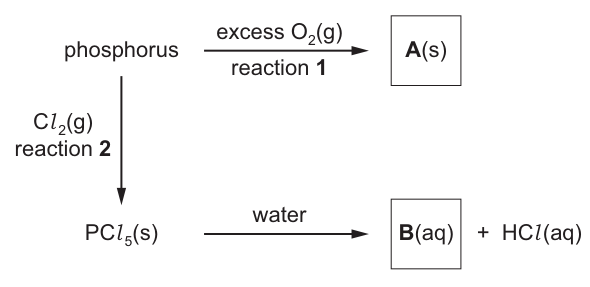
Write an equation to represent reaction 1, the formation of compound A.
Give two observations you could make in reaction 2.
Name compound B.
Cerium is a lanthanoid metal that shows similar chemical reactions to some elements in the third period. Most of cerium’s compounds contain or ions.
Cerium shows the same structure and bonding as a typical metal.
Draw a labelled diagram to show the structure and bonding in cerium.
Cerium(IV) oxide, , is a ceramic.
Suggest two physical properties of cerium(IV) oxide.
A naturally occurring sample of cerium contains only four isotopes. Data for three of the isotopes are shown in the table.
| isotope | ||||
|---|---|---|---|---|
| relative isotopic mass | 135.907 | 137.906 | 139.905 | to be calculated |
| percentage abundance | 0.185 | 0.251 | 88.450 | to be calculated |
The of the sample is 140.116.
Use these data to calculate the relative isotopic mass of the fourth isotope in this sample of cerium.
Give your answer to three decimal places.
The rest of this paper
2 more questions- Q2Chemical Bonding · Group 17 · Equilibria · Chemical Energetics · Reaction Kinetics22M
- Q3Halogen Compounds · Hydroxy Compounds · Carboxylic Acids and Derivatives · Polymerisation · Introduction to Organic Chemistry · Hydrocarbons · Analytical Techniques21M