Chemistry 9701/32 — May/June 2016
Cambridge AS Level · Advanced Practical Skills · worked solutions for every part, with the mark scheme
Topics Manipulation, Measurement and Observation · Analysis, Conclusions and Evaluation · Presentation of Data and Observations · Qualitative Analysis
In Questions 1 and 2 you will determine the relative atomic mass, , of magnesium by two different methods.
In the first method you will collect and measure the volume of gas given off in the reaction between a known mass of magnesium and a known amount of dilute sulfuric acid. The acid will be in excess.
FB 1 is a strip of magnesium ribbon, Mg.
FB 2 is sulfuric acid, .
Method
Read through the whole method before starting any practical work.
The diagrams below may help you in setting up your apparatus.
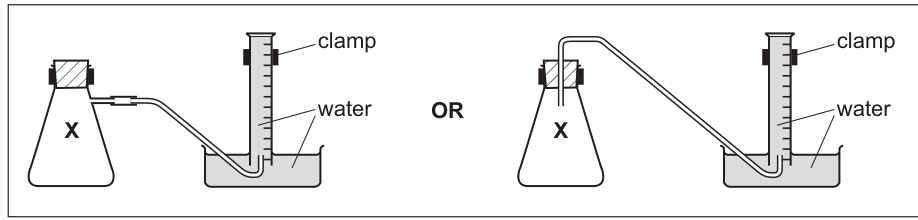
- Fill the tub with water to a depth of about .
- Fill the measuring cylinder completely with water. Hold a piece of paper towel firmly over the top, invert the measuring cylinder and place it in the water in the tub.
- Remove the paper towel and clamp the inverted measuring cylinder so the open end is in the water just above the base of the tub.
- Pipette of FB 2 into the reaction flask labelled X.
- Check that the bung fits tightly in the neck of flask X, clamp flask X, and place the end of the delivery tube into the inverted measuring cylinder.
- Weigh the magnesium ribbon, FB 1, and record the mass in the space below.
- Remove the bung from the neck of the flask. Add the magnesium ribbon, FB 1, into the acid in the flask and replace the bung immediately. Remove the flask from the clamp and swirl it to mix the contents. Swirl the flask occasionally until no more gas is evolved. Replace the flask in the clamp.
- When no more gas is collected, measure and record the final volume of gas in the measuring cylinder in the space below.
KEEP THE CONTENTS OF THE CONICAL FLASK X FOR USE IN QUESTION 2.
Results
Calculations
Show your working and appropriate significant figures in the final answer to each step of your calculations.
Calculate the number of moles of gas collected in the measuring cylinder.
[Assume that of gas occupies under these conditions.]
Use your answer to (i) and the mass of magnesium, FB 1, recorded in (a) to calculate the relative atomic mass, , of magnesium.
The rest of this paper
2 more questions- Q2Manipulation, Measurement and Observation · Presentation of Data and Observations · Analysis, Conclusions and Evaluation17M
- Q3Qualitative Analysis · Manipulation, Measurement and Observation · Analysis, Conclusions and Evaluation18M