Chemistry 9701/21 — May/June 2016
Cambridge AS Level · AS Level Structured Questions · worked solutions for every part, with the mark scheme
Topics Atoms, Molecules and Stoichiometry · States of Matter · Introduction to Organic Chemistry · Hydrocarbons · Atomic Structure · Chemical Periodicity · +7 more
Complete the table to show the composition and identity of some atoms and ions.
| name of element | nucleon number | atomic number | number of protons | number of neutrons | number of electrons | overall charge |
|---|---|---|---|---|---|---|
| lithium | 6 | 3 | +1 | |||
| oxygen | 9 | 10 | ||||
| 54 | 26 | 26 | 24 | |||
| 17 | 18 | 0 |
Answer
| name of element | nucleon number | atomic number | number of protons | number of neutrons | number of electrons | overall charge |
|---|---|---|---|---|---|---|
| lithium | 6 | 3 | 3 | 3 | 2 | +1 |
| oxygen | 17 | 8 | 8 | 9 | 10 | –2 |
| iron | 54 | 26 | 26 | 28 | 24 | +2 |
| chlorine | 35 | 17 | 17 | 18 | 17 | 0 |
See completed table above.
Background Concept
An atom's atomic number () is the number of protons in its nucleus, which defines the element. The nucleon number or mass number () is the total number of protons and neutrons. Therefore, the number of neutrons is . In a neutral atom, the number of electrons equals the number of protons. For an ion, the overall charge indicates a loss or gain of electrons: a positive charge (cation) means fewer electrons than protons (), and a negative charge (anion) means more electrons ().
Understanding the Question
The question provides a table with partial information about four species (lithium, oxygen, an unknown with , and an unknown with 17 protons). The task is to fill in the missing values for nucleon number, atomic number, protons, neutrons, electrons, overall charge, and element identity using the relationships between these quantities.
Approach
Apply the fundamental formulas: , , , and use the atomic number to identify the element from the Periodic Table.
Step-by-Step Reasoning
- Row 1 (Lithium ion): Given , , charge . Protons . Neutrons . Electrons .
- Row 2 (Oxygen ion): Given neutrons , electrons , charge is unknown. Oxygen is in Group 16, typically forming a ion with a full outer shell. If charge , protons . Thus . Nucleon number .
- Row 3 (Unknown): Given , , electrons . Atomic number 26 corresponds to iron (). Neutrons . Overall charge .
- Row 4 (Unknown): Given protons , neutrons , charge . Atomic number 17 is chlorine (). Neutral atom means electrons . Nucleon number .
Key Takeaways
The relationships and are foundational for deducing atomic and ionic compositions. Identifying the element from is required when is unknown but protons/neutrons are given.
Common Mistakes
- Forgetting that ions have a different number of electrons than protons (e.g., calculating 3 electrons for ).
- Confusing nucleon number and atomic number when calculating neutrons.
- Misidentifying the element when only the number of protons is given.
Things to Be Careful About
Always check that the number of neutrons is non-negative (). When deducing the charge of an ion from its electron count, remember that a deficit of electrons yields a positive charge.
Beams of protons, neutrons and electrons behave differently in an electric field due to their differing properties.
The diagram shows the path of a beam of electrons in an electric field.
Add and label lines to represent the paths of beams of protons and neutrons in the same field.
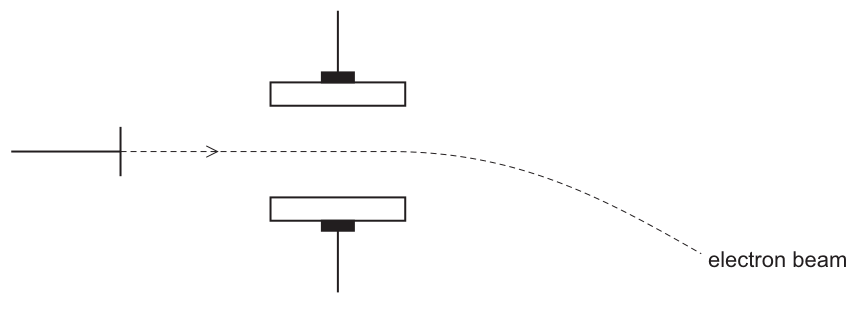
Answer
- Neutrons: Draw a straight horizontal line continuing directly through the gap between the plates (no deflection). Label it neutrons.
- Protons: Draw a curve deflecting upwards (towards the top, negative plate). Label it protons.
- The proton curve must clearly show less overall deflection (a wider radius of curvature) than the electron beam curve, reflecting the much greater mass of a proton compared to an electron.
See diagram annotations: neutrons travel straight, protons deflect upwards with less curvature than electrons.
Background Concept
When a beam of particles passes through an electric field, charged particles experience a force . This force causes acceleration . The trajectory of the particle curves towards the oppositely charged plate. Neutral particles () experience no force and travel in a straight line. The degree of deflection depends on the mass-to-charge ratio (): for the same magnitude of charge, a more massive particle will accelerate less and thus deflect less over the same distance.
Understanding the Question
The diagram shows an electron beam deflecting downwards, meaning the bottom plate is positive and the top plate is negative. We must add the paths of protons (positive, massive) and neutrons (neutral) to this field.
Approach
- Determine the deflection direction based on the particle's charge.
- Determine the relative curvature based on the particle's mass relative to the electron.
Step-by-Step Reasoning
- Neutrons: Have zero charge (). They experience no electrostatic force. Path: straight horizontal line through the slit, labelled neutrons.
- Protons: Have a positive charge (). They are attracted to the negative (top) plate. Path: curves upwards, labelled protons.
- Comparison with electrons: Both electrons and protons have the same magnitude of charge (), but a proton's mass is approximately 1836 times that of an electron. Therefore, the proton's acceleration is much smaller (). The proton's path must curve upwards but with a much larger radius of curvature (less deflection) than the electron's downward curve.
Key Takeaways
Neutral particles are unaffected by electric fields. Positive and negative particles deflect in opposite directions. For equal charges, lighter particles deflect more than heavier ones.
Common Mistakes
- Drawing the proton path deflecting downwards (forgetting opposite charges attract).
- Drawing the proton path with the same curvature as the electron (ignoring the mass difference).
- Forgetting to label the lines.
Things to Be Careful About
Ensure the labels are clear and the relative curvature difference is visually apparent. The proton line should not cross the electron line in a way that implies equal deflection.
The fifth to eighth ionisation energies of three elements in the third period of the Periodic Table are given. The symbols used for reference are not the actual symbols of the elements.
| fifth / | sixth / | seventh / | eighth / | |
|---|---|---|---|---|
| X | 6274 | 21269 | 25398 | 29855 |
| Y | 7012 | 8496 | 27107 | 31671 |
| Z | 6542 | 9362 | 11018 | 33606 |
State and explain the group number of element Y.
Answer
Group 6 (or Group 16 / VIA).
Explanation: There is a large jump (big difference) in ionisation energy between the 6th and 7th values. This indicates that the 7th electron is being removed from a new, inner principal quantum shell (closer to the nucleus), meaning there are 6 electrons in the outermost shell.
Group 6 (or 16); large jump between 6th and 7th IE indicates removal from an inner shell.
Background Concept
Successive ionisation energies increase gradually as electrons are removed from the same shell because the ion becomes more positively charged, increasing the attraction on the remaining electrons. However, a large jump in ionisation energy occurs when an electron is removed from a new, inner principal quantum shell (closer to the nucleus). The inner shell electrons experience a much stronger electrostatic attraction due to less shielding and a smaller distance from the nucleus.
Understanding the Question
We are given the 5th to 8th ionisation energies for elements X, Y, and Z. We must deduce the group number of element Y based on the pattern of these IEs.
Approach
Look for the largest relative increase (jump) between consecutive ionisation energy values. The position of the jump reveals how many valence electrons the element has.
Step-by-Step Reasoning
- For element Y, the IEs are: 7012, 8496, 27107, 31671.
- The jump from the 6th to the 7th IE is from 8496 to 27107 kJ mol, which is a massive increase (more than triple).
- This large jump indicates that the 7th electron is being removed from an inner shell. Therefore, the element has 6 electrons in its outermost shell.
- Elements with 6 outer electrons belong to Group 6 (or Group 16 / VIA) of the Periodic Table (e.g., sulfur).
Key Takeaways
The number of valence electrons equals the number of electrons removed before the first large jump in successive ionisation energies.
Common Mistakes
- Counting the total number of IEs given (4) instead of looking at the jump.
- Misinterpreting the jump: the jump is after the 6th IE, meaning 6 electrons were removed from the outer shell, not 7.
Things to Be Careful About
Ensure you state both the group number and the explanation (the large jump between 6th and 7th IE). "Group 6" and "Group 16" are both acceptable.
State and explain the general trend in first ionisation energies across the third period.
Answer
The first ionisation energy increases across the third period.
This is due to the increasing nuclear charge (atomic number / proton number) as protons are added to the nucleus. The shielding effect remains roughly constant (or similar) because electrons are added to the same outer principal energy level (shell). The increased attraction between the nucleus and the outermost electrons makes them harder to remove.
Increases across the period due to increasing nuclear charge with constant shielding.
Background Concept
First ionisation energy is the energy required to remove one mole of outermost electrons from one mole of gaseous atoms. Across a period, the general trend is an increase in first ionisation energy. This is governed by the balance between nuclear charge (which increases) and shielding (which remains relatively constant).
Understanding the Question
State the general trend in first ionisation energies across Period 3 and explain the underlying reasons.
Approach
- State the trend (increases).
- Explain using two factors: increasing nuclear charge and constant/constant-like shielding.
Step-by-Step Reasoning
- Trend: First ionisation energy generally increases from left to right across Period 3.
- Reason 1: The nuclear charge (number of protons) increases across the period (e.g., Na has 11, Mg has 12, etc.).
- Reason 2: The additional electrons are added to the same principal energy level (the 3rd shell). Inner shell electrons shield the outer electrons from the nucleus. Since the number of inner shells remains the same, the shielding effect is roughly constant (or similar).
- Conclusion: The increased nuclear charge exerts a stronger electrostatic attraction on the outermost electrons, requiring more energy to remove them.
Key Takeaways
The general trend across a period is driven by increasing nuclear charge with minimal increase in shielding.
Common Mistakes
- Saying "shielding increases" (it stays roughly constant across a period).
- Saying "atomic radius decreases" as the primary reason (while true, it's a consequence of the increased nuclear charge; the direct cause is the increased attraction).
Things to Be Careful About
Must mention both increasing nuclear charge AND constant/similar shielding. Mentioning only one will not earn full marks.
Explain why the first ionisation energy of element Y is less than that of element X.
Answer
Element Y has a pair of electrons in one of its 3p orbitals (it is in Group 6, e.g., sulfur), while element X has a half-filled 3p subshell (Group 5, e.g., phosphorus).
The electron pair repulsion between the two electrons in the same 3p orbital in Y makes it easier to remove one of them, resulting in a lower first ionisation energy compared to X.
Electron pair repulsion in the paired 3p orbital of Y lowers the energy required to remove an electron.
Background Concept
While the general trend across a period is an increase in first ionisation energy, there are slight dips or anomalies. A well-known anomaly occurs between Group 5 and Group 6 elements (e.g., phosphorus to sulfur, or nitrogen to oxygen). Group 5 elements have a half-filled p subshell (), which is relatively stable. Group 6 elements have a paired electron in one of the p orbitals (). The two electrons in the same orbital experience mutual electron-electron repulsion, making one of them easier to remove.
Understanding the Question
Explain why the first ionisation energy of element Y is less than that of element X. From part (c)(i), Y is in Group 6. Since they are in the same period and X has a higher IE, X must be in Group 5 (the anomaly is between Group 5 and 6).
Approach
Identify the electronic configurations of Group 5 and Group 6 elements in Period 3. Explain the effect of electron pairing in the p subshell.
Step-by-Step Reasoning
- From the data, Y is Group 6 (sulfur, ) and X is Group 5 (phosphorus, ).
- In element Y (sulfur), the 3p subshell contains a pair of electrons in one of the 3p orbitals ().
- In element X (phosphorus), the 3p subshell is half-filled (), with one electron in each orbital.
- The electron pair repulsion between the two electrons in the same orbital in Y reduces the effective nuclear attraction on that pair, making it easier to remove one electron.
- Therefore, the first ionisation energy of Y is less than that of X, despite Y having a higher nuclear charge.
Key Takeaways
Anomalies in ionisation energy trends can be explained by subshell stability (half-filled or fully filled) and electron-electron repulsion within orbitals.
Common Mistakes
- Failing to mention "electron pair repulsion" or "pair of electrons in the same orbital".
- Saying "Y has more electrons" without explaining the repulsion aspect.
- Confusing this with the drop from Group 2 to Group 13 (which is due to s vs p orbital penetration).
Things to Be Careful About
Be precise: specify that the pair is in a 3p orbital (or p orbital). "Electron repulsion" alone is not enough; it must be electron pair repulsion in the same orbital.
Complete the electronic configuration of element Z.
.................................................................................................................................
Answer
(Element Z is in Group 7, e.g., chlorine, with 7 outer electrons: . The large jump between 7th and 8th IE confirms this.)
1s^2 2s^2 2p^6 3s^2 3p^5
Background Concept
The electronic configuration describes the distribution of electrons in atomic orbitals. The Aufbau principle states that electrons fill lower-energy orbitals first: 1s, 2s, 2p, 3s, 3p, etc. For Period 3 elements, the outer shell is the 3rd shell ( and ).
Understanding the Question
Complete the electronic configuration of element Z, given the starting .
Approach
Determine the group of Z from the IE data, then write the full configuration up to the 8th electron.
Step-by-Step Reasoning
- Look at the IEs for Z: 6542, 9362, 11018, 33606.
- The large jump is between the 7th and 8th IE (11018 to 33606). This means Z has 7 outer electrons (Group 7 / Group 17 / VIIA).
- In Period 3, Group 7 is chlorine (), with atomic number 17.
- Total electrons = 17. Configuration: .
- The question provides , so the remainder is .
Key Takeaways
Ionisation energy jumps directly reveal the number of valence electrons, which allows you to write the full electronic configuration.
Common Mistakes
- Writing the configuration for the wrong element (e.g., if they misidentified the jump).
- Forgetting to include the electrons (only writing ).
Things to Be Careful About
Ensure the configuration is complete and correctly ordered. The question asks to complete , so write the rest: .
A sample of strontium exists as a mixture of four isotopes. Information about three of these isotopes is given in the table.
| mass number | 86 | 87 | 88 |
|---|---|---|---|
| abundance | 9.86% | 7.00% | 82.58% |
Calculate the abundance of the fourth isotope.
Working
The total abundance of all isotopes must equal 100%.
Answer
0.56%
0.56%
Background Concept
An element exists as a mixture of isotopes. The sum of the relative abundances (percentages) of all isotopes of an element must equal 100%. The relative atomic mass () is the weighted mean of the isotopic masses based on their relative abundances.
Understanding the Question
Given the abundances of three strontium isotopes (86, 87, 88), calculate the abundance of the fourth isotope.
Approach
Subtract the sum of the given abundances from 100%.
Step-by-Step Reasoning
- Given abundances: 9.86% (for mass 86), 7.00% (for mass 87), 82.58% (for mass 88).
- Sum of known abundances .
- Abundance of the fourth isotope .
Key Takeaways
Isotope abundances always sum to 100% (or 1 in fractional form).
Common Mistakes
- Forgetting to subtract from 100% correctly.
- Rounding errors in intermediate steps.
Things to Be Careful About
Maintain correct significant figures. The answer 0.56% has two decimal places, consistent with the given data.
The relative atomic mass of this sample of strontium is 87.71.
Calculate the mass number of the fourth isotope.
Working
The relative atomic mass () is the weighted mean of the isotopic masses:
Let be the mass number of the fourth isotope. Using the given :
Multiply both sides by 100:
Rounding to the nearest whole number (mass number):
Answer
84
84
Background Concept
The relative atomic mass () of an element is calculated as the weighted average of the masses of its naturally occurring isotopes, based on their relative abundances (usually as percentages). The formula is:
where is the mass of isotope and is its percentage abundance.
Understanding the Question
Given the relative atomic mass of strontium (87.71) and the masses and abundances of three isotopes, calculate the mass number () of the fourth isotope (abundance 0.56%).
Approach
- Set up the equation with the unknown mass .
- Substitute the known values.
- Solve for algebraically.
Step-by-Step Reasoning
- Equation:
- Calculate the known contributions:
- Sum of known contributions
- Substitute back:
- Rearrange:
- Solve for :
- Since mass number must be a whole number, .
Key Takeaways
The relative atomic mass equation can be rearranged to solve for an unknown isotopic mass or abundance. Mass numbers are integers.
Common Mistakes
- Forgetting to divide the sum by 100 (or multiply by 100 first).
- Arithmetic errors in calculating the weighted contributions.
- Not rounding the final answer to the nearest whole number (mass number is an integer).
Things to Be Careful About
Keep all intermediate values in the calculator to avoid rounding errors. The final mass number is always a whole number, so round 83.93 to 84.
The rest of this paper
4 more questions- Q2Chemical Periodicity · States of Matter7M
- Q3Group 2 · Atoms, Molecules and Stoichiometry · Chemical Energetics · Reaction Kinetics · States of Matter15M
- Q4Introduction to Organic Chemistry · Hydrocarbons7M
- Q5Halogen Compounds · Carboxylic Acids and Derivatives · Analytical Techniques · Hydrocarbons · Hydroxy Compounds · Introduction to Organic Chemistry15M