Chemistry 9701/22 — February/March 2016
Cambridge AS Level · AS Level Structured Questions · worked solutions for every part, with the mark scheme
Topics Chemical Bonding · Analytical Techniques · Carbonyl Compounds · Introduction to Organic Chemistry · Hydrocarbons · Atomic Structure · +8 more
This question is about Period 3 elements and their compounds.
Give an explanation for each of the following statements.
The atomic radius decreases across Period 3 (Na to Ar).
Answer
- The proton number (or nuclear charge) increases across the period, while the outer electrons occupy the same shell (so shielding is roughly constant).
- This results in a greater attractive force between the nucleus and the outer electrons, pulling them closer and decreasing the atomic radius.
Increasing nuclear charge with constant shielding increases the attractive force on the outer electrons, decreasing the radius.
Background Concept
Atomic radius is the distance from the nucleus to the outermost electrons. Across a period in the periodic table, electrons are added to the same principal energy level (shell). The inner electrons shield the outer electrons from the full positive charge of the nucleus.
Understanding the Question
The question asks to explain why atomic radius decreases from Na to Ar. We need to connect the increasing proton number to the effective nuclear charge experienced by the outer electrons.
Approach
State the two key facts: (1) nuclear charge increases, (2) shielding remains roughly constant because electrons are added to the same shell. Conclude that the increased effective nuclear charge pulls the outer electrons closer.
Step-by-Step Reasoning
- As we move from Na to Ar, protons are added to the nucleus, so the proton number (nuclear charge) increases.
- Electrons are added to the same outer shell (n=3). Inner electrons provide shielding, but since no new inner shells are added, the shielding effect remains roughly constant.
- The combination of higher nuclear charge and constant shielding means the effective nuclear charge (the net positive charge felt by outer electrons) increases.
- This stronger electrostatic attraction pulls the outer electron cloud closer to the nucleus, resulting in a smaller atomic radius.
Key Takeaways
Across a period, atomic radius decreases due to increasing nuclear charge with constant shielding.
Common Mistakes
- Saying "more electrons" without mentioning the shell or shielding. Just saying "more electrons" would incorrectly suggest a larger radius if shielding isn't considered.
- Forgetting to mention that electrons are in the same shell / shielding is constant.
Things to Be Careful About
- Use precise terms: "nuclear charge" or "proton number", "same shell" or "same principal quantum level", "shielding is roughly constant". Do not say "more protons attract more electrons" without the shielding context.
The first ionisation energy of sulfur is lower than that of phosphorus.
Answer
- In sulfur, the outer electron is removed from a fully occupied 3p orbital (or there are two electrons in the same 3p orbital).
- The electron-electron repulsion between these paired electrons reduces the energy required to remove one.
Electron-electron repulsion in the paired 3p electrons of sulfur lowers its first ionisation energy compared to phosphorus.
Background Concept
First ionisation energy is the energy required to remove one mole of electrons from one mole of gaseous atoms to form one mole of gaseous 1+ ions. Generally, IE increases across a period due to increasing nuclear charge. However, there are small drops at Group 13 (p-block starts) and Group 16 (paired p electrons).
Understanding the Question
Explain why S (Group 16) has a lower first IE than P (Group 15), despite having a higher nuclear charge.
Approach
Look at the electron configurations of P and S. P is [Ne] 3s² 3p³ (half-filled, one electron per p orbital). S is [Ne] 3s² 3p⁴ (one p orbital has a pair). The pairing causes repulsion.
Step-by-Step Reasoning
- Phosphorus has the electron configuration 1s² 2s² 2p⁶ 3s² 3p³. The three 3p electrons occupy separate orbitals (Hund's rule).
- Sulfur has the configuration 1s² 2s² 2p⁶ 3s² 3p⁴. One of the 3p orbitals contains a pair of electrons.
- The paired electrons in the same orbital in sulfur experience electron-electron repulsion.
- This repulsion makes it easier (requires less energy) to remove one of the paired electrons compared to removing an unpaired electron from phosphorus.
Key Takeaways
Paired electrons in the same orbital experience repulsion, lowering the ionisation energy. This causes the drop from Group 15 to 16.
Common Mistakes
- Saying "sulfur has more electrons" or "higher nuclear charge" without explaining the orbital pairing.
- Confusing this with the drop from Group 2 to 13 (which is due to s vs p orbital energy differences).
Things to Be Careful About
- Specify that the electron is removed from a full (3p) orbital or that there are two electrons in the same orbital. Mention "electron-electron repulsion".
Sodium is a better electrical conductor than phosphorus.
Answer
- Sodium has mobile (or free) electrons that are free to move throughout its metallic structure.
- Phosphorus exists as simple covalent (or molecular) molecules with no mobile charge carriers.
Sodium has delocalised electrons; phosphorus is simple molecular with no mobile charge carriers.
Background Concept
Electrical conductivity requires mobile charge carriers. In metals, these are delocalised electrons. In non-metals, conductivity depends on structure: giant covalent structures like graphite have delocalised electrons, but simple molecular substances do not.
Understanding the Question
Explain why sodium (a metal) conducts electricity better than phosphorus (a non-metal).
Approach
Describe the structure and bonding of both elements and link it to the presence (or absence) of mobile charge carriers.
Step-by-Step Reasoning
- Sodium is a metal with a giant metallic lattice. Its outer electrons are delocalised and free to move throughout the structure, allowing it to conduct electricity.
- Phosphorus (specifically white phosphorus, P₄) forms simple covalent molecules. The electrons are localised in bonds between atoms, and there are no mobile charge carriers in the solid or liquid state.
- Therefore, sodium conducts electricity well, while phosphorus does not.
Key Takeaways
Metals conduct due to delocalised electrons; simple molecular non-metals do not conduct because all electrons are localised.
Common Mistakes
- Saying "phosphorus has no electrons" or "phosphorus is an insulator" without explaining the structural reason.
- Forgetting to mention that sodium's electrons are mobile or delocalised.
Things to Be Careful About
- Use precise terminology: "mobile/free/delocalised electrons" for sodium, and "simple covalent/molecular" for phosphorus.
Magnesium is a better electrical conductor than sodium.
Answer
- Magnesium has two free (or delocalised) outer electrons per atom, compared to one for sodium.
- This gives magnesium a higher density of mobile charge carriers.
Magnesium has two delocalised electrons per atom vs one for sodium.
Background Concept
The electrical conductivity of a metal depends on the density of delocalised electrons. Group 2 metals have two outer electrons per atom available for delocalisation, compared to one for Group 1 metals.
Understanding the Question
Explain why magnesium is a better conductor than sodium.
Approach
Compare the number of delocalised electrons contributed by each atom to the metallic lattice.
Step-by-Step Reasoning
- Magnesium is in Group 2 and contributes two outer electrons per atom to the delocalised sea.
- Sodium is in Group 1 and contributes only one outer electron per atom.
- Therefore, magnesium has a higher concentration of mobile charge carriers, making it a better conductor.
Key Takeaways
Group 2 metals generally have higher conductivity than Group 1 metals due to more delocalised electrons per atom.
Common Mistakes
- Saying "magnesium has a stronger metallic bond" without linking it to conductivity (stronger bonds actually mean higher melting points, not necessarily higher conductivity, though both are true here).
Things to Be Careful About
- Specify "two electrons per atom" or "more delocalised electrons than sodium".
The flow chart below shows a series of reactions.
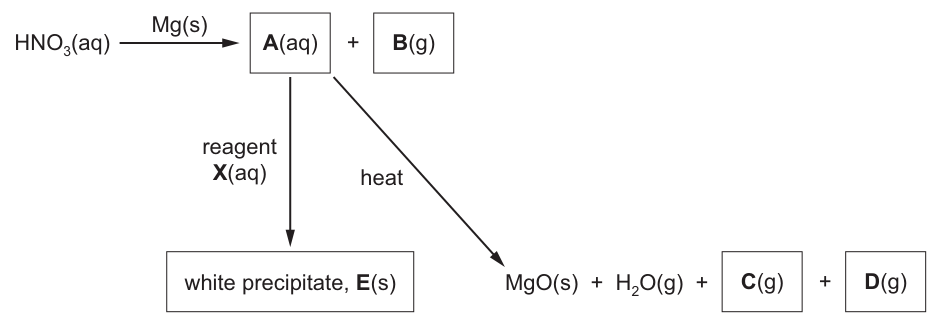
Give the formula of each of the compounds A to D.
A ............................................. B .............................................
C ............................................. D .............................................
Answer
- A:
- B:
- C: (or )
- D: (or )
Working
- Reaction 1:
- Dilute reacts with reactive metals like Mg to produce hydrogen gas () and the metal nitrate ().
- Reaction 2 (Thermal Decomposition):
- Group 2 nitrates decompose on heating to give the metal oxide, nitrogen dioxide, and oxygen. Thus, C and D are and (in either order).
A = Mg(NO3)2, B = H2, C = NO2 (or O2), D = O2 (or NO2)
Background Concept
Reactive metals (Group 1 and Group 2) react with dilute acids to produce a salt and hydrogen gas. Nitric acid is an oxidising acid, but with very reactive metals like Mg and Mn, dilute can still produce . Group 2 metal nitrates decompose on heating to give the metal oxide, , and .
Understanding the Question
Identify compounds A, B, C, and D in the flow chart. A is formed from Mg and dilute . B is a gas. A decomposes on heating to MgO, , and gases C and D.
Approach
- Determine the reaction of Mg with dilute . Since Mg is highly reactive, it displaces hydrogen, forming and .
- Identify A and B. A is , B is .
- Use the thermal decomposition of Group 2 nitrates to find C and D. The general equation is . The gases are and .
Step-by-Step Reasoning
- Step 1: reacts with dilute . The products are magnesium nitrate, , and hydrogen gas, . So A is and B is .
- Step 2: Heating causes thermal decomposition. Group 2 nitrates decompose to the oxide, nitrogen dioxide, and oxygen: . Note: the flow chart includes , which might imply a hydrated salt or a slight variation, but the key gases C and D are and .
- Step 3: Assign C and D as and (the order does not matter as they are interchangeable in the box).
Key Takeaways
Dilute with reactive metals gives . Group 2 nitrates decompose to oxide + + .
Common Mistakes
- Assuming always produces or with metals. With Mg and dilute acid, is produced.
- Forgetting that Group 2 nitrates produce as well as (Group 1 nitrates produce and nitrite, but Group 2 produce oxide, , ).
Things to Be Careful About
- Ensure state symbols match the flow chart (A is aq, B is g).
- C and D are interchangeable.
E reacts with dilute aqueous acid to produce a gas that turns limewater cloudy.
Suggest the identity of reagent X.
Answer
- Reagent X is a soluble carbonate, such as or , or ammonium carbonate .
Working
- A is . Reacting it with a carbonate produces a white precipitate of magnesium carbonate, (this is E).
- E () reacts with dilute acid to produce , which turns limewater cloudy.
- Therefore, X must provide carbonate ions ().
Any soluble Group I carbonate (e.g., Na2CO3) or ammonium carbonate.
Background Concept
Magnesium ions react with carbonate ions to form a white precipitate of magnesium carbonate, . Carbonates react with dilute acids to produce carbon dioxide gas, , which turns limewater (calcium hydroxide solution) cloudy due to the formation of insoluble calcium carbonate.
Understanding the Question
Reagent X reacts with to form a white precipitate E. E reacts with dilute acid to produce a gas that turns limewater cloudy. Identify X.
Approach
- Identify gas from E + acid: turns limewater cloudy . This means E is a carbonate.
- Identify E: white precipitate from and a carbonate is .
- Identify X: must be a soluble source of ions.
Step-by-Step Reasoning
- The gas that turns limewater cloudy is carbon dioxide (). This is produced when a carbonate reacts with an acid.
- Therefore, precipitate E must be a carbonate. Since A is , E is magnesium carbonate, .
- To form from , reagent X must supply carbonate ions ().
- X must be a soluble carbonate. Group 1 carbonates (like or ) and ammonium carbonate () are soluble and suitable.
Key Takeaways
White precipitate from metal ions + carbonate = metal carbonate. Metal carbonates + acid + limewater test.
Common Mistakes
- Suggesting or as X. These produce , which is a white precipitate, but it does not produce with acid (it just dissolves to give water).
- Forgetting that the carbonate must be soluble (e.g., suggesting as X, which is insoluble and won't react in aqueous solution to precipitate MgCO3 effectively in the same way, though technically it's about providing ions).
Things to Be Careful About
- The question asks for the "identity of reagent X". Giving a specific example like "sodium carbonate" or the general class "any Group I carbonate" is required. Just saying "carbonate" might be too vague, but "a soluble carbonate" is usually acceptable. The mark scheme accepts "any Group I carbonate OR ammonium carbonate".
The rest of this paper
4 more questions- Q2Atoms, Molecules and Stoichiometry · Electrochemistry10M
- Q3Chemical Bonding · Equilibria · Reaction Kinetics · Carbonyl Compounds17M
- Q4Introduction to Organic Chemistry · Hydrocarbons · Nitrogen and Sulfur · Chemical Bonding · Halogen Compounds11M
- Q5Hydrocarbons · Carbonyl Compounds · Introduction to Organic Chemistry · Analytical Techniques10M