Chemistry 9701/21 — May/June 2015
Cambridge AS Level · AS Level Structured Questions · worked solutions for every part, with the mark scheme
Topics States of Matter · Introduction to Organic Chemistry · Atomic Structure · Atoms, Molecules and Stoichiometry · Chemical Bonding · Chemical Periodicity · +5 more
Chemists recognise that atoms are made of three types of particle.
Complete the following table with their names and properties.
| name of particle | relative mass | relative charge |
|---|---|---|
| 0 | ||
The relative atomic mass of an element can be determined using data from its mass spectrum.
The mass spectrum of element X is shown, with the percentage abundance of each isotope labelled.
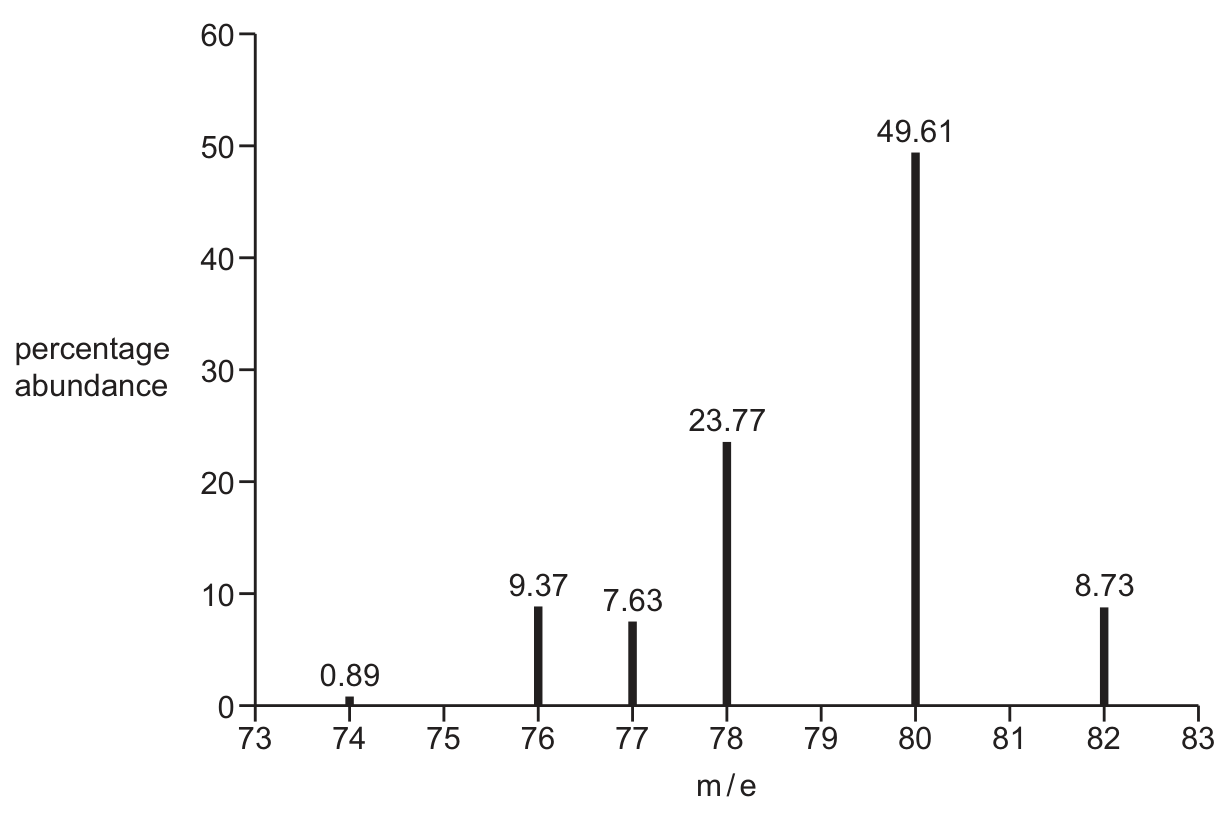
Define the terms relative atomic mass and isotope.
Use the data in the mass spectrum to calculate the relative atomic mass, , of X.
Give your answer to two decimal places and suggest the identity of X.
The element tellurium, Te, reacts with chlorine to form a single solid product, with a relative formula mass of 270. The product contains 52.6% chlorine by mass.
Calculate the molecular formula of this chloride.
This chloride melts at 224 °C and reacts vigorously with water.
State the type of bonding and structure present in this chloride and explain your reasoning.
Suggest an equation for the reaction of this chloride with water.
Sodium and silicon also react directly with chlorine to produce the chlorides shown.
| chloride | melting point / °C | difference between the electronegativities of the elements |
|---|---|---|
| 801 | 2.2 | |
| –69 | 1.3 |
Describe what you would see during the reaction between sodium and chlorine.
Explain the differences between the melting points of these two chlorides in terms of their structure and bonding. You should refer to the difference between the electronegativities of the elements in your answer.
The rest of this paper
3 more questions- Q2States of Matter · Nitrogen and Sulfur15M
- Q3Chemical Energetics · Introduction to Organic Chemistry · Carbonyl Compounds12M
- Q4Introduction to Organic Chemistry · Hydroxy Compounds13M