Chemistry 9701/13 — May/June 2015
Cambridge AS Level · Multiple Choice (AS Level) · answer key with instant marking and worked solutions
Topics Chemical Bonding · Halogen Compounds · Electrochemistry · Carboxylic Acids and Derivatives · Hydrocarbons · Group 17 · +12 more
Tap an option under each question to check it — your score builds as you go.
The diagram shows the Boltzmann energy distribution curve for molecules of a mixture of two gases at a given temperature. For a reaction to occur the molecules must collide together with sufficient energy.
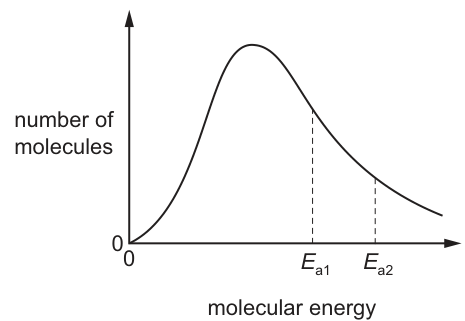
is used to represent the activation energy for the reaction between the gases. Of the two values shown, one is the activation energy for a catalysed reaction, the other for an uncatalysed reaction.
Which statement about is correct?
Options
A corresponds to a catalysed reaction with fewer effective collisions than the uncatalysed reaction.
B corresponds to an uncatalysed reaction with fewer effective collisions than the catalysed reaction.
C corresponds to a catalysed reaction with a greater number of effective collisions than the uncatalysed reaction.
D corresponds to an uncatalysed reaction with a greater number of effective collisions than the catalysed reaction.
The rest of this paper
39 more questions- Q2States of Matter1M
- Q3Chemical Energetics1M
- Q4Chemical Bonding1M
- Q5Electrochemistry1M
- Q6Chemical Bonding1M
- Q7Chemical Energetics1M
- Q8Reaction Kinetics · Carboxylic Acids and Derivatives1M
- Q9Group 17 · Electrochemistry1M
- Q10Atoms, Molecules and Stoichiometry1M
- Q11States of Matter1M
- Q12Chemical Periodicity1M
- Q13Group 21M
- Q14Chemical Bonding1M
- Q15Chemical Periodicity1M
- Q16Equilibria1M
- Q17Atomic Structure1M
- Q18Group 21M
- Q19Group 17 · Group 21M
- Q20Hydroxy Compounds1M
- Q21Chemical Bonding1M
- Q22Halogen Compounds · Introduction to Organic Chemistry1M
- Q23Carboxylic Acids and Derivatives1M
- Q24Carbonyl Compounds · Hydrocarbons1M
- Q25Hydroxy Compounds · Carboxylic Acids and Derivatives1M
- Q26Hydrocarbons · Halogen Compounds1M
- Q27Introduction to Organic Chemistry1M
- Q28Halogen Compounds1M
- Q29Halogen Compounds1M
- Q30Hydroxy Compounds · Carboxylic Acids and Derivatives1M
- Q31Atomic Structure1M
- Q32Chemical Bonding1M
- Q33Electrochemistry1M
- Q34Chemical Bonding1M
- Q35Nitrogen and Sulfur1M
- Q36Group 171M
- Q37Introduction to Organic Chemistry1M
- Q38Carbonyl Compounds1M
- Q39Electrochemistry · Hydrocarbons · Carbonyl Compounds1M
- Q40Halogen Compounds · Hydrocarbons1M