Chemistry 9701/23 — October/November 2014
Cambridge AS Level · AS Level Structured Questions · worked solutions for every part, with the mark scheme
Topics Chemical Bonding · Atoms, Molecules and Stoichiometry · Hydrocarbons · Atomic Structure · Group 17 · Electrochemistry · +6 more
Successive ionisation energies for the elements fluorine, F, to bromine, Br, are shown on the graph.
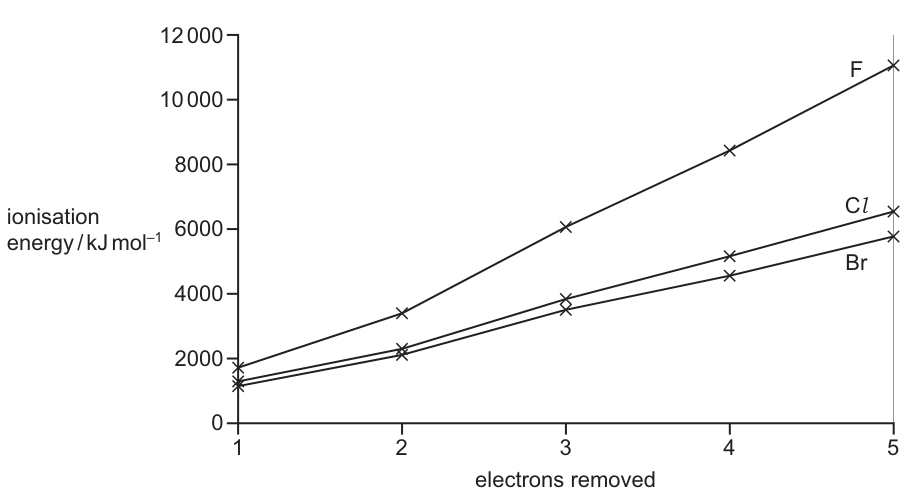
Explain why the first ionisation energies decrease down the group.
Answer
- The outer (highest-energy) electrons are further from the nucleus down the group.
- There is increased shielding (screening) by inner electron shells.
- These factors reduce the electrostatic attraction between the nucleus and the outer electron, so less energy is required to remove it.
Increasing distance of outer electrons from nucleus; increased shielding by inner shells; reduced attraction between nucleus and outer electron.
Background Concept
First ionisation energy is the energy required to remove one electron from each atom in one mole of gaseous atoms. Down a group, the number of electron shells increases, so the outer electrons occupy successively higher principal quantum levels. Two competing effects determine the net attraction felt by an outer electron: the nuclear charge increases (more protons), which would tend to pull electrons closer, but both the distance from the nucleus and the shielding by inner electrons increase. The shielding effect dominates, so the effective nuclear charge felt by the outer electron decreases, and less energy is needed to remove it.
Understanding the Question
The question asks you to explain why first ionisation energy decreases down Group VII (F, Cl, Br). You are given a graph showing the first ionisation energies and need to provide the physical reasoning. The command word is 'Explain', so each point must carry a cause-and-effect link.
Approach
Identify the structural changes down the group (more shells, greater distance, more shielding) and connect them to the force of attraction on the outer electron. Three distinct points are needed for three marks.
Step-by-Step Reasoning
Point 1 – Distance: Going from F to Cl to Br, each element has one more occupied shell than the one above. The outer electron is therefore further from the nucleus. By Coulomb's law, the electrostatic force of attraction decreases with the square of the distance, so the outer electron is held less tightly.
Point 2 – Shielding: The additional inner shells of electrons between the nucleus and the outer electron repel the outer electron, partially cancelling the nuclear charge. This is called shielding or screening. More inner shells means more shielding.
Point 3 – Net effect on attraction: The combination of greater distance and greater shielding reduces the effective nuclear charge experienced by the outer electron. The attraction is weaker, so less energy is needed to remove the electron — hence first ionisation energy decreases.
Key Takeaways
- Down a group, first ionisation energy decreases because distance and shielding outweigh the increase in nuclear charge.
- Always link structural features (shells, distance, shielding) to the physical consequence (attraction, energy needed).
Common Mistakes
- Saying only 'more shells' without connecting to distance or shielding explicitly.
- Attributing the decrease to 'more protons' — more protons would increase attraction; it is the shielding and distance that dominate.
- Confusing first ionisation energy with successive ionisation energies (part a(ii)).
Things to Be Careful About
- Use the term 'shielding' or 'screening' — 'protection' is not accepted.
- Specify that it is the outer or highest-energy electron being removed.
- State that the attraction is reduced (or weaker), not just 'less'.
Explain why there is an increase in the successive ionisation energies of fluorine.
Answer
- As electrons are removed successively, the ion becomes increasingly positive (effective nuclear charge on remaining electrons increases).
- The remaining electrons are attracted more strongly to the nucleus, so more energy is needed to remove each successive electron.
Increasing positive charge on the ion (higher effective nuclear charge per remaining electron) causes stronger attraction to the nucleus, requiring more energy for each successive removal.
Background Concept
Successive ionisation energies are the energies required to remove the first, second, third, etc. electrons from a gaseous atom or ion. After removing the first electron, the species becomes a positive ion (cation). Each subsequent electron is removed from an increasingly positively charged species, so the electrostatic attraction between the nucleus and the remaining electrons increases. This means each successive ionisation energy is greater than the previous one.
Understanding the Question
The graph shows that for fluorine, each successive ionisation energy is larger than the previous one (the curve rises steadily). You must explain why this happens. The key is that the number of protons stays the same but the number of electrons decreases, so the net positive charge increases.
Approach
Focus on what changes when an electron is removed: the ion becomes more positively charged, which means the remaining electrons feel a stronger pull from the nucleus.
Step-by-Step Reasoning
Point 1 – Increasing cation charge: After removing one electron from F, the species is F⁺. After removing a second, it is F²⁺, and so on. The number of protons (9) remains constant, but fewer electrons are present to 'share' the nuclear attraction. The effective nuclear charge per remaining electron increases.
Point 2 – Increased attraction: With a higher effective nuclear charge, the remaining electrons are held more tightly by the nucleus. Therefore, more energy is required to overcome this stronger attraction for each successive removal.
Key Takeaways
- Successive ionisation energies always increase for a given element because the ion becomes more positive.
- This is distinct from the down-group trend (part a(i)), where first ionisation energy decreases.
Common Mistakes
- Saying 'more protons are added' — the proton number does not change.
- Attributing the increase to 'electrons being closer to the nucleus' — while true for inner-shell electrons, the mark scheme focuses on the increasing positive charge.
- Confusing this with the large jumps between shells (which would indicate a new shell being entered).
Things to Be Careful About
- The mark scheme accepts 'increasing cation charge' or 'effective nuclear charge' or 'decreasing number of electrons compared with protons'.
- Must link to 'increased attraction' as a separate point.
Group VII is the only group in the Periodic Table containing elements in all three states of matter at room conditions.
State and explain, in terms of intermolecular forces, the trend in the boiling points of the elements down Group VII.
Answer
- The boiling point increases down Group VII.
- The number of electrons in each molecule increases down the group.
- This leads to stronger (more) van der Waals' forces (instantaneous dipole–induced dipole forces) between molecules.
- More energy is needed to overcome these stronger intermolecular forces, so the boiling point rises.
Boiling point increases down the group due to increasing number of electrons causing stronger van der Waals' forces, requiring more energy to overcome.
Background Concept
Group VII elements exist as diatomic molecules (Cl₂, Br₂, I₂). They are non-polar molecules, so the only intermolecular forces between them are van der Waals' forces (also called London dispersion forces or instantaneous dipole–induced dipole forces). These arise from temporary fluctuations in the electron distribution that create instantaneous dipoles, which induce dipoles in neighbouring molecules. The strength of these forces depends on the number of electrons (and the polarisability of the electron cloud): more electrons means larger, more easily distorted electron clouds, giving stronger van der Waals' forces.
Understanding the Question
You must state the trend (boiling point increases down the group) and explain it in terms of intermolecular forces. Four marks require four distinct points: the trend, the cause (more electrons), the consequence (stronger van der Waals' forces), and the link to boiling point (more energy needed).
Approach
Build the chain: more electrons → stronger van der Waals' forces → more energy to overcome → higher boiling point. State the direction of the trend first.
Step-by-Step Reasoning
Point 1 – Trend: Boiling point increases from Cl₂ (gas) to Br₂ (liquid) to I₂ (solid) at room conditions. This is why Group VII is unique in containing elements in all three states.
Point 2 – More electrons: Cl₂ has 34 electrons total, Br₂ has 70, I₂ has 106. The number of electrons increases down the group because the atoms are larger with more shells.
Point 3 – Stronger van der Waals' forces: More electrons means a larger, more polarisable electron cloud. The instantaneous dipoles are larger and more easily induced in neighbouring molecules, so the van der Waals' forces between molecules are stronger.
Point 4 – More energy needed: Boiling involves overcoming intermolecular forces (not breaking covalent bonds within the molecule). Stronger intermolecular forces require more thermal energy to overcome, hence a higher boiling point.
Key Takeaways
- Boiling point depends on intermolecular forces, not on covalent bond strength within the molecule.
- Van der Waals' forces increase with the number of electrons (and molecular size/polarisability).
- The state at room temperature (gas → liquid → solid) reflects the increasing strength of intermolecular forces.
Common Mistakes
- Saying 'more energy needed to break covalent bonds' — boiling does not break intramolecular covalent bonds.
- Saying 'stronger bonds down the group' without specifying intermolecular forces.
- Attributing the trend to 'increasing molecular mass' alone without linking to electrons and van der Waals' forces.
Things to Be Careful About
- The mark scheme accepts 'instantaneous dipole–induced dipole forces' as an alternative to 'van der Waals' forces'.
- Must mention 'electrons' specifically, not just 'size' or 'mass'.
- Must say 'more energy needed to overcome' the forces, not just 'stronger forces'.
Compounds containing different halogen atoms covalently bonded together are called interhalogen compounds.
One interhalogen compound can be prepared by the reaction between iodine and fluorine. This compound has and the percentage composition by mass: F, 42.8; I, 57.2.
Calculate the molecular formula of this interhalogen compound.
Working
Dividing by the smallest value:
Empirical formula = IF₅
Empirical formula mass = , which equals the given .
Therefore molecular formula = IF₅.
Answer
IF₅
IF₅
Background Concept
To determine a molecular formula from percentage composition and relative molecular mass, the standard procedure is: (1) convert each percentage to moles by dividing by the relative atomic mass, (2) find the simplest whole-number ratio by dividing all mole values by the smallest, giving the empirical formula, (3) compare the empirical formula mass with the given to determine the molecular formula. If they are equal, the empirical formula is the molecular formula.
Understanding the Question
You are told that an interhalogen compound (containing iodine and fluorine covalently bonded) has and is 42.8% fluorine and 57.2% iodine by mass. You must find the molecular formula.
Approach
Use the standard three-step method: moles from percentage composition, ratio, then check if EF = MF.
Step-by-Step Reasoning
Step 1 – Moles of each element:
Assume 100 g of compound. Then mass of F = 42.8 g and mass of I = 57.2 g.
Step 2 – Simplest ratio:
Divide both by the smaller value (0.450):
Empirical formula = IF₅.
Step 3 – Confirm molecular formula:
Empirical formula mass of IF₅ = .
This matches the given , so the molecular formula is the same as the empirical formula: IF₅.
Key Takeaways
- The three-step method (moles → ratio → compare with ) is universal for formula determination from percentage composition.
- Always check whether the empirical formula mass equals the given ; if not, multiply by the appropriate factor.
Common Mistakes
- Forgetting to divide by the smallest value to get the ratio.
- Not checking whether EF = MF (the mark scheme requires this as a separate point).
- Using the wrong values (F = 19, I = 127).
Things to Be Careful About
- The mark scheme awards separate marks for: (1) correct division by , (2) correct ratio giving IF₅, (3) confirmation that EF = MF or that IF₅ = 222.
- Show all three steps explicitly.
Another interhalogen compound has the formula ICl.
Draw a 'dot-and-cross' diagram of a molecule of this compound, showing outer shell electrons only. Explain whether or not you would expect this molecule to be polar.
Answer
The molecule is polar because the electronegativities of iodine and chlorine are different (Cl is more electronegative than I), so the bonding pair of electrons is attracted more towards the chlorine atom, creating a permanent dipole.
Answer
Polar — because the two atoms have different electronegativities, so the shared pair is unequally distributed.
Polar; the electronegativities of I and Cl differ, so the bonding pair is unequally shared, creating a dipole.
Background Concept
A dot-and-cross diagram shows the outer-shell (valence) electrons of atoms in a covalent molecule, using dots for one atom's electrons and crosses for the other's. A shared pair (one dot and one cross between the atoms) represents the covalent bond. Lone pairs are shown as non-bonding pairs on each atom. Bond polarity arises when two bonded atoms have different electronegativities: the shared pair is drawn closer to the more electronegative atom, creating a permanent dipole with partial charges ( and ).
Understanding the Question
You must draw the dot-and-cross diagram of ICl showing only outer-shell electrons, then state whether the molecule is polar and explain why. Both the diagram and the polarity explanation are marked.
Approach
For the diagram: I and Cl are both in Group VII, so each has 7 valence electrons. They share one pair to form a single covalent bond, leaving 3 lone pairs on each atom. For polarity: compare electronegativities of I and Cl.
Step-by-Step Reasoning
Dot-and-cross diagram:
- Chlorine has 7 valence electrons (shown as crosses): 6 in three lone pairs + 1 shared.
- Iodine has 7 valence electrons (shown as dots): 6 in three lone pairs + 1 shared.
- The shared pair (one dot + one cross) between the two atoms represents the single covalent bond.
- Each atom achieves an octet (8 electrons in its outer shell).
Polarity:
- Chlorine is more electronegative than iodine (electronegativity increases up Group VII).
- Therefore, the bonding pair of electrons is attracted more towards the Cl atom.
- This creates an unequal distribution of electron density, giving Cl a partial negative charge () and I a partial positive charge ().
- The molecule is therefore polar.
Key Takeaways
- In a dot-and-cross diagram, each atom's electrons are shown distinctly (dots vs crosses) to illustrate sharing.
- A molecule with a single bond between two different atoms is polar if the electronegativities differ.
- Electronegativity increases up a group, so Cl > I in electronegativity.
Common Mistakes
- Drawing too many or too few electrons (each atom must show exactly 7 valence electrons).
- Forgetting to show lone pairs.
- Saying the molecule is non-polar because it is diatomic — diatomic molecules with different atoms are polar.
- Not using different symbols (dots and crosses) for the two atoms' electrons.
Things to Be Careful About
- The diagram must show only outer-shell electrons (not inner shells).
- The explanation must mention electronegativity difference as the reason for polarity.
- State that the bonding pair is unequally shared / attracted more to Cl.
Some reactions involving chlorine and its compounds are shown in the reaction scheme below.
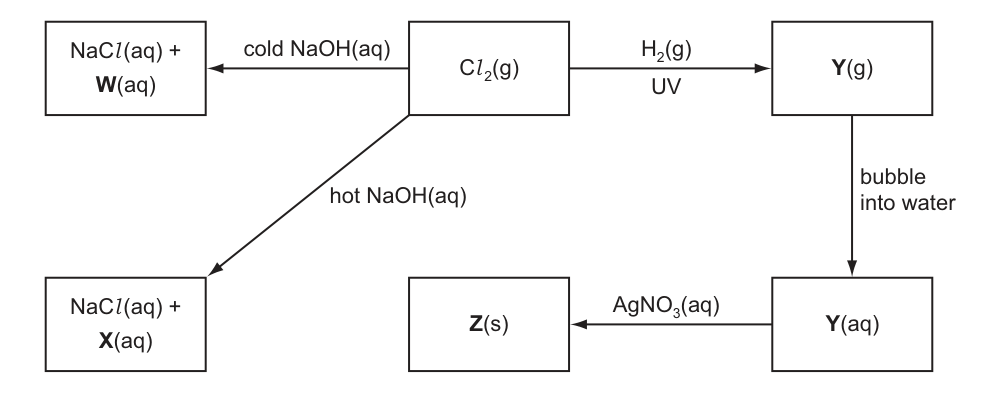
Give the formulae of W, X, Y and Z.
Answer
W = NaClO, X = NaClO₃, Y = HCl, Z = AgCl
Background Concept
Chlorine reacts with cold dilute NaOH to undergo disproportionation, forming sodium chloride (NaCl) and sodium chlorate(I) (NaClO, also called sodium hypochlorite). With hot concentrated NaOH, chlorine also disproportionates but forms sodium chloride and sodium chlorate(V) (NaClO₃). Chlorine reacts with hydrogen (ignited or in UV light) to form hydrogen chloride (HCl). When aqueous HCl (or any chloride ion solution) reacts with AgNO₃(aq), a white precipitate of silver chloride (AgCl) forms.
Understanding the Question
The reaction scheme shows Cl₂ reacting with cold NaOH to give NaCl + W, with hot NaOH to give NaCl + X, with H₂/UV to give Y(g), Y bubbled into water gives Y(aq), and Y(aq) + AgNO₃ gives Z(s). You must identify W, X, Y, and Z.
Approach
Work through each reaction in the scheme using knowledge of chlorine chemistry:
- Cl₂ + cold NaOH → NaCl + NaClO (disproportionation to chlorate(I))
- Cl₂ + hot NaOH → NaCl + NaClO₃ (disproportionation to chlorate(V))
- Cl₂ + H₂ (UV) → HCl
- HCl(aq) + AgNO₃(aq) → AgCl(s) + HNO₃(aq)
Step-by-Step Reasoning
W: Cold NaOH with Cl₂ gives NaCl + NaClO. Since NaCl is already shown, W = NaClO.
X: Hot NaOH with Cl₂ gives NaCl + NaClO₃. Since NaCl is already shown, X = NaClO₃.
Y: Cl₂ + H₂ in UV light gives HCl (hydrogen chloride gas). Y = HCl.
Z: HCl dissolved in water gives H⁺(aq) + Cl⁻(aq). Adding AgNO₃(aq) gives AgCl(s), a white precipitate. Z = AgCl.
Key Takeaways
- Cold vs hot alkali gives different disproportionation products of chlorine (chlorate(I) vs chlorate(V)).
- The oxidation state of Cl increases from 0 to +1 (cold) or 0 to +5 (hot) in the oxyanion.
- AgCl is the characteristic white precipitate of chloride ions with Ag⁺.
Common Mistakes
- Confusing W and X (NaClO vs NaClO₃).
- Writing Y as Cl₂ dissolved in water rather than HCl.
- Writing Z as AgClO₃ or another silver salt.
Things to Be Careful About
- Formulae must be correct: NaClO (not NaClO₂ or NaClO₃) for W.
- Y is HCl (the gas), which dissolves to give hydrochloric acid.
- Z is AgCl (the precipitate), not the full equation.
Write an equation for the reaction of chlorine with hot NaOH(aq).
Answer
3Cl₂ + 6NaOH → 5NaCl + NaClO₃ + 3H₂O
Background Concept
When chlorine reacts with hot concentrated sodium hydroxide, it undergoes disproportionation: chlorine is simultaneously oxidised and reduced. Some Cl atoms are reduced from oxidation state 0 to −1 (forming NaCl), while others are oxidised from 0 to +5 (forming NaClO₃). The balanced equation requires 3 Cl₂ molecules: 5 Cl atoms end up in NaCl (each gaining 1 electron) and 1 Cl atom ends up in NaClO₃ (losing 5 electrons), giving electron balance.
Understanding the Question
Write the balanced equation for the reaction of chlorine with hot NaOH(aq). The products are NaCl, NaClO₃, and H₂O. Two marks: correct species (M1) and balanced equation (A1).
Approach
Identify the products from the scheme (NaCl + X where X = NaClO₃), add water, then balance.
Step-by-Step Reasoning
Unbalanced skeleton:
Balancing:
- Cl: On the left, Cl₂ provides 2 Cl atoms. On the right, NaCl has 1 Cl and NaClO₃ has 1 Cl, total 2 Cl per Cl₂. But we need 5 NaCl for every 1 NaClO₃ to balance the redox (5 × 1 electron gained = 1 × 5 electrons lost). So we need 3 Cl₂ (giving 6 Cl atoms): 5 go to NaCl, 1 goes to NaClO₃.
- Na: 5 NaCl + 1 NaClO₃ = 6 Na, so 6 NaOH.
- H: 6 NaOH gives 6 H, so 3 H₂O.
- O: 6 NaOH gives 6 O; NaClO₃ has 3 O and 3 H₂O has 3 O, total 6 O. ✓
Balanced equation:
Key Takeaways
- Disproportionation equations can be balanced by tracking electron transfer: the ratio of reduced to oxidised product must conserve electrons.
- The 3:6:5:1:3 ratio is characteristic of the hot alkali reaction.
Common Mistakes
- Writing NaClO instead of NaClO₃ (that would be the cold alkali product).
- Forgetting water as a product.
- Incorrect balancing (e.g., 2Cl₂ + 4NaOH → 3NaCl + NaClO₃ + 2H₂O — this is actually also balanced but uses different coefficients; the mark scheme expects the simplest whole-number ratio as shown).
Things to Be Careful About
- State symbols are not required by the mark scheme for this part.
- The equation must be fully balanced — M1 for correct species, A1 for balancing.
State the oxidation numbers of chlorine at the start and at the end of the reaction in (ii).
Answer
Start: 0
End: −1 (in NaCl) and +5 (in NaClO₃)
0 to −1 and 0 to +5
Background Concept
Oxidation number is the charge an atom would carry if all bonds were treated as ionic. In the elemental form (Cl₂), the oxidation number is 0. In NaCl, Cl has oxidation number −1 (it is more electronegative than Na). In NaClO₃, the oxidation number of Cl is +5: Na is +1, each O is −2 (total −6 for three O), so Cl must be +5 to give a neutral compound: (+1) + Cl + 3(−2) = 0, giving Cl = +5.
Understanding the Question
State the oxidation numbers of chlorine at the start (in Cl₂) and at the end (in the products NaCl and NaClO₃) of the hot alkali reaction. Two marks: one for the −1 product, one for the +5 product.
Approach
Identify the oxidation state of Cl in each species: Cl₂ (element, 0), NaCl (−1), NaClO₃ (+5).
Step-by-Step Reasoning
Start: Cl₂ is the elemental form, so oxidation number = 0.
End in NaCl: Na is +1 (Group I), so Cl must be −1 for the compound to be neutral.
End in NaClO₃: Na is +1, O is −2 each (three O = −6 total). For neutrality: +1 + Cl + (−6) = 0, so Cl = +5.
This confirms disproportionation: Cl is both reduced (0 → −1) and oxidised (0 → +5).
Key Takeaways
- Disproportionation means the same element is both oxidised and reduced.
- Oxidation number in elemental form is always 0.
- In oxyanions, calculate Cl's oxidation number from the known charges of Na and O.
Common Mistakes
- Saying +1 for Cl in NaClO₃ (forgetting there are three oxygen atoms).
- Saying 0 to only −1 (missing the +5 product).
- Confusing oxidation number with charge on the ion.
Things to Be Careful About
- The mark scheme requires both endpoints: 0 to −1 (B1) and 0 to +5 (B1).
- Must state 'start' and 'end' clearly.
Write an ionic equation for the reaction of Y with AgNO₃(aq). Include state symbols.
Answer
Ag⁺(aq) + Cl⁻(aq) → AgCl(s)
Background Concept
When a halide ion solution is treated with aqueous silver nitrate, a silver halide precipitate forms. For chloride ions, the precipitate is white AgCl. The ionic equation shows only the species that actually change: Ag⁺ from AgNO₃ and Cl⁻ from the acid combine to form the insoluble solid AgCl. The spectator ions (Na⁺/H⁺ and NO₃⁻) are omitted.
Understanding the Question
Write the ionic equation for the reaction of Y (which is HCl, providing Cl⁻(aq)) with AgNO₃(aq). Include state symbols. One mark for the correct equation with states.
Approach
Identify the reacting ions: Ag⁺(aq) and Cl⁻(aq). The product is AgCl(s). Write the net ionic equation.
Step-by-Step Reasoning
- AgNO₃(aq) dissociates to give Ag⁺(aq) + NO₃⁻(aq).
- HCl(aq) dissociates to give H⁺(aq) + Cl⁻(aq).
- Ag⁺ and Cl⁻ combine to form the insoluble precipitate AgCl(s).
- NO₃⁻ and H⁺ are spectator ions and are omitted.
Key Takeaways
- The ionic equation for halide detection always has the form: Ag⁺(aq) + X⁻(aq) → AgX(s).
- State symbols are essential: (aq) for ions, (s) for the precipitate.
Common Mistakes
- Writing the full molecular equation instead of the ionic equation.
- Omitting state symbols.
- Writing AgCl(aq) instead of AgCl(s).
Things to Be Careful About
- The mark scheme requires state symbols to be included.
- Charges must be shown on the ions (Ag⁺, Cl⁻), not written as Ag+ or Cl-.
The rest of this paper
3 more questions- Q2Atoms, Molecules and Stoichiometry · Reaction Kinetics · Chemical Bonding · Equilibria18M
- Q3Hydrocarbons · Carbonyl Compounds · Introduction to Organic Chemistry10M
- Q4Hydrocarbons · Hydroxy Compounds · Halogen Compounds9M