Chemistry 9701/22 — October/November 2014
Cambridge AS Level · AS Level Structured Questions · worked solutions for every part, with the mark scheme
Topics Atoms, Molecules and Stoichiometry · Atomic Structure · Electrochemistry · Group 2 · Chemical Energetics · Nitrogen and Sulfur · +7 more
Successive ionisation energies for the elements magnesium to barium are given in the table.
| element | 1st ionisation energy / kJ mol⁻¹ | 2nd ionisation energy / kJ mol⁻¹ | 3rd ionisation energy / kJ mol⁻¹ |
|---|---|---|---|
| Mg | 736 | 1450 | 7740 |
| Ca | 590 | 1150 | 4940 |
| Sr | 548 | 1060 | 4120 |
| Ba | 502 | 966 | 3390 |
Explain why the first ionisation energies decrease down the group.
Explain why, for each element, there is a large increase between the 2nd and 3rd ionisation energies.
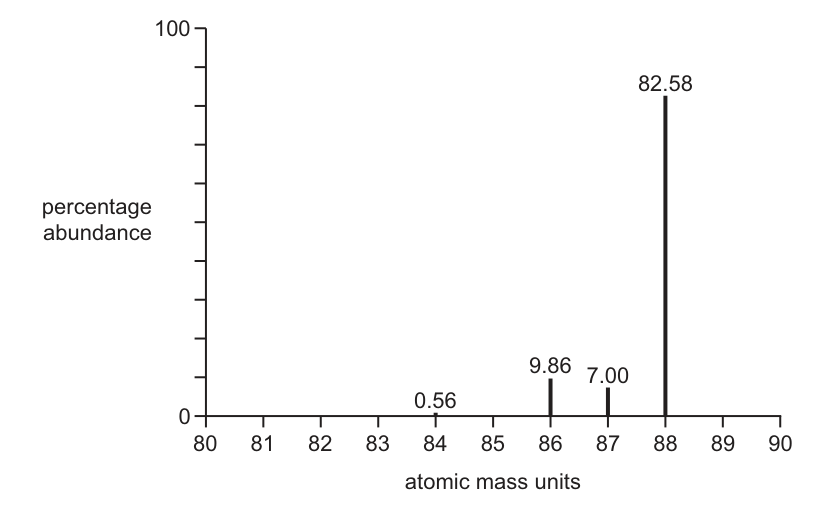
A sample of strontium, atomic number 38, gave the mass spectrum shown. The percentage abundances are given above each peak.
Complete the full electronic configuration of strontium.
1s² 2s² 2p⁶ ...................................................................................................................
Explain why there are four different peaks in the mass spectrum of strontium.
Calculate the atomic mass, , of this sample of strontium.
Give your answer to three significant figures.
= .............................
A compound of barium, A, is used in fireworks as an oxidising agent and to produce a green colour.
Explain, in terms of electron transfer, what is meant by the term oxidising agent.
A has the following percentage composition by mass: Ba, 45.1; Cl, 23.4; O, 31.5.
Calculate the empirical formula of A.
empirical formula of A = ...........................................
Some reactions involving magnesium and its compounds are shown in the reaction scheme below.
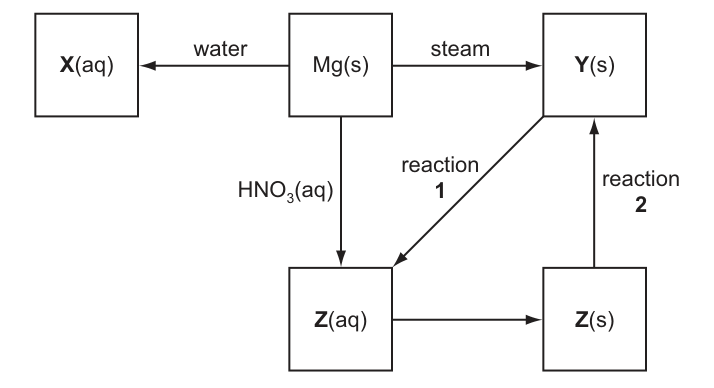
Give the formulae of the compounds X, Y and Z.
X .........................................................................................................................................
Y .........................................................................................................................................
Z .........................................................................................................................................
Name the reagent needed to convert Y(s) into Z(aq) in reaction 1 and write an equation for the reaction.
reagent ...............................................................................................................................
equation ..............................................................................................................................
How would you convert a sample of Z(s) into Y(s) in reaction 2?
Give equations for the conversions of Mg into X, and Z(s) into Y.
Mg to X ...............................................................................................................................
Z to Y ..................................................................................................................................
The rest of this paper
3 more questions- Q2Atoms, Molecules and Stoichiometry · Chemical Energetics · Nitrogen and Sulfur · Chemical Bonding · Equilibria · Reaction Kinetics19M
- Q3Introduction to Organic Chemistry · Carbonyl Compounds10M
- Q4Hydroxy Compounds · Carboxylic Acids and Derivatives10M