Chemistry 9701/21 — October/November 2014
Cambridge AS Level · AS Level Structured Questions · worked solutions for every part, with the mark scheme
Topics Atoms, Molecules and Stoichiometry · Atomic Structure · Analytical Techniques · Electrochemistry · Group 2 · Equilibria · +7 more
Successive ionisation energies for the elements magnesium to barium are given in the table.
| element | 1st ionisation energy / kJ mol⁻¹ | 2nd ionisation energy / kJ mol⁻¹ | 3rd ionisation energy / kJ mol⁻¹ |
|---|---|---|---|
| Mg | 736 | 1450 | 7740 |
| Ca | 590 | 1150 | 4940 |
| Sr | 548 | 1060 | 4120 |
| Ba | 502 | 966 | 3390 |
Explain why the first ionisation energies decrease down the group.
Answer
- The outer electrons are at an increasing distance from the nucleus.
- There is increased shielding (or screening) from the inner electron shells.
- This reduces the attraction between the nucleus and the outer electrons.
Increasing distance from nucleus, increased shielding from inner shells, reducing nuclear attraction.
Background Concept
Ionisation energy is the energy required to remove one mole of electrons from one mole of gaseous atoms to form one mole of gaseous 1+ ions. For the first ionisation energy, this involves removing the outermost electron. The magnitude of this energy depends on the electrostatic attraction between the positively charged nucleus and the negatively charged outer electron.
Understanding the Question
The question asks for an explanation of the trend in first ionisation energies down Group 2 (from Mg to Ba). The data shows a clear decrease: 736 kJ mol⁻¹ (Mg) down to 502 kJ mol⁻¹ (Ba). We need to explain this decrease in terms of atomic structure.
Approach
To explain a periodic trend, we look at the factors affecting the electrostatic attraction: the charge of the nucleus, the distance of the electron from the nucleus, and the shielding effect of inner electrons. We will trace how these factors change as we move down the group.
Step-by-Step Reasoning
- Distance: As you move down Group 2, each element has an additional principal quantum shell. The outer electron is therefore further away from the nucleus. Coulomb's law tells us that force of attraction decreases with distance.
- Shielding: The inner shells of electrons repel the outer electrons, shielding them from the full positive charge of the nucleus. As more inner shells are added down the group, the shielding effect increases.
- Attraction: Because the outer electron is further away and more shielded, the net attractive force holding it to the nucleus is weaker. Less energy is required to remove it, hence the ionisation energy decreases.
Key Takeaways
Down a group, ionisation energy decreases due to increased atomic radius (distance) and increased electron shielding, both of which reduce the effective nuclear attraction on the outermost electron.
Common Mistakes
- Saying "nuclear charge decreases". The nuclear charge (proton number) actually increases down the group; it is the effective nuclear charge felt by the outer electron that decreases due to shielding.
- Forgetting to mention shielding or distance; just saying "atoms get bigger" is not precise enough for full marks.
Things to Be Careful About
- Ensure you mention all three points: distance, shielding, and reduced attraction. Mark schemes are strict about these three components.
- Use precise terminology: "shielding" or "screening" from "inner shells", not just "electrons".
Explain why, for each element, there is a large increase between the 2nd and 3rd ionisation energies.
Answer
- The 3rd electron is removed from an inner (or lower energy level / closer to nucleus) shell.
- There is less shielding for this electron, leading to a (large) increase in nuclear attraction.
3rd electron is from an inner shell closer to the nucleus with less shielding, causing a large increase in attraction.
Background Concept
Successive ionisation energies are the energies required to remove electrons one by one from a gaseous atom or ion. removes the first electron, the second, and so on. A large jump in ionisation energy indicates that the electron is being removed from a shell closer to the nucleus, where the attraction is much stronger.
Understanding the Question
For each Group 2 element, the 3rd ionisation energy is much larger than the 2nd (e.g., for Mg: 1450 to 7740 kJ mol⁻¹). We need to explain why this large increase occurs.
Approach
Group 2 elements have two valence electrons in the outermost s-orbital. The first two electrons are removed from this outer shell. The third electron must come from the next inner shell, which is closer to the nucleus and has less shielding.
Step-by-Step Reasoning
- Electron configuration: Mg is . The 1st and 2nd electrons are removed from the 3s orbital (outer shell).
- Shell break: The 3rd electron is removed from the 2p orbital (inner shell / ).
- Explanation: Inner shell electrons are closer to the nucleus and experience less shielding from other inner electrons (in fact, they are the inner electrons shielding others). The electrostatic attraction between the nucleus and this inner electron is much stronger, requiring significantly more energy to remove.
Key Takeaways
A large jump in successive ionisation energies indicates the removal of an electron from a new, inner principal energy level closer to the nucleus.
Common Mistakes
- Saying the 3rd electron is "harder to remove because the ion is more positive". While true that is harder to ionise than , the large jump specifically indicates a change in shell. You must mention the inner shell / closer to nucleus aspect.
Things to Be Careful About
- The mark scheme accepts "inner shell", "lower energy level", "closer to nucleus", or "less shielding". Ensure you link this to the increased attraction.
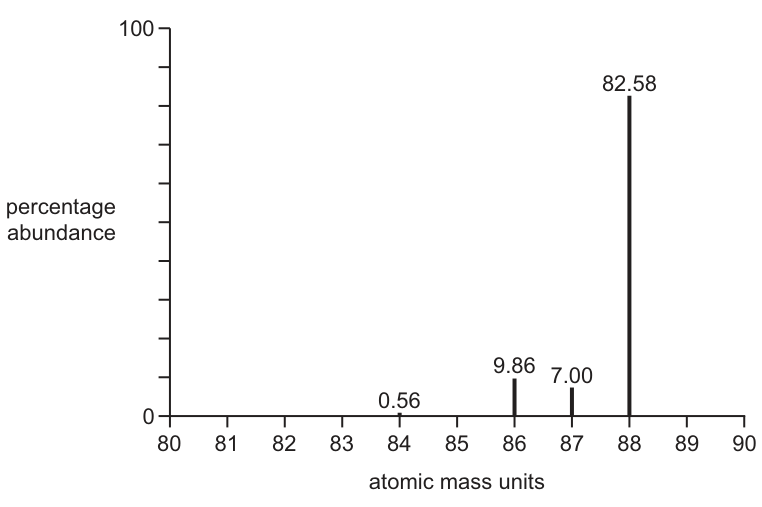
A sample of strontium, atomic number 38, gave the mass spectrum shown. The percentage abundances are given above each peak.
Complete the full electronic configuration of strontium.
1s² 2s² 2p⁶ ...................................................................................................................
Answer
3s² 3p⁶ 3d¹⁰ 4s² 4p⁶ 5s²
Background Concept
The electronic configuration describes the distribution of electrons in atomic orbitals. The order of filling is determined by the Aufbau principle: 1s, 2s, 2p, 3s, 3p, 4s, 3d, 4p, 5s, 4d, 5p, etc. Strontium (Sr) is in Group 2, Period 5, so it has 38 electrons and ends in .
Understanding the Question
We are given the start of the configuration: . We need to complete it for Sr (atomic number 38).
Approach
Count the electrons already given: . We need to add 28 more electrons. Follow the filling order: 3s(2), 3p(6), 4s(2), 3d(10), 4p(6), 5s(2). Total = . . Correct.
Step-by-Step Reasoning
- Remaining electrons: .
- Fill 3s: (2 electrons, 26 left)
- Fill 3p: (6 electrons, 20 left)
- Fill 4s: (2 electrons, 18 left)
- Fill 3d: (10 electrons, 8 left)
- Fill 4p: (6 electrons, 2 left)
- Fill 5s: (2 electrons, 0 left)
- Full configuration: .
Key Takeaways
Memorise the filling order or use the periodic table blocks (s, p, d, f) to determine configurations. For transition metals and post-transition metals like Sr, the d-block fills before the next s-block of the following period.
Common Mistakes
- Writing before in the final written configuration. While 4s fills before 3d, when writing the full configuration, it is conventional (and often required) to group by principal quantum number: . The mark scheme accepts the filling order order: .
Things to Be Careful About
- Ensure the total number of electrons sums to 38.
- Do not forget the subshell; it is easy to skip from to .
Explain why there are four different peaks in the mass spectrum of strontium.
Answer
- There are four isotopes of strontium present in the sample.
Four isotopes of strontium.
Background Concept
Isotopes are atoms of the same element with the same number of protons but different numbers of neutrons. They have different mass numbers. In a mass spectrum, each isotope appears as a peak at its respective mass-to-charge ratio (m/z). Since these are singly charged ions (), the m/z value equals the mass number.
Understanding the Question
The mass spectrum shows four peaks at m/z = 84, 86, 87, and 88. We need to explain why there are four peaks.
Approach
Each peak corresponds to a different isotope of the element. Since there are four peaks, there are four isotopes.
Step-by-Step Reasoning
- The mass spectrum displays the relative abundances of ions with different mass-to-charge ratios.
- For singly charged ions (), the m/z value is the mass number of the isotope.
- The peaks at 84, 86, 87, and 88 correspond to four different isotopes of strontium (, , , ).
- Therefore, the presence of four peaks indicates four isotopes.
Key Takeaways
Each peak in a mass spectrum (for singly charged ions) represents a distinct isotope of the element.
Common Mistakes
- Saying "four different elements". It's the same element (strontium), so different isotopes.
- Not mentioning "isotopes". Just saying "different masses" is not precise enough.
Things to Be Careful About
- The mark scheme says "four isotopes owtte" (or words to that effect). Be precise.
Calculate the atomic mass, , of this sample of strontium.
Give your answer to three significant figures.
Working
Answer
(to 3 significant figures)
87.7
Background Concept
The relative atomic mass () is the weighted average mass of an atom of an element relative to 1/12th the mass of a atom. It is calculated from the mass numbers and percentage abundances of its isotopes:
Understanding the Question
We are given the mass spectrum data for Sr: m/z 84 (0.56%), 86 (9.86%), 87 (7.00%), 88 (82.58%). We need to calculate to 3 significant figures.
Approach
Multiply each mass number by its percentage abundance, sum them up, and divide by 100. Round the final answer to 3 significant figures.
Step-by-Step Reasoning
- Contribution from :
- Contribution from :
- Contribution from :
- Contribution from :
- Sum:
- Divide by 100:
- Round to 3 sig figs:
Key Takeaways
Always divide by 100 when using percentage abundances. Pay attention to significant figure requirements in the question.
Common Mistakes
- Forgetting to divide by 100.
- Rounding too early in the calculation.
- Giving the answer to the wrong number of significant figures (the question asks for 3).
Things to Be Careful About
- The mark scheme explicitly states "must be 3 sig figs". would be wrong. is correct.
A compound of barium, A, is used in fireworks as an oxidising agent and to produce a green colour.
Explain, in terms of electron transfer, what is meant by the term oxidising agent.
Answer
- An oxidising agent is a species that gains (or takes) electrons.
A species that gains electrons.
Background Concept
In redox reactions, oxidation is the loss of electrons, and reduction is the gain of electrons. The substance that causes oxidation (by taking electrons from another substance) is the oxidising agent. It is itself reduced.
Understanding the Question
We need to define "oxidising agent" specifically in terms of electron transfer.
Approach
State that it gains or accepts electrons.
Step-by-Step Reasoning
- An oxidising agent accepts electrons from another species.
- By gaining electrons, the oxidising agent is reduced.
- Example: In , is the oxidising agent because it gains 2 electrons.
Key Takeaways
Oxidising agent = electron acceptor. Reducing agent = electron donor.
Common Mistakes
- Saying "gains oxygen". While historically true, the question asks for electron transfer.
- Saying "takes electrons from the other substance". This is fine, but "gains electrons" is more direct and standard.
Things to Be Careful About
- The mark scheme looks for "gains/takes electron(s)". Be precise.
A has the following percentage composition by mass: Ba, 45.1; Cl, 23.4; O, 31.5.
Calculate the empirical formula of A.
empirical formula of A ...........................................
Working
Moles of each element (assume 100 g sample):
Simplest ratio (divide by smallest, 0.329):
Empirical formula:
Answer
(or )
BaCl2O6
Background Concept
The empirical formula is the simplest whole-number ratio of atoms of each element in a compound. To find it from percentage composition, assume a 100 g sample so percentages become masses in grams. Convert masses to moles using relative atomic masses (), then find the simplest ratio by dividing by the smallest number of moles.
Understanding the Question
Compound A contains Ba (45.1%), Cl (23.4%), O (31.5%). Calculate the empirical formula.
Approach
- Convert % to mass (assume 100g).
- Convert mass to moles ().
- Divide all mole values by the smallest mole value.
- Write the formula.
Step-by-Step Reasoning
-
Moles:
- , , .
- mol
- mol
- mol
-
Ratio:
- Smallest is .
- Ba:
- Cl:
- O:
-
Formula: . This can also be written as (barium chlorate), which makes chemical sense as an oxidising agent in fireworks.
Key Takeaways
Always check if the empirical formula can be written as a recognizable compound (e.g., is barium chlorate). The mark scheme accepts .
Common Mistakes
- Using wrong values (e.g., Cl=35.5, not 35).
- Rounding errors in the ratio step (5.98 is close enough to 6, don't try to multiply by 2 to get 12 unless it's 5.5).
- Forgetting to divide by the smallest number of moles.
Things to Be Careful About
- The mark scheme gives the ratio as 1.00 : 2.00 : 5.98/6. Ensure your working shows the division clearly.
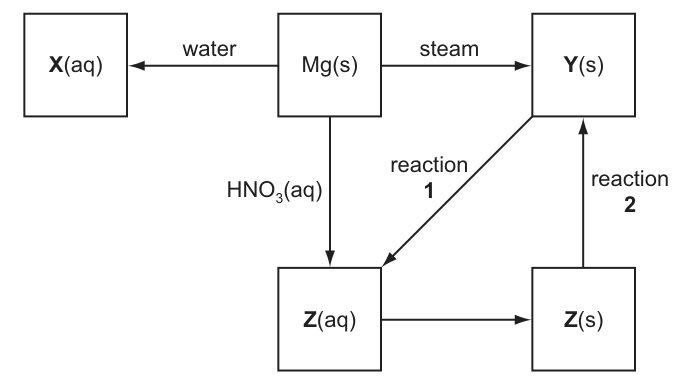
Some reactions involving magnesium and its compounds are shown in the reaction scheme below.
Give the formulae of the compounds X, Y and Z.
X .........................................................................................................................................
Y .........................................................................................................................................
Z .........................................................................................................................................
Answer
- X:
- Y:
- Z:
X = Mg(OH)2, Y = MgO, Z = Mg(NO3)2
Background Concept
Magnesium reacts differently with water and steam. With cold water, it reacts very slowly to form magnesium hydroxide and hydrogen. With steam, it reacts more vigorously to form magnesium oxide and hydrogen. Magnesium reacts with dilute acids (like nitric acid) to form the corresponding salt and hydrogen.
Understanding the Question
We have a reaction scheme:
- Mg + water -> X(aq)
- Mg + steam -> Y(s)
- Mg + HNO3(aq) -> Z(aq)
- Z(aq) -> Z(s) (evaporation/crystallisation)
- Y(s) + reagent -> Z(aq) (reaction 1)
- Z(s) -> Y(s) (reaction 2)
We need to identify X, Y, Z.
Approach
Use the known reactions of Mg to deduce the products.
Step-by-Step Reasoning
- Mg + water: . X is aqueous, but Mg(OH)2 is sparingly soluble, so it forms a suspension/solution. X = .
- Mg + steam: . Y is solid. Y = .
- Mg + HNO3: . Z is aqueous. Z = .
- Check consistency: Y (MgO) + acid -> Z (Mg(NO3)2). Yes, MgO + 2HNO3 -> Mg(NO3)2 + H2O. Z(s) (Mg(NO3)2) heated -> Y (MgO). Yes, thermal decomposition of magnesium nitrate gives MgO, NO2, O2.
Key Takeaways
Group 2 metals react with cold water to form hydroxides, with steam to form oxides, and with acids to form salts.
Common Mistakes
- Confusing the products of Mg with cold water vs steam. Cold water -> hydroxide; steam -> oxide.
- Writing wrong formulas for nitrate ( not ).
Things to Be Careful About
- State symbols in the question help: X(aq), Y(s), Z(aq). Mg(OH)2 is slightly soluble, so (aq) is acceptable in this context (or suspension). MgO is definitely (s). Mg(NO3)2 is soluble, so (aq).
Name the reagent needed to convert Y(s) into Z(aq) in reaction 1 and write an equation for the reaction.
reagent ...............................................................................................................................
equation ..............................................................................................................................
Answer
- Reagent: Nitric acid ()
- Equation:
Reagent: Nitric acid; Equation: MgO + 2HNO3 -> Mg(NO3)2 + H2O
Background Concept
Metal oxides are basic. They react with acids to form a salt and water. This is a neutralisation reaction.
Understanding the Question
Reaction 1 converts Y(s) () into Z(aq) (). We need the reagent and the equation.
Approach
To convert MgO to Mg(NO3)2, we need an acid that provides nitrate ions. That is nitric acid (). Then write the balanced equation for MgO + HNO3.
Step-by-Step Reasoning
- Reagent: Nitric acid ((aq)).
- Equation: .
- Balance: 1 Mg, 1 O (from oxide) + 2 H, 2 NO3 on left. Right: 1 Mg, 2 NO3, 2 H, 1 O. Balanced.
Key Takeaways
Basic oxides react with acids to form salt + water. Choose the acid that matches the anion of the desired salt.
Common Mistakes
- Writing the wrong acid (e.g., HCl would give MgCl2, not Mg(NO3)2).
- Unbalanced equation (forgetting the 2 in front of HNO3).
- Missing state symbols if required (mark scheme doesn't explicitly demand them here, but good practice).
Things to Be Careful About
- The mark scheme asks for "reagent" and "equation". Give both clearly.
How would you convert a sample of Z(s) into Y(s) in reaction 2?
Answer
- Heat the solid (thermal decomposition).
Heat / thermal decomposition
Background Concept
Group 2 nitrates decompose on heating to give the metal oxide, nitrogen dioxide, and oxygen. This is a thermal decomposition reaction.
Understanding the Question
Reaction 2 converts Z(s) () into Y(s) (). How do we do this?
Approach
Thermal decomposition. Heat the solid nitrate.
Step-by-Step Reasoning
- Magnesium nitrate decomposes on strong heating: .
- The method is simply to heat or strongly heat the solid.
Key Takeaways
Group 2 nitrates -> oxides + NO2 + O2 upon heating.
Common Mistakes
- Saying "burn" or "combust". Thermal decomposition is the correct term.
- Not specifying "heat" or "strongly heat".
Things to Be Careful About
- The mark scheme accepts "Heat" or "thermal decomposition". Be concise.
Give equations for the conversions of Mg into X, and Z(s) into Y.
Mg to X ...............................................................................................................................
Z to Y ..............................................................................................................................
Answer
- Mg to X:
- Z to Y:
Mg + 2H2O -> Mg(OH)2 + H2; 2Mg(NO3)2 -> 2MgO + 4NO2 + O2
Background Concept
We need two equations:
- Reaction of Mg with water to form Mg(OH)2 (compound X).
- Thermal decomposition of Mg(NO3)2 (compound Z) to form MgO (compound Y).
Understanding the Question
Write balanced symbol equations for these two conversions.
Approach
Recall the specific reactions.
Step-by-Step Reasoning
-
Mg to X ():
- Mg reacts with water (steam or hot water gives oxide, cold water gives hydroxide slowly, but the scheme says water -> X(aq), so hydroxide).
- Equation: .
- Note: With cold water, the reaction is very slow, but the product is Mg(OH)2 and H2.
-
Z () to Y ():
- Thermal decomposition of magnesium nitrate.
- Group 2 nitrates decompose to oxide + NO2 + O2.
- Equation: .
- Balance check: Left: 2 Mg, 4 N, 12 O. Right: 2 Mg, 2 O + 4 N, 8 O + 2 O = 2 Mg, 4 N, 12 O. Balanced.
Key Takeaways
- Mg + water -> Mg(OH)2 + H2 (slow with cold water, fast with steam -> MgO).
- Group 2 nitrates (except Li) decompose to oxide + NO2 + O2.
Common Mistakes
- Writing the thermal decomposition of nitrate as giving NO instead of NO2. Group 2 nitrates give NO2.
- Unbalanced equations (especially the nitrate decomposition, need 2, 2, 4, 1).
- Forgetting state symbols if the mark scheme requires them (the provided mark scheme doesn't explicitly show them in the equation line, but it's good practice. The mark scheme text: "" and "").
Things to Be Careful About
- Ensure the nitrate decomposition equation is balanced correctly: .
The rest of this paper
3 more questions- Q2Atoms, Molecules and Stoichiometry · Equilibria · Chemical Bonding · Reaction Kinetics19M
- Q3Introduction to Organic Chemistry · Hydrocarbons · Carbonyl Compounds10M
- Q4Carboxylic Acids and Derivatives · Hydroxy Compounds10M